The Skeletal
System
Structure, Function, and Diseases
Functions
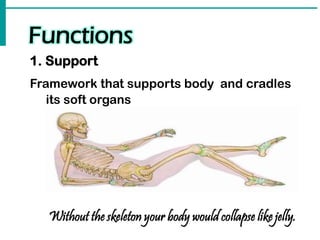
1. Support
Framework that supports body and cradles
its soft organs
Without the skeleton your body would collapse like jelly.
Functions
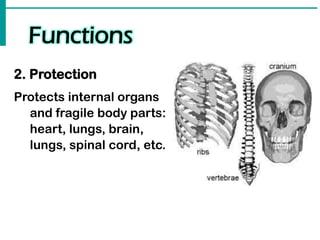
2. Protection
Protects internal organs
and fragile body parts:
heart, lungs, brain,
lungs, spinal cord, etc.
Functions
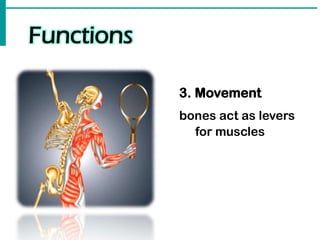
3. Movement
bones act as levers
for muscles
Functions
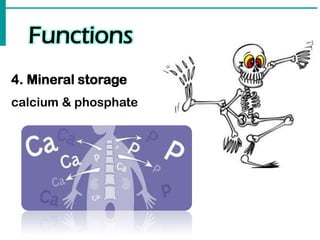
4. Mineral storage
calcium & phosphate
Functions
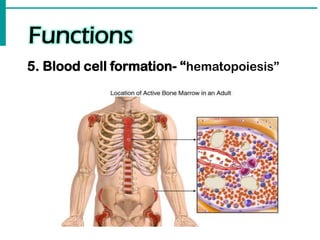
5. Blood cell formation- “hematopoiesis”
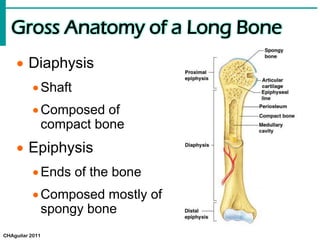
 Diaphysis
Shaft
Composed of
compact bone
 Epiphysis
Ends of the bone
Composed mostly of
spongy bone
Gross Anatomy of a Long Bone
CHAguilar 2011
Types of Bone Cells
 Osteocytes
 Mature bone cells
 Osteoblasts
 Bone-forming cells
 Osteoclasts
 Bone-destroying cells
 Break down bone matrix for remodeling and
release of calcium
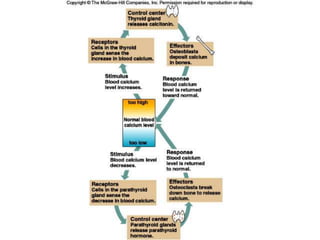
 Bone remodeling is a process by both
osteoblasts and osteoclasts
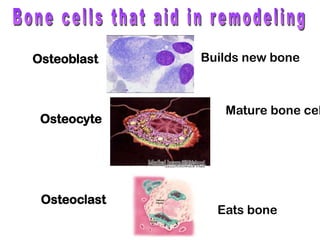
Osteoblast
Osteocyte
Osteoclast
Eats bone
Builds new bone
Mature bone cel
Changes in the Human Skeleton
 In embryos, the skeleton is primarily hyaline
cartilage
 During development, much of this cartilage
is replaced by bone
 Cartilage remains in isolated areas
 Bridge of the nose
 Parts of ribs
 Joints
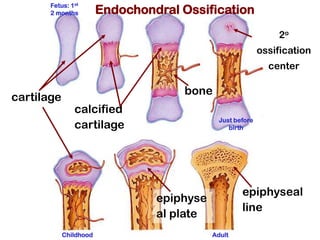
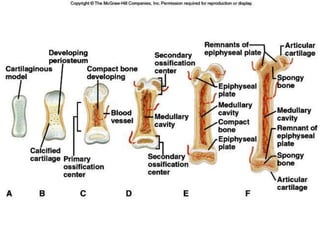
I. ENDOCHONDRAL OSSIFICATION- cartilage
to bone
a. Circumference
- deposition of osteoblasts beneath periosteum
forming new bone on the surface and
increasing girth
- osteoclasts dissolve bony tissue in interior to
give way to marrow cavity
b. Length- 4 regions in epiphyseal plate ( between
epiphysis and diaphysis)
1. “resting” cartilage cells
2. zone of proliferation
3. zone of hypertrophy
4. zone of calcification
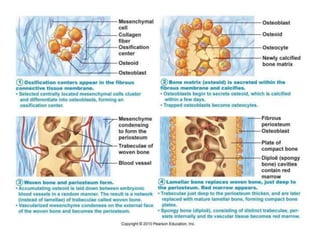
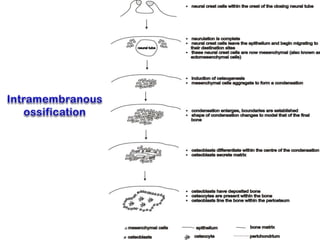
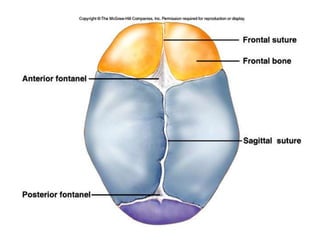
II. INTRAMEMBRANOUS OSSIFICATION
•Membranous tissue to bone
•In flat bones of the skull
•Done through appositional growth ( addition on
sides of osseous tissue)
•Cannot grow by interior expansion
BONE GROWTH AND RESORPTION
•Childhood- faster ossification, slower resorption=
inc in size of the bone
•Adulthood- ossification=resorption-constant size
•Late adulthood(35-40 onwards)- faster
resorption, slower ossification- osteoporosis in
older women
cartilage
calcified
cartilage
bone
epiphyse
al plate
epiphyseal
line
Endochondral Ossification
2o
ossification
center
Fetus: 1st
2 months
AdultChildhood
Just before
birth
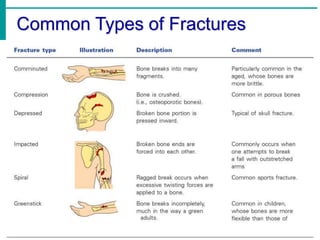
Bone Fractures
Copyright © 2003 Pearson Education, Inc. publishing as Benjamin Cummings
 A break in a bone
 Types of bone fractures
 Closed (simple) fracture – break that does not
penetrate the skin
 Open (compound) fracture – broken bone
penetrates through the skin
 Bone fractures are treated by reduction
and immobilization
 Realignment of the bone
Common Types of Fractures
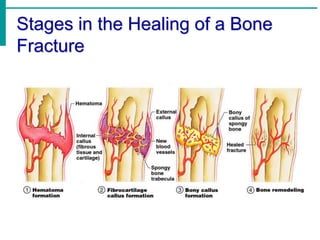
Stages in the Healing of a Bone
Fracture
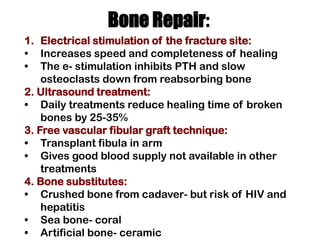
Bone Repair:
1. Electrical stimulation of the fracture site:
• Increases speed and completeness of healing
• The e- stimulation inhibits PTH and slow
osteoclasts down from reabsorbing bone
2. Ultrasound treatment:
• Daily treatments reduce healing time of broken
bones by 25-35%
3. Free vascular fibular graft technique:
• Transplant fibula in arm
• Gives good blood supply not available in other
treatments
4. Bone substitutes:
• Crushed bone from cadaver- but risk of HIV and
hepatitis
• Sea bone- coral
• Artificial bone- ceramic
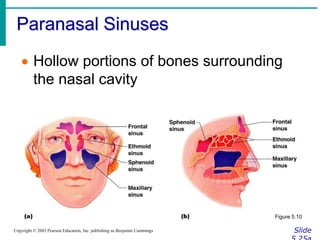
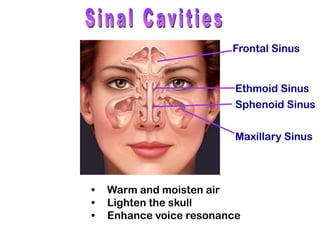
Paranasal Sinuses
SlideCopyright © 2003 Pearson Education, Inc. publishing as Benjamin Cummings
 Hollow portions of bones surrounding
the nasal cavity
Figure 5.10
• Warm and moisten air
• Lighten the skull
• Enhance voice resonance
Frontal Sinus
Ethmoid Sinus
Sphenoid Sinus
Maxillary Sinus
EFFECTS OF HORMONES ON BONES
1. Growth hormone
• hyposecretion/removal of pituitary gland
- results in premature cessation of transformation of
chondrocytes to bones in epiphysis
• Hypersecretion- giantism/acromegaly
2. Parathormone- overactivity
- bones become unduly fragile and fracture
spontaneously and cysts form ( osteitis fibrosa cystica)
3.Thyroxine- deficiency in young- delayed/inc ossification=
softer bones
4. estrogen- stimulate osteoblastic activity
-def during post-menopausal stage- osteoporosis
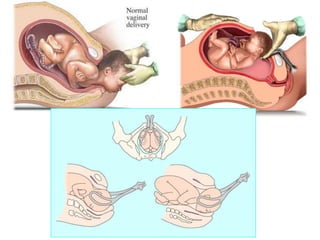
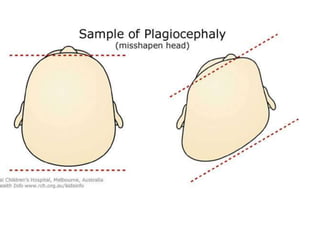
Head shape and delivery method
•Method of delivery determined thru diameter of
female pelvis and size of fetal skull
•Small pelvic measurements- cesarean operation
no molding( different shape of head)
•Average pelvic measurements-natural delivery
head is molded during its passage through
birth canal
•Instrumental delivery- placing forceps on head
and pulling
very delicate job and could cause damage to
motor cortex of brain – spastic child
Diseases and Conditions
of the Skeletal System
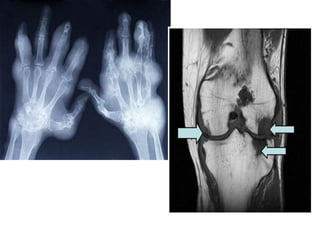
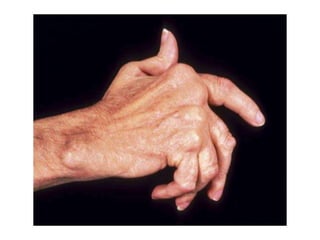
Arthritis
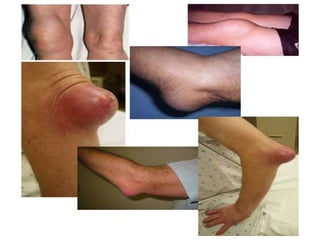
Bursitis
• Inflammation of the Bursa (fluid
filled sac surrounding the joint).
• bursa can become inflamed from
injury, infection or due to an
underlying rheumatic condition.
• typically identified by localized pain
or swelling, tenderness, and pain
with motion of the tissues in the
affected area.
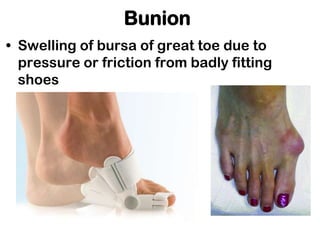
Bunion
• Swelling of bursa of great toe due to
pressure or friction from badly fitting
shoes
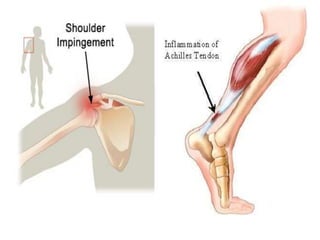
Tendonitis
• literally means inflammation of
the tendon
• If normal smooth gliding motion
of tendon is impaired, the
tendon will become inflamed
and movement will become
painful.
• The most common cause of
tendonitis is overuse.
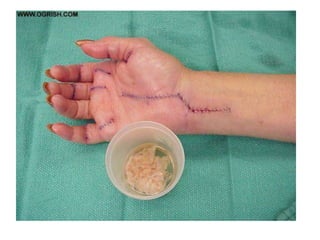
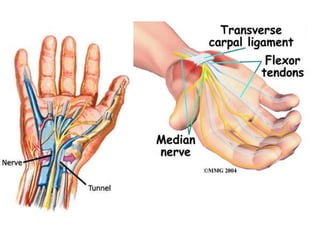
Carpal Tunnel Syndrome
• Due to any condition that causes
swelling or a change in position of
the tissue within the carpal tunnel
• can squeeze and irritate the median
nerve.
• This causes tingling and numbness
of the thumb, index, and the middle
fingers, a condition known as
"carpal tunnel syndrome."
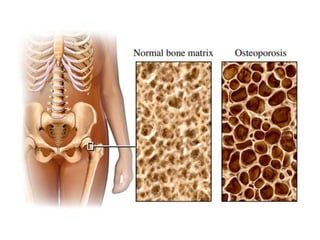
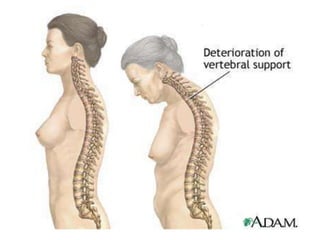
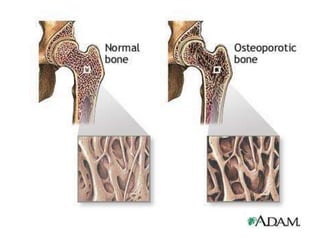
Osteoporosis
• means "porous bones.“
Risk Factors:
• Being female:decreased estrogen after
menopause
• Small frame
• Caucasian or Asian ethnicity
• Little weight-bearing exercise
• diet poor in Ca++ and protein
• abnormal vitamin D receptors
• Smoking
• Drinking alcohol
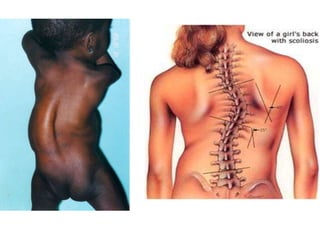
Scoliosis
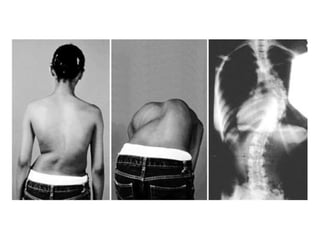
• Scoliosis is an abnormal curvature of the
spine.
• Scoliosis runs in families, but doctors
often don't know the cause.
• More girls than boys have severe
scoliosis.
• Adult scoliosis may be a worsening of a
condition that began in childhood
• scoliosis may also result from a
degenerative joint condition in the spine.
Kyphosis
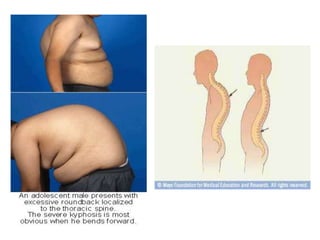
• With kyphosis, your spine may look normal or
you may develop a hump.
• Kyphosis can occur as a result of
developmental problems; degenerative
diseases, such as arthritis of the spine;
osteoporosis with compression fractures of
the vertebrae; or trauma to the spine.
• It can affect children, adolescents and adults.
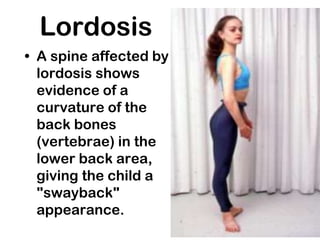
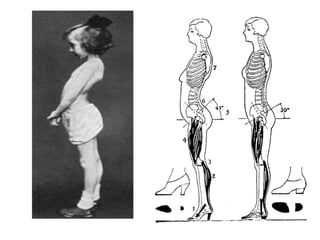
Lordosis
• A spine affected by
lordosis shows
evidence of a
curvature of the
back bones
(vertebrae) in the
lower back area,
giving the child a
"swayback"
appearance.
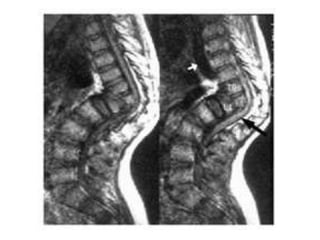
Tuberculosis of the Spine-
(Pott’s Disease)
• A form of extrapulmonary tuberculosis that
impacts the spine,
• Aka arthritis for the vertebrae
• More properly known as tuberculosis
spondylitis,
• Pott’s disease is often experienced as a local
phenomenon that begins in the thoracic section
of the spinal column.
• Early signs of the presence of Pott’s disease
generally begin with a simple back pain that in
short order,will begin to multiply.
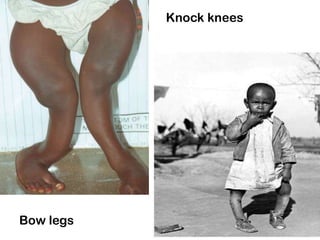
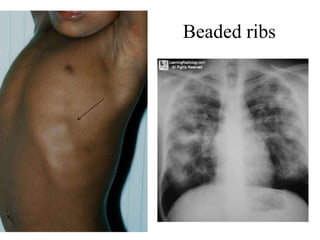
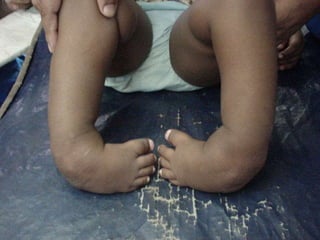
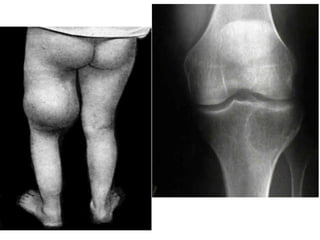
Rickets
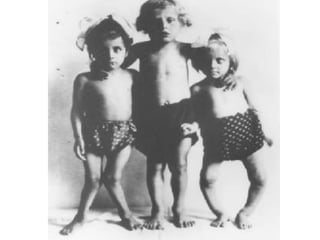
• Rickets is the softening and
weakening of bones in children,
usually because of an extreme and
prolonged vitamin D deficiency.
• Some skeletal deformities caused by
rickets may need corrective
surgery.
Knock knees
Bow legs
Beaded ribs
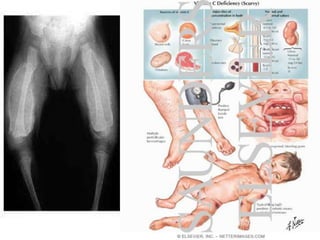
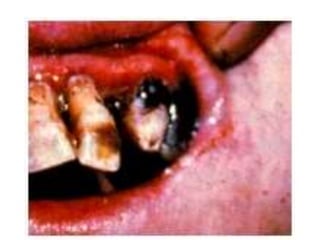
Scurvy
• Consumption of fruits and
vegetables or diets fortified with
vitamin C are essential to avoid
ascorbic acid deficiency.
• Even though scurvy is uncommon, it
still occurs and can affect adults and
children who have chronic dietary
vitamin C deficiency.
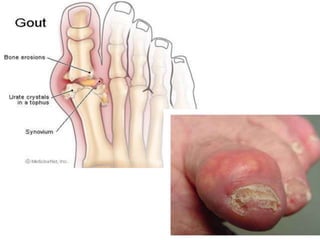
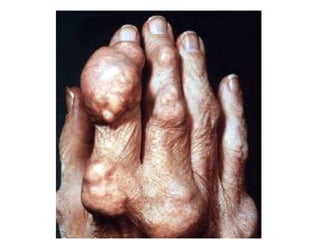
Gout
• results from an overload of uric acid in
the body which leads to the formation of
tiny crystals of urate that deposit in the
joints.
• When crystals form in the joints it causes
recurring attacks of joint inflammation
(arthritis).
• Chronic gout can also lead to deposits of
hard lumps of uric acid in and around the
joints and may cause joint destruction,
decreased kidney function and kidney
stones
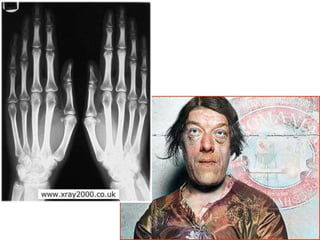
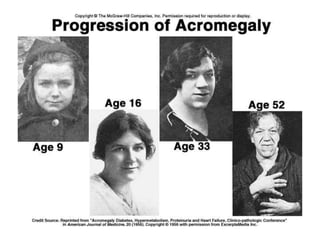
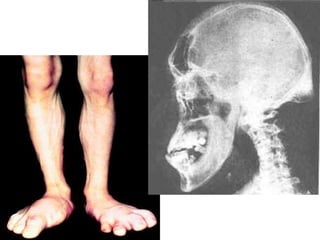
Acromegaly
• occurs when the pituitary gland
produces too much growth
• When there is too much growth
hormone in the body, these tissues
grow larger than normal.
• This excessive growth can cause
serious disease and even premature
death.
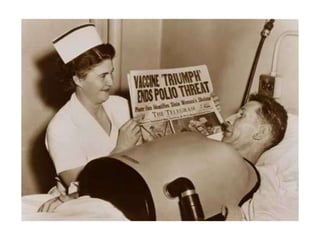
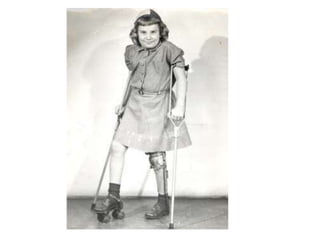
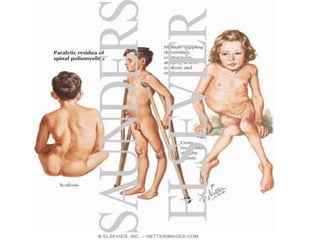
Poliomyelitis
• a highly infectious disease caused by a virus which invades the
nervous system causing total paralysis in a matter of hours.
• can strike at any age, but affects mainly children under three
(over 50% of all cases).
• The virus enters the body through the mouth and multiplies in
the intestine. Initial symptoms are fever, fatigue, headache,
vomiting, stiffness in the neck and pain in the limbs.
• One in 200 infections leads to irreversible paralysis (usually in
the legs). Amongst those paralysed, 5%-10% die when their
breathing muscles become immobilized.
• As most people infected with poliovirus have no signs of illness,
poliovirus can spread widely
• After initial infection with poliovirus, the virus is shed
intermittently in faeces (excrement) for several weeks. During
that time, polio can spread rapidly through the community.
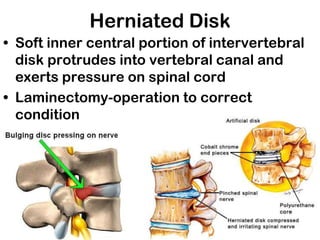
Herniated Disk
• Soft inner central portion of intervertebral
disk protrudes into vertebral canal and
exerts pressure on spinal cord
• Laminectomy-operation to correct
condition
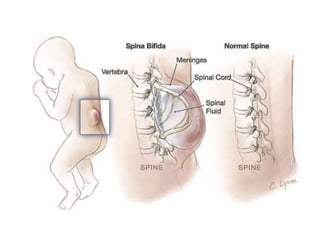
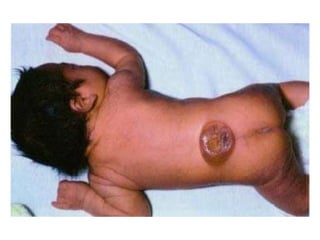
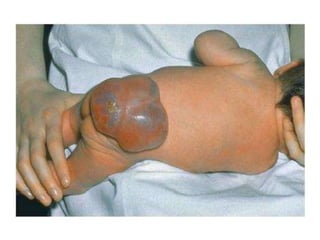
Spina Bifida
• birth defect that involves the incomplete
development of the spinal cord or its
coverings.
• The term spina bifida comes from Latin and
literally means "split" or "open" spine.
• Spina bifida occurs at the end of the first
month of pregnancy when the two sides of the
ハembryo's spine fail to join together, leaving
an open area.
• In some cases, the spinal cord or other
membranes may push through this opening in
the back. The condition usually isハdetected
before a baby is born and treated right away.
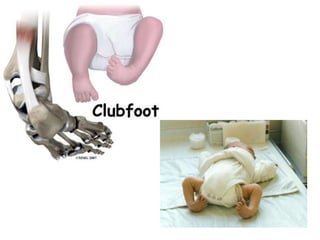
Talipes Equinovarus-
“Clubfoot”
• A deformity of the whole foot that is present at
birth.
• Aka as 'talipes', as the deformity is mostly in
the talus (a bone in the ankle).
• The most common of the talipes is what is
known as "talipes equino varus“
• In talipes equino varus, the child is born with
the foot pointing down and twisted inwards at
the ankle.
Sarcoma
• Osteosarcoma-The most common
type of bone cancer.
• arises in bone and is most commonly
found in children and adolescents
• A rare form occurs in adults,
particularly in patients who have
been cured of other cancers with
radiation therapy.
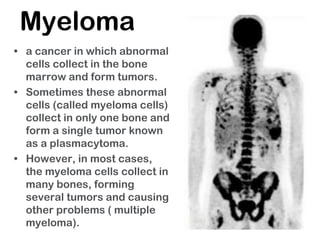
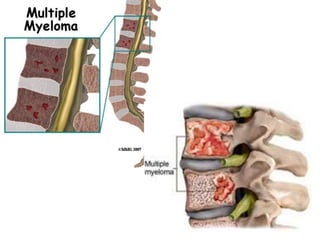
Myeloma
• a cancer in which abnormal
cells collect in the bone
marrow and form tumors.
• Sometimes these abnormal
cells (called myeloma cells)
collect in only one bone and
form a single tumor known
as a plasmacytoma.
• However, in most cases,
the myeloma cells collect in
many bones, forming
several tumors and causing
other problems ( multiple
myeloma).
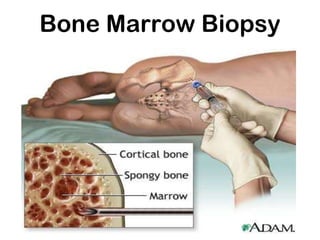
Bone Marrow Biopsy

4. skeletal system

  • 1.
  • 2.
    Functions 1. Support Framework thatsupports body and cradles its soft organs Without the skeleton your body would collapse like jelly.
  • 3.
    Functions 2. Protection Protects internalorgans and fragile body parts: heart, lungs, brain, lungs, spinal cord, etc.
  • 4.
    Functions 3. Movement bones actas levers for muscles
  • 5.
  • 6.
    Functions 5. Blood cellformation- “hematopoiesis”
  • 7.
     Diaphysis Shaft Composed of compactbone  Epiphysis Ends of the bone Composed mostly of spongy bone Gross Anatomy of a Long Bone CHAguilar 2011
  • 8.
    Types of BoneCells  Osteocytes  Mature bone cells  Osteoblasts  Bone-forming cells  Osteoclasts  Bone-destroying cells  Break down bone matrix for remodeling and release of calcium  Bone remodeling is a process by both osteoblasts and osteoclasts
  • 9.
  • 11.
    Changes in theHuman Skeleton  In embryos, the skeleton is primarily hyaline cartilage  During development, much of this cartilage is replaced by bone  Cartilage remains in isolated areas  Bridge of the nose  Parts of ribs  Joints
  • 12.
    I. ENDOCHONDRAL OSSIFICATION-cartilage to bone a. Circumference - deposition of osteoblasts beneath periosteum forming new bone on the surface and increasing girth - osteoclasts dissolve bony tissue in interior to give way to marrow cavity b. Length- 4 regions in epiphyseal plate ( between epiphysis and diaphysis) 1. “resting” cartilage cells 2. zone of proliferation 3. zone of hypertrophy 4. zone of calcification
  • 13.
    II. INTRAMEMBRANOUS OSSIFICATION •Membranoustissue to bone •In flat bones of the skull •Done through appositional growth ( addition on sides of osseous tissue) •Cannot grow by interior expansion BONE GROWTH AND RESORPTION •Childhood- faster ossification, slower resorption= inc in size of the bone •Adulthood- ossification=resorption-constant size •Late adulthood(35-40 onwards)- faster resorption, slower ossification- osteoporosis in older women
  • 14.
  • 19.
    Bone Fractures Copyright ©2003 Pearson Education, Inc. publishing as Benjamin Cummings  A break in a bone  Types of bone fractures  Closed (simple) fracture – break that does not penetrate the skin  Open (compound) fracture – broken bone penetrates through the skin  Bone fractures are treated by reduction and immobilization  Realignment of the bone
  • 20.
    Common Types ofFractures
  • 21.
    Stages in theHealing of a Bone Fracture
  • 22.
    Bone Repair: 1. Electricalstimulation of the fracture site: • Increases speed and completeness of healing • The e- stimulation inhibits PTH and slow osteoclasts down from reabsorbing bone 2. Ultrasound treatment: • Daily treatments reduce healing time of broken bones by 25-35% 3. Free vascular fibular graft technique: • Transplant fibula in arm • Gives good blood supply not available in other treatments 4. Bone substitutes: • Crushed bone from cadaver- but risk of HIV and hepatitis • Sea bone- coral • Artificial bone- ceramic
  • 23.
    Paranasal Sinuses SlideCopyright ©2003 Pearson Education, Inc. publishing as Benjamin Cummings  Hollow portions of bones surrounding the nasal cavity Figure 5.10
  • 24.
    • Warm andmoisten air • Lighten the skull • Enhance voice resonance Frontal Sinus Ethmoid Sinus Sphenoid Sinus Maxillary Sinus
  • 25.
    EFFECTS OF HORMONESON BONES 1. Growth hormone • hyposecretion/removal of pituitary gland - results in premature cessation of transformation of chondrocytes to bones in epiphysis • Hypersecretion- giantism/acromegaly 2. Parathormone- overactivity - bones become unduly fragile and fracture spontaneously and cysts form ( osteitis fibrosa cystica) 3.Thyroxine- deficiency in young- delayed/inc ossification= softer bones 4. estrogen- stimulate osteoblastic activity -def during post-menopausal stage- osteoporosis
  • 26.
    Head shape anddelivery method •Method of delivery determined thru diameter of female pelvis and size of fetal skull •Small pelvic measurements- cesarean operation no molding( different shape of head) •Average pelvic measurements-natural delivery head is molded during its passage through birth canal •Instrumental delivery- placing forceps on head and pulling very delicate job and could cause damage to motor cortex of brain – spastic child
  • 29.
    Diseases and Conditions ofthe Skeletal System
  • 30.
  • 34.
    Bursitis • Inflammation ofthe Bursa (fluid filled sac surrounding the joint). • bursa can become inflamed from injury, infection or due to an underlying rheumatic condition. • typically identified by localized pain or swelling, tenderness, and pain with motion of the tissues in the affected area.
  • 36.
    Bunion • Swelling ofbursa of great toe due to pressure or friction from badly fitting shoes
  • 37.
    Tendonitis • literally meansinflammation of the tendon • If normal smooth gliding motion of tendon is impaired, the tendon will become inflamed and movement will become painful. • The most common cause of tendonitis is overuse.
  • 39.
    Carpal Tunnel Syndrome •Due to any condition that causes swelling or a change in position of the tissue within the carpal tunnel • can squeeze and irritate the median nerve. • This causes tingling and numbness of the thumb, index, and the middle fingers, a condition known as "carpal tunnel syndrome."
  • 42.
    Osteoporosis • means "porousbones.“ Risk Factors: • Being female:decreased estrogen after menopause • Small frame • Caucasian or Asian ethnicity • Little weight-bearing exercise • diet poor in Ca++ and protein • abnormal vitamin D receptors • Smoking • Drinking alcohol
  • 46.
    Scoliosis • Scoliosis isan abnormal curvature of the spine. • Scoliosis runs in families, but doctors often don't know the cause. • More girls than boys have severe scoliosis. • Adult scoliosis may be a worsening of a condition that began in childhood • scoliosis may also result from a degenerative joint condition in the spine.
  • 50.
    Kyphosis • With kyphosis,your spine may look normal or you may develop a hump. • Kyphosis can occur as a result of developmental problems; degenerative diseases, such as arthritis of the spine; osteoporosis with compression fractures of the vertebrae; or trauma to the spine. • It can affect children, adolescents and adults.
  • 53.
    Lordosis • A spineaffected by lordosis shows evidence of a curvature of the back bones (vertebrae) in the lower back area, giving the child a "swayback" appearance.
  • 55.
    Tuberculosis of theSpine- (Pott’s Disease) • A form of extrapulmonary tuberculosis that impacts the spine, • Aka arthritis for the vertebrae • More properly known as tuberculosis spondylitis, • Pott’s disease is often experienced as a local phenomenon that begins in the thoracic section of the spinal column. • Early signs of the presence of Pott’s disease generally begin with a simple back pain that in short order,will begin to multiply.
  • 59.
    Rickets • Rickets isthe softening and weakening of bones in children, usually because of an extreme and prolonged vitamin D deficiency. • Some skeletal deformities caused by rickets may need corrective surgery.
  • 60.
  • 62.
  • 63.
    Scurvy • Consumption offruits and vegetables or diets fortified with vitamin C are essential to avoid ascorbic acid deficiency. • Even though scurvy is uncommon, it still occurs and can affect adults and children who have chronic dietary vitamin C deficiency.
  • 66.
    Gout • results froman overload of uric acid in the body which leads to the formation of tiny crystals of urate that deposit in the joints. • When crystals form in the joints it causes recurring attacks of joint inflammation (arthritis). • Chronic gout can also lead to deposits of hard lumps of uric acid in and around the joints and may cause joint destruction, decreased kidney function and kidney stones
  • 69.
    Acromegaly • occurs whenthe pituitary gland produces too much growth • When there is too much growth hormone in the body, these tissues grow larger than normal. • This excessive growth can cause serious disease and even premature death.
  • 73.
    Poliomyelitis • a highlyinfectious disease caused by a virus which invades the nervous system causing total paralysis in a matter of hours. • can strike at any age, but affects mainly children under three (over 50% of all cases). • The virus enters the body through the mouth and multiplies in the intestine. Initial symptoms are fever, fatigue, headache, vomiting, stiffness in the neck and pain in the limbs. • One in 200 infections leads to irreversible paralysis (usually in the legs). Amongst those paralysed, 5%-10% die when their breathing muscles become immobilized. • As most people infected with poliovirus have no signs of illness, poliovirus can spread widely • After initial infection with poliovirus, the virus is shed intermittently in faeces (excrement) for several weeks. During that time, polio can spread rapidly through the community.
  • 77.
    Herniated Disk • Softinner central portion of intervertebral disk protrudes into vertebral canal and exerts pressure on spinal cord • Laminectomy-operation to correct condition
  • 78.
    Spina Bifida • birthdefect that involves the incomplete development of the spinal cord or its coverings. • The term spina bifida comes from Latin and literally means "split" or "open" spine. • Spina bifida occurs at the end of the first month of pregnancy when the two sides of the ハembryo's spine fail to join together, leaving an open area. • In some cases, the spinal cord or other membranes may push through this opening in the back. The condition usually isハdetected before a baby is born and treated right away.
  • 82.
    Talipes Equinovarus- “Clubfoot” • Adeformity of the whole foot that is present at birth. • Aka as 'talipes', as the deformity is mostly in the talus (a bone in the ankle). • The most common of the talipes is what is known as "talipes equino varus“ • In talipes equino varus, the child is born with the foot pointing down and twisted inwards at the ankle.
  • 85.
    Sarcoma • Osteosarcoma-The mostcommon type of bone cancer. • arises in bone and is most commonly found in children and adolescents • A rare form occurs in adults, particularly in patients who have been cured of other cancers with radiation therapy.
  • 89.
    Myeloma • a cancerin which abnormal cells collect in the bone marrow and form tumors. • Sometimes these abnormal cells (called myeloma cells) collect in only one bone and form a single tumor known as a plasmacytoma. • However, in most cases, the myeloma cells collect in many bones, forming several tumors and causing other problems ( multiple myeloma).
  • 91.