BIER BLOCK (INTRAVENOUS
REGIONAL ANESTHESIA)
By: Komal Haleem
(Pharm-D)
Huda Hamid
Amna Tahir
Yoanna David
HISTORY
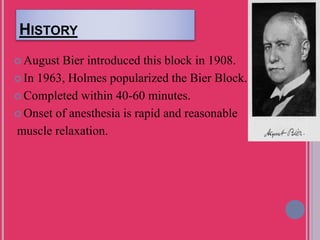
 August Bier introduced this block in 1908.
 In 1963, Holmes popularized the Bier Block.
 Completed within 40-60 minutes.
 Onset of anesthesia is rapid and reasonable
muscle relaxation.
CONDITIONS
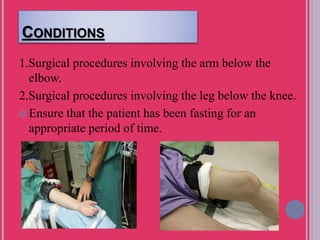
1.Surgical procedures involving the arm below the
elbow.
2.Surgical procedures involving the leg below the knee.
 Ensure that the patient has been fasting for an
appropriate period of time.
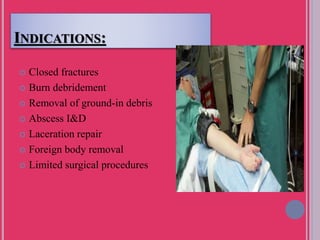
INDICATIONS:
 Closed fractures
 Burn debridement
 Removal of ground-in debris
 Abscess I&D
 Laceration repair
 Foreign body removal
 Limited surgical procedures
There appears to be multiple and complementary
mechanisms for producing analgesia and anesthesia.
FACTORS RESPONSIBLE:
 A large volume of dilute anesthetic
 Ischemia
 Asphyxia
 Hypothermia
 Acidosis
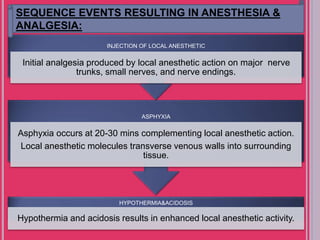
HYPOTHERMIA&ACIDOSIS
Hypothermia and acidosis results in enhanced local anesthetic activity.
ASPHYXIA
Asphyxia occurs at 20-30 mins complementing local anesthetic action.
Local anesthetic molecules transverse venous walls into surrounding
tissue.
INJECTION OF LOCAL ANESTHETIC
Initial analgesia produced by local anesthetic action on major nerve
trunks, small nerves, and nerve endings.
SEQUENCE EVENTS RESULTING IN ANESTHESIA &
ANALGESIA:
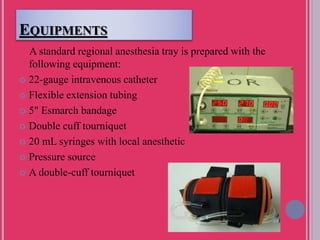
EQUIPMENTS
A standard regional anesthesia tray is prepared with the
following equipment:
 22-gauge intravenous catheter
 Flexible extension tubing
 5" Esmarch bandage
 Double cuff tourniquet
 20 mL syringes with local anesthetic
 Pressure source
 A double-cuff tourniquet
PROCEDURE:
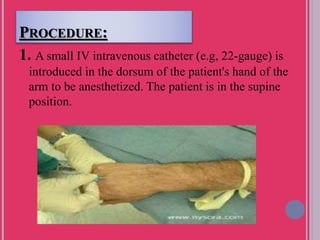
1. A small IV intravenous catheter (e.g, 22-gauge) is
introduced in the dorsum of the patient's hand of the
arm to be anesthetized. The patient is in the supine
position.
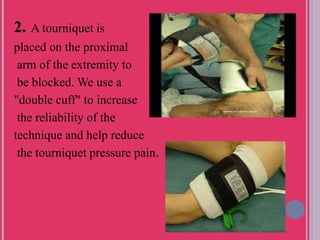
2. A tourniquet is
placed on the proximal
arm of the extremity to
be blocked. We use a
"double cuff" to increase
the reliability of the
technique and help reduce
the tourniquet pressure pain.
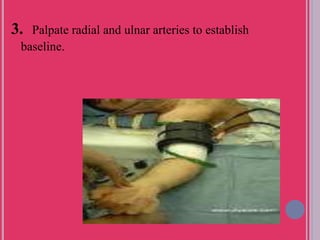
3. Palpate radial and ulnar arteries to establish
baseline.
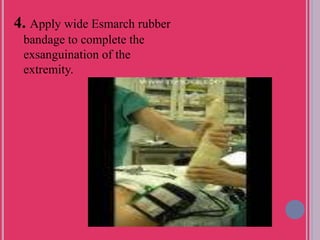
4. Apply wide Esmarch rubber
bandage to complete the
exsanguination of the
extremity.
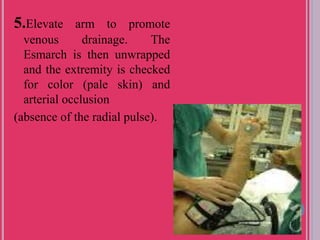
5.Elevate arm to promote
venous drainage. The
Esmarch is then unwrapped
and the extremity is checked
for color (pale skin) and
arterial occlusion
(absence of the radial pulse).
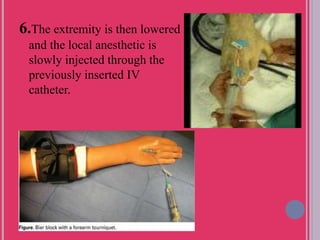
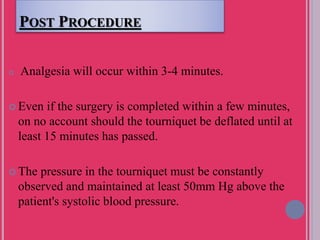
6.The extremity is then lowered
and the local anesthetic is
slowly injected through the
previously inserted IV
catheter.
POST PROCEDURE
 Analgesia will occur within 3-4 minutes.
 Even if the surgery is completed within a few minutes,
on no account should the tourniquet be deflated until at
least 15 minutes has passed.
 The pressure in the tourniquet must be constantly
observed and maintained at least 50mm Hg above the
patient's systolic blood pressure.
 If the operation is prolonged, the patient may
complain of pain due to pressure from the
tourniquet. This may be reduced either by the
subcutaneous infiltration of a few mls of local
anesthetic above the tourniquet or by the use of a
"double tourniquet technique”.
 At the end of the procedure, the tourniquet is
deflated and normal sensation quickly returns.
 The tourniquet is reinflated again 20-30 seconds.
ADVANTAGES OF THE BIER BLOCK
Easy to administer
Low incidence of block failure
Safe technique when used appropriately
Rapid onset and recovery
Patient is awake during procedure.
Controllable extent of anesthesia.
DISADVANTAGES OF THE BIER BLOCK
Should be used for only short procedures
Patient may experience tourniquet pain after
20-30 minutes
Sudden cardiovascular collapse or seizures
may occur if local anesthetic is released into
the circulation too early.
 Lose pulse
Rapid recovery may lead to postoperative
pain
Difficulty in providing a bloodless field
CONTRAINDICATIONS
Reynaud’s disease
Homozygous sickle cell disease
Young children
Unreliable or inadequate tourniquets.
Shock
Multiple trauma (crush injuries of relevant
limb)
Hypersensitivity to Prilocaine or lidocaine
Seizure disorder
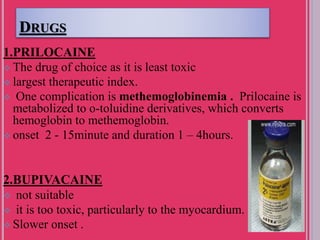
DRUGS
1.PRILOCAINE
 The drug of choice as it is least toxic
 largest therapeutic index.
 One complication is methemoglobinemia . Prilocaine is
metabolized to o-toluidine derivatives, which converts
hemoglobin to methemoglobin.
 onset 2 - 15minute and duration 1 – 4hours.
2.BUPIVACAINE
 not suitable
 it is too toxic, particularly to the myocardium.
 Slower onset .
3.LIGNOCAINE
 acceptable alternative.
 onset 1.5 - 5minute and duration 1 – 4hours
DOSAGE
 the arm dosage can be: 30-40 ml of 0.5%
prilocaine or 0.5 % lidocaine.
 In leg, larger volumes 50-60 ml.
COMPLICATIONS
1. Tourniquet pain
2. At IV site: blotchy erythema, flushing, urticaria
3. Tourniquet fails  Lidocaine bolus:
Headache, lethargy, slurred speech, seizure
Hypotension, bradycardia
4. Toxicity of local anesthetics
 Signs and symptoms may include nausea,
vomiting, dizziness, tinnitus, funny sensation
around the mouth, loss of consciousness.
Local Anesthetic Toxicity Management
 Use the A, B, C’s for the management of local
anesthetic toxicity.
 A= airway. administer 100% oxygen.
 B= breathing. May need to assist the patient with
positive pressure ventilation or intubation.
 C= circulation. Check for a pulse..
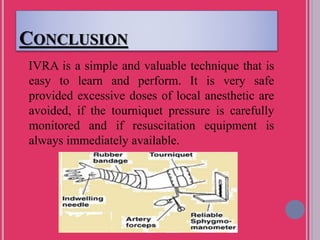
CONCLUSION
IVRA is a simple and valuable technique that is
easy to learn and perform. It is very safe
provided excessive doses of local anesthetic are
avoided, if the tourniquet pressure is carefully
monitored and if resuscitation equipment is
always immediately available.
Bier block (intravenous regional anesthesia)

Bier block (intravenous regional anesthesia)

  • 1.
    BIER BLOCK (INTRAVENOUS REGIONALANESTHESIA) By: Komal Haleem (Pharm-D) Huda Hamid Amna Tahir Yoanna David
  • 2.
    HISTORY  August Bierintroduced this block in 1908.  In 1963, Holmes popularized the Bier Block.  Completed within 40-60 minutes.  Onset of anesthesia is rapid and reasonable muscle relaxation.
  • 3.
    CONDITIONS 1.Surgical procedures involvingthe arm below the elbow. 2.Surgical procedures involving the leg below the knee.  Ensure that the patient has been fasting for an appropriate period of time.
  • 4.
    INDICATIONS:  Closed fractures Burn debridement  Removal of ground-in debris  Abscess I&D  Laceration repair  Foreign body removal  Limited surgical procedures
  • 5.
    There appears tobe multiple and complementary mechanisms for producing analgesia and anesthesia. FACTORS RESPONSIBLE:  A large volume of dilute anesthetic  Ischemia  Asphyxia  Hypothermia  Acidosis
  • 6.
    HYPOTHERMIA&ACIDOSIS Hypothermia and acidosisresults in enhanced local anesthetic activity. ASPHYXIA Asphyxia occurs at 20-30 mins complementing local anesthetic action. Local anesthetic molecules transverse venous walls into surrounding tissue. INJECTION OF LOCAL ANESTHETIC Initial analgesia produced by local anesthetic action on major nerve trunks, small nerves, and nerve endings. SEQUENCE EVENTS RESULTING IN ANESTHESIA & ANALGESIA:
  • 7.
    EQUIPMENTS A standard regionalanesthesia tray is prepared with the following equipment:  22-gauge intravenous catheter  Flexible extension tubing  5" Esmarch bandage  Double cuff tourniquet  20 mL syringes with local anesthetic  Pressure source  A double-cuff tourniquet
  • 8.
    PROCEDURE: 1. A smallIV intravenous catheter (e.g, 22-gauge) is introduced in the dorsum of the patient's hand of the arm to be anesthetized. The patient is in the supine position.
  • 9.
    2. A tourniquetis placed on the proximal arm of the extremity to be blocked. We use a "double cuff" to increase the reliability of the technique and help reduce the tourniquet pressure pain.
  • 10.
    3. Palpate radialand ulnar arteries to establish baseline.
  • 11.
    4. Apply wideEsmarch rubber bandage to complete the exsanguination of the extremity.
  • 12.
    5.Elevate arm topromote venous drainage. The Esmarch is then unwrapped and the extremity is checked for color (pale skin) and arterial occlusion (absence of the radial pulse).
  • 13.
    6.The extremity isthen lowered and the local anesthetic is slowly injected through the previously inserted IV catheter.
  • 14.
    POST PROCEDURE  Analgesiawill occur within 3-4 minutes.  Even if the surgery is completed within a few minutes, on no account should the tourniquet be deflated until at least 15 minutes has passed.  The pressure in the tourniquet must be constantly observed and maintained at least 50mm Hg above the patient's systolic blood pressure.
  • 15.
     If theoperation is prolonged, the patient may complain of pain due to pressure from the tourniquet. This may be reduced either by the subcutaneous infiltration of a few mls of local anesthetic above the tourniquet or by the use of a "double tourniquet technique”.  At the end of the procedure, the tourniquet is deflated and normal sensation quickly returns.  The tourniquet is reinflated again 20-30 seconds.
  • 16.
    ADVANTAGES OF THEBIER BLOCK Easy to administer Low incidence of block failure Safe technique when used appropriately Rapid onset and recovery Patient is awake during procedure. Controllable extent of anesthesia.
  • 17.
    DISADVANTAGES OF THEBIER BLOCK Should be used for only short procedures Patient may experience tourniquet pain after 20-30 minutes Sudden cardiovascular collapse or seizures may occur if local anesthetic is released into the circulation too early.  Lose pulse Rapid recovery may lead to postoperative pain Difficulty in providing a bloodless field
  • 18.
    CONTRAINDICATIONS Reynaud’s disease Homozygous sicklecell disease Young children Unreliable or inadequate tourniquets. Shock Multiple trauma (crush injuries of relevant limb) Hypersensitivity to Prilocaine or lidocaine Seizure disorder
  • 19.
    DRUGS 1.PRILOCAINE  The drugof choice as it is least toxic  largest therapeutic index.  One complication is methemoglobinemia . Prilocaine is metabolized to o-toluidine derivatives, which converts hemoglobin to methemoglobin.  onset 2 - 15minute and duration 1 – 4hours. 2.BUPIVACAINE  not suitable  it is too toxic, particularly to the myocardium.  Slower onset .
  • 20.
    3.LIGNOCAINE  acceptable alternative. onset 1.5 - 5minute and duration 1 – 4hours DOSAGE  the arm dosage can be: 30-40 ml of 0.5% prilocaine or 0.5 % lidocaine.  In leg, larger volumes 50-60 ml.
  • 21.
    COMPLICATIONS 1. Tourniquet pain 2.At IV site: blotchy erythema, flushing, urticaria 3. Tourniquet fails  Lidocaine bolus: Headache, lethargy, slurred speech, seizure Hypotension, bradycardia
  • 22.
    4. Toxicity oflocal anesthetics  Signs and symptoms may include nausea, vomiting, dizziness, tinnitus, funny sensation around the mouth, loss of consciousness. Local Anesthetic Toxicity Management  Use the A, B, C’s for the management of local anesthetic toxicity.  A= airway. administer 100% oxygen.  B= breathing. May need to assist the patient with positive pressure ventilation or intubation.  C= circulation. Check for a pulse..
  • 23.
    CONCLUSION IVRA is asimple and valuable technique that is easy to learn and perform. It is very safe provided excessive doses of local anesthetic are avoided, if the tourniquet pressure is carefully monitored and if resuscitation equipment is always immediately available.