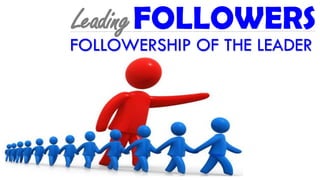


FOLLOWERSHIP OF THE LEADER
LeadingFOLLOWERS
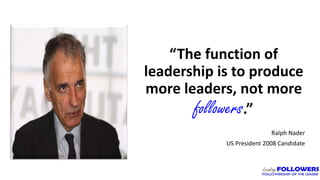
“The function of
leadership is to produce
more leaders, not more
followers.”
Ralph Nader
US President 2008 Candidate
But, we need followers…
4
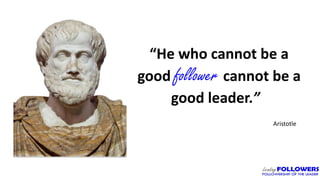
“He who cannot be a
good follower cannot be a
good leader.”
Aristotle
5
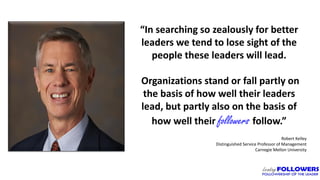
“In searching so zealously for better
leaders we tend to lose sight of the
people these leaders will lead.
Organizations stand or fall partly on
the basis of how well their leaders
lead, but partly also on the basis of
how well their followers follow.”
Robert Kelley
Distinguished Service Professor of Management
Carnegie Mellon University
We need to understand the human
qualities that allow effective followership
to occur.
Kelly, Robert (1988). In Praise of Followers, HBR
MODEL 1
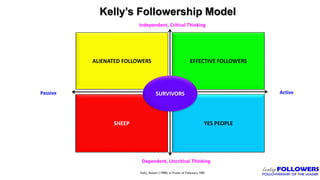
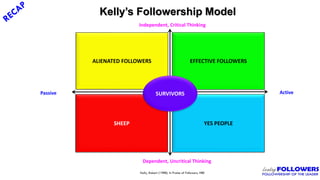
Kelly’s Followership Model
ALIENATED FOLLOWERS EFFECTIVE FOLLOWERS
YES PEOPLESHEEP
Active
Kelly, Robert (1988). In Praise of Followers, HBR
Passive
Dependent, Uncritical Thinking
Independent, Critical Thinking
SURVIVORS
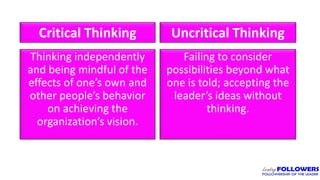
Critical Thinking
Thinking independently
and being mindful of the
effects of one’s own and
other people’s behavior
on achieving the
organization’s vision.
Uncritical Thinking
Failing to consider
possibilities beyond what
one is told; accepting the
leader’s ideas without
thinking.
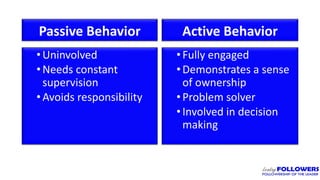
•Uninvolved
•Needs constant
supervision
•Avoids responsibility
•Fully engaged
•Demonstrates a sense
of ownership
•Problem solver
•Involved in decision
making
Passive Behavior Active Behavior
Complete the
FOLLOWERSHIP SELF-
ASSESSMENT QUESTIONNAIRE
http://mbanicas.weebly.com/identify-your-followership-style.html
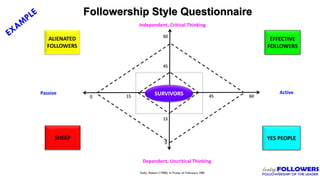
Followership Style Questionnaire
ALIENATED
FOLLOWERS
EFFECTIVE
FOLLOWERS
YES PEOPLESHEEP
Active
Kelly, Robert (1988). In Praise of Followers, HBR
Passive
Dependent, Uncritical Thinking
Independent, Critical Thinking
30
45
60
15
15 45 600
0
SURVIVORS
Kelly’s Followership Model
SHEEP
Active
Kelly, Robert (1992). Kelly’s Model of Follower Behavior
Passive
Dependent, Uncritical Thinking
Independent, Critical Thinking
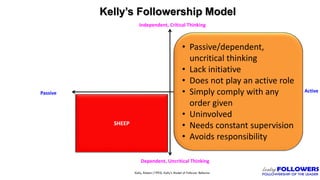
• Passive/dependent,
uncritical thinking
• Lack initiative
• Does not play an active role
• Simply comply with any
order given
• Uninvolved
• Needs constant supervision
• Avoids responsibility
Kelly’s Followership Model
YES PEOPLE
Active
Kelly, Robert (1992). Kelly’s Model of Follower Behavior
Passive
Dependent, Uncritical Thinking
Independent, Critical Thinking
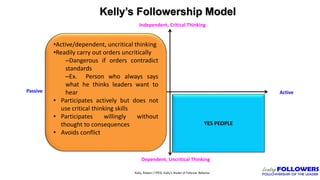
•Active/dependent, uncritical thinking
•Readily carry out orders uncritically
–Dangerous if orders contradict
standards
–Ex. Person who always says
what he thinks leaders want to
hear
• Participates actively but does not
use critical thinking skills
• Participates willingly without
thought to consequences
• Avoids conflict
Kelly’s Followership Model
Active
Kelly, Robert (1992). Kelly’s Model of Follower Behavior
Passive
Dependent, Uncritical Thinking
Independent, Critical Thinking
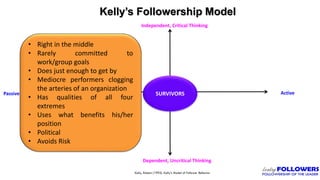
SURVIVORS
• Right in the middle
• Rarely committed to
work/group goals
• Does just enough to get by
• Mediocre performers clogging
the arteries of an organization
• Has qualities of all four
extremes
• Uses what benefits his/her
position
• Political
• Avoids Risk
Kelly’s Followership Model
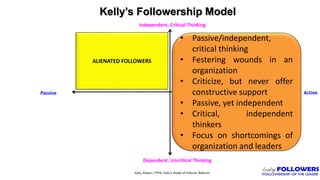
ALIENATED FOLLOWERS
Active
Kelly, Robert (1992). Kelly’s Model of Follower Behavior
Passive
Dependent, Uncritical Thinking
Independent, Critical Thinking
• Passive/independent,
critical thinking
• Festering wounds in an
organization
• Criticize, but never offer
constructive support
• Passive, yet independent
• Critical, independent
thinkers
• Focus on shortcomings of
organization and leaders
Kelly’s Followership Model
EFFECTIVE FOLLOWERS
Active
Kelly, Robert (1992). Kelly’s Model of Follower Behavior
Dependent, Uncritical Thinking
Independent, Critical Thinking
Passive
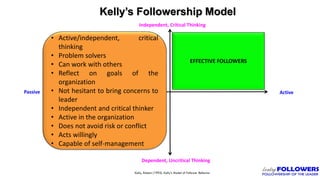
• Active/independent, critical
thinking
• Problem solvers
• Can work with others
• Reflect on goals of the
organization
• Not hesitant to bring concerns to
leader
• Independent and critical thinker
• Active in the organization
• Does not avoid risk or conflict
• Acts willingly
• Capable of self-management
Kelly’s Followership Model
ALIENATED FOLLOWERS EFFECTIVE FOLLOWERS
YES PEOPLESHEEP
Active
Kelly, Robert (1988). In Praise of Followers, HBR
Passive
Dependent, Uncritical Thinking
Independent, Critical Thinking
SURVIVORS
MODEL 2
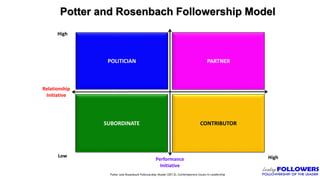
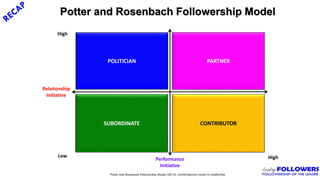
Potter and Rosenbach Followership Model
POLITICIAN PARTNER
CONTRIBUTORSUBORDINATE
Low
Potter and Rosenbach Followership Model (2012). Contemporary Issues In Leadership
Relationship
Initiative
Performance
Initiative
High
High
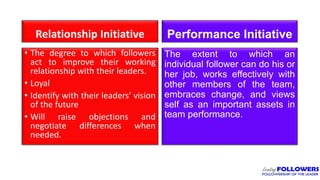
Performance Initiative
The extent to which an
individual follower can do his or
her job, works effectively with
other members of the team,
embraces change, and views
self as an important assets in
team performance.
Relationship Initiative
• The degree to which followers
act to improve their working
relationship with their leaders.
• Loyal
• Identify with their leaders’ vision
of the future
• Will raise objections and
negotiate differences when
needed.
Potter and Rosenbach Followership Model
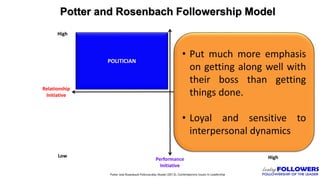
POLITICIAN
Low
Relationship
Initiative
Performance
Initiative
High
High
Potter and Rosenbach Followership Model (2012). Contemporary Issues In Leadership
• Put much more emphasis
on getting along well with
their boss than getting
things done.
• Loyal and sensitive to
interpersonal dynamics
Potter and Rosenbach Followership Model
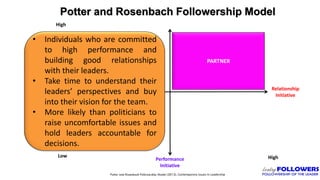
PARTNER
Low
Relationship
Initiative
Performance
Initiative
High
High
Potter and Rosenbach Followership Model (2012). Contemporary Issues In Leadership
• Individuals who are committed
to high performance and
building good relationships
with their leaders.
• Take time to understand their
leaders’ perspectives and buy
into their vision for the team.
• More likely than politicians to
raise uncomfortable issues and
hold leaders accountable for
decisions.
Potter and Rosenbach Followership Model
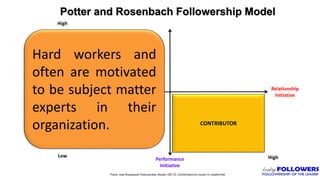
CONTRIBUTOR
Low
Relationship
Initiative
Performance
Initiative
High
High
Potter and Rosenbach Followership Model (2012). Contemporary Issues In Leadership
Hard workers and
often are motivated
to be subject matter
experts in their
organization.
Potter and Rosenbach Followership Model
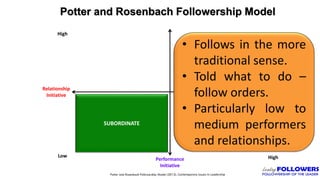
SUBORDINATE
Low
Relationship
Initiative
Performance
Initiative
High
High
Potter and Rosenbach Followership Model (2012). Contemporary Issues In Leadership
• Follows in the more
traditional sense.
• Told what to do –
follow orders.
• Particularly low to
medium performers
and relationships.
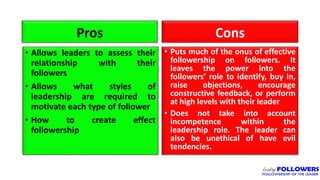
Pros
• Allows leaders to assess their
relationship with their
followers
• Allows what styles of
leadership are required to
motivate each type of follower
• How to create effect
followership
Cons
• Puts much of the onus of effective
followership on followers. It
leaves the power into the
followers’ role to identify, buy in,
raise objections, encourage
constructive feedback, or perform
at high levels with their leader
• Does not take into account
incompetence within the
leadership role. The leader can
also be unethical of have evil
tendencies.
Potter and Rosenbach Followership Model
POLITICIAN PARTNER
CONTRIBUTORSUBORDINATE
Low
Potter and Rosenbach Followership Model (2012). Contemporary Issues In Leadership
Relationship
Initiative
Performance
Initiative
High
High
MODEL 3
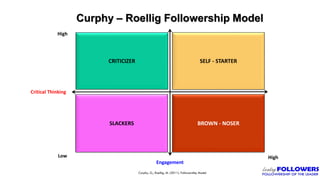
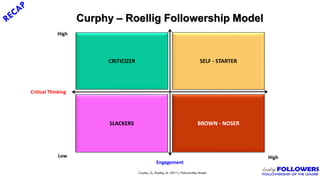
Curphy – Roellig Followership Model
CRITICIZER SELF - STARTER
BROWN - NOSERSLACKERS
Low
Curphy, G., Roellig, M. (2011). Followership Model
Critical Thinking
Engagement
High
High
Complete the
FOLLOWERSHIP SELF-
ASSESSMENT QUESTIONNAIRE
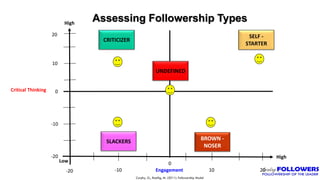
Assessing Followership Types
CRITICIZER
SELF -
STARTER
BROWN -
NOSER
SLACKERS
Low
Curphy, G., Roellig, M. (2011). Followership Model
Critical Thinking
Engagement
High
High
-20
-20
-10
0
0
10 20
-10
10
20
UNDEFINED
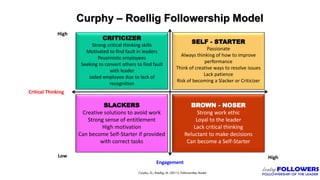
Curphy – Roellig Followership Model
CRITICIZER
Strong critical thinking skills
Motivated to find fault in leaders
Pessimistic employees
Seeking to convert others to find fault
with leader
Jaded employee due to lack of
recognition
SELF - STARTER
Passionate
Always thinking of how to improve
performance
Think of creative ways to resolve issues
Lack patience
Risk of becoming a Slacker or Criticizer
BROWN - NOSER
Strong work ethic
Loyal to the leader
Lack critical thinking
Reluctant to make decisions
Can become a Self-Starter
SLACKERS
Creative solutions to avoid work
Strong sense of entitlement
High motivation
Can become Self-Starter if provided
with correct tasks
Low
Curphy, G., Roellig, M. (2011). Followership Model
Critical Thinking
Engagement
High
High
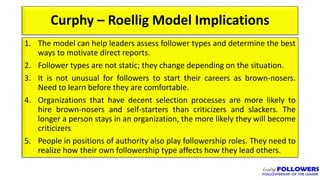
Curphy – Roellig Model Implications
1. The model can help leaders assess follower types and determine the best
ways to motivate direct reports.
2. Follower types are not static; they change depending on the situation.
3. It is not unusual for followers to start their careers as brown-nosers.
Need to learn before they are comfortable.
4. Organizations that have decent selection processes are more likely to
hire brown-nosers and self-starters than criticizers and slackers. The
longer a person stays in an organization, the more likely they will become
criticizers
5. People in positions of authority also play followership roles. They need to
realize how their own followership type affects how they lead others.
Curphy – Roellig Followership Model
CRITICIZER SELF - STARTER
BROWN - NOSERSLACKERS
Low
Curphy, G., Roellig, M. (2011). Followership Model
Critical Thinking
Engagement
High
High
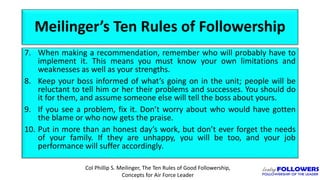
RULES OF FOLLOWERSHIP
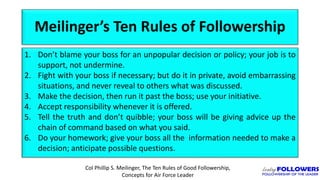
Meilinger’s Ten Rules of Followership
1. Don’t blame your boss for an unpopular decision or policy; your job is to
support, not undermine.
2. Fight with your boss if necessary; but do it in private, avoid embarrassing
situations, and never reveal to others what was discussed.
3. Make the decision, then run it past the boss; use your initiative.
4. Accept responsibility whenever it is offered.
5. Tell the truth and don’t quibble; your boss will be giving advice up the
chain of command based on what you said.
6. Do your homework; give your boss all the information needed to make a
decision; anticipate possible questions.
Col Phillip S. Meilinger, The Ten Rules of Good Followership,
Concepts for Air Force Leader
Meilinger’s Ten Rules of Followership
7. When making a recommendation, remember who will probably have to
implement it. This means you must know your own limitations and
weaknesses as well as your strengths.
8. Keep your boss informed of what’s going on in the unit; people will be
reluctant to tell him or her their problems and successes. You should do
it for them, and assume someone else will tell the boss about yours.
9. If you see a problem, fix it. Don’t worry about who would have gotten
the blame or who now gets the praise.
10. Put in more than an honest day’s work, but don’t ever forget the needs
of your family. If they are unhappy, you will be too, and your job
performance will suffer accordingly.
Col Phillip S. Meilinger, The Ten Rules of Good Followership,
Concepts for Air Force Leader
Follower should influence the leader…
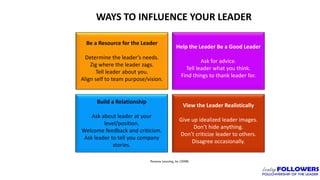
WAYS TO INFLUENCE YOUR LEADER
Be a Resource for the Leader
Determine the leader’s needs.
Zig where the leader zags.
Tell leader about you.
Align self to team purpose/vision.
Help the Leader Be a Good Leader
Ask for advice.
Tell leader what you think.
Find things to thank leader for.
View the Leader Realistically
Give up idealized leader images.
Don’t hide anything.
Don’t criticize leader to others.
Disagree occasionally.
Build a Relationship
Ask about leader at your
level/position.
Welcome feedback and criticism.
Ask leader to tell you company
stories.
Thomson Learning, Inc (2008)
But, what type of a worker /
follower are you?
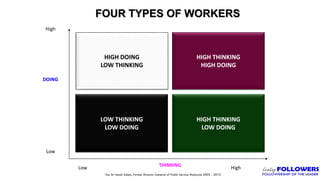
FOUR TYPES OF WORKERS
HIGH DOING
LOW THINKING
HIGH THINKING
HIGH DOING
HIGH THINKING
LOW DOING
LOW THINKING
LOW DOING
High
Tan Sri Ismail Adam, Former Director General of Public Service Malaysia 2005 - 2010
Low
Low High
DOING
THINKING
But are we ready for the followership of
the millennials?
Without followers, there are no leaders.
The nature of leader- follower relationships
involves reciprocity, or the mutual exchange
of influence.
Daft, Richard (2008). The Leadership Experience
So... What kind of
follower are you?
Well... It depends
on what kind
of a leader
you are?
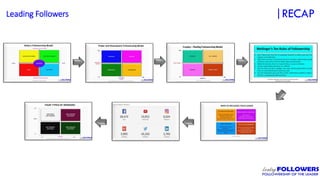
Leading Followers |RECAP
Leading Followers

Leading Followers

  • 1.
    FOLLOWERSHIP OF THELEADER LeadingFOLLOWERS
  • 2.
    “The function of leadershipis to produce more leaders, not more followers.” Ralph Nader US President 2008 Candidate
  • 3.
    But, we needfollowers…
  • 4.
    4 “He who cannotbe a good follower cannot be a good leader.” Aristotle
  • 5.
    5 “In searching sozealously for better leaders we tend to lose sight of the people these leaders will lead. Organizations stand or fall partly on the basis of how well their leaders lead, but partly also on the basis of how well their followers follow.” Robert Kelley Distinguished Service Professor of Management Carnegie Mellon University
  • 6.
    We need tounderstand the human qualities that allow effective followership to occur. Kelly, Robert (1988). In Praise of Followers, HBR
  • 7.
  • 8.
    Kelly’s Followership Model ALIENATEDFOLLOWERS EFFECTIVE FOLLOWERS YES PEOPLESHEEP Active Kelly, Robert (1988). In Praise of Followers, HBR Passive Dependent, Uncritical Thinking Independent, Critical Thinking SURVIVORS
  • 9.
    Critical Thinking Thinking independently andbeing mindful of the effects of one’s own and other people’s behavior on achieving the organization’s vision. Uncritical Thinking Failing to consider possibilities beyond what one is told; accepting the leader’s ideas without thinking.
  • 10.
    •Uninvolved •Needs constant supervision •Avoids responsibility •Fullyengaged •Demonstrates a sense of ownership •Problem solver •Involved in decision making Passive Behavior Active Behavior
  • 11.
    Complete the FOLLOWERSHIP SELF- ASSESSMENTQUESTIONNAIRE http://mbanicas.weebly.com/identify-your-followership-style.html
  • 12.
    Followership Style Questionnaire ALIENATED FOLLOWERS EFFECTIVE FOLLOWERS YESPEOPLESHEEP Active Kelly, Robert (1988). In Praise of Followers, HBR Passive Dependent, Uncritical Thinking Independent, Critical Thinking 30 45 60 15 15 45 600 0 SURVIVORS
  • 13.
    Kelly’s Followership Model SHEEP Active Kelly,Robert (1992). Kelly’s Model of Follower Behavior Passive Dependent, Uncritical Thinking Independent, Critical Thinking • Passive/dependent, uncritical thinking • Lack initiative • Does not play an active role • Simply comply with any order given • Uninvolved • Needs constant supervision • Avoids responsibility
  • 14.
    Kelly’s Followership Model YESPEOPLE Active Kelly, Robert (1992). Kelly’s Model of Follower Behavior Passive Dependent, Uncritical Thinking Independent, Critical Thinking •Active/dependent, uncritical thinking •Readily carry out orders uncritically –Dangerous if orders contradict standards –Ex. Person who always says what he thinks leaders want to hear • Participates actively but does not use critical thinking skills • Participates willingly without thought to consequences • Avoids conflict
  • 15.
    Kelly’s Followership Model Active Kelly,Robert (1992). Kelly’s Model of Follower Behavior Passive Dependent, Uncritical Thinking Independent, Critical Thinking SURVIVORS • Right in the middle • Rarely committed to work/group goals • Does just enough to get by • Mediocre performers clogging the arteries of an organization • Has qualities of all four extremes • Uses what benefits his/her position • Political • Avoids Risk
  • 16.
    Kelly’s Followership Model ALIENATEDFOLLOWERS Active Kelly, Robert (1992). Kelly’s Model of Follower Behavior Passive Dependent, Uncritical Thinking Independent, Critical Thinking • Passive/independent, critical thinking • Festering wounds in an organization • Criticize, but never offer constructive support • Passive, yet independent • Critical, independent thinkers • Focus on shortcomings of organization and leaders
  • 17.
    Kelly’s Followership Model EFFECTIVEFOLLOWERS Active Kelly, Robert (1992). Kelly’s Model of Follower Behavior Dependent, Uncritical Thinking Independent, Critical Thinking Passive • Active/independent, critical thinking • Problem solvers • Can work with others • Reflect on goals of the organization • Not hesitant to bring concerns to leader • Independent and critical thinker • Active in the organization • Does not avoid risk or conflict • Acts willingly • Capable of self-management
  • 18.
    Kelly’s Followership Model ALIENATEDFOLLOWERS EFFECTIVE FOLLOWERS YES PEOPLESHEEP Active Kelly, Robert (1988). In Praise of Followers, HBR Passive Dependent, Uncritical Thinking Independent, Critical Thinking SURVIVORS
  • 19.
  • 20.
    Potter and RosenbachFollowership Model POLITICIAN PARTNER CONTRIBUTORSUBORDINATE Low Potter and Rosenbach Followership Model (2012). Contemporary Issues In Leadership Relationship Initiative Performance Initiative High High
  • 21.
    Performance Initiative The extentto which an individual follower can do his or her job, works effectively with other members of the team, embraces change, and views self as an important assets in team performance. Relationship Initiative • The degree to which followers act to improve their working relationship with their leaders. • Loyal • Identify with their leaders’ vision of the future • Will raise objections and negotiate differences when needed.
  • 22.
    Potter and RosenbachFollowership Model POLITICIAN Low Relationship Initiative Performance Initiative High High Potter and Rosenbach Followership Model (2012). Contemporary Issues In Leadership • Put much more emphasis on getting along well with their boss than getting things done. • Loyal and sensitive to interpersonal dynamics
  • 23.
    Potter and RosenbachFollowership Model PARTNER Low Relationship Initiative Performance Initiative High High Potter and Rosenbach Followership Model (2012). Contemporary Issues In Leadership • Individuals who are committed to high performance and building good relationships with their leaders. • Take time to understand their leaders’ perspectives and buy into their vision for the team. • More likely than politicians to raise uncomfortable issues and hold leaders accountable for decisions.
  • 24.
    Potter and RosenbachFollowership Model CONTRIBUTOR Low Relationship Initiative Performance Initiative High High Potter and Rosenbach Followership Model (2012). Contemporary Issues In Leadership Hard workers and often are motivated to be subject matter experts in their organization.
  • 25.
    Potter and RosenbachFollowership Model SUBORDINATE Low Relationship Initiative Performance Initiative High High Potter and Rosenbach Followership Model (2012). Contemporary Issues In Leadership • Follows in the more traditional sense. • Told what to do – follow orders. • Particularly low to medium performers and relationships.
  • 26.
    Pros • Allows leadersto assess their relationship with their followers • Allows what styles of leadership are required to motivate each type of follower • How to create effect followership Cons • Puts much of the onus of effective followership on followers. It leaves the power into the followers’ role to identify, buy in, raise objections, encourage constructive feedback, or perform at high levels with their leader • Does not take into account incompetence within the leadership role. The leader can also be unethical of have evil tendencies.
  • 27.
    Potter and RosenbachFollowership Model POLITICIAN PARTNER CONTRIBUTORSUBORDINATE Low Potter and Rosenbach Followership Model (2012). Contemporary Issues In Leadership Relationship Initiative Performance Initiative High High
  • 28.
  • 29.
    Curphy – RoelligFollowership Model CRITICIZER SELF - STARTER BROWN - NOSERSLACKERS Low Curphy, G., Roellig, M. (2011). Followership Model Critical Thinking Engagement High High
  • 30.
  • 31.
    Assessing Followership Types CRITICIZER SELF- STARTER BROWN - NOSER SLACKERS Low Curphy, G., Roellig, M. (2011). Followership Model Critical Thinking Engagement High High -20 -20 -10 0 0 10 20 -10 10 20 UNDEFINED
  • 32.
    Curphy – RoelligFollowership Model CRITICIZER Strong critical thinking skills Motivated to find fault in leaders Pessimistic employees Seeking to convert others to find fault with leader Jaded employee due to lack of recognition SELF - STARTER Passionate Always thinking of how to improve performance Think of creative ways to resolve issues Lack patience Risk of becoming a Slacker or Criticizer BROWN - NOSER Strong work ethic Loyal to the leader Lack critical thinking Reluctant to make decisions Can become a Self-Starter SLACKERS Creative solutions to avoid work Strong sense of entitlement High motivation Can become Self-Starter if provided with correct tasks Low Curphy, G., Roellig, M. (2011). Followership Model Critical Thinking Engagement High High
  • 34.
    Curphy – RoelligModel Implications 1. The model can help leaders assess follower types and determine the best ways to motivate direct reports. 2. Follower types are not static; they change depending on the situation. 3. It is not unusual for followers to start their careers as brown-nosers. Need to learn before they are comfortable. 4. Organizations that have decent selection processes are more likely to hire brown-nosers and self-starters than criticizers and slackers. The longer a person stays in an organization, the more likely they will become criticizers 5. People in positions of authority also play followership roles. They need to realize how their own followership type affects how they lead others.
  • 35.
    Curphy – RoelligFollowership Model CRITICIZER SELF - STARTER BROWN - NOSERSLACKERS Low Curphy, G., Roellig, M. (2011). Followership Model Critical Thinking Engagement High High
  • 36.
  • 37.
    Meilinger’s Ten Rulesof Followership 1. Don’t blame your boss for an unpopular decision or policy; your job is to support, not undermine. 2. Fight with your boss if necessary; but do it in private, avoid embarrassing situations, and never reveal to others what was discussed. 3. Make the decision, then run it past the boss; use your initiative. 4. Accept responsibility whenever it is offered. 5. Tell the truth and don’t quibble; your boss will be giving advice up the chain of command based on what you said. 6. Do your homework; give your boss all the information needed to make a decision; anticipate possible questions. Col Phillip S. Meilinger, The Ten Rules of Good Followership, Concepts for Air Force Leader
  • 38.
    Meilinger’s Ten Rulesof Followership 7. When making a recommendation, remember who will probably have to implement it. This means you must know your own limitations and weaknesses as well as your strengths. 8. Keep your boss informed of what’s going on in the unit; people will be reluctant to tell him or her their problems and successes. You should do it for them, and assume someone else will tell the boss about yours. 9. If you see a problem, fix it. Don’t worry about who would have gotten the blame or who now gets the praise. 10. Put in more than an honest day’s work, but don’t ever forget the needs of your family. If they are unhappy, you will be too, and your job performance will suffer accordingly. Col Phillip S. Meilinger, The Ten Rules of Good Followership, Concepts for Air Force Leader
  • 39.
  • 40.
    WAYS TO INFLUENCEYOUR LEADER Be a Resource for the Leader Determine the leader’s needs. Zig where the leader zags. Tell leader about you. Align self to team purpose/vision. Help the Leader Be a Good Leader Ask for advice. Tell leader what you think. Find things to thank leader for. View the Leader Realistically Give up idealized leader images. Don’t hide anything. Don’t criticize leader to others. Disagree occasionally. Build a Relationship Ask about leader at your level/position. Welcome feedback and criticism. Ask leader to tell you company stories. Thomson Learning, Inc (2008)
  • 41.
    But, what typeof a worker / follower are you?
  • 42.
    FOUR TYPES OFWORKERS HIGH DOING LOW THINKING HIGH THINKING HIGH DOING HIGH THINKING LOW DOING LOW THINKING LOW DOING High Tan Sri Ismail Adam, Former Director General of Public Service Malaysia 2005 - 2010 Low Low High DOING THINKING
  • 43.
    But are weready for the followership of the millennials?
  • 45.
    Without followers, thereare no leaders. The nature of leader- follower relationships involves reciprocity, or the mutual exchange of influence. Daft, Richard (2008). The Leadership Experience
  • 46.
    So... What kindof follower are you? Well... It depends on what kind of a leader you are?
  • 47.