0
NAME KAREEM AYMAN ABDEL HAMID MOHAMED
SECTION 3
DEPARTMENT AUTOMOTIVE ENGINEERING DEP. 3RD
SQUAD
REPORT ON VEHICLES CLASSIFICATION
COURSE AUTOMOTIVE ENGINEERING 1
Lecturer Professor / WALID ABDUL HADY
YEAR 2016-2017
1
Contents
2 . Abstract
3. Definition of vehicles
4. Importance of vehicle categories
5. Types of Categories
5.Vehicle categories in ECE
6,7. L category
8. M category
9. N category and O category
10. Economy Cars
11. Family Cars
12. Saloon Cars
13. crossover cars
14. Luxury cars
15. Super Cars and sport cars
16. Power to weight Ratio
16. References
2
Vehicle classification
Abstract:
Vehicle classification according to standard regulation Clearly defined vehicle categories
are essential for the competitiveness of the automotive industry. The categories
classify vehicles for regulatory purposes, enable manufacturers to benefit .
" There are many international Organizations that classify vehicle on manufacturing "
They are Vehicle regulations are requirements that automobiles must satisfy in order to be
sold in a particular country. They are usually mandated by legislation, and administered by
a government body.
Such as :
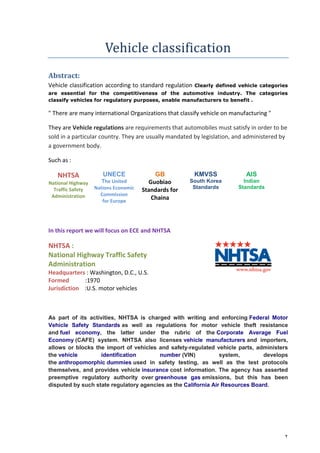
NHTSA
National Highway
Traffic Safety
Administration
UNECE
The United
Nations Economic
Commission
for Europe
GB
Guobiao
Standards for
Chaina
KMVSS
South Korea
Standards
AIS
Indian
Standards
In this report we will focus on ECE and NHTSA
NHTSA :
National Highway Traffic Safety
Administration
Headquarters : Washington, D.C., U.S.
Formed :1970
Jurisdiction :U.S. motor vehicles
As part of its activities, NHTSA is charged with writing and enforcing Federal Motor
Vehicle Safety Standards as well as regulations for motor vehicle theft resistance
and fuel economy, the latter under the rubric of the Corporate Average Fuel
Economy (CAFE) system. NHTSA also licenses vehicle manufacturers and importers,
allows or blocks the import of vehicles and safety-regulated vehicle parts, administers
the vehicle identification number (VIN) system, develops
the anthropomorphic dummies used in safety testing, as well as the test protocols
themselves, and provides vehicle insurance cost information. The agency has asserted
preemptive regulatory authority over greenhouse gas emissions, but this has been
disputed by such state regulatory agencies as the California Air Resources Board.
3
UNECE | ECE :
The United Nations Economic
Commission for Europe
Headquarters : Washington, D.C., U.S.
Formed : 1947
Jurisdiction : Commission for Europe
members
www.unece.org
The United Nations Economic Commission for Europe (UNECE or ECE) was established
in 1947 to encourage economic cooperation among its member states. It is one of five
regional commissions under the administrative direction of United Nations headquarters.
It has 56 member states, and reports to the United Nations Economic and Social
Council (ECOSOC). Besides countries in Europe.
A- Definitions of vehicles :
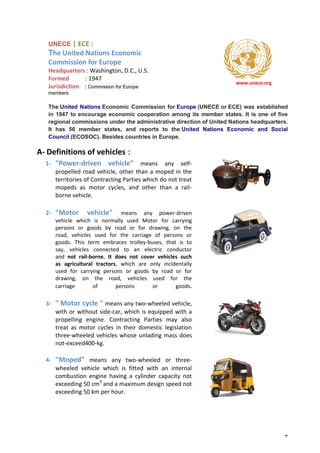
1- "Power-driven vehicle" means any self-
propelled road vehicle, other than a moped in the
territories of Contracting Parties which do not treat
mopeds as motor cycles, and other than a rail-
borne vehicle.
2- "Motor vehicle" means any power-driven
vehicle which is normally used Motor for carrying
persons or goods by road or for drawing, on the
road, vehicles used for the carriage of persons or
goods. This term embraces trolley-buses, that is to
say, vehicles connected to an electric conductor
and not rail-borne. It does not cover vehicles such
as agricultural tractors, which are only incidentally
used for carrying persons or goods by road or for
drawing, on the road, vehicles used for the
carriage of persons or goods.
3- " Motor cycle " means any two-wheeled vehicle,
with or without side-car, which is equipped with a
propelling engine. Contracting Parties may also
treat as motor cycles in their domestic legislation
three-wheeled vehicles whose unlading mass does
not-exceed400-kg.
4- "Moped" means any two-wheeled or three-
wheeled vehicle which is fitted with an internal
combustion engine having a cylinder capacity not
exceeding 50 cm3
and a maximum design speed not
exceeding 50 km per hour.
4
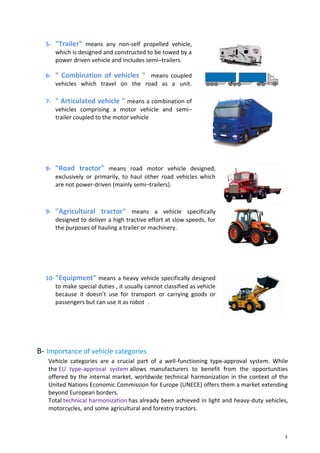
5- "Trailer" means any non-self propelled vehicle,
which is designed and constructed to be towed by a
power driven vehicle and includes semi–trailers.
6- " Combination of vehicles " means coupled
vehicles which travel on the road as a unit.
7- " Articulated vehicle " means a combination of
vehicles comprising a motor vehicle and semi–
trailer coupled to the motor vehicle
8- "Road tractor" means road motor vehicle designed,
exclusively or primarily, to haul other road vehicles which
are not power-driven (mainly semi–trailers).
9- "Agricultural tractor" means a vehicle specifically
designed to deliver a high tractive effort at slow speeds, for
the purposes of hauling a trailer or machinery.
10- "Equipment" means a heavy vehicle specifically designed
to make special duties , it usually cannot classified as vehicle
because it doesn’t use for transport or carrying goods or
passengers but can use it as robot .
B- Importance of vehicle categories
Vehicle categories are a crucial part of a well-functioning type-approval system. While
the EU type-approval system allows manufacturers to benefit from the opportunities
offered by the internal market, worldwide technical harmonization in the context of the
United Nations Economic Commission for Europe (UNECE) offers them a market extending
beyond European borders.
Total technical harmonization has already been achieved in light and heavy-duty vehicles,
motorcycles, and some agricultural and forestry tractors.
5
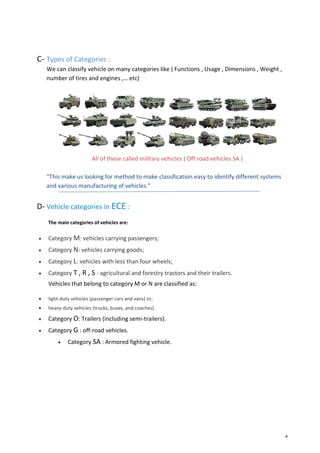
C- Types of Categories :
We can classify vehicle on many categories like ( Functions , Usage , Dimensions , Weight ,
number of tires and engines ,… etc)
All of these called military vehicles ( Off road vehicles SA )
“This make us looking for method to make classification easy to identify different systems
and various manufacturing of vehicles.”
D- Vehicle categories in ECE :
The main categories of vehicles are:
 Category M: vehicles carrying passengers;
 Category N: vehicles carrying goods;
 Category L: vehicles with less than four wheels;
 Category T , R , S : agricultural and forestry tractors and their trailers.
Vehicles that belong to category M or N are classified as:
 light-duty vehicles (passenger cars and vans) or;
 heavy-duty vehicles (trucks, buses, and coaches).
 Category O: Trailers (including semi-trailers).
 Category G : off-road vehicles.
 Category SA : Armored fighting vehicle.
6
LCategory
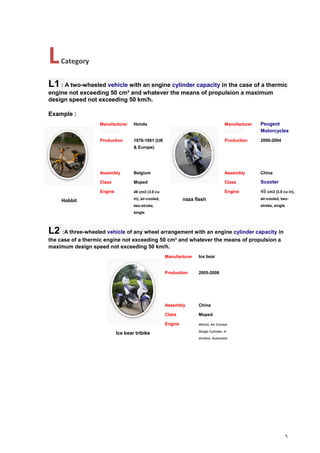
L1 : A two-wheeled vehicle with an engine cylinder capacity in the case of a thermic
engine not exceeding 50 cm³ and whatever the means of propulsion a maximum
design speed not exceeding 50 km/h.
Example :
Manufacturer Honda Manufacturer Peugeot
Motorcycles
Production 1976-1991 (UK
& Europe)
Production 2000-2004
Assembly Belgium Assembly China
Class Moped Class Scooter
Engine 49 cm3 (3.0 cu
in), air-cooled,
two-stroke,
single
Engine 49 cm3 (3.0 cu in),
air-cooled, two-
stroke, single
Hobbit naza flash
L2 :A three-wheeled vehicle of any wheel arrangement with an engine cylinder capacity in
the case of a thermic engine not exceeding 50 cm³ and whatever the means of propulsion a
maximum design speed not exceeding 50 km/h.
Manufacturer Ice bear
Production 2005-2008
Assembly China
Class Moped
Engine 49cm3, Air Cooled,
Single Cylinder, 4-
strokes, Automatic
Ice bear tribike
7
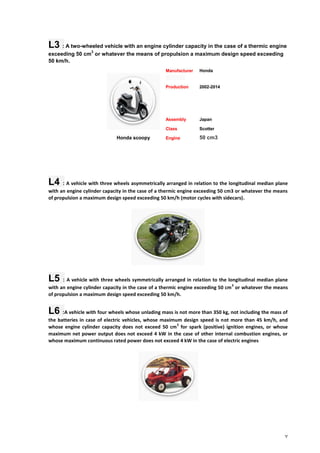
L3 : A two-wheeled vehicle with an engine cylinder capacity in the case of a thermic engine
exceeding 50 cm
3
or whatever the means of propulsion a maximum design speed exceeding
50 km/h.
Manufacturer Honda
Production 2002-2014
Assembly Japan
Class Scotter
Honda scoopy Engine 50 cm3
L4 : A vehicle with three wheels asymmetrically arranged in relation to the longitudinal median plane
with an engine cylinder capacity in the case of a thermic engine exceeding 50 cm3 or whatever the means
of propulsion a maximum design speed exceeding 50 km/h (motor cycles with sidecars).
L5 : A vehicle with three wheels symmetrically arranged in relation to the longitudinal median plane
with an engine cylinder capacity in the case of a thermic engine exceeding 50 cm
3
or whatever the means
of propulsion a maximum design speed exceeding 50 km/h.
L6 :A vehicle with four wheels whose unlading mass is not more than 350 kg, not including the mass of
the batteries in case of electric vehicles, whose maximum design speed is not more than 45 km/h, and
whose engine cylinder capacity does not exceed 50 cm
3
for spark (positive) ignition engines, or whose
maximum net power output does not exceed 4 kW in the case of other internal combustion engines, or
whose maximum continuous rated power does not exceed 4 kW in the case of electric engines
8
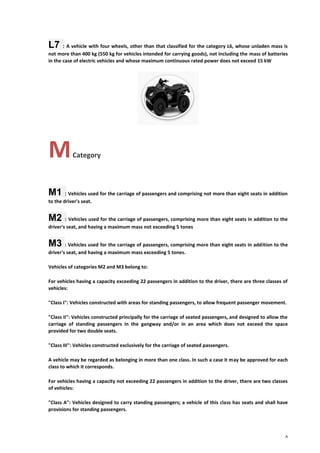
L7 : A vehicle with four wheels, other than that classified for the category L6, whose unladen mass is
not more than 400 kg (550 kg for vehicles intended for carrying goods), not including the mass of batteries
in the case of electric vehicles and whose maximum continuous rated power does not exceed 15 kW
MCategory
M1 : Vehicles used for the carriage of passengers and comprising not more than eight seats in addition
to the driver's seat.
M2 : Vehicles used for the carriage of passengers, comprising more than eight seats in addition to the
driver's seat, and having a maximum mass not exceeding 5 tones
M3 : Vehicles used for the carriage of passengers, comprising more than eight seats in addition to the
driver's seat, and having a maximum mass exceeding 5 tones.
Vehicles of categories M2 and M3 belong to:
For vehicles having a capacity exceeding 22 passengers in addition to the driver, there are three classes of
vehicles:
"Class I": Vehicles constructed with areas for standing passengers, to allow frequent passenger movement.
"Class II": Vehicles constructed principally for the carriage of seated passengers, and designed to allow the
carriage of standing passengers in the gangway and/or in an area which does not exceed the space
provided for two double seats.
"Class III": Vehicles constructed exclusively for the carriage of seated passengers.
A vehicle may be regarded as belonging in more than one class. In such a case it may be approved for each
class to which it corresponds.
For vehicles having a capacity not exceeding 22 passengers in addition to the driver, there are two classes
of vehicles:
"Class A": Vehicles designed to carry standing passengers; a vehicle of this class has seats and shall have
provisions for standing passengers.
9
"Class B": Vehicles not designed to carry standing passengers; a vehicle of this class has no provision for
standing passengers.
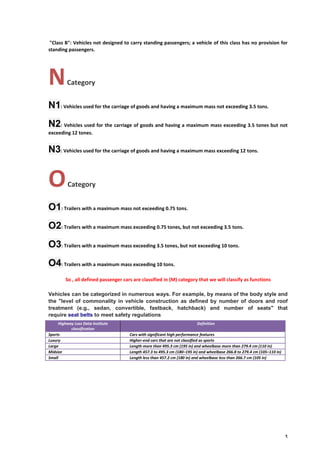
NCategory
N1: Vehicles used for the carriage of goods and having a maximum mass not exceeding 3.5 tons.
N2: Vehicles used for the carriage of goods and having a maximum mass exceeding 3.5 tones but not
exceeding 12 tones.
N3: Vehicles used for the carriage of goods and having a maximum mass exceeding 12 tons.
OCategory
O1: Trailers with a maximum mass not exceeding 0.75 tons.
O2: Trailers with a maximum mass exceeding 0.75 tones, but not exceeding 3.5 tons.
O3: Trailers with a maximum mass exceeding 3.5 tones, but not exceeding 10 tons.
O4: Trailers with a maximum mass exceeding 10 tons.
So , all defined passenger cars are classified in (M) category that we will classify as functions
Vehicles can be categorized in numerous ways. For example, by means of the body style and
the "level of commonality in vehicle construction as defined by number of doors and roof
treatment (e.g., sedan, convertible, fastback, hatchback) and number of seats" that
require seat belts to meet safety regulations
Highway Loss Data Institute
classification
Definition
Sports Cars with significant high performance features
Luxury Higher-end cars that are not classified as sports
Large Length more than 495.3 cm (195 in) and wheelbase more than 279.4 cm (110 in)
Midsize Length 457.3 to 495.3 cm (180–195 in) and wheelbase 266.8 to 279.4 cm (105–110 in)
Small Length less than 457.2 cm (180 in) and wheelbase less than 266.7 cm (105 in)
10
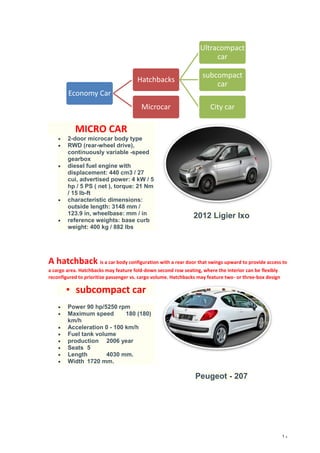
MICRO CAR
 2-door microcar body type
 RWD (rear-wheel drive),
continuously variable -speed
gearbox
 diesel fuel engine with
displacement: 440 cm3 / 27
cui, advertised power: 4 kW / 5
hp / 5 PS ( net ), torque: 21 Nm
/ 15 lb-ft
 characteristic dimensions:
outside length: 3148 mm /
123.9 in, wheelbase: mm / in
 reference weights: base curb
weight: 400 kg / 882 lbs
2012 Ligier Ixo
A hatchback is a car body configuration with a rear door that swings upward to provide access to
a cargo area. Hatchbacks may feature fold-down second row seating, where the interior can be flexibly
reconfigured to prioritize passenger vs. cargo volume. Hatchbacks may feature two- or three-box design
• subcompact car
 Power 90 hp/5250 rpm
 Maximum speed 180 (180)
km/h
 Acceleration 0 - 100 km/h
 Fuel tank volume
 production 2006 year
 Seats 5
 Length 4030 mm.
 Width 1720 mm.
Peugeot - 207
Economy Car
Hatchbacks
Ultracompact
car
subcompact
car
City carMicrocar
11
• City Car
city car is a small
automobile intended
for use in urban areas.
Unlike microcars, a
city car's greater
speed, capacity and
(in perception at least)
occupant protection
are safer in mixed
traffic environments
and weather
conditions.
chevrolet spark 2016
Small
 Transmission5-speed manual
 6-speed manual
 6-speed automatic
 Dimensions
 Wheelbase 2,620 mm (103.1
in)
 Length 4,253 mm (167.4
in)
 4,580 mm (180.3 in) for SW
 Width 1,815 mm (71.5 in)
 Height 1,460 mm (57.5 in)
Peugeot 308 2007
Family Car
Large / mid
small
12
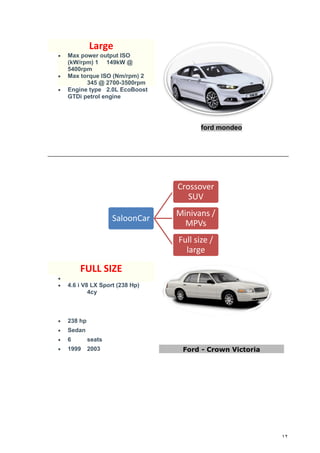
Large
 Max power output ISO
(kW/rpm) 1 149kW @
5400rpm
 Max torque ISO (Nm/rpm) 2
345 @ 2700-3500rpm
 Engine type 2.0L EcoBoost
GTDi petrol engine
ford mondeo
FULL SIZE

 4.6 i V8 LX Sport (238 Hp)
4cy
 238 hp
 Sedan
 6 seats
 1999 2003 Ford - Crown Victoria
SaloonCar
Crossover
SUV
Minivans /
MPVs
Full size /
large
13
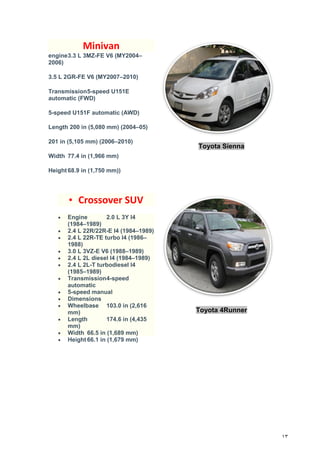
Minivan
engine3.3 L 3MZ-FE V6 (MY2004–
2006)
3.5 L 2GR-FE V6 (MY2007–2010)
Transmission5-speed U151E
automatic (FWD)
5-speed U151F automatic (AWD)
Length 200 in (5,080 mm) (2004–05)
201 in (5,105 mm) (2006–2010)
Width 77.4 in (1,966 mm)
Height 68.9 in (1,750 mm))
Toyota Sienna
• Crossover SUV
 Engine 2.0 L 3Y I4
(1984–1989)
 2.4 L 22R/22R-E I4 (1984–1989)
 2.4 L 22R-TE turbo I4 (1986–
1988)
 3.0 L 3VZ-E V6 (1988–1989)
 2.4 L 2L diesel I4 (1984–1989)
 2.4 L 2L-T turbodiesel I4
(1985–1989)
 Transmission4-speed
automatic
 5-speed manual
 Dimensions
 Wheelbase 103.0 in (2,616
mm)
 Length 174.6 in (4,435
mm)
 Width 66.5 in (1,689 mm)
 Height 66.1 in (1,679 mm)
Toyota 4Runner
14
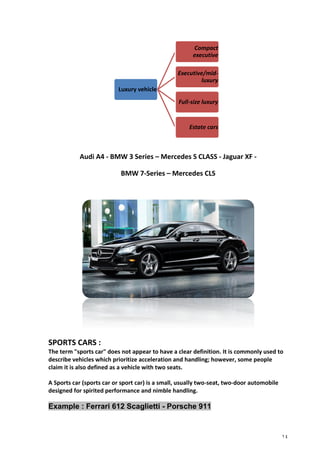
Audi A4 - BMW 3 Series – Mercedes S CLASS - Jaguar XF -
BMW 7-Series – Mercedes CLS
SPORTS CARS :
The term "sports car" does not appear to have a clear definition. It is commonly used to
describe vehicles which prioritize acceleration and handling; however, some people
claim it is also defined as a vehicle with two seats.
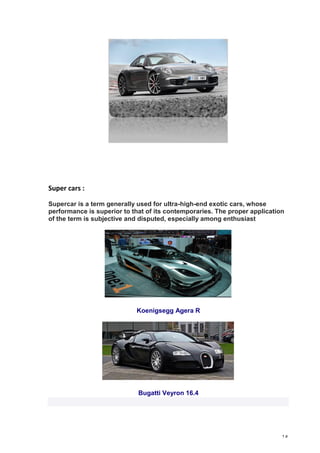
A Sports car (sports car or sport car) is a small, usually two-seat, two-door automobile
designed for spirited performance and nimble handling.
Example : Ferrari 612 Scaglietti - Porsche 911
Luxury vehicle
Compact
executive
Executive/mid-
luxury
Full-size luxury
Estate cars
15
Super cars :
Supercar is a term generally used for ultra-high-end exotic cars, whose
performance is superior to that of its contemporaries. The proper application
of the term is subjective and disputed, especially among enthusiast
Koenigsegg Agera R
Bugatti Veyron 16.4
16
Power to weight ratio :
You can have all the power in the world under the hood but unless its used efficiently, it may
as well not be there. A car’s horsepower only tells one side of the story when it comes to a
car’s speed. A better way to gauge how fast a car is to check out its power to weight ratio.
Power to weight ratio is used as a measurement of a car’s performance, with the power
output divided by the mass of the car to give a metric that is independent of a car’s size.
Why the need to include mass (or weight) in the calculation? Revisiting Newtonian’s Kinetic
Energy Equation, Ek=½mv
2
, by reducing the mass, less energy is needed for a car to move at
the same speed. Hence it is important to take into account the horsepower along with the
weight when measuring a vehicle’s performance.
In short, cars with lower horsepower may not necessarily be slower than cars with higher
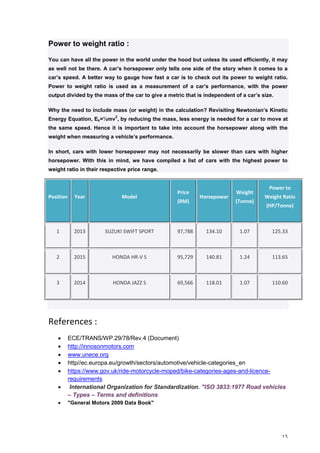
horsepower. With this in mind, we have compiled a list of cars with the highest power to
weight ratio in their respective price range.
Position Year Model
Price
(RM)
Horsepower
Weight
(Tonne)
Power to
Weight Ratio
(HP/Tonne)
1 2013 SUZUKI SWIFT SPORT 97,788 134.10 1.07 125.33
2 2015 HONDA HR-V S 95,729 140.81 1.24 113.65
3 2014 HONDA JAZZ S 69,566 118.01 1.07 110.60
References :
 ECE/TRANS/WP.29/78/Rev.4 (Document)
 http://innosonmotors.com
 www.unece.org
 http//ec.europa.eu/growth/sectors/automotive/vehicle-categories_en
 https://www.gov.uk/ride-motorcycle-moped/bike-categories-ages-and-licence-
requirements
 International Organization for Standardization. "ISO 3833:1977 Road vehicles
– Types – Terms and definitions
 "General Motors 2009 Data Book"

Vehicle classification

  • 1.
    0 NAME KAREEM AYMANABDEL HAMID MOHAMED SECTION 3 DEPARTMENT AUTOMOTIVE ENGINEERING DEP. 3RD SQUAD REPORT ON VEHICLES CLASSIFICATION COURSE AUTOMOTIVE ENGINEERING 1 Lecturer Professor / WALID ABDUL HADY YEAR 2016-2017
  • 2.
    1 Contents 2 . Abstract 3.Definition of vehicles 4. Importance of vehicle categories 5. Types of Categories 5.Vehicle categories in ECE 6,7. L category 8. M category 9. N category and O category 10. Economy Cars 11. Family Cars 12. Saloon Cars 13. crossover cars 14. Luxury cars 15. Super Cars and sport cars 16. Power to weight Ratio 16. References
  • 3.
    2 Vehicle classification Abstract: Vehicle classificationaccording to standard regulation Clearly defined vehicle categories are essential for the competitiveness of the automotive industry. The categories classify vehicles for regulatory purposes, enable manufacturers to benefit . " There are many international Organizations that classify vehicle on manufacturing " They are Vehicle regulations are requirements that automobiles must satisfy in order to be sold in a particular country. They are usually mandated by legislation, and administered by a government body. Such as : NHTSA National Highway Traffic Safety Administration UNECE The United Nations Economic Commission for Europe GB Guobiao Standards for Chaina KMVSS South Korea Standards AIS Indian Standards In this report we will focus on ECE and NHTSA NHTSA : National Highway Traffic Safety Administration Headquarters : Washington, D.C., U.S. Formed :1970 Jurisdiction :U.S. motor vehicles As part of its activities, NHTSA is charged with writing and enforcing Federal Motor Vehicle Safety Standards as well as regulations for motor vehicle theft resistance and fuel economy, the latter under the rubric of the Corporate Average Fuel Economy (CAFE) system. NHTSA also licenses vehicle manufacturers and importers, allows or blocks the import of vehicles and safety-regulated vehicle parts, administers the vehicle identification number (VIN) system, develops the anthropomorphic dummies used in safety testing, as well as the test protocols themselves, and provides vehicle insurance cost information. The agency has asserted preemptive regulatory authority over greenhouse gas emissions, but this has been disputed by such state regulatory agencies as the California Air Resources Board.
  • 4.
    3 UNECE | ECE: The United Nations Economic Commission for Europe Headquarters : Washington, D.C., U.S. Formed : 1947 Jurisdiction : Commission for Europe members www.unece.org The United Nations Economic Commission for Europe (UNECE or ECE) was established in 1947 to encourage economic cooperation among its member states. It is one of five regional commissions under the administrative direction of United Nations headquarters. It has 56 member states, and reports to the United Nations Economic and Social Council (ECOSOC). Besides countries in Europe. A- Definitions of vehicles : 1- "Power-driven vehicle" means any self- propelled road vehicle, other than a moped in the territories of Contracting Parties which do not treat mopeds as motor cycles, and other than a rail- borne vehicle. 2- "Motor vehicle" means any power-driven vehicle which is normally used Motor for carrying persons or goods by road or for drawing, on the road, vehicles used for the carriage of persons or goods. This term embraces trolley-buses, that is to say, vehicles connected to an electric conductor and not rail-borne. It does not cover vehicles such as agricultural tractors, which are only incidentally used for carrying persons or goods by road or for drawing, on the road, vehicles used for the carriage of persons or goods. 3- " Motor cycle " means any two-wheeled vehicle, with or without side-car, which is equipped with a propelling engine. Contracting Parties may also treat as motor cycles in their domestic legislation three-wheeled vehicles whose unlading mass does not-exceed400-kg. 4- "Moped" means any two-wheeled or three- wheeled vehicle which is fitted with an internal combustion engine having a cylinder capacity not exceeding 50 cm3 and a maximum design speed not exceeding 50 km per hour.
  • 5.
    4 5- "Trailer" meansany non-self propelled vehicle, which is designed and constructed to be towed by a power driven vehicle and includes semi–trailers. 6- " Combination of vehicles " means coupled vehicles which travel on the road as a unit. 7- " Articulated vehicle " means a combination of vehicles comprising a motor vehicle and semi– trailer coupled to the motor vehicle 8- "Road tractor" means road motor vehicle designed, exclusively or primarily, to haul other road vehicles which are not power-driven (mainly semi–trailers). 9- "Agricultural tractor" means a vehicle specifically designed to deliver a high tractive effort at slow speeds, for the purposes of hauling a trailer or machinery. 10- "Equipment" means a heavy vehicle specifically designed to make special duties , it usually cannot classified as vehicle because it doesn’t use for transport or carrying goods or passengers but can use it as robot . B- Importance of vehicle categories Vehicle categories are a crucial part of a well-functioning type-approval system. While the EU type-approval system allows manufacturers to benefit from the opportunities offered by the internal market, worldwide technical harmonization in the context of the United Nations Economic Commission for Europe (UNECE) offers them a market extending beyond European borders. Total technical harmonization has already been achieved in light and heavy-duty vehicles, motorcycles, and some agricultural and forestry tractors.
  • 6.
    5 C- Types ofCategories : We can classify vehicle on many categories like ( Functions , Usage , Dimensions , Weight , number of tires and engines ,… etc) All of these called military vehicles ( Off road vehicles SA ) “This make us looking for method to make classification easy to identify different systems and various manufacturing of vehicles.” D- Vehicle categories in ECE : The main categories of vehicles are:  Category M: vehicles carrying passengers;  Category N: vehicles carrying goods;  Category L: vehicles with less than four wheels;  Category T , R , S : agricultural and forestry tractors and their trailers. Vehicles that belong to category M or N are classified as:  light-duty vehicles (passenger cars and vans) or;  heavy-duty vehicles (trucks, buses, and coaches).  Category O: Trailers (including semi-trailers).  Category G : off-road vehicles.  Category SA : Armored fighting vehicle.
  • 7.
    6 LCategory L1 : Atwo-wheeled vehicle with an engine cylinder capacity in the case of a thermic engine not exceeding 50 cm³ and whatever the means of propulsion a maximum design speed not exceeding 50 km/h. Example : Manufacturer Honda Manufacturer Peugeot Motorcycles Production 1976-1991 (UK & Europe) Production 2000-2004 Assembly Belgium Assembly China Class Moped Class Scooter Engine 49 cm3 (3.0 cu in), air-cooled, two-stroke, single Engine 49 cm3 (3.0 cu in), air-cooled, two- stroke, single Hobbit naza flash L2 :A three-wheeled vehicle of any wheel arrangement with an engine cylinder capacity in the case of a thermic engine not exceeding 50 cm³ and whatever the means of propulsion a maximum design speed not exceeding 50 km/h. Manufacturer Ice bear Production 2005-2008 Assembly China Class Moped Engine 49cm3, Air Cooled, Single Cylinder, 4- strokes, Automatic Ice bear tribike
  • 8.
    7 L3 : Atwo-wheeled vehicle with an engine cylinder capacity in the case of a thermic engine exceeding 50 cm 3 or whatever the means of propulsion a maximum design speed exceeding 50 km/h. Manufacturer Honda Production 2002-2014 Assembly Japan Class Scotter Honda scoopy Engine 50 cm3 L4 : A vehicle with three wheels asymmetrically arranged in relation to the longitudinal median plane with an engine cylinder capacity in the case of a thermic engine exceeding 50 cm3 or whatever the means of propulsion a maximum design speed exceeding 50 km/h (motor cycles with sidecars). L5 : A vehicle with three wheels symmetrically arranged in relation to the longitudinal median plane with an engine cylinder capacity in the case of a thermic engine exceeding 50 cm 3 or whatever the means of propulsion a maximum design speed exceeding 50 km/h. L6 :A vehicle with four wheels whose unlading mass is not more than 350 kg, not including the mass of the batteries in case of electric vehicles, whose maximum design speed is not more than 45 km/h, and whose engine cylinder capacity does not exceed 50 cm 3 for spark (positive) ignition engines, or whose maximum net power output does not exceed 4 kW in the case of other internal combustion engines, or whose maximum continuous rated power does not exceed 4 kW in the case of electric engines
  • 9.
    8 L7 : Avehicle with four wheels, other than that classified for the category L6, whose unladen mass is not more than 400 kg (550 kg for vehicles intended for carrying goods), not including the mass of batteries in the case of electric vehicles and whose maximum continuous rated power does not exceed 15 kW MCategory M1 : Vehicles used for the carriage of passengers and comprising not more than eight seats in addition to the driver's seat. M2 : Vehicles used for the carriage of passengers, comprising more than eight seats in addition to the driver's seat, and having a maximum mass not exceeding 5 tones M3 : Vehicles used for the carriage of passengers, comprising more than eight seats in addition to the driver's seat, and having a maximum mass exceeding 5 tones. Vehicles of categories M2 and M3 belong to: For vehicles having a capacity exceeding 22 passengers in addition to the driver, there are three classes of vehicles: "Class I": Vehicles constructed with areas for standing passengers, to allow frequent passenger movement. "Class II": Vehicles constructed principally for the carriage of seated passengers, and designed to allow the carriage of standing passengers in the gangway and/or in an area which does not exceed the space provided for two double seats. "Class III": Vehicles constructed exclusively for the carriage of seated passengers. A vehicle may be regarded as belonging in more than one class. In such a case it may be approved for each class to which it corresponds. For vehicles having a capacity not exceeding 22 passengers in addition to the driver, there are two classes of vehicles: "Class A": Vehicles designed to carry standing passengers; a vehicle of this class has seats and shall have provisions for standing passengers.
  • 10.
    9 "Class B": Vehiclesnot designed to carry standing passengers; a vehicle of this class has no provision for standing passengers. NCategory N1: Vehicles used for the carriage of goods and having a maximum mass not exceeding 3.5 tons. N2: Vehicles used for the carriage of goods and having a maximum mass exceeding 3.5 tones but not exceeding 12 tones. N3: Vehicles used for the carriage of goods and having a maximum mass exceeding 12 tons. OCategory O1: Trailers with a maximum mass not exceeding 0.75 tons. O2: Trailers with a maximum mass exceeding 0.75 tones, but not exceeding 3.5 tons. O3: Trailers with a maximum mass exceeding 3.5 tones, but not exceeding 10 tons. O4: Trailers with a maximum mass exceeding 10 tons. So , all defined passenger cars are classified in (M) category that we will classify as functions Vehicles can be categorized in numerous ways. For example, by means of the body style and the "level of commonality in vehicle construction as defined by number of doors and roof treatment (e.g., sedan, convertible, fastback, hatchback) and number of seats" that require seat belts to meet safety regulations Highway Loss Data Institute classification Definition Sports Cars with significant high performance features Luxury Higher-end cars that are not classified as sports Large Length more than 495.3 cm (195 in) and wheelbase more than 279.4 cm (110 in) Midsize Length 457.3 to 495.3 cm (180–195 in) and wheelbase 266.8 to 279.4 cm (105–110 in) Small Length less than 457.2 cm (180 in) and wheelbase less than 266.7 cm (105 in)
  • 11.
    10 MICRO CAR  2-doormicrocar body type  RWD (rear-wheel drive), continuously variable -speed gearbox  diesel fuel engine with displacement: 440 cm3 / 27 cui, advertised power: 4 kW / 5 hp / 5 PS ( net ), torque: 21 Nm / 15 lb-ft  characteristic dimensions: outside length: 3148 mm / 123.9 in, wheelbase: mm / in  reference weights: base curb weight: 400 kg / 882 lbs 2012 Ligier Ixo A hatchback is a car body configuration with a rear door that swings upward to provide access to a cargo area. Hatchbacks may feature fold-down second row seating, where the interior can be flexibly reconfigured to prioritize passenger vs. cargo volume. Hatchbacks may feature two- or three-box design • subcompact car  Power 90 hp/5250 rpm  Maximum speed 180 (180) km/h  Acceleration 0 - 100 km/h  Fuel tank volume  production 2006 year  Seats 5  Length 4030 mm.  Width 1720 mm. Peugeot - 207 Economy Car Hatchbacks Ultracompact car subcompact car City carMicrocar
  • 12.
    11 • City Car citycar is a small automobile intended for use in urban areas. Unlike microcars, a city car's greater speed, capacity and (in perception at least) occupant protection are safer in mixed traffic environments and weather conditions. chevrolet spark 2016 Small  Transmission5-speed manual  6-speed manual  6-speed automatic  Dimensions  Wheelbase 2,620 mm (103.1 in)  Length 4,253 mm (167.4 in)  4,580 mm (180.3 in) for SW  Width 1,815 mm (71.5 in)  Height 1,460 mm (57.5 in) Peugeot 308 2007 Family Car Large / mid small
  • 13.
    12 Large  Max poweroutput ISO (kW/rpm) 1 149kW @ 5400rpm  Max torque ISO (Nm/rpm) 2 345 @ 2700-3500rpm  Engine type 2.0L EcoBoost GTDi petrol engine ford mondeo FULL SIZE   4.6 i V8 LX Sport (238 Hp) 4cy  238 hp  Sedan  6 seats  1999 2003 Ford - Crown Victoria SaloonCar Crossover SUV Minivans / MPVs Full size / large
  • 14.
    13 Minivan engine3.3 L 3MZ-FEV6 (MY2004– 2006) 3.5 L 2GR-FE V6 (MY2007–2010) Transmission5-speed U151E automatic (FWD) 5-speed U151F automatic (AWD) Length 200 in (5,080 mm) (2004–05) 201 in (5,105 mm) (2006–2010) Width 77.4 in (1,966 mm) Height 68.9 in (1,750 mm)) Toyota Sienna • Crossover SUV  Engine 2.0 L 3Y I4 (1984–1989)  2.4 L 22R/22R-E I4 (1984–1989)  2.4 L 22R-TE turbo I4 (1986– 1988)  3.0 L 3VZ-E V6 (1988–1989)  2.4 L 2L diesel I4 (1984–1989)  2.4 L 2L-T turbodiesel I4 (1985–1989)  Transmission4-speed automatic  5-speed manual  Dimensions  Wheelbase 103.0 in (2,616 mm)  Length 174.6 in (4,435 mm)  Width 66.5 in (1,689 mm)  Height 66.1 in (1,679 mm) Toyota 4Runner
  • 15.
    14 Audi A4 -BMW 3 Series – Mercedes S CLASS - Jaguar XF - BMW 7-Series – Mercedes CLS SPORTS CARS : The term "sports car" does not appear to have a clear definition. It is commonly used to describe vehicles which prioritize acceleration and handling; however, some people claim it is also defined as a vehicle with two seats. A Sports car (sports car or sport car) is a small, usually two-seat, two-door automobile designed for spirited performance and nimble handling. Example : Ferrari 612 Scaglietti - Porsche 911 Luxury vehicle Compact executive Executive/mid- luxury Full-size luxury Estate cars
  • 16.
    15 Super cars : Supercaris a term generally used for ultra-high-end exotic cars, whose performance is superior to that of its contemporaries. The proper application of the term is subjective and disputed, especially among enthusiast Koenigsegg Agera R Bugatti Veyron 16.4
  • 17.
    16 Power to weightratio : You can have all the power in the world under the hood but unless its used efficiently, it may as well not be there. A car’s horsepower only tells one side of the story when it comes to a car’s speed. A better way to gauge how fast a car is to check out its power to weight ratio. Power to weight ratio is used as a measurement of a car’s performance, with the power output divided by the mass of the car to give a metric that is independent of a car’s size. Why the need to include mass (or weight) in the calculation? Revisiting Newtonian’s Kinetic Energy Equation, Ek=½mv 2 , by reducing the mass, less energy is needed for a car to move at the same speed. Hence it is important to take into account the horsepower along with the weight when measuring a vehicle’s performance. In short, cars with lower horsepower may not necessarily be slower than cars with higher horsepower. With this in mind, we have compiled a list of cars with the highest power to weight ratio in their respective price range. Position Year Model Price (RM) Horsepower Weight (Tonne) Power to Weight Ratio (HP/Tonne) 1 2013 SUZUKI SWIFT SPORT 97,788 134.10 1.07 125.33 2 2015 HONDA HR-V S 95,729 140.81 1.24 113.65 3 2014 HONDA JAZZ S 69,566 118.01 1.07 110.60 References :  ECE/TRANS/WP.29/78/Rev.4 (Document)  http://innosonmotors.com  www.unece.org  http//ec.europa.eu/growth/sectors/automotive/vehicle-categories_en  https://www.gov.uk/ride-motorcycle-moped/bike-categories-ages-and-licence- requirements  International Organization for Standardization. "ISO 3833:1977 Road vehicles – Types – Terms and definitions  "General Motors 2009 Data Book"