Introduction
Outline
 Classification of motor vehicles
 Transmission of motion to wheel
Introduction
1. What is motor vehicle?
2. What is automotive?
Introduction
1. What is motor vehicle?
 A motor vehicle, also known as motorized
vehicle or automotive vehicle, is a self-propelled
land vehicle, commonly wheeled, that does not operate
on rails (such as trains or trams) and is used for the
transportation of people or cargo.
 In 1968 the Vienna convention on road traffic (which no
longer exists) gave one of the first international definitions
of a motor vehicle:
 “Power-driven vehicle” means any self-propelled road
vehicle, other than a moped in the territories of Contracting
Parties which do not treat mopeds as motorcycles, and other
than a rail-borne vehicle;
 (p) “Motor vehicle” means any power-driven vehicle which is
normally used for carrying persons or goods by road or for
drawing, on the road, vehicles used for the carriage of
persons or goods.
Introduction
1. What is automotive?
A self propelled vehicle used for transportation of goods and
passengers on land is called an automobile.
adjective
 pertaining to the design, operation, manufacture, or
sale of automobiles
 propelled by a self-contained motor, engine, or the
like.
noun
 Informal. an industry, store department, etc.,
specializing in appliances and parts for cars, trucks,
and other motorized vehicles:
Introduction
Classification of motor vehicles
 On the basis of number of wheels.
 On the basis of prime mover used
 On the basis of weight of the vehicle and its
payload capacity.
 On the basis of purpose served.
 On the basis of fuel used.
 On the basis of type of wheel drive system.
Introduction
On the basis of number of wheels
Two - wheelers such as motorcycles.
 Three - wheelers such as tempos (Bajaj, TVS), road rollers,
tractors.
 Four - Wheelers such as cars, jeeps, minibuses, trucks, tractors,
buses and racing cars.
 Six - wheelers such as truck tankers, gun carriage vehicles.
 Eight or more – wheelers such as a car transporting vehicles.
ON THE BASIS OF purpose served
 On – the – road vehicles such as motorcycles, cars, trucks.
 Off - the – road vehicles such as tractors, construction
equipments.
 On –the – road and off – the – road vehicles such as wheel
dozers, motor graders.
Introduction
ON THE BASIS OF PRIME MOVER USED
 Steam engine driven auto vehicles
 I.C engine driven auto vehicles
 Petrol vehicles
 Diesel vehicles
 Gas vehicles
 Gas turbine driven auto vehicles
 Electric power driven auto vehicles
 Battery (chemical power) driven auto vehicles
 Solar energy driven auto vehicles
 Hydrogen (fuel) propelled auto vehicles
 Wankel engine driven auto vehicles
 Hybrid powered auto vehicles
Introduction
On the basis of weight of the vehicle and its payload capacity
Gross Vehicle Weight (GVW)– Kerb weight = payload
 Light weight or light duty vehicles GVW – 1 tonne
 Medium weight or medium duty vehicles, 3.5 > gvw > 1
 Heavy weight or heavy duty vehicles 7.5 > gvw >3.5
 Extra heavy duty vehicles 15 > gvw > 7.5
 Special purpose (load) vehicles, GVW > 15 tone
On the basis of fuel used
 Petrol vehicles
 Diesel vehicles
 Multi fuel
 Gas vehicles
 Hydrogen vehicles
 Electric vehicles
Introduction
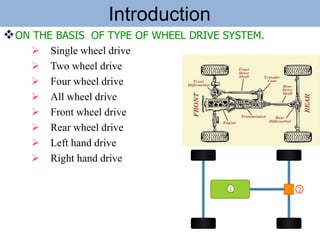
ON THE BASIS OF TYPE OF WHEEL DRIVE SYSTEM.
 Single wheel drive
 Two wheel drive
 Four wheel drive
 All wheel drive
 Front wheel drive
 Rear wheel drive
 Left hand drive
 Right hand drive
Introduction
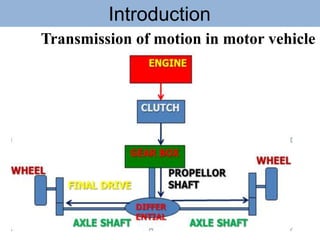
Transmission of motion in motor vehicle
Introduction
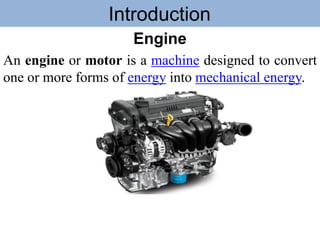
Engine
An engine or motor is a machine designed to convert
one or more forms of energy into mechanical energy.
Introduction
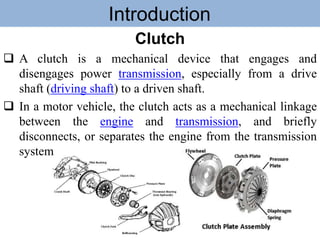
Clutch
 A clutch is a mechanical device that engages and
disengages power transmission, especially from a drive
shaft (driving shaft) to a driven shaft.
 In a motor vehicle, the clutch acts as a mechanical linkage
between the engine and transmission, and briefly
disconnects, or separates the engine from the transmission
system
Introduction
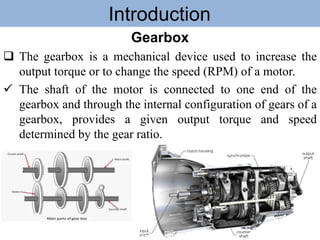
Gearbox
 The gearbox is a mechanical device used to increase the
output torque or to change the speed (RPM) of a motor.
 The shaft of the motor is connected to one end of the
gearbox and through the internal configuration of gears of a
gearbox, provides a given output torque and speed
determined by the gear ratio.
Introduction
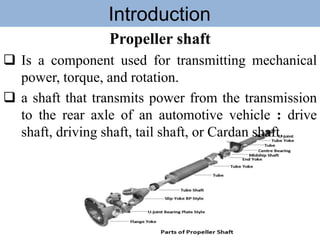
Propeller shaft
 Is a component used for transmitting mechanical
power, torque, and rotation.
 a shaft that transmits power from the transmission
to the rear axle of an automotive vehicle : drive
shaft, driving shaft, tail shaft, or Cardan shaft.
Introduction
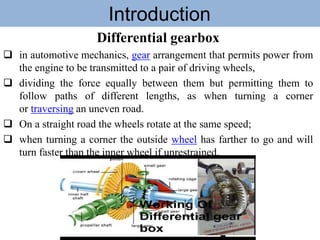
Differential gearbox
 in automotive mechanics, gear arrangement that permits power from
the engine to be transmitted to a pair of driving wheels,
 dividing the force equally between them but permitting them to
follow paths of different lengths, as when turning a corner
or traversing an uneven road.
 On a straight road the wheels rotate at the same speed;
 when turning a corner the outside wheel has farther to go and will
turn faster than the inner wheel if unrestrained.
Introduction
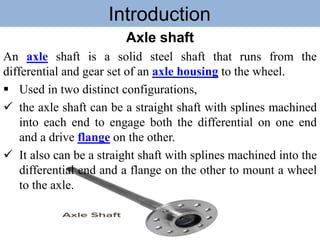
Axle shaft
An axle shaft is a solid steel shaft that runs from the
differential and gear set of an axle housing to the wheel.
 Used in two distinct configurations,
 the axle shaft can be a straight shaft with splines machined
into each end to engage both the differential on one end
and a drive flange on the other.
 It also can be a straight shaft with splines machined into the
differential end and a flange on the other to mount a wheel
to the axle.
Introduction
Wheel
A wheel is a circular component that is intended to
rotate on an axle bearing. The wheel is one of the key
components of the wheel and axle which is one of
the six simple machines.

Motor Vehicle Chap-1 Introduction.pptx

  • 1.
    Introduction Outline  Classification ofmotor vehicles  Transmission of motion to wheel
  • 2.
    Introduction 1. What ismotor vehicle? 2. What is automotive?
  • 3.
    Introduction 1. What ismotor vehicle?  A motor vehicle, also known as motorized vehicle or automotive vehicle, is a self-propelled land vehicle, commonly wheeled, that does not operate on rails (such as trains or trams) and is used for the transportation of people or cargo.  In 1968 the Vienna convention on road traffic (which no longer exists) gave one of the first international definitions of a motor vehicle:  “Power-driven vehicle” means any self-propelled road vehicle, other than a moped in the territories of Contracting Parties which do not treat mopeds as motorcycles, and other than a rail-borne vehicle;  (p) “Motor vehicle” means any power-driven vehicle which is normally used for carrying persons or goods by road or for drawing, on the road, vehicles used for the carriage of persons or goods.
  • 4.
    Introduction 1. What isautomotive? A self propelled vehicle used for transportation of goods and passengers on land is called an automobile. adjective  pertaining to the design, operation, manufacture, or sale of automobiles  propelled by a self-contained motor, engine, or the like. noun  Informal. an industry, store department, etc., specializing in appliances and parts for cars, trucks, and other motorized vehicles:
  • 5.
    Introduction Classification of motorvehicles  On the basis of number of wheels.  On the basis of prime mover used  On the basis of weight of the vehicle and its payload capacity.  On the basis of purpose served.  On the basis of fuel used.  On the basis of type of wheel drive system.
  • 6.
    Introduction On the basisof number of wheels Two - wheelers such as motorcycles.  Three - wheelers such as tempos (Bajaj, TVS), road rollers, tractors.  Four - Wheelers such as cars, jeeps, minibuses, trucks, tractors, buses and racing cars.  Six - wheelers such as truck tankers, gun carriage vehicles.  Eight or more – wheelers such as a car transporting vehicles. ON THE BASIS OF purpose served  On – the – road vehicles such as motorcycles, cars, trucks.  Off - the – road vehicles such as tractors, construction equipments.  On –the – road and off – the – road vehicles such as wheel dozers, motor graders.
  • 7.
    Introduction ON THE BASISOF PRIME MOVER USED  Steam engine driven auto vehicles  I.C engine driven auto vehicles  Petrol vehicles  Diesel vehicles  Gas vehicles  Gas turbine driven auto vehicles  Electric power driven auto vehicles  Battery (chemical power) driven auto vehicles  Solar energy driven auto vehicles  Hydrogen (fuel) propelled auto vehicles  Wankel engine driven auto vehicles  Hybrid powered auto vehicles
  • 8.
    Introduction On the basisof weight of the vehicle and its payload capacity Gross Vehicle Weight (GVW)– Kerb weight = payload  Light weight or light duty vehicles GVW – 1 tonne  Medium weight or medium duty vehicles, 3.5 > gvw > 1  Heavy weight or heavy duty vehicles 7.5 > gvw >3.5  Extra heavy duty vehicles 15 > gvw > 7.5  Special purpose (load) vehicles, GVW > 15 tone On the basis of fuel used  Petrol vehicles  Diesel vehicles  Multi fuel  Gas vehicles  Hydrogen vehicles  Electric vehicles
  • 9.
    Introduction ON THE BASISOF TYPE OF WHEEL DRIVE SYSTEM.  Single wheel drive  Two wheel drive  Four wheel drive  All wheel drive  Front wheel drive  Rear wheel drive  Left hand drive  Right hand drive
  • 10.
  • 11.
    Introduction Engine An engine ormotor is a machine designed to convert one or more forms of energy into mechanical energy.
  • 12.
    Introduction Clutch  A clutchis a mechanical device that engages and disengages power transmission, especially from a drive shaft (driving shaft) to a driven shaft.  In a motor vehicle, the clutch acts as a mechanical linkage between the engine and transmission, and briefly disconnects, or separates the engine from the transmission system
  • 13.
    Introduction Gearbox  The gearboxis a mechanical device used to increase the output torque or to change the speed (RPM) of a motor.  The shaft of the motor is connected to one end of the gearbox and through the internal configuration of gears of a gearbox, provides a given output torque and speed determined by the gear ratio.
  • 14.
    Introduction Propeller shaft  Isa component used for transmitting mechanical power, torque, and rotation.  a shaft that transmits power from the transmission to the rear axle of an automotive vehicle : drive shaft, driving shaft, tail shaft, or Cardan shaft.
  • 15.
    Introduction Differential gearbox  inautomotive mechanics, gear arrangement that permits power from the engine to be transmitted to a pair of driving wheels,  dividing the force equally between them but permitting them to follow paths of different lengths, as when turning a corner or traversing an uneven road.  On a straight road the wheels rotate at the same speed;  when turning a corner the outside wheel has farther to go and will turn faster than the inner wheel if unrestrained.
  • 16.
    Introduction Axle shaft An axleshaft is a solid steel shaft that runs from the differential and gear set of an axle housing to the wheel.  Used in two distinct configurations,  the axle shaft can be a straight shaft with splines machined into each end to engage both the differential on one end and a drive flange on the other.  It also can be a straight shaft with splines machined into the differential end and a flange on the other to mount a wheel to the axle.
  • 17.
    Introduction Wheel A wheel isa circular component that is intended to rotate on an axle bearing. The wheel is one of the key components of the wheel and axle which is one of the six simple machines.