WELCOME
Introduction
 Crop models offer a very promising way to estimate
this reference level and its variability in the field.
 In addition, crop models are able to account for
several scenarios of climate conditions prevailing
between the nitrogen application considered and
harvest, frequency analysis of these variables allowing
a better decision to be derived.
It can also account for nitrogen use efficiency.
The success of crop models for decision
making relies on their performances for yield
and environmental budget simulations.
Definitions
Model:
• Model is a set of mathematical equations describing/
mimic behaviour of a system.
• Model stimulates or imitates the behaviour of a real
crop by predicting the growth of its component.
Modelling:
• Modelling is based on the assumption that any given
process can expressed in a formal mathematical
statement or set of statements.
Simulation:
• It is a process of building models and analysing the
system.
• The art of building mathematical models and study
their properties in reference to those of the system
(De wit, 1982)
Crop model:
• Simple representation of a crop.
System:
• Limited part of a reality that contains inter related.
The crop growth models are being developed to meet the
demands under the following situations in agricultural
meteorology :
 When the farmers have the difficult task of managing their crops on poor soils
in harsh and risky climates.
 When scientists and research managers need tools that can assist them in
taking an integrated approach to finding solutions in the complex problem of
weather, soil and crop management.
 When policy makers and administrators need simple tools that can assist them
in policy management in agricultural meteorology.
The models allow evaluation of one or more options that
are available with respect to one or more agronomic
management decisions like:
Determine optimum planting date.
Determine best choice of cultivars.
Evaluate weather risk.
Investment decisions.
Crop loss due to climatic
extremes/deviations
1. Stress at different periods during crop season
2. Stress at different crop development stages
3. Stress of different intensities
4. Stress at different locations
5. Base weather
6. Different years/seasons
7. Soils
8. Varieties
9. Planting dates
10. Fertilizers
11. Irrigation
Types of crop models
Depending upon the purpose for which it is designed the models
are classified into different groups or types. Of them a few are :
Statistical and empirical models
Mechanistic models
Deterministic models
Stochastic models
Static models
Dynamic models
Simulation models
Explanatory models
a. Statistical models: These models express the relationship
between yield or yield components and weather parameters. In
these models relationships are measured in a system using
statistical techniques .
Example: Step down regressions, correlation, etc.
b. Mechanistic models: These models explain not only the
relationship between weather parameters and yield, but also the
mechanism of these models (explains the relationship of
influencing dependent variables). These models are based on
physical selection.
d. Stochastic models: A probability element is attached to each
output. For each set of inputs different outputs are given along
with probabilities. These models define yield or state of
dependent variable at a given rate.
e. Dynamic models: Time is included as a variable. Both dependent
and independent variables are having values which remain
constant over a given period of time.
f. Static: Time is not included as variables. Dependent and
independent variables having values remain constant over a
given period of time.
g. Deterministic models: These models estimate the exact
value of the yield or dependent variable. These models also
have defined coefficients.
g. Simulation models: Computer models, in general, are a mathematical
representation of a real world system. One of the main goals of crop simulation
models is to estimate agricultural production as a function of weather and soil
conditions as well as crop management. These models use one or more sets of
differential equations, and calculate both rate and state variables over time,
normally from planting until harvest maturity or final harvest.
h. Explanatory model: This consists of quantitative description of the mechanisms
and processes that cause the behaviour of the system. To create this model, a
system is analyzed and its processes and mechanisms are quantified separately.
The model is built by integrating these descriptions for the entire system. It
contains descriptions of distinct processes such as leaf area expansion, tiller
production, etc. Crop growth is a consequence of these processes.
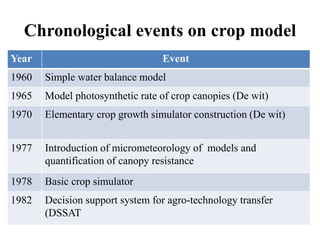
Chronological events on crop model
Year Event
1960 Simple water balance model
1965 Model photosynthetic rate of crop canopies (De wit)
1970 Elementary crop growth simulator construction (De wit)
1977 Introduction of micrometeorology of models and
quantification of canopy resistance
1978 Basic crop simulator
1982 Decision support system for agro-technology transfer
(DSSAT
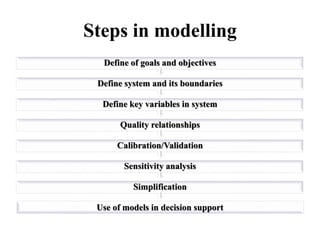
Steps in modelling
Use of models in decision support
Simplification
Sensitivity analysis
Calibration/Validation
Quality relationships
Define key variables in system
Define system and its boundaries
Define of goals and objectives
A few successfully used models in agrometeorology
• 1. The deWit school of models
 In the sixties, the first attempt to model photosynthetic
rates of crop canopies was made (deWit, 1965).
 The results obtained from this model were used among
others, to estimate potential food production for some
areas of the world and to provide indications for crop
management and breeding (Wit, 1967; Linneman et al.,
1979).
 This was followed by the construction of an Elementary
CROP growth Simulator (ELCROS) by deWit et al.
(1970).
 This model included the static photosynthesis model
and crop respiration was taken as a fixed fraction per
day of the biomass, plus an amount proportional to the
growth rate.
2. IBSNAT and DSSAT Models
 (International Benchmark Sites Network for Agrotechnology
Transfer and Decision Support System for Agro-Technology
Transfer)
 The goal is to obtain higher yields from the crops that they have
been growing for a long time. Also, while sustaining the yield
levels they want to :
 1. Substantially improve the income.
 2. Reduce soil degradation.
 3. Reduce dependence on off-farm inputs.
 4. Exploit local market opportunities.
What is expected from crop modelling in
horticulture?
• Models are presented in the literature as
scientific, as well as engineering tools. It does
not mean that the same approaches can be used
indifferently for the two purposes. The aims of
a specific modelling activity should be
explicit. That is why we will identify in this
chapter the various motivations for modelling
crops in horticulture.
The uses of models in plant production.
Research models in horticulture.
 Models for decision-making and policy
analysis in horticulture.
 Models for teaching horticulture.
The uses of models in plant production.
• They usually provide quantitative information from
which decisions, such as crop timing, irrigation,
fertilisation, crop protection, and climate control, can
be taken at the field scale. On a regional scale,
policies can be evaluated from estimations of
potential yields, water needs, fertiliser losses, and
other factors. At last, models can help scientists,
engineers and growers to exchange information.
Research models in horticulture
• There is a specific need for research models in
horticulture. As for other areas of crop production, the
development of models often starts as a natural
continuation of the experimental approach to a problem.
‘‘As a branch of science progresses from the qualitative to
the quantitative, one day it may be expected to reach the
point where the connections between theory and
experiment are most efficiently made using the language
of mathematics’’ (Thornley) .
• More specifically, because of their particular features,
horticultural crops have been considered as original lab
tools to study and model various plant processes.
Models for decision-making and policy analysis in
horticulture
• Horticulture needs crop models for a large range of
applications, including yield forecast, policy analysis,
and management. The prediction of yield and its
timing are important when producers have to fit
closely within market or industry requirements.
Models for teaching horticulture
• Models can be very useful in teaching students
horticultural principles. This includes concepts
on how plants respond in general to
environment and management, and how
horticultural species differ. In addition, models
can be very useful in demonstrating
interactions among processes or components
of crop production systems.
Advantages
In agro-meteorological research the crop models basically helps in:
 Testing scientific hypothesis.
 Estimation of potential yields.
 Estimation of yield gaps: cause and their contribution.
 Yield forecasting.
 Impact assessment of climatic variability and climatic change.
 Environmental impact-percolation, N losses, GHG emissions.
 Organizing data.
 Integrating across disciplines.
 Assist in genetic improvement;
 Evaluate optimum genetic traits for specific
environments.
 Evaluate cultivar stability under long term weather.
Crop models can be used to understand the
effects of climate change such as
• Consequences of elevated carbon-dioxide
• Changes in temperature and rainfall on crop
development, growth and yield.
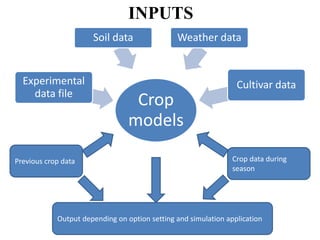
Crop
models
Experimental
data file
Soil data Weather data
Cultivar data
Previous crop data Crop data during
season
Output depending on option setting and simulation application
INPUTS
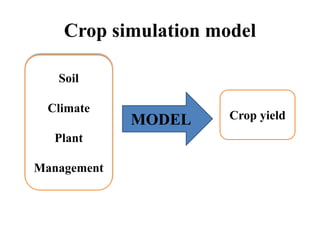
Crop simulation model
Soil
Climate
Plant
Management
MODEL Crop yield
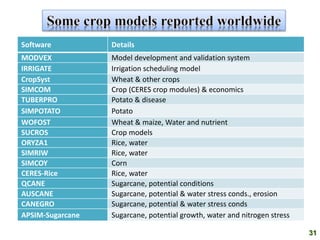
31
Software Details
MODVEX Model development and validation system
IRRIGATE Irrigation scheduling model
CropSyst Wheat & other crops
SIMCOM Crop (CERES crop modules) & economics
TUBERPRO Potato & disease
SIMPOTATO Potato
WOFOST Wheat & maize, Water and nutrient
SUCROS Crop models
ORYZA1 Rice, water
SIMRIW Rice, water
SIMCOY Corn
CERES-Rice Rice, water
QCANE Sugarcane, potential conditions
AUSCANE Sugarcane, potential & water stress conds., erosion
CANEGRO Sugarcane, potential & water stress conds
APSIM-Sugarcane Sugarcane, potential growth, water and nitrogen stress
33
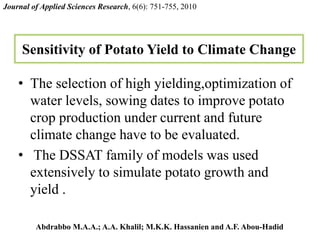
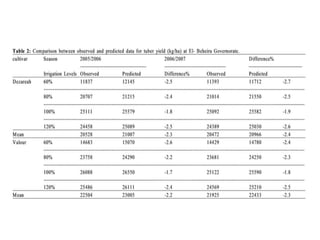
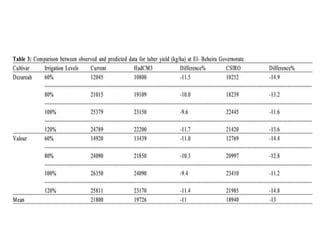
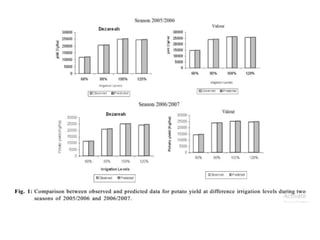
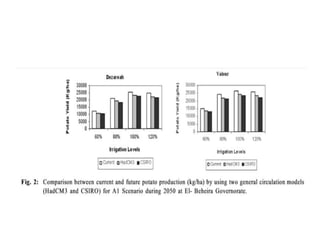
Sensitivity of Potato Yield to Climate Change
• The selection of high yielding,optimization of
water levels, sowing dates to improve potato
crop production under current and future
climate change have to be evaluated.
• The DSSAT family of models was used
extensively to simulate potato growth and
yield .
Journal of Applied Sciences Research, 6(6): 751-755, 2010
Abdrabbo M.A.A.; A.A. Khalil; M.K.K. Hassanien and A.F. Abou-Hadid
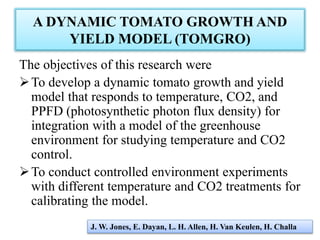
A DYNAMIC TOMATO GROWTH AND
YIELD MODEL (TOMGRO)
The objectives of this research were
To develop a dynamic tomato growth and yield
model that responds to temperature, CO2, and
PPFD (photosynthetic photon flux density) for
integration with a model of the greenhouse
environment for studying temperature and CO2
control.
To conduct controlled environment experiments
with different temperature and CO2 treatments for
calibrating the model.
J. W. Jones, E. Dayan, L. H. Allen, H. Van Keulen, H. Challa
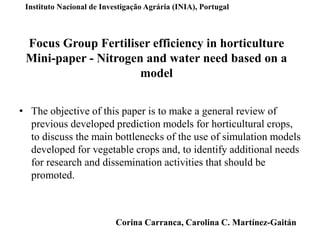
Focus Group Fertiliser efficiency in horticulture
Mini-paper - Nitrogen and water need based on a
model
• The objective of this paper is to make a general review of
previous developed prediction models for horticultural crops,
to discuss the main bottlenecks of the use of simulation models
developed for vegetable crops and, to identify additional needs
for research and dissemination activities that should be
promoted.
Instituto Nacional de Investigação Agrária (INIA), Portugal
Corina Carranca, Carolina C. Martínez-Gaitán
Limitations of crop modelling
Corp models required large amount of input data, which may
not be available.
skilled manpower with good knowledge of computers and
computer language.
Crop modelling needs multidisciplinary knowledge. No model
can take into account all the existing complexity of biological
systems. Hence simulation results have errors.
A model is a tool for improving critical thought, not a
substitute for it.
Models can help formulate hypotheses and improve
efficiency of field experiments, but they do not
eliminate the need for continued experimentation.
Models developed for a specific region cannot be used
as such in another region.
Proper parameterization and calibration is needed
before using a model.
Conclusion
• Models are holistic, knowledge-based international tools for
worldwide and local applications.
• Crop model help us in assimilating knowledge gained from
experimentation.
• It helps to understand or foresee the behaviour of biological
systems on the basis of fundamental level of incorporation.
• It offers dynamic, quantitative tools for analyzing the
complexity of agricultural systems.
• Promote inter-disciplinary research.
• Increase the efficiency of agricultural research and
management and improve agronomic efficiency and
environmental quality.

Crop modelling.pptx

  • 1.
  • 3.
    Introduction  Crop modelsoffer a very promising way to estimate this reference level and its variability in the field.  In addition, crop models are able to account for several scenarios of climate conditions prevailing between the nitrogen application considered and harvest, frequency analysis of these variables allowing a better decision to be derived.
  • 4.
    It can alsoaccount for nitrogen use efficiency. The success of crop models for decision making relies on their performances for yield and environmental budget simulations.
  • 5.
    Definitions Model: • Model isa set of mathematical equations describing/ mimic behaviour of a system. • Model stimulates or imitates the behaviour of a real crop by predicting the growth of its component. Modelling: • Modelling is based on the assumption that any given process can expressed in a formal mathematical statement or set of statements.
  • 6.
    Simulation: • It isa process of building models and analysing the system. • The art of building mathematical models and study their properties in reference to those of the system (De wit, 1982) Crop model: • Simple representation of a crop. System: • Limited part of a reality that contains inter related.
  • 7.
    The crop growthmodels are being developed to meet the demands under the following situations in agricultural meteorology :  When the farmers have the difficult task of managing their crops on poor soils in harsh and risky climates.  When scientists and research managers need tools that can assist them in taking an integrated approach to finding solutions in the complex problem of weather, soil and crop management.  When policy makers and administrators need simple tools that can assist them in policy management in agricultural meteorology.
  • 8.
    The models allowevaluation of one or more options that are available with respect to one or more agronomic management decisions like: Determine optimum planting date. Determine best choice of cultivars. Evaluate weather risk. Investment decisions.
  • 9.
    Crop loss dueto climatic extremes/deviations 1. Stress at different periods during crop season 2. Stress at different crop development stages 3. Stress of different intensities 4. Stress at different locations 5. Base weather
  • 10.
    6. Different years/seasons 7.Soils 8. Varieties 9. Planting dates 10. Fertilizers 11. Irrigation
  • 11.
    Types of cropmodels Depending upon the purpose for which it is designed the models are classified into different groups or types. Of them a few are : Statistical and empirical models Mechanistic models Deterministic models Stochastic models Static models Dynamic models Simulation models Explanatory models
  • 12.
    a. Statistical models:These models express the relationship between yield or yield components and weather parameters. In these models relationships are measured in a system using statistical techniques . Example: Step down regressions, correlation, etc. b. Mechanistic models: These models explain not only the relationship between weather parameters and yield, but also the mechanism of these models (explains the relationship of influencing dependent variables). These models are based on physical selection.
  • 13.
    d. Stochastic models:A probability element is attached to each output. For each set of inputs different outputs are given along with probabilities. These models define yield or state of dependent variable at a given rate. e. Dynamic models: Time is included as a variable. Both dependent and independent variables are having values which remain constant over a given period of time.
  • 14.
    f. Static: Timeis not included as variables. Dependent and independent variables having values remain constant over a given period of time. g. Deterministic models: These models estimate the exact value of the yield or dependent variable. These models also have defined coefficients.
  • 15.
    g. Simulation models:Computer models, in general, are a mathematical representation of a real world system. One of the main goals of crop simulation models is to estimate agricultural production as a function of weather and soil conditions as well as crop management. These models use one or more sets of differential equations, and calculate both rate and state variables over time, normally from planting until harvest maturity or final harvest. h. Explanatory model: This consists of quantitative description of the mechanisms and processes that cause the behaviour of the system. To create this model, a system is analyzed and its processes and mechanisms are quantified separately. The model is built by integrating these descriptions for the entire system. It contains descriptions of distinct processes such as leaf area expansion, tiller production, etc. Crop growth is a consequence of these processes.
  • 16.
    Chronological events oncrop model Year Event 1960 Simple water balance model 1965 Model photosynthetic rate of crop canopies (De wit) 1970 Elementary crop growth simulator construction (De wit) 1977 Introduction of micrometeorology of models and quantification of canopy resistance 1978 Basic crop simulator 1982 Decision support system for agro-technology transfer (DSSAT
  • 17.
    Steps in modelling Useof models in decision support Simplification Sensitivity analysis Calibration/Validation Quality relationships Define key variables in system Define system and its boundaries Define of goals and objectives
  • 18.
    A few successfullyused models in agrometeorology • 1. The deWit school of models  In the sixties, the first attempt to model photosynthetic rates of crop canopies was made (deWit, 1965).  The results obtained from this model were used among others, to estimate potential food production for some areas of the world and to provide indications for crop management and breeding (Wit, 1967; Linneman et al., 1979).
  • 19.
     This wasfollowed by the construction of an Elementary CROP growth Simulator (ELCROS) by deWit et al. (1970).  This model included the static photosynthesis model and crop respiration was taken as a fixed fraction per day of the biomass, plus an amount proportional to the growth rate.
  • 20.
    2. IBSNAT andDSSAT Models  (International Benchmark Sites Network for Agrotechnology Transfer and Decision Support System for Agro-Technology Transfer)  The goal is to obtain higher yields from the crops that they have been growing for a long time. Also, while sustaining the yield levels they want to :  1. Substantially improve the income.  2. Reduce soil degradation.  3. Reduce dependence on off-farm inputs.  4. Exploit local market opportunities.
  • 21.
    What is expectedfrom crop modelling in horticulture? • Models are presented in the literature as scientific, as well as engineering tools. It does not mean that the same approaches can be used indifferently for the two purposes. The aims of a specific modelling activity should be explicit. That is why we will identify in this chapter the various motivations for modelling crops in horticulture.
  • 22.
    The uses ofmodels in plant production. Research models in horticulture.  Models for decision-making and policy analysis in horticulture.  Models for teaching horticulture.
  • 23.
    The uses ofmodels in plant production. • They usually provide quantitative information from which decisions, such as crop timing, irrigation, fertilisation, crop protection, and climate control, can be taken at the field scale. On a regional scale, policies can be evaluated from estimations of potential yields, water needs, fertiliser losses, and other factors. At last, models can help scientists, engineers and growers to exchange information.
  • 24.
    Research models inhorticulture • There is a specific need for research models in horticulture. As for other areas of crop production, the development of models often starts as a natural continuation of the experimental approach to a problem. ‘‘As a branch of science progresses from the qualitative to the quantitative, one day it may be expected to reach the point where the connections between theory and experiment are most efficiently made using the language of mathematics’’ (Thornley) . • More specifically, because of their particular features, horticultural crops have been considered as original lab tools to study and model various plant processes.
  • 25.
    Models for decision-makingand policy analysis in horticulture • Horticulture needs crop models for a large range of applications, including yield forecast, policy analysis, and management. The prediction of yield and its timing are important when producers have to fit closely within market or industry requirements.
  • 26.
    Models for teachinghorticulture • Models can be very useful in teaching students horticultural principles. This includes concepts on how plants respond in general to environment and management, and how horticultural species differ. In addition, models can be very useful in demonstrating interactions among processes or components of crop production systems.
  • 27.
    Advantages In agro-meteorological researchthe crop models basically helps in:  Testing scientific hypothesis.  Estimation of potential yields.  Estimation of yield gaps: cause and their contribution.  Yield forecasting.  Impact assessment of climatic variability and climatic change.  Environmental impact-percolation, N losses, GHG emissions.
  • 28.
     Organizing data. Integrating across disciplines.  Assist in genetic improvement;  Evaluate optimum genetic traits for specific environments.  Evaluate cultivar stability under long term weather.
  • 29.
    Crop models canbe used to understand the effects of climate change such as • Consequences of elevated carbon-dioxide • Changes in temperature and rainfall on crop development, growth and yield.
  • 30.
    Crop models Experimental data file Soil dataWeather data Cultivar data Previous crop data Crop data during season Output depending on option setting and simulation application INPUTS
  • 31.
  • 32.
    31 Software Details MODVEX Modeldevelopment and validation system IRRIGATE Irrigation scheduling model CropSyst Wheat & other crops SIMCOM Crop (CERES crop modules) & economics TUBERPRO Potato & disease SIMPOTATO Potato WOFOST Wheat & maize, Water and nutrient SUCROS Crop models ORYZA1 Rice, water SIMRIW Rice, water SIMCOY Corn CERES-Rice Rice, water QCANE Sugarcane, potential conditions AUSCANE Sugarcane, potential & water stress conds., erosion CANEGRO Sugarcane, potential & water stress conds APSIM-Sugarcane Sugarcane, potential growth, water and nitrogen stress
  • 33.
  • 34.
    Sensitivity of PotatoYield to Climate Change • The selection of high yielding,optimization of water levels, sowing dates to improve potato crop production under current and future climate change have to be evaluated. • The DSSAT family of models was used extensively to simulate potato growth and yield . Journal of Applied Sciences Research, 6(6): 751-755, 2010 Abdrabbo M.A.A.; A.A. Khalil; M.K.K. Hassanien and A.F. Abou-Hadid
  • 39.
    A DYNAMIC TOMATOGROWTH AND YIELD MODEL (TOMGRO) The objectives of this research were To develop a dynamic tomato growth and yield model that responds to temperature, CO2, and PPFD (photosynthetic photon flux density) for integration with a model of the greenhouse environment for studying temperature and CO2 control. To conduct controlled environment experiments with different temperature and CO2 treatments for calibrating the model. J. W. Jones, E. Dayan, L. H. Allen, H. Van Keulen, H. Challa
  • 40.
    Focus Group Fertiliserefficiency in horticulture Mini-paper - Nitrogen and water need based on a model • The objective of this paper is to make a general review of previous developed prediction models for horticultural crops, to discuss the main bottlenecks of the use of simulation models developed for vegetable crops and, to identify additional needs for research and dissemination activities that should be promoted. Instituto Nacional de Investigação Agrária (INIA), Portugal Corina Carranca, Carolina C. Martínez-Gaitán
  • 42.
    Limitations of cropmodelling Corp models required large amount of input data, which may not be available. skilled manpower with good knowledge of computers and computer language. Crop modelling needs multidisciplinary knowledge. No model can take into account all the existing complexity of biological systems. Hence simulation results have errors. A model is a tool for improving critical thought, not a substitute for it.
  • 43.
    Models can helpformulate hypotheses and improve efficiency of field experiments, but they do not eliminate the need for continued experimentation. Models developed for a specific region cannot be used as such in another region. Proper parameterization and calibration is needed before using a model.
  • 44.
    Conclusion • Models areholistic, knowledge-based international tools for worldwide and local applications. • Crop model help us in assimilating knowledge gained from experimentation. • It helps to understand or foresee the behaviour of biological systems on the basis of fundamental level of incorporation. • It offers dynamic, quantitative tools for analyzing the complexity of agricultural systems. • Promote inter-disciplinary research. • Increase the efficiency of agricultural research and management and improve agronomic efficiency and environmental quality.