POSTPARTUM HAEMORRHAGEPOSTPARTUM HAEMORRHAGE
DR. JYOTI BHASKAR
MD MRCOG
Director LIFECAREIVF
Senior Consultant PUSHPANJALI CROSSLAY, LIFECARE
PPH today living in the shadow of TAJMAHAL
PPHPPH
Single most important cause of maternalSingle most important cause of maternal
mortality worldwide.mortality worldwide.
Accounts for 34% of maternal deaths inAccounts for 34% of maternal deaths in
developing countries.developing countries.
DefinitionDefinition
Any blood loss than has potential toAny blood loss than has potential to
produce or produces hemodynamicproduce or produces hemodynamic
instabilityinstability
DefinitionDefinition
Blood loss > 500 ml after deliveryBlood loss > 500 ml after delivery
> 1000 ml after LSCS> 1000 ml after LSCS
Minor : 500-1000 mlMinor : 500-1000 ml
Moderate : 1000-2000 mlModerate : 1000-2000 ml
Severe : > 2000 mlSevere : > 2000 ml
Proposed classification. adapted fromProposed classification. adapted from
Benedetti,2002Benedetti,2002
HemorrhageHemorrhage
classclass
Estimated bloodEstimated blood
lossloss
(ml)(ml)
Blood volumeBlood volume
lossloss
(%)(%)
Clinical signs &Clinical signs &
symptomsymptom
managementmanagement
00 <500<500 <10<10 nonenone nonenone
11 500-1000500-1000 1515 minimalminimal Observation+/-RPObservation+/-RP
TxTx
22 1200-15001200-1500 20-2520-25
↓↓urine outputurine output
↑↑pulse ratepulse rate
↑↑respiratory raterespiratory rate
PosturalPostural
hypotensionhypotension
Narrow pulse prNarrow pulse pr
ReplacementReplacement
therapy withtherapy with
oxytocicsoxytocics
33 1800-21001800-2100 30-3530-35 HypotensionHypotension
TachycardiaTachycardia
TachypneaTachypnea
Cold clammyCold clammy
UrgentUrgent activeactive
managementmanagement
44 >2400>2400 >40>40 Profound shockProfound shock Critical active MxCritical active Mx
PREDICTION AND PREVENTIONPREDICTION AND PREVENTION
Identify pt. at riskIdentify pt. at risk
-- Pl previa/accretaPl previa/accreta
- Anticoagulation RxAnticoagulation Rx
- CoagulopathyCoagulopathy
- Overdistended uterusOverdistended uterus
- Grand multiparityGrand multiparity
- Abn labor patternAbn labor pattern
- ChorioamnionitisChorioamnionitis
- Large myomasLarge myomas
- Previous history ofPrevious history of
PPHPPH
PREVENTIONPREVENTION
 Regular ANCRegular ANC
 Correction of anaemiaCorrection of anaemia
 Identification of high risk casesIdentification of high risk cases
 Delivery in hospital with facility for EmergencyDelivery in hospital with facility for Emergency
Obstetric Care.Obstetric Care.
 Otherwise transport to the nearest such hospital atOtherwise transport to the nearest such hospital at
the earliest.the earliest.
 Keep speedy transport availableKeep speedy transport available
 ACTIVE MANAGEMENT OF 3ACTIVE MANAGEMENT OF 3RDRD
STAGE OF LABOURSTAGE OF LABOUR
 44thth
Stage of labour - Observation, OxytocinStage of labour - Observation, Oxytocin
ACTIVE MANAGEMENT OF 3ACTIVE MANAGEMENT OF 3RDRD
STAGE OF LABOUR (WHO-1989)STAGE OF LABOUR (WHO-1989)
 Oxytocics - Routine use in third stageOxytocics - Routine use in third stage →→ bloodblood
lossloss ↓↓ by 30-40% and risk of PPH by 60%by 30-40% and risk of PPH by 60%
 5 or 10 U Oxytocin IM5 or 10 U Oxytocin IM
 Syntometrine 1 Amp IMSyntometrine 1 Amp IM
 Ergometrine 1 Amp IV/IMErgometrine 1 Amp IV/IM
-- Misoprost in home birth settings-- Misoprost in home birth settings
 Early cord clampingEarly cord clamping
 Controlled cord tractionControlled cord traction
 Inspection of placenta & lower genital tractInspection of placenta & lower genital tract
 CS settings -5 U of oxytocin IV bolus , CarbetocinCS settings -5 U of oxytocin IV bolus , Carbetocin
DIAGNOSISDIAGNOSIS
&&
MANAGEMENTMANAGEMENT
It is an EnigmaIt is an Enigma
 IIt is sudden
 often unpredicted
 assessed subjectively
 Can be catastrophic.
The clinical picture changes so rapidly that unless
timely action is taken maternal death occurs within
a short period.
““The golden hour” of resuscitationThe golden hour” of resuscitation
““Rule of 30”Rule of 30”
 if SBP falls by 30mmHg,if SBP falls by 30mmHg,
 HR rises by 30 beats/min,HR rises by 30 beats/min,
 RR ↑to 30breaths/min,RR ↑to 30breaths/min,
 HCT drop by 30%,HCT drop by 30%,
 urine output <30ml/hrurine output <30ml/hr
 lost at least 30% of her blood volumelost at least 30% of her blood volume
Guidelines of RCOGGuidelines of RCOG
Green top No.52 May 2009Green top No.52 May 2009
 COMMUNICATE.COMMUNICATE.
 RESUSCITATE.RESUSCITATE.
 MONITOR / INVESTIGATE.MONITOR / INVESTIGATE.
 STOP THE BLEEDINGSTOP THE BLEEDING..
CALLCALL
FORFOR
HELPHELP
COMMUNICATECOMMUNICATE
 CallCall experienced midwifeexperienced midwife
 CallCall OObstetric registrar & alert consultantbstetric registrar & alert consultant
 CallCall anaesthetic registrar , alert consultantanaesthetic registrar , alert consultant
 AlertAlert haematologisthaematologist
 AlertAlert Blood Transfusion ServiceBlood Transfusion Service
 CallCall porters for delivery of specimens / bloodporters for delivery of specimens / blood
 Alert one member of the team to record events,
fluids, drugs and vital signs
RESUSCITATERESUSCITATE
MINOR PPH (blood loss 500–1000 ml, no
clinical shock):
 Intravenous access (14-G cannula x 1).
 Commence crystalloid infusion.
 Consider venepuncture (20 ml) for:
Group and screen
Full blood count
Coagulation screen including fibrinogen
 Pulse and blood pressure recording every 15
minutes.
Full protocol for MAJOR PPH (blood loss >
1000 ml and continuing to bleed OR clinical
shock):
 Assess
Airway.
Breathing.
Circulation
 Oxygen by mask at 10–15 litres/minute.
 Intravenous access (14-gauge cannula x 2, orange
cannulae).
 Position flat.
 Keep the woman warm using appropriate available
measures.
 Transfuse blood as soon as possible.
 Until blood is available, Infuse up to 3.5
litres of warmed Crystalloid Hartmann’s
solution (2 litres) and or Colloid (1–2 litres)
as rapidly as required.
 The best equipment available should be
used to achieve RAPID WARMED
infusion of fluids.
Fluid Therapy and Blood ProductsFluid Therapy and Blood Products
 Crystalloid Up to 2 litres Hartmann’s solution
 Colloid Up to 1–2 litres colloid until blood
arrives
 Blood If crossmatched blood is still
unavailable, give uncrossmatched
group-specific blood OR give ‘O RhD
negative’ blood
 Fresh Frozen Plasma 4 units for every 6 units of red cells
or PT/ APTT > 1.5 x normal
(12–15 ml/kg or total 1 litre)
 Platelets concentrates if PLT count < 50 x 109
 Cryoprecipitate If fibrinogen < 1 g/l
Upto 1 litre of FFP and 10 units of Cryoprecipitate can be
given in case of relentless bleeding.
Main Therapeutic GoalsMain Therapeutic Goals
 Main therapeutic goals of management of
massive blood loss is to maintain:
 haemoglobin > 8g/dl
 platelet count > 75 x 109/l
 prothrombin < 1.5 x mean control
 activated prothrombin times < 1.5 x mean
control
 fibrinogen > 1.0 g/l.
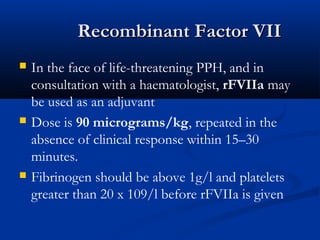
Recombinant Factor VIIRecombinant Factor VII
 In the face of life-threatening PPH, and in
consultation with a haematologist, rFVIIa may
be used as an adjuvant
 Dose is 90 micrograms/kg, repeated in the
absence of clinical response within 15–30
minutes.
 Fibrinogen should be above 1g/l and platelets
greater than 20 x 109/l before rFVIIa is given
MONITOR / INVESTIGATEMONITOR / INVESTIGATE
 Consider venepuncture (20 ml) for:
 Crossmatch (4 units minimum)
 full blood count
 coagulation screen including fibrinogen
 renal and liver function for baseline.
 Monitor temperature every 15 minutes.
 Continuous pulse, blood pressure recording
and respiratory rate (using oximeter,
electrocardiogram and automated blood pressure
recording).
 Foley catheter to monitor urine output.
 Consider arterial line monitoring (once
appropriately experienced staff available for
insertion).
 Consider transfer to ITU once the bleeding is
controlled or monitoring at high dependency unit
on delivery suite, if appropriate.
 Recording of parameters on a flow chart
such as the modified obstetric early warning
system charts.
 Documentation of fluid balance, blood,
blood products and procedures.
The Four “T”The Four “T”
ToneTone
TissueTissue
TraumaTrauma
ThrombinThrombin
BimanualBimanual
CompressionCompression
If uterus is relaxed :If uterus is relaxed :
massaging the uterusmassaging the uterus
will expel anywill expel any
retained bits &retained bits &
stimulate uterinestimulate uterine
contractionscontractions
Administer Uterotonic DrugsAdminister Uterotonic Drugs
 FIRST LINEFIRST LINE
Oxytocin:Oxytocin:
Start with 5 units slow iv or im.Start with 5 units slow iv or im.
Infusion of 20 units in 1 L@ 60 dr/min.Infusion of 20 units in 1 L@ 60 dr/min.
Continue same dose @ 40 dr/min until bleedingContinue same dose @ 40 dr/min until bleeding
stops.stops.
Maximum upto 3 L.Maximum upto 3 L.
 SECOND LINESECOND LINE
Ergometrine/ methyl ergometrine:Ergometrine/ methyl ergometrine:
Dose: 0.2 mg im or slow ivDose: 0.2 mg im or slow iv
Repeat 0.2 mg after 15 min.Repeat 0.2 mg after 15 min.
Maximum 5 doses (1 mg)Maximum 5 doses (1 mg)
SyntometrineSyntometrine imim
 THIRD LINETHIRD LINE
PGF 2PGF 2αα::
Dose: 0.25 mg im.Dose: 0.25 mg im.
Can be repeated every 15 min.Can be repeated every 15 min.
Maximum upto 2 mg or 8 doses.Maximum upto 2 mg or 8 doses.
Misoprostol:Misoprostol:
200-800 µg sublingually/per rectal200-800 µg sublingually/per rectal
Do not exceed 1000 µgDo not exceed 1000 µg
WHO GUIDELINES FOR MANAGEMENT OF PPH 2009WHO GUIDELINES FOR MANAGEMENT OF PPH 2009
If conservative measures fail to controlIf conservative measures fail to control
haemorrhage, initiate surgical haemostasishaemorrhage, initiate surgical haemostasis
SOONER RATHER THAN LATERSOONER RATHER THAN LATER
 Balloon tamponade
 Haemostatic brace suturing (such as
using procedures described by B-Lynch
or modified compression sutures)
 Bilateral ligation of uterine arteries
 Bilateral ligation of internal iliac
(hypogastric) arteries
 Selective arterial embolisation.
Uterine TamponadeUterine Tamponade
• Bakri balloonBakri balloon
• SengstakenSengstaken
BlakemoreBlakemore
oesophageal catheteroesophageal catheter
• Condom catheterCondom catheter
• Urological RuschUrological Rusch
balloonballoon
Success depends uponSuccess depends upon
Positive TamponadePositive Tamponade
Procedure of condom BalloonProcedure of condom Balloon
insertioninsertion
InitialInitial
AssemblyAssembly
 Condoms-2Condoms-2
 Foley’s catheter-Foley’s catheter-
no.16no.16
 Saline with iv setSaline with iv set
 SpeculumSpeculum
 Sponge holdingSponge holding
forceps
ProcedureProcedure
 Lithotomy positionLithotomy position
 Indwelling Foley’sIndwelling Foley’s
catheter.catheter.
 Explore uterus, cervixExplore uterus, cervix
and vagina.and vagina.
 Inflate balloon withInflate balloon with
100-300 ml warm100-300 ml warm
0.9% Sodium0.9% Sodium
chloride until bleedingchloride until bleeding
is controlled (is controlled (PositivePositive
Compression suturesCompression sutures
B Lynch SutureB Lynch Suture
•FundalFundal
compressioncompression
suturesuture
•ApposesApposes
anterior &anterior &
posterior wallposterior wall
Contd…Contd…
Parallel Vertical compression sutures forParallel Vertical compression sutures for
placenta praeviaplacenta praevia
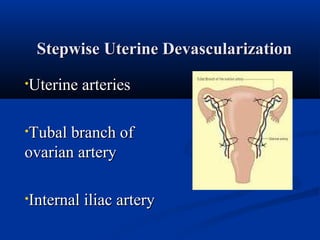
Stepwise Uterine DevascularizationStepwise Uterine Devascularization
•Uterine arteriesUterine arteries
•Tubal branch ofTubal branch of
ovarian arteryovarian artery
•Internal iliac arteryInternal iliac artery
Uterine Artery EmbolizationUterine Artery Embolization
Possible only ifPossible only if
internal arteryinternal artery
ligation has not beenligation has not been
done and facility fordone and facility for
interventionalinterventional
radiology availableradiology available
Resort to hysterectomyResort to hysterectomy
SOONER RATHERSOONER RATHER
THAN LATER (especiallyTHAN LATER (especially
in cases of placenta accretain cases of placenta accreta
or uterine rupture)or uterine rupture)
Documentation and DebriefingDocumentation and Debriefing
Important to record:Important to record:
Sequence of eventsSequence of events
Time and sequence of administration ofTime and sequence of administration of
pharmacological agents, fluids, bloodpharmacological agents, fluids, blood
productsproducts
The time of surgical interventionThe time of surgical intervention
The condition of mother throughout .The condition of mother throughout .
HAEMOSTASIS algorithmHAEMOSTASIS algorithm
 H- ask for helpH- ask for help
 A- assess (vitals, blood loss) & resuscitateA- assess (vitals, blood loss) & resuscitate
 E -E -
1.1. EstablishEstablish
etiology(tone,tissue,trauma,thrombine)etiology(tone,tissue,trauma,thrombine)
2.2. Ecbolics (syntometrine,ergometrine)Ecbolics (syntometrine,ergometrine)
3.3. Ensure availability of bloodEnsure availability of blood
 M - massage the uterusM - massage the uterus
 O – oxytocin infusion & prostaglandinO – oxytocin infusion & prostaglandin
§ S-S-
Ø shift to operating theatreshift to operating theatre
Ø Bimanual compressionBimanual compression
Ø Pneumatic anti-shock garmentPneumatic anti-shock garment
 T- Tissue & trauma to be excludedT- Tissue & trauma to be excluded
 A- apply compression suturesA- apply compression sutures
 S- systematic pelvic devascularisationS- systematic pelvic devascularisation
 I - interventional radiologyI - interventional radiology
 S- subtotal/total hysterectomyS- subtotal/total hysterectomy
ConclusionConclusion
We NeedWe Need
Intelligent anticipationIntelligent anticipation
Skilled supervisionSkilled supervision
Prompt detectionPrompt detection
Effective institution of therapyEffective institution of therapy
to prevent disastrous consequences of PPHto prevent disastrous consequences of PPH..
To Conclude, Management of PPHTo Conclude, Management of PPH
Has Evolved From:Has Evolved From:
 PanicPanic
 PanicPanic
 HysterectomyHysterectomy
Pitocin
Prostaglandins
Happiness
IncidenceIncidence
 PPH is one of the commonest cause of maternalPPH is one of the commonest cause of maternal
mortality & accounts for 1/4mortality & accounts for 1/4thth
of all maternal deathof all maternal death
worldwide. (WHO 2005)worldwide. (WHO 2005)
 In developing countries it accounts over 1/3In developing countries it accounts over 1/3rdrd
of allof all
maternal death. (Khan KS 2006)maternal death. (Khan KS 2006)
 14 million cases occur each year with a case fatality14 million cases occur each year with a case fatality
rate of 1%.(WHO 2004)rate of 1%.(WHO 2004)
 In India PPH responsible forIn India PPH responsible for 15-20%15-20% 0f maternal0f maternal
death ( Mukherjee et al 2002).death ( Mukherjee et al 2002).
Post Partum haemorrhagePost Partum haemorrhage
. . . the most common and severe type of obstetric
haemmorrhage, is an enigma even to the
present day obstetrician as it is sudden,
often unpredicted, assessed subjectively
and can be catastrophic. The clinical
picture changes so rapidly that unless
timely action is taken maternal death
occurs within a short period.
““women are not dying because of awomen are not dying because of a
disease we cannot treat. They aredisease we cannot treat. They are
dying because societies have yet todying because societies have yet to
make decision that their lives aremake decision that their lives are
worth saving”worth saving”
Mamoud Fathalla,Mamoud Fathalla,
President of FOGSI.19President of FOGSI.199797
Case ScenarioCase Scenario
 Doctor is delivering the placenta – afterDoctor is delivering the placenta – after
delivery of placenta she has a sudden gushdelivery of placenta she has a sudden gush
of bleeding.of bleeding.
 ABCABC
 VitalsVitals
 Call for helpCall for help
 CannulaCannula
 InvestigationInvestigation
 FluidsFluids
 Cause for bleedingCause for bleeding
 Treatment accordinglyTreatment accordingly
Case Scenario 2Case Scenario 2
 No doctor available –No doctor available –
 Baby has been delivered.Baby has been delivered.
 Pt is known to be anaemic .Pt is known to be anaemic .
 How will you manage the third stage so as toHow will you manage the third stage so as to
prevent PPHprevent PPH

Pph

  • 1.
    POSTPARTUM HAEMORRHAGEPOSTPARTUM HAEMORRHAGE DR.JYOTI BHASKAR MD MRCOG Director LIFECAREIVF Senior Consultant PUSHPANJALI CROSSLAY, LIFECARE
  • 2.
    PPH today livingin the shadow of TAJMAHAL
  • 3.
    PPHPPH Single most importantcause of maternalSingle most important cause of maternal mortality worldwide.mortality worldwide. Accounts for 34% of maternal deaths inAccounts for 34% of maternal deaths in developing countries.developing countries.
  • 4.
    DefinitionDefinition Any blood lossthan has potential toAny blood loss than has potential to produce or produces hemodynamicproduce or produces hemodynamic instabilityinstability
  • 5.
    DefinitionDefinition Blood loss >500 ml after deliveryBlood loss > 500 ml after delivery > 1000 ml after LSCS> 1000 ml after LSCS Minor : 500-1000 mlMinor : 500-1000 ml Moderate : 1000-2000 mlModerate : 1000-2000 ml Severe : > 2000 mlSevere : > 2000 ml
  • 6.
    Proposed classification. adaptedfromProposed classification. adapted from Benedetti,2002Benedetti,2002 HemorrhageHemorrhage classclass Estimated bloodEstimated blood lossloss (ml)(ml) Blood volumeBlood volume lossloss (%)(%) Clinical signs &Clinical signs & symptomsymptom managementmanagement 00 <500<500 <10<10 nonenone nonenone 11 500-1000500-1000 1515 minimalminimal Observation+/-RPObservation+/-RP TxTx 22 1200-15001200-1500 20-2520-25 ↓↓urine outputurine output ↑↑pulse ratepulse rate ↑↑respiratory raterespiratory rate PosturalPostural hypotensionhypotension Narrow pulse prNarrow pulse pr ReplacementReplacement therapy withtherapy with oxytocicsoxytocics 33 1800-21001800-2100 30-3530-35 HypotensionHypotension TachycardiaTachycardia TachypneaTachypnea Cold clammyCold clammy UrgentUrgent activeactive managementmanagement 44 >2400>2400 >40>40 Profound shockProfound shock Critical active MxCritical active Mx
  • 7.
    PREDICTION AND PREVENTIONPREDICTIONAND PREVENTION Identify pt. at riskIdentify pt. at risk -- Pl previa/accretaPl previa/accreta - Anticoagulation RxAnticoagulation Rx - CoagulopathyCoagulopathy - Overdistended uterusOverdistended uterus - Grand multiparityGrand multiparity - Abn labor patternAbn labor pattern - ChorioamnionitisChorioamnionitis - Large myomasLarge myomas - Previous history ofPrevious history of PPHPPH
  • 8.
    PREVENTIONPREVENTION  Regular ANCRegularANC  Correction of anaemiaCorrection of anaemia  Identification of high risk casesIdentification of high risk cases  Delivery in hospital with facility for EmergencyDelivery in hospital with facility for Emergency Obstetric Care.Obstetric Care.  Otherwise transport to the nearest such hospital atOtherwise transport to the nearest such hospital at the earliest.the earliest.  Keep speedy transport availableKeep speedy transport available  ACTIVE MANAGEMENT OF 3ACTIVE MANAGEMENT OF 3RDRD STAGE OF LABOURSTAGE OF LABOUR  44thth Stage of labour - Observation, OxytocinStage of labour - Observation, Oxytocin
  • 9.
    ACTIVE MANAGEMENT OF3ACTIVE MANAGEMENT OF 3RDRD STAGE OF LABOUR (WHO-1989)STAGE OF LABOUR (WHO-1989)  Oxytocics - Routine use in third stageOxytocics - Routine use in third stage →→ bloodblood lossloss ↓↓ by 30-40% and risk of PPH by 60%by 30-40% and risk of PPH by 60%  5 or 10 U Oxytocin IM5 or 10 U Oxytocin IM  Syntometrine 1 Amp IMSyntometrine 1 Amp IM  Ergometrine 1 Amp IV/IMErgometrine 1 Amp IV/IM -- Misoprost in home birth settings-- Misoprost in home birth settings  Early cord clampingEarly cord clamping  Controlled cord tractionControlled cord traction  Inspection of placenta & lower genital tractInspection of placenta & lower genital tract  CS settings -5 U of oxytocin IV bolus , CarbetocinCS settings -5 U of oxytocin IV bolus , Carbetocin
  • 10.
  • 11.
    It is anEnigmaIt is an Enigma  IIt is sudden  often unpredicted  assessed subjectively  Can be catastrophic. The clinical picture changes so rapidly that unless timely action is taken maternal death occurs within a short period.
  • 12.
    ““The golden hour”of resuscitationThe golden hour” of resuscitation ““Rule of 30”Rule of 30”  if SBP falls by 30mmHg,if SBP falls by 30mmHg,  HR rises by 30 beats/min,HR rises by 30 beats/min,  RR ↑to 30breaths/min,RR ↑to 30breaths/min,  HCT drop by 30%,HCT drop by 30%,  urine output <30ml/hrurine output <30ml/hr  lost at least 30% of her blood volumelost at least 30% of her blood volume
  • 13.
    Guidelines of RCOGGuidelinesof RCOG Green top No.52 May 2009Green top No.52 May 2009  COMMUNICATE.COMMUNICATE.  RESUSCITATE.RESUSCITATE.  MONITOR / INVESTIGATE.MONITOR / INVESTIGATE.  STOP THE BLEEDINGSTOP THE BLEEDING..
  • 14.
  • 15.
    COMMUNICATECOMMUNICATE  CallCall experiencedmidwifeexperienced midwife  CallCall OObstetric registrar & alert consultantbstetric registrar & alert consultant  CallCall anaesthetic registrar , alert consultantanaesthetic registrar , alert consultant  AlertAlert haematologisthaematologist  AlertAlert Blood Transfusion ServiceBlood Transfusion Service  CallCall porters for delivery of specimens / bloodporters for delivery of specimens / blood  Alert one member of the team to record events, fluids, drugs and vital signs
  • 16.
    RESUSCITATERESUSCITATE MINOR PPH (bloodloss 500–1000 ml, no clinical shock):  Intravenous access (14-G cannula x 1).  Commence crystalloid infusion.  Consider venepuncture (20 ml) for: Group and screen Full blood count Coagulation screen including fibrinogen  Pulse and blood pressure recording every 15 minutes.
  • 17.
    Full protocol forMAJOR PPH (blood loss > 1000 ml and continuing to bleed OR clinical shock):  Assess Airway. Breathing. Circulation  Oxygen by mask at 10–15 litres/minute.  Intravenous access (14-gauge cannula x 2, orange cannulae).  Position flat.  Keep the woman warm using appropriate available measures.
  • 18.
     Transfuse bloodas soon as possible.  Until blood is available, Infuse up to 3.5 litres of warmed Crystalloid Hartmann’s solution (2 litres) and or Colloid (1–2 litres) as rapidly as required.  The best equipment available should be used to achieve RAPID WARMED infusion of fluids.
  • 19.
    Fluid Therapy andBlood ProductsFluid Therapy and Blood Products  Crystalloid Up to 2 litres Hartmann’s solution  Colloid Up to 1–2 litres colloid until blood arrives  Blood If crossmatched blood is still unavailable, give uncrossmatched group-specific blood OR give ‘O RhD negative’ blood  Fresh Frozen Plasma 4 units for every 6 units of red cells or PT/ APTT > 1.5 x normal (12–15 ml/kg or total 1 litre)  Platelets concentrates if PLT count < 50 x 109  Cryoprecipitate If fibrinogen < 1 g/l Upto 1 litre of FFP and 10 units of Cryoprecipitate can be given in case of relentless bleeding.
  • 20.
    Main Therapeutic GoalsMainTherapeutic Goals  Main therapeutic goals of management of massive blood loss is to maintain:  haemoglobin > 8g/dl  platelet count > 75 x 109/l  prothrombin < 1.5 x mean control  activated prothrombin times < 1.5 x mean control  fibrinogen > 1.0 g/l.
  • 21.
    Recombinant Factor VIIRecombinantFactor VII  In the face of life-threatening PPH, and in consultation with a haematologist, rFVIIa may be used as an adjuvant  Dose is 90 micrograms/kg, repeated in the absence of clinical response within 15–30 minutes.  Fibrinogen should be above 1g/l and platelets greater than 20 x 109/l before rFVIIa is given
  • 22.
    MONITOR / INVESTIGATEMONITOR/ INVESTIGATE  Consider venepuncture (20 ml) for:  Crossmatch (4 units minimum)  full blood count  coagulation screen including fibrinogen  renal and liver function for baseline.  Monitor temperature every 15 minutes.  Continuous pulse, blood pressure recording and respiratory rate (using oximeter, electrocardiogram and automated blood pressure recording).  Foley catheter to monitor urine output.
  • 23.
     Consider arterialline monitoring (once appropriately experienced staff available for insertion).  Consider transfer to ITU once the bleeding is controlled or monitoring at high dependency unit on delivery suite, if appropriate.  Recording of parameters on a flow chart such as the modified obstetric early warning system charts.  Documentation of fluid balance, blood, blood products and procedures.
  • 24.
    The Four “T”TheFour “T” ToneTone TissueTissue TraumaTrauma ThrombinThrombin
  • 25.
    BimanualBimanual CompressionCompression If uterus isrelaxed :If uterus is relaxed : massaging the uterusmassaging the uterus will expel anywill expel any retained bits &retained bits & stimulate uterinestimulate uterine contractionscontractions
  • 26.
    Administer Uterotonic DrugsAdministerUterotonic Drugs  FIRST LINEFIRST LINE Oxytocin:Oxytocin: Start with 5 units slow iv or im.Start with 5 units slow iv or im. Infusion of 20 units in 1 L@ 60 dr/min.Infusion of 20 units in 1 L@ 60 dr/min. Continue same dose @ 40 dr/min until bleedingContinue same dose @ 40 dr/min until bleeding stops.stops. Maximum upto 3 L.Maximum upto 3 L.
  • 27.
     SECOND LINESECONDLINE Ergometrine/ methyl ergometrine:Ergometrine/ methyl ergometrine: Dose: 0.2 mg im or slow ivDose: 0.2 mg im or slow iv Repeat 0.2 mg after 15 min.Repeat 0.2 mg after 15 min. Maximum 5 doses (1 mg)Maximum 5 doses (1 mg) SyntometrineSyntometrine imim
  • 28.
     THIRD LINETHIRDLINE PGF 2PGF 2αα:: Dose: 0.25 mg im.Dose: 0.25 mg im. Can be repeated every 15 min.Can be repeated every 15 min. Maximum upto 2 mg or 8 doses.Maximum upto 2 mg or 8 doses. Misoprostol:Misoprostol: 200-800 µg sublingually/per rectal200-800 µg sublingually/per rectal Do not exceed 1000 µgDo not exceed 1000 µg WHO GUIDELINES FOR MANAGEMENT OF PPH 2009WHO GUIDELINES FOR MANAGEMENT OF PPH 2009
  • 29.
    If conservative measuresfail to controlIf conservative measures fail to control haemorrhage, initiate surgical haemostasishaemorrhage, initiate surgical haemostasis SOONER RATHER THAN LATERSOONER RATHER THAN LATER  Balloon tamponade  Haemostatic brace suturing (such as using procedures described by B-Lynch or modified compression sutures)  Bilateral ligation of uterine arteries  Bilateral ligation of internal iliac (hypogastric) arteries  Selective arterial embolisation.
  • 30.
    Uterine TamponadeUterine Tamponade •Bakri balloonBakri balloon • SengstakenSengstaken BlakemoreBlakemore oesophageal catheteroesophageal catheter • Condom catheterCondom catheter • Urological RuschUrological Rusch balloonballoon Success depends uponSuccess depends upon Positive TamponadePositive Tamponade
  • 31.
    Procedure of condomBalloonProcedure of condom Balloon insertioninsertion InitialInitial AssemblyAssembly  Condoms-2Condoms-2  Foley’s catheter-Foley’s catheter- no.16no.16  Saline with iv setSaline with iv set  SpeculumSpeculum  Sponge holdingSponge holding forceps
  • 32.
    ProcedureProcedure  Lithotomy positionLithotomyposition  Indwelling Foley’sIndwelling Foley’s catheter.catheter.  Explore uterus, cervixExplore uterus, cervix and vagina.and vagina.  Inflate balloon withInflate balloon with 100-300 ml warm100-300 ml warm 0.9% Sodium0.9% Sodium chloride until bleedingchloride until bleeding is controlled (is controlled (PositivePositive
  • 33.
    Compression suturesCompression sutures BLynch SutureB Lynch Suture •FundalFundal compressioncompression suturesuture •ApposesApposes anterior &anterior & posterior wallposterior wall
  • 34.
    Contd…Contd… Parallel Vertical compressionsutures forParallel Vertical compression sutures for placenta praeviaplacenta praevia
  • 35.
    Stepwise Uterine DevascularizationStepwiseUterine Devascularization •Uterine arteriesUterine arteries •Tubal branch ofTubal branch of ovarian arteryovarian artery •Internal iliac arteryInternal iliac artery
  • 36.
    Uterine Artery EmbolizationUterineArtery Embolization Possible only ifPossible only if internal arteryinternal artery ligation has not beenligation has not been done and facility fordone and facility for interventionalinterventional radiology availableradiology available
  • 37.
    Resort to hysterectomyResortto hysterectomy SOONER RATHERSOONER RATHER THAN LATER (especiallyTHAN LATER (especially in cases of placenta accretain cases of placenta accreta or uterine rupture)or uterine rupture)
  • 38.
    Documentation and DebriefingDocumentationand Debriefing Important to record:Important to record: Sequence of eventsSequence of events Time and sequence of administration ofTime and sequence of administration of pharmacological agents, fluids, bloodpharmacological agents, fluids, blood productsproducts The time of surgical interventionThe time of surgical intervention The condition of mother throughout .The condition of mother throughout .
  • 39.
    HAEMOSTASIS algorithmHAEMOSTASIS algorithm H- ask for helpH- ask for help  A- assess (vitals, blood loss) & resuscitateA- assess (vitals, blood loss) & resuscitate  E -E - 1.1. EstablishEstablish etiology(tone,tissue,trauma,thrombine)etiology(tone,tissue,trauma,thrombine) 2.2. Ecbolics (syntometrine,ergometrine)Ecbolics (syntometrine,ergometrine) 3.3. Ensure availability of bloodEnsure availability of blood  M - massage the uterusM - massage the uterus  O – oxytocin infusion & prostaglandinO – oxytocin infusion & prostaglandin
  • 40.
    § S-S- Ø shiftto operating theatreshift to operating theatre Ø Bimanual compressionBimanual compression Ø Pneumatic anti-shock garmentPneumatic anti-shock garment  T- Tissue & trauma to be excludedT- Tissue & trauma to be excluded  A- apply compression suturesA- apply compression sutures  S- systematic pelvic devascularisationS- systematic pelvic devascularisation  I - interventional radiologyI - interventional radiology  S- subtotal/total hysterectomyS- subtotal/total hysterectomy
  • 41.
    ConclusionConclusion We NeedWe Need IntelligentanticipationIntelligent anticipation Skilled supervisionSkilled supervision Prompt detectionPrompt detection Effective institution of therapyEffective institution of therapy to prevent disastrous consequences of PPHto prevent disastrous consequences of PPH..
  • 42.
    To Conclude, Managementof PPHTo Conclude, Management of PPH Has Evolved From:Has Evolved From:  PanicPanic  PanicPanic  HysterectomyHysterectomy Pitocin Prostaglandins Happiness
  • 44.
    IncidenceIncidence  PPH isone of the commonest cause of maternalPPH is one of the commonest cause of maternal mortality & accounts for 1/4mortality & accounts for 1/4thth of all maternal deathof all maternal death worldwide. (WHO 2005)worldwide. (WHO 2005)  In developing countries it accounts over 1/3In developing countries it accounts over 1/3rdrd of allof all maternal death. (Khan KS 2006)maternal death. (Khan KS 2006)  14 million cases occur each year with a case fatality14 million cases occur each year with a case fatality rate of 1%.(WHO 2004)rate of 1%.(WHO 2004)  In India PPH responsible forIn India PPH responsible for 15-20%15-20% 0f maternal0f maternal death ( Mukherjee et al 2002).death ( Mukherjee et al 2002).
  • 45.
    Post Partum haemorrhagePostPartum haemorrhage . . . the most common and severe type of obstetric haemmorrhage, is an enigma even to the present day obstetrician as it is sudden, often unpredicted, assessed subjectively and can be catastrophic. The clinical picture changes so rapidly that unless timely action is taken maternal death occurs within a short period.
  • 46.
    ““women are notdying because of awomen are not dying because of a disease we cannot treat. They aredisease we cannot treat. They are dying because societies have yet todying because societies have yet to make decision that their lives aremake decision that their lives are worth saving”worth saving” Mamoud Fathalla,Mamoud Fathalla, President of FOGSI.19President of FOGSI.199797
  • 47.
    Case ScenarioCase Scenario Doctor is delivering the placenta – afterDoctor is delivering the placenta – after delivery of placenta she has a sudden gushdelivery of placenta she has a sudden gush of bleeding.of bleeding.
  • 48.
     ABCABC  VitalsVitals Call for helpCall for help  CannulaCannula  InvestigationInvestigation  FluidsFluids  Cause for bleedingCause for bleeding  Treatment accordinglyTreatment accordingly
  • 49.
    Case Scenario 2CaseScenario 2  No doctor available –No doctor available –  Baby has been delivered.Baby has been delivered.  Pt is known to be anaemic .Pt is known to be anaemic .  How will you manage the third stage so as toHow will you manage the third stage so as to prevent PPHprevent PPH