ISP
Internet Service Provider
What is ISP..??
An Internet service provider (ISP), also sometimes
referred to as an Internet access provider (IAP), is a
company that offers its customers access to the
Internet.
• In other words, ISP is a service (an access)
provider to a business/company that provides
individuals and organizations access to the
Internet free or for a monthly or yearly fee.
For complete Internet connectivity..??
• You must be able to reach all destinations on
the net.
• Your packets have to get delivered to every
destination.
• Packets from everywhere else have to “find
you”. This is done by having your ISP(s)
advertise routes for you.
TYPES OF ISP
• An Internet Service Providers are categorized
as:-
1. Regional ISP’s
2. National ISPs.
• Other than Internet connection, ISPs may also
provide related services like Web site hosting
& development, e-mail hosting, domain name
registration etc.
Regional ISP
A regional ISP usually provides Internet access
to a specific geographic area and usually has a
smaller technical support team
National ISP
A national ISP is a business that provides
Internet access in cities and towns nationwide
and have a much larger technical support
team.
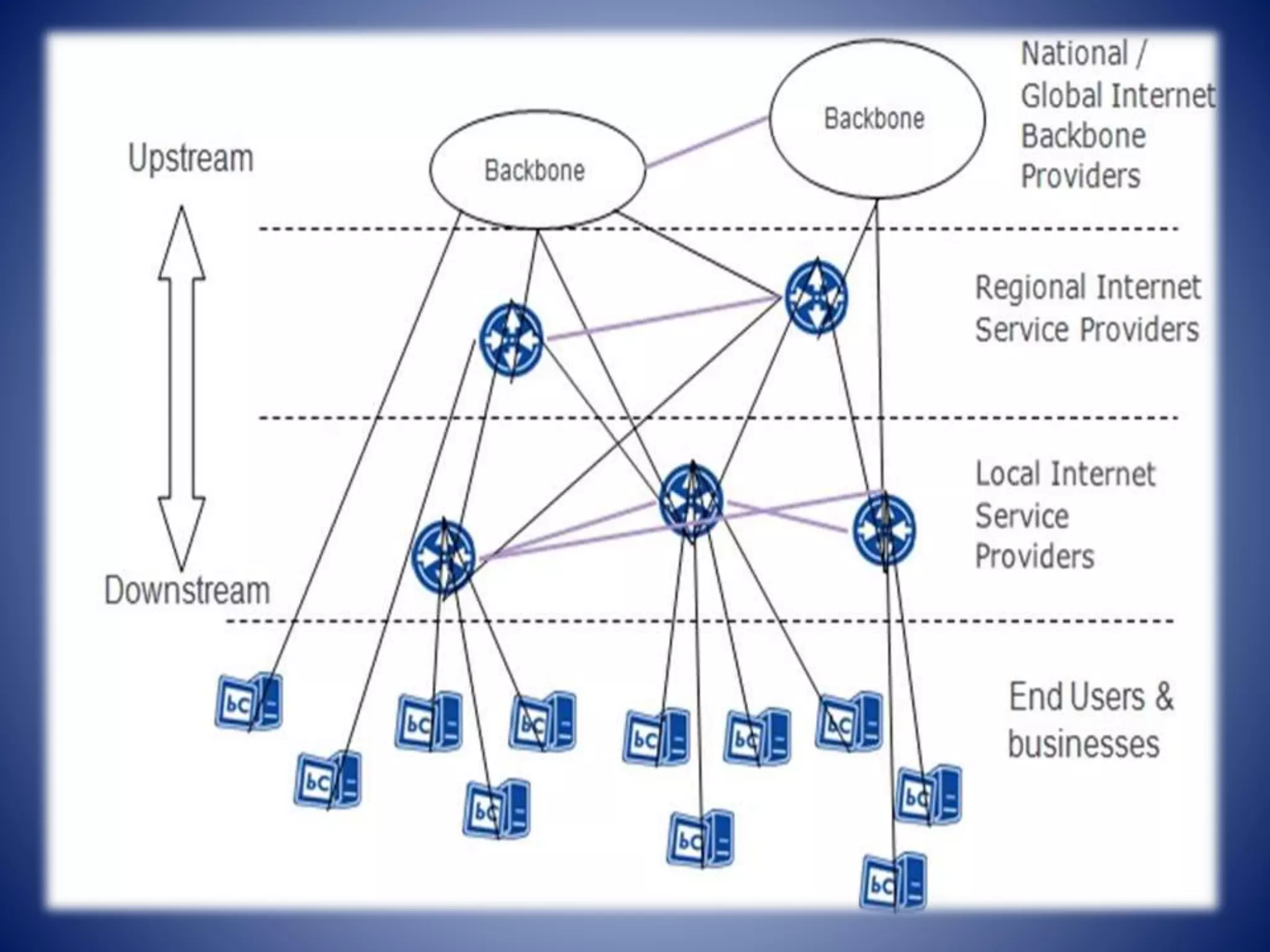
ISP Interconnection
• Just as their customers pay them for Internet
access, ISPs themselves pay upstream ISPs for
Internet access.
• An upstream ISP usually has a larger network
than the contracting ISP and/or is able to provide
the contracting ISP with access to parts of the
Internet the contracting ISP by itself has no
access to.
The Internet Hierarchy
Peering
ISPs may engage in peering, where multiple ISPs
interconnect at peering points or Internet
exchange points (IXs), allowing routing of data
between each network, without charging one
another for the data transmitted—data that
would otherwise have passed through a third
upstream ISP, incurring charges from the
upstream ISP.
Upstream
Technologies Employed
• For home users:-
Dial-up
DSL (ADSL)
Broadband wireless access
Cable modem
ISDN
• For medium-to-large businesses:-
DSL (SDSL or ADSL)
Ethernet Technologies
ISDN
Satellite Internet
Responsibility of an ISP
• Providing and maintaining a connection to the
Internet
• Support the hardware and software needed to
service that connection
• To protect their site and network from external
threats such as viruses, hacker attacks and other
illegal activities
• Provide 24-hour customer service and technical
support
THANK YOU

Internet Service Provider-ISP

  • 1.
  • 2.
  • 3.
    An Internet serviceprovider (ISP), also sometimes referred to as an Internet access provider (IAP), is a company that offers its customers access to the Internet.
  • 4.
    • In otherwords, ISP is a service (an access) provider to a business/company that provides individuals and organizations access to the Internet free or for a monthly or yearly fee.
  • 5.
    For complete Internetconnectivity..?? • You must be able to reach all destinations on the net. • Your packets have to get delivered to every destination. • Packets from everywhere else have to “find you”. This is done by having your ISP(s) advertise routes for you.
  • 6.
  • 7.
    • An InternetService Providers are categorized as:- 1. Regional ISP’s 2. National ISPs. • Other than Internet connection, ISPs may also provide related services like Web site hosting & development, e-mail hosting, domain name registration etc.
  • 8.
    Regional ISP A regionalISP usually provides Internet access to a specific geographic area and usually has a smaller technical support team
  • 9.
    National ISP A nationalISP is a business that provides Internet access in cities and towns nationwide and have a much larger technical support team.
  • 10.
  • 11.
    • Just astheir customers pay them for Internet access, ISPs themselves pay upstream ISPs for Internet access. • An upstream ISP usually has a larger network than the contracting ISP and/or is able to provide the contracting ISP with access to parts of the Internet the contracting ISP by itself has no access to.
  • 12.
  • 14.
  • 15.
    ISPs may engagein peering, where multiple ISPs interconnect at peering points or Internet exchange points (IXs), allowing routing of data between each network, without charging one another for the data transmitted—data that would otherwise have passed through a third upstream ISP, incurring charges from the upstream ISP. Upstream
  • 16.
  • 17.
    • For homeusers:- Dial-up DSL (ADSL) Broadband wireless access Cable modem ISDN • For medium-to-large businesses:- DSL (SDSL or ADSL) Ethernet Technologies ISDN Satellite Internet
  • 18.
  • 19.
    • Providing andmaintaining a connection to the Internet • Support the hardware and software needed to service that connection • To protect their site and network from external threats such as viruses, hacker attacks and other illegal activities • Provide 24-hour customer service and technical support
  • 20.