ISP Meaning.
ISP is acronym for Internet Service Provider.
ISP (Internet service provider) is a company that
provides individuals and other companies access to the
Internet and other related services such as Web site
building and virtual hosting. Among the largest ISPs are
AT&T WorldNet, IBM Global Network, MCI, Netcom,
UUNet, and PSINet. Raha broadband, TTCL, Simbanet,
UhuruOne etc.
ISP meaning cont…
An Internet service provider (ISP) is an organization that
provides services for accessing and using the Internet.
Internet service providers may be organized in various forms,
such as commercial, community-owned, non-profit, or
otherwise privately owned. (web history timeline, 2013).
Types of ISP.
Internet Service Providers (ISPs) have several
types of connectivity options for the Internet. Each
ISP is different in that the company provides a
different type of connectivity protocol and speed.
DIALUP
Although it's painfully slow, dialup access is still
a necessity for small, rural areas. ISPs offer
dialup access in these areas. A dialup ISP requires
the user to have a modem for Internet access. The
user dials a phone connection using a telephone
number, connects to a remote server, and uses the
telephone connection to browse websites.
DSL
DSL is normally offered by the local phone company. DSL is a
technology that uses the "extra" signals not used by telephone
signals.
CABLE
Cable is offered by the local cable company in the user's
neighborhood. Cable Internet access is available by connecting
a cable router to the computer and connecting to a designated
jack.
DSL means Digital Subscriber Line.
WIFI ACCESS
WiFi is wireless Internet access. It's used by laptops
and offered freely by many hotels and coffee shops.
WiFi can also be installed in the home for people
who have desktops and laptops networked
SATELLITE
Satellite access is offered for people who are not
able to receive DSL or Cable options
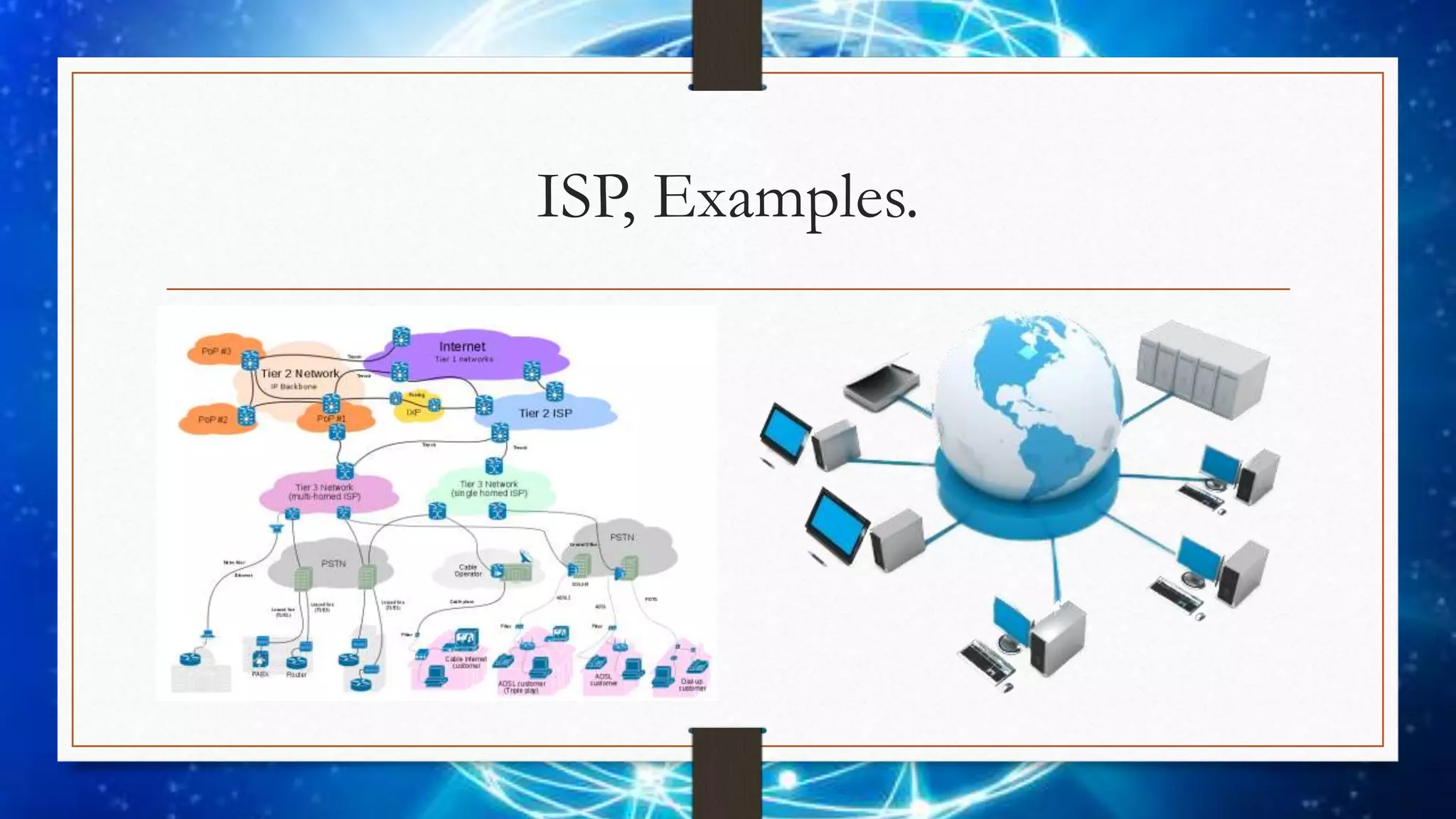
ISP, Examples.
Things to consider as we research for
Internet Service Provider (ISP).
As we are looking for internet
service provider, the following
is reflected.
Uptime commitments
We should think on one which commits to
provide 99.5% uptime with respect to the
Customer’s Service during each time. As we
research for it, this is critical issue.
This is computer industry term for the time
during which a computer is operational.
Appropriate Technology
The best ISP should focus on advanced technology regarding to
the company or organization need.
Example the organization is heavy internet user, perhaps the
best option for you would be cable or DSL. If you want a more
portable option, then you should go for 3G or 4G connection.
Manageable technical support.
Once things go wrong, and they will go
wrong, how accessible is technical support?
Be sure that selected ISP provides technical
support that meets your organization
requirements.
Price.
As the ISP, The price should be considered as the
critical factor.
The price should be very friendly to organization
budget, so that to ensure the sustainability of the
agency.
Equipment flexibility
Some ISPs enable customers to supply their own
modems. As we research for ISP, take
advantage of these opportunities, as supplying
your own network equipment not only allows
you to select the quality you want but
potentially lowers costs, too.
Equipment quality
As we think on ISP for the organization, you
should think through about the quality of
equipment, thus equipment used should be
updated with current technology as well as
higher quality.
Downstream speed and upstream capacity.
As we are looking for ISP, The best selected, solely
on advertised downstream speeds. However
upstream speed should also considered.
Security of service
You should ask your ISP to provide information
about security services and how the customer is
able to control use of their account by other
parties
Location.
First, research the available internet services provider in
your city, although internet service provider likely
advertise in your area it is not guaranteed that your
precise location will be supported by all carriers.
Conclusion.
Every organization need is different,
therefore decision made should be
directed on what plan suit the
organization need.
Thanks you!

Isp, the things to know.

  • 1.
    ISP Meaning. ISP isacronym for Internet Service Provider. ISP (Internet service provider) is a company that provides individuals and other companies access to the Internet and other related services such as Web site building and virtual hosting. Among the largest ISPs are AT&T WorldNet, IBM Global Network, MCI, Netcom, UUNet, and PSINet. Raha broadband, TTCL, Simbanet, UhuruOne etc.
  • 2.
    ISP meaning cont… AnInternet service provider (ISP) is an organization that provides services for accessing and using the Internet. Internet service providers may be organized in various forms, such as commercial, community-owned, non-profit, or otherwise privately owned. (web history timeline, 2013).
  • 3.
    Types of ISP. InternetService Providers (ISPs) have several types of connectivity options for the Internet. Each ISP is different in that the company provides a different type of connectivity protocol and speed.
  • 4.
    DIALUP Although it's painfullyslow, dialup access is still a necessity for small, rural areas. ISPs offer dialup access in these areas. A dialup ISP requires the user to have a modem for Internet access. The user dials a phone connection using a telephone number, connects to a remote server, and uses the telephone connection to browse websites.
  • 5.
    DSL DSL is normallyoffered by the local phone company. DSL is a technology that uses the "extra" signals not used by telephone signals. CABLE Cable is offered by the local cable company in the user's neighborhood. Cable Internet access is available by connecting a cable router to the computer and connecting to a designated jack. DSL means Digital Subscriber Line.
  • 6.
    WIFI ACCESS WiFi iswireless Internet access. It's used by laptops and offered freely by many hotels and coffee shops. WiFi can also be installed in the home for people who have desktops and laptops networked SATELLITE Satellite access is offered for people who are not able to receive DSL or Cable options
  • 7.
  • 8.
    Things to consideras we research for Internet Service Provider (ISP). As we are looking for internet service provider, the following is reflected.
  • 9.
    Uptime commitments We shouldthink on one which commits to provide 99.5% uptime with respect to the Customer’s Service during each time. As we research for it, this is critical issue. This is computer industry term for the time during which a computer is operational.
  • 10.
    Appropriate Technology The bestISP should focus on advanced technology regarding to the company or organization need. Example the organization is heavy internet user, perhaps the best option for you would be cable or DSL. If you want a more portable option, then you should go for 3G or 4G connection.
  • 11.
    Manageable technical support. Oncethings go wrong, and they will go wrong, how accessible is technical support? Be sure that selected ISP provides technical support that meets your organization requirements.
  • 12.
    Price. As the ISP,The price should be considered as the critical factor. The price should be very friendly to organization budget, so that to ensure the sustainability of the agency.
  • 13.
    Equipment flexibility Some ISPsenable customers to supply their own modems. As we research for ISP, take advantage of these opportunities, as supplying your own network equipment not only allows you to select the quality you want but potentially lowers costs, too.
  • 14.
    Equipment quality As wethink on ISP for the organization, you should think through about the quality of equipment, thus equipment used should be updated with current technology as well as higher quality.
  • 15.
    Downstream speed andupstream capacity. As we are looking for ISP, The best selected, solely on advertised downstream speeds. However upstream speed should also considered.
  • 16.
    Security of service Youshould ask your ISP to provide information about security services and how the customer is able to control use of their account by other parties
  • 17.
    Location. First, research theavailable internet services provider in your city, although internet service provider likely advertise in your area it is not guaranteed that your precise location will be supported by all carriers.
  • 19.
    Conclusion. Every organization needis different, therefore decision made should be directed on what plan suit the organization need.
  • 20.

Editor's Notes

  • #13 Example take into consider that, most of the welfare organization is non profit oriented.
  • #16 Thus, downstream speed refer to data sent from network service provider to the customer and upstream capacity means the direction in which data can be transferred from the client to the server.