Jian Qin
                      School of Information Studies
                      Syracuse University
                      http://eslib.ischool.syr.edu/jqin/


Survey Methodology and
     Ethical Issues
SUMMER 2012, WUHAN UNIVERSITY
Outline

 •  What is a survey?
 •  What is survey methodology?
 •  Survey design
 •  Survey quality
 •  Ethical issues in using survey methodology


                  Survey methodology, Wuhan
6/22/12                                          2
                           University
What is a survey?

 •  A systematic method for gathering
    information from (a sample of) individuals for
    the purposes of describing the attributes of
    the larger population of which the
    individuals are members.
 •  The attributes attempt to describe basic
    characteristics or experiences of large and
    small populations in our world.

                                              (Enanoria, 2005)

                  Survey methodology, Wuhan
6/22/12                                                          3
                           University
Features of a survey

 •  Information is gathered by asking people
    questions
 •  Information is collected either by having
    interviewers ask questions and record
    answers or by having people read or hear
    questions and record their answers
 •  Information is collected from only a subset of
    the population to be described (a sample)
    rather than from all members
                                              (Groves, et al., 2009)
                  Survey methodology, Wuhan
6/22/12                                                            4
                           University
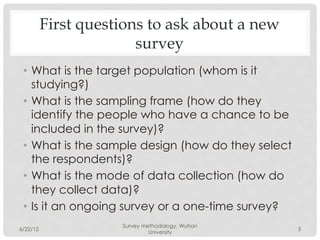
First questions to ask about a new
                        survey
 •  What is the target population (whom is it
    studying?)
 •  What is the sampling frame (how do they
    identify the people who have a chance to be
    included in the survey)?
 •  What is the sample design (how do they select
    the respondents)?
 •  What is the mode of data collection (how do
    they collect data)?
 •  Is it an ongoing survey or a one-time survey?
                     Survey methodology, Wuhan
6/22/12                                             5
                              University
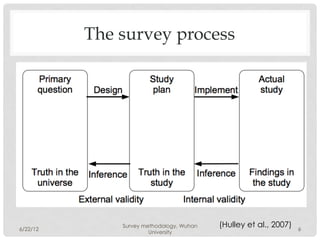
The survey process


6/22/12
              Survey methodology, Wuhan   (Hulley et al., 2007)   6
                       University
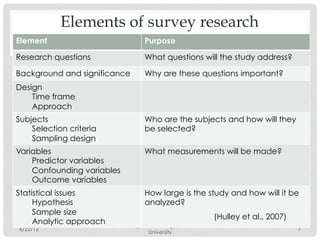
Elements of survey research
Element                            Purpose

Research questions                 What questions will the study address?

Background and significance        Why are these questions important?
Design
    Time frame
    Approach
Subjects                           Who are the subjects and how will they
    Selection criteria             be selected?
    Sampling design
Variables                          What measurements will be made?
    Predictor variables
    Confounding variables
    Outcome variables
Statistical issues                 How large is the study and how will it be
     Hypothesis                    analyzed?
     Sample size
                                                        (Hulley et al., 2007)
     Analytic approach      Survey methodology, Wuhan
6/22/12                                                                         7
                                     University
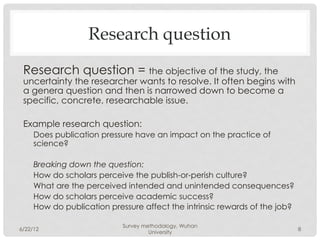
Research question
 Research question = the objective of the study, the
 uncertainty the researcher wants to resolve. It often begins with
 a genera question and then is narrowed down to become a
 specific, concrete, researchable issue.

 Example research question:
     Does publication pressure have an impact on the practice of
     science?

     Breaking down the question:
     How do scholars perceive the publish-or-perish culture?
     What are the perceived intended and unintended consequences?
     How do scholars perceive academic success?
     How do publication pressure affect the intrinsic rewards of the job?

                            Survey methodology, Wuhan
6/22/12                                                                     8
                                     University
Background and significance
 •  Sets the proposed study in context and gives its
    rationale:
     •  What is known about the topic at hand?
     •  Why is the research question important?
     •  What kind of answers will the study provide?
 •  This section should:
     •  Cite previous research that is relevant
     •  Indicate the problems with the prior research and
        what uncertainties remain
     •  Specify how the findings of the proposed study will
        help resolve these uncertainties and lead to new
        scientific knowledge
                        Survey methodology, Wuhan
6/22/12                                                       9
                                 University
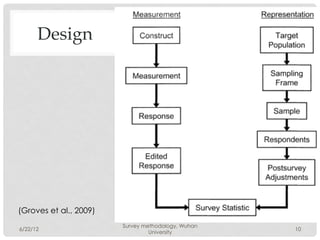
Design


(Groves et al., 2009)
                        Survey methodology, Wuhan
6/22/12                                             10
                                 University
Design: constructs

 •  Constructs: the elements of information that
    are sought by the researcher.
     •  In some sense, constructs are ideas
     •  Can be abstract


 •  Example:
     Perceived consequences of publication pressure
     Perception of determinants of academic success


                      Survey methodology, Wuhan
6/22/12                                               11
                               University
Design: measurement

 •  Measurements are more concrete than
    constructs
     •  Ways to gather information about constructs
     •  Often the questions posed to a respondent, using
        words
 •  Critical task for measurement:
     •  Design questions that produce answers reflecting
        perfectly the constructs you are trying to measure


                      Survey methodology, Wuhan
6/22/12                                                  12
                               University
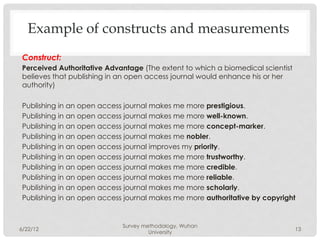
Example of constructs and measurements
 Construct:
 Perceived Authoritative Advantage (The extent to which a biomedical scientist
 believes that publishing in an open access journal would enhance his or her
 authority)
  
 Publishing in an open access journal makes me more prestigious.
 Publishing in an open access journal makes me more well-known.
 Publishing in an open access journal makes me more concept-marker.
 Publishing in an open access journal makes me nobler.
 Publishing in an open access journal improves my priority.
 Publishing in an open access journal makes me more trustworthy.
 Publishing in an open access journal makes me more credible.
 Publishing in an open access journal makes me more reliable.
 Publishing in an open access journal makes me more scholarly.
 Publishing in an open access journal makes me more authoritative by copyright


                             Survey methodology, Wuhan
6/22/12                                                                      13
                                      University
Example of constructs and
                 measurements
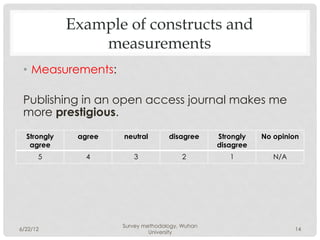
 •  Measurements:

 Publishing in an open access journal makes me
 more prestigious.
  Strongly    agree   neutral        disagree     Strongly   No opinion
   agree                                          disagree
      5         4        3               2           1          N/A


                      Survey methodology, Wuhan
6/22/12                                                               14
                               University
Design: response

 •  The data produced in a survey come from
    information provided through the survey
    measurements


                Survey methodology, Wuhan
6/22/12                                       15
                         University
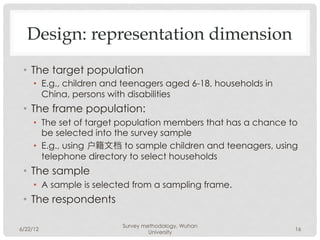
Design: representation dimension
 •  The target population
     •  E.g., children and teenagers aged 6-18, households in
        China, persons with disabilities
 •  The frame population:
     •  The set of target population members that has a chance to
        be selected into the survey sample
     •  E.g., using 户籍文档 to sample children and teenagers, using
        telephone directory to select households
 •  The sample
     •  A sample is selected from a sampling frame.
 •  The respondents

                         Survey methodology, Wuhan
6/22/12                                                         16
                                  University
Design: sampling
•  Sampling plan                         •  Procedures for
  •  How an adequate                        obtaining population
     sample size will be                    estimates from the
     determined                             sample data and for
  •  The choice of media                    estimating the
     through which the                      reliability of those
     survey will be
     administered
                                            population estimates
      •    Telephone interviews
      •    F-to-F interviews
      •    Mailed questionnaire
      •    Online questionnaire

                            Survey methodology, Wuhan
6/22/12                                                        17
                                     University
Design: sample selection

 •  Sample size is determined by:
     •  Desired degree of precision
     •  Statistical power required
     •  Ability of the researcher to gain access to the
        study subjects
     •  Degree to which the population can be stratified
     •  Selection of the relevant units of analysis


                      Survey methodology, Wuhan
6/22/12                                                    18
                               University
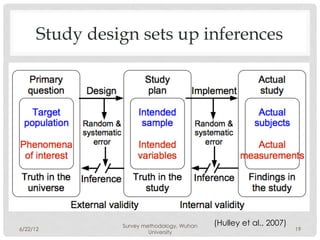
Study design sets up inferences


                Survey methodology, Wuhan   (Hulley et al., 2007)
6/22/12                                                             19
                         University
Design: survey instrument

 •  Standards for good survey questions
     •  Question wording
     •  Feasible and ethical
     •  Biased wording
     •  Biased context


                       Survey methodology, Wuhan
6/22/12                                            20
                                University
Types of survey questions
 •  Open-ended questions
 •  Closed-ended questions
     •  Questions that describe and evaluate people,
        places, and events
          •  Evaluative scales: usually 5-7 response options
          •  Agreement scales
          •  Other rating scales: importance (1st, 2nd, 3rd,…)
     •  Questions that measure responses to ideas,
        analyses or proposals
     •  Questions that measure knowledge: familiarity
        with something

                             Survey methodology, Wuhan
6/22/12                                                          21
                                      University
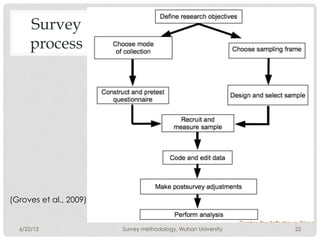
Survey
     process


(Groves et al., 2009)


  6/22/12               Survey methodology, Wuhan University   22
Example: ARL Annual Salary Survey

 •  http://www.arl.org/stats/annualsurveys/
    salary/salform11.shtml
 •  Cover letter to directors
 •  Instructions about data input
 •  Survey form
 •  Data template
 •  ARL library codes
 •  Standard for race and ethnicity

                 Survey methodology, Wuhan
6/22/12                                       23
                          University
Survey Methodology
             QUALITY CONTROL


              Survey methodology, Wuhan
6/22/12                                   24
                       University
A few important terms
 •  Interviews: verbal surveys
 •  Questionnaire: written surveys
 •  Reliability: the consistency of survey
    responses over time
 •  Item consistency: whether the responses for
    each question are consistent across
    constructs
 •  Test administration and scoring consistency:
    the probability of errors caused by
    carelessness in administration or scoring
                  Survey methodology, Wuhan
6/22/12                                            25
                           University
Important terms (cont’d)
 •  Validity: the extent to which the measurements of the
    survey provide the information needed to meet the
    study’s purpose

     •  Content validity considers whether the questions measure the
        content they were intended to measure.

     •  Predictive validity examines whether the responses are able to
        predict a criterion measure.

     •  Concurrent validity addresses the correlation of survey results
        with results from other sources.

     •  Construct validity asks whether the survey questions capably
        measure hypothetical constructs.

                            Survey methodology, Wuhan
6/22/12                                                                   26
                                     University
What is survey methodology

 •  Survey methodology is the study of survey
    methods and the sources of error in surveys.
     •  “Error” describes deviations from the desired
        outcome
     •  Survey methodology studies ways to minimize
        such errors.


                      Survey methodology, Wuhan
6/22/12                                                 27
                               University
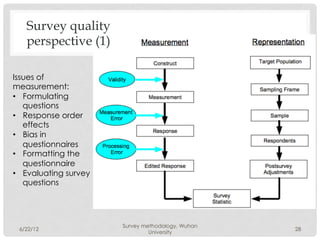
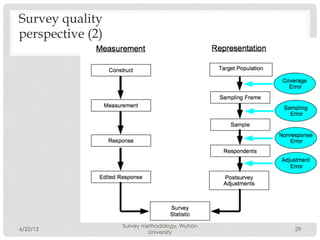
Survey quality
   perspective (1)

Issues of
measurement:
•  Formulating
   questions
•  Response order
   effects
•  Bias in
   questionnaires
•  Formatting the
   questionnaire
•  Evaluating survey
   questions


                       Survey methodology, Wuhan
 6/22/12                                           28
                                University
Survey quality
perspective (2)


                  Survey methodology, Wuhan
6/22/12                                       29
                           University
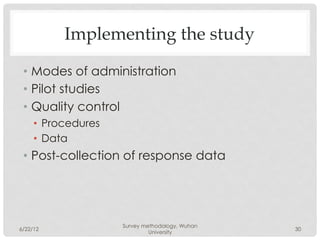
Implementing the study

 •  Modes of administration
 •  Pilot studies
 •  Quality control
     •  Procedures
     •  Data
 •  Post-collection of response data


                     Survey methodology, Wuhan
6/22/12                                          30
                              University
Ethical issues

             Survey methodology, Wuhan
6/22/12                                  31
                      University
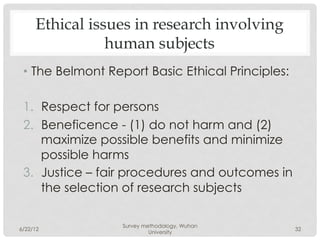
Ethical issues in research involving
                human subjects
 •  The Belmont Report Basic Ethical Principles:

 1.  Respect for persons
 2.  Beneficence - (1) do not harm and (2)
     maximize possible benefits and minimize
     possible harms
 3.  Justice – fair procedures and outcomes in
     the selection of research subjects

                  Survey methodology, Wuhan
6/22/12                                            32
                           University
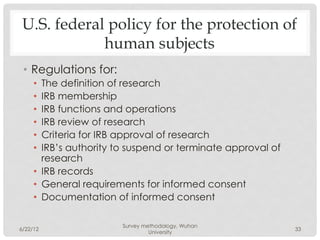
U.S. federal policy for the protection of
             human subjects
 •  Regulations for:
     •  The definition of research
     •  IRB membership
     •  IRB functions and operations
     •  IRB review of research
     •  Criteria for IRB approval of research
     •  IRB’s authority to suspend or terminate approval of
        research
     •  IRB records
     •  General requirements for informed consent
     •  Documentation of informed consent

                        Survey methodology, Wuhan
6/22/12                                                       33
                                 University
Definition of human subjects research
       as defined by federal policy
 •  Research means a systematic investigation,
    including research development, testing and
    evaluation, designed to develop or contribute
    to generalizable knowledge.

 •  Human subject means a living individual about
    whom an investigator (whether professional or
    student) conducting research obtains
     •  (1) Data through intervention or interaction with the
        individual, or
     •  (2) Identifiable private information.

                        Survey methodology, Wuhan
6/22/12                                                         34
                                 University
IRB application content
 •  Purpose of Research (Rationale or research question)
 •  Approach/Method –What are you going to do and what is going to
    happen to the subject?
 •  Qualifications of the Researchers
 •  Characteristics of the Subject population to be Recruited
 •  Special Groups Involved in Research
 •  Type of Informed Consent to Be Obtained
 •  Precautions to Ensure Privacy and Confidentiality
 •  Risks to Subjects (physical, psychological, financial, etc.) and how the
    risks will be managed.
     •  Benefits to Subjects and Society at Large - How Do the Benefits Outweigh the
        Risks?
 •  All applications should be completed under the guidance of the
    student’s faculty advisor and reviewed by the faculty advisor prior to
    submission.
 •  The application must be signed by the faculty advisor and the
    student .

                                Survey methodology, Wuhan
6/22/12                                                                                35
                                         University
Informed consent
 •  Required elements include (are not limited to):
     •    Statement – that the study involves “research”
     •    Purpose of Research
     •    Procedures involved in the Research
     •    Duration of Involvement in the Research
     •    Participation is Voluntary-Right to withdraw at anytime
          without Penalty
     •    Right to confidentiality
     •    Risks and Benefits
     •    Who to Contact for More Information or Questions
     •    Who to Contact if a Participant is Harmed or Has
          Concerns
                           Survey methodology, Wuhan
6/22/12                                                         36
                                    University
Informed consent (cont’d)

 •  Use everyday language appropriate to
    potential participant (readable and clear)
 •  On institution’s Letterhead
 •  Title of Research
 •  Signature lines


                 Survey methodology, Wuhan
6/22/12                                          37
                          University
References
 •  Enanoria, W. (2005). Introduction to survey methodology.
    http://www.idready.org/courses/2005/spring/
    survey_IntroSurveyMethods.pdf
 •  Glasow, P.A. (2005). Fundamentals of survey research methodology.
    http://www.mitre.org/work/tech_papers/
    tech_papers_05/05_0638/05_0638.pdf
 •  Groves, R. et al. (2009). Survey Methodology. Hoboken, NJ: John
    Wiley & Sons.
 •  Hulley, S.B. et al. (2007). Designing Clinical Research. 2nd ed.
    Philadelphia, PA: Lippincott Williams & Wilkins.


                         Survey methodology, Wuhan
6/22/12                                                                 38
                                  University

Survey research

  • 1.
    Jian Qin School of Information Studies Syracuse University http://eslib.ischool.syr.edu/jqin/ Survey Methodology and Ethical Issues SUMMER 2012, WUHAN UNIVERSITY
  • 2.
    Outline •  Whatis a survey? •  What is survey methodology? •  Survey design •  Survey quality •  Ethical issues in using survey methodology Survey methodology, Wuhan 6/22/12 2 University
  • 3.
    What is asurvey? •  A systematic method for gathering information from (a sample of) individuals for the purposes of describing the attributes of the larger population of which the individuals are members. •  The attributes attempt to describe basic characteristics or experiences of large and small populations in our world. (Enanoria, 2005) Survey methodology, Wuhan 6/22/12 3 University
  • 4.
    Features of asurvey •  Information is gathered by asking people questions •  Information is collected either by having interviewers ask questions and record answers or by having people read or hear questions and record their answers •  Information is collected from only a subset of the population to be described (a sample) rather than from all members (Groves, et al., 2009) Survey methodology, Wuhan 6/22/12 4 University
  • 5.
    First questions toask about a new survey •  What is the target population (whom is it studying?) •  What is the sampling frame (how do they identify the people who have a chance to be included in the survey)? •  What is the sample design (how do they select the respondents)? •  What is the mode of data collection (how do they collect data)? •  Is it an ongoing survey or a one-time survey? Survey methodology, Wuhan 6/22/12 5 University
  • 6.
    The survey process 6/22/12 Survey methodology, Wuhan (Hulley et al., 2007) 6 University
  • 7.
    Elements of surveyresearch Element Purpose Research questions What questions will the study address? Background and significance Why are these questions important? Design Time frame Approach Subjects Who are the subjects and how will they Selection criteria be selected? Sampling design Variables What measurements will be made? Predictor variables Confounding variables Outcome variables Statistical issues How large is the study and how will it be Hypothesis analyzed? Sample size (Hulley et al., 2007) Analytic approach Survey methodology, Wuhan 6/22/12 7 University
  • 8.
    Research question Researchquestion = the objective of the study, the uncertainty the researcher wants to resolve. It often begins with a genera question and then is narrowed down to become a specific, concrete, researchable issue. Example research question: Does publication pressure have an impact on the practice of science? Breaking down the question: How do scholars perceive the publish-or-perish culture? What are the perceived intended and unintended consequences? How do scholars perceive academic success? How do publication pressure affect the intrinsic rewards of the job? Survey methodology, Wuhan 6/22/12 8 University
  • 9.
    Background and significance •  Sets the proposed study in context and gives its rationale: •  What is known about the topic at hand? •  Why is the research question important? •  What kind of answers will the study provide? •  This section should: •  Cite previous research that is relevant •  Indicate the problems with the prior research and what uncertainties remain •  Specify how the findings of the proposed study will help resolve these uncertainties and lead to new scientific knowledge Survey methodology, Wuhan 6/22/12 9 University
  • 10.
    Design (Groves et al.,2009) Survey methodology, Wuhan 6/22/12 10 University
  • 11.
    Design: constructs • Constructs: the elements of information that are sought by the researcher. •  In some sense, constructs are ideas •  Can be abstract •  Example: Perceived consequences of publication pressure Perception of determinants of academic success Survey methodology, Wuhan 6/22/12 11 University
  • 12.
    Design: measurement • Measurements are more concrete than constructs •  Ways to gather information about constructs •  Often the questions posed to a respondent, using words •  Critical task for measurement: •  Design questions that produce answers reflecting perfectly the constructs you are trying to measure Survey methodology, Wuhan 6/22/12 12 University
  • 13.
    Example of constructsand measurements Construct: Perceived Authoritative Advantage (The extent to which a biomedical scientist believes that publishing in an open access journal would enhance his or her authority)   Publishing in an open access journal makes me more prestigious. Publishing in an open access journal makes me more well-known. Publishing in an open access journal makes me more concept-marker. Publishing in an open access journal makes me nobler. Publishing in an open access journal improves my priority. Publishing in an open access journal makes me more trustworthy. Publishing in an open access journal makes me more credible. Publishing in an open access journal makes me more reliable. Publishing in an open access journal makes me more scholarly. Publishing in an open access journal makes me more authoritative by copyright Survey methodology, Wuhan 6/22/12 13 University
  • 14.
    Example of constructsand measurements •  Measurements: Publishing in an open access journal makes me more prestigious. Strongly agree neutral disagree Strongly No opinion agree disagree 5 4 3 2 1 N/A Survey methodology, Wuhan 6/22/12 14 University
  • 15.
    Design: response • The data produced in a survey come from information provided through the survey measurements Survey methodology, Wuhan 6/22/12 15 University
  • 16.
    Design: representation dimension •  The target population •  E.g., children and teenagers aged 6-18, households in China, persons with disabilities •  The frame population: •  The set of target population members that has a chance to be selected into the survey sample •  E.g., using 户籍文档 to sample children and teenagers, using telephone directory to select households •  The sample •  A sample is selected from a sampling frame. •  The respondents Survey methodology, Wuhan 6/22/12 16 University
  • 17.
    Design: sampling •  Samplingplan •  Procedures for •  How an adequate obtaining population sample size will be estimates from the determined sample data and for •  The choice of media estimating the through which the reliability of those survey will be administered population estimates •  Telephone interviews •  F-to-F interviews •  Mailed questionnaire •  Online questionnaire Survey methodology, Wuhan 6/22/12 17 University
  • 18.
    Design: sample selection •  Sample size is determined by: •  Desired degree of precision •  Statistical power required •  Ability of the researcher to gain access to the study subjects •  Degree to which the population can be stratified •  Selection of the relevant units of analysis Survey methodology, Wuhan 6/22/12 18 University
  • 19.
    Study design setsup inferences Survey methodology, Wuhan (Hulley et al., 2007) 6/22/12 19 University
  • 20.
    Design: survey instrument •  Standards for good survey questions •  Question wording •  Feasible and ethical •  Biased wording •  Biased context Survey methodology, Wuhan 6/22/12 20 University
  • 21.
    Types of surveyquestions •  Open-ended questions •  Closed-ended questions •  Questions that describe and evaluate people, places, and events •  Evaluative scales: usually 5-7 response options •  Agreement scales •  Other rating scales: importance (1st, 2nd, 3rd,…) •  Questions that measure responses to ideas, analyses or proposals •  Questions that measure knowledge: familiarity with something Survey methodology, Wuhan 6/22/12 21 University
  • 22.
    Survey process (Groves et al., 2009) 6/22/12 Survey methodology, Wuhan University 22
  • 23.
    Example: ARL AnnualSalary Survey •  http://www.arl.org/stats/annualsurveys/ salary/salform11.shtml •  Cover letter to directors •  Instructions about data input •  Survey form •  Data template •  ARL library codes •  Standard for race and ethnicity Survey methodology, Wuhan 6/22/12 23 University
  • 24.
    Survey Methodology QUALITY CONTROL Survey methodology, Wuhan 6/22/12 24 University
  • 25.
    A few importantterms •  Interviews: verbal surveys •  Questionnaire: written surveys •  Reliability: the consistency of survey responses over time •  Item consistency: whether the responses for each question are consistent across constructs •  Test administration and scoring consistency: the probability of errors caused by carelessness in administration or scoring Survey methodology, Wuhan 6/22/12 25 University
  • 26.
    Important terms (cont’d) •  Validity: the extent to which the measurements of the survey provide the information needed to meet the study’s purpose •  Content validity considers whether the questions measure the content they were intended to measure. •  Predictive validity examines whether the responses are able to predict a criterion measure. •  Concurrent validity addresses the correlation of survey results with results from other sources. •  Construct validity asks whether the survey questions capably measure hypothetical constructs. Survey methodology, Wuhan 6/22/12 26 University
  • 27.
    What is surveymethodology •  Survey methodology is the study of survey methods and the sources of error in surveys. •  “Error” describes deviations from the desired outcome •  Survey methodology studies ways to minimize such errors. Survey methodology, Wuhan 6/22/12 27 University
  • 28.
    Survey quality perspective (1) Issues of measurement: •  Formulating questions •  Response order effects •  Bias in questionnaires •  Formatting the questionnaire •  Evaluating survey questions Survey methodology, Wuhan 6/22/12 28 University
  • 29.
    Survey quality perspective (2) Survey methodology, Wuhan 6/22/12 29 University
  • 30.
    Implementing the study •  Modes of administration •  Pilot studies •  Quality control •  Procedures •  Data •  Post-collection of response data Survey methodology, Wuhan 6/22/12 30 University
  • 31.
    Ethical issues Survey methodology, Wuhan 6/22/12 31 University
  • 32.
    Ethical issues inresearch involving human subjects •  The Belmont Report Basic Ethical Principles: 1.  Respect for persons 2.  Beneficence - (1) do not harm and (2) maximize possible benefits and minimize possible harms 3.  Justice – fair procedures and outcomes in the selection of research subjects Survey methodology, Wuhan 6/22/12 32 University
  • 33.
    U.S. federal policyfor the protection of human subjects •  Regulations for: •  The definition of research •  IRB membership •  IRB functions and operations •  IRB review of research •  Criteria for IRB approval of research •  IRB’s authority to suspend or terminate approval of research •  IRB records •  General requirements for informed consent •  Documentation of informed consent Survey methodology, Wuhan 6/22/12 33 University
  • 34.
    Definition of humansubjects research as defined by federal policy •  Research means a systematic investigation, including research development, testing and evaluation, designed to develop or contribute to generalizable knowledge. •  Human subject means a living individual about whom an investigator (whether professional or student) conducting research obtains •  (1) Data through intervention or interaction with the individual, or •  (2) Identifiable private information. Survey methodology, Wuhan 6/22/12 34 University
  • 35.
    IRB application content •  Purpose of Research (Rationale or research question) •  Approach/Method –What are you going to do and what is going to happen to the subject? •  Qualifications of the Researchers •  Characteristics of the Subject population to be Recruited •  Special Groups Involved in Research •  Type of Informed Consent to Be Obtained •  Precautions to Ensure Privacy and Confidentiality •  Risks to Subjects (physical, psychological, financial, etc.) and how the risks will be managed. •  Benefits to Subjects and Society at Large - How Do the Benefits Outweigh the Risks? •  All applications should be completed under the guidance of the student’s faculty advisor and reviewed by the faculty advisor prior to submission. •  The application must be signed by the faculty advisor and the student . Survey methodology, Wuhan 6/22/12 35 University
  • 36.
    Informed consent • Required elements include (are not limited to): •  Statement – that the study involves “research” •  Purpose of Research •  Procedures involved in the Research •  Duration of Involvement in the Research •  Participation is Voluntary-Right to withdraw at anytime without Penalty •  Right to confidentiality •  Risks and Benefits •  Who to Contact for More Information or Questions •  Who to Contact if a Participant is Harmed or Has Concerns Survey methodology, Wuhan 6/22/12 36 University
  • 37.
    Informed consent (cont’d) •  Use everyday language appropriate to potential participant (readable and clear) •  On institution’s Letterhead •  Title of Research •  Signature lines Survey methodology, Wuhan 6/22/12 37 University
  • 38.
    References •  Enanoria,W. (2005). Introduction to survey methodology. http://www.idready.org/courses/2005/spring/ survey_IntroSurveyMethods.pdf •  Glasow, P.A. (2005). Fundamentals of survey research methodology. http://www.mitre.org/work/tech_papers/ tech_papers_05/05_0638/05_0638.pdf •  Groves, R. et al. (2009). Survey Methodology. Hoboken, NJ: John Wiley & Sons. •  Hulley, S.B. et al. (2007). Designing Clinical Research. 2nd ed. Philadelphia, PA: Lippincott Williams & Wilkins. Survey methodology, Wuhan 6/22/12 38 University