Chapter 21: Exploring Space
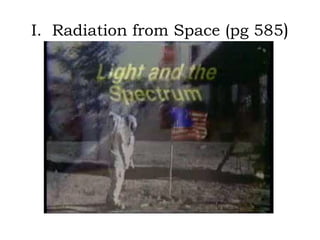
I.  Radiation from Space (pg 584) Electromagnetic Waves Light from the past Light seen from stars, may have left that star many years ago.  Light and other energy leaving a star are forms of radiation.  Radiation is energy that’s transmitted from one place to another by electromagnetic waves.  Because of this radiation, its called electromagnetic radiation.
I. Radiation from Space (pg 585) Electromagnetic Radiation Sound waves, a type of mechanical waves can’t travel through empty space.  Then how do we hear the voices of astronauts while they are in space?  When they speak into a microphone, the sound is converted into electromagnetic waves called radio waves.  They are then converted back into sound by electronic equipment and audio speakers.
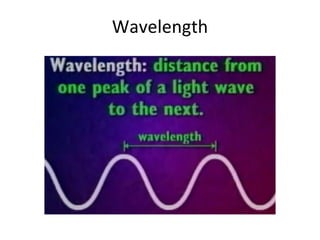
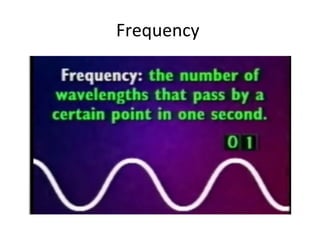
I.  Radiation from Space (pg 585) Electromagnetic Radiation Types of electromagnetic radiation  Radio waves, visible light, gamma rays, X-rays, ultraviolet waves, infrared waves, and microwaves. Measured in wavelength and frequency.  Wavelength is the distance from the top of one wave to the next.  Frequency is the number of wavelengths that pass by a certain point in one second.  As wavelength increases; frequency decreases and vice versa.
Wavelength
Frequency
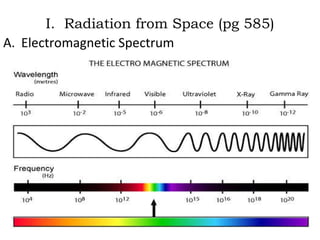
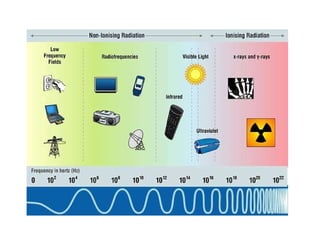
I.  Radiation from Space (pg 585) Electromagnetic Spectrum
I.  Radiation from Space (pg 585) Speed of Light Light is part electricity and part magnetism Speed of light is 3.8 X 10 8  m/s or 300,000 km/s All electromagnetic waves travel at the speed of light.  Universe is so large it takes millions of years from the light from some stars to reach the Earth.  Once electromagnetic radiation from stars and other objects reach Earth, we can use it to learn about the source of the electromagnetic radiation.
I.  Radiation from Space (pg 585 )
I.  Radiation from Space (pg 585) Speed of Light One tool used for observing electromagnetic radiation from distant sources is a TELESCOPE. End Day One Lecture  HOMEWORK:  Monday January 4 th , 2010 Due:  Wednesday January 6 th , 2010 Key Science Words--pg 609-- (a to n)  Homework Quiz Friday January 8 th , 2010
Water Found on Mars!
21.1 Radiation from Space J.  Electromagnetic Waves (Quick Review) 1.  Light from the Past a.  Stars are images of the past Light from stars takes time to travel through space Our sun = 150 Million Km away = 8 minutes travel time Alpha Centauri (our closest neighboring star) = 40 Trillion Km away = 4.2 years travel time Light travels at 300,000 km per sec/ 186,000,miles/sec. Light travels 9.5 Trillion km in a year = 1 light year 1 Light year measures both distance & time
 
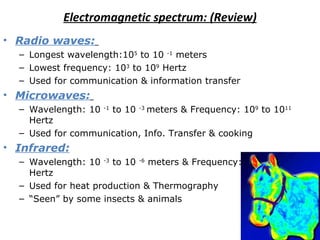
Electromagnetic spectrum: (Review) Radio waves:   Longest wavelength:10 5  to 10  -1  meters Lowest frequency: 10 3  to 10 9  Hertz Used for communication & information transfer  Microwaves:   Wavelength: 10  -1  to 10  -3  meters & Frequency: 10 9  to 10 11  Hertz Used for communication, Info. Transfer & cooking Infrared: Wavelength: 10  -3  to 10  -6  meters & Frequency: 10 11  to 10 14  Hertz Used for heat production & Thermography “ Seen” by some insects & animals
Visible Light: Wavelength: 10  -7  meters & Frequency: 10 15  Hertz Colors seen by human eyes Ultraviolet: Wavelength: 10  -7  to 10  -9  meters & Frequency: 10 15  to 10 17  Hertz “ Seen” by some insects Cause of tanning, sunburn, skin cancer Degrades rubber & plastic materials (fades cloth & paper) X – Rays: Wavelength: 10  -9  to 10  -11  meters & Frequency: 10 17  to 10 19  Hertz Bone scans, Information transfer Gamma Rays: High level radiation (Very Dangerous) Shortest wavelength: 10  -11  to 10  -15  Meters Highest frequency : 10 19  to 10 23  Hertz
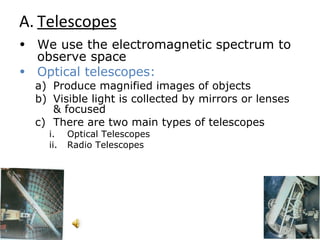
Telescopes We use the electromagnetic spectrum to observe space Optical telescopes:   Produce magnified images of objects Visible light is collected by mirrors or lenses & focused  There are two main types of telescopes Optical Telescopes Radio Telescopes
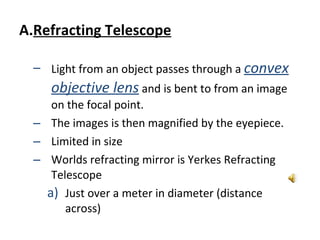
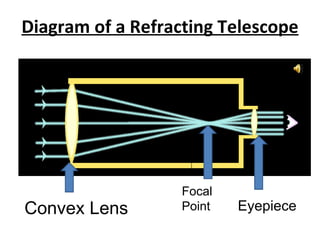
Refracting Telescope Light from an object passes through a  convex objective lens  and is bent to from an image on the focal point.  The images is then magnified by the eyepiece.  Limited in size Worlds refracting mirror is Yerkes Refracting Telescope Just over a meter in diameter (distance across)
Diagram of a Refracting Telescope Focal Point Convex Lens  Eyepiece
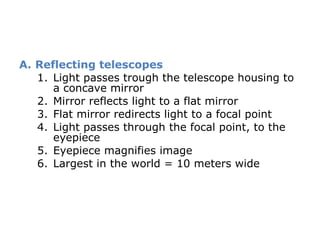
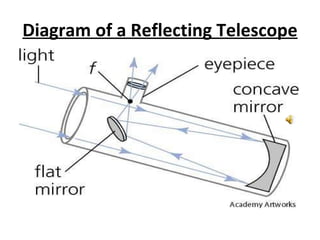
Reflecting telescopes Light passes trough the telescope housing to a concave mirror Mirror reflects light to a flat mirror Flat mirror redirects light to a focal point Light passes through the focal point, to the eyepiece Eyepiece magnifies image  Largest in the world = 10 meters wide
Diagram of a Reflecting Telescope
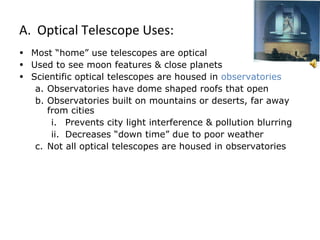
Optical Telescope Uses: Most “home” use telescopes are optical Used to see moon features & close planets Scientific optical telescopes are housed in  observatories Observatories have dome shaped roofs that open  Observatories built on mountains or deserts, far away from cities Prevents city light interference & pollution blurring Decreases “down time” due to poor weather Not all optical telescopes are housed in observatories
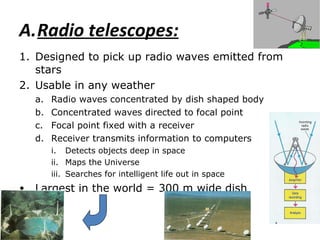
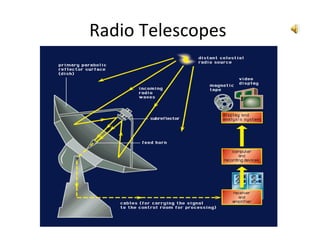
Radio telescopes: Designed to pick up radio waves emitted from stars Usable in any weather Radio waves concentrated by dish shaped body Concentrated waves directed to focal point Focal point fixed with a receiver Receiver transmits information to computers Detects objects deep in space Maps the Universe Searches for intelligent life out in space Largest in the world = 300 m wide dish
Radio Telescopes
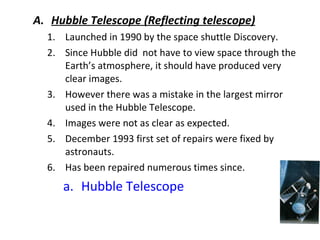
Hubble Telescope (Reflecting telescope) Launched in 1990 by the space shuttle Discovery. Since Hubble did  not have to view space through the Earth’s atmosphere, it should have produced very clear images.  However there was a mistake in the largest mirror used in the Hubble Telescope.  Images were not as clear as expected.  December 1993 first set of repairs were fixed by astronauts.  Has been repaired numerous times since.  Hubble Telescope
End of Day #2 Lecture!! Homework Vocabulary Quiz Friday!!! Blended Schools Chapter 21 Homework/StudyGuides Folder Lecture Day #1 Worksheet due Friday You will have time to work on this in class Wednesday Video:  All about Telescopes
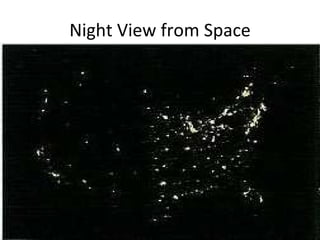
21.2 Light Pollution Light pollution & stargazing Night time sky from the city Hazy, glowing sky with a few bright stars Night time sky from far away from cities Crisp, black sky with many stars of different brightness The difference =  Light Pollution City lights & bright moon light cover the dimmer stars Large US cities are reducing light pollution Low pressure sodium lights replacing mercury vapor lights Reduces glare, improves over all visibility, cheaper to run “ Hooding” large light sources Pgs: 591 - 593
Night View from Space
2 Points of View Right to have security lighting Crime & Safety is a unilateral concern Lighting is a main tactic for prevention Property owners use lights to protect people & property  Right to Dark Sky Observation Natural phenomena should be viewable Meteor showers are everyone’s right to see Security lighting too bright, and drowns out your view Who’s right’s are more important (Your’s or Their’s)?
21.3 Artificial Satellites & Space Probes The first steps into space Telescopes view objects from a distance Scientists want to get closer Satellites:  Space exploration began in  1957  ( Sputnik I ) USSR placed Sputnik I in a low level orbit (visible from Earth) Orbited Earth for 3 months Caused major panic in the US  Began the “Space Race” Satellites  are any object that revolve (orbit) around a larger object Orbit:  curved path of satellites around a star, planet, etc. Pgs. 594 - 599
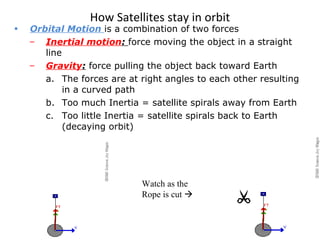
How Satellites stay in orbit Orbital Motion  is a combination of two forces Inertial motion :  force moving the object in a straight line Gravity :  force pulling the object back toward Earth The forces are at right angles to each other resulting in a curved path Too much Inertia = satellite spirals away from Earth Too little Inertia = satellite spirals back to Earth (decaying orbit) Watch as the Rope is cut  
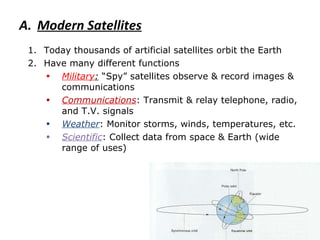
Modern Satellites Today thousands of artificial satellites orbit the Earth Have many different functions Military :  “Spy” satellites observe & record images & communications Communications : Transmit & relay telephone, radio, and T.V. signals Weather : Monitor storms, winds, temperatures, etc. Scientific : Collect data from space & Earth (wide range of uses)
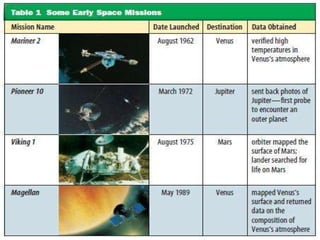
Space Probes: Not all objects in space become satellites Scientists use space probes to gather information also Space Probe : Electronic equipment designed to gather information and transmit it back to Earth Travel through (and out of) the Solar System Carry cameras, radio transmitters & receivers, sensors, etc.
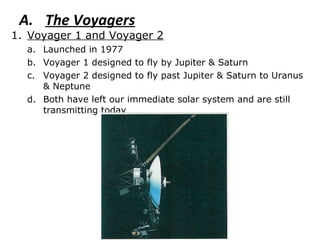
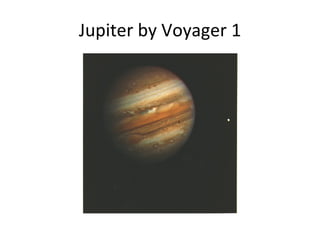
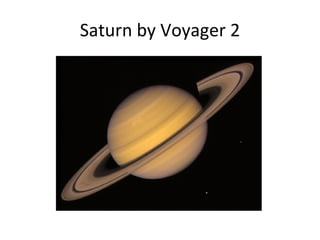
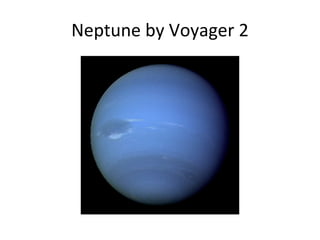
The Voyagers Voyager 1 and Voyager 2 Launched in 1977 Voyager 1 designed to fly by Jupiter & Saturn Voyager 2 designed to fly past Jupiter & Saturn to Uranus & Neptune Both have left our immediate solar system and are still transmitting today
Jupiter by Voyager 1
Saturn by Voyager 2
Neptune by Voyager 2
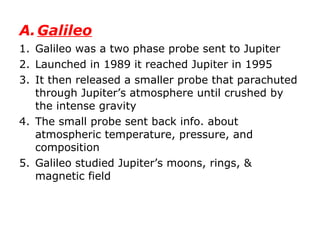
Galileo Galileo was a two phase probe sent to Jupiter Launched in 1989 it reached Jupiter in 1995 It then released a smaller probe that parachuted through Jupiter’s atmosphere until crushed by the intense gravity The small probe sent back info. about atmospheric temperature, pressure, and composition Galileo studied Jupiter’s moons, rings, & magnetic field
Galileo’s View as it Approaches Jupiter http://www2.jpl.nasa.gov/galileo/countdown/impact.html
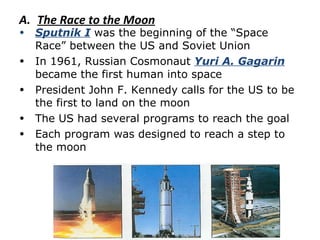
The Race to the Moon Sputnik I  was the beginning of the “Space Race” between the US and Soviet Union In 1961, Russian Cosmonaut  Yuri A. Gagarin  became the first human into space President John F. Kennedy calls for the US to be the first to land on the moon The US had several programs to reach the goal Each program was designed to reach a step to the moon
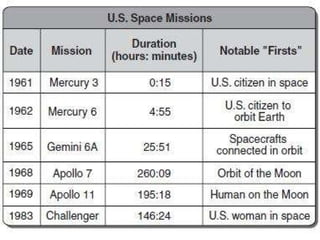
Project Mercury Goal: Orbit a craft around the Earth & return it safely Gave valuable information about space travel United States program to reach the moon began with Project Mercury. Consisted of 9 missions May 5, 1961:  Alan B. Shepard  = First American in space 15 minutes 1962:  John Glenn  = First American to orbit Earth 4 hours, 55 minutes
 
Project Gemini Goal: Team of two will spend 10 days in space Consisted of 10 missions Learned skills needed for the trip to the moon One team docked with another ship while in space During the ongoing Gemini project, several probes were sent to the moon Ranger:  Proved reaching the moon was possible Surveyor : Proved a lunar landing was possible Orbiter :  Took pictures of the moon’s surface
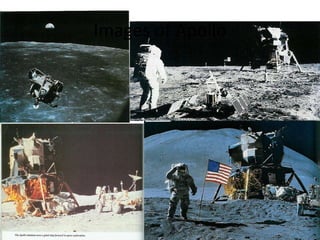
Project Apollo Series of missions to reach, land on & explore the moon Apollo 11: first to reach the moon (July 20, 1969) Neil Armstrong: first person to walk on the moon “ One small step for man, One giant leap for mankind” Edwin “Buzz” Aldrin joined Armstrong exploring for 2 hours Michael Collins remained in the Command Module (orbiting moon) 5 other Apollo Missions also landed on the moon All total more than 2000 samples of lunar rocks & soil was collected The program ended in 1972
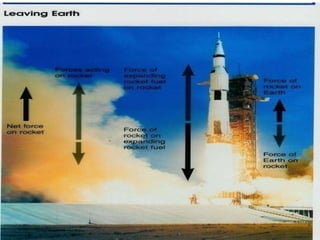
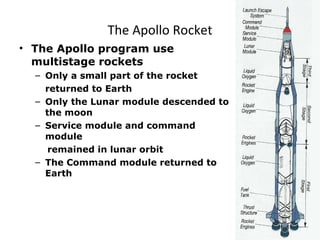
The Apollo Rocket The Apollo program use multistage rockets  Only a small part of the rocket  returned to Earth Only the Lunar module descended to  the moon Service module and command module  remained in lunar orbit The Command module returned to Earth
Images of Apollo
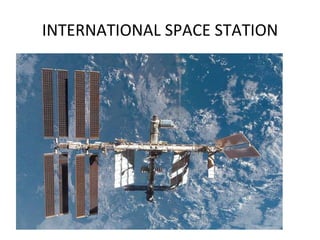
Current Space Travel Currently many nations work together in space travel The International Space Station: A cooperative effort between many countries to build an extraterrestrial habitat used for research.  Started in  1998  and the first person inhabited it on  2000 .  There have been people there ever since 2000. Missions to Mars: Several countries are working towards a joint mission Possibilities of a Martian base are also being considered
INTERNATIONAL SPACE STATION
 
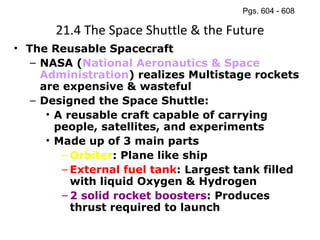
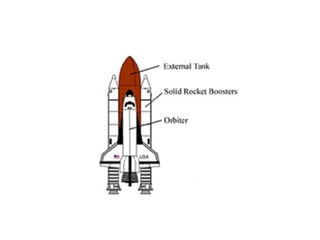
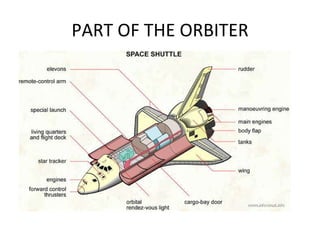
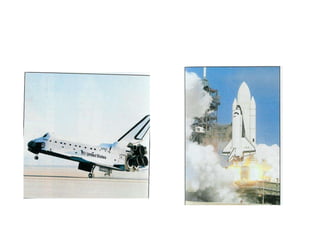
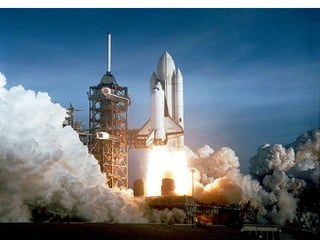
21.4 The Space Shuttle & the Future The Reusable Spacecraft NASA ( National Aeronautics & Space Administration ) realizes Multistage rockets are expensive & wasteful Designed the Space Shuttle:  A reusable craft capable of carrying people, satellites, and experiments Made up of 3 main parts Orbiter : Plane like ship External fuel tank : Largest tank filled with liquid Oxygen & Hydrogen 2 solid rocket boosters : Produces thrust required to launch Pgs. 604 - 608
 
 
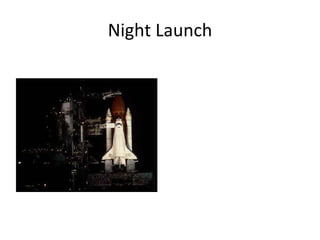
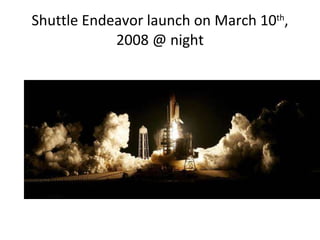
Night Launch
Shuttle Endeavor launch on March 10 th , 2008 @ night
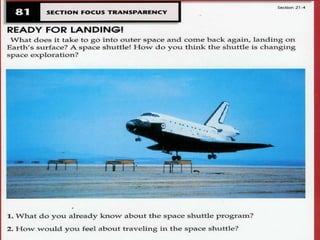
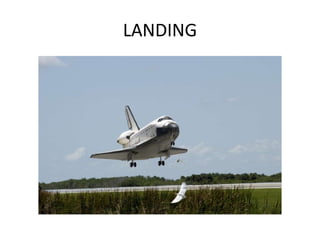
LANDING
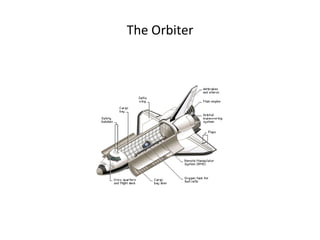
PART OF THE ORBITER
Shuttle Launch Upon Launch the solid rocket boosters fire producing lift At 45 km (27 miles), they are depleted & eject (parachuting back to Earth) Recovered & Reused Shuttle flies on fuel from the External Tank Once it is empty it is ejected (crashing into the Ocean) External Tanks are not reused (scrapped & recycled) Once in space the shuttle orbits the Earth Experiments conducted, Satellites deployed, etc. Upon completion of mission the Orbiter returns Glides into a runway, landing like an Airplane
The Orbiter
Space Stations Space Ships only limited resources, & cannot stay in space for long periods of time Space stations are massive complexes that allow humans to stay in space for extended periods of time Provides living quarters, work & exercise areas Carries all equipment & support systems needed Sky Lab : US Space Station launched in 1973 Crews stationed for 84 day tours Purpose: Perform experiments on effects of living in space Scrapped in 1979 (Placed in decaying orbit & burned up)  Mir : Russian space station Cosmonauts stay for 438 days (current record)
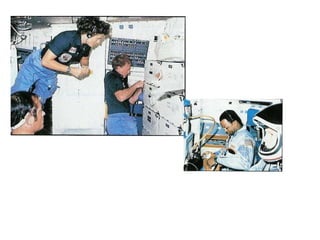
Cooperation in Space Countries realize that pooling resources = less expense 1995: US & Russia begin working together on projects Americans now travel in Russian rockets & Russians travel in the Space Shuttle The  Atlantis  was the first shuttle to dock with  Mir The International Space Station Project began in 1997 (on going) A dozen nations are cooperating to build the station Main components built on Earth & transported into space The components will be assembled in space
 
 
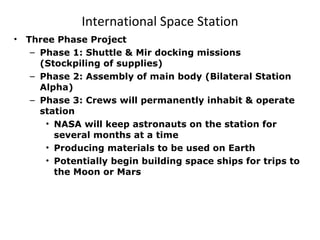
International Space Station Three Phase Project Phase 1: Shuttle & Mir docking missions (Stockpiling of supplies) Phase 2: Assembly of main body (Bilateral Station Alpha) Phase 3: Crews will permanently inhabit & operate station NASA will keep astronauts on the station for several months at a time Producing materials to be used on Earth Potentially begin building space ships for trips to the Moon or Mars
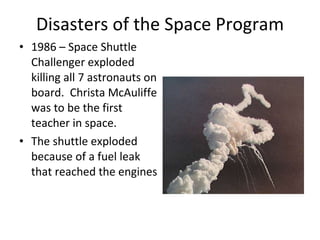
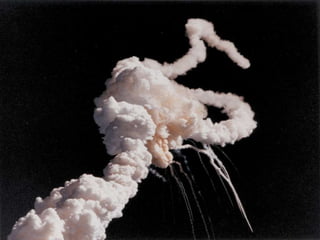
Disasters of the Space Program 1986 – Space Shuttle Challenger exploded killing all 7 astronauts on board.  Christa McAuliffe was to be the first teacher in space. The shuttle exploded because of a fuel leak that reached the engines
 
 
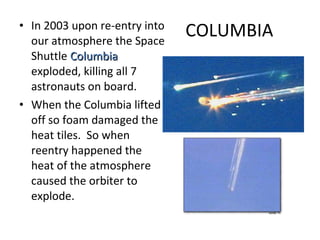
COLUMBIA In 2003 upon re-entry into our atmosphere the Space Shuttle  Columbia  exploded, killing all 7 astronauts on board. When the Columbia lifted off so foam damaged the heat tiles.  So when reentry happened the heat of the atmosphere caused the orbiter to explode.
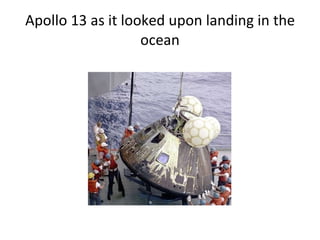
APOLLO 13 Apollo 13  was the third manned lunar-landing mission, part of  Project Apollo  under  NASA  in the United States. It launched on  April 11 ,  1970 . Two days after the launch, the Apollo spacecraft was crippled by an explosion, caused by a fault in the oxygen tank. The explosion damaged the  Service Module , resulting in a loss of oxygen and electrical power. The crew used the  Lunar Module  as a “lifeboat”.  They of course made it back to earth safely.
Apollo 13 as it looked upon landing in the ocean
 
 
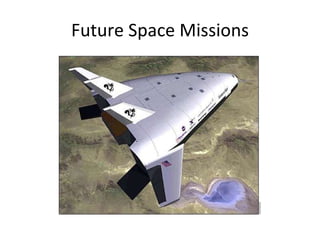
Future Space Missions

Ch. 21 Exploring Space 2010

  • 1.
  • 2.
    I. Radiationfrom Space (pg 584) Electromagnetic Waves Light from the past Light seen from stars, may have left that star many years ago. Light and other energy leaving a star are forms of radiation. Radiation is energy that’s transmitted from one place to another by electromagnetic waves. Because of this radiation, its called electromagnetic radiation.
  • 3.
    I. Radiation fromSpace (pg 585) Electromagnetic Radiation Sound waves, a type of mechanical waves can’t travel through empty space. Then how do we hear the voices of astronauts while they are in space? When they speak into a microphone, the sound is converted into electromagnetic waves called radio waves. They are then converted back into sound by electronic equipment and audio speakers.
  • 4.
    I. Radiationfrom Space (pg 585) Electromagnetic Radiation Types of electromagnetic radiation Radio waves, visible light, gamma rays, X-rays, ultraviolet waves, infrared waves, and microwaves. Measured in wavelength and frequency. Wavelength is the distance from the top of one wave to the next. Frequency is the number of wavelengths that pass by a certain point in one second. As wavelength increases; frequency decreases and vice versa.
  • 5.
  • 6.
  • 7.
    I. Radiationfrom Space (pg 585) Electromagnetic Spectrum
  • 8.
    I. Radiationfrom Space (pg 585) Speed of Light Light is part electricity and part magnetism Speed of light is 3.8 X 10 8 m/s or 300,000 km/s All electromagnetic waves travel at the speed of light. Universe is so large it takes millions of years from the light from some stars to reach the Earth. Once electromagnetic radiation from stars and other objects reach Earth, we can use it to learn about the source of the electromagnetic radiation.
  • 9.
    I. Radiationfrom Space (pg 585 )
  • 10.
    I. Radiationfrom Space (pg 585) Speed of Light One tool used for observing electromagnetic radiation from distant sources is a TELESCOPE. End Day One Lecture HOMEWORK: Monday January 4 th , 2010 Due: Wednesday January 6 th , 2010 Key Science Words--pg 609-- (a to n) Homework Quiz Friday January 8 th , 2010
  • 11.
  • 12.
    21.1 Radiation fromSpace J. Electromagnetic Waves (Quick Review) 1. Light from the Past a. Stars are images of the past Light from stars takes time to travel through space Our sun = 150 Million Km away = 8 minutes travel time Alpha Centauri (our closest neighboring star) = 40 Trillion Km away = 4.2 years travel time Light travels at 300,000 km per sec/ 186,000,miles/sec. Light travels 9.5 Trillion km in a year = 1 light year 1 Light year measures both distance & time
  • 13.
  • 14.
    Electromagnetic spectrum: (Review)Radio waves: Longest wavelength:10 5 to 10 -1 meters Lowest frequency: 10 3 to 10 9 Hertz Used for communication & information transfer Microwaves: Wavelength: 10 -1 to 10 -3 meters & Frequency: 10 9 to 10 11 Hertz Used for communication, Info. Transfer & cooking Infrared: Wavelength: 10 -3 to 10 -6 meters & Frequency: 10 11 to 10 14 Hertz Used for heat production & Thermography “ Seen” by some insects & animals
  • 15.
    Visible Light: Wavelength:10 -7 meters & Frequency: 10 15 Hertz Colors seen by human eyes Ultraviolet: Wavelength: 10 -7 to 10 -9 meters & Frequency: 10 15 to 10 17 Hertz “ Seen” by some insects Cause of tanning, sunburn, skin cancer Degrades rubber & plastic materials (fades cloth & paper) X – Rays: Wavelength: 10 -9 to 10 -11 meters & Frequency: 10 17 to 10 19 Hertz Bone scans, Information transfer Gamma Rays: High level radiation (Very Dangerous) Shortest wavelength: 10 -11 to 10 -15 Meters Highest frequency : 10 19 to 10 23 Hertz
  • 16.
    Telescopes We usethe electromagnetic spectrum to observe space Optical telescopes: Produce magnified images of objects Visible light is collected by mirrors or lenses & focused There are two main types of telescopes Optical Telescopes Radio Telescopes
  • 17.
    Refracting Telescope Lightfrom an object passes through a convex objective lens and is bent to from an image on the focal point. The images is then magnified by the eyepiece. Limited in size Worlds refracting mirror is Yerkes Refracting Telescope Just over a meter in diameter (distance across)
  • 18.
    Diagram of aRefracting Telescope Focal Point Convex Lens Eyepiece
  • 19.
    Reflecting telescopes Lightpasses trough the telescope housing to a concave mirror Mirror reflects light to a flat mirror Flat mirror redirects light to a focal point Light passes through the focal point, to the eyepiece Eyepiece magnifies image Largest in the world = 10 meters wide
  • 20.
    Diagram of aReflecting Telescope
  • 21.
    Optical Telescope Uses:Most “home” use telescopes are optical Used to see moon features & close planets Scientific optical telescopes are housed in observatories Observatories have dome shaped roofs that open Observatories built on mountains or deserts, far away from cities Prevents city light interference & pollution blurring Decreases “down time” due to poor weather Not all optical telescopes are housed in observatories
  • 22.
    Radio telescopes: Designedto pick up radio waves emitted from stars Usable in any weather Radio waves concentrated by dish shaped body Concentrated waves directed to focal point Focal point fixed with a receiver Receiver transmits information to computers Detects objects deep in space Maps the Universe Searches for intelligent life out in space Largest in the world = 300 m wide dish
  • 23.
  • 24.
    Hubble Telescope (Reflectingtelescope) Launched in 1990 by the space shuttle Discovery. Since Hubble did not have to view space through the Earth’s atmosphere, it should have produced very clear images. However there was a mistake in the largest mirror used in the Hubble Telescope. Images were not as clear as expected. December 1993 first set of repairs were fixed by astronauts. Has been repaired numerous times since. Hubble Telescope
  • 25.
    End of Day#2 Lecture!! Homework Vocabulary Quiz Friday!!! Blended Schools Chapter 21 Homework/StudyGuides Folder Lecture Day #1 Worksheet due Friday You will have time to work on this in class Wednesday Video: All about Telescopes
  • 26.
    21.2 Light PollutionLight pollution & stargazing Night time sky from the city Hazy, glowing sky with a few bright stars Night time sky from far away from cities Crisp, black sky with many stars of different brightness The difference = Light Pollution City lights & bright moon light cover the dimmer stars Large US cities are reducing light pollution Low pressure sodium lights replacing mercury vapor lights Reduces glare, improves over all visibility, cheaper to run “ Hooding” large light sources Pgs: 591 - 593
  • 27.
  • 28.
    2 Points ofView Right to have security lighting Crime & Safety is a unilateral concern Lighting is a main tactic for prevention Property owners use lights to protect people & property Right to Dark Sky Observation Natural phenomena should be viewable Meteor showers are everyone’s right to see Security lighting too bright, and drowns out your view Who’s right’s are more important (Your’s or Their’s)?
  • 29.
    21.3 Artificial Satellites& Space Probes The first steps into space Telescopes view objects from a distance Scientists want to get closer Satellites: Space exploration began in 1957 ( Sputnik I ) USSR placed Sputnik I in a low level orbit (visible from Earth) Orbited Earth for 3 months Caused major panic in the US Began the “Space Race” Satellites are any object that revolve (orbit) around a larger object Orbit: curved path of satellites around a star, planet, etc. Pgs. 594 - 599
  • 30.
    How Satellites stayin orbit Orbital Motion is a combination of two forces Inertial motion : force moving the object in a straight line Gravity : force pulling the object back toward Earth The forces are at right angles to each other resulting in a curved path Too much Inertia = satellite spirals away from Earth Too little Inertia = satellite spirals back to Earth (decaying orbit) Watch as the Rope is cut 
  • 31.
    Modern Satellites Todaythousands of artificial satellites orbit the Earth Have many different functions Military : “Spy” satellites observe & record images & communications Communications : Transmit & relay telephone, radio, and T.V. signals Weather : Monitor storms, winds, temperatures, etc. Scientific : Collect data from space & Earth (wide range of uses)
  • 32.
    Space Probes: Notall objects in space become satellites Scientists use space probes to gather information also Space Probe : Electronic equipment designed to gather information and transmit it back to Earth Travel through (and out of) the Solar System Carry cameras, radio transmitters & receivers, sensors, etc.
  • 33.
    The Voyagers Voyager1 and Voyager 2 Launched in 1977 Voyager 1 designed to fly by Jupiter & Saturn Voyager 2 designed to fly past Jupiter & Saturn to Uranus & Neptune Both have left our immediate solar system and are still transmitting today
  • 34.
  • 35.
  • 36.
  • 37.
    Galileo Galileo wasa two phase probe sent to Jupiter Launched in 1989 it reached Jupiter in 1995 It then released a smaller probe that parachuted through Jupiter’s atmosphere until crushed by the intense gravity The small probe sent back info. about atmospheric temperature, pressure, and composition Galileo studied Jupiter’s moons, rings, & magnetic field
  • 38.
    Galileo’s View asit Approaches Jupiter http://www2.jpl.nasa.gov/galileo/countdown/impact.html
  • 39.
    The Race tothe Moon Sputnik I was the beginning of the “Space Race” between the US and Soviet Union In 1961, Russian Cosmonaut Yuri A. Gagarin became the first human into space President John F. Kennedy calls for the US to be the first to land on the moon The US had several programs to reach the goal Each program was designed to reach a step to the moon
  • 40.
    Project Mercury Goal:Orbit a craft around the Earth & return it safely Gave valuable information about space travel United States program to reach the moon began with Project Mercury. Consisted of 9 missions May 5, 1961: Alan B. Shepard = First American in space 15 minutes 1962: John Glenn = First American to orbit Earth 4 hours, 55 minutes
  • 41.
  • 42.
    Project Gemini Goal:Team of two will spend 10 days in space Consisted of 10 missions Learned skills needed for the trip to the moon One team docked with another ship while in space During the ongoing Gemini project, several probes were sent to the moon Ranger: Proved reaching the moon was possible Surveyor : Proved a lunar landing was possible Orbiter : Took pictures of the moon’s surface
  • 43.
    Project Apollo Seriesof missions to reach, land on & explore the moon Apollo 11: first to reach the moon (July 20, 1969) Neil Armstrong: first person to walk on the moon “ One small step for man, One giant leap for mankind” Edwin “Buzz” Aldrin joined Armstrong exploring for 2 hours Michael Collins remained in the Command Module (orbiting moon) 5 other Apollo Missions also landed on the moon All total more than 2000 samples of lunar rocks & soil was collected The program ended in 1972
  • 44.
    The Apollo RocketThe Apollo program use multistage rockets Only a small part of the rocket returned to Earth Only the Lunar module descended to the moon Service module and command module remained in lunar orbit The Command module returned to Earth
  • 45.
  • 46.
    Current Space TravelCurrently many nations work together in space travel The International Space Station: A cooperative effort between many countries to build an extraterrestrial habitat used for research. Started in 1998 and the first person inhabited it on 2000 . There have been people there ever since 2000. Missions to Mars: Several countries are working towards a joint mission Possibilities of a Martian base are also being considered
  • 47.
  • 48.
  • 49.
    21.4 The SpaceShuttle & the Future The Reusable Spacecraft NASA ( National Aeronautics & Space Administration ) realizes Multistage rockets are expensive & wasteful Designed the Space Shuttle: A reusable craft capable of carrying people, satellites, and experiments Made up of 3 main parts Orbiter : Plane like ship External fuel tank : Largest tank filled with liquid Oxygen & Hydrogen 2 solid rocket boosters : Produces thrust required to launch Pgs. 604 - 608
  • 50.
  • 51.
  • 52.
  • 53.
    Shuttle Endeavor launchon March 10 th , 2008 @ night
  • 54.
  • 55.
    PART OF THEORBITER
  • 56.
    Shuttle Launch UponLaunch the solid rocket boosters fire producing lift At 45 km (27 miles), they are depleted & eject (parachuting back to Earth) Recovered & Reused Shuttle flies on fuel from the External Tank Once it is empty it is ejected (crashing into the Ocean) External Tanks are not reused (scrapped & recycled) Once in space the shuttle orbits the Earth Experiments conducted, Satellites deployed, etc. Upon completion of mission the Orbiter returns Glides into a runway, landing like an Airplane
  • 57.
  • 58.
    Space Stations SpaceShips only limited resources, & cannot stay in space for long periods of time Space stations are massive complexes that allow humans to stay in space for extended periods of time Provides living quarters, work & exercise areas Carries all equipment & support systems needed Sky Lab : US Space Station launched in 1973 Crews stationed for 84 day tours Purpose: Perform experiments on effects of living in space Scrapped in 1979 (Placed in decaying orbit & burned up) Mir : Russian space station Cosmonauts stay for 438 days (current record)
  • 59.
    Cooperation in SpaceCountries realize that pooling resources = less expense 1995: US & Russia begin working together on projects Americans now travel in Russian rockets & Russians travel in the Space Shuttle The Atlantis was the first shuttle to dock with Mir The International Space Station Project began in 1997 (on going) A dozen nations are cooperating to build the station Main components built on Earth & transported into space The components will be assembled in space
  • 60.
  • 61.
  • 62.
    International Space StationThree Phase Project Phase 1: Shuttle & Mir docking missions (Stockpiling of supplies) Phase 2: Assembly of main body (Bilateral Station Alpha) Phase 3: Crews will permanently inhabit & operate station NASA will keep astronauts on the station for several months at a time Producing materials to be used on Earth Potentially begin building space ships for trips to the Moon or Mars
  • 63.
    Disasters of theSpace Program 1986 – Space Shuttle Challenger exploded killing all 7 astronauts on board. Christa McAuliffe was to be the first teacher in space. The shuttle exploded because of a fuel leak that reached the engines
  • 64.
  • 65.
  • 66.
    COLUMBIA In 2003upon re-entry into our atmosphere the Space Shuttle Columbia exploded, killing all 7 astronauts on board. When the Columbia lifted off so foam damaged the heat tiles. So when reentry happened the heat of the atmosphere caused the orbiter to explode.
  • 67.
    APOLLO 13 Apollo13 was the third manned lunar-landing mission, part of Project Apollo under NASA in the United States. It launched on April 11 , 1970 . Two days after the launch, the Apollo spacecraft was crippled by an explosion, caused by a fault in the oxygen tank. The explosion damaged the Service Module , resulting in a loss of oxygen and electrical power. The crew used the Lunar Module as a “lifeboat”. They of course made it back to earth safely.
  • 68.
    Apollo 13 asit looked upon landing in the ocean
  • 69.
  • 70.
  • 71.