Comprehensive Land
Use Planning
MPA 203 Local Governance and
Administration
Josefina B. Bitonio, DPA
Comprehensive Land
Use Planning
 Mother plan
 9-10 years
 Use of the land
 How to implement
Comprehensive
Development Plan
 Medium Term Plan
 AIP lifted from the MTP
 6 years
 Coincide with the term of the
national leadership
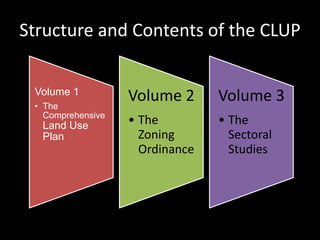
Structure and Contents of the CLUP
Volume 1
• The
Comprehensive
Land Use
Plan
Volume 2
• The
Zoning
Ordinance
Volume 3
• The
Sectoral
Studies
Two Comprehensive Plans Mandated by the
Local Government Code for Cities and
Municipalities
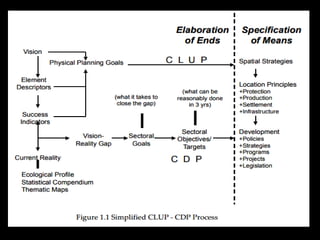
• Comprehensive Land Use Plan
(CLUP) – Physical Plan
• Comprehensive Development Plan
(CDP) – Multi-Sectoral Plan
CDP + Development
Investment Plan (DIP)
Each LGU shall have a Comprehensive
Multi-Sectoral Development Plan to be
initiated by the LDC and approved by its
sanggunian
Sec. 109, RA 7160
The local government units shall inconformity
with existing laws, continue to prepare the
irrespective Comprehensive Land Use Plans
enacted through zoning ordinances which shall
be the primary and dominant bases for the future
use of land resources: Provided, that the
requirements for food production, human
settlements, and industrial expansion shall be
taken into consideration in the preparation of
such plans
• Sec. 20 (c), RA 7160
The Comprehensive Land Use Plan
(CLUP)
• Document embodying specific proposals for
guiding and regulating the growth and/or
development of a City/ Municipality.
• A long-term plan (10 yrs. minimum)
• A tool for managing land and natural
resources at the local level.
In the Philippines, all local government
units (LGUs) from the province, city, and
municipality are mandated to formulate its
Comprehensive Land Use Plans (CLUPs).
Land use planning is imperative because of
the scarcity of land. Land use planning aims
to find a balance among competing and
sometimes contradictory uses.
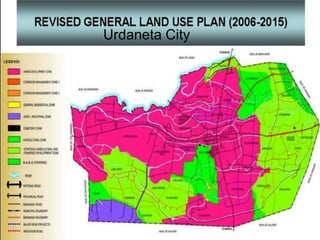
Urdaneta City
The comprehensive plan, also known as a
general plan, master plan or land-use plan, is a
document designed to guide the future actions of a
community. It presents a vision for the future, with
long-range goals and objectives for all activities that
affect the local government.
This includes guidance on how to make
decisions on public and private land development
proposals, the expenditure of public funds,
availability of tax policy (tax incentives), cooperative
efforts and issues of pressing concern, such as
farmland preservation or the rehabilitation of older
neighborhoods areas
Most plans are written to provide
direction for future activities over a 10-
to 20-year period after plan adoption.
However, plans should receive a
considered review and possible update
every five years.
Volume 1 : Comprehensive Land Use
Plan
1. Preliminary pages
2. Brief profile of city/municipal (general
information)
a. Brief history
b. Physical, Demographic, Socioeconomic
features/structures/resources
3. Existing land use and land use trend
4. Comparative/competitive advantages
5. Weaknesses, priority issues and concerns
6. Functional role
Volume 1 : Comprehensive Land Use
Plan
7. The Land Use Plan
• Vision/mission
• Goals, Objectives, Strategies
• The concept/structure plan
• The Proposed Land and Water Uses
• Policies/Priority programs and projects
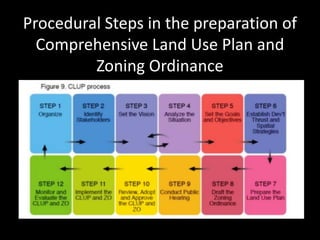
Procedural Steps in the preparation of
Comprehensive Land Use Plan and
Zoning Ordinance
CLUP Process
1. Organize
2. Identify stakeholders
3. Set the vision
4. Analyze the situation
5. Set the goals and objectives
6. Establish development thrust and spatial
strategies
7. Prepare the land use plan
8. Draft the Zoning Ordinance (ZO)
9. Conduct public hearing
10. Review, adopt and approve the CLUP and ZO
11. Implement the CLUP and ZO
12. Monitor and evaluate the CLUP & ZO
CLUP Process
Volume 2
The Zoning Ordinance
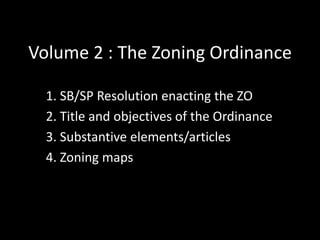
Volume 2 : The Zoning Ordinance
1. SB/SP Resolution enacting the ZO
2. Title and objectives of the Ordinance
3. Substantive elements/articles
4. Zoning maps
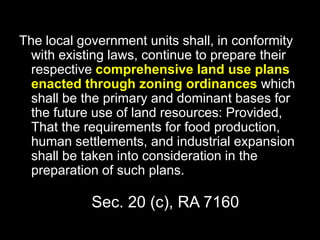
Sec. 20 (c), RA 7160
The local government units shall, in conformity
with existing laws, continue to prepare their
respective comprehensive land use plans
enacted through zoning ordinances which
shall be the primary and dominant bases for
the future use of land resources: Provided,
That the requirements for food production,
human settlements, and industrial expansion
shall be taken into consideration in the
preparation of such plans.
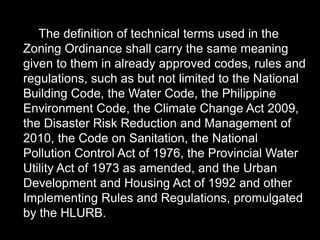
The definition of technical terms used in the
Zoning Ordinance shall carry the same meaning
given to them in already approved codes, rules and
regulations, such as but not limited to the National
Building Code, the Water Code, the Philippine
Environment Code, the Climate Change Act 2009,
the Disaster Risk Reduction and Management of
2010, the Code on Sanitation, the National
Pollution Control Act of 1976, the Provincial Water
Utility Act of 1973 as amended, and the Urban
Development and Housing Act of 1992 and other
Implementing Rules and Regulations, promulgated
by the HLURB.
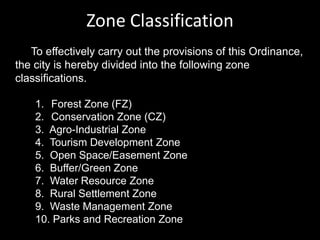
Zone Classification
To effectively carry out the provisions of this Ordinance,
the city is hereby divided into the following zone
classifications.
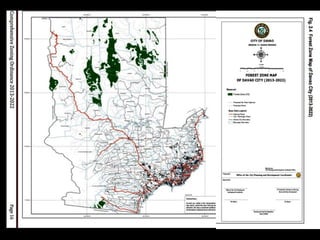
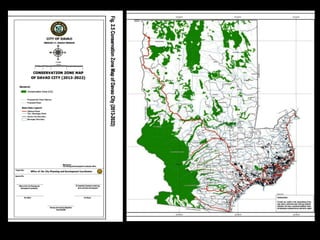
1. Forest Zone (FZ)
2. Conservation Zone (CZ)
3. Agro-Industrial Zone
4. Tourism Development Zone
5. Open Space/Easement Zone
6. Buffer/Green Zone
7. Water Resource Zone
8. Rural Settlement Zone
9. Waste Management Zone
10. Parks and Recreation Zone
Agricultural Land Zone
• (ALZ which is further subdivided into :
• a. Prime Agricultural Land Sub-zone
• b. Agri-non Tillage Land Sub-zone
• c. Marginal Agricultural Land Sub-zone
http://cpdo.davaocity.gov.ph/wp-
content/uploads/2016/10/Vol2ZoningOrdinance2013-202220151215090202.pdf
Major Urban Zone
a. Low Density Residential Sub-zone (R-1)
b. Medium Density Residential Sub-zone (R-2)
c. High Density Residential Sub-zone (R-3)
d. Socialized Housing Sub-zone (SHZ)
e. Planned Unit Development (PUD)
f. Minor Commercial Sub-zone (C-1)
g. Major Commercial Sub-zone (C-2)
h. Light Industrial Sub-zone (I-1)
i. Medium Industrial Sub-zone (I-2)
j. Heavy Industrial Sub-zone (I-3)
k. General Institutional Sub-zone (Gins)
l. Special Institutional Sub-zone (Sins)
m. Infrastructure Utilities Sub-zone (IU)
Environment Management Zone
a. Landslide mitigation sub-zone
b. Flood way mitigation sub-zone
c. Urban Ecological Enhancement Sub-zone
http://cpdo.davaocity.gov.ph/wp-
content/uploads/2016/10/Vol2ZoningOrdinance2013-
202220151215090202.pdf
Coastal Water Zone
a. Aquaculture/Mariculture Sub-zone
b. Marine Protected Sub-zone
i. Mangrove Protection and Rehabilitation area
ii. Species Conservation area
iii. Fish Sanctuary area
c. Fishing Sub-zone
d. Recreation Sub-zone
e. Industrial Sub-zone
f. Multiple Use Sub-zone
g. Eco-Tourism & Research Sub-zone
Inland Water Zone
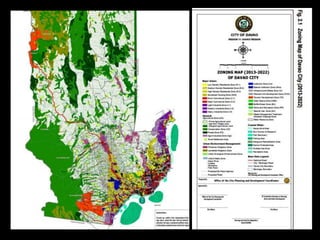
Zoning Maps
• It is hereby adopted as an integral part of this
Ordinance, the Official Zoning Maps for the
general zones, agricultural land sub-zones,
major urban sub-zones, environment
management sub-zones and coastal water
sub-zones for all the zone classifications of the
whole city.
http://cpdo.davaocity.gov.ph/wp-
content/uploads/2016/10/Vol2ZoningOrdinance2013-
202220151215090202.pdf
The following projects are required to secure
Preliminary Approval and Locational Clearance (PALC)
and Development Permit (DP) from the Sangguniang
Panlungsod which shall be granted through a resolution by
a majority votes of all its members.
1. Commercial, residential and industrial subdivisions
2. Malls, commercial centers and shopping centers
3. Memorial Parks/Cemeteries
4. Town houses and Apartments
5. Hotels and Motels
6. Warehouses
7. Residential and Commercial Condominiums (PALC only
as DP shall be from the HLURB)
Additional Requirements for PALC and
DP: As requirement for PALC and DP
projects enumerated in Section 1 hereof
must obtain clearance/certifications
provided in Article XII, Section 1.3.
Additionally, project p proponents are
required to submit Traffic Impact Assessment
and Utilities Impact Assessment.
All land uses, development or
constructions shall conform to the
following standards :
1. Noise and Vibrations
2. Smoke
3. Dust, Dirt and Fly Ash
4. Odors and Gases
5. Glare and Heat
6. Industrial Waste
7. Sewerage Disposal
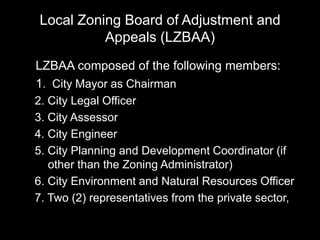
Local Zoning Board of Adjustment and
Appeals (LZBAA)
LZBAA composed of the following members:
1. City Mayor as Chairman
2. City Legal Officer
3. City Assessor
4. City Engineer
5. City Planning and Development Coordinator (if
other than the Zoning Administrator)
6. City Environment and Natural Resources Officer
7. Two (2) representatives from the private sector,
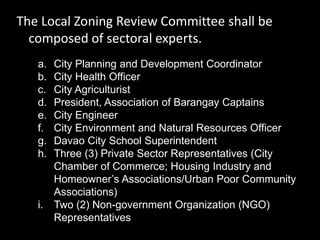
The Local Zoning Review Committee shall be
composed of sectoral experts.
a. City Planning and Development Coordinator
b. City Health Officer
c. City Agriculturist
d. President, Association of Barangay Captains
e. City Engineer
f. City Environment and Natural Resources Officer
g. Davao City School Superintendent
h. Three (3) Private Sector Representatives (City
Chamber of Commerce; Housing Industry and
Homeowner’s Associations/Urban Poor Community
Associations)
i. Two (2) Non-government Organization (NGO)
Representatives
Volume 3
The Sectoral Studies
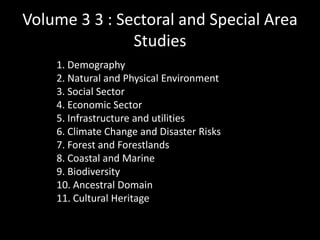
Volume 3 3 : Sectoral and Special Area
Studies
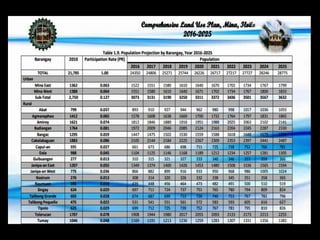
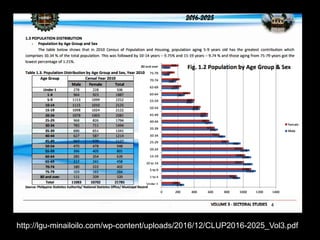
1. Demography
2. Natural and Physical Environment
3. Social Sector
4. Economic Sector
5. Infrastructure and utilities
6. Climate Change and Disaster Risks
7. Forest and Forestlands
8. Coastal and Marine
9. Biodiversity
10. Ancestral Domain
11. Cultural Heritage
http://lgu-minailoilo.com/wp-content/uploads/2016/12/CLUP2016-2025_Vol3.pdf
Policy Environment
1. Forestry Code
2. Mining Act
3. NIPAS Act
4. Ecological SWM Act
5. Climate Change Act
6. Disaster Risk reduction and management Act
7. IPRA Law
8. National Heritage Act
9. Local Government Code
10.UDHA Law
11.Water Code
12.AFMA
13.CARPER
14.Fisheries Code
Policies and Spatial Strategies in the
CLUP and Zoning Ordinance
• Prevent future development in areas highly
susceptible to hazards where possible;
• Keep land use intensity, buildings value, and
occupancy to a minimum in areas where
development cannot be prevented;
• Encourage risk mitigation through proper
urban design, site planning, and building
design in areas where development occurs
and where the above strategies are not viable;
Ridge to Reef
Approach
Integrated Ecosystems Management
(IEM) Approach (Ridge-to-Reef (R2R),
Watershed)
• a strategy for the integrated management
of land, water and living resources that
promotes conservation and sustainable
use in an equitable way (CBD, 1995)
• The uses of forests and forestlands will
have impacts on its immediate
environment (on-site impact areas) as
well as downstream areas (off-site impact
areas).
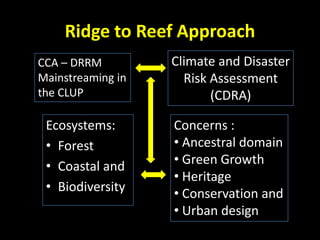
Ridge to Reef Approach
Ecosystems:
• Forest
• Coastal and
• Biodiversity
Concerns :
• Ancestral domain
• Green Growth
• Heritage
• Conservation and
• Urban design
CCA – DRRM
Mainstreaming in
the CLUP
Climate and Disaster
Risk Assessment
(CDRA)
Enhancing LGU Capacity on Disaster Risks
Reduction and Management and Climate
Change Adaptation
The Department of the Interior and
Local Government (DILG) takes an active
role in Climate Change Adaptation (CCA)
and Disaster Risk Reduction Management
(DRRM) per their mandate RA 9729
(Climate Change Act) and RA 10121
(DRRM Act) to provide for capacity
development programs for CCA and
disaster preparedness.
The efforts lean towards enhancing the capacity of Local
Government Units (LGUs) to be at the forefront of the
government’s initiative to adapt, mitigate and prepare for climate
change and disasters.
The Department has a three-component
framework to achieve CCA and DRRM
compliant LGUs leading to more resilient and
safe communities. The cycle framework
includes assessment, capacity enhancement
and enabling access to financing to achieve
adaptive and disaster resilient LGUs
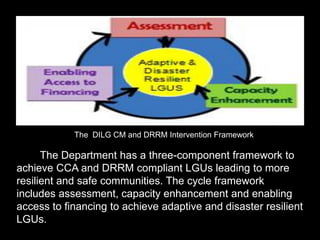
The Department has a three-component framework to
achieve CCA and DRRM compliant LGUs leading to more
resilient and safe communities. The cycle framework
includes assessment, capacity enhancement and enabling
access to financing to achieve adaptive and disaster resilient
LGUs.
The DILG CM and DRRM Intervention Framework
The component on assessment tells us
whether or not our LGUs are institutionally
prepared, what are gaps into becoming resilient.
Meanwhile, capacity enhancement aims to share
knowledge, promote tools and methodologies in
mainstreaming to CLUPs and CDPs, and develop
capabilities of LGUs and communities to be safe
and resilient. Finally, the component on enabling
access to financing shall provide avenues for
resource generation and project development for
the various CCA-DRRM initiatives to materialize.
Every Cities/Municipalities should
prepare their CLUP (Comprehensive
Land Use Planning)
The Disaster Risk Reduction &
Climate Change Adaptation
Enhanced is integrated in the plan
Rationale of IEM/R2R Approach
• The uplands and the lowlands are economically,
politically, ecologically, and biophysically
interconnected and interdependent
• Impacts of climate change and disaster demand
that planning be comprehensive and integrative
• Provides framework for rational use of PAs and
how it will complement the use of A&D lands.
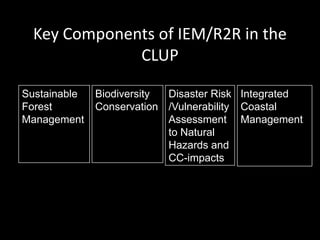
Key Components of IEM/R2R in the
CLUP
Integrated
Coastal
Management
Sustainable
Forest
Management
Biodiversity
Conservation
Disaster Risk
/Vulnerability
Assessment
to Natural
Hazards and
CC-impacts
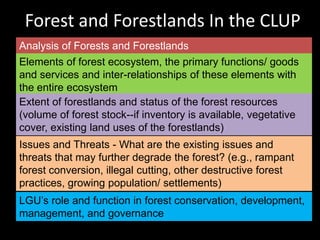
Forest and Forestlands In the CLUP
Analysis of Forests and Forestlands
Elements of forest ecosystem, the primary functions/ goods
and services and inter-relationships of these elements with
the entire ecosystem
Extent of forestlands and status of the forest resources
(volume of forest stock--if inventory is available, vegetative
cover, existing land uses of the forestlands)
Issues and Threats - What are the existing issues and
threats that may further degrade the forest? (e.g., rampant
forest conversion, illegal cutting, other destructive forest
practices, growing population/ settlements)
LGU’s role and function in forest conservation, development,
management, and governance
Policies and Spatial Strategies in the
CLUP and Zoning Ordinance
• Protect life and existing development from
losses
• Conserve protective environmental systems
• Prevent future development from creating
conditions that contribute to risk.
Land Mapping: Ridge to Reef
From Forest to Coastal
• Forest land Use plan (administration and
jurisdiction)
• Coastal land use plan ( Municipal Water Use
Plan)
• How are you going to use the 15 kms
municipal seashores?
PROCESS: Who is Responsible?
 Local Development Council – plan preparation
(M-C) ¼ from private sector representation (F, F, Y,
W, Coops)
 Planning officer coordinate with Line Agencies
(LAs) to complete the plan
 Conduct public hearing
 Comments to be integrated by M-C LDC
 If okey, adopt
 Endorse to SB/SP
Seal of Good Governance
• One of the requirements is the CLUP with 3
volumes (Year 1, Year 2, Year 3)
Implementation
• From Planning to monitoring
• Monitoring of projects in all phases
• Ownership of the project
• (continue and protect the project)
Indicators of a Successful Projects
• Objectives are met
• Outcome/Result
• Interview?
• Farming nakatulong ba?
(w/o the project/ with project)
• Sanitary/Toilet
(w/o the project/ with project)
Thoughts
• May budget but no plan?
• To respond to the needs of the
people
Reference
• Atty. Linda L. Malenab – Hornilla (2017) Enhanced
Comprehensive Land Use Plan and Zoning Ordinance.
Accessed Aug. 18, 2018 .
https://www.slideshare.net/jrmadriaga/enhanced-clu-
pandzollmh.
• Comprehensive Zoning Ordinance of Davao City.
http://cpdo.davaocity.gov.ph/wp-
content/uploads/2016/10/Vol2ZoningOrdinance2013-
202220151215090202.pdf.
• Sectoral Studies Mina Iloilo. http://lgu-minailoilo.com/wp-
content/uploads/2016/12/CLUP2016-2025_Vol3.pdf

Comprehensive Land Use Planning

  • 1.
    Comprehensive Land Use Planning MPA203 Local Governance and Administration Josefina B. Bitonio, DPA
  • 2.
    Comprehensive Land Use Planning Mother plan  9-10 years  Use of the land  How to implement
  • 3.
    Comprehensive Development Plan  MediumTerm Plan  AIP lifted from the MTP  6 years  Coincide with the term of the national leadership
  • 4.
    Structure and Contentsof the CLUP Volume 1 • The Comprehensive Land Use Plan Volume 2 • The Zoning Ordinance Volume 3 • The Sectoral Studies
  • 5.
    Two Comprehensive PlansMandated by the Local Government Code for Cities and Municipalities • Comprehensive Land Use Plan (CLUP) – Physical Plan • Comprehensive Development Plan (CDP) – Multi-Sectoral Plan
  • 6.
  • 8.
    Each LGU shallhave a Comprehensive Multi-Sectoral Development Plan to be initiated by the LDC and approved by its sanggunian Sec. 109, RA 7160
  • 9.
    The local governmentunits shall inconformity with existing laws, continue to prepare the irrespective Comprehensive Land Use Plans enacted through zoning ordinances which shall be the primary and dominant bases for the future use of land resources: Provided, that the requirements for food production, human settlements, and industrial expansion shall be taken into consideration in the preparation of such plans • Sec. 20 (c), RA 7160
  • 10.
    The Comprehensive LandUse Plan (CLUP) • Document embodying specific proposals for guiding and regulating the growth and/or development of a City/ Municipality. • A long-term plan (10 yrs. minimum) • A tool for managing land and natural resources at the local level.
  • 11.
    In the Philippines,all local government units (LGUs) from the province, city, and municipality are mandated to formulate its Comprehensive Land Use Plans (CLUPs). Land use planning is imperative because of the scarcity of land. Land use planning aims to find a balance among competing and sometimes contradictory uses.
  • 12.
  • 13.
    The comprehensive plan,also known as a general plan, master plan or land-use plan, is a document designed to guide the future actions of a community. It presents a vision for the future, with long-range goals and objectives for all activities that affect the local government. This includes guidance on how to make decisions on public and private land development proposals, the expenditure of public funds, availability of tax policy (tax incentives), cooperative efforts and issues of pressing concern, such as farmland preservation or the rehabilitation of older neighborhoods areas
  • 14.
    Most plans arewritten to provide direction for future activities over a 10- to 20-year period after plan adoption. However, plans should receive a considered review and possible update every five years.
  • 15.
    Volume 1 :Comprehensive Land Use Plan 1. Preliminary pages 2. Brief profile of city/municipal (general information) a. Brief history b. Physical, Demographic, Socioeconomic features/structures/resources 3. Existing land use and land use trend 4. Comparative/competitive advantages 5. Weaknesses, priority issues and concerns 6. Functional role
  • 16.
    Volume 1 :Comprehensive Land Use Plan 7. The Land Use Plan • Vision/mission • Goals, Objectives, Strategies • The concept/structure plan • The Proposed Land and Water Uses • Policies/Priority programs and projects
  • 17.
    Procedural Steps inthe preparation of Comprehensive Land Use Plan and Zoning Ordinance
  • 18.
    CLUP Process 1. Organize 2.Identify stakeholders 3. Set the vision 4. Analyze the situation 5. Set the goals and objectives 6. Establish development thrust and spatial strategies
  • 19.
    7. Prepare theland use plan 8. Draft the Zoning Ordinance (ZO) 9. Conduct public hearing 10. Review, adopt and approve the CLUP and ZO 11. Implement the CLUP and ZO 12. Monitor and evaluate the CLUP & ZO CLUP Process
  • 20.
  • 21.
    Volume 2 :The Zoning Ordinance 1. SB/SP Resolution enacting the ZO 2. Title and objectives of the Ordinance 3. Substantive elements/articles 4. Zoning maps
  • 22.
    Sec. 20 (c),RA 7160 The local government units shall, in conformity with existing laws, continue to prepare their respective comprehensive land use plans enacted through zoning ordinances which shall be the primary and dominant bases for the future use of land resources: Provided, That the requirements for food production, human settlements, and industrial expansion shall be taken into consideration in the preparation of such plans.
  • 23.
    The definition oftechnical terms used in the Zoning Ordinance shall carry the same meaning given to them in already approved codes, rules and regulations, such as but not limited to the National Building Code, the Water Code, the Philippine Environment Code, the Climate Change Act 2009, the Disaster Risk Reduction and Management of 2010, the Code on Sanitation, the National Pollution Control Act of 1976, the Provincial Water Utility Act of 1973 as amended, and the Urban Development and Housing Act of 1992 and other Implementing Rules and Regulations, promulgated by the HLURB.
  • 24.
    Zone Classification To effectivelycarry out the provisions of this Ordinance, the city is hereby divided into the following zone classifications. 1. Forest Zone (FZ) 2. Conservation Zone (CZ) 3. Agro-Industrial Zone 4. Tourism Development Zone 5. Open Space/Easement Zone 6. Buffer/Green Zone 7. Water Resource Zone 8. Rural Settlement Zone 9. Waste Management Zone 10. Parks and Recreation Zone
  • 27.
    Agricultural Land Zone •(ALZ which is further subdivided into : • a. Prime Agricultural Land Sub-zone • b. Agri-non Tillage Land Sub-zone • c. Marginal Agricultural Land Sub-zone http://cpdo.davaocity.gov.ph/wp- content/uploads/2016/10/Vol2ZoningOrdinance2013-202220151215090202.pdf
  • 28.
    Major Urban Zone a.Low Density Residential Sub-zone (R-1) b. Medium Density Residential Sub-zone (R-2) c. High Density Residential Sub-zone (R-3) d. Socialized Housing Sub-zone (SHZ) e. Planned Unit Development (PUD) f. Minor Commercial Sub-zone (C-1) g. Major Commercial Sub-zone (C-2) h. Light Industrial Sub-zone (I-1) i. Medium Industrial Sub-zone (I-2) j. Heavy Industrial Sub-zone (I-3) k. General Institutional Sub-zone (Gins) l. Special Institutional Sub-zone (Sins) m. Infrastructure Utilities Sub-zone (IU)
  • 29.
    Environment Management Zone a.Landslide mitigation sub-zone b. Flood way mitigation sub-zone c. Urban Ecological Enhancement Sub-zone http://cpdo.davaocity.gov.ph/wp- content/uploads/2016/10/Vol2ZoningOrdinance2013- 202220151215090202.pdf
  • 30.
    Coastal Water Zone a.Aquaculture/Mariculture Sub-zone b. Marine Protected Sub-zone i. Mangrove Protection and Rehabilitation area ii. Species Conservation area iii. Fish Sanctuary area c. Fishing Sub-zone d. Recreation Sub-zone e. Industrial Sub-zone f. Multiple Use Sub-zone g. Eco-Tourism & Research Sub-zone
  • 31.
  • 32.
    Zoning Maps • Itis hereby adopted as an integral part of this Ordinance, the Official Zoning Maps for the general zones, agricultural land sub-zones, major urban sub-zones, environment management sub-zones and coastal water sub-zones for all the zone classifications of the whole city. http://cpdo.davaocity.gov.ph/wp- content/uploads/2016/10/Vol2ZoningOrdinance2013- 202220151215090202.pdf
  • 34.
    The following projectsare required to secure Preliminary Approval and Locational Clearance (PALC) and Development Permit (DP) from the Sangguniang Panlungsod which shall be granted through a resolution by a majority votes of all its members. 1. Commercial, residential and industrial subdivisions 2. Malls, commercial centers and shopping centers 3. Memorial Parks/Cemeteries 4. Town houses and Apartments 5. Hotels and Motels 6. Warehouses 7. Residential and Commercial Condominiums (PALC only as DP shall be from the HLURB)
  • 35.
    Additional Requirements forPALC and DP: As requirement for PALC and DP projects enumerated in Section 1 hereof must obtain clearance/certifications provided in Article XII, Section 1.3. Additionally, project p proponents are required to submit Traffic Impact Assessment and Utilities Impact Assessment.
  • 36.
    All land uses,development or constructions shall conform to the following standards : 1. Noise and Vibrations 2. Smoke 3. Dust, Dirt and Fly Ash 4. Odors and Gases 5. Glare and Heat 6. Industrial Waste 7. Sewerage Disposal
  • 37.
    Local Zoning Boardof Adjustment and Appeals (LZBAA) LZBAA composed of the following members: 1. City Mayor as Chairman 2. City Legal Officer 3. City Assessor 4. City Engineer 5. City Planning and Development Coordinator (if other than the Zoning Administrator) 6. City Environment and Natural Resources Officer 7. Two (2) representatives from the private sector,
  • 38.
    The Local ZoningReview Committee shall be composed of sectoral experts. a. City Planning and Development Coordinator b. City Health Officer c. City Agriculturist d. President, Association of Barangay Captains e. City Engineer f. City Environment and Natural Resources Officer g. Davao City School Superintendent h. Three (3) Private Sector Representatives (City Chamber of Commerce; Housing Industry and Homeowner’s Associations/Urban Poor Community Associations) i. Two (2) Non-government Organization (NGO) Representatives
  • 39.
  • 40.
    Volume 3 3: Sectoral and Special Area Studies 1. Demography 2. Natural and Physical Environment 3. Social Sector 4. Economic Sector 5. Infrastructure and utilities 6. Climate Change and Disaster Risks 7. Forest and Forestlands 8. Coastal and Marine 9. Biodiversity 10. Ancestral Domain 11. Cultural Heritage
  • 42.
  • 43.
    Policy Environment 1. ForestryCode 2. Mining Act 3. NIPAS Act 4. Ecological SWM Act 5. Climate Change Act 6. Disaster Risk reduction and management Act 7. IPRA Law 8. National Heritage Act 9. Local Government Code 10.UDHA Law 11.Water Code 12.AFMA 13.CARPER 14.Fisheries Code
  • 44.
    Policies and SpatialStrategies in the CLUP and Zoning Ordinance • Prevent future development in areas highly susceptible to hazards where possible; • Keep land use intensity, buildings value, and occupancy to a minimum in areas where development cannot be prevented; • Encourage risk mitigation through proper urban design, site planning, and building design in areas where development occurs and where the above strategies are not viable;
  • 45.
  • 46.
    Integrated Ecosystems Management (IEM)Approach (Ridge-to-Reef (R2R), Watershed) • a strategy for the integrated management of land, water and living resources that promotes conservation and sustainable use in an equitable way (CBD, 1995) • The uses of forests and forestlands will have impacts on its immediate environment (on-site impact areas) as well as downstream areas (off-site impact areas).
  • 47.
    Ridge to ReefApproach Ecosystems: • Forest • Coastal and • Biodiversity Concerns : • Ancestral domain • Green Growth • Heritage • Conservation and • Urban design CCA – DRRM Mainstreaming in the CLUP Climate and Disaster Risk Assessment (CDRA)
  • 48.
    Enhancing LGU Capacityon Disaster Risks Reduction and Management and Climate Change Adaptation The Department of the Interior and Local Government (DILG) takes an active role in Climate Change Adaptation (CCA) and Disaster Risk Reduction Management (DRRM) per their mandate RA 9729 (Climate Change Act) and RA 10121 (DRRM Act) to provide for capacity development programs for CCA and disaster preparedness. The efforts lean towards enhancing the capacity of Local Government Units (LGUs) to be at the forefront of the government’s initiative to adapt, mitigate and prepare for climate change and disasters.
  • 49.
    The Department hasa three-component framework to achieve CCA and DRRM compliant LGUs leading to more resilient and safe communities. The cycle framework includes assessment, capacity enhancement and enabling access to financing to achieve adaptive and disaster resilient LGUs
  • 50.
    The Department hasa three-component framework to achieve CCA and DRRM compliant LGUs leading to more resilient and safe communities. The cycle framework includes assessment, capacity enhancement and enabling access to financing to achieve adaptive and disaster resilient LGUs. The DILG CM and DRRM Intervention Framework
  • 51.
    The component onassessment tells us whether or not our LGUs are institutionally prepared, what are gaps into becoming resilient. Meanwhile, capacity enhancement aims to share knowledge, promote tools and methodologies in mainstreaming to CLUPs and CDPs, and develop capabilities of LGUs and communities to be safe and resilient. Finally, the component on enabling access to financing shall provide avenues for resource generation and project development for the various CCA-DRRM initiatives to materialize.
  • 52.
    Every Cities/Municipalities should preparetheir CLUP (Comprehensive Land Use Planning) The Disaster Risk Reduction & Climate Change Adaptation Enhanced is integrated in the plan
  • 53.
    Rationale of IEM/R2RApproach • The uplands and the lowlands are economically, politically, ecologically, and biophysically interconnected and interdependent • Impacts of climate change and disaster demand that planning be comprehensive and integrative • Provides framework for rational use of PAs and how it will complement the use of A&D lands.
  • 54.
    Key Components ofIEM/R2R in the CLUP Integrated Coastal Management Sustainable Forest Management Biodiversity Conservation Disaster Risk /Vulnerability Assessment to Natural Hazards and CC-impacts
  • 55.
    Forest and ForestlandsIn the CLUP Analysis of Forests and Forestlands Elements of forest ecosystem, the primary functions/ goods and services and inter-relationships of these elements with the entire ecosystem Extent of forestlands and status of the forest resources (volume of forest stock--if inventory is available, vegetative cover, existing land uses of the forestlands) Issues and Threats - What are the existing issues and threats that may further degrade the forest? (e.g., rampant forest conversion, illegal cutting, other destructive forest practices, growing population/ settlements) LGU’s role and function in forest conservation, development, management, and governance
  • 56.
    Policies and SpatialStrategies in the CLUP and Zoning Ordinance • Protect life and existing development from losses • Conserve protective environmental systems • Prevent future development from creating conditions that contribute to risk.
  • 57.
    Land Mapping: Ridgeto Reef From Forest to Coastal • Forest land Use plan (administration and jurisdiction) • Coastal land use plan ( Municipal Water Use Plan) • How are you going to use the 15 kms municipal seashores?
  • 58.
    PROCESS: Who isResponsible?  Local Development Council – plan preparation (M-C) ¼ from private sector representation (F, F, Y, W, Coops)  Planning officer coordinate with Line Agencies (LAs) to complete the plan  Conduct public hearing  Comments to be integrated by M-C LDC  If okey, adopt  Endorse to SB/SP
  • 59.
    Seal of GoodGovernance • One of the requirements is the CLUP with 3 volumes (Year 1, Year 2, Year 3)
  • 60.
    Implementation • From Planningto monitoring • Monitoring of projects in all phases • Ownership of the project • (continue and protect the project)
  • 61.
    Indicators of aSuccessful Projects • Objectives are met • Outcome/Result • Interview? • Farming nakatulong ba? (w/o the project/ with project) • Sanitary/Toilet (w/o the project/ with project)
  • 62.
    Thoughts • May budgetbut no plan? • To respond to the needs of the people
  • 63.
    Reference • Atty. LindaL. Malenab – Hornilla (2017) Enhanced Comprehensive Land Use Plan and Zoning Ordinance. Accessed Aug. 18, 2018 . https://www.slideshare.net/jrmadriaga/enhanced-clu- pandzollmh. • Comprehensive Zoning Ordinance of Davao City. http://cpdo.davaocity.gov.ph/wp- content/uploads/2016/10/Vol2ZoningOrdinance2013- 202220151215090202.pdf. • Sectoral Studies Mina Iloilo. http://lgu-minailoilo.com/wp- content/uploads/2016/12/CLUP2016-2025_Vol3.pdf