Engineering Change
Management:
The Process
John M. Cachat
jmc@peproso.com
© Copyright John Cachat
About John M. Cachat
• Driving Business Performance
– Helping companies align their business and technology
– Focus on people, process, and then the technology
– Subject matter expert on business process management
– On-going research into next generation of technology for enterprise
systems
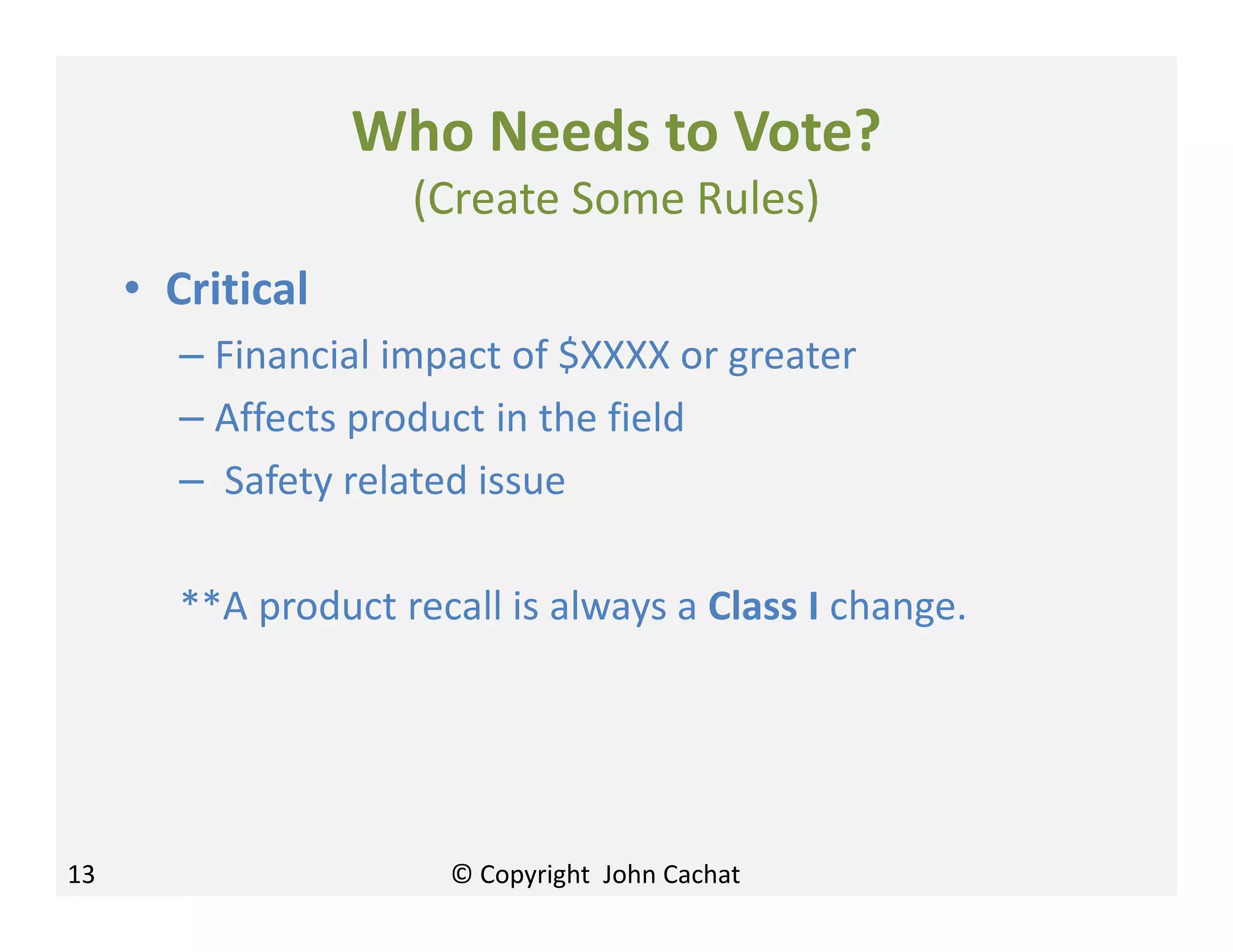
• 28 years experience in enterprise systems
– USAF Research Project (1985)
– Founder of enterprise quality software company (1988)
– Chair of ASQ technical committee on computerizing quality (1992)
• Trusted advisor to global organizations, government agencies,
and professional groups
http://www.linkedin.com/in/johncachat
2 © Copyright John Cachat
Housekeeping
Phones are muted
Use the question
block for questions Copy of presentation
available upon request
3 © Copyright John Cachat
Today’s Discussion
• Why Now?
• Engineering Change Management Process
• Identifying & Eliminating Waste In The Process
• The Role of Software
• Summary
• Free Proof of Concept Offer
• Q & A
4 © Copyright John Cachat
Why Now?
• As manufacturing firms increase their rates of
new product introduction, the management of
engineering change has become a major and
ongoing challenge.
• The need for rapid engineering change is an
requirement of a rapid rate of new product
introduction and short product life cycles.
5 © Copyright John Cachat
Engineering Change is
More Critical Than Ever?
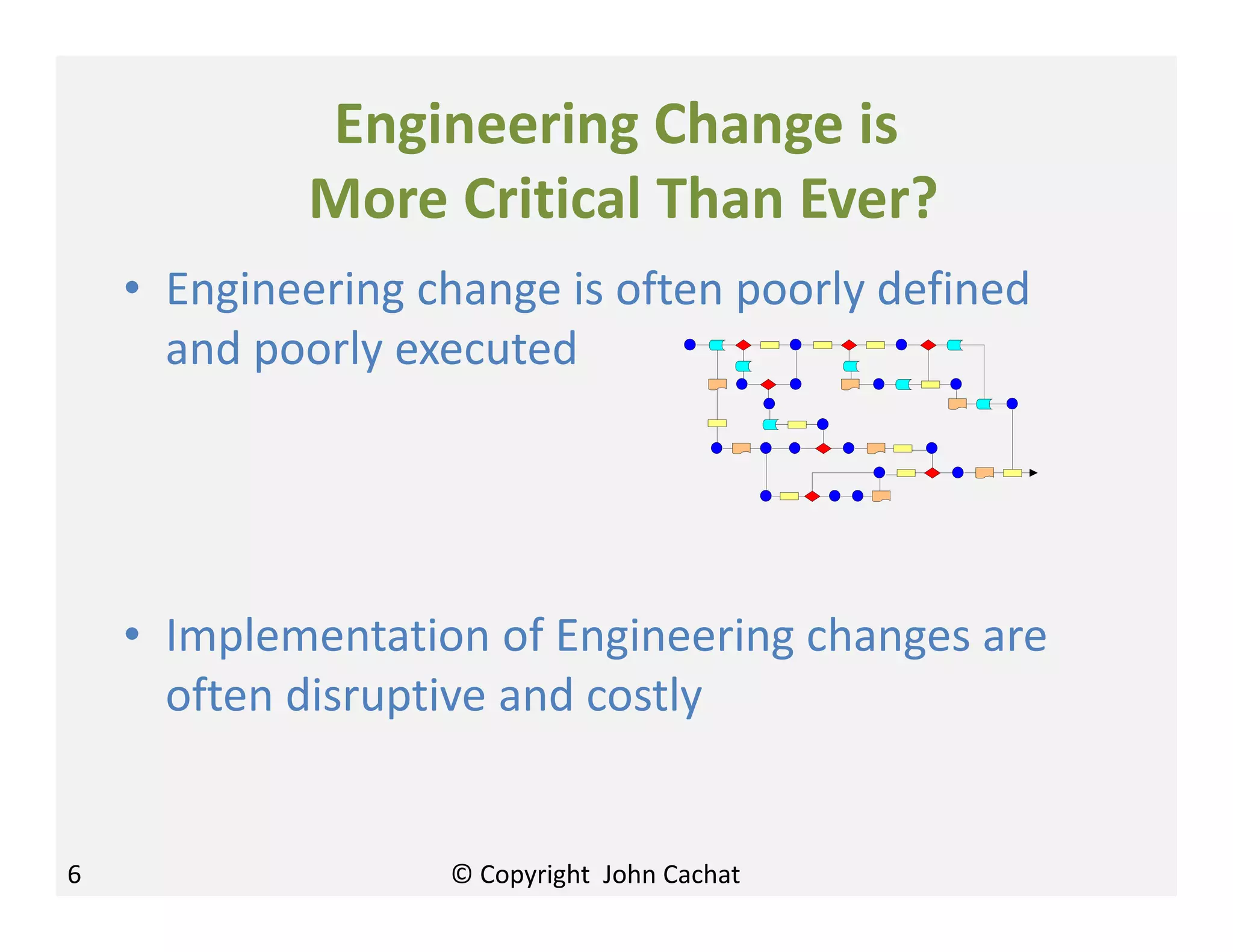
• Engineering change is often poorly defined
and poorly executed
• Implementation of Engineering changes are
often disruptive and costly
6 © Copyright John Cachat
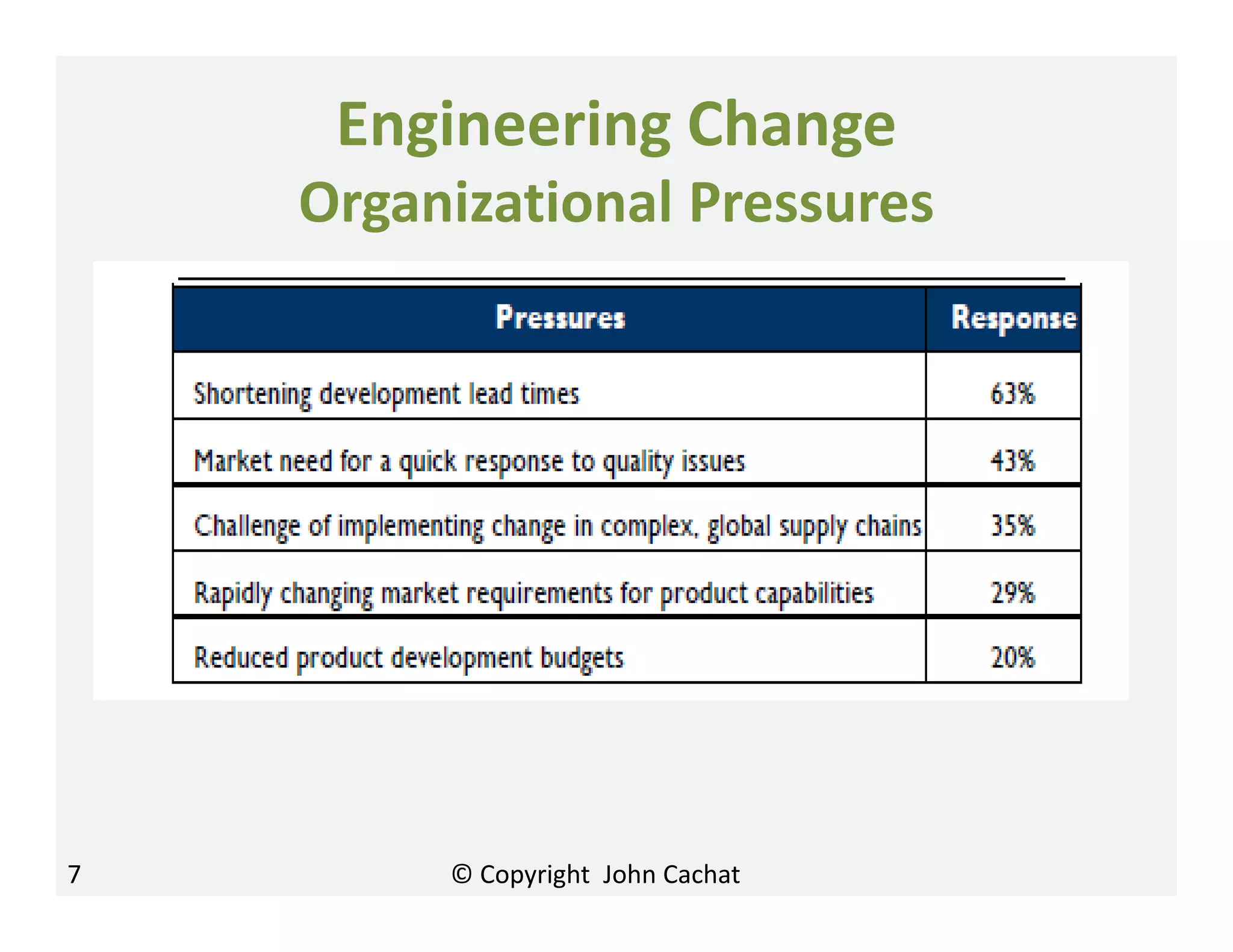
Engineering Change
Organizational Pressures
7 © Copyright John Cachat
8
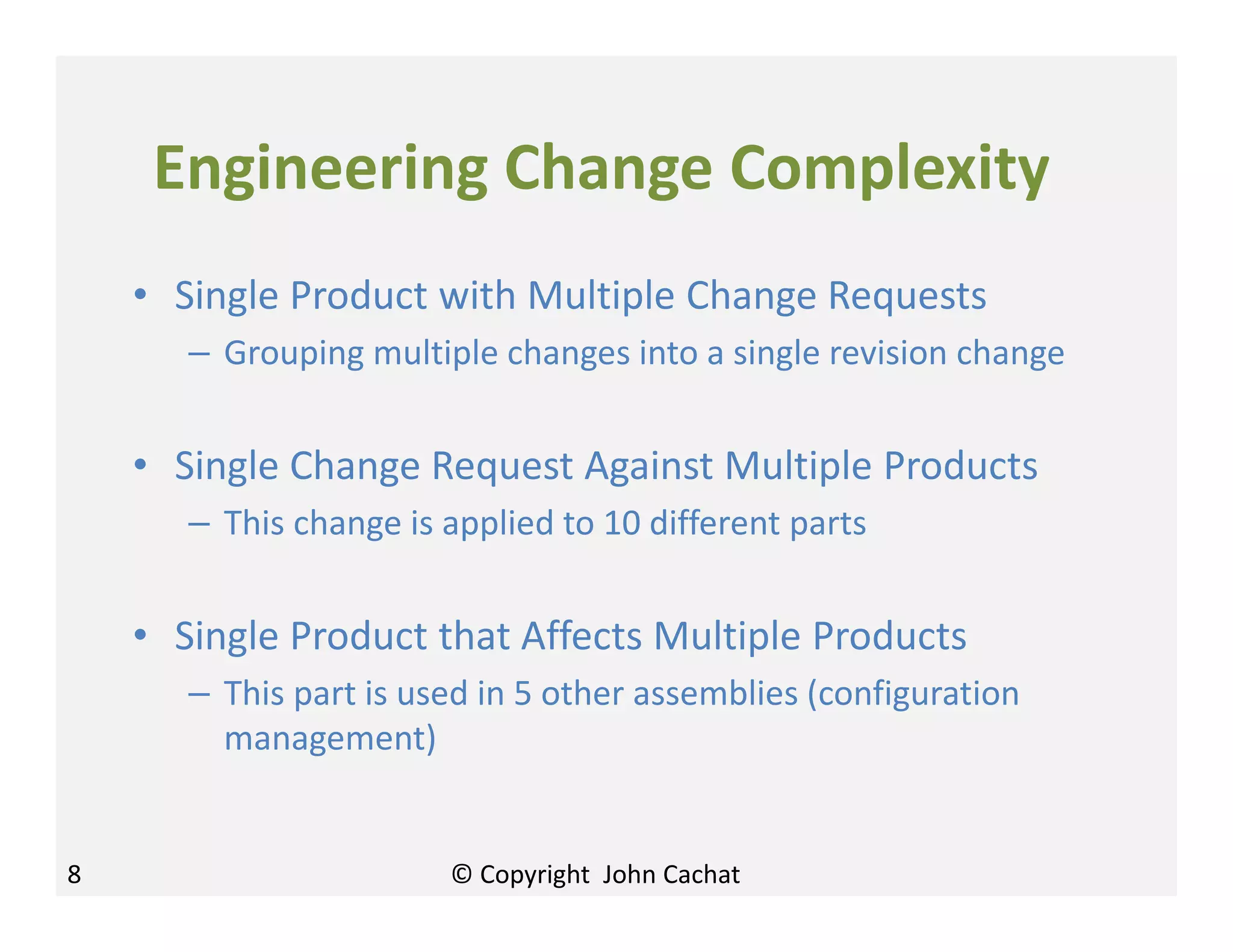
Engineering Change Complexity
• Single Product with Multiple Change Requests
– Grouping multiple changes into a single revision change
• Single Change Request Against Multiple Products
– This change is applied to 10 different parts
• Single Product that Affects Multiple Products
– This part is used in 5 other assemblies (configuration
management)
© Copyright John Cachat
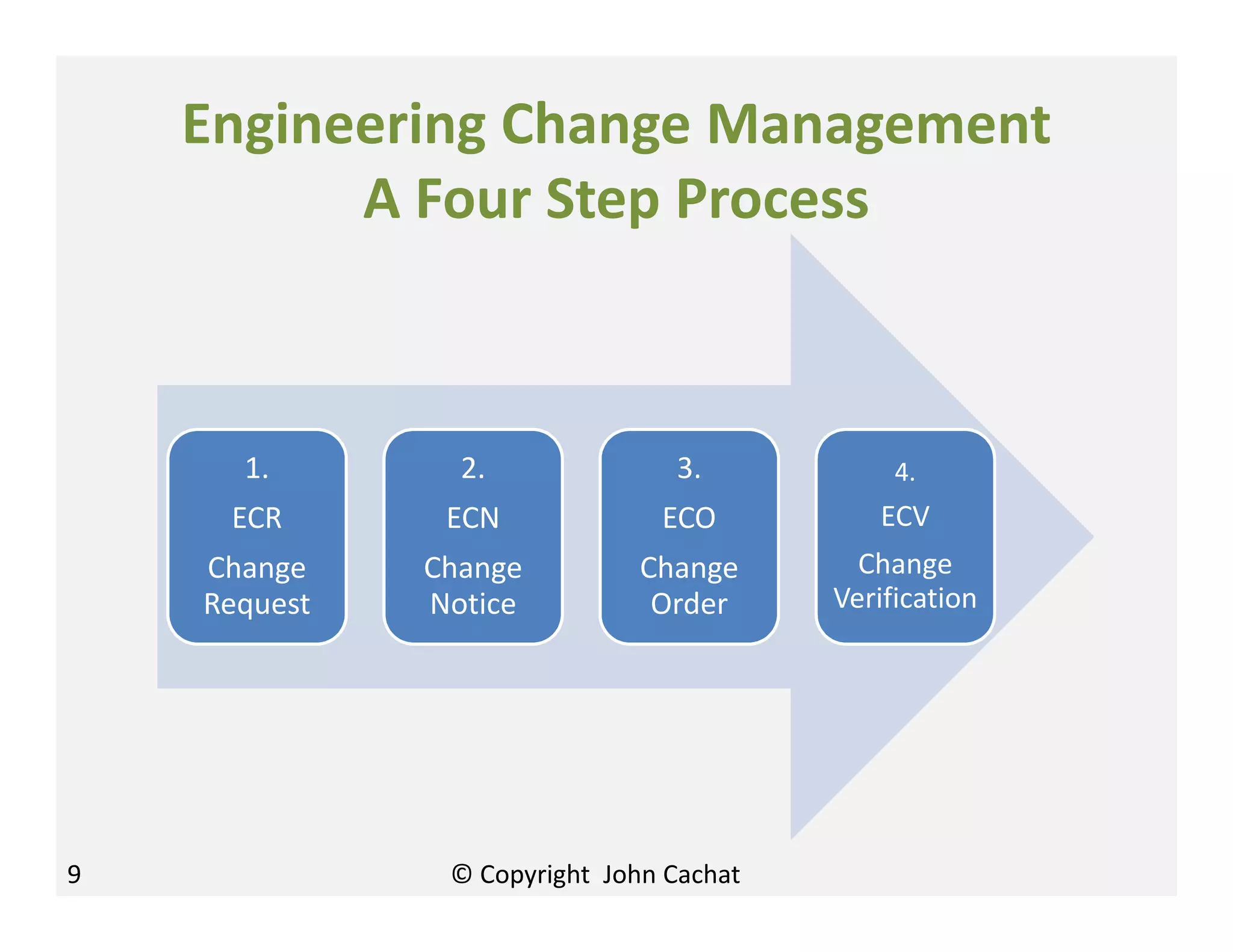
Engineering Change Management
A Four Step Process
1.
ECR
Change
Request
2.
ECN
Change
Notice
3.
ECO
Change
Order
4.
ECV
Change
Verification
9 © Copyright John Cachat
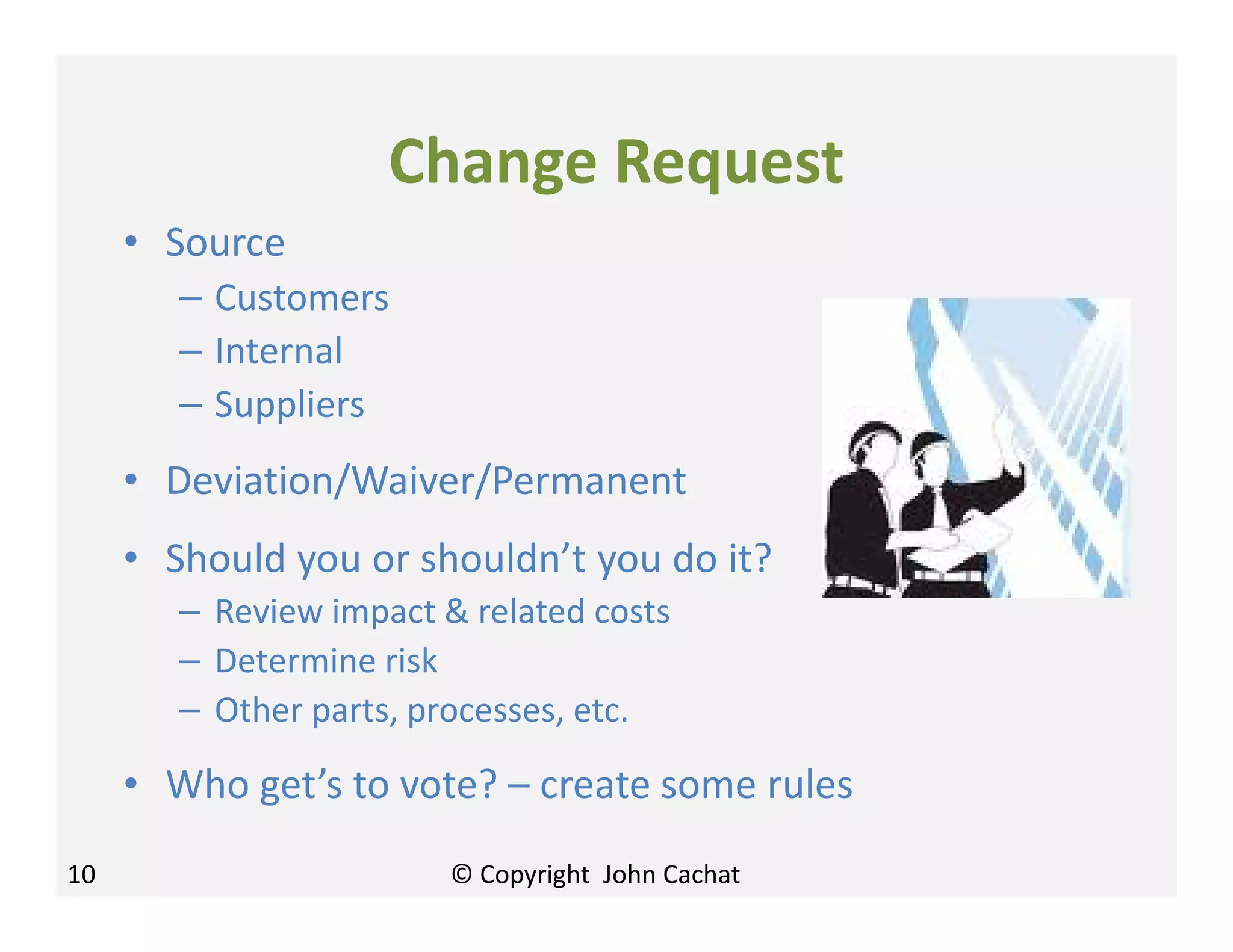
Change Request
• Source
– Customers
– Internal
– Suppliers
• Deviation/Waiver/Permanent
• Should you or shouldn’t you do it?
– Review impact & related costs
– Determine risk
– Other parts, processes, etc.
• Who get’s to vote? – create some rules
10 © Copyright John Cachat
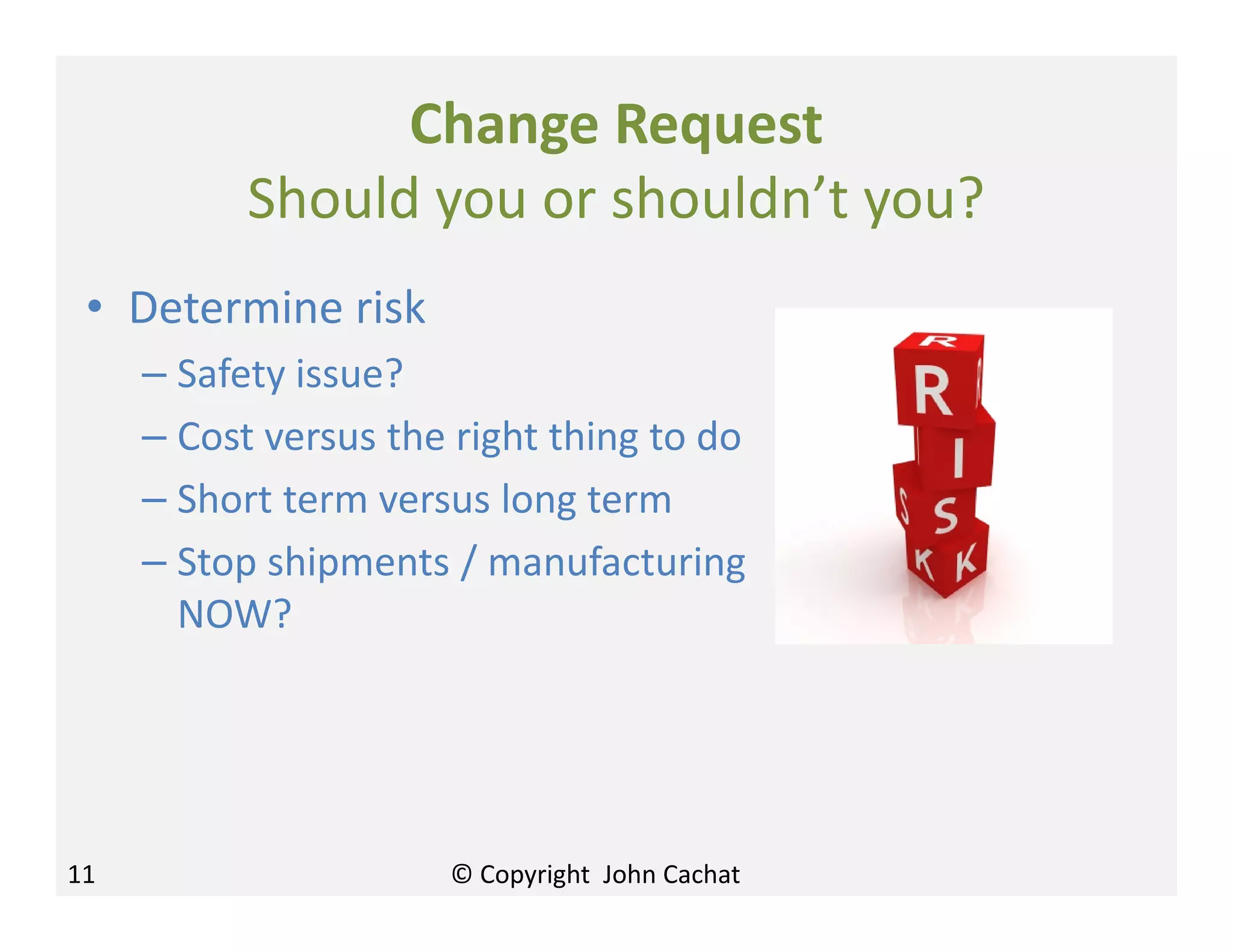
Change Request
Should you or shouldn’t you?
• Determine risk
– Safety issue?
– Cost versus the right thing to do
– Short term versus long term
– Stop shipments / manufacturing
NOW?
11 © Copyright John Cachat
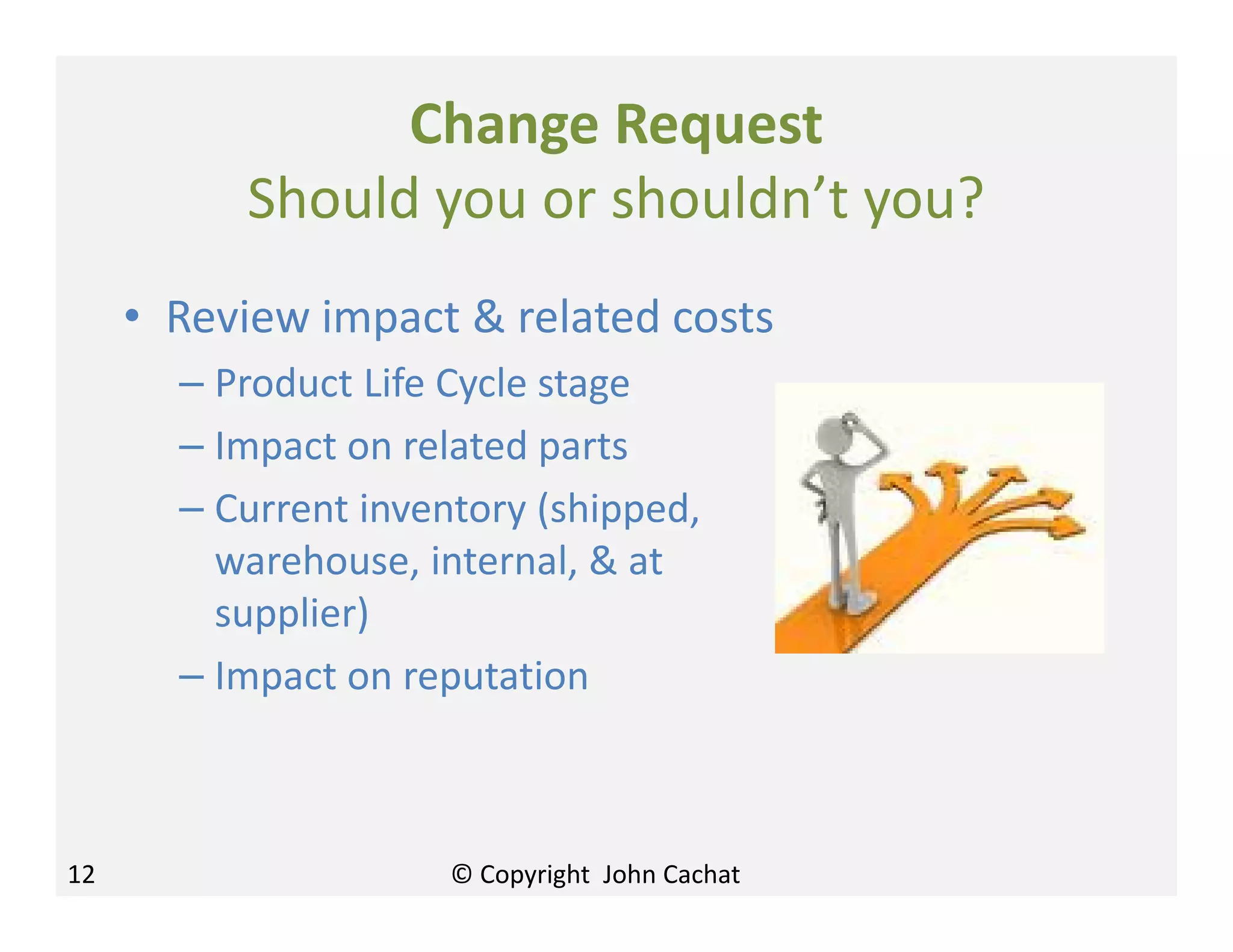
Change Request
Should you or shouldn’t you?
• Review impact & related costs
– Product Life Cycle stage
– Impact on related parts
– Current inventory (shipped,
warehouse, internal, & at
supplier)
– Impact on reputation
12 © Copyright John Cachat
Who Needs to Vote?
(Create Some Rules)
• Critical
– Financial impact of $XXXX or greater
– Affects product in the field
– Safety related issue
**A product recall is always a Class I change.
13 © Copyright John Cachat
Who Needs to Vote?
(Create Some Rules)
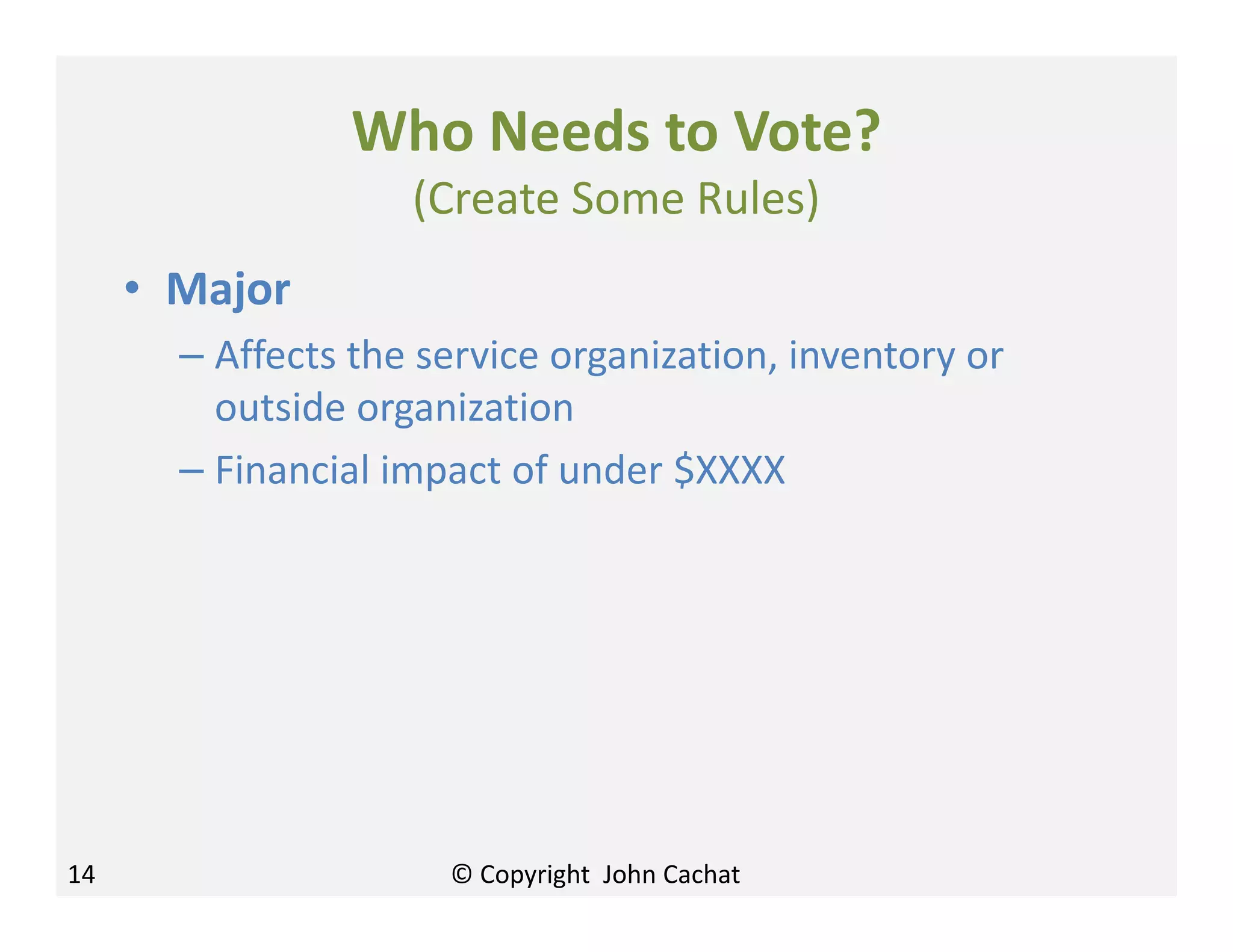
• Major
– Affects the service organization, inventory or
outside organization
– Financial impact of under $XXXX
14 © Copyright John Cachat
Who Needs to Vote?
(Create Some Rules)
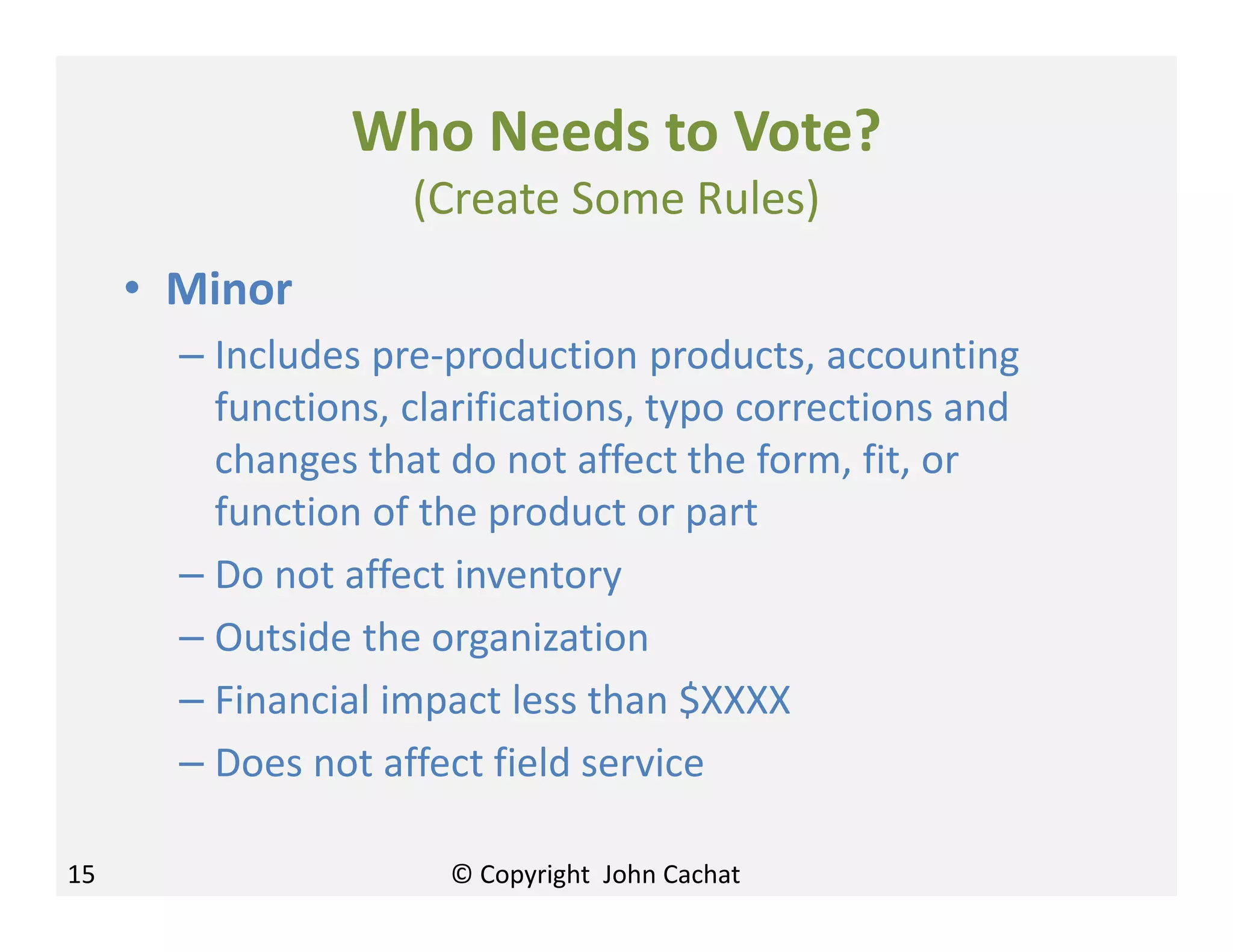
• Minor
– Includes pre-production products, accounting
functions, clarifications, typo corrections and
changes that do not affect the form, fit, or
function of the product or part
– Do not affect inventory
– Outside the organization
– Financial impact less than $XXXX
– Does not affect field service
15 © Copyright John Cachat
Engineering Change Management
A Four Step Process
1.
ECR
Change
Request
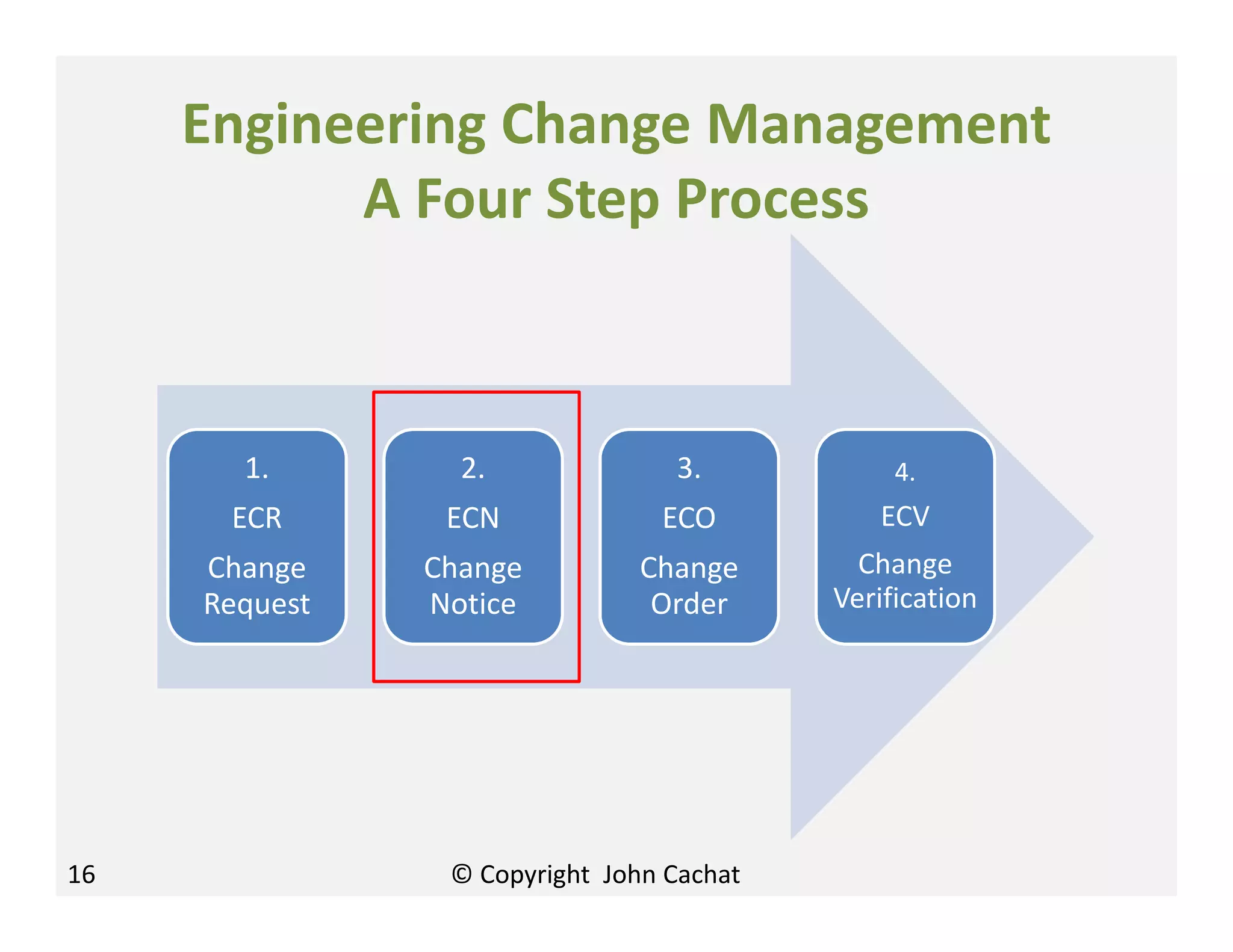
2.
ECN
Change
Notice
3.
ECO
Change
Order
4.
ECV
Change
Verification
16 © Copyright John Cachat
Change Notice
• Who needs to know about the change and what
do they have to do in order to prepare for the
change?
– Engineering
– Manufacturing
– Quality
– Purchasing
– Marketing (packaging)
– Customers
– Suppliers
• What needs to be updated?
17 © Copyright John Cachat
Change Notice
• What is impacted?
– Already shipped
– In the warehouse
– In production
– At the supplier
• What needs to be updated?
18 © Copyright John Cachat
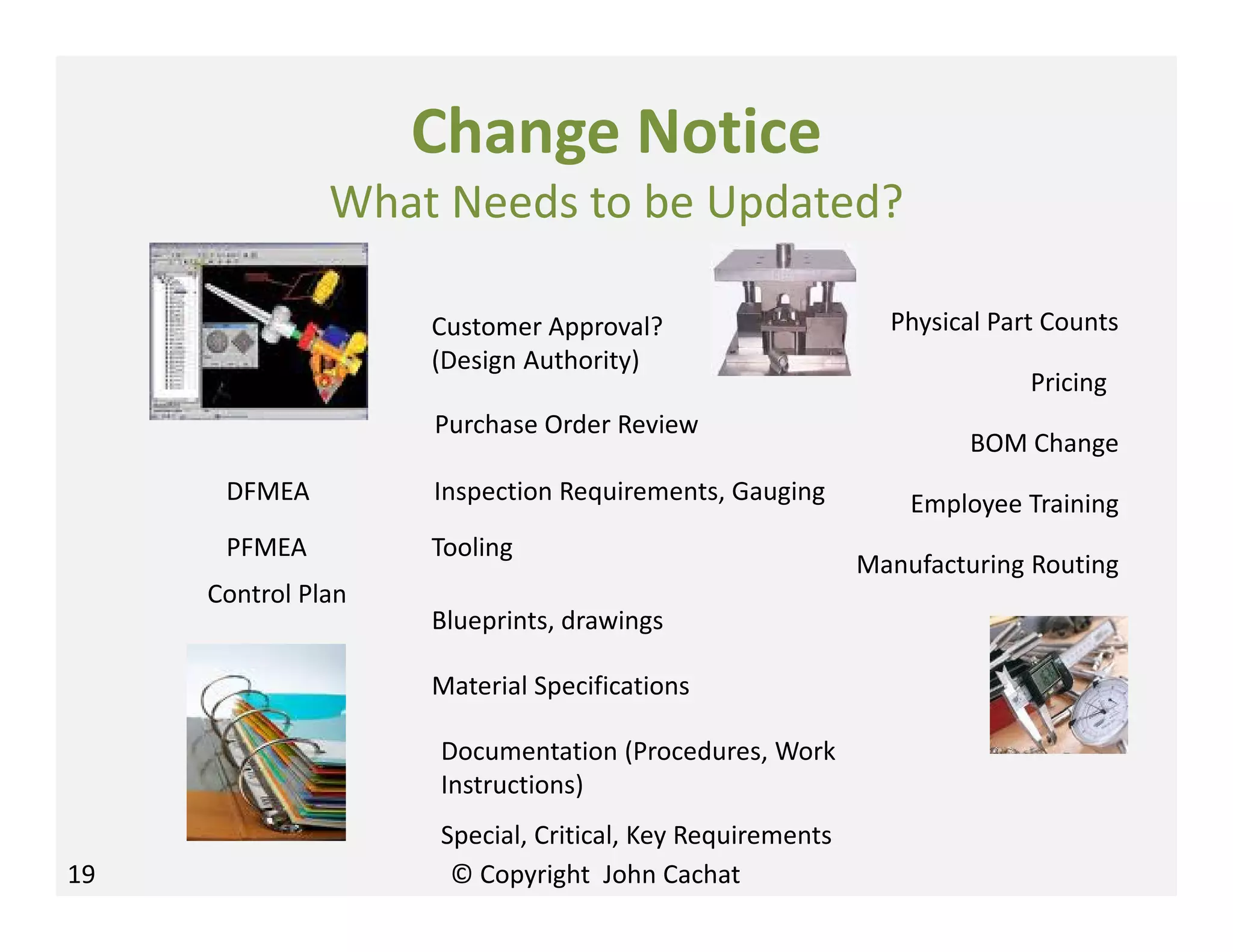
Change Notice
What Needs to be Updated?
19
Pricing
Purchase Order Review
Inspection Requirements, Gauging
Tooling
Documentation (Procedures, Work
Instructions)
Blueprints, drawings
Employee Training
Customer Approval?
(Design Authority)
Physical Part Counts
BOM Change
Manufacturing Routing
DFMEA
PFMEA
Control Plan
Special, Critical, Key Requirements
Material Specifications
© Copyright John Cachat
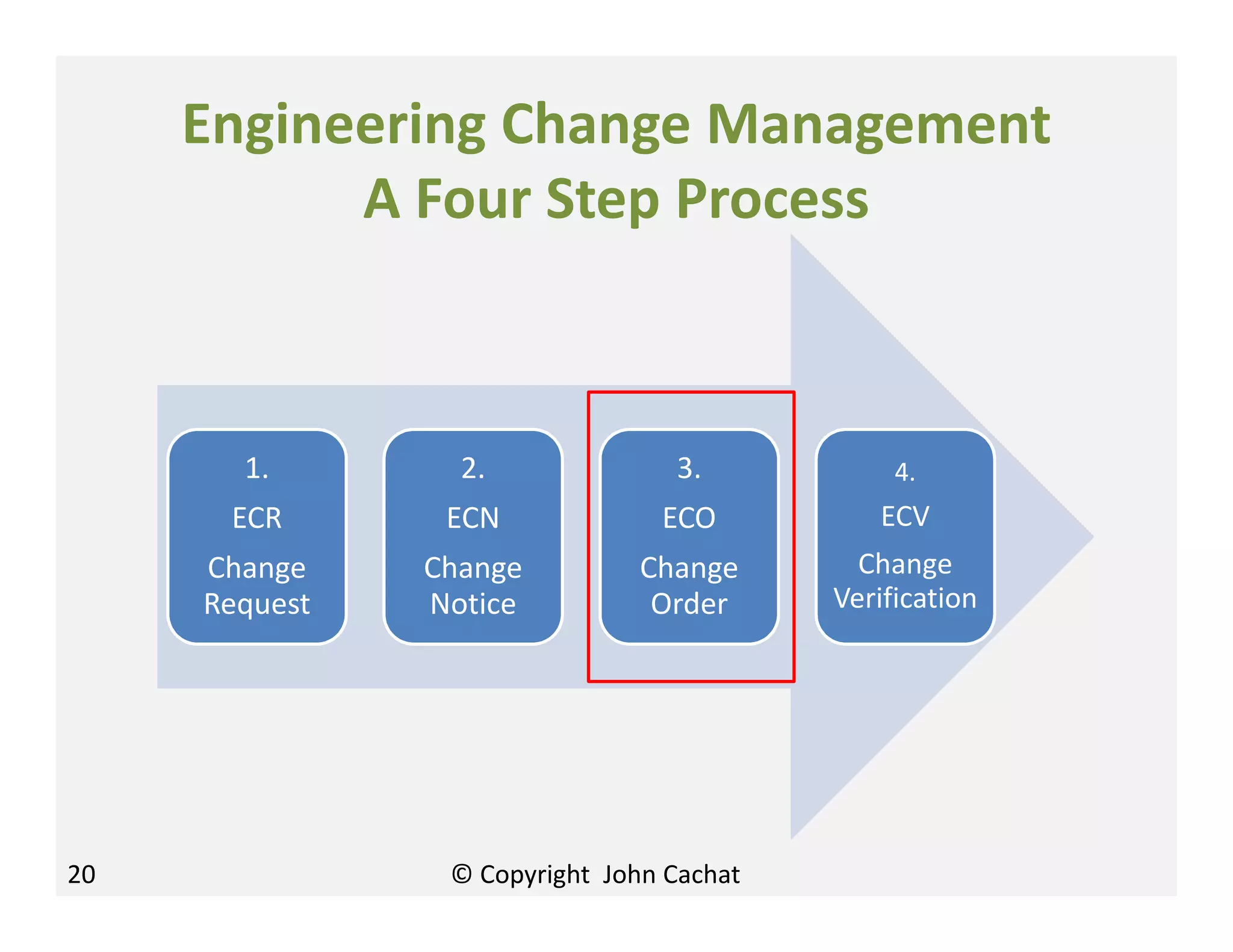
Engineering Change Management
A Four Step Process
1.
ECR
Change
Request
2.
ECN
Change
Notice
3.
ECO
Change
Order
4.
ECV
Change
Verification
20 © Copyright John Cachat
Change Order
• Everything is ready to go
• When do we start?
– Immediately
– By Date
– By Inventory/production schedule
• Existing parts (rework, scrap, use as is)
• New parts
21 © Copyright John Cachat
Engineering Change Management
A Four Step Process
1.
ECR
Change
Request
2.
ECN
Change
Notice
3.
ECO
Change
Order
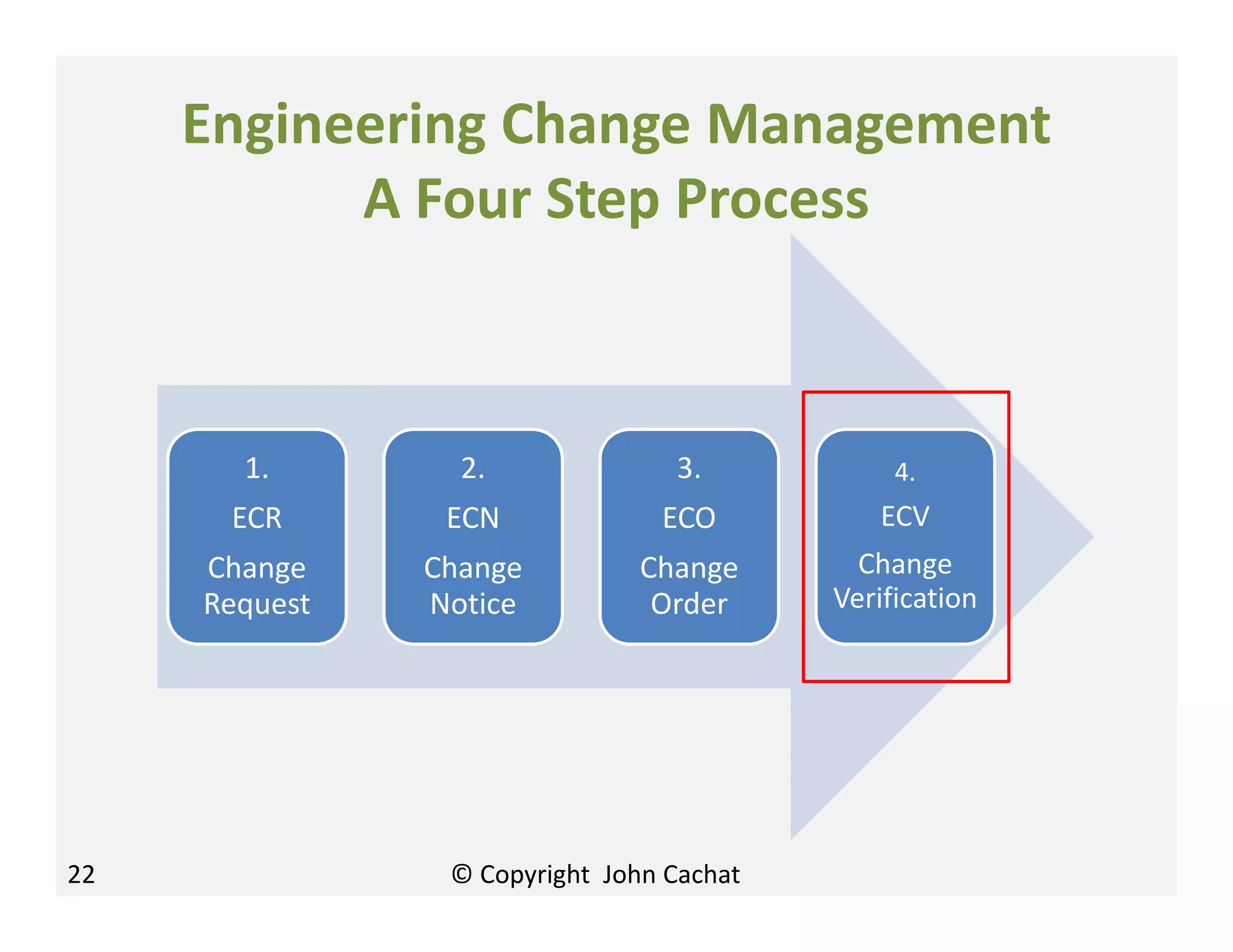
4.
ECV
Change
Verification
22 © Copyright John Cachat
Change Verification
• % of changes that were correct
• Did we get what we expected?
– Cost reduction
– Quality improvement
• If yes, great and review other parts that we
can apply the same change to (look across and
read across)
• If no, start over
23 © Copyright John Cachat
Automation Ideas
• Small company versus big company
• The current “state of the art” in
most companies include MS Project
& MS Excel
• These tools are personal
productivity tools – not enterprise
business systems
24 © Copyright John Cachat
Automation Ideas
• Look at the product lifecycle and look for gaps
• Process view, not department view, not a
document view
• Start with a process flowchart
25 © Copyright John Cachat
26
Engineering Change Process
What it actually is
What you think it is
What it should be
© Copyright John Cachat
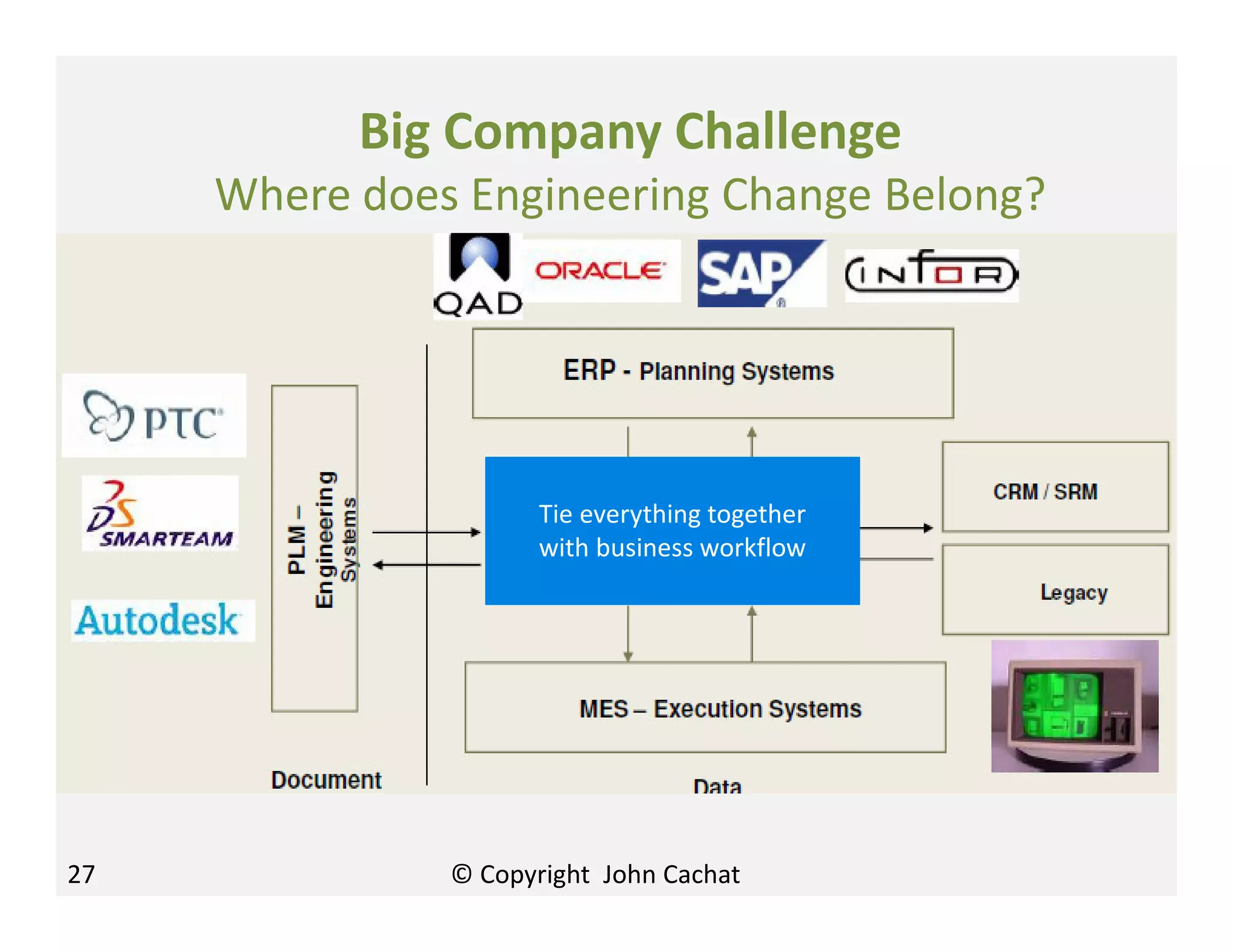
Big Company Challenge
Where does Engineering Change Belong?
27
Tie everything together
with business workflow
© Copyright John Cachat
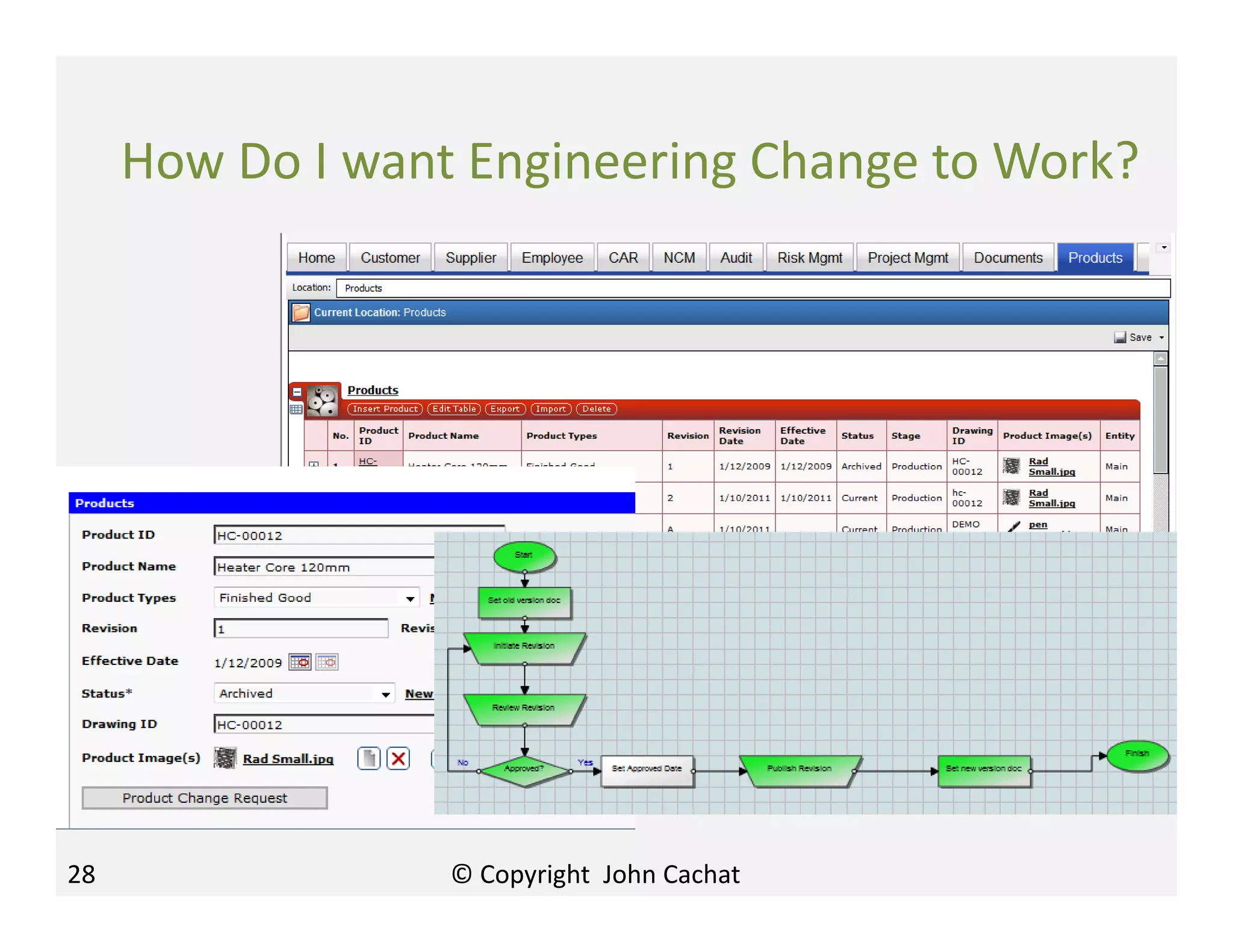
How Do I want Engineering Change to Work?
28 © Copyright John Cachat
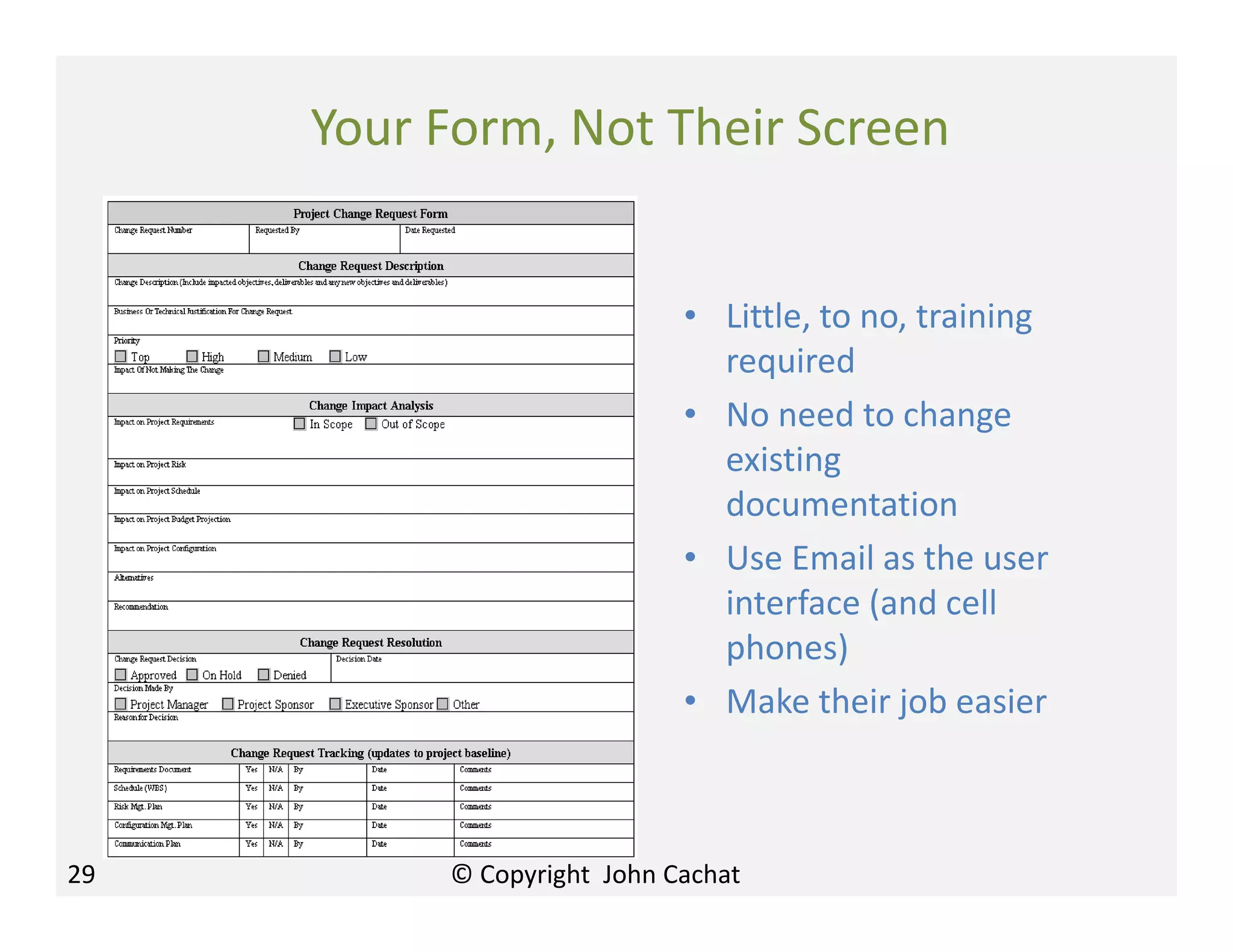
Your Form, Not Their Screen
29
• Little, to no, training
required
• No need to change
existing
documentation
• Use Email as the user
interface (and cell
phones)
• Make their job easier
© Copyright John Cachat
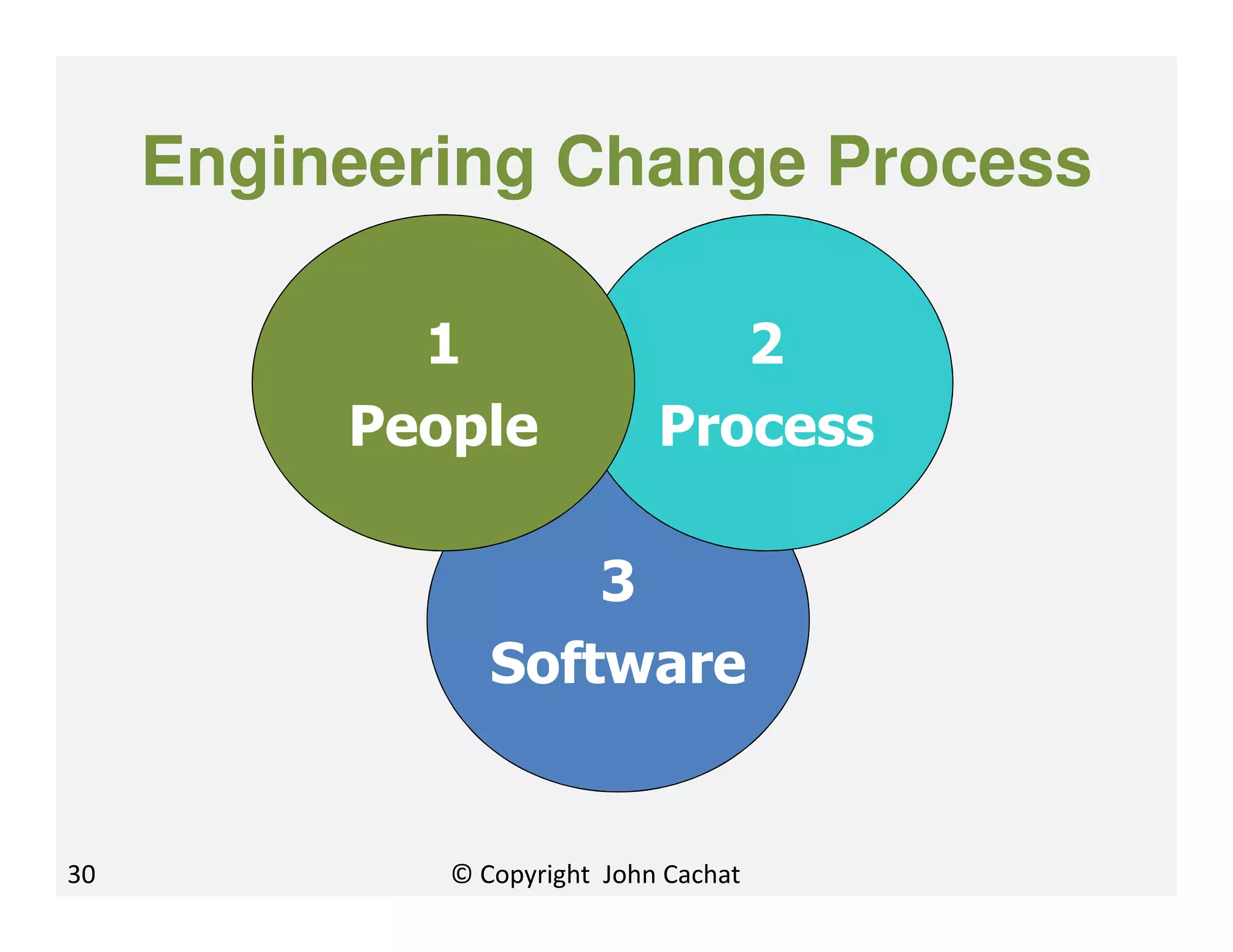
Engineering Change Process
3
Software
2
Process
1
People
30 © Copyright John Cachat
Benefits / Value
• Increase Revenue
– Develop new markets and gain market share by collaborating more
directly with the customer and delivering customer-specific goods
more quickly
• Competitive advantage
– Faster time to market
– Reduce design cycle times and product costs through collaboration
– Lower costs with more efficient use of resources in product
development
– Reduce delivery lead times
• Compliance and risk mitigation
– Rock solid process with robust audit trail
31 © Copyright John Cachat
Benefits / Value
• Reduce Inventory Waste
– Stop making parts to the wrong revision
– Reduce component obsolescence
– Faster and more effective change management with Suppliers
• Improve Decision Making Analysis / Management Review
– Change Verification feeds information back into Engineering
– View a single, consistent record of figures and analytics
related change management
– Improve financial analysis by capturing engineering change
costs and cycle times
32 © Copyright John Cachat
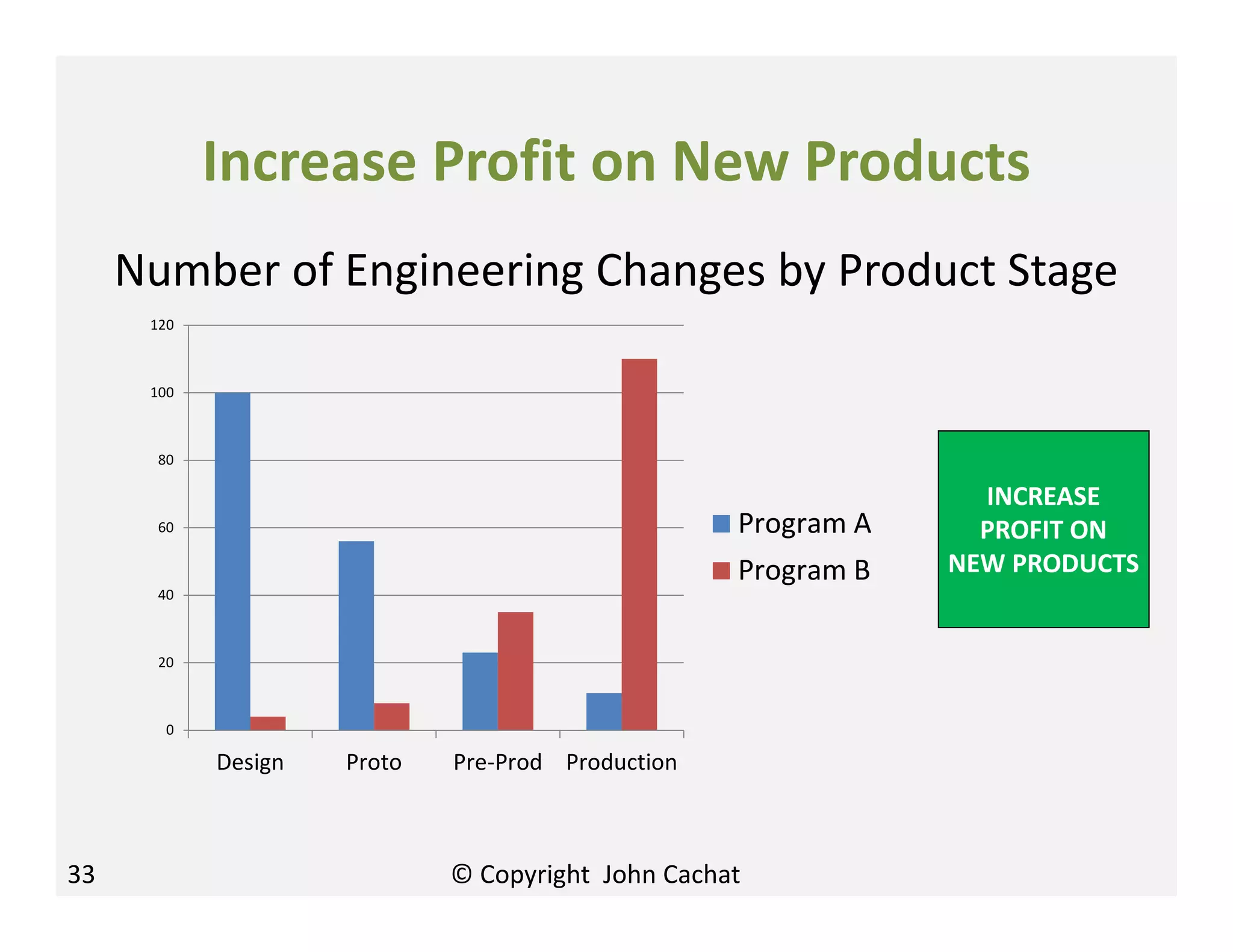
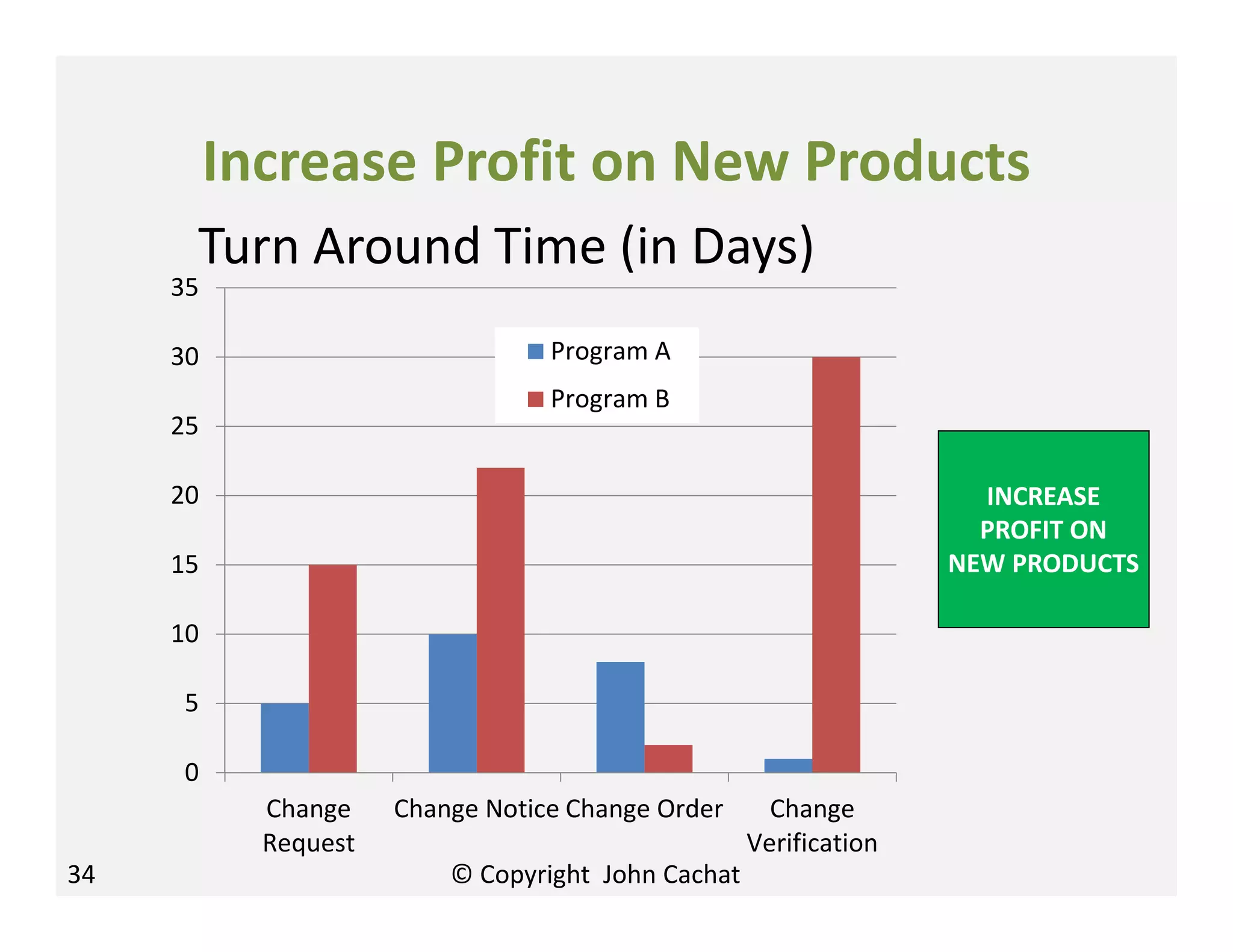
Increase Profit on New Products
33
INCREASE
PROFIT ON
NEW PRODUCTS
0
20
40
60
80
100
120
Design Proto Pre-Prod Production
Program A
Program B
Number of Engineering Changes by Product Stage
© Copyright John Cachat
Increase Profit on New Products
34
INCREASE
PROFIT ON
NEW PRODUCTS
Turn Around Time (in Days)
0
5
10
15
20
25
30
35
Change
Request
Change Notice Change Order Change
Verification
Program A
Program B
© Copyright John Cachat
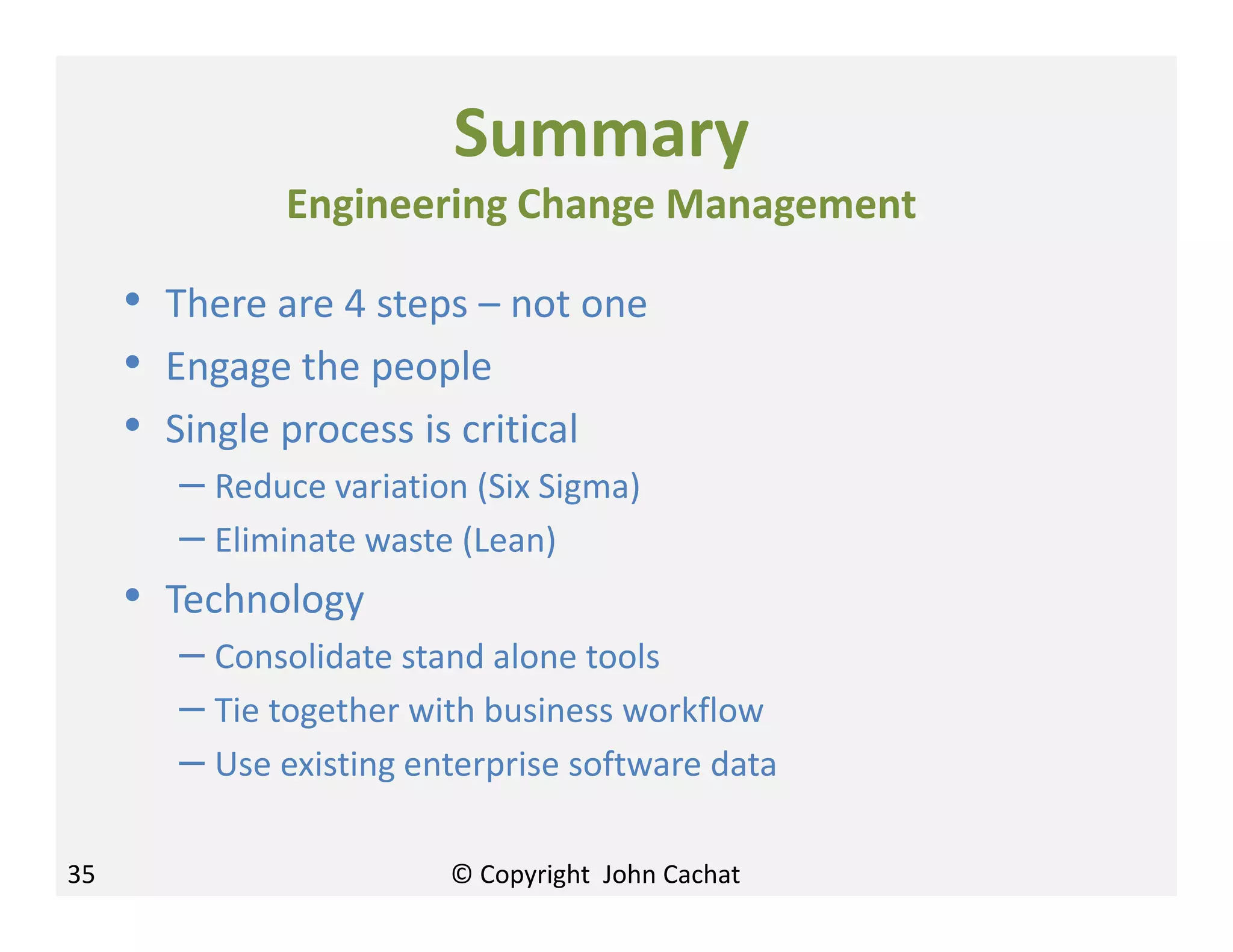
35
Summary
Engineering Change Management
• There are 4 steps – not one
• Engage the people
• Single process is critical
– Reduce variation (Six Sigma)
– Eliminate waste (Lean)
• Technology
– Consolidate stand alone tools
– Tie together with business workflow
– Use existing enterprise software data
© Copyright John Cachat
36
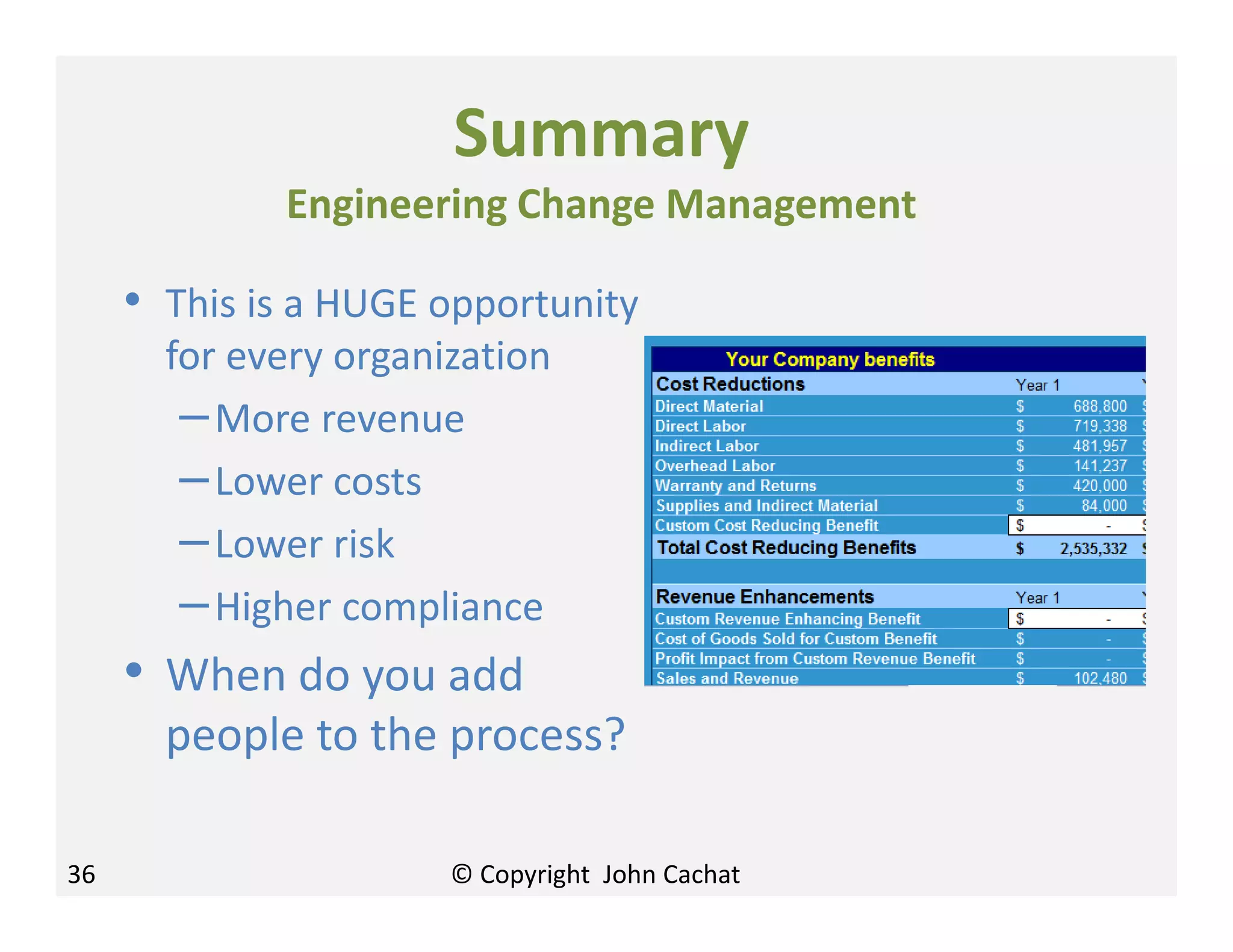
Summary
Engineering Change Management
• This is a HUGE opportunity
for every organization
–More revenue
–Lower costs
–Lower risk
–Higher compliance
• When do you add
people to the process?
© Copyright John Cachat
About Us
John Cachat
jmc@peproso.com
Contact
Proven expertise in training
and document management
systems
Rapid Solution
Development™ process
Services
Assess Current Status
Develop Short and Long
Term Plans
Develop Specific Solutions
to Your Problems
Assist in ROI Analysis
37 © Copyright John Cachat
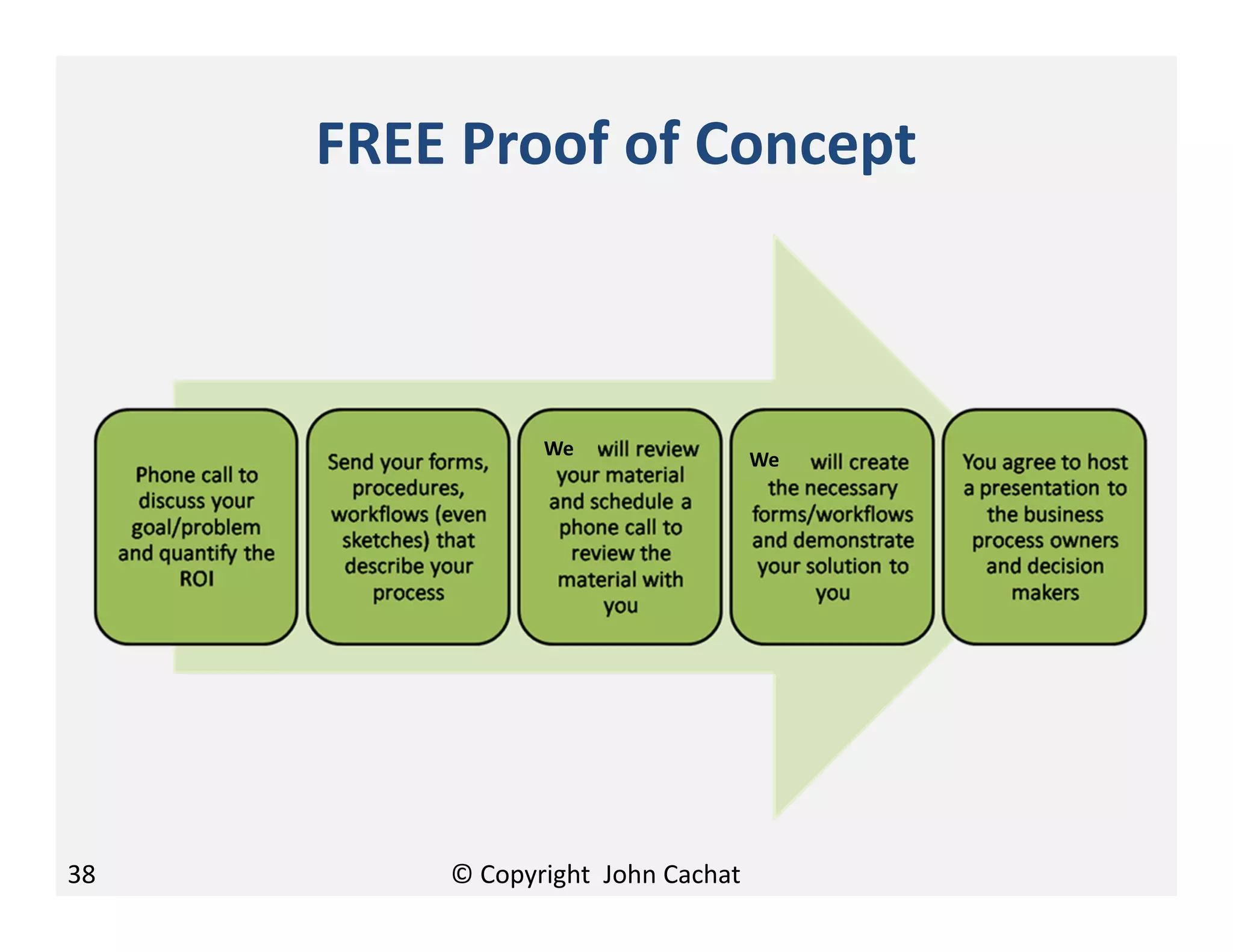
FREE Proof of Concept
38 © Copyright John Cachat
We
We
© Copyright John Cachat
&
Contact:
John Cachat
jmc@peproso.com
Copy of Presentation
&
Request a Demo
Visit:
http://peproso.com/webinars
Future Webinars
Engineering Change Management: The Process
39

Engineering change management webinar april 2013

  • 1.
    Engineering Change Management: The Process JohnM. Cachat jmc@peproso.com © Copyright John Cachat
  • 2.
    About John M.Cachat • Driving Business Performance – Helping companies align their business and technology – Focus on people, process, and then the technology – Subject matter expert on business process management – On-going research into next generation of technology for enterprise systems • 28 years experience in enterprise systems – USAF Research Project (1985) – Founder of enterprise quality software company (1988) – Chair of ASQ technical committee on computerizing quality (1992) • Trusted advisor to global organizations, government agencies, and professional groups http://www.linkedin.com/in/johncachat 2 © Copyright John Cachat
  • 3.
    Housekeeping Phones are muted Usethe question block for questions Copy of presentation available upon request 3 © Copyright John Cachat
  • 4.
    Today’s Discussion • WhyNow? • Engineering Change Management Process • Identifying & Eliminating Waste In The Process • The Role of Software • Summary • Free Proof of Concept Offer • Q & A 4 © Copyright John Cachat
  • 5.
    Why Now? • Asmanufacturing firms increase their rates of new product introduction, the management of engineering change has become a major and ongoing challenge. • The need for rapid engineering change is an requirement of a rapid rate of new product introduction and short product life cycles. 5 © Copyright John Cachat
  • 6.
    Engineering Change is MoreCritical Than Ever? • Engineering change is often poorly defined and poorly executed • Implementation of Engineering changes are often disruptive and costly 6 © Copyright John Cachat
  • 7.
  • 8.
    8 Engineering Change Complexity •Single Product with Multiple Change Requests – Grouping multiple changes into a single revision change • Single Change Request Against Multiple Products – This change is applied to 10 different parts • Single Product that Affects Multiple Products – This part is used in 5 other assemblies (configuration management) © Copyright John Cachat
  • 9.
    Engineering Change Management AFour Step Process 1. ECR Change Request 2. ECN Change Notice 3. ECO Change Order 4. ECV Change Verification 9 © Copyright John Cachat
  • 10.
    Change Request • Source –Customers – Internal – Suppliers • Deviation/Waiver/Permanent • Should you or shouldn’t you do it? – Review impact & related costs – Determine risk – Other parts, processes, etc. • Who get’s to vote? – create some rules 10 © Copyright John Cachat
  • 11.
    Change Request Should youor shouldn’t you? • Determine risk – Safety issue? – Cost versus the right thing to do – Short term versus long term – Stop shipments / manufacturing NOW? 11 © Copyright John Cachat
  • 12.
    Change Request Should youor shouldn’t you? • Review impact & related costs – Product Life Cycle stage – Impact on related parts – Current inventory (shipped, warehouse, internal, & at supplier) – Impact on reputation 12 © Copyright John Cachat
  • 13.
    Who Needs toVote? (Create Some Rules) • Critical – Financial impact of $XXXX or greater – Affects product in the field – Safety related issue **A product recall is always a Class I change. 13 © Copyright John Cachat
  • 14.
    Who Needs toVote? (Create Some Rules) • Major – Affects the service organization, inventory or outside organization – Financial impact of under $XXXX 14 © Copyright John Cachat
  • 15.
    Who Needs toVote? (Create Some Rules) • Minor – Includes pre-production products, accounting functions, clarifications, typo corrections and changes that do not affect the form, fit, or function of the product or part – Do not affect inventory – Outside the organization – Financial impact less than $XXXX – Does not affect field service 15 © Copyright John Cachat
  • 16.
    Engineering Change Management AFour Step Process 1. ECR Change Request 2. ECN Change Notice 3. ECO Change Order 4. ECV Change Verification 16 © Copyright John Cachat
  • 17.
    Change Notice • Whoneeds to know about the change and what do they have to do in order to prepare for the change? – Engineering – Manufacturing – Quality – Purchasing – Marketing (packaging) – Customers – Suppliers • What needs to be updated? 17 © Copyright John Cachat
  • 18.
    Change Notice • Whatis impacted? – Already shipped – In the warehouse – In production – At the supplier • What needs to be updated? 18 © Copyright John Cachat
  • 19.
    Change Notice What Needsto be Updated? 19 Pricing Purchase Order Review Inspection Requirements, Gauging Tooling Documentation (Procedures, Work Instructions) Blueprints, drawings Employee Training Customer Approval? (Design Authority) Physical Part Counts BOM Change Manufacturing Routing DFMEA PFMEA Control Plan Special, Critical, Key Requirements Material Specifications © Copyright John Cachat
  • 20.
    Engineering Change Management AFour Step Process 1. ECR Change Request 2. ECN Change Notice 3. ECO Change Order 4. ECV Change Verification 20 © Copyright John Cachat
  • 21.
    Change Order • Everythingis ready to go • When do we start? – Immediately – By Date – By Inventory/production schedule • Existing parts (rework, scrap, use as is) • New parts 21 © Copyright John Cachat
  • 22.
    Engineering Change Management AFour Step Process 1. ECR Change Request 2. ECN Change Notice 3. ECO Change Order 4. ECV Change Verification 22 © Copyright John Cachat
  • 23.
    Change Verification • %of changes that were correct • Did we get what we expected? – Cost reduction – Quality improvement • If yes, great and review other parts that we can apply the same change to (look across and read across) • If no, start over 23 © Copyright John Cachat
  • 24.
    Automation Ideas • Smallcompany versus big company • The current “state of the art” in most companies include MS Project & MS Excel • These tools are personal productivity tools – not enterprise business systems 24 © Copyright John Cachat
  • 25.
    Automation Ideas • Lookat the product lifecycle and look for gaps • Process view, not department view, not a document view • Start with a process flowchart 25 © Copyright John Cachat
  • 26.
    26 Engineering Change Process Whatit actually is What you think it is What it should be © Copyright John Cachat
  • 27.
    Big Company Challenge Wheredoes Engineering Change Belong? 27 Tie everything together with business workflow © Copyright John Cachat
  • 28.
    How Do Iwant Engineering Change to Work? 28 © Copyright John Cachat
  • 29.
    Your Form, NotTheir Screen 29 • Little, to no, training required • No need to change existing documentation • Use Email as the user interface (and cell phones) • Make their job easier © Copyright John Cachat
  • 30.
  • 31.
    Benefits / Value •Increase Revenue – Develop new markets and gain market share by collaborating more directly with the customer and delivering customer-specific goods more quickly • Competitive advantage – Faster time to market – Reduce design cycle times and product costs through collaboration – Lower costs with more efficient use of resources in product development – Reduce delivery lead times • Compliance and risk mitigation – Rock solid process with robust audit trail 31 © Copyright John Cachat
  • 32.
    Benefits / Value •Reduce Inventory Waste – Stop making parts to the wrong revision – Reduce component obsolescence – Faster and more effective change management with Suppliers • Improve Decision Making Analysis / Management Review – Change Verification feeds information back into Engineering – View a single, consistent record of figures and analytics related change management – Improve financial analysis by capturing engineering change costs and cycle times 32 © Copyright John Cachat
  • 33.
    Increase Profit onNew Products 33 INCREASE PROFIT ON NEW PRODUCTS 0 20 40 60 80 100 120 Design Proto Pre-Prod Production Program A Program B Number of Engineering Changes by Product Stage © Copyright John Cachat
  • 34.
    Increase Profit onNew Products 34 INCREASE PROFIT ON NEW PRODUCTS Turn Around Time (in Days) 0 5 10 15 20 25 30 35 Change Request Change Notice Change Order Change Verification Program A Program B © Copyright John Cachat
  • 35.
    35 Summary Engineering Change Management •There are 4 steps – not one • Engage the people • Single process is critical – Reduce variation (Six Sigma) – Eliminate waste (Lean) • Technology – Consolidate stand alone tools – Tie together with business workflow – Use existing enterprise software data © Copyright John Cachat
  • 36.
    36 Summary Engineering Change Management •This is a HUGE opportunity for every organization –More revenue –Lower costs –Lower risk –Higher compliance • When do you add people to the process? © Copyright John Cachat
  • 37.
    About Us John Cachat jmc@peproso.com Contact Provenexpertise in training and document management systems Rapid Solution Development™ process Services Assess Current Status Develop Short and Long Term Plans Develop Specific Solutions to Your Problems Assist in ROI Analysis 37 © Copyright John Cachat
  • 38.
    FREE Proof ofConcept 38 © Copyright John Cachat We We
  • 39.
    © Copyright JohnCachat & Contact: John Cachat jmc@peproso.com Copy of Presentation & Request a Demo Visit: http://peproso.com/webinars Future Webinars Engineering Change Management: The Process 39