Exploring Learning Analytics
and Learning Dashboards
from a HCI Perspective
Jose Luis Santos
PUBLIC PHD DEFENSE
1http://bit.do/santos_scholar http://www.slideshare.net/jlsantoso
Learning analytics is the measurement, collection, analysis
and reporting of data about learners and their contexts,
for purposes of understanding and optimising learning and
the environments in which it occurs” - George Siemens [1]
[1] G. Siemens. “Learning analytics: envisioning a research discipline and
a domain of practice”. Proceedings of the 2nd International Conference on
Learning Analytics and Knowledge . ACM. 2012, pp. 4–8.
DEFINITION
page 1 of the thesis text
2
IMPACT
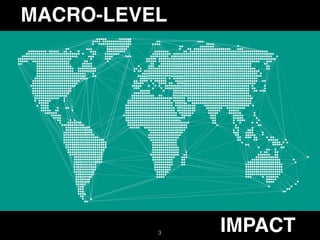
MACRO-LEVEL
3
IMPACT
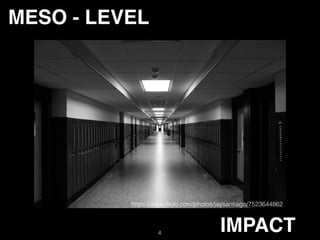
MESO - LEVEL
https://www.flickr.com/photos/jaysantiago/7523644862
4
IMPACT
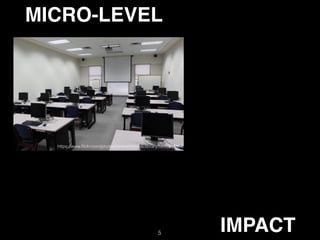
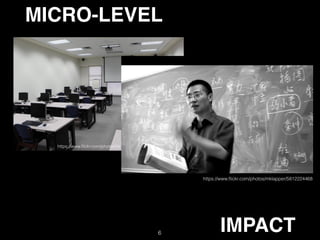
MICRO-LEVEL
https://www.flickr.com/photos/fortworthpubliclibrary/5202801554
5
IMPACT
MICRO-LEVEL
https://www.flickr.com/photos/fortworthpubliclibrary/5202801554
https://www.flickr.com/photos/mklapper/5812224468
6
IMPACT
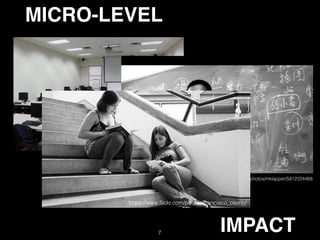
MICRO-LEVEL
https://www.flickr.com/photos/fortworthpubliclibrary/5202801554
https://www.flickr.com/photos/mklapper/5812224468
https://www.flickr.com/people/francisco_osorio/
7
Classrooms and learning communities
SCOPE
see background section (pg.3) of the thesis text
8
9
10
11
12
13
LEARNINGDASHBOARDS
14
Classrooms and learning communities
Learning Dashboards
as Personal Informatics Tools
see background section (pg.3) of the thesis text
15 SCOPE
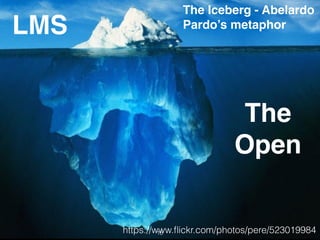
https://www.flickr.com/photos/pere/523019984
The Iceberg - Abelardo
Pardo’s metaphorLMS
The
Open
16
17
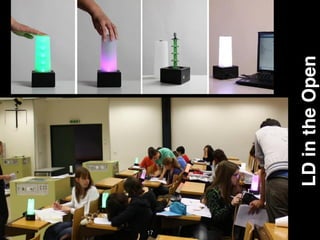
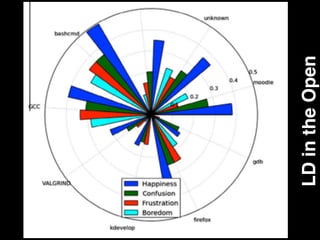
LDintheOpen
18
19
LDintheOpen
20
LDintheOpen
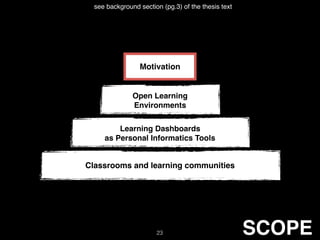
Classrooms and learning communities
Learning Dashboards
as Personal Informatics Tools
Open Learning
Environments
see background section (pg.3) of the thesis text
21 SCOPE
MOTIVATION
ability
motivation
triggers fail
here
triggers succeed
here
BJ Fogg’s
model
http://www.behaviormodel.org/
22
Classrooms and learning communities
Learning Dashboards
as Personal Informatics Tools
Open Learning
Environments
Motivation
see background section (pg.3) of the thesis text
23 SCOPE
EVALUATION INSTRUMENTS
24
• Google Analytics
• Own tracking systems
EVALUATION INSTRUMENTS
25
• Google Analytics
• Own tracking systems
• SUS questionnaire
EVALUATION INSTRUMENTS
26
• Google Analytics
• Own tracking systems
• SUS questionnaire
• Customised questionnaires
EVALUATION INSTRUMENTS
27
• Google Analytics
• Own tracking systems
• SUS questionnaire
• Customised questionnaires
• Interviews
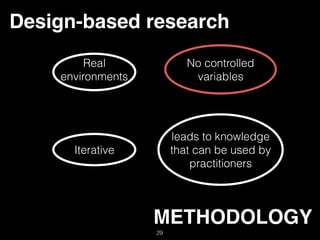
METHODOLOGY
Iterative
Real
environments
No controlled
variables
leads to knowledge
that can be used by
practitioners
Design-based research
28
METHODOLOGY
Iterative
Real
environments
No controlled
variables
leads to knowledge
that can be used by
practitioners
Design-based research
29
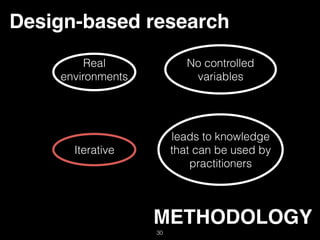
METHODOLOGY
Iterative
Real
environments
No controlled
variables
leads to knowledge
that can be used by
practitioners
Design-based research
30
METHODOLOGY
Iterative
Real
environments
No controlled
variables
leads to knowledge
that can be used by
practitioners
Design-based research
31
32
CASE STUDIES
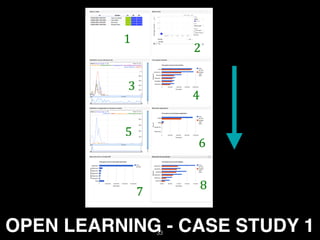
OPEN LEARNING - CASE STUDY 133
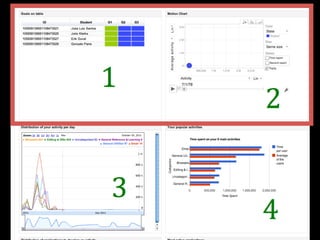
CASE STUDY 134
CASE STUDY 135
CASE STUDY 136
CASE STUDY 137
CASE STUDY 138
CASE STUDY 139
40
What did we
learn?
41
What did we
learn?
What came next?
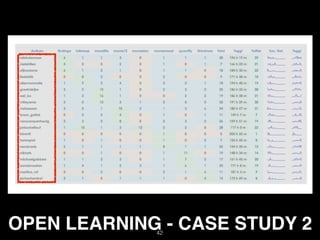
OPEN LEARNING - CASE STUDY 242
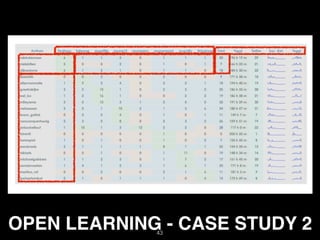
OPEN LEARNING - CASE STUDY 243
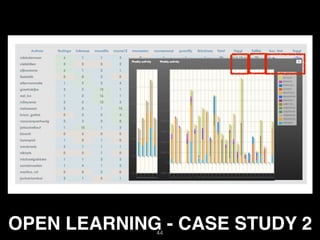
OPEN LEARNING - CASE STUDY 244
45
What did we
learn?
46
What did we
learn?
47
What did we
learn?
What came next?
48
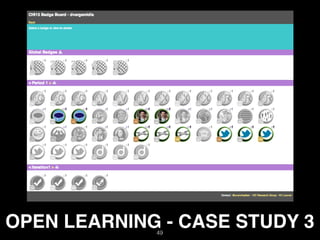
OPEN LEARNING - CASE STUDY 349
50
What did we
learn?
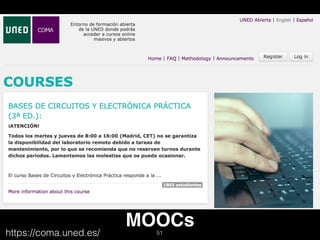
MOOCs51https://coma.uned.es/
52
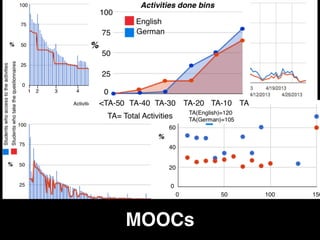
MOOCs
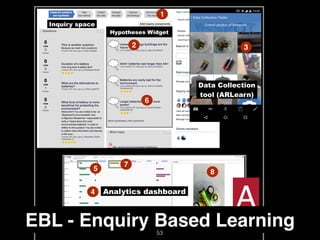
EBL - Enquiry Based Learning53
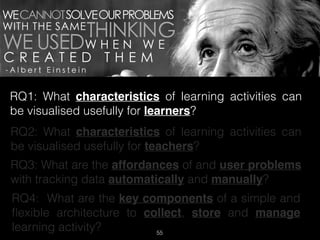
RESEARCH QUESTIONS
RQ1: What characteristics of learning activities can
be visualised usefully for learners?
RQ2: What characteristics of learning activities can
be visualised usefully for teachers?
RQ3: What are the affordances of and user problems
with tracking data automatically and manually?
RQ4: What are the key components of a simple and
flexible architecture to collect, store and manage
learning activity? 54
RESEARCH QUESTIONS
RQ1: What characteristics of learning activities can
be visualised usefully for learners?
RQ2: What characteristics of learning activities can
be visualised usefully for teachers?
RQ3: What are the affordances of and user problems
with tracking data automatically and manually?
RQ4: What are the key components of a simple and
flexible architecture to collect, store and manage
learning activity? 55
Approach56
128 students3 learning analytics dashboards
5 case studies
real settingsusability
perceived usefulness
Publications57
Santos et al. 2012. “Goal-oriented visualizations of activity tracking: a case study with
engineering students”, In Proceedings of the 2nd International Conference on Learning
Analytics and Knowledge (LAK ’12). ACM, New York, NY, USA, 143-152.
Santos et al. 2013a. “Addressing learner issues with StepUp!: an evaluation”, In Proceedings
of the Third International Conference on Learning Analytics and Knowledge (LAK ’13).
ACM, New York, NY, USA, 14-22.
Santos et al. 2013b. “Evaluating the use of open badges in an open learning environment” , In
proceedings of of the Eight European Conference on Technology Enhanced Learning,
Scaling up Learning for Sustained Impact, Springer Berlin Heidelberg, Berlin, Germany.
314-327.
Santos et al. 2015 “Tracking Data in Open Learning Environments" Journal of
Universal Computer Science, Vol. 21, No. 7, pp. 976-996
Santos et al. 2014. “Success, activity and drop-outs in MOOCs an exploratory study on
the UNED COMA courses”. In Proceedings of the Fourth International Conference on
Learning Analytics And Knowledge (LAK’14). ACM, New York, NY, USA, 98-102
“As described in section 1.1, learning dashboards
visualise learning traces, actions that students
perform while they learn. In this context, RQ1
explores the usefulness of such traces in five different
open learning courses.”
Problem58
rq1 problem statement - see page 14 of the thesis text
[3,4]
Time
spent
Artefacts
Produced
Social
Interaction
Resource
use
Exercise/
Test
results
Ch. 2
Ch. 3
Ch. 4
[3] K. Verbert, E. Duval, J. Klerkx, S. Govaerts, and J. L. Santos. “Learning Analytics Dashboard Applications”. In:
American Behavioral Scientist 57.10 (2013), pp. 1500–1509.
[4] K. Verbert, S. Govaerts, E. Duval, J. L. Santos, F. Van Assche, G. Parra, and J. Klerkx. “Learning dashboards: an
overview and future research opportunities”. In: Personal and Ubiquitous Computing 18.6 (2014), pp. 1499–1514.
Approach
page 15 of the thesis text
59
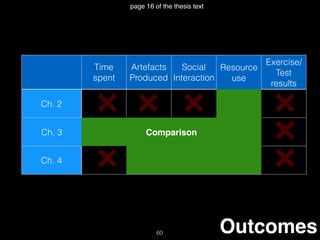
Time
spent
Artefacts
Produced
Social
Interaction
Resource
use
Exercise/
Test
results
Ch. 2
Ch. 3 Comparison
Ch. 4
Outcomes
page 16 of the thesis text
60
[3,4]
Time
spent
Artefacts
Produced
Social
Interaction
Resource
use
Exercise/
Test
results
Ch. 2
Ch. 3
Social
activity
Ch. 4
Outcomes
page 16 of the thesis text
61
Time
spent
Artefacts
Produced
Social
Interaction
Resource
use
Exercise/
Test
results
Ch. 2
Ch. 3 individual vs group work
Ch. 4
Outcomes
page 16 of the thesis text
62
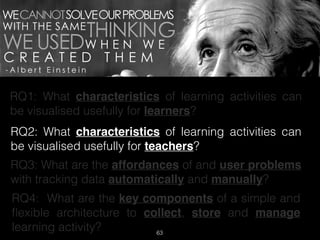
RESEARCH QUESTIONS
RQ1: What characteristics of learning activities can
be visualised usefully for learners?
RQ2: What characteristics of learning activities can
be visualised usefully for teachers?
RQ3: What are the affordances of and user problems
with tracking data automatically and manually?
RQ4: What are the key components of a simple and
flexible architecture to collect, store and manage
learning activity? 63
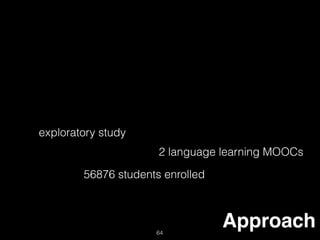
Approach64
exploratory study
2 language learning MOOCs
56876 students enrolled
Publications65
Santos et al. 2012. “Goal-oriented visualizations of activity tracking: a case study with
engineering students”, In Proceedings of the 2nd International Conference on Learning
Analytics and Knowledge (LAK ’12). ACM, New York, NY, USA, 143-152.
Santos et al. 2013a. “Addressing learner issues with StepUp!: an evaluation”, In
Proceedings of the Third International Conference on Learning Analytics and Knowledge (LAK
’13). ACM, New York, NY, USA, 14-22.
Santos et al. 2013b. “Evaluating the use of open badges in an open learning
environment” , In proceedings of of the Eight European Conference on Technology Enhanced
Learning, Scaling up Learning for Sustained Impact, Springer Berlin Heidelberg, Berlin,
Germany. 314-327.
Santos et al. 2014. “Success, activity and drop-outs in MOOCs an exploratory study on the
UNED COMA courses”. In Proceedings of the Fourth International Conference on Learning
Analytics And Knowledge (LAK’14). ACM, New York, NY, USA, 98-102
Santos et al. 2015 “Tracking Data in Open Learning Environments" Journal of
Universal Computer Science, Vol. 21, No. 7, pp. 976-996
“Results of our analyses [94, 95] report that
dashboards for teachers are designed to raise
awareness of the activities taking place in the course,
analyse activity and plan interventions, among others.
Related to activity analysis, we explored what
teachers can actually learn from visualisations.”
Problem66
rq2 problem statement - see page 17 of the thesis text
Time
spent
Artefacts
Produced
Social
Interaction
Resource
use
Exercise/
Test
results
Drop-outs
[5,6,7]
Language use
[8]
Social
interaction [9]
[5] C. Alario-Hoyos et al. “Analysing the Impact of Built-In and External Social Tools in a MOOC on Educational Technologies”. In: ECTEL’13 . Vol. 8095. LNCS. Springer, 2013, pp. 5–18.
[6] D. Clow. “MOOCs and the funnel of participation”. In: Proceedings of the Third International Conference on Learning Analytics and Knowledge. LAK ’13. ACM, 2013, pp. 185–189.
[7] H. Spoelstra et al. “Team formation instruments to enhance learner interactions in open learning environments”. In: Computers in Human Behavior 45 (2015), pp. 11–20.
[8] P. Levy. “Technology-Supported Design for Inquiry-Based Learning”. In: Exploring Learning & Teaching in Higher Education . Springer, 2015, pp. 289–304.
[9] N. Michinov et al. “Procrastination, participation, and performance in online learning environments”. In: Computers & Education 56.1 (Jan. 2011), pp. 243–252.
67
Approach
table with data from page 17 and chapter 5 of the thesis text
Time
spent
Artefacts
Produced
Social
Interaction
Resource
use
Exercise/
Test
results
Drop-outs
[5,6,7]
attention to the first units of the lessons
Language use
[8]
Social
interaction [9]
68
Outcome
table with data from page 18 of the thesis text
Time
spent
Artefacts
Produced
Social
Interaction
Resource
use
Exercise/
Test
results
Drop-outs
[5,6,7]
attention to the first units of the lessons
Language use
[8]
? ?
Social
interaction [9]
69
Outcome
table with data from page 18 of the thesis text
Time
spent
Artefacts
Produced
Social
Interaction
Resource
use
Exercise/
Test
results
Drop-outs
[5,6,7]
attention to the first units of the lessons
Language use
[8]
? ?
Social
interaction [9]
70
Outcome
table with data from page 18 of the thesis text
thresholds thresholds
RESEARCH QUESTIONS
RQ1: What characteristics of learning activities can
be visualised usefully for learners?
RQ2: What characteristics of learning activities can
be visualised usefully for teachers?
RQ3: What are the affordances of and user problems
with tracking data automatically and manually?
RQ4: What are the key components of a simple and
flexible architecture to collect, store and manage
learning activity? 71
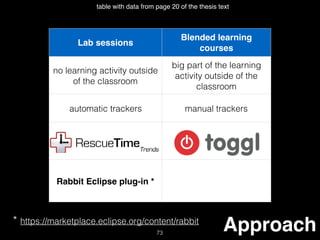
“Therefore, we consider relevant to evaluate how
students perceived automatic and manual trackers.”
Problem72
rq3 problem statement - see page 19 of the thesis text
Manual Automatic
PROS Privacy tracking fatigue [10]
CONTRAS tracking fatigue [10] Privacy
[10] E. K. Choe, N. B. Lee, B. Lee, W. Pratt, and J. A. Kientz. “Understanding quantified-selfers’ practices in collecting and exploring personal data”. In:
Proceedings of the 32nd annual ACM conference on Human factors in computing systems . ACM. 2014, pp. 1143–1152.
73
Approach
table with data from page 20 of the thesis text
Lab sessions
Blended learning
courses
no learning activity outside
of the classroom
big part of the learning
activity outside of the
classroom
automatic trackers manual trackers
Rabbit Eclipse plug-in *
* https://marketplace.eclipse.org/content/rabbit
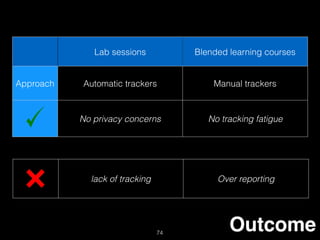
Outcome
Lab sessions Blended learning courses
Approach Automatic trackers Manual trackers
No privacy concerns No tracking fatigue
lack of tracking Over reporting
74
RESEARCH QUESTIONS
RQ1: What characteristics of learning activities can
be visualised usefully for learners?
RQ2: What characteristics of learning activities can
be visualised usefully for teachers?
RQ3: What are the affordances of and user problems
with tracking data automatically and manually?
RQ4: What are the key components of a simple and
flexible architecture to collect, store and manage
learning activity? 75
Publications76
Santos et al. 2015 “Tracking Data in Open Learning Environments" Journal of Universal
Computer Science, Vol. 21, No. 7, pp. 976-996
Santos et al. 2012. “Goal-oriented visualizations of activity tracking: a case study with
engineering students”, In Proceedings of the 2nd International Conference on Learning
Analytics and Knowledge (LAK ’12). ACM, New York, NY, USA, 143-152.
Santos et al. 2013a. “Addressing learner issues with StepUp!: an evaluation”, In
Proceedings of the Third International Conference on Learning Analytics and Knowledge (LAK
’13). ACM, New York, NY, USA, 14-22.
Santos et al. 2013b. “Evaluating the use of open badges in an open learning
environment” , In proceedings of of the Eight European Conference on Technology Enhanced
Learning, Scaling up Learning for Sustained Impact, Springer Berlin Heidelberg, Berlin,
Germany. 314-327.
Santos et al. 2014. “Success, activity and drop-outs in MOOCs an exploratory study on
the UNED COMA courses”. In Proceedings of the Fourth International Conference on
Learning Analytics And Knowledge (LAK’14). ACM, New York, NY, USA, 98-102
77
image at page 21 of the thesis text
Approach
Experience report
two environments
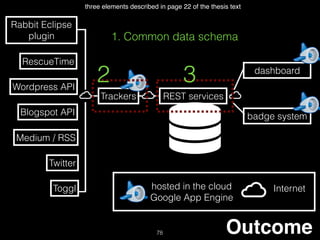
78
Rabbit Eclipse
plugin
RescueTime
Wordpress API
Blogspot API
Medium / RSS
Twitter
Toggl
Trackers REST services
dashboard
badge system
Internethosted in the cloud
Google App Engine
1. Common data schema
2 3
three elements described in page 22 of the thesis text
Outcome
Wrap-up
79
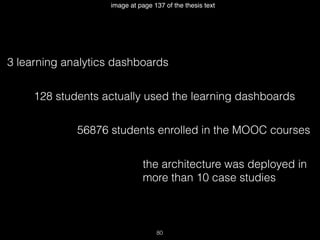
image at page 137 of the thesis text
128 students actually used the learning dashboards
56876 students enrolled in the MOOC courses
the architecture was deployed in
more than 10 case studies
3 learning analytics dashboards
80
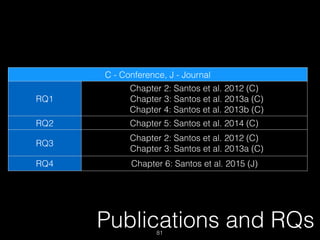
Publications and RQs
C - Conference, J - Journal
RQ1
Chapter 2: Santos et al. 2012 (C)
Chapter 3: Santos et al. 2013a (C)
Chapter 4: Santos et al. 2013b (C)
RQ2 Chapter 5: Santos et al. 2014 (C)
RQ3
Chapter 2: Santos et al. 2012 (C)
Chapter 3: Santos et al. 2013a (C)
RQ4 Chapter 6: Santos et al. 2015 (J)
81
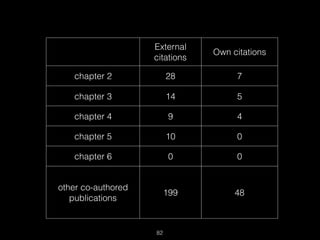
External
citations
Own citations
chapter 2 28 7
chapter 3 14 5
chapter 4 9 4
chapter 5 10 0
chapter 6 0 0
other co-authored
publications
199 48
82
83
84
85
86
87
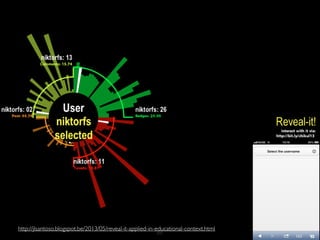
http://jlsantoso.blogspot.be/2013/05/reveal-it-applied-in-educational-context.html
88
8 May 2013 | @svencharleer | svencharleer.com
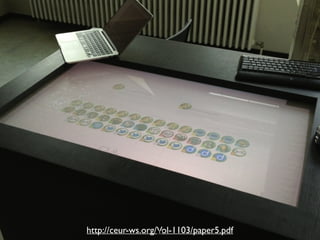
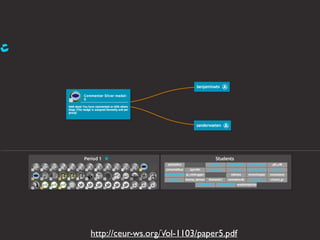
http://ceur-ws.org/Vol-1103/paper5.pdf89
http://ceur-ws.org/Vol-1103/paper5.pdf90
“What is research but a blind date with
knowledge?”
Will Harvey
91
Thank you for your attention!
Looking forward to answer
your questions.
92

Public PhD defense