Hello, in the first class today, all we did was go over the question that we did yesterday, and then did a similar question. Then we looked at some  graphs !  y = sin (x) May 17, 2007  Scribe-  Periodic Functions
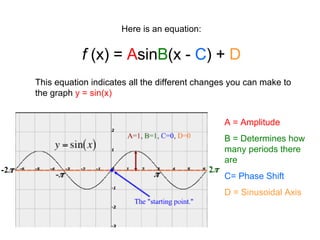
Here is an equation: f  (x) =  A sin B (x -  C ) +  D This equation indicates all the different changes you can make to the graph  y = sin(x) A = Amplitude B = Determines how many periods there are C= Phase Shift D = Sinusoidal Axis
A , the  AMPLITUDE  tells you the distance to travel from the  sinusoidal axis  to find the  y- maximum  and  y - minimum. EXAMPLE:   The black graph is y = sin(x) The red graph is  y = 2sin(x) See how the  red graph  has a  max. y value of 2  and a  min. y value of -2 . The “ 2 ” in front of the equation “y =  2 sin(x)” tells you that from the starting point on the sinusoidal axis, you must go  UP 2 units . The black graph is y = sin(x) The blue graph is  y = -2sin(x) The “ -2 ” in front of the equation “y =  -2 sin(x)” tells you that from the starting point on the sinusoidal axis, you must go  DOWN 2 units . Or you can say that the graph is just flipped over the sinusoidal axis.
B , it  DETERMINES THE PERIOD , but is  NOT  the period, according to these formulas: EXAMPLE: So the  period  of the graph  y = sin(2x)  is  π
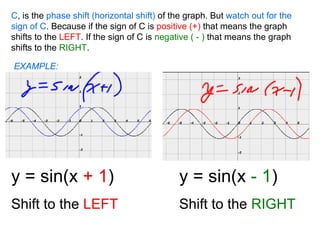
C , is the  phase shift (horizontal shift)  of the graph. But  watch out for the sign of C . Because if the sign of C is  positive (+)  that means the graph shifts to the  LEFT . If the sign of C is  negative ( - )  that means the graph shifts to the  RIGHT . EXAMPLE:  y = sin(x  + 1 )  Shift to the  LEFT y = sin(x  - 1 )  Shift to the  RIGHT
D , is the  SINUSOIDAL AXIS  (learn how to say and spell that word!!!). It also has other names ;  vertical shift  or  average value of function . Y = sin x  + 1 That  “+1”  tells you that you must move the whole graph  UP 1 unit . Y = sin x  - 2 That  “-2”  tells you that you must move the whole graph  DOWN 2 units.

Periodic Functions scribe

  • 1.
    Hello, in thefirst class today, all we did was go over the question that we did yesterday, and then did a similar question. Then we looked at some graphs ! y = sin (x) May 17, 2007 Scribe- Periodic Functions
  • 2.
    Here is anequation: f (x) = A sin B (x - C ) + D This equation indicates all the different changes you can make to the graph y = sin(x) A = Amplitude B = Determines how many periods there are C= Phase Shift D = Sinusoidal Axis
  • 3.
    A , the AMPLITUDE tells you the distance to travel from the sinusoidal axis to find the y- maximum and y - minimum. EXAMPLE: The black graph is y = sin(x) The red graph is y = 2sin(x) See how the red graph has a max. y value of 2 and a min. y value of -2 . The “ 2 ” in front of the equation “y = 2 sin(x)” tells you that from the starting point on the sinusoidal axis, you must go UP 2 units . The black graph is y = sin(x) The blue graph is y = -2sin(x) The “ -2 ” in front of the equation “y = -2 sin(x)” tells you that from the starting point on the sinusoidal axis, you must go DOWN 2 units . Or you can say that the graph is just flipped over the sinusoidal axis.
  • 4.
    B , it DETERMINES THE PERIOD , but is NOT the period, according to these formulas: EXAMPLE: So the period of the graph y = sin(2x) is π
  • 5.
    C , isthe phase shift (horizontal shift) of the graph. But watch out for the sign of C . Because if the sign of C is positive (+) that means the graph shifts to the LEFT . If the sign of C is negative ( - ) that means the graph shifts to the RIGHT . EXAMPLE: y = sin(x + 1 ) Shift to the LEFT y = sin(x - 1 ) Shift to the RIGHT
  • 6.
    D , isthe SINUSOIDAL AXIS (learn how to say and spell that word!!!). It also has other names ; vertical shift or average value of function . Y = sin x + 1 That “+1” tells you that you must move the whole graph UP 1 unit . Y = sin x - 2 That “-2” tells you that you must move the whole graph DOWN 2 units.