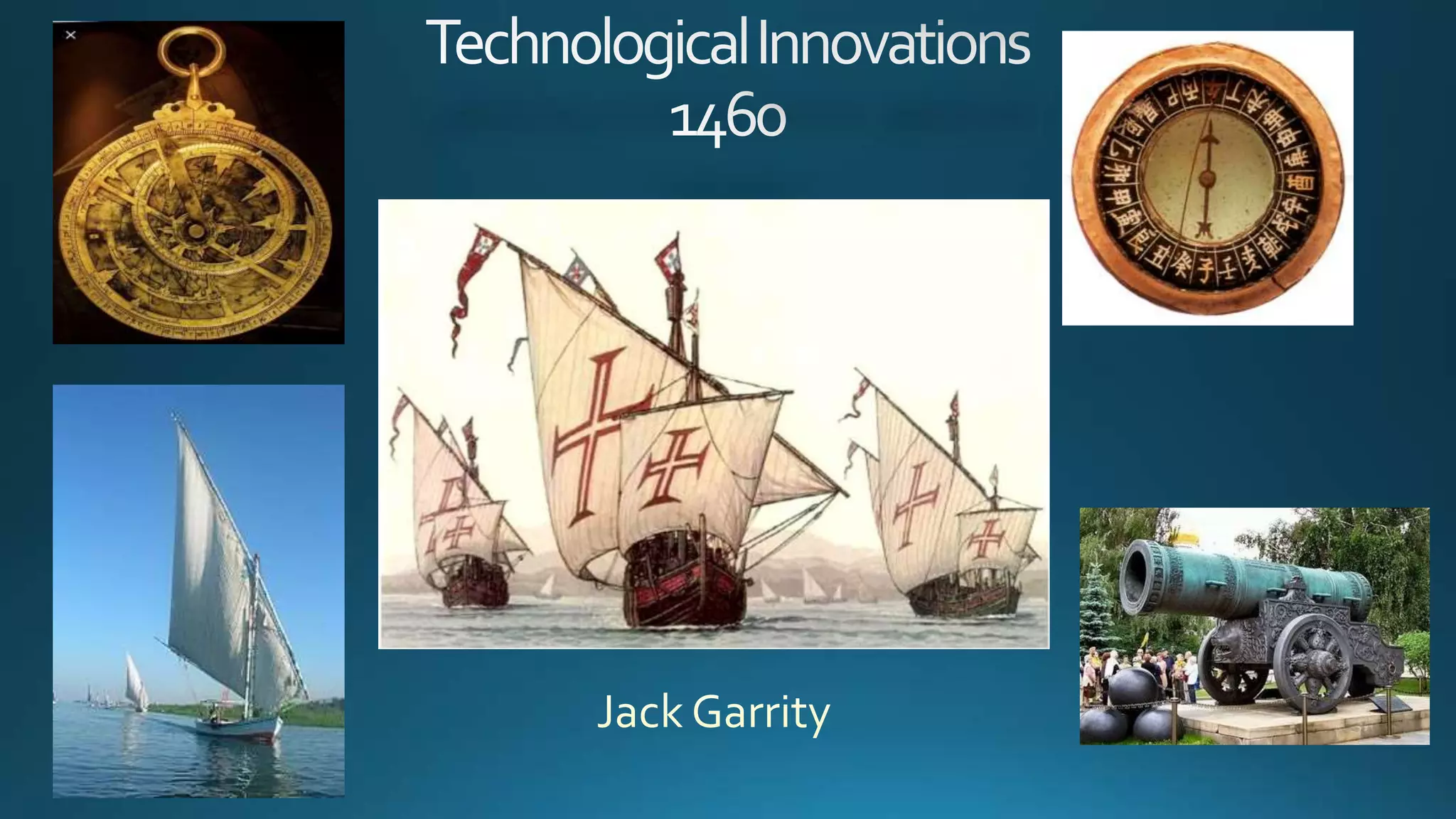
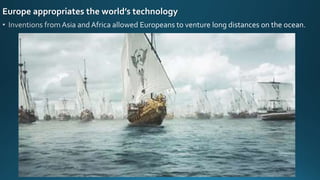
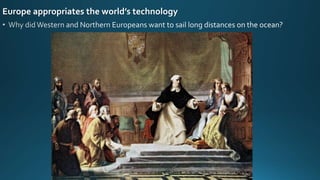
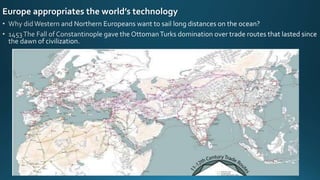
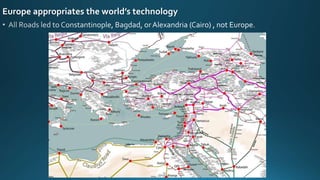
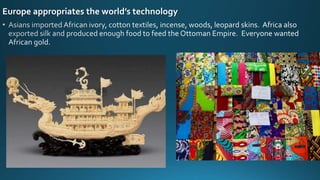
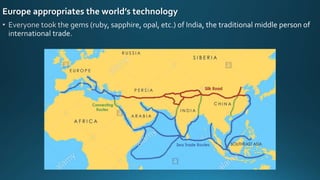
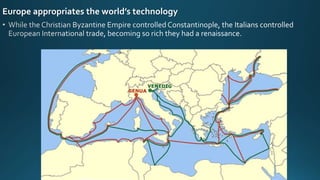
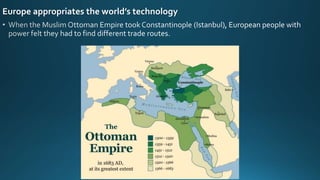
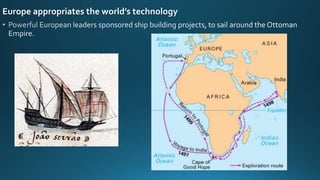
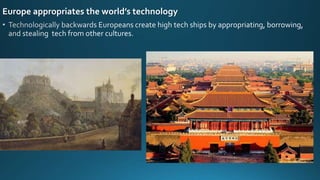
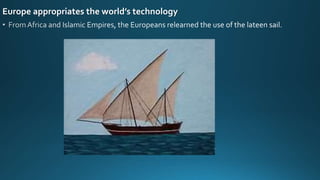
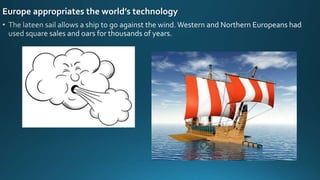
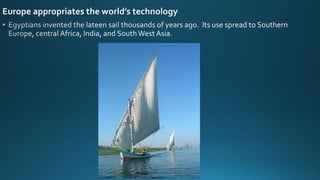
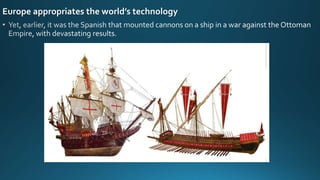
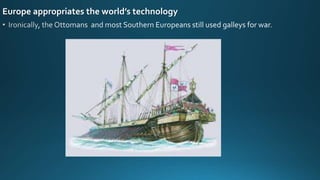
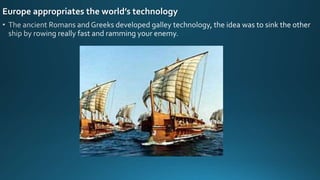
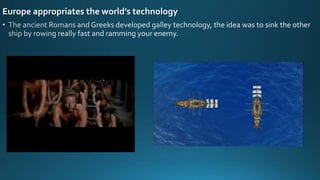
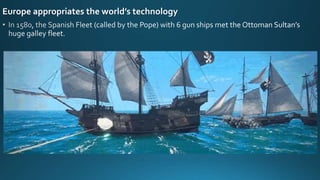
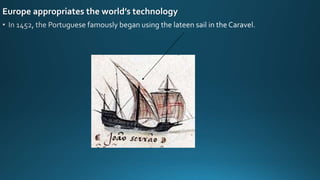
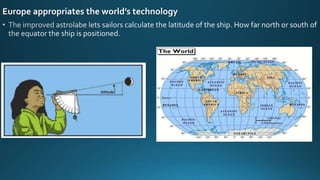
Europe appropriates the world’s technology
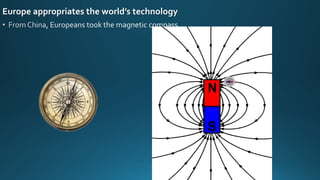
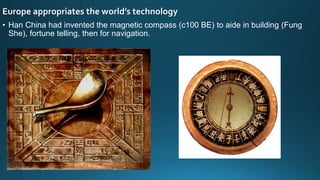
• Han China had invented the magnetic compass (c100 BE) to aide in building (Fung
She), fortune telling, then for navigation.
Europe appropriates the world’s technology
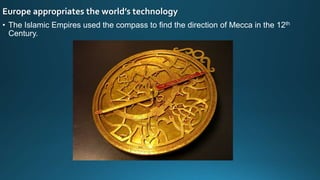
• The Islamic Empires used the compass to find the direction of Mecca in the 12th
Century.
Europe appropriates the world’s technology
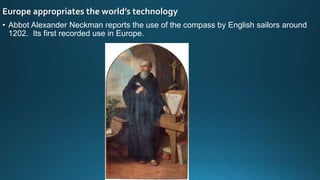
• Abbot Alexander Neckman reports the use of the compass by English sailors around
1202. Its first recorded use in Europe.
Europe appropriates the world’s technology
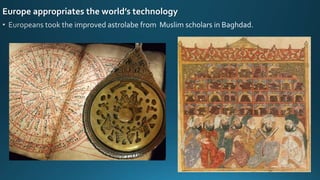
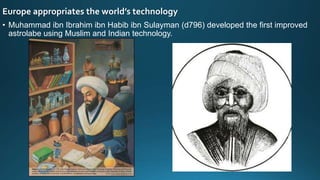
• Muhammad ibn Ibrahim ibn Habib ibn Sulayman (d796) developed the first improved
astrolabe using Muslim and Indian technology.
Europe appropriates the world’s technology
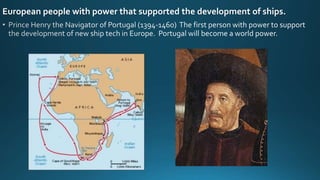
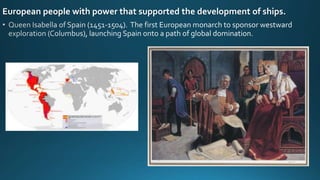
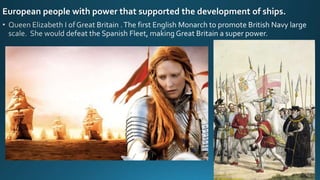
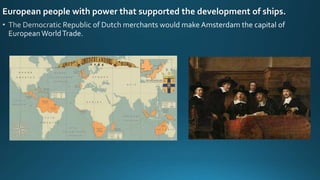
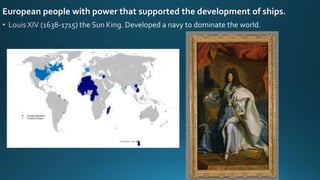
European people with power that supported the development of ships.
Europe appropriates the world’s technology
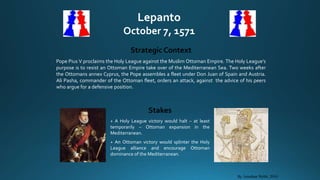
Lepanto
October 7, 1571
Strategic Context
Pope Pius V proclaims the Holy League against the Muslim Ottoman Empire. The Holy League’s
purpose is to resist an Ottoman Empire take over of the Mediterranean Sea. Two weeks after
the Ottomans annex Cyprus, the Pope assembles a fleet under Don Juan of Spain and Austria.
Ali Pasha, commander of the Ottoman fleet, orders an attack, against the advice of his peers
who argue for a defensive position.
Stakes
+ A Holy League victory would halt – at least
temporarily – Ottoman expansion in the
Mediterranean.
+ An Ottoman victory would splinter the Holy
League alliance and encourage Ottoman
dominance of the Mediterranean.
By Jonathan Webb, 2010
Lepanto, 1571
Strength
Holy League
Well
Ottomans
Well
Don Juan of Austria
216 galleys202 galleys
Müezzinzade Ali Pasha
By Jonathan Webb, 2010
6 galeasses 64 galiots
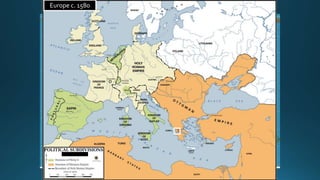
Europe c. 1580
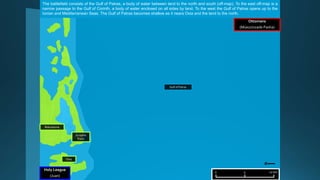
The battlefield consists of the Gulf of Patras, a body of water between land to the north and south (off-map). To the east off-map is a
narrow passage to the Gulf of Corinth, a body of water enclosed on all sides by land. To the west the Gulf of Patras opens up to the
Ionian and Mediterranean Seas. The Gulf of Patras becomes shallow as it nears Oxia and the land to the north.
Ottomans
(Müezzinzade Pasha)
Holy League
(Juan)
NN
0 5 10 km
Malcantone
Gulf of Patras
Oxia
Scropha
Point
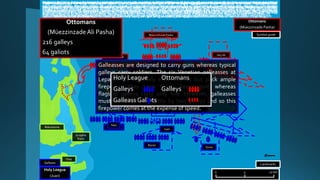
Müezzinzade Pasha deploys his fleet in five divisions, three being pre-committed to fight at his dense center. His left wing has the most room to maneuver and thus equipped
with many with smaller, more agile galiots. He plans to preserve his center while one or both of his wings defeat their opposition and envelop the Holy League line. Juan deploys
his fleet in four divisions, one being a reserve. Juan strengthens his center with both quantity and quality of galleys and allows his lethal galleasses to sail ahead of the main line
to thin out the Ottoman ranks with their greater firepoer. He plans to crush the Ottoman center while his wings prevent his own center from being outflanked. Overall, the Holy
League galleys are larger and boast more firepower but are slower than their Ottoman counterparts. Both Müezzinzade and Juan command from the center of their lines.
Holy League
(Juan)
Mehmet Suluk
As both fleets sail towards each other, Barbarigo’s galleasses pulverize Mehmet Suluk’s galleys and disrupt their formation. Mehmet Suluk
adapts by sending the galleys on his extreme right to round the inshore flank of Barbarigo’s galleys, knowing the Holy League captains are less
accustomed to the area and more fearful of running ashore. The rest of the Ottoman right wing follows and is able to concentrate against only
half of the Holy League left wing.
Doria
Bazan
Barbarigo
Juan
Müezzinzade Pasha
Uluj Ali
Mehmet Suluk is punishing the Holy League left wing until its other half swings around to engage in battle and Bazan sends reinforcements from
the reserve. Barbarigo is mortally wounded and must cede command to Contarini who is then killed and succeeded by Nani. Juan’s center
galleasses decimate the Ottoman galleys with a murderous fire before close combat. Meanwhile, Uluj Ali is straining the Holy League right by
deploying his surplus of ships in line, forcing Doria to stretch his own line to match the length of the Ottoman line. This inevitably creates gaps.
In the north, Nani turns the tide by killing Mehmet Suluk and trapping the Ottoman galleys against the shore. In the center, the heftier Holy
League galleys are inflicting heavy losses while a duel between the two flagships develops; both commanders funnel all available men into this
battle. Bazan sends reinforcements from the reserve to ensure steady pressure against the Ottoman flagship. In the south, Uluj Ali continues to
deploy ships and force Doria to strain his line; the Holy League right wing is drifting dangerously further from the center.
Trapped against the shore and without a leader, the Ottoman right wing is in the process of annihilation. The Ottoman center continues to suffer grievous losses but remains
intact. Fifteen captains of Doria’s extreme left believe he is betraying the Holy League by ignoring the fierce engagement in the center so they break formation to join the fray,
creating a sizeable gap in the Holy League right wing. Uluj Ali seizes this opportunity to charge the gap, destroying most of the wandering galleys on the way. Juan’s right flank is
suddenly threatened but Bazan sends the last of the reserve to try and contain the gap. Doria meanwhile rushes to engage the rest of his division but cannot fully do so.
The remainder of the Ottoman right wing runs aground and the crews abandon their galleys for land. Meanwhile,
Müezzinzade Pasha is finally killed and his flagship overrun just as Doria engages the Ottoman left wing. Uluj Ali realizes
the situation is futile and escapes westward with thirty galleys. The remaining Ottoman galleys flee in small contingents.
Holy League
(Don Juan ofAustria)
202 galleys
6 galeasses
Ottomans
(MüezzinzadeAli Pasha)
216 galleys
64 galiots
Contarini
Nani
Holy League Reserve
(DonÁlvaro de Bazan)
38 galleys
Ottoman RightWing
(Mehmet Suluk Pasha)
60 galleys 2
galiots
Holy League Center
(Don Juan ofAustria)
62 galleys 2
galeasses
Holy League LeftWing
(Agostin Barbarigo)
53 galleys 2
galeasses
Holy League RightWing
(GianAndrea Doria)
54 galleys 2
galeasses
Ottoman Center
(MüezzinzadeAli Pasha)
95 galleys 30
galiots
Ottoman LeftWing
(Uluj Ali Pasha)
61 galleys 32
galiots
Holy League LeftWing
(Frederigo Nani)
53 galleys 2
galeasses
Galleass
NN
0 5 10 km
Symbol guide
Ottomans
(Müezzinzade Pasha)
Malcantone
Gulf of Patras
Oxia
Scropha
Point
Landmarks
Galleasses are designed to carry guns whereas typical
galleys carry soldiers. The six Venetian galleasses at
Lepanto are relatively experimental but pack ample
firepower: they carry fourty heavy guns whereas
flagship galleys carry only five. However, galleasses
must be towed into battle by two galleys and so this
firepower comes at the expense of speed.
Holy League Ottomans
Galleys Galleys
Galleass Galiots
Lepanto, 1571
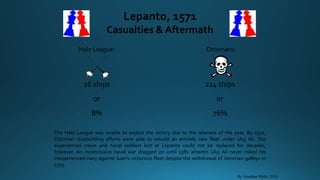
Casualties & Aftermath
Holy League: Ottomans:
16 ships
or
8%
214 ships
or
76%
By Jonathan Webb, 2010
The Holy League was unable to exploit the victory due to the lateness of the year. By 1572,
Ottoman shipbuilding efforts were able to rebuild an entirely new fleet under Uluj Ali. The
experienced crews and naval soldiers lost at Lepanto could not be replaced for decades,
however. An inconclusive naval war dragged on until 1581 wherein Uluj Ali never risked his
inexperienced navy against Juan’s victorious fleet despite the withdrawal of Venetian galleys in
1573.
The Art of Battle:
Animated Battle Maps
http://www.theartofbattle.com
By Jonathan Webb, 2010
4.1.Techinnovatons AP History

4.1.Techinnovatons AP History

  • 7.
    Europe appropriates theworld’s technology
  • 8.
    Europe appropriates theworld’s technology
  • 9.
    Europe appropriates theworld’s technology
  • 10.
    Europe appropriates theworld’s technology
  • 11.
    Europe appropriates theworld’s technology
  • 12.
    Europe appropriates theworld’s technology
  • 13.
    Europe appropriates theworld’s technology
  • 14.
    Europe appropriates theworld’s technology
  • 15.
    Europe appropriates theworld’s technology
  • 16.
    Europe appropriates theworld’s technology
  • 17.
    Europe appropriates theworld’s technology
  • 18.
    Europe appropriates theworld’s technology
  • 19.
    Europe appropriates theworld’s technology
  • 20.
    Europe appropriates theworld’s technology
  • 21.
    Europe appropriates theworld’s technology
  • 22.
    Europe appropriates theworld’s technology
  • 23.
    Europe appropriates theworld’s technology
  • 24.
    Europe appropriates theworld’s technology
  • 25.
    Europe appropriates theworld’s technology
  • 26.
    Europe appropriates theworld’s technology
  • 27.
    Europe appropriates theworld’s technology • Han China had invented the magnetic compass (c100 BE) to aide in building (Fung She), fortune telling, then for navigation.
  • 28.
    Europe appropriates theworld’s technology • The Islamic Empires used the compass to find the direction of Mecca in the 12th Century.
  • 29.
    Europe appropriates theworld’s technology • Abbot Alexander Neckman reports the use of the compass by English sailors around 1202. Its first recorded use in Europe.
  • 30.
    Europe appropriates theworld’s technology
  • 31.
    Europe appropriates theworld’s technology
  • 32.
    Europe appropriates theworld’s technology
  • 33.
    Europe appropriates theworld’s technology
  • 34.
    Europe appropriates theworld’s technology
  • 35.
    Europe appropriates theworld’s technology
  • 36.
    Europe appropriates theworld’s technology
  • 37.
    Europe appropriates theworld’s technology
  • 38.
    Europe appropriates theworld’s technology • Muhammad ibn Ibrahim ibn Habib ibn Sulayman (d796) developed the first improved astrolabe using Muslim and Indian technology.
  • 39.
    Europe appropriates theworld’s technology
  • 40.
    Europe appropriates theworld’s technology
  • 43.
    Europe appropriates theworld’s technology
  • 45.
    Europe appropriates theworld’s technology
  • 46.
    Europe appropriates theworld’s technology
  • 47.
    Europe appropriates theworld’s technology
  • 48.
    Europe appropriates theworld’s technology
  • 49.
    Europe appropriates theworld’s technology
  • 50.
    European people withpower that supported the development of ships.
  • 51.
    European people withpower that supported the development of ships.
  • 52.
    European people withpower that supported the development of ships.
  • 53.
    European people withpower that supported the development of ships.
  • 54.
    European people withpower that supported the development of ships.
  • 55.
    Europe appropriates theworld’s technology
  • 56.
    Europe appropriates theworld’s technology
  • 57.
    Europe appropriates theworld’s technology
  • 58.
    Europe appropriates theworld’s technology
  • 59.
    Europe appropriates theworld’s technology
  • 60.
    Lepanto October 7, 1571 StrategicContext Pope Pius V proclaims the Holy League against the Muslim Ottoman Empire. The Holy League’s purpose is to resist an Ottoman Empire take over of the Mediterranean Sea. Two weeks after the Ottomans annex Cyprus, the Pope assembles a fleet under Don Juan of Spain and Austria. Ali Pasha, commander of the Ottoman fleet, orders an attack, against the advice of his peers who argue for a defensive position. Stakes + A Holy League victory would halt – at least temporarily – Ottoman expansion in the Mediterranean. + An Ottoman victory would splinter the Holy League alliance and encourage Ottoman dominance of the Mediterranean. By Jonathan Webb, 2010
  • 61.
    Lepanto, 1571 Strength Holy League Well Ottomans Well DonJuan of Austria 216 galleys202 galleys Müezzinzade Ali Pasha By Jonathan Webb, 2010 6 galeasses 64 galiots
  • 62.
  • 63.
    The battlefield consistsof the Gulf of Patras, a body of water between land to the north and south (off-map). To the east off-map is a narrow passage to the Gulf of Corinth, a body of water enclosed on all sides by land. To the west the Gulf of Patras opens up to the Ionian and Mediterranean Seas. The Gulf of Patras becomes shallow as it nears Oxia and the land to the north. Ottomans (Müezzinzade Pasha) Holy League (Juan) NN 0 5 10 km Malcantone Gulf of Patras Oxia Scropha Point
  • 64.
    Müezzinzade Pasha deployshis fleet in five divisions, three being pre-committed to fight at his dense center. His left wing has the most room to maneuver and thus equipped with many with smaller, more agile galiots. He plans to preserve his center while one or both of his wings defeat their opposition and envelop the Holy League line. Juan deploys his fleet in four divisions, one being a reserve. Juan strengthens his center with both quantity and quality of galleys and allows his lethal galleasses to sail ahead of the main line to thin out the Ottoman ranks with their greater firepoer. He plans to crush the Ottoman center while his wings prevent his own center from being outflanked. Overall, the Holy League galleys are larger and boast more firepower but are slower than their Ottoman counterparts. Both Müezzinzade and Juan command from the center of their lines. Holy League (Juan) Mehmet Suluk As both fleets sail towards each other, Barbarigo’s galleasses pulverize Mehmet Suluk’s galleys and disrupt their formation. Mehmet Suluk adapts by sending the galleys on his extreme right to round the inshore flank of Barbarigo’s galleys, knowing the Holy League captains are less accustomed to the area and more fearful of running ashore. The rest of the Ottoman right wing follows and is able to concentrate against only half of the Holy League left wing. Doria Bazan Barbarigo Juan Müezzinzade Pasha Uluj Ali Mehmet Suluk is punishing the Holy League left wing until its other half swings around to engage in battle and Bazan sends reinforcements from the reserve. Barbarigo is mortally wounded and must cede command to Contarini who is then killed and succeeded by Nani. Juan’s center galleasses decimate the Ottoman galleys with a murderous fire before close combat. Meanwhile, Uluj Ali is straining the Holy League right by deploying his surplus of ships in line, forcing Doria to stretch his own line to match the length of the Ottoman line. This inevitably creates gaps. In the north, Nani turns the tide by killing Mehmet Suluk and trapping the Ottoman galleys against the shore. In the center, the heftier Holy League galleys are inflicting heavy losses while a duel between the two flagships develops; both commanders funnel all available men into this battle. Bazan sends reinforcements from the reserve to ensure steady pressure against the Ottoman flagship. In the south, Uluj Ali continues to deploy ships and force Doria to strain his line; the Holy League right wing is drifting dangerously further from the center. Trapped against the shore and without a leader, the Ottoman right wing is in the process of annihilation. The Ottoman center continues to suffer grievous losses but remains intact. Fifteen captains of Doria’s extreme left believe he is betraying the Holy League by ignoring the fierce engagement in the center so they break formation to join the fray, creating a sizeable gap in the Holy League right wing. Uluj Ali seizes this opportunity to charge the gap, destroying most of the wandering galleys on the way. Juan’s right flank is suddenly threatened but Bazan sends the last of the reserve to try and contain the gap. Doria meanwhile rushes to engage the rest of his division but cannot fully do so. The remainder of the Ottoman right wing runs aground and the crews abandon their galleys for land. Meanwhile, Müezzinzade Pasha is finally killed and his flagship overrun just as Doria engages the Ottoman left wing. Uluj Ali realizes the situation is futile and escapes westward with thirty galleys. The remaining Ottoman galleys flee in small contingents. Holy League (Don Juan ofAustria) 202 galleys 6 galeasses Ottomans (MüezzinzadeAli Pasha) 216 galleys 64 galiots Contarini Nani Holy League Reserve (DonÁlvaro de Bazan) 38 galleys Ottoman RightWing (Mehmet Suluk Pasha) 60 galleys 2 galiots Holy League Center (Don Juan ofAustria) 62 galleys 2 galeasses Holy League LeftWing (Agostin Barbarigo) 53 galleys 2 galeasses Holy League RightWing (GianAndrea Doria) 54 galleys 2 galeasses Ottoman Center (MüezzinzadeAli Pasha) 95 galleys 30 galiots Ottoman LeftWing (Uluj Ali Pasha) 61 galleys 32 galiots Holy League LeftWing (Frederigo Nani) 53 galleys 2 galeasses Galleass NN 0 5 10 km Symbol guide Ottomans (Müezzinzade Pasha) Malcantone Gulf of Patras Oxia Scropha Point Landmarks Galleasses are designed to carry guns whereas typical galleys carry soldiers. The six Venetian galleasses at Lepanto are relatively experimental but pack ample firepower: they carry fourty heavy guns whereas flagship galleys carry only five. However, galleasses must be towed into battle by two galleys and so this firepower comes at the expense of speed. Holy League Ottomans Galleys Galleys Galleass Galiots
  • 65.
    Lepanto, 1571 Casualties &Aftermath Holy League: Ottomans: 16 ships or 8% 214 ships or 76% By Jonathan Webb, 2010 The Holy League was unable to exploit the victory due to the lateness of the year. By 1572, Ottoman shipbuilding efforts were able to rebuild an entirely new fleet under Uluj Ali. The experienced crews and naval soldiers lost at Lepanto could not be replaced for decades, however. An inconclusive naval war dragged on until 1581 wherein Uluj Ali never risked his inexperienced navy against Juan’s victorious fleet despite the withdrawal of Venetian galleys in 1573.
  • 66.
    The Art ofBattle: Animated Battle Maps http://www.theartofbattle.com By Jonathan Webb, 2010