










In Partial Fulfillment of the
Requirements in Major 10
(Production of Social Studies
Instructional Materials)
CARIE//
GUILBERT/// and
PRINCESSES///
Am I SEXy?
Laguna State Polytechnic University
     San Pablo City Campus
          San Pablo City


         Guilbert Kaligayahan
I’M the Next Superstar! …Be Amazed!
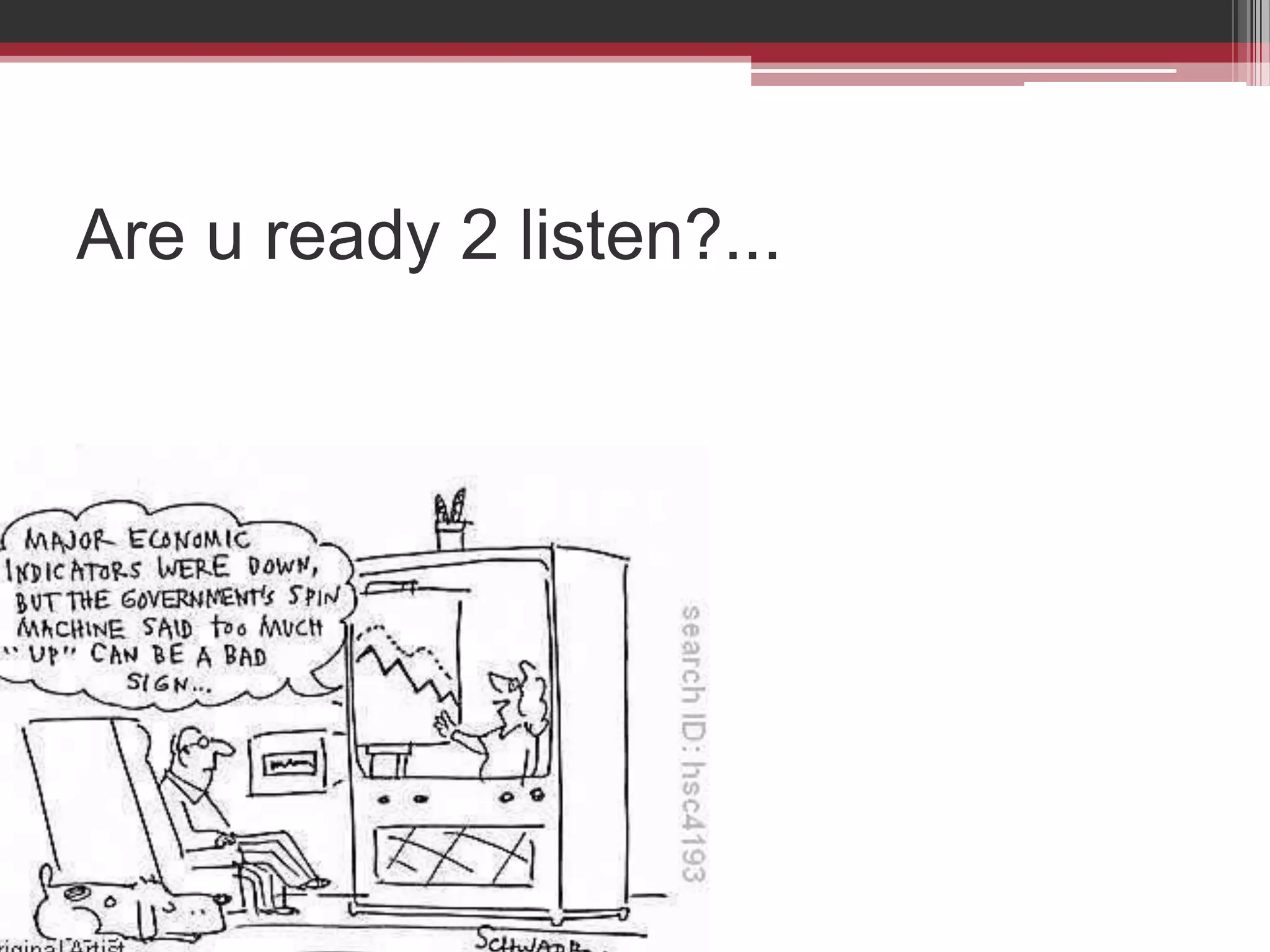
Are u ready 2 listen?...
Chapter 34
Factors of Production
•       Production is the combination and use of all factors
producing goods and services that will satisfy the needs of
man. Factors of production are used to produce products and
services, there are four factors of production:
land, labor, capital, and entrepreneur. Land is the
nonrenewable resource where the raw materials needed in
production come from. This factor cannot be increased
according to the desire of the individual. It is a natural factor
of production. Labor or labor force, whether physical or
mental, are the talents and strength necessary in production.
Capital is the material things created by man.
Entrepreneur is a factor of production and is called captain
of the industry.
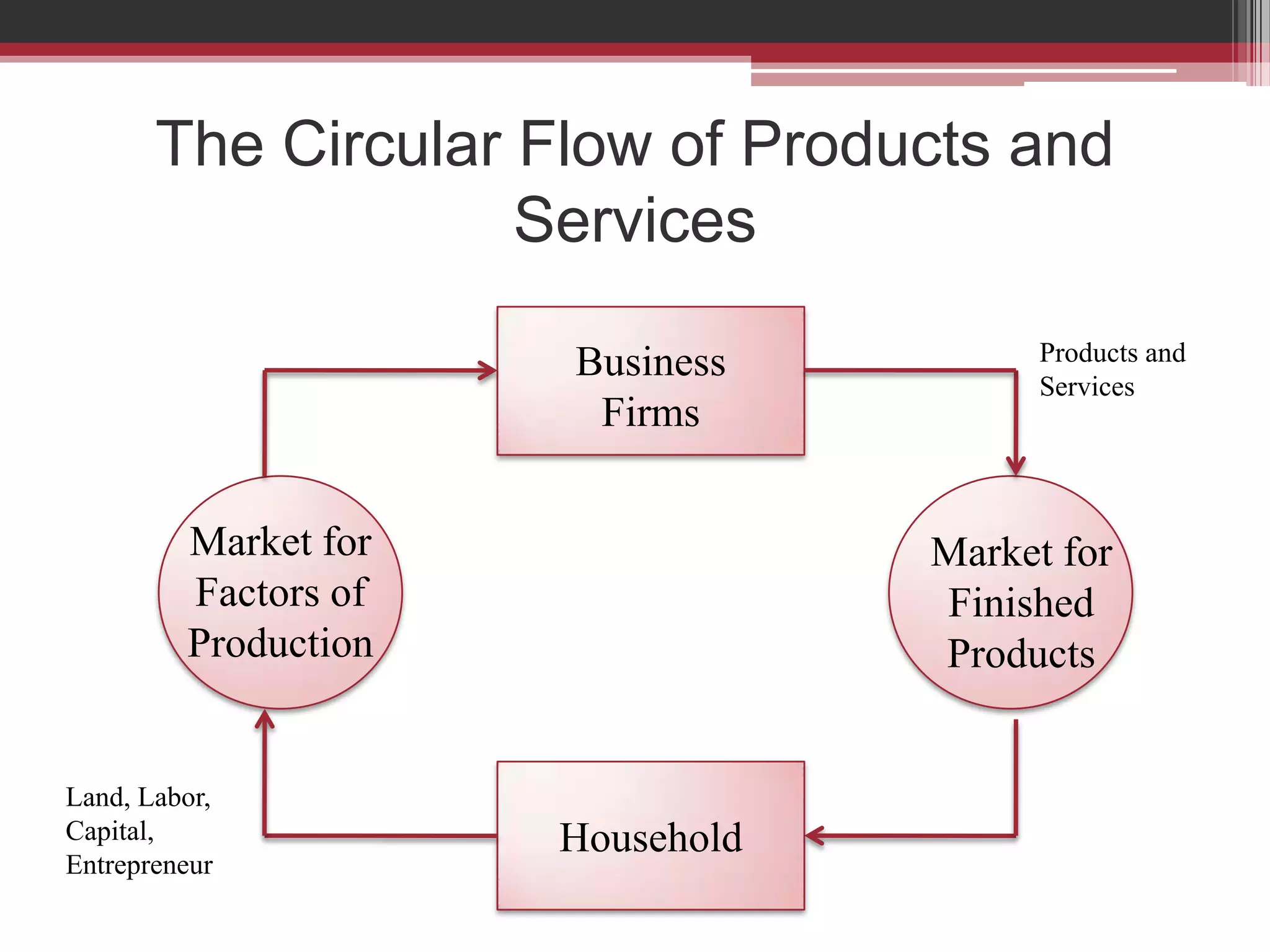
The Circular Flow of Products and
                    Services

                      Business         Products and
                                       Services
                       Firms


         Market for               Market for
         Factors of               Finished
         Production               Products


Land, Labor,
Capital,              Household
Entrepreneur
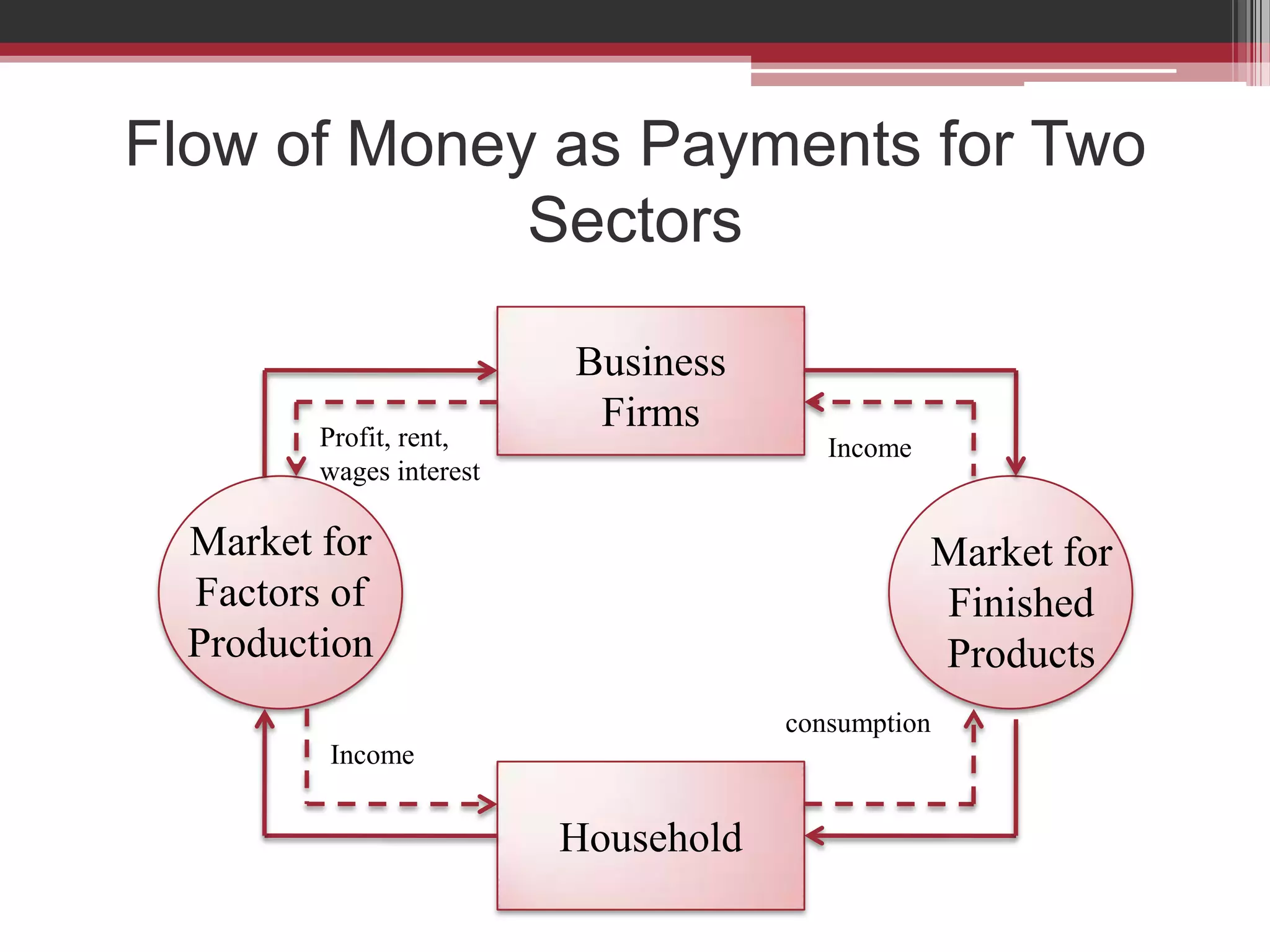
Flow of Money as Payments for Two
             Sectors

                          Business
         Profit, rent,
                           Firms
                                         Income
         wages interest

  Market for                                      Market for
  Factors of                                      Finished
  Production                                      Products
                                      consumption
         Income


                          Household
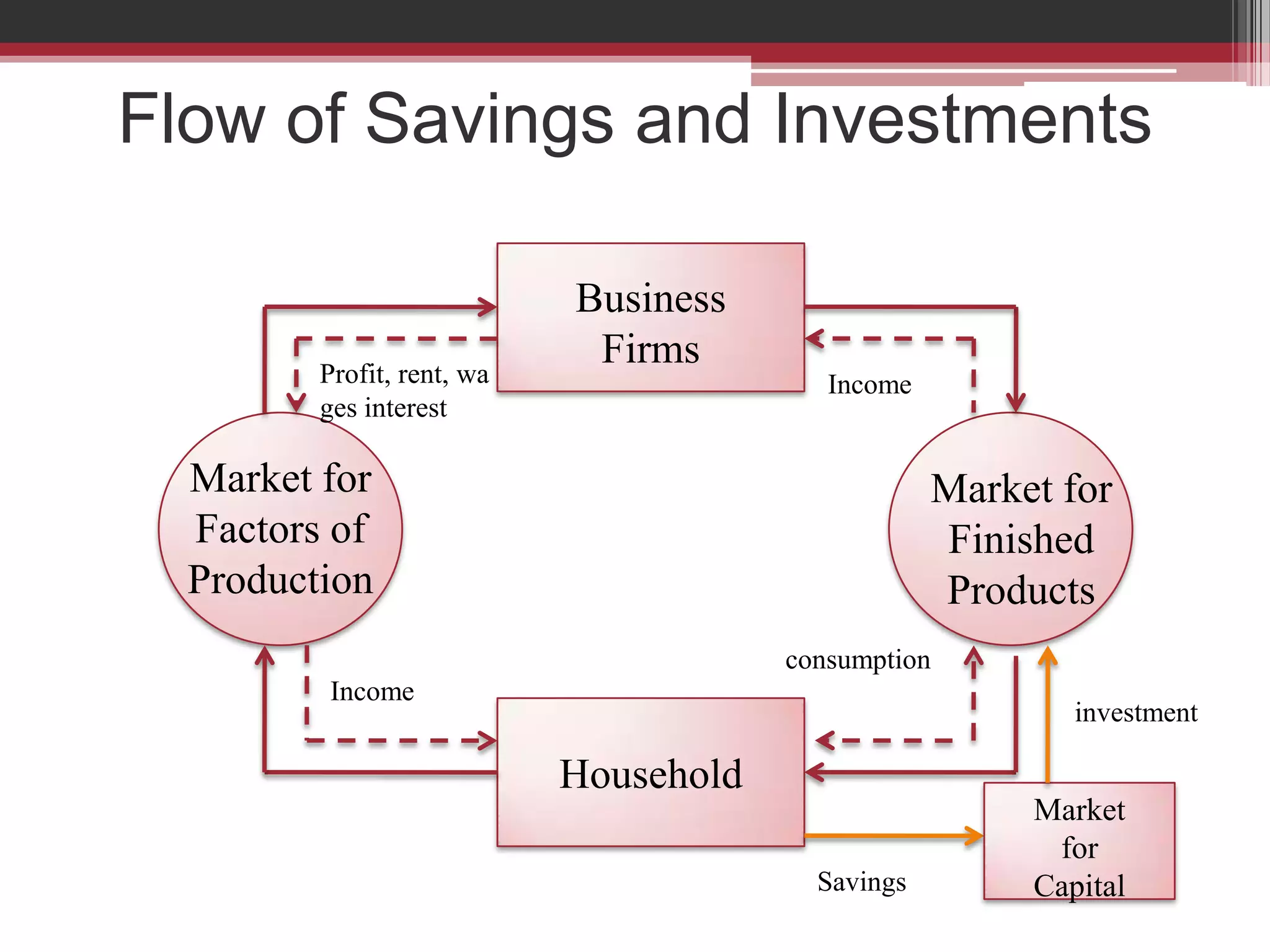
Flow of Savings and Investments

                            Business
         Profit, rent, wa
                             Firms
                                           Income
         ges interest

  Market for                                        Market for
  Factors of                                        Finished
  Production                                        Products
                                        consumption
         Income
                                                            investment

                            Household
                                                         Market
                                                          for
                                          Savings        Capital
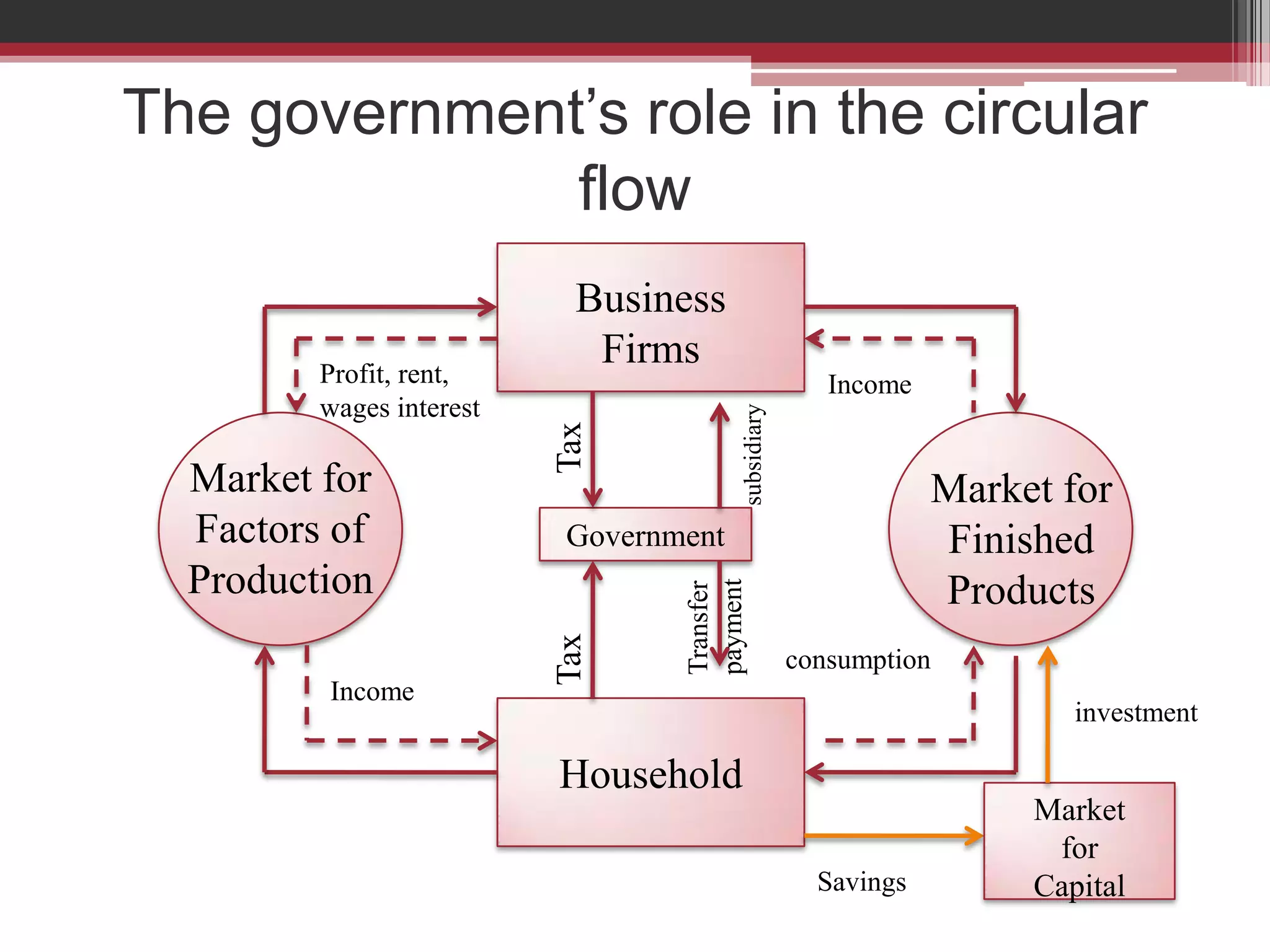
The government’s role in the circular
              flow
                           Business
         Profit, rent,
                            Firms
                                                        Income
         wages interest


                                        subsidiary
                          Tax
  Market for                                                     Market for
  Factors of              Government                             Finished
  Production                                                     Products


                                 payment
                                 Transfer
                          Tax

                                                     consumption
         Income
                                                                         investment

                          Household
                                                                      Market
                                                                       for
                                                       Savings        Capital
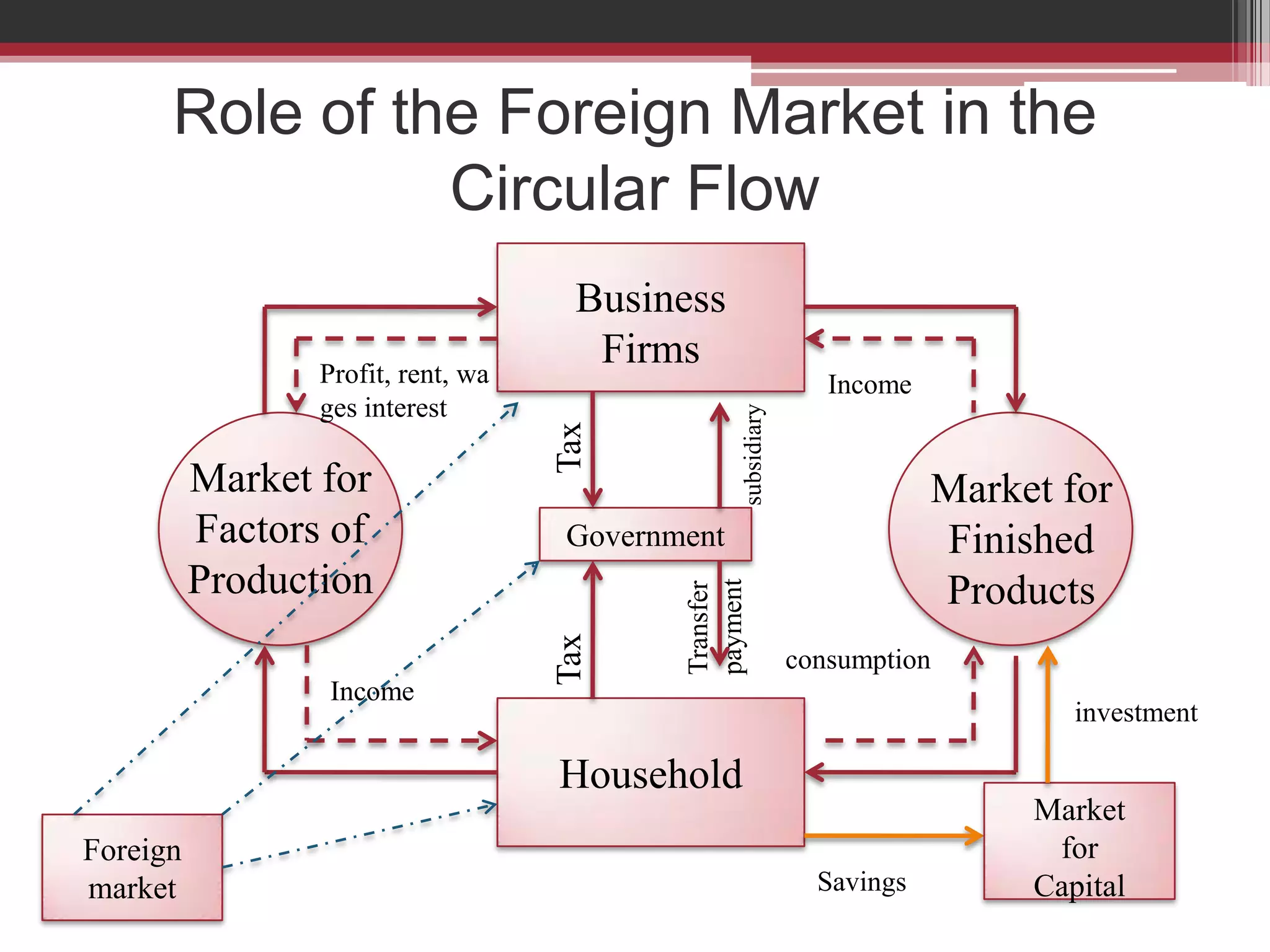
Role of the Foreign Market in the
                Circular Flow
                                     Business
                 Profit, rent, wa
                                      Firms
                                                                  Income
                 ges interest


                                                  subsidiary
                                    Tax
          Market for                                                       Market for
          Factors of                Government                             Finished
          Production                                                       Products


                                           payment
                                           Transfer
                                    Tax

                                                               consumption
                 Income
                                                                                   investment

                                    Household
                                                                                Market
Foreign                                                                          for
market                                                           Savings        Capital
Chapter 35
Economic Indicators
      Economic progress can be traced through the
economic performance of the country. It serves as
gauge for the government and other sectors if they are
performing well. In measuring the economic
performance of the country indicators are being used.
The indicators describe the condition of the country.
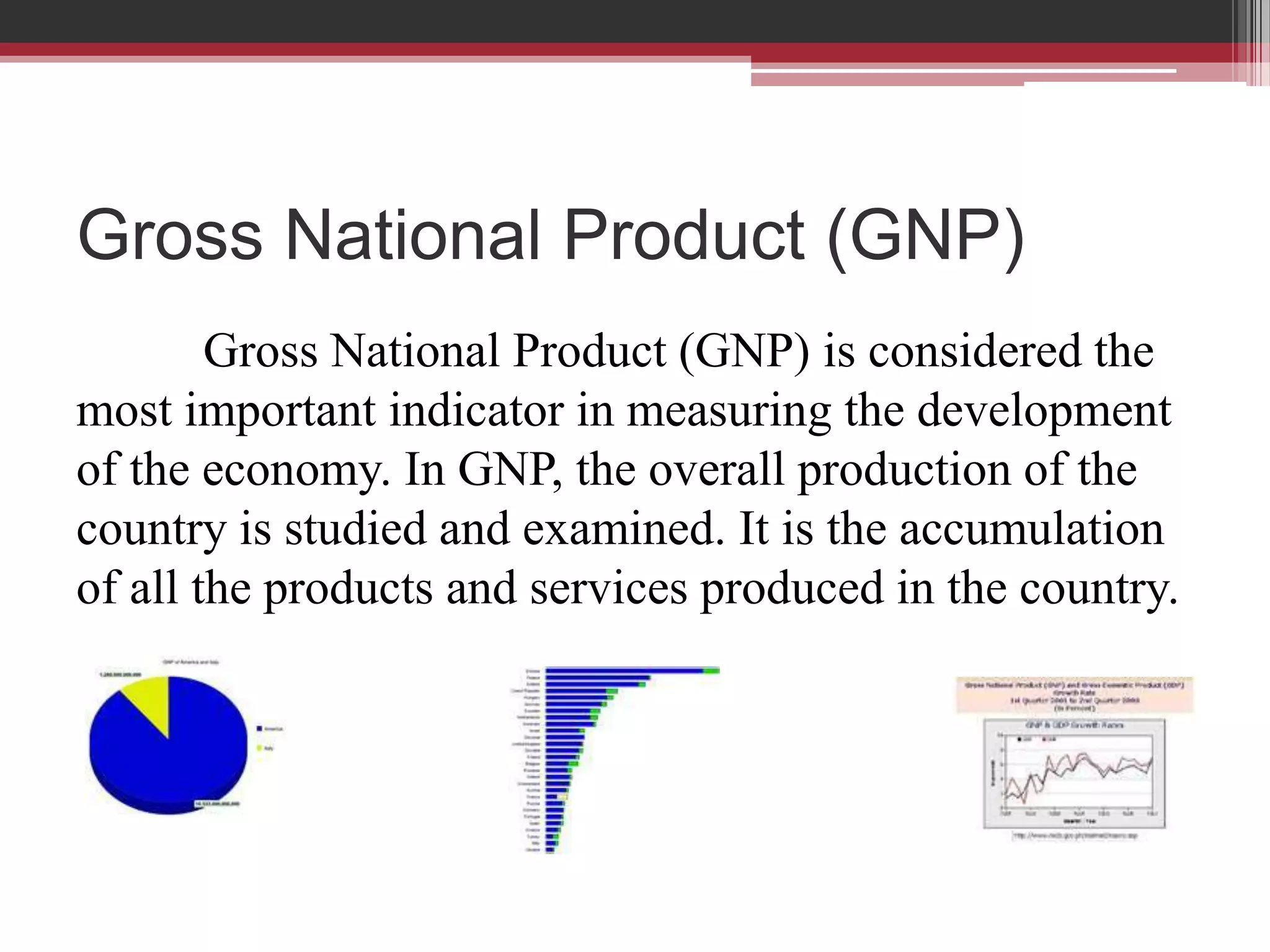
Gross National Product (GNP)
        Gross National Product (GNP) is considered the
most important indicator in measuring the development
of the economy. In GNP, the overall production of the
country is studied and examined. It is the accumulation
of all the products and services produced in the country.
GNP

GDP
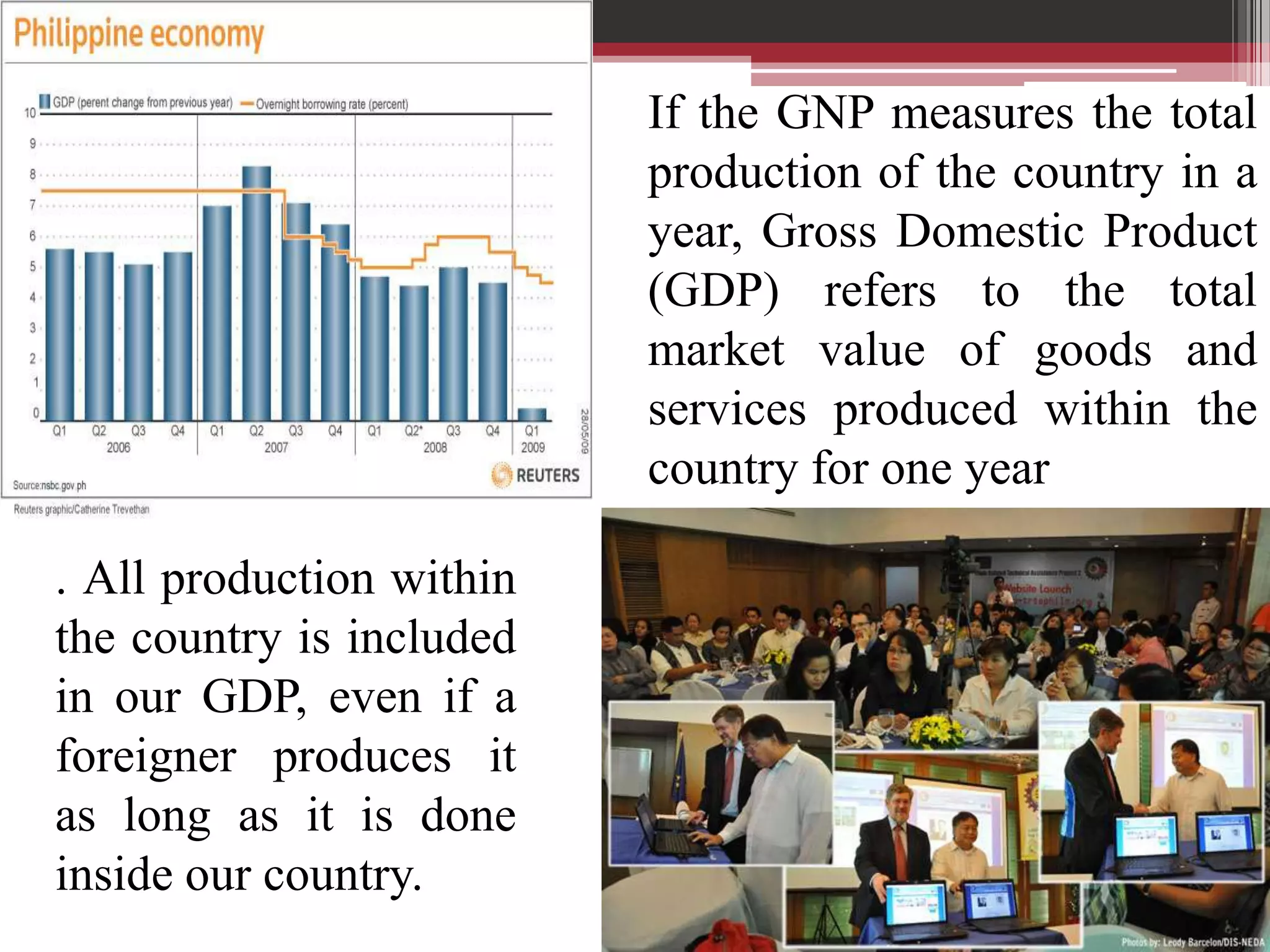
If the GNP measures the total
                          production of the country in a
                          year, Gross Domestic Product
                          (GDP) refers to the total
                          market value of goods and
                          services produced within the
                          country for one year

. All production within
the country is included
in our GDP, even if a
foreigner produces it
as long as it is done
inside our country.
Difference of GNP and GDP
      In general, all the produced goods and services of
the Filipinos inside the Philippines is both included in
GNP and GDP. As we deduct the income earned by the
Filipinos abroad from the income earned by the
foreigners in our country, we will get the Net Factor
Income from Abroad (NFIA). When the income of the
foreigners are higher than the income of the Filipinos
abroad, the NFIA has a negative decrease compared to
GDP.
Potential and Actual GNP
        The number of workers, their working hours, machine-
ries, and technology used and the natural resources in the country
are the basis in estimating the total production of the economy.
Every country has a target quantity of production based on its
capacity. Potential GNP is the estimated total production of the
country based on the productivity and capacity of the factors
mentioned earlier. It is the goal of the economy for a year. At the
end of the year, the production of the country is being
measured, and it represent the actual GNP. Actual GNP is the
amount of the produced goods and services attained in a country
for one year. It serves as a barometer if the economy has been
effective in maximizing the use of the natural
resources, machineries, and workers in achieving the potential
GNP.
Chapter 36
Approaches to GNP Measurement
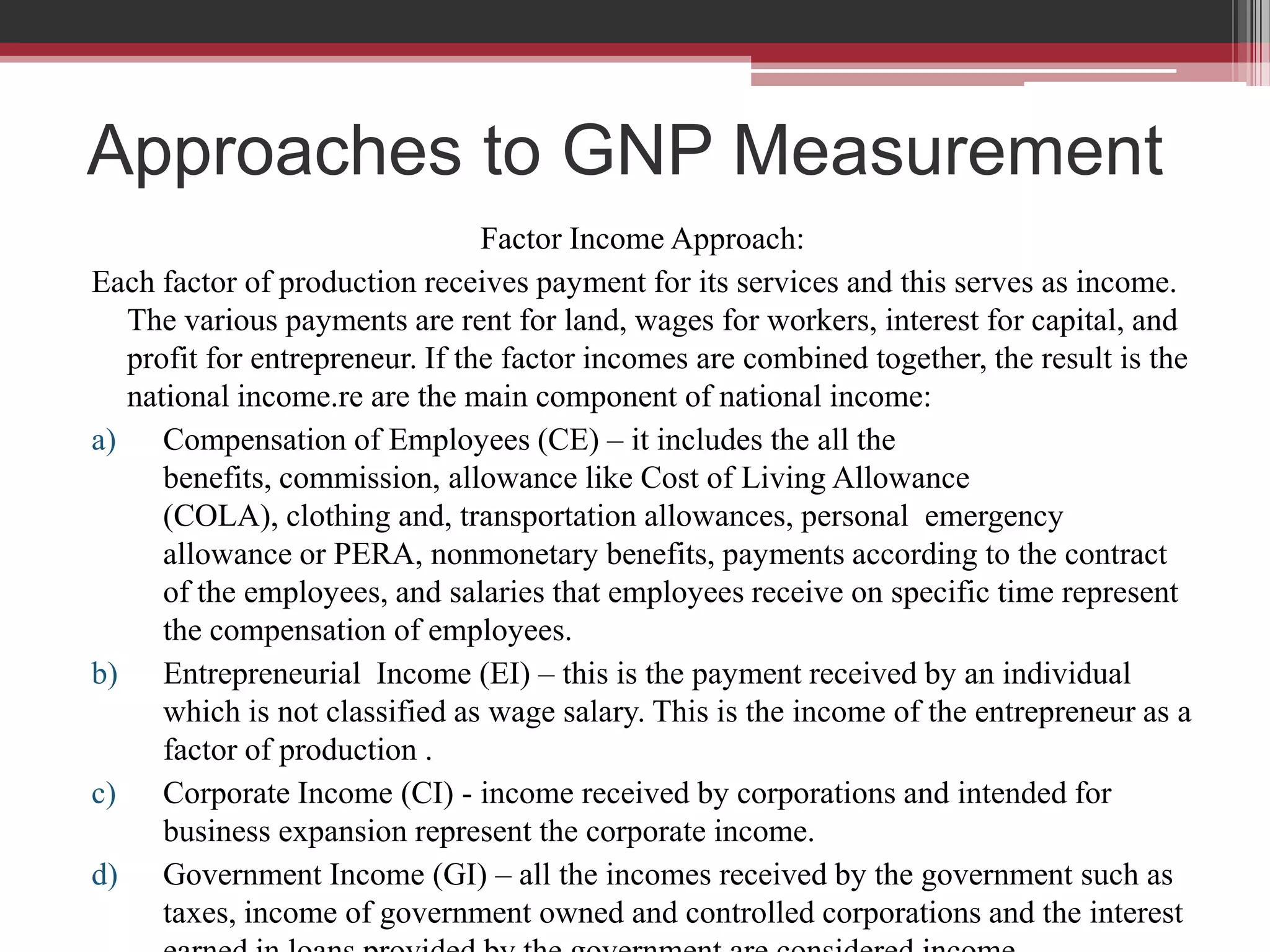
                                Factor Income Approach:
Each factor of production receives payment for its services and this serves as income.
  The various payments are rent for land, wages for workers, interest for capital, and
  profit for entrepreneur. If the factor incomes are combined together, the result is the
  national income.re are the main component of national income:
a) Compensation of Employees (CE) – it includes the all the
     benefits, commission, allowance like Cost of Living Allowance
     (COLA), clothing and, transportation allowances, personal emergency
     allowance or PERA, nonmonetary benefits, payments according to the contract
     of the employees, and salaries that employees receive on specific time represent
     the compensation of employees.
b) Entrepreneurial Income (EI) – this is the payment received by an individual
     which is not classified as wage salary. This is the income of the entrepreneur as a
     factor of production .
c) Corporate Income (CI) - income received by corporations and intended for
     business expansion represent the corporate income.
d) Government Income (GI) – all the incomes received by the government such as
     taxes, income of government owned and controlled corporations and the interest
Factor Income Approach
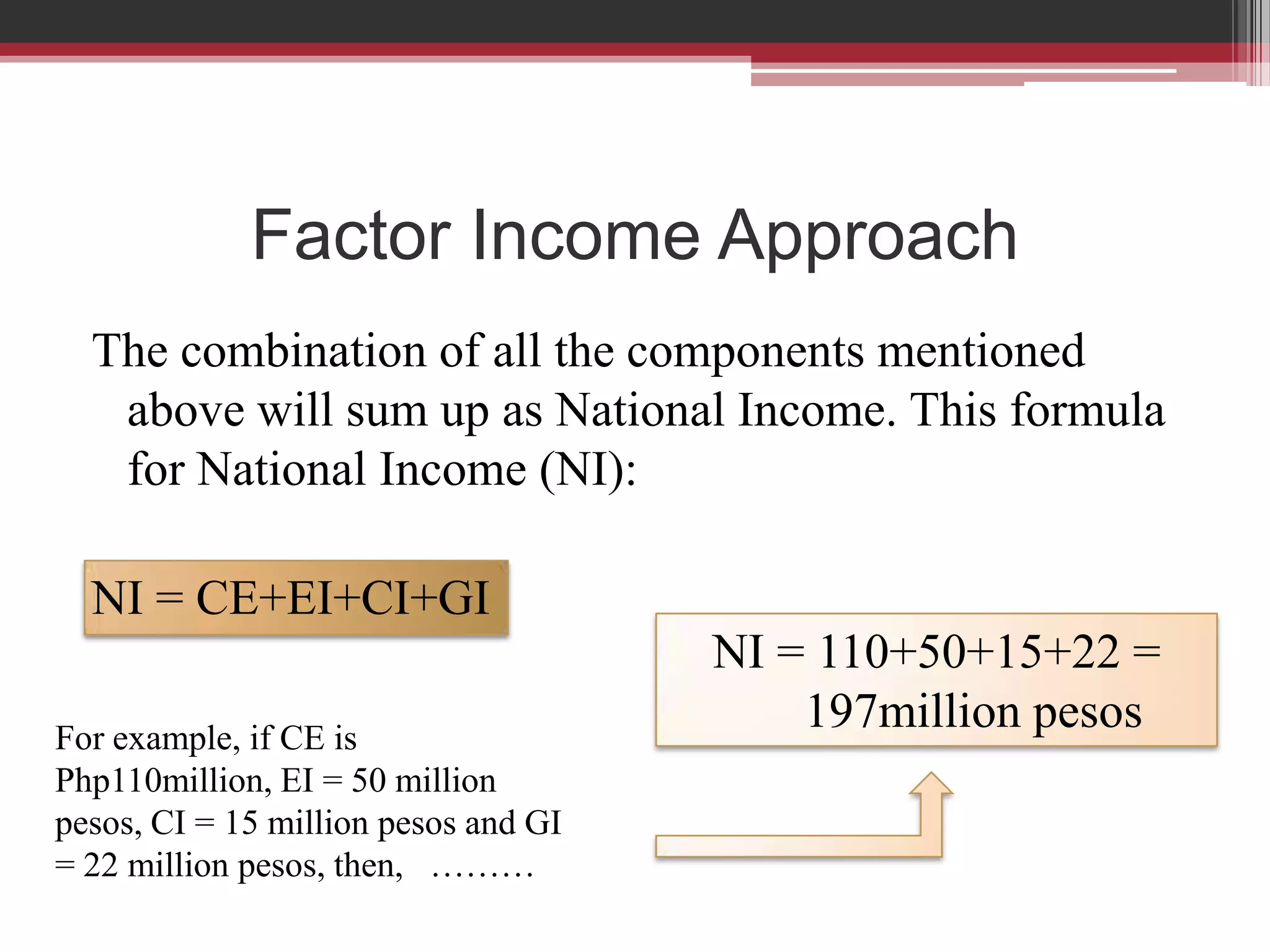
  The combination of all the components mentioned
   above will sum up as National Income. This formula
   for National Income (NI):

  NI = CE+EI+CI+GI
                                      NI = 110+50+15+22 =
For example, if CE is
                                          197million pesos
Php110million, EI = 50 million
pesos, CI = 15 million pesos and GI
= 22 million pesos, then, ………
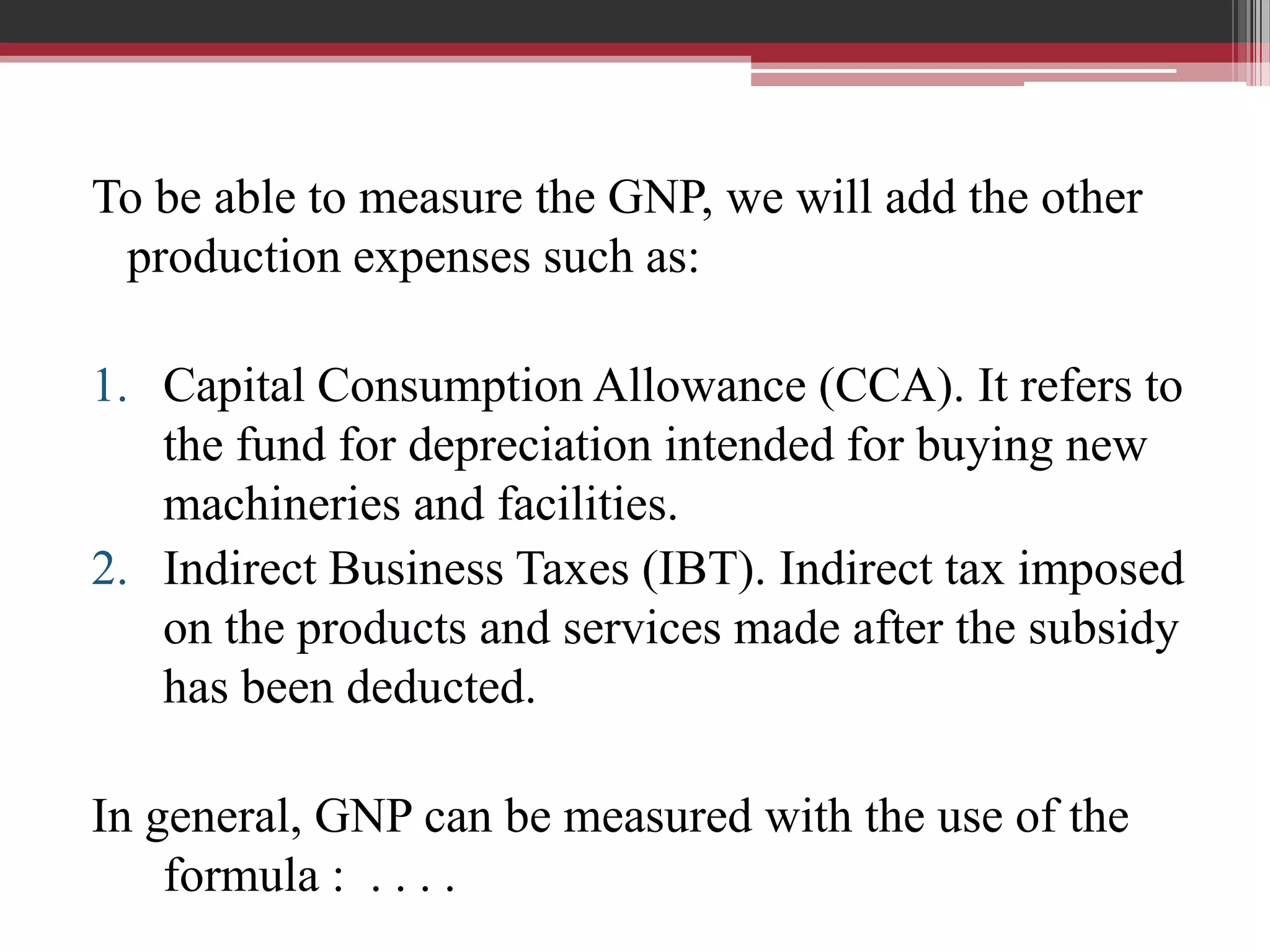
To be able to measure the GNP, we will add the other
 production expenses such as:

1. Capital Consumption Allowance (CCA). It refers to
   the fund for depreciation intended for buying new
   machineries and facilities.
2. Indirect Business Taxes (IBT). Indirect tax imposed
   on the products and services made after the subsidy
   has been deducted.

In general, GNP can be measured with the use of the
    formula : . . . .
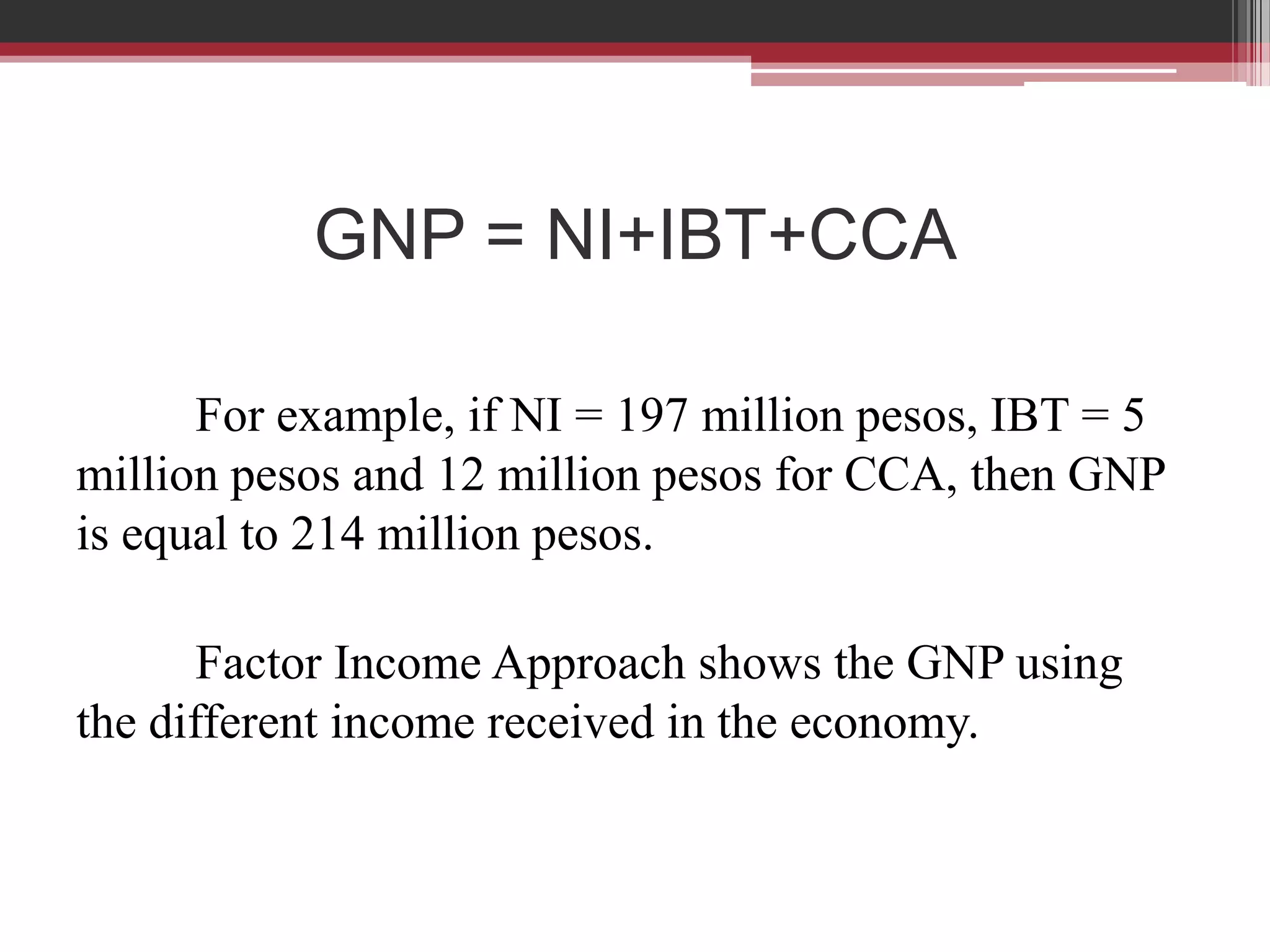
GNP = NI+IBT+CCA

      For example, if NI = 197 million pesos, IBT = 5
million pesos and 12 million pesos for CCA, then GNP
is equal to 214 million pesos.

       Factor Income Approach shows the GNP using
the different income received in the economy.
Final Expenditure Approach
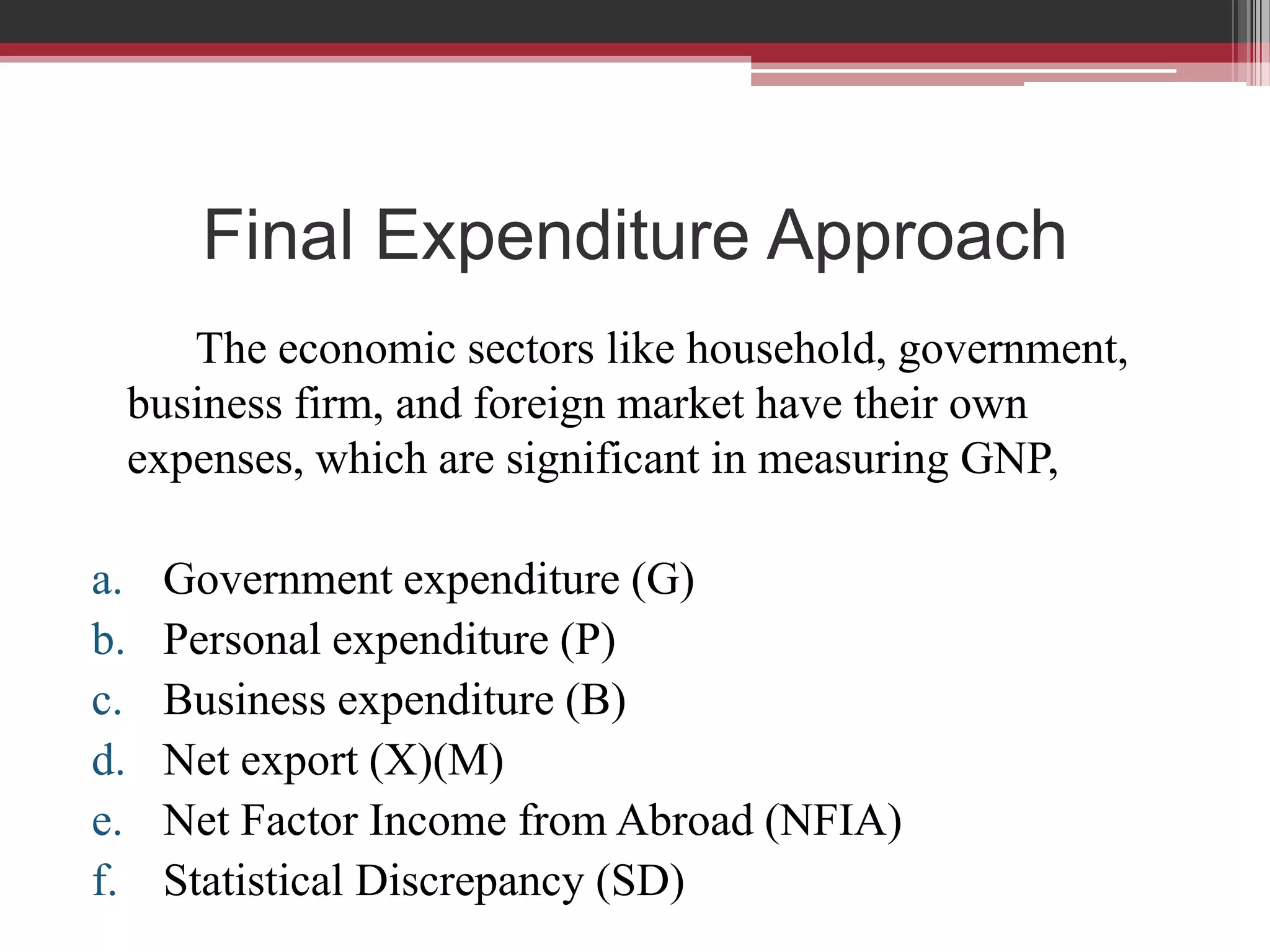
        The economic sectors like household, government,
     business firm, and foreign market have their own
     expenses, which are significant in measuring GNP,

a.    Government expenditure (G)
b.    Personal expenditure (P)
c.    Business expenditure (B)
d.    Net export (X)(M)
e.    Net Factor Income from Abroad (NFIA)
f.    Statistical Discrepancy (SD)
If all the expenditures mentioned above are put
  together, GNP will be computed. The formula for
  measuring the GNP using this approach is:

         GNP = G+P+B+(X – M)+NFIA+SD
For example:
G = 34 million pesos
P = 130 million pesos
B = 59 million pesos    Using the formula in measuring
M = -7 million pesos    GNP at Factor Income Approach,
X = -7 million pesos    the amount is…
NFIA = -5 million pesos
SD = 3 million pesos
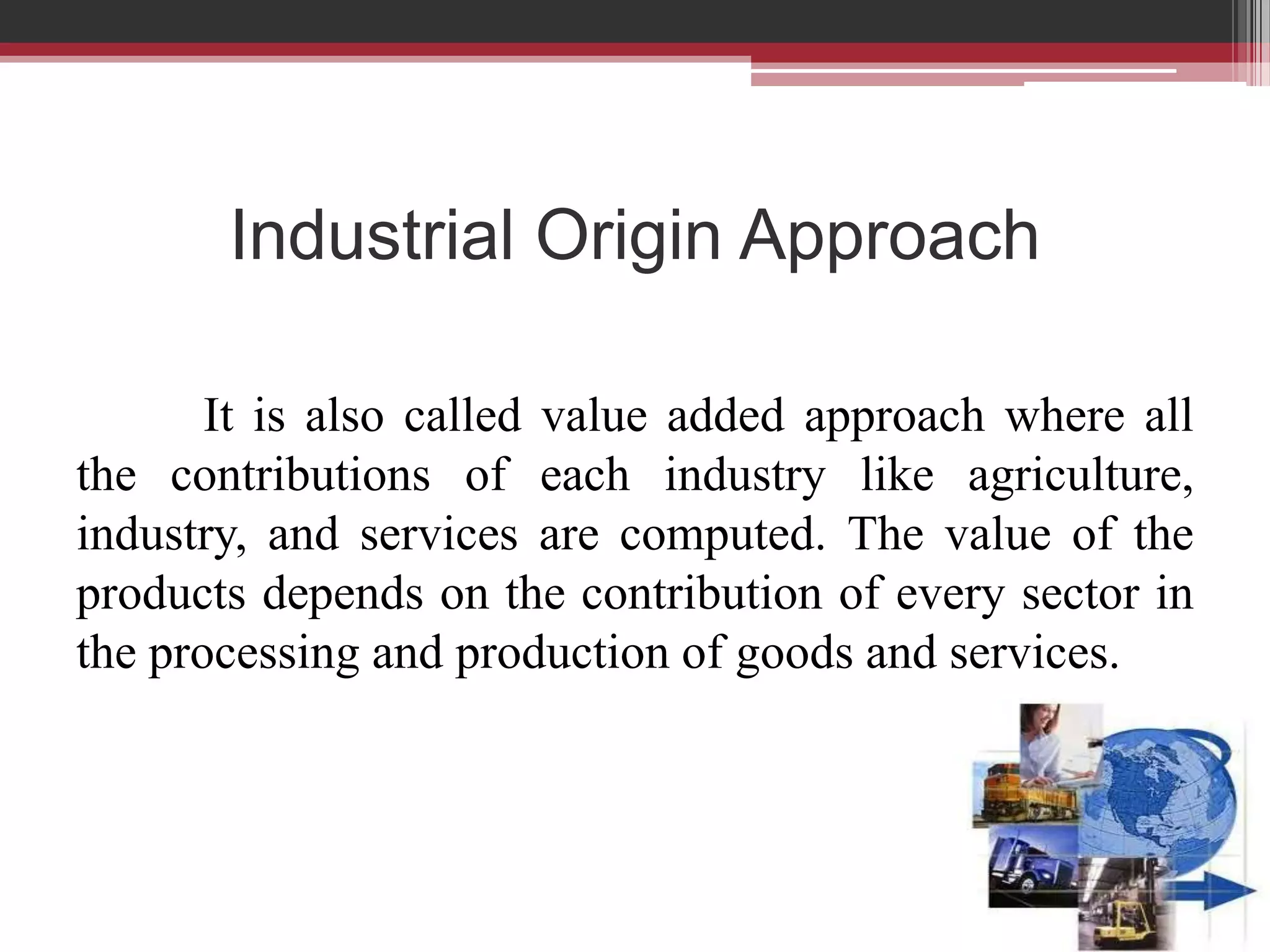
Industrial Origin Approach

       It is also called value added approach where all
the contributions of each industry like agriculture,
industry, and services are computed. The value of the
products depends on the contribution of every sector in
the processing and production of goods and services.
Limitations in Measuring the GNP
        GNP alone is not enough to measure the development
of the economy. Even if the government stated that the GNP
achieved a five percent increase, the reality speaks the
truth, the common man still not experience and feel the said
increase in his daily living. Still the lives of many Filipinos
are falling into poverty.

       In GNP measurement, not all commodities are
included in the total market value of products and services.
There are products and services which are not included in
the computation because they are not recorded or they are
not paying the required tax. This kind of activities include in
the underground economy.
Chapter 37
Price Increases
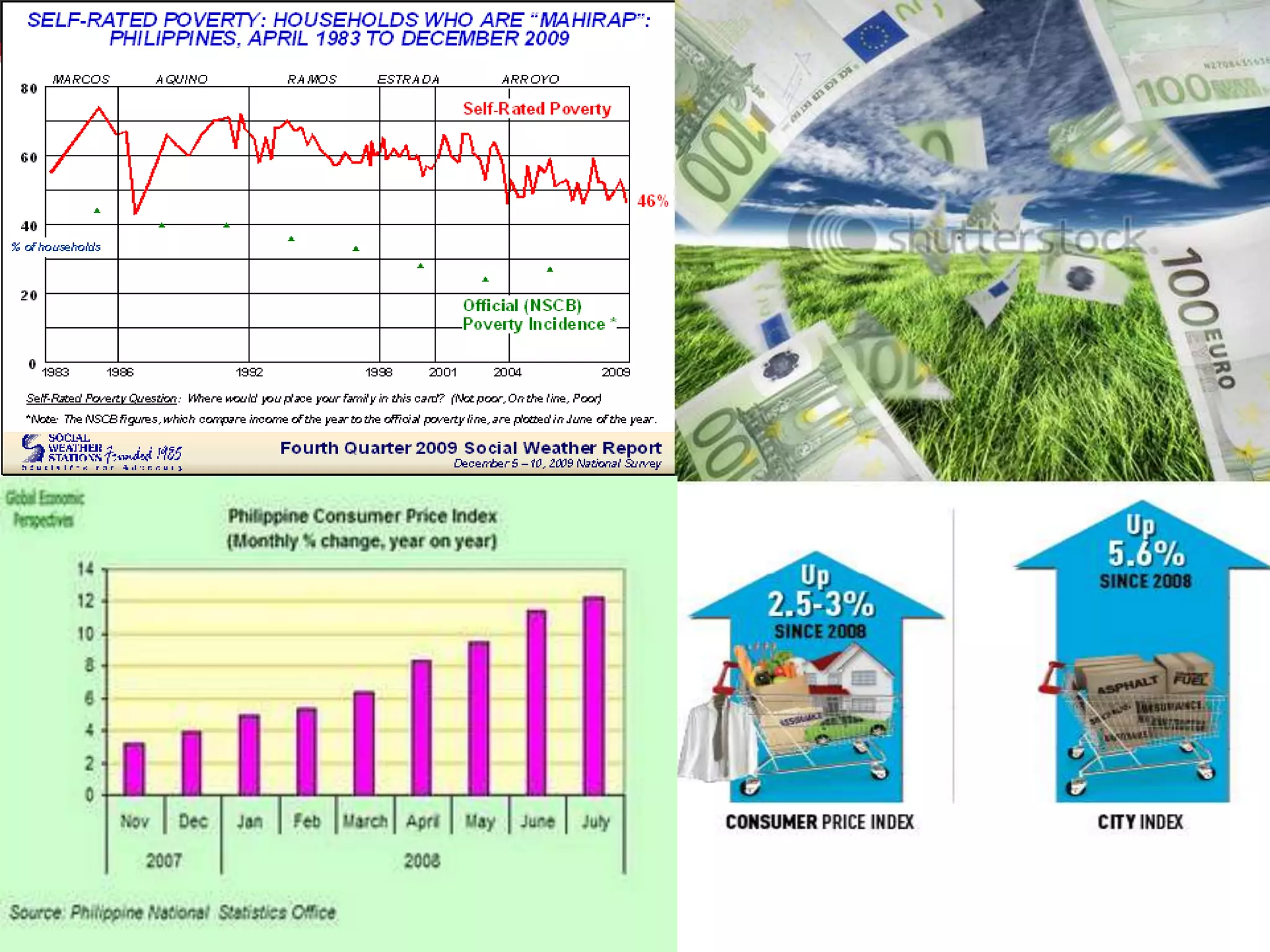
      The continuing increases in the general price
level of commodities are called inflation.


       As of now, inflation cannot be prevented. It
remains big problem o the economy. The basic
commodities like sugar, rice, beef, milk, cooking oil and
etc. are affected by price increases. So many consumers
cannot afford to satisfy their basic needs in life.
Types of Measuring Instruments of
           Price Changes
1. GNP deflator or GNP Implicit Price Index – it is the
   average price index used to adjust the current GNP
   against constant GNP. The GNP deflator is being
   used to know the value of GNP based on the
   previous year. This formula being used:

   In short, it is used for anyGNP at Current Prices in the
                                changes in price
                   computation of GNP.
   GNP at constant prices =
                                  GNP deflator
2. Wholesale Price Index and Retail Price Index – it shows and
  measures the changes in the price of finished
  products, intermediate goods, and crude materials in wholesale
  and retail trading. Wholesale is the price of every piece of
  goods.

3. Consumer Price Index (CPI) – it is the most popular
  instrument in measuring inflation. The CPI measures the
  average percentage in the change of retail prices of
  commodities usually purchased by consumers. It describes the
  present living condition of the consumers according to
  changes on price. The commodities, which the CPI
  measures, are those products that are included in the market
  basket of goods. The inflation rate depends on the CPI.
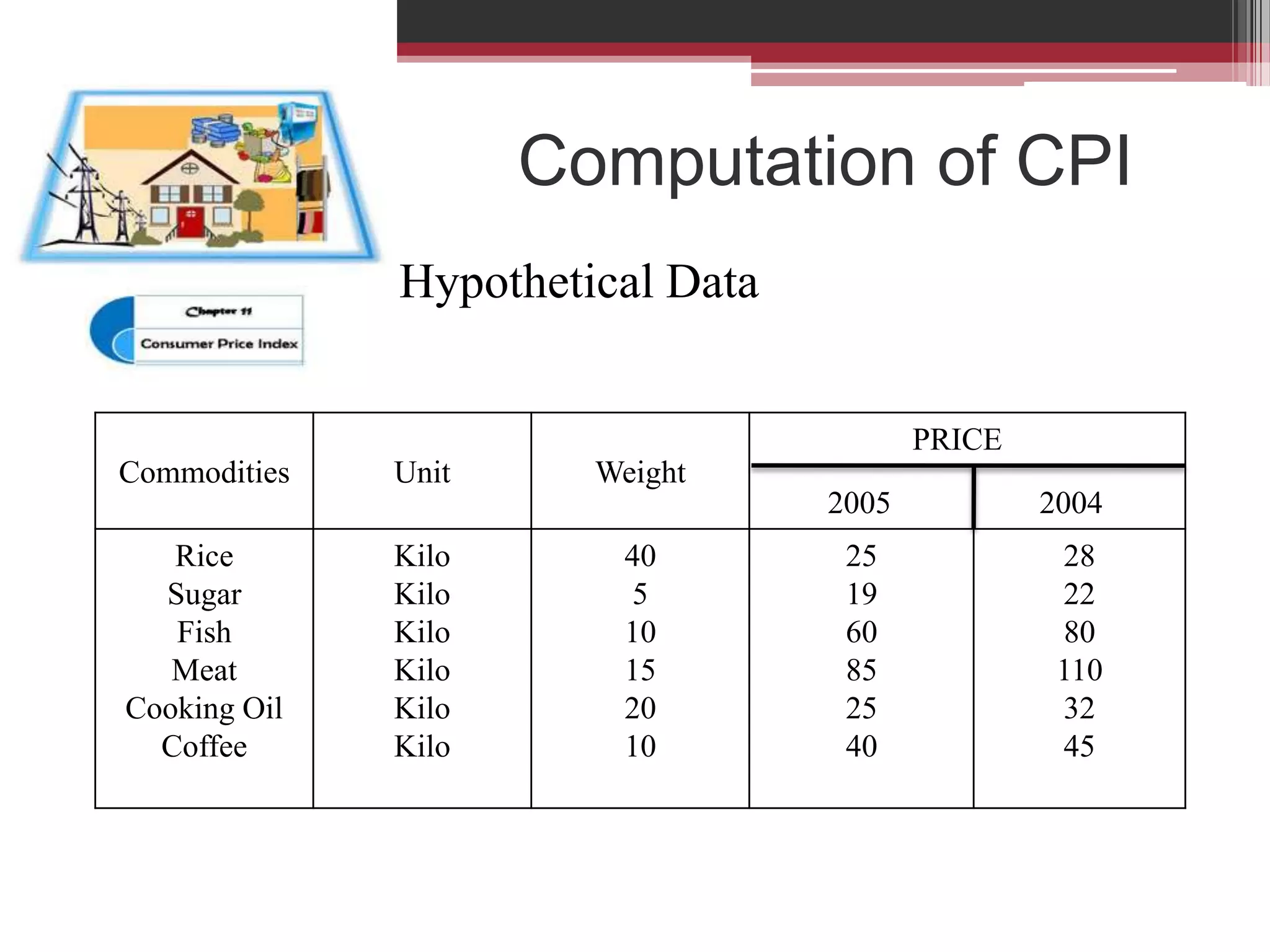
Computation of CPI
              Hypothetical Data


                                         PRICE
Commodities   Unit     Weight
                                  2005           2004
   Rice       Kilo      40         25             28
  Sugar       Kilo      5          19             22
   Fish       Kilo      10         60             80
   Meat       Kilo      15         85             110
Cooking Oil   Kilo      20         25             32
  Coffee      Kilo      10         40             45
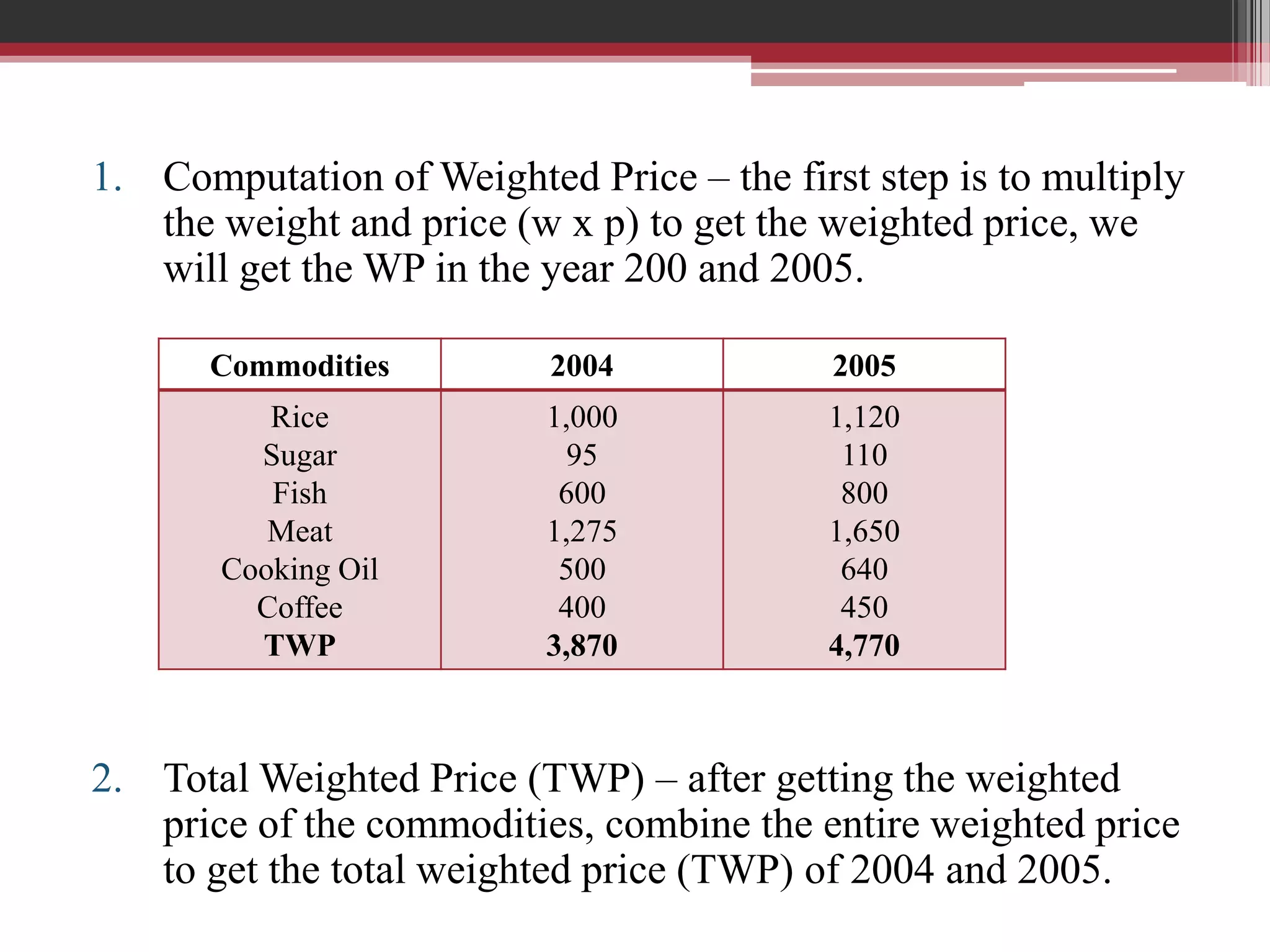
1. Computation of Weighted Price – the first step is to multiply
   the weight and price (w x p) to get the weighted price, we
   will get the WP in the year 200 and 2005.

      Commodities         2004             2005
          Rice            1,000            1,120
         Sugar              95              110
          Fish             600              800
          Meat            1,275            1,650
       Cooking Oil         500              640
         Coffee            400              450
         TWP              3,870            4,770


2. Total Weighted Price (TWP) – after getting the weighted
   price of the commodities, combine the entire weighted price
   to get the total weighted price (TWP) of 2004 and 2005.
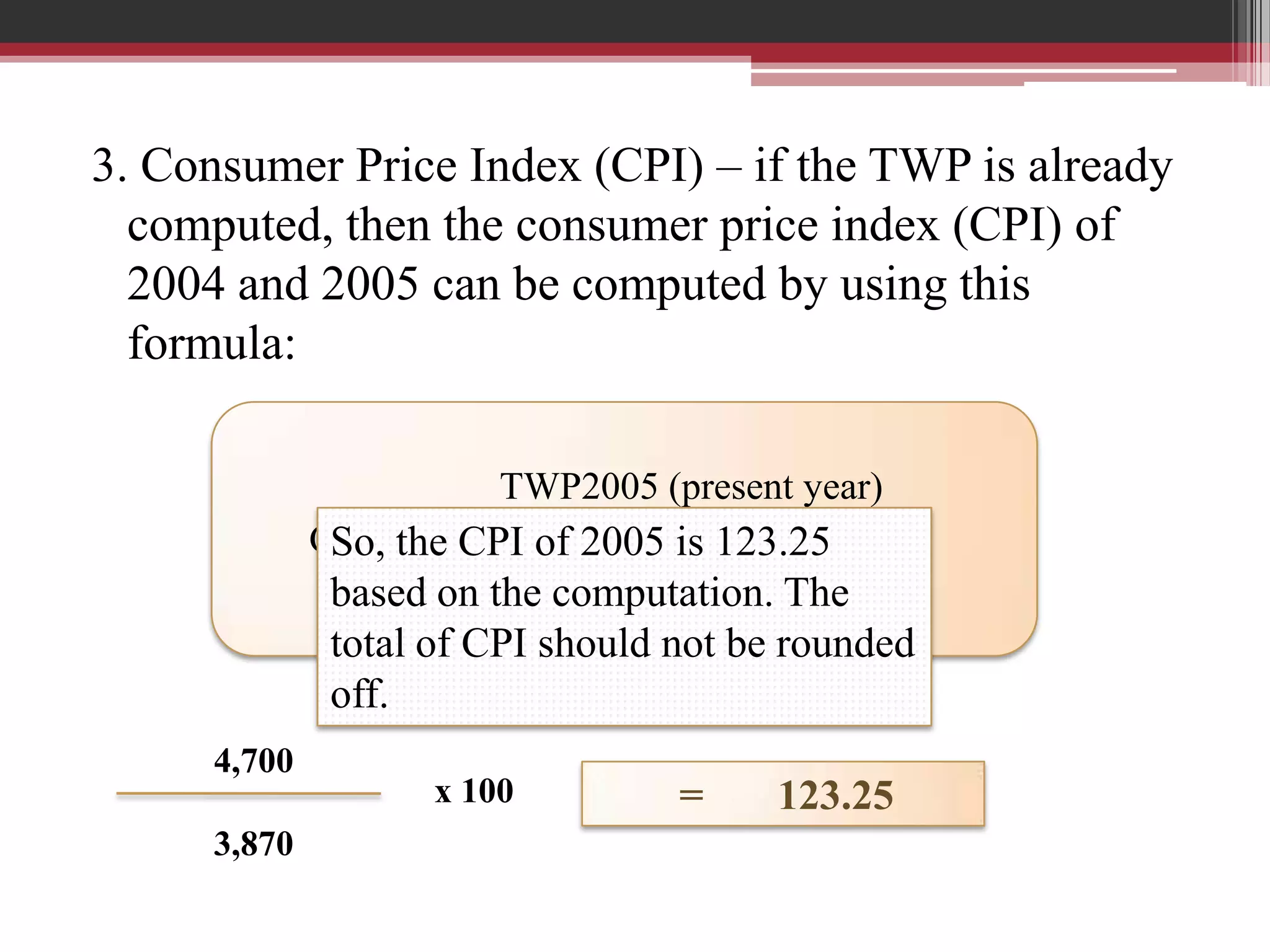
3. Consumer Price Index (CPI) – if the TWP is already
  computed, then the consumer price index (CPI) of
  2004 and 2005 can be computed by using this
  formula:

                        TWP2005 (present year)
             CPI =the CPI of 2005 is 123.25
              So,
                        TWP2004(base year)
              based on the computation. The
              total of CPI should not be rounded
              off.
     4,700
                    x 100         =     123.25
     3,870
Purchasing Power of the Peso (PPP)
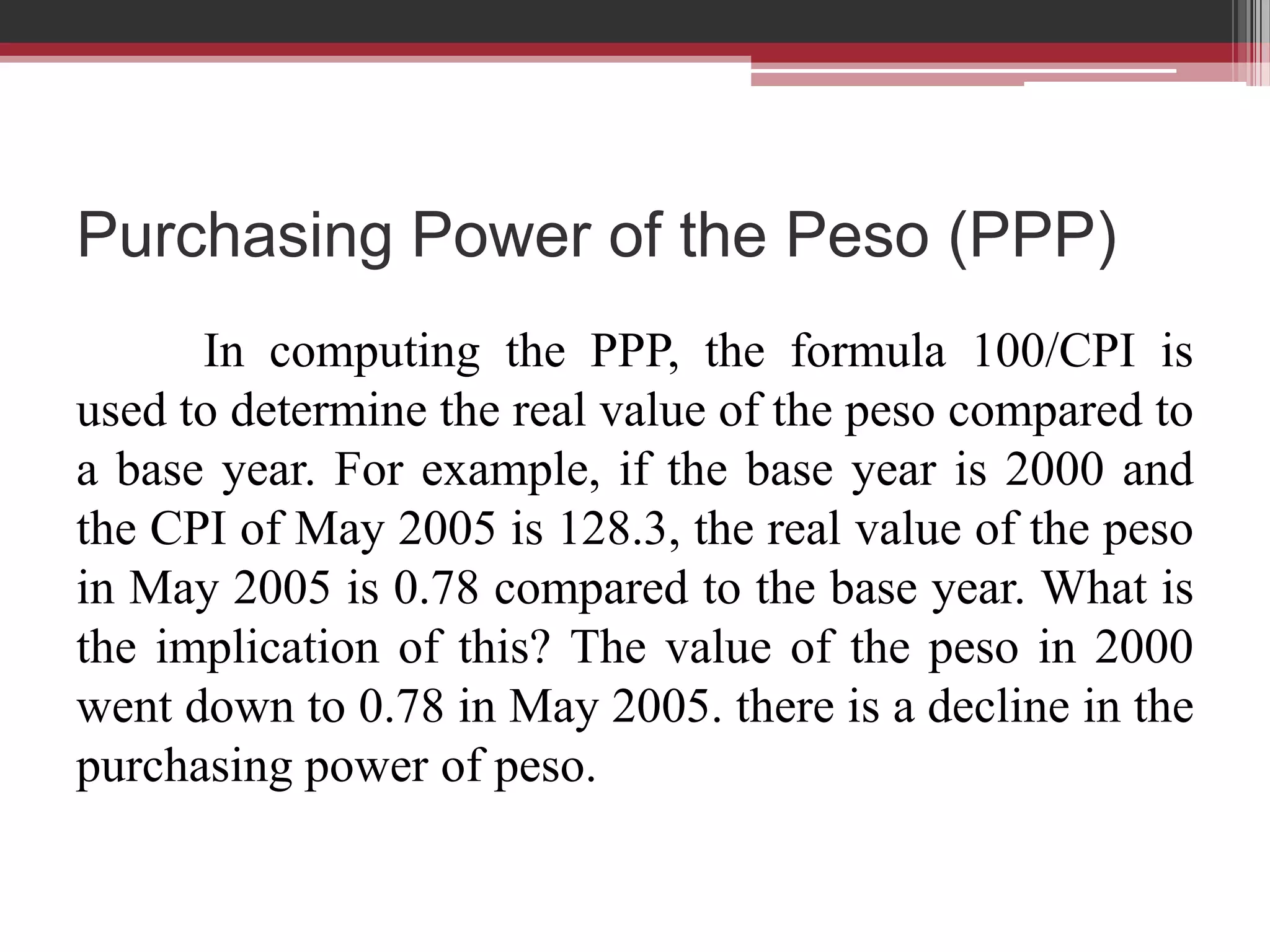
      In computing the PPP, the formula 100/CPI is
used to determine the real value of the peso compared to
a base year. For example, if the base year is 2000 and
the CPI of May 2005 is 128.3, the real value of the peso
in May 2005 is 0.78 compared to the base year. What is
the implication of this? The value of the peso in 2000
went down to 0.78 in May 2005. there is a decline in the
purchasing power of peso.
Chapter 38
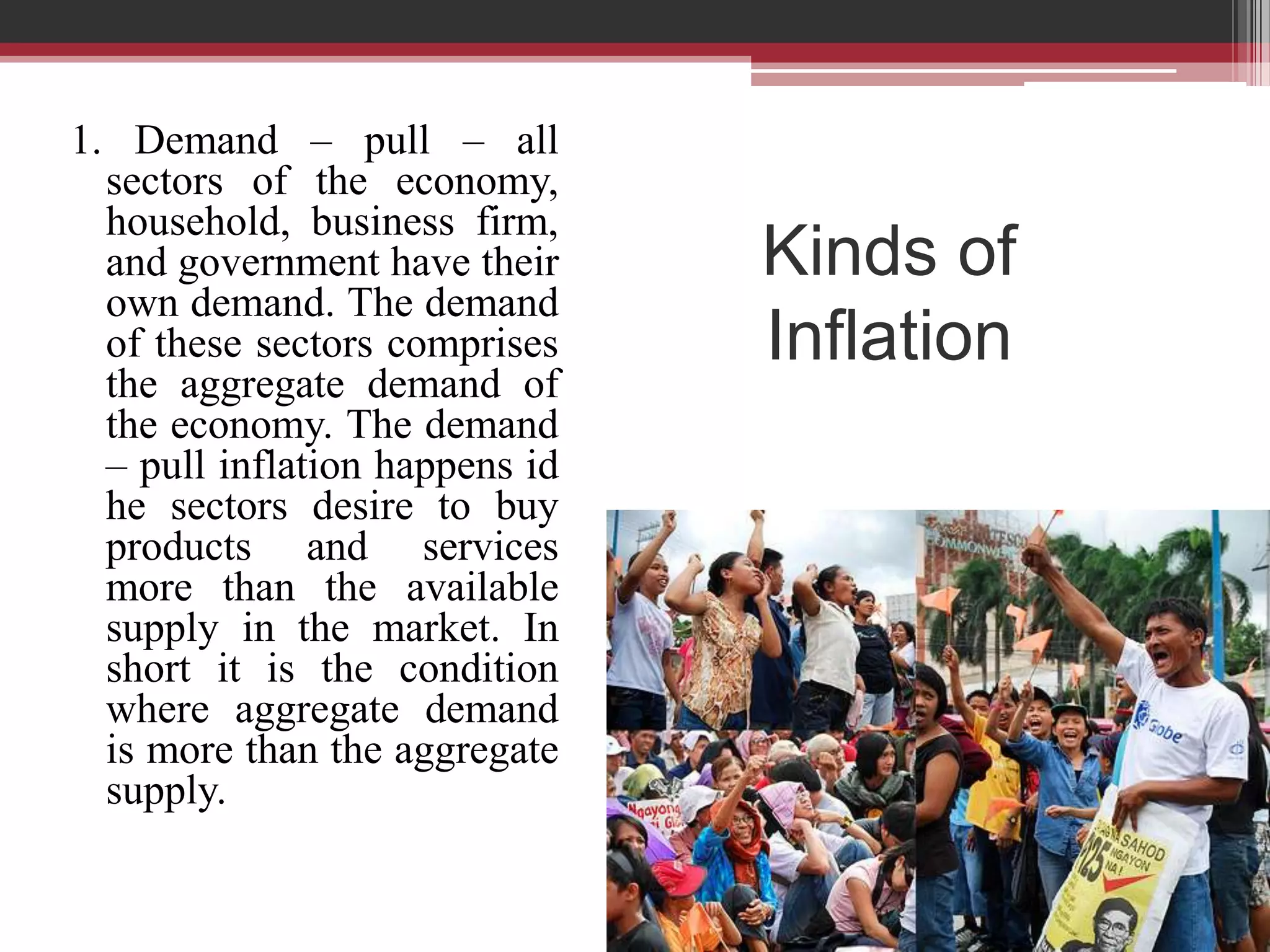
1. Demand – pull – all
  sectors of the economy,
  household, business firm,
  and government have their     Kinds of
  own demand. The demand
  of these sectors comprises    Inflation
  the aggregate demand of
  the economy. The demand
  – pull inflation happens id
  he sectors desire to buy
  products and services
  more than the available
  supply in the market. In
  short it is the condition
  where aggregate demand
  is more than the aggregate
  supply.
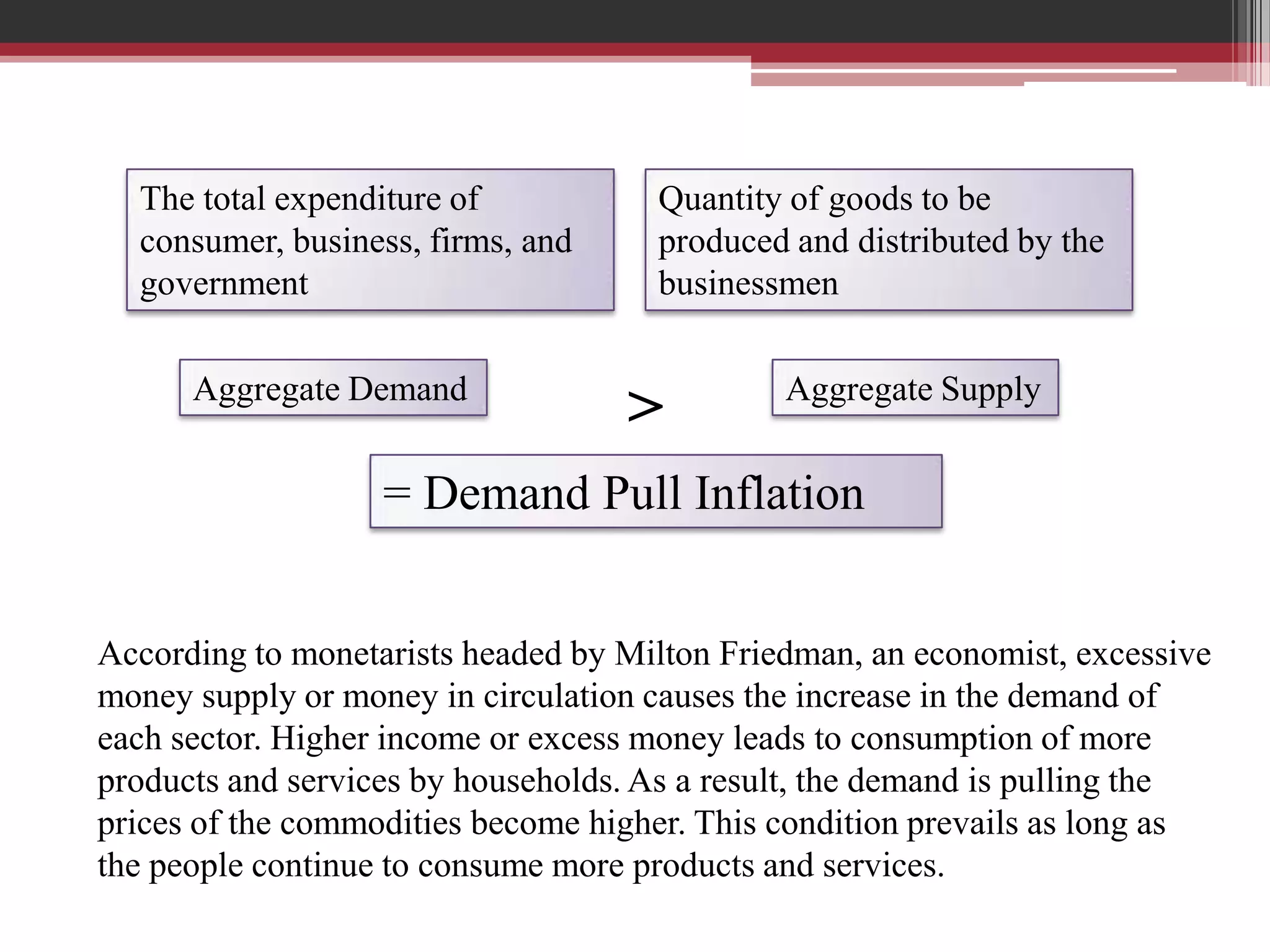
The total expenditure of           Quantity of goods to be
  consumer, business, firms, and     produced and distributed by the
  government                         businessmen

      Aggregate Demand                        Aggregate Supply
                                   >
                   = Demand Pull Inflation


According to monetarists headed by Milton Friedman, an economist, excessive
money supply or money in circulation causes the increase in the demand of
each sector. Higher income or excess money leads to consumption of more
products and services by households. As a result, the demand is pulling the
prices of the commodities become higher. This condition prevails as long as
the people continue to consume more products and services.
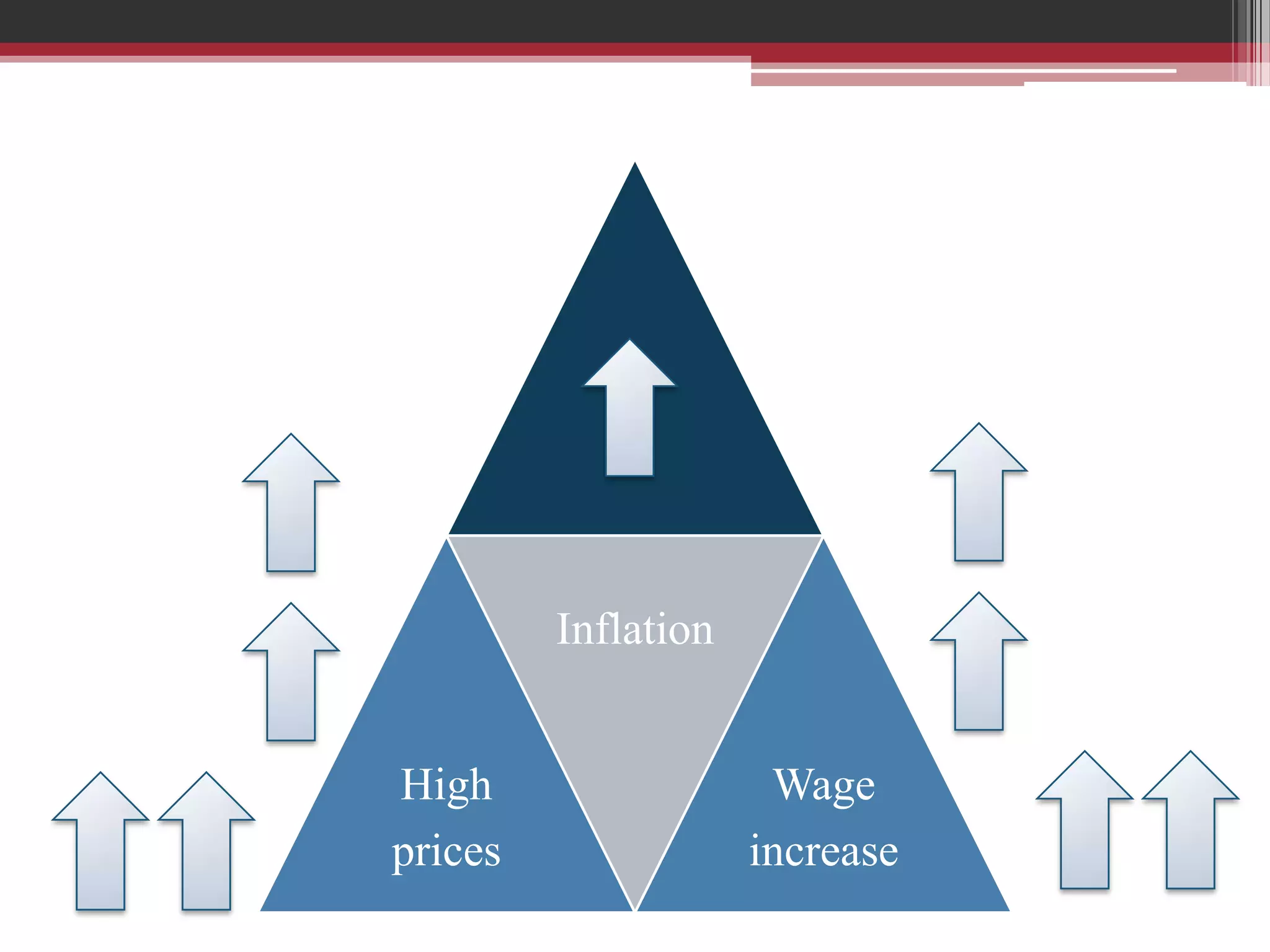
Cost - Push

• The increase in the
  production costs of firms
  leads to price increases.
  Income        in       wages,
  purchases of raw materials
  and machineries, and the
  desire to have more profit
  are the main reasons why
  the     price      of      the
  commodities         increases,
  particularly if the factors of
  production ask for high
  payment for the services.
Inflation


High                  Wage
prices               increase
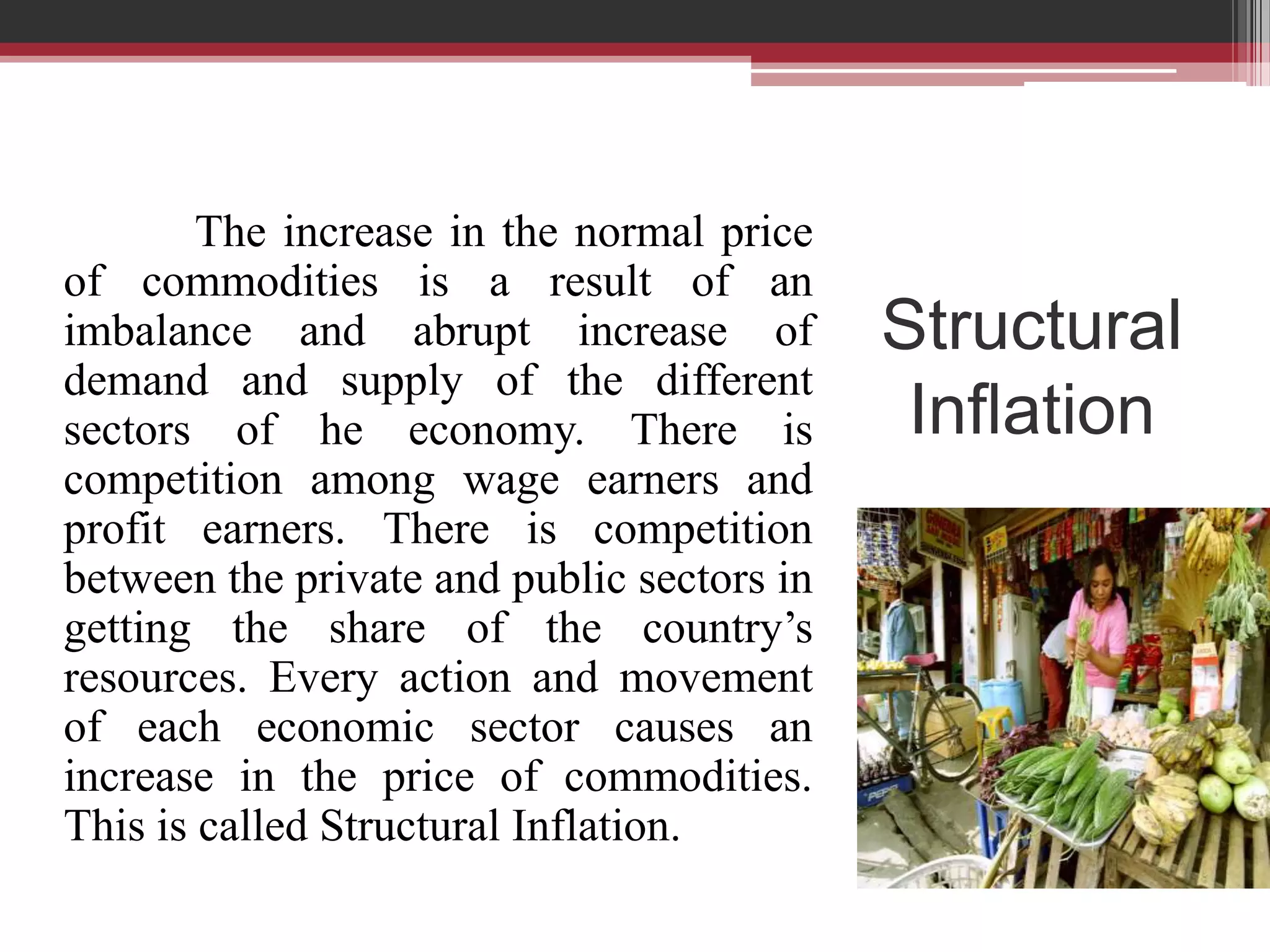
The increase in the normal price
of commodities is a result of an
imbalance and abrupt increase of            Structural
demand and supply of the different
sectors of he economy. There is              Inflation
competition among wage earners and
profit earners. There is competition
between the private and public sectors in
getting the share of the country’s
resources. Every action and movement
of each economic sector causes an
increase in the price of commodities.
This is called Structural Inflation.
Examine if the following are effects of inflation or causes of
inflation. Write EI if it is an effect and CI if it is a cause.

____1. consumers cannot afford to buy many products
 in the market
____2. a big portion of our budget is allocated for the
 payment of foreign debt
____3. a huge amount of bonus is given to workers
____4. corruption in the government is so rampant
____5. increase in the production level of the country.
Chapter 39
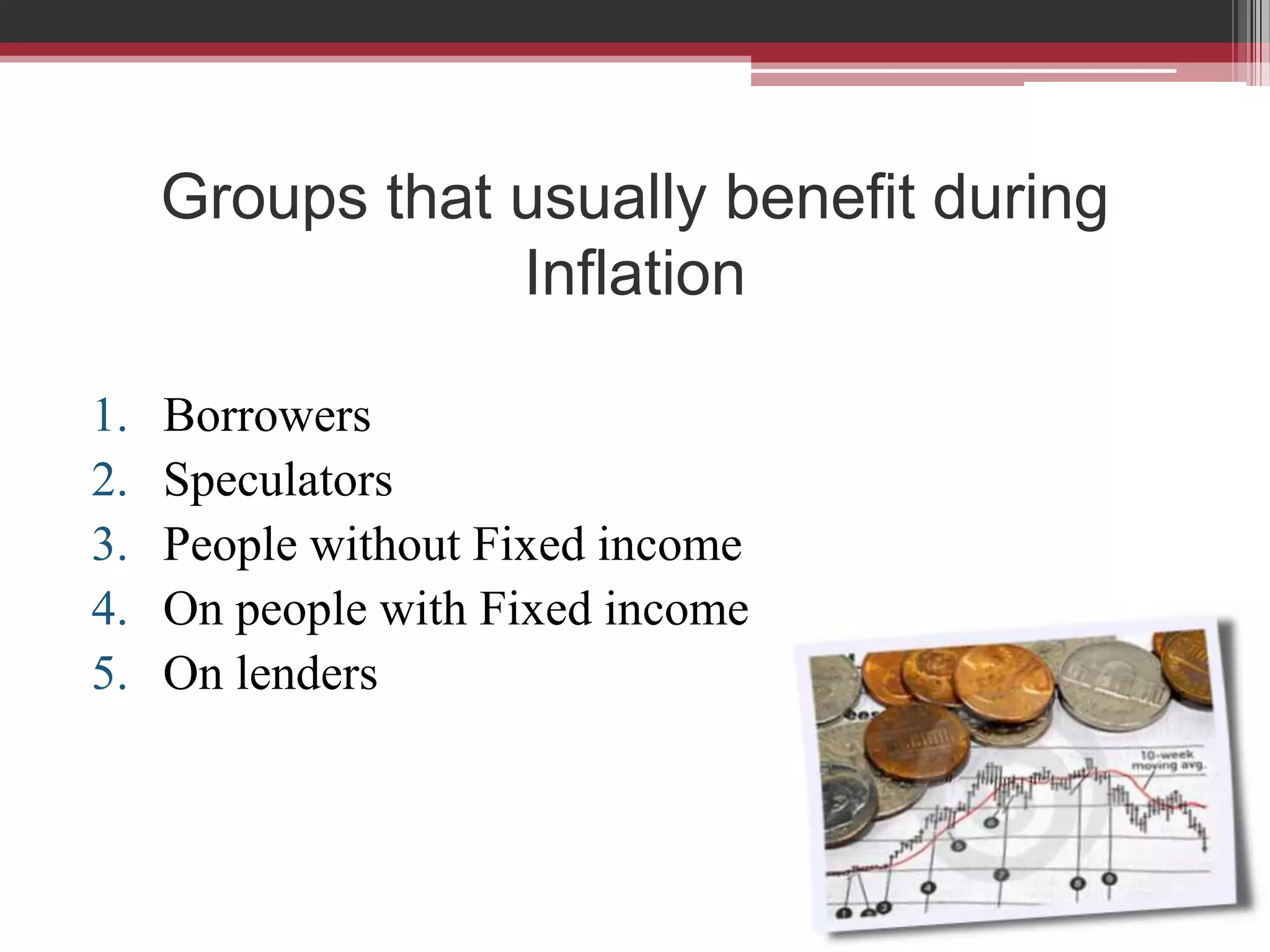
Groups that usually benefit during
                 Inflation

1.   Borrowers
2.   Speculators
3.   People without Fixed income
4.   On people with Fixed income
5.   On lenders
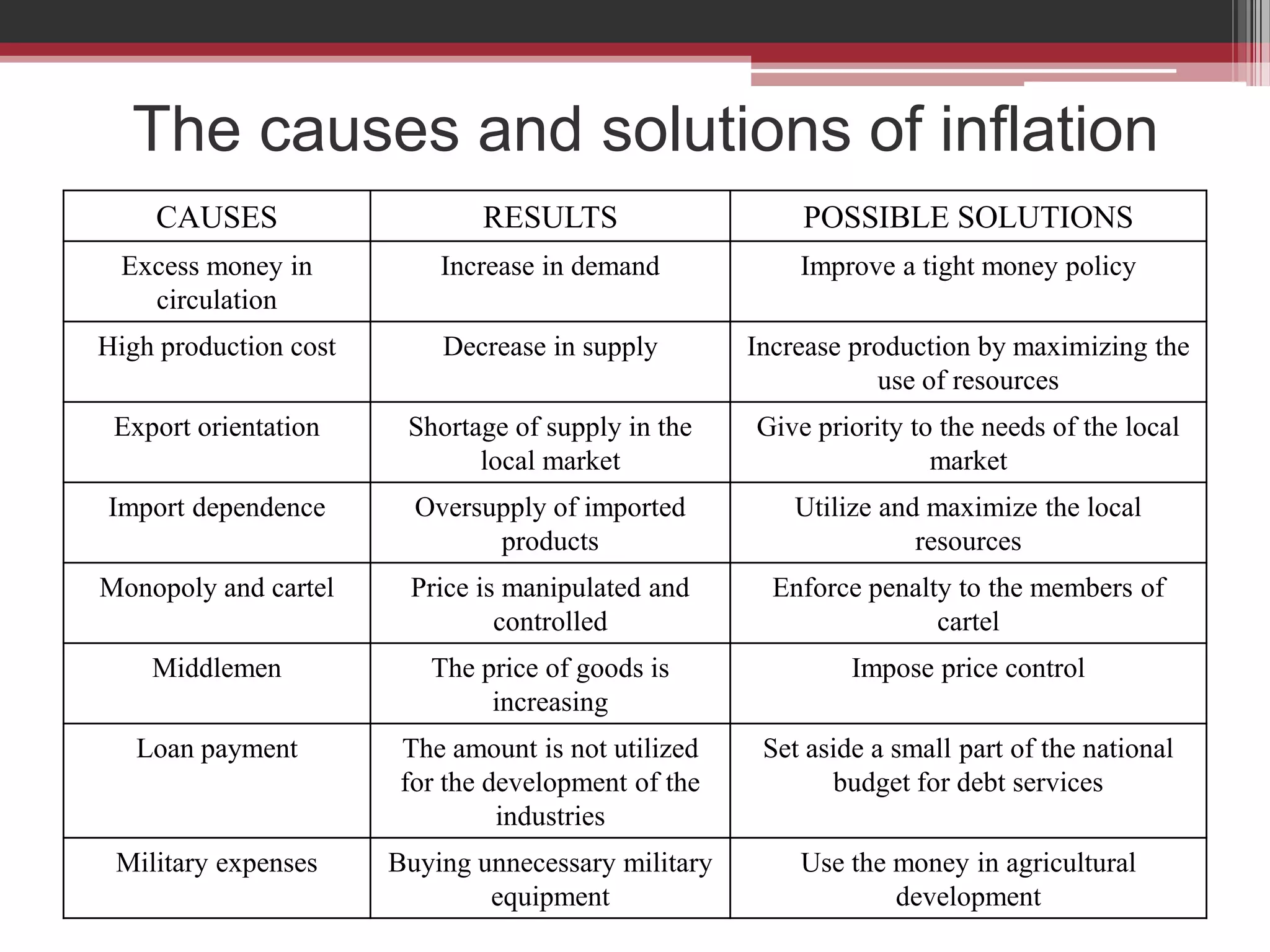
The causes and solutions of inflation
    CAUSES                     RESULTS                   POSSIBLE SOLUTIONS
 Excess money in           Increase in demand            Improve a tight money policy
   circulation
High production cost       Decrease in supply        Increase production by maximizing the
                                                                use of resources
 Export orientation     Shortage of supply in the    Give priority to the needs of the local
                              local market                           market
Import dependence        Oversupply of imported         Utilize and maximize the local
                               products                            resources
Monopoly and cartel     Price is manipulated and       Enforce penalty to the members of
                                controlled                           cartel
    Middlemen             The price of goods is               Impose price control
                               increasing
   Loan payment         The amount is not utilized    Set aside a small part of the national
                        for the development of the          budget for debt services
                                 industries
 Military expenses     Buying unnecessary military       Use the money in agricultural
                               equipment                         development
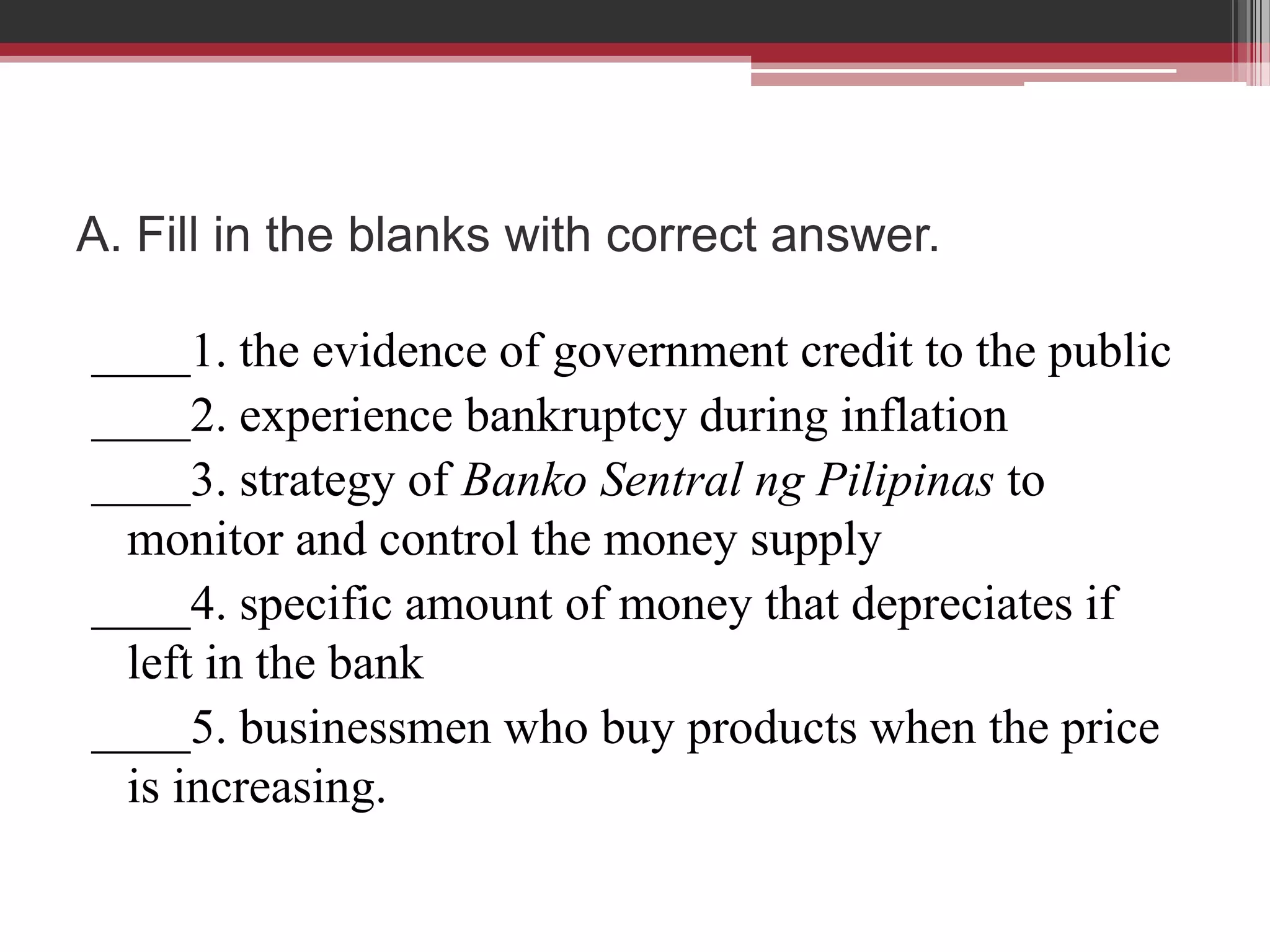
A. Fill in the blanks with correct answer.

____1. the evidence of government credit to the public
____2. experience bankruptcy during inflation
____3. strategy of Banko Sentral ng Pilipinas to
 monitor and control the money supply
____4. specific amount of money that depreciates if
 left in the bank
____5. businessmen who buy products when the price
 is increasing.
Chapter 40
What is income?
• Income is the money received by an individual as
  payment for producing goods and services. Per
  Capita income (PCI) is the income received by an
  individual if the total population divides the total
  production. It is also known as GNP per capita. In
  computing the per capita income use he formula:


           GNP
                       = GNP per capita
         Population
Income distribution
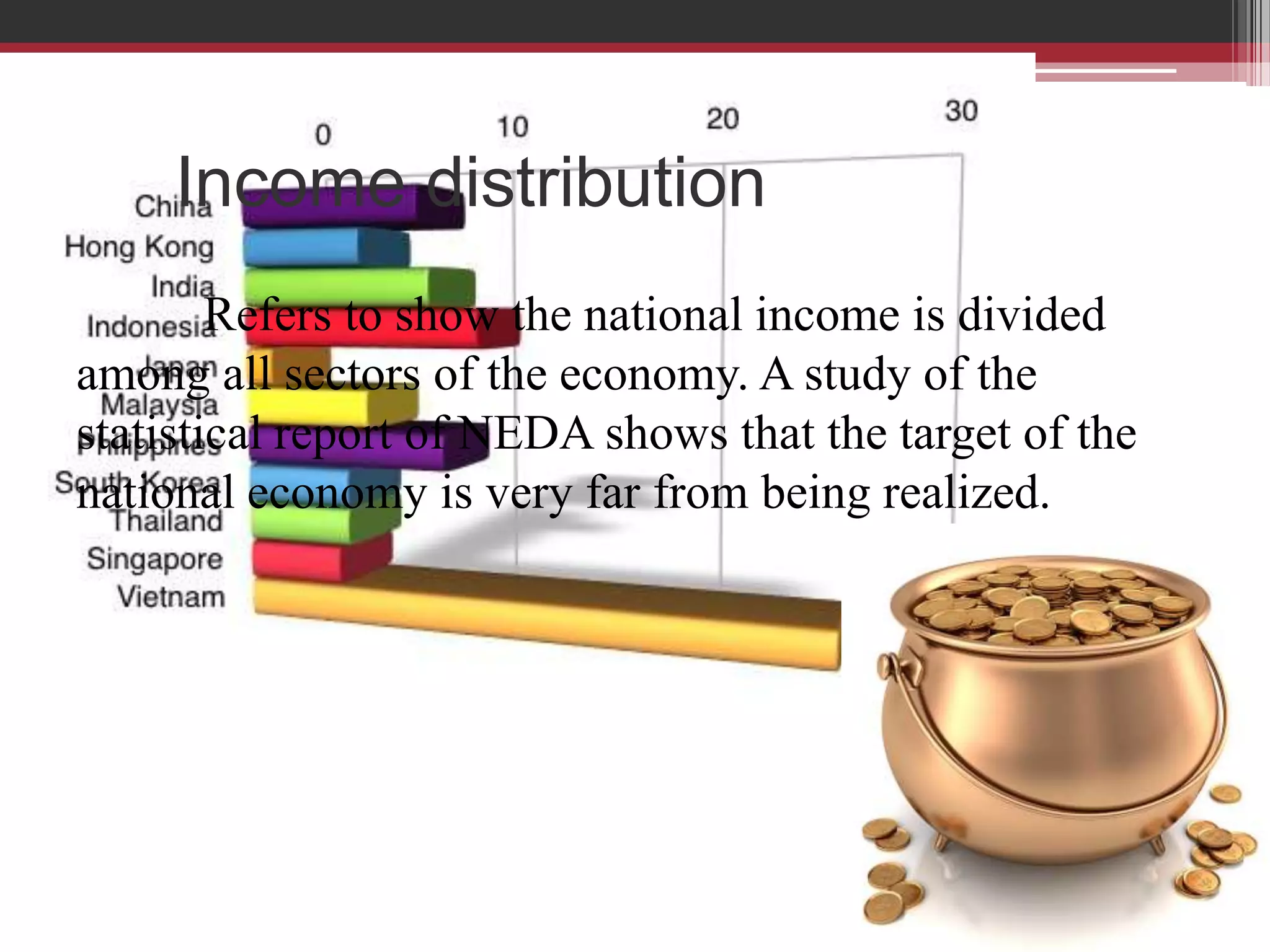
        Refers to show the national income is divided
among all sectors of the economy. A study of the
statistical report of NEDA shows that the target of the
national economy is very far from being realized.
Lorenz Curve
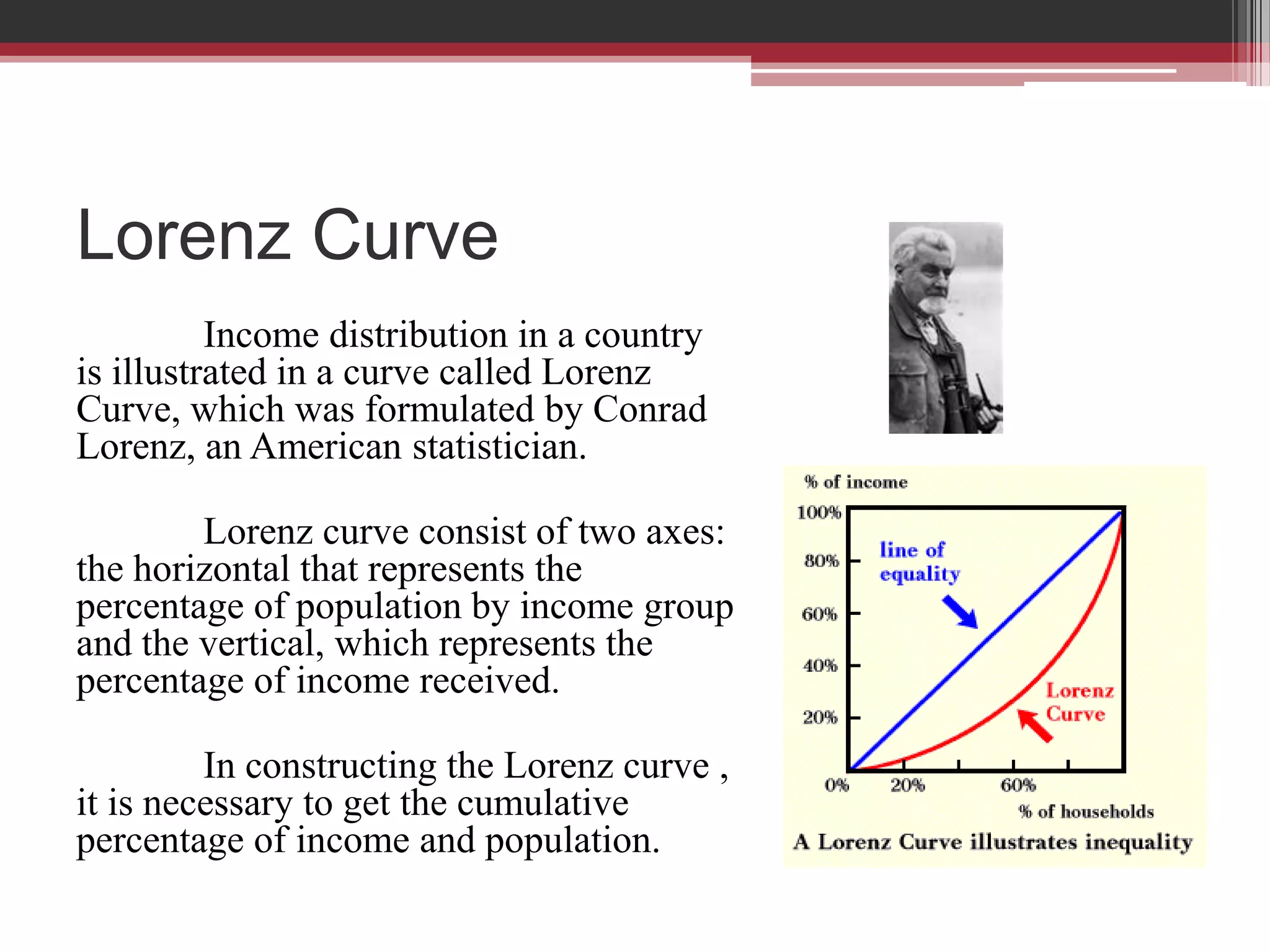
          Income distribution in a country
is illustrated in a curve called Lorenz
Curve, which was formulated by Conrad
Lorenz, an American statistician.

        Lorenz curve consist of two axes:
the horizontal that represents the
percentage of population by income group
and the vertical, which represents the
percentage of income received.

         In constructing the Lorenz curve ,
it is necessary to get the cumulative
percentage of income and population.
Chapter 41
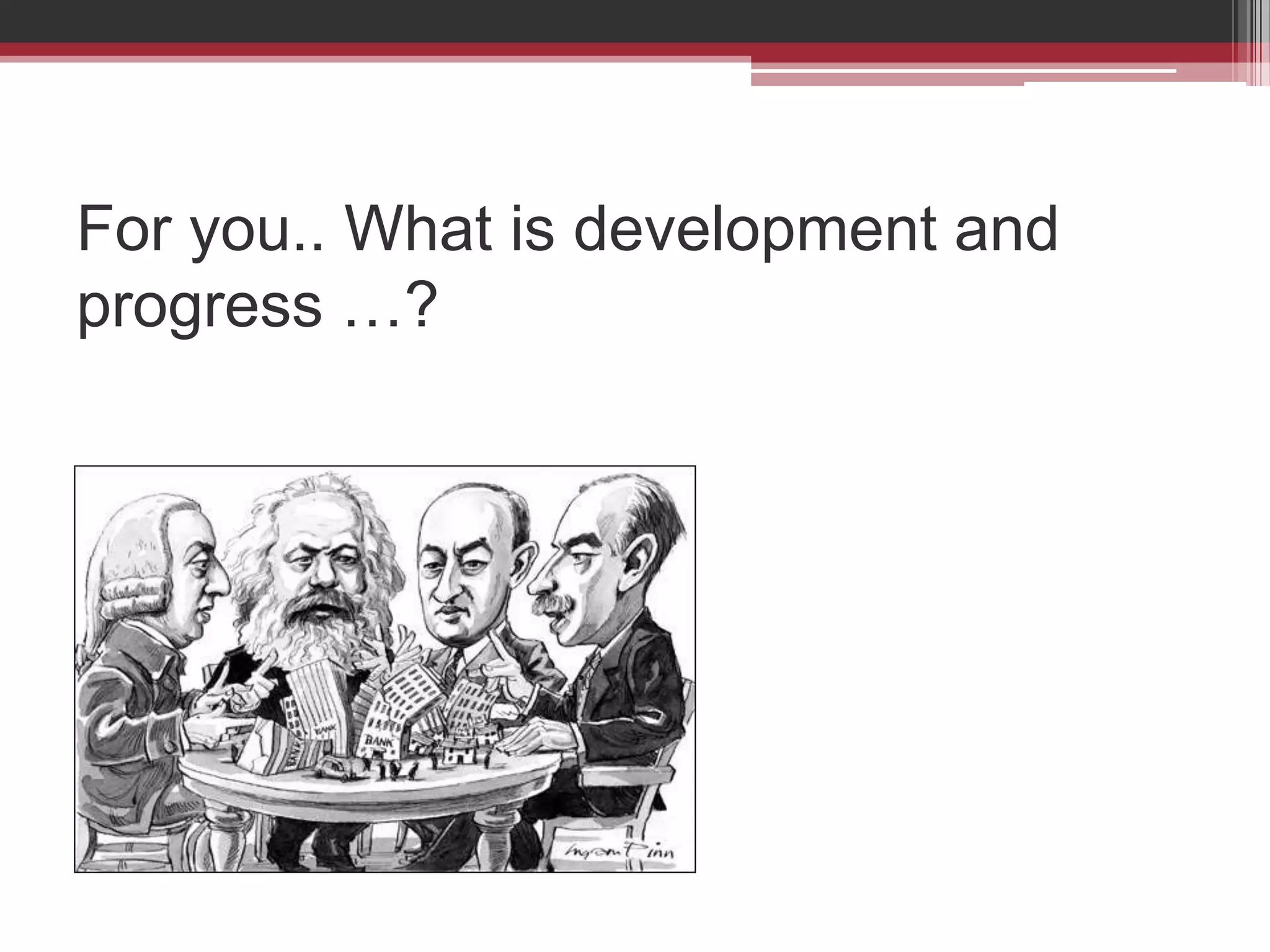
For you.. What is development and
progress …?
• The term Development and Progress are
  frequently used in economics. The two
  terms are interrelated but they have
  different characteristics

What is development and what is
 progress?

Economic progress can be easily measured.
  It is the result of a process that shows
  changes in the economy.
While…
Economic development is not only the idea
  of improvement of the economy cut also
  the enhancement of human dignity,
  security, justice, and equality.
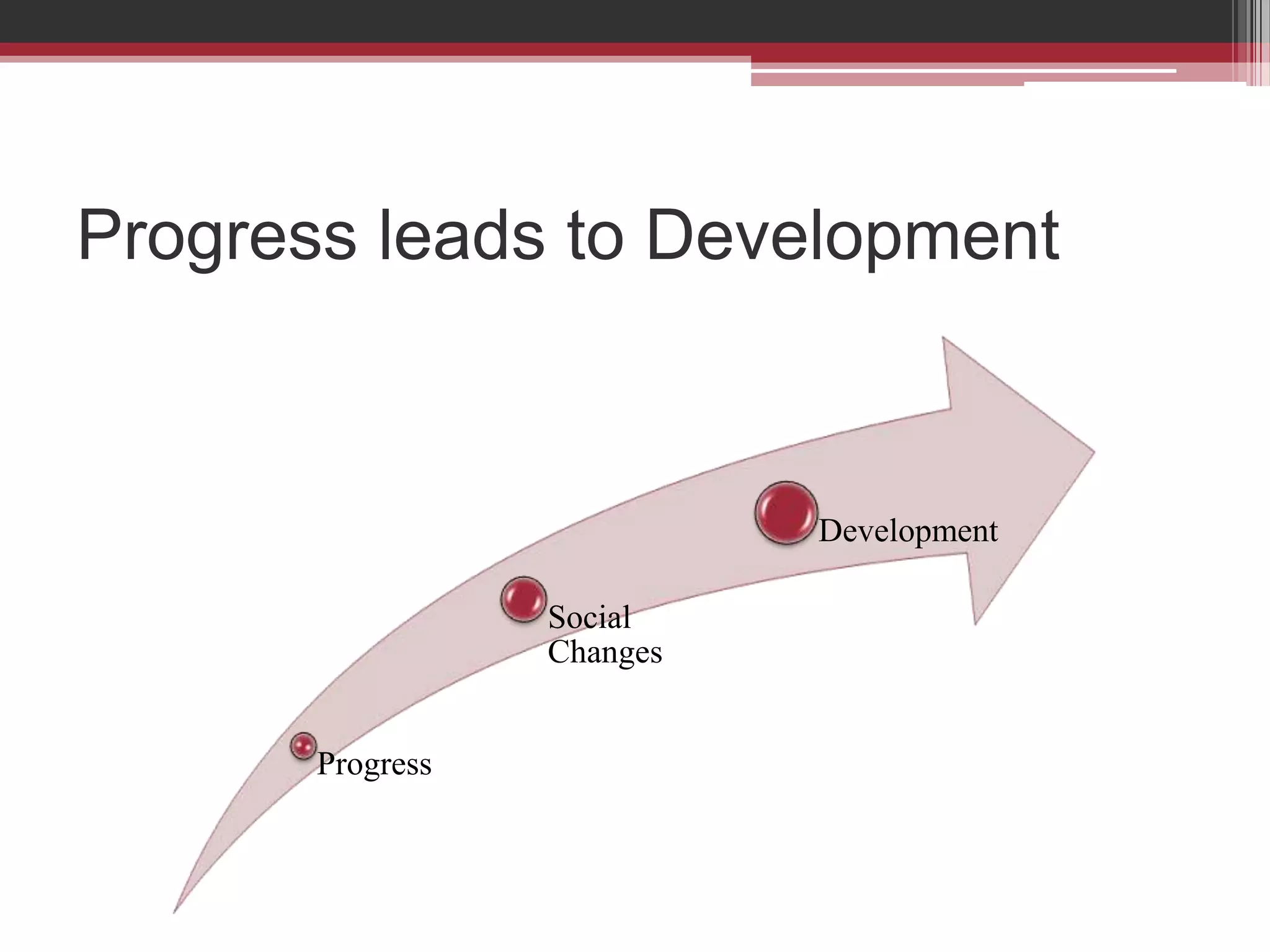
Progress leads to Development


                            Development

                  Social
                  Changes


       Progress
The Principle Theories on progress and
             Development
      Physiocrats, composed of economist led by
Francios Quesnay, believed in the rule of nature.

        Physiocrats agreed hat industrialists and
businessmen must have the freedom to intensify the
industries. They supported the Laissez Faire doctrine
because they believed that the expansion of industries is
vital to economic development.
Model of Physiocrats


Agriculture                 Laissez Faire


              Physiocrats
Theory of Adam Smith
     Adam smith is popularly known as he Father of
“Modern Economics”.

      The principle of Adam Smith centered on the
development of production through specialization.
Specialization is the division of work based on capacity
and ability. Job specialization is necessary in improving
and fact tracking work.
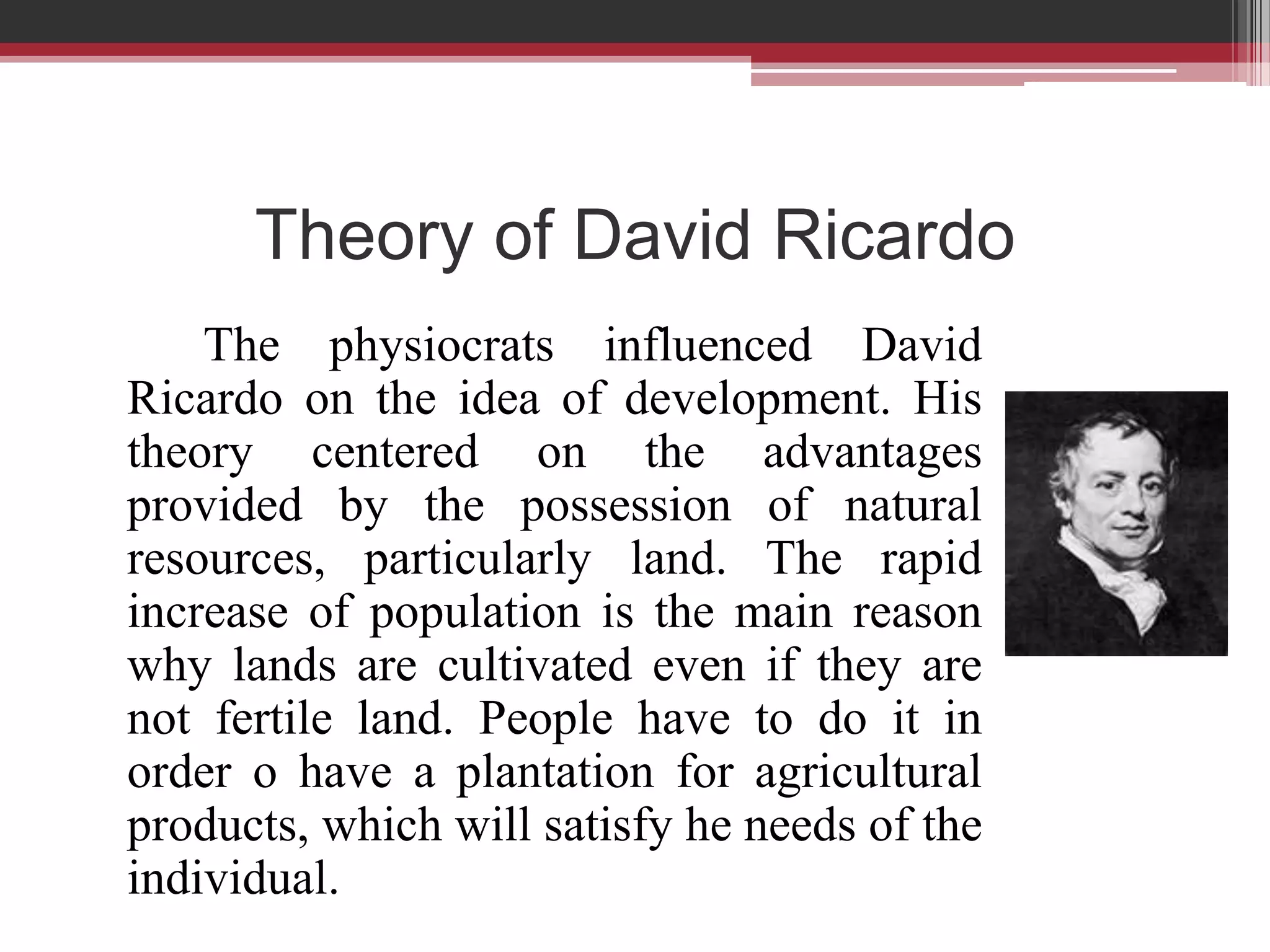
Theory of David Ricardo
    The physiocrats influenced David
Ricardo on the idea of development. His
theory centered on the advantages
provided by the possession of natural
resources, particularly land. The rapid
increase of population is the main reason
why lands are cultivated even if they are
not fertile land. People have to do it in
order o have a plantation for agricultural
products, which will satisfy he needs of the
individual.
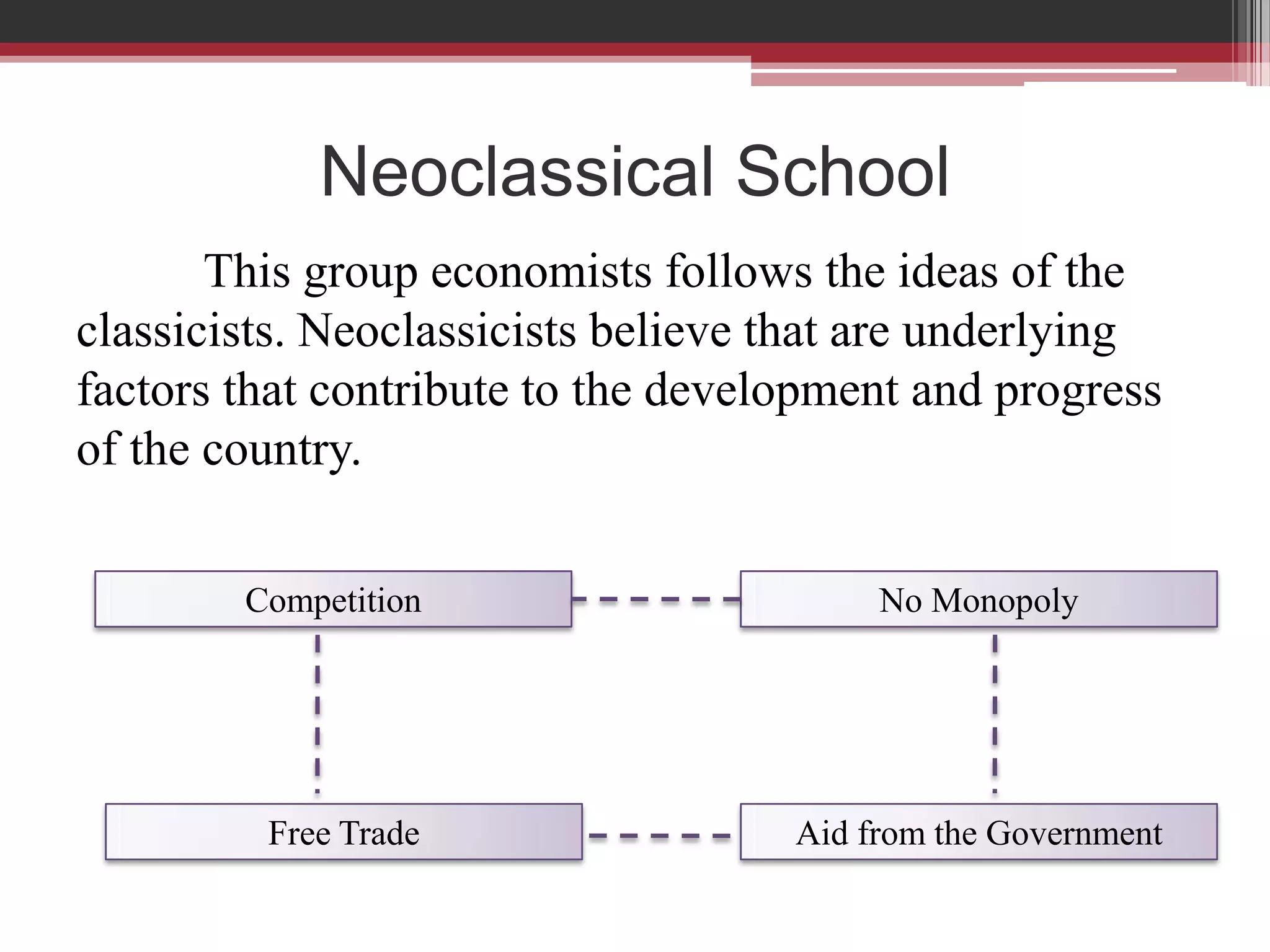
Neoclassical School
       This group economists follows the ideas of the
classicists. Neoclassicists believe that are underlying
factors that contribute to the development and progress
of the country.

        Competition                      No Monopoly


         Free Trade                 Aid from the Government
One important mechanism that motivates
businessmen and consumers to improve their activities is
competition. Competition can only be achieved if there is
no monopoly or oligopoly in the market that causes crisis
in the economy.

       Free trade is an effective method in the exchange
goods services among countries without setting up barriers
like quotas and tariffs. Quotas are limitations in the
quantity of products that can be exported or imported while
the tariffs are tax levied on imported products. The
aforementioned factors are necessary to increase the
revenue of the economy in order for it to achieve
progress, according to neoclassicists.
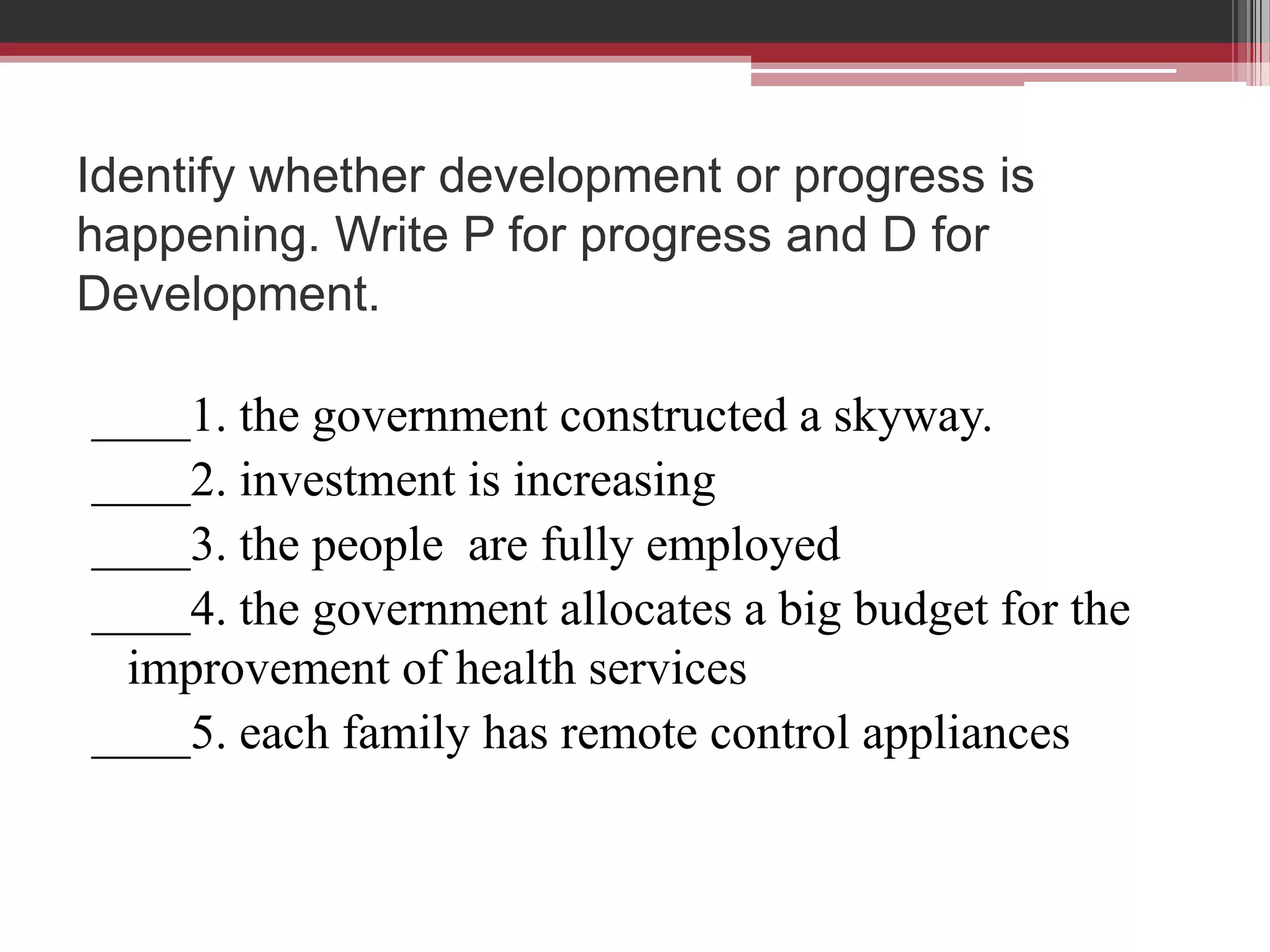
Identify whether development or progress is
happening. Write P for progress and D for
Development.

____1. the government constructed a skyway.
____2. investment is increasing
____3. the people are fully employed
____4. the government allocates a big budget for the
 improvement of health services
____5. each family has remote control appliances
Chapter 42
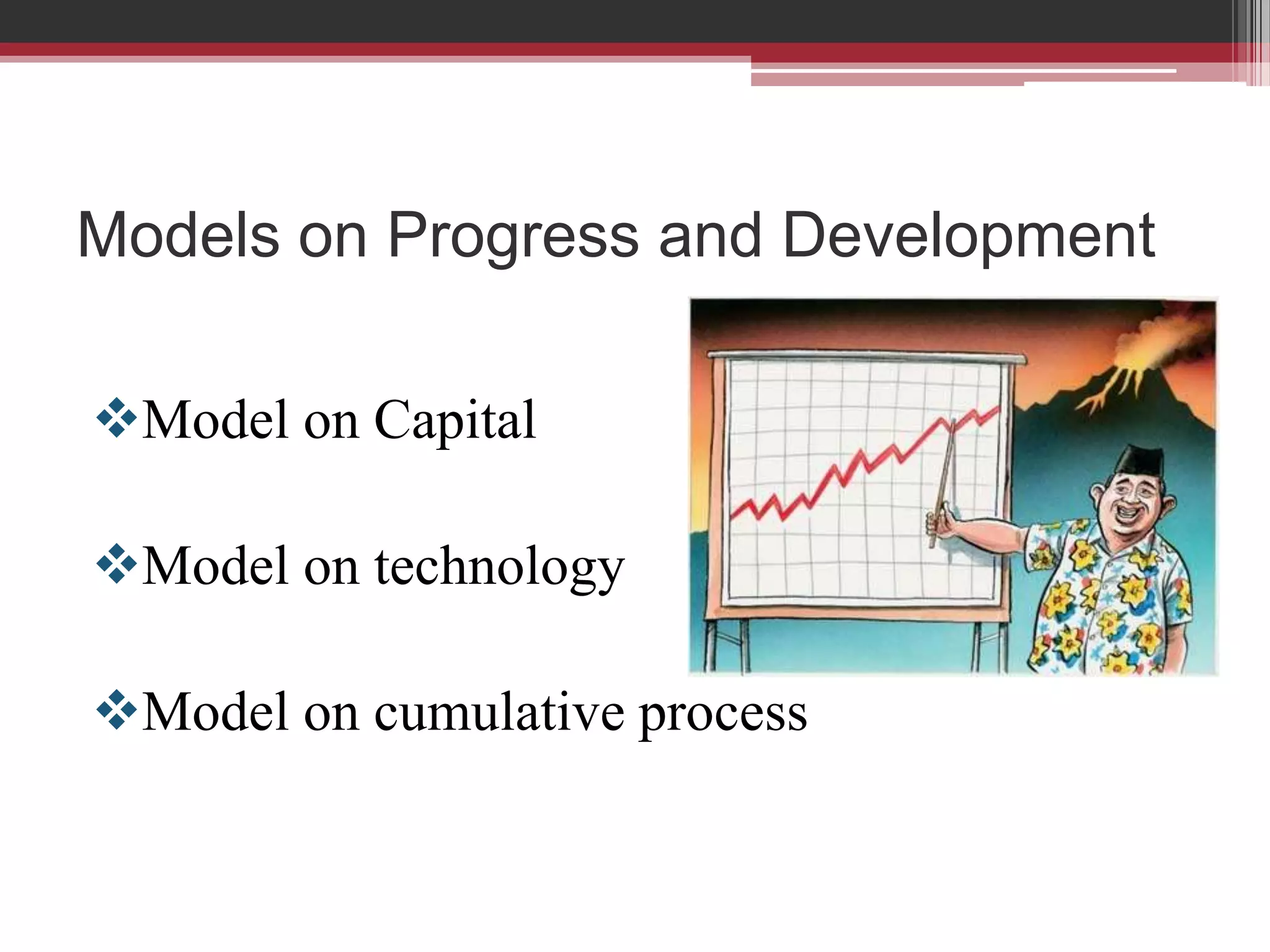
Models on Progress and Development

Model on Capital

Model on technology

Model on cumulative process
Model on Capital
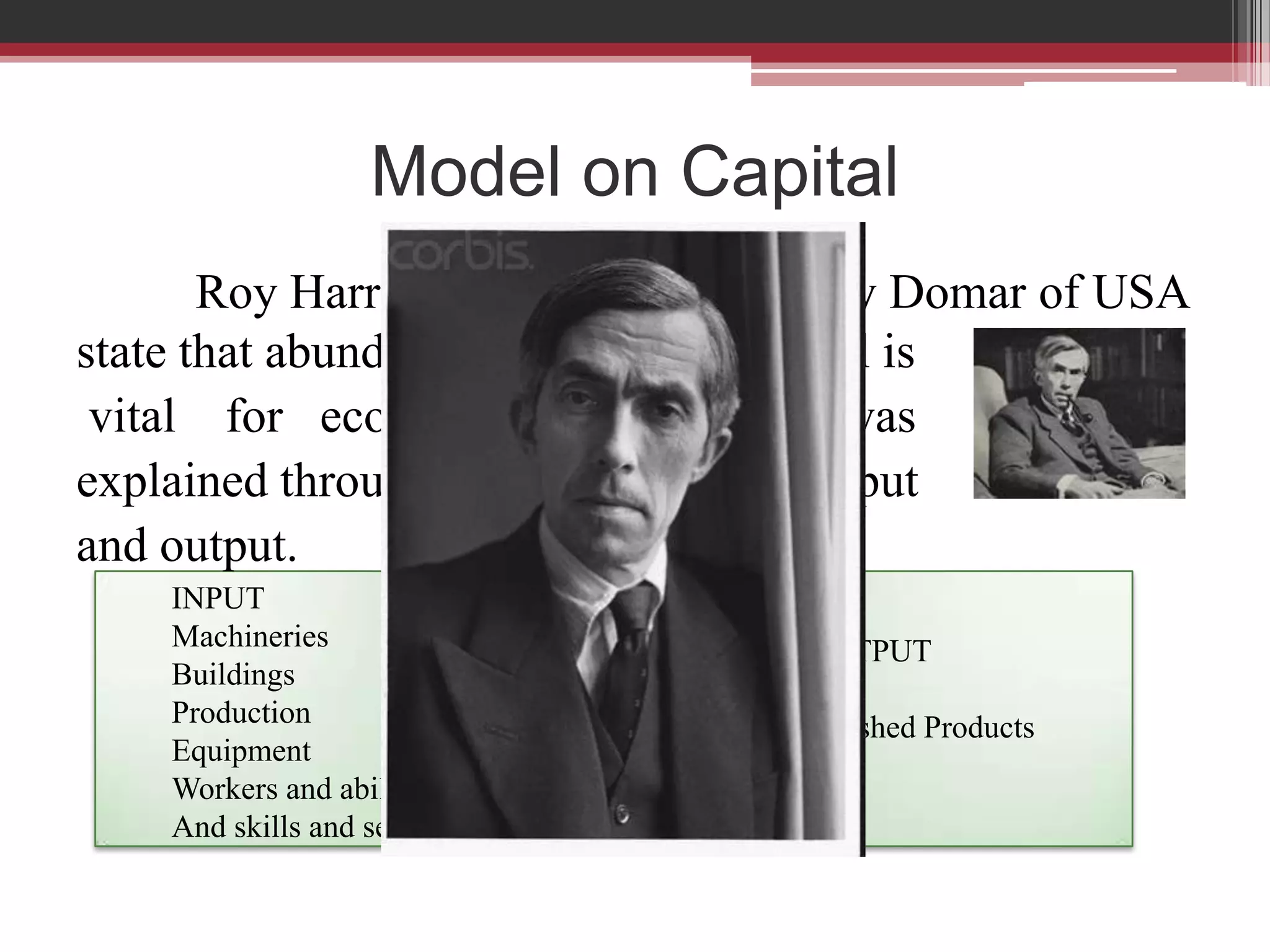
       Roy Harrod of England and Evsey Domar of USA
state that abundant and sufficient capital is
 vital for economic progress. This was
explained through the relationship of input
and output.
    INPUT
    Machineries                  OUTPUT
    Buildings
    Production                   Finished Products
    Equipment
    Workers and abilities
    And skills and services
Model on Technology
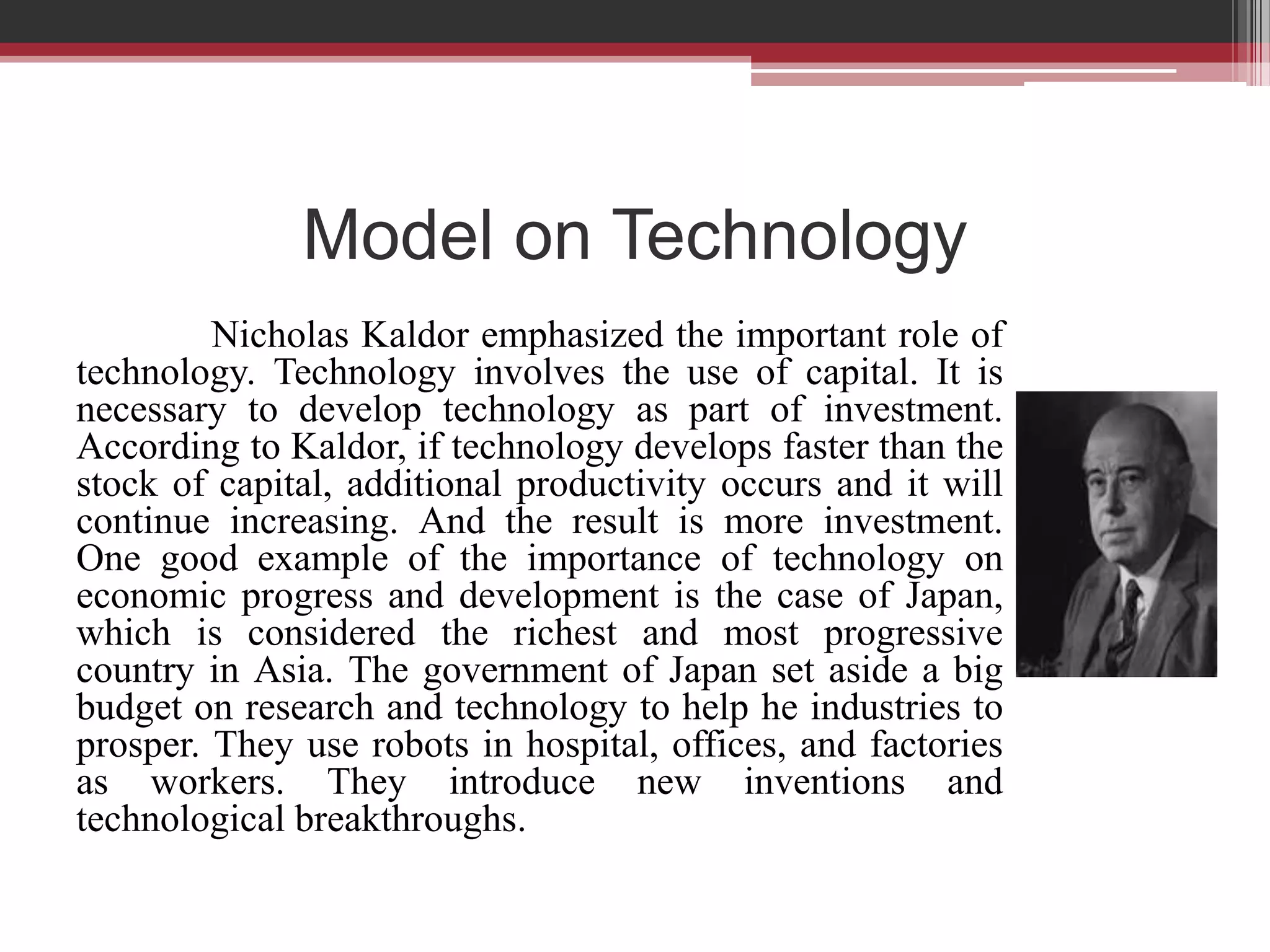
         Nicholas Kaldor emphasized the important role of
technology. Technology involves the use of capital. It is
necessary to develop technology as part of investment.
According to Kaldor, if technology develops faster than the
stock of capital, additional productivity occurs and it will
continue increasing. And the result is more investment.
One good example of the importance of technology on
economic progress and development is the case of Japan,
which is considered the richest and most progressive
country in Asia. The government of Japan set aside a big
budget on research and technology to help he industries to
prosper. They use robots in hospital, offices, and factories
as workers. They introduce new inventions and
technological breakthroughs.
Model on Cumulative Process
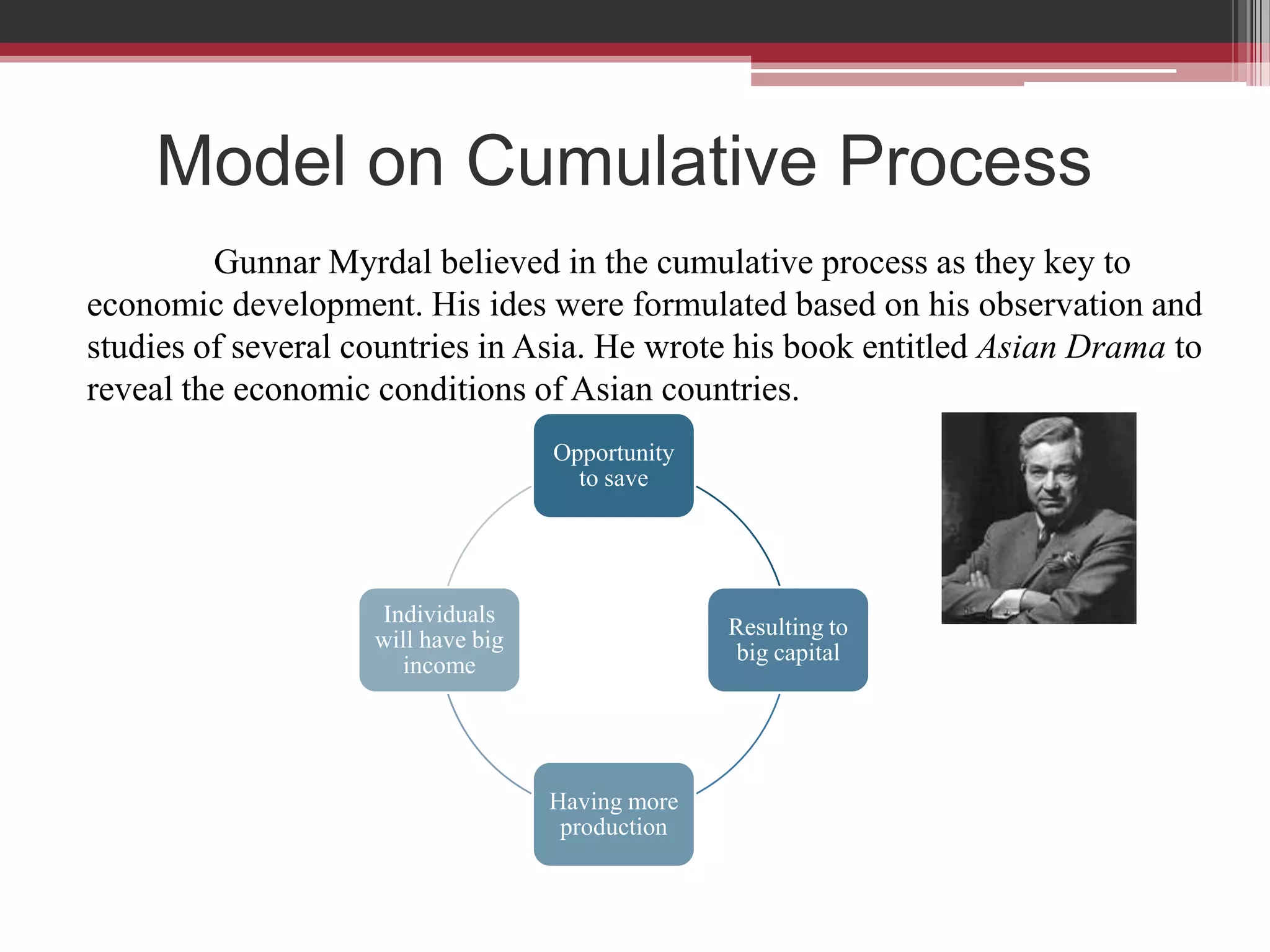
         Gunnar Myrdal believed in the cumulative process as they key to
economic development. His ides were formulated based on his observation and
studies of several countries in Asia. He wrote his book entitled Asian Drama to
reveal the economic conditions of Asian countries.
                                    Opportunity
                                      to save


                    Individuals
                                                  Resulting to
                    will have big
                                                  big capital
                      income


                                    Having more
                                     production
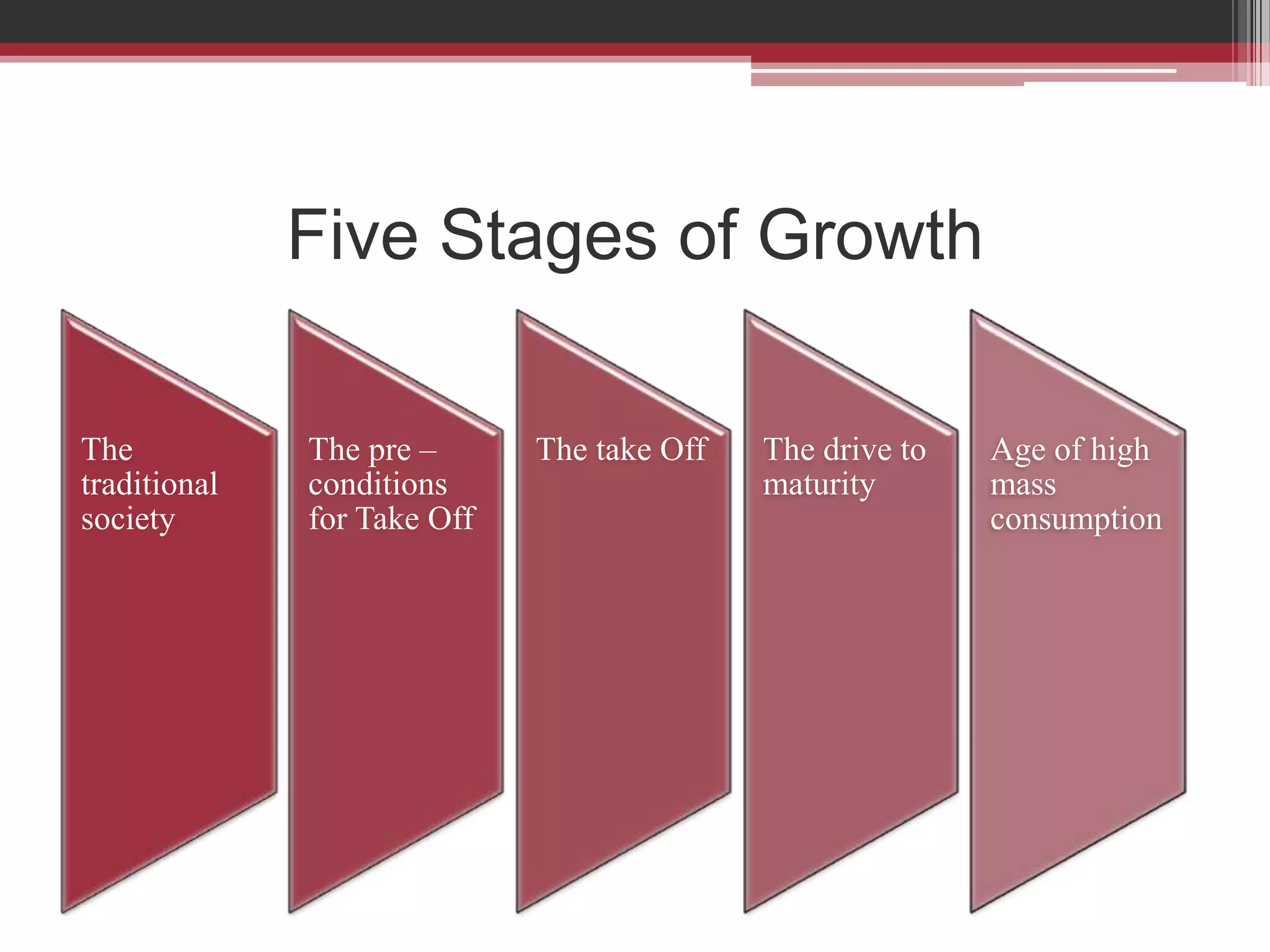
Five Stages of Growth

The           The pre –      The take Off   The drive to   Age of high
traditional   conditions                    maturity       mass
society       for Take Off                                 consumption
Theory of Karl Marx
    The economic point of view of Karl
Marx was derived from the beliefs of the
classicist. Marx gave emphasis on labor.
According to him, workers were the real
producers of the products, but the profit
goes to the capitalists and not to the
workers. As a result, differences between
the workers and capitalists exist.
Relationship of workers and capitalists


Workers (thesis)


   Capitalists (Anti – Thesis)


       New System (Synthesis)
Any Question???????
Explain your answer.
1. Do you agree that workers play an important role in
   the development of the economy as what Karl Marx
   stated? Why?
2. Why should the government intensify the
   accumulation of capital?
3. How does technology help in the development of
   the economy?
4. Why should the government support the
   entrepreneur or innovation?
Arrange the following sentences by putting number 1 – 5
according to their importance to economic development.
Use number 1 as most important.


_____ use of modern equipment in production
_____ development of other economic sectors
_____ overflowing foreign investment
_____ agreement between workers and capitalists
_____ support of the government to Filipino inventors
Finish?

If yes … exchange papers…
That’s all…..
End…
SPECIAL THANKS TO:


•ATE MARFIL
•SIR TENORIO
•MORPHEME & APOLLO
•KUA KEN
•BSED, II – T
•BSED, III – T, Math Majors
•RIZZA U
•DING
•And to CARIE heheh!
Thank you 4 oL ur SupporT..

economics IV part 3

  • 1.
    In Partial Fulfillmentof the Requirements in Major 10 (Production of Social Studies Instructional Materials) CARIE// GUILBERT/// and PRINCESSES///
  • 2.
  • 3.
    Laguna State PolytechnicUniversity San Pablo City Campus San Pablo City Guilbert Kaligayahan
  • 4.
    I’M the NextSuperstar! …Be Amazed!
  • 5.
    Are u ready2 listen?...
  • 7.
  • 9.
    Factors of Production • Production is the combination and use of all factors producing goods and services that will satisfy the needs of man. Factors of production are used to produce products and services, there are four factors of production: land, labor, capital, and entrepreneur. Land is the nonrenewable resource where the raw materials needed in production come from. This factor cannot be increased according to the desire of the individual. It is a natural factor of production. Labor or labor force, whether physical or mental, are the talents and strength necessary in production. Capital is the material things created by man. Entrepreneur is a factor of production and is called captain of the industry.
  • 10.
    The Circular Flowof Products and Services Business Products and Services Firms Market for Market for Factors of Finished Production Products Land, Labor, Capital, Household Entrepreneur
  • 11.
    Flow of Moneyas Payments for Two Sectors Business Profit, rent, Firms Income wages interest Market for Market for Factors of Finished Production Products consumption Income Household
  • 12.
    Flow of Savingsand Investments Business Profit, rent, wa Firms Income ges interest Market for Market for Factors of Finished Production Products consumption Income investment Household Market for Savings Capital
  • 13.
    The government’s rolein the circular flow Business Profit, rent, Firms Income wages interest subsidiary Tax Market for Market for Factors of Government Finished Production Products payment Transfer Tax consumption Income investment Household Market for Savings Capital
  • 14.
    Role of theForeign Market in the Circular Flow Business Profit, rent, wa Firms Income ges interest subsidiary Tax Market for Market for Factors of Government Finished Production Products payment Transfer Tax consumption Income investment Household Market Foreign for market Savings Capital
  • 15.
  • 16.
    Economic Indicators Economic progress can be traced through the economic performance of the country. It serves as gauge for the government and other sectors if they are performing well. In measuring the economic performance of the country indicators are being used. The indicators describe the condition of the country.
  • 17.
    Gross National Product(GNP) Gross National Product (GNP) is considered the most important indicator in measuring the development of the economy. In GNP, the overall production of the country is studied and examined. It is the accumulation of all the products and services produced in the country.
  • 18.
  • 19.
    If the GNPmeasures the total production of the country in a year, Gross Domestic Product (GDP) refers to the total market value of goods and services produced within the country for one year . All production within the country is included in our GDP, even if a foreigner produces it as long as it is done inside our country.
  • 20.
    Difference of GNPand GDP In general, all the produced goods and services of the Filipinos inside the Philippines is both included in GNP and GDP. As we deduct the income earned by the Filipinos abroad from the income earned by the foreigners in our country, we will get the Net Factor Income from Abroad (NFIA). When the income of the foreigners are higher than the income of the Filipinos abroad, the NFIA has a negative decrease compared to GDP.
  • 21.
    Potential and ActualGNP The number of workers, their working hours, machine- ries, and technology used and the natural resources in the country are the basis in estimating the total production of the economy. Every country has a target quantity of production based on its capacity. Potential GNP is the estimated total production of the country based on the productivity and capacity of the factors mentioned earlier. It is the goal of the economy for a year. At the end of the year, the production of the country is being measured, and it represent the actual GNP. Actual GNP is the amount of the produced goods and services attained in a country for one year. It serves as a barometer if the economy has been effective in maximizing the use of the natural resources, machineries, and workers in achieving the potential GNP.
  • 22.
  • 23.
    Approaches to GNPMeasurement Factor Income Approach: Each factor of production receives payment for its services and this serves as income. The various payments are rent for land, wages for workers, interest for capital, and profit for entrepreneur. If the factor incomes are combined together, the result is the national income.re are the main component of national income: a) Compensation of Employees (CE) – it includes the all the benefits, commission, allowance like Cost of Living Allowance (COLA), clothing and, transportation allowances, personal emergency allowance or PERA, nonmonetary benefits, payments according to the contract of the employees, and salaries that employees receive on specific time represent the compensation of employees. b) Entrepreneurial Income (EI) – this is the payment received by an individual which is not classified as wage salary. This is the income of the entrepreneur as a factor of production . c) Corporate Income (CI) - income received by corporations and intended for business expansion represent the corporate income. d) Government Income (GI) – all the incomes received by the government such as taxes, income of government owned and controlled corporations and the interest
  • 24.
    Factor Income Approach The combination of all the components mentioned above will sum up as National Income. This formula for National Income (NI): NI = CE+EI+CI+GI NI = 110+50+15+22 = For example, if CE is 197million pesos Php110million, EI = 50 million pesos, CI = 15 million pesos and GI = 22 million pesos, then, ………
  • 25.
    To be ableto measure the GNP, we will add the other production expenses such as: 1. Capital Consumption Allowance (CCA). It refers to the fund for depreciation intended for buying new machineries and facilities. 2. Indirect Business Taxes (IBT). Indirect tax imposed on the products and services made after the subsidy has been deducted. In general, GNP can be measured with the use of the formula : . . . .
  • 26.
    GNP = NI+IBT+CCA For example, if NI = 197 million pesos, IBT = 5 million pesos and 12 million pesos for CCA, then GNP is equal to 214 million pesos. Factor Income Approach shows the GNP using the different income received in the economy.
  • 27.
    Final Expenditure Approach The economic sectors like household, government, business firm, and foreign market have their own expenses, which are significant in measuring GNP, a. Government expenditure (G) b. Personal expenditure (P) c. Business expenditure (B) d. Net export (X)(M) e. Net Factor Income from Abroad (NFIA) f. Statistical Discrepancy (SD)
  • 29.
    If all theexpenditures mentioned above are put together, GNP will be computed. The formula for measuring the GNP using this approach is: GNP = G+P+B+(X – M)+NFIA+SD For example: G = 34 million pesos P = 130 million pesos B = 59 million pesos Using the formula in measuring M = -7 million pesos GNP at Factor Income Approach, X = -7 million pesos the amount is… NFIA = -5 million pesos SD = 3 million pesos
  • 30.
    Industrial Origin Approach It is also called value added approach where all the contributions of each industry like agriculture, industry, and services are computed. The value of the products depends on the contribution of every sector in the processing and production of goods and services.
  • 31.
    Limitations in Measuringthe GNP GNP alone is not enough to measure the development of the economy. Even if the government stated that the GNP achieved a five percent increase, the reality speaks the truth, the common man still not experience and feel the said increase in his daily living. Still the lives of many Filipinos are falling into poverty. In GNP measurement, not all commodities are included in the total market value of products and services. There are products and services which are not included in the computation because they are not recorded or they are not paying the required tax. This kind of activities include in the underground economy.
  • 32.
  • 33.
    Price Increases The continuing increases in the general price level of commodities are called inflation. As of now, inflation cannot be prevented. It remains big problem o the economy. The basic commodities like sugar, rice, beef, milk, cooking oil and etc. are affected by price increases. So many consumers cannot afford to satisfy their basic needs in life.
  • 34.
    Types of MeasuringInstruments of Price Changes 1. GNP deflator or GNP Implicit Price Index – it is the average price index used to adjust the current GNP against constant GNP. The GNP deflator is being used to know the value of GNP based on the previous year. This formula being used: In short, it is used for anyGNP at Current Prices in the changes in price computation of GNP. GNP at constant prices = GNP deflator
  • 35.
    2. Wholesale PriceIndex and Retail Price Index – it shows and measures the changes in the price of finished products, intermediate goods, and crude materials in wholesale and retail trading. Wholesale is the price of every piece of goods. 3. Consumer Price Index (CPI) – it is the most popular instrument in measuring inflation. The CPI measures the average percentage in the change of retail prices of commodities usually purchased by consumers. It describes the present living condition of the consumers according to changes on price. The commodities, which the CPI measures, are those products that are included in the market basket of goods. The inflation rate depends on the CPI.
  • 36.
    Computation of CPI Hypothetical Data PRICE Commodities Unit Weight 2005 2004 Rice Kilo 40 25 28 Sugar Kilo 5 19 22 Fish Kilo 10 60 80 Meat Kilo 15 85 110 Cooking Oil Kilo 20 25 32 Coffee Kilo 10 40 45
  • 37.
    1. Computation ofWeighted Price – the first step is to multiply the weight and price (w x p) to get the weighted price, we will get the WP in the year 200 and 2005. Commodities 2004 2005 Rice 1,000 1,120 Sugar 95 110 Fish 600 800 Meat 1,275 1,650 Cooking Oil 500 640 Coffee 400 450 TWP 3,870 4,770 2. Total Weighted Price (TWP) – after getting the weighted price of the commodities, combine the entire weighted price to get the total weighted price (TWP) of 2004 and 2005.
  • 38.
    3. Consumer PriceIndex (CPI) – if the TWP is already computed, then the consumer price index (CPI) of 2004 and 2005 can be computed by using this formula: TWP2005 (present year) CPI =the CPI of 2005 is 123.25 So, TWP2004(base year) based on the computation. The total of CPI should not be rounded off. 4,700 x 100 = 123.25 3,870
  • 40.
    Purchasing Power ofthe Peso (PPP) In computing the PPP, the formula 100/CPI is used to determine the real value of the peso compared to a base year. For example, if the base year is 2000 and the CPI of May 2005 is 128.3, the real value of the peso in May 2005 is 0.78 compared to the base year. What is the implication of this? The value of the peso in 2000 went down to 0.78 in May 2005. there is a decline in the purchasing power of peso.
  • 41.
  • 42.
    1. Demand –pull – all sectors of the economy, household, business firm, and government have their Kinds of own demand. The demand of these sectors comprises Inflation the aggregate demand of the economy. The demand – pull inflation happens id he sectors desire to buy products and services more than the available supply in the market. In short it is the condition where aggregate demand is more than the aggregate supply.
  • 43.
    The total expenditureof Quantity of goods to be consumer, business, firms, and produced and distributed by the government businessmen Aggregate Demand Aggregate Supply > = Demand Pull Inflation According to monetarists headed by Milton Friedman, an economist, excessive money supply or money in circulation causes the increase in the demand of each sector. Higher income or excess money leads to consumption of more products and services by households. As a result, the demand is pulling the prices of the commodities become higher. This condition prevails as long as the people continue to consume more products and services.
  • 44.
    Cost - Push •The increase in the production costs of firms leads to price increases. Income in wages, purchases of raw materials and machineries, and the desire to have more profit are the main reasons why the price of the commodities increases, particularly if the factors of production ask for high payment for the services.
  • 46.
    Inflation High Wage prices increase
  • 47.
    The increase inthe normal price of commodities is a result of an imbalance and abrupt increase of Structural demand and supply of the different sectors of he economy. There is Inflation competition among wage earners and profit earners. There is competition between the private and public sectors in getting the share of the country’s resources. Every action and movement of each economic sector causes an increase in the price of commodities. This is called Structural Inflation.
  • 48.
    Examine if thefollowing are effects of inflation or causes of inflation. Write EI if it is an effect and CI if it is a cause. ____1. consumers cannot afford to buy many products in the market ____2. a big portion of our budget is allocated for the payment of foreign debt ____3. a huge amount of bonus is given to workers ____4. corruption in the government is so rampant ____5. increase in the production level of the country.
  • 49.
  • 50.
    Groups that usuallybenefit during Inflation 1. Borrowers 2. Speculators 3. People without Fixed income 4. On people with Fixed income 5. On lenders
  • 51.
    The causes andsolutions of inflation CAUSES RESULTS POSSIBLE SOLUTIONS Excess money in Increase in demand Improve a tight money policy circulation High production cost Decrease in supply Increase production by maximizing the use of resources Export orientation Shortage of supply in the Give priority to the needs of the local local market market Import dependence Oversupply of imported Utilize and maximize the local products resources Monopoly and cartel Price is manipulated and Enforce penalty to the members of controlled cartel Middlemen The price of goods is Impose price control increasing Loan payment The amount is not utilized Set aside a small part of the national for the development of the budget for debt services industries Military expenses Buying unnecessary military Use the money in agricultural equipment development
  • 52.
    A. Fill inthe blanks with correct answer. ____1. the evidence of government credit to the public ____2. experience bankruptcy during inflation ____3. strategy of Banko Sentral ng Pilipinas to monitor and control the money supply ____4. specific amount of money that depreciates if left in the bank ____5. businessmen who buy products when the price is increasing.
  • 53.
  • 54.
    What is income? •Income is the money received by an individual as payment for producing goods and services. Per Capita income (PCI) is the income received by an individual if the total population divides the total production. It is also known as GNP per capita. In computing the per capita income use he formula: GNP = GNP per capita Population
  • 55.
    Income distribution Refers to show the national income is divided among all sectors of the economy. A study of the statistical report of NEDA shows that the target of the national economy is very far from being realized.
  • 56.
    Lorenz Curve Income distribution in a country is illustrated in a curve called Lorenz Curve, which was formulated by Conrad Lorenz, an American statistician. Lorenz curve consist of two axes: the horizontal that represents the percentage of population by income group and the vertical, which represents the percentage of income received. In constructing the Lorenz curve , it is necessary to get the cumulative percentage of income and population.
  • 57.
  • 58.
    For you.. Whatis development and progress …?
  • 59.
    • The termDevelopment and Progress are frequently used in economics. The two terms are interrelated but they have different characteristics What is development and what is progress? Economic progress can be easily measured. It is the result of a process that shows changes in the economy. While… Economic development is not only the idea of improvement of the economy cut also the enhancement of human dignity, security, justice, and equality.
  • 60.
    Progress leads toDevelopment Development Social Changes Progress
  • 61.
    The Principle Theorieson progress and Development Physiocrats, composed of economist led by Francios Quesnay, believed in the rule of nature. Physiocrats agreed hat industrialists and businessmen must have the freedom to intensify the industries. They supported the Laissez Faire doctrine because they believed that the expansion of industries is vital to economic development.
  • 62.
    Model of Physiocrats Agriculture Laissez Faire Physiocrats
  • 63.
    Theory of AdamSmith Adam smith is popularly known as he Father of “Modern Economics”. The principle of Adam Smith centered on the development of production through specialization. Specialization is the division of work based on capacity and ability. Job specialization is necessary in improving and fact tracking work.
  • 64.
    Theory of DavidRicardo The physiocrats influenced David Ricardo on the idea of development. His theory centered on the advantages provided by the possession of natural resources, particularly land. The rapid increase of population is the main reason why lands are cultivated even if they are not fertile land. People have to do it in order o have a plantation for agricultural products, which will satisfy he needs of the individual.
  • 65.
    Neoclassical School This group economists follows the ideas of the classicists. Neoclassicists believe that are underlying factors that contribute to the development and progress of the country. Competition No Monopoly Free Trade Aid from the Government
  • 66.
    One important mechanismthat motivates businessmen and consumers to improve their activities is competition. Competition can only be achieved if there is no monopoly or oligopoly in the market that causes crisis in the economy. Free trade is an effective method in the exchange goods services among countries without setting up barriers like quotas and tariffs. Quotas are limitations in the quantity of products that can be exported or imported while the tariffs are tax levied on imported products. The aforementioned factors are necessary to increase the revenue of the economy in order for it to achieve progress, according to neoclassicists.
  • 67.
    Identify whether developmentor progress is happening. Write P for progress and D for Development. ____1. the government constructed a skyway. ____2. investment is increasing ____3. the people are fully employed ____4. the government allocates a big budget for the improvement of health services ____5. each family has remote control appliances
  • 68.
  • 69.
    Models on Progressand Development Model on Capital Model on technology Model on cumulative process
  • 70.
    Model on Capital Roy Harrod of England and Evsey Domar of USA state that abundant and sufficient capital is vital for economic progress. This was explained through the relationship of input and output. INPUT Machineries OUTPUT Buildings Production Finished Products Equipment Workers and abilities And skills and services
  • 71.
    Model on Technology Nicholas Kaldor emphasized the important role of technology. Technology involves the use of capital. It is necessary to develop technology as part of investment. According to Kaldor, if technology develops faster than the stock of capital, additional productivity occurs and it will continue increasing. And the result is more investment. One good example of the importance of technology on economic progress and development is the case of Japan, which is considered the richest and most progressive country in Asia. The government of Japan set aside a big budget on research and technology to help he industries to prosper. They use robots in hospital, offices, and factories as workers. They introduce new inventions and technological breakthroughs.
  • 72.
    Model on CumulativeProcess Gunnar Myrdal believed in the cumulative process as they key to economic development. His ides were formulated based on his observation and studies of several countries in Asia. He wrote his book entitled Asian Drama to reveal the economic conditions of Asian countries. Opportunity to save Individuals Resulting to will have big big capital income Having more production
  • 73.
    Five Stages ofGrowth The The pre – The take Off The drive to Age of high traditional conditions maturity mass society for Take Off consumption
  • 74.
    Theory of KarlMarx The economic point of view of Karl Marx was derived from the beliefs of the classicist. Marx gave emphasis on labor. According to him, workers were the real producers of the products, but the profit goes to the capitalists and not to the workers. As a result, differences between the workers and capitalists exist.
  • 75.
    Relationship of workersand capitalists Workers (thesis) Capitalists (Anti – Thesis) New System (Synthesis)
  • 76.
  • 77.
    Explain your answer. 1.Do you agree that workers play an important role in the development of the economy as what Karl Marx stated? Why? 2. Why should the government intensify the accumulation of capital? 3. How does technology help in the development of the economy? 4. Why should the government support the entrepreneur or innovation?
  • 78.
    Arrange the followingsentences by putting number 1 – 5 according to their importance to economic development. Use number 1 as most important. _____ use of modern equipment in production _____ development of other economic sectors _____ overflowing foreign investment _____ agreement between workers and capitalists _____ support of the government to Filipino inventors
  • 79.
    Finish? If yes …exchange papers…
  • 80.
  • 81.
  • 82.
    SPECIAL THANKS TO: •ATEMARFIL •SIR TENORIO •MORPHEME & APOLLO •KUA KEN •BSED, II – T •BSED, III – T, Math Majors •RIZZA U •DING •And to CARIE heheh!
  • 83.
    Thank you 4oL ur SupporT..