Department of Computer Science & Engineering
DISSERTATION on
Image Retrieval for Medical Imaging Using Gabor Wavelet and GLCM
Texture Features Approach
Guided By:
Ms. Astha Gautam
Assistant Professor
Department of Computer Science & Engineering
Presented By
Isha Sharma
Roll No-MT-1206
M.Tech CSE
Outline
 Abstract
 Introduction
 Literature Survey
 Problem Formulation
 Objectives
 Methodology
 Results
 Precision, Recall and Accuracy
 Conclusion
 Future Scope
Abstract
 Content-Based Image Retrieval (CBIR) has become one of the most active areas in
research in the past few decades. Since, the numbers of digital images are hugely
available and are growing.
 Hence, one of the fields that may profit more from CBIR is medical area, where
generation of digital images is huge. Surgeon can query image databases to detect
tumours and malformations in X-rays or Magnetic Resonance Images (MRI) based on
the image content.
 Extensive research has been done to develop methods to ensure that queries become
faster and more effective but several problems related to semantic meaning of image
content along with retrieval efficiency in large databases are yet to be solved.
 Retrieval of images based not on keywords or annotations but based on futures
extracted directly from the image data.
 Searching a large database for images that match a query.
 The term CBIR was coined by T. Kato in 1992, to describe
experiments into automatic retrieval of images from a
database, based on the colors and shapes present.
 Why CBIR??????
 What kinds of queries?
 Applications of CBIR
Content-based Image Retrieval (CBIR)
Applications
 In Biomedical
 In crime anticipation
 In military
 In architectural and manufacturing
 In fashion and interior design
 In geographical and remote sensing systems
 In cultural heritage
 In education and training
 In World Wide Web searching
What is a Query?
 an image you already have
How did you get it?
 a rough sketch you draw
How might you draw it?
 a symbolic description of what you want
What’s an example?
How to search images?????
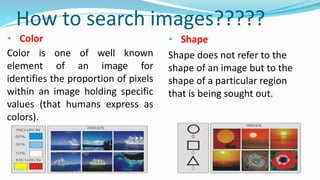
• Color • Shape
Color is one of well known
element of an image for
identifies the proportion of pixels
within an image holding specific
values (that humans express as
colors).
Shape does not refer to the
shape of an image but to the
shape of a particular region
that is being sought out.
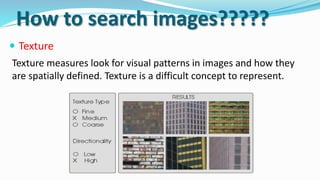
 Texture
Texture measures look for visual patterns in images and how they
are spatially defined. Texture is a difficult concept to represent.
How to search images?????
Literature Review
Literature Review
Literature Review
Problem Formulation
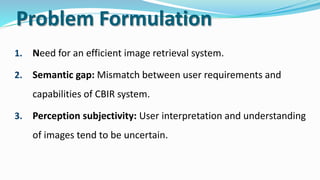
1. Need for an efficient image retrieval system.
2. Semantic gap: Mismatch between user requirements and
capabilities of CBIR system.
3. Perception subjectivity: User interpretation and understanding
of images tend to be uncertain.
Objectives
1. To improve the performance of cbir system to achieve better
accuracy.
2. To implement various features of images for cbir listed below:
1. Contrast
2. Mean and Standard deviation.
3. Entropy
4. Energy
3. Applying Similarity measures.
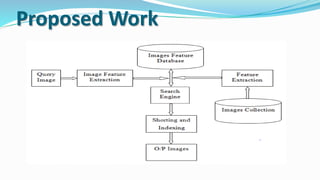
Proposed Work
Result
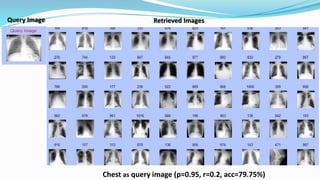
Chest as query image (p=0.95, r=0.2, acc=79.75%)
Query Image Retrieved Images
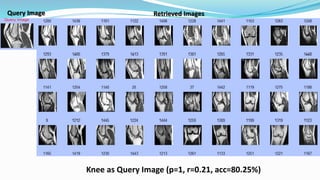
Knee as Query Image (p=1, r=0.21, acc=80.25%)
Query Image Retrieved Images
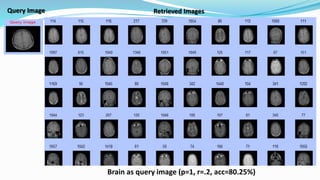
Brain as query image (p=1, r=.2, acc=80.25%)
Query Image Retrieved Images
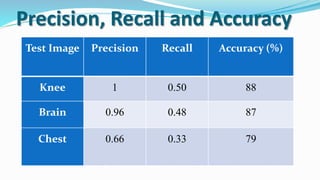
Precision, Recall and Accuracy
Test Image Precision Recall Accuracy (%)
Knee 1 0.50 88
Brain 0.96 0.48 87
Chest 0.66 0.33 79
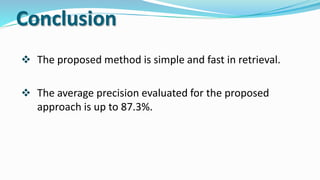
Conclusion
 The proposed method is simple and fast in retrieval.
 The average precision evaluated for the proposed
approach is up to 87.3%.
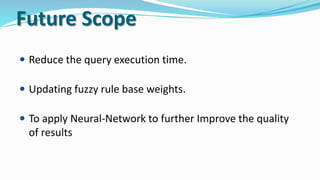
Future Scope
 Reduce the query execution time.
 Updating fuzzy rule base weights.
 To apply Neural-Network to further Improve the quality
of results
List of Publications from the Dissertation
 CONTENT BASED IMAGE RETRIEVAL SYSTEM : A SURVEY Isha
Sharma International Journal of Research Fellow for
Engineering Volume 3, Issue 3 March.2015 , pp. 1-6
 Image Retrieval for Medical Imaging Using Gabor Wavelet
and GLCM Texture Features Approach Isha Sharma
International Journal of Graphics & Image Processing (IJGIP)
Volume 5 Issue 2 May 2015,pp.1-6
References
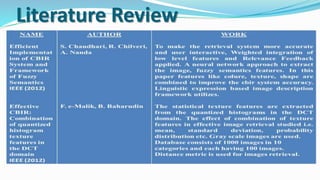
 [1] S. Chaudhari, R. Chilveri, A. Nanda, and R. Borse, “Efficient Implementation of CBIR
System and Framework of Fuzzy Semantics,” 2012 Int. Conf. Adv. Mob. Network, Commun. Its
Appl., pp. 111–114, Aug. 2012.
 [2] B. Baharudin, “Effective content-based image retrieval: Combination of quantized
histogram texture features in the DCT domain,” 2012 Int. Conf. Comput. Inf. Sci., pp. 425–430,
Jun. 2012.
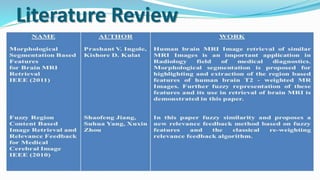
 [3] P. V. Ingole and K. D. Kulat, “A Morphological Segmentation Based Features for Brain
MRI Retrieval,” 2011 Fourth Int. Conf. Emerg. Trends Eng. Technol., pp. 210–214, Nov. 2011.
 [4] S. Jiang, S. Yang, X. Zhou, and W. Chen, “Fuzzy region content based image retrieval
and relevance feedback for medical cerebral image,” 2010 3rd Int. Conf. Biomed. Eng.
Informatics, pp. 282–285, Oct. 2010.
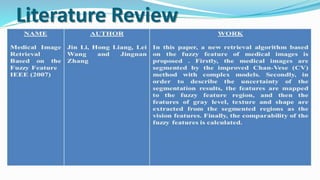
 [5] J. Li, H. Liang, L. Wang, and J. Zhang, “The Medical Image Retrieval Based on the Fuzzy
Feature,” 2007 Int. Conf. Mechatronics Autom., pp. 1245–1250, Aug. 2007.
THANK YOU

CBIR For Medical Imaging...

  • 1.
    Department of ComputerScience & Engineering DISSERTATION on Image Retrieval for Medical Imaging Using Gabor Wavelet and GLCM Texture Features Approach Guided By: Ms. Astha Gautam Assistant Professor Department of Computer Science & Engineering Presented By Isha Sharma Roll No-MT-1206 M.Tech CSE
  • 2.
    Outline  Abstract  Introduction Literature Survey  Problem Formulation  Objectives  Methodology  Results  Precision, Recall and Accuracy  Conclusion  Future Scope
  • 3.
    Abstract  Content-Based ImageRetrieval (CBIR) has become one of the most active areas in research in the past few decades. Since, the numbers of digital images are hugely available and are growing.  Hence, one of the fields that may profit more from CBIR is medical area, where generation of digital images is huge. Surgeon can query image databases to detect tumours and malformations in X-rays or Magnetic Resonance Images (MRI) based on the image content.  Extensive research has been done to develop methods to ensure that queries become faster and more effective but several problems related to semantic meaning of image content along with retrieval efficiency in large databases are yet to be solved.  Retrieval of images based not on keywords or annotations but based on futures extracted directly from the image data.
  • 4.
     Searching alarge database for images that match a query.  The term CBIR was coined by T. Kato in 1992, to describe experiments into automatic retrieval of images from a database, based on the colors and shapes present.  Why CBIR??????  What kinds of queries?  Applications of CBIR Content-based Image Retrieval (CBIR)
  • 5.
    Applications  In Biomedical In crime anticipation  In military  In architectural and manufacturing  In fashion and interior design  In geographical and remote sensing systems  In cultural heritage  In education and training  In World Wide Web searching
  • 6.
    What is aQuery?  an image you already have How did you get it?  a rough sketch you draw How might you draw it?  a symbolic description of what you want What’s an example?
  • 7.
    How to searchimages????? • Color • Shape Color is one of well known element of an image for identifies the proportion of pixels within an image holding specific values (that humans express as colors). Shape does not refer to the shape of an image but to the shape of a particular region that is being sought out.
  • 8.
     Texture Texture measureslook for visual patterns in images and how they are spatially defined. Texture is a difficult concept to represent. How to search images?????
  • 9.
  • 10.
  • 11.
  • 12.
    Problem Formulation 1. Needfor an efficient image retrieval system. 2. Semantic gap: Mismatch between user requirements and capabilities of CBIR system. 3. Perception subjectivity: User interpretation and understanding of images tend to be uncertain.
  • 13.
    Objectives 1. To improvethe performance of cbir system to achieve better accuracy. 2. To implement various features of images for cbir listed below: 1. Contrast 2. Mean and Standard deviation. 3. Entropy 4. Energy 3. Applying Similarity measures.
  • 14.
  • 15.
  • 16.
    Chest as queryimage (p=0.95, r=0.2, acc=79.75%) Query Image Retrieved Images
  • 17.
    Knee as QueryImage (p=1, r=0.21, acc=80.25%) Query Image Retrieved Images
  • 18.
    Brain as queryimage (p=1, r=.2, acc=80.25%) Query Image Retrieved Images
  • 19.
    Precision, Recall andAccuracy Test Image Precision Recall Accuracy (%) Knee 1 0.50 88 Brain 0.96 0.48 87 Chest 0.66 0.33 79
  • 20.
    Conclusion  The proposedmethod is simple and fast in retrieval.  The average precision evaluated for the proposed approach is up to 87.3%.
  • 21.
    Future Scope  Reducethe query execution time.  Updating fuzzy rule base weights.  To apply Neural-Network to further Improve the quality of results
  • 22.
    List of Publicationsfrom the Dissertation  CONTENT BASED IMAGE RETRIEVAL SYSTEM : A SURVEY Isha Sharma International Journal of Research Fellow for Engineering Volume 3, Issue 3 March.2015 , pp. 1-6  Image Retrieval for Medical Imaging Using Gabor Wavelet and GLCM Texture Features Approach Isha Sharma International Journal of Graphics & Image Processing (IJGIP) Volume 5 Issue 2 May 2015,pp.1-6
  • 23.
    References  [1] S.Chaudhari, R. Chilveri, A. Nanda, and R. Borse, “Efficient Implementation of CBIR System and Framework of Fuzzy Semantics,” 2012 Int. Conf. Adv. Mob. Network, Commun. Its Appl., pp. 111–114, Aug. 2012.  [2] B. Baharudin, “Effective content-based image retrieval: Combination of quantized histogram texture features in the DCT domain,” 2012 Int. Conf. Comput. Inf. Sci., pp. 425–430, Jun. 2012.  [3] P. V. Ingole and K. D. Kulat, “A Morphological Segmentation Based Features for Brain MRI Retrieval,” 2011 Fourth Int. Conf. Emerg. Trends Eng. Technol., pp. 210–214, Nov. 2011.  [4] S. Jiang, S. Yang, X. Zhou, and W. Chen, “Fuzzy region content based image retrieval and relevance feedback for medical cerebral image,” 2010 3rd Int. Conf. Biomed. Eng. Informatics, pp. 282–285, Oct. 2010.  [5] J. Li, H. Liang, L. Wang, and J. Zhang, “The Medical Image Retrieval Based on the Fuzzy Feature,” 2007 Int. Conf. Mechatronics Autom., pp. 1245–1250, Aug. 2007.
  • 24.