International Journal of Trend in Scientific Research and Development (IJTSRD)
Volume: 3 | Issue: 4 | May-Jun 2019 Available Online: www.ijtsrd.com e-ISSN: 2456 - 6470
@ IJTSRD | Unique Paper ID – IJTSRD24047 | Volume – 3 | Issue – 4 | May-Jun 2019 Page: 1151
Content Based Image Retrieval
Dr. Aziz Makandar1, Mrs. Rashmi Somshekhar2, Miss. Nayan Jadav3
1Professor, 2Research Scholar, 3Student
1, 2, 3Department of Computer Science, Women’s University, Vijayapura, Karnataka, India
How to cite this paper: Dr. Aziz
Makandar | Mrs. Rashmi Somshekhar |
Miss. NayanJadav"ContentBased Image
Retrieval" Published in International
Journal of Trend in Scientific Research
and Development
(ijtsrd), ISSN: 2456-
6470, Volume-3 |
Issue-4, June 2019,
pp.1151-1154, URL:
https://www.ijtsrd.c
om/papers/ijtsrd24
047.pdf
Copyright © 2019 by author(s) and
International Journal of Trend in
Scientific Research and Development
Journal. This is an Open Access article
distributed under
the terms of the
Creative Commons
Attribution License (CC BY 4.0)
(http://creativecommons.org/licenses/
by/4.0)
ABSTRACT
The incremented desideratum of content-based image retrieval system can be
found in a number of different domains such as Data Mining, Edification, Medical
Imaging, Malefaction Aversion, climate, Remote Sensing and Management of
Globe Resources. Google’s image search and photo album implements such as
image search, Google’s Picasa project applications in general gregarious
networking environment, the hunt for practical, efficacious image search in the
web context. Our application provides the color based image retrieval, utilizing
features like dominant color. The color features are obtained through wavelet
transformation and color histogram and the amalgamation of these features is
robust to scaling and translation of objectsinan image.Theproposed systemhas
established a promising and more expeditious retrievalmethod on ainputimage
database containing more general-purpose color images. The performance has
been analysed by estimating with the subsisting systems in the literature.
Keywords: Color based image retrieval, wavelet transformation, Color histogram
1. INTRODUCTION
Color Image databases and accumulations can be gargantuan in size, containing
hundreds, thousands or even millions of color images. The conventional method
of color image retrieval is probing forakeyword that would matchthedescriptive
keyword assigned to the image by a human categorizer. Currently under
development, albeit several systems subsist, is the retrieval of images based on
their content, called CBIR. While computationally expensive,
the results are far more precise than conventional image
indexing. Hence, there subsistsatrade-off betweenprecision
and computational price. This trade-off decreases as more
efficient algorithms are utilized and incremented
computational power becomesinexpensive. ThisisnotCBIR,
In CBIR, each image which is retrieved fromthedatabase has
its features obtained and compared to the features of the
query image.
2. IMAGE RETRIEVAL
The process of browsing, searching and fetching imagefrom
a large database of digital image.
CBIR used 2 approaches for retrieving the image from the
image database.
A. TEXT BASED APPROACH (INDEX IMAGES USING
KEYWORDS)
It deals with searching images from a vast database fulfilling
a user specified criterion. queries are texts and targets are
images. Text based method used the keywords descriptions
as a input and get the desired output in the form of similar
types of images.
B. CONTENT-BASEDAPPROACH (INDEX IMAGES USING
IMAGES)
Content-based image retrieval (CBIR) uses visual
information of the images to retrieve them from large image
databases according to user’s interest. Content based
approach using image as an input query and it generate the
output of similar types of images.
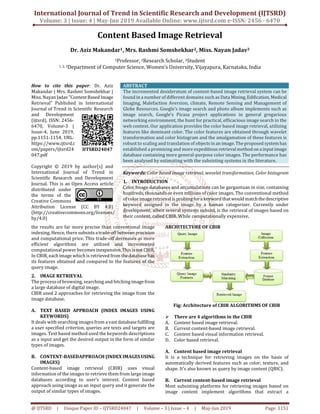
ARCHITECTURE OF CBIR
Fig: Architecture of CBIR ALGORITHMS OF CBIR
There are 4 algorithms in the CBIR
A. Content based image retrieval.
B. Current content-based image retrieval.
C. Content based visual information retrieval.
D. Color based retrieval.
A. Content based image retrieval
It is a technique for retrieving images on the basis of
automatically derived features such as color, texture, and
shape. It’s also known as query by image content (QBIC).
B. Current content-based image retrieval
Most subsisting platforms for retrieving images based on
image content implement algorithms that extract a
IJTSRD24047
International Journal of Trend in Scientific Research and Development (IJTSRD) @ www.ijtsrd.com eISSN: 2456-6470
@ IJTSRD | Unique Paper ID - IJTSRD24047 | Volume – 3 | Issue – 4 | May-Jun 2019 Page: 1152
coalescence of shape, texture and shape features from an
image.
C. Content based visual information retrieval
The application of computer vision to the image retrieval
problem, that the problem of searching for digital images in
large database.
D. Color based retrieval
Most used color code will be obtained by extracting color
code from input image. The average color codeisdeclared as
most used color in the input image.
3. PROPOSED METHOD
The solution initially proposed was to extract the primitive
features of a query color image and compare them to those
of database color images. The image features under
consideration of dominant / dominant color. Query Image
will be converted Image Matrix We have developed
customized algorithm in C# which will obtained the
dominant color in an image. The dominantcoloralgorithmis
used for determining the overall tone of an image. This
algorithm is very simple and there are probably more
involutes and hence, better color algorithms out there.
The dominant color is obtained by analysing every pixel in
the image. For each pixel, our application will keep trackof3
values: the red ratio, the green ratio, and the blue ratio
(RGB). In our project we won't consider the alpha i.e.
transparency. Hence, we analyse each pixel; our application
will emerged color which is considered as dominant color.
Maintain an average of the entire red ratio, all the green
ratio, and the entire blue ratio. Analysing the entire image,
our application will predict most.
QUERY FORMATION
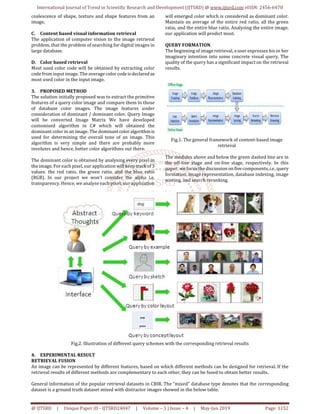
The beginning of image retrieval, a user expresses his or her
imaginary intention into some concrete visual query. The
quality of the query has a significant impact on the retrieval
results.
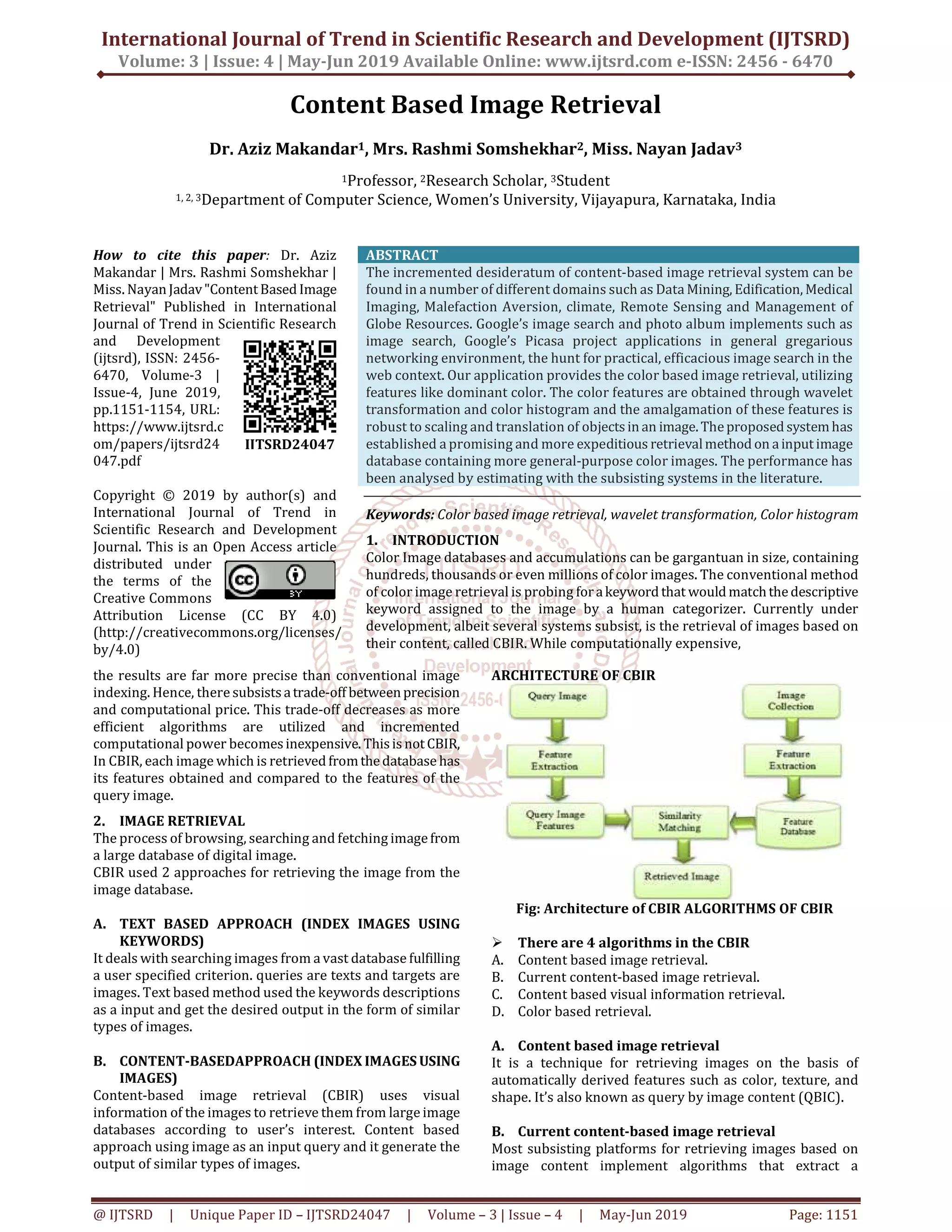
Fig.1. The general framework of content-based image
retrieval
The modules above and below the green dashed line are in
the off-line stage and on-line stage, respectively. In this
paper, we focus the discussion on fivecomponents,i.e., query
formation, image representation, database indexing, image
scoring, and search reranking.
Fig.2. Illustration of different query schemes with the corresponding retrieval results
4. EXPERIMENTAL RESULT
RETRIEVAL FUSION
An image can be represented by different features, based on which different methods can be designed for retrieval. If the
retrieval results of different methods are complementary to each other, they can be fused to obtain better results.
General information of the popular retrieval datasets in CBIR. The “mixed” database type denotes that the corresponding
dataset is a ground truth dataset mixed with distractor images showed in the below table.
International Journal of Trend in Scientific Research and Development (IJTSRD) @ www.ijtsrd.com eISSN: 2456-6470
@ IJTSRD | Unique Paper ID - IJTSRD24047 | Volume – 3 | Issue – 4 | May-Jun 2019 Page: 1153
Table1.
Database Name Database Type Database Size Query Number Category Number Resolution
UKBench Ground Truth 10,200 10,200 2,550 640×480
Holidays Ground Truth 1,491 500 500 1024×768
Oxford-5K Mixed 6,053 55 11 1024×768
Paris Mixed 6,412 500 12 1024×768
DupImage Ground Truth 1,104 108 33 460×350 (average)
FlickrLogos-32 Mixed 8,240 500 32 1024×768
INSTRE Ground Truth 28,543 N/A 200 1000×720 (average)
ZuBuD Ground Truth 1,005 115 200 320×240
SMVS Ground Truth 1,200 3,300 1,200 640×480
MIR Flickr-1M Distractor 1,000,000 N/A N/A 500×500
Flickr1M Distractor 1,000,000 N/A N/A N/A
Fig: The database result as per our registration
About tools
Front - End Tool: ASP.NET
Reason- Fast and easy to implemented with added security
Back - End Tool: Ms SQL Server
Reason- It facilitates in handling queries, managing table
data and designing a good database system.
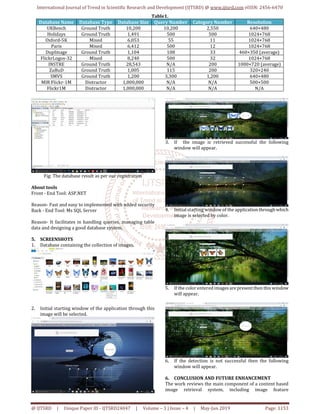
5. SCREENSHOTS
1. Database containing the collection of images.
2. Initial starting window of the application through this
image will be selected.
3. If the image is retrieved successful the following
window will appear.
4. Initial starting window of the application through which
image is selected by color.
5. If the color entered imagesarepresentthen thiswindow
will appear.
6. If the detection is not successful then the following
window will appear.
6. CONCLUSION AND FUTURE ENHANCEMENT
The work reviews the main component of a content based
image retrieval system, including image feature
International Journal of Trend in Scientific Research and Development (IJTSRD) @ www.ijtsrd.com eISSN: 2456-6470
@ IJTSRD | Unique Paper ID - IJTSRD24047 | Volume – 3 | Issue – 4 | May-Jun 2019 Page: 1154
representation, query processing and query image
matching and user’s interaction, while highlighting the
current state of the art and the key challenges.
FUTURE SCOPE
Email notifications.
Secure authentications with backend for college faculty
to upload notes anywhere anytime.
References
[1] Y. Rui, T. S. Huang, M. Ortega, and S. Mehrotra,
“Relevance feedback: a power tool for interactive
content-based image retrieval,” IEEE Transactions on
Circuits and Systems for Video Technology, vol. 8, no. 5,
pp. 644–655, 1998.
[2] A. Alzubi, A. Amira, and N. Ramzan, “Semantic content-
based image retrieval: A comprehensive study,” Journal
of Visual Communication andImageRepresentation, vol.
32, pp. 20–54, 2015.
[3] X. Li, T. Uricchio, L. Ballan, M. Bertini, C. G. Snoek, and A.
D. Bimbo, “Socializing the semantic gap: A comparative
survey on image tag assignment, refinement, and
retrieval,” ACM Computing Surveys (CSUR), vol. 49, no.
1, p. 14, 2016.
[4] Z. Lin, G. Ding, M. Hu, and J. Wang, “Semantics-
preserving hashing for cross-view retrieval,” in IEEE
Conference on ComputerVisionand PatternRecognition
(CVPR), 2015, pp. 3864–3872.
[5] A. W. Smeulders, M. Worring, S. Santini, A. Gupta, and R.
Jain, “Content-based image retrieval at the end of the
early years,” IEEE Transactions on Pattern Analysis and
Machine Intelligence, vol. 22, no. 12, pp. 1349–1380,
2000.

Content Based Image Retrieval

  • 1.
    International Journal ofTrend in Scientific Research and Development (IJTSRD) Volume: 3 | Issue: 4 | May-Jun 2019 Available Online: www.ijtsrd.com e-ISSN: 2456 - 6470 @ IJTSRD | Unique Paper ID – IJTSRD24047 | Volume – 3 | Issue – 4 | May-Jun 2019 Page: 1151 Content Based Image Retrieval Dr. Aziz Makandar1, Mrs. Rashmi Somshekhar2, Miss. Nayan Jadav3 1Professor, 2Research Scholar, 3Student 1, 2, 3Department of Computer Science, Women’s University, Vijayapura, Karnataka, India How to cite this paper: Dr. Aziz Makandar | Mrs. Rashmi Somshekhar | Miss. NayanJadav"ContentBased Image Retrieval" Published in International Journal of Trend in Scientific Research and Development (ijtsrd), ISSN: 2456- 6470, Volume-3 | Issue-4, June 2019, pp.1151-1154, URL: https://www.ijtsrd.c om/papers/ijtsrd24 047.pdf Copyright © 2019 by author(s) and International Journal of Trend in Scientific Research and Development Journal. This is an Open Access article distributed under the terms of the Creative Commons Attribution License (CC BY 4.0) (http://creativecommons.org/licenses/ by/4.0) ABSTRACT The incremented desideratum of content-based image retrieval system can be found in a number of different domains such as Data Mining, Edification, Medical Imaging, Malefaction Aversion, climate, Remote Sensing and Management of Globe Resources. Google’s image search and photo album implements such as image search, Google’s Picasa project applications in general gregarious networking environment, the hunt for practical, efficacious image search in the web context. Our application provides the color based image retrieval, utilizing features like dominant color. The color features are obtained through wavelet transformation and color histogram and the amalgamation of these features is robust to scaling and translation of objectsinan image.Theproposed systemhas established a promising and more expeditious retrievalmethod on ainputimage database containing more general-purpose color images. The performance has been analysed by estimating with the subsisting systems in the literature. Keywords: Color based image retrieval, wavelet transformation, Color histogram 1. INTRODUCTION Color Image databases and accumulations can be gargantuan in size, containing hundreds, thousands or even millions of color images. The conventional method of color image retrieval is probing forakeyword that would matchthedescriptive keyword assigned to the image by a human categorizer. Currently under development, albeit several systems subsist, is the retrieval of images based on their content, called CBIR. While computationally expensive, the results are far more precise than conventional image indexing. Hence, there subsistsatrade-off betweenprecision and computational price. This trade-off decreases as more efficient algorithms are utilized and incremented computational power becomesinexpensive. ThisisnotCBIR, In CBIR, each image which is retrieved fromthedatabase has its features obtained and compared to the features of the query image. 2. IMAGE RETRIEVAL The process of browsing, searching and fetching imagefrom a large database of digital image. CBIR used 2 approaches for retrieving the image from the image database. A. TEXT BASED APPROACH (INDEX IMAGES USING KEYWORDS) It deals with searching images from a vast database fulfilling a user specified criterion. queries are texts and targets are images. Text based method used the keywords descriptions as a input and get the desired output in the form of similar types of images. B. CONTENT-BASEDAPPROACH (INDEX IMAGES USING IMAGES) Content-based image retrieval (CBIR) uses visual information of the images to retrieve them from large image databases according to user’s interest. Content based approach using image as an input query and it generate the output of similar types of images. ARCHITECTURE OF CBIR Fig: Architecture of CBIR ALGORITHMS OF CBIR There are 4 algorithms in the CBIR A. Content based image retrieval. B. Current content-based image retrieval. C. Content based visual information retrieval. D. Color based retrieval. A. Content based image retrieval It is a technique for retrieving images on the basis of automatically derived features such as color, texture, and shape. It’s also known as query by image content (QBIC). B. Current content-based image retrieval Most subsisting platforms for retrieving images based on image content implement algorithms that extract a IJTSRD24047
  • 2.
    International Journal ofTrend in Scientific Research and Development (IJTSRD) @ www.ijtsrd.com eISSN: 2456-6470 @ IJTSRD | Unique Paper ID - IJTSRD24047 | Volume – 3 | Issue – 4 | May-Jun 2019 Page: 1152 coalescence of shape, texture and shape features from an image. C. Content based visual information retrieval The application of computer vision to the image retrieval problem, that the problem of searching for digital images in large database. D. Color based retrieval Most used color code will be obtained by extracting color code from input image. The average color codeisdeclared as most used color in the input image. 3. PROPOSED METHOD The solution initially proposed was to extract the primitive features of a query color image and compare them to those of database color images. The image features under consideration of dominant / dominant color. Query Image will be converted Image Matrix We have developed customized algorithm in C# which will obtained the dominant color in an image. The dominantcoloralgorithmis used for determining the overall tone of an image. This algorithm is very simple and there are probably more involutes and hence, better color algorithms out there. The dominant color is obtained by analysing every pixel in the image. For each pixel, our application will keep trackof3 values: the red ratio, the green ratio, and the blue ratio (RGB). In our project we won't consider the alpha i.e. transparency. Hence, we analyse each pixel; our application will emerged color which is considered as dominant color. Maintain an average of the entire red ratio, all the green ratio, and the entire blue ratio. Analysing the entire image, our application will predict most. QUERY FORMATION The beginning of image retrieval, a user expresses his or her imaginary intention into some concrete visual query. The quality of the query has a significant impact on the retrieval results. Fig.1. The general framework of content-based image retrieval The modules above and below the green dashed line are in the off-line stage and on-line stage, respectively. In this paper, we focus the discussion on fivecomponents,i.e., query formation, image representation, database indexing, image scoring, and search reranking. Fig.2. Illustration of different query schemes with the corresponding retrieval results 4. EXPERIMENTAL RESULT RETRIEVAL FUSION An image can be represented by different features, based on which different methods can be designed for retrieval. If the retrieval results of different methods are complementary to each other, they can be fused to obtain better results. General information of the popular retrieval datasets in CBIR. The “mixed” database type denotes that the corresponding dataset is a ground truth dataset mixed with distractor images showed in the below table.
  • 3.
    International Journal ofTrend in Scientific Research and Development (IJTSRD) @ www.ijtsrd.com eISSN: 2456-6470 @ IJTSRD | Unique Paper ID - IJTSRD24047 | Volume – 3 | Issue – 4 | May-Jun 2019 Page: 1153 Table1. Database Name Database Type Database Size Query Number Category Number Resolution UKBench Ground Truth 10,200 10,200 2,550 640×480 Holidays Ground Truth 1,491 500 500 1024×768 Oxford-5K Mixed 6,053 55 11 1024×768 Paris Mixed 6,412 500 12 1024×768 DupImage Ground Truth 1,104 108 33 460×350 (average) FlickrLogos-32 Mixed 8,240 500 32 1024×768 INSTRE Ground Truth 28,543 N/A 200 1000×720 (average) ZuBuD Ground Truth 1,005 115 200 320×240 SMVS Ground Truth 1,200 3,300 1,200 640×480 MIR Flickr-1M Distractor 1,000,000 N/A N/A 500×500 Flickr1M Distractor 1,000,000 N/A N/A N/A Fig: The database result as per our registration About tools Front - End Tool: ASP.NET Reason- Fast and easy to implemented with added security Back - End Tool: Ms SQL Server Reason- It facilitates in handling queries, managing table data and designing a good database system. 5. SCREENSHOTS 1. Database containing the collection of images. 2. Initial starting window of the application through this image will be selected. 3. If the image is retrieved successful the following window will appear. 4. Initial starting window of the application through which image is selected by color. 5. If the color entered imagesarepresentthen thiswindow will appear. 6. If the detection is not successful then the following window will appear. 6. CONCLUSION AND FUTURE ENHANCEMENT The work reviews the main component of a content based image retrieval system, including image feature
  • 4.
    International Journal ofTrend in Scientific Research and Development (IJTSRD) @ www.ijtsrd.com eISSN: 2456-6470 @ IJTSRD | Unique Paper ID - IJTSRD24047 | Volume – 3 | Issue – 4 | May-Jun 2019 Page: 1154 representation, query processing and query image matching and user’s interaction, while highlighting the current state of the art and the key challenges. FUTURE SCOPE Email notifications. Secure authentications with backend for college faculty to upload notes anywhere anytime. References [1] Y. Rui, T. S. Huang, M. Ortega, and S. Mehrotra, “Relevance feedback: a power tool for interactive content-based image retrieval,” IEEE Transactions on Circuits and Systems for Video Technology, vol. 8, no. 5, pp. 644–655, 1998. [2] A. Alzubi, A. Amira, and N. Ramzan, “Semantic content- based image retrieval: A comprehensive study,” Journal of Visual Communication andImageRepresentation, vol. 32, pp. 20–54, 2015. [3] X. Li, T. Uricchio, L. Ballan, M. Bertini, C. G. Snoek, and A. D. Bimbo, “Socializing the semantic gap: A comparative survey on image tag assignment, refinement, and retrieval,” ACM Computing Surveys (CSUR), vol. 49, no. 1, p. 14, 2016. [4] Z. Lin, G. Ding, M. Hu, and J. Wang, “Semantics- preserving hashing for cross-view retrieval,” in IEEE Conference on ComputerVisionand PatternRecognition (CVPR), 2015, pp. 3864–3872. [5] A. W. Smeulders, M. Worring, S. Santini, A. Gupta, and R. Jain, “Content-based image retrieval at the end of the early years,” IEEE Transactions on Pattern Analysis and Machine Intelligence, vol. 22, no. 12, pp. 1349–1380, 2000.