International Research Journal of Engineering and Technology (IRJET) e-ISSN: 2395-0056
Volume: 09 Issue: 03 | Mar 2022 www.irjet.net p-ISSN: 2395-0072
© 2022, IRJET | Impact Factor value: 7.529 | ISO 9001:2008 Certified Journal | Page 643
CROP YIELD PREDICTION USING ARTIFICIAL NEURAL NETWORK
M.THIRUNAVAKKARASU1, GORREMUCHU AKHIL KUMAR2, KOTHAGORLA LOKESH3
2B.E Graduate (IV year), Computer Science and Engineering, SCSVMV, Kanchipuram
3B.E Graduate (IV year), Computer Science and Engineering, SCSVMV, Kanchipuram
---------------------------------------------------------------------***----------------------------------------------------------------------
Abstract: - Agriculture is the key origin oflivingforregarding
58 percentage of India's population. Agriculture is the most
major zone of Indian wealth. Indian zone report for 18
percentage of India’s gross domestic product (GDP). In our
project, by using the Artificial Neural Networks (ANN) the
crop yield prediction can be calculated. The values of weights
and bias are taken by theForwardPropagationand Backward
Propagation. The predicted value is compared with the
Support Vector Machine (SVM) by using performancemetrics.
The performance metrics prove that the proposed project is
more efficient than SVM, RF.
Key Words: Artificial Neural Network (ANN), Forward
Propagation, Backward Propagation, Support Vector
Machine, Random Forest.
1. INTRODUCTION
Agriculture is one of the most important industrial sectors
in India. Rural areas mainly depend on the agricultureasthe
primary source of Income. Agriculture describes for
concerning 13.7 percentage of Gross Domestic Product
(GDP). Day by Day, the population increases. So the demand
of food increases. In India, rice is the vital cereal crop. Rice is
a strapping crop competent of adjusting itself to variation of
ecosphere. Beyond 58% of the India’s citizens be contingent
on rice even as a key origin of living. The prediction of crop
yield is generally used to forecasttheyieldofparticularcrop.
Now- a-days, crop productivity prediction is essential to
identify the cause for low or high productivity factors.There
may be various factors which influence the productivity are
Rainfall, Temperature, Water supply, soil types and so on.
There are so many methods are available to predict the crop
yield. In addition to crop yield prediction there are other
types of predictions i.e., Disease prediction, Rainfall
prediction, Temperature prediction etc. The prediction of
crop yield is proposed in this project. A prediction can be
obtain using different types data i.e.,imagedata,tabular data
etc. There are so many methods available for prediction.
Prediction can be done in many ways i.e., using data mining
techniques and Machine learning techniques and so on.
Machine learning techniques are used in the proposed
project. The Artificial Neural Networks are used in the
proposed project. Seven years data was gathered through
the probability and agricultural sections. The learning zone
is located within the GPS synchronize of North latitude,
10°10' and 11°20' and South latitude, 79°15' and 79°50'and
elevation is 9mtrs.solve the severe traffic congestion,
alleviate transportation troubles, reduce traffic volume and
waiting time, minimized over all travel time and enlarge the
benefits in health, economic and environmental divisions.
This paper proposes a simple lowbudget,trafficlightcontrol
system that aims to defeat many defects and improve that
traffic management.
2. Project Description:
Our project is to predict the utmost yield of the crops
created at minimum value. Early detectionandmanagement
of issues related to crop yield indicators will facilitate
increase yield and ensuant profit. By influencing regional
weather patterns, large-scalemeteoricphenomena will have
a major impact on agricultural production.
• to check the socio-spatial and temporal variations of
agricultural land use pattern.
• to analyze the pattern ofagricultural productivity,intensity
of cropping, crop diversification and rotation of crops.
• To assess the contribution of varied social teams to the
agricultural changes in the regionand examinethedominant
factors behind such changes
3. Proposed Method:
A crop yield prediction using Machine Learning
Techniques have been proposed. The proposed project will
give the predicted value of crop yield by the tabular data.
Data Collection is the most important part in the project. As
earlier determine that the data is gathered from probability
and agricultural section of the Andhra Pradesh, Prakasam
District. The strapping area is located within the GPS
synchronize of North latitude, 10°10' and 11°20' and South
latitude, 79°15' and 79°50' and elevation is 9mtrs. Thereare
various features available with respect to the crop yield.Out
of those feature selection five are used to foretell the crop
yield. A feature is normalized using the data mining
techniques. In the proposed project, Artificial Neural
Networks (ANN) has been implemented. Artificial Neural
Network with the forward propagation and backward
propagation instruction innovation was warned for
foretelling precise paddy crop capitulate. Forward
propagation is used to find the predicted value of the crop
yield and backward propagationisusedtorecheck error and
replace the previous value to new value to increase the
accuracy of the prediction. Generally, the bias and weights
value to initial layer has taken randomly. But, in the
proposed project, the weights andbiasvaluesaretakenfrom
1Assistant Professor, Computer Science and Engineering, SCSVMV, Kanchipuram
International Research Journal of Engineering and Technology (IRJET) e-ISSN: 2395-0056
Volume: 09 Issue: 03 | Mar 2022 www.irjet.net p-ISSN: 2395-0072
© 2022, IRJET | Impact Factor value: 7.529 | ISO 9001:2008 Certified Journal | Page 644
intercepts and coefficients of Forward Propagation and
Backward Propagation. So, the proposed project is
implementation of ANN.
IMPLEMENTATION:
In this paper crop prediction methodology is employed to
predict the acceptable crop by sensing varied parameter of
soil and conjointly parameter associated with atmosphere.
Parameters like form of soil, PH, nitrogen, phosphate,
potassium, organic carbon, calcium, magnesium, Sulphur,
manganese, copper, iron, depth, temperature, rainfall,
humidity. For that purpose, we tend to square measureused
artificial neural network (ANN). This project shows the
power of artificial neural network technology to be used for
the approximation and prediction of crop yields at rural
district.norms. Implementation literally suggests that to
place into product or to carry out.
3.1.PROJECT MODULES:
The modules incorporated in this project are:
1. Data Collection
2. Data Normalization
3. Executing ANN
4. Performance Metrics
5. User login
3.2 MODULE DESCRIPTION
3.2.1 Data Collection:
Data collection is the primary mark of the proposed work.
Data with seven features has been gathered from the
agricultural and statistical sector of Prakasam District as
mentioned above.
3.2.2 Data Normalization:
The upcoming step after the data is collected is data
normalization using data mining techniques. The null,
duplicate, empty columns are restored by some numbers
using the data mining techniques. This Techniques used in
the current work for Data Cleaning and Data Normalization.
3.2.3 Executing ANN:
ANN is a computational algorithm.Itdeliberatedtorestoring
the character of biological systems collected of neurons. It is
an efficient of machine learningtechniquesaswell aspattern
identification.
3.2.3.1 Forward Propagation:
The key in features is providing for the forward intendance
between the webbing. Each concealed surface receives the
input features, summons it as by the activation function and
proceed to the consecutive surface. It describes to the
computation and the warehouse of halfway variablesforthe
neural network. In sequence from the input layer to the
output layer and then perform step by step between the
techniques of a deep network with concealed layer.
3.2.3.2 Backward Propagation:
It is the core of sensory net instructions. It is theexecution of
better-tune up the weights of a sensory net drew on the
error rate (i.e., mislaying) acquired in the preceding period
(i.e., iteration). Real tune up of the weights certify beneath
error rates, manufacturing the imitation dependable by
growing its conception. It is a supervised learning of ANN
and an error purpose; the method computes the radiant of
the inaccuracy function with regard to the neural network’s
bias.
3.2.4 Performance Metrics:
In this module, the following visual quality metrics are
calculated to estimate the accuracy of crop yield predicted
valued.
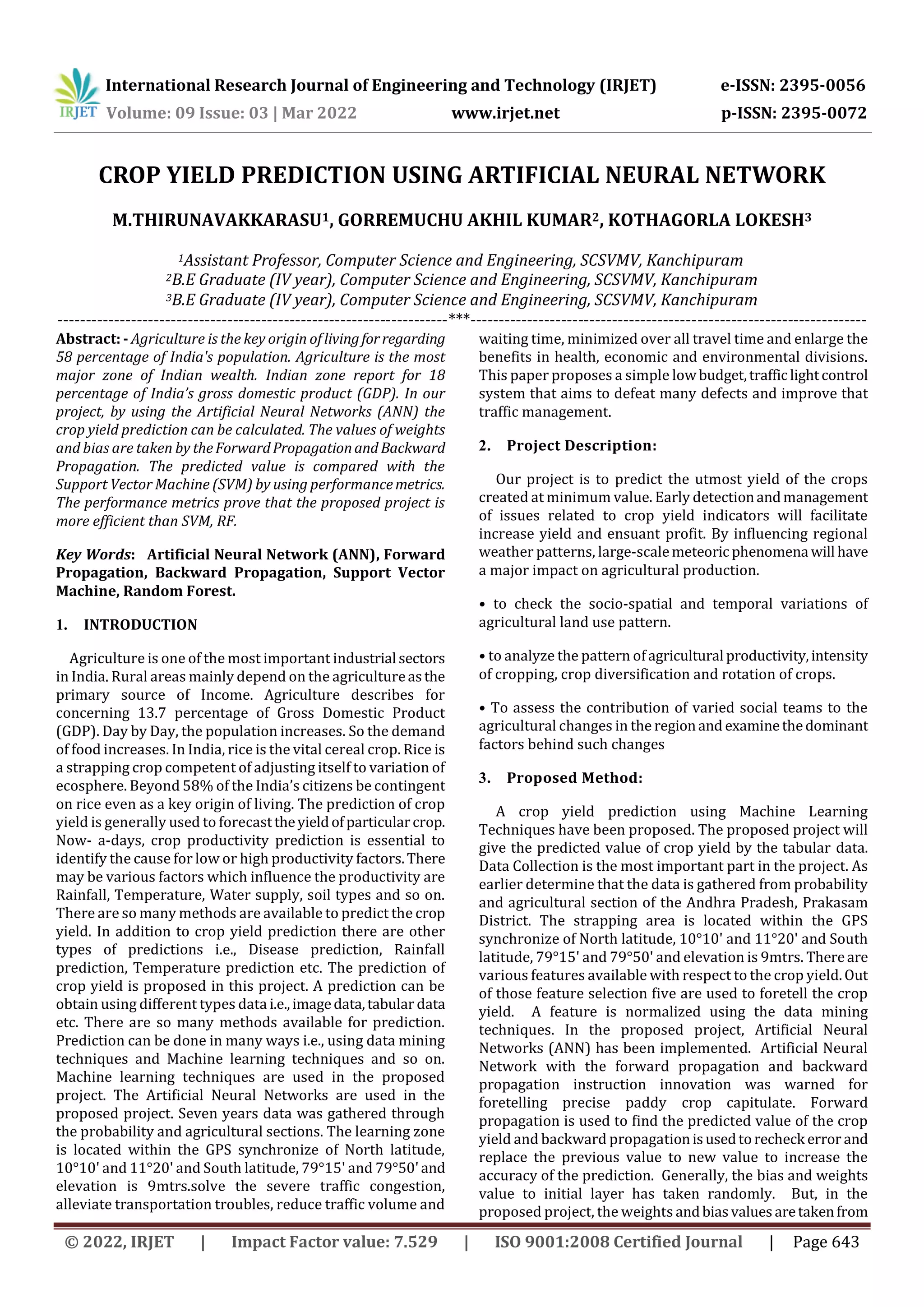
1.Root Mean Squared Error
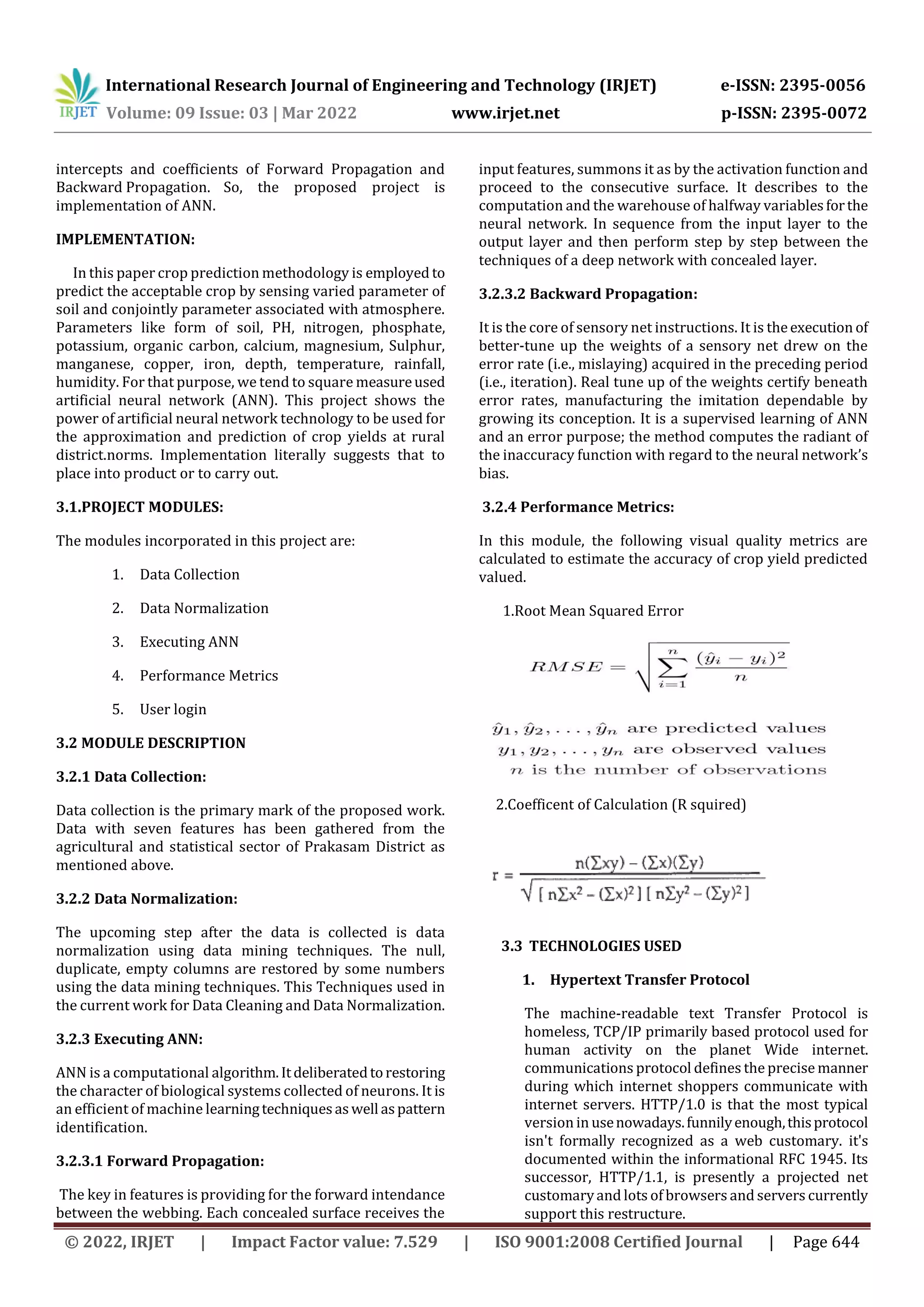
2.Coefficent of Calculation (R squired)
3.3 TECHNOLOGIES USED
1. Hypertext Transfer Protocol
The machine-readable text Transfer Protocol is
homeless, TCP/IP primarily based protocol used for
human activity on the planet Wide internet.
communications protocol defines the precise manner
during which internet shoppers communicate with
internet servers. HTTP/1.0 is that the most typical
version in usenowadays.funnilyenough,thisprotocol
isn't formally recognized as a web customary. it's
documented within the informational RFC 1945. Its
successor, HTTP/1.1, is presently a projected net
customaryand lots of browsers and servers currently
support this restructure.
International Research Journal of Engineering and Technology (IRJET) e-ISSN: 2395-0056
Volume: 09 Issue: 03 | Mar 2022 www.irjet.net p-ISSN: 2395-0072
© 2022, IRJET | Impact Factor value: 7.529 | ISO 9001:2008 Certified Journal | Page 645
2. SQL SERVER
SQL Server is a perfect knowledge set stage to beused
in sharedand devoted internet facilitatingconditions.
Of the various SQL Server releases, simply SQL Server
specific need to never be utilized in Shared Hosting
things, this version was supposed for application
improvement conditions because it were. The SQL
Server readying steerage for internet Hosting
Environmentsprovidesbestpracticestotranscription
SQL Server to boost security, occupier confinement,
and also the presentation of your expedited SQL
Server organization. check scripts for provisioning
shoppers and knowledge sets to be used in shared
facilitating are incorporated.
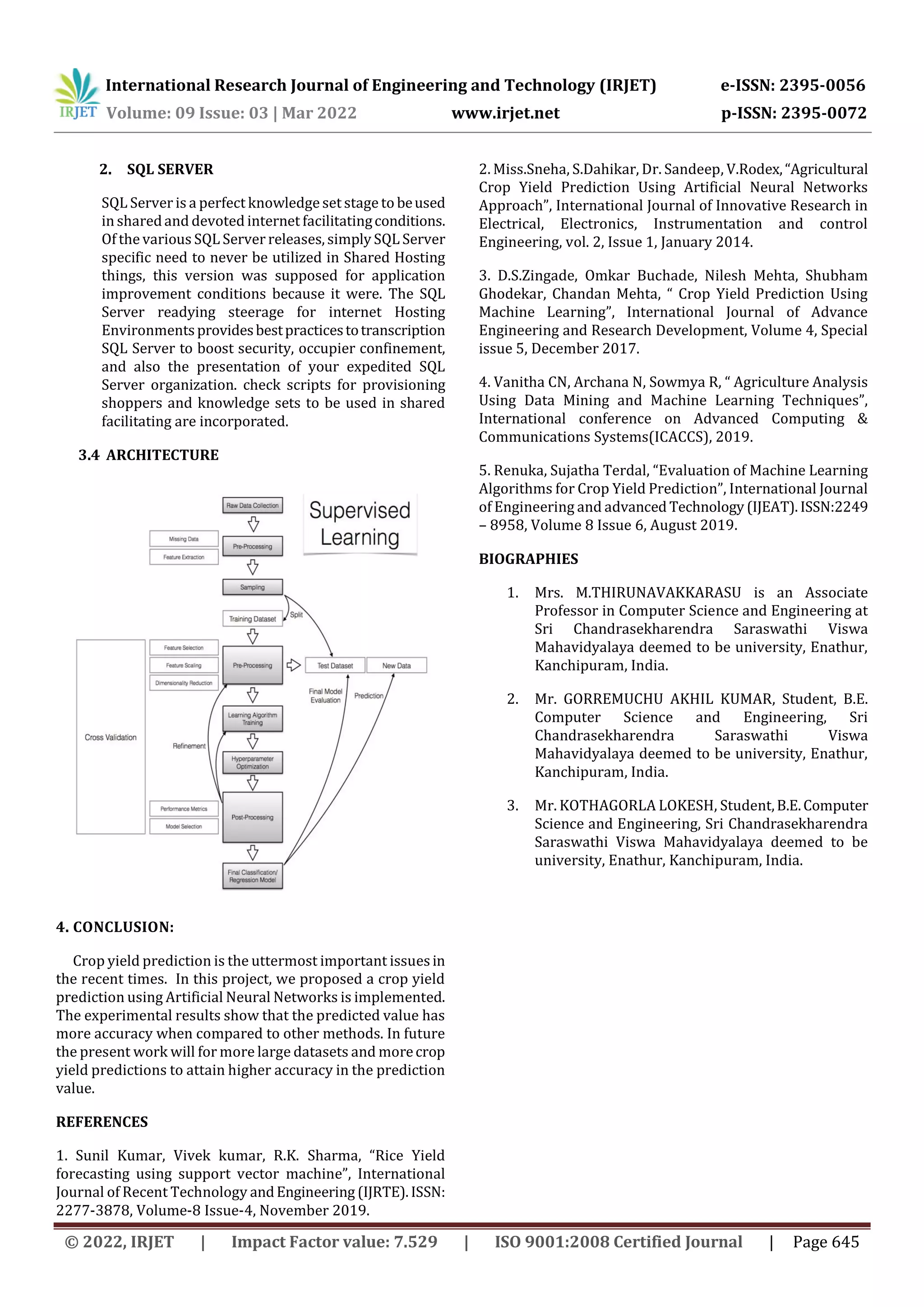
3.4 ARCHITECTURE
4. CONCLUSION:
Crop yield prediction is the uttermost important issuesin
the recent times. In this project, we proposed a crop yield
prediction using Artificial Neural Networks is implemented.
The experimental results show that the predicted value has
more accuracy when compared to other methods. In future
the present work will for more large datasets and morecrop
yield predictions to attain higher accuracy in the prediction
value.
REFERENCES
1. Sunil Kumar, Vivek kumar, R.K. Sharma, “Rice Yield
forecasting using support vector machine”, International
Journal of Recent Technology andEngineering (IJRTE).ISSN:
2277-3878, Volume-8 Issue-4, November 2019.
2. Miss.Sneha, S.Dahikar, Dr. Sandeep, V.Rodex,“Agricultural
Crop Yield Prediction Using Artificial Neural Networks
Approach”, International Journal of Innovative Research in
Electrical, Electronics, Instrumentation and control
Engineering, vol. 2, Issue 1, January 2014.
3. D.S.Zingade, Omkar Buchade, Nilesh Mehta, Shubham
Ghodekar, Chandan Mehta, “ Crop Yield Prediction Using
Machine Learning”, International Journal of Advance
Engineering and Research Development, Volume 4, Special
issue 5, December 2017.
4. Vanitha CN, Archana N, Sowmya R, “ Agriculture Analysis
Using Data Mining and Machine Learning Techniques”,
International conference on Advanced Computing &
Communications Systems(ICACCS), 2019.
5. Renuka, Sujatha Terdal, “Evaluation of Machine Learning
Algorithms for Crop Yield Prediction”, International Journal
of Engineering and advanced Technology (IJEAT).ISSN:2249
– 8958, Volume 8 Issue 6, August 2019.
BIOGRAPHIES
1. Mrs. M.THIRUNAVAKKARASU is an Associate
Professor in Computer Science and Engineering at
Sri Chandrasekharendra Saraswathi Viswa
Mahavidyalaya deemed to be university, Enathur,
Kanchipuram, India.
2. Mr. GORREMUCHU AKHIL KUMAR, Student, B.E.
Computer Science and Engineering, Sri
Chandrasekharendra Saraswathi Viswa
Mahavidyalaya deemed to be university, Enathur,
Kanchipuram, India.
3. Mr. KOTHAGORLA LOKESH, Student,B.E.Computer
Science and Engineering, Sri Chandrasekharendra
Saraswathi Viswa Mahavidyalaya deemed to be
university, Enathur, Kanchipuram, India.

CROP YIELD PREDICTION USING ARTIFICIAL NEURAL NETWORK

  • 1.
    International Research Journalof Engineering and Technology (IRJET) e-ISSN: 2395-0056 Volume: 09 Issue: 03 | Mar 2022 www.irjet.net p-ISSN: 2395-0072 © 2022, IRJET | Impact Factor value: 7.529 | ISO 9001:2008 Certified Journal | Page 643 CROP YIELD PREDICTION USING ARTIFICIAL NEURAL NETWORK M.THIRUNAVAKKARASU1, GORREMUCHU AKHIL KUMAR2, KOTHAGORLA LOKESH3 2B.E Graduate (IV year), Computer Science and Engineering, SCSVMV, Kanchipuram 3B.E Graduate (IV year), Computer Science and Engineering, SCSVMV, Kanchipuram ---------------------------------------------------------------------***---------------------------------------------------------------------- Abstract: - Agriculture is the key origin oflivingforregarding 58 percentage of India's population. Agriculture is the most major zone of Indian wealth. Indian zone report for 18 percentage of India’s gross domestic product (GDP). In our project, by using the Artificial Neural Networks (ANN) the crop yield prediction can be calculated. The values of weights and bias are taken by theForwardPropagationand Backward Propagation. The predicted value is compared with the Support Vector Machine (SVM) by using performancemetrics. The performance metrics prove that the proposed project is more efficient than SVM, RF. Key Words: Artificial Neural Network (ANN), Forward Propagation, Backward Propagation, Support Vector Machine, Random Forest. 1. INTRODUCTION Agriculture is one of the most important industrial sectors in India. Rural areas mainly depend on the agricultureasthe primary source of Income. Agriculture describes for concerning 13.7 percentage of Gross Domestic Product (GDP). Day by Day, the population increases. So the demand of food increases. In India, rice is the vital cereal crop. Rice is a strapping crop competent of adjusting itself to variation of ecosphere. Beyond 58% of the India’s citizens be contingent on rice even as a key origin of living. The prediction of crop yield is generally used to forecasttheyieldofparticularcrop. Now- a-days, crop productivity prediction is essential to identify the cause for low or high productivity factors.There may be various factors which influence the productivity are Rainfall, Temperature, Water supply, soil types and so on. There are so many methods are available to predict the crop yield. In addition to crop yield prediction there are other types of predictions i.e., Disease prediction, Rainfall prediction, Temperature prediction etc. The prediction of crop yield is proposed in this project. A prediction can be obtain using different types data i.e.,imagedata,tabular data etc. There are so many methods available for prediction. Prediction can be done in many ways i.e., using data mining techniques and Machine learning techniques and so on. Machine learning techniques are used in the proposed project. The Artificial Neural Networks are used in the proposed project. Seven years data was gathered through the probability and agricultural sections. The learning zone is located within the GPS synchronize of North latitude, 10°10' and 11°20' and South latitude, 79°15' and 79°50'and elevation is 9mtrs.solve the severe traffic congestion, alleviate transportation troubles, reduce traffic volume and waiting time, minimized over all travel time and enlarge the benefits in health, economic and environmental divisions. This paper proposes a simple lowbudget,trafficlightcontrol system that aims to defeat many defects and improve that traffic management. 2. Project Description: Our project is to predict the utmost yield of the crops created at minimum value. Early detectionandmanagement of issues related to crop yield indicators will facilitate increase yield and ensuant profit. By influencing regional weather patterns, large-scalemeteoricphenomena will have a major impact on agricultural production. • to check the socio-spatial and temporal variations of agricultural land use pattern. • to analyze the pattern ofagricultural productivity,intensity of cropping, crop diversification and rotation of crops. • To assess the contribution of varied social teams to the agricultural changes in the regionand examinethedominant factors behind such changes 3. Proposed Method: A crop yield prediction using Machine Learning Techniques have been proposed. The proposed project will give the predicted value of crop yield by the tabular data. Data Collection is the most important part in the project. As earlier determine that the data is gathered from probability and agricultural section of the Andhra Pradesh, Prakasam District. The strapping area is located within the GPS synchronize of North latitude, 10°10' and 11°20' and South latitude, 79°15' and 79°50' and elevation is 9mtrs. Thereare various features available with respect to the crop yield.Out of those feature selection five are used to foretell the crop yield. A feature is normalized using the data mining techniques. In the proposed project, Artificial Neural Networks (ANN) has been implemented. Artificial Neural Network with the forward propagation and backward propagation instruction innovation was warned for foretelling precise paddy crop capitulate. Forward propagation is used to find the predicted value of the crop yield and backward propagationisusedtorecheck error and replace the previous value to new value to increase the accuracy of the prediction. Generally, the bias and weights value to initial layer has taken randomly. But, in the proposed project, the weights andbiasvaluesaretakenfrom 1Assistant Professor, Computer Science and Engineering, SCSVMV, Kanchipuram
  • 2.
    International Research Journalof Engineering and Technology (IRJET) e-ISSN: 2395-0056 Volume: 09 Issue: 03 | Mar 2022 www.irjet.net p-ISSN: 2395-0072 © 2022, IRJET | Impact Factor value: 7.529 | ISO 9001:2008 Certified Journal | Page 644 intercepts and coefficients of Forward Propagation and Backward Propagation. So, the proposed project is implementation of ANN. IMPLEMENTATION: In this paper crop prediction methodology is employed to predict the acceptable crop by sensing varied parameter of soil and conjointly parameter associated with atmosphere. Parameters like form of soil, PH, nitrogen, phosphate, potassium, organic carbon, calcium, magnesium, Sulphur, manganese, copper, iron, depth, temperature, rainfall, humidity. For that purpose, we tend to square measureused artificial neural network (ANN). This project shows the power of artificial neural network technology to be used for the approximation and prediction of crop yields at rural district.norms. Implementation literally suggests that to place into product or to carry out. 3.1.PROJECT MODULES: The modules incorporated in this project are: 1. Data Collection 2. Data Normalization 3. Executing ANN 4. Performance Metrics 5. User login 3.2 MODULE DESCRIPTION 3.2.1 Data Collection: Data collection is the primary mark of the proposed work. Data with seven features has been gathered from the agricultural and statistical sector of Prakasam District as mentioned above. 3.2.2 Data Normalization: The upcoming step after the data is collected is data normalization using data mining techniques. The null, duplicate, empty columns are restored by some numbers using the data mining techniques. This Techniques used in the current work for Data Cleaning and Data Normalization. 3.2.3 Executing ANN: ANN is a computational algorithm.Itdeliberatedtorestoring the character of biological systems collected of neurons. It is an efficient of machine learningtechniquesaswell aspattern identification. 3.2.3.1 Forward Propagation: The key in features is providing for the forward intendance between the webbing. Each concealed surface receives the input features, summons it as by the activation function and proceed to the consecutive surface. It describes to the computation and the warehouse of halfway variablesforthe neural network. In sequence from the input layer to the output layer and then perform step by step between the techniques of a deep network with concealed layer. 3.2.3.2 Backward Propagation: It is the core of sensory net instructions. It is theexecution of better-tune up the weights of a sensory net drew on the error rate (i.e., mislaying) acquired in the preceding period (i.e., iteration). Real tune up of the weights certify beneath error rates, manufacturing the imitation dependable by growing its conception. It is a supervised learning of ANN and an error purpose; the method computes the radiant of the inaccuracy function with regard to the neural network’s bias. 3.2.4 Performance Metrics: In this module, the following visual quality metrics are calculated to estimate the accuracy of crop yield predicted valued. 1.Root Mean Squared Error 2.Coefficent of Calculation (R squired) 3.3 TECHNOLOGIES USED 1. Hypertext Transfer Protocol The machine-readable text Transfer Protocol is homeless, TCP/IP primarily based protocol used for human activity on the planet Wide internet. communications protocol defines the precise manner during which internet shoppers communicate with internet servers. HTTP/1.0 is that the most typical version in usenowadays.funnilyenough,thisprotocol isn't formally recognized as a web customary. it's documented within the informational RFC 1945. Its successor, HTTP/1.1, is presently a projected net customaryand lots of browsers and servers currently support this restructure.
  • 3.
    International Research Journalof Engineering and Technology (IRJET) e-ISSN: 2395-0056 Volume: 09 Issue: 03 | Mar 2022 www.irjet.net p-ISSN: 2395-0072 © 2022, IRJET | Impact Factor value: 7.529 | ISO 9001:2008 Certified Journal | Page 645 2. SQL SERVER SQL Server is a perfect knowledge set stage to beused in sharedand devoted internet facilitatingconditions. Of the various SQL Server releases, simply SQL Server specific need to never be utilized in Shared Hosting things, this version was supposed for application improvement conditions because it were. The SQL Server readying steerage for internet Hosting Environmentsprovidesbestpracticestotranscription SQL Server to boost security, occupier confinement, and also the presentation of your expedited SQL Server organization. check scripts for provisioning shoppers and knowledge sets to be used in shared facilitating are incorporated. 3.4 ARCHITECTURE 4. CONCLUSION: Crop yield prediction is the uttermost important issuesin the recent times. In this project, we proposed a crop yield prediction using Artificial Neural Networks is implemented. The experimental results show that the predicted value has more accuracy when compared to other methods. In future the present work will for more large datasets and morecrop yield predictions to attain higher accuracy in the prediction value. REFERENCES 1. Sunil Kumar, Vivek kumar, R.K. Sharma, “Rice Yield forecasting using support vector machine”, International Journal of Recent Technology andEngineering (IJRTE).ISSN: 2277-3878, Volume-8 Issue-4, November 2019. 2. Miss.Sneha, S.Dahikar, Dr. Sandeep, V.Rodex,“Agricultural Crop Yield Prediction Using Artificial Neural Networks Approach”, International Journal of Innovative Research in Electrical, Electronics, Instrumentation and control Engineering, vol. 2, Issue 1, January 2014. 3. D.S.Zingade, Omkar Buchade, Nilesh Mehta, Shubham Ghodekar, Chandan Mehta, “ Crop Yield Prediction Using Machine Learning”, International Journal of Advance Engineering and Research Development, Volume 4, Special issue 5, December 2017. 4. Vanitha CN, Archana N, Sowmya R, “ Agriculture Analysis Using Data Mining and Machine Learning Techniques”, International conference on Advanced Computing & Communications Systems(ICACCS), 2019. 5. Renuka, Sujatha Terdal, “Evaluation of Machine Learning Algorithms for Crop Yield Prediction”, International Journal of Engineering and advanced Technology (IJEAT).ISSN:2249 – 8958, Volume 8 Issue 6, August 2019. BIOGRAPHIES 1. Mrs. M.THIRUNAVAKKARASU is an Associate Professor in Computer Science and Engineering at Sri Chandrasekharendra Saraswathi Viswa Mahavidyalaya deemed to be university, Enathur, Kanchipuram, India. 2. Mr. GORREMUCHU AKHIL KUMAR, Student, B.E. Computer Science and Engineering, Sri Chandrasekharendra Saraswathi Viswa Mahavidyalaya deemed to be university, Enathur, Kanchipuram, India. 3. Mr. KOTHAGORLA LOKESH, Student,B.E.Computer Science and Engineering, Sri Chandrasekharendra Saraswathi Viswa Mahavidyalaya deemed to be university, Enathur, Kanchipuram, India.