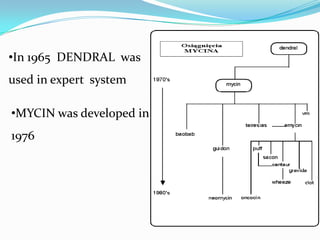
•In 1965 DENDRAL was
used in expert system
•MYCIN was developed in
1976
WHY MYCIN
 Disease diagnosis and therapy selection
 Advise for non expert physicians with time

consideration and incomplete evidence as
 Bacterial infections of the blood
 Extended to other elements
PROBLEM BEFORE MYCIN
• ROBERTS AND VISCONTI:-

 Only 13% patients are treated rationally
 66% are being given irrational treatment
 21% are being given questionable treatment

• IRRATIONAL MEANS, FOR EXAMPLE: Using a contra-indicated combination

 Using the wrong agent for a specific organisms
 Not taking the required culture
DEVELOPMENT OF MYCIN
• Developed by ADWARD SHORTLIFFE in 1976

a STANFORD UNIVERSITY in the artificial intelligence
in medicine group
• First system that was implemented into the medical

field
HOW MYCIN WAS TESTED FOR
ACCURACY
• 10 patients for a particular disease were chosen

• Their information was sent to 8 physicians and MYCIN
• All then came up with recommended treatment
• Those recommendations along with what the patient

actually received as treatment was sent to 8

unidentified specialists
WHO WON FROM THE TEST
• MYCIN won the test
• MYCIN received the highest score as for as

accuracy and effectiveness of diagnosis
STAGES IN DAIGNOSIS AND
TREATMENT

• Decide if there is significant infection

• Identify the causing organism(s) by clinical and

laboratory evidence
• Decide what antibiotic agent the organisms are

sensitive to
• Prescribe the optimal drug combination for particular

case
RESULTS
 Never implemented for routine clinical use
 Shown to be competent by panels of experts even in

case where experts themselves disagreed on
conclusions
 Key contributions
 Reuse of production rules( expansion knowledge aquision )
PROBLEMS
• If the system gives an incorrect diagnosis, who is

to be blamed or sued
• Physicians rely to heavily on system instead of

consulting other experts
Resources


Wikipedia Page




Building Expert Systems in Prolog





Available at: http://www.amzi.com/ExpertSystemsInProlog/xsipfrtop.htm

Artificial Intelligence - A modern Approach by Stuart Rassell, Peter
Norvig
PC AI – Expert Systems




Available at: http://en.wikipedia.org/wiki/Expert_system

Available at: http://www.pcai.com/web/ai_info/expert_systems.html

VisiRule Web Demos (A simple example):
http://www.lpa.co.uk/vrs_dem.htm
Expert system   mycin

Expert system mycin

  • 2.
    •In 1965 DENDRALwas used in expert system •MYCIN was developed in 1976
  • 3.
    WHY MYCIN  Diseasediagnosis and therapy selection  Advise for non expert physicians with time consideration and incomplete evidence as  Bacterial infections of the blood  Extended to other elements
  • 4.
    PROBLEM BEFORE MYCIN •ROBERTS AND VISCONTI:-  Only 13% patients are treated rationally  66% are being given irrational treatment  21% are being given questionable treatment • IRRATIONAL MEANS, FOR EXAMPLE: Using a contra-indicated combination  Using the wrong agent for a specific organisms  Not taking the required culture
  • 5.
    DEVELOPMENT OF MYCIN •Developed by ADWARD SHORTLIFFE in 1976 a STANFORD UNIVERSITY in the artificial intelligence in medicine group • First system that was implemented into the medical field
  • 6.
    HOW MYCIN WASTESTED FOR ACCURACY • 10 patients for a particular disease were chosen • Their information was sent to 8 physicians and MYCIN • All then came up with recommended treatment • Those recommendations along with what the patient actually received as treatment was sent to 8 unidentified specialists
  • 7.
    WHO WON FROMTHE TEST • MYCIN won the test • MYCIN received the highest score as for as accuracy and effectiveness of diagnosis
  • 8.
    STAGES IN DAIGNOSISAND TREATMENT • Decide if there is significant infection • Identify the causing organism(s) by clinical and laboratory evidence • Decide what antibiotic agent the organisms are sensitive to • Prescribe the optimal drug combination for particular case
  • 9.
    RESULTS  Never implementedfor routine clinical use  Shown to be competent by panels of experts even in case where experts themselves disagreed on conclusions  Key contributions  Reuse of production rules( expansion knowledge aquision )
  • 10.
    PROBLEMS • If thesystem gives an incorrect diagnosis, who is to be blamed or sued • Physicians rely to heavily on system instead of consulting other experts
  • 11.
    Resources  Wikipedia Page   Building ExpertSystems in Prolog    Available at: http://www.amzi.com/ExpertSystemsInProlog/xsipfrtop.htm Artificial Intelligence - A modern Approach by Stuart Rassell, Peter Norvig PC AI – Expert Systems   Available at: http://en.wikipedia.org/wiki/Expert_system Available at: http://www.pcai.com/web/ai_info/expert_systems.html VisiRule Web Demos (A simple example): http://www.lpa.co.uk/vrs_dem.htm