Int. Journal of Electrical & Electronics Engg. Vol. 2, Spl. Issue 1 (2015) e-ISSN: 1694-2310 | p-ISSN: 1694-2426
NITTTR, Chandigarh EDIT -2015 128
Speed Control of PMBLDC Motor using
LPC 2148 – A Practical Approach
G.A.Rathy1, P.Sivasankar2
1
Assistant Professor, Electrical Department, NITTTR, Chennai, India.
2
Assistant Professor, Electronics Department, NITTTR, Chennai, India.
rathysanju@gmail.com, siva_sankar123p@yahoo.com
ABSTRACT: Permanent Magnet Brushless DC Motor
(PMBLDC) motors are gaining popularity in industries like
automotive, aircrafts, medical Appliances, electric traction,
disk drive, industrial drives and instrumentation because of
their high efficiency, silent operation, high power factor,
reliability, compact, low maintenance and high torque to
power ratio. The PMBLDC motor requires an inverter and a
position sensor that exposes rotor position for appropriate
alternation of current. The control in the inverter circuit is
achieved using LPC 2148.The pulses generated by LPC 2148
controls the power devices of the inverter circuit. The rotation
of the PMBLDC motor is built on the feedback of rotor
position that is gained from the hall sensors. PMBLDC motor
generally utilizes three hall sensors for deciding the
commutation sequence. In this paper it is proposed to achieve
a practical effective speed control of PMBLDC motor using
LPC 2148.
Keywords: PMBLDC Motor, Speed Control, PWM, Duty cycle, hall
sensors
1. INTRODUCTION
DC motors have a high starting torque. DC motors were
preferred and are still often used for adjustable speed
applications. The disadvantages of Brush Type DC Motors
are the brushes. These brushes have to be inspected from
time to time and replaced when they are worn out. So,
brush DC motors have a limited life and often its life
cannot easily be predicted. The windings of the DC motor
are on the armature. For rapid start-stop applications the
inertia of the heavy armature can be a major drawback. To
overcome these drawbacks the construction of the DC
motors were altered and this resulted in the Permanent
Magnet Brushless DC motor. Brushless DC (BLDC)
motors are rapidly gaining popularity. They offer longer
life and less maintenance than conventional brushed DC
motors [3]. Some other advantages over brushed DC
motors and induction motors are:
 Better speed versus torque characteristics
 Faster dynamic response
 High efficiency
 Long operating life
 Noiseless operation
 Higher speed range.
And in addition, the ratio of torque delivered to the size of
the motor is higher, making them useful in applications
where space and weight are critical factors [4].
2. LITERATURE SURVEY
Ravikiran et al in [1] represented the modeling of the
Permanent Magnet Brushless DC (PMBLDC) motor drive
using Matlab / Simulink Software. The modelling of
Permanent Magnet Brushless DC (PMBLDC) motor drive
is useful in various phenomenons such as aerospace
modelling and more other applications. In that Paper, the
modelling of PMBLDC motor drive is done by using
various components such as current, Speed controllers and
sensors are installed to sense the various factors such as
speed, current, and the output obtained from the inverter.
The basic purpose of designing of such drive is to gives the
certain ideas about designing of the motor drive using
Matlab / Simulink [1] and how it helps in various
applications such as electric Traction, automotive
industries and more other places. Prakash et al.in [2],
proposed the model for Closed Loop Controlled Buck
Converter Fed PMBLDC Drive System using Simulation.
Vandana Govindan et al in [5] presented digital speed
control of permanent magnet brushless dc motor using
TMS320F2812 DSP controller . The DSP controller used
here has the special features for digital motor control.
Control algorithms used for the speed control has been
implemented by assembly language programming in
TMS320F2812 DSP controller. According to the input
command, feedback and the control algorithm, the PWM
pulses for each phase is generated by the DSP and is given
to the MOSFET driver. The output of the driver is 6
independent PWM pulses that have to be given to the
corresponding gates of the six MOSFETs
power switches used in the three-phase bridge inverter
whose output is given to the stator of the Brushless DC
Motor. The complete system model is simulated in
MATLAB/ Simulink environment. Hardware
implementation for the speed control has been achieved by
programming in the DSP controller TMS320F2812 [5].
But in this paper, the speed control of PMBLDC motor is
achieved using LPC 2148 microcontroller. This LPC2148
is very simple compared to TMS320F2812 DSP processor.
Also writing programs to generate the PWM is much easier
than DSP based system control. Also in our proposed
model we experimentally control the speed of the
PMBLDC motor instead of using any simulation.
3. CONSTRUCTION OF PMBLDC MOTOR
In this section, the construction of PMBLDC motor will be
discussed.
3.1 Stator
Brushless DC motor Stator has Silicon steel stampings
with slots in its interior surface. These slots accommodate
a closed distributed armature windings. These windings are
Int. Journal of Electrical & Electronics Engg. Vol. 2, Spl. Issue 1 (2015) e-ISSN: 1694-2310 | p-ISSN: 1694-2426
129 NITTTR, Chandigarh EDIT-2015
wound for specific number of poles. This winding is
suitably connected to a DC supply through power
Electronic circuitry. Traditionally, the stator resembles that
of an induction motor; however, the windings are
distributed in a different manner. Each of these windings
are constructed with numerous coils interconnected to form
a winding. One or more coils are placed in the slots and
they are interconnected to make a winding. Each of these
windings are distributed over the stator periphery to form
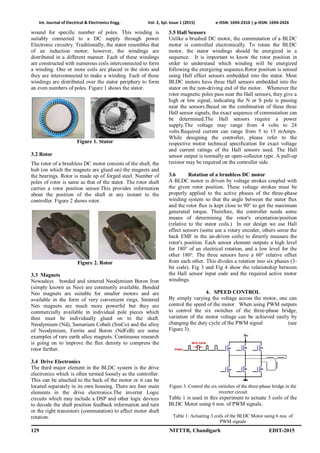
an even numbers of poles. Figure 1 shows the stator.
Figure 1. Stator
3.2 Rotor
The rotor of a brushless DC motor consists of the shaft, the
hub (on which the magnets are glued on) the magnets and
the bearings. Rotor is made up of forged steel. Number of
poles of rotor is same as that of the stator. The rotor shaft
carries a rotor position sensor.This provides information
about the position of the shaft at any instant to the
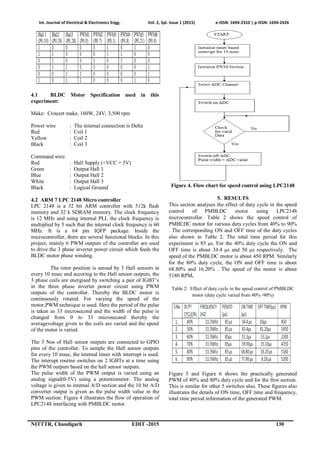
controller. Figure 2 shows rotor.
Figure 2. Rotor
3.3 Magnets
Nowadays bonded and sintered Neodymium Boron Iron
(simply known as Neo) are commonly available. Bonded
Neo magnets are suitable for smaller motors and are
available in the form of very convenient rings. Sintered
Neo magnets are much more powerful but they are
commercially available in individual pole pieces which
then must be individually glued on to the shaft.
Neodymium (Nd), Samarium Cobalt (SmCo) and the alloy
of Neodymium, Ferrite and Boron (NdFeB) are some
examples of rare earth alloy magnets. Continuous research
is going on to improve the flux density to compress the
rotor further.
3.4 Drive Electronics
The third major element in the BLDC system is the drive
electronics which is often termed loosely as the controller.
This can be attached to the back of the motor or it can be
located separately in its own housing. There are four main
elements in the drive electronics.The inverter Logic
circuits which may include a DSP and other logic devices
to decode the shaft position feedback information and turn
or the right transistors (commutation) to affect motor shaft
rotation.
3.5 Hall Sensors
Unlike a brushed DC motor, the commutation of a BLDC
motor is controlled electronically. To rotate the BLDC
motor, the stator windings should be energized in a
sequence. It is important to know the rotor position in
order to understand which winding will be energized
following the energizing sequence.Rotor position is sensed
using Hall effect sensors embedded into the stator. Most
BLDC motors have three Hall sensors embedded into the
stator on the non-driving end of the motor. Whenever the
rotor magnetic poles pass near the Hall sensors, they give a
high or low signal, indicating the N or S pole is passing
near the sensors.Based on the combination of these three
Hall sensor signals, the exact sequence of commutation can
be determined.The Hall sensors require a power
supply.The voltage may range from 4 volts to 24
volts.Required current can range from 5 to 15 mAmps.
While designing the controller, please refer to the
respective motor technical specification for exact voltage
and current ratings of the Hall sensors used. The Hall
sensor output is normally an open-collector type. A pull-up
resistor may be required on the controller side.
3.6 Rotation of a brushless DC motor
A BLDC motor is driven by voltage strokes coupled with
the given rotor position. These voltage strokes must be
properly applied to the active phases of the three-phase
winding system so that the angle between the stator flux
and the rotor flux is kept close to 90° to get the maximum
generated torque. Therefore, the controller needs some
means of determining the rotor's orientation/position
(relative to the stator coils.) In our design we use Hall
effect sensors (some use a rotary encoder, others sense the
back EMF in the un-driven coils) to directly measure the
rotor's position. Each sensor element outputs a high level
for 180° of an electrical rotation, and a low level for the
other 180°. The three sensors have a 60° relative offset
from each other. This divides a rotation into six phases (3-
bit code). Fig 3 and Fig 4 show the relationship between
the Hall sensor input code and the required active motor
windings.
4. SPEED CONTROL
By simply varying the voltage across the motor, one can
control the speed of the motor. When using PWM outputs
to control the six switches of the three-phase bridge,
variation of the motor voltage can be achieved easily by
changing the duty cycle of the PWM signal (see
Figure 3).
Figure 3. Control the six switches of the three-phase bridge in the
inverter circuit
Table 1 is used in this experiment to actuate 3 coils of the
BLDC Motor using 6 nos. of PWM signals.
Table 1: Actuating 3 coils of the BLDC Motor using 6 nos. of
PWM signals
Int. Journal of Electrical & Electronics Engg. Vol. 2, Spl. Issue 1 (2015) e-ISSN: 1694-2310 | p-ISSN: 1694-2426
NITTTR, Chandigarh EDIT -2015 130
4.1 BLDC Motor Specification used in this
experiment:
Make: Crouzet make, 160W, 24V, 3,500 rpm
Power wire : The internal connection is Delta
Red : Coil 1
Yellow : Coil 2
Black : Coil 3
Command wire:
Red : Hall Supply (+VCC = 5V)
Green : Output Hall 1
Blue : Output Hall 2
White : Output Hall 3
Black : Logical Ground
4.2 ARM 7 LPC 2148 Micro controller
LPC 2148 is a 32 bit ARM controller with 512k flash
memory and 32 k SDRAM memory. The clock frequency
is 12 MHz and using internal PLL the clock frequency is
multiplied by 5 such that the internal clock frequency is 60
MHz. It is a 64 pin IQFP package. Inside the
microcontroller, there are several functional blocks. In this
project, mainly 6 PWM outputs of the controller are used
to drive the 3 phase inverter power circuit which feeds the
BLDC motor phase winding.
The rotor position is sensed by 3 Hall sensors in
every 10 msec and accoring to the Hall sensor outputs, the
3 phase coils are energised by switching a pair of IGBT’s
in the three phase inverter power circuit using PWM
outputs of the controller. Thereby the BLDC motor is
continuously rotated. For varying the speed of the
motor,PWM technique is used. Here the period of the pulse
is taken as 33 microsecond and the width of the pulse is
changed from 0 to 33 microsecand thereby the
averagevoltage given to the coils are varied and the speed
of the motor is varied.
The 3 Nos of Hall sensor outputs are connected to GPIO
pins of the controller. To sample the Hall sensor outputs
for every 10 msec, the internal timer with interrupt is used.
The interupt routine switches on 2 IGBTs at a time using
the PWM outputs based on the hall sensor outputs.
The pulse width of the PWM output is varied using an
analog signal(0-5V) using a potentiometer. The analog
voltage is given to internal A/D section and the 10 bit A/D
converter output is given as the pulse width value in the
PWM section. Figure 4 illustrates the flow of operation of
LPC2148 interfacing with PMBLDC motor.
Figure 4. Flow chart for speed control using LPC2148
5. RESULTS
This section analyses the effect of duty cycle in the speed
control of PMBLDC motor using LPC2148
microcontroller. Table 2 shows the speed control of
PMBLDC motor for various duty cycles from 40% to 90%
. The corresponding ON and OFF time of the duty cycles
also shown in Table 2. The total time period for this
experiment is 85 μs. For the 40% duty cycle the ON and
OFF time is about 34.4 μs and 50 μs respectively. The
speed of the PMBLDC motor is about 450 RPM. Similarly
for the 80% duty cycle, the ON and OFF time is about
68.80% and 16.20% . The speed of the motor is about
5180 RPM.
Table 2: Effect of duty cycle in the speed control of PMBLDC
motor (duty cycle varied from 40% -90%)
Figure 5 and Figure 6 shows the practically generated
PWM of 40% and 80% duty cycle and for the first section.
This is similar for other 5 switches also. These figures also
illustrates the details of ON time, OFF time and frequency,
total time period information of the generated PWM.
Int. Journal of Electrical & Electronics Engg. Vol. 2, Spl. Issue 1 (2015) e-ISSN: 1694-2310 | p-ISSN: 1694-2426
131 NITTTR, Chandigarh EDIT-2015
Figure 5. PWM1 40% duty cycle
Figure 6. PWM1 80% duty cycle
6. CONCLUSION
This paper has proposed a practical approach to achieve an
efficient speed control of PMBLDC motor using LPC-
2148 micro controller. For various PWM such as 40% to
90% variation of duty cycle, the speed of the PMBLDC
motor is efficiently controlled. This practical approach of
speed control using LPC2148 is an efficient method
compared to other speed control methods.
REFERENCES
[1] Ravikiran H. Rushiya, Renish M. George, Prateek R. Dongre, Swapnil
B. Borkar, Shankar S. Soneker And S. W. Khubalkar, “A Review:
Modelling of Permanent Magnet Brushless DC Motor Drive”,
International Journal of Application or Innovation in Engineering &
Management (IJAIEM), 2013.
[2] S. Prakash , R. Dhanasekaran , Syed Ammal,, “Modelling and
Simulation of Closed Loop Controlled Buck Converter Fed PMBLDC
Drive System”, Research Journal of Applied Sciences, Engineering
and Technology 3(4): 284-289, ISSN: 2040-7467, 2011.
[3] R. Somanatham , P. V. N. Prasad , A. D. Rajkumar, “Simulation of
PMBLDC Motor With Sinusoidal Excitation Using Trapezoidal
Control Strategy”, (ICIEA 2006) 0-7803-9514-X/06, 2006.
[4] Padmaraja Yedamale, “Brushless DC (BLDC) Motor Fundamentals”,
Microchip technology, 2004.
[5] Vandana Govindan T.K, Anish Gopinath,S.Thomas George, “DSP
based Speed Control of Permanent Magnet Brushless DC Motor”,
IJCA Special Issue on Computational Science - New Dimensions &
Perspectives, 2011.

Speed Control of PMBLDC Motor using LPC 2148 – A Practical Approach

  • 1.
    Int. Journal ofElectrical & Electronics Engg. Vol. 2, Spl. Issue 1 (2015) e-ISSN: 1694-2310 | p-ISSN: 1694-2426 NITTTR, Chandigarh EDIT -2015 128 Speed Control of PMBLDC Motor using LPC 2148 – A Practical Approach G.A.Rathy1, P.Sivasankar2 1 Assistant Professor, Electrical Department, NITTTR, Chennai, India. 2 Assistant Professor, Electronics Department, NITTTR, Chennai, India. rathysanju@gmail.com, siva_sankar123p@yahoo.com ABSTRACT: Permanent Magnet Brushless DC Motor (PMBLDC) motors are gaining popularity in industries like automotive, aircrafts, medical Appliances, electric traction, disk drive, industrial drives and instrumentation because of their high efficiency, silent operation, high power factor, reliability, compact, low maintenance and high torque to power ratio. The PMBLDC motor requires an inverter and a position sensor that exposes rotor position for appropriate alternation of current. The control in the inverter circuit is achieved using LPC 2148.The pulses generated by LPC 2148 controls the power devices of the inverter circuit. The rotation of the PMBLDC motor is built on the feedback of rotor position that is gained from the hall sensors. PMBLDC motor generally utilizes three hall sensors for deciding the commutation sequence. In this paper it is proposed to achieve a practical effective speed control of PMBLDC motor using LPC 2148. Keywords: PMBLDC Motor, Speed Control, PWM, Duty cycle, hall sensors 1. INTRODUCTION DC motors have a high starting torque. DC motors were preferred and are still often used for adjustable speed applications. The disadvantages of Brush Type DC Motors are the brushes. These brushes have to be inspected from time to time and replaced when they are worn out. So, brush DC motors have a limited life and often its life cannot easily be predicted. The windings of the DC motor are on the armature. For rapid start-stop applications the inertia of the heavy armature can be a major drawback. To overcome these drawbacks the construction of the DC motors were altered and this resulted in the Permanent Magnet Brushless DC motor. Brushless DC (BLDC) motors are rapidly gaining popularity. They offer longer life and less maintenance than conventional brushed DC motors [3]. Some other advantages over brushed DC motors and induction motors are:  Better speed versus torque characteristics  Faster dynamic response  High efficiency  Long operating life  Noiseless operation  Higher speed range. And in addition, the ratio of torque delivered to the size of the motor is higher, making them useful in applications where space and weight are critical factors [4]. 2. LITERATURE SURVEY Ravikiran et al in [1] represented the modeling of the Permanent Magnet Brushless DC (PMBLDC) motor drive using Matlab / Simulink Software. The modelling of Permanent Magnet Brushless DC (PMBLDC) motor drive is useful in various phenomenons such as aerospace modelling and more other applications. In that Paper, the modelling of PMBLDC motor drive is done by using various components such as current, Speed controllers and sensors are installed to sense the various factors such as speed, current, and the output obtained from the inverter. The basic purpose of designing of such drive is to gives the certain ideas about designing of the motor drive using Matlab / Simulink [1] and how it helps in various applications such as electric Traction, automotive industries and more other places. Prakash et al.in [2], proposed the model for Closed Loop Controlled Buck Converter Fed PMBLDC Drive System using Simulation. Vandana Govindan et al in [5] presented digital speed control of permanent magnet brushless dc motor using TMS320F2812 DSP controller . The DSP controller used here has the special features for digital motor control. Control algorithms used for the speed control has been implemented by assembly language programming in TMS320F2812 DSP controller. According to the input command, feedback and the control algorithm, the PWM pulses for each phase is generated by the DSP and is given to the MOSFET driver. The output of the driver is 6 independent PWM pulses that have to be given to the corresponding gates of the six MOSFETs power switches used in the three-phase bridge inverter whose output is given to the stator of the Brushless DC Motor. The complete system model is simulated in MATLAB/ Simulink environment. Hardware implementation for the speed control has been achieved by programming in the DSP controller TMS320F2812 [5]. But in this paper, the speed control of PMBLDC motor is achieved using LPC 2148 microcontroller. This LPC2148 is very simple compared to TMS320F2812 DSP processor. Also writing programs to generate the PWM is much easier than DSP based system control. Also in our proposed model we experimentally control the speed of the PMBLDC motor instead of using any simulation. 3. CONSTRUCTION OF PMBLDC MOTOR In this section, the construction of PMBLDC motor will be discussed. 3.1 Stator Brushless DC motor Stator has Silicon steel stampings with slots in its interior surface. These slots accommodate a closed distributed armature windings. These windings are
  • 2.
    Int. Journal ofElectrical & Electronics Engg. Vol. 2, Spl. Issue 1 (2015) e-ISSN: 1694-2310 | p-ISSN: 1694-2426 129 NITTTR, Chandigarh EDIT-2015 wound for specific number of poles. This winding is suitably connected to a DC supply through power Electronic circuitry. Traditionally, the stator resembles that of an induction motor; however, the windings are distributed in a different manner. Each of these windings are constructed with numerous coils interconnected to form a winding. One or more coils are placed in the slots and they are interconnected to make a winding. Each of these windings are distributed over the stator periphery to form an even numbers of poles. Figure 1 shows the stator. Figure 1. Stator 3.2 Rotor The rotor of a brushless DC motor consists of the shaft, the hub (on which the magnets are glued on) the magnets and the bearings. Rotor is made up of forged steel. Number of poles of rotor is same as that of the stator. The rotor shaft carries a rotor position sensor.This provides information about the position of the shaft at any instant to the controller. Figure 2 shows rotor. Figure 2. Rotor 3.3 Magnets Nowadays bonded and sintered Neodymium Boron Iron (simply known as Neo) are commonly available. Bonded Neo magnets are suitable for smaller motors and are available in the form of very convenient rings. Sintered Neo magnets are much more powerful but they are commercially available in individual pole pieces which then must be individually glued on to the shaft. Neodymium (Nd), Samarium Cobalt (SmCo) and the alloy of Neodymium, Ferrite and Boron (NdFeB) are some examples of rare earth alloy magnets. Continuous research is going on to improve the flux density to compress the rotor further. 3.4 Drive Electronics The third major element in the BLDC system is the drive electronics which is often termed loosely as the controller. This can be attached to the back of the motor or it can be located separately in its own housing. There are four main elements in the drive electronics.The inverter Logic circuits which may include a DSP and other logic devices to decode the shaft position feedback information and turn or the right transistors (commutation) to affect motor shaft rotation. 3.5 Hall Sensors Unlike a brushed DC motor, the commutation of a BLDC motor is controlled electronically. To rotate the BLDC motor, the stator windings should be energized in a sequence. It is important to know the rotor position in order to understand which winding will be energized following the energizing sequence.Rotor position is sensed using Hall effect sensors embedded into the stator. Most BLDC motors have three Hall sensors embedded into the stator on the non-driving end of the motor. Whenever the rotor magnetic poles pass near the Hall sensors, they give a high or low signal, indicating the N or S pole is passing near the sensors.Based on the combination of these three Hall sensor signals, the exact sequence of commutation can be determined.The Hall sensors require a power supply.The voltage may range from 4 volts to 24 volts.Required current can range from 5 to 15 mAmps. While designing the controller, please refer to the respective motor technical specification for exact voltage and current ratings of the Hall sensors used. The Hall sensor output is normally an open-collector type. A pull-up resistor may be required on the controller side. 3.6 Rotation of a brushless DC motor A BLDC motor is driven by voltage strokes coupled with the given rotor position. These voltage strokes must be properly applied to the active phases of the three-phase winding system so that the angle between the stator flux and the rotor flux is kept close to 90° to get the maximum generated torque. Therefore, the controller needs some means of determining the rotor's orientation/position (relative to the stator coils.) In our design we use Hall effect sensors (some use a rotary encoder, others sense the back EMF in the un-driven coils) to directly measure the rotor's position. Each sensor element outputs a high level for 180° of an electrical rotation, and a low level for the other 180°. The three sensors have a 60° relative offset from each other. This divides a rotation into six phases (3- bit code). Fig 3 and Fig 4 show the relationship between the Hall sensor input code and the required active motor windings. 4. SPEED CONTROL By simply varying the voltage across the motor, one can control the speed of the motor. When using PWM outputs to control the six switches of the three-phase bridge, variation of the motor voltage can be achieved easily by changing the duty cycle of the PWM signal (see Figure 3). Figure 3. Control the six switches of the three-phase bridge in the inverter circuit Table 1 is used in this experiment to actuate 3 coils of the BLDC Motor using 6 nos. of PWM signals. Table 1: Actuating 3 coils of the BLDC Motor using 6 nos. of PWM signals
  • 3.
    Int. Journal ofElectrical & Electronics Engg. Vol. 2, Spl. Issue 1 (2015) e-ISSN: 1694-2310 | p-ISSN: 1694-2426 NITTTR, Chandigarh EDIT -2015 130 4.1 BLDC Motor Specification used in this experiment: Make: Crouzet make, 160W, 24V, 3,500 rpm Power wire : The internal connection is Delta Red : Coil 1 Yellow : Coil 2 Black : Coil 3 Command wire: Red : Hall Supply (+VCC = 5V) Green : Output Hall 1 Blue : Output Hall 2 White : Output Hall 3 Black : Logical Ground 4.2 ARM 7 LPC 2148 Micro controller LPC 2148 is a 32 bit ARM controller with 512k flash memory and 32 k SDRAM memory. The clock frequency is 12 MHz and using internal PLL the clock frequency is multiplied by 5 such that the internal clock frequency is 60 MHz. It is a 64 pin IQFP package. Inside the microcontroller, there are several functional blocks. In this project, mainly 6 PWM outputs of the controller are used to drive the 3 phase inverter power circuit which feeds the BLDC motor phase winding. The rotor position is sensed by 3 Hall sensors in every 10 msec and accoring to the Hall sensor outputs, the 3 phase coils are energised by switching a pair of IGBT’s in the three phase inverter power circuit using PWM outputs of the controller. Thereby the BLDC motor is continuously rotated. For varying the speed of the motor,PWM technique is used. Here the period of the pulse is taken as 33 microsecond and the width of the pulse is changed from 0 to 33 microsecand thereby the averagevoltage given to the coils are varied and the speed of the motor is varied. The 3 Nos of Hall sensor outputs are connected to GPIO pins of the controller. To sample the Hall sensor outputs for every 10 msec, the internal timer with interrupt is used. The interupt routine switches on 2 IGBTs at a time using the PWM outputs based on the hall sensor outputs. The pulse width of the PWM output is varied using an analog signal(0-5V) using a potentiometer. The analog voltage is given to internal A/D section and the 10 bit A/D converter output is given as the pulse width value in the PWM section. Figure 4 illustrates the flow of operation of LPC2148 interfacing with PMBLDC motor. Figure 4. Flow chart for speed control using LPC2148 5. RESULTS This section analyses the effect of duty cycle in the speed control of PMBLDC motor using LPC2148 microcontroller. Table 2 shows the speed control of PMBLDC motor for various duty cycles from 40% to 90% . The corresponding ON and OFF time of the duty cycles also shown in Table 2. The total time period for this experiment is 85 μs. For the 40% duty cycle the ON and OFF time is about 34.4 μs and 50 μs respectively. The speed of the PMBLDC motor is about 450 RPM. Similarly for the 80% duty cycle, the ON and OFF time is about 68.80% and 16.20% . The speed of the motor is about 5180 RPM. Table 2: Effect of duty cycle in the speed control of PMBLDC motor (duty cycle varied from 40% -90%) Figure 5 and Figure 6 shows the practically generated PWM of 40% and 80% duty cycle and for the first section. This is similar for other 5 switches also. These figures also illustrates the details of ON time, OFF time and frequency, total time period information of the generated PWM.
  • 4.
    Int. Journal ofElectrical & Electronics Engg. Vol. 2, Spl. Issue 1 (2015) e-ISSN: 1694-2310 | p-ISSN: 1694-2426 131 NITTTR, Chandigarh EDIT-2015 Figure 5. PWM1 40% duty cycle Figure 6. PWM1 80% duty cycle 6. CONCLUSION This paper has proposed a practical approach to achieve an efficient speed control of PMBLDC motor using LPC- 2148 micro controller. For various PWM such as 40% to 90% variation of duty cycle, the speed of the PMBLDC motor is efficiently controlled. This practical approach of speed control using LPC2148 is an efficient method compared to other speed control methods. REFERENCES [1] Ravikiran H. Rushiya, Renish M. George, Prateek R. Dongre, Swapnil B. Borkar, Shankar S. Soneker And S. W. Khubalkar, “A Review: Modelling of Permanent Magnet Brushless DC Motor Drive”, International Journal of Application or Innovation in Engineering & Management (IJAIEM), 2013. [2] S. Prakash , R. Dhanasekaran , Syed Ammal,, “Modelling and Simulation of Closed Loop Controlled Buck Converter Fed PMBLDC Drive System”, Research Journal of Applied Sciences, Engineering and Technology 3(4): 284-289, ISSN: 2040-7467, 2011. [3] R. Somanatham , P. V. N. Prasad , A. D. Rajkumar, “Simulation of PMBLDC Motor With Sinusoidal Excitation Using Trapezoidal Control Strategy”, (ICIEA 2006) 0-7803-9514-X/06, 2006. [4] Padmaraja Yedamale, “Brushless DC (BLDC) Motor Fundamentals”, Microchip technology, 2004. [5] Vandana Govindan T.K, Anish Gopinath,S.Thomas George, “DSP based Speed Control of Permanent Magnet Brushless DC Motor”, IJCA Special Issue on Computational Science - New Dimensions & Perspectives, 2011.