The Degrees of Comparison
Contents
 The Degrees of Comparison
 Kinds of Degrees of comparison
 Positive Degree
 Degree of equality
 Degree of inequality
 Comparative Degree
 Progressive Degree
 Parallel Degree
 Superlative Degree
 Exercises
The Degrees of Comparison
 The Degrees of Comparison in      English
 grammar are made with        the Adjective and
 Adverb words to show how big or small, high
 or low, more or less, many or      few, etc., of
 the qualities, numbers and positions of the
      nouns (persons, things and places) in
 comparison to the      others mentioned in the
 other      part of a sentence/expression.
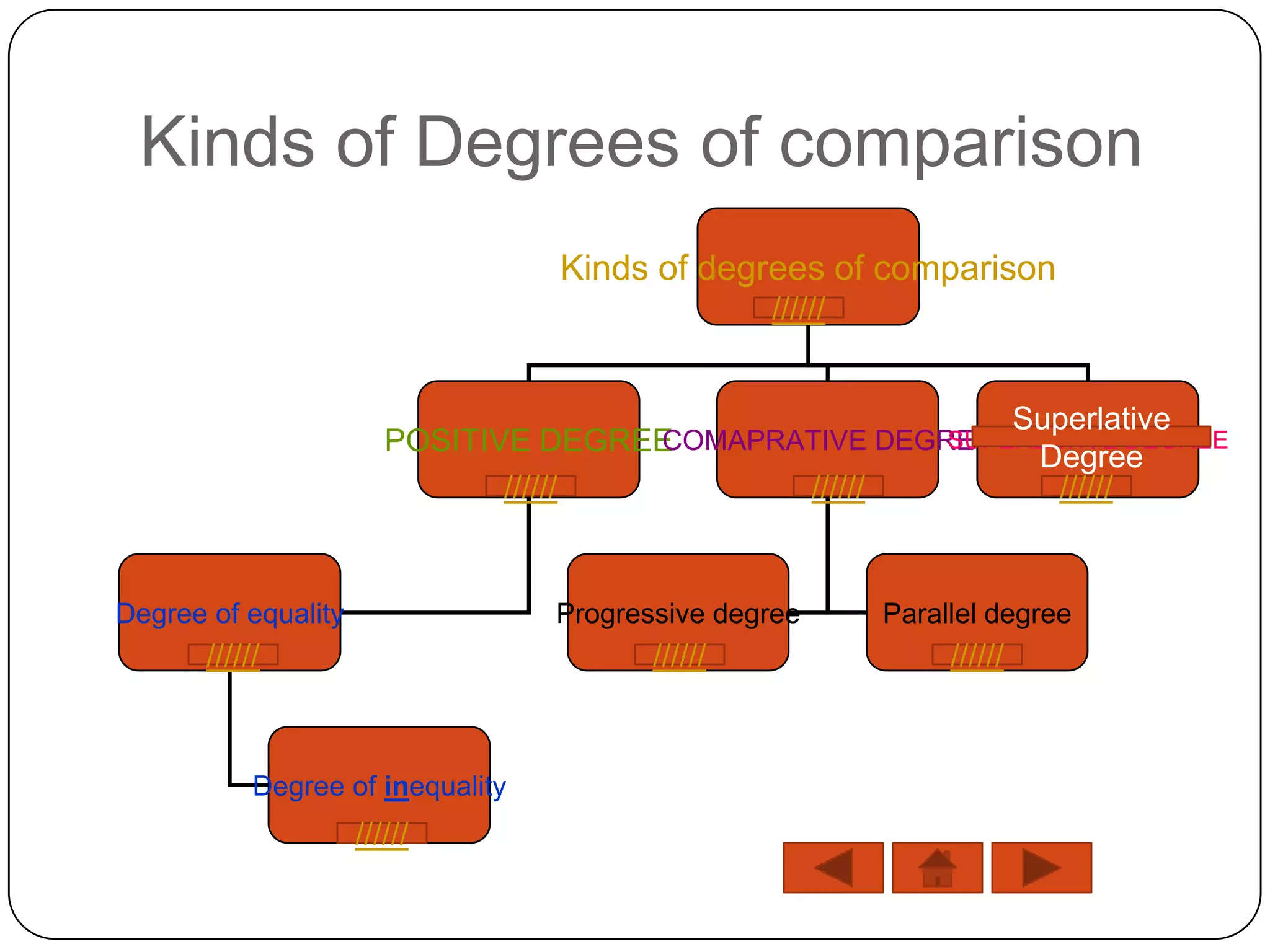
Kinds of Degrees of comparison
                                   Kinds of degrees of comparison
                                                   //////


                                                          Superlative
                        POSITIVE DEGREE
                                      COMAPRATIVE DEGREE
                                                      SUPERLATIVE DEGREE
                                                            Degree
                               //////        //////          //////


Degree of equality                 Progressive degree       Parallel degree
       //////                             //////                 //////


            Degree of inequality
                     //////
Positive Degree
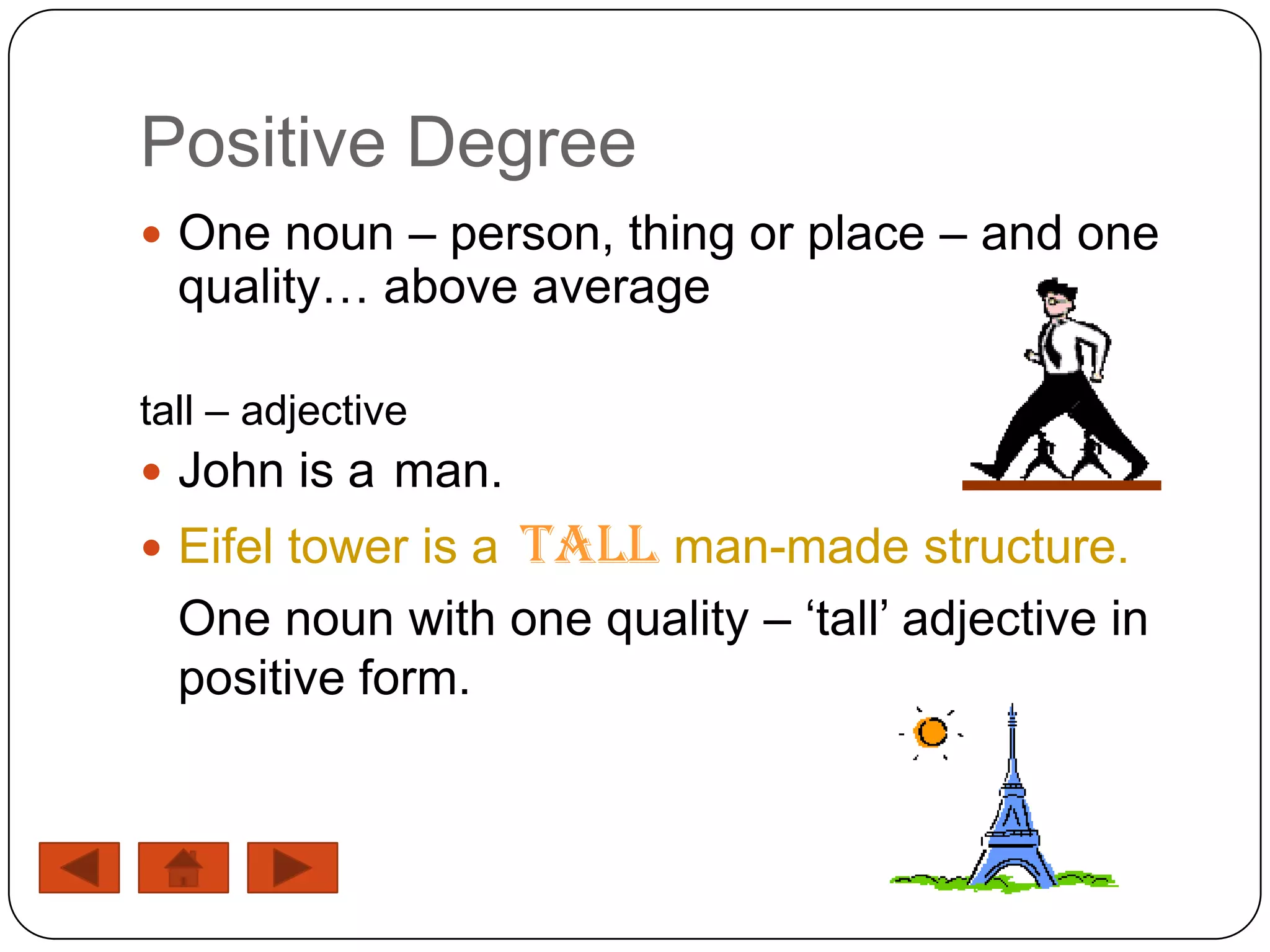
 One noun – person, thing or place – and one
 quality… above average

tall – adjective
 John is a man.
 Eifel tower is a   tall man-made structure.
 One noun with one quality – „tall‟ adjective in
 positive form.
Degree of equality
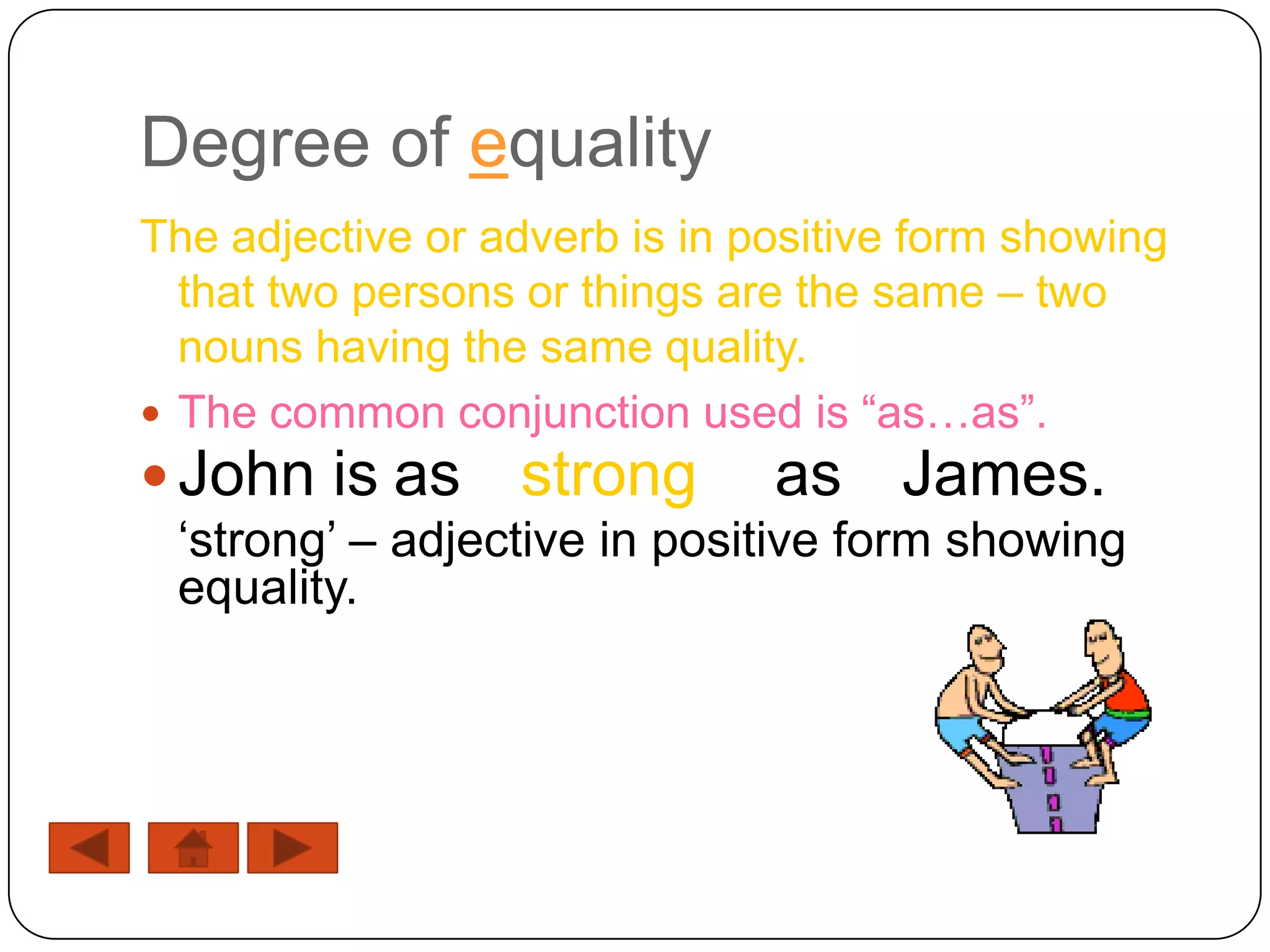
The adjective or adverb is in positive form showing
  that two persons or things are the same – two
  nouns having the same quality.
 The common conjunction used is “as…as”.
 John is as      strong       as James.
 „strong‟ – adjective in positive form showing
 equality.
Degree of inequality
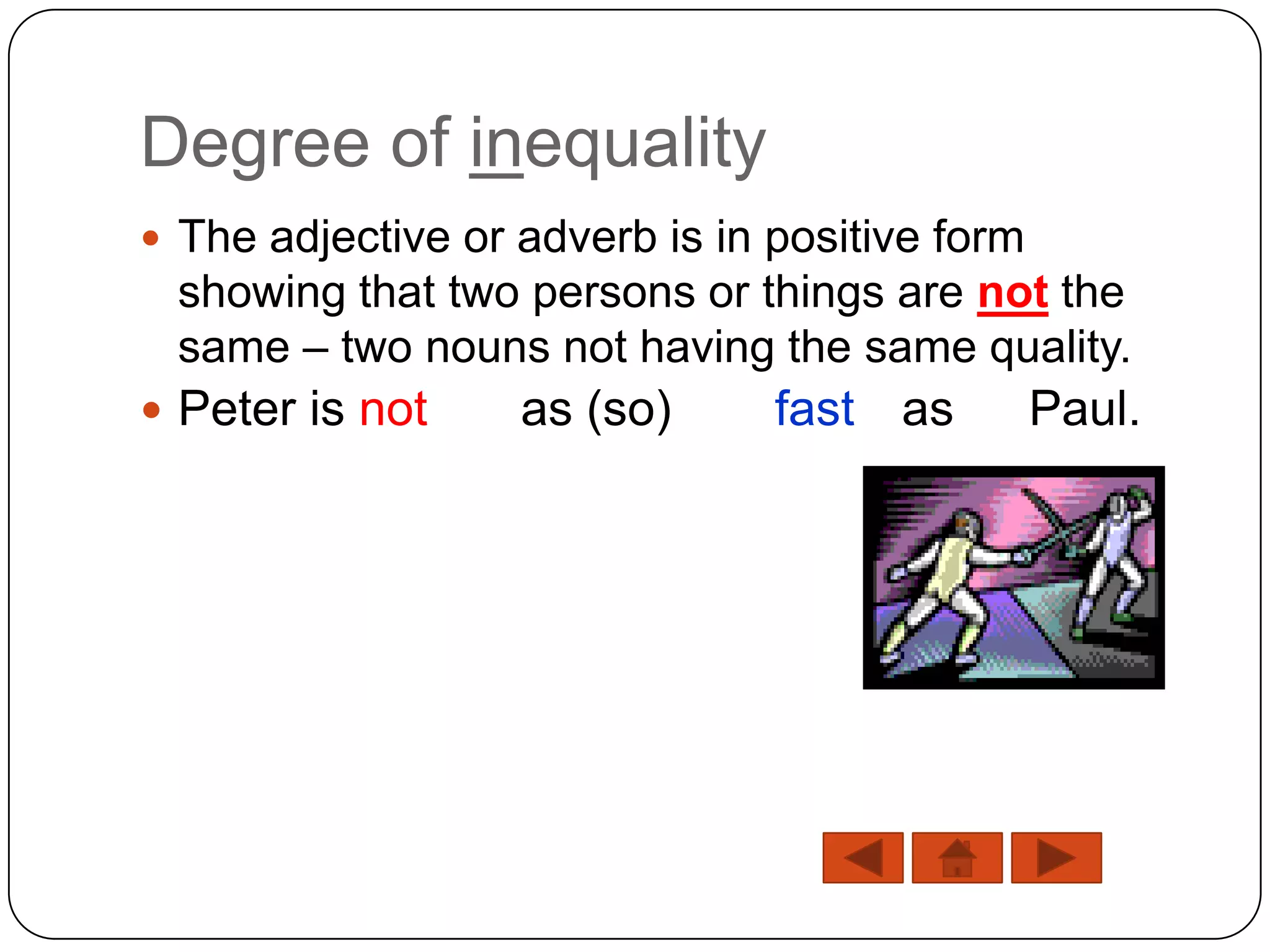
 The adjective or adverb is in positive form
 showing that two persons or things are not the
 same – two nouns not having the same quality.
 Peter is not     as (so)      fast as         Paul.
COMPARATIVE DEGREE
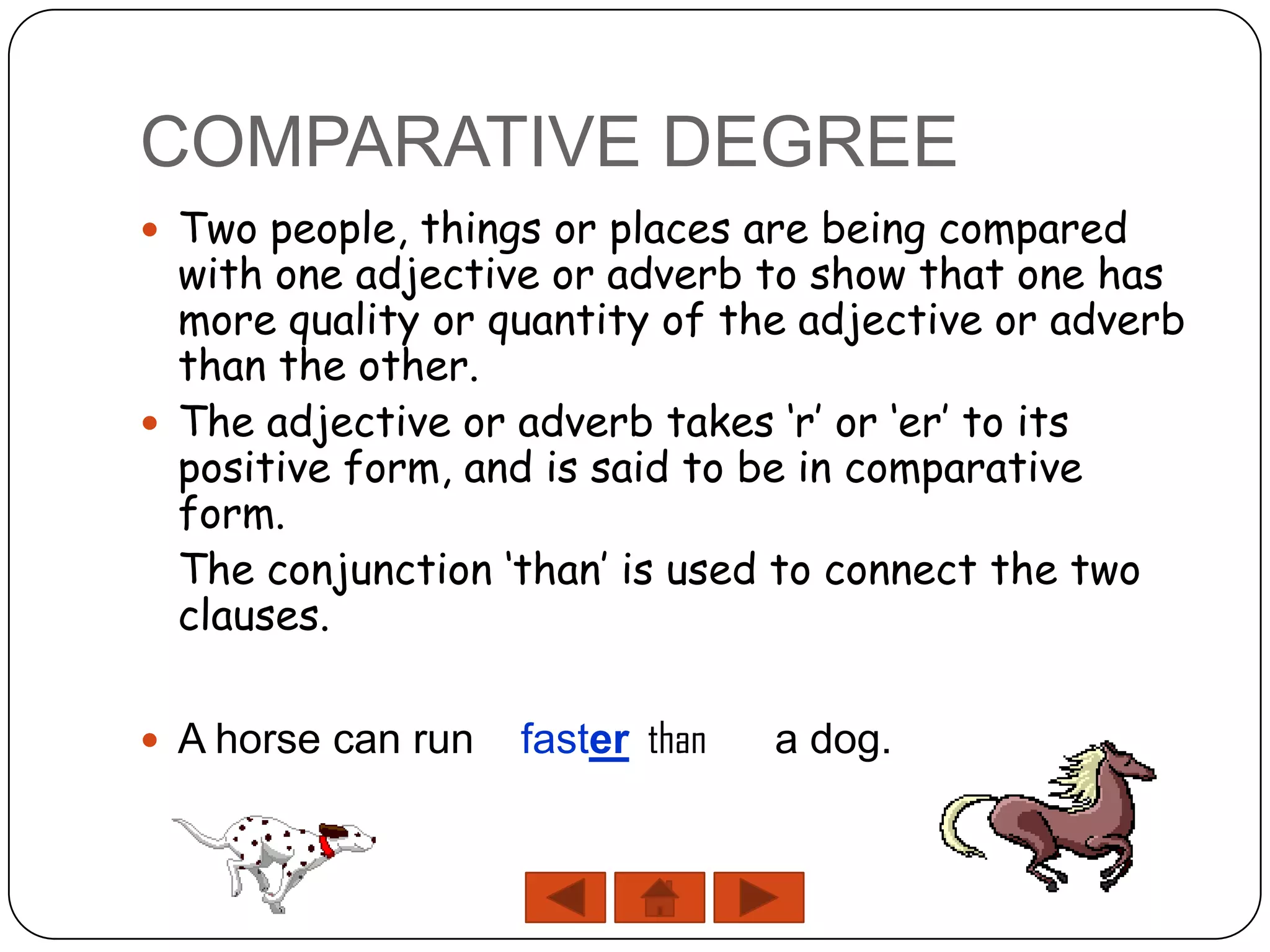
 Two people, things or places are being compared
  with one adjective or adverb to show that one has
  more quality or quantity of the adjective or adverb
  than the other.
 The adjective or adverb takes ‘r’ or ‘er’ to its
  positive form, and is said to be in comparative
  form.
  The conjunction ‘than’ is used to connect the two
  clauses.

 A horse can run   faster than   a dog.
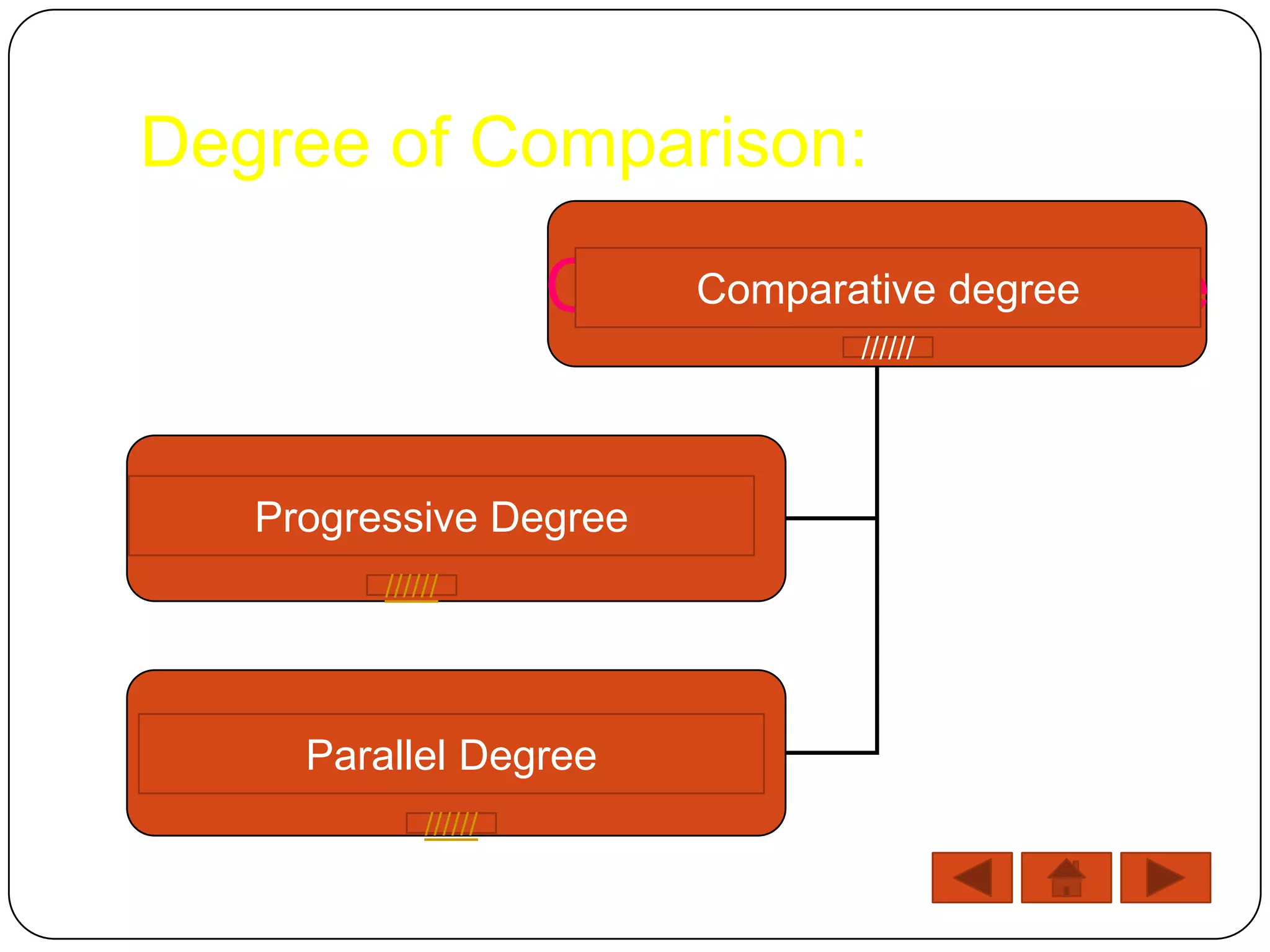
Degree of Comparison:

                     Comparative degree
                        Comparative degree
                              //////


 Progressive Degree
   Progressive Degree
        //////


   Parallel Degree
     Parallel Degree
            //////
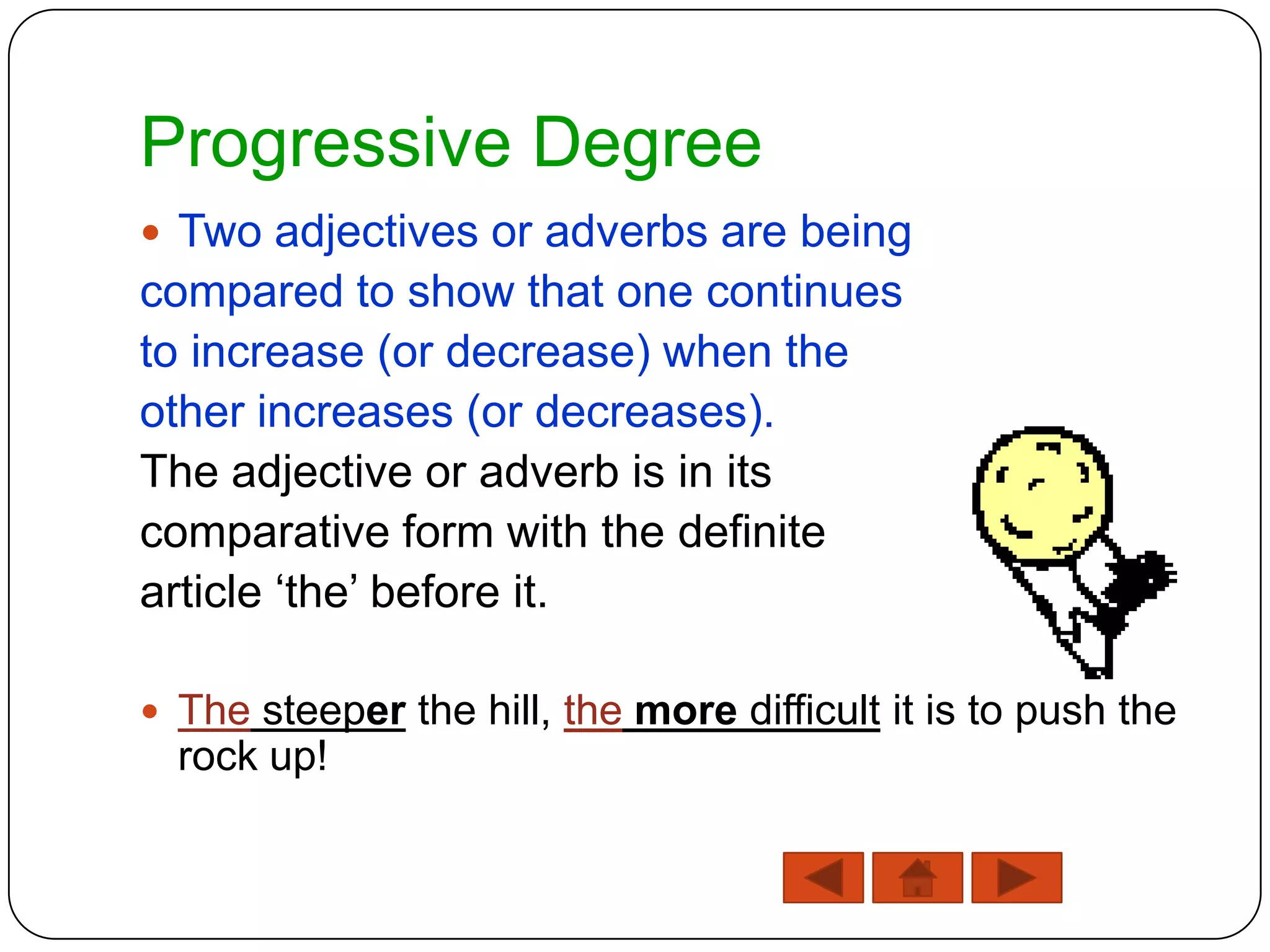
Progressive Degree
 Two adjectives or adverbs are being
compared to show that one continues
to increase (or decrease) when the
other increases (or decreases).
The adjective or adverb is in its
comparative form with the definite
article „the‟ before it.

 The steeper the hill, the more difficult it is to push the
  rock up!
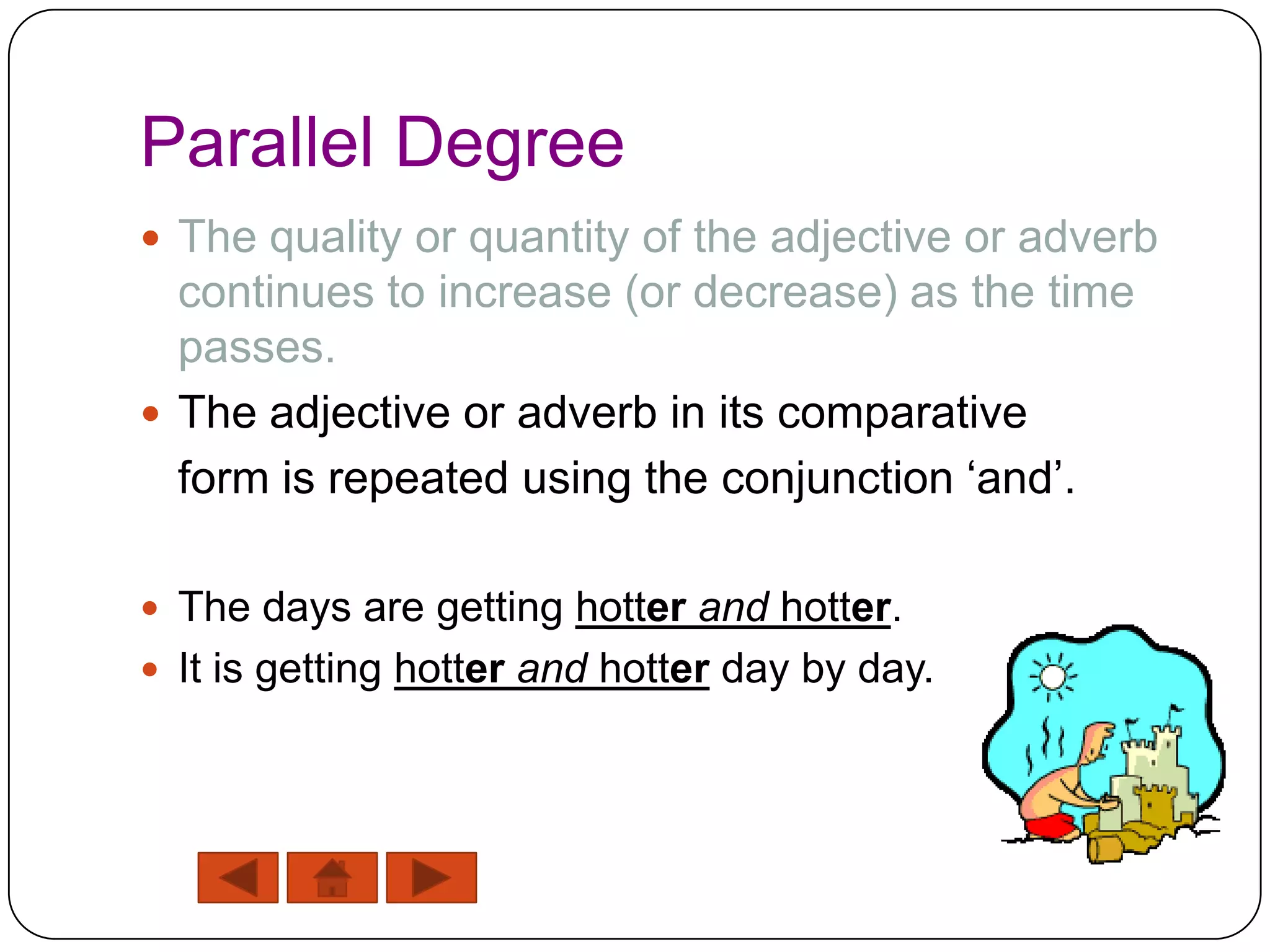
Parallel Degree
 The quality or quantity of the adjective or adverb
  continues to increase (or decrease) as the time
  passes.
 The adjective or adverb in its comparative
  form is repeated using the conjunction „and‟.

 The days are getting hotter and hotter.
 It is getting hotter and hotter day by day.
SUPERLATIVE DEGREE
 Comparing one noun – person, thing or place – with
  several others of its kind to show that this particular
  noun has the highest degree of the quality or quantity
  of the adjective or adverb being used to compare.
 The adjective or adverb takes the „superlative form‟,
  ending with „st‟ or „est‟, with the definite article „the‟
  before it.
 The preposition „of‟ is used when the comparison is
  among items, and „in‟ is used to specify the place,
  position or area.

 Susan is the most intelligent girl in the class.
Susan
Examples.
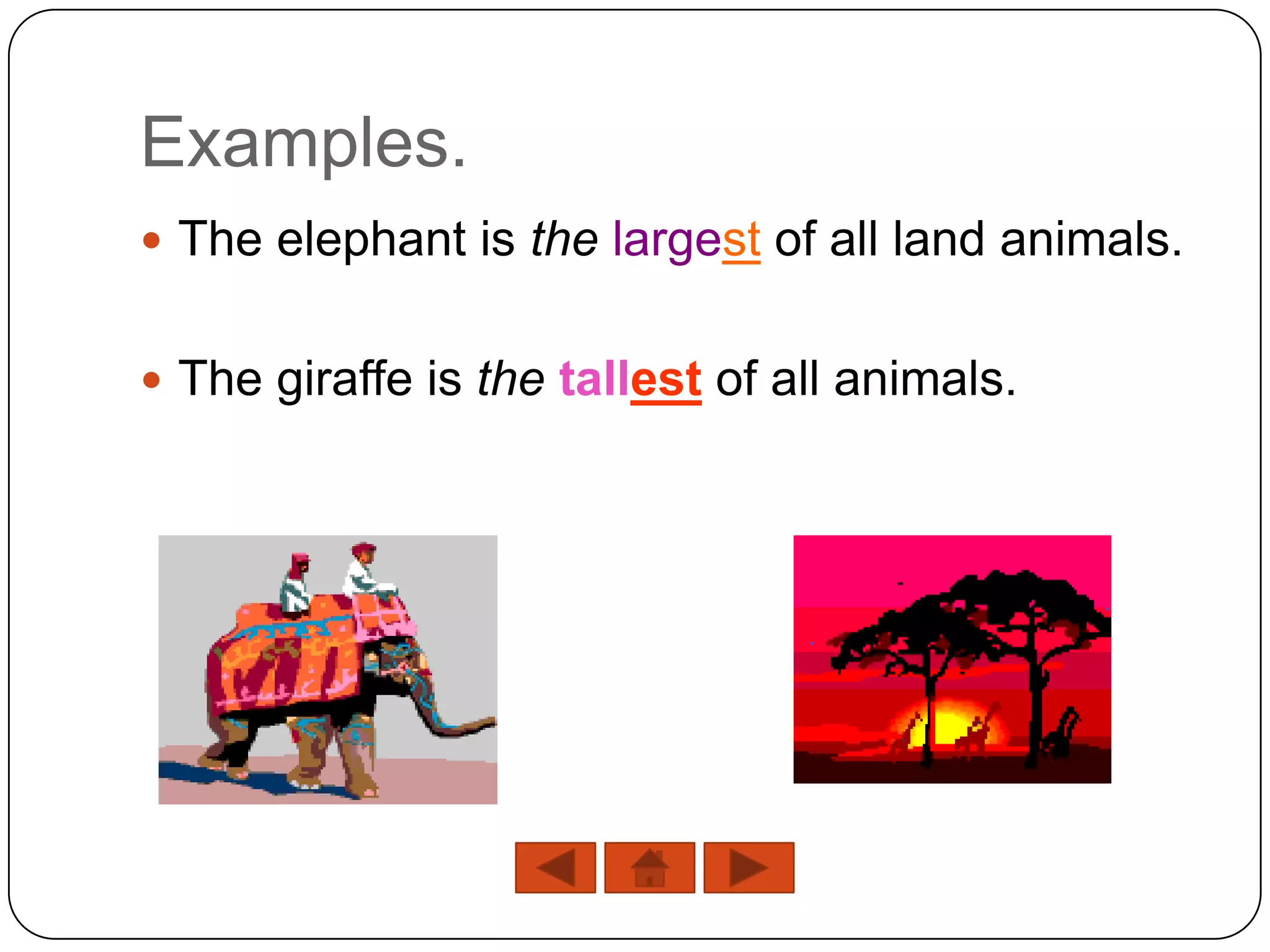
 The elephant is the largest of all land animals.


 The giraffe is the tallest of all animals.
Exercises.
Choose the correct answer.

1. Gerald is                          footballer in our team.
         fast
         the fastest
         the faster
 2. Tom is a                   boy.
           stronger
           the strongest
           strong

3. The white flower is as                  as
the red flower.
          the most beautiful
          more beautiful
          beautiful
4.            the weights, the                  it is to lift
  them.
The heavy
the difficult
The heavier
the more difficult

5. The sea is getting                       .
         rough and rough
         rougher and rougher
         the rougher and the rougher


 6. Mt. Everest is            mountain in
 the world.
          higher than
          high
          the highest

The degrees of comparison

  • 1.
    The Degrees ofComparison
  • 2.
    Contents  The Degreesof Comparison  Kinds of Degrees of comparison  Positive Degree  Degree of equality  Degree of inequality  Comparative Degree  Progressive Degree  Parallel Degree  Superlative Degree  Exercises
  • 3.
    The Degrees ofComparison  The Degrees of Comparison in English grammar are made with the Adjective and Adverb words to show how big or small, high or low, more or less, many or few, etc., of the qualities, numbers and positions of the nouns (persons, things and places) in comparison to the others mentioned in the other part of a sentence/expression.
  • 4.
    Kinds of Degreesof comparison Kinds of degrees of comparison ////// Superlative POSITIVE DEGREE COMAPRATIVE DEGREE SUPERLATIVE DEGREE Degree ////// ////// ////// Degree of equality Progressive degree Parallel degree ////// ////// ////// Degree of inequality //////
  • 5.
    Positive Degree  Onenoun – person, thing or place – and one quality… above average tall – adjective  John is a man.  Eifel tower is a tall man-made structure. One noun with one quality – „tall‟ adjective in positive form.
  • 6.
    Degree of equality Theadjective or adverb is in positive form showing that two persons or things are the same – two nouns having the same quality.  The common conjunction used is “as…as”.  John is as strong as James. „strong‟ – adjective in positive form showing equality.
  • 7.
    Degree of inequality The adjective or adverb is in positive form showing that two persons or things are not the same – two nouns not having the same quality.  Peter is not as (so) fast as Paul.
  • 8.
    COMPARATIVE DEGREE  Twopeople, things or places are being compared with one adjective or adverb to show that one has more quality or quantity of the adjective or adverb than the other.  The adjective or adverb takes ‘r’ or ‘er’ to its positive form, and is said to be in comparative form. The conjunction ‘than’ is used to connect the two clauses.  A horse can run faster than a dog.
  • 9.
    Degree of Comparison: Comparative degree Comparative degree ////// Progressive Degree Progressive Degree ////// Parallel Degree Parallel Degree //////
  • 10.
    Progressive Degree  Twoadjectives or adverbs are being compared to show that one continues to increase (or decrease) when the other increases (or decreases). The adjective or adverb is in its comparative form with the definite article „the‟ before it.  The steeper the hill, the more difficult it is to push the rock up!
  • 11.
    Parallel Degree  Thequality or quantity of the adjective or adverb continues to increase (or decrease) as the time passes.  The adjective or adverb in its comparative form is repeated using the conjunction „and‟.  The days are getting hotter and hotter.  It is getting hotter and hotter day by day.
  • 12.
    SUPERLATIVE DEGREE  Comparingone noun – person, thing or place – with several others of its kind to show that this particular noun has the highest degree of the quality or quantity of the adjective or adverb being used to compare.  The adjective or adverb takes the „superlative form‟, ending with „st‟ or „est‟, with the definite article „the‟ before it.  The preposition „of‟ is used when the comparison is among items, and „in‟ is used to specify the place, position or area.  Susan is the most intelligent girl in the class. Susan
  • 13.
    Examples.  The elephantis the largest of all land animals.  The giraffe is the tallest of all animals.
  • 14.
    Exercises. Choose the correctanswer. 1. Gerald is footballer in our team. fast the fastest the faster 2. Tom is a boy. stronger the strongest strong 3. The white flower is as as the red flower. the most beautiful more beautiful beautiful
  • 15.
    4. the weights, the it is to lift them. The heavy the difficult The heavier the more difficult 5. The sea is getting . rough and rough rougher and rougher the rougher and the rougher 6. Mt. Everest is mountain in the world. higher than high the highest