Prof. Dr. Nane Kratzke
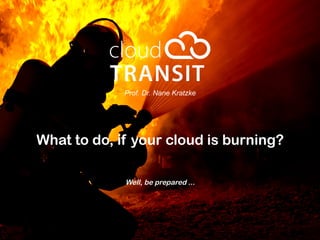
What to do if your cloud is burning?
Well, be prepared ...
ESCAPE ROUTE (aka Agenda)
2
Burning cloud? What does that mean?
How long is your escape route in cloud computing?
Who takes care for escape routes in cloud computing?
How can escape routes look like in cloud computing?
Why to take the risk?
What is your major whish in a burning house?
Get out! Fast ...
Was ist ihr sehnlichster Wunsch
brennenden Haus?
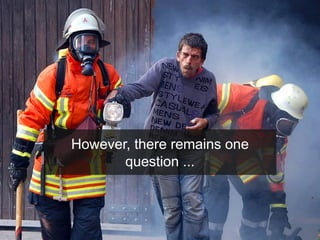
However, there remains one
question ...
How to convince these both to
get in, just to get you out?
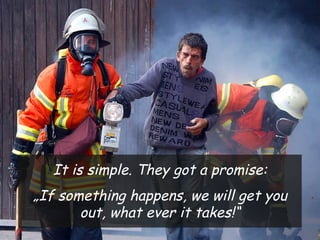
It is simple. They got a promise:
„If something happens, we will get you
out, what ever it takes!“
Cloud TRANSIT (a research project to get you out of a cloud)
8
• There are a lot of
approaches to get into
a cloud.
• But almost no
(pragmatic)
approaches exist to
leave a cloud or move
between clouds.
• But: If you know how
to get out, you are
more willing to take the
risk to go in.
What does it mean? My cloud is burning ...
Prof. Dr. rer. nat. Nane Kratzke
Praktische Informatik und betriebliche Informationssysteme
9
• Provider is insolvent ...
• Provider rises prices ...
• Provider reduces resource limits ...
• Provider terminates your contract ...
• Provider has availability problems ...
• Changing laws (data protection) ...
• Other governance/compliance reasons (data hosted on US
territory, NSA?)
There are a lot of (hardly predictable) reasons to
leave a cloud service provider.
ESCAPE ROUTE (Agenda)
10
Burning cloud? What does that mean?
How long is your escape route in cloud computing?
Who takes care for escape routes in cloud computing?
How can escape routes look like in cloud computing?
Why to take the risk?
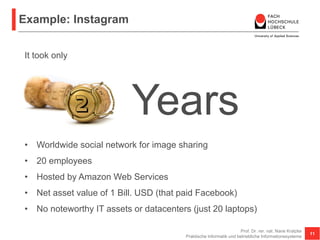
Example: Instagram
Prof. Dr. rer. nat. Nane Kratzke
Praktische Informatik und betriebliche Informationssysteme
11
• Worldwide social network for image sharing
• 20 employees
• Hosted by Amazon Web Services
• Net asset value of 1 Bill. USD (that paid Facebook)
• No noteworthy IT assets or datacenters (just 20 laptops)
Years
It took only
Example: Instagram
Prof. Dr. rer. nat. Nane Kratzke
Praktische Informatik und betriebliche Informationssysteme
12
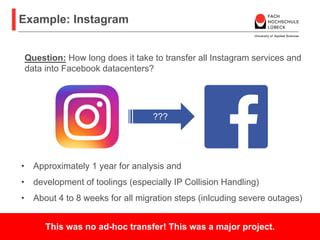
• Approximately 1 year for analysis and
• development of toolings (especially IP Collision Handling)
• About 4 to 8 weeks for all migration steps (inlcuding severe outages)
Question: How long does it take to transfer all Instagram services and
data into Facebook datacenters?
???
This was no ad-hoc transfer! This was a major project.
So, your escape route can be long, ...
... lonely,
cumbersome
and far away from any data highway.
ESCAPE ROUTE (Agenda)
14
Burning cloud? What does that mean?
How long is your escape route in cloud computing?
Who takes care for escape routes in cloud computing?
How can escape routes look like in cloud computing?
Why to take the risk?
Did you know ...
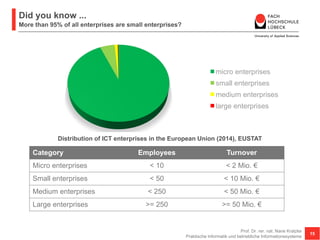
More than 95% of all enterprises are small enterprises?
Prof. Dr. rer. nat. Nane Kratzke
Praktische Informatik und betriebliche Informationssysteme
15
micro enterprises
small enterprises
medium enterprises
large enterprises
Category Employees Turnover
Micro enterprises < 10 < 2 Mio. €
Small enterprises < 50 < 10 Mio. €
Medium enterprises < 250 < 50 Mio. €
Large enterprises >= 250 >= 50 Mio. €
Distribution of ICT enterprises in the European Union (2014), EUSTAT
Current Cloud Computing Research ...
Prof. Dr. rer. nat. Nane Kratzke
Computer Science and Business Information Systems
16
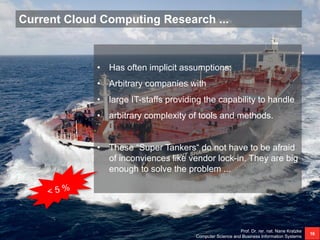
• Has often implicit assumptions:
• Arbitrary companies with
• large IT-staffs providing the capability to handle
• arbitrary complexity of tools and methods.
• These “Super Tankers“ do not have to be afraid
of inconviences like vendor lock-in. They are big
enough to solve the problem ...
Our target group is different ...
Prof. Dr. rer. nat. Nane Kratzke
Computer Science and Business Information Systems
17
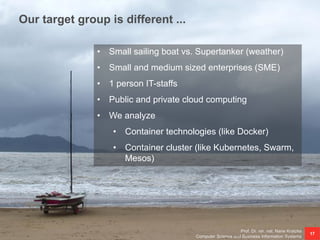
• Small sailing boat vs. Supertanker (weather)
• Small and medium sized enterprises (SME)
• 1 person IT-staffs
• Public and private cloud computing
• We analyze
• Container technologies (like Docker)
• Container cluster (like Kubernetes, Swarm,
Mesos)
According to that ....
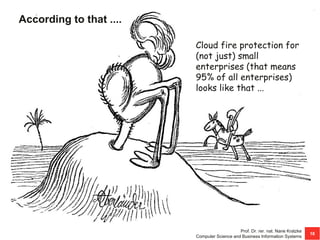
Cloud fire protection for
(not just) small
enterprises (that means
95% of all enterprises)
looks like that ...
Prof. Dr. rer. nat. Nane Kratzke
Computer Science and Business Information Systems
18
ESCAPE ROUTE (Agenda)
19
Burning cloud? What does that mean?
How long is your escape route in cloud computing?
Who takes care for escape routes in cloud computing?
How can escape routes look like in cloud computing?
Why to take the risk?
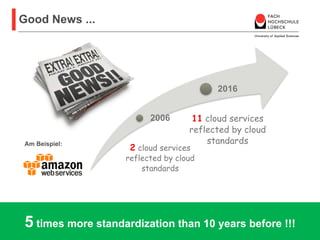
Good News ...
Prof. Dr. rer. nat. Nane Kratzke
Praktische Informatik und betriebliche Informationssysteme
20
2006
2 cloud services
reflected by cloud
standards
2016
11 cloud services
reflected by cloud
standards
5 times more standardization than 10 years before !!!
Example:
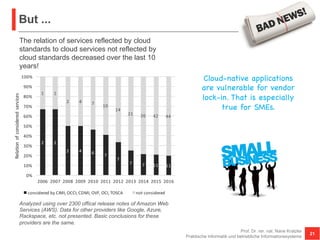
But ...
Prof. Dr. rer. nat. Nane Kratzke
Praktische Informatik und betriebliche Informationssysteme
21
2 2
2 4 6
7
7
7 7 11 11
1 1
2 4 7
10
14
21 26 42 44
0%
10%
20%
30%
40%
50%
60%
70%
80%
90%
100%
2006 2007 2008 2009 2010 2011 2012 2013 2014 2015 2016
Relation	of	considered	services
considered	by	CIMI,	OCCI,	CDMI,	OVF,	OCI,	TOSCA not	considered	
The relation of services reflected by cloud
standards to cloud services not reflected by
cloud standards decreased over the last 10
years!
Analyzed using over 2300 offical release notes of Amazon Web
Services (AWS). Data for other providers like Google, Azure,
Rackspace, etc. not presented. Basic conclusions for these
providers are the same.
Cloud-native applications
are vulnerable for vendor
lock-in. That is especially
true for SMEs.
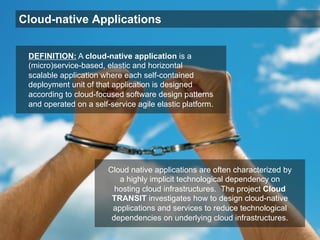
Cloud-native Applications
Cloud native applications are often characterized by
a highly implicit technological dependency on
hosting cloud infrastructures. The project Cloud
TRANSIT investigates how to design cloud-native
applications and services to reduce technological
dependencies on underlying cloud infrastructures.
DEFINITION: A cloud-native application is a
(micro)service-based, elastic and horizontal
scalable application where each self-contained
deployment unit of that application is designed
according to cloud-focused software design patterns
and operated on a self-service agile elastic platform.
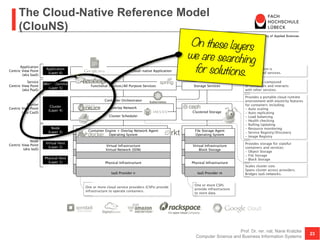
The Cloud-Native Reference Model
(ClouNS)
Prof. Dr. rer. nat. Nane Kratzke
Computer Science and Business Information Systems
23
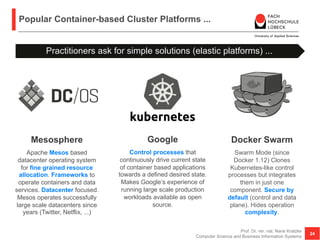
Popular Container-based Cluster Platforms ...
Prof. Dr. rer. nat. Nane Kratzke
Computer Science and Business Information Systems
24
Docker Swarm
Swarm Mode (since
Docker 1.12) Clones
Kubernetes-like control
processes but integrates
them in just one
component. Secure by
default (control and data
plane). Hides operation
complexity.
Google
Control processes that
continuously drive current state
of container based applications
towards a defined desired state.
Makes Google‘s experience of
running large scale production
workloads available as open
source.
Mesosphere
Apache Mesos based
datacenter operating system
for fine grained resource
allocation. Frameworks to
operate containers and data
services. Datacenter focused.
Mesos operates successfully
large scale datacenters since
years (Twitter, Netflix, ...)
Practitioners ask for simple solutions (elastic platforms) ...
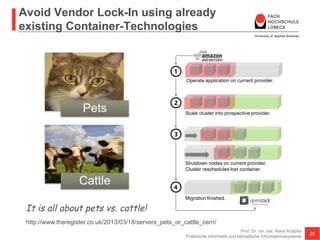
Avoid Vendor Lock-In using already
existing Container-Technologies
Prof. Dr. rer. nat. Nane Kratzke
Praktische Informatik und betriebliche Informationssysteme
25
Operate application on current provider.
Scale cluster into prospective provider.
Shutdown nodes on current provider.
Cluster reschedules lost container.
Migration finished.
Pets
Cattle
It is all about pets vs. cattle!
http://www.theregister.co.uk/2013/03/18/servers_pets_or_cattle_cern/
ESCAPE ROUTE (Agenda)
26
Burning cloud? What does that mean?
How long is your escape route in cloud computing?
Who takes care for escape routes in cloud computing?
How can escape routes look like in cloud computing?
Why to take the risk?
Prof. Dr. rer. nat. Nane Kratzke
Praktische Informatik und betriebliche Informationssysteme
27
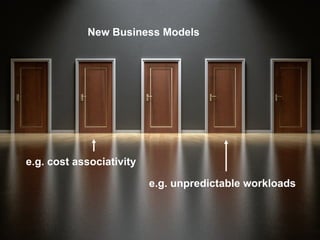
Kostenassoziativät
New Business Models
e.g. cost associativity
e.g. unpredictable workloads
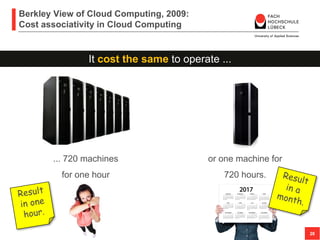
Berkley View of Cloud Computing, 2009:
Cost associativity in Cloud Computing
28
It cost the same to operate ...
... 720 machines
for one hour
or one machine for
720 hours.
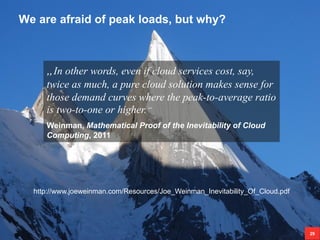
We are afraid of peak loads, but why?
29
„In other words, even if cloud services cost, say,
twice as much, a pure cloud solution makes sense for
those demand curves where the peak-to-average ratio
is two-to-one or higher.“
Weinman, Mathematical Proof of the Inevitability of Cloud
Computing, 2011
http://www.joeweinman.com/Resources/Joe_Weinman_Inevitability_Of_Cloud.pdf
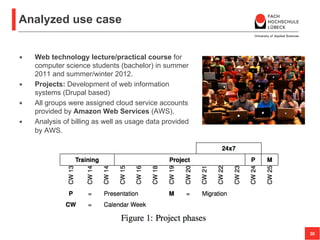
Analyzed use case
• Web technology lecture/practical course for
computer science students (bachelor) in summer
2011 and summer/winter 2012.
• Projects: Development of web information
systems (Drupal based)
• All groups were assigned cloud service accounts
provided by Amazon Web Services (AWS).
• Analysis of billing as well as usage data provided
by AWS.
Prof. Dr. rer. nat. Nane Kratzke
Computer Science and Business Information Systems
30
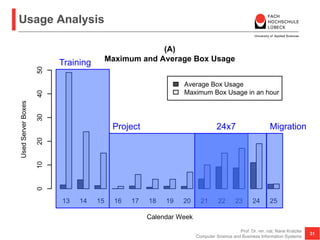
Usage Analysis
31
Prof. Dr. rer. nat. Nane Kratzke
Computer Science and Business Information Systems
13 14 15 16 17 18 19 20 21 22 23 24 25
Average Box Usage
Maximum Box Usage in an hour
(A)
Maximum and Average Box Usage
Calendar Week
UsedServerBoxes
01020304050
Training
Project 24x7 Migration
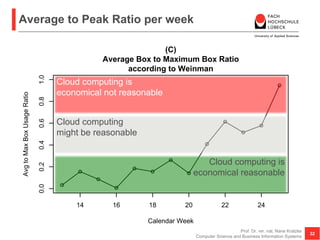
Average to Peak Ratio per week
32
Prof. Dr. rer. nat. Nane Kratzke
Computer Science and Business Information Systems
13 14 15 16 17 18 19 20 21 22 23 24 25
Calendar Week
0
14 16 18 20 22 24
0.00.20.40.60.81.0
(C)
Average Box to Maximum Box Ratio
according to Weinman
Calendar Week
AvgtoMaxBoxUsageRatio
Cloud computing is
economical reasonable
Cloud computing
might be reasonable
Cloud computing is
economical not reasonable
Economical Decision Analysis
A four step process to decide for or against cloud based virtual labs
Prof. Dr. rer. nat. Nane Kratzke
Computer Science and Business Information Systems
33
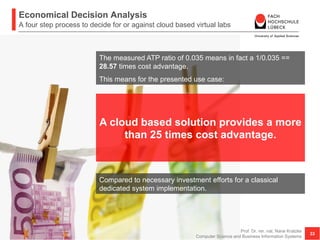
A cloud based solution provides a more
than 25 times cost advantage.
The measured ATP ratio of 0.035 means in fact a 1/0.035 ==
28.57 times cost advantage.
This means for the presented use case:
Compared to necessary investment efforts for a classical
dedicated system implementation.
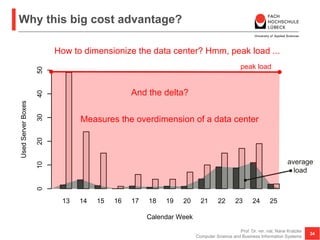
Why this big cost advantage?
Prof. Dr. rer. nat. Nane Kratzke
Computer Science and Business Information Systems
34
13 14 15 16 17 18 19 20 21 22 23 24 25
Average Box Usage
Maximum Box Usage in an hour
(A)
Maximum and Average Box Usage
Calendar Week
UsedServerBoxes
01020304050
How to dimensionize the data center? Hmm, peak load ...
peak load
average
load
And the delta?
Measures the overdimension of a data center
ESCAPE ROUTE (Agenda)
35
Burning cloud? What does that mean?
How long is your escape route in cloud computing?
Who takes care for escape routes in cloud computing?
How can escape routes look like in cloud computing?
Why to take the risk?
Summary
• You want to adopt cloud computing?
• Think about your escape strategy FIRST!
• Support research focussing small and
medium sized enterprises (it does not cost
sooo much)
• That supports 95% of all enterprises
• (and not only 5% supertankers)
• New (maybe disruptive?) business models ...
• Cost associativity
• Cost advantages for non-static of
unpredictable workloads
Acknowledgement
• All Pictures taken from Pixabay.com (CC0 Licence)
Prof. Dr. rer. nat. Nane Kratzke
Computer Science and Business Information Systems
37
Our research is funded by German Federal Ministry of Education and Research
(Project Cloud TRANSIT, 03FH021PX4). We thank fat IT solution GmbH (Kiel)
for their support of Cloud TRANSIT.
Picture Reference
Presentation URL
About
Prof. Dr. rer. nat. Nane Kratzke
Computer Science and Business Information Systems
38
CoSA: https://cosa.fh-luebeck.de/en/contact/people/n-kratzke
Blog: http://www.nkode.io
Twitter: @NaneKratzke
GooglePlus: +NaneKratzke
LinkedIn: https://de.linkedin.com/in/nanekratzke
GitHub: https://github.com/nkratzke
ResearchGate: https://www.researchgate.net/profile/Nane_Kratzke
SlideShare: http://de.slideshare.net/i21aneka
Prof. Dr. rer. nat.
Nane Kratzke

What the cloud has to do with a burning house?

  • 1.
    Prof. Dr. NaneKratzke What to do if your cloud is burning? Well, be prepared ...
  • 2.
    ESCAPE ROUTE (akaAgenda) 2 Burning cloud? What does that mean? How long is your escape route in cloud computing? Who takes care for escape routes in cloud computing? How can escape routes look like in cloud computing? Why to take the risk?
  • 3.
    What is yourmajor whish in a burning house?
  • 4.
  • 5.
    Was ist ihrsehnlichster Wunsch brennenden Haus? However, there remains one question ...
  • 6.
    How to convincethese both to get in, just to get you out?
  • 7.
    It is simple.They got a promise: „If something happens, we will get you out, what ever it takes!“
  • 8.
    Cloud TRANSIT (aresearch project to get you out of a cloud) 8 • There are a lot of approaches to get into a cloud. • But almost no (pragmatic) approaches exist to leave a cloud or move between clouds. • But: If you know how to get out, you are more willing to take the risk to go in.
  • 9.
    What does itmean? My cloud is burning ... Prof. Dr. rer. nat. Nane Kratzke Praktische Informatik und betriebliche Informationssysteme 9 • Provider is insolvent ... • Provider rises prices ... • Provider reduces resource limits ... • Provider terminates your contract ... • Provider has availability problems ... • Changing laws (data protection) ... • Other governance/compliance reasons (data hosted on US territory, NSA?) There are a lot of (hardly predictable) reasons to leave a cloud service provider.
  • 10.
    ESCAPE ROUTE (Agenda) 10 Burningcloud? What does that mean? How long is your escape route in cloud computing? Who takes care for escape routes in cloud computing? How can escape routes look like in cloud computing? Why to take the risk?
  • 11.
    Example: Instagram Prof. Dr.rer. nat. Nane Kratzke Praktische Informatik und betriebliche Informationssysteme 11 • Worldwide social network for image sharing • 20 employees • Hosted by Amazon Web Services • Net asset value of 1 Bill. USD (that paid Facebook) • No noteworthy IT assets or datacenters (just 20 laptops) Years It took only
  • 12.
    Example: Instagram Prof. Dr.rer. nat. Nane Kratzke Praktische Informatik und betriebliche Informationssysteme 12 • Approximately 1 year for analysis and • development of toolings (especially IP Collision Handling) • About 4 to 8 weeks for all migration steps (inlcuding severe outages) Question: How long does it take to transfer all Instagram services and data into Facebook datacenters? ??? This was no ad-hoc transfer! This was a major project.
  • 13.
    So, your escaperoute can be long, ... ... lonely, cumbersome and far away from any data highway.
  • 14.
    ESCAPE ROUTE (Agenda) 14 Burningcloud? What does that mean? How long is your escape route in cloud computing? Who takes care for escape routes in cloud computing? How can escape routes look like in cloud computing? Why to take the risk?
  • 15.
    Did you know... More than 95% of all enterprises are small enterprises? Prof. Dr. rer. nat. Nane Kratzke Praktische Informatik und betriebliche Informationssysteme 15 micro enterprises small enterprises medium enterprises large enterprises Category Employees Turnover Micro enterprises < 10 < 2 Mio. € Small enterprises < 50 < 10 Mio. € Medium enterprises < 250 < 50 Mio. € Large enterprises >= 250 >= 50 Mio. € Distribution of ICT enterprises in the European Union (2014), EUSTAT
  • 16.
    Current Cloud ComputingResearch ... Prof. Dr. rer. nat. Nane Kratzke Computer Science and Business Information Systems 16 • Has often implicit assumptions: • Arbitrary companies with • large IT-staffs providing the capability to handle • arbitrary complexity of tools and methods. • These “Super Tankers“ do not have to be afraid of inconviences like vendor lock-in. They are big enough to solve the problem ...
  • 17.
    Our target groupis different ... Prof. Dr. rer. nat. Nane Kratzke Computer Science and Business Information Systems 17 • Small sailing boat vs. Supertanker (weather) • Small and medium sized enterprises (SME) • 1 person IT-staffs • Public and private cloud computing • We analyze • Container technologies (like Docker) • Container cluster (like Kubernetes, Swarm, Mesos)
  • 18.
    According to that.... Cloud fire protection for (not just) small enterprises (that means 95% of all enterprises) looks like that ... Prof. Dr. rer. nat. Nane Kratzke Computer Science and Business Information Systems 18
  • 19.
    ESCAPE ROUTE (Agenda) 19 Burningcloud? What does that mean? How long is your escape route in cloud computing? Who takes care for escape routes in cloud computing? How can escape routes look like in cloud computing? Why to take the risk?
  • 20.
    Good News ... Prof.Dr. rer. nat. Nane Kratzke Praktische Informatik und betriebliche Informationssysteme 20 2006 2 cloud services reflected by cloud standards 2016 11 cloud services reflected by cloud standards 5 times more standardization than 10 years before !!! Example:
  • 21.
    But ... Prof. Dr.rer. nat. Nane Kratzke Praktische Informatik und betriebliche Informationssysteme 21 2 2 2 4 6 7 7 7 7 11 11 1 1 2 4 7 10 14 21 26 42 44 0% 10% 20% 30% 40% 50% 60% 70% 80% 90% 100% 2006 2007 2008 2009 2010 2011 2012 2013 2014 2015 2016 Relation of considered services considered by CIMI, OCCI, CDMI, OVF, OCI, TOSCA not considered The relation of services reflected by cloud standards to cloud services not reflected by cloud standards decreased over the last 10 years! Analyzed using over 2300 offical release notes of Amazon Web Services (AWS). Data for other providers like Google, Azure, Rackspace, etc. not presented. Basic conclusions for these providers are the same. Cloud-native applications are vulnerable for vendor lock-in. That is especially true for SMEs.
  • 22.
    Cloud-native Applications Cloud nativeapplications are often characterized by a highly implicit technological dependency on hosting cloud infrastructures. The project Cloud TRANSIT investigates how to design cloud-native applications and services to reduce technological dependencies on underlying cloud infrastructures. DEFINITION: A cloud-native application is a (micro)service-based, elastic and horizontal scalable application where each self-contained deployment unit of that application is designed according to cloud-focused software design patterns and operated on a self-service agile elastic platform.
  • 23.
    The Cloud-Native ReferenceModel (ClouNS) Prof. Dr. rer. nat. Nane Kratzke Computer Science and Business Information Systems 23
  • 24.
    Popular Container-based ClusterPlatforms ... Prof. Dr. rer. nat. Nane Kratzke Computer Science and Business Information Systems 24 Docker Swarm Swarm Mode (since Docker 1.12) Clones Kubernetes-like control processes but integrates them in just one component. Secure by default (control and data plane). Hides operation complexity. Google Control processes that continuously drive current state of container based applications towards a defined desired state. Makes Google‘s experience of running large scale production workloads available as open source. Mesosphere Apache Mesos based datacenter operating system for fine grained resource allocation. Frameworks to operate containers and data services. Datacenter focused. Mesos operates successfully large scale datacenters since years (Twitter, Netflix, ...) Practitioners ask for simple solutions (elastic platforms) ...
  • 25.
    Avoid Vendor Lock-Inusing already existing Container-Technologies Prof. Dr. rer. nat. Nane Kratzke Praktische Informatik und betriebliche Informationssysteme 25 Operate application on current provider. Scale cluster into prospective provider. Shutdown nodes on current provider. Cluster reschedules lost container. Migration finished. Pets Cattle It is all about pets vs. cattle! http://www.theregister.co.uk/2013/03/18/servers_pets_or_cattle_cern/
  • 26.
    ESCAPE ROUTE (Agenda) 26 Burningcloud? What does that mean? How long is your escape route in cloud computing? Who takes care for escape routes in cloud computing? How can escape routes look like in cloud computing? Why to take the risk?
  • 27.
    Prof. Dr. rer.nat. Nane Kratzke Praktische Informatik und betriebliche Informationssysteme 27 Kostenassoziativät New Business Models e.g. cost associativity e.g. unpredictable workloads
  • 28.
    Berkley View ofCloud Computing, 2009: Cost associativity in Cloud Computing 28 It cost the same to operate ... ... 720 machines for one hour or one machine for 720 hours.
  • 29.
    We are afraidof peak loads, but why? 29 „In other words, even if cloud services cost, say, twice as much, a pure cloud solution makes sense for those demand curves where the peak-to-average ratio is two-to-one or higher.“ Weinman, Mathematical Proof of the Inevitability of Cloud Computing, 2011 http://www.joeweinman.com/Resources/Joe_Weinman_Inevitability_Of_Cloud.pdf
  • 30.
    Analyzed use case •Web technology lecture/practical course for computer science students (bachelor) in summer 2011 and summer/winter 2012. • Projects: Development of web information systems (Drupal based) • All groups were assigned cloud service accounts provided by Amazon Web Services (AWS). • Analysis of billing as well as usage data provided by AWS. Prof. Dr. rer. nat. Nane Kratzke Computer Science and Business Information Systems 30
  • 31.
    Usage Analysis 31 Prof. Dr.rer. nat. Nane Kratzke Computer Science and Business Information Systems 13 14 15 16 17 18 19 20 21 22 23 24 25 Average Box Usage Maximum Box Usage in an hour (A) Maximum and Average Box Usage Calendar Week UsedServerBoxes 01020304050 Training Project 24x7 Migration
  • 32.
    Average to PeakRatio per week 32 Prof. Dr. rer. nat. Nane Kratzke Computer Science and Business Information Systems 13 14 15 16 17 18 19 20 21 22 23 24 25 Calendar Week 0 14 16 18 20 22 24 0.00.20.40.60.81.0 (C) Average Box to Maximum Box Ratio according to Weinman Calendar Week AvgtoMaxBoxUsageRatio Cloud computing is economical reasonable Cloud computing might be reasonable Cloud computing is economical not reasonable
  • 33.
    Economical Decision Analysis Afour step process to decide for or against cloud based virtual labs Prof. Dr. rer. nat. Nane Kratzke Computer Science and Business Information Systems 33 A cloud based solution provides a more than 25 times cost advantage. The measured ATP ratio of 0.035 means in fact a 1/0.035 == 28.57 times cost advantage. This means for the presented use case: Compared to necessary investment efforts for a classical dedicated system implementation.
  • 34.
    Why this bigcost advantage? Prof. Dr. rer. nat. Nane Kratzke Computer Science and Business Information Systems 34 13 14 15 16 17 18 19 20 21 22 23 24 25 Average Box Usage Maximum Box Usage in an hour (A) Maximum and Average Box Usage Calendar Week UsedServerBoxes 01020304050 How to dimensionize the data center? Hmm, peak load ... peak load average load And the delta? Measures the overdimension of a data center
  • 35.
    ESCAPE ROUTE (Agenda) 35 Burningcloud? What does that mean? How long is your escape route in cloud computing? Who takes care for escape routes in cloud computing? How can escape routes look like in cloud computing? Why to take the risk?
  • 36.
    Summary • You wantto adopt cloud computing? • Think about your escape strategy FIRST! • Support research focussing small and medium sized enterprises (it does not cost sooo much) • That supports 95% of all enterprises • (and not only 5% supertankers) • New (maybe disruptive?) business models ... • Cost associativity • Cost advantages for non-static of unpredictable workloads
  • 37.
    Acknowledgement • All Picturestaken from Pixabay.com (CC0 Licence) Prof. Dr. rer. nat. Nane Kratzke Computer Science and Business Information Systems 37 Our research is funded by German Federal Ministry of Education and Research (Project Cloud TRANSIT, 03FH021PX4). We thank fat IT solution GmbH (Kiel) for their support of Cloud TRANSIT. Picture Reference Presentation URL
  • 38.
    About Prof. Dr. rer.nat. Nane Kratzke Computer Science and Business Information Systems 38 CoSA: https://cosa.fh-luebeck.de/en/contact/people/n-kratzke Blog: http://www.nkode.io Twitter: @NaneKratzke GooglePlus: +NaneKratzke LinkedIn: https://de.linkedin.com/in/nanekratzke GitHub: https://github.com/nkratzke ResearchGate: https://www.researchgate.net/profile/Nane_Kratzke SlideShare: http://de.slideshare.net/i21aneka Prof. Dr. rer. nat. Nane Kratzke