We have the Bricks to Build Cloud-
native Cathedrals
But do we have the mortar?
Nane Kratzke
Panel Discussion: “Challenges in Cloud Computing-based Systems“
9th International Conference on Cloud Computing, GRIDs, and Virtualization (CLOUD COMPUTING 2018); Barcelona, Spain, 2018
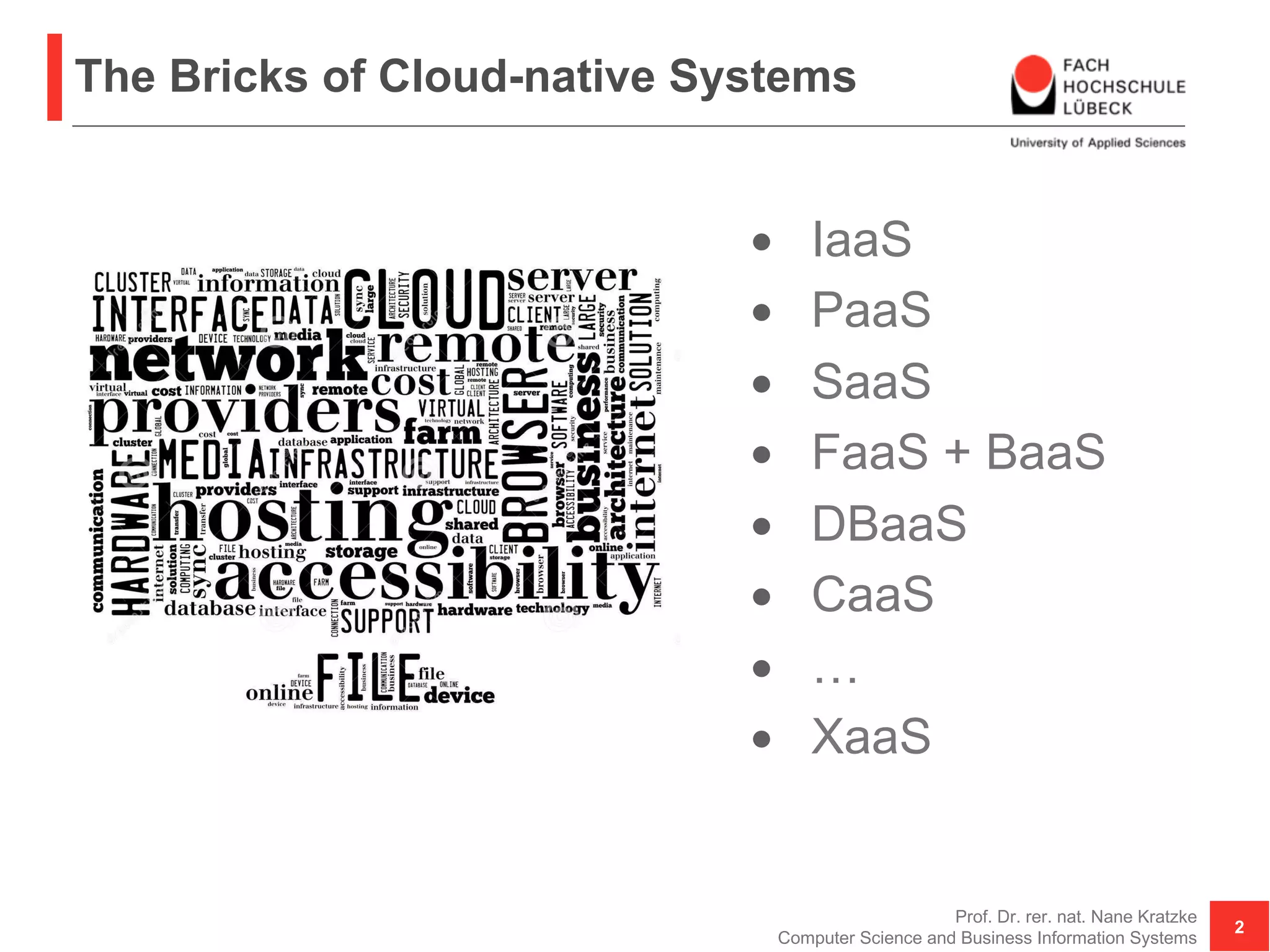
The Bricks of Cloud-native Systems
• IaaS
• PaaS
• SaaS
• FaaS + BaaS
• DBaaS
• CaaS
• …
• XaaS
Prof. Dr. rer. nat. Nane Kratzke
Computer Science and Business Information Systems
2
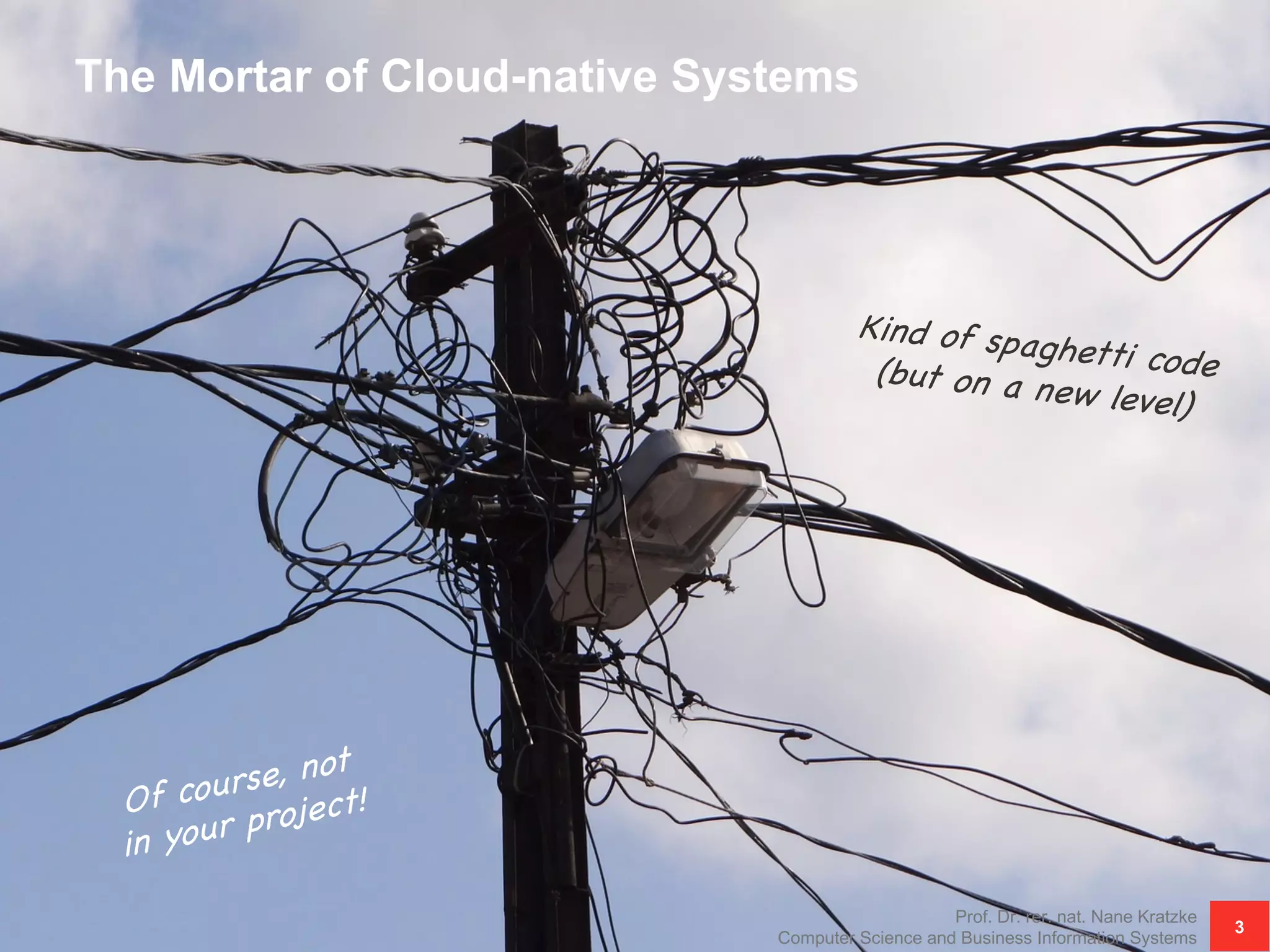
The Mortar of Cloud-native Systems
Prof. Dr. rer. nat. Nane Kratzke
Computer Science and Business Information Systems
3
Of course, not
in your project!
Kind of spaghetti code(but on a new level)
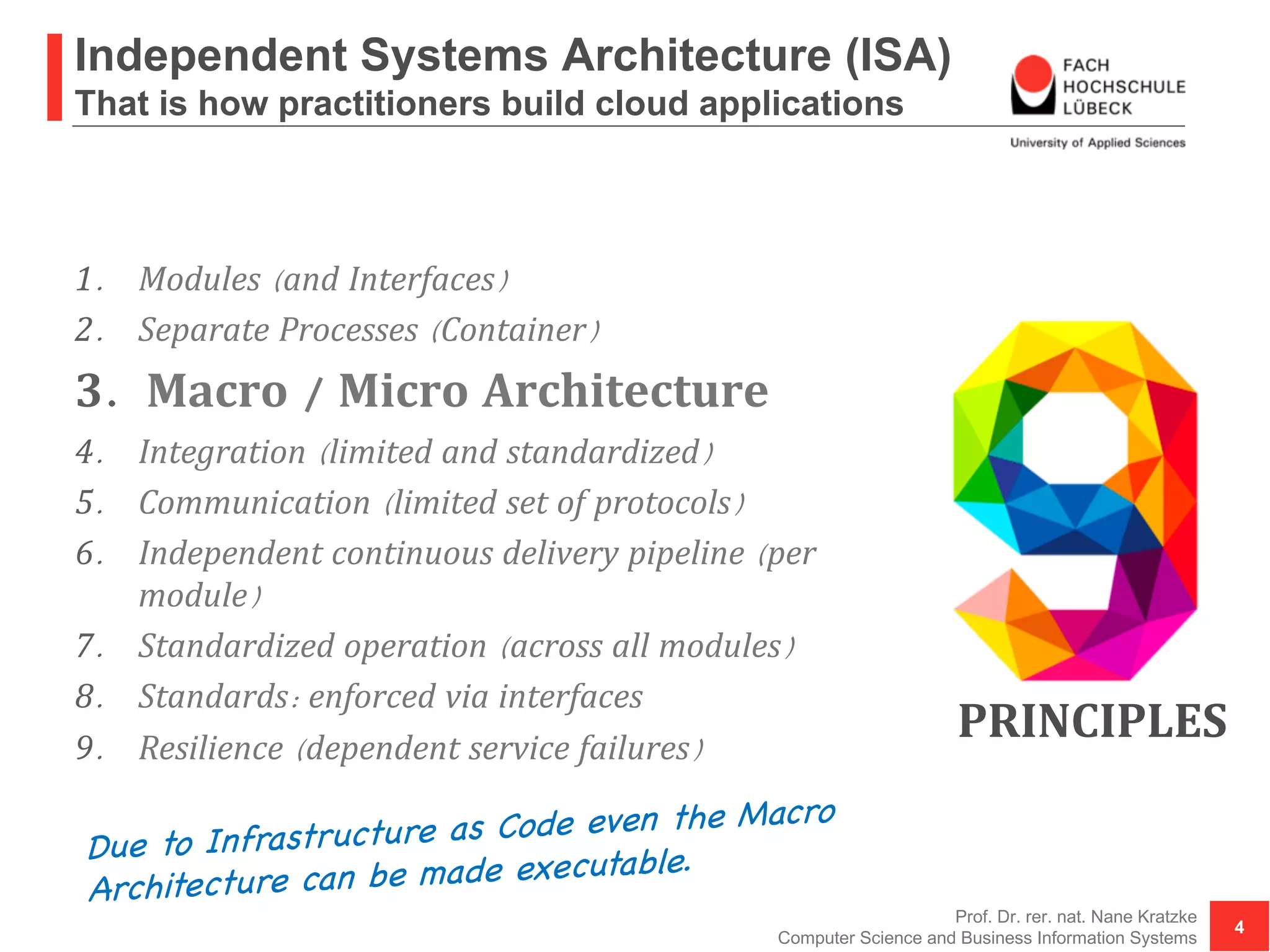
Independent Systems Architecture (ISA)
That is how practitioners build cloud applications
1. Modules (and Interfaces)
2. Separate Processes (Container)
3. Macro / Micro Architecture
4. Integration (limited and standardized)
5. Communication (limited set of protocols)
6. Independent continuous delivery pipeline (per
module)
7. Standardized operation (across all modules)
8. Standards: enforced via interfaces
9. Resilience (dependent service failures)
Prof. Dr. rer. nat. Nane Kratzke
Computer Science and Business Information Systems
4
PRINCIPLES
Due to Infrastructure as Code even the Macro
Architecture can be made executable.
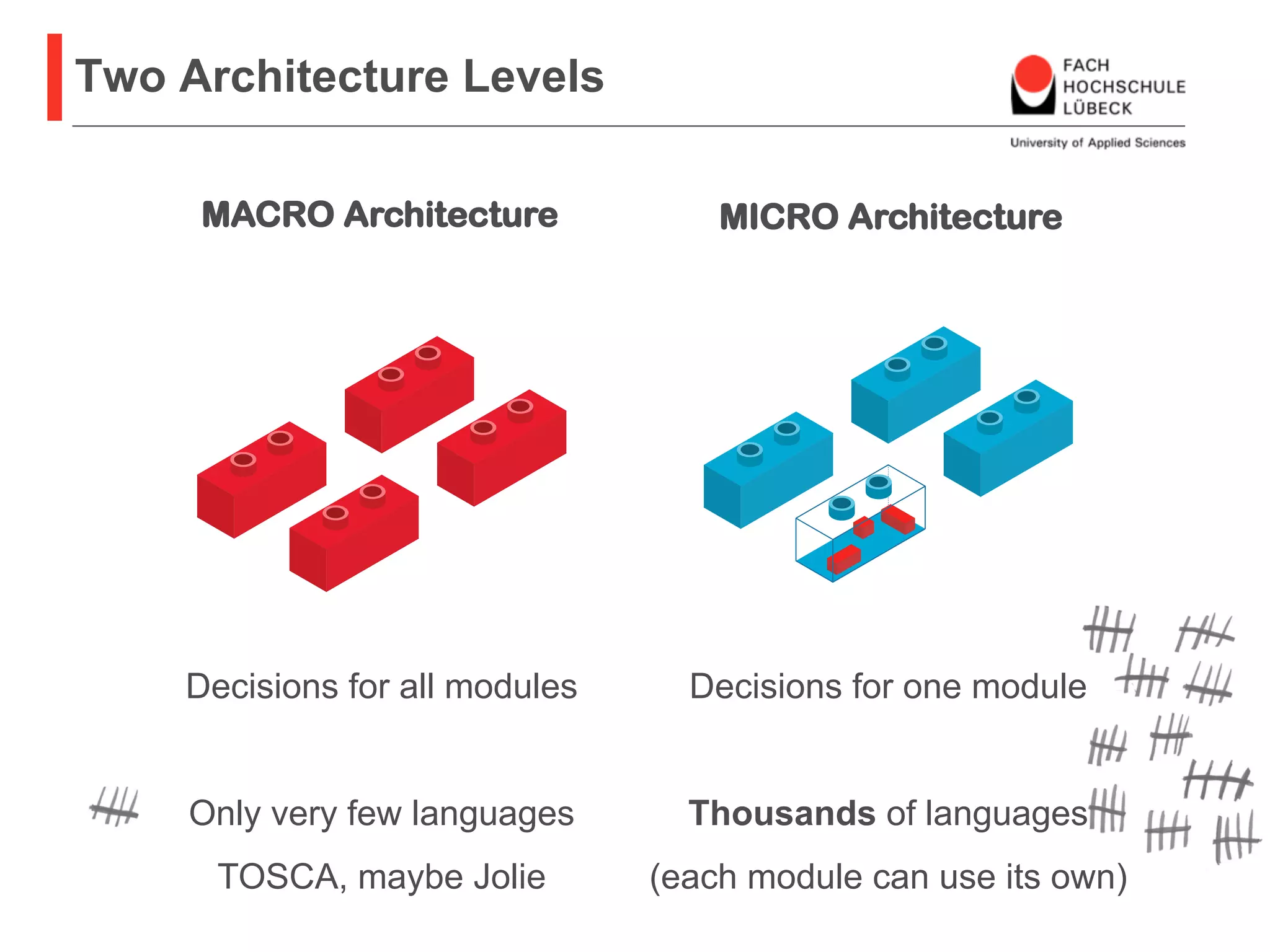
Two Architecture Levels
Decisions for all modules
Only very few languages
TOSCA, maybe Jolie
Decisions for one module
Thousands of languages
(each module can use its own)
MACRO Architecture MICRO Architecture
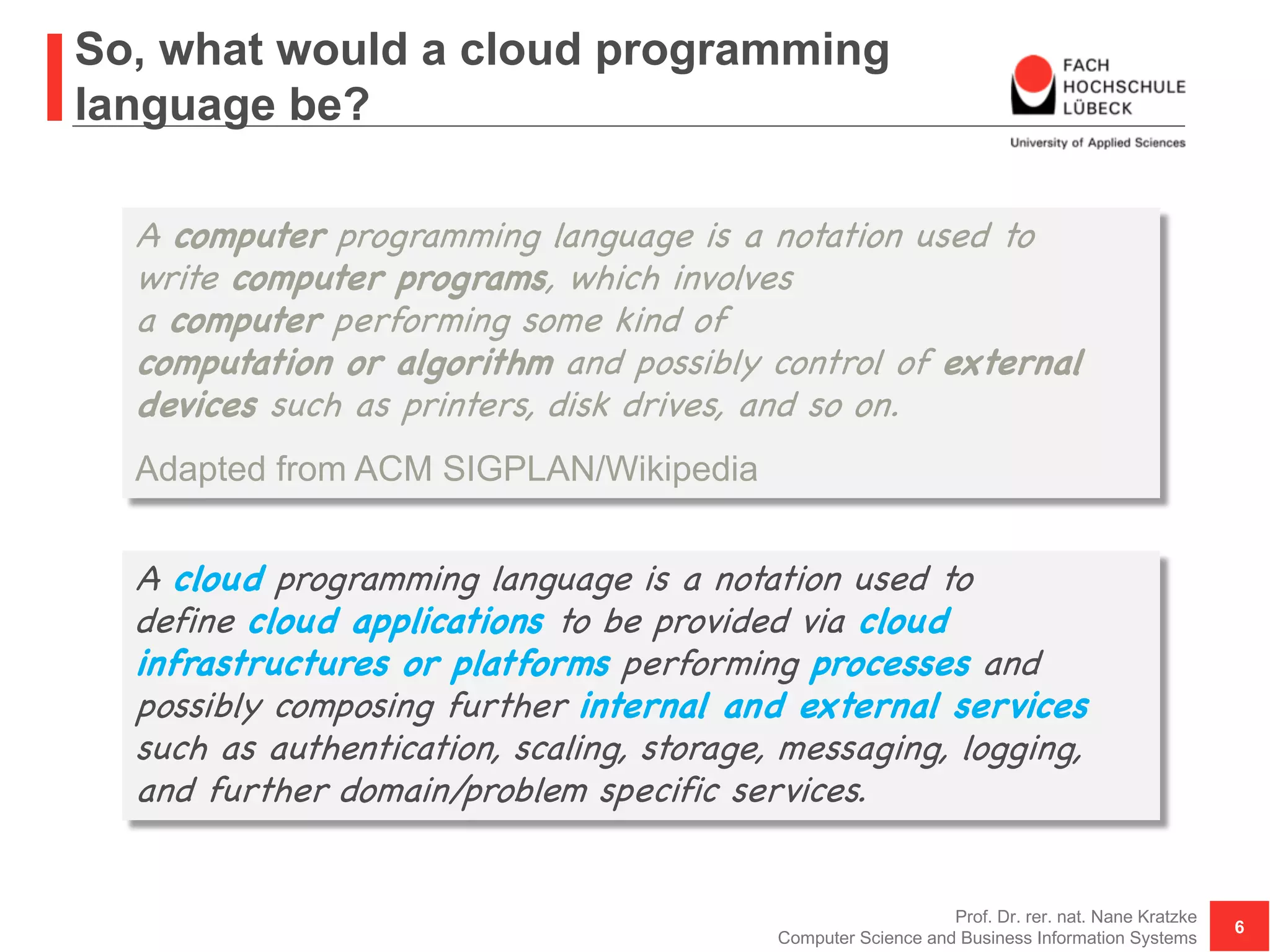
So, what would a cloud programming
language be?
Prof. Dr. rer. nat. Nane Kratzke
Computer Science and Business Information Systems
6
A computer programming language is a notation used to
write computer programs, which involves
a computer performing some kind of
computation or algorithm and possibly control of external
devices such as printers, disk drives, and so on.
Adapted from ACM SIGPLAN/Wikipedia
A cloud programming language is a notation used to
define cloud applications to be provided via cloud
infrastructures or platforms performing processes and
possibly composing further internal and external services
such as authentication, scaling, storage, messaging, logging,
and further domain/problem specific services.
Can we solve cloud orchestration problems
different?
Prof. Dr. rer. nat. Nane Kratzke
Computer Science and Business Information Systems
7
TOSCA
[QK2018a] Quint, P.-C., & Kratzke, N. (2018). Towards a Lightweight Multi-Cloud DSL for Elastic and Transferable Cloud-native
Applications. In Proceedings of the 8th Int. Conf. on Cloud Computing and Services Science (CLOSER 2018, Madeira, Portugal).
UCAML
[Kra2017a] Kratzke, N. (2017). Smuggling Multi-Cloud Support into Cloud-native Applications using Elastic Container Platforms.
In Proceedings of the 7th Int. Conf. on Cloud Computing and Services Science (CLOSER 2017) (pp. 29–42).
PLAIN
Jolie
(1st language
for micro-
services)
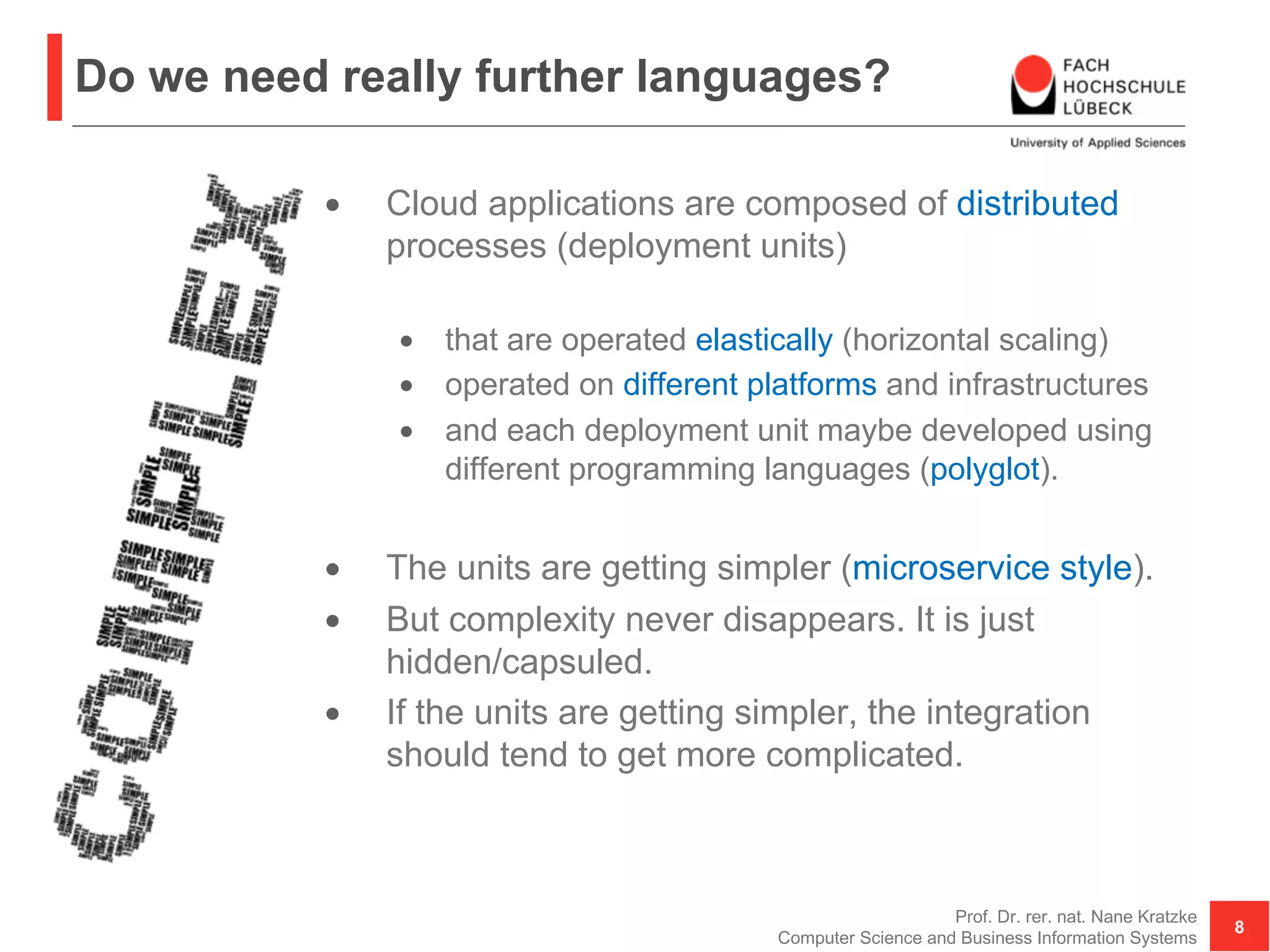
Do we need really further languages?
• Cloud applications are composed of distributed
processes (deployment units)
• that are operated elastically (horizontal scaling)
• operated on different platforms and infrastructures
• and each deployment unit maybe developed using
different programming languages (polyglot).
• The units are getting simpler (microservice style).
• But complexity never disappears. It is just
hidden/capsuled.
• If the units are getting simpler, the integration
should tend to get more complicated.
Prof. Dr. rer. nat. Nane Kratzke
Computer Science and Business Information Systems
8
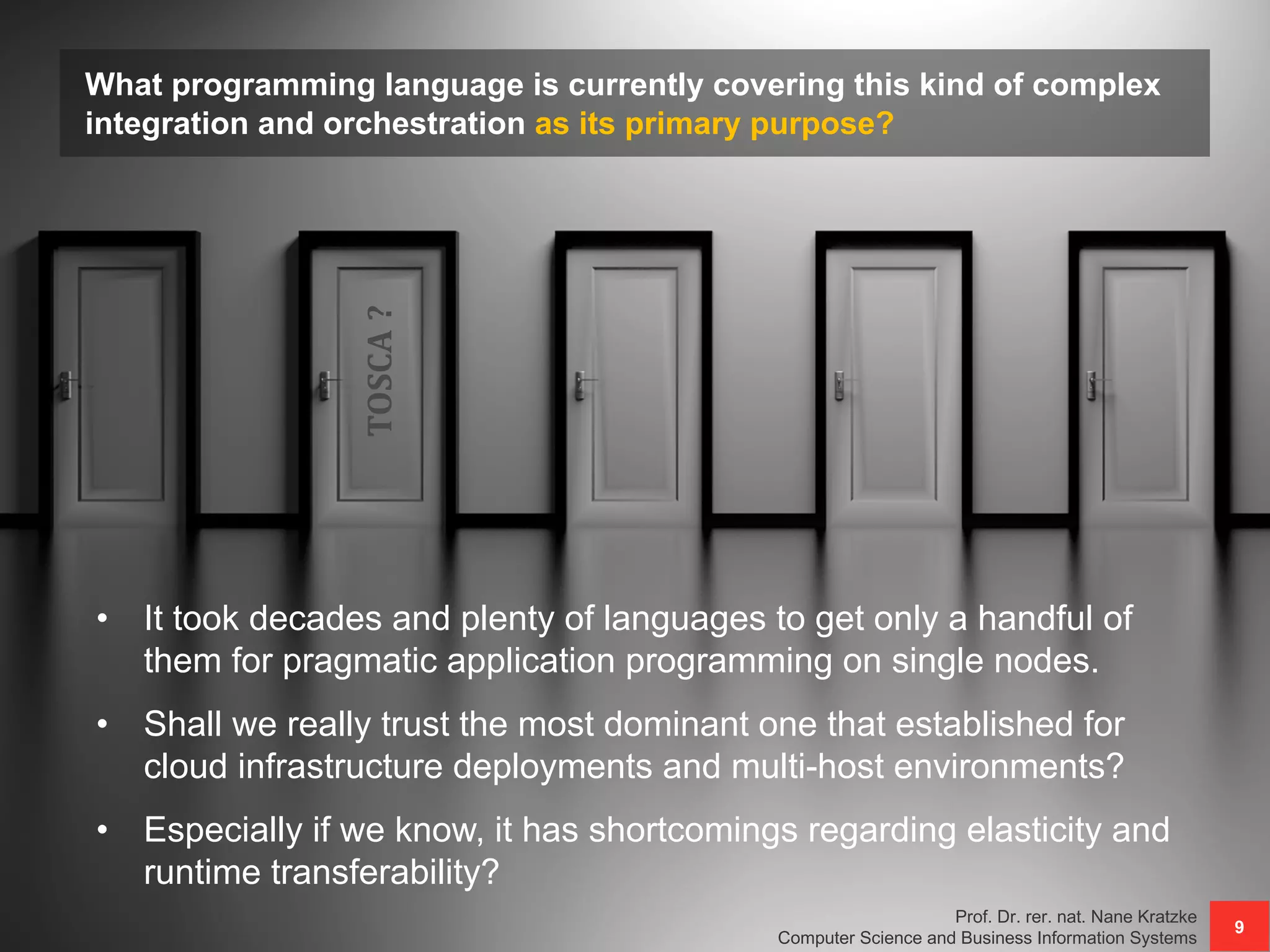
What programming language is currently covering this kind of complex
integration and orchestration as its primary purpose?
Prof. Dr. rer. nat. Nane Kratzke
Computer Science and Business Information Systems
9
• It took decades and plenty of languages to get only a handful of
them for pragmatic application programming on single nodes.
• Shall we really trust the most dominant one that established for
cloud infrastructure deployments and multi-host environments?
• Especially if we know, it has shortcomings regarding elasticity and
runtime transferability?
TOSCA?
Acknowledgement
• Ruine: Pixabay (CC0 Public Domain)
• Definition: Pixabay (CC0 Public Domain)
• Power Suply: Pixabay (CC0 Public Domain)
• Doors: Pixabay (CC0 Public Domain)
• Air Transport: Pixabay (CC0 Public Domain, WikiImages)
Prof. Dr. rer. nat. Nane Kratzke
Computer Science and Business Information Systems
10
Picture Reference
Our research is funded by German Federal Ministry of Education
and Research (13FH021PX4).
Presentation URL
About
Prof. Dr. rer. nat. Nane Kratzke
Computer Science and Business Information Systems
11
Nane Kratzke
CoSA: http://cosa.fh-luebeck.de/en/contact/people/n-kratzke
Blog: http://www.nkode.io
Twitter: @NaneKratzke
GooglePlus: +NaneKratzke
LinkedIn: https://de.linkedin.com/in/nanekratzke
GitHub: https://github.com/nkratzke
ResearchGate: https://www.researchgate.net/profile/Nane_Kratzke
SlideShare: http://de.slideshare.net/i21aneka

We have the Bricks to Build Cloud-native Cathedrals - But do we have the mortar?

  • 1.
    We have theBricks to Build Cloud- native Cathedrals But do we have the mortar? Nane Kratzke Panel Discussion: “Challenges in Cloud Computing-based Systems“ 9th International Conference on Cloud Computing, GRIDs, and Virtualization (CLOUD COMPUTING 2018); Barcelona, Spain, 2018
  • 2.
    The Bricks ofCloud-native Systems • IaaS • PaaS • SaaS • FaaS + BaaS • DBaaS • CaaS • … • XaaS Prof. Dr. rer. nat. Nane Kratzke Computer Science and Business Information Systems 2
  • 3.
    The Mortar ofCloud-native Systems Prof. Dr. rer. nat. Nane Kratzke Computer Science and Business Information Systems 3 Of course, not in your project! Kind of spaghetti code(but on a new level)
  • 4.
    Independent Systems Architecture(ISA) That is how practitioners build cloud applications 1. Modules (and Interfaces) 2. Separate Processes (Container) 3. Macro / Micro Architecture 4. Integration (limited and standardized) 5. Communication (limited set of protocols) 6. Independent continuous delivery pipeline (per module) 7. Standardized operation (across all modules) 8. Standards: enforced via interfaces 9. Resilience (dependent service failures) Prof. Dr. rer. nat. Nane Kratzke Computer Science and Business Information Systems 4 PRINCIPLES Due to Infrastructure as Code even the Macro Architecture can be made executable.
  • 5.
    Two Architecture Levels Decisionsfor all modules Only very few languages TOSCA, maybe Jolie Decisions for one module Thousands of languages (each module can use its own) MACRO Architecture MICRO Architecture
  • 6.
    So, what woulda cloud programming language be? Prof. Dr. rer. nat. Nane Kratzke Computer Science and Business Information Systems 6 A computer programming language is a notation used to write computer programs, which involves a computer performing some kind of computation or algorithm and possibly control of external devices such as printers, disk drives, and so on. Adapted from ACM SIGPLAN/Wikipedia A cloud programming language is a notation used to define cloud applications to be provided via cloud infrastructures or platforms performing processes and possibly composing further internal and external services such as authentication, scaling, storage, messaging, logging, and further domain/problem specific services.
  • 7.
    Can we solvecloud orchestration problems different? Prof. Dr. rer. nat. Nane Kratzke Computer Science and Business Information Systems 7 TOSCA [QK2018a] Quint, P.-C., & Kratzke, N. (2018). Towards a Lightweight Multi-Cloud DSL for Elastic and Transferable Cloud-native Applications. In Proceedings of the 8th Int. Conf. on Cloud Computing and Services Science (CLOSER 2018, Madeira, Portugal). UCAML [Kra2017a] Kratzke, N. (2017). Smuggling Multi-Cloud Support into Cloud-native Applications using Elastic Container Platforms. In Proceedings of the 7th Int. Conf. on Cloud Computing and Services Science (CLOSER 2017) (pp. 29–42). PLAIN Jolie (1st language for micro- services)
  • 8.
    Do we needreally further languages? • Cloud applications are composed of distributed processes (deployment units) • that are operated elastically (horizontal scaling) • operated on different platforms and infrastructures • and each deployment unit maybe developed using different programming languages (polyglot). • The units are getting simpler (microservice style). • But complexity never disappears. It is just hidden/capsuled. • If the units are getting simpler, the integration should tend to get more complicated. Prof. Dr. rer. nat. Nane Kratzke Computer Science and Business Information Systems 8
  • 9.
    What programming languageis currently covering this kind of complex integration and orchestration as its primary purpose? Prof. Dr. rer. nat. Nane Kratzke Computer Science and Business Information Systems 9 • It took decades and plenty of languages to get only a handful of them for pragmatic application programming on single nodes. • Shall we really trust the most dominant one that established for cloud infrastructure deployments and multi-host environments? • Especially if we know, it has shortcomings regarding elasticity and runtime transferability? TOSCA?
  • 10.
    Acknowledgement • Ruine: Pixabay(CC0 Public Domain) • Definition: Pixabay (CC0 Public Domain) • Power Suply: Pixabay (CC0 Public Domain) • Doors: Pixabay (CC0 Public Domain) • Air Transport: Pixabay (CC0 Public Domain, WikiImages) Prof. Dr. rer. nat. Nane Kratzke Computer Science and Business Information Systems 10 Picture Reference Our research is funded by German Federal Ministry of Education and Research (13FH021PX4). Presentation URL
  • 11.
    About Prof. Dr. rer.nat. Nane Kratzke Computer Science and Business Information Systems 11 Nane Kratzke CoSA: http://cosa.fh-luebeck.de/en/contact/people/n-kratzke Blog: http://www.nkode.io Twitter: @NaneKratzke GooglePlus: +NaneKratzke LinkedIn: https://de.linkedin.com/in/nanekratzke GitHub: https://github.com/nkratzke ResearchGate: https://www.researchgate.net/profile/Nane_Kratzke SlideShare: http://de.slideshare.net/i21aneka