Entrepreneurial
pathways
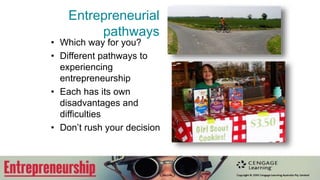
• Which way for you?
• Different pathways to
experiencing
entrepreneurship
• Each has its own
disadvantages and
difficulties
• Don’t rush your decision
Chapter 5
Pathways to entrepreneurial ventures
Objectives
1. To describe the major pathways that may lead to
entrepreneurial ventures
2. To examine bootstrapping and minipreneurship as fast lanes
to gaining entrepreneurial experience
3. To identify and discuss what is involved in acquiring an
established venture that already has some entrepreneurial
momentum
4. To outline key questions to ask when buying an ongoing
venture that is already generating value
5. To define a franchise and outline its structure
6. To examine the benefits and drawbacks of franchising
7. To look at the route social entrepreneurs take to creating
new ventures
But first
• Assuming you have the desire and
enough money to make either choice,
which would you prefer?
• Are you more likely to establish your
own business ‘from scratch’ or
• take over running an established
business?
• Why?
?
Six common
business
creation pathways
1. Bootstrapping
2. Minipreneurship
3. A new business start-up
4. Acquiring an existing venture
5. Buying a franchise
6. Establishing a social venture
7. Taking over the family business
(Chapter 7)
8. Starting a business for your
employer (Chapter 8)
Pathway 1:
Bootstrapping
• “Highly creative acquisition”
• Using other people’s resources
• Relies on:
– Networks, trust &
– cooperation
– wise use of existing resources.
• No debt / don’t give away equity
• Look for ‘low hanging fruit’
• Use a copycat idea
• Find quick, break-even, cash-
generating products
• Keep growth in check
• Focus on cash for healthy,
immediate returns
• Avoid loss-making strategiesSee dozens of bootstrapping ideas in Chapter 5.
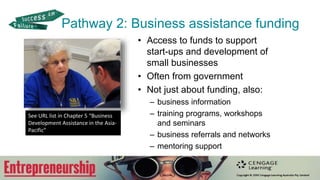
Pathway 2: Business assistance funding
• Access to funds to support
start-ups and development of
small businesses
• Often from government
• Not just about funding, also:
– business information
– training programs, workshops
and seminars
– business referrals and networks
– mentoring support
See URL list in Chapter 5 “Business
Development Assistance in the Asia-
Pacific”
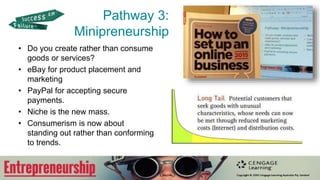
Pathway 3:
Minipreneurship
• Do you create rather than consume
goods or services?
• eBay for product placement and
marketing
• PayPal for accepting secure
payments.
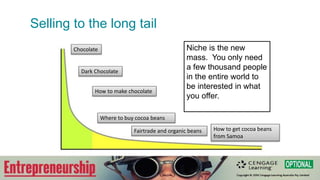
• Niche is the new mass.
• Consumerism is now about
standing out rather than conforming
to trends.
Selling to the long tail
Chocolate
Dark Chocolate
How to make chocolate
Fairtrade and organic beans
Where to buy cocoa beans
How to get cocoa beans
from Samoa
Niche is the new
mass. You only need
a few thousand people
in the entire world to
be interested in what
you offer.
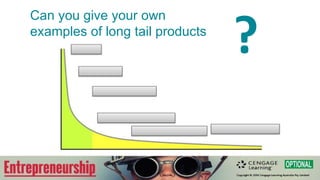
Can you give your own
examples of long tail products
?
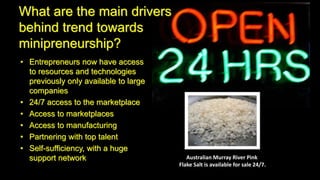
What are the main drivers
behind trend towards
minipreneurship?
• Entrepreneurs now have access
to resources and technologies
previously only available to large
companies
• 24/7 access to the marketplace
• Access to marketplaces
• Access to manufacturing
• Partnering with top talent
• Self-sufficiency, with a huge
support network Australian Murray River Pink
Flake Salt is available for sale 24/7.
Pathway 4: Classic start-up
• Entrepreneurs launch a
business when they can:
– drive less innovative products
out of the market
– advance the product frontier
– lower prices
– satisfy untapped demand or
– broaden market penetration.
• Two ways to do this:
– create a unique product or
service
– adapt or extend something that
is currently on the market
The new-new approach
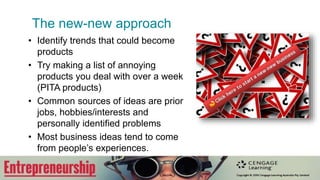
• Identify trends that could become
products
• Try making a list of annoying
products you deal with over a week
(PITA products)
• Common sources of ideas are prior
jobs, hobbies/interests and
personally identified problems
• Most business ideas tend to come
from people’s experiences.
The new-new approach
1. Think about the last few days.
Identify a product you have used
which left you annoyed.
What could be done to fix it?
2. Identify a current social or
educational trend.
If people were caught up in the
trend, what products or services
would they want?
?
The new-old approach
• Rather than a totally new idea,
piggyback.
• Bring an existing idea to a new
place.
• Choose a product or service
which is difficult to copy (to
minimise or delay competition).
Opportunity trends
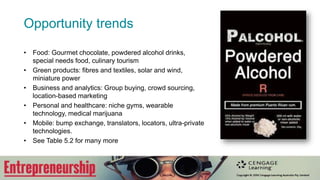
• Food: Gourmet chocolate, powdered alcohol drinks,
special needs food, culinary tourism
• Green products: fibres and textiles, solar and wind,
miniature power
• Business and analytics: Group buying, crowd sourcing,
location-based marketing
• Personal and healthcare: niche gyms, wearable
technology, medical marijuana
• Mobile: bump exchange, translators, locators, ultra-private
technologies.
• See Table 5.2 for many more
The cost of start-up
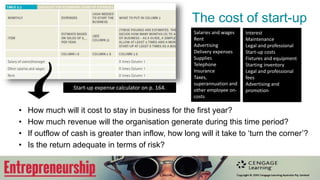
• How much will it cost to stay in business for the first year?
• How much revenue will the organisation generate during this time period?
• If outflow of cash is greater than inflow, how long will it take to ‘turn the corner’?
• Is the return adequate in terms of risk?
Start-up expense calculator on p. 164.
Salaries and wages
Rent
Advertising
Delivery expenses
Supplies
Telephone
Insurance
Taxes,
superannuation and
other employee on-
costs
Interest
Maintenance
Legal and professional
Start-up costs
Fixtures and equipment
Starting inventory
Legal and professional
fees
Advertising and
promotion
Go or no-go decisions
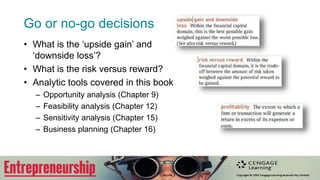
• What is the ‘upside gain’ and
‘downside loss’?
• What is the risk versus reward?
• Analytic tools covered in this book
– Opportunity analysis (Chapter 9)
– Feasibility analysis (Chapter 12)
– Sensitivity analysis (Chapter 15)
– Business planning (Chapter 16)
Advantages
• Future success is likely
• Reduced time and effort
• Possibly, a good price
Key questions to ask
• Why being sold?
• Current physical condition of the
business?
• Condition of inventory?
• How many of the employees will
remain?
• What type of competition does the
business face?
• What does the company’s financial
picture look like?
Pathway 5: acquiring an existing venture
Pathway 5:
buying a franchise
• Combining independence with
the larger umbrella of a
corporation.
• 1/3 of all retail sales generated
by franchises.
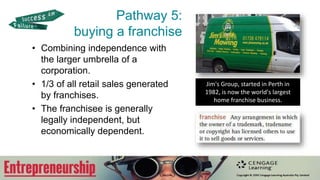
• The franchisee is generally
legally independent, but
economically dependent.
Jim's Group, started in Perth in
1982, is now the world's largest
home franchise business.
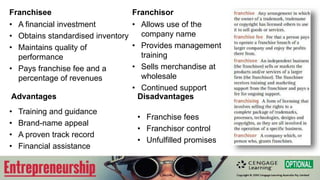
Franchisee
• A financial investment
• Obtains standardised inventory
• Maintains quality of
performance
• Pays franchise fee and a
percentage of revenues
Franchisor
• Allows use of the
company name
• Provides management
training
• Sells merchandise at
wholesale
• Continued support
Advantages
• Training and guidance
• Brand-name appeal
• A proven track record
• Financial assistance
Disadvantages
• Franchise fees
• Franchisor control
• Unfulfilled promises
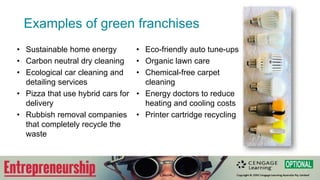
Examples of green franchises
• Sustainable home energy
• Carbon neutral dry cleaning
• Ecological car cleaning and
detailing services
• Pizza that use hybrid cars for
delivery
• Rubbish removal companies
that completely recycle the
waste
• Eco-friendly auto tune-ups
• Organic lawn care
• Chemical-free carpet
cleaning
• Energy doctors to reduce
heating and cooling costs
• Printer cartridge recycling
Social venturing
How would establishing a social
venture be different to the preceding
pathways?
?
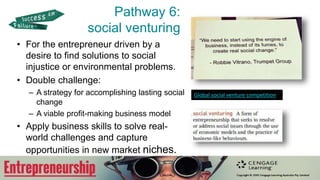
Pathway 6:
social venturing
• For the entrepreneur driven by a
desire to find solutions to social
injustice or environmental problems.
• Double challenge:
– A strategy for accomplishing lasting social
change
– A viable profit-making business model
• Apply business skills to solve real-
world challenges and capture
opportunities in new market niches.
Global social venture competition
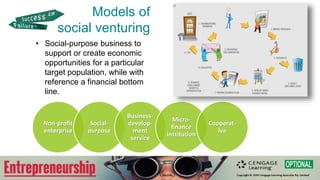
Models of
social venturing
• Social-purpose business to
support or create economic
opportunities for a particular
target population, while with
reference a financial bottom
line.
Non-profit
enterprise
Social-
purpose
Business-
develop-
ment
service
Micro-
finance
institution
Cooperat-
ive
Key concepts
(close your books)
1. Name the six pathways.
2. Which pathway(s) would appeal
to you and why?
?
Key concepts
Six common pathways:
1. Bootstrapping
2. Minipreneurship
3. A new business start-up
4. Acquiring an existing venture
5. Buying a franchise
6. Establishing a social venture
• Don’t forget we’ll be covering
two more pathways:
– Taking over the family business
(Chapter 7)
– Starting a business for your
employer (Chapter 8)

Pathways to entrepreneurial ventures

  • 1.
    Entrepreneurial pathways • Which wayfor you? • Different pathways to experiencing entrepreneurship • Each has its own disadvantages and difficulties • Don’t rush your decision
  • 3.
    Chapter 5 Pathways toentrepreneurial ventures
  • 4.
    Objectives 1. To describethe major pathways that may lead to entrepreneurial ventures 2. To examine bootstrapping and minipreneurship as fast lanes to gaining entrepreneurial experience 3. To identify and discuss what is involved in acquiring an established venture that already has some entrepreneurial momentum 4. To outline key questions to ask when buying an ongoing venture that is already generating value 5. To define a franchise and outline its structure 6. To examine the benefits and drawbacks of franchising 7. To look at the route social entrepreneurs take to creating new ventures
  • 5.
    But first • Assumingyou have the desire and enough money to make either choice, which would you prefer? • Are you more likely to establish your own business ‘from scratch’ or • take over running an established business? • Why? ?
  • 6.
    Six common business creation pathways 1.Bootstrapping 2. Minipreneurship 3. A new business start-up 4. Acquiring an existing venture 5. Buying a franchise 6. Establishing a social venture 7. Taking over the family business (Chapter 7) 8. Starting a business for your employer (Chapter 8)
  • 7.
    Pathway 1: Bootstrapping • “Highlycreative acquisition” • Using other people’s resources • Relies on: – Networks, trust & – cooperation – wise use of existing resources. • No debt / don’t give away equity • Look for ‘low hanging fruit’ • Use a copycat idea • Find quick, break-even, cash- generating products • Keep growth in check • Focus on cash for healthy, immediate returns • Avoid loss-making strategiesSee dozens of bootstrapping ideas in Chapter 5.
  • 8.
    Pathway 2: Businessassistance funding • Access to funds to support start-ups and development of small businesses • Often from government • Not just about funding, also: – business information – training programs, workshops and seminars – business referrals and networks – mentoring support See URL list in Chapter 5 “Business Development Assistance in the Asia- Pacific”
  • 9.
    Pathway 3: Minipreneurship • Doyou create rather than consume goods or services? • eBay for product placement and marketing • PayPal for accepting secure payments. • Niche is the new mass. • Consumerism is now about standing out rather than conforming to trends.
  • 10.
    Selling to thelong tail Chocolate Dark Chocolate How to make chocolate Fairtrade and organic beans Where to buy cocoa beans How to get cocoa beans from Samoa Niche is the new mass. You only need a few thousand people in the entire world to be interested in what you offer.
  • 11.
    Can you giveyour own examples of long tail products ?
  • 12.
    What are themain drivers behind trend towards minipreneurship? • Entrepreneurs now have access to resources and technologies previously only available to large companies • 24/7 access to the marketplace • Access to marketplaces • Access to manufacturing • Partnering with top talent • Self-sufficiency, with a huge support network Australian Murray River Pink Flake Salt is available for sale 24/7.
  • 13.
    Pathway 4: Classicstart-up • Entrepreneurs launch a business when they can: – drive less innovative products out of the market – advance the product frontier – lower prices – satisfy untapped demand or – broaden market penetration. • Two ways to do this: – create a unique product or service – adapt or extend something that is currently on the market
  • 14.
    The new-new approach •Identify trends that could become products • Try making a list of annoying products you deal with over a week (PITA products) • Common sources of ideas are prior jobs, hobbies/interests and personally identified problems • Most business ideas tend to come from people’s experiences.
  • 15.
    The new-new approach 1.Think about the last few days. Identify a product you have used which left you annoyed. What could be done to fix it? 2. Identify a current social or educational trend. If people were caught up in the trend, what products or services would they want? ?
  • 16.
    The new-old approach •Rather than a totally new idea, piggyback. • Bring an existing idea to a new place. • Choose a product or service which is difficult to copy (to minimise or delay competition).
  • 17.
    Opportunity trends • Food:Gourmet chocolate, powdered alcohol drinks, special needs food, culinary tourism • Green products: fibres and textiles, solar and wind, miniature power • Business and analytics: Group buying, crowd sourcing, location-based marketing • Personal and healthcare: niche gyms, wearable technology, medical marijuana • Mobile: bump exchange, translators, locators, ultra-private technologies. • See Table 5.2 for many more
  • 18.
    The cost ofstart-up • How much will it cost to stay in business for the first year? • How much revenue will the organisation generate during this time period? • If outflow of cash is greater than inflow, how long will it take to ‘turn the corner’? • Is the return adequate in terms of risk? Start-up expense calculator on p. 164. Salaries and wages Rent Advertising Delivery expenses Supplies Telephone Insurance Taxes, superannuation and other employee on- costs Interest Maintenance Legal and professional Start-up costs Fixtures and equipment Starting inventory Legal and professional fees Advertising and promotion
  • 19.
    Go or no-godecisions • What is the ‘upside gain’ and ‘downside loss’? • What is the risk versus reward? • Analytic tools covered in this book – Opportunity analysis (Chapter 9) – Feasibility analysis (Chapter 12) – Sensitivity analysis (Chapter 15) – Business planning (Chapter 16)
  • 20.
    Advantages • Future successis likely • Reduced time and effort • Possibly, a good price Key questions to ask • Why being sold? • Current physical condition of the business? • Condition of inventory? • How many of the employees will remain? • What type of competition does the business face? • What does the company’s financial picture look like? Pathway 5: acquiring an existing venture
  • 21.
    Pathway 5: buying afranchise • Combining independence with the larger umbrella of a corporation. • 1/3 of all retail sales generated by franchises. • The franchisee is generally legally independent, but economically dependent. Jim's Group, started in Perth in 1982, is now the world's largest home franchise business.
  • 22.
    Franchisee • A financialinvestment • Obtains standardised inventory • Maintains quality of performance • Pays franchise fee and a percentage of revenues Franchisor • Allows use of the company name • Provides management training • Sells merchandise at wholesale • Continued support Advantages • Training and guidance • Brand-name appeal • A proven track record • Financial assistance Disadvantages • Franchise fees • Franchisor control • Unfulfilled promises
  • 23.
    Examples of greenfranchises • Sustainable home energy • Carbon neutral dry cleaning • Ecological car cleaning and detailing services • Pizza that use hybrid cars for delivery • Rubbish removal companies that completely recycle the waste • Eco-friendly auto tune-ups • Organic lawn care • Chemical-free carpet cleaning • Energy doctors to reduce heating and cooling costs • Printer cartridge recycling
  • 24.
    Social venturing How wouldestablishing a social venture be different to the preceding pathways? ?
  • 25.
    Pathway 6: social venturing •For the entrepreneur driven by a desire to find solutions to social injustice or environmental problems. • Double challenge: – A strategy for accomplishing lasting social change – A viable profit-making business model • Apply business skills to solve real- world challenges and capture opportunities in new market niches. Global social venture competition
  • 26.
    Models of social venturing •Social-purpose business to support or create economic opportunities for a particular target population, while with reference a financial bottom line. Non-profit enterprise Social- purpose Business- develop- ment service Micro- finance institution Cooperat- ive
  • 27.
    Key concepts (close yourbooks) 1. Name the six pathways. 2. Which pathway(s) would appeal to you and why? ?
  • 28.
    Key concepts Six commonpathways: 1. Bootstrapping 2. Minipreneurship 3. A new business start-up 4. Acquiring an existing venture 5. Buying a franchise 6. Establishing a social venture • Don’t forget we’ll be covering two more pathways: – Taking over the family business (Chapter 7) – Starting a business for your employer (Chapter 8)