Coherent-Feedback Formulation
 of a Continuous Quantum Error
            Correction Protocol
                                arXiv:0907.0236

                                   Hendra Nurdin
              (The Australian National University)
              Joint work with:
                                    Joe Kerckhoff
                                  Dmitri Pavlichin
                                   Hideo Mabuchi
                             (Stanford University)
Talk plan
  Reminder of quantum error correction (QEC).

  Continuous QEC.

  Description of a scheme for coherent-feedback QEC for
   a simple 3 qubit bit flip code.

  Concluding remarks.
Quantum error correction (QEC)
  Quantum error correction is essential for quantum
   information processing since qubits are susceptible to
   decoherence.

  When decoherence alters the state of a qubit, a QEC
   algorithm acts to restore it to the state prior to
   decoherence.
QEC principles
  Main ingredient is to introduce reduncancy by encoding
   a logical qubit into a number of physical qubits.

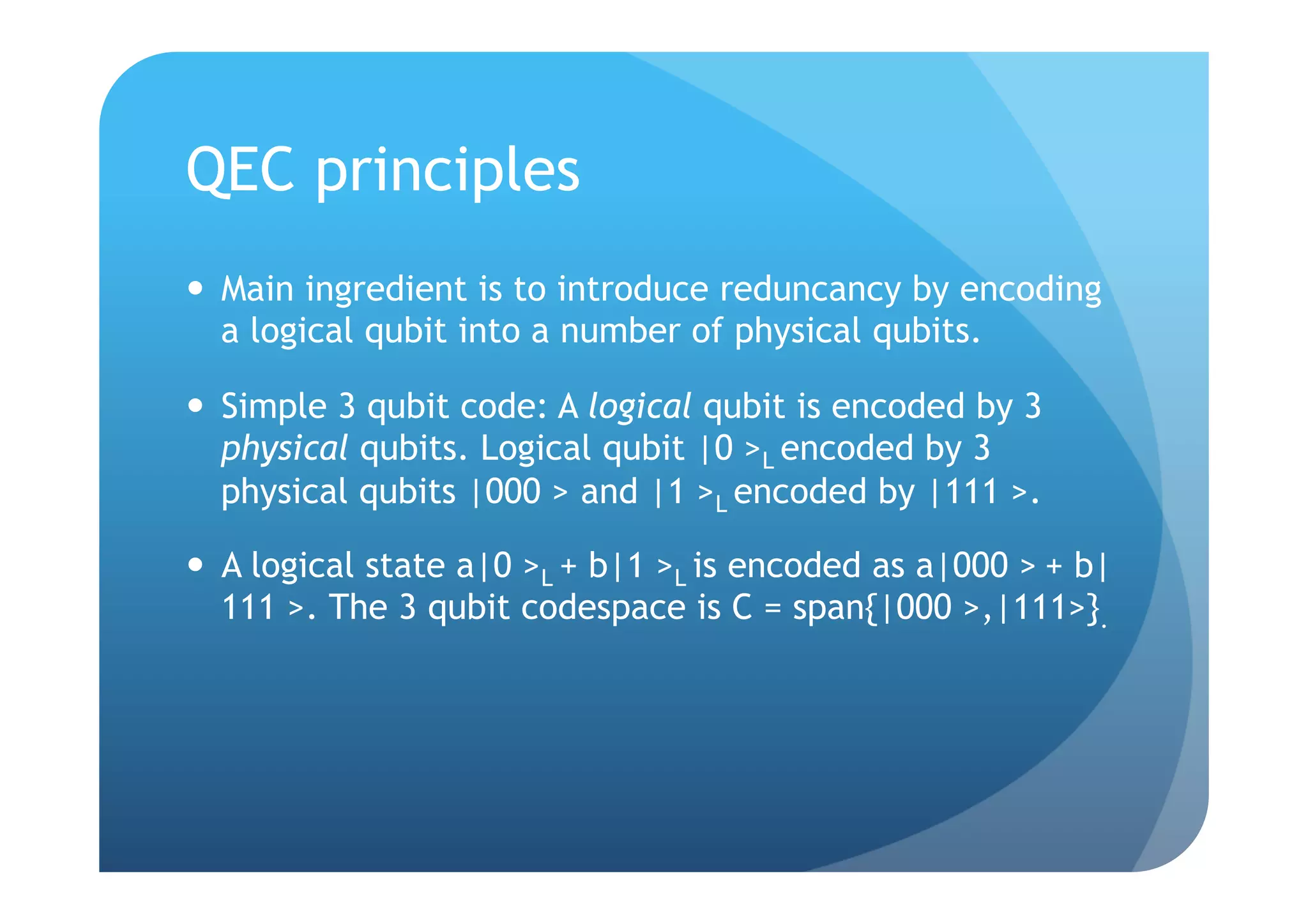
  Simple 3 qubit code: A logical qubit is encoded by 3
   physical qubits. Logical qubit |0 >L encoded by 3
   physical qubits |000 > and |1 >L encoded by |111 >.

  A logical state a|0 >L + b|1 >L is encoded as a|000 > + b|
   111 >. The 3 qubit codespace is C = span{|000 >,|111>}.
The 3 qubit bit flip code
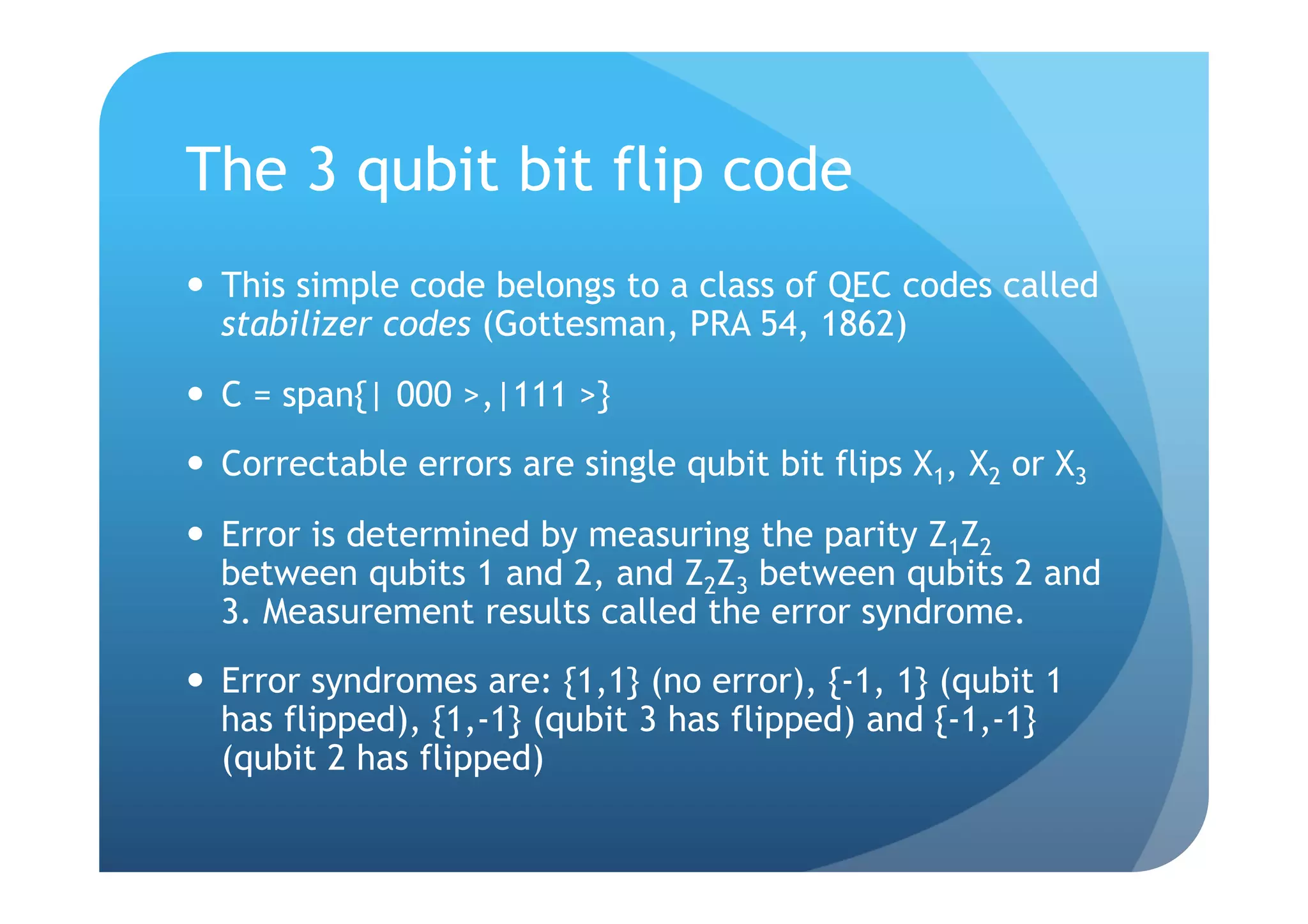
  This simple code belongs to a class of QEC codes called
   stabilizer codes (Gottesman, PRA 54, 1862)
  C = span{| 000 >,|111 >}
  Correctable errors are single qubit bit flips X1, X2 or X3
  Error is determined by measuring the parity Z1Z2
   between qubits 1 and 2, and Z2Z3 between qubits 2 and
   3. Measurement results called the error syndrome.
  Error syndromes are: {1,1} (no error), {-1, 1} (qubit 1
   has flipped), {1,-1} (qubit 3 has flipped) and {-1,-1}
   (qubit 2 has flipped)
Continuous QEC
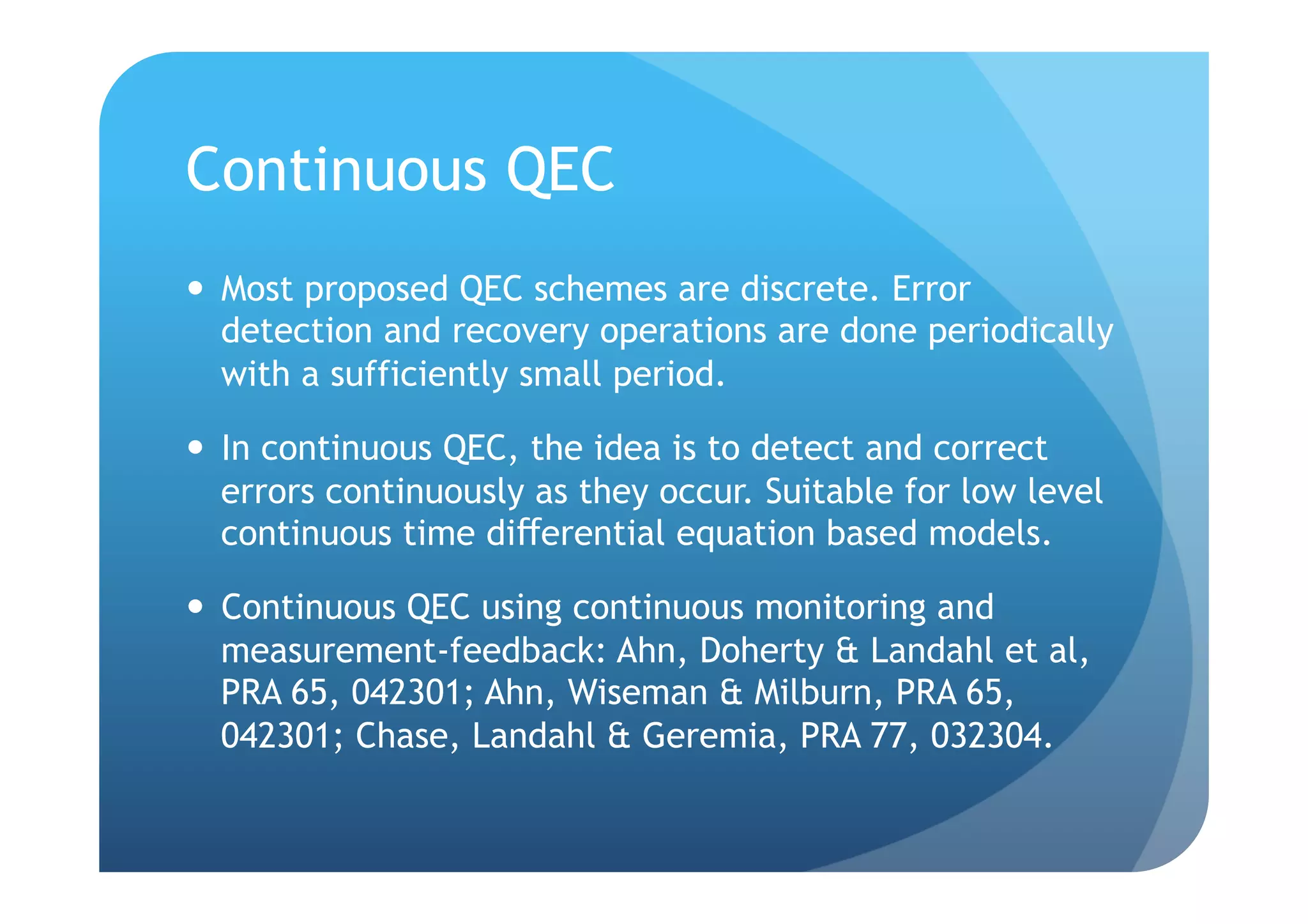
  Most proposed QEC schemes are discrete. Error
   detection and recovery operations are done periodically
   with a sufficiently small period.

  In continuous QEC, the idea is to detect and correct
   errors continuously as they occur. Suitable for low level
   continuous time differential equation based models.

  Continuous QEC using continuous monitoring and
   measurement-feedback: Ahn, Doherty & Landahl et al,
   PRA 65, 042301; Ahn, Wiseman & Milburn, PRA 65,
   042301; Chase, Landahl & Geremia, PRA 77, 032304.
Why coherent-feedback?
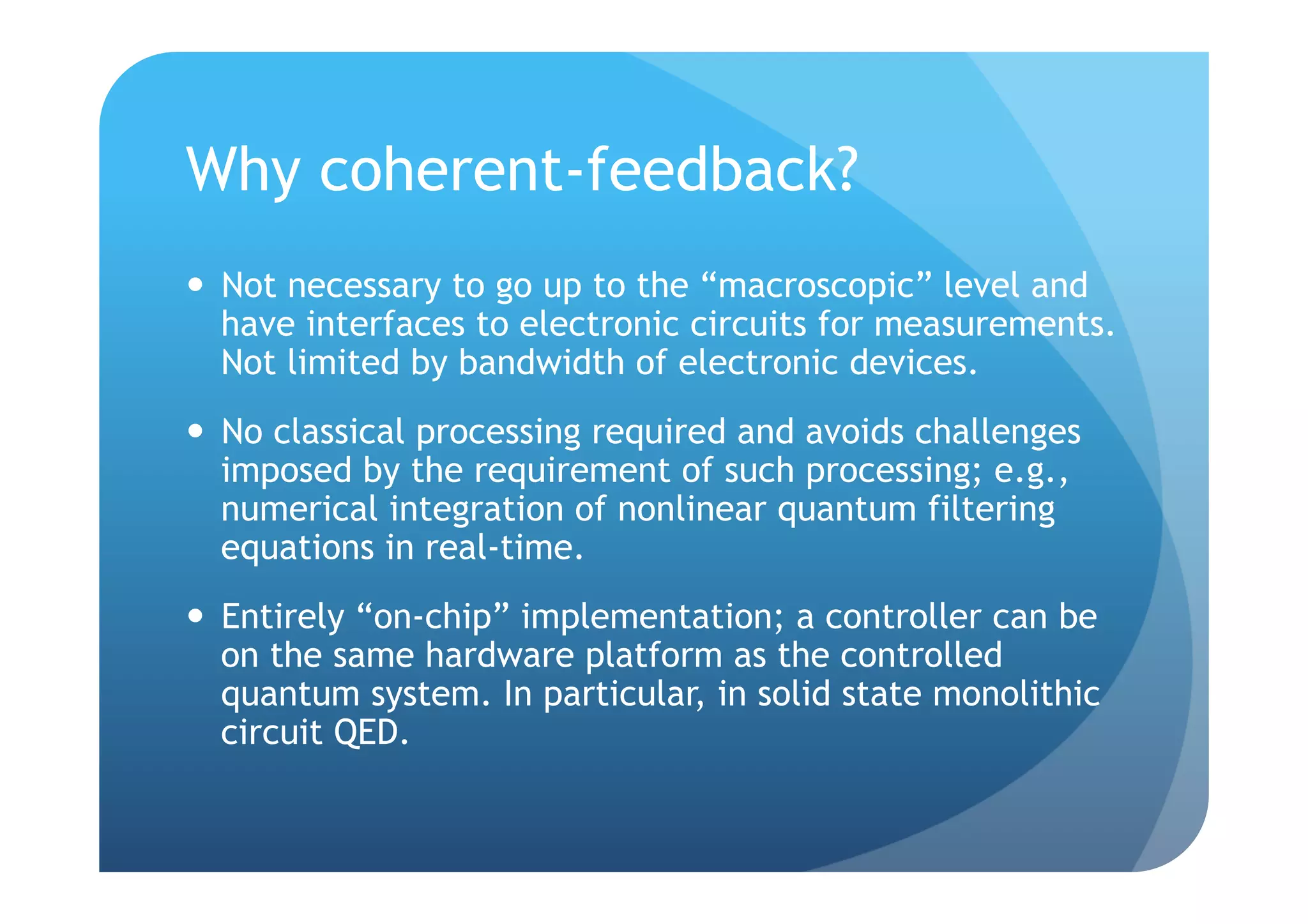
  Not necessary to go up to the “macroscopic” level and
   have interfaces to electronic circuits for measurements.
   Not limited by bandwidth of electronic devices.
  No classical processing required and avoids challenges
   imposed by the requirement of such processing; e.g.,
   numerical integration of nonlinear quantum filtering
   equations in real-time.
  Entirely “on-chip” implementation; a controller can be
   on the same hardware platform as the controlled
   quantum system. In particular, in solid state monolithic
   circuit QED.
Quantum network notation and
operations
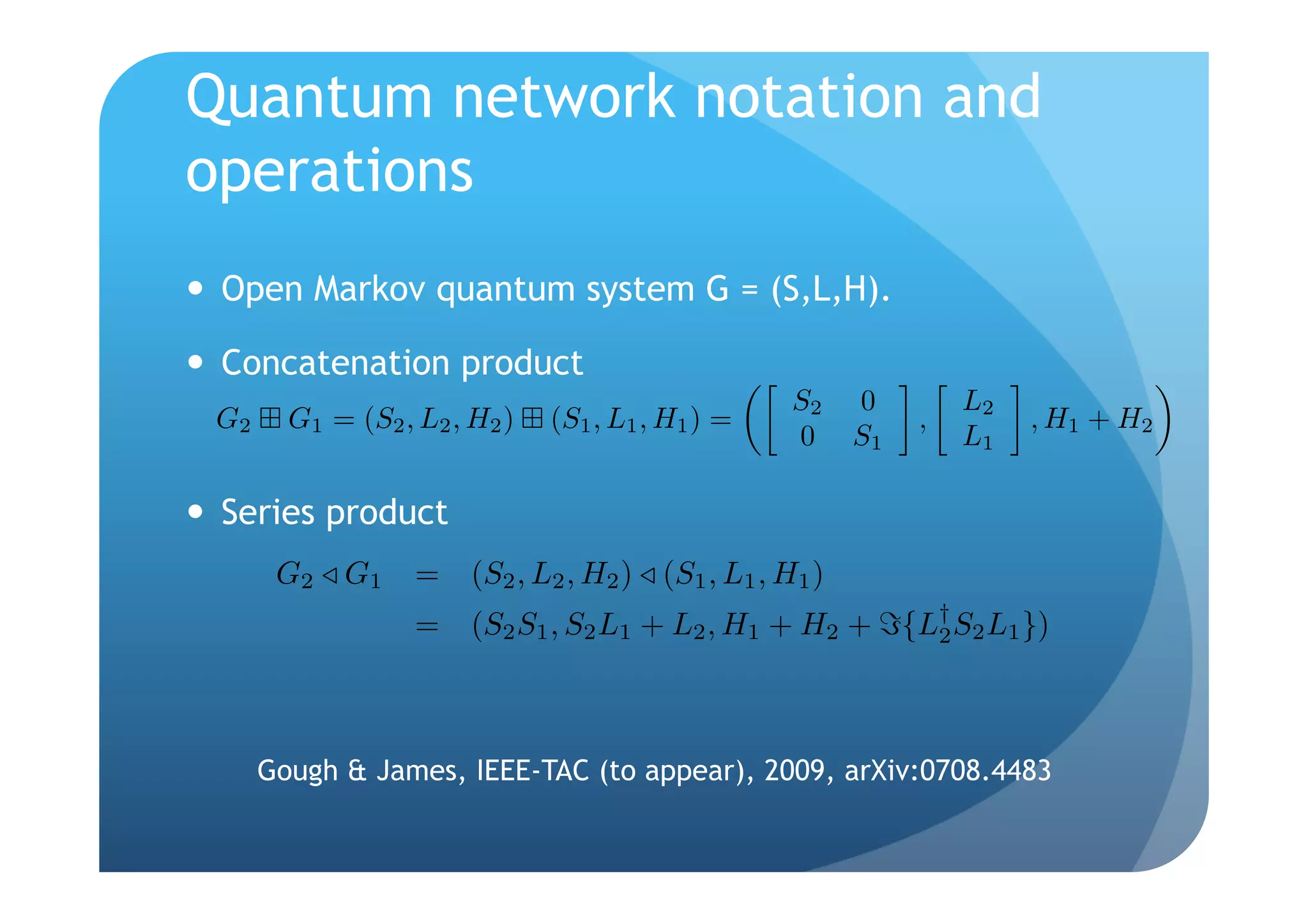
  Open Markov quantum system G = (S,L,H).

  Concatenation product
                                                   S2   0        L2
 G2     G1 = (S2 , L2 , H2 )   (S1 , L1 , H1 ) =             ,        , H1 + H2
                                                   0    S1       L1

  Series product
       G2 G 1      = (S2 , L2 , H2 ) (S1 , L1 , H1 )
                   = (S2 S1 , S2 L1 + L2 , H1 + H2 + {L† S2 L1 })
                                                       2


      Gough & James, IEEE-TAC (to appear), 2009, arXiv:0708.4483
error correction and       trogen vacancy center in diamond, etc. , are interrogated se-
architectures are es-      quentially by a coherent optical probe with amplitude
of quantum informa-         similar arrangements have previously been considered in the
 research in these ar-     context of quantum information science 10 . A qubit is en-
models for quantum         coded in the ground states        and      of the intracavity


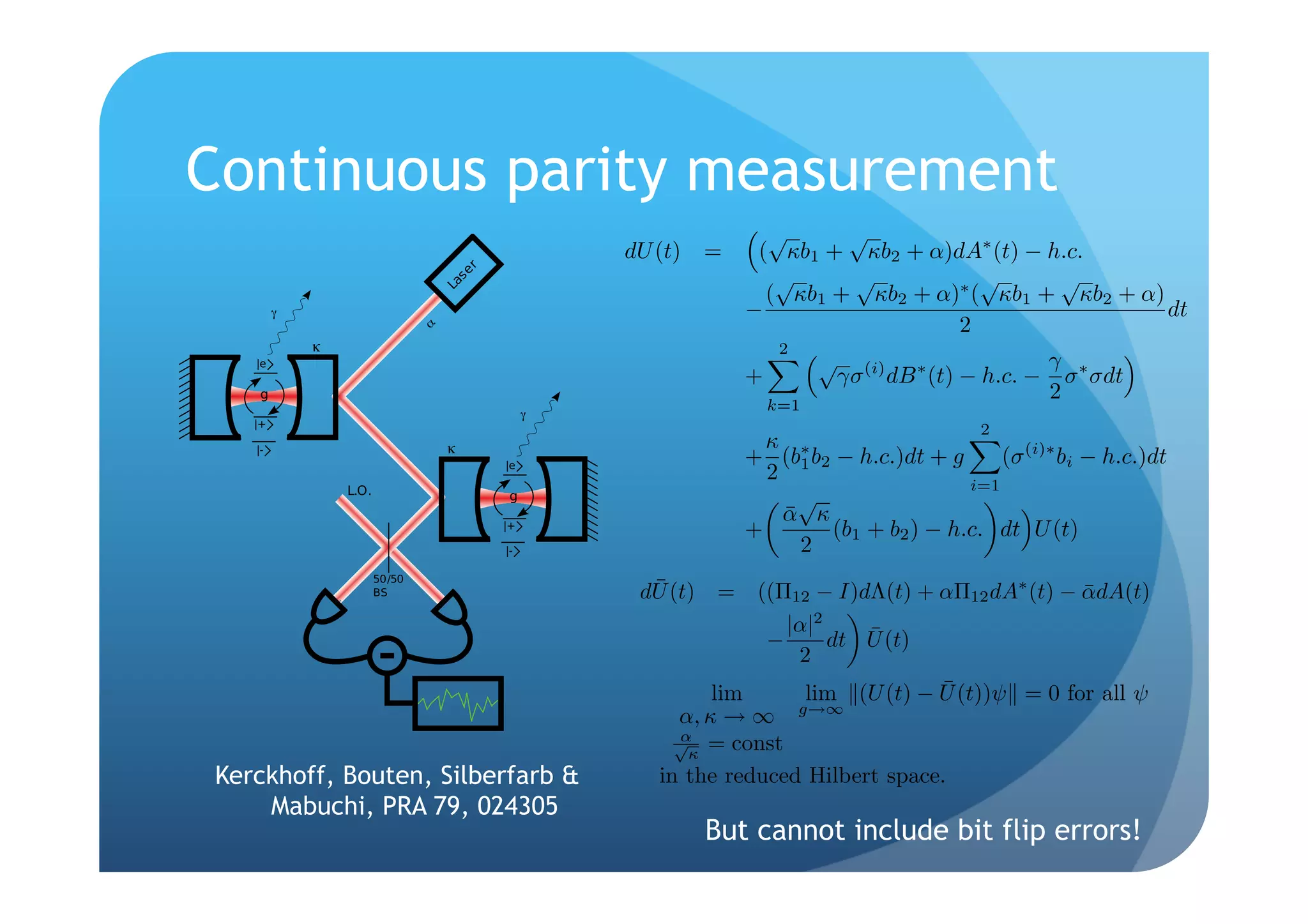
                             Continuous parity measurement
erhaps more familiar       atom; an optical transition between     and the excited state
   theorists, there has     e is coupled strongly to a quantized cavity mode with
  ey ideas 2 to the        vacuum Rabi frequency g. For simplicity we assume atomic
  quation-based mod-       selection rules such that e decays only to     , with excited-
context of ab initio
 ntribute to a line of                                                                                             √      √
  rs 3–6 and broad-                                                                                   dU (t) =    ( κb1 + κb2 + α)dA∗ (t) − h.c.
hich focuses on con-                                                                                                √     √           √      √
  abilizer coding and                                                                                              ( κb1 + κb2 + α)∗ ( κb1 + κb2 + α)
s approach is attrac-                                                                                            −                                    dt
  fundamentally con-
                                                                                                                                   2
                                                                                                                      2
 uppression with for-                                                                                                      √                              γ ∗
 ontrol theory 7 . It                                                                                            +             γσ (i) dB ∗ (t) − h.c. −     σ σdt
mentation advantage                                                                                                                                       2
                                                                                                                     k=1
s in that continuous
out the need for ex-                                                                                                                           2
                                                                                                                   κ
   this of course relies                                                                                         + (b∗ b2 − h.c.)dt + g     (σ (i)∗ bi − h.c.)dt
 emolition syndrome                                                                                                2   1
                                                                                                                                        i=1
 rimentally favorable                                                                                                  √
 aightforward imple-                                                                                                 ¯
                                                                                                                     α κ
y measurement suf-                                                                                               +       (b1 + b2 ) − h.c. dt U (t)
 he quantum bit-flip                                                                                                    2
 ectrodynamics cav-
 of our scheme both                                                                                     ¯
                                                                                                       dU (t) = ((Π12 − I)dΛ(t) + αΠ12 dA∗ (t) − αdA(t)
                                                                                                                                                   ¯
 ical simulation and
  a adiabatic elimina-                                                                                                |α|2    ¯
                                                                                                                    −      dt U (t)
oherent-state optical                                                                                                  2
 qubits and exploits
ace of clocked quan-                                                                                           lim                    ¯
                                                                                                                        lim (U (t) − U (t))ψ = 0 for all ψ
 . The strength of the                                                                                                 g→∞
                                                                                                           α, κ → ∞
 s be modulated eas-                                                                                       √ = const
                                                                                                           α
 stment of the power           FIG. 1. Color online Schematic depiction of two cavities                     κ
                                  Kerckhoff, Bouten, Silberfarb &
                           driven sequentially by a resonant laser beam. A three-level atom is           in the reduced Hilbert space.
ementation is shown        trapped inside each cavity, and identical atom-cavity dynamics ap-
aining a single three-                Mabuchi, PRA 79, 024305
                           ply in each. After probing both cavities, the laser light is directed to
 kali-metal atom, ni-      a homodyne receiver.                                                              But cannot include bit flip errors!
                     024305-1                            ©2009 The American Physical Society
Modified parity measurement
model
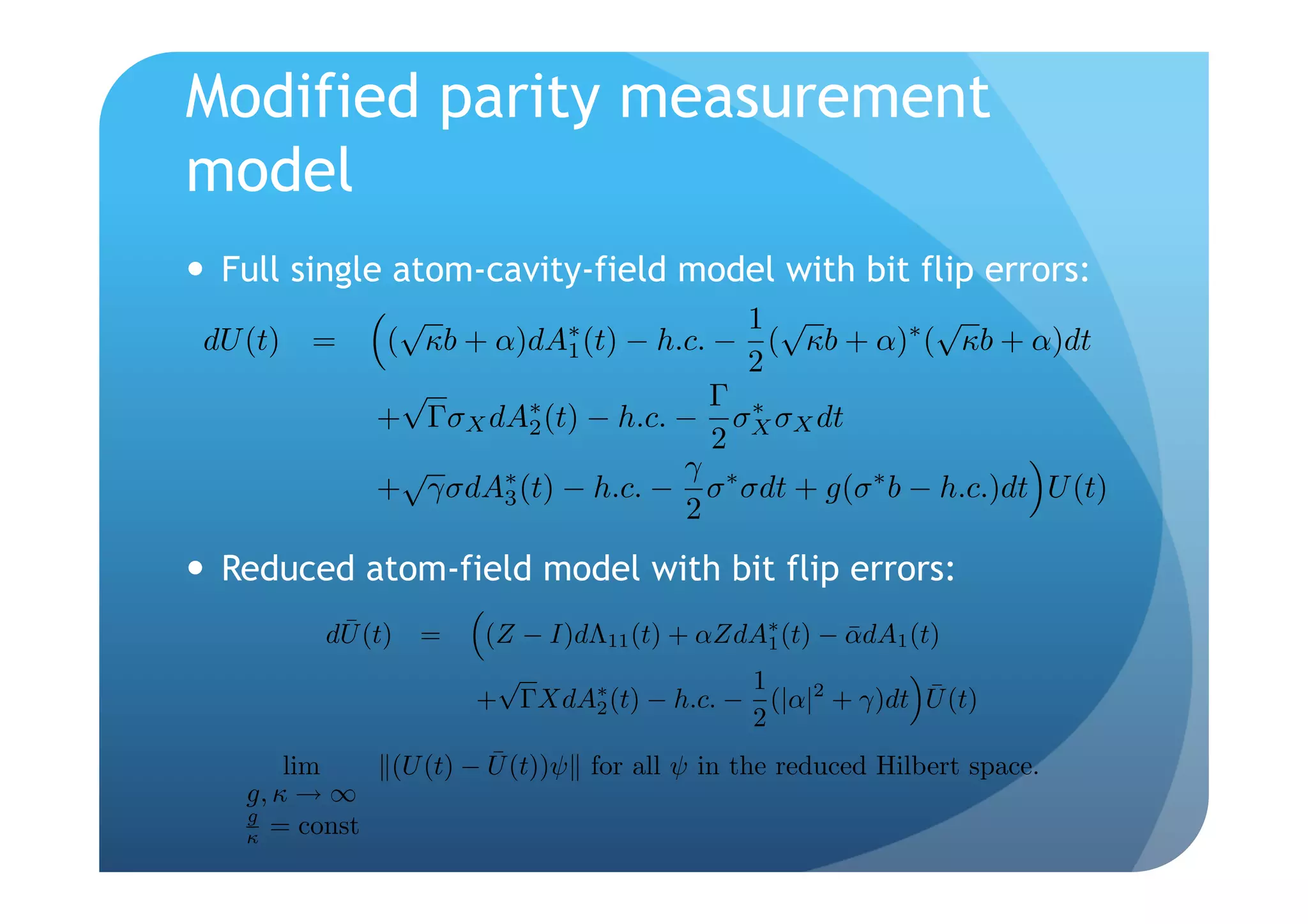
  Full single atom-cavity-field model with bit flip errors:
                 √                        1 √          √
 dU (t) =       ( κb + α)dA1 (t) − h.c. − ( κb + α) ( κb + α)dt
                            ∗                        ∗
                                          2
                 √                     Γ ∗
                + ΓσX dA∗ (t) − h.c. − σX σX dt
                         2
                                        2
                 √                   γ ∗
                + γσdA3 (t) − h.c. − σ σdt + g(σ ∗ b − h.c.)dt U (t)
                       ∗
                                     2
  Reduced atom-field model with bit flip errors:
           ¯
          dU (t) =      (Z − I)dΛ11 (t) + αZdA∗ (t) − αdA1 (t)
                                               1      ¯
                         √                   1               ¯
                        + ΓXdA∗ (t) − h.c. − (|α|2 + γ)dt U (t)
                                2
                                             2
        lim               ¯
                 (U (t) − U (t))ψ for all ψ in the reduced Hilbert space.
    g, κ → ∞
    g
    κ = const
Modified parity measurement
     model
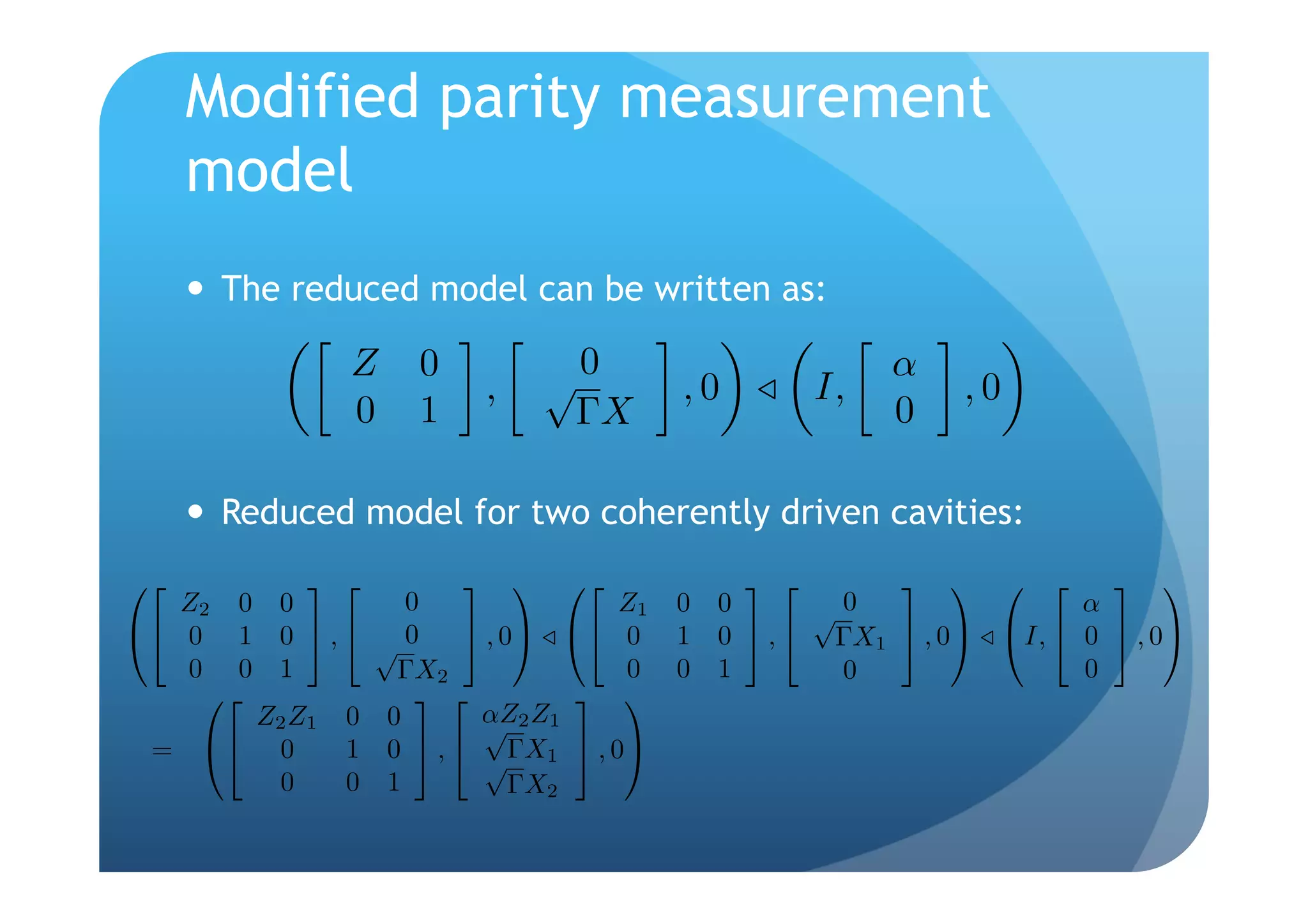
       The reduced model can be written as:

               Z     0
                             ,    √0     ,0         I,
                                                         α
                                                             ,0
               0     1             ΓX                    0

       Reduced model for two coherently driven cavities:
                                                            
   Z2 0 0           0               Z1   0 0      √0                α
                  √0
 0 1 0  ,             , 0  0     1 0  ,  ΓX1  , 0 I,  0  , 0
   0 0 1           ΓX2              0    0 1       0                0
                               
       Z2 Z1 0    0       αZ2 Z1
                           √
 =  0      1    0  ,  √ΓX1  , 0
        0    0    1           ΓX2
The “bare bones” of it
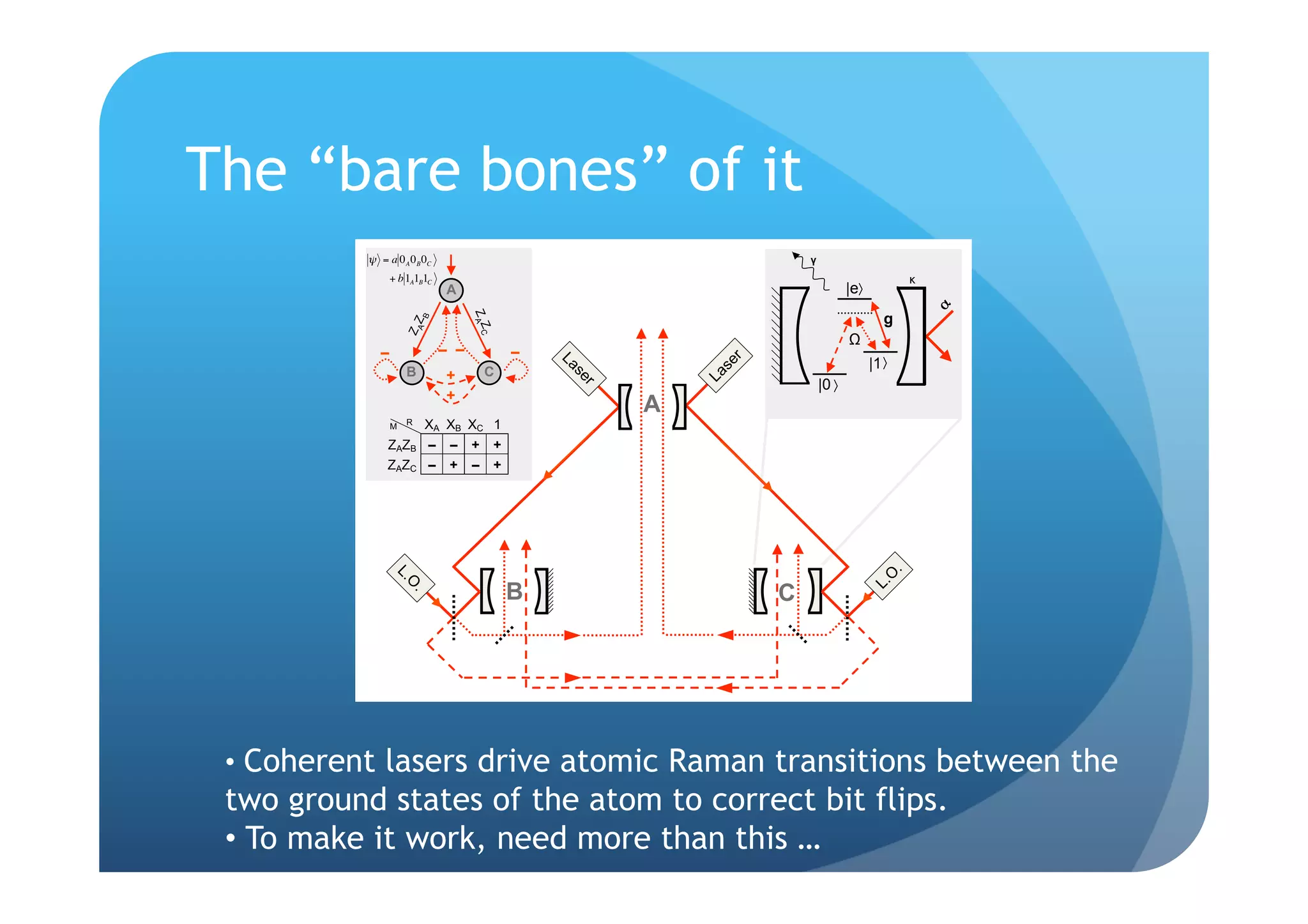
           " = a 0 A 0 B 0C                                                  !
                  + b 1A1B1C                                                                        !
                               A                                                      |e


                                                                                                        !
                                                                                                g


                                     Z AZ C
                          B
                      Z Z
       !


                       A
                                                                                      "
              –                – –                –
                                                                                           |1


                                                                     r
                                                      La


                                                                   se
                      B        +         C


                                                        se


                                                                 La
                                                                                 |0


                                                        r
                               +
                                                             A
                  M   R     XA XB XC 1
               ZAZB         – – + +
               ZAZC –           +    –        +


                                                                                                .
                  L.


                                                                                              O
                                                  B                      C
                      O


                                                                                           L.
                       .


 •  Coherent lasers drive atomic Raman transitions between the
 two ground states of the atom to correct bit flips.
 •  To make it work, need more than this …
n are replaced by unitary processing of the probe beams and coherent feedback to
 its. We exploit a limit theorem for quantum stochastic differential equations to an-
eedback networks based on the bit-flip/phase-flip code, obtaining simple closed-loop
 s with only four Hilbert-space dimensions required for the controller. Our approach
   to physical implementations that feature solid-state qubits embedded in planar
  circuits.

                     The actual scheme
03.67.Pp,02.30.Yy,42.50.-p,03.65.Yz


    quantum error correction
                                                                                 !"
   and measurement of syn-
  ntral to the modern field of
  e. Although substantial work
  nsions and refinements of ab-
 orts [2, 3, 4] have begun to fo-                                  !#
 task of developing implemen-         ! "
                                      !!!"                                             $#
 ly the fundamental principles
  ally accommodate the struc-
                                                                                        !""
models. Such new approaches
                                                           $%
quantum memories that make
  physical resources and intro-
 ted abstractions for quantum                                !""
plement those we have inher-
 r science.                                      !%

 recently proposed [5] a cavity
 cavity QED) implementation
 ty measurement required for
                                FIG. 1: Schematic diagram of a coherent-feedback quantum
  9, 10, 11, 12] versionQuantummemory showing qubits-in-cavities (Q1,facilitate switching
                        of the  switches R1, R2 inserted to Q2 and Q3), circula-             to higher
 or phase-flip codes, which be-
                        amplitude bit flip correcting Raman lasers. (R1 and R2).
                                tors, beam-splitters, steering mirrors and relays
el in a strong coupling limit.  The calculation we present is based on a modified arrange-
further step of describing co-  ment that leads to the same closed-loop master equation but
hat realize quantum memories    factorizes into four simple sub-networks.
e encoded qubit is suppressed
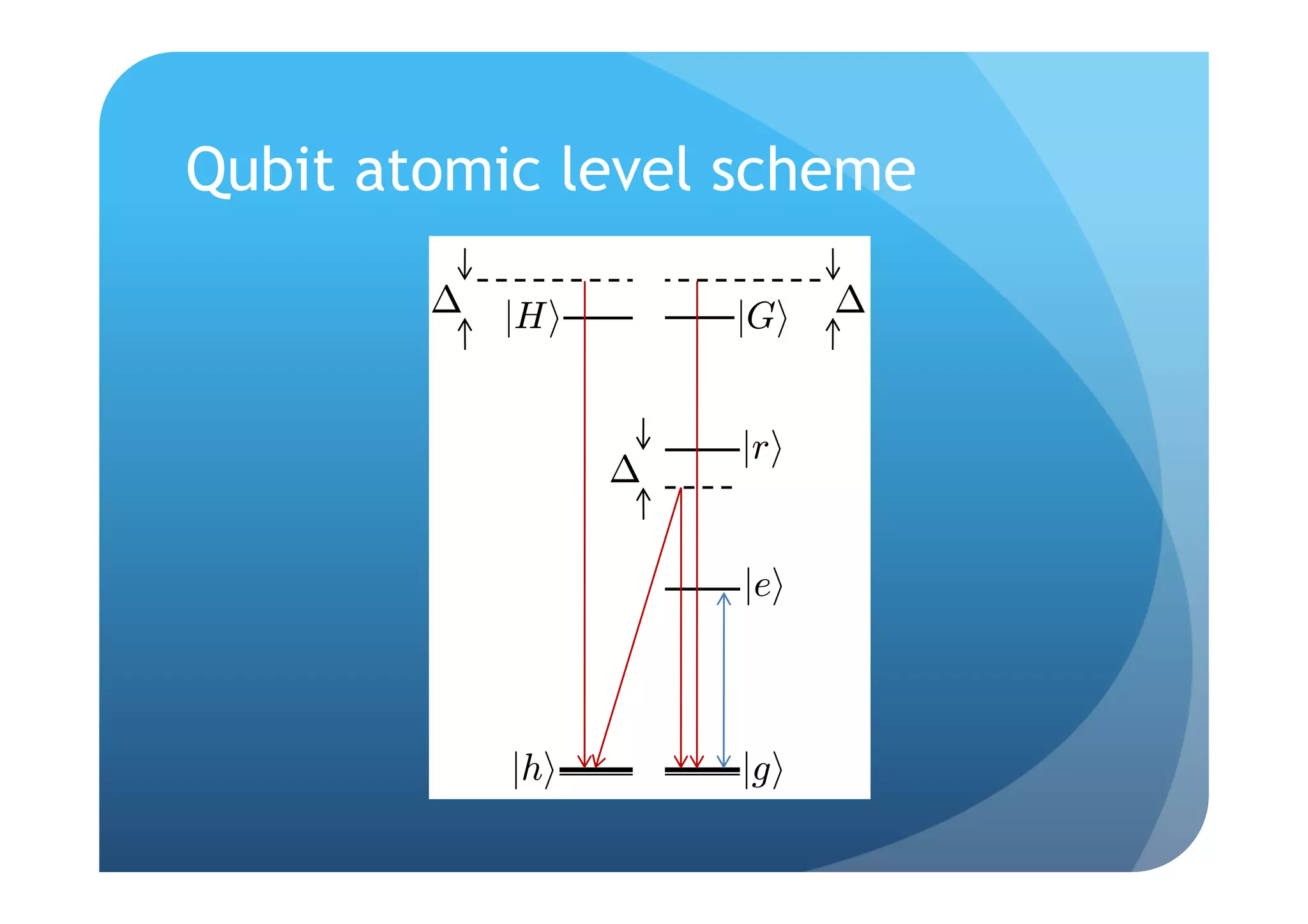
Qubit atomic level scheme

        !   !""       !!"   !


                      !#"
                  !

                      !$"


            !&"       !%"
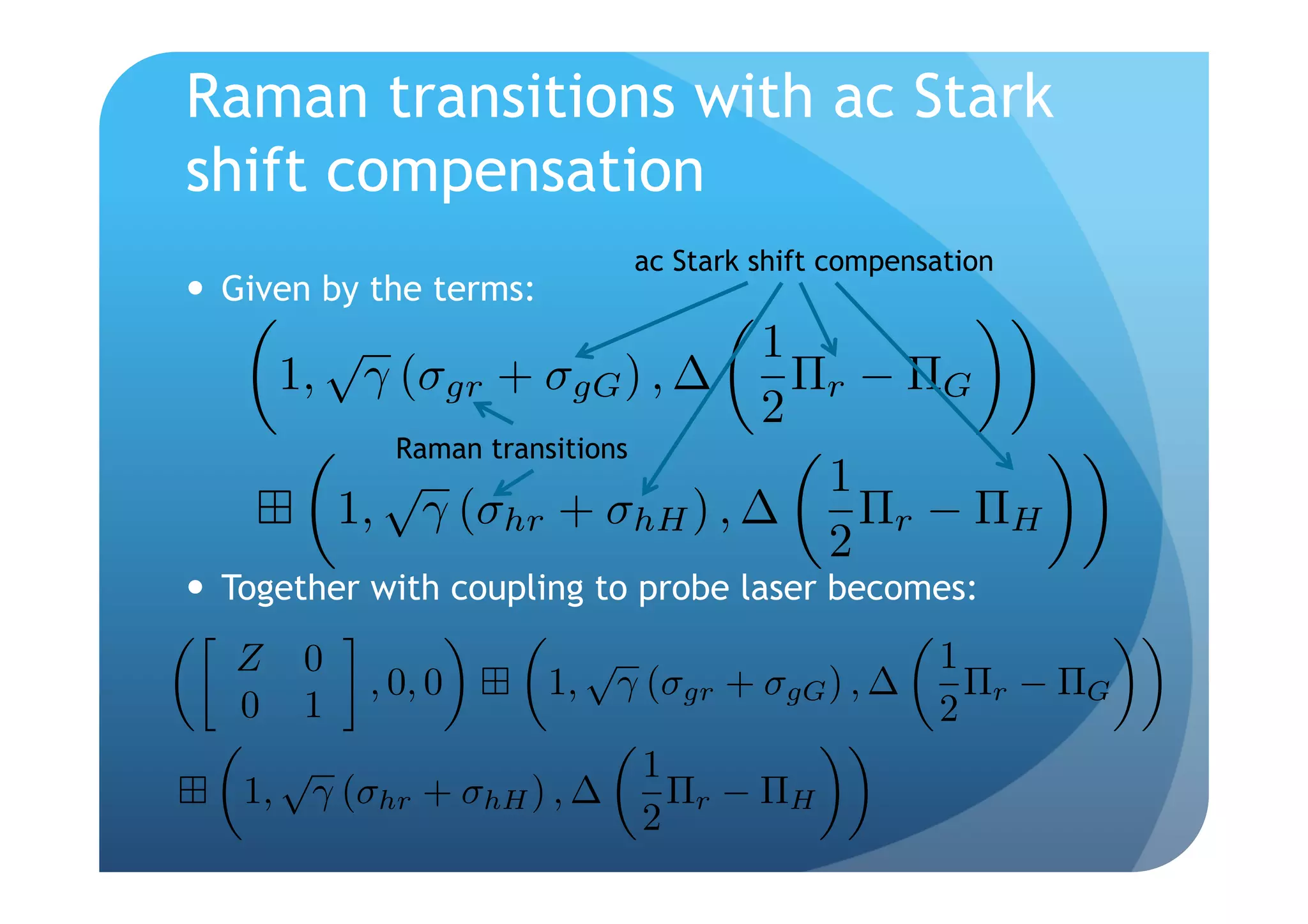
Raman transitions with ac Stark
shift compensation
                               ac Stark shift compensation
  Given by the terms:
            √                 1
       1, γ (σgr + σgG ) , ∆    Πr − ΠG
                              2
            Raman transitions
           √                     1
         1, γ (σhr + σhH ) , ∆     Πr − ΠH
                                 2
  Together with coupling to probe laser becomes:

   Z    0                  √                         1
                , 0, 0   1, γ (σgr + σgG ) , ∆         Πr − ΠG
   0    1                                            2
       √                       1
   1, γ (σhr + σhH ) , ∆         Πr − ΠH
                               2
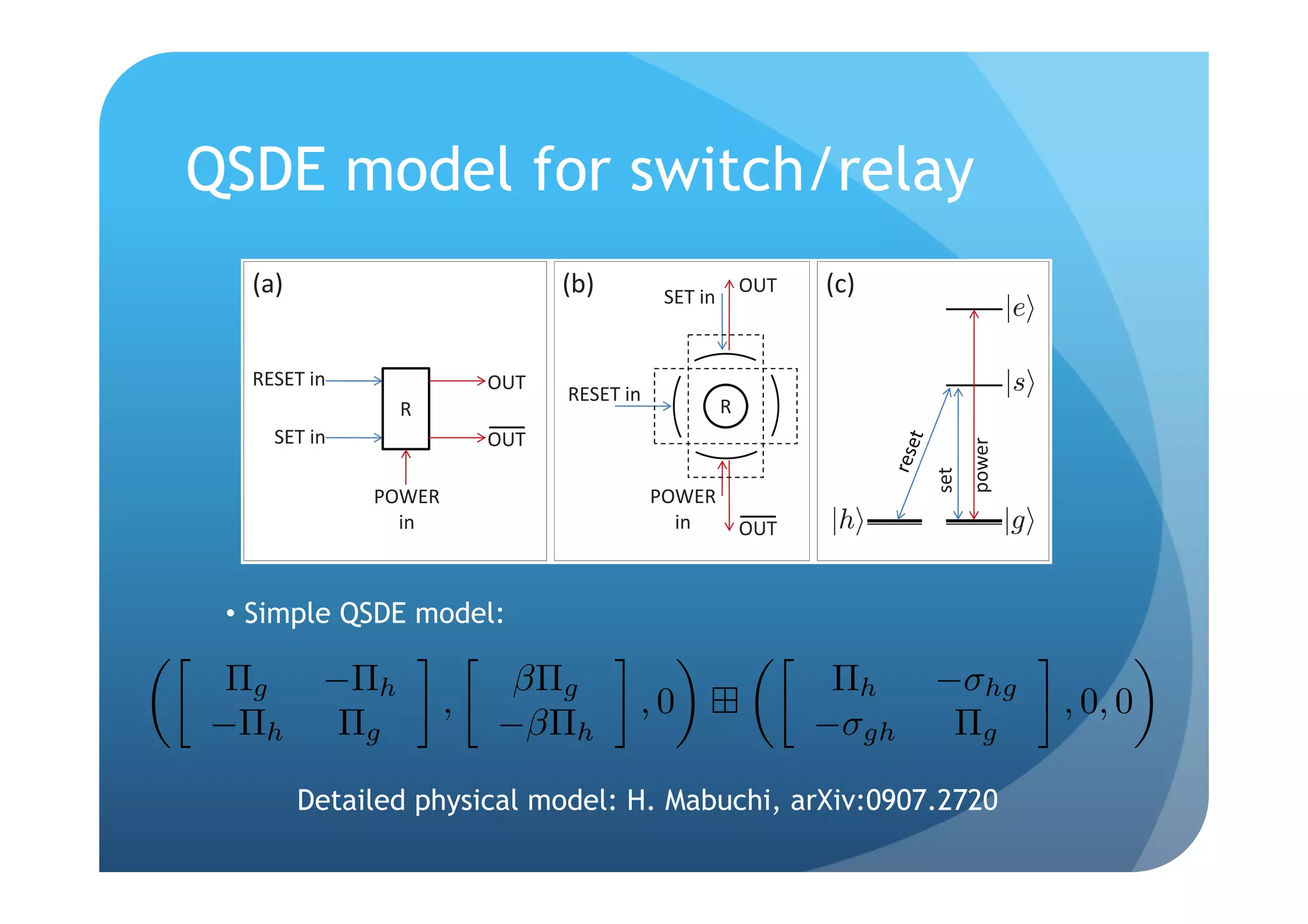
QSDE model for switch/relay
   (+*                          (,*         $%#!&'
                                                         !"#   ()*
                                                                                    !!"

   -%$%#!&'               !"#
                                -%$%#!&'                                            !""
                -                                    -
     $%#!&'
     $%# &'               !"#


                                                                            34516
                                                                      012
              .!/%-                        .!/%-
                &'                           &'          !"#   !$"                  !#"


 •  Simple QSDE model:

 Πg       −Πh              βΠg                                  Πh    −σhg
                      ,                ,0                                                 , 0, 0
−Πh        Πg             −βΠh                                 −σgh    Πg

         Detailed physical model: H. Mabuchi, arXiv:0907.2720
QEC network description
                                                                !"
                                                                                         (Modified) half network diagram          3

 (+*                       (,*         $%#!&'
                                                    !"#   ()*
                                                                               !!"                                    ;88
                                                !#                                                -88       9:
              ! "
              !!!"                                                             $#
 -%$%#!&'            !"#
                           -%$%#!&'                                            !""
             -                                  -
   $%#!&'
   $%# &'                                                                                 9<      -87                 ;8<
                     !"#


                                                                       34516
                                                                                 !""
                                                                 012
                                       $%
            .!/%-                     .!/%-
              &'                        &'          !"#   !$"                  !#"
                                                                                                                      ;77
                                         !""
 ( *                      ( *                 ( *                                                                     ;78
                                     &'                      !!! "
FIG. 3: Details of the ‘set-reset flip-flop cross-over relay’ com-                          98
                         !%
ponent model [22]: (a) input and output ports, (b) coupling
of input/output fields to resonant modes of two cavities, and
                    !"#7                                                                                              ;<7
                               &
(c) relay internal level diagram.

                           Half it would be possible to f (p=probe path, f=feedback path):
but in a practical implementation network Gp G FIG. 4: Signal-flow diagram of the half-network Gp                            Gf .

utilize double-pole double-throw relays that switch not
                        Gp = R12 B3 ((Q we Q21 ) (1, 0, 0)) B1 ,
only the Raman beam itself but also an auxiliary beam 13 proceed to assemble the full network√model N =
                                                            Gp Gf G          Gf G . Here GΓ = ( ΓX , 0, 0)
                        Gf = (Q11 chosen soQ22√ΓX (B0) p 2√ΓX0,0,Γ0) describes bit-flip 1decoher-
whose frequency, polarization and amplitude is Q
                                                   32       (
                                                              ) , 0, 5 ( (1, , 0))
that it provides equivalent compensation.                          2              3
  Some details of our relay model are displayed in (1, 0, 0))
                                          (R11 Fig. 3 ence of the register qubits, and the component connec-
[22]. In electrical engineering parlance, the devices we    tions for Gp Gf are shown in Fig. 4 (note that as the
utilize correspond to open quantum systems versions of a    signal routing shown in Fig. 1 yields rather unwieldy
cross-over relay driven by a set-reset flip-flop. Each relay  network calculations, we are here adopting a modified
QEC network master equation
  The QEC network master equation in the limit that Δ, β  ∞
   with β2/ Δ constant is:
                                            7
                                                             1
                       ρt = −i[H, ρt ] +
                       ˙                           Li ρt L∗ − {L∗ Li , ρt } ,
                                           i=1
                                                          i
                                                             2 i

      where (Ω ≡ β 2 /γ∆),
                             √             (R2 )
                                                          √      (R1 )
                   H    =        2ΩΠ(R1 ) Πh
                                    g              X1 +       2ΩΠh       Π(R2 ) X3
                                                                          g

                             −ΩΠ(R1 ) Π(R2 ) X2 ,
                                 g     g
                              α
                  L1    =    √ σhg 1 ) (1 + Z1 Z2 ) + Π(R1 ) (1 − Z1 Z2 )
                                    (R
                                                       h                             ,
                               2
                              α
                  L2    =    √ σgh 1 ) (1 − Z1 Z2 ) + Π(R1 ) (1 + Z1 Z2 )
                                    (R
                                                       g                             ,
                               2
                              α
                  L3    =    √ σhg 2 ) (1 + Z3 Z2 ) + Π(R2 ) (1 − Z3 Z2 )
                                    (R
                                                       h                             ,
                               2
                              α
                  L4    =    √ σgh 2 ) (1 − Z3 Z2 ) + Π(R2 ) (1 + Z3 Z2 )
                                    (R
                                                       g                             ,
                               2
                             √               √                √
                  L5    =      ΓX1 , L6 = ΓX2 , L7 = ΓX3 .
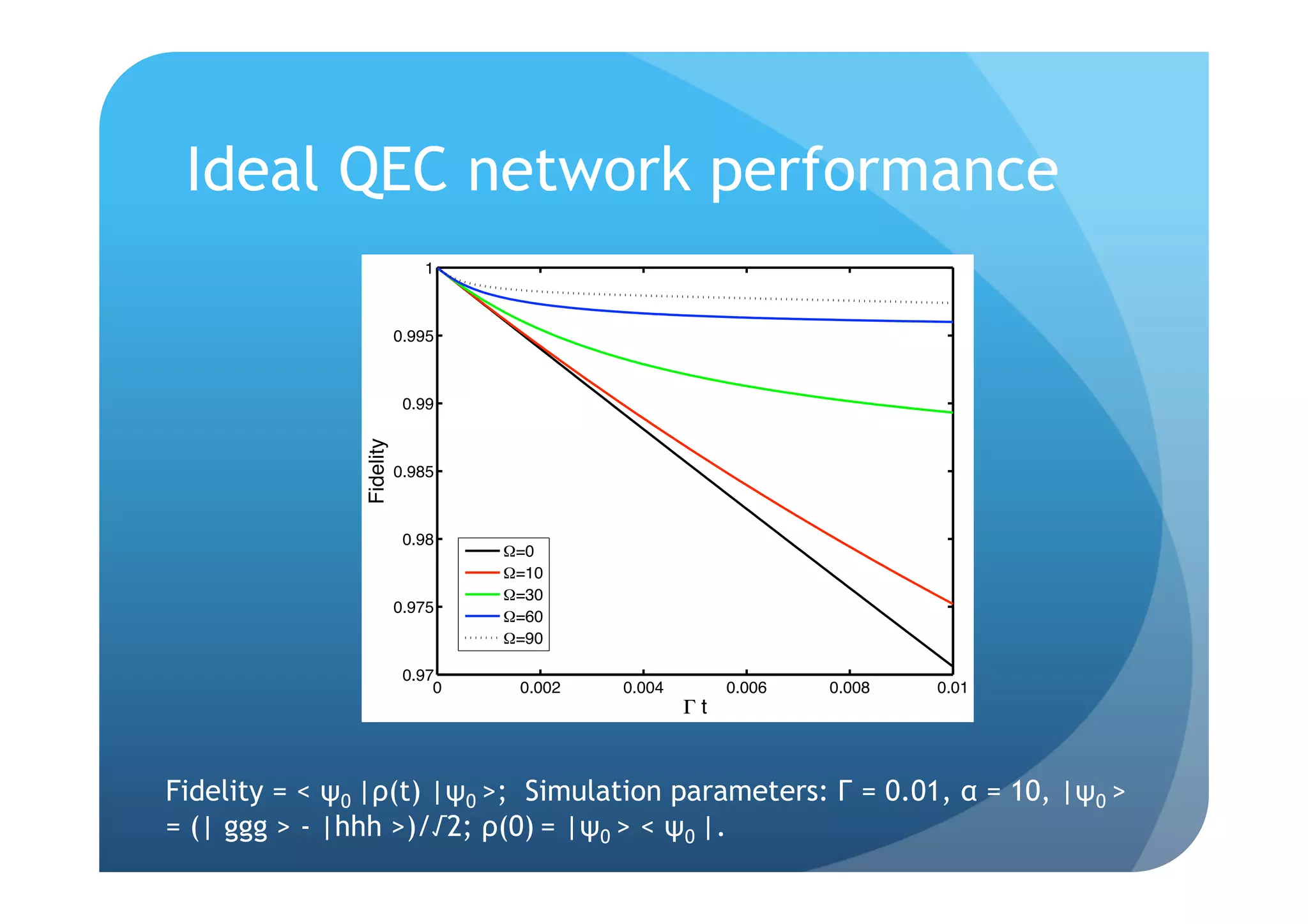
Ideal QEC network performance
                             1


                          0.995


                           0.99
               Fidelity


                          0.985


                           0.98
                                   "=0
                                   "=10
                                   "=30
                          0.975
                                   "=60
                                   "=90

                           0.97
                               0    0.002   0.004        0.006   0.008   0.01
                                                    !t


Fidelity = < ψ0 |ρ(t) |ψ0 >; Simulation parameters: Γ = 0.01, α = 10, |ψ0 >
= (| ggg > - |hhh >)/√2; ρ(0) = |ψ0 > < ψ0 |.
Ideal QEC network performance
                        -./01234,2540167819:4/28;<4!=>!                                               *+,-./0-1213,.41156)/78.!9:!


    "#&'                                                                        "#'$!$

    "#&+
                                                                                "#'$!%
    "#&*

    "#&$
                                                                                "#'$!%
    "#&%

    "#&)                                                                        "#'$!(


                                                                            ;
?


    "#&&
                                                                                "#'$!(
    "#&!

     "#&
                                                                                "#'$!&
    "#!(

    "#!'                                                                        "#'$!&
       %                                                                             %

           &                                                            !                &                                                         !
                                                                  "#$                                                                        "#$
               "                                                                             "
                                                              "                                                                          "
                   !&                                                                            !&
                                                  !"#$                                                                       !"#$

               "
                           !%     !!                                                                     !%    !!
                                                          ,                                  "                                       )


Fidelity = < ψ0 |ρ(T) |ψ0 >; Simulation parameters: Γ = 0.01, α = 10,β = 30,
|ψ0 > = a |ggg > + √(1-a2)eiθ|hhh >, a in [-1,1], θ in [-π,π]; ρ(0) = |ψ0 > < ψ0 |.
Concluding remarks
  We have proposed a coherent-feedback QEC scheme for
   a simple 3 qubit QEC code that protects against single
   bit flip errors; can be easily adapted to a 3 qubit phase
   flip code.
  Simulations of the QEC network master equation
   indicates the scheme can slow down decoherence due
   to single bit flips.
  Ideas for the future: Adaptation to more complex
   stabilizer codes, but necessarily also with more complex
   quantum circuits. Perhaps also to non-stabilizer codes
   (more challenging?).

Coherent feedback formulation of a continuous quantum error correction protocol

  • 1.
    Coherent-Feedback Formulation ofa Continuous Quantum Error Correction Protocol arXiv:0907.0236 Hendra Nurdin (The Australian National University) Joint work with: Joe Kerckhoff Dmitri Pavlichin Hideo Mabuchi (Stanford University)
  • 2.
    Talk plan   Reminderof quantum error correction (QEC).   Continuous QEC.   Description of a scheme for coherent-feedback QEC for a simple 3 qubit bit flip code.   Concluding remarks.
  • 3.
    Quantum error correction(QEC)   Quantum error correction is essential for quantum information processing since qubits are susceptible to decoherence.   When decoherence alters the state of a qubit, a QEC algorithm acts to restore it to the state prior to decoherence.
  • 4.
    QEC principles   Mainingredient is to introduce reduncancy by encoding a logical qubit into a number of physical qubits.   Simple 3 qubit code: A logical qubit is encoded by 3 physical qubits. Logical qubit |0 >L encoded by 3 physical qubits |000 > and |1 >L encoded by |111 >.   A logical state a|0 >L + b|1 >L is encoded as a|000 > + b| 111 >. The 3 qubit codespace is C = span{|000 >,|111>}.
  • 5.
    The 3 qubitbit flip code   This simple code belongs to a class of QEC codes called stabilizer codes (Gottesman, PRA 54, 1862)   C = span{| 000 >,|111 >}   Correctable errors are single qubit bit flips X1, X2 or X3   Error is determined by measuring the parity Z1Z2 between qubits 1 and 2, and Z2Z3 between qubits 2 and 3. Measurement results called the error syndrome.   Error syndromes are: {1,1} (no error), {-1, 1} (qubit 1 has flipped), {1,-1} (qubit 3 has flipped) and {-1,-1} (qubit 2 has flipped)
  • 6.
    Continuous QEC   Mostproposed QEC schemes are discrete. Error detection and recovery operations are done periodically with a sufficiently small period.   In continuous QEC, the idea is to detect and correct errors continuously as they occur. Suitable for low level continuous time differential equation based models.   Continuous QEC using continuous monitoring and measurement-feedback: Ahn, Doherty & Landahl et al, PRA 65, 042301; Ahn, Wiseman & Milburn, PRA 65, 042301; Chase, Landahl & Geremia, PRA 77, 032304.
  • 7.
    Why coherent-feedback?   Notnecessary to go up to the “macroscopic” level and have interfaces to electronic circuits for measurements. Not limited by bandwidth of electronic devices.   No classical processing required and avoids challenges imposed by the requirement of such processing; e.g., numerical integration of nonlinear quantum filtering equations in real-time.   Entirely “on-chip” implementation; a controller can be on the same hardware platform as the controlled quantum system. In particular, in solid state monolithic circuit QED.
  • 8.
    Quantum network notationand operations   Open Markov quantum system G = (S,L,H).   Concatenation product S2 0 L2 G2 G1 = (S2 , L2 , H2 ) (S1 , L1 , H1 ) = , , H1 + H2 0 S1 L1   Series product G2 G 1 = (S2 , L2 , H2 ) (S1 , L1 , H1 ) = (S2 S1 , S2 L1 + L2 , H1 + H2 + {L† S2 L1 }) 2 Gough & James, IEEE-TAC (to appear), 2009, arXiv:0708.4483
  • 9.
    error correction and trogen vacancy center in diamond, etc. , are interrogated se- architectures are es- quentially by a coherent optical probe with amplitude of quantum informa- similar arrangements have previously been considered in the research in these ar- context of quantum information science 10 . A qubit is en- models for quantum coded in the ground states and of the intracavity Continuous parity measurement erhaps more familiar atom; an optical transition between and the excited state theorists, there has e is coupled strongly to a quantized cavity mode with ey ideas 2 to the vacuum Rabi frequency g. For simplicity we assume atomic quation-based mod- selection rules such that e decays only to , with excited- context of ab initio ntribute to a line of √ √ rs 3–6 and broad- dU (t) = ( κb1 + κb2 + α)dA∗ (t) − h.c. hich focuses on con- √ √ √ √ abilizer coding and ( κb1 + κb2 + α)∗ ( κb1 + κb2 + α) s approach is attrac- − dt fundamentally con- 2 2 uppression with for- √ γ ∗ ontrol theory 7 . It + γσ (i) dB ∗ (t) − h.c. − σ σdt mentation advantage 2 k=1 s in that continuous out the need for ex- 2 κ this of course relies + (b∗ b2 − h.c.)dt + g (σ (i)∗ bi − h.c.)dt emolition syndrome 2 1 i=1 rimentally favorable √ aightforward imple- ¯ α κ y measurement suf- + (b1 + b2 ) − h.c. dt U (t) he quantum bit-flip 2 ectrodynamics cav- of our scheme both ¯ dU (t) = ((Π12 − I)dΛ(t) + αΠ12 dA∗ (t) − αdA(t) ¯ ical simulation and a adiabatic elimina- |α|2 ¯ − dt U (t) oherent-state optical 2 qubits and exploits ace of clocked quan- lim ¯ lim (U (t) − U (t))ψ = 0 for all ψ . The strength of the g→∞ α, κ → ∞ s be modulated eas- √ = const α stment of the power FIG. 1. Color online Schematic depiction of two cavities κ Kerckhoff, Bouten, Silberfarb & driven sequentially by a resonant laser beam. A three-level atom is in the reduced Hilbert space. ementation is shown trapped inside each cavity, and identical atom-cavity dynamics ap- aining a single three- Mabuchi, PRA 79, 024305 ply in each. After probing both cavities, the laser light is directed to kali-metal atom, ni- a homodyne receiver. But cannot include bit flip errors! 024305-1 ©2009 The American Physical Society
  • 10.
    Modified parity measurement model  Full single atom-cavity-field model with bit flip errors: √ 1 √ √ dU (t) = ( κb + α)dA1 (t) − h.c. − ( κb + α) ( κb + α)dt ∗ ∗ 2 √ Γ ∗ + ΓσX dA∗ (t) − h.c. − σX σX dt 2 2 √ γ ∗ + γσdA3 (t) − h.c. − σ σdt + g(σ ∗ b − h.c.)dt U (t) ∗ 2   Reduced atom-field model with bit flip errors: ¯ dU (t) = (Z − I)dΛ11 (t) + αZdA∗ (t) − αdA1 (t) 1 ¯ √ 1 ¯ + ΓXdA∗ (t) − h.c. − (|α|2 + γ)dt U (t) 2 2 lim ¯ (U (t) − U (t))ψ for all ψ in the reduced Hilbert space. g, κ → ∞ g κ = const
  • 11.
    Modified parity measurement model   The reduced model can be written as: Z 0 , √0 ,0 I, α ,0 0 1 ΓX 0   Reduced model for two coherently driven cavities:               Z2 0 0 0 Z1 0 0 √0 α √0  0 1 0  ,   , 0  0 1 0  ,  ΓX1  , 0 I,  0  , 0 0 0 1 ΓX2 0 0 1 0 0      Z2 Z1 0 0 αZ2 Z1 √ =  0 1 0  ,  √ΓX1  , 0 0 0 1 ΓX2
  • 12.
    The “bare bones”of it " = a 0 A 0 B 0C ! + b 1A1B1C ! A |e ! g Z AZ C B Z Z ! A " – – – – |1 r La se B + C se La |0 r + A M R XA XB XC 1 ZAZB – – + + ZAZC – + – + . L. O B C O L. . •  Coherent lasers drive atomic Raman transitions between the two ground states of the atom to correct bit flips. •  To make it work, need more than this …
  • 13.
    n are replacedby unitary processing of the probe beams and coherent feedback to its. We exploit a limit theorem for quantum stochastic differential equations to an- eedback networks based on the bit-flip/phase-flip code, obtaining simple closed-loop s with only four Hilbert-space dimensions required for the controller. Our approach to physical implementations that feature solid-state qubits embedded in planar circuits. The actual scheme 03.67.Pp,02.30.Yy,42.50.-p,03.65.Yz quantum error correction !" and measurement of syn- ntral to the modern field of e. Although substantial work nsions and refinements of ab- orts [2, 3, 4] have begun to fo- !# task of developing implemen- ! " !!!" $# ly the fundamental principles ally accommodate the struc- !"" models. Such new approaches $% quantum memories that make physical resources and intro- ted abstractions for quantum !"" plement those we have inher- r science. !% recently proposed [5] a cavity cavity QED) implementation ty measurement required for FIG. 1: Schematic diagram of a coherent-feedback quantum 9, 10, 11, 12] versionQuantummemory showing qubits-in-cavities (Q1,facilitate switching   of the switches R1, R2 inserted to Q2 and Q3), circula- to higher or phase-flip codes, which be- amplitude bit flip correcting Raman lasers. (R1 and R2). tors, beam-splitters, steering mirrors and relays el in a strong coupling limit. The calculation we present is based on a modified arrange- further step of describing co- ment that leads to the same closed-loop master equation but hat realize quantum memories factorizes into four simple sub-networks. e encoded qubit is suppressed
  • 14.
    Qubit atomic levelscheme ! !"" !!" ! !#" ! !$" !&" !%"
  • 15.
    Raman transitions withac Stark shift compensation ac Stark shift compensation   Given by the terms: √ 1 1, γ (σgr + σgG ) , ∆ Πr − ΠG 2 Raman transitions √ 1 1, γ (σhr + σhH ) , ∆ Πr − ΠH 2   Together with coupling to probe laser becomes: Z 0 √ 1 , 0, 0 1, γ (σgr + σgG ) , ∆ Πr − ΠG 0 1 2 √ 1 1, γ (σhr + σhH ) , ∆ Πr − ΠH 2
  • 16.
    QSDE model forswitch/relay (+* (,* $%#!&' !"# ()* !!" -%$%#!&' !"# -%$%#!&' !"" - - $%#!&' $%# &' !"# 34516 012 .!/%- .!/%- &' &' !"# !$" !#" •  Simple QSDE model: Πg −Πh βΠg Πh −σhg , ,0 , 0, 0 −Πh Πg −βΠh −σgh Πg Detailed physical model: H. Mabuchi, arXiv:0907.2720
  • 17.
    QEC network description !"   (Modified) half network diagram 3 (+* (,* $%#!&' !"# ()* !!" ;88 !# -88 9: ! " !!!" $# -%$%#!&' !"# -%$%#!&' !"" - - $%#!&' $%# &' 9< -87 ;8< !"# 34516 !"" 012 $% .!/%- .!/%- &' &' !"# !$" !#" ;77 !"" ( * ( * ( * ;78 &' !!! " FIG. 3: Details of the ‘set-reset flip-flop cross-over relay’ com- 98 !% ponent model [22]: (a) input and output ports, (b) coupling of input/output fields to resonant modes of two cavities, and !"#7 ;<7 & (c) relay internal level diagram. Half it would be possible to f (p=probe path, f=feedback path): but in a practical implementation network Gp G FIG. 4: Signal-flow diagram of the half-network Gp Gf . utilize double-pole double-throw relays that switch not Gp = R12 B3 ((Q we Q21 ) (1, 0, 0)) B1 , only the Raman beam itself but also an auxiliary beam 13 proceed to assemble the full network√model N = Gp Gf G Gf G . Here GΓ = ( ΓX , 0, 0) Gf = (Q11 chosen soQ22√ΓX (B0) p 2√ΓX0,0,Γ0) describes bit-flip 1decoher- whose frequency, polarization and amplitude is Q 32 ( ) , 0, 5 ( (1, , 0)) that it provides equivalent compensation. 2 3 Some details of our relay model are displayed in (1, 0, 0)) (R11 Fig. 3 ence of the register qubits, and the component connec- [22]. In electrical engineering parlance, the devices we tions for Gp Gf are shown in Fig. 4 (note that as the utilize correspond to open quantum systems versions of a signal routing shown in Fig. 1 yields rather unwieldy cross-over relay driven by a set-reset flip-flop. Each relay network calculations, we are here adopting a modified
  • 18.
    QEC network masterequation   The QEC network master equation in the limit that Δ, β  ∞ with β2/ Δ constant is: 7 1 ρt = −i[H, ρt ] + ˙ Li ρt L∗ − {L∗ Li , ρt } , i=1 i 2 i where (Ω ≡ β 2 /γ∆), √ (R2 ) √ (R1 ) H = 2ΩΠ(R1 ) Πh g X1 + 2ΩΠh Π(R2 ) X3 g −ΩΠ(R1 ) Π(R2 ) X2 , g g α L1 = √ σhg 1 ) (1 + Z1 Z2 ) + Π(R1 ) (1 − Z1 Z2 ) (R h , 2 α L2 = √ σgh 1 ) (1 − Z1 Z2 ) + Π(R1 ) (1 + Z1 Z2 ) (R g , 2 α L3 = √ σhg 2 ) (1 + Z3 Z2 ) + Π(R2 ) (1 − Z3 Z2 ) (R h , 2 α L4 = √ σgh 2 ) (1 − Z3 Z2 ) + Π(R2 ) (1 + Z3 Z2 ) (R g , 2 √ √ √ L5 = ΓX1 , L6 = ΓX2 , L7 = ΓX3 .
  • 19.
    Ideal QEC networkperformance 1 0.995 0.99 Fidelity 0.985 0.98 "=0 "=10 "=30 0.975 "=60 "=90 0.97 0 0.002 0.004 0.006 0.008 0.01 !t Fidelity = < ψ0 |ρ(t) |ψ0 >; Simulation parameters: Γ = 0.01, α = 10, |ψ0 > = (| ggg > - |hhh >)/√2; ρ(0) = |ψ0 > < ψ0 |.
  • 20.
    Ideal QEC networkperformance -./01234,2540167819:4/28;<4!=>! *+,-./0-1213,.41156)/78.!9:! "#&' "#'$!$ "#&+ "#'$!% "#&* "#&$ "#'$!% "#&% "#&) "#'$!( ; ? "#&& "#'$!( "#&! "#& "#'$!& "#!( "#!' "#'$!& % % & ! & ! "#$ "#$ " " " " !& !& !"#$ !"#$ " !% !! !% !! , " ) Fidelity = < ψ0 |ρ(T) |ψ0 >; Simulation parameters: Γ = 0.01, α = 10,β = 30, |ψ0 > = a |ggg > + √(1-a2)eiθ|hhh >, a in [-1,1], θ in [-π,π]; ρ(0) = |ψ0 > < ψ0 |.
  • 21.
    Concluding remarks   Wehave proposed a coherent-feedback QEC scheme for a simple 3 qubit QEC code that protects against single bit flip errors; can be easily adapted to a 3 qubit phase flip code.   Simulations of the QEC network master equation indicates the scheme can slow down decoherence due to single bit flips.   Ideas for the future: Adaptation to more complex stabilizer codes, but necessarily also with more complex quantum circuits. Perhaps also to non-stabilizer codes (more challenging?).