TERMINAL BALLISTICS
DEPARTMENT OF CRIMINOLOGY AND FORENSIC SCIENCE
Dr. Hari Singh Gour
Vishwavidyalaya
Submitted to: Submitted by:
Dr. Navjot Kaur Kanwal Pragya Gupta
Assistant Professor Y19242518
Surabhi Oraon
Y19242528
MSc. Forensic Science 1st sem
Introduction
● Terminal ballistics, a sub-field of ballistics deals with the study of the
behaviour and effect of a projectile when it hits the target and
transfers its energy to the target
● Terminal ballistics can be subdivided into penetration potential, which
is the capability of a missile to penetrate various materials and wound
ballistics, which is the effect of projectile on the living tissue.
Wound Ballistics
● The minimum velocity, known as threshold velocity,
required to penetrate the skin is found to be 40-50 m/s. The
threshold velocity for bone penetration is 60 m/s
● When a projectile strikes the human body, it depresses and
compresses the sikn, flesh and bone tissues underneath.
The continued pressure stretches them beyond the elastic
limits if the projectile has sufficient energy. The stretched
skin under the impact of the projectile is pierced
● The projectile continues its onward progress till it leaves the
body through an exit hole.
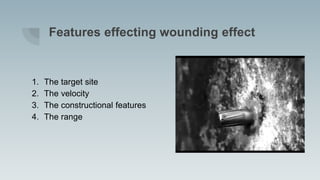
Features effecting wounding effect
1. The target site
2. The velocity
3. The constructional features
4. The range
The target site
About 43% of the total body area covers body parts (organs,
cavities, nerves, blood vessels, etc.) which are easily damaged.
Likewise the depth of tissue on the frontal side of the body is
0.6 cm only, whereas average depth us more than five times
(3.3 cm) on the back side. Thus a frontal attack is likely to
cause more serious wounds than the injury from the back side.
The velocity
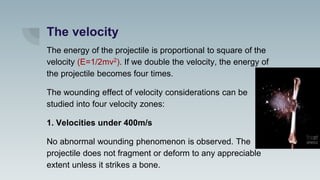
The energy of the projectile is proportional to square of the
velocity (E=1/2mv2). If we double the velocity, the energy of
the projectile becomes four times.
The wounding effect of velocity considerations can be
studied into four velocity zones:
1. Velocities under 400m/s
No abnormal wounding phenomenon is observed. The
projectile does not fragment or deform to any appreciable
extent unless it strikes a bone.
Contd.
4. Velocities from 400-600 m/s
● lead bullets and expanding bullets start mushrooming.
Extent of mushrooming depends upon the striking velocity
and constructional material and features of the projectile
● The tissue damage is greater because the cross sectional
area increases as the projectile progresses forward.
3. Velocities from 600-1100 m/s
● The high velocity projectile creates a vacuum behind it. As
it enters the body the air behind rushes at a terrific speed
and disrupts the body tissues
Contd.
● The body parts hit by the projectile themselves become
effective secondary missiles and cause extensive damage
● The projectile fragments and these fragments cause
extensive damage
● The gyratory motion is very high due to which the tissue
which come in contact with the projectile are set into
motion and churned.
4. Velocities beyond 1100 m/s
● The projectile compresses air in its front due to which it
produces a shock wave. The intensity of shock wave
Contd.
depends upon the velocity of the projectile and the energy
transferred by it to the target
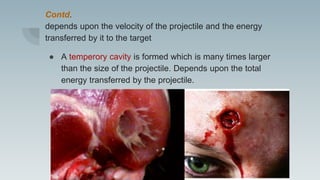
● A temperory cavity is formed which is many times larger
than the size of the projectile. Depends upon the total
energy transferred by the projectile.
The constructional features
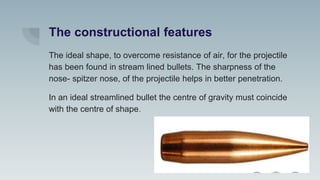
The ideal shape, to overcome resistance of air, for the projectile
has been found in stream lined bullets. The sharpness of the
nose- spitzer nose, of the projectile helps in better penetration.
In an ideal streamlined bullet the centre of gravity must coincide
with the centre of shape.
The range
The increasing range of fire in addition to reducing the velocity
of the projectile influences the wounding effect in the following
ways:
1. The lighter ejecta is dispersed. It does not reach or enter
the target.
2. The initial instability of the projectile is overcome.
The powder gases, smoke, semi burnt or unburnt powder
residue, metallic particles, dirt and wads if any constitute
lighter ejecta. They are important in the wounding effects
Contd.
only when the firearm is fired, pressed to the skin(contact
wound) or from very close range (near contact wounds). The
expansion of gases takes place inside the body.
● The damage inside gives the appearance of explosion,
● Often there is no charring, blackening or tattooing on the
outer margin of the wound. The phenomenon is seen inside
the wound,
● The outcoming gases evert the margins,
● Wads of a shotgun can inflict fatal injuries from close
range..
Characteristics of firearm injuries
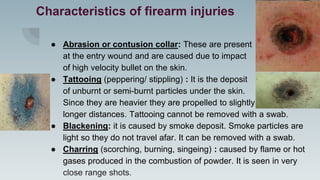
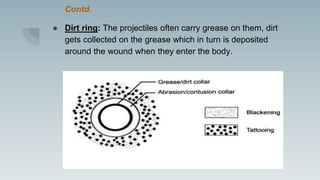
● Abrasion or contusion collar: These are present
at the entry wound and are caused due to impact
of high velocity bullet on the skin.
● Tattooing (peppering/ stippling) : It is the deposit
of unburnt or semi-burnt particles under the skin.
Since they are heavier they are propelled to slightly
longer distances. Tattooing cannot be removed with a swab.
● Blackening: it is caused by smoke deposit. Smoke particles are
light so they do not travel afar. It can be removed with a swab.
● Charring (scorching, burning, singeing) : caused by flame or hot
gases produced in the combustion of powder. It is seen in very
close range shots.
Contd.
● Dirt ring: The projectiles often carry grease on them, dirt
gets collected on the grease which in turn is deposited
around the wound when they enter the body.
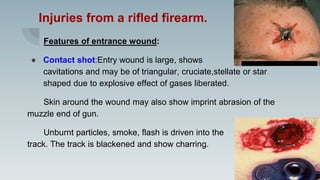
Injuries from a rifled firearm.
Features of entrance wound:
● Contact shot:Entry wound is large, shows
cavitations and may be of triangular, cruciate,stellate or star
shaped due to explosive effect of gases liberated.
Skin around the wound may also show imprint abrasion of the
muzzle end of gun.
Unburnt particles, smoke, flash is driven into the
track. The track is blackened and show charring.
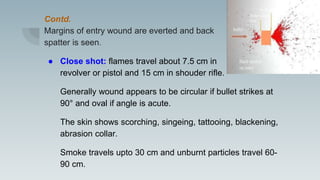
Contd.
Margins of entry wound are everted and back
spatter is seen.
● Close shot: flames travel about 7.5 cm in
revolver or pistol and 15 cm in shouder rifle.
Generally wound appears to be circular if bullet strikes at
90° and oval if angle is acute.
The skin shows scorching, singeing, tattooing, blackening,
abrasion collar.
Smoke travels upto 30 cm and unburnt particles travel 60-
90 cm.
Contd.
● Near shot: Here victim is within the range of powder deposition
but outside the range of flame i.e. within 60 cm. Singeing and
scorching absent.
Abrasion collar, grease collar present. Blackening is not seen if
range is beyond 30 cm. Tattooing is present.
Margins are inverted.
● Distant shot: Here victim is beyond the range of gun powder.
Entry wound is circular, margins inverted.
Scorching, singeing, tattooing, blackening - absent.
Features of exit wound
1. It may be absent in some cases where bullet is lodged in
body.
2. Multiple exit wounds may be present due to:
● Breaking of bullet and fragments exit by different wounds,
● Fragments of bone along with bullet causes two or more
exit wounds.
3. Exit wounds may vary in size and shape due to:
● Bullet tumbles in the body and exit by base end first rather
than nose end or
Contd.
● Bullet gets deformed or
● Bullet may break into pieces or
● Bullet may be accompanied by a larger bone fragment.
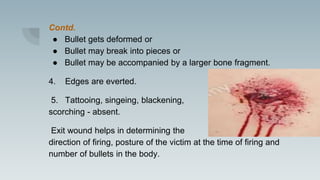
4. Edges are everted.
5. Tattooing, singeing, blackening,
scorching - absent.
Exit wound helps in determining the
direction of firing, posture of the victim at the time of firing and
number of bullets in the body.
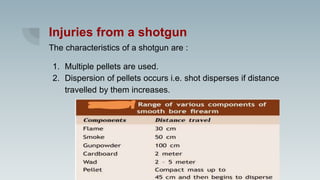
Injuries from a shotgun
The characteristics of a shotgun are :
1. Multiple pellets are used.
2. Dispersion of pellets occurs i.e. shot disperses if distance
travelled by them increases.
Features of entrance wound
● Contact shot: The wound is single, burning, singeing minimal or
absent.
Muzzle impression of weapon present.
Shape of wound is usually circular. However, wound over skin
with underlying bone may produce varied form of shape.
Contd.
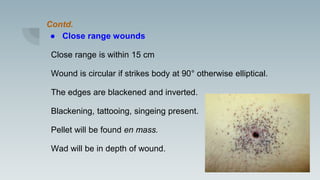
● Close range wounds
Close range is within 15 cm
Wound is circular if strikes body at 90° otherwise elliptical.
The edges are blackened and inverted.
Blackening, tattooing, singeing present.
Pellet will be found en mass.
Wad will be in depth of wound.
Contd.
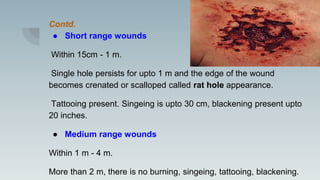
● Short range wounds
Within 15cm - 1 m.
Single hole persists for upto 1 m and the edge of the wound
becomes crenated or scalloped called rat hole appearance.
Tattooing present. Singeing is upto 30 cm, blackening present upto
20 inches.
● Medium range wounds
Within 1 m - 4 m.
More than 2 m, there is no burning, singeing, tattooing, blackening.
Contd.
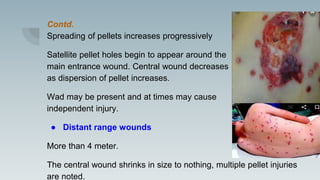
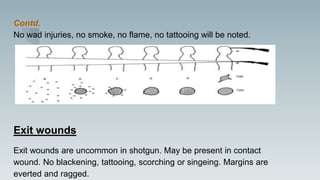
Spreading of pellets increases progressively
Satellite pellet holes begin to appear around the
main entrance wound. Central wound decreases
as dispersion of pellet increases.
Wad may be present and at times may cause
independent injury.
● Distant range wounds
More than 4 meter.
The central wound shrinks in size to nothing, multiple pellet injuries
are noted.
Contd.
No wad injuries, no smoke, no flame, no tattooing will be noted.
Exit wounds
Exit wounds are uncommon in shotgun. May be present in contact
wound. No blackening, tattooing, scorching or singeing. Margins are
everted and ragged.
Improvised firearm injuries
The nature of improvised firearms varies not only from one
firearm to another, but sometimes they can vary with the same
weapon also. As such no generalizations are, therefore,
possible.
Ricochet effect
Definition: Ricochet is a phenomenon which refers to the
deflection of projectile from its trajectory or line of motion after
hitting a hard object even from bone.
● It may vary with bullet shape, bullet material, spin, velocity,
target material and the angle of incidence,
● Unintentional ricochets can cause potential damage to
objects outside the path of the bullet,
● Damage potential of ricochets, like bullets is proportional to
the mass of bullet fragment and the square of its velocity.
Wounds and ricocheting
● Wounds produced by bullets ricocheting from hard surfaces
can be easily identified. The entry wound caused by a bullet
after ricocheting will be very distinctive as it is caused by a
distorted bullet which will generally have ragged edges.
After it enters the body, the bullet due to its inherent
unstable condition, tumble end over end and would leave a
large and irregular channel,
● Jacketed bullets tend to break up on ricocheting and
possibility of recovery of fragmented jacket and lead core
are more,
● Ricocheting of bullets cause serious injuries even fatal
ones.
Postmortem and anti-mortem firearm
injuries
Anti-mortem injuries bleed profusely while postmortem injuries
bleed a little unless some blood vessel is punctured.
In anti-mortem injuries the entrance wound is smaller than the
diameter of the projectile due to elasticity of skin whereas in
postmortem injury the entry wound will be of the same as the
diameter of the projectile as skin loses its elasticity after death.
Reference:
● R. BARDALE, 2011, Principles of Forensic Medicine and
Toxicology, Jaypee Brothers Medical Publishers Ltd.
● TOM WARLOW, 2005,Firearms, The Law and Forensic
Ballistics, CRC Press
● B.J. HEARD, 2008, Handbook of firearms and ballistics, John
Wiley and Sons Ltd.
● R. KRISHNAMURTHY, 2011, Forensic science in criminal
investigation, Selective and Scientific books
● B.R. SHARMA, 2003, Forensic Science in Criminal
Investigation and Trials, Universal Law Publishing Co. Pvt. Ltd.
Thank you

Terminal ballistics

  • 1.
    TERMINAL BALLISTICS DEPARTMENT OFCRIMINOLOGY AND FORENSIC SCIENCE Dr. Hari Singh Gour Vishwavidyalaya Submitted to: Submitted by: Dr. Navjot Kaur Kanwal Pragya Gupta Assistant Professor Y19242518 Surabhi Oraon Y19242528 MSc. Forensic Science 1st sem
  • 3.
    Introduction ● Terminal ballistics,a sub-field of ballistics deals with the study of the behaviour and effect of a projectile when it hits the target and transfers its energy to the target ● Terminal ballistics can be subdivided into penetration potential, which is the capability of a missile to penetrate various materials and wound ballistics, which is the effect of projectile on the living tissue.
  • 4.
    Wound Ballistics ● Theminimum velocity, known as threshold velocity, required to penetrate the skin is found to be 40-50 m/s. The threshold velocity for bone penetration is 60 m/s ● When a projectile strikes the human body, it depresses and compresses the sikn, flesh and bone tissues underneath. The continued pressure stretches them beyond the elastic limits if the projectile has sufficient energy. The stretched skin under the impact of the projectile is pierced ● The projectile continues its onward progress till it leaves the body through an exit hole.
  • 5.
    Features effecting woundingeffect 1. The target site 2. The velocity 3. The constructional features 4. The range
  • 6.
    The target site About43% of the total body area covers body parts (organs, cavities, nerves, blood vessels, etc.) which are easily damaged. Likewise the depth of tissue on the frontal side of the body is 0.6 cm only, whereas average depth us more than five times (3.3 cm) on the back side. Thus a frontal attack is likely to cause more serious wounds than the injury from the back side.
  • 7.
    The velocity The energyof the projectile is proportional to square of the velocity (E=1/2mv2). If we double the velocity, the energy of the projectile becomes four times. The wounding effect of velocity considerations can be studied into four velocity zones: 1. Velocities under 400m/s No abnormal wounding phenomenon is observed. The projectile does not fragment or deform to any appreciable extent unless it strikes a bone.
  • 8.
    Contd. 4. Velocities from400-600 m/s ● lead bullets and expanding bullets start mushrooming. Extent of mushrooming depends upon the striking velocity and constructional material and features of the projectile ● The tissue damage is greater because the cross sectional area increases as the projectile progresses forward. 3. Velocities from 600-1100 m/s ● The high velocity projectile creates a vacuum behind it. As it enters the body the air behind rushes at a terrific speed and disrupts the body tissues
  • 9.
    Contd. ● The bodyparts hit by the projectile themselves become effective secondary missiles and cause extensive damage ● The projectile fragments and these fragments cause extensive damage ● The gyratory motion is very high due to which the tissue which come in contact with the projectile are set into motion and churned. 4. Velocities beyond 1100 m/s ● The projectile compresses air in its front due to which it produces a shock wave. The intensity of shock wave
  • 10.
    Contd. depends upon thevelocity of the projectile and the energy transferred by it to the target ● A temperory cavity is formed which is many times larger than the size of the projectile. Depends upon the total energy transferred by the projectile.
  • 11.
    The constructional features Theideal shape, to overcome resistance of air, for the projectile has been found in stream lined bullets. The sharpness of the nose- spitzer nose, of the projectile helps in better penetration. In an ideal streamlined bullet the centre of gravity must coincide with the centre of shape.
  • 12.
    The range The increasingrange of fire in addition to reducing the velocity of the projectile influences the wounding effect in the following ways: 1. The lighter ejecta is dispersed. It does not reach or enter the target. 2. The initial instability of the projectile is overcome. The powder gases, smoke, semi burnt or unburnt powder residue, metallic particles, dirt and wads if any constitute lighter ejecta. They are important in the wounding effects
  • 13.
    Contd. only when thefirearm is fired, pressed to the skin(contact wound) or from very close range (near contact wounds). The expansion of gases takes place inside the body. ● The damage inside gives the appearance of explosion, ● Often there is no charring, blackening or tattooing on the outer margin of the wound. The phenomenon is seen inside the wound, ● The outcoming gases evert the margins, ● Wads of a shotgun can inflict fatal injuries from close range..
  • 14.
    Characteristics of firearminjuries ● Abrasion or contusion collar: These are present at the entry wound and are caused due to impact of high velocity bullet on the skin. ● Tattooing (peppering/ stippling) : It is the deposit of unburnt or semi-burnt particles under the skin. Since they are heavier they are propelled to slightly longer distances. Tattooing cannot be removed with a swab. ● Blackening: it is caused by smoke deposit. Smoke particles are light so they do not travel afar. It can be removed with a swab. ● Charring (scorching, burning, singeing) : caused by flame or hot gases produced in the combustion of powder. It is seen in very close range shots.
  • 15.
    Contd. ● Dirt ring:The projectiles often carry grease on them, dirt gets collected on the grease which in turn is deposited around the wound when they enter the body.
  • 16.
    Injuries from arifled firearm. Features of entrance wound: ● Contact shot:Entry wound is large, shows cavitations and may be of triangular, cruciate,stellate or star shaped due to explosive effect of gases liberated. Skin around the wound may also show imprint abrasion of the muzzle end of gun. Unburnt particles, smoke, flash is driven into the track. The track is blackened and show charring.
  • 17.
    Contd. Margins of entrywound are everted and back spatter is seen. ● Close shot: flames travel about 7.5 cm in revolver or pistol and 15 cm in shouder rifle. Generally wound appears to be circular if bullet strikes at 90° and oval if angle is acute. The skin shows scorching, singeing, tattooing, blackening, abrasion collar. Smoke travels upto 30 cm and unburnt particles travel 60- 90 cm.
  • 18.
    Contd. ● Near shot:Here victim is within the range of powder deposition but outside the range of flame i.e. within 60 cm. Singeing and scorching absent. Abrasion collar, grease collar present. Blackening is not seen if range is beyond 30 cm. Tattooing is present. Margins are inverted. ● Distant shot: Here victim is beyond the range of gun powder. Entry wound is circular, margins inverted. Scorching, singeing, tattooing, blackening - absent.
  • 19.
    Features of exitwound 1. It may be absent in some cases where bullet is lodged in body. 2. Multiple exit wounds may be present due to: ● Breaking of bullet and fragments exit by different wounds, ● Fragments of bone along with bullet causes two or more exit wounds. 3. Exit wounds may vary in size and shape due to: ● Bullet tumbles in the body and exit by base end first rather than nose end or
  • 20.
    Contd. ● Bullet getsdeformed or ● Bullet may break into pieces or ● Bullet may be accompanied by a larger bone fragment. 4. Edges are everted. 5. Tattooing, singeing, blackening, scorching - absent. Exit wound helps in determining the direction of firing, posture of the victim at the time of firing and number of bullets in the body.
  • 21.
    Injuries from ashotgun The characteristics of a shotgun are : 1. Multiple pellets are used. 2. Dispersion of pellets occurs i.e. shot disperses if distance travelled by them increases.
  • 22.
    Features of entrancewound ● Contact shot: The wound is single, burning, singeing minimal or absent. Muzzle impression of weapon present. Shape of wound is usually circular. However, wound over skin with underlying bone may produce varied form of shape.
  • 23.
    Contd. ● Close rangewounds Close range is within 15 cm Wound is circular if strikes body at 90° otherwise elliptical. The edges are blackened and inverted. Blackening, tattooing, singeing present. Pellet will be found en mass. Wad will be in depth of wound.
  • 24.
    Contd. ● Short rangewounds Within 15cm - 1 m. Single hole persists for upto 1 m and the edge of the wound becomes crenated or scalloped called rat hole appearance. Tattooing present. Singeing is upto 30 cm, blackening present upto 20 inches. ● Medium range wounds Within 1 m - 4 m. More than 2 m, there is no burning, singeing, tattooing, blackening.
  • 25.
    Contd. Spreading of pelletsincreases progressively Satellite pellet holes begin to appear around the main entrance wound. Central wound decreases as dispersion of pellet increases. Wad may be present and at times may cause independent injury. ● Distant range wounds More than 4 meter. The central wound shrinks in size to nothing, multiple pellet injuries are noted.
  • 26.
    Contd. No wad injuries,no smoke, no flame, no tattooing will be noted. Exit wounds Exit wounds are uncommon in shotgun. May be present in contact wound. No blackening, tattooing, scorching or singeing. Margins are everted and ragged.
  • 27.
    Improvised firearm injuries Thenature of improvised firearms varies not only from one firearm to another, but sometimes they can vary with the same weapon also. As such no generalizations are, therefore, possible.
  • 28.
    Ricochet effect Definition: Ricochetis a phenomenon which refers to the deflection of projectile from its trajectory or line of motion after hitting a hard object even from bone. ● It may vary with bullet shape, bullet material, spin, velocity, target material and the angle of incidence, ● Unintentional ricochets can cause potential damage to objects outside the path of the bullet, ● Damage potential of ricochets, like bullets is proportional to the mass of bullet fragment and the square of its velocity.
  • 29.
    Wounds and ricocheting ●Wounds produced by bullets ricocheting from hard surfaces can be easily identified. The entry wound caused by a bullet after ricocheting will be very distinctive as it is caused by a distorted bullet which will generally have ragged edges. After it enters the body, the bullet due to its inherent unstable condition, tumble end over end and would leave a large and irregular channel, ● Jacketed bullets tend to break up on ricocheting and possibility of recovery of fragmented jacket and lead core are more, ● Ricocheting of bullets cause serious injuries even fatal ones.
  • 30.
    Postmortem and anti-mortemfirearm injuries Anti-mortem injuries bleed profusely while postmortem injuries bleed a little unless some blood vessel is punctured. In anti-mortem injuries the entrance wound is smaller than the diameter of the projectile due to elasticity of skin whereas in postmortem injury the entry wound will be of the same as the diameter of the projectile as skin loses its elasticity after death.
  • 31.
    Reference: ● R. BARDALE,2011, Principles of Forensic Medicine and Toxicology, Jaypee Brothers Medical Publishers Ltd. ● TOM WARLOW, 2005,Firearms, The Law and Forensic Ballistics, CRC Press ● B.J. HEARD, 2008, Handbook of firearms and ballistics, John Wiley and Sons Ltd. ● R. KRISHNAMURTHY, 2011, Forensic science in criminal investigation, Selective and Scientific books ● B.R. SHARMA, 2003, Forensic Science in Criminal Investigation and Trials, Universal Law Publishing Co. Pvt. Ltd.
  • 32.