SCHOOL OF APPLIEDSCIENCES
DEPARTMENT OF Criminology & FORENSICSCIENCE
SUBMITTEDBY-
HemantVeerJain& Annanya saraf
EnrolmentNo. : - Y19242508&Y19242505
M.SCFORENSICSCIENCE1ST SEM
SUBMITTEDTO–
Dr. NAVJOT KAUR KANWAL
ASSISTANTPROFESSOR
Contents :-
PHOTOGRAPHY
FORENSICPHOTOGRAPHY
Why to take photos
History
Camera
Press camera
Snapshot, 110 format cameras
Snapshot, 35mmformat cameras
Twin-lens reflex
Single lens reflex, 35mm
Lens
Shutter
 Depth of field
Films
electronic flash
automatic winder/motor drive
Tripod
Lens Filters
Aerial photography
Digital photography
Use of technique and tool
Use of equipments
Steps for taking proper crime scene
photograph
Points of objection
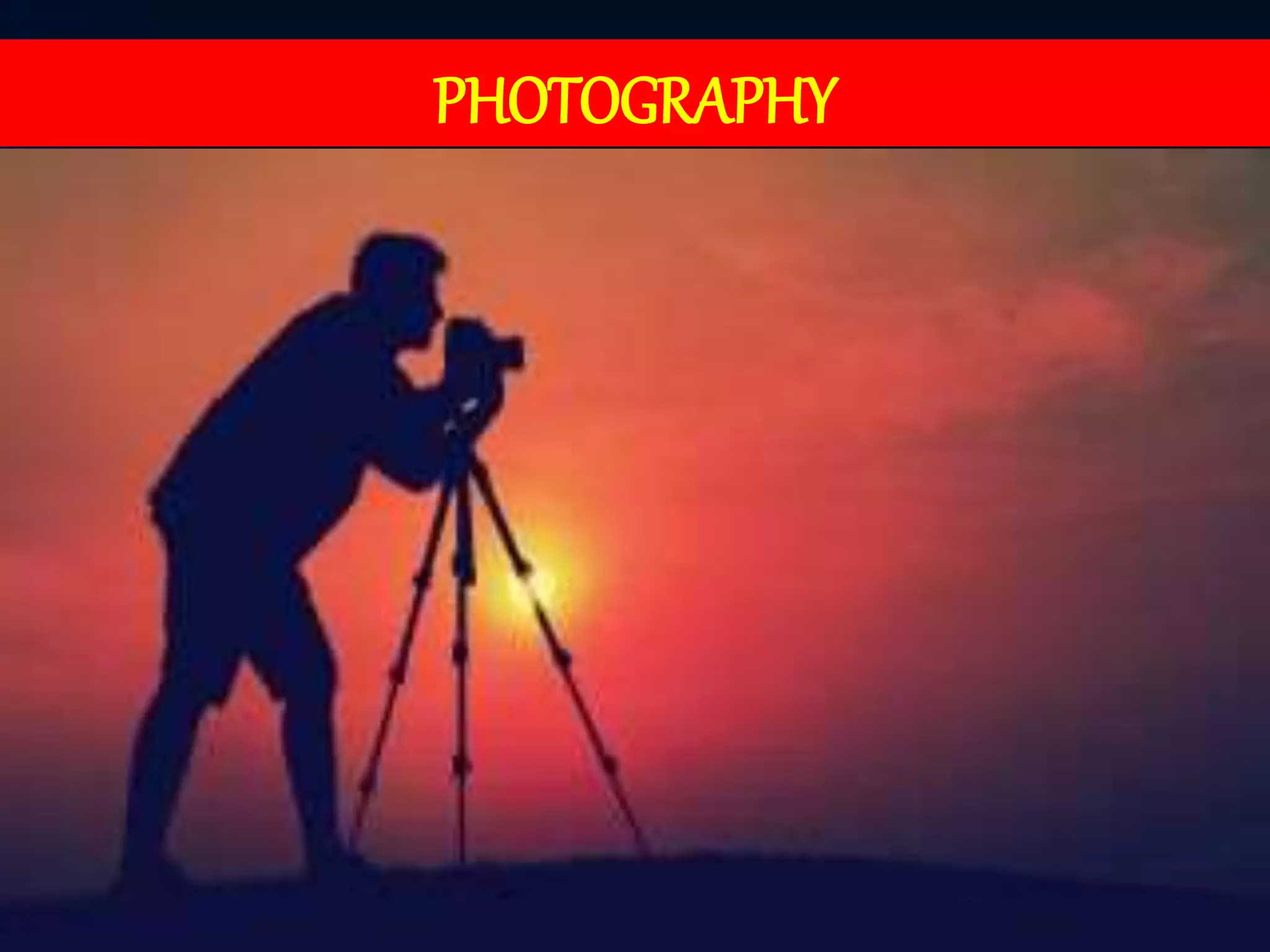
PHOTOGRAPHY
Photography is the science, art and
practice of creating durable
images by recording light or other
electromagnetic radiation, either
electronically by means of an image
sensor, or chemically by means of
a light-sensitive material such as
photographic film.
PHOTOGRAPHY
Photography is derived from the Greek
photos for “light” and –graphos for
“write”. It is the art , science, and
practice of reading durable images by
recording light or other electromagnetic
radiation, either chemically by means of
a light sensitive material such as
photographic film, or electronically by
means of an image sensor.
PHOTOGRAPHY….continue
• It is also called to as forensic imaging or
crime scene photography, is the art of
producing an accurate reproduction of a
crime scene or an accident scene using
photography for the benefit of a court or to
aid in an investigation.
• It is part of the process of evidence
collecting
• It provides investigators with photos of
victims, places and items involved in the crime
• Involves choosing correct lighting, accurate
angling of lenses, and a collection of different
viewpoints
FORENSIC PHOTOGRAPHY
FORENSIC PHOTOGRAPHY..
continue
Why To take photos
Still photography is one of four
accepted principal means of providing
courtroom with visual evidence of
what took place or existed at crime
scene
Photos complement and support one
another in the preservation of
evidence
 Assist in mental reconstruction of
the structure
 Clarify and aid interviews
 Identify witnesses
 prove suspects presence at scene
 Documentation of pre-fire condition
of structure
 Prove in court case, are used by
investigators, prosecutor, defence
attorneys, witnesses and other
Why To take photos… continue
History
 When a photograph of a forged
document was presented and allowed
as courtroom evidence in 1851
 The first use of forensic photography
was in the nineteenth century by
Alphonse Bertillon. This makes him the
first forensic photographer
 Photographing Criminals and
Suspects was widespread until the
latter part of the 19th century
The process of having one’s picture
taken and archived was limited as like
the number of photographer
 As the number of criminals climbed,
so did the number of photographs
The earliest evidence of these galleries
(called, “Rogues Galleries”) was found
in Birmingham, England in the 1850s
 Shortly after this were initial
attempts at standardizing the
photographs
History … continue
Photography
Instruments Medium
MAIN REQUIREMENTS OF
photography
The camera no matter which type,
is used to co11ect the reflected light
images and record them on 1ight-
sensitive film. The camera must be
Lightproof except for the controlled
light that is allowed to strike the
light sensitive surface (film plane)
of the film. The light enters the
camera through an opening and
collects the reflected light images to
be recorded in focus on the film..
Camera
Different type of camera
Press camera
Snapshot, 110 format cameras
Snapshot, 35mm format cameras
Twin-lens reflex
Single lens reflex, 35mm
Press camera
A press camera is a medium or large
format view camera that was
predominantly used by press
photographers in the early to mid-20th
century. It was largely replaced for press
photography by 35mm film cameras in
the 1960s, and subsequently, by digital
cameras. The quintessential press camera
was the Speed Graphic. Press cameras are
still used as portable and rugged view
cameras.
Press camera
Snapshot, 110 format cameras
 For the unrelated roll-film format
produced from 1898 to 1929
 110 is a cartridge-based film
format used in still photography. It
was introduced by Kodak in 1972.
110 is essentially a miniaturised
version of Kodak's earlier 126 film
format. Each frame is 13 mm × 17
mm (0.51 in × 0.67 in), with one
registration hole
Snapshot, 110 format cameras
Snapshot, 35mm format cameras
The 35 mm format, or simply
35 mm, is the common name
for the 36×24 mm film format
or image sensor format used in
photography. It has an aspect
ratio of 3:2, and a diagonal
measurement of approximately
43 mm.
Snapshot, 110 format cameras
Twin-lens reflex
A twin-lens reflex camera (TLR) is
a type of camera with two objective
lenses of the same focal length. One
of the lenses is the photographic
objective or "taking lens" (the lens
that takes the picture), while the
other is used for the viewfinder
system, which is usually viewed
from above at waist level.
Twin-lens reflex
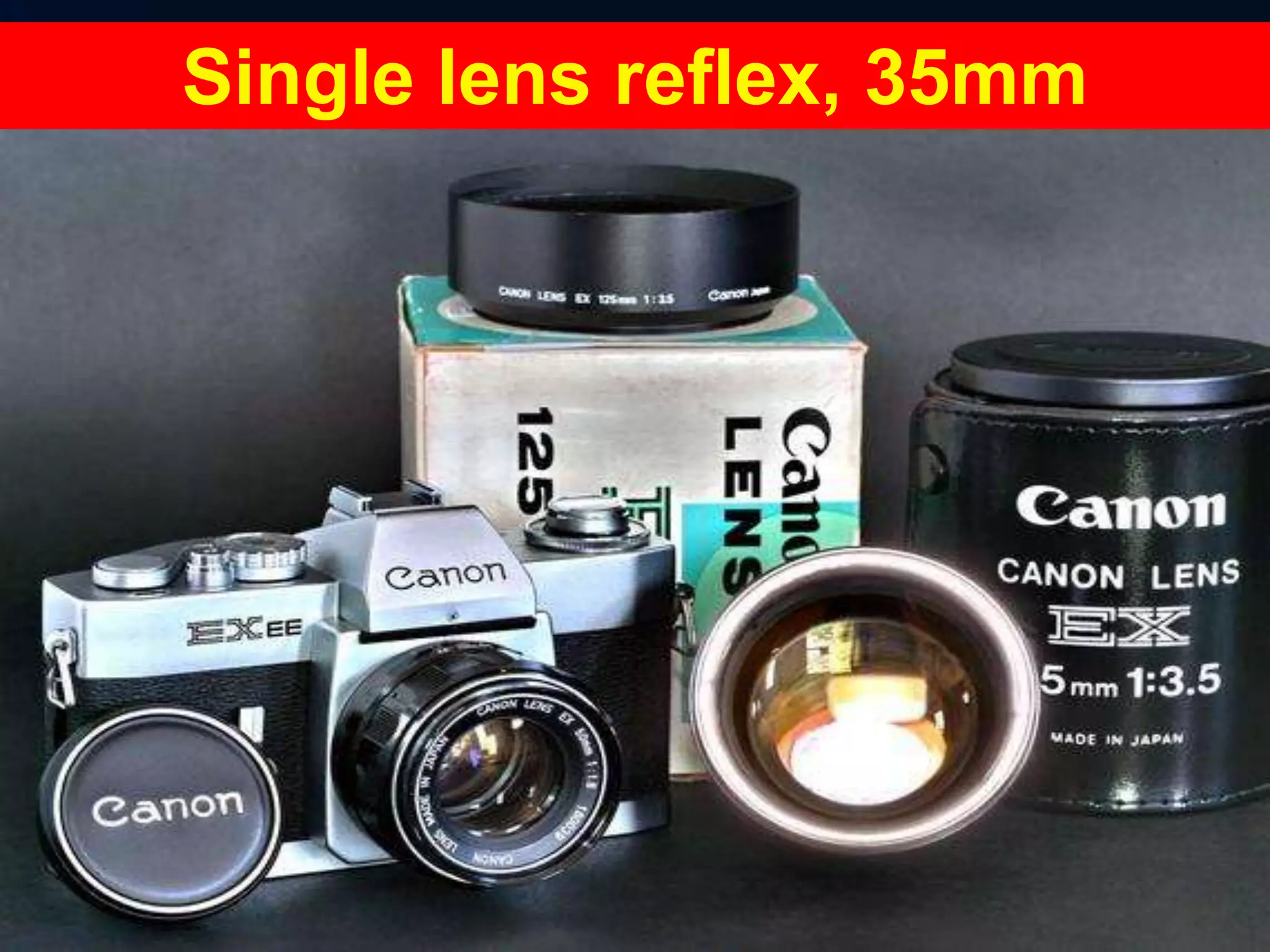
Single lens reflex, 35mm
A single-lens reflex camera (SLR) is a
camera that typically uses a mirror and
prism system (hence "reflex" from the
mirror's reflection) that permits the
photographer to view through the lens
and see exactly what will be captured.
When the shutter button is pressed on
most SLRs, the mirror flips out of the
light path, allowing light to pass through
to the light receptor and the image to be
captured.
Single lens reflex, 35mm
Lens
The lens is made up of several
individual lenses which in essence
from a compound lens. Located
between the front and rear lenses
is the aperture opening. adjusting
the aperture controls the amount
of light entering the camera to be
recorded the film.
The aperture setting
(lens opening) is
referred to as f-stop
or f-number. This f-
number is calibrated
to the size of the lens
opening, f-2 is the
largest opening and
f-22 is the smallest
opening one stop.
Lens… continue
Primary lens categories and their
focal lengths.
Lens Type
Focal
Length Best Use
Wide Angle
28mm or
lower
Landscapes
and interiors
Standard 35-85 mm Portraits
Telephoto
100mm-
300mm
Portraits and
sports
Super-
Telephoto
300 mm or
higher
wildlife and
sports
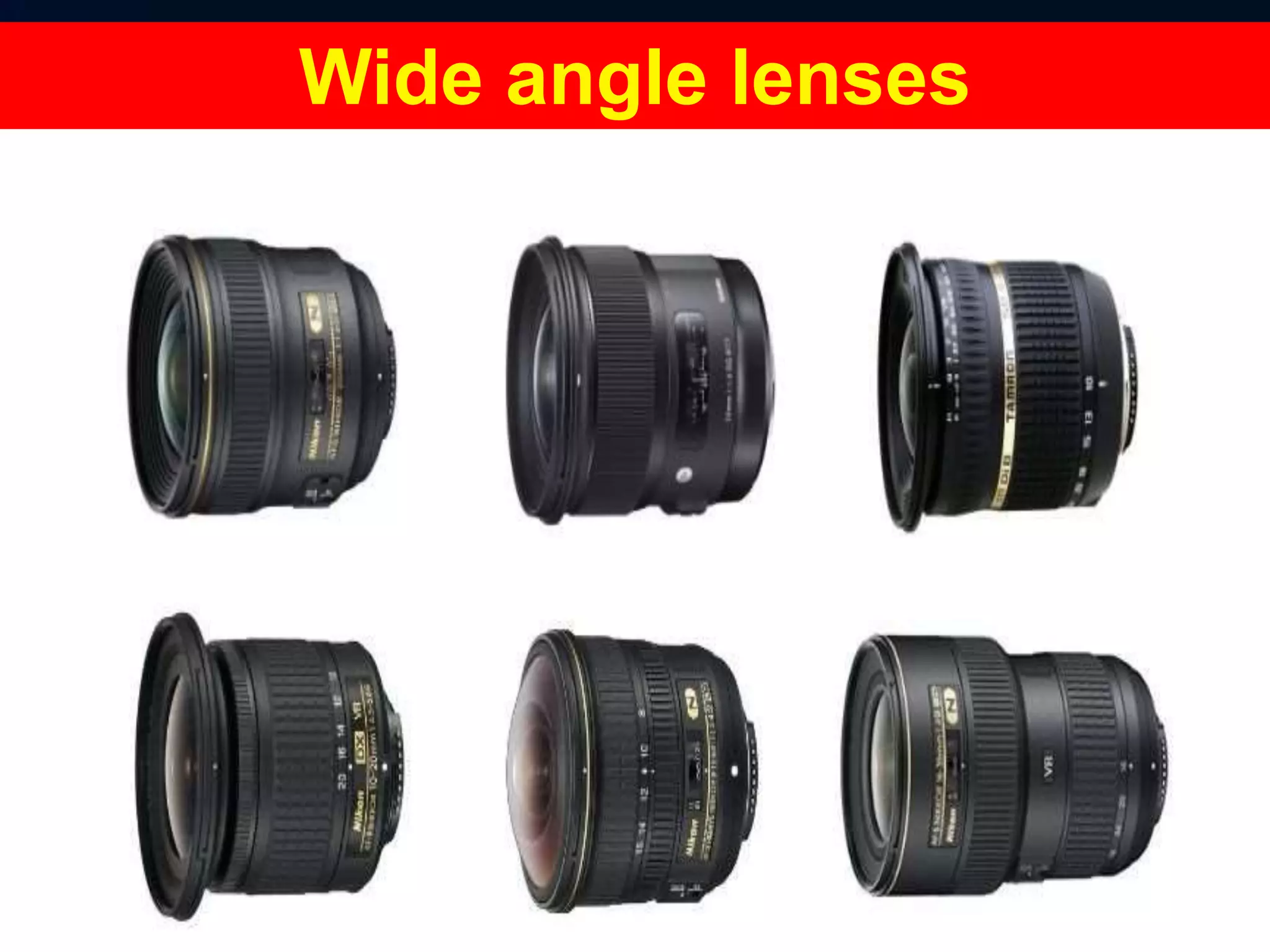
 Wide Angle Lenses are ideal
for landscape photographers
that want to capture all the
scenery in front of them. These
lenses can capture virtually
everything that your eyes see in
front of you from the ground at
your feet to the mountains and
in the distance
Wide angle lenses
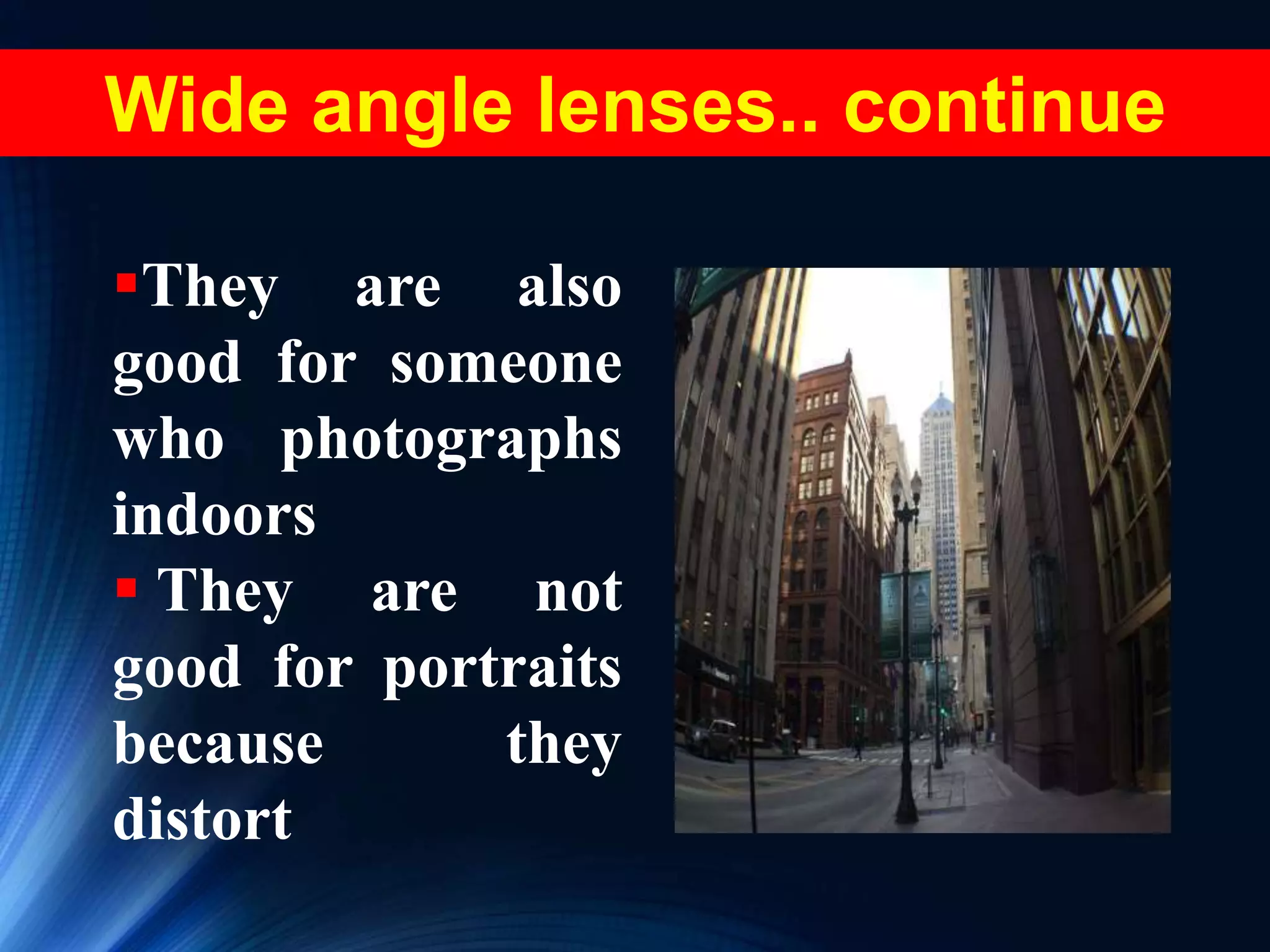
They are also
good for someone
who photographs
indoors
 They are not
good for portraits
because they
distort
Wide angle lenses.. continue
Wide angle lenses
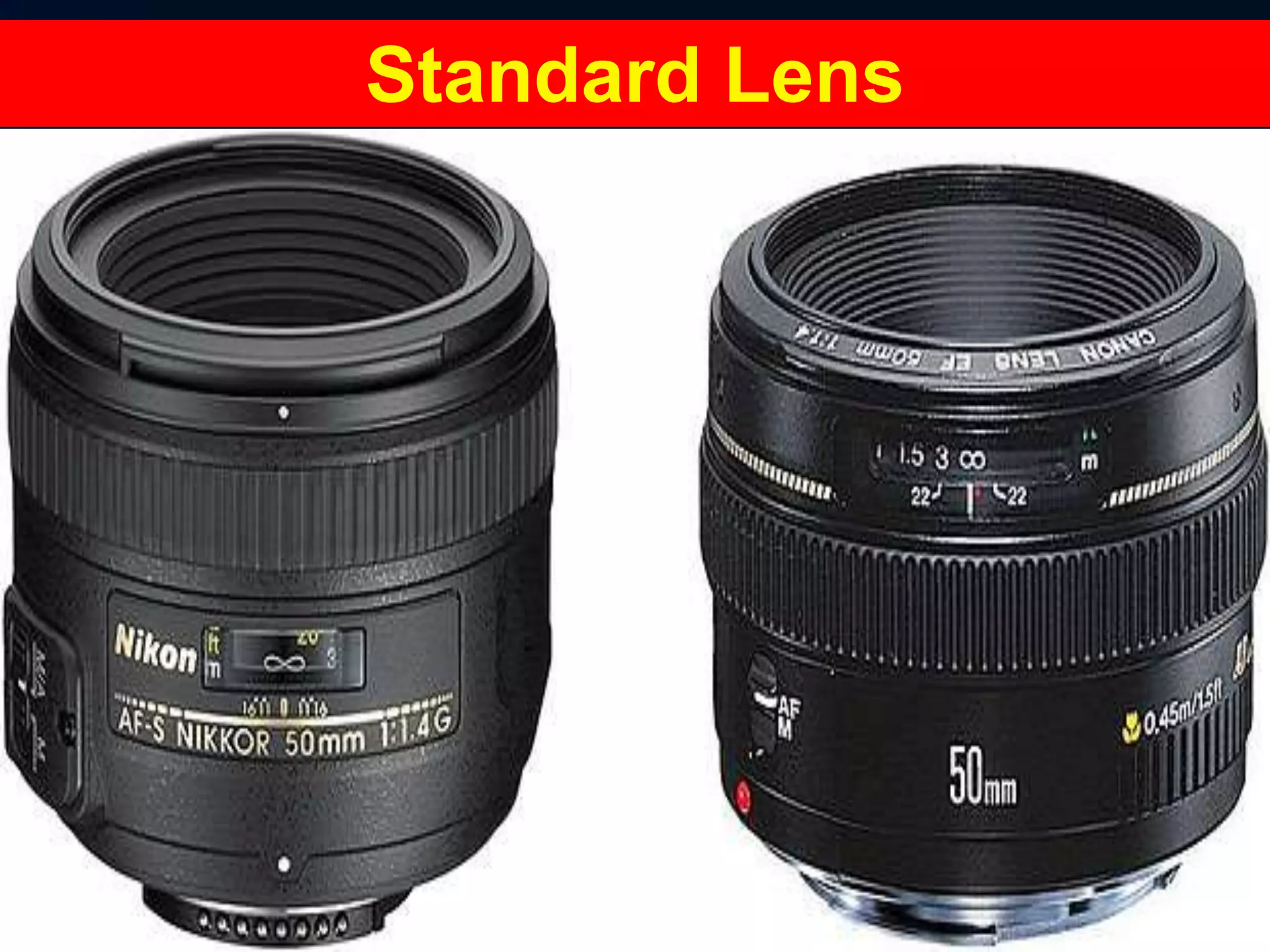
Good for a wide range of
photographic needs but excel at
portraits
 Lenses in the 50 mm to 75 mm
range create natural looking
portraits without facial
distortions
Standard Lens
Standard Lens
Work well with portraits but
also cause some distortion, the
longer the focal length of the
lens, the more it compresses the
visual space. Can’t tell the
distance between objects.
Good at getting close up views
of objects that are far away.
Good for sports and wildlife.
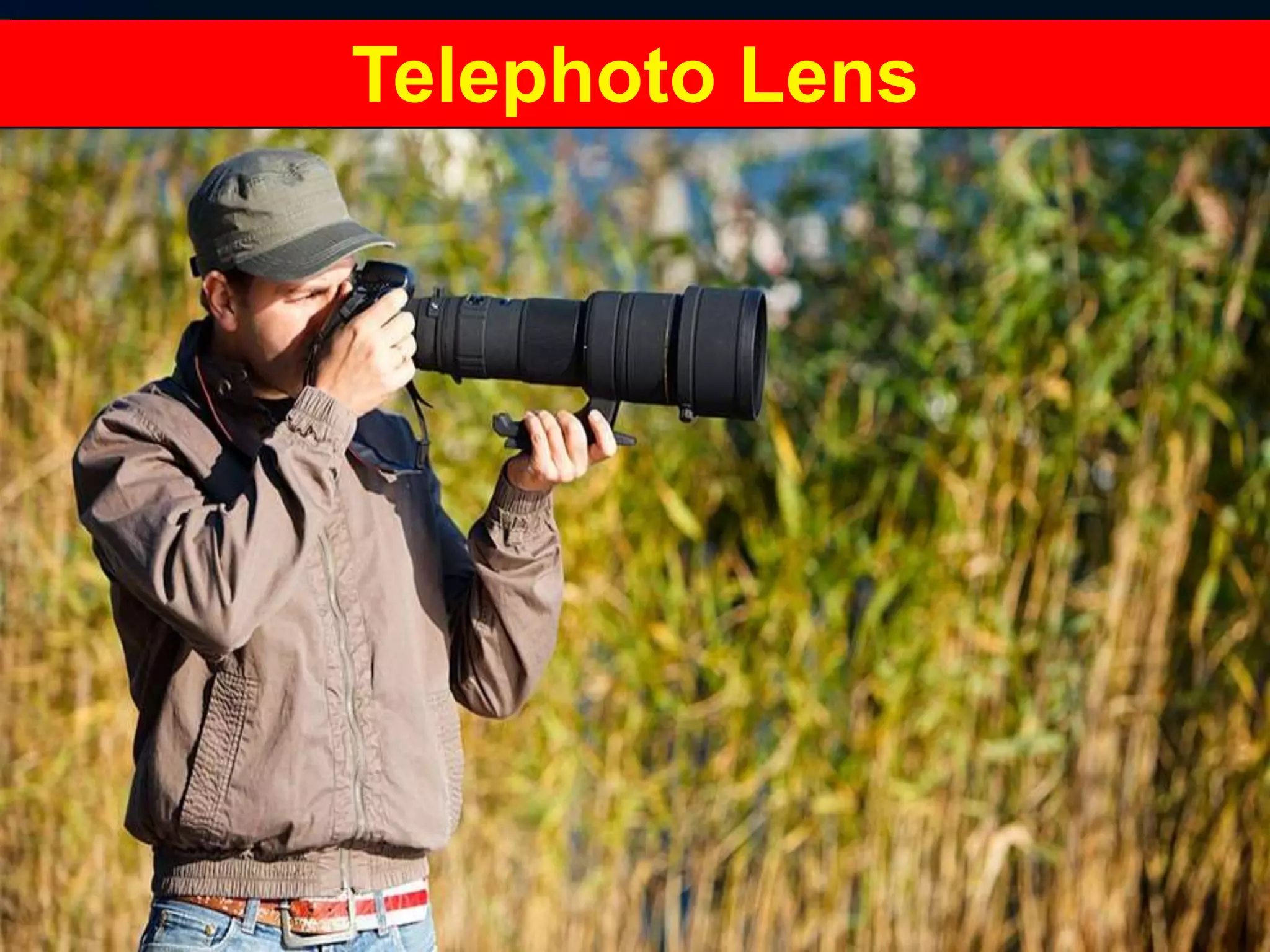
Telephoto Lens
Telephoto Lens
 Exclusively the domain of
professional photographers.
These lenses are very
expensive.
They are used by wildlife
photographers where getting
close up to the subject is not
possible.
Also used for professional
sporting events.
Super Telephoto Lens
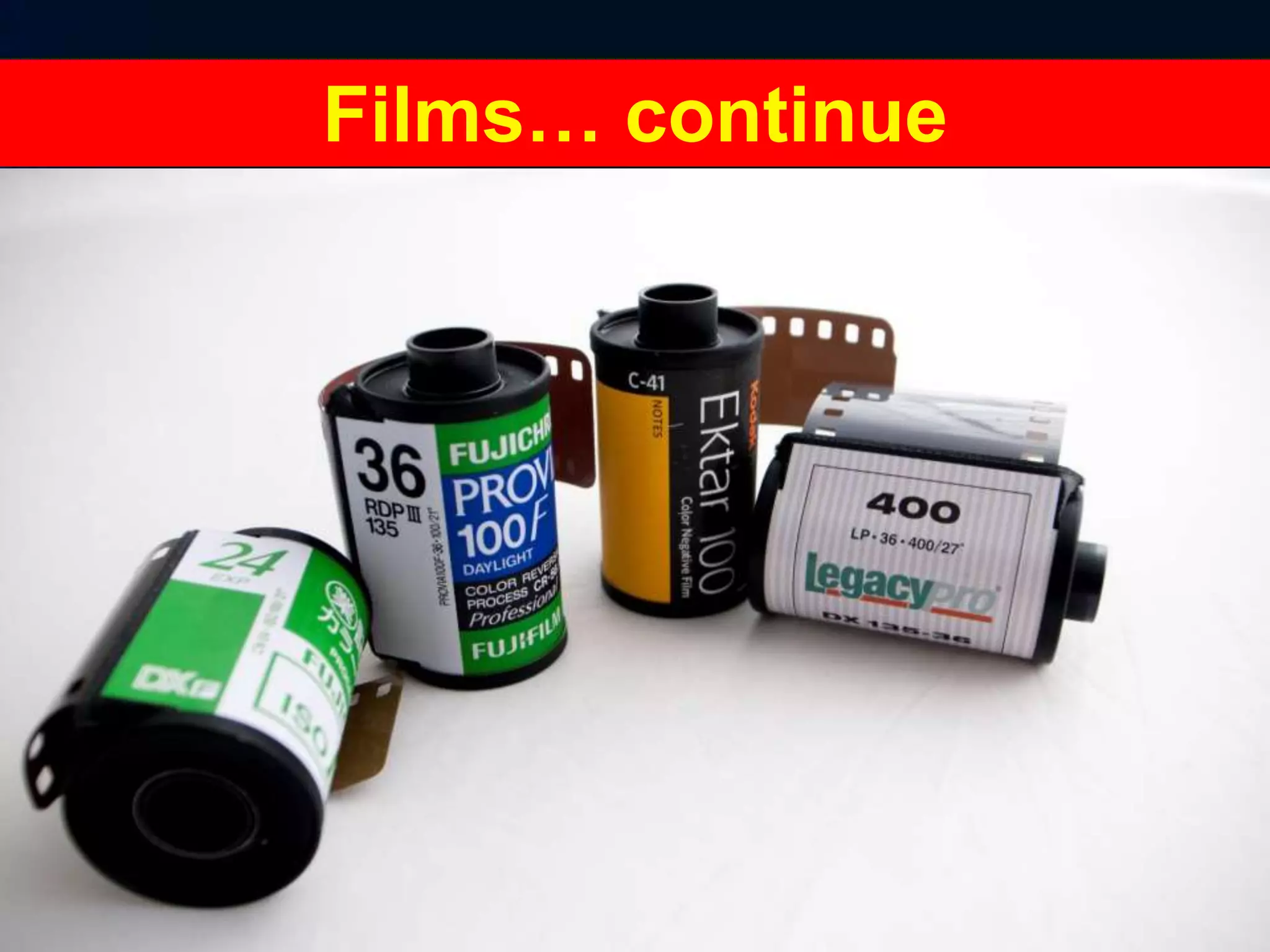
Films
 To complete a photographic
documentation, we need a light-
sensitive medium called films to
record our “writing with light”
 Film is produced in many
ranges and varieties for a
multitude of uses. The variety of
films, their speeds.
 The film speed is a measure of
its sensitivity to light
 Film was rated by a
standardize number, its (ASA)
and (DIN)
The faster the film, the
heigher the ASA /DIN.
 In 1979 , these rating were
replaced by the international
standard organization (ISO)
number
Films… continue
Films… continue
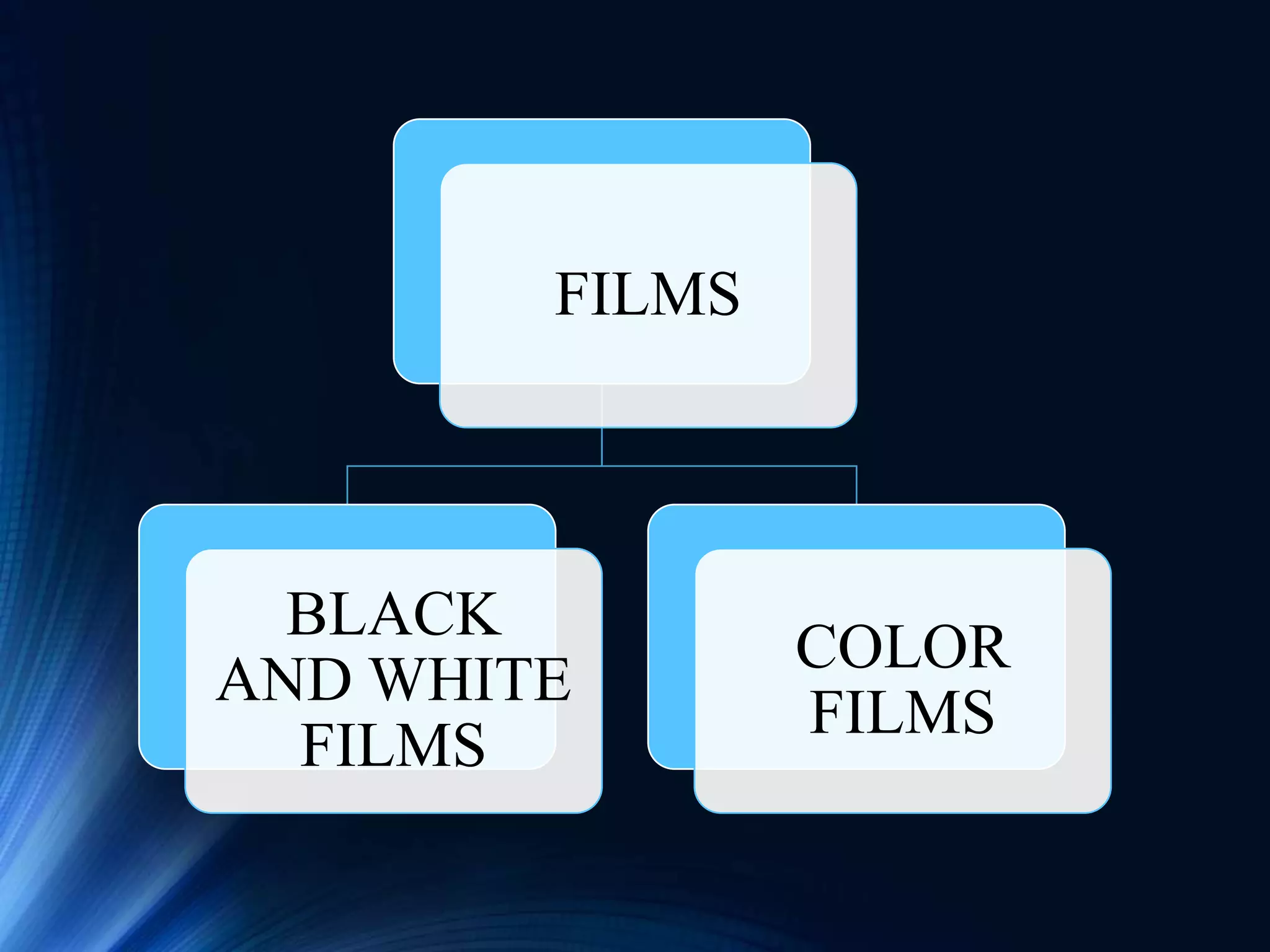
FILMS
BLACK
AND WHITE
FILMS
COLOR
FILMS
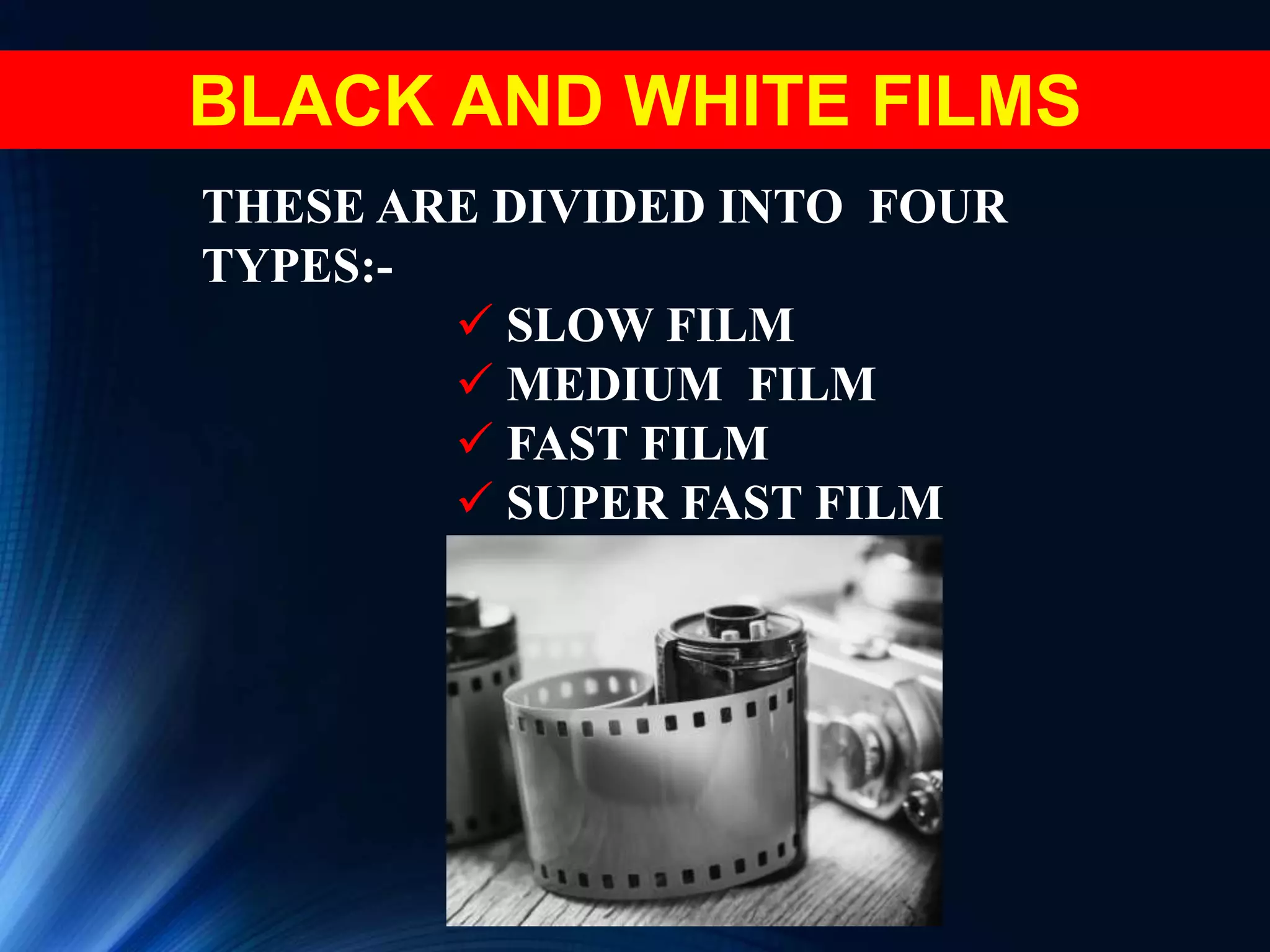
BLACK AND WHITE FILMS
THESE ARE DIVIDED INTO FOUR
TYPES:-
 SLOW FILM
 MEDIUM FILM
 FAST FILM
 SUPER FAST FILM
COLOR FILMS
THESE ARE DIVIDED INTO 2 TYPES :-
 COLOR NAGATIVE
 COLOR REVERSAL ( SLIDE FILM)
electronic flash
An electronic flash, also known as a
strobe, is a convenient source of
very bright artificial light that can
be attached to, or even built into, a
camera. In conventional cameras
and mainstream photography, the
electronic flash is based on a xenon
gas-filled glass tube, which emits a
very brief but very bright flash of
light when a high voltage is passed
through it.
electronic flash
Tripod
A tripod is a portable three-legged
frame or stand, used as a platform for
supporting the weight and maintaining
the stability of some other object. A
tripod provides stability against
downward forces and horizontal forces
and movements about horizontal axes.
The positioning of the three legs away
from the vertical centre allows the
tripod better leverage for resisting
lateral forces.
Tripod
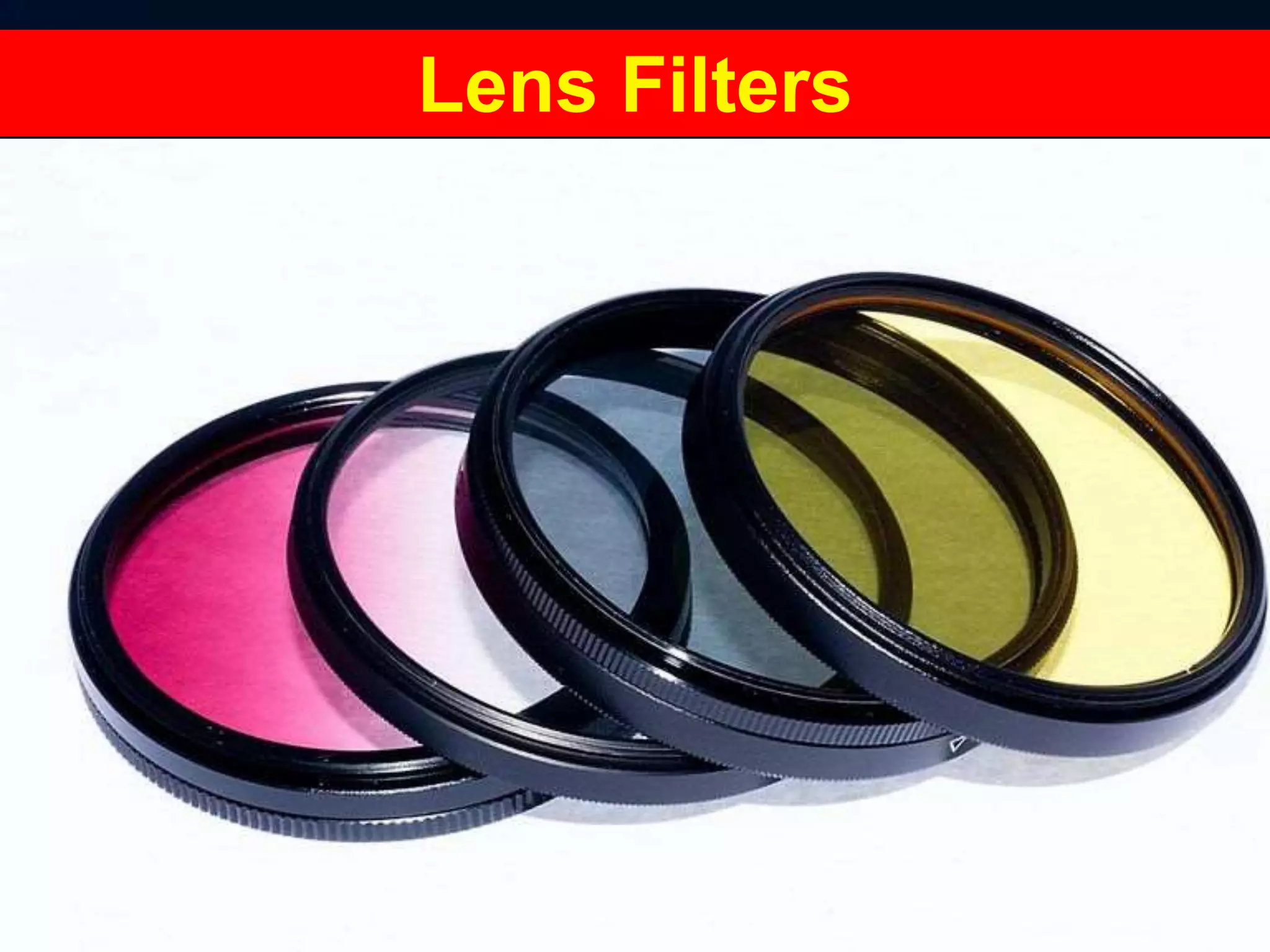
Lens Filters
 Can enhance colours, add special
effects and reduce reflections
Can protect lenses for capturing
scenery in extremely difficult lighting
conditions
Are often necessary to modify the
light before it enters the lens
At the same time, lens filters can
actually hurt photographs if they are
not properly used
Lens Filters
filters generally come in two
varieties:
1.Front filters :– (more flexible)
It can be used on virtually any lens
diameter; may also be more inefficient
to use since they may need to be held
in front of the lens. On the other hand,
filter holder kits are available that can
improve this process.
Front filters
2. Screw-on filters –
 It can provide an airtight seal
when needed for protection, and
cannot accidentally move relative to
the lens during composure.
Disadvantage: a given screw-on
filter will only work with a specific
lens size
 Expressed in terms of its
diameter, which corresponds to the
diameter usually listed on the top or
front of your camera lens
Listed in
millimetres
and usually
ranges
from about
46 to 82
mm for
digital SLR
cameras
Screw-on filters..continue
Types
1. Circular screw-on filters
• Most common
• Mounts directly on the lens filter
thread
• E.G. UV/clear/haze filters, circular
polarisers, neutral density and
colour filters
2. Square filters
• A popular choice for landscape and
other photography
• A filter holder directly attaches to the
lens filter thread and can hold one or
more filters
• The most popular sizes are 3×3 and
4×4
• Can be stacked together in certain
situations, which can negatively impact
image quality and add reflections
3. Rectangular filters
• Another popular choice, primarily
among landscape photographers
• Mounted just like square filters via a
filter holder system
• Unlike square filters, they have more
room to move up and down
• The most popular size is 4×6, although
larger and smaller filter sizes are also
available
4. Drop-in filters
• These filters are used inside long
telephoto lenses, due to the large size
of the front lens element
• Only clear and polarizing filters are
used for drop-in filters
• Filters change the dynamics of the
light entering the lens and usually
require you to alter your exposure
to compensate for this fact which is
called filter factor.
• Each filter has a specific filter
factor.
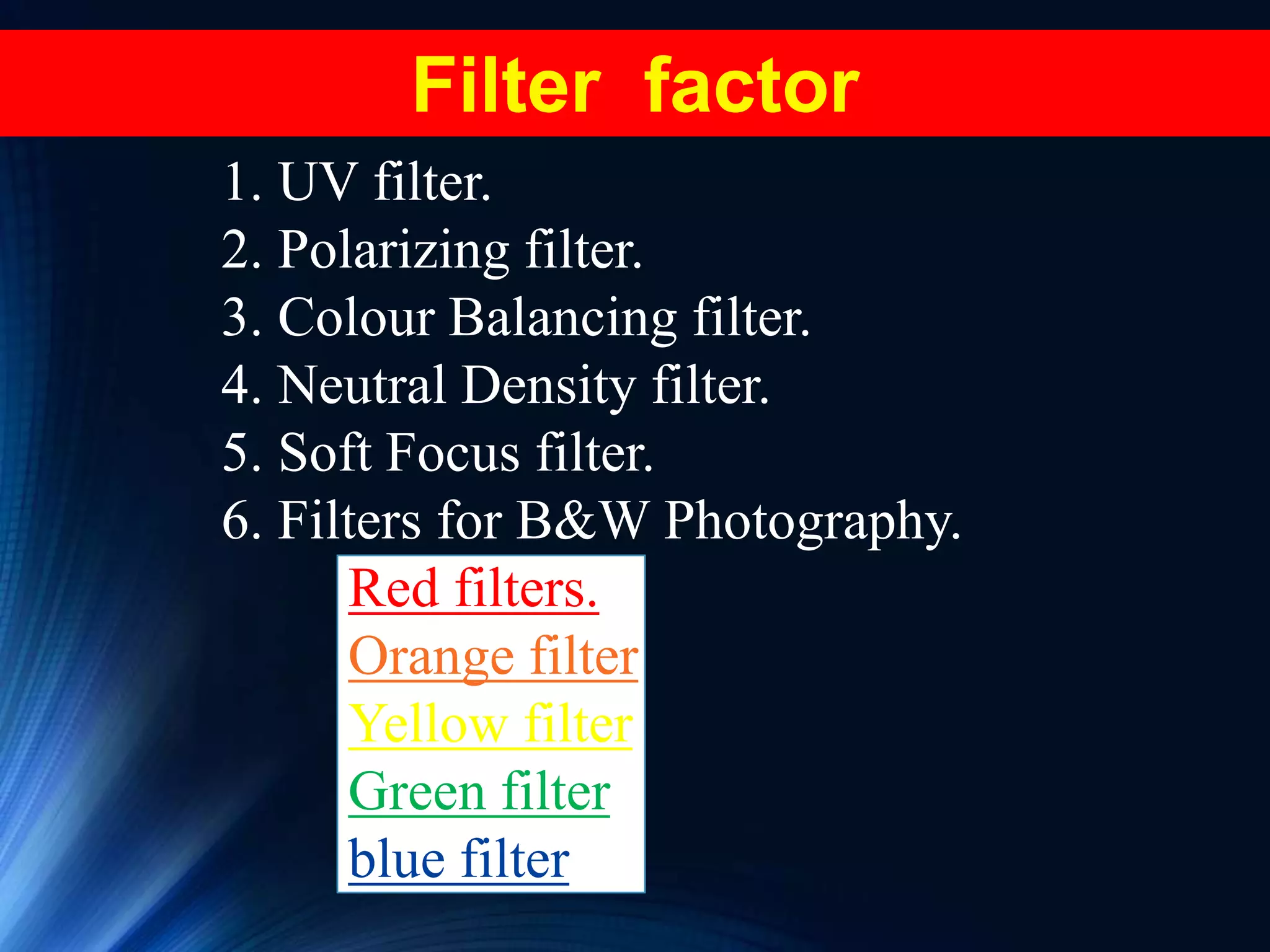
Filter Factor
1. UV filter.
2. Polarizing filter.
3. Colour Balancing filter.
4. Neutral Density filter.
5. Soft Focus filter.
6. Filters for B&W Photography.
Red filters.
Orange filter
Yellow filter
Green filter
blue filter
Filter factor
Filter factor
Shutter
Another, equally important, part of the
camera for the control of light entering is
the shutter. The purpose of the shutter is to
control the amount of time the light is
allowed to focus on the film. the shutter is
generally activated by depressing a shutter
release button. again, like the aperture/f-
stop setting, the speed of the shutter may be
fixed or adjustable. usually the less
expensive instamatic and instant print
camera have shutter speed preset by the
manufacture.
Shutter
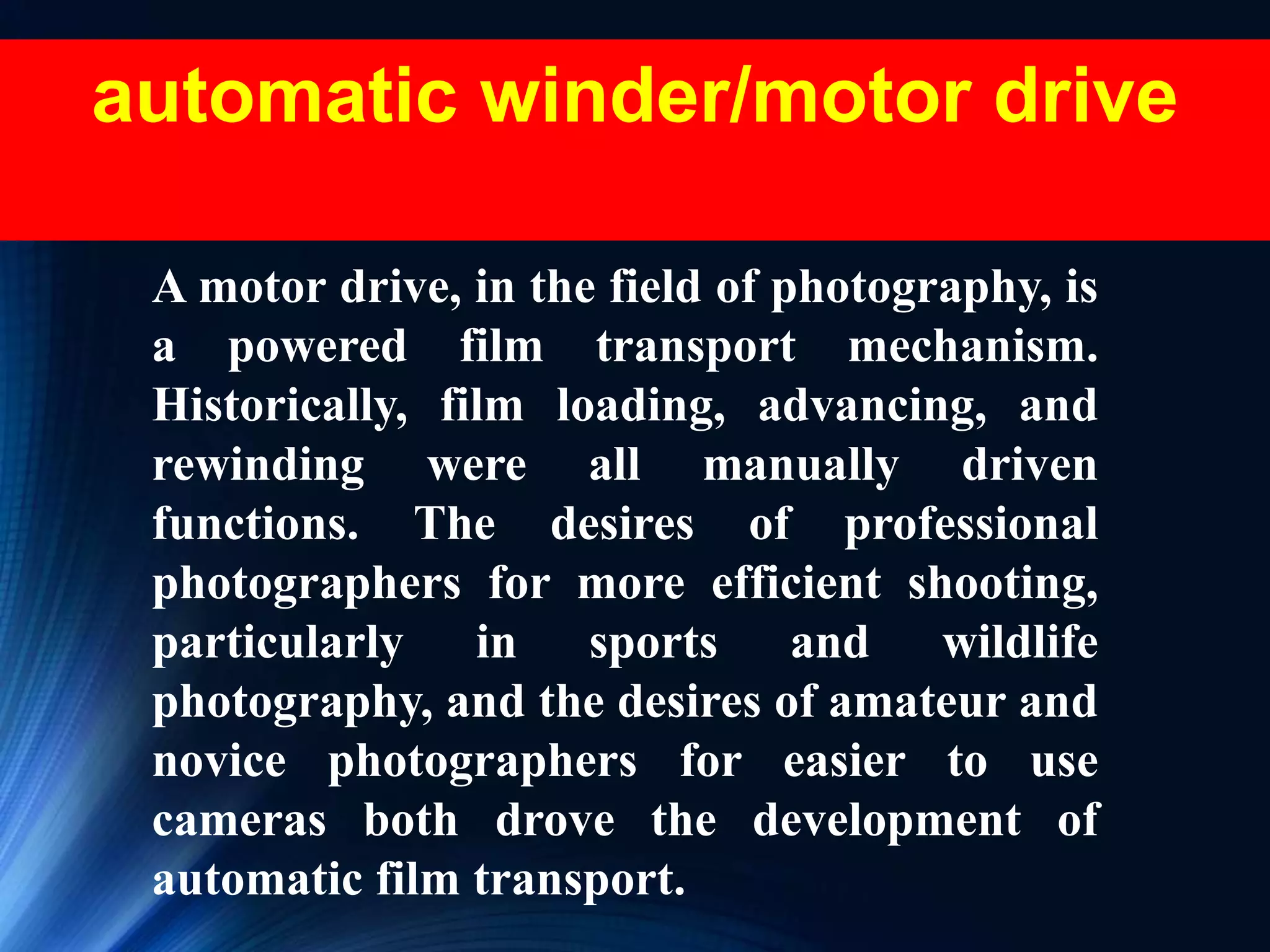
automatic winder/motor drive
A motor drive, in the field of photography, is
a powered film transport mechanism.
Historically, film loading, advancing, and
rewinding were all manually driven
functions. The desires of professional
photographers for more efficient shooting,
particularly in sports and wildlife
photography, and the desires of amateur and
novice photographers for easier to use
cameras both drove the development of
automatic film transport.
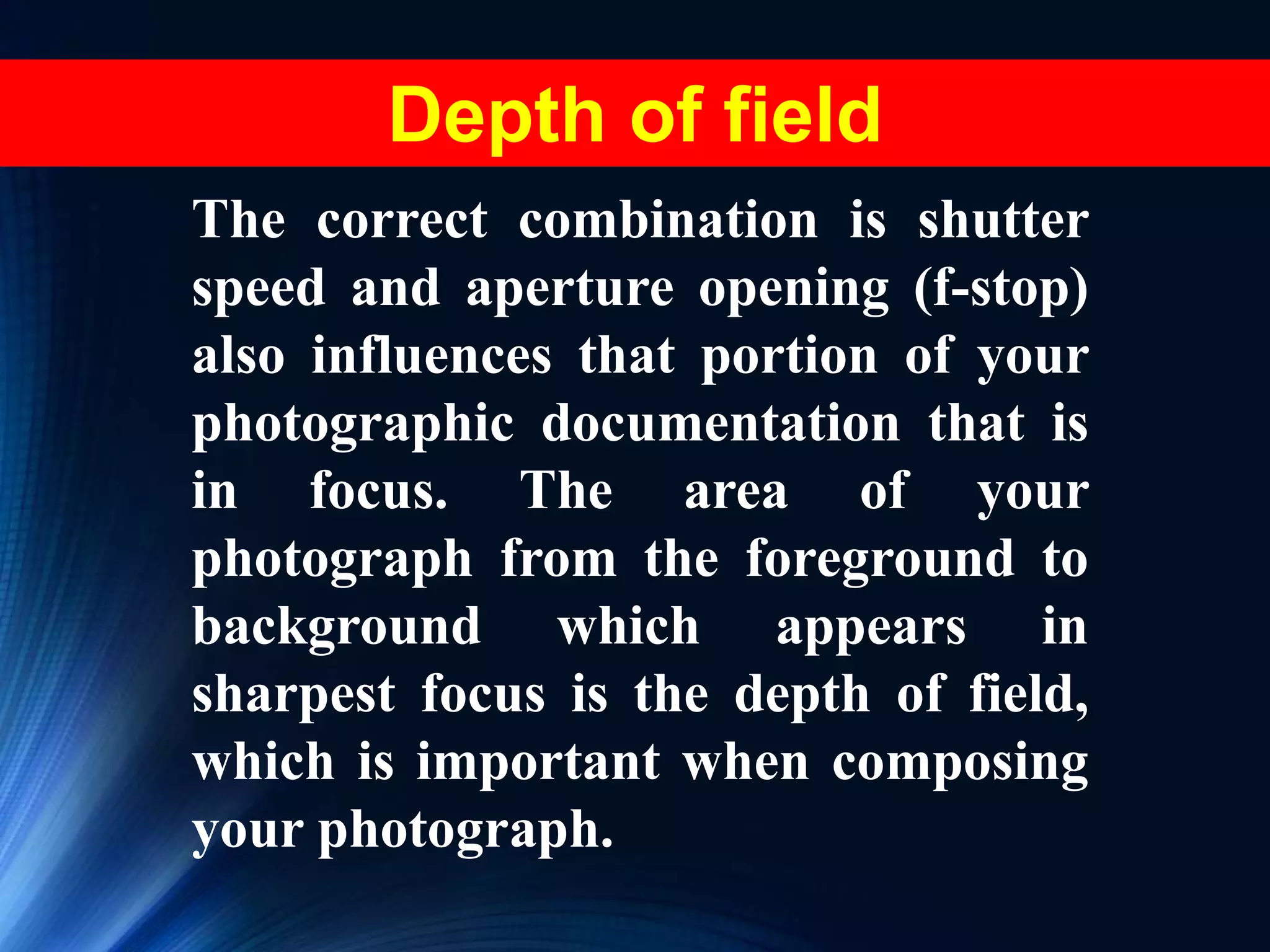
The correct combination is shutter
speed and aperture opening (f-stop)
also influences that portion of your
photographic documentation that is
in focus. The area of your
photograph from the foreground to
background which appears in
sharpest focus is the depth of field,
which is important when composing
your photograph.
Depth of field
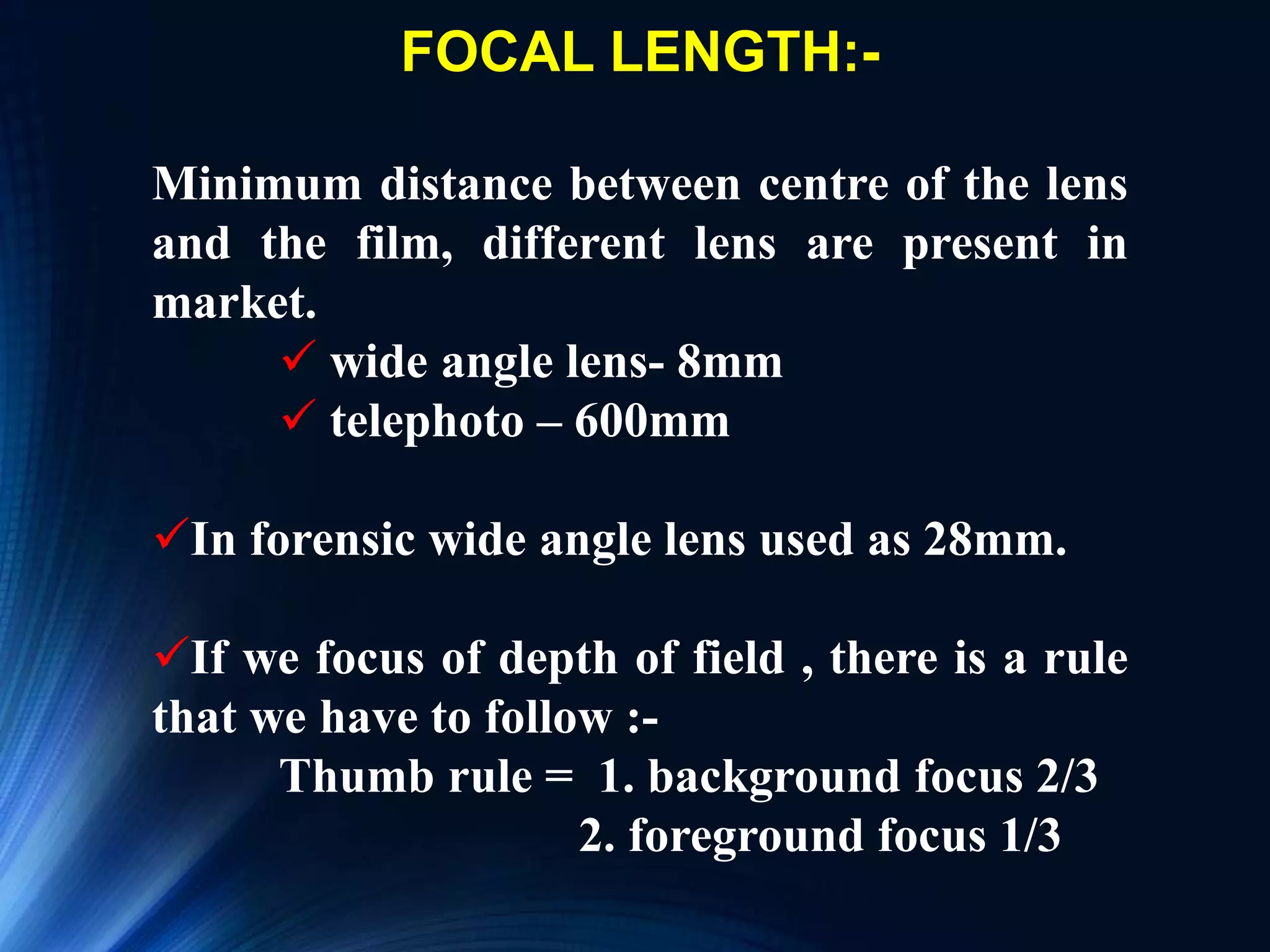
FOCAL LENGTH:-
Minimum distance between centre of the lens
and the film, different lens are present in
market.
 wide angle lens- 8mm
 telephoto – 600mm
In forensic wide angle lens used as 28mm.
If we focus of depth of field , there is a rule
that we have to follow :-
Thumb rule = 1. background focus 2/3
2. foreground focus 1/3
We want maximum depth of field
that’s depends on three factors
which are :-
 shorter focal length lens.
 smaller aperture opening (f-
stop).
 greater distance to the point of
focus.
FOCAL LENGTH … continue
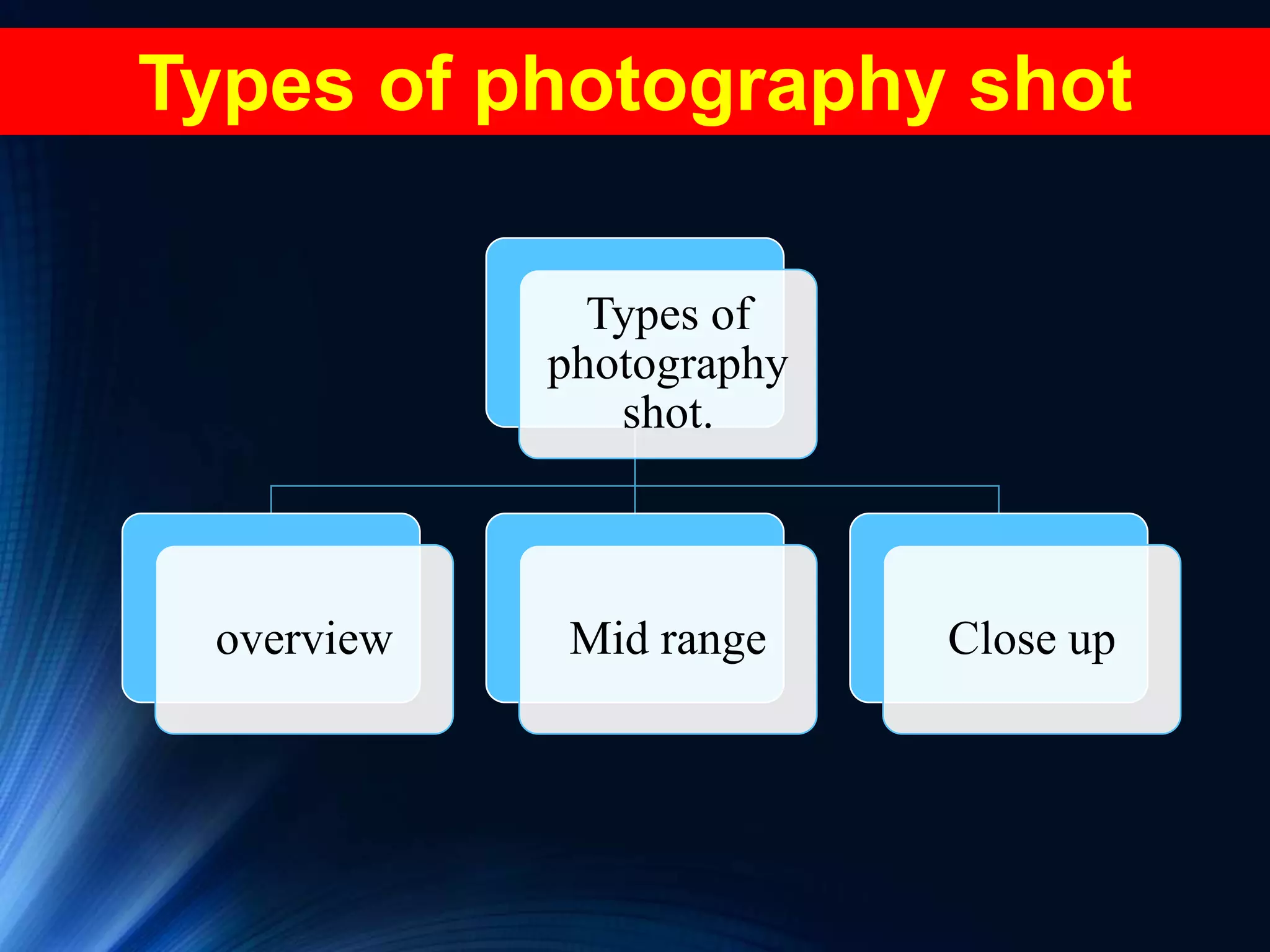
Types of
photography
shot.
overview Mid range Close up
Types of photography shot
Types of photography shot..
continue
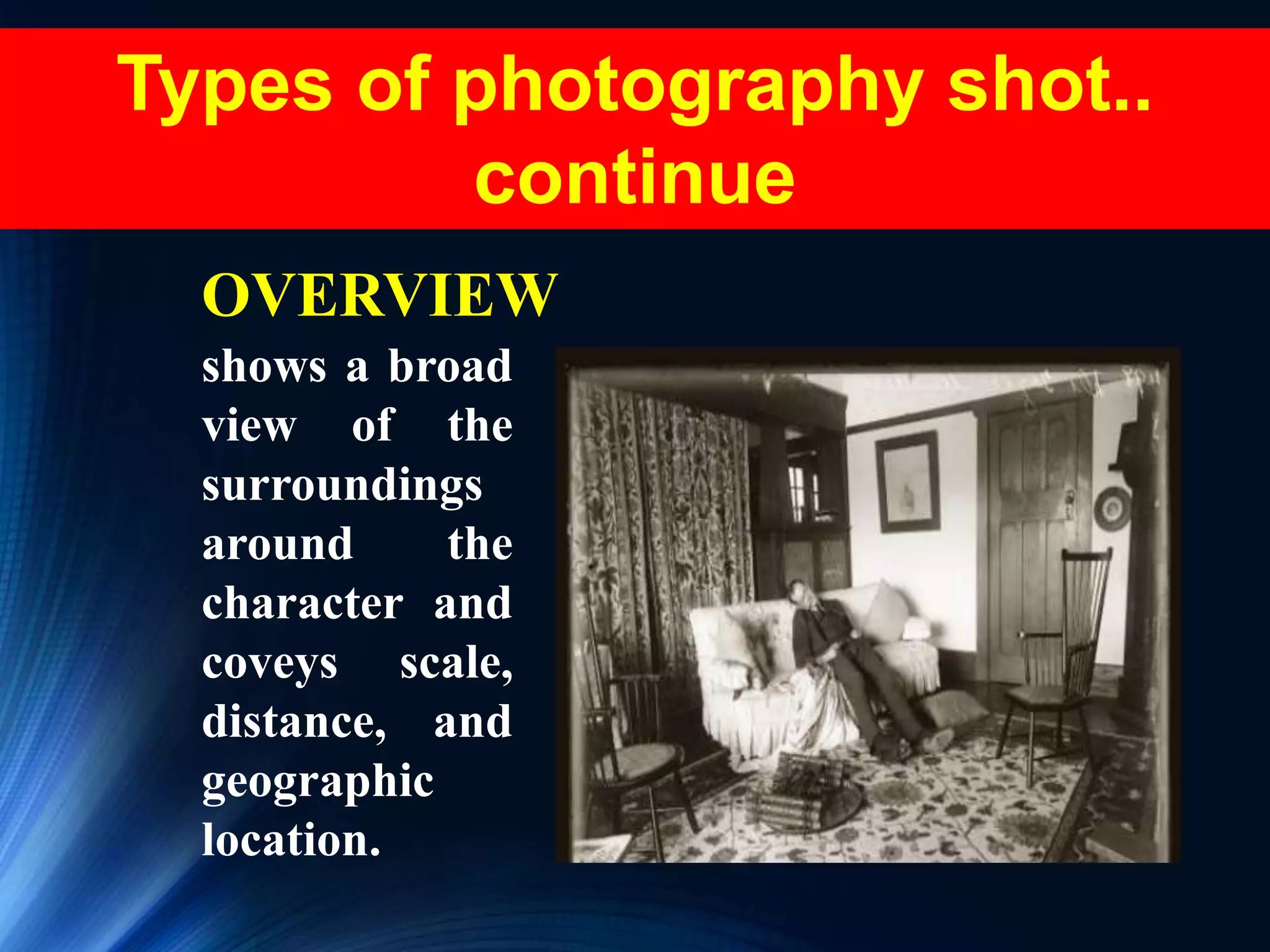
OVERVIEW
shows a broad
view of the
surroundings
around the
character and
coveys scale,
distance, and
geographic
location.
Types of photography shot..
continue
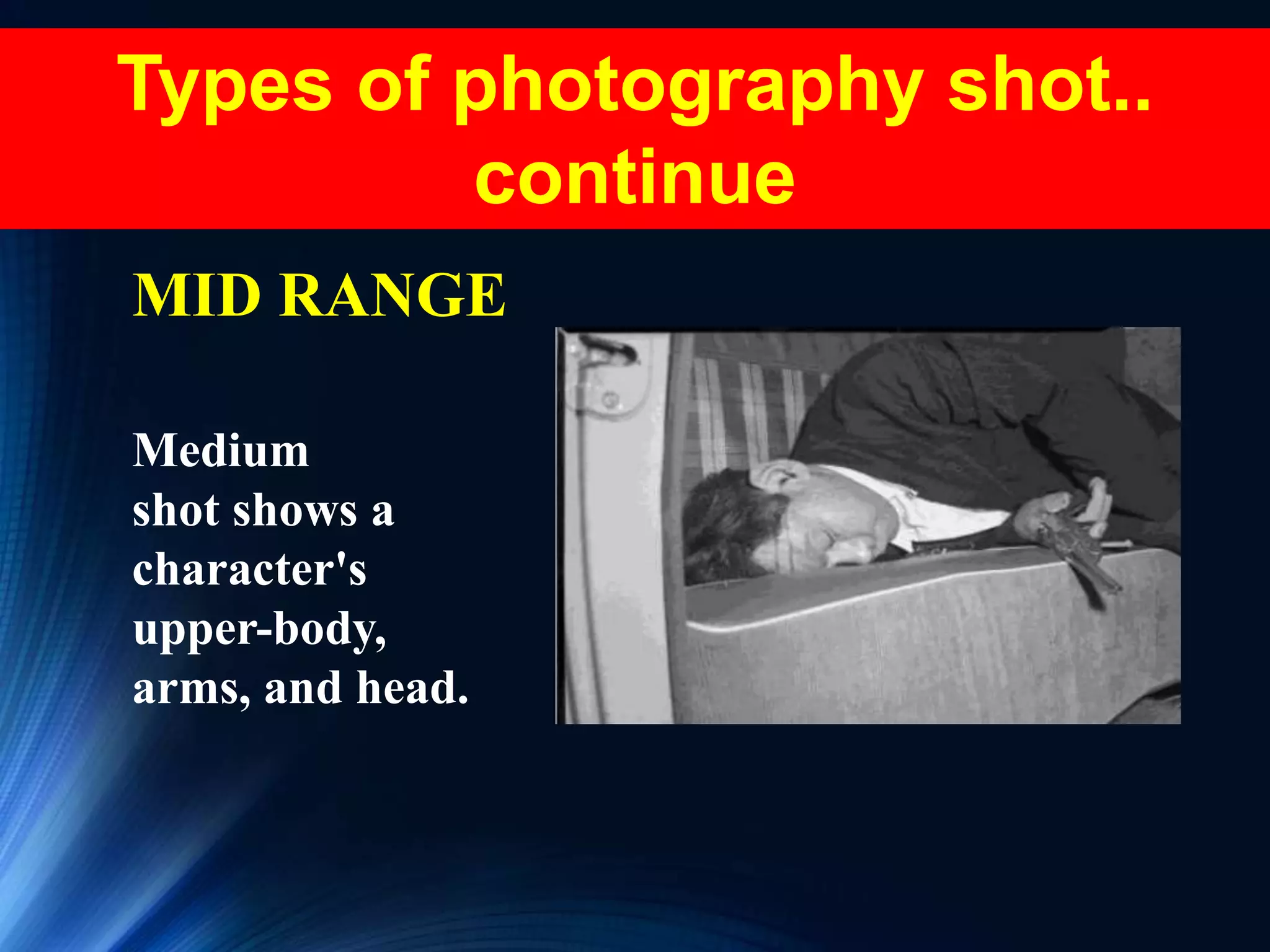
MID RANGE
Medium
shot shows a
character's
upper-body,
arms, and head.
Types of photography shot..
continue
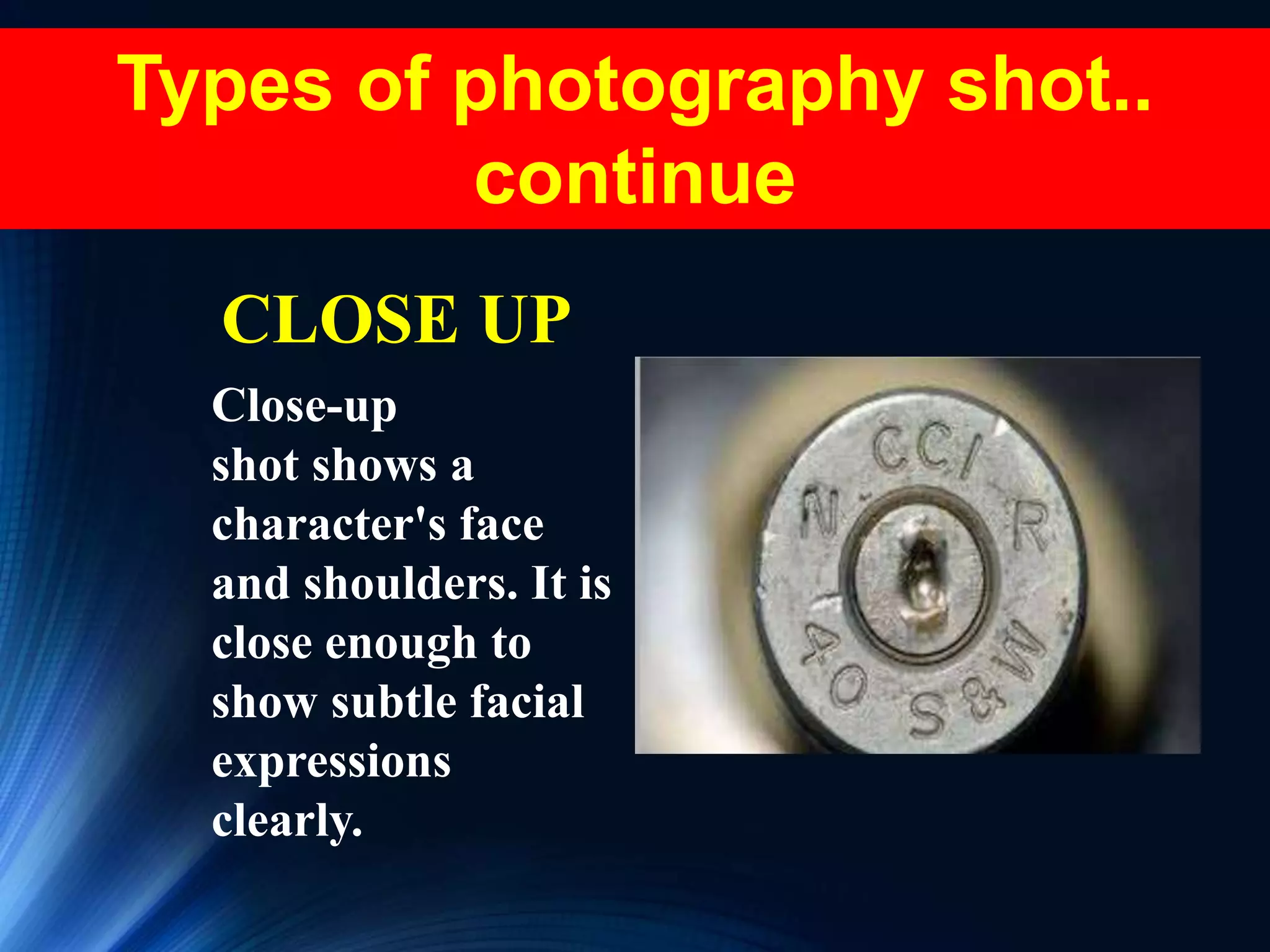
CLOSE UP
Close-up
shot shows a
character's face
and shoulders. It is
close enough to
show subtle facial
expressions
clearly.
Aerial photography (or airborne
imagery) is the taking of photographs
from an aircraft or other flying
object. Platforms for aerial
photography include fixed-wing
aircraft, helicopters, unmanned
aerial vehicles (UAVs or "drones"),
balloons, blimps and dirigibles,
rockets, pigeons, kites, parachutes,
stand-alone telescoping and vehicle-
mounted poles.
Aerial photography
Aerial photography
Digital photography
Digital photography uses cameras
containing arrays of electronic photo
detectors to capture images focused
by a lens, as opposed to an exposure
on photographic film. The captured
images are digitized and stored as a
computer file ready for further
digital processing, viewing, electronic
publishing, or digital printing.
Digital photography
Use of technique and tool IN
FORENSICPHOTOGRAPHY
 Photographs taken at the scene of a
crime are the only permanent record
of the evidence found there
Crime or accident scene
photographers usually capture images
in colour but also in black and white
Crime scene photographers, then,
must be skilled in quickly identifying
key pieces of evidence, no matter how
small or seemingly unrelated to the
crime
 Photographs from the crime scene
can also be used in direct comparison
situations
When the scene is no longer intact,
the photographs must provide ample
information to help solve the crime
Need knowledge of criminal
investigation principles and
procedures
Use of technique and tool…
continue
Can be used to compare fingerprint and
shoeprints photographed
Colour pictures are generally preferred because
colour is an important aspect of the trace evidence
Various forces and different countries have
different policies in regards to 35 mm film or
digital photography
Conventional film photographs have a high
resolution used for closer examination
Pictures of the relative position of objects (as in
a Palimpsest) can establish a sequence of events at
a crime
Use of technique and tool…
continue
 Photographs also to provide a tangible image for the court
to better enable them to understand what happened
The use of several views taken from different angles helps to
minimize the problem of parallax
Context images show evidence in context, like how the
knife/Gun was on the spot
Close up images show fine detail of an artefact, such as a
bloody fingerprint on the knife.
Road traffic incident (RTI) photographs show the overall
layout at the scene taken from many different angles, with
close-ups of significant damage, or trace evidence.
Crime or accident scene photographs can often be re-
analyzed in cold cases.
Use of technique and tool…
continue
Close up images show fine detail of
an artefact, such as a bloody
fingerprint on the knife
Road traffic incident (RTI)
photographs show the overall layout
at the scene taken from many
different angles, with close-ups of
significant damage, or trace evidence
Crime or accident scene
photographs can often be re-analyzed
in cold cases
Use of technique and tool…
continue
Points of objection:-
 accuracy of colour
 alteration of negative prints
 computer generated
 enlargements
 errors in painting
 equipments
 inflammatory photographs
Lightning
 marking
Misleading
 optical illusion
 scale of reference
 sight perspective
 time frame
References:-
 DAVID R. RED SICKER (2007)THE PRACTICAL
METHODOLOGY OF FORENSIC PHOTOGRAPHY -
CRC PRESS, (WASHINTON D.C.) Edition second
https://en.wikipedia.org/wiki/Digital_photography
Retrieved on 13/10/2019
https://en.wikipedia.org/wiki/Aerial_photography
Retrieved on 13/10/2019
https://www.slideshare.net/rahul2800/various-filters-in-
photography-1 (Retrieved on 13/10/2019)
https://www.slideshare.net/hyoscyamus/lens-power-
point-presentation (Retrieved on 13/10/2019)
https://www.whatdigitalcamera.com/technology_gui
des/electronic-flash-work-60484(Retrieved on
13/10/2019)
https://en.wikipedia.org/wiki/Single-
lens_reflex_camera (Retrieved on 13/10/2019)
https://spexforensics.com/applications/photography
-using-an-alternate-light-source(Retrieved on
13/10/2019)
https://www.slideshare.net/dlamptey/forensic-
photography (Retrieved on 13/10/2019)
https://www.slideshare.net/ShaTarraNHarris/forens
ic-photography-77215040 (Retrieved on 13/10/2019)
References:-
https://www.slideshare.net/HasibN/crime-
scene-photography (Retrieved on 13/10/2019)
https://www.slideshare.net/MichaelSparks4/cri
me-scene-photography-portfolio-final-results-
48125827 (Retrieved on 13/10/2019)
http://www.forensicsciencesimplified.org/photo/
(Retrieved on 13/10/2019)
References:-
photography, forensic photography and its explanation

photography, forensic photography and its explanation

  • 1.
    SCHOOL OF APPLIEDSCIENCES DEPARTMENTOF Criminology & FORENSICSCIENCE SUBMITTEDBY- HemantVeerJain& Annanya saraf EnrolmentNo. : - Y19242508&Y19242505 M.SCFORENSICSCIENCE1ST SEM SUBMITTEDTO– Dr. NAVJOT KAUR KANWAL ASSISTANTPROFESSOR
  • 2.
    Contents :- PHOTOGRAPHY FORENSICPHOTOGRAPHY Why totake photos History Camera Press camera Snapshot, 110 format cameras Snapshot, 35mmformat cameras Twin-lens reflex Single lens reflex, 35mm Lens Shutter
  • 3.
     Depth offield Films electronic flash automatic winder/motor drive Tripod Lens Filters Aerial photography Digital photography Use of technique and tool Use of equipments Steps for taking proper crime scene photograph Points of objection
  • 4.
  • 5.
    Photography is thescience, art and practice of creating durable images by recording light or other electromagnetic radiation, either electronically by means of an image sensor, or chemically by means of a light-sensitive material such as photographic film. PHOTOGRAPHY
  • 6.
    Photography is derivedfrom the Greek photos for “light” and –graphos for “write”. It is the art , science, and practice of reading durable images by recording light or other electromagnetic radiation, either chemically by means of a light sensitive material such as photographic film, or electronically by means of an image sensor. PHOTOGRAPHY….continue
  • 7.
    • It isalso called to as forensic imaging or crime scene photography, is the art of producing an accurate reproduction of a crime scene or an accident scene using photography for the benefit of a court or to aid in an investigation. • It is part of the process of evidence collecting • It provides investigators with photos of victims, places and items involved in the crime • Involves choosing correct lighting, accurate angling of lenses, and a collection of different viewpoints FORENSIC PHOTOGRAPHY
  • 8.
  • 9.
    Why To takephotos Still photography is one of four accepted principal means of providing courtroom with visual evidence of what took place or existed at crime scene Photos complement and support one another in the preservation of evidence
  • 10.
     Assist inmental reconstruction of the structure  Clarify and aid interviews  Identify witnesses  prove suspects presence at scene  Documentation of pre-fire condition of structure  Prove in court case, are used by investigators, prosecutor, defence attorneys, witnesses and other Why To take photos… continue
  • 11.
    History  When aphotograph of a forged document was presented and allowed as courtroom evidence in 1851  The first use of forensic photography was in the nineteenth century by Alphonse Bertillon. This makes him the first forensic photographer  Photographing Criminals and Suspects was widespread until the latter part of the 19th century
  • 12.
    The process ofhaving one’s picture taken and archived was limited as like the number of photographer  As the number of criminals climbed, so did the number of photographs The earliest evidence of these galleries (called, “Rogues Galleries”) was found in Birmingham, England in the 1850s  Shortly after this were initial attempts at standardizing the photographs History … continue
  • 13.
  • 14.
    The camera nomatter which type, is used to co11ect the reflected light images and record them on 1ight- sensitive film. The camera must be Lightproof except for the controlled light that is allowed to strike the light sensitive surface (film plane) of the film. The light enters the camera through an opening and collects the reflected light images to be recorded in focus on the film.. Camera
  • 15.
    Different type ofcamera Press camera Snapshot, 110 format cameras Snapshot, 35mm format cameras Twin-lens reflex Single lens reflex, 35mm
  • 16.
    Press camera A presscamera is a medium or large format view camera that was predominantly used by press photographers in the early to mid-20th century. It was largely replaced for press photography by 35mm film cameras in the 1960s, and subsequently, by digital cameras. The quintessential press camera was the Speed Graphic. Press cameras are still used as portable and rugged view cameras.
  • 17.
  • 18.
    Snapshot, 110 formatcameras  For the unrelated roll-film format produced from 1898 to 1929  110 is a cartridge-based film format used in still photography. It was introduced by Kodak in 1972. 110 is essentially a miniaturised version of Kodak's earlier 126 film format. Each frame is 13 mm × 17 mm (0.51 in × 0.67 in), with one registration hole
  • 19.
  • 20.
    Snapshot, 35mm formatcameras The 35 mm format, or simply 35 mm, is the common name for the 36×24 mm film format or image sensor format used in photography. It has an aspect ratio of 3:2, and a diagonal measurement of approximately 43 mm.
  • 21.
  • 22.
    Twin-lens reflex A twin-lensreflex camera (TLR) is a type of camera with two objective lenses of the same focal length. One of the lenses is the photographic objective or "taking lens" (the lens that takes the picture), while the other is used for the viewfinder system, which is usually viewed from above at waist level.
  • 23.
  • 24.
    Single lens reflex,35mm A single-lens reflex camera (SLR) is a camera that typically uses a mirror and prism system (hence "reflex" from the mirror's reflection) that permits the photographer to view through the lens and see exactly what will be captured. When the shutter button is pressed on most SLRs, the mirror flips out of the light path, allowing light to pass through to the light receptor and the image to be captured.
  • 25.
  • 26.
    Lens The lens ismade up of several individual lenses which in essence from a compound lens. Located between the front and rear lenses is the aperture opening. adjusting the aperture controls the amount of light entering the camera to be recorded the film.
  • 27.
    The aperture setting (lensopening) is referred to as f-stop or f-number. This f- number is calibrated to the size of the lens opening, f-2 is the largest opening and f-22 is the smallest opening one stop. Lens… continue
  • 28.
    Primary lens categoriesand their focal lengths. Lens Type Focal Length Best Use Wide Angle 28mm or lower Landscapes and interiors Standard 35-85 mm Portraits Telephoto 100mm- 300mm Portraits and sports Super- Telephoto 300 mm or higher wildlife and sports
  • 29.
     Wide AngleLenses are ideal for landscape photographers that want to capture all the scenery in front of them. These lenses can capture virtually everything that your eyes see in front of you from the ground at your feet to the mountains and in the distance Wide angle lenses
  • 30.
    They are also goodfor someone who photographs indoors  They are not good for portraits because they distort Wide angle lenses.. continue
  • 31.
  • 32.
    Good for awide range of photographic needs but excel at portraits  Lenses in the 50 mm to 75 mm range create natural looking portraits without facial distortions Standard Lens
  • 33.
  • 34.
    Work well withportraits but also cause some distortion, the longer the focal length of the lens, the more it compresses the visual space. Can’t tell the distance between objects. Good at getting close up views of objects that are far away. Good for sports and wildlife. Telephoto Lens
  • 35.
  • 36.
     Exclusively thedomain of professional photographers. These lenses are very expensive. They are used by wildlife photographers where getting close up to the subject is not possible. Also used for professional sporting events. Super Telephoto Lens
  • 37.
  • 38.
    Films  To completea photographic documentation, we need a light- sensitive medium called films to record our “writing with light”  Film is produced in many ranges and varieties for a multitude of uses. The variety of films, their speeds.  The film speed is a measure of its sensitivity to light
  • 39.
     Film wasrated by a standardize number, its (ASA) and (DIN) The faster the film, the heigher the ASA /DIN.  In 1979 , these rating were replaced by the international standard organization (ISO) number Films… continue
  • 40.
  • 41.
  • 42.
    BLACK AND WHITEFILMS THESE ARE DIVIDED INTO FOUR TYPES:-  SLOW FILM  MEDIUM FILM  FAST FILM  SUPER FAST FILM
  • 43.
    COLOR FILMS THESE AREDIVIDED INTO 2 TYPES :-  COLOR NAGATIVE  COLOR REVERSAL ( SLIDE FILM)
  • 44.
    electronic flash An electronicflash, also known as a strobe, is a convenient source of very bright artificial light that can be attached to, or even built into, a camera. In conventional cameras and mainstream photography, the electronic flash is based on a xenon gas-filled glass tube, which emits a very brief but very bright flash of light when a high voltage is passed through it.
  • 45.
  • 46.
    Tripod A tripod isa portable three-legged frame or stand, used as a platform for supporting the weight and maintaining the stability of some other object. A tripod provides stability against downward forces and horizontal forces and movements about horizontal axes. The positioning of the three legs away from the vertical centre allows the tripod better leverage for resisting lateral forces.
  • 47.
  • 48.
    Lens Filters  Canenhance colours, add special effects and reduce reflections Can protect lenses for capturing scenery in extremely difficult lighting conditions Are often necessary to modify the light before it enters the lens At the same time, lens filters can actually hurt photographs if they are not properly used
  • 49.
  • 50.
    filters generally comein two varieties: 1.Front filters :– (more flexible) It can be used on virtually any lens diameter; may also be more inefficient to use since they may need to be held in front of the lens. On the other hand, filter holder kits are available that can improve this process.
  • 51.
  • 52.
    2. Screw-on filters–  It can provide an airtight seal when needed for protection, and cannot accidentally move relative to the lens during composure. Disadvantage: a given screw-on filter will only work with a specific lens size  Expressed in terms of its diameter, which corresponds to the diameter usually listed on the top or front of your camera lens
  • 53.
    Listed in millimetres and usually ranges fromabout 46 to 82 mm for digital SLR cameras Screw-on filters..continue
  • 54.
    Types 1. Circular screw-onfilters • Most common • Mounts directly on the lens filter thread • E.G. UV/clear/haze filters, circular polarisers, neutral density and colour filters
  • 55.
    2. Square filters •A popular choice for landscape and other photography • A filter holder directly attaches to the lens filter thread and can hold one or more filters • The most popular sizes are 3×3 and 4×4 • Can be stacked together in certain situations, which can negatively impact image quality and add reflections
  • 56.
    3. Rectangular filters •Another popular choice, primarily among landscape photographers • Mounted just like square filters via a filter holder system • Unlike square filters, they have more room to move up and down • The most popular size is 4×6, although larger and smaller filter sizes are also available
  • 57.
    4. Drop-in filters •These filters are used inside long telephoto lenses, due to the large size of the front lens element • Only clear and polarizing filters are used for drop-in filters
  • 58.
    • Filters changethe dynamics of the light entering the lens and usually require you to alter your exposure to compensate for this fact which is called filter factor. • Each filter has a specific filter factor. Filter Factor
  • 59.
    1. UV filter. 2.Polarizing filter. 3. Colour Balancing filter. 4. Neutral Density filter. 5. Soft Focus filter. 6. Filters for B&W Photography. Red filters. Orange filter Yellow filter Green filter blue filter Filter factor
  • 60.
  • 61.
    Shutter Another, equally important,part of the camera for the control of light entering is the shutter. The purpose of the shutter is to control the amount of time the light is allowed to focus on the film. the shutter is generally activated by depressing a shutter release button. again, like the aperture/f- stop setting, the speed of the shutter may be fixed or adjustable. usually the less expensive instamatic and instant print camera have shutter speed preset by the manufacture.
  • 62.
  • 63.
    automatic winder/motor drive Amotor drive, in the field of photography, is a powered film transport mechanism. Historically, film loading, advancing, and rewinding were all manually driven functions. The desires of professional photographers for more efficient shooting, particularly in sports and wildlife photography, and the desires of amateur and novice photographers for easier to use cameras both drove the development of automatic film transport.
  • 64.
    The correct combinationis shutter speed and aperture opening (f-stop) also influences that portion of your photographic documentation that is in focus. The area of your photograph from the foreground to background which appears in sharpest focus is the depth of field, which is important when composing your photograph. Depth of field
  • 65.
    FOCAL LENGTH:- Minimum distancebetween centre of the lens and the film, different lens are present in market.  wide angle lens- 8mm  telephoto – 600mm In forensic wide angle lens used as 28mm. If we focus of depth of field , there is a rule that we have to follow :- Thumb rule = 1. background focus 2/3 2. foreground focus 1/3
  • 66.
    We want maximumdepth of field that’s depends on three factors which are :-  shorter focal length lens.  smaller aperture opening (f- stop).  greater distance to the point of focus. FOCAL LENGTH … continue
  • 67.
    Types of photography shot. overview Midrange Close up Types of photography shot
  • 68.
    Types of photographyshot.. continue OVERVIEW shows a broad view of the surroundings around the character and coveys scale, distance, and geographic location.
  • 69.
    Types of photographyshot.. continue MID RANGE Medium shot shows a character's upper-body, arms, and head.
  • 70.
    Types of photographyshot.. continue CLOSE UP Close-up shot shows a character's face and shoulders. It is close enough to show subtle facial expressions clearly.
  • 71.
    Aerial photography (orairborne imagery) is the taking of photographs from an aircraft or other flying object. Platforms for aerial photography include fixed-wing aircraft, helicopters, unmanned aerial vehicles (UAVs or "drones"), balloons, blimps and dirigibles, rockets, pigeons, kites, parachutes, stand-alone telescoping and vehicle- mounted poles. Aerial photography
  • 72.
  • 73.
    Digital photography Digital photographyuses cameras containing arrays of electronic photo detectors to capture images focused by a lens, as opposed to an exposure on photographic film. The captured images are digitized and stored as a computer file ready for further digital processing, viewing, electronic publishing, or digital printing.
  • 74.
  • 75.
    Use of techniqueand tool IN FORENSICPHOTOGRAPHY  Photographs taken at the scene of a crime are the only permanent record of the evidence found there Crime or accident scene photographers usually capture images in colour but also in black and white Crime scene photographers, then, must be skilled in quickly identifying key pieces of evidence, no matter how small or seemingly unrelated to the crime
  • 76.
     Photographs fromthe crime scene can also be used in direct comparison situations When the scene is no longer intact, the photographs must provide ample information to help solve the crime Need knowledge of criminal investigation principles and procedures Use of technique and tool… continue
  • 77.
    Can be usedto compare fingerprint and shoeprints photographed Colour pictures are generally preferred because colour is an important aspect of the trace evidence Various forces and different countries have different policies in regards to 35 mm film or digital photography Conventional film photographs have a high resolution used for closer examination Pictures of the relative position of objects (as in a Palimpsest) can establish a sequence of events at a crime Use of technique and tool… continue
  • 78.
     Photographs alsoto provide a tangible image for the court to better enable them to understand what happened The use of several views taken from different angles helps to minimize the problem of parallax Context images show evidence in context, like how the knife/Gun was on the spot Close up images show fine detail of an artefact, such as a bloody fingerprint on the knife. Road traffic incident (RTI) photographs show the overall layout at the scene taken from many different angles, with close-ups of significant damage, or trace evidence. Crime or accident scene photographs can often be re- analyzed in cold cases. Use of technique and tool… continue
  • 79.
    Close up imagesshow fine detail of an artefact, such as a bloody fingerprint on the knife Road traffic incident (RTI) photographs show the overall layout at the scene taken from many different angles, with close-ups of significant damage, or trace evidence Crime or accident scene photographs can often be re-analyzed in cold cases Use of technique and tool… continue
  • 80.
    Points of objection:- accuracy of colour  alteration of negative prints  computer generated  enlargements  errors in painting  equipments
  • 81.
     inflammatory photographs Lightning marking Misleading  optical illusion  scale of reference  sight perspective  time frame
  • 82.
    References:-  DAVID R.RED SICKER (2007)THE PRACTICAL METHODOLOGY OF FORENSIC PHOTOGRAPHY - CRC PRESS, (WASHINTON D.C.) Edition second https://en.wikipedia.org/wiki/Digital_photography Retrieved on 13/10/2019 https://en.wikipedia.org/wiki/Aerial_photography Retrieved on 13/10/2019 https://www.slideshare.net/rahul2800/various-filters-in- photography-1 (Retrieved on 13/10/2019) https://www.slideshare.net/hyoscyamus/lens-power- point-presentation (Retrieved on 13/10/2019)
  • 83.
    https://www.whatdigitalcamera.com/technology_gui des/electronic-flash-work-60484(Retrieved on 13/10/2019) https://en.wikipedia.org/wiki/Single- lens_reflex_camera (Retrievedon 13/10/2019) https://spexforensics.com/applications/photography -using-an-alternate-light-source(Retrieved on 13/10/2019) https://www.slideshare.net/dlamptey/forensic- photography (Retrieved on 13/10/2019) https://www.slideshare.net/ShaTarraNHarris/forens ic-photography-77215040 (Retrieved on 13/10/2019) References:-
  • 84.
    https://www.slideshare.net/HasibN/crime- scene-photography (Retrieved on13/10/2019) https://www.slideshare.net/MichaelSparks4/cri me-scene-photography-portfolio-final-results- 48125827 (Retrieved on 13/10/2019) http://www.forensicsciencesimplified.org/photo/ (Retrieved on 13/10/2019) References:-