CONTENTS
I. Introduction to Climate
II. The Composite Climate
III.Adaptations
CLIMATE
 The composite zone covers the central part of India. Some cities that
experience this type of climate are New Delhi, Kanpur and Madhya
Pradesh.
 A variable landscape and seasonal vegetation characterise this zone.
 The intensity of solar radiation is very high in summer. In monsoons, the
intensity is low with predominantly diffuse radiation.
 The maximum temperature in summers is in the range of 32 – 43 ºC, and
night time values are from 27 to 32 ºC. In winter, the values are between
10 to 25 ºC during the day and 4 to 10 ºC at night.
 The relative humidity is about 20 – 25 % in dry periods and 55 – 95 %
in wet periods.
 Precipitation in this zone varies between 500 – 1300 mm per year.
 This region receives strong winds during monsoons from the south-
east and dry cold winds from the north-east.
 Generally, composite regions experience higher humidity levels during
monsoons than hot and dry zones.
MAP OF INDIA
REPRESENTATING
CLIMATES
ADAPTATIONS
Abundance of water can cause problems such as promoting
the growth of bacteria and fungi which could be harmful to
plants.
Plants grow rapidly and quickly use up any organic material left
from decomposing plants and animals.
However, the plants at the top of the rainforest in the canopy,
must be able to survive 12 hours of intense sunlight every day
of the year.
drip tips and waxy surfaces allow water to run off, to discourage
growth of bacteria and fungi
buttresses and prop and stilt roots help hold up plants in the shallow
soil
some plants climb on others to reach the sunlight
some plants grow on other plants to reach the sunlight
flowers on the forest floor are designed to lure animal pollinators
since there is relatively no wind on the forest floor to aid in
pollination
smooth bark and smooth or waxy flowers speed the run off of water
plants have shallow roots to help capture nutrients from the top level
of soil.
many bromeliads are epiphytes (plants that live on other plants);
instead of collecting water with roots they collect rainwater into a
central reservoir from which they absorb the water through hairs on
their leaves
epiphytic orchids have aerial roots that cling to the host plant,
absorb minerals, and absorb water from the atmosphere
Drip-tips on leaves help
shed excess water.
Prop roots help support
plants in the shallow soil.
Some plants collect rainwater
into a central reservoir.
 Semi- deciduous
trees upto 15m (
50ft) tall with a
spreading crown.
 Native to South
Eastern Asia.
BAUHINIA VARIEGATA
( ORCHID
TREE)
 The branches are usually trained to
grow horizontal at about 8-10 feet
high
 The flowering season is around
February to April. Flowers grow in heavy
lush bunches and are orange-yellow
color.
SARACA ASOCA
( SITA
ASOKA)
Small erect
evergreen trees
Grow upto 15m
in height
Native to The
Indian
Subcontinent
The Sita Ashoka tree
has downward drooping
leaves and branches.
Possess deep green lanceolate
leaves that are 15-25cm in length
growing in dense bunches.
Flowering season is around
February to April. Flowers grow
in lush heavy bunches and are
ornge-yellow in color.
BISMARCK NOBILIS
( BISMARCK
PALM)
Grows from solitary
trunks,Grey to tan
color
Height can reach 25m
in natural habitat.
However, when
cultivated ,it grows
only upto 12m.
Native to
Madagascar
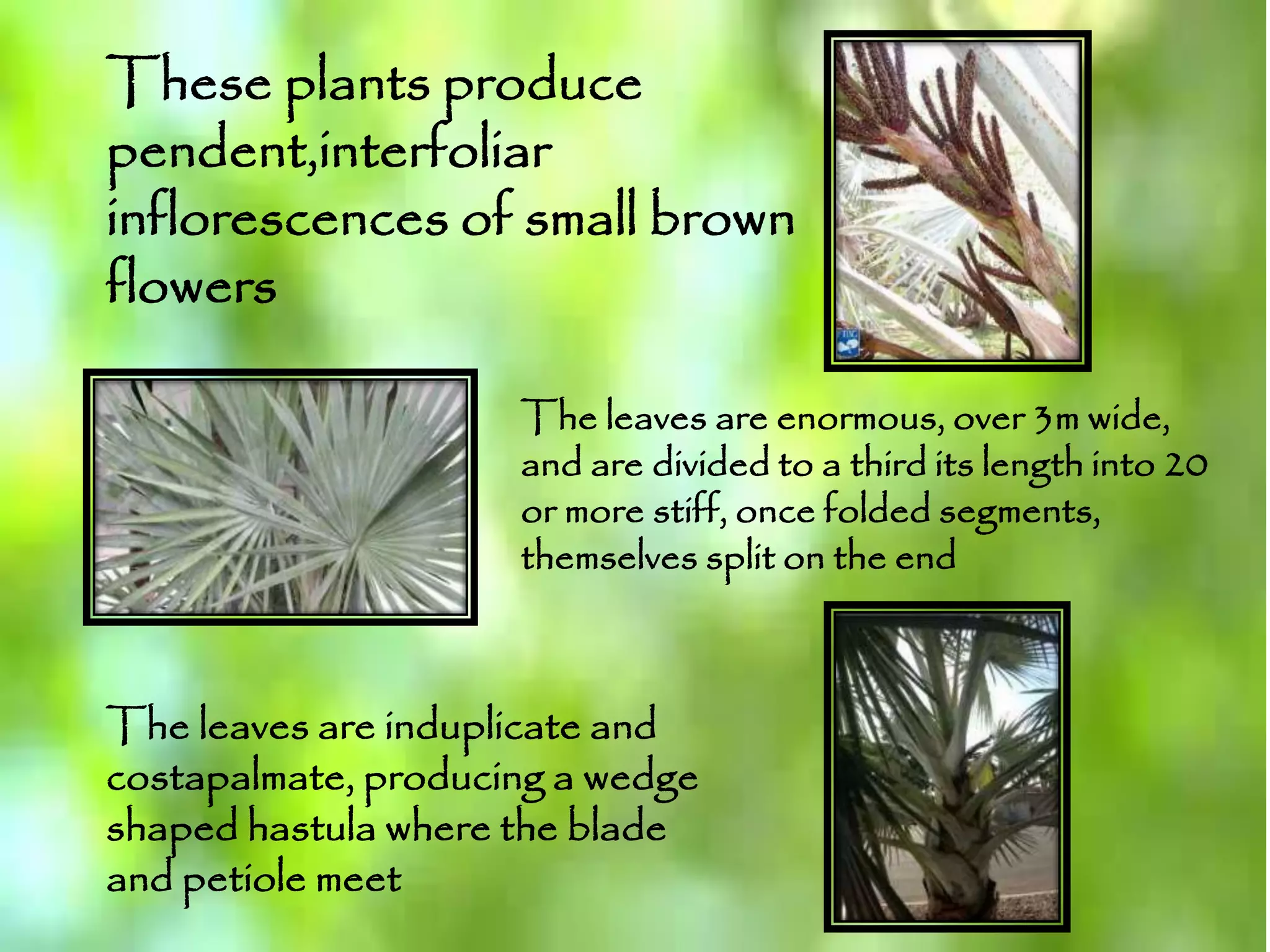
These plants produce
pendent,interfoliar
inflorescences of small brown
flowers
The leaves are enormous, over 3m wide,
and are divided to a third its length into 20
or more stiff, once folded segments,
themselves split on the end
The leaves are induplicate and
costapalmate, producing a wedge
shaped hastula where the blade
and petiole meet
FICUS RELIGIOSA
( PEEPAL
TREE)
A large season
deciduous or semi
ever green tree
It grows upto
30m in height
Native to south
east Asia
Its branches are closely set and from a
dense crown, hence the name Umbrella
Tree in english
The leaves are
broadly heart
shaped,7-12cm
long,
alternately set
on the
branches. The
apex of the
leap tapers into
a fine point
The fruits are
small figs, 1-1.5
cm in the
diameter, green
ripening to
purple. The
tree bares red-
colored flowers
in the month of
February
MILLINGTONIA HORTENSIS
( JASMINE/
INDIAN CORK)
 Tall and straight
tree grows upto
24m in height
 Native to The
Indian
Subcontinent
Bears one pair of three
leaved pinnae, one or two
pairs of leaflets and one
leaflet at the end
The leaves are smooth, oval,
slightly round-toothed and
pointed leaflets each being 2.5 -7
cm in length.
Each flower is tiny bell shaped
calyx, a long slender tube of pale
green divided into 4 waxy white
petals.
PUTRANJIVA ROXANBHUGII
( PUTRANJIVA)
 Erect straight trunk
with a large shady
head and
innumerable
expanding branches
 Grow upto 25m in
height
 Native to the India
and Srilanka
Leaves are
leathery and shiny,
usually wavy on the
margins. Young
leaves are light
green in color. Old
leaves become
darker and shinier.
Erect straight trunk with a large
shady head and innumerable
expanding branches. Flowers are
yellow in color but are seldom noticed
due to small size. The fruit is drupe
15-20mm, long and egg shaped.
 Vachellia
nilotica (widely known
by the taxonomic
synonym Acacia
nilotica, or the
common names gum
arabic tree,
Babul/Kikar, Egypti
an thorn, Sant
tree, Alsant or prickly
acacia
Vachellia nilotica
A tree 5–20 m high with a dense spheric crown stems and branches usually dark
to black coloured, fissured bark, grey-pinkish slash, exuding a reddish low quality
gum.
The tree has thin, straight, light, grey spines in axillary pairs, usually in 3 to 12
pairs, 5 to 7.5 cm (3 in) long in young trees,
Flowers in globulous heads 1.2–1.5 cm in diameter of a bright golden-yellow
color, set up either axillary or whorly onpenducles 2–3 cm long located at the
end of the branches.
Aegle marmelos, commonly known
as bael, Bengal quince,golden
apple,stone apple, wood apple, bili, is a
species of tree native to India.
In Hinduism the tree is sacred. It is
used in the worship of Shiva, who is
said to favour the leaves.It even has
medicinal uses.
Aegle marmelos
 Albizia lebbeck is
a species of Albizia ,nam
es for it
include lebbeck, lebbek
tree, flea tree
 It is a tree growing to a
height of 18–30 m tall
with a trunk 50 cm to 1 m
in diameter.
 The flowers are white,
with numerous 2.5–3.8 cm
long stamens, and very
fragrant. The fruit is
a pod 15–30 cm long and
2.5-5.0 cm broad,
containing six to
twelve seeds.
Albizia lebbeck
SmallTree
Cassia fistula
Shrubs
Achyranthes aspera
Argemone mexicana
Calotropis gigantea
Capparis decidua
Cassia fistula, known as
the golden shower tree .
 The golden shower tree is
a medium-sized tree,
growing to 10–20 m (33–
66 ft) tall with fast growth.
The leaves are deciduous,
The flowers are produced
in pendulous racemes 20–
40 cm (7.9–15.7 in) long,
each flower 4–7 cm (1.6–
2.8 in) diameter with five
yellow petals of equal size
and shape.
Cassia fistula
 Achyranthes
aspera (common name: prickly
chaff flower,devil'shorsewhip,
Sanskrit: अपामार्ग apamarga)
is a species of plant in
the Amaranthaeace family. It
is distributed throughout
the tropical world.
Achyranthes aspera
 Argemone mexicana (Mexican poppy,Mexican prickly
poppy, flowering thistle,
 It is used for medicinal purposes
Argemone
mexicana
 It is a large shrub growing
to 4 m (13 ft) tall. It has
clusters of waxy flowers
that are either white or
lavender in colour. Each
flower consists of five
pointed petals and a small,
elegant "crown" rising
from the centre, which
holds the stamens.
Calotropis gigantea
Capparis decidua is commonly
known
as kair, kerda, karir, kirir, karril
It is a small much
branched tree or shrub of arid regi
ons in Africa, Middle East and
southern Asia, including the Thar
desert. It bears a mass of slender,
leafless branches, the
small caducous leaves being found
only on young shoots. It rarely
exceeds a height of 5 meters
(15 feet).
Capparis decidua

PLANTATION- Composite Climate

  • 2.
    CONTENTS I. Introduction toClimate II. The Composite Climate III.Adaptations
  • 3.
    CLIMATE  The compositezone covers the central part of India. Some cities that experience this type of climate are New Delhi, Kanpur and Madhya Pradesh.  A variable landscape and seasonal vegetation characterise this zone.  The intensity of solar radiation is very high in summer. In monsoons, the intensity is low with predominantly diffuse radiation.  The maximum temperature in summers is in the range of 32 – 43 ºC, and night time values are from 27 to 32 ºC. In winter, the values are between 10 to 25 ºC during the day and 4 to 10 ºC at night.  The relative humidity is about 20 – 25 % in dry periods and 55 – 95 % in wet periods.  Precipitation in this zone varies between 500 – 1300 mm per year.  This region receives strong winds during monsoons from the south- east and dry cold winds from the north-east.  Generally, composite regions experience higher humidity levels during monsoons than hot and dry zones.
  • 4.
  • 5.
    ADAPTATIONS Abundance of watercan cause problems such as promoting the growth of bacteria and fungi which could be harmful to plants. Plants grow rapidly and quickly use up any organic material left from decomposing plants and animals. However, the plants at the top of the rainforest in the canopy, must be able to survive 12 hours of intense sunlight every day of the year.
  • 6.
    drip tips andwaxy surfaces allow water to run off, to discourage growth of bacteria and fungi buttresses and prop and stilt roots help hold up plants in the shallow soil some plants climb on others to reach the sunlight some plants grow on other plants to reach the sunlight flowers on the forest floor are designed to lure animal pollinators since there is relatively no wind on the forest floor to aid in pollination smooth bark and smooth or waxy flowers speed the run off of water plants have shallow roots to help capture nutrients from the top level of soil. many bromeliads are epiphytes (plants that live on other plants); instead of collecting water with roots they collect rainwater into a central reservoir from which they absorb the water through hairs on their leaves epiphytic orchids have aerial roots that cling to the host plant, absorb minerals, and absorb water from the atmosphere
  • 7.
    Drip-tips on leaveshelp shed excess water. Prop roots help support plants in the shallow soil. Some plants collect rainwater into a central reservoir.
  • 8.
     Semi- deciduous treesupto 15m ( 50ft) tall with a spreading crown.  Native to South Eastern Asia. BAUHINIA VARIEGATA ( ORCHID TREE)
  • 9.
     The branchesare usually trained to grow horizontal at about 8-10 feet high  The flowering season is around February to April. Flowers grow in heavy lush bunches and are orange-yellow color.
  • 10.
    SARACA ASOCA ( SITA ASOKA) Smallerect evergreen trees Grow upto 15m in height Native to The Indian Subcontinent
  • 11.
    The Sita Ashokatree has downward drooping leaves and branches. Possess deep green lanceolate leaves that are 15-25cm in length growing in dense bunches. Flowering season is around February to April. Flowers grow in lush heavy bunches and are ornge-yellow in color.
  • 12.
    BISMARCK NOBILIS ( BISMARCK PALM) Growsfrom solitary trunks,Grey to tan color Height can reach 25m in natural habitat. However, when cultivated ,it grows only upto 12m. Native to Madagascar
  • 13.
    These plants produce pendent,interfoliar inflorescencesof small brown flowers The leaves are enormous, over 3m wide, and are divided to a third its length into 20 or more stiff, once folded segments, themselves split on the end The leaves are induplicate and costapalmate, producing a wedge shaped hastula where the blade and petiole meet
  • 14.
    FICUS RELIGIOSA ( PEEPAL TREE) Alarge season deciduous or semi ever green tree It grows upto 30m in height Native to south east Asia
  • 15.
    Its branches areclosely set and from a dense crown, hence the name Umbrella Tree in english The leaves are broadly heart shaped,7-12cm long, alternately set on the branches. The apex of the leap tapers into a fine point The fruits are small figs, 1-1.5 cm in the diameter, green ripening to purple. The tree bares red- colored flowers in the month of February
  • 16.
    MILLINGTONIA HORTENSIS ( JASMINE/ INDIANCORK)  Tall and straight tree grows upto 24m in height  Native to The Indian Subcontinent
  • 17.
    Bears one pairof three leaved pinnae, one or two pairs of leaflets and one leaflet at the end The leaves are smooth, oval, slightly round-toothed and pointed leaflets each being 2.5 -7 cm in length. Each flower is tiny bell shaped calyx, a long slender tube of pale green divided into 4 waxy white petals.
  • 18.
    PUTRANJIVA ROXANBHUGII ( PUTRANJIVA) Erect straight trunk with a large shady head and innumerable expanding branches  Grow upto 25m in height  Native to the India and Srilanka
  • 19.
    Leaves are leathery andshiny, usually wavy on the margins. Young leaves are light green in color. Old leaves become darker and shinier. Erect straight trunk with a large shady head and innumerable expanding branches. Flowers are yellow in color but are seldom noticed due to small size. The fruit is drupe 15-20mm, long and egg shaped.
  • 20.
     Vachellia nilotica (widelyknown by the taxonomic synonym Acacia nilotica, or the common names gum arabic tree, Babul/Kikar, Egypti an thorn, Sant tree, Alsant or prickly acacia Vachellia nilotica
  • 21.
    A tree 5–20m high with a dense spheric crown stems and branches usually dark to black coloured, fissured bark, grey-pinkish slash, exuding a reddish low quality gum. The tree has thin, straight, light, grey spines in axillary pairs, usually in 3 to 12 pairs, 5 to 7.5 cm (3 in) long in young trees, Flowers in globulous heads 1.2–1.5 cm in diameter of a bright golden-yellow color, set up either axillary or whorly onpenducles 2–3 cm long located at the end of the branches.
  • 22.
    Aegle marmelos, commonlyknown as bael, Bengal quince,golden apple,stone apple, wood apple, bili, is a species of tree native to India. In Hinduism the tree is sacred. It is used in the worship of Shiva, who is said to favour the leaves.It even has medicinal uses. Aegle marmelos
  • 23.
     Albizia lebbeckis a species of Albizia ,nam es for it include lebbeck, lebbek tree, flea tree  It is a tree growing to a height of 18–30 m tall with a trunk 50 cm to 1 m in diameter.  The flowers are white, with numerous 2.5–3.8 cm long stamens, and very fragrant. The fruit is a pod 15–30 cm long and 2.5-5.0 cm broad, containing six to twelve seeds. Albizia lebbeck
  • 24.
    SmallTree Cassia fistula Shrubs Achyranthes aspera Argemonemexicana Calotropis gigantea Capparis decidua
  • 25.
    Cassia fistula, knownas the golden shower tree .  The golden shower tree is a medium-sized tree, growing to 10–20 m (33– 66 ft) tall with fast growth. The leaves are deciduous, The flowers are produced in pendulous racemes 20– 40 cm (7.9–15.7 in) long, each flower 4–7 cm (1.6– 2.8 in) diameter with five yellow petals of equal size and shape. Cassia fistula
  • 26.
     Achyranthes aspera (commonname: prickly chaff flower,devil'shorsewhip, Sanskrit: अपामार्ग apamarga) is a species of plant in the Amaranthaeace family. It is distributed throughout the tropical world. Achyranthes aspera
  • 27.
     Argemone mexicana(Mexican poppy,Mexican prickly poppy, flowering thistle,  It is used for medicinal purposes Argemone mexicana
  • 28.
     It isa large shrub growing to 4 m (13 ft) tall. It has clusters of waxy flowers that are either white or lavender in colour. Each flower consists of five pointed petals and a small, elegant "crown" rising from the centre, which holds the stamens. Calotropis gigantea
  • 29.
    Capparis decidua iscommonly known as kair, kerda, karir, kirir, karril It is a small much branched tree or shrub of arid regi ons in Africa, Middle East and southern Asia, including the Thar desert. It bears a mass of slender, leafless branches, the small caducous leaves being found only on young shoots. It rarely exceeds a height of 5 meters (15 feet). Capparis decidua