Why Process Measures 
Are Often More Important 
Than Outcome Measures 
in Healthcare 
-Tom Burton
© 2014 Health Catalyst 
www.healthcatalyst.com 
Measuring Outcomes 
Tracking outcome measures 
alone is insufficient to achieve 
quality and cost goals. 
Health systems must get more 
granular with their data. In 
addition to outcome measure-ments 
they must also track 
evidence-based process 
measures. 
Proprietary. Feel free to share but we would appreciate a Health Catalyst citation.
1 2 
© 2014 Health Catalyst 
www.healthcatalyst.com 
Three Measures 
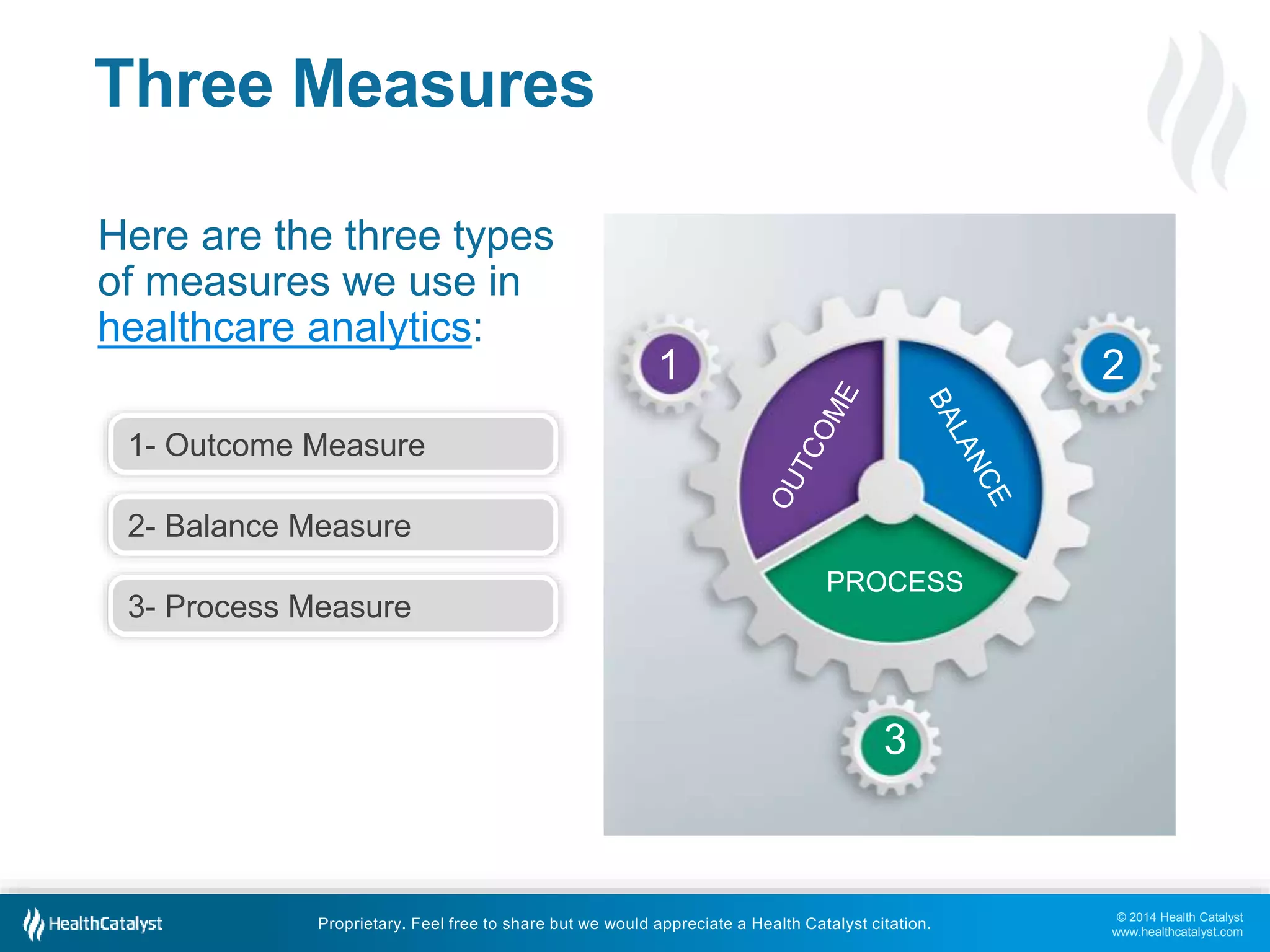
Here are the three types 
of measures we use in 
healthcare analytics: 
PROCESS 
3 
1- Outcome Measure 
2- Balance Measure 
3- Process Measure 
Proprietary. Feel free to share but we would appreciate a Health Catalyst citation.
© 2014 Health Catalyst 
www.healthcatalyst.com 
Three Measures 
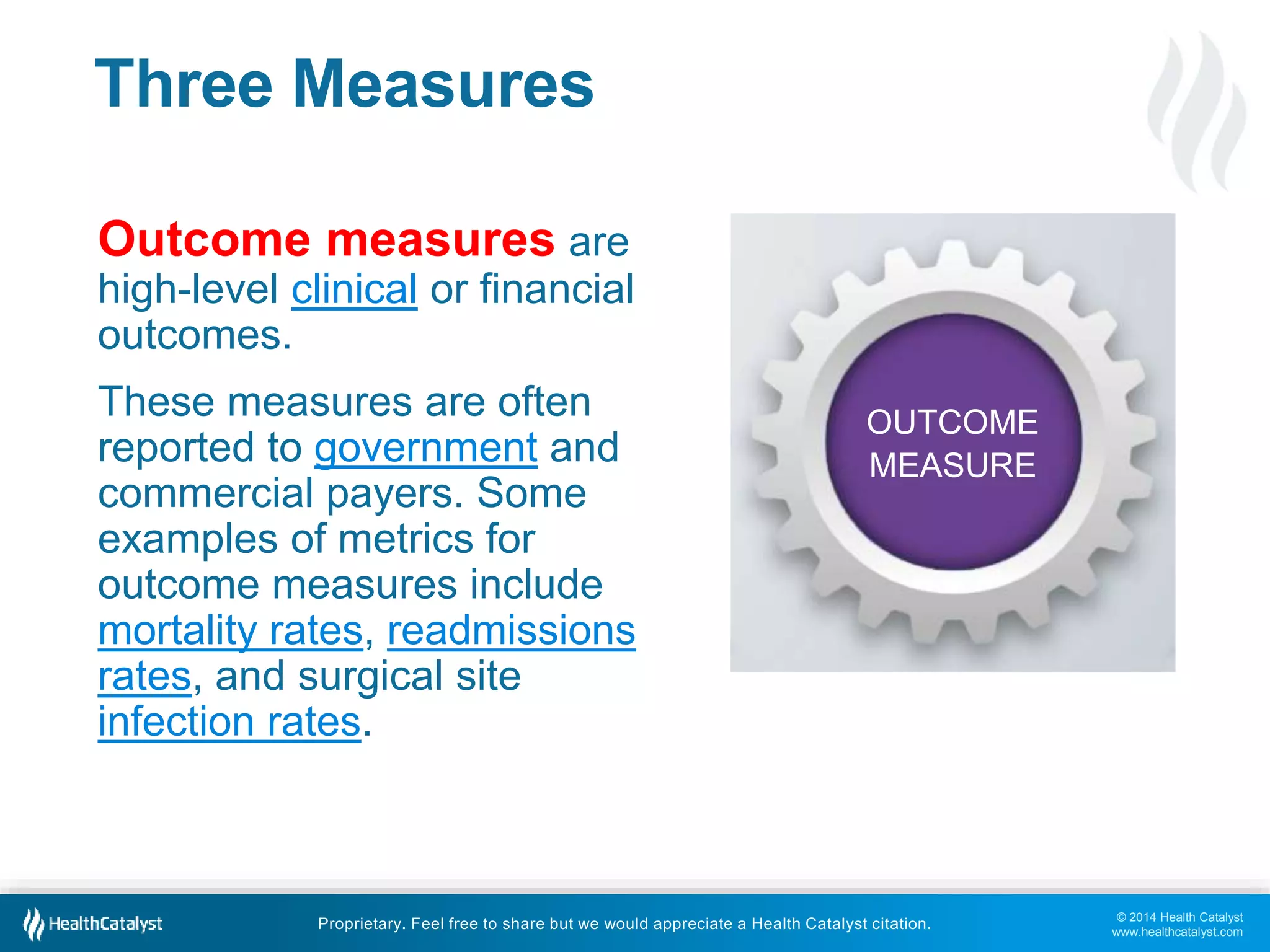
Outcome measures are 
high-level clinical or financial 
outcomes. 
These measures are often 
reported to government and 
commercial payers. Some 
examples of metrics for 
outcome measures include 
mortality rates, readmissions 
rates, and surgical site 
infection rates. 
OUTCOME 
MEASURE 
Proprietary. Feel free to share but we would appreciate a Health Catalyst citation.
© 2014 Health Catalyst 
www.healthcatalyst.com 
Three Measures 
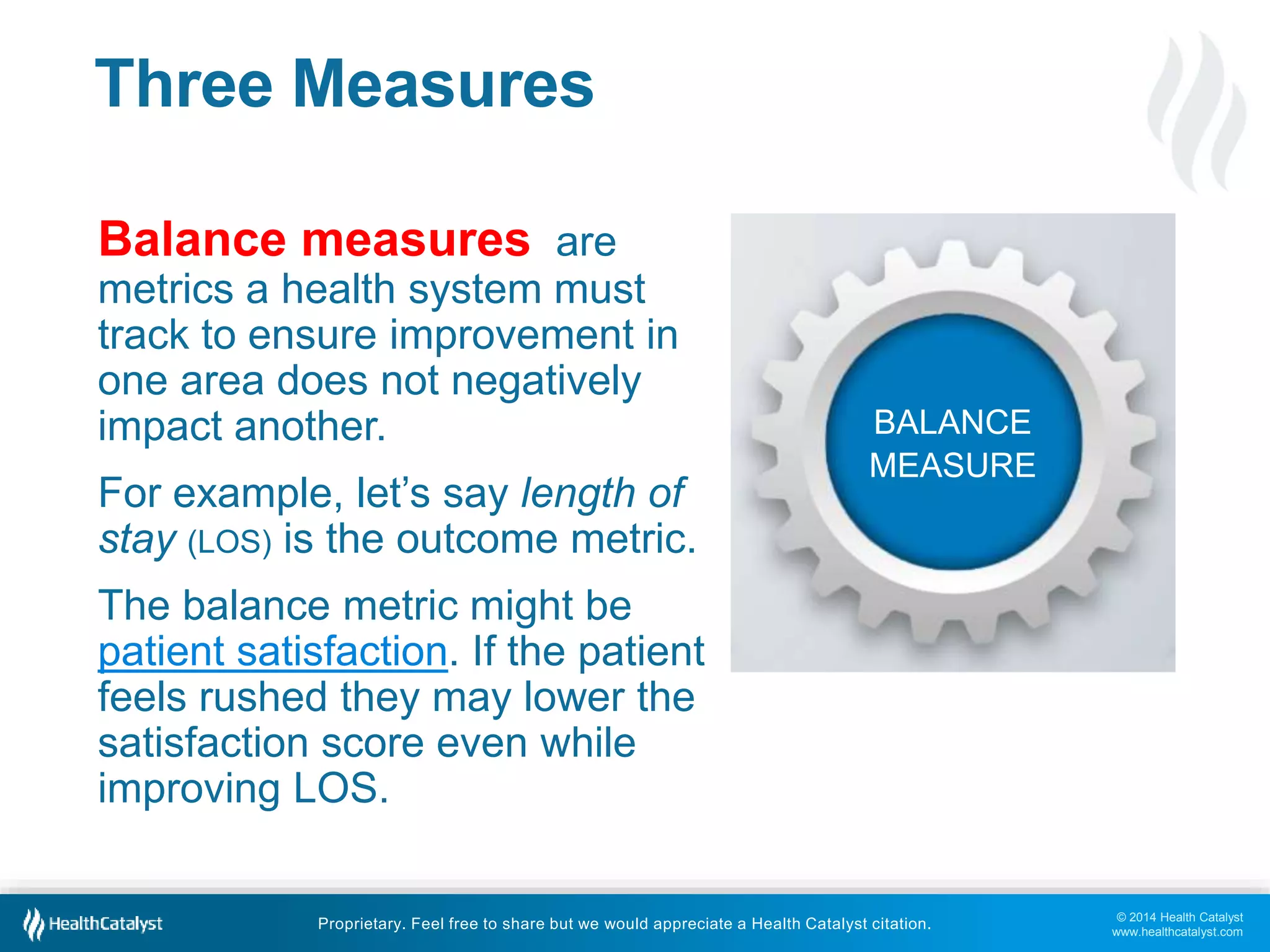
Balance measures are 
metrics a health system must 
track to ensure improvement in 
one area does not negatively 
impact another. 
For example, let’s say length of 
stay (LOS) is the outcome metric. 
The balance metric might be 
patient satisfaction. If the patient 
feels rushed they may lower the 
satisfaction score even while 
improving LOS. 
BALANCE 
MEASURE 
Proprietary. Feel free to share but we would appreciate a Health Catalyst citation.
© 2014 Health Catalyst 
www.healthcatalyst.com 
Three Measures 
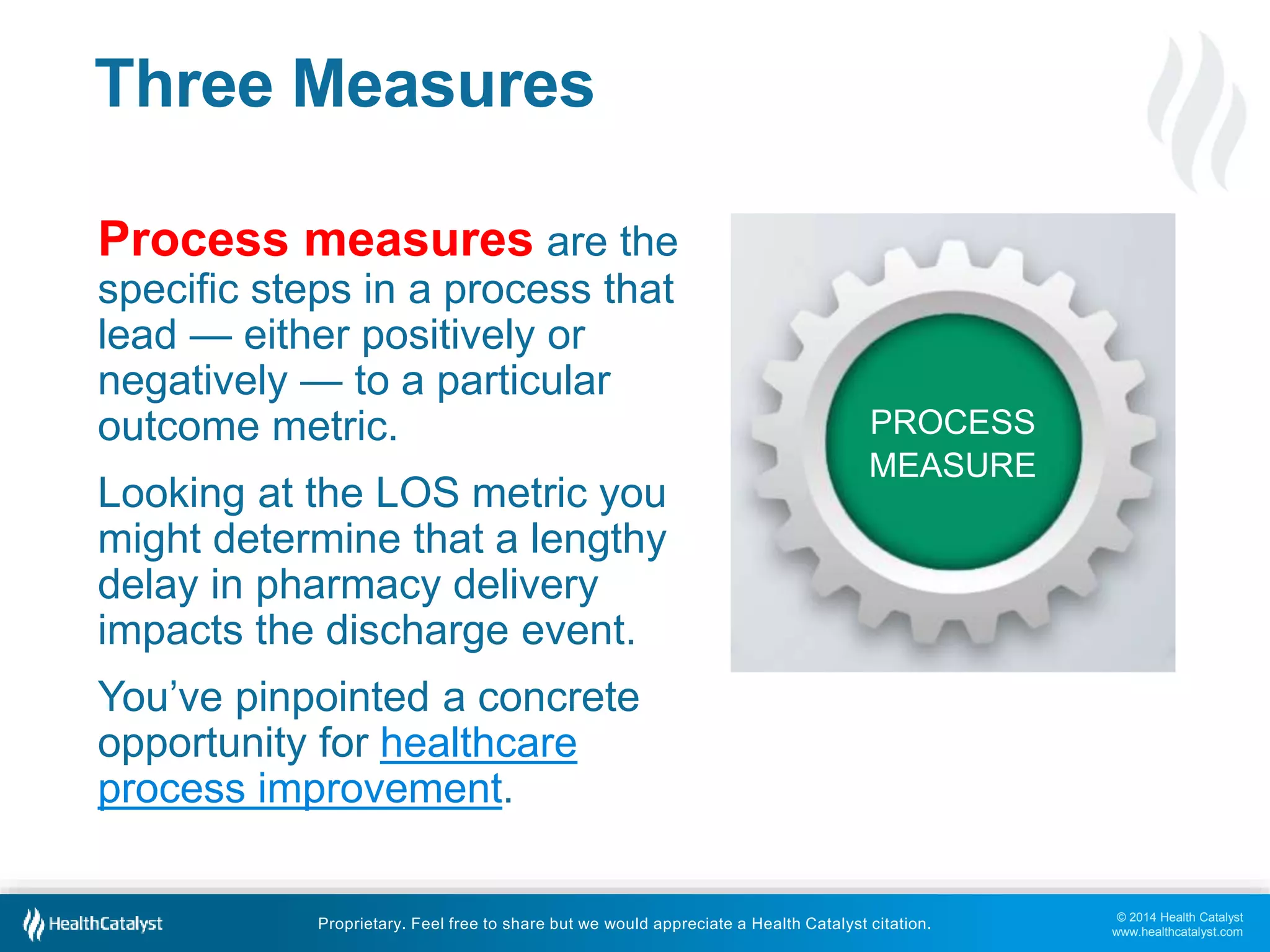
Process measures are the 
specific steps in a process that 
lead — either positively or 
negatively — to a particular 
outcome metric. 
Looking at the LOS metric you 
might determine that a lengthy 
delay in pharmacy delivery 
impacts the discharge event. 
You’ve pinpointed a concrete 
opportunity for healthcare 
process improvement. 
PROCESS 
MEASURE 
Proprietary. Feel free to share but we would appreciate a Health Catalyst citation.
Importance of Process Measures 
Process measures represent a 
health system’s efforts to 
incorporate and systematize 
evidence-based best practices 
into its improvement efforts. 
One goal is to identify at-risk 
patients for the treatment 
process you are analyzing. 
© 2014 Health Catalyst 
www.healthcatalyst.com 
Proprietary. Feel free to share but we would appreciate a Health Catalyst citation.
Importance of Process Measures 
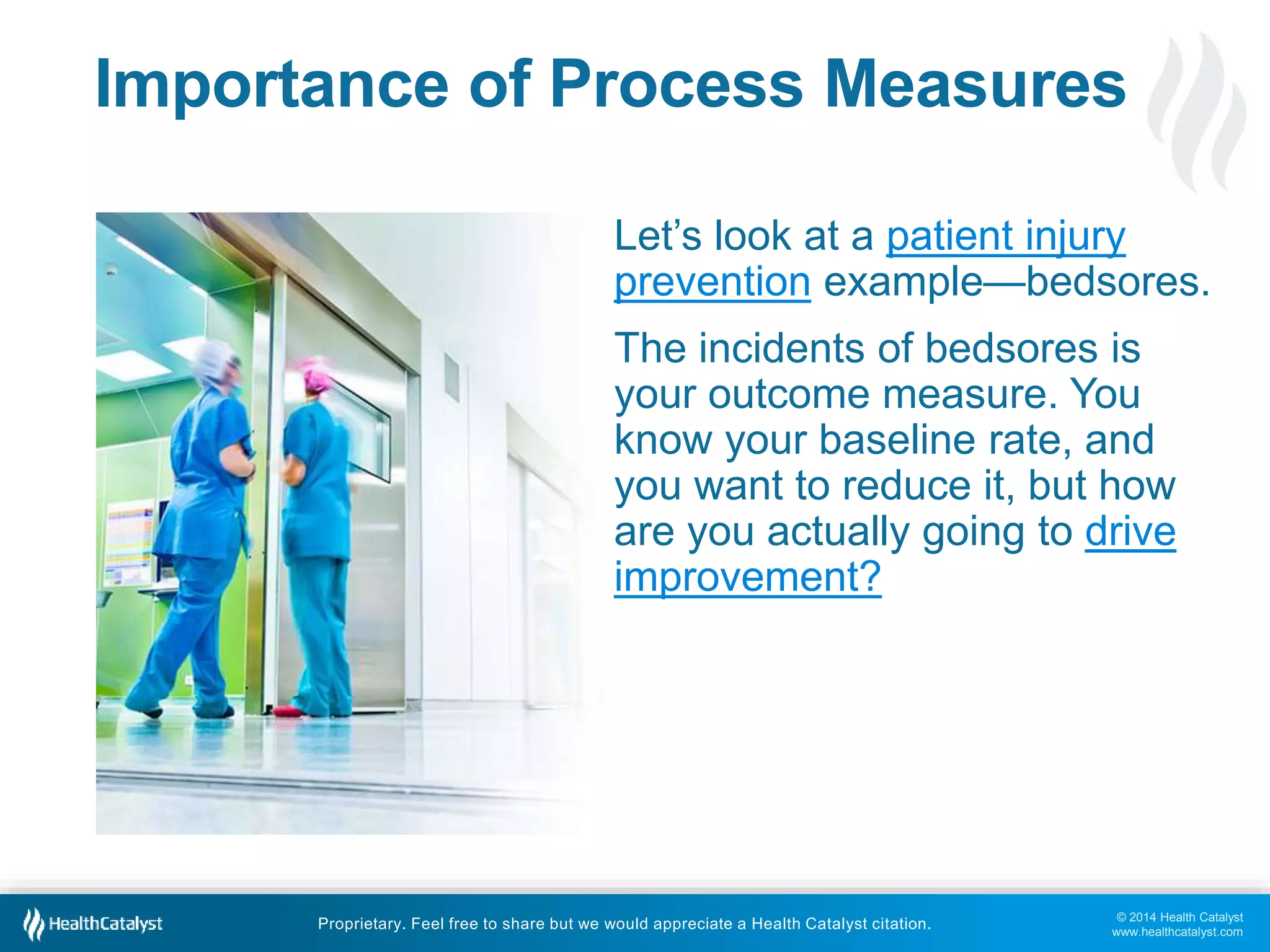
Let’s look at a patient injury 
prevention example—bedsores. 
The incidents of bedsores is 
your outcome measure. You 
know your baseline rate, and 
you want to reduce it, but how 
are you actually going to drive 
improvement? 
© 2014 Health Catalyst 
www.healthcatalyst.com 
Proprietary. Feel free to share but we would appreciate a Health Catalyst citation.
Importance of Process Measures 
The answer is straightforward: 
by implementing and tracking 
the right process metrics. 
Process measures in this 
example are the steps that 
should be performed every time 
for every bed-bound patient in 
the intensive care unit (ICU) or 
in the med-surg units. 
© 2014 Health Catalyst 
www.healthcatalyst.com 
Proprietary. Feel free to share but we would appreciate a Health Catalyst citation.
Importance of Process Measures 
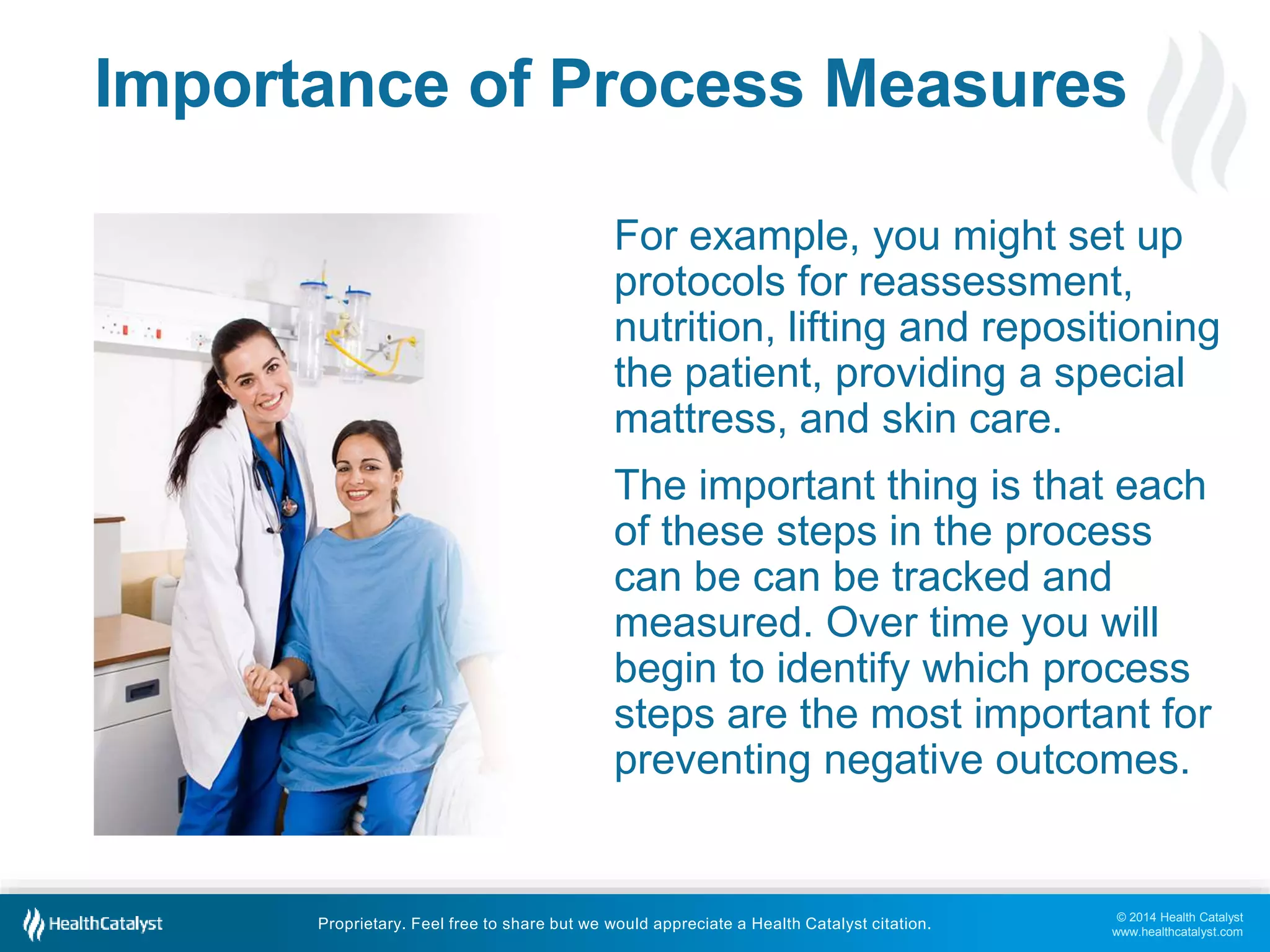
First you would perform a risk 
assessment using the Braden 
Scale for predicting pressure 
ulcer risk on all the appropriate 
units in the Hospital. 
Patients identified as “at risk” 
would then receive treatment for 
preventing bedsores according 
to your organization’s chosen 
best-practice protocol. 
© 2014 Health Catalyst 
www.healthcatalyst.com 
Proprietary. Feel free to share but we would appreciate a Health Catalyst citation.
Importance of Process Measures 
For example, you might set up 
protocols for reassessment, 
nutrition, lifting and repositioning 
the patient, providing a special 
mattress, and skin care. 
The important thing is that each 
of these steps in the process 
can be can be tracked and 
measured. Over time you will 
begin to identify which process 
steps are the most important for 
preventing negative outcomes. 
© 2014 Health Catalyst 
www.healthcatalyst.com 
Proprietary. Feel free to share but we would appreciate a Health Catalyst citation.
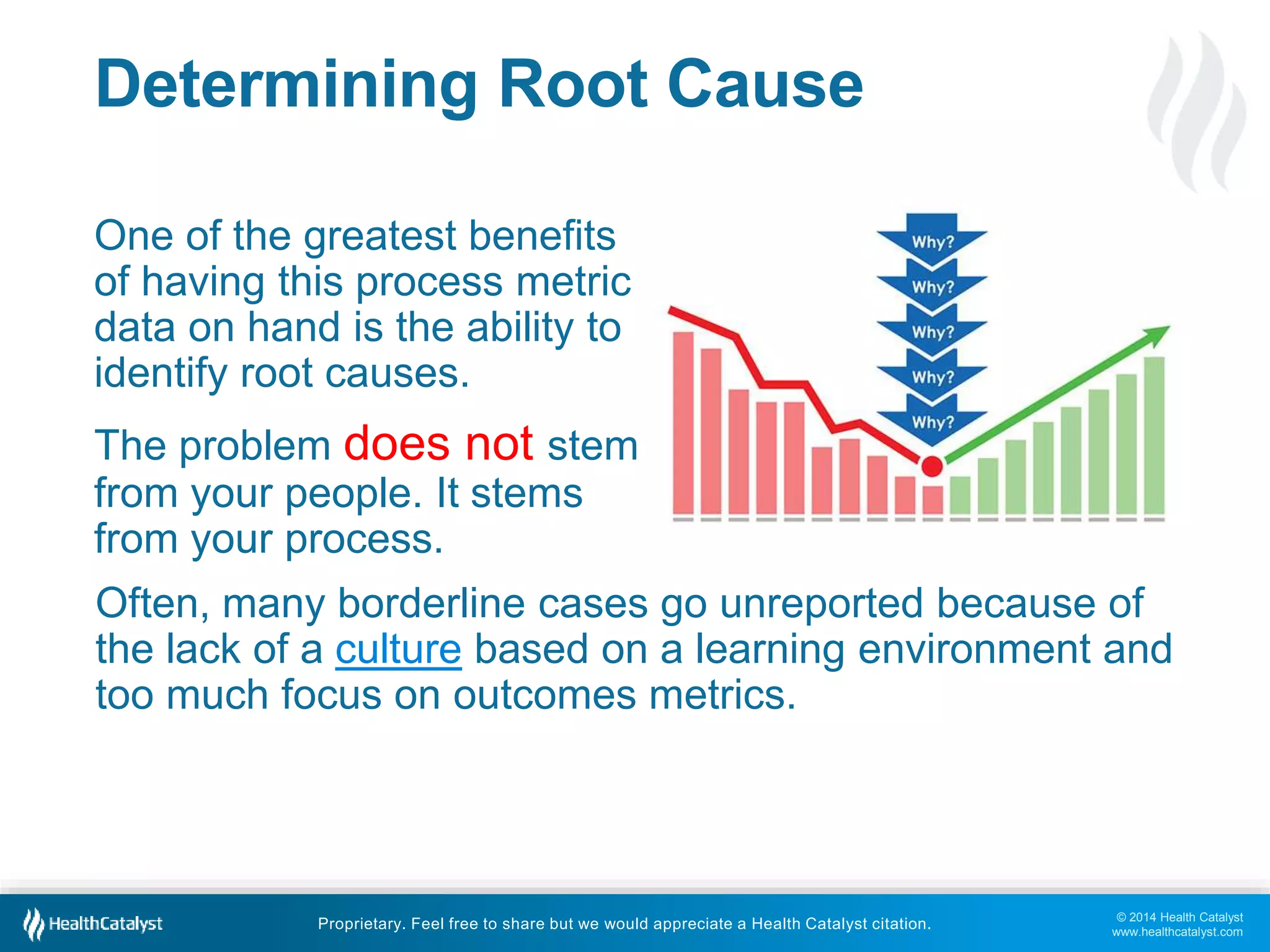
One of the greatest benefits 
of having this process metric 
data on hand is the ability to 
identify root causes. 
The problem does not stem 
from your people. It stems 
from your process. 
Often, many borderline cases go unreported because of 
the lack of a culture based on a learning environment and 
too much focus on outcomes metrics. 
© 2014 Health Catalyst 
www.healthcatalyst.com 
Determining Root Cause 
Proprietary. Feel free to share but we would appreciate a Health Catalyst citation.
© 2014 Health Catalyst 
www.healthcatalyst.com 
Determining Root Cause 
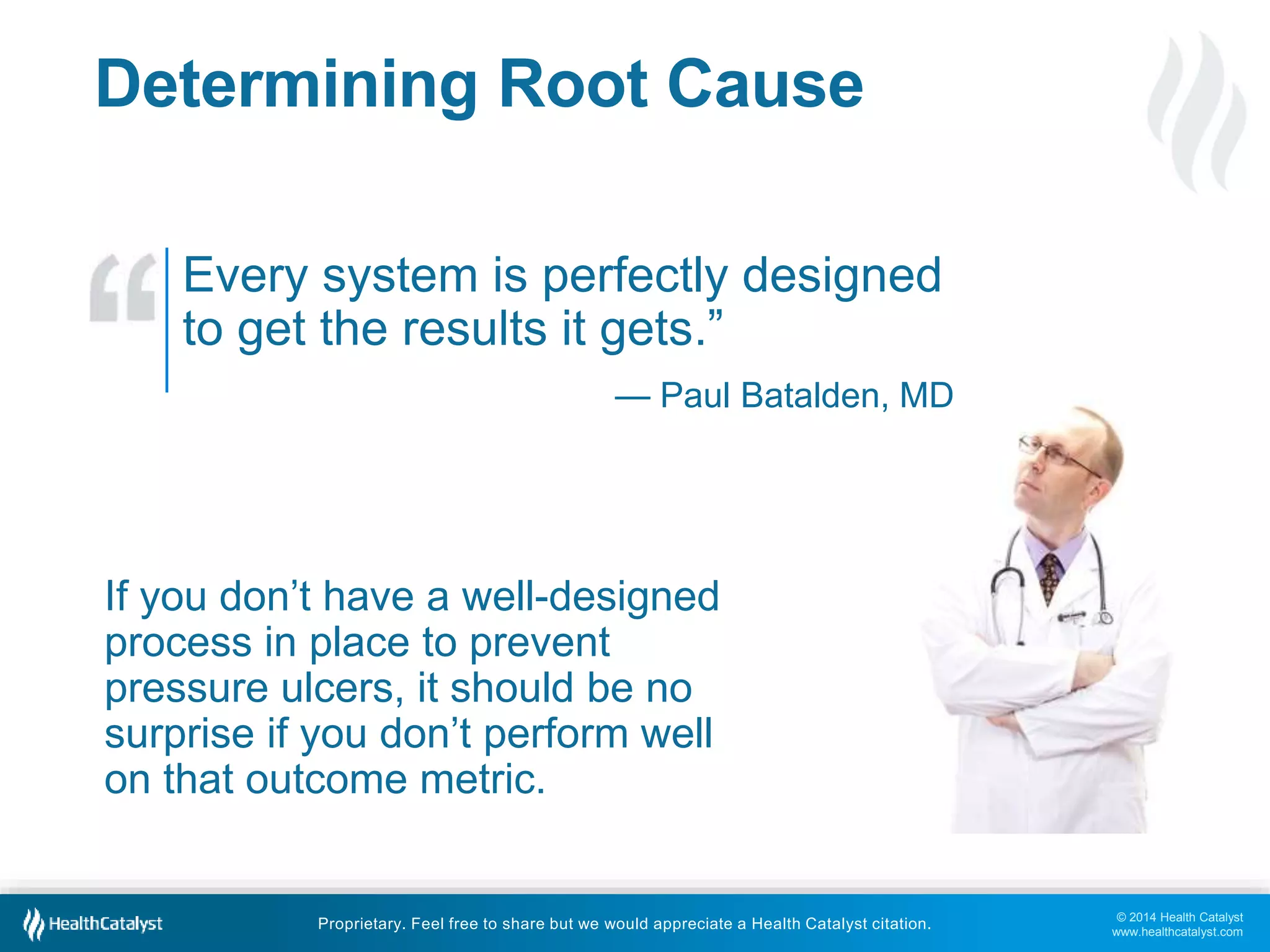
Every system is perfectly designed 
to get the results it gets.” 
— Paul Batalden, MD 
If you don’t have a well-designed 
process in place to prevent 
pressure ulcers, it should be no 
surprise if you don’t perform well 
on that outcome metric. 
Proprietary. Feel free to share but we would appreciate a Health Catalyst citation.
© 2014 Health Catalyst 
www.healthcatalyst.com 
Determining Root Cause 
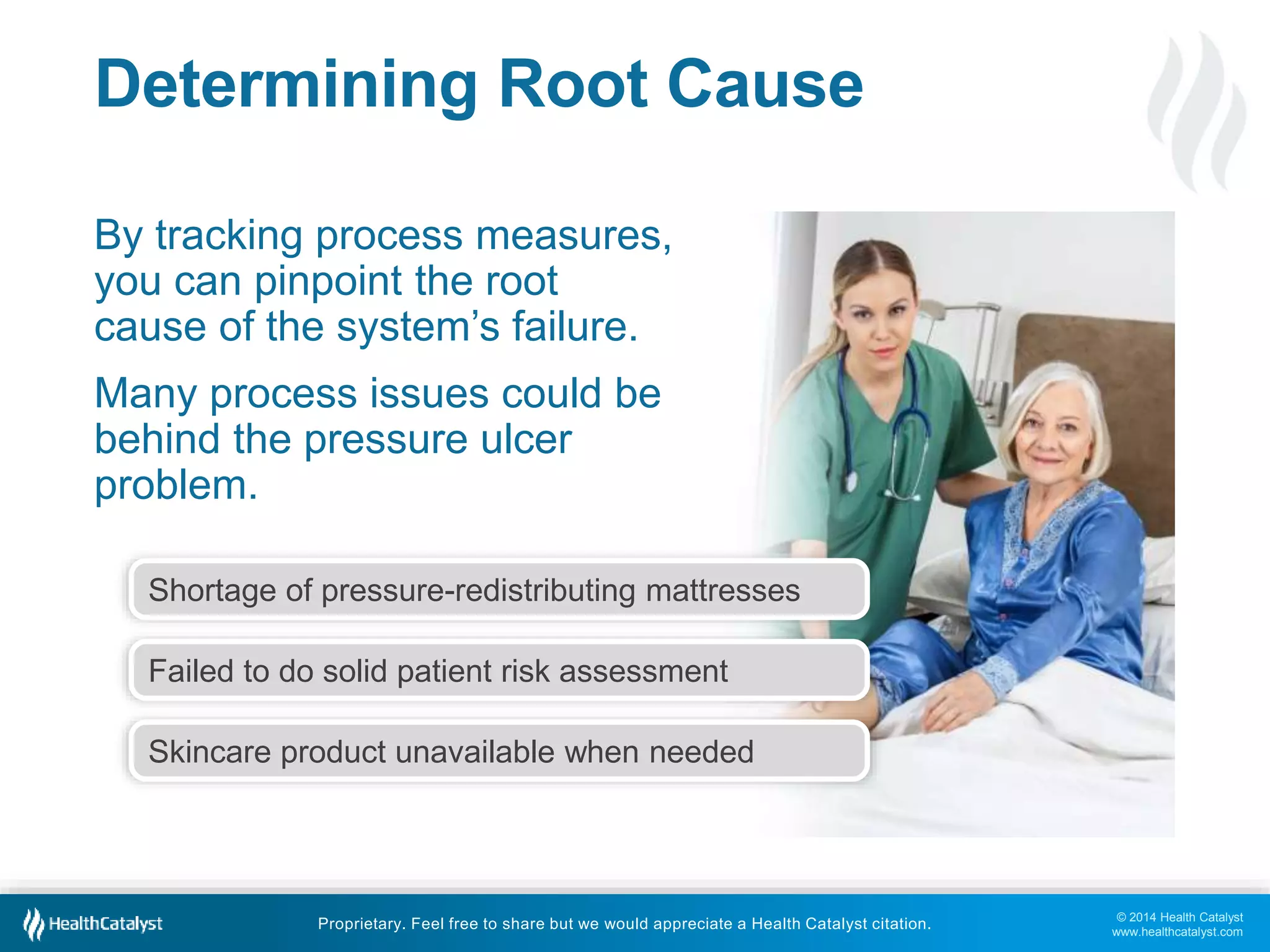
By tracking process measures, 
you can pinpoint the root 
cause of the system’s failure. 
Many process issues could be 
behind the pressure ulcer 
problem. 
Shortage of pressure-redistributing mattresses 
Failed to do solid patient risk assessment 
Skincare product unavailable when needed 
Proprietary. Feel free to share but we would appreciate a Health Catalyst citation.
Using Measures to Reduce Variation 
© 2014 Health Catalyst 
www.healthcatalyst.com 
Process measures improve 
quality and cost by enabling 
organizations to reduce the 
amount of variation in care 
delivery. 
Establishing process metrics at 
potential points of variation in a 
care process enables you to 
monitor and reduce 
inappropriate variation. 
Proprietary. Feel free to share but we would appreciate a Health Catalyst citation.
Using Measures to Reduce Variation 
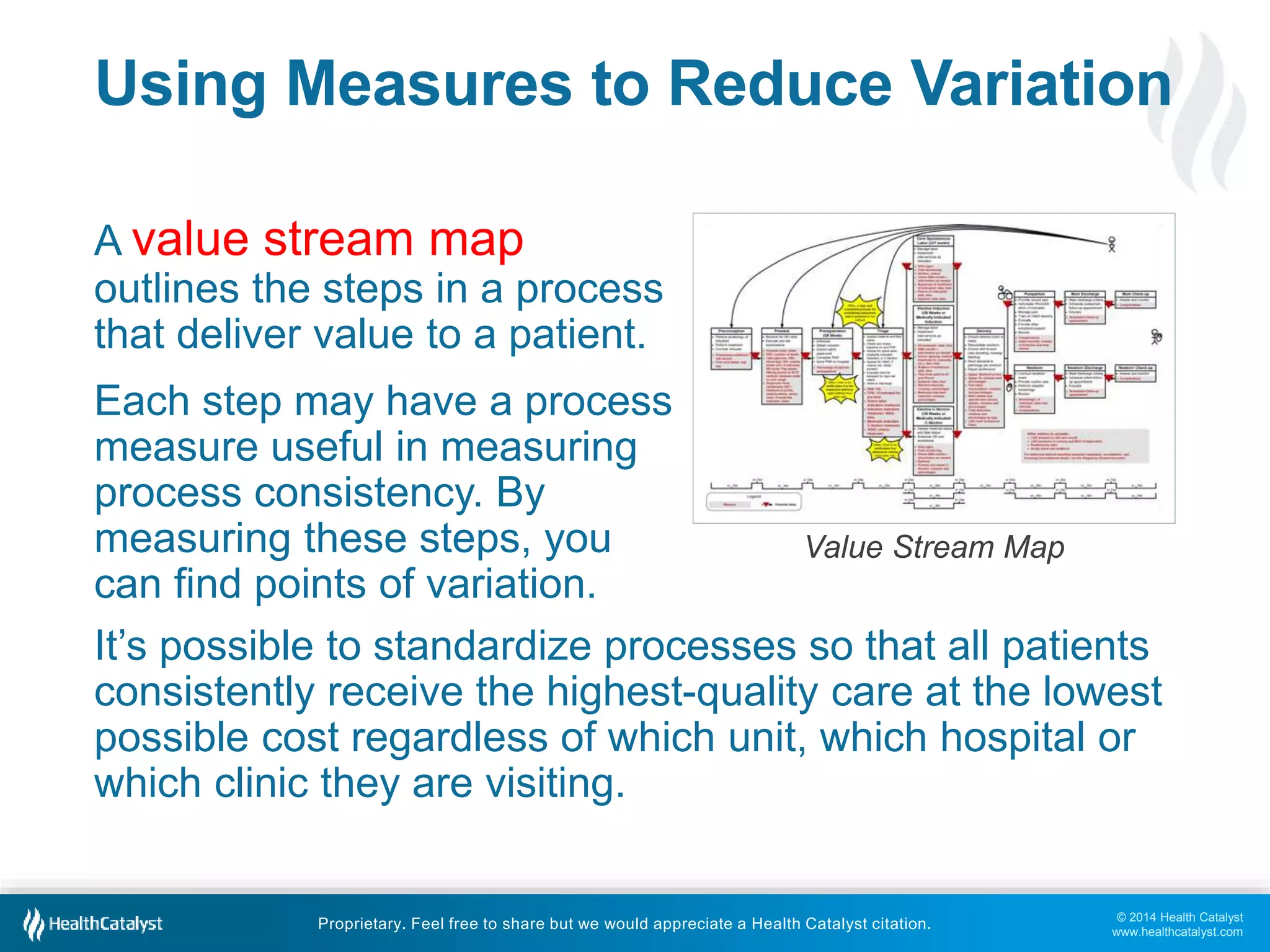
A value stream map 
outlines the steps in a process 
that deliver value to a patient. 
Each step may have a process 
measure useful in measuring 
process consistency. By 
measuring these steps, you 
can find points of variation. 
It’s possible to standardize processes so that all patients 
consistently receive the highest-quality care at the lowest 
possible cost regardless of which unit, which hospital or 
which clinic they are visiting. 
© 2014 Health Catalyst 
www.healthcatalyst.com 
Value Stream Map 
Proprietary. Feel free to share but we would appreciate a Health Catalyst citation.
© 2014 Health Catalyst 
www.healthcatalyst.com 
Use an EDW to Track Metrics 
Healthcare organizations 
normally don’t have the 
infrastructure to handle both 
outcome and process 
metrics. 
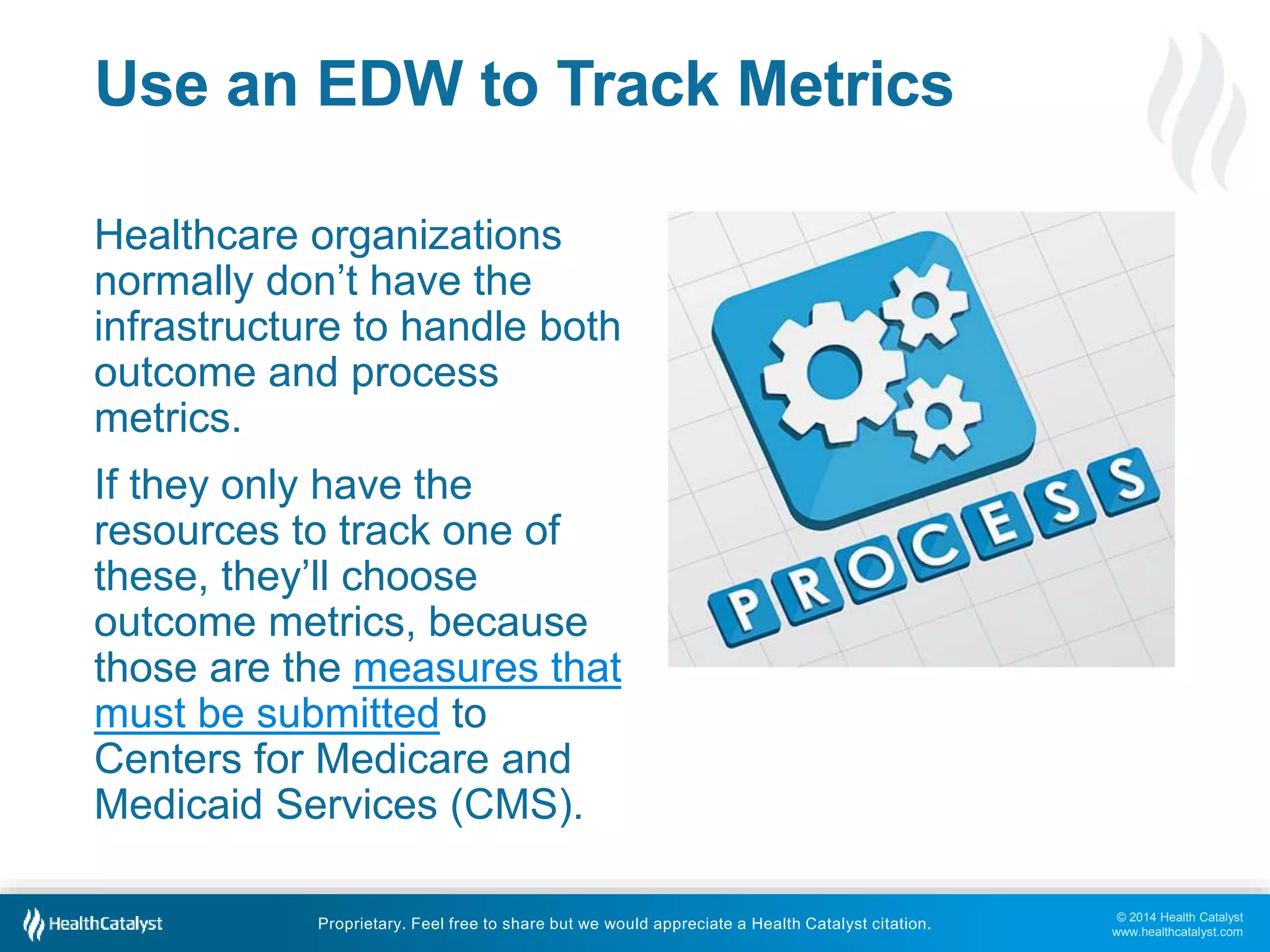
If they only have the 
resources to track one of 
these, they’ll choose 
outcome metrics, because 
those are the measures that 
must be submitted to 
Centers for Medicare and 
Medicaid Services (CMS). 
Proprietary. Feel free to share but we would appreciate a Health Catalyst citation.
© 2014 Health Catalyst 
www.healthcatalyst.com 
Use an EDW to Track Metrics 
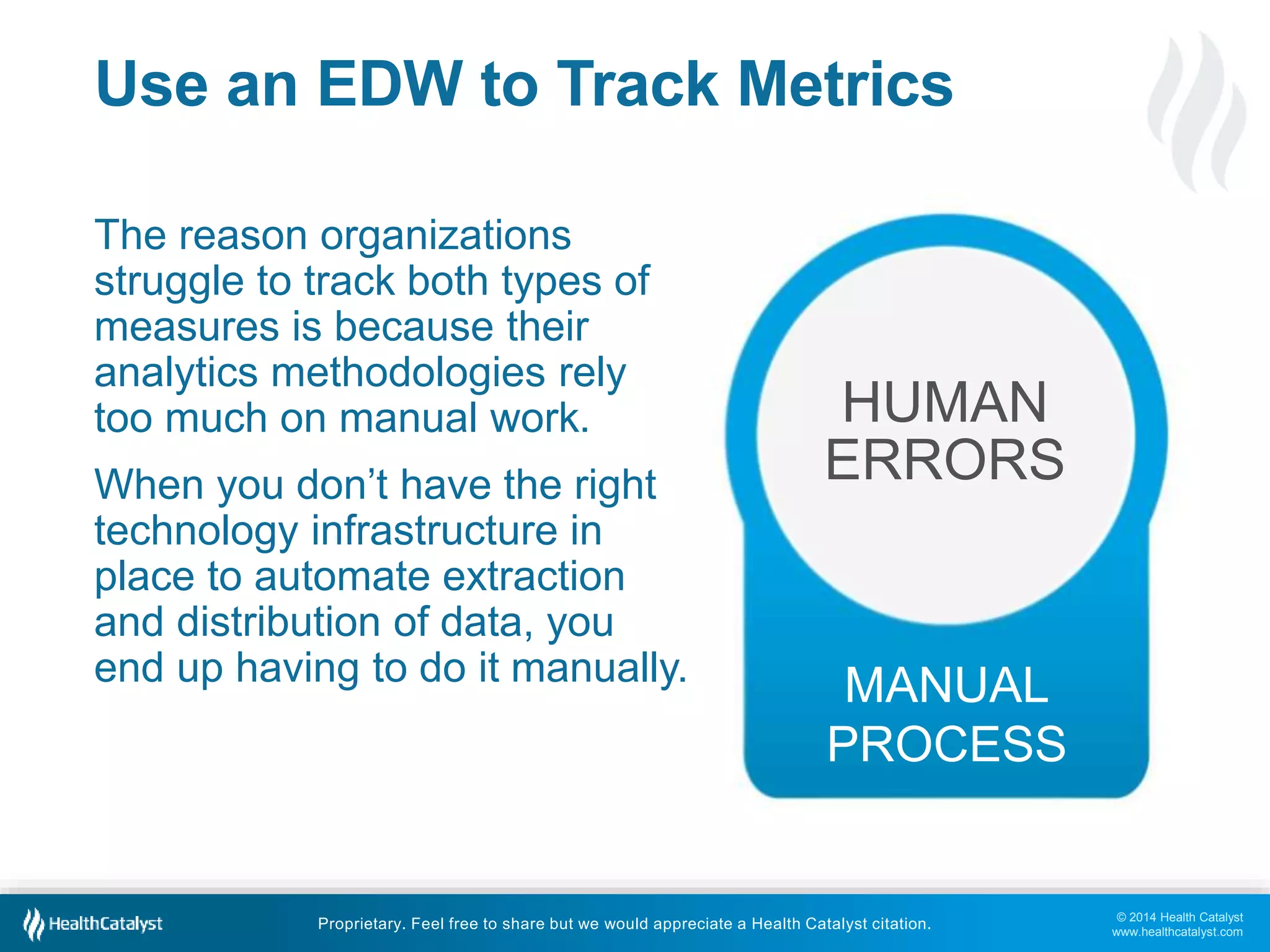
The reason organizations 
struggle to track both types of 
measures is because their 
analytics methodologies rely 
too much on manual work. 
When you don’t have the right 
technology infrastructure in 
place to automate extraction 
and distribution of data, you 
end up having to do it manually. MANUAL 
HUMAN 
ERRORS 
PROCESS 
Proprietary. Feel free to share but we would appreciate a Health Catalyst citation.
© 2014 Health Catalyst 
www.healthcatalyst.com 
Use an EDW to Track Metrics 
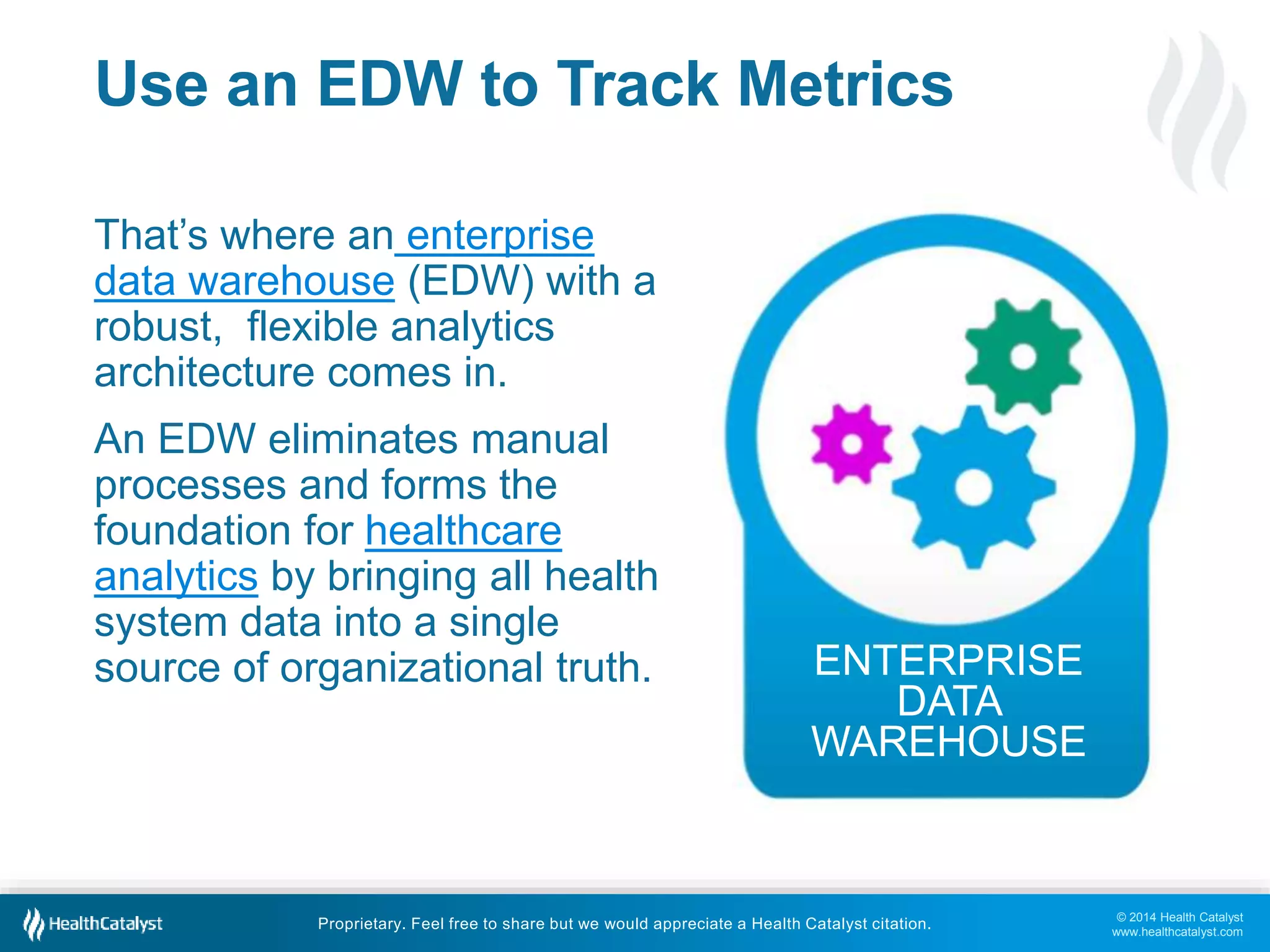
That’s where an enterprise 
data warehouse (EDW) with a 
robust, flexible analytics 
architecture comes in. 
An EDW eliminates manual 
processes and forms the 
foundation for healthcare 
analytics by bringing all health 
system data into a single 
source of organizational truth. ENTERPRISE 
DATA 
WAREHOUSE 
Proprietary. Feel free to share but we would appreciate a Health Catalyst citation.
With an EDW, analysts can 
focus their time on discovering 
data patterns which will lead to 
understanding, insight, and 
ultimately action. 
But without an EDW, it will be 
very difficult for analysts to 
provide reliable and 
repeatable reports and in-depth 
analyses of areas that 
will provide the best 
opportunities for improving 
outcomes. 
© 2014 Health Catalyst 
www.healthcatalyst.com 
Use an EDW to Track Metrics 
Proprietary. Feel free to share but we would appreciate a Health Catalyst citation.
Link to original article for a more in-depth discussion. 
Why Process Measures Are Often More Important Than Outcome 
Measures in Healthcare 
The Key to Real Process Improvement Outcomes: Linking Clinical and Financial Data 
Bobbi Brown, VP of Financial Engagement 
6 Steps for Implementing Successful Performance Improvement Initiatives in Healthcare 
Bobbi Brown, VP of Financial Engagement 
How to Reduce Sepsis Mortality Rates by 22% with Clinical and Process Improvement 
Services — A Success Story from MultiCare Health System 
© 2014 Health Catalyst 
www.healthcatalyst.com 
More about this topic 
The Best Approach to Healthcare Analytics 
Tom Burton, Co-Founder, Senior VP of Product Development 
Healthcare Analytics Adoption Model: A Framework and Roadmap (white paper) 
David Burton, MD, SVP; Dale Sanders, SVP; and Denis Protti, ScD 
Proprietary. Feel free to share but we would appreciate a Health Catalyst citation.
© 2014 Health Catalyst 
www.healthcatalyst.com 
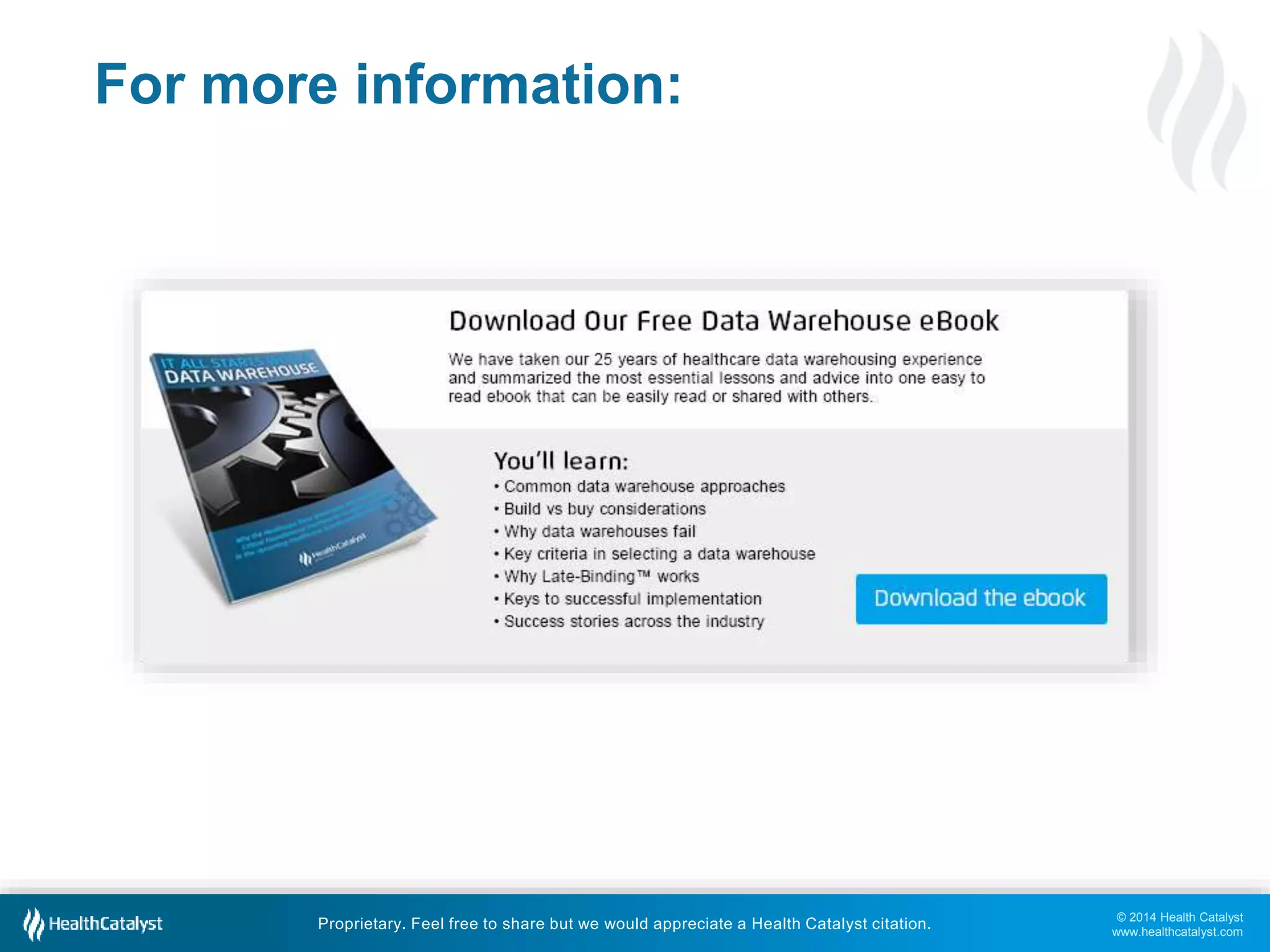
For more information: 
Proprietary. Feel free to share but we would appreciate a Health Catalyst citation.
Other Clinical Quality Improvement Resources 
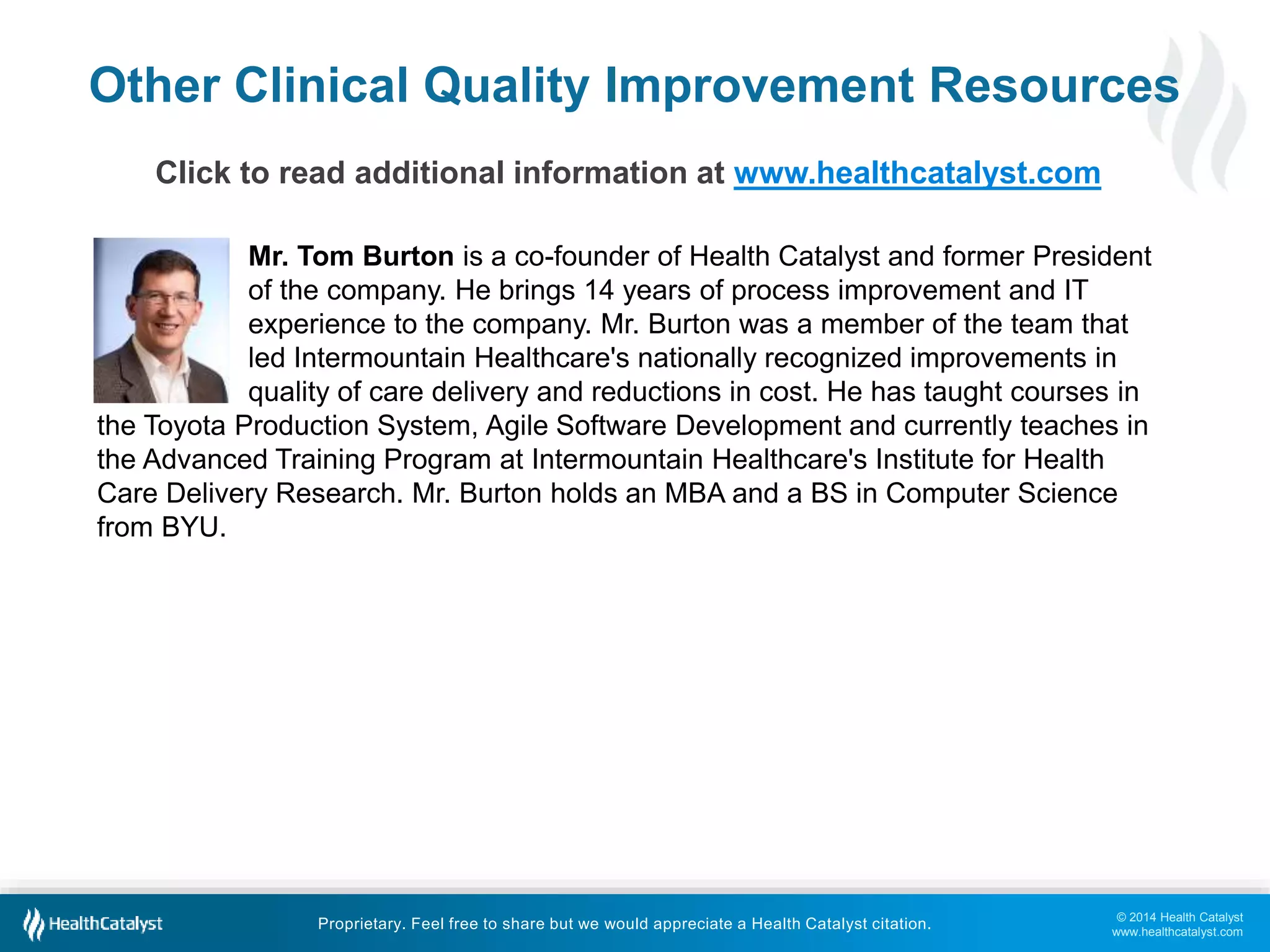
Mr. Tom Burton is a co-founder of Health Catalyst and former President 
of the company. He brings 14 years of process improvement and IT 
experience to the company. Mr. Burton was a member of the team that 
led Intermountain Healthcare's nationally recognized improvements in 
quality of care delivery and reductions in cost. He has taught courses in 
the Toyota Production System, Agile Software Development and currently teaches in 
the Advanced Training Program at Intermountain Healthcare's Institute for Health 
Care Delivery Research. Mr. Burton holds an MBA and a BS in Computer Science 
from BYU. 
© 2014 Health Catalyst 
www.healthcatalyst.com 
Click to read additional information at www.healthcatalyst.com 
Proprietary. Feel free to share but we would appreciate a Health Catalyst citation.

Why Process Measures Are Often More Important Than Outcome Measures in Healthcare

  • 1.
    Why Process Measures Are Often More Important Than Outcome Measures in Healthcare -Tom Burton
  • 2.
    © 2014 HealthCatalyst www.healthcatalyst.com Measuring Outcomes Tracking outcome measures alone is insufficient to achieve quality and cost goals. Health systems must get more granular with their data. In addition to outcome measure-ments they must also track evidence-based process measures. Proprietary. Feel free to share but we would appreciate a Health Catalyst citation.
  • 3.
    1 2 ©2014 Health Catalyst www.healthcatalyst.com Three Measures Here are the three types of measures we use in healthcare analytics: PROCESS 3 1- Outcome Measure 2- Balance Measure 3- Process Measure Proprietary. Feel free to share but we would appreciate a Health Catalyst citation.
  • 4.
    © 2014 HealthCatalyst www.healthcatalyst.com Three Measures Outcome measures are high-level clinical or financial outcomes. These measures are often reported to government and commercial payers. Some examples of metrics for outcome measures include mortality rates, readmissions rates, and surgical site infection rates. OUTCOME MEASURE Proprietary. Feel free to share but we would appreciate a Health Catalyst citation.
  • 5.
    © 2014 HealthCatalyst www.healthcatalyst.com Three Measures Balance measures are metrics a health system must track to ensure improvement in one area does not negatively impact another. For example, let’s say length of stay (LOS) is the outcome metric. The balance metric might be patient satisfaction. If the patient feels rushed they may lower the satisfaction score even while improving LOS. BALANCE MEASURE Proprietary. Feel free to share but we would appreciate a Health Catalyst citation.
  • 6.
    © 2014 HealthCatalyst www.healthcatalyst.com Three Measures Process measures are the specific steps in a process that lead — either positively or negatively — to a particular outcome metric. Looking at the LOS metric you might determine that a lengthy delay in pharmacy delivery impacts the discharge event. You’ve pinpointed a concrete opportunity for healthcare process improvement. PROCESS MEASURE Proprietary. Feel free to share but we would appreciate a Health Catalyst citation.
  • 7.
    Importance of ProcessMeasures Process measures represent a health system’s efforts to incorporate and systematize evidence-based best practices into its improvement efforts. One goal is to identify at-risk patients for the treatment process you are analyzing. © 2014 Health Catalyst www.healthcatalyst.com Proprietary. Feel free to share but we would appreciate a Health Catalyst citation.
  • 8.
    Importance of ProcessMeasures Let’s look at a patient injury prevention example—bedsores. The incidents of bedsores is your outcome measure. You know your baseline rate, and you want to reduce it, but how are you actually going to drive improvement? © 2014 Health Catalyst www.healthcatalyst.com Proprietary. Feel free to share but we would appreciate a Health Catalyst citation.
  • 9.
    Importance of ProcessMeasures The answer is straightforward: by implementing and tracking the right process metrics. Process measures in this example are the steps that should be performed every time for every bed-bound patient in the intensive care unit (ICU) or in the med-surg units. © 2014 Health Catalyst www.healthcatalyst.com Proprietary. Feel free to share but we would appreciate a Health Catalyst citation.
  • 10.
    Importance of ProcessMeasures First you would perform a risk assessment using the Braden Scale for predicting pressure ulcer risk on all the appropriate units in the Hospital. Patients identified as “at risk” would then receive treatment for preventing bedsores according to your organization’s chosen best-practice protocol. © 2014 Health Catalyst www.healthcatalyst.com Proprietary. Feel free to share but we would appreciate a Health Catalyst citation.
  • 11.
    Importance of ProcessMeasures For example, you might set up protocols for reassessment, nutrition, lifting and repositioning the patient, providing a special mattress, and skin care. The important thing is that each of these steps in the process can be can be tracked and measured. Over time you will begin to identify which process steps are the most important for preventing negative outcomes. © 2014 Health Catalyst www.healthcatalyst.com Proprietary. Feel free to share but we would appreciate a Health Catalyst citation.
  • 12.
    One of thegreatest benefits of having this process metric data on hand is the ability to identify root causes. The problem does not stem from your people. It stems from your process. Often, many borderline cases go unreported because of the lack of a culture based on a learning environment and too much focus on outcomes metrics. © 2014 Health Catalyst www.healthcatalyst.com Determining Root Cause Proprietary. Feel free to share but we would appreciate a Health Catalyst citation.
  • 13.
    © 2014 HealthCatalyst www.healthcatalyst.com Determining Root Cause Every system is perfectly designed to get the results it gets.” — Paul Batalden, MD If you don’t have a well-designed process in place to prevent pressure ulcers, it should be no surprise if you don’t perform well on that outcome metric. Proprietary. Feel free to share but we would appreciate a Health Catalyst citation.
  • 14.
    © 2014 HealthCatalyst www.healthcatalyst.com Determining Root Cause By tracking process measures, you can pinpoint the root cause of the system’s failure. Many process issues could be behind the pressure ulcer problem. Shortage of pressure-redistributing mattresses Failed to do solid patient risk assessment Skincare product unavailable when needed Proprietary. Feel free to share but we would appreciate a Health Catalyst citation.
  • 15.
    Using Measures toReduce Variation © 2014 Health Catalyst www.healthcatalyst.com Process measures improve quality and cost by enabling organizations to reduce the amount of variation in care delivery. Establishing process metrics at potential points of variation in a care process enables you to monitor and reduce inappropriate variation. Proprietary. Feel free to share but we would appreciate a Health Catalyst citation.
  • 16.
    Using Measures toReduce Variation A value stream map outlines the steps in a process that deliver value to a patient. Each step may have a process measure useful in measuring process consistency. By measuring these steps, you can find points of variation. It’s possible to standardize processes so that all patients consistently receive the highest-quality care at the lowest possible cost regardless of which unit, which hospital or which clinic they are visiting. © 2014 Health Catalyst www.healthcatalyst.com Value Stream Map Proprietary. Feel free to share but we would appreciate a Health Catalyst citation.
  • 17.
    © 2014 HealthCatalyst www.healthcatalyst.com Use an EDW to Track Metrics Healthcare organizations normally don’t have the infrastructure to handle both outcome and process metrics. If they only have the resources to track one of these, they’ll choose outcome metrics, because those are the measures that must be submitted to Centers for Medicare and Medicaid Services (CMS). Proprietary. Feel free to share but we would appreciate a Health Catalyst citation.
  • 18.
    © 2014 HealthCatalyst www.healthcatalyst.com Use an EDW to Track Metrics The reason organizations struggle to track both types of measures is because their analytics methodologies rely too much on manual work. When you don’t have the right technology infrastructure in place to automate extraction and distribution of data, you end up having to do it manually. MANUAL HUMAN ERRORS PROCESS Proprietary. Feel free to share but we would appreciate a Health Catalyst citation.
  • 19.
    © 2014 HealthCatalyst www.healthcatalyst.com Use an EDW to Track Metrics That’s where an enterprise data warehouse (EDW) with a robust, flexible analytics architecture comes in. An EDW eliminates manual processes and forms the foundation for healthcare analytics by bringing all health system data into a single source of organizational truth. ENTERPRISE DATA WAREHOUSE Proprietary. Feel free to share but we would appreciate a Health Catalyst citation.
  • 20.
    With an EDW,analysts can focus their time on discovering data patterns which will lead to understanding, insight, and ultimately action. But without an EDW, it will be very difficult for analysts to provide reliable and repeatable reports and in-depth analyses of areas that will provide the best opportunities for improving outcomes. © 2014 Health Catalyst www.healthcatalyst.com Use an EDW to Track Metrics Proprietary. Feel free to share but we would appreciate a Health Catalyst citation.
  • 21.
    Link to originalarticle for a more in-depth discussion. Why Process Measures Are Often More Important Than Outcome Measures in Healthcare The Key to Real Process Improvement Outcomes: Linking Clinical and Financial Data Bobbi Brown, VP of Financial Engagement 6 Steps for Implementing Successful Performance Improvement Initiatives in Healthcare Bobbi Brown, VP of Financial Engagement How to Reduce Sepsis Mortality Rates by 22% with Clinical and Process Improvement Services — A Success Story from MultiCare Health System © 2014 Health Catalyst www.healthcatalyst.com More about this topic The Best Approach to Healthcare Analytics Tom Burton, Co-Founder, Senior VP of Product Development Healthcare Analytics Adoption Model: A Framework and Roadmap (white paper) David Burton, MD, SVP; Dale Sanders, SVP; and Denis Protti, ScD Proprietary. Feel free to share but we would appreciate a Health Catalyst citation.
  • 22.
    © 2014 HealthCatalyst www.healthcatalyst.com For more information: Proprietary. Feel free to share but we would appreciate a Health Catalyst citation.
  • 23.
    Other Clinical QualityImprovement Resources Mr. Tom Burton is a co-founder of Health Catalyst and former President of the company. He brings 14 years of process improvement and IT experience to the company. Mr. Burton was a member of the team that led Intermountain Healthcare's nationally recognized improvements in quality of care delivery and reductions in cost. He has taught courses in the Toyota Production System, Agile Software Development and currently teaches in the Advanced Training Program at Intermountain Healthcare's Institute for Health Care Delivery Research. Mr. Burton holds an MBA and a BS in Computer Science from BYU. © 2014 Health Catalyst www.healthcatalyst.com Click to read additional information at www.healthcatalyst.com Proprietary. Feel free to share but we would appreciate a Health Catalyst citation.