How to Improve
Clinical Programs by
Breaking the Cycle of
Waste in Healthcare
- Ann Tinker
© 2014 Health Catalyst
www.healthcatalyst.com
Proprietary. Feel free to share but we would appreciate a Health Catalyst citation.
Like Money Down the Drain
Waste adds significant costs
and doesn’t align with quality
processes, it is a prime area
for health systems to target
for improvement initiatives.
There are typically three types
of waste in healthcare:
1.Ordering Waste
2.Workflow and Operational Waste
3.Defect Waste
© 2014 Health Catalyst
www.healthcatalyst.com
Proprietary. Feel free to share but we would appreciate a Health Catalyst citation.
Ordering Waste
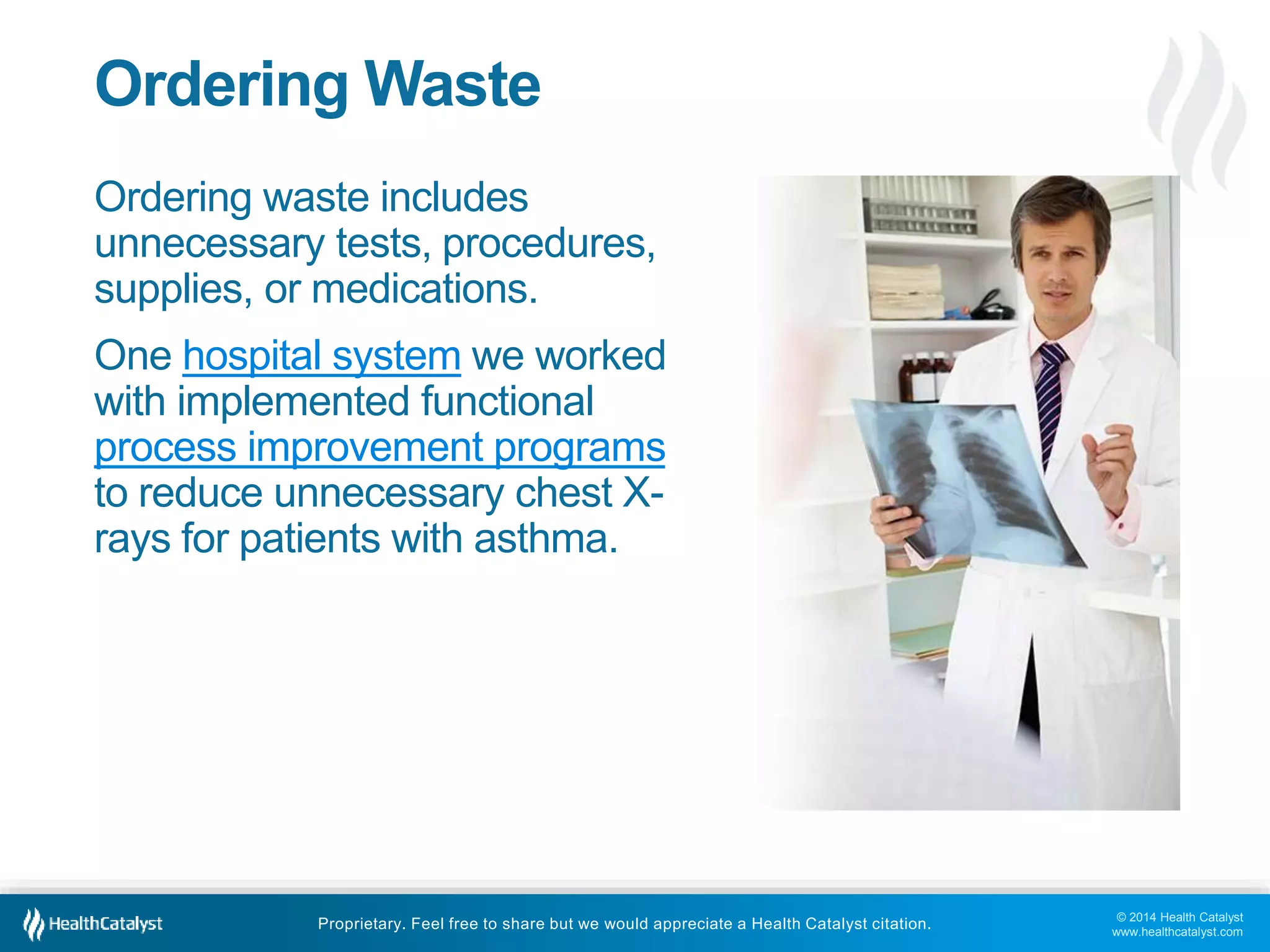
Ordering waste includes
unnecessary tests, procedures,
supplies, or medications.
One hospital system we worked
with implemented functional
process improvement programs
to reduce unnecessary chest X-
rays for patients with asthma.
© 2014 Health Catalyst
www.healthcatalyst.com
Proprietary. Feel free to share but we would appreciate a Health Catalyst citation.
Workflow and Operational Variations
Workflow variation is an area of
waste that typically offers the
largest opportunity for
improvements because of the
significant variation in how or
where care is delivered.
© 2014 Health Catalyst
www.healthcatalyst.com
Proprietary. Feel free to share but we would appreciate a Health Catalyst citation.
Defect Waste
Defect waste is a particularly
concerning form of waste for
health systems. It increases
patient stays, mortality rates,
and cost of care.
Defect waste can potentially
reduce reimbursements.
A 2009 CDC report estimates
that one CLABSI case costs
about $16,550. Defect waste is
also largely preventable.
© 2014 Health Catalyst
www.healthcatalyst.com
Proprietary. Feel free to share but we would appreciate a Health Catalyst citation.
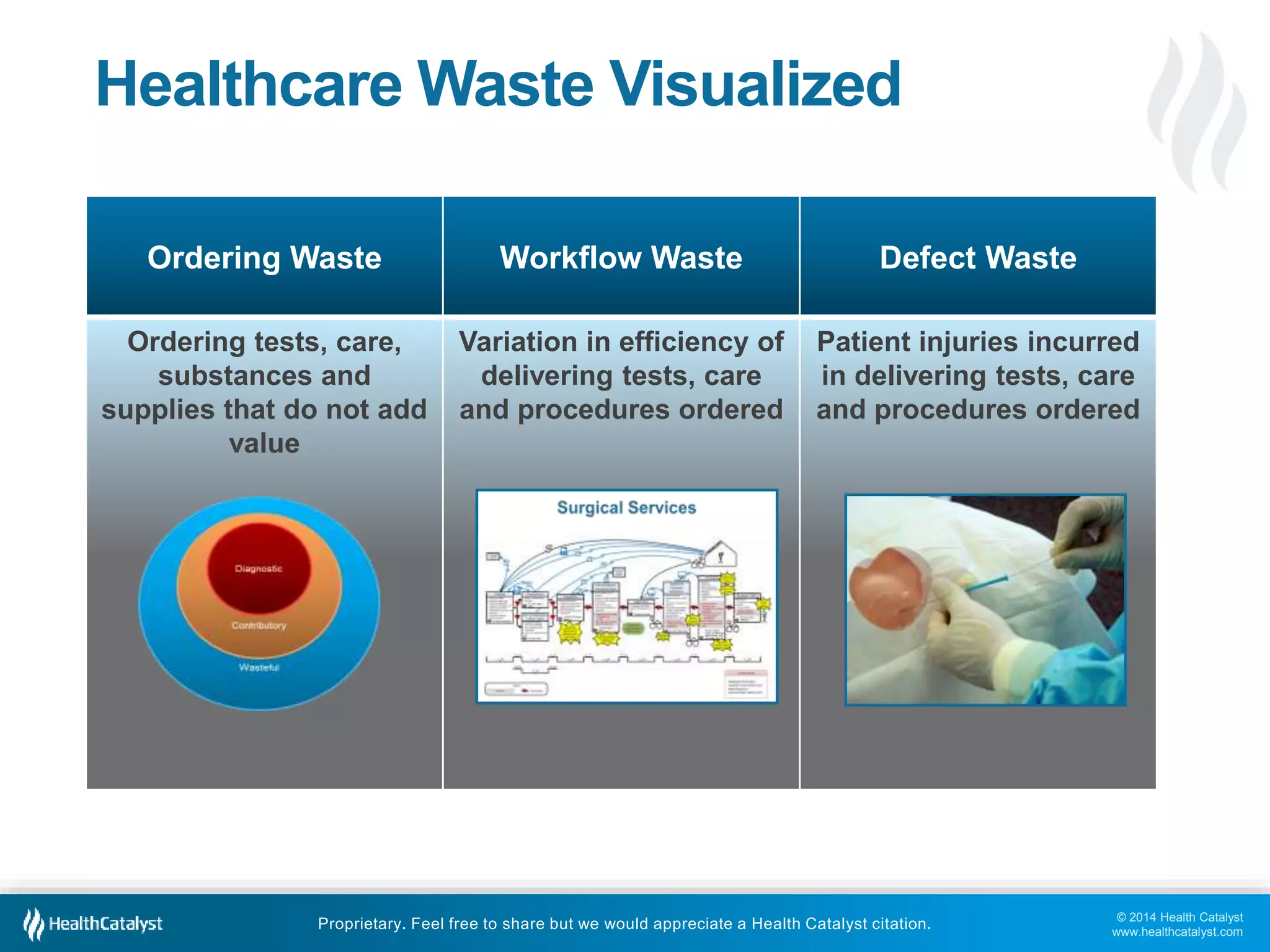
Healthcare Waste Visualized
Ordering Waste Workflow Waste Defect Waste
Ordering tests, care,
substances and
supplies that do not add
value
Variation in efficiency of
delivering tests, care
and procedures ordered
Patient injuries incurred
in delivering tests, care
and procedures ordered
© 2014 Health Catalyst
www.healthcatalyst.com
Proprietary. Feel free to share but we would appreciate a Health Catalyst citation.
Prioritizing Clinical Program Improvement
Identifying which improvement
opportunities will provide the
best return on investment starts
with data collection at the
patient’s bedside.
Use the patient’s data to
understand his or her status
and provide an accurate
charting update.
© 2014 Health Catalyst
www.healthcatalyst.com
Proprietary. Feel free to share but we would appreciate a Health Catalyst citation.
Prioritizing Clinical Program Improvement
Then to understand the
outcomes of a patient group,
use an enterprise data
warehouse (EDW) to analyze
their charts against other
relevant data.
By cross referencing multiple
patient care records, you will
find opportunities to improve
the overall care for an entire
group of patients.
© 2014 Health Catalyst
www.healthcatalyst.com
Proprietary. Feel free to share but we would appreciate a Health Catalyst citation.
Prioritizing Clinical Program Improvement
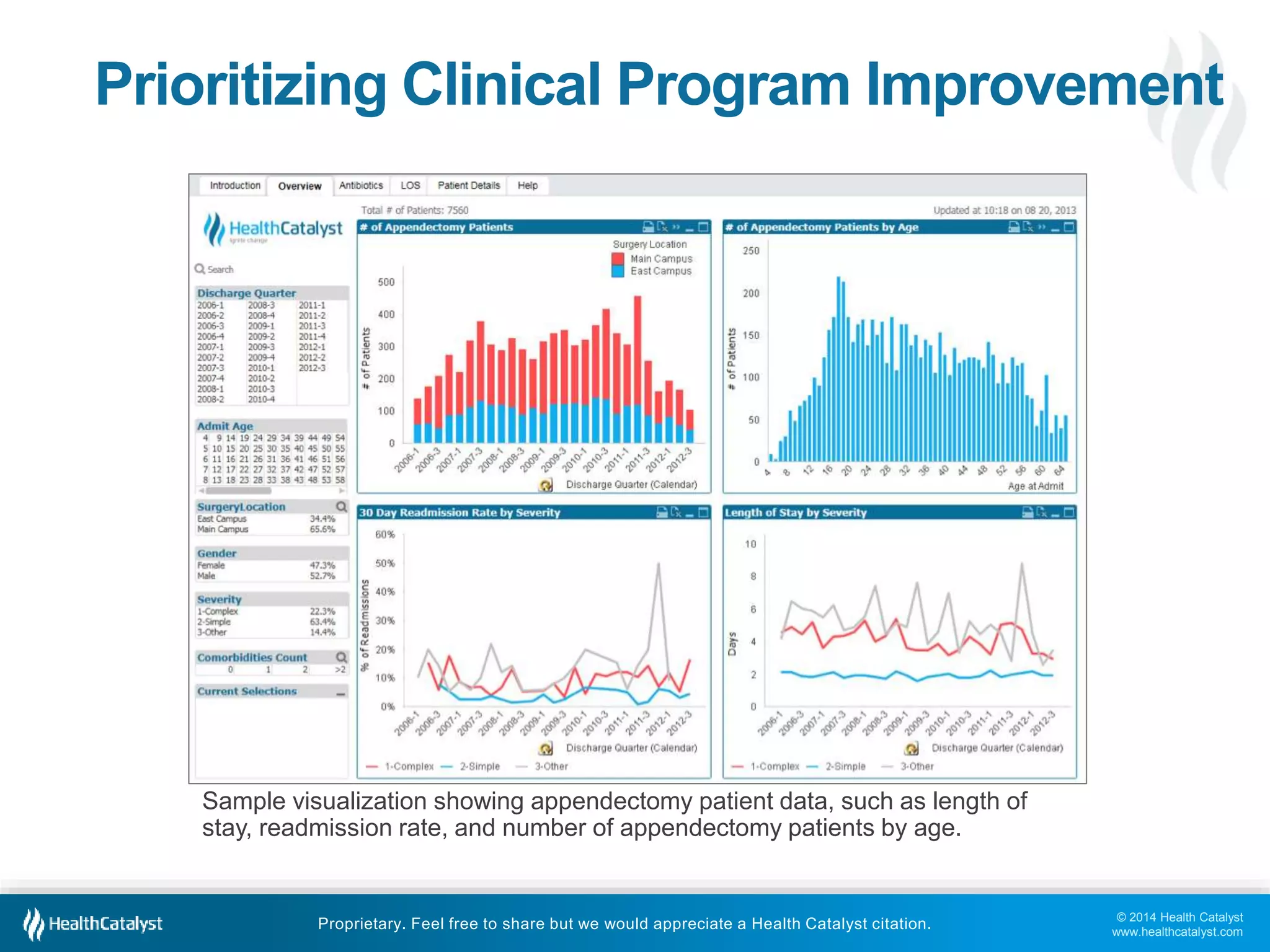
Sample visualization showing appendectomy patient data, such as length of
stay, readmission rate, and number of appendectomy patients by age.
© 2014 Health Catalyst
www.healthcatalyst.com
Proprietary. Feel free to share but we would appreciate a Health Catalyst citation.
The Case for an EDW
The appendectomy example
showed broad and varying data
points are critical when
prioritizing clinical program
improvement projects.
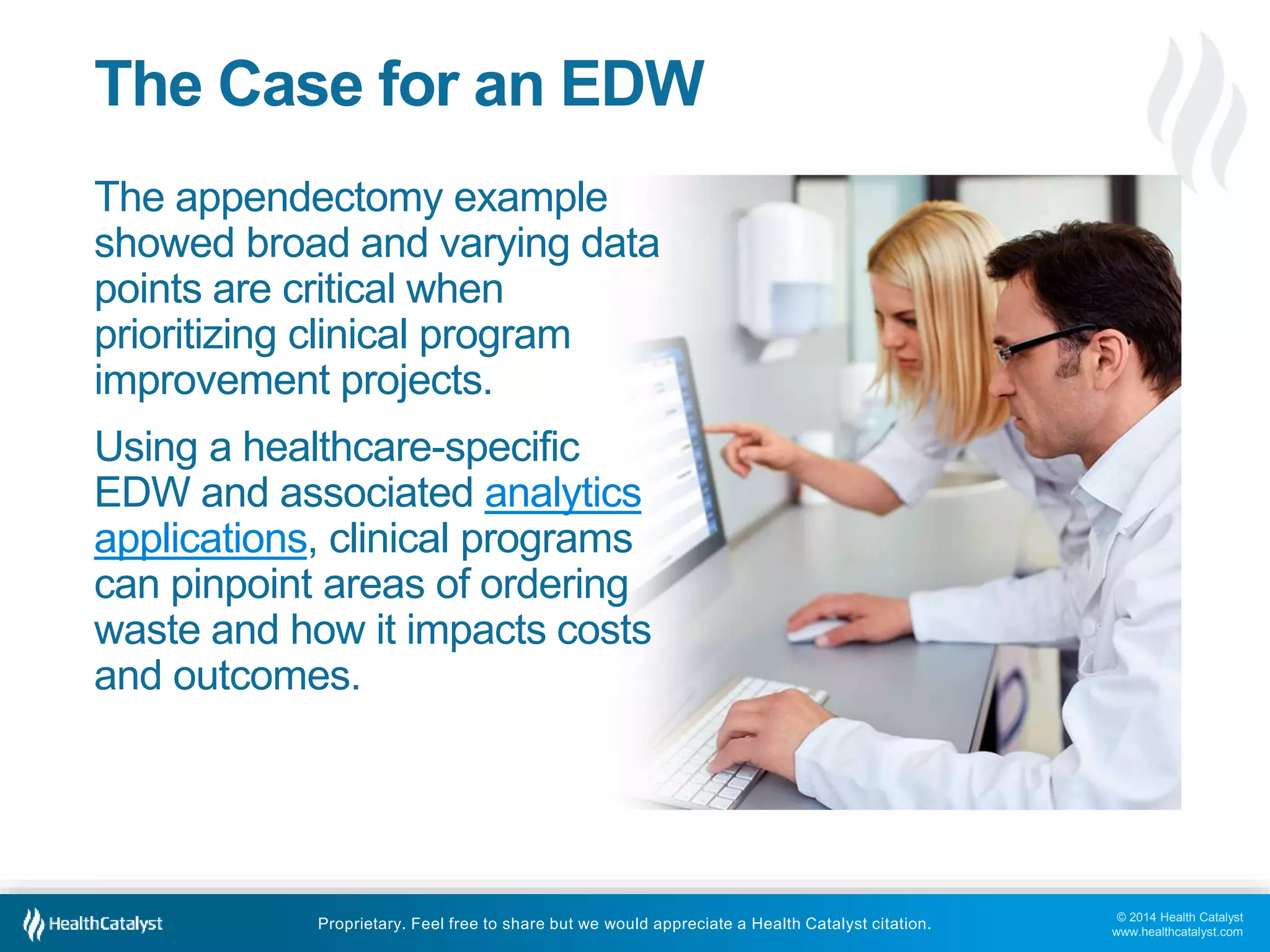
Using a healthcare-specific
EDW and associated analytics
applications, clinical programs
can pinpoint areas of ordering
waste and how it impacts costs
and outcomes.
© 2014 Health Catalyst
www.healthcatalyst.com
Proprietary. Feel free to share but we would appreciate a Health Catalyst citation.
The Case for Advanced Analytic Apps
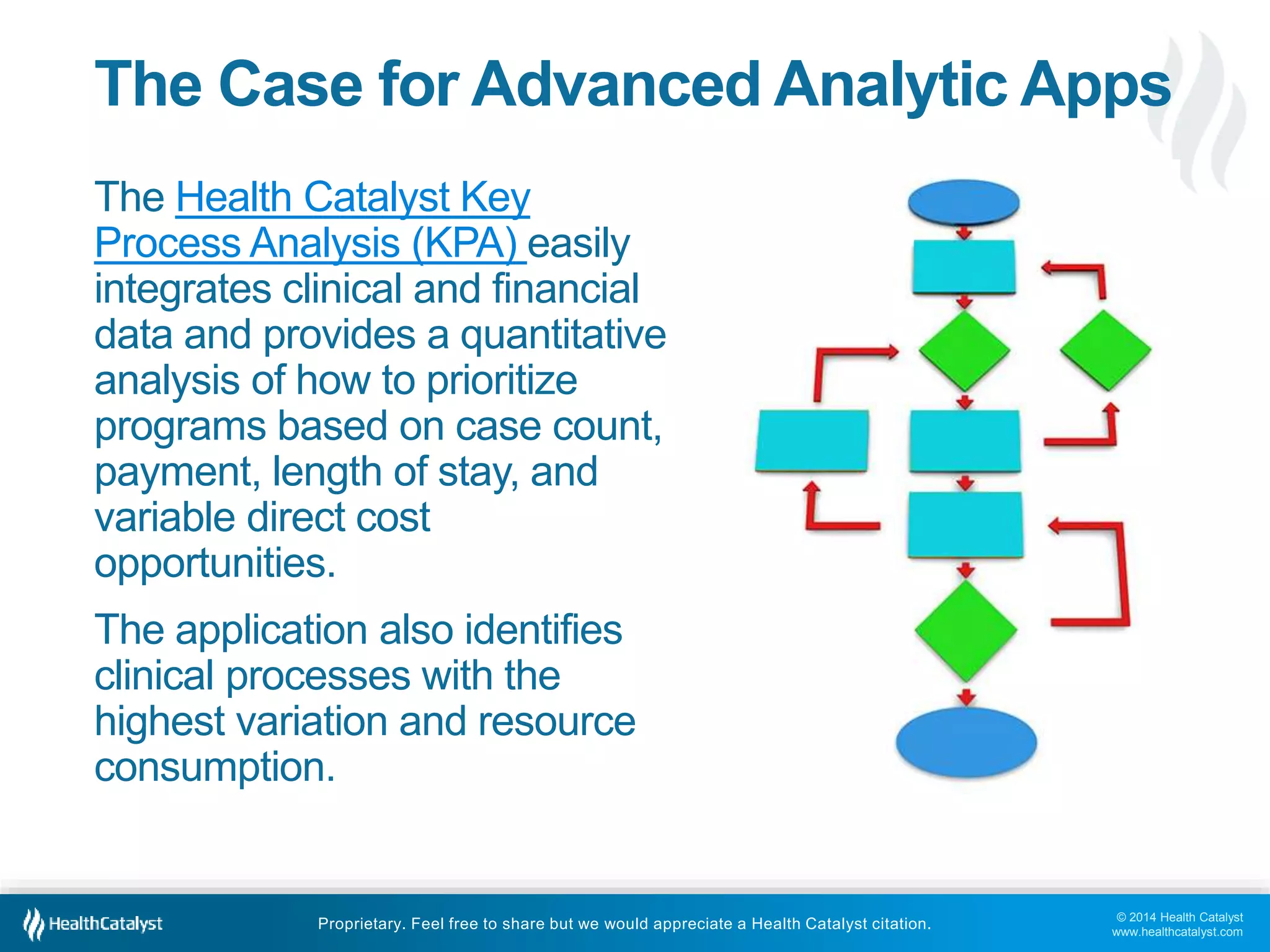
The Health Catalyst Key
Process Analysis (KPA) easily
integrates clinical and financial
data and provides a quantitative
analysis of how to prioritize
programs based on case count,
payment, length of stay, and
variable direct cost
opportunities.
The application also identifies
clinical processes with the
highest variation and resource
consumption.
© 2014 Health Catalyst
www.healthcatalyst.com
Proprietary. Feel free to share but we would appreciate a Health Catalyst citation.
Organizational Readiness Assessments
Another key component when
deciding where to start a quality
improvement project is
organizational readiness.
If the people, culture, or
resources associated with the
work processes aren’t ready to
implement data-driven changes,
the project most likely won’t be
successful or sustainable.
© 2014 Health Catalyst
www.healthcatalyst.com
Proprietary. Feel free to share but we would appreciate a Health Catalyst citation.
Organizational Readiness Assessments
Assessing these areas will help
reveal organizational readiness:
Clinical or operational leadership
Data availability
Shared vision
Administrative support
© 2014 Health Catalyst
www.healthcatalyst.com
Proprietary. Feel free to share but we would appreciate a Health Catalyst citation.
Organizational Readiness Assessments
Clinical or operational leadership
Does the project have the
support and oversight required
to guide the team to success?
Is the commitment sustainable?
Will the project be viewed as a
“one and done” versus a
continuous process of ongoing
improvement?
© 2014 Health Catalyst
www.healthcatalyst.com
Proprietary. Feel free to share but we would appreciate a Health Catalyst citation.
Organizational Readiness Assessments
Data availability
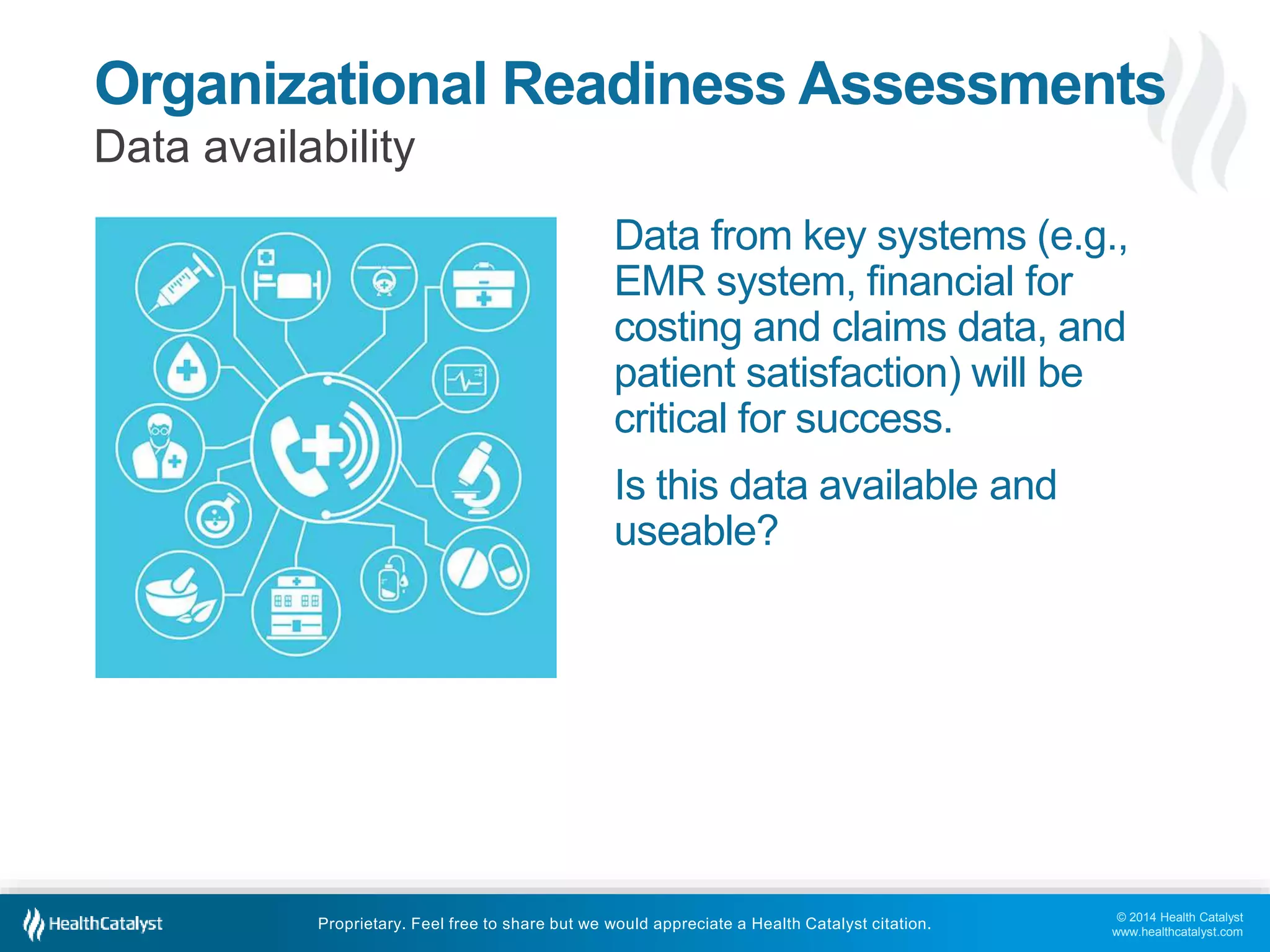
Data from key systems (e.g.,
EMR system, financial for
costing and claims data, and
patient satisfaction) will be
critical for success.
Is this data available and
useable?
© 2014 Health Catalyst
www.healthcatalyst.com
Proprietary. Feel free to share but we would appreciate a Health Catalyst citation.
Organizational Readiness Assessments
Shared vision
Does the quality-improvement
project align with the strategic
direction of those involved in the
delivery of care or the
organization’s goals?
© 2014 Health Catalyst
www.healthcatalyst.com
Proprietary. Feel free to share but we would appreciate a Health Catalyst citation.
Organizational Readiness Assessments
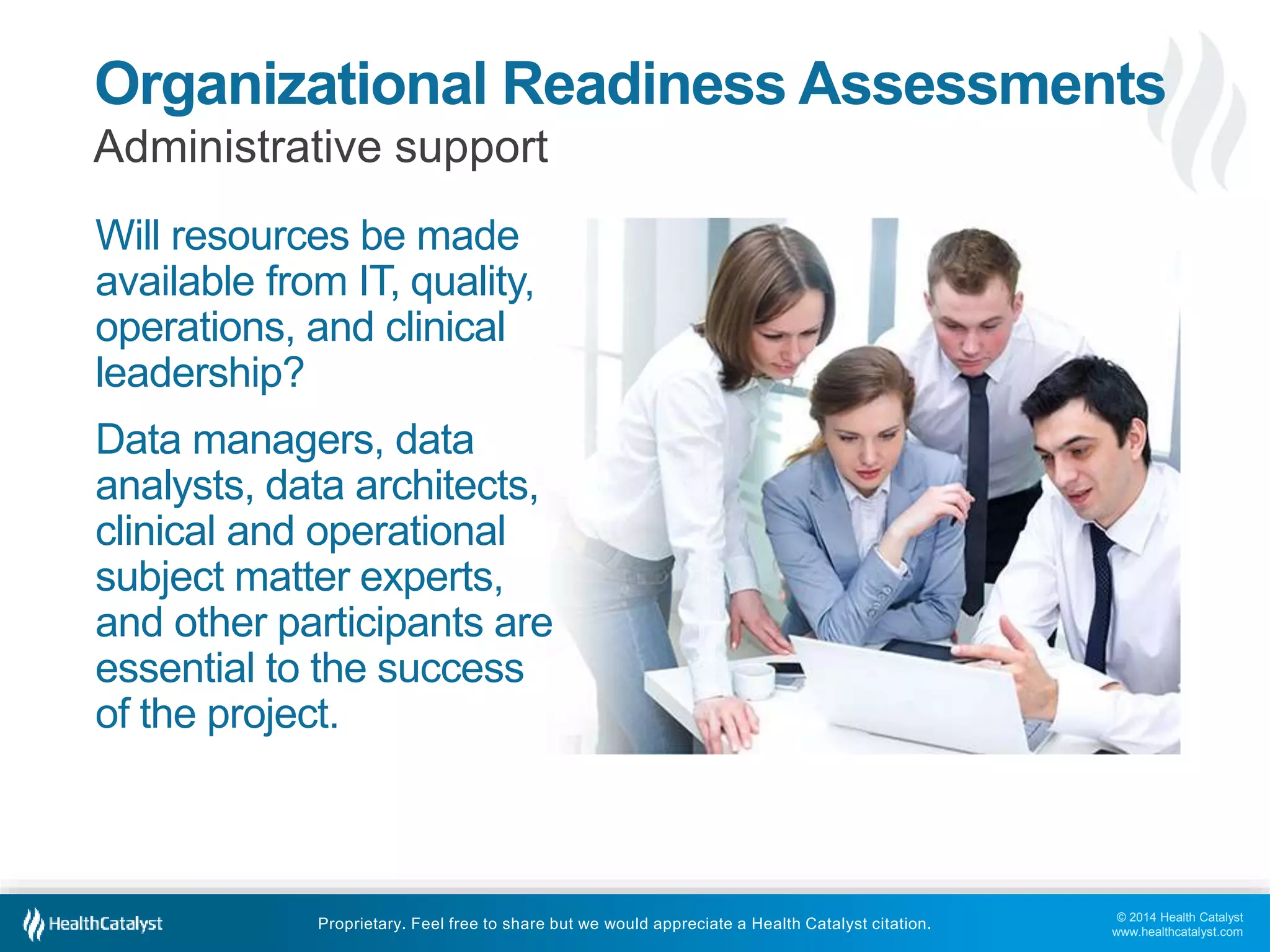
Administrative support
Will resources be made
available from IT, quality,
operations, and clinical
leadership?
Data managers, data
analysts, data architects,
clinical and operational
subject matter experts,
and other participants are
essential to the success
of the project.
© 2014 Health Catalyst
www.healthcatalyst.com
Proprietary. Feel free to share but we would appreciate a Health Catalyst citation.
Breaking the Cycle of Waste
Waste in healthcare creates
many opportunities for
improvements within a health
system’s clinical programs.
An EDW, the KPAApplication,
and an organizational
readiness assessment
combine to drive clinical
program improvements and
break the cycle of waste in
healthcare.
© 2014 Health Catalyst
www.healthcatalyst.com
Proprietary. Feel free to share but we would appreciate a Health Catalyst citation.
More about this topic
Keys to Improving Your Clinical Program Effectiveness
Ann Tinker, VP of Engagement
Overcoming Clinical Data Problems in Quality Improvement Projects
Ann Tinker, VP of Engagement and Kathleen Merkley, VP of Engagement
The Best Analytics Application for Prioritizing Improvement Programs
Bobbi Brown, VP of Financial Engagement
Texas Children’s Hospital Reduces Clinical Quality Improvement Project Time by 85%
A Success Story
Improvement Readiness Assessment: The Key to Achieving the IHI Triple Aim
Ann Tinker, VP of Engagement and Susan Easton, VP of Engagement
Link to original article for a more in-depth discussion.
How to Improve Clinical Programs by Breaking the Cycle of Waste in
Healthcare
© 2014 Health Catalyst
www.healthcatalyst.com
Proprietary. Feel free to share but we would appreciate a Health Catalyst citation.
For more information:
© 2014 Health Catalyst
www.healthcatalyst.com
Proprietary. Feel free to share but we would appreciate a Health Catalyst citation.
Other Clinical Quality Improvement Resources
Click to read additional information at www.healthcatalyst.com
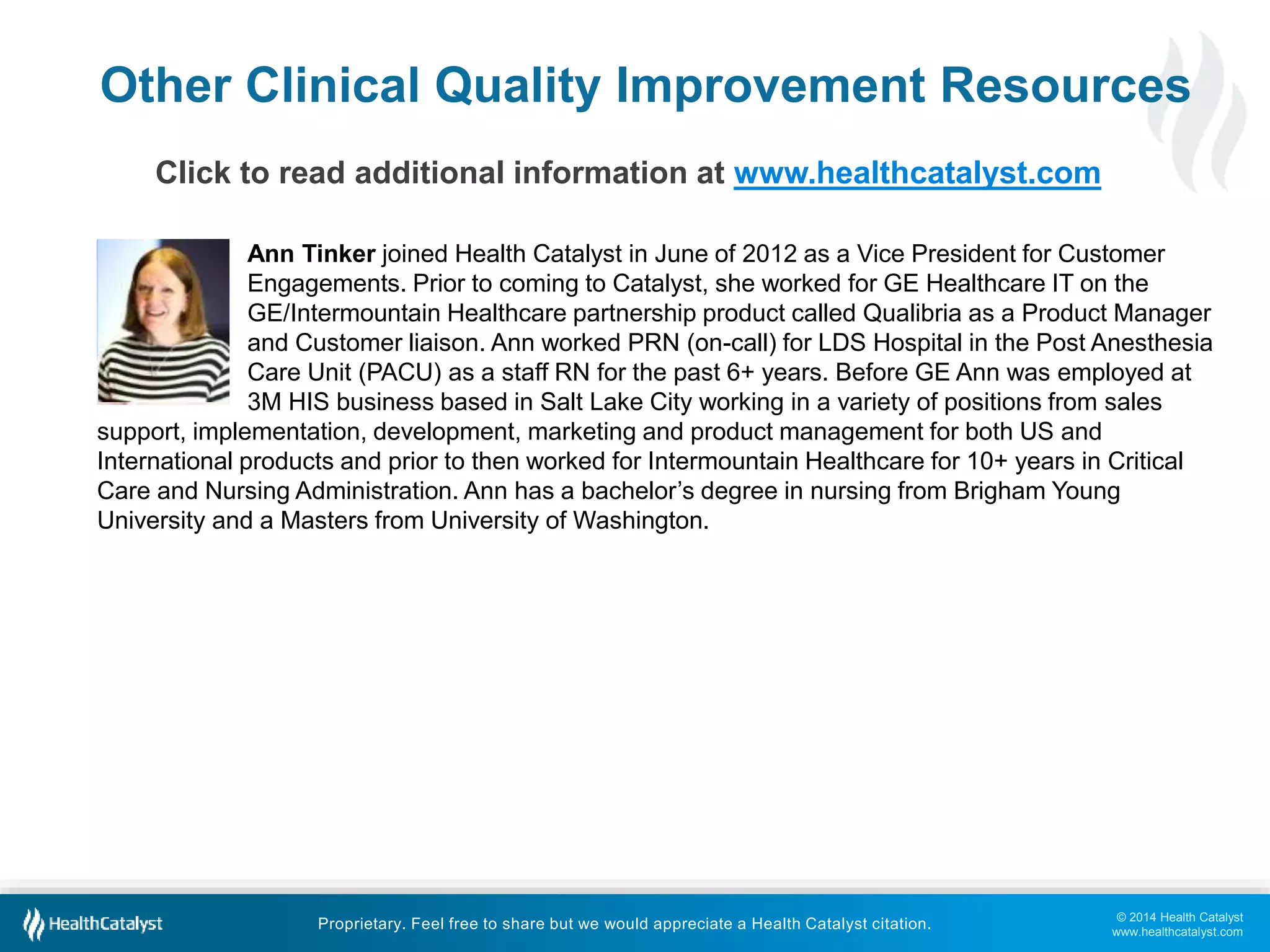
Ann Tinker joined Health Catalyst in June of 2012 as a Vice President for Customer
Engagements. Prior to coming to Catalyst, she worked for GE Healthcare IT on the
GE/Intermountain Healthcare partnership product called Qualibria as a Product Manager
and Customer liaison. Ann worked PRN (on-call) for LDS Hospital in the Post Anesthesia
Care Unit (PACU) as a staff RN for the past 6+ years. Before GE Ann was employed at
3M HIS business based in Salt Lake City working in a variety of positions from sales
support, implementation, development, marketing and product management for both US and
International products and prior to then worked for Intermountain Healthcare for 10+ years in Critical
Care and Nursing Administration. Ann has a bachelor’s degree in nursing from Brigham Young
University and a Masters from University of Washington.

How to Improve Clinical Programs by Breaking the Cycle of Waste in Healthcare

  • 1.
    How to Improve ClinicalPrograms by Breaking the Cycle of Waste in Healthcare - Ann Tinker
  • 2.
    © 2014 HealthCatalyst www.healthcatalyst.com Proprietary. Feel free to share but we would appreciate a Health Catalyst citation. Like Money Down the Drain Waste adds significant costs and doesn’t align with quality processes, it is a prime area for health systems to target for improvement initiatives. There are typically three types of waste in healthcare: 1.Ordering Waste 2.Workflow and Operational Waste 3.Defect Waste
  • 3.
    © 2014 HealthCatalyst www.healthcatalyst.com Proprietary. Feel free to share but we would appreciate a Health Catalyst citation. Ordering Waste Ordering waste includes unnecessary tests, procedures, supplies, or medications. One hospital system we worked with implemented functional process improvement programs to reduce unnecessary chest X- rays for patients with asthma.
  • 4.
    © 2014 HealthCatalyst www.healthcatalyst.com Proprietary. Feel free to share but we would appreciate a Health Catalyst citation. Workflow and Operational Variations Workflow variation is an area of waste that typically offers the largest opportunity for improvements because of the significant variation in how or where care is delivered.
  • 5.
    © 2014 HealthCatalyst www.healthcatalyst.com Proprietary. Feel free to share but we would appreciate a Health Catalyst citation. Defect Waste Defect waste is a particularly concerning form of waste for health systems. It increases patient stays, mortality rates, and cost of care. Defect waste can potentially reduce reimbursements. A 2009 CDC report estimates that one CLABSI case costs about $16,550. Defect waste is also largely preventable.
  • 6.
    © 2014 HealthCatalyst www.healthcatalyst.com Proprietary. Feel free to share but we would appreciate a Health Catalyst citation. Healthcare Waste Visualized Ordering Waste Workflow Waste Defect Waste Ordering tests, care, substances and supplies that do not add value Variation in efficiency of delivering tests, care and procedures ordered Patient injuries incurred in delivering tests, care and procedures ordered
  • 7.
    © 2014 HealthCatalyst www.healthcatalyst.com Proprietary. Feel free to share but we would appreciate a Health Catalyst citation. Prioritizing Clinical Program Improvement Identifying which improvement opportunities will provide the best return on investment starts with data collection at the patient’s bedside. Use the patient’s data to understand his or her status and provide an accurate charting update.
  • 8.
    © 2014 HealthCatalyst www.healthcatalyst.com Proprietary. Feel free to share but we would appreciate a Health Catalyst citation. Prioritizing Clinical Program Improvement Then to understand the outcomes of a patient group, use an enterprise data warehouse (EDW) to analyze their charts against other relevant data. By cross referencing multiple patient care records, you will find opportunities to improve the overall care for an entire group of patients.
  • 9.
    © 2014 HealthCatalyst www.healthcatalyst.com Proprietary. Feel free to share but we would appreciate a Health Catalyst citation. Prioritizing Clinical Program Improvement Sample visualization showing appendectomy patient data, such as length of stay, readmission rate, and number of appendectomy patients by age.
  • 10.
    © 2014 HealthCatalyst www.healthcatalyst.com Proprietary. Feel free to share but we would appreciate a Health Catalyst citation. The Case for an EDW The appendectomy example showed broad and varying data points are critical when prioritizing clinical program improvement projects. Using a healthcare-specific EDW and associated analytics applications, clinical programs can pinpoint areas of ordering waste and how it impacts costs and outcomes.
  • 11.
    © 2014 HealthCatalyst www.healthcatalyst.com Proprietary. Feel free to share but we would appreciate a Health Catalyst citation. The Case for Advanced Analytic Apps The Health Catalyst Key Process Analysis (KPA) easily integrates clinical and financial data and provides a quantitative analysis of how to prioritize programs based on case count, payment, length of stay, and variable direct cost opportunities. The application also identifies clinical processes with the highest variation and resource consumption.
  • 12.
    © 2014 HealthCatalyst www.healthcatalyst.com Proprietary. Feel free to share but we would appreciate a Health Catalyst citation. Organizational Readiness Assessments Another key component when deciding where to start a quality improvement project is organizational readiness. If the people, culture, or resources associated with the work processes aren’t ready to implement data-driven changes, the project most likely won’t be successful or sustainable.
  • 13.
    © 2014 HealthCatalyst www.healthcatalyst.com Proprietary. Feel free to share but we would appreciate a Health Catalyst citation. Organizational Readiness Assessments Assessing these areas will help reveal organizational readiness: Clinical or operational leadership Data availability Shared vision Administrative support
  • 14.
    © 2014 HealthCatalyst www.healthcatalyst.com Proprietary. Feel free to share but we would appreciate a Health Catalyst citation. Organizational Readiness Assessments Clinical or operational leadership Does the project have the support and oversight required to guide the team to success? Is the commitment sustainable? Will the project be viewed as a “one and done” versus a continuous process of ongoing improvement?
  • 15.
    © 2014 HealthCatalyst www.healthcatalyst.com Proprietary. Feel free to share but we would appreciate a Health Catalyst citation. Organizational Readiness Assessments Data availability Data from key systems (e.g., EMR system, financial for costing and claims data, and patient satisfaction) will be critical for success. Is this data available and useable?
  • 16.
    © 2014 HealthCatalyst www.healthcatalyst.com Proprietary. Feel free to share but we would appreciate a Health Catalyst citation. Organizational Readiness Assessments Shared vision Does the quality-improvement project align with the strategic direction of those involved in the delivery of care or the organization’s goals?
  • 17.
    © 2014 HealthCatalyst www.healthcatalyst.com Proprietary. Feel free to share but we would appreciate a Health Catalyst citation. Organizational Readiness Assessments Administrative support Will resources be made available from IT, quality, operations, and clinical leadership? Data managers, data analysts, data architects, clinical and operational subject matter experts, and other participants are essential to the success of the project.
  • 18.
    © 2014 HealthCatalyst www.healthcatalyst.com Proprietary. Feel free to share but we would appreciate a Health Catalyst citation. Breaking the Cycle of Waste Waste in healthcare creates many opportunities for improvements within a health system’s clinical programs. An EDW, the KPAApplication, and an organizational readiness assessment combine to drive clinical program improvements and break the cycle of waste in healthcare.
  • 19.
    © 2014 HealthCatalyst www.healthcatalyst.com Proprietary. Feel free to share but we would appreciate a Health Catalyst citation. More about this topic Keys to Improving Your Clinical Program Effectiveness Ann Tinker, VP of Engagement Overcoming Clinical Data Problems in Quality Improvement Projects Ann Tinker, VP of Engagement and Kathleen Merkley, VP of Engagement The Best Analytics Application for Prioritizing Improvement Programs Bobbi Brown, VP of Financial Engagement Texas Children’s Hospital Reduces Clinical Quality Improvement Project Time by 85% A Success Story Improvement Readiness Assessment: The Key to Achieving the IHI Triple Aim Ann Tinker, VP of Engagement and Susan Easton, VP of Engagement Link to original article for a more in-depth discussion. How to Improve Clinical Programs by Breaking the Cycle of Waste in Healthcare
  • 20.
    © 2014 HealthCatalyst www.healthcatalyst.com Proprietary. Feel free to share but we would appreciate a Health Catalyst citation. For more information:
  • 21.
    © 2014 HealthCatalyst www.healthcatalyst.com Proprietary. Feel free to share but we would appreciate a Health Catalyst citation. Other Clinical Quality Improvement Resources Click to read additional information at www.healthcatalyst.com Ann Tinker joined Health Catalyst in June of 2012 as a Vice President for Customer Engagements. Prior to coming to Catalyst, she worked for GE Healthcare IT on the GE/Intermountain Healthcare partnership product called Qualibria as a Product Manager and Customer liaison. Ann worked PRN (on-call) for LDS Hospital in the Post Anesthesia Care Unit (PACU) as a staff RN for the past 6+ years. Before GE Ann was employed at 3M HIS business based in Salt Lake City working in a variety of positions from sales support, implementation, development, marketing and product management for both US and International products and prior to then worked for Intermountain Healthcare for 10+ years in Critical Care and Nursing Administration. Ann has a bachelor’s degree in nursing from Brigham Young University and a Masters from University of Washington.