How to Measure Health Outcomes that
Matter to Everyone
̶ Josh Ferguson
© 2016 Health Catalyst
Proprietary. Feel free to share but we would appreciate a Health Catalyst citation.
Outcome Measurements that Matter
Today’s healthcare industry is consumed by an
urgency to measure and improve outcomes.
The switch to outcomes-based healthcare is
incredibly positive, but it also has many
organizations scrambling to put together data-
driven improvement programs.
This rush, though necessary, often results in
reactionary and haphazard plans for outcomes
improvement.
Using a few key ideas, organizations can improve
how to measure health outcomes and take steps
toward real improvements in quality and cost.
© 2016 Health Catalyst
Proprietary. Feel free to share but we would appreciate a Health Catalyst citation.
Regulatory Requirements vs. Outcomes Improvement
As the industry accelerates its focus on
improving outcomes, a virtual flood of new
regulatory requirements continue to arise.
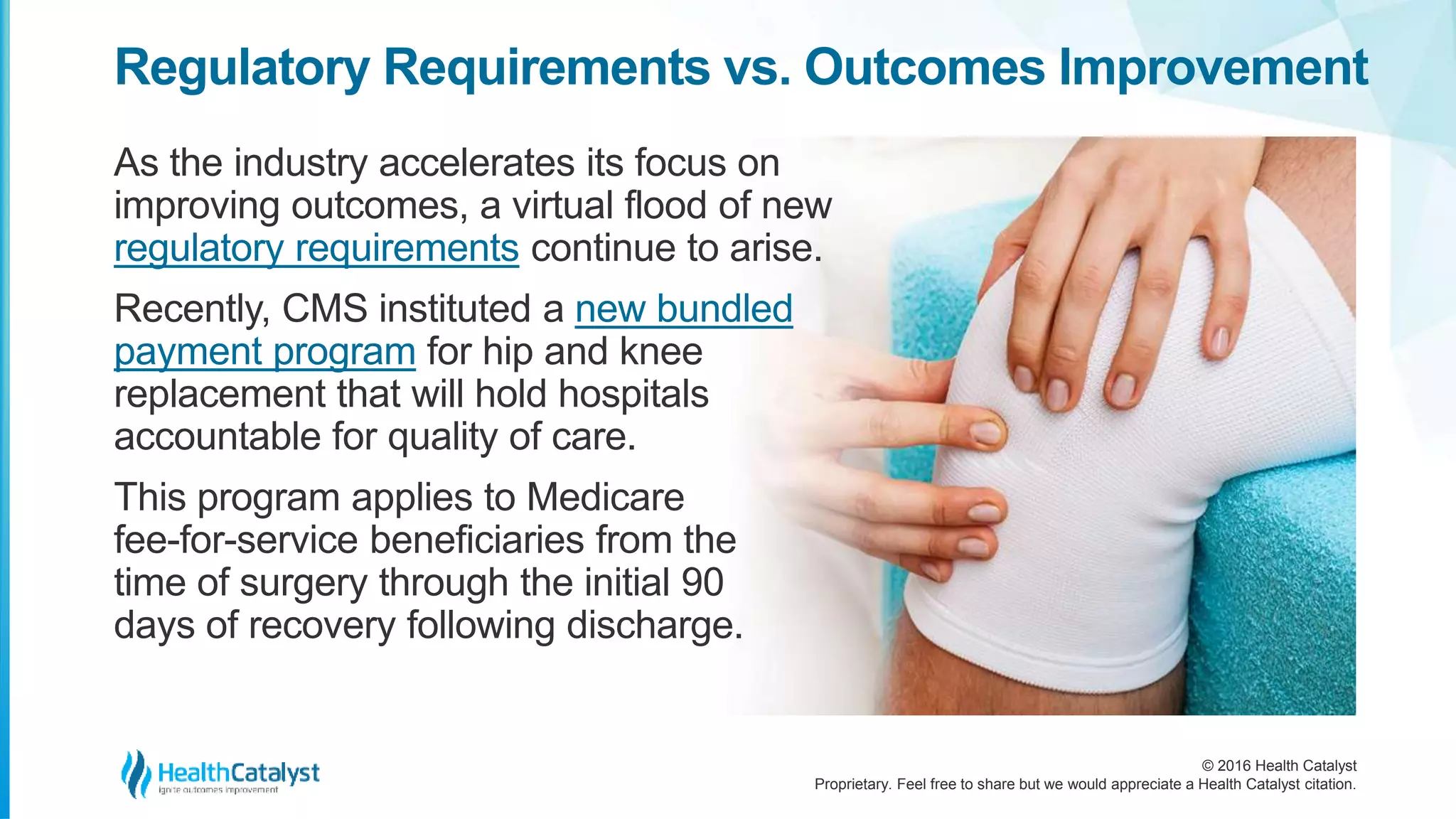
Recently, CMS instituted a new bundled
payment program for hip and knee
replacement that will hold hospitals
accountable for quality of care.
This program applies to Medicare
fee-for-service beneficiaries from the
time of surgery through the initial 90
days of recovery following discharge.
© 2016 Health Catalyst
Proprietary. Feel free to share but we would appreciate a Health Catalyst citation.
Regulatory Requirements vs. Outcomes Improvement
While initially restricted to a limited number
of geographic areas, it has the potential to
become the standard method by which
CMS will hold hospitals accountable for
delivering high-quality care in the near
future, including care areas beyond the
hip and knee patient population.
© 2016 Health Catalyst
Proprietary. Feel free to share but we would appreciate a Health Catalyst citation.
Regulatory Requirements vs. Outcomes Improvement
At times, regulatory requirements can
create a national focus on common
goals and standards.
Achieving the benchmarks established
from regulatory requirements should not
be seen as the final organizational
destination on the journey to continued
outcomes improvement.
Rather, regulatory requirements should
be seen as one leg of a multi-leg journey
on the way to change and adaptation.
© 2016 Health Catalyst
Proprietary. Feel free to share but we would appreciate a Health Catalyst citation.
Regulatory Requirements vs. Outcomes Improvement
For example, there are national
standards for stroke care improvement
and for providing certain types of care
within a specific time window.
With stroke, time is crucial, and
depending on many factors, tPA, an
IV medication, may be used to
dissolve a blood clot in the brain.
The national guideline is to begin
administering tPA within 60 minutes
of a patient arriving at the Emergency
Department.
© 2016 Health Catalyst
Proprietary. Feel free to share but we would appreciate a Health Catalyst citation.
Regulatory Requirements vs. Outcomes Improvement
If an organization achieves this measure,
it doesn’t mean the work is over, or that
the outcome has been achieved.
Instead, the team should begin looking to
the next leg of the journey and seeking
how to shorten administration time even
further so the majority of patients have a
door-to-needle time of, say, less than
45 minutes.
© 2016 Health Catalyst
Proprietary. Feel free to share but we would appreciate a Health Catalyst citation.
Regulatory Requirements vs. Outcomes Improvement
In healthcare, we often use surrogate
outcome markers and process measures
for improvement because some outcome
metrics are often difficult to collect.
When measuring outcomes, we often
focus on length of stay or mortality rates;
these metrics are often readily available
and easily calculated.
But do these represent true outcomes?
No, our best outcome metrics speak
to the health and functional status
of the individual…
© 2016 Health Catalyst
Proprietary. Feel free to share but we would appreciate a Health Catalyst citation.
Regulatory Requirements vs. Outcomes Improvement
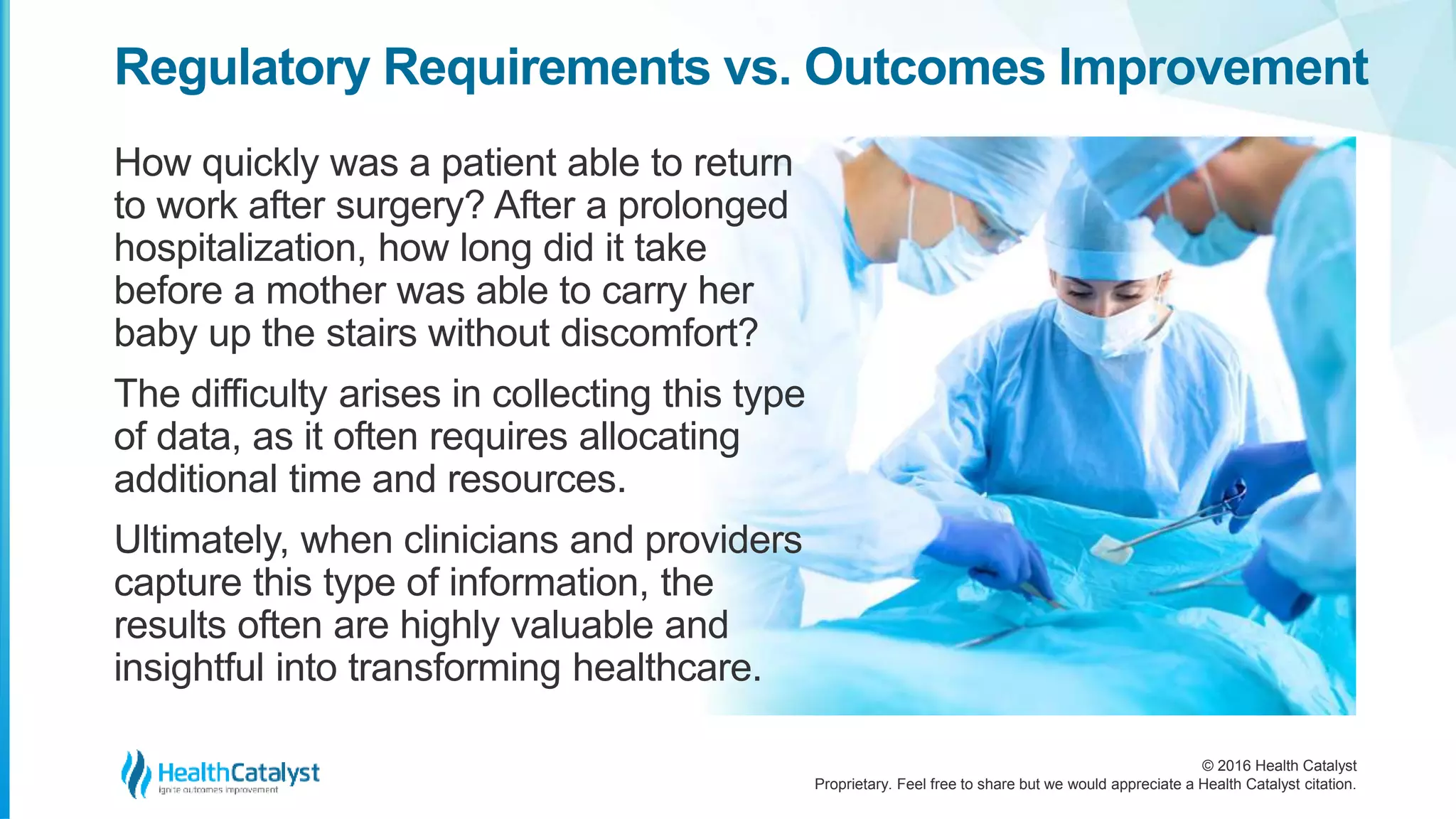
How quickly was a patient able to return
to work after surgery? After a prolonged
hospitalization, how long did it take
before a mother was able to carry her
baby up the stairs without discomfort?
The difficulty arises in collecting this type
of data, as it often requires allocating
additional time and resources.
Ultimately, when clinicians and providers
capture this type of information, the
results often are highly valuable and
insightful into transforming healthcare.
© 2016 Health Catalyst
Proprietary. Feel free to share but we would appreciate a Health Catalyst citation.
Regulatory Requirements vs. Outcomes Improvement
In 2003, Dr. Margaret Herridge and her
colleagues at the TGRI, published a
landmark article in the New England
Journal of Medicine that looked at one-
year outcomes in survivors of acute
respiratory distress syndrome (ARDS).
Margaret S Herridge
BSc, MSc, MPH, MD, FRCPC
Toronto General Research Institute (TGRI)
© 2016 Health Catalyst
Proprietary. Feel free to share but we would appreciate a Health Catalyst citation.
Regulatory Requirements vs. Outcomes Improvement
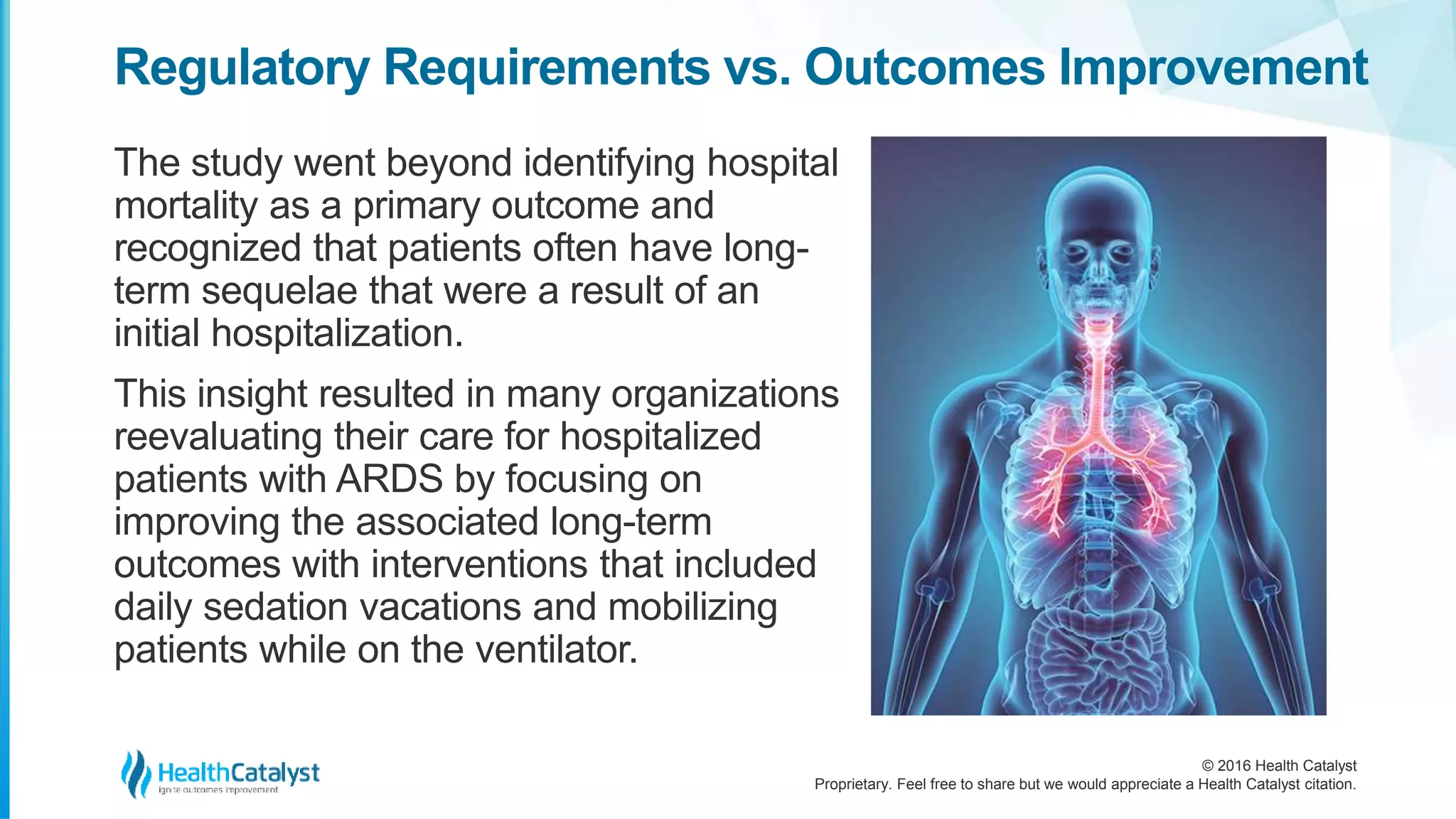
The study went beyond identifying hospital
mortality as a primary outcome and
recognized that patients often have long-
term sequelae that were a result of an
initial hospitalization.
This insight resulted in many organizations
reevaluating their care for hospitalized
patients with ARDS by focusing on
improving the associated long-term
outcomes with interventions that included
daily sedation vacations and mobilizing
patients while on the ventilator.
© 2016 Health Catalyst
Proprietary. Feel free to share but we would appreciate a Health Catalyst citation.
Regulatory Requirements vs. Outcomes Improvement
We need to look at both outcome and
process metrics in order to establish
quality-improvement programs.
The need to react to new regulatory
requirements and to focus on metrics
with an associated incentive or penalty
won’t go away anytime soon.
Healthcare must transition from
reactionary outcomes measurements to
a thoughtful, proactive process for
selecting outcome measures.
© 2016 Health Catalyst
Proprietary. Feel free to share but we would appreciate a Health Catalyst citation.
Avoid the Outcomes Measures Graveyard
An outcomes measures graveyard is
full of metrics designed with good
intentions, but are of limited utility.
With so many human, financial, and
operational resources required to
improve outcomes, we need to ensure
all efforts are strategically aligned with
an organization’s goals and value.
At the same time we must consider
how much data being collected is
useful and necessary.
© 2016 Health Catalyst
Proprietary. Feel free to share but we would appreciate a Health Catalyst citation.
Avoid the Outcomes Measures Graveyard
It’s easy to get excited about the
possibilities inherent in data. We often
fail to consider the strain data capture
can put on busy healthcare teams.
For the most part, data collection for
outcomes measures requires providers
and clinicians to document an evidence-
based process or action.
The additional time spent documenting
often results in loss of time at the
patient’s bedside providing direct care.
© 2016 Health Catalyst
Proprietary. Feel free to share but we would appreciate a Health Catalyst citation.
Avoid the Outcomes Measures Graveyard
Precise outcomes measurement
requires planning. It begins with asking
the right questions, such as:
By requiring this to be documented, are we truly
improving patient care?
How many items of information are we requiring
providers or clinicians to document?
How often will we really use the information?
How many of these pieces of information
actually matter to the outcome?
© 2016 Health Catalyst
Proprietary. Feel free to share but we would appreciate a Health Catalyst citation.
Avoid the Outcomes Measures Graveyard
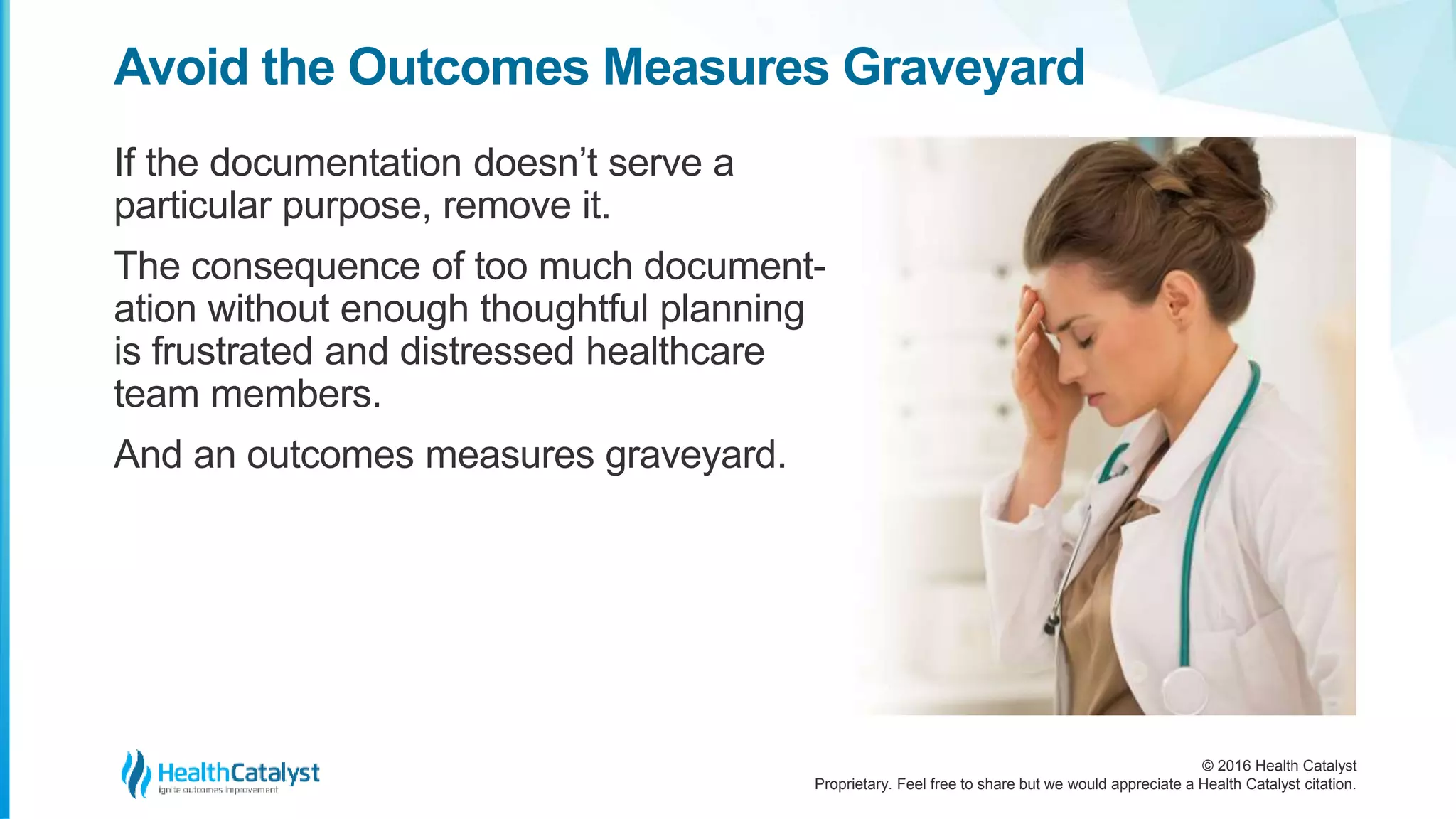
If the documentation doesn’t serve a
particular purpose, remove it.
The consequence of too much document-
ation without enough thoughtful planning
is frustrated and distressed healthcare
team members.
And an outcomes measures graveyard.
© 2016 Health Catalyst
Proprietary. Feel free to share but we would appreciate a Health Catalyst citation.
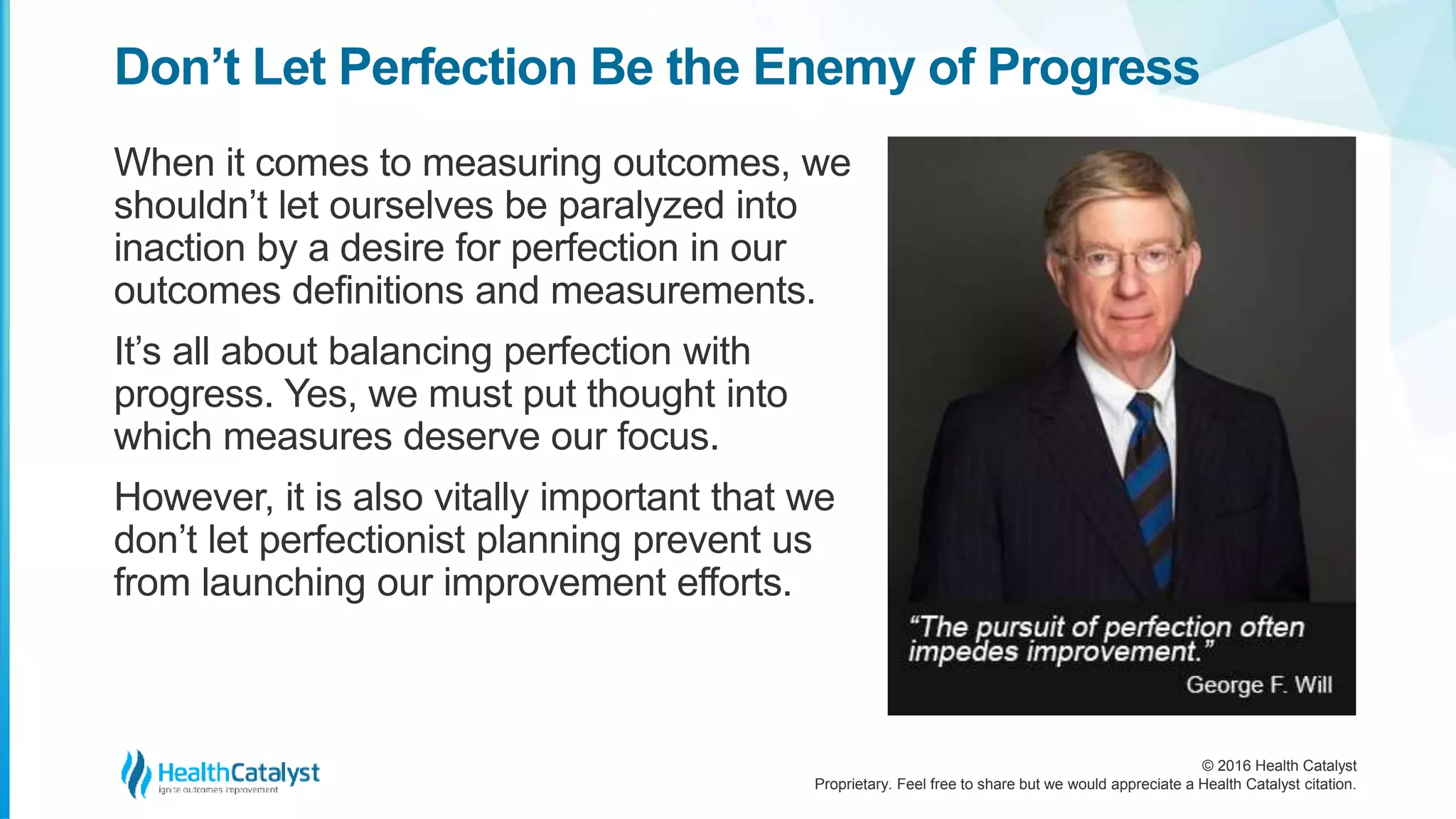
Don’t Let Perfection Be the Enemy of Progress
When it comes to measuring outcomes, we
shouldn’t let ourselves be paralyzed into
inaction by a desire for perfection in our
outcomes definitions and measurements.
It’s all about balancing perfection with
progress. Yes, we must put thought into
which measures deserve our focus.
However, it is also vitally important that we
don’t let perfectionist planning prevent us
from launching our improvement efforts.
© 2016 Health Catalyst
Proprietary. Feel free to share but we would appreciate a Health Catalyst citation.
Don’t Let Perfection Be the Enemy of Progress
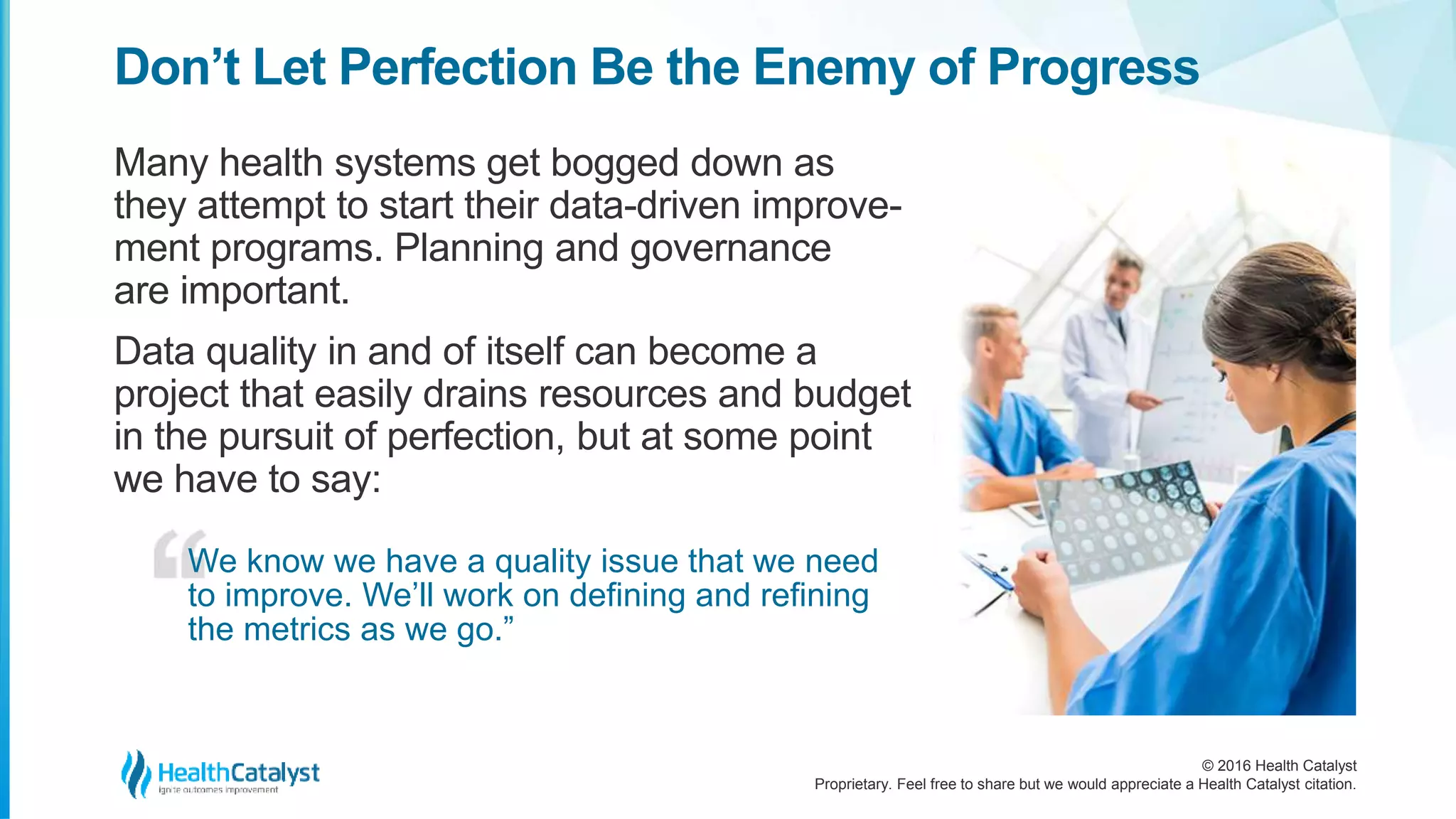
Many health systems get bogged down as
they attempt to start their data-driven improve-
ment programs. Planning and governance
are important.
Data quality in and of itself can become a
project that easily drains resources and budget
in the pursuit of perfection, but at some point
we have to say:
We know we have a quality issue that we need
to improve. We’ll work on defining and refining
the metrics as we go.”
© 2016 Health Catalyst
Proprietary. Feel free to share but we would appreciate a Health Catalyst citation.
Consider the Perspective of Different Stakeholders
When creating a quality improvement initiative,
it’s important to consider how different metrics
are relevant to different stakeholders.
Someone with a finance background may see
data through a different lens than someone
with a regulatory or purely clinical background.
In fact, the richest and most useful
outcomes measure results from
bringing different stakeholders
together to understand the purpose
of the project or rather, the “why.”
© 2016 Health Catalyst
Proprietary. Feel free to share but we would appreciate a Health Catalyst citation.
Consider the Perspective of Different Stakeholders
At the very least, organizations should consider
soliciting input from providers and clinicians
when designing improvement projects.
Not only will they provide vital feedback
regarding how well a measure is designed,
they often have some of the best ideas
on how to improve overall quality.
And because clinicians are typically
the stakeholders most affected by an
improvement initiative, their engage-
ment and alignment with the improvement
strategy is the ultimate key to success.
© 2016 Health Catalyst
Proprietary. Feel free to share but we would appreciate a Health Catalyst citation.
Metrics Are More than Numbers—They Represent Lives
Sometimes, as we deal with measuring
outcomes to meet regulatory requirements
or to keep the organization in the black, we
get caught up in jargon and politics.
Ultimately, we must remember that these
metrics represent actual patients and real
health outcomes; we can’t afford to lose
sight of that as we move forward.
We must remember the why. The patient
needs to be at the center of our actions.
© 2016 Health Catalyst
Proprietary. Feel free to share but we would appreciate a Health Catalyst citation.
Metrics Are More than Numbers—They Represent Lives
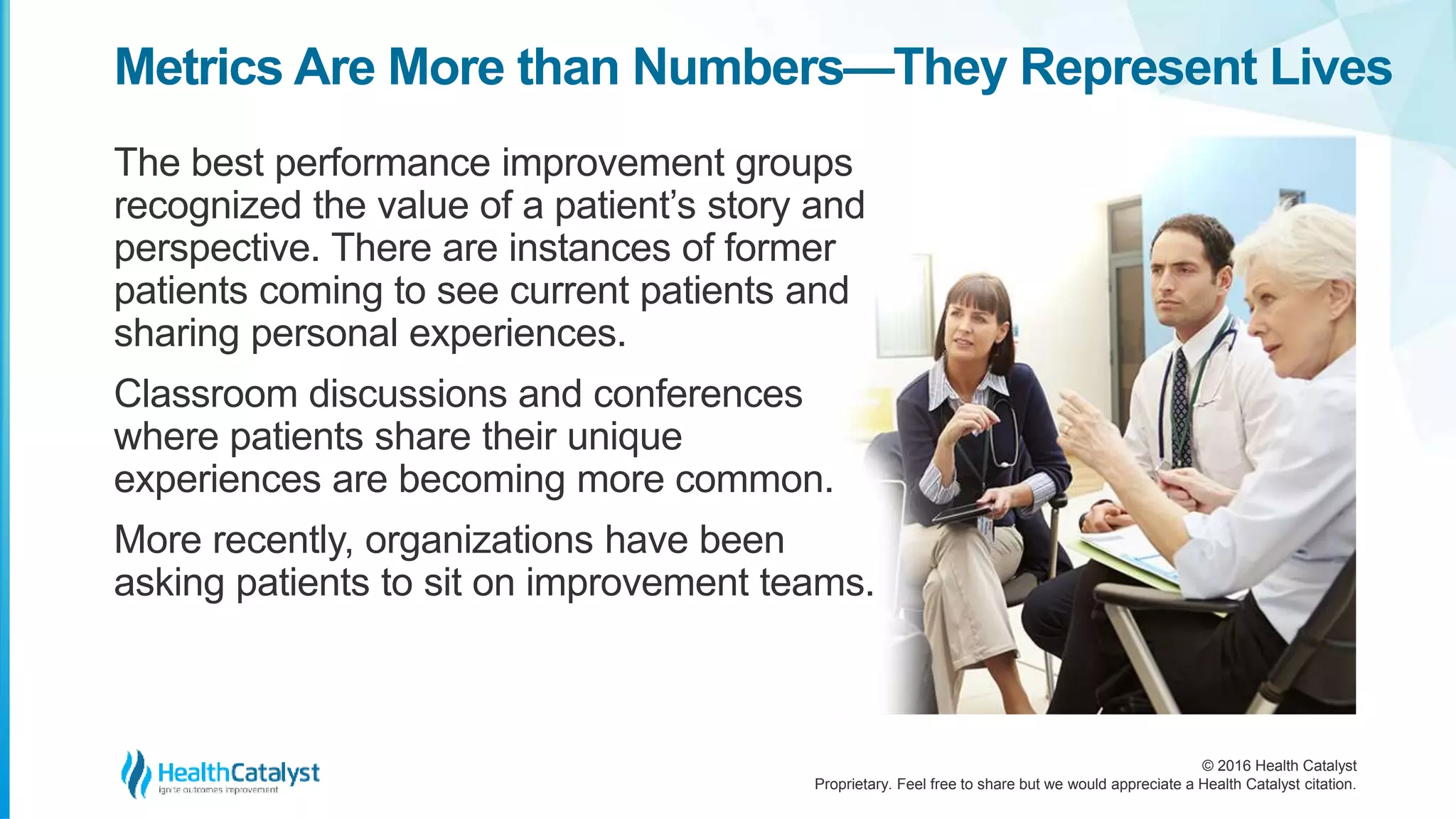
The best performance improvement groups
recognized the value of a patient’s story and
perspective. There are instances of former
patients coming to see current patients and
sharing personal experiences.
Classroom discussions and conferences
where patients share their unique
experiences are becoming more common.
More recently, organizations have been
asking patients to sit on improvement teams.
© 2016 Health Catalyst
Proprietary. Feel free to share but we would appreciate a Health Catalyst citation.
Metrics Are More than Numbers—They Represent Lives
We need to focus on outcomes metrics that
speak to the health and functional status of
individual patients. We need to understand
that this is a progressive, iterative process.
We need to involve the stakeholders who
have a vested interest in outcomes
measurement and improvement, who are
catalysts for continuous, long-term change.
Finally, we need to remember that patients
are why we need to continuously improve
how we measure health outcomes.
© 2016 Health Catalyst
Proprietary. Feel free to share but we would appreciate a Health Catalyst citation.
For more information:
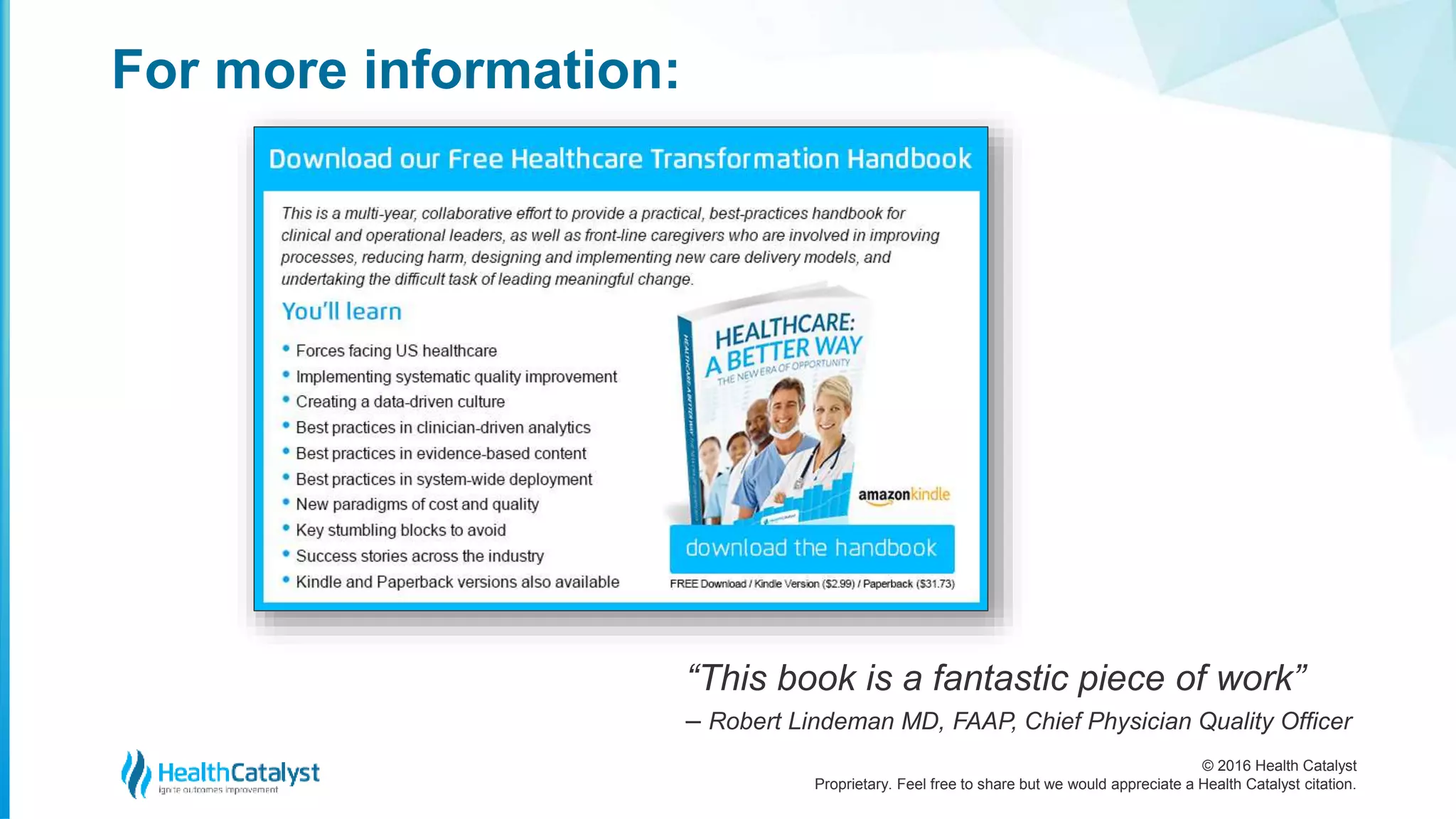
“This book is a fantastic piece of work”
– Robert Lindeman MD, FAAP, Chief Physician Quality Officer
© 2016 Health Catalyst
Proprietary. Feel free to share but we would appreciate a Health Catalyst citation.
More about this topic
Link to original article for a more in-depth discussion.
How to Measure Health Outcomes that Matter to Everyone
Why We Need to Shift Healthcare Quality Measures from Volume to Value
Jared Crapo, Sales, VP
7 Features of Highly Effective Outcomes Improvement Projects
Brant Avondet, Vice President of Client Operations
6 Steps for Implementing Successful Performance Improvement Initiatives in Healthcare
Bobbi Brown, Vice President of Financial Engagement; Leslie Falk, Customer Engagement, VP
Quality Improvement in Healthcare: Where is the Best Place to Start?
Eric Just, Technology, VP
Outcomes Improvement: What You Get When You Mix Good Data with Physician Engagement
Paul Horstmeier, Senior Vice President
© 2016 Health Catalyst
Proprietary. Feel free to share but we would appreciate a Health Catalyst citation.
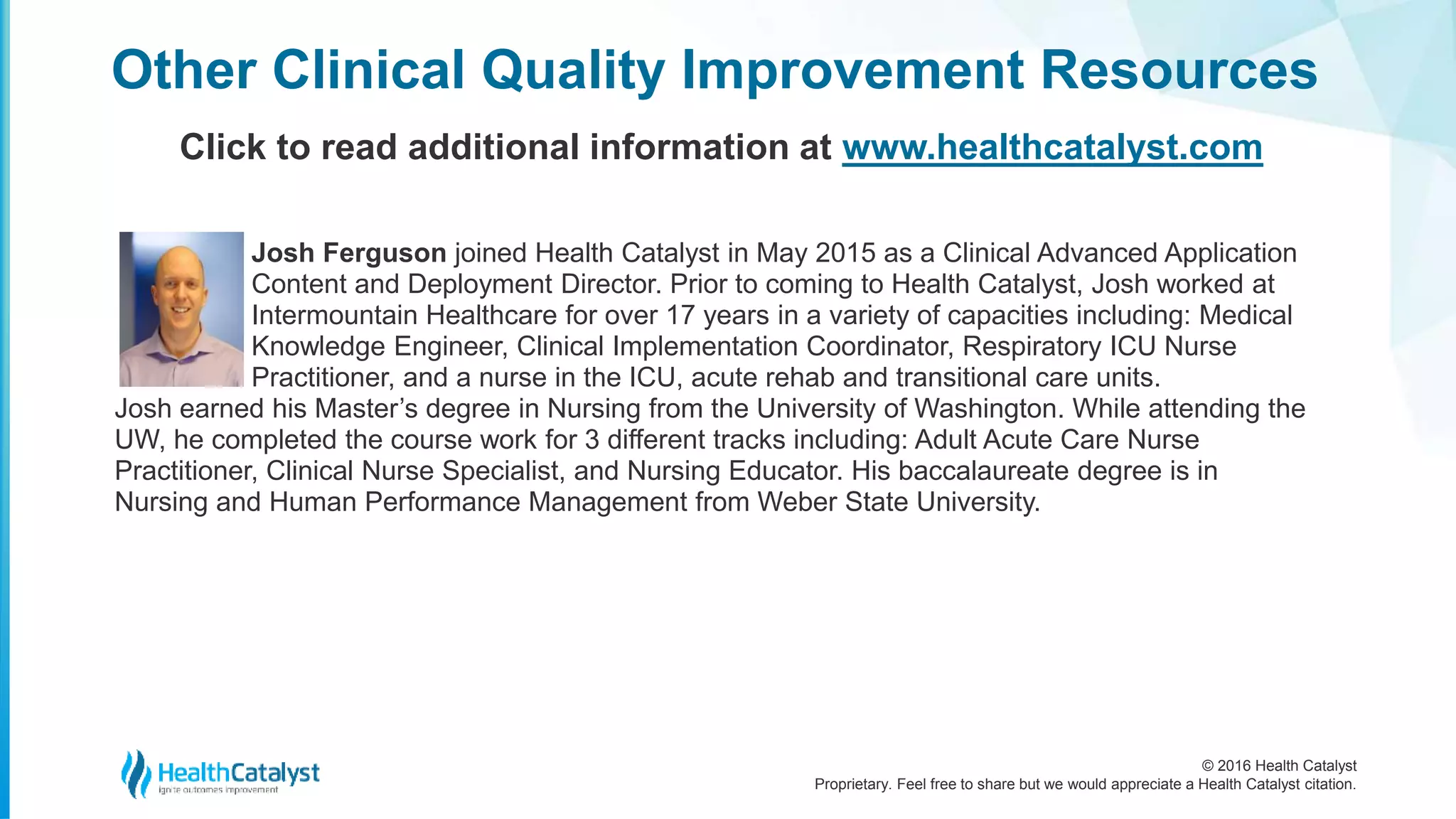
Josh Ferguson joined Health Catalyst in May 2015 as a Clinical Advanced Application
Content and Deployment Director. Prior to coming to Health Catalyst, Josh worked at
Intermountain Healthcare for over 17 years in a variety of capacities including: Medical
Knowledge Engineer, Clinical Implementation Coordinator, Respiratory ICU Nurse
Practitioner, and a nurse in the ICU, acute rehab and transitional care units.
Josh earned his Master’s degree in Nursing from the University of Washington. While attending the
UW, he completed the course work for 3 different tracks including: Adult Acute Care Nurse
Practitioner, Clinical Nurse Specialist, and Nursing Educator. His baccalaureate degree is in
Nursing and Human Performance Management from Weber State University.
Other Clinical Quality Improvement Resources
Click to read additional information at www.healthcatalyst.com

How to Measure Health Outcomes that Matter to Everyone

  • 1.
    How to MeasureHealth Outcomes that Matter to Everyone ̶ Josh Ferguson
  • 2.
    © 2016 HealthCatalyst Proprietary. Feel free to share but we would appreciate a Health Catalyst citation. Outcome Measurements that Matter Today’s healthcare industry is consumed by an urgency to measure and improve outcomes. The switch to outcomes-based healthcare is incredibly positive, but it also has many organizations scrambling to put together data- driven improvement programs. This rush, though necessary, often results in reactionary and haphazard plans for outcomes improvement. Using a few key ideas, organizations can improve how to measure health outcomes and take steps toward real improvements in quality and cost.
  • 3.
    © 2016 HealthCatalyst Proprietary. Feel free to share but we would appreciate a Health Catalyst citation. Regulatory Requirements vs. Outcomes Improvement As the industry accelerates its focus on improving outcomes, a virtual flood of new regulatory requirements continue to arise. Recently, CMS instituted a new bundled payment program for hip and knee replacement that will hold hospitals accountable for quality of care. This program applies to Medicare fee-for-service beneficiaries from the time of surgery through the initial 90 days of recovery following discharge.
  • 4.
    © 2016 HealthCatalyst Proprietary. Feel free to share but we would appreciate a Health Catalyst citation. Regulatory Requirements vs. Outcomes Improvement While initially restricted to a limited number of geographic areas, it has the potential to become the standard method by which CMS will hold hospitals accountable for delivering high-quality care in the near future, including care areas beyond the hip and knee patient population.
  • 5.
    © 2016 HealthCatalyst Proprietary. Feel free to share but we would appreciate a Health Catalyst citation. Regulatory Requirements vs. Outcomes Improvement At times, regulatory requirements can create a national focus on common goals and standards. Achieving the benchmarks established from regulatory requirements should not be seen as the final organizational destination on the journey to continued outcomes improvement. Rather, regulatory requirements should be seen as one leg of a multi-leg journey on the way to change and adaptation.
  • 6.
    © 2016 HealthCatalyst Proprietary. Feel free to share but we would appreciate a Health Catalyst citation. Regulatory Requirements vs. Outcomes Improvement For example, there are national standards for stroke care improvement and for providing certain types of care within a specific time window. With stroke, time is crucial, and depending on many factors, tPA, an IV medication, may be used to dissolve a blood clot in the brain. The national guideline is to begin administering tPA within 60 minutes of a patient arriving at the Emergency Department.
  • 7.
    © 2016 HealthCatalyst Proprietary. Feel free to share but we would appreciate a Health Catalyst citation. Regulatory Requirements vs. Outcomes Improvement If an organization achieves this measure, it doesn’t mean the work is over, or that the outcome has been achieved. Instead, the team should begin looking to the next leg of the journey and seeking how to shorten administration time even further so the majority of patients have a door-to-needle time of, say, less than 45 minutes.
  • 8.
    © 2016 HealthCatalyst Proprietary. Feel free to share but we would appreciate a Health Catalyst citation. Regulatory Requirements vs. Outcomes Improvement In healthcare, we often use surrogate outcome markers and process measures for improvement because some outcome metrics are often difficult to collect. When measuring outcomes, we often focus on length of stay or mortality rates; these metrics are often readily available and easily calculated. But do these represent true outcomes? No, our best outcome metrics speak to the health and functional status of the individual…
  • 9.
    © 2016 HealthCatalyst Proprietary. Feel free to share but we would appreciate a Health Catalyst citation. Regulatory Requirements vs. Outcomes Improvement How quickly was a patient able to return to work after surgery? After a prolonged hospitalization, how long did it take before a mother was able to carry her baby up the stairs without discomfort? The difficulty arises in collecting this type of data, as it often requires allocating additional time and resources. Ultimately, when clinicians and providers capture this type of information, the results often are highly valuable and insightful into transforming healthcare.
  • 10.
    © 2016 HealthCatalyst Proprietary. Feel free to share but we would appreciate a Health Catalyst citation. Regulatory Requirements vs. Outcomes Improvement In 2003, Dr. Margaret Herridge and her colleagues at the TGRI, published a landmark article in the New England Journal of Medicine that looked at one- year outcomes in survivors of acute respiratory distress syndrome (ARDS). Margaret S Herridge BSc, MSc, MPH, MD, FRCPC Toronto General Research Institute (TGRI)
  • 11.
    © 2016 HealthCatalyst Proprietary. Feel free to share but we would appreciate a Health Catalyst citation. Regulatory Requirements vs. Outcomes Improvement The study went beyond identifying hospital mortality as a primary outcome and recognized that patients often have long- term sequelae that were a result of an initial hospitalization. This insight resulted in many organizations reevaluating their care for hospitalized patients with ARDS by focusing on improving the associated long-term outcomes with interventions that included daily sedation vacations and mobilizing patients while on the ventilator.
  • 12.
    © 2016 HealthCatalyst Proprietary. Feel free to share but we would appreciate a Health Catalyst citation. Regulatory Requirements vs. Outcomes Improvement We need to look at both outcome and process metrics in order to establish quality-improvement programs. The need to react to new regulatory requirements and to focus on metrics with an associated incentive or penalty won’t go away anytime soon. Healthcare must transition from reactionary outcomes measurements to a thoughtful, proactive process for selecting outcome measures.
  • 13.
    © 2016 HealthCatalyst Proprietary. Feel free to share but we would appreciate a Health Catalyst citation. Avoid the Outcomes Measures Graveyard An outcomes measures graveyard is full of metrics designed with good intentions, but are of limited utility. With so many human, financial, and operational resources required to improve outcomes, we need to ensure all efforts are strategically aligned with an organization’s goals and value. At the same time we must consider how much data being collected is useful and necessary.
  • 14.
    © 2016 HealthCatalyst Proprietary. Feel free to share but we would appreciate a Health Catalyst citation. Avoid the Outcomes Measures Graveyard It’s easy to get excited about the possibilities inherent in data. We often fail to consider the strain data capture can put on busy healthcare teams. For the most part, data collection for outcomes measures requires providers and clinicians to document an evidence- based process or action. The additional time spent documenting often results in loss of time at the patient’s bedside providing direct care.
  • 15.
    © 2016 HealthCatalyst Proprietary. Feel free to share but we would appreciate a Health Catalyst citation. Avoid the Outcomes Measures Graveyard Precise outcomes measurement requires planning. It begins with asking the right questions, such as: By requiring this to be documented, are we truly improving patient care? How many items of information are we requiring providers or clinicians to document? How often will we really use the information? How many of these pieces of information actually matter to the outcome?
  • 16.
    © 2016 HealthCatalyst Proprietary. Feel free to share but we would appreciate a Health Catalyst citation. Avoid the Outcomes Measures Graveyard If the documentation doesn’t serve a particular purpose, remove it. The consequence of too much document- ation without enough thoughtful planning is frustrated and distressed healthcare team members. And an outcomes measures graveyard.
  • 17.
    © 2016 HealthCatalyst Proprietary. Feel free to share but we would appreciate a Health Catalyst citation. Don’t Let Perfection Be the Enemy of Progress When it comes to measuring outcomes, we shouldn’t let ourselves be paralyzed into inaction by a desire for perfection in our outcomes definitions and measurements. It’s all about balancing perfection with progress. Yes, we must put thought into which measures deserve our focus. However, it is also vitally important that we don’t let perfectionist planning prevent us from launching our improvement efforts.
  • 18.
    © 2016 HealthCatalyst Proprietary. Feel free to share but we would appreciate a Health Catalyst citation. Don’t Let Perfection Be the Enemy of Progress Many health systems get bogged down as they attempt to start their data-driven improve- ment programs. Planning and governance are important. Data quality in and of itself can become a project that easily drains resources and budget in the pursuit of perfection, but at some point we have to say: We know we have a quality issue that we need to improve. We’ll work on defining and refining the metrics as we go.”
  • 19.
    © 2016 HealthCatalyst Proprietary. Feel free to share but we would appreciate a Health Catalyst citation. Consider the Perspective of Different Stakeholders When creating a quality improvement initiative, it’s important to consider how different metrics are relevant to different stakeholders. Someone with a finance background may see data through a different lens than someone with a regulatory or purely clinical background. In fact, the richest and most useful outcomes measure results from bringing different stakeholders together to understand the purpose of the project or rather, the “why.”
  • 20.
    © 2016 HealthCatalyst Proprietary. Feel free to share but we would appreciate a Health Catalyst citation. Consider the Perspective of Different Stakeholders At the very least, organizations should consider soliciting input from providers and clinicians when designing improvement projects. Not only will they provide vital feedback regarding how well a measure is designed, they often have some of the best ideas on how to improve overall quality. And because clinicians are typically the stakeholders most affected by an improvement initiative, their engage- ment and alignment with the improvement strategy is the ultimate key to success.
  • 21.
    © 2016 HealthCatalyst Proprietary. Feel free to share but we would appreciate a Health Catalyst citation. Metrics Are More than Numbers—They Represent Lives Sometimes, as we deal with measuring outcomes to meet regulatory requirements or to keep the organization in the black, we get caught up in jargon and politics. Ultimately, we must remember that these metrics represent actual patients and real health outcomes; we can’t afford to lose sight of that as we move forward. We must remember the why. The patient needs to be at the center of our actions.
  • 22.
    © 2016 HealthCatalyst Proprietary. Feel free to share but we would appreciate a Health Catalyst citation. Metrics Are More than Numbers—They Represent Lives The best performance improvement groups recognized the value of a patient’s story and perspective. There are instances of former patients coming to see current patients and sharing personal experiences. Classroom discussions and conferences where patients share their unique experiences are becoming more common. More recently, organizations have been asking patients to sit on improvement teams.
  • 23.
    © 2016 HealthCatalyst Proprietary. Feel free to share but we would appreciate a Health Catalyst citation. Metrics Are More than Numbers—They Represent Lives We need to focus on outcomes metrics that speak to the health and functional status of individual patients. We need to understand that this is a progressive, iterative process. We need to involve the stakeholders who have a vested interest in outcomes measurement and improvement, who are catalysts for continuous, long-term change. Finally, we need to remember that patients are why we need to continuously improve how we measure health outcomes.
  • 24.
    © 2016 HealthCatalyst Proprietary. Feel free to share but we would appreciate a Health Catalyst citation. For more information: “This book is a fantastic piece of work” – Robert Lindeman MD, FAAP, Chief Physician Quality Officer
  • 25.
    © 2016 HealthCatalyst Proprietary. Feel free to share but we would appreciate a Health Catalyst citation. More about this topic Link to original article for a more in-depth discussion. How to Measure Health Outcomes that Matter to Everyone Why We Need to Shift Healthcare Quality Measures from Volume to Value Jared Crapo, Sales, VP 7 Features of Highly Effective Outcomes Improvement Projects Brant Avondet, Vice President of Client Operations 6 Steps for Implementing Successful Performance Improvement Initiatives in Healthcare Bobbi Brown, Vice President of Financial Engagement; Leslie Falk, Customer Engagement, VP Quality Improvement in Healthcare: Where is the Best Place to Start? Eric Just, Technology, VP Outcomes Improvement: What You Get When You Mix Good Data with Physician Engagement Paul Horstmeier, Senior Vice President
  • 26.
    © 2016 HealthCatalyst Proprietary. Feel free to share but we would appreciate a Health Catalyst citation. Josh Ferguson joined Health Catalyst in May 2015 as a Clinical Advanced Application Content and Deployment Director. Prior to coming to Health Catalyst, Josh worked at Intermountain Healthcare for over 17 years in a variety of capacities including: Medical Knowledge Engineer, Clinical Implementation Coordinator, Respiratory ICU Nurse Practitioner, and a nurse in the ICU, acute rehab and transitional care units. Josh earned his Master’s degree in Nursing from the University of Washington. While attending the UW, he completed the course work for 3 different tracks including: Adult Acute Care Nurse Practitioner, Clinical Nurse Specialist, and Nursing Educator. His baccalaureate degree is in Nursing and Human Performance Management from Weber State University. Other Clinical Quality Improvement Resources Click to read additional information at www.healthcatalyst.com