

Use Well-Crafted Aim Statements To
Achieve Clinical Quality Improvements
© 2014 Health Catalyst
www.healthcatalyst.com
Proprietary. Feel free to share but we would appreciate a Health Catalyst citation.
The Analogy of Golf
Golf is a game of precision, strategy,
and constant improvement with a clear
aim to decrease the number of strokes.
There are multiple factors in achieving
that aim: driving, long irons, short irons,
chipping, and putting.
© 2014 Health Catalyst
www.healthcatalyst.com
Proprietary. Feel free to share but we would appreciate a Health Catalyst citation.
The Analogy of Golf
Course features such as slope, water,
sand, and rough, all come into play.
Strategies must adapt to each condition
as it is encountered.
Professional golfers constantly work to
improve every aspect of their game.
© 2014 Health Catalyst
www.healthcatalyst.com
Proprietary. Feel free to share but we would appreciate a Health Catalyst citation.
The Analogy of Golf
Caring for patients is far more complex than golf, but
improving your process require the same diligence.
In order to improve you must understand how what you do
contributes to, or gets in the way of, achieving that aim.
© 2014 Health Catalyst
www.healthcatalyst.com
Proprietary. Feel free to share but we would appreciate a Health Catalyst citation.
Aim Statements Articulate the Problem
An effective aim statement
begins with clearly articulating
the problem being addressed.
The end result should provide
meaningful value to patients
and the organization.
Aim statements, and the time
and resources required to
address them are two sides of
the same coin.
© 2014 Health Catalyst
www.healthcatalyst.com
Proprietary. Feel free to share but we would appreciate a Health Catalyst citation.
Aim Statements Articulate the Problem
If the problem is significant
enough, then the investment of
the coin makes sense.
Let’s face it, not all the
challenges facing healthcare
organizations, once addressed,
represent the same worth
© 2014 Health Catalyst
www.healthcatalyst.com
Proprietary. Feel free to share but we would appreciate a Health Catalyst citation.
Aim Statements Articulate the Problem
To identify the issues that would
deliver substantial value you must
analyze the healthcare data at hand.
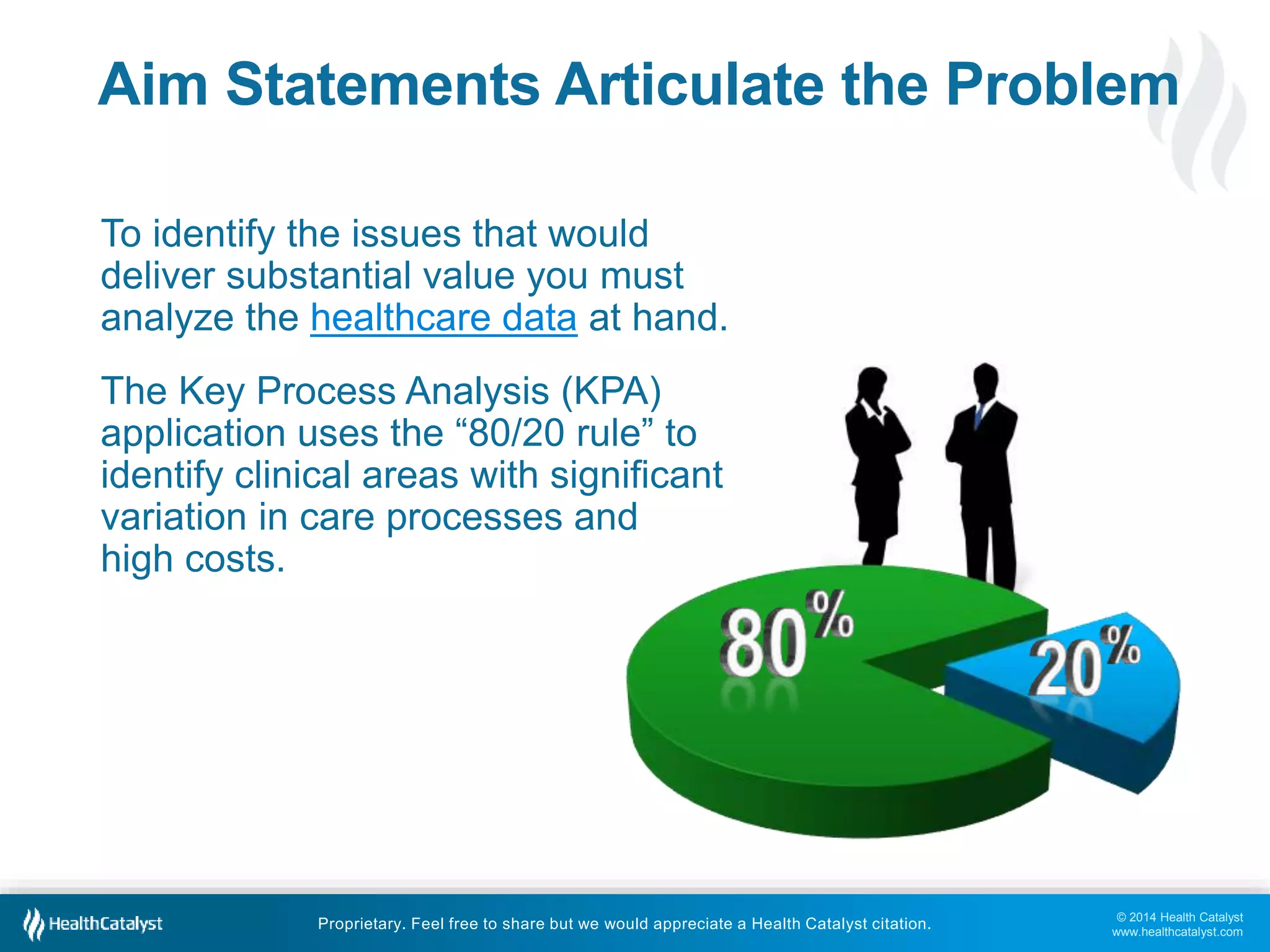
The Key Process Analysis (KPA)
application uses the “80/20 rule” to
identify clinical areas with significant
variation in care processes and
high costs.
© 2014 Health Catalyst
www.healthcatalyst.com
Proprietary. Feel free to share but we would appreciate a Health Catalyst citation.
Aim Statements Articulate the Problem
The KPA combines clinical and
financial data to highlight the best
opportunities for improvement
and cost reduction.
It’s crucial to use your own data
to understand where the greatest
opportunities for improvement
are, and then prioritize your
investment of time and resources
to address the critical few.
© 2014 Health Catalyst
www.healthcatalyst.com
Proprietary. Feel free to share but we would appreciate a Health Catalyst citation.
Taking Aim at Processes
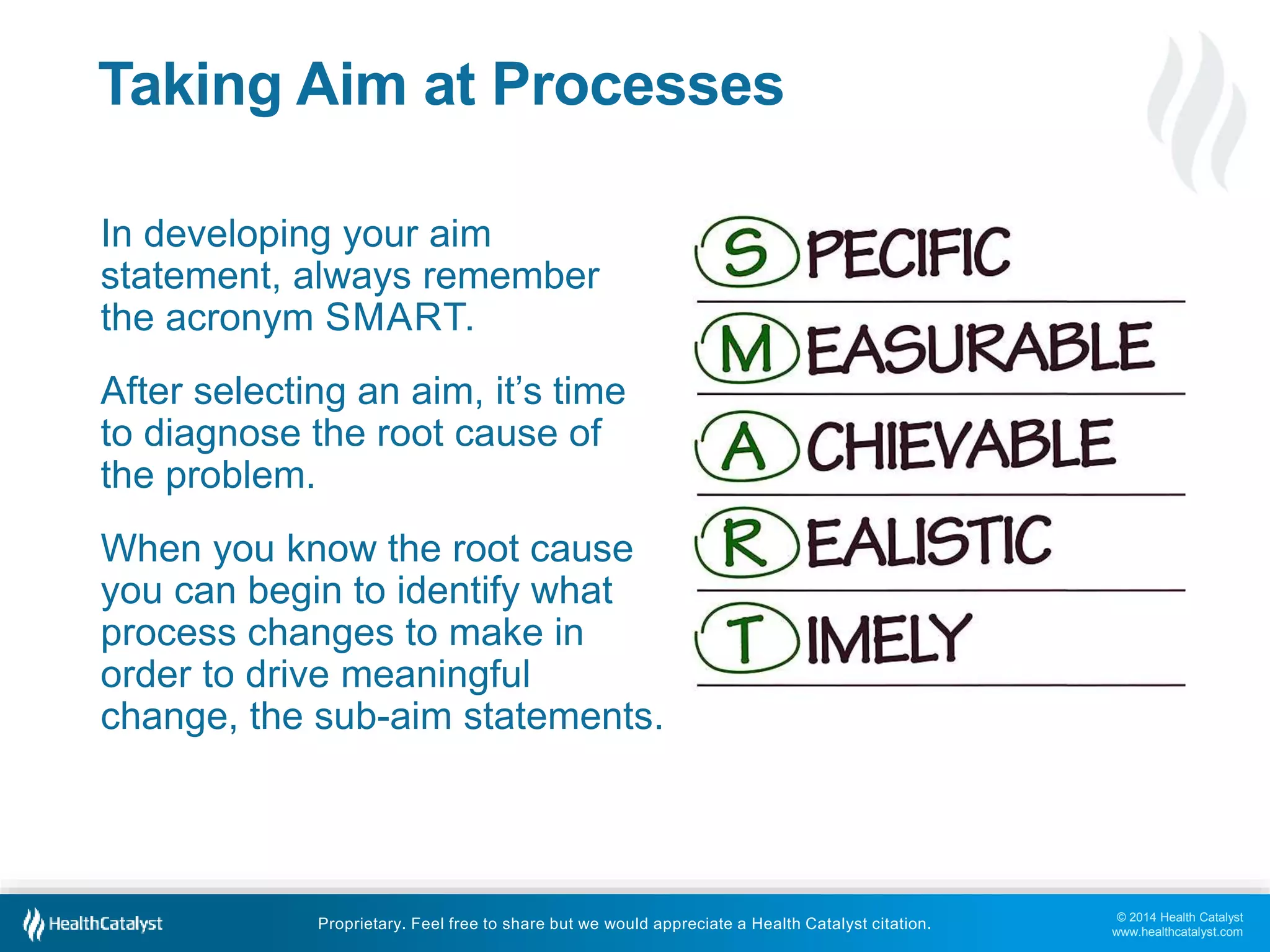
In developing your aim
statement, always remember
the acronym SMART.
After selecting an aim, it’s time
to diagnose the root cause of
the problem.
When you know the root cause
you can begin to identify what
process changes to make in
order to drive meaningful
change, the sub-aim statements.
© 2014 Health Catalyst
www.healthcatalyst.com
Proprietary. Feel free to share but we would appreciate a Health Catalyst citation.
Taking Aim at Processes
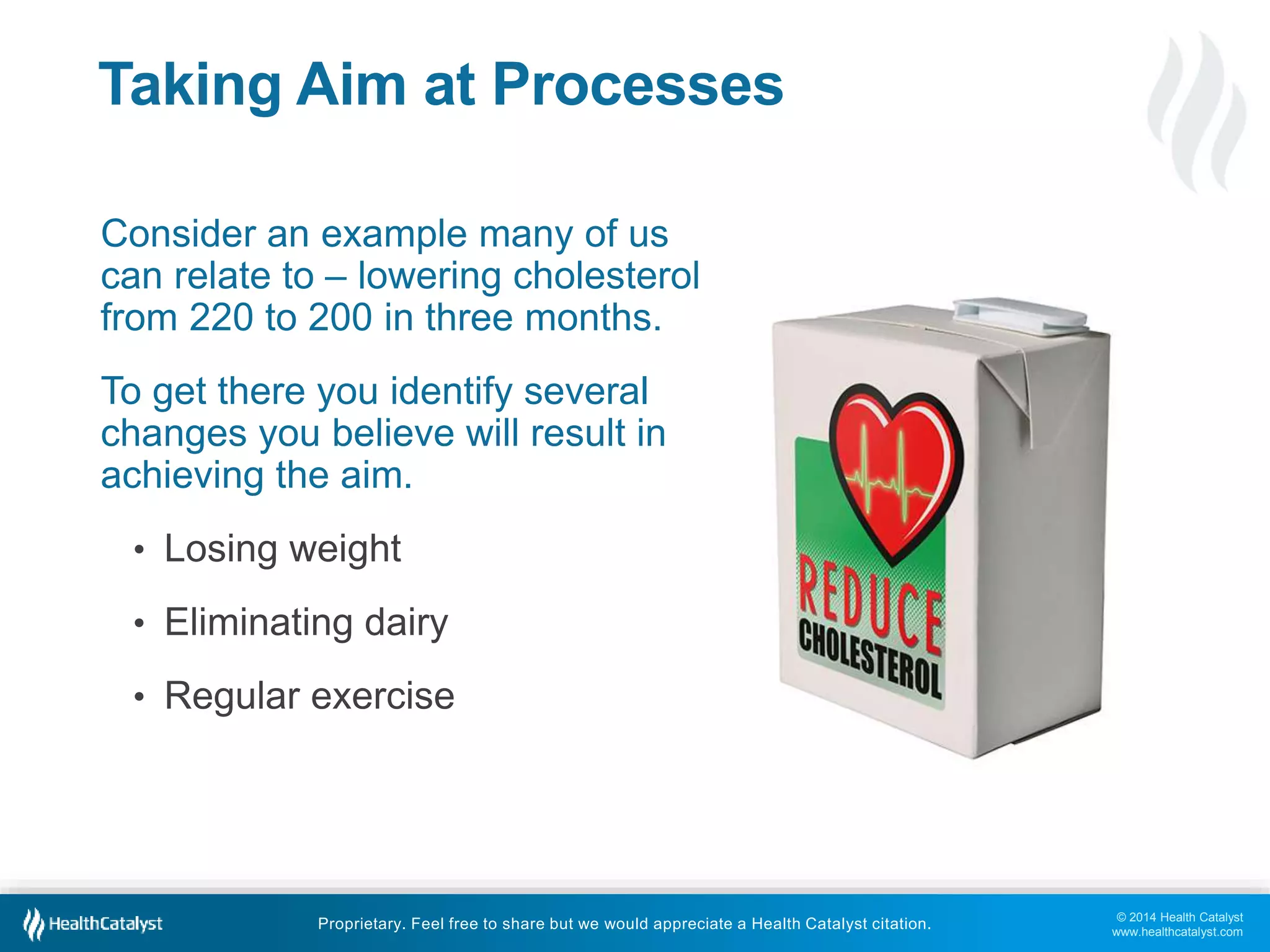
Consider an example many of us
can relate to – lowering cholesterol
from 220 to 200 in three months.
To get there you identify several
changes you believe will result in
achieving the aim.
• Losing weight
• Eliminating dairy
• Regular exercise
© 2014 Health Catalyst
www.healthcatalyst.com
Proprietary. Feel free to share but we would appreciate a Health Catalyst citation.
Taking Aim at Processes
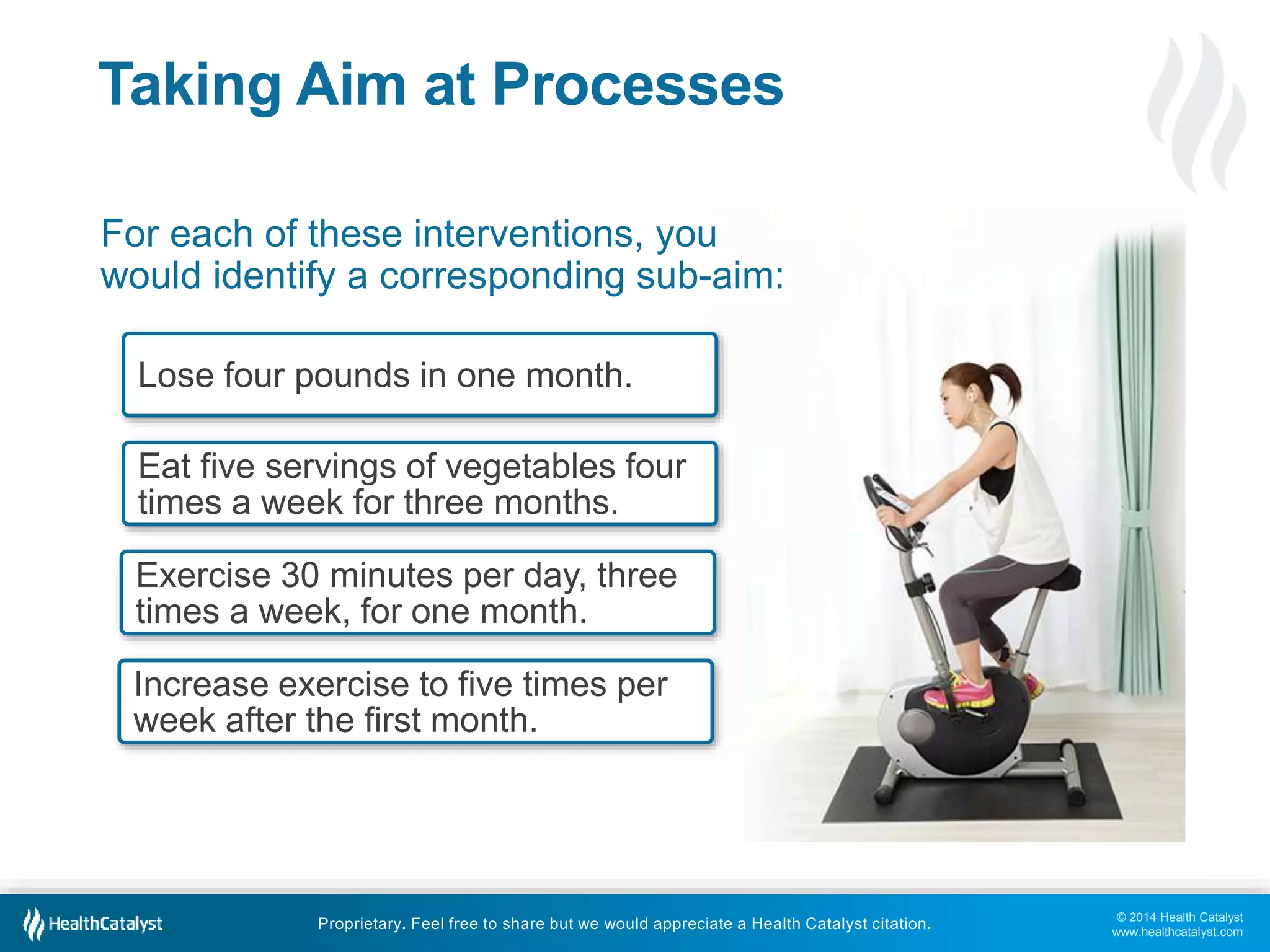
For each of these interventions, you
would identify a corresponding sub-aim:
Lose four pounds in one month.
Eat five servings of vegetables four
times a week for three months.
Exercise 30 minutes per day, three
times a week, for one month.
Increase exercise to five times per
week after the first month.
© 2014 Health Catalyst
www.healthcatalyst.com
Proprietary. Feel free to share but we would appreciate a Health Catalyst citation.
Process Improvement Example
Here’s an example of how setting
an aim and corresponding sub-
aim statements worked to deliver
clinical process improvement for
mortality rates and sepsis.
After analyzing patient data, a
health system recognized that its
30-percent mortality rate for
sepsis patients, especially those
presenting through the emergency
department (ED), was too high.
© 2014 Health Catalyst
www.healthcatalyst.com
Proprietary. Feel free to share but we would appreciate a Health Catalyst citation.
Process Improvement Example
Since 80 percent of its sepsis
patients came through the ED, the
health system decided to focus its
improvement efforts there.
Studying the data, they realized
that one facility had a mortality
rate of 40 percent.
They determined this hospital had
very long wait times in the ED,
and that the triage process was
sporadic and chaotic.
© 2014 Health Catalyst
www.healthcatalyst.com
Proprietary. Feel free to share but we would appreciate a Health Catalyst citation.
Process Improvement Example
As a result, sepsis was often
missed during triage in patients
who came in with it. As a result
critical labs and treatments were
delayed. From their conclusion
they developed this goal:
Decrease mortality rates of sepsis
patients admitted through the ED at
this hospital from 40 percent to 30
percent—and decrease variable
direct costs by 5 percent – by
September 30, 2015
AIM STATEMENT
© 2014 Health Catalyst
www.healthcatalyst.com
Proprietary. Feel free to share but we would appreciate a Health Catalyst citation.
Process Improvement Example
To get there, the health system
developed two key sub-aims:
1. Increase adherence to the ED
early recognition triage protocol
by 70 percent by July 31, 2015
2. Increase by 10 percent the
number of patients who were
accurately diagnosed with
sepsis within one hour in the ED
by September 31, 2015
© 2014 Health Catalyst
www.healthcatalyst.com
Proprietary. Feel free to share but we would appreciate a Health Catalyst citation.
Process Improvement Example
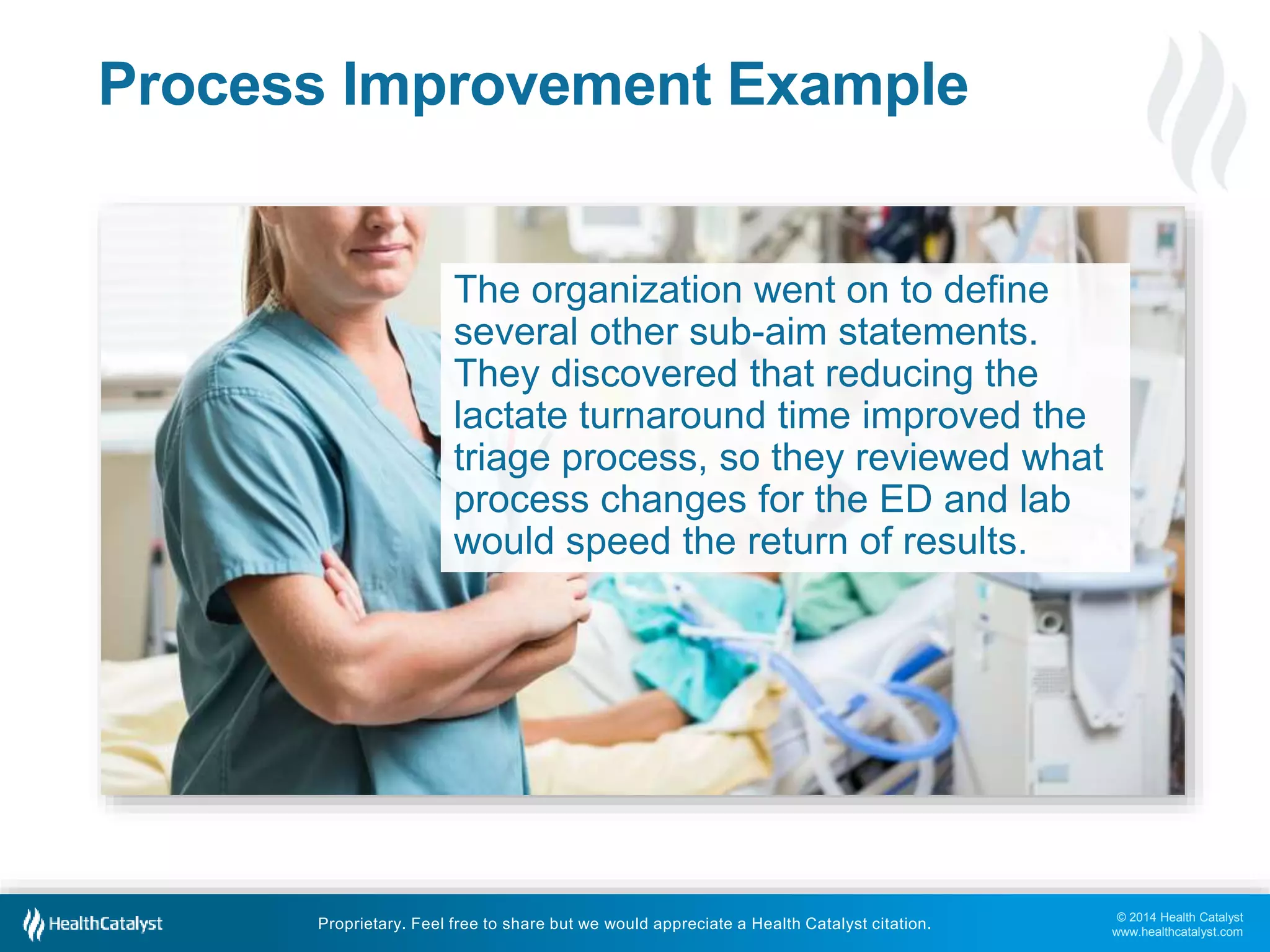
The organization went on to define
several other sub-aim statements.
They discovered that reducing the
lactate turnaround time improved the
triage process, so they reviewed what
process changes for the ED and lab
would speed the return of results.
© 2014 Health Catalyst
www.healthcatalyst.com
Proprietary. Feel free to share but we would appreciate a Health Catalyst citation.
Process Improvement Example
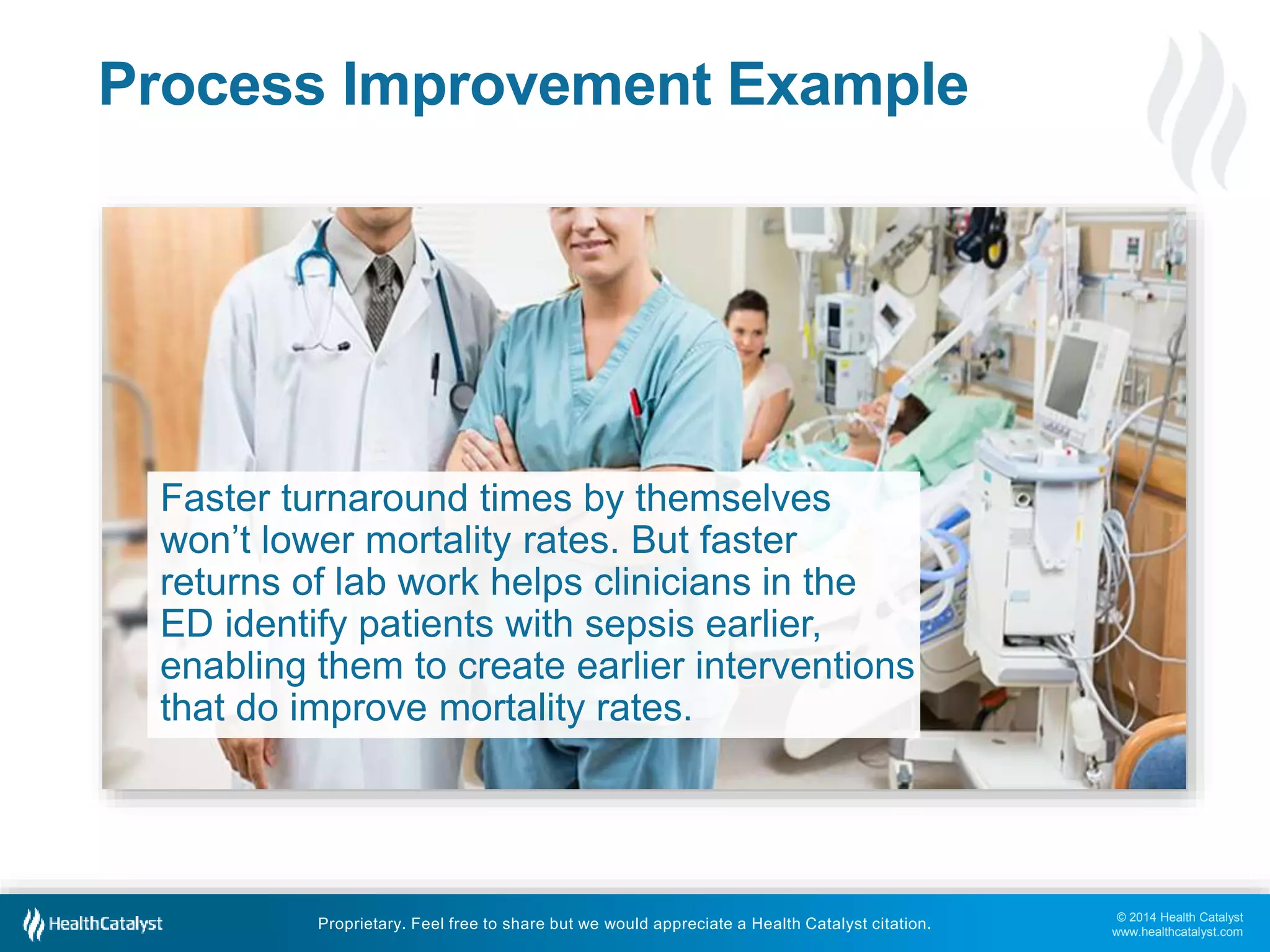
Faster turnaround times by themselves
won’t lower mortality rates. But faster
returns of lab work helps clinicians in the
ED identify patients with sepsis earlier,
enabling them to create earlier interventions
that do improve mortality rates.
© 2014 Health Catalyst
www.healthcatalyst.com
Proprietary. Feel free to share but we would appreciate a Health Catalyst citation.
Winning the Quality Improvement Game
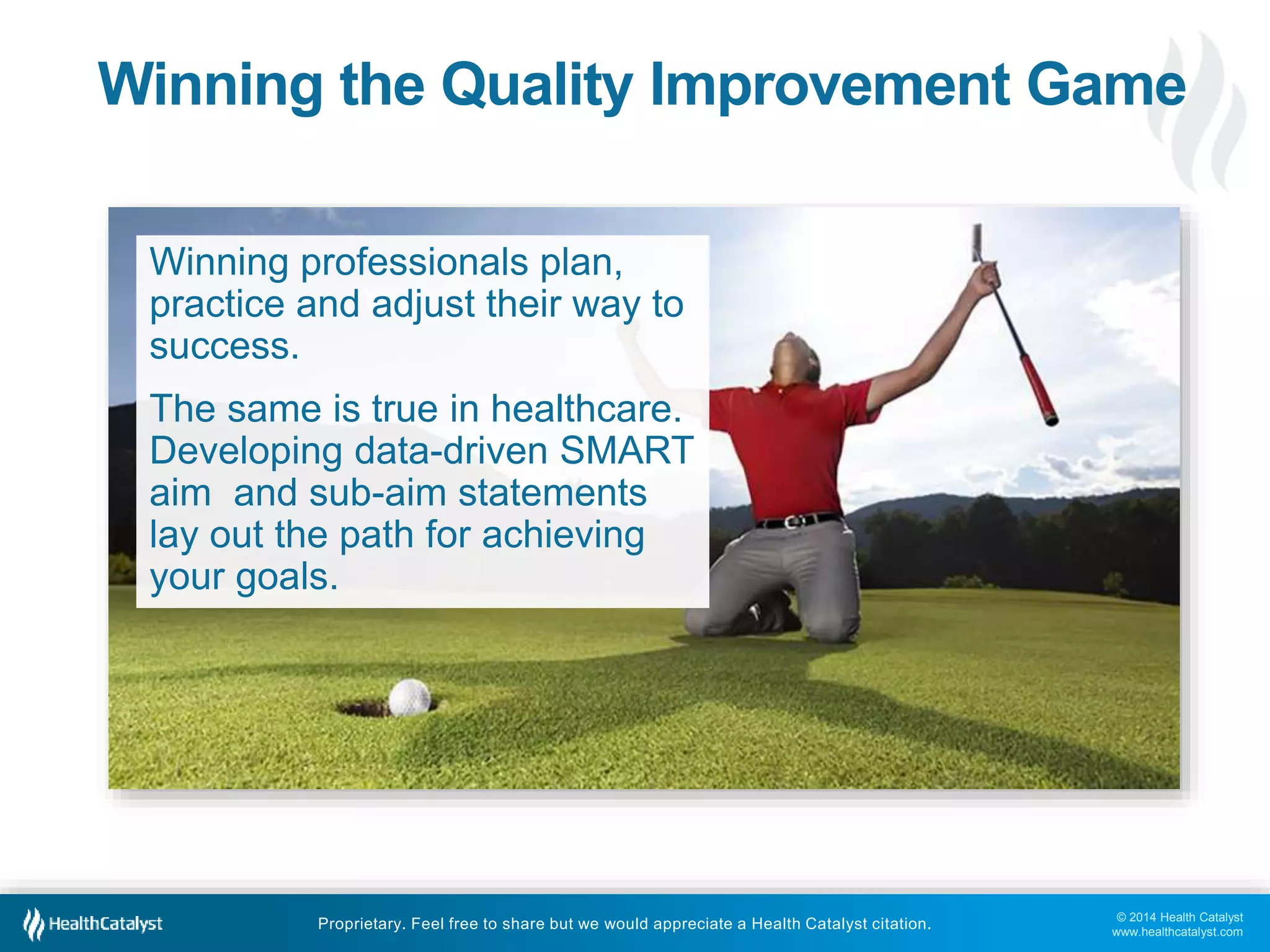
Winning professionals plan,
practice and adjust their way to
success.
The same is true in healthcare.
Developing data-driven SMART
aim and sub-aim statements
lay out the path for achieving
your goals.
© 2014 Health Catalyst
www.healthcatalyst.com
Proprietary. Feel free to share but we would appreciate a Health Catalyst citation.
More about this topic
A Key to Measurable Healthcare Quality Improvement: Use AIM Statements
Kathleen Merkley, Engagement Executive
Planning for Healthcare Improvement: A Goal Without a Plan Is Just a Wish
Dr. John Haughom, Senior Advisor
How to Improve Clinical Programs by Breaking the Cycle of Waste in Healthcare
Ann Tinker, Vice President for Customer Engagements
Introducing the Accelerated Practices (AP) Program: An Innovative Way to Help Health
Systems Accelerate and Sustain Outcomes Improvement
Dr. John Haughom, Senior Advisor
Bryan Oshiro, MD, Medical Director
Sherry Martin, Med
Link to original article for a more in-depth discussion.
Use Well-Crafted Aim Statements To Achieve Clinical Quality Improvements
© 2014 Health Catalyst
www.healthcatalyst.com
Proprietary. Feel free to share but we would appreciate a Health Catalyst citation.
For more information:
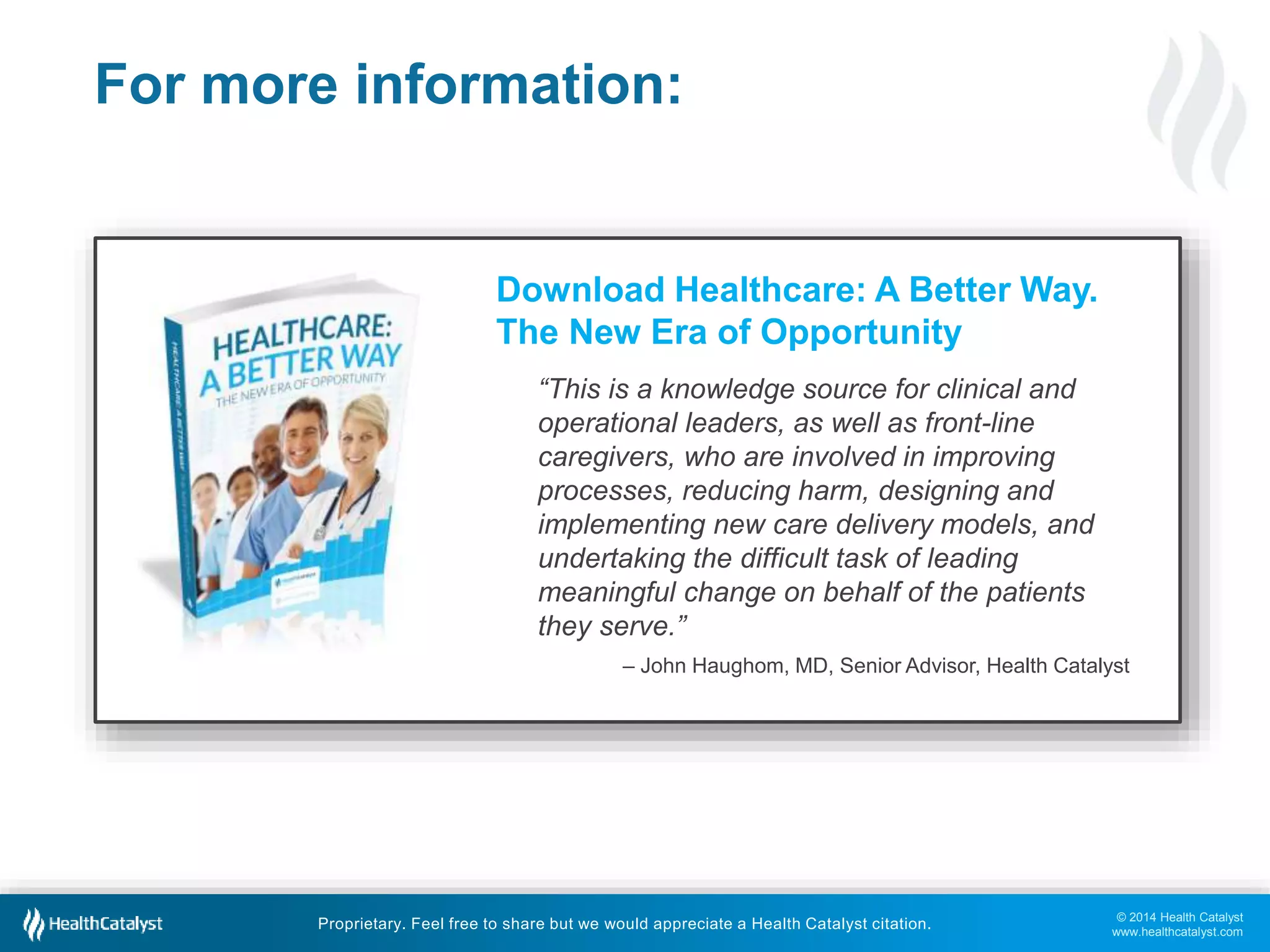
Download Healthcare: A Better Way.
The New Era of Opportunity
“This is a knowledge source for clinical and
operational leaders, as well as front-line
caregivers, who are involved in improving
processes, reducing harm, designing and
implementing new care delivery models, and
undertaking the difficult task of leading
meaningful change on behalf of the patients
they serve.”
– John Haughom, MD, Senior Advisor, Health Catalyst
© 2014 Health Catalyst
www.healthcatalyst.com
Proprietary. Feel free to share but we would appreciate a Health Catalyst citation.
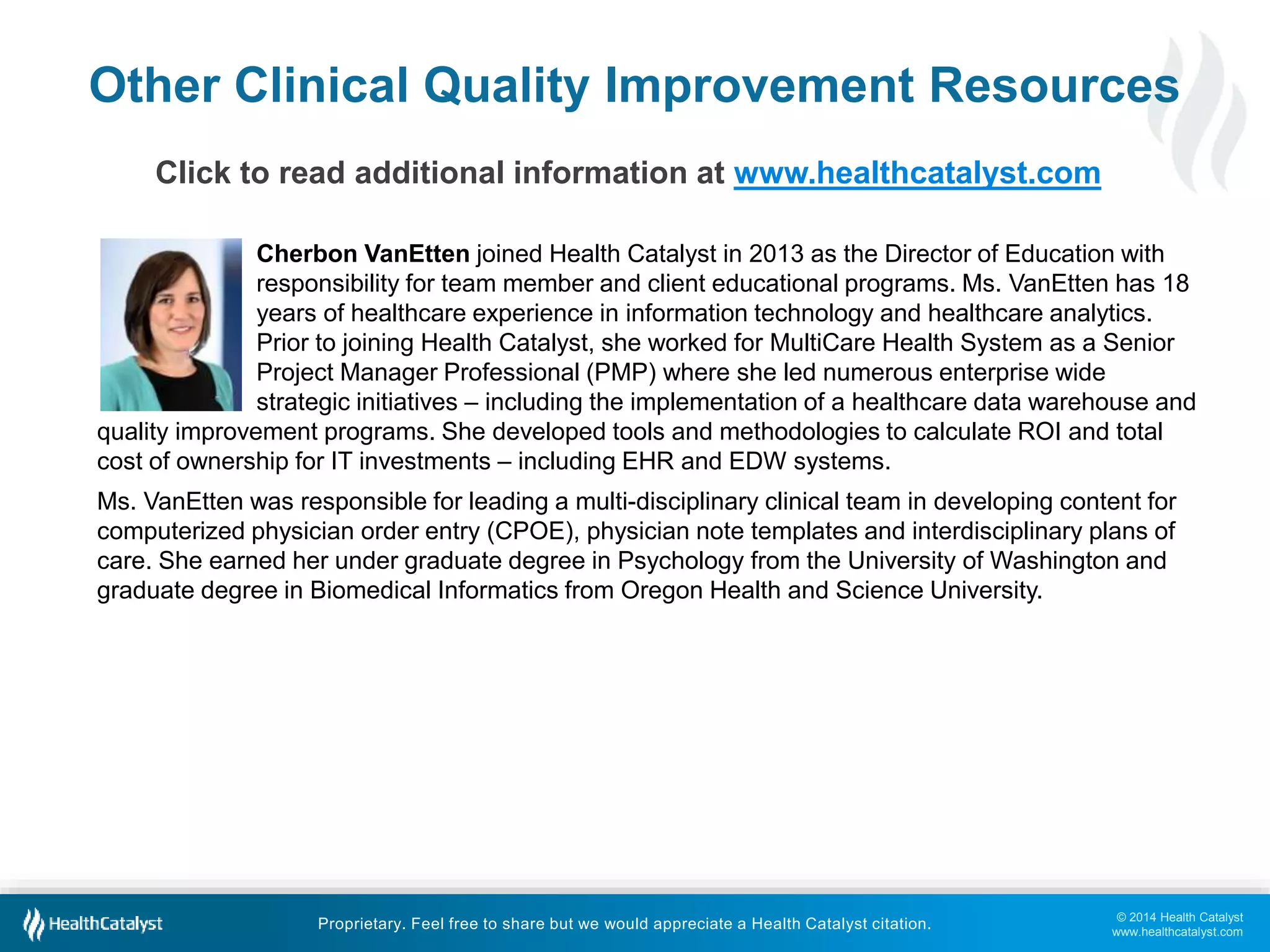
Cherbon VanEtten joined Health Catalyst in 2013 as the Director of Education with
responsibility for team member and client educational programs. Ms. VanEtten has 18
years of healthcare experience in information technology and healthcare analytics.
Prior to joining Health Catalyst, she worked for MultiCare Health System as a Senior
Project Manager Professional (PMP) where she led numerous enterprise wide
strategic initiatives – including the implementation of a healthcare data warehouse and
quality improvement programs. She developed tools and methodologies to calculate ROI and total
cost of ownership for IT investments – including EHR and EDW systems.
Ms. VanEtten was responsible for leading a multi-disciplinary clinical team in developing content for
computerized physician order entry (CPOE), physician note templates and interdisciplinary plans of
care. She earned her under graduate degree in Psychology from the University of Washington and
graduate degree in Biomedical Informatics from Oregon Health and Science University.
Other Clinical Quality Improvement Resources
Click to read additional information at www.healthcatalyst.com

Use Well-Crafted Aim Statements To Achieve Clinical Quality Improvements

  • 1.
    Use Well-Crafted AimStatements To Achieve Clinical Quality Improvements
  • 2.
    © 2014 HealthCatalyst www.healthcatalyst.com Proprietary. Feel free to share but we would appreciate a Health Catalyst citation. The Analogy of Golf Golf is a game of precision, strategy, and constant improvement with a clear aim to decrease the number of strokes. There are multiple factors in achieving that aim: driving, long irons, short irons, chipping, and putting.
  • 3.
    © 2014 HealthCatalyst www.healthcatalyst.com Proprietary. Feel free to share but we would appreciate a Health Catalyst citation. The Analogy of Golf Course features such as slope, water, sand, and rough, all come into play. Strategies must adapt to each condition as it is encountered. Professional golfers constantly work to improve every aspect of their game.
  • 4.
    © 2014 HealthCatalyst www.healthcatalyst.com Proprietary. Feel free to share but we would appreciate a Health Catalyst citation. The Analogy of Golf Caring for patients is far more complex than golf, but improving your process require the same diligence. In order to improve you must understand how what you do contributes to, or gets in the way of, achieving that aim.
  • 5.
    © 2014 HealthCatalyst www.healthcatalyst.com Proprietary. Feel free to share but we would appreciate a Health Catalyst citation. Aim Statements Articulate the Problem An effective aim statement begins with clearly articulating the problem being addressed. The end result should provide meaningful value to patients and the organization. Aim statements, and the time and resources required to address them are two sides of the same coin.
  • 6.
    © 2014 HealthCatalyst www.healthcatalyst.com Proprietary. Feel free to share but we would appreciate a Health Catalyst citation. Aim Statements Articulate the Problem If the problem is significant enough, then the investment of the coin makes sense. Let’s face it, not all the challenges facing healthcare organizations, once addressed, represent the same worth
  • 7.
    © 2014 HealthCatalyst www.healthcatalyst.com Proprietary. Feel free to share but we would appreciate a Health Catalyst citation. Aim Statements Articulate the Problem To identify the issues that would deliver substantial value you must analyze the healthcare data at hand. The Key Process Analysis (KPA) application uses the “80/20 rule” to identify clinical areas with significant variation in care processes and high costs.
  • 8.
    © 2014 HealthCatalyst www.healthcatalyst.com Proprietary. Feel free to share but we would appreciate a Health Catalyst citation. Aim Statements Articulate the Problem The KPA combines clinical and financial data to highlight the best opportunities for improvement and cost reduction. It’s crucial to use your own data to understand where the greatest opportunities for improvement are, and then prioritize your investment of time and resources to address the critical few.
  • 9.
    © 2014 HealthCatalyst www.healthcatalyst.com Proprietary. Feel free to share but we would appreciate a Health Catalyst citation. Taking Aim at Processes In developing your aim statement, always remember the acronym SMART. After selecting an aim, it’s time to diagnose the root cause of the problem. When you know the root cause you can begin to identify what process changes to make in order to drive meaningful change, the sub-aim statements.
  • 10.
    © 2014 HealthCatalyst www.healthcatalyst.com Proprietary. Feel free to share but we would appreciate a Health Catalyst citation. Taking Aim at Processes Consider an example many of us can relate to – lowering cholesterol from 220 to 200 in three months. To get there you identify several changes you believe will result in achieving the aim. • Losing weight • Eliminating dairy • Regular exercise
  • 11.
    © 2014 HealthCatalyst www.healthcatalyst.com Proprietary. Feel free to share but we would appreciate a Health Catalyst citation. Taking Aim at Processes For each of these interventions, you would identify a corresponding sub-aim: Lose four pounds in one month. Eat five servings of vegetables four times a week for three months. Exercise 30 minutes per day, three times a week, for one month. Increase exercise to five times per week after the first month.
  • 12.
    © 2014 HealthCatalyst www.healthcatalyst.com Proprietary. Feel free to share but we would appreciate a Health Catalyst citation. Process Improvement Example Here’s an example of how setting an aim and corresponding sub- aim statements worked to deliver clinical process improvement for mortality rates and sepsis. After analyzing patient data, a health system recognized that its 30-percent mortality rate for sepsis patients, especially those presenting through the emergency department (ED), was too high.
  • 13.
    © 2014 HealthCatalyst www.healthcatalyst.com Proprietary. Feel free to share but we would appreciate a Health Catalyst citation. Process Improvement Example Since 80 percent of its sepsis patients came through the ED, the health system decided to focus its improvement efforts there. Studying the data, they realized that one facility had a mortality rate of 40 percent. They determined this hospital had very long wait times in the ED, and that the triage process was sporadic and chaotic.
  • 14.
    © 2014 HealthCatalyst www.healthcatalyst.com Proprietary. Feel free to share but we would appreciate a Health Catalyst citation. Process Improvement Example As a result, sepsis was often missed during triage in patients who came in with it. As a result critical labs and treatments were delayed. From their conclusion they developed this goal: Decrease mortality rates of sepsis patients admitted through the ED at this hospital from 40 percent to 30 percent—and decrease variable direct costs by 5 percent – by September 30, 2015 AIM STATEMENT
  • 15.
    © 2014 HealthCatalyst www.healthcatalyst.com Proprietary. Feel free to share but we would appreciate a Health Catalyst citation. Process Improvement Example To get there, the health system developed two key sub-aims: 1. Increase adherence to the ED early recognition triage protocol by 70 percent by July 31, 2015 2. Increase by 10 percent the number of patients who were accurately diagnosed with sepsis within one hour in the ED by September 31, 2015
  • 16.
    © 2014 HealthCatalyst www.healthcatalyst.com Proprietary. Feel free to share but we would appreciate a Health Catalyst citation. Process Improvement Example The organization went on to define several other sub-aim statements. They discovered that reducing the lactate turnaround time improved the triage process, so they reviewed what process changes for the ED and lab would speed the return of results.
  • 17.
    © 2014 HealthCatalyst www.healthcatalyst.com Proprietary. Feel free to share but we would appreciate a Health Catalyst citation. Process Improvement Example Faster turnaround times by themselves won’t lower mortality rates. But faster returns of lab work helps clinicians in the ED identify patients with sepsis earlier, enabling them to create earlier interventions that do improve mortality rates.
  • 18.
    © 2014 HealthCatalyst www.healthcatalyst.com Proprietary. Feel free to share but we would appreciate a Health Catalyst citation. Winning the Quality Improvement Game Winning professionals plan, practice and adjust their way to success. The same is true in healthcare. Developing data-driven SMART aim and sub-aim statements lay out the path for achieving your goals.
  • 19.
    © 2014 HealthCatalyst www.healthcatalyst.com Proprietary. Feel free to share but we would appreciate a Health Catalyst citation. More about this topic A Key to Measurable Healthcare Quality Improvement: Use AIM Statements Kathleen Merkley, Engagement Executive Planning for Healthcare Improvement: A Goal Without a Plan Is Just a Wish Dr. John Haughom, Senior Advisor How to Improve Clinical Programs by Breaking the Cycle of Waste in Healthcare Ann Tinker, Vice President for Customer Engagements Introducing the Accelerated Practices (AP) Program: An Innovative Way to Help Health Systems Accelerate and Sustain Outcomes Improvement Dr. John Haughom, Senior Advisor Bryan Oshiro, MD, Medical Director Sherry Martin, Med Link to original article for a more in-depth discussion. Use Well-Crafted Aim Statements To Achieve Clinical Quality Improvements
  • 20.
    © 2014 HealthCatalyst www.healthcatalyst.com Proprietary. Feel free to share but we would appreciate a Health Catalyst citation. For more information: Download Healthcare: A Better Way. The New Era of Opportunity “This is a knowledge source for clinical and operational leaders, as well as front-line caregivers, who are involved in improving processes, reducing harm, designing and implementing new care delivery models, and undertaking the difficult task of leading meaningful change on behalf of the patients they serve.” – John Haughom, MD, Senior Advisor, Health Catalyst
  • 21.
    © 2014 HealthCatalyst www.healthcatalyst.com Proprietary. Feel free to share but we would appreciate a Health Catalyst citation. Cherbon VanEtten joined Health Catalyst in 2013 as the Director of Education with responsibility for team member and client educational programs. Ms. VanEtten has 18 years of healthcare experience in information technology and healthcare analytics. Prior to joining Health Catalyst, she worked for MultiCare Health System as a Senior Project Manager Professional (PMP) where she led numerous enterprise wide strategic initiatives – including the implementation of a healthcare data warehouse and quality improvement programs. She developed tools and methodologies to calculate ROI and total cost of ownership for IT investments – including EHR and EDW systems. Ms. VanEtten was responsible for leading a multi-disciplinary clinical team in developing content for computerized physician order entry (CPOE), physician note templates and interdisciplinary plans of care. She earned her under graduate degree in Psychology from the University of Washington and graduate degree in Biomedical Informatics from Oregon Health and Science University. Other Clinical Quality Improvement Resources Click to read additional information at www.healthcatalyst.com