1
1.Introduction to Culture: Definitions of Culture and Why do cultures
differ?
2.Types of Cultural Communication
-Cross-cultural communication
-International communication
-Multi-cultural communication
-Intercultural communication
3. What is Intercultural Communication?
4. Importance of Intercultural Communication
5. Examples for Cultural Differences in the Business World
6. Need for Intercultural Communication
7. Two Trends of Intercultural Communication: Globalisation and
Multicultural Workforce
8. Factors playing roles in bringing cultures together
9. Do’s of Intercultural Communication
10. Don’ts of Intercultural Communication
11. Various Cultures, Various Dining Etiquette
12. Conclusion
13. References
2
Introduction to Culture
What is ‘culture’? Culture is the characteristics of a particular group of people, defined by everything from
language, religion, cuisine, social habits, music and arts. Today, in the United States as in other countries populated
largely by immigrants, the culture is influenced by the many groups of people that now make up the country. (Kim Ann
Zimmermann)
Why do cultures differ? :
History
Educational Backgrounds
Social backgrounds
Ethnic
Religion
Ecology
Technology 3
Various cultures in USA
4
Types of Cultural Communication
 Cross cultural communication
 International communication
Multicultural communication
 Intercultural communication
See 1
5
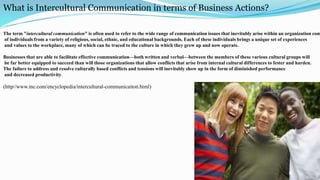
What is Intercultural Communication in terms of Business Actions?
The term "intercultural communication" is often used to refer to the wide range of communication issues that inevitably arise within an organization com
of individuals from a variety of religious, social, ethnic, and educational backgrounds. Each of these individuals brings a unique set of experiences
and values to the workplace, many of which can be traced to the culture in which they grew up and now operate.
Businesses that are able to facilitate effective communication—both written and verbal—between the members of these various cultural groups will
be far better equipped to succeed than will those organizations that allow conflicts that arise from internal cultural differences to fester and harden.
The failure to address and resolve culturally based conflicts and tensions will inevitably show up in the form of diminished performance
and decreased productivity.
(http//www.inc.com/encyclopedia/intercultural-communicaiton.html)
6
Significance of Intercultural Communication in terms of Business Actions
Effective intercultural communication helps to eliminate
communication obstacles like language barriers and
stereotypes from international business . Effective global
communication can be achieved through learning about other
cultures and implementing communication strategies such as
reflective listening and being open-minded.
(Importance of Intercultural Communication in Business |
eHow.com http://www.ehow.com/facts_6933179_importance-intercultural-communication-
business.html#ixzz2S8Y3Zzsi)
7
Examples for cultural differences in the
business world
 Gestures
 Touch
 Masculinity & Feminity
 Seperation of Power
8
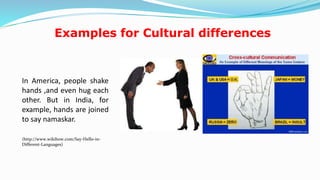
Examples for Cultural differences
In America, people shake
hands ,and even hug each
other. But in India, for
example, hands are joined
to say namaskar.
(http://www.wikihow.com/Say-Hello-in-
Different-Languages)
9
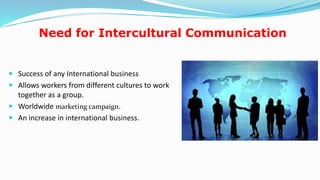
Need for Intercultural Communication
 Success of any International business
 Allows workers from different cultures to work
together as a group.
 Worldwide marketing campaign.
 An increase in international business.
10
Two trends of Intercultural Communication
 Globalization
 Multicultural Workforce
11
GLOBALIZATION
 Globalization refers to the
reduction and removal of barriers
between national borders in order
to facilitate the flow of goods,
capital, services and labour
(http://www.worldbank.org/economi
cpolicy/globalization/index.)
12
The term “globalization” is widely used in various sources of literature. Many authors refer to it in different ways.
Croucher (2004) defines globalization as a combination of economic, technological, sociocultural and political
forces. Friedman (2008) has an opinion that globalized trade, outsourcing, supply-chaining, and political forces
have changed the world permanently, for both better and worse. The author states that the pace of globalization is
quickening and will continue to have a growing impact on business organization and practice. Palmer (2004)
defines globalization as "the elimination of state-enforced restrictions on exchanges across borders and the
increasingly integrated and complex global system of production and exchange that has emerged as a result.
Scholars Held and McGrew (1999) state that Globalization is „...a widening, deepening and speeding up of
interconnectedness in all aspects of contemporary social life from the cultural to the criminal, the financial to the
spiritual“.
13
MULTICULTURAL WORKFORCE
 The phrase "multicultural workforce"
refers to the changing age, gender,
ethnicity, physical ability, and race, of
employees across all types and places of
work
(http://www.referenceforbusiness.com/encyclopedia/Mor-
Off/Multicultural-Workforce.html)
14
Impact of Globalization- business sector
 e.g., Import and Export of food,
electronic goods, etc. to other
countries.
 Building a business friendly
environment with other nations.
15
Impact of Globalization-Advancement in
Film Industry
 Spreading of multiculturalism,
collaborations
 For example: Endhiran Film was
persuaded by animatronic technicians
from other countries also.
16
Increase in international travel and tourism
 Greater international travel and
tourism help cultures come closer to
each other.
 For example: In 2004, there were over
17 million international tourist arrivals
to Turkey, with a rapid growth as in
2008 the number increased to 26
million.
17
Global sporting events
 Worldwide sporting events
such as World Cup , ICC world
cup and the Olympic Games.
18
DO’S OF INTERCULTURAL COMMUNICATION
 Avoid Assumptions, jokes which are misunderstood
 Use symbols, diagrams and pictures.
 Avoid using slang and idioms, choosing words that will
convey only the most specific meaning;
 Investigate their culture's perception
 Take cultural and local differences into account.
 Say what you do and do what you say. Make sure that your
communication is line with the audience; use
understandable language.
 Find out what cultural factors may hinder effective
communication 19
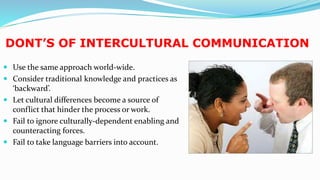
DONT’S OF INTERCULTURAL COMMUNICATION
 Use the same approach world-wide.
 Consider traditional knowledge and practices as
‘backward’.
 Let cultural differences become a source of
conflict that hinder the process or work.
 Fail to ignore culturally-dependent enabling and
counteracting forces.
 Fail to take language barriers into account.
20
DON’T’S OF INTERCULTURAL COMMUNICATION
For example:
-North Americans view direct
eye contact as a sign of
honesty
-Asians view direct eye
contact as a form of disrespect
21
DON’T’S OF INTERCULTURAL COMMUNICATION
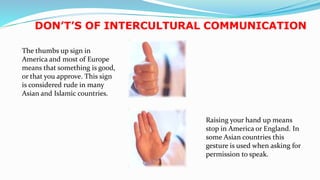
The thumbs up sign in
America and most of Europe
means that something is good,
or that you approve. This sign
is considered rude in many
Asian and Islamic countries.
Raising your hand up means
stop in America or England. In
some Asian countries this
gesture is used when asking for
permission to speak.
22
VARIOUS CULTURES, VARIOUS DINING ETIQUETTES
 Seating
 Eating
 Home/restaurant
 The food
 Conversation
 Body language
23
EUROPE CHINA
24
CONCLUSION I
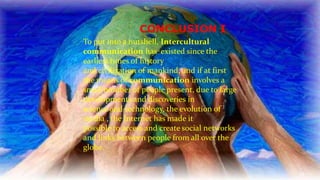
To put into a nutshell, Intercultural
communication has existed since the
earliest times of history
and civilization of mankind, and if at first
the means of communication involves a
small number of people present, due to large
developments and discoveries in
science and technology, the evolution of
media , the Internet has made it
possible to access and create social networks
and links between people from all over the
globe.
25
CONCLUSION II
Not practicing effective intercultural communication can lead to accidentally
offending another individual. An organization dedicated to improving
business between cultures, the consequences for such an accident can range
from an embarrassing moment to the collapse of an entire business deal.
26
Thank You
27
Croucher, Sh. L. (2004). Globalization and Belonging: The Politics of Identity in a Changing World. Rowman & Littlefield.,10.
Friedman T.L. (2008). The Dell Theory of Conflict Prevention. Boston: Bedford, St. Martins, 49.
Globalisation (2001). Retrieved March 5, 2012 from http://www1.worldbank.org/economicpolicy/globalization/index.html
Gestures, Touch, Masculinity and Feminity and Separetion of Power. Retrieved from http://www.ehow.com/info.8020031_cultural-differences-business
-communication-styles.html. On 2 April, 2013
Held, D., A. McGrew, D. Goldblatt, and J. Perraton. (1999). Global Transformations: Politics, Economics and Culture. Polity and Stanford University Press.
Kim Ann Zimmermann. What is culture? Retrieved from http://www.livescience.com/21478-what-is-culture-definition-of-culture.html on March 4 , 2012
Palmer T.G. (2004). Globalization Is Grrrreat!. Cato Institute, 14-16.
Stanford University Press. Transformations: Politics, Economics and Culture.
Intercultural communication. Retrieved from http://www.inc.com/encyclopedia/intercultural-communication.html on 8 April,2013
Inercultural communicaiton in the business world. Retrieved from http//www.inc.com/encyclopedia/intercultural-communicaiton.html on 8 April,2013
Multicultural workforce. Retrieved from http://www.referenceforbusiness.com/encyclopedia/Mor-Off/Multicultural-Workforce.html on 9 April, 2013
Say hello in different languages. Retrieved from http://www.wikihow.com/Say-Hello-in-Different-Languages on 9 April, 2013
What is Crosscultural communication? Retrieved from http://www. Ewbs.com on 17 April, 2013
What is Intercultural communication? Retrieved from http://www.kwintessential.co.uk/articles on 8 April, 2013
What is International communication? Retrieved from http://www.ewb.mit.edu on 8 April, 2013
REFERENCES
28

Intercultural communication presentation

  • 1.
  • 2.
    1.Introduction to Culture:Definitions of Culture and Why do cultures differ? 2.Types of Cultural Communication -Cross-cultural communication -International communication -Multi-cultural communication -Intercultural communication 3. What is Intercultural Communication? 4. Importance of Intercultural Communication 5. Examples for Cultural Differences in the Business World 6. Need for Intercultural Communication 7. Two Trends of Intercultural Communication: Globalisation and Multicultural Workforce 8. Factors playing roles in bringing cultures together 9. Do’s of Intercultural Communication 10. Don’ts of Intercultural Communication 11. Various Cultures, Various Dining Etiquette 12. Conclusion 13. References 2
  • 3.
    Introduction to Culture Whatis ‘culture’? Culture is the characteristics of a particular group of people, defined by everything from language, religion, cuisine, social habits, music and arts. Today, in the United States as in other countries populated largely by immigrants, the culture is influenced by the many groups of people that now make up the country. (Kim Ann Zimmermann) Why do cultures differ? : History Educational Backgrounds Social backgrounds Ethnic Religion Ecology Technology 3
  • 4.
  • 5.
    Types of CulturalCommunication  Cross cultural communication  International communication Multicultural communication  Intercultural communication See 1 5
  • 6.
    What is InterculturalCommunication in terms of Business Actions? The term "intercultural communication" is often used to refer to the wide range of communication issues that inevitably arise within an organization com of individuals from a variety of religious, social, ethnic, and educational backgrounds. Each of these individuals brings a unique set of experiences and values to the workplace, many of which can be traced to the culture in which they grew up and now operate. Businesses that are able to facilitate effective communication—both written and verbal—between the members of these various cultural groups will be far better equipped to succeed than will those organizations that allow conflicts that arise from internal cultural differences to fester and harden. The failure to address and resolve culturally based conflicts and tensions will inevitably show up in the form of diminished performance and decreased productivity. (http//www.inc.com/encyclopedia/intercultural-communicaiton.html) 6
  • 7.
    Significance of InterculturalCommunication in terms of Business Actions Effective intercultural communication helps to eliminate communication obstacles like language barriers and stereotypes from international business . Effective global communication can be achieved through learning about other cultures and implementing communication strategies such as reflective listening and being open-minded. (Importance of Intercultural Communication in Business | eHow.com http://www.ehow.com/facts_6933179_importance-intercultural-communication- business.html#ixzz2S8Y3Zzsi) 7
  • 8.
    Examples for culturaldifferences in the business world  Gestures  Touch  Masculinity & Feminity  Seperation of Power 8
  • 9.
    Examples for Culturaldifferences In America, people shake hands ,and even hug each other. But in India, for example, hands are joined to say namaskar. (http://www.wikihow.com/Say-Hello-in- Different-Languages) 9
  • 10.
    Need for InterculturalCommunication  Success of any International business  Allows workers from different cultures to work together as a group.  Worldwide marketing campaign.  An increase in international business. 10
  • 11.
    Two trends ofIntercultural Communication  Globalization  Multicultural Workforce 11
  • 12.
    GLOBALIZATION  Globalization refersto the reduction and removal of barriers between national borders in order to facilitate the flow of goods, capital, services and labour (http://www.worldbank.org/economi cpolicy/globalization/index.) 12
  • 13.
    The term “globalization”is widely used in various sources of literature. Many authors refer to it in different ways. Croucher (2004) defines globalization as a combination of economic, technological, sociocultural and political forces. Friedman (2008) has an opinion that globalized trade, outsourcing, supply-chaining, and political forces have changed the world permanently, for both better and worse. The author states that the pace of globalization is quickening and will continue to have a growing impact on business organization and practice. Palmer (2004) defines globalization as "the elimination of state-enforced restrictions on exchanges across borders and the increasingly integrated and complex global system of production and exchange that has emerged as a result. Scholars Held and McGrew (1999) state that Globalization is „...a widening, deepening and speeding up of interconnectedness in all aspects of contemporary social life from the cultural to the criminal, the financial to the spiritual“. 13
  • 14.
    MULTICULTURAL WORKFORCE  Thephrase "multicultural workforce" refers to the changing age, gender, ethnicity, physical ability, and race, of employees across all types and places of work (http://www.referenceforbusiness.com/encyclopedia/Mor- Off/Multicultural-Workforce.html) 14
  • 15.
    Impact of Globalization-business sector  e.g., Import and Export of food, electronic goods, etc. to other countries.  Building a business friendly environment with other nations. 15
  • 16.
    Impact of Globalization-Advancementin Film Industry  Spreading of multiculturalism, collaborations  For example: Endhiran Film was persuaded by animatronic technicians from other countries also. 16
  • 17.
    Increase in internationaltravel and tourism  Greater international travel and tourism help cultures come closer to each other.  For example: In 2004, there were over 17 million international tourist arrivals to Turkey, with a rapid growth as in 2008 the number increased to 26 million. 17
  • 18.
    Global sporting events Worldwide sporting events such as World Cup , ICC world cup and the Olympic Games. 18
  • 19.
    DO’S OF INTERCULTURALCOMMUNICATION  Avoid Assumptions, jokes which are misunderstood  Use symbols, diagrams and pictures.  Avoid using slang and idioms, choosing words that will convey only the most specific meaning;  Investigate their culture's perception  Take cultural and local differences into account.  Say what you do and do what you say. Make sure that your communication is line with the audience; use understandable language.  Find out what cultural factors may hinder effective communication 19
  • 20.
    DONT’S OF INTERCULTURALCOMMUNICATION  Use the same approach world-wide.  Consider traditional knowledge and practices as ‘backward’.  Let cultural differences become a source of conflict that hinder the process or work.  Fail to ignore culturally-dependent enabling and counteracting forces.  Fail to take language barriers into account. 20
  • 21.
    DON’T’S OF INTERCULTURALCOMMUNICATION For example: -North Americans view direct eye contact as a sign of honesty -Asians view direct eye contact as a form of disrespect 21
  • 22.
    DON’T’S OF INTERCULTURALCOMMUNICATION The thumbs up sign in America and most of Europe means that something is good, or that you approve. This sign is considered rude in many Asian and Islamic countries. Raising your hand up means stop in America or England. In some Asian countries this gesture is used when asking for permission to speak. 22
  • 23.
    VARIOUS CULTURES, VARIOUSDINING ETIQUETTES  Seating  Eating  Home/restaurant  The food  Conversation  Body language 23
  • 24.
  • 25.
    CONCLUSION I To putinto a nutshell, Intercultural communication has existed since the earliest times of history and civilization of mankind, and if at first the means of communication involves a small number of people present, due to large developments and discoveries in science and technology, the evolution of media , the Internet has made it possible to access and create social networks and links between people from all over the globe. 25
  • 26.
    CONCLUSION II Not practicingeffective intercultural communication can lead to accidentally offending another individual. An organization dedicated to improving business between cultures, the consequences for such an accident can range from an embarrassing moment to the collapse of an entire business deal. 26
  • 27.
  • 28.
    Croucher, Sh. L.(2004). Globalization and Belonging: The Politics of Identity in a Changing World. Rowman & Littlefield.,10. Friedman T.L. (2008). The Dell Theory of Conflict Prevention. Boston: Bedford, St. Martins, 49. Globalisation (2001). Retrieved March 5, 2012 from http://www1.worldbank.org/economicpolicy/globalization/index.html Gestures, Touch, Masculinity and Feminity and Separetion of Power. Retrieved from http://www.ehow.com/info.8020031_cultural-differences-business -communication-styles.html. On 2 April, 2013 Held, D., A. McGrew, D. Goldblatt, and J. Perraton. (1999). Global Transformations: Politics, Economics and Culture. Polity and Stanford University Press. Kim Ann Zimmermann. What is culture? Retrieved from http://www.livescience.com/21478-what-is-culture-definition-of-culture.html on March 4 , 2012 Palmer T.G. (2004). Globalization Is Grrrreat!. Cato Institute, 14-16. Stanford University Press. Transformations: Politics, Economics and Culture. Intercultural communication. Retrieved from http://www.inc.com/encyclopedia/intercultural-communication.html on 8 April,2013 Inercultural communicaiton in the business world. Retrieved from http//www.inc.com/encyclopedia/intercultural-communicaiton.html on 8 April,2013 Multicultural workforce. Retrieved from http://www.referenceforbusiness.com/encyclopedia/Mor-Off/Multicultural-Workforce.html on 9 April, 2013 Say hello in different languages. Retrieved from http://www.wikihow.com/Say-Hello-in-Different-Languages on 9 April, 2013 What is Crosscultural communication? Retrieved from http://www. Ewbs.com on 17 April, 2013 What is Intercultural communication? Retrieved from http://www.kwintessential.co.uk/articles on 8 April, 2013 What is International communication? Retrieved from http://www.ewb.mit.edu on 8 April, 2013 REFERENCES 28