Culture and Cultural
Intelligence: Beyond Awareness
Ilan Alon, PhD
School of Business and Law
University of Agder
ilan.alon@uia.no
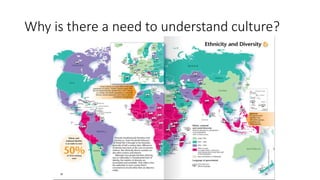
Why is there a need to understand culture?
What is culture?
And, by extension, what is cultural awareness?
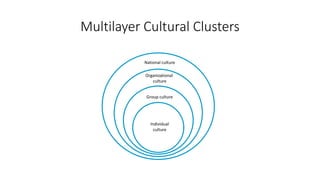
Multilayer Cultural Clusters
Individual
culture
Group culture
Organizational
culture
National culture
Other Layers of Culture
• Corporate Culture – culture adopted, developed and disseminated in an
organization; deviate from national norms, but that depends upon the
strength of culture and the values and practices tied to it
• Ethnicity – significant ethnic communities exist in many countries; likely to
affect a myriad of issues
• Industry – important layer of culture
• Demographics – education, age, seniority and hierarchical level affect
difference in values
• Ideology – not always consistent with cultures and can vary along time and
across regions
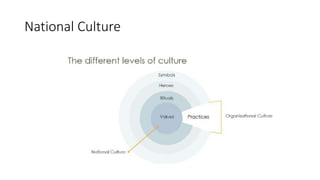
National Culture
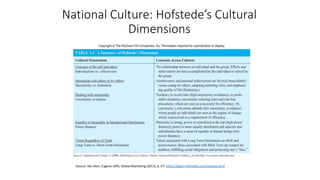
National Culture: Hofstede’s Cultural
Dimensions
Source: Ilan Alon, Eugene Jaffe, Global Marketing (2013), p. 67: https://geert-hofstede.com/norway.html
Other dimensions of culture
• Monochronic vs polychromic
• Performance vs. humane orientation
• Mastery vs. harmony
• Neutral vs. emotional
• Diffuse vs. specific, etc.
Are there international clusters with cultural commonalities?
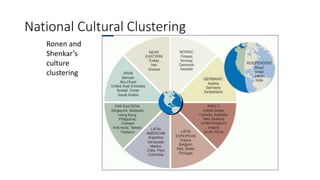
National Cultural Clustering
Ronen and
Shenkar’s
culture
clustering
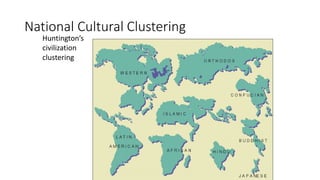
National Cultural Clustering
Huntington’s
civilization
clustering
Niccolo Machiavelli (1532)
“But when a prince acquires the sovereignty of a country differing
from his own both in language, manners, and intellectual
organization, great difficulties arise; and in order to maintain the
possession of it, good fortune must unite with superior talent.”
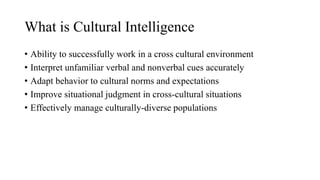
What is cultural intelligence?
• Ability to successfully work in a cross cultural environment
• Interpret unfamiliar verbal and nonverbal cues accurately
• Adapt behavior to cultural norms and expectations
• Improve situational judgment in cross-cultural situations
• Effectively manage culturally-diverse populations
What is Cultural Intelligence
Academic definition
• A system of interacting knowledge and skills, linked by cultural meta-
cognition, which allows people to adapt to, select and shape the
cultural aspects of their environment (Thomas et al., 2008)
Importance of Cultural Intelligence
• Work and academic performance and judgement
• Work related attitudes
• Psychological and sociological adjustment
• Cross cultural impression management
• Expatriate and international assignment success
• Global leadership success
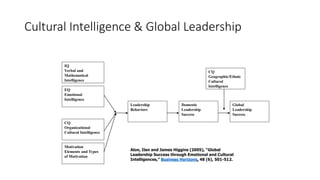
Cultural Intelligence & Global Leadership
EQ
Emotional
Intelligence
Leadership
Behaviors
Domestic
Leadership
Success
Global
Leadership
Success
CQ
Geographic/Ethnic
Cultural
Intelligence
IQ
Verbal and
Mathematical
Intelligence
Motivation
Elements and Types
of Motivation
CQ
Organizational
Cultural Intelligence
Alon, Ilan and James Higgins (2005), “Global
Leadership Success through Emotional and Cultural
Intelligences,” Business Horizons, 48 (6), 501-512.
Cultural Intelligence
• IQ + EQ + CQ = Effective Global Leadership
• Cultural intelligence =
• awareness +
• motivation +
• action/reaction
• (Un)Learning through
• Experience
• Interpretation
• Evaluation
• Defined domains based on literature review
• Operationalized knowledge, skills, actions, and cultural metacognition
• Developed and tested prototypes
• Validated instrument using appropriate extensive statistical analysis
including EFA and SEM
• Validation published in Cross Cultural and Strategy Management
(2016) and Thunderbird International Business Review (2016)
• http://www.emeraldinsight.com/doi/full/10.1108/IJoEM-01-2014-0011
• http://onlinelibrary.wiley.com/doi/10.1002/tie.21826/full
Developing the BCIQ
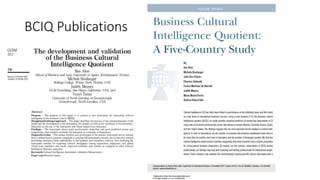
BCIQ Publications
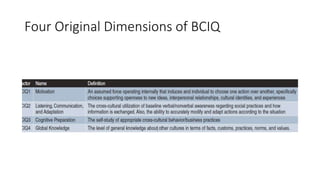
Four Original Dimensions of BCIQ
• Openness and Tolerance to Ambiguity
and Uncertainty
• Listening and Communicative Adaptation
• Cognitive Preparation and Learning Behavior
• Interpersonal Relationship Management
• Global and National Knowledge
BCIQ- 38 Establishment of Five Initial Dimensions
BCIQ – 50 Finalization of Six Dimensions
1. Motivation
2. Adaptive Communication Behavior
3. Cognitive Preparation and Learning Behavior
4. Active Learning and Perceptual Sensitivity
5. Cognitive Awareness
6. Global and National Knowledge
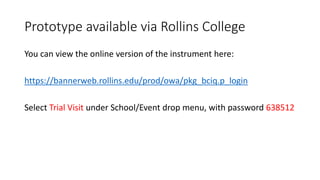
Prototype available via Rollins College
You can view the online version of the instrument here:
https://bannerweb.rollins.edu/prod/owa/pkg_bciq.p_login
Select Trial Visit under School/Event drop menu, with password 638512
Needs Satisfied
• Impact of international education (international offices)
• Teaching international business and cross cultural management
• Assurance of learning for accreditation
• Development of virtual international teams in working efficiently
together (X-culture)
Discussion Questions
• Why is cultural intelligence important to our university?
• How do we develop cultural intelligence in our students and staff?
• How can I develop my cultural intelligence? And how can the
university help me?
• Increasing your cultural intelligence

Culture and cultural intelligence

  • 1.
    Culture and Cultural Intelligence:Beyond Awareness Ilan Alon, PhD School of Business and Law University of Agder ilan.alon@uia.no
  • 2.
    Why is therea need to understand culture?
  • 3.
    What is culture? And,by extension, what is cultural awareness?
  • 4.
    Multilayer Cultural Clusters Individual culture Groupculture Organizational culture National culture
  • 5.
    Other Layers ofCulture • Corporate Culture – culture adopted, developed and disseminated in an organization; deviate from national norms, but that depends upon the strength of culture and the values and practices tied to it • Ethnicity – significant ethnic communities exist in many countries; likely to affect a myriad of issues • Industry – important layer of culture • Demographics – education, age, seniority and hierarchical level affect difference in values • Ideology – not always consistent with cultures and can vary along time and across regions
  • 6.
  • 7.
    National Culture: Hofstede’sCultural Dimensions Source: Ilan Alon, Eugene Jaffe, Global Marketing (2013), p. 67: https://geert-hofstede.com/norway.html
  • 8.
    Other dimensions ofculture • Monochronic vs polychromic • Performance vs. humane orientation • Mastery vs. harmony • Neutral vs. emotional • Diffuse vs. specific, etc. Are there international clusters with cultural commonalities?
  • 9.
    National Cultural Clustering Ronenand Shenkar’s culture clustering
  • 10.
  • 11.
    Niccolo Machiavelli (1532) “Butwhen a prince acquires the sovereignty of a country differing from his own both in language, manners, and intellectual organization, great difficulties arise; and in order to maintain the possession of it, good fortune must unite with superior talent.”
  • 12.
    What is culturalintelligence?
  • 13.
    • Ability tosuccessfully work in a cross cultural environment • Interpret unfamiliar verbal and nonverbal cues accurately • Adapt behavior to cultural norms and expectations • Improve situational judgment in cross-cultural situations • Effectively manage culturally-diverse populations What is Cultural Intelligence
  • 14.
    Academic definition • Asystem of interacting knowledge and skills, linked by cultural meta- cognition, which allows people to adapt to, select and shape the cultural aspects of their environment (Thomas et al., 2008)
  • 15.
    Importance of CulturalIntelligence • Work and academic performance and judgement • Work related attitudes • Psychological and sociological adjustment • Cross cultural impression management • Expatriate and international assignment success • Global leadership success
  • 17.
    Cultural Intelligence &Global Leadership EQ Emotional Intelligence Leadership Behaviors Domestic Leadership Success Global Leadership Success CQ Geographic/Ethnic Cultural Intelligence IQ Verbal and Mathematical Intelligence Motivation Elements and Types of Motivation CQ Organizational Cultural Intelligence Alon, Ilan and James Higgins (2005), “Global Leadership Success through Emotional and Cultural Intelligences,” Business Horizons, 48 (6), 501-512.
  • 18.
    Cultural Intelligence • IQ+ EQ + CQ = Effective Global Leadership • Cultural intelligence = • awareness + • motivation + • action/reaction • (Un)Learning through • Experience • Interpretation • Evaluation
  • 19.
    • Defined domainsbased on literature review • Operationalized knowledge, skills, actions, and cultural metacognition • Developed and tested prototypes • Validated instrument using appropriate extensive statistical analysis including EFA and SEM • Validation published in Cross Cultural and Strategy Management (2016) and Thunderbird International Business Review (2016) • http://www.emeraldinsight.com/doi/full/10.1108/IJoEM-01-2014-0011 • http://onlinelibrary.wiley.com/doi/10.1002/tie.21826/full Developing the BCIQ
  • 20.
  • 21.
  • 22.
    • Openness andTolerance to Ambiguity and Uncertainty • Listening and Communicative Adaptation • Cognitive Preparation and Learning Behavior • Interpersonal Relationship Management • Global and National Knowledge BCIQ- 38 Establishment of Five Initial Dimensions
  • 23.
    BCIQ – 50Finalization of Six Dimensions 1. Motivation 2. Adaptive Communication Behavior 3. Cognitive Preparation and Learning Behavior 4. Active Learning and Perceptual Sensitivity 5. Cognitive Awareness 6. Global and National Knowledge
  • 24.
    Prototype available viaRollins College You can view the online version of the instrument here: https://bannerweb.rollins.edu/prod/owa/pkg_bciq.p_login Select Trial Visit under School/Event drop menu, with password 638512
  • 25.
    Needs Satisfied • Impactof international education (international offices) • Teaching international business and cross cultural management • Assurance of learning for accreditation • Development of virtual international teams in working efficiently together (X-culture)
  • 26.
    Discussion Questions • Whyis cultural intelligence important to our university? • How do we develop cultural intelligence in our students and staff? • How can I develop my cultural intelligence? And how can the university help me? • Increasing your cultural intelligence

Editor's Notes

  • #3 Customers, suppliers, employees, competitors are multinational and multicultural
  • #8 Cultural distance concept