Horizontal Mass
Spring System
By: Yueyan Li
section: LE2
Learning objective 1
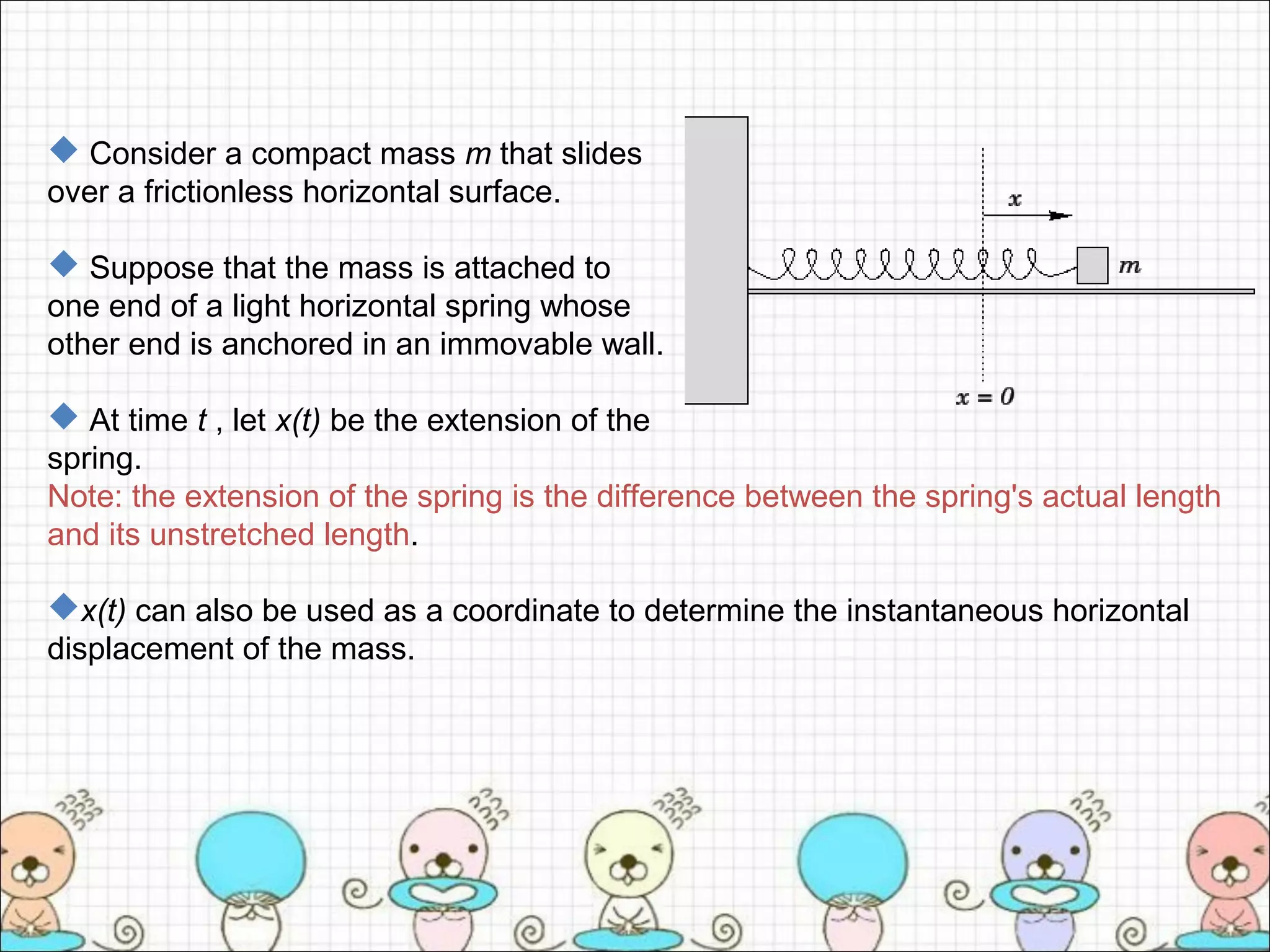
 Consider a compact mass m that slides
over a frictionless horizontal surface.
 Suppose that the mass is attached to
one end of a light horizontal spring whose
other end is anchored in an immovable wall.
 At time t , let x(t) be the extension of the
spring.
Note: the extension of the spring is the difference between the spring's actual length
and its unstretched length.
x(t) can also be used as a coordinate to determine the instantaneous horizontal
displacement of the mass.
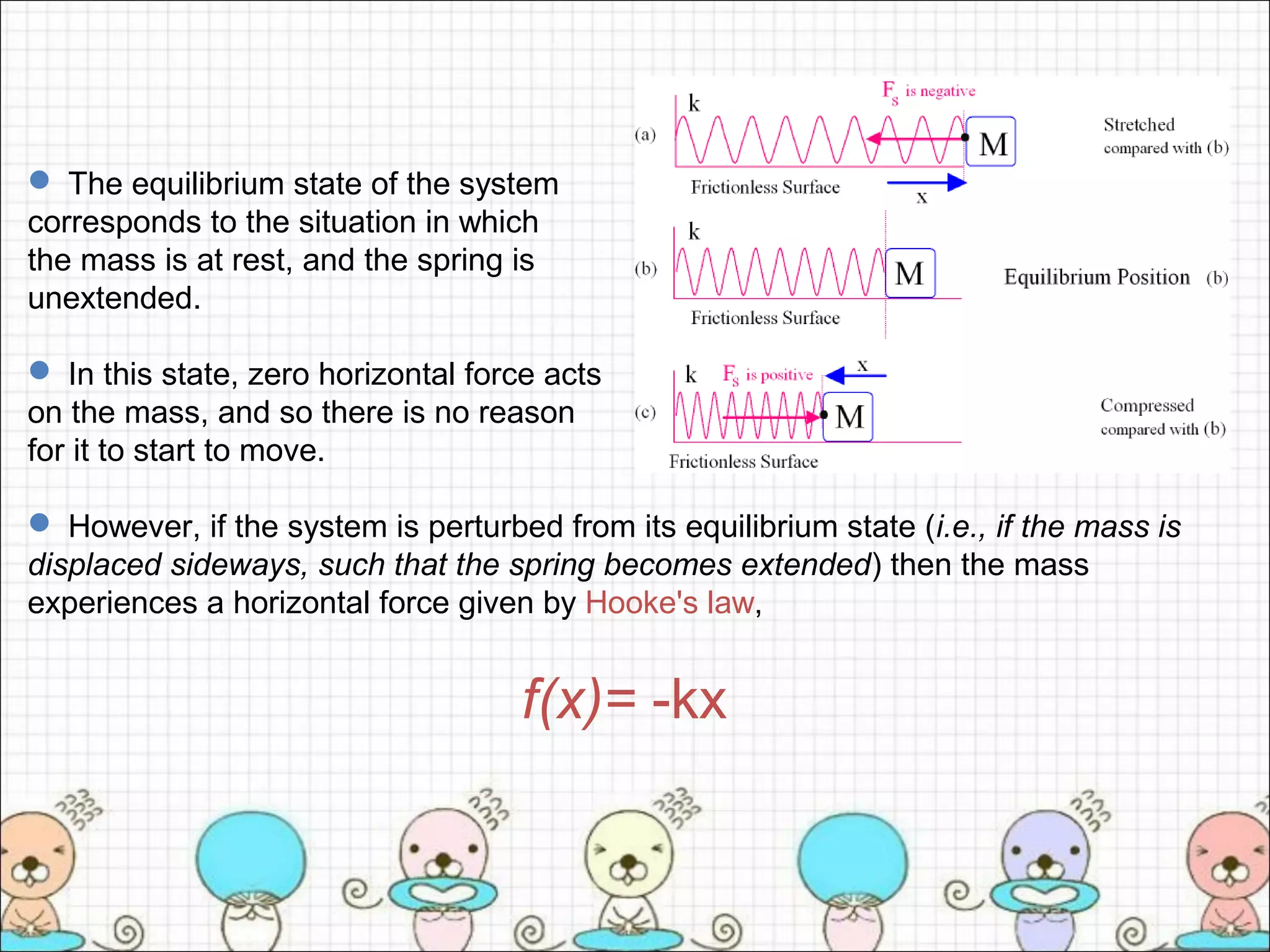
 The equilibrium state of the system
corresponds to the situation in which
the mass is at rest, and the spring is
unextended.
 In this state, zero horizontal force acts
on the mass, and so there is no reason
for it to start to move.
 However, if the system is perturbed from its equilibrium state (i.e., if the mass is
displaced sideways, such that the spring becomes extended) then the mass
experiences a horizontal force given by Hooke's law,
f(x)= -kx
• f(x)= -kx
• Here, k>0 is the so-called force constant of the spring.
• The negative sign in the preceding expression indicates that f(x) is a restoring
force (i.e., if the displacement is positive then the force is negative, and vice
versa).
• The magnitude of this restoring force is directly proportional to the displacement
of the mass from its equilibrium position. Hooke's law only holds for relatively
small spring extensions.
• Newton's second law of motion leads to the following time evolution equation for
the system,
F = ma = -kx
a= -(k/m)x
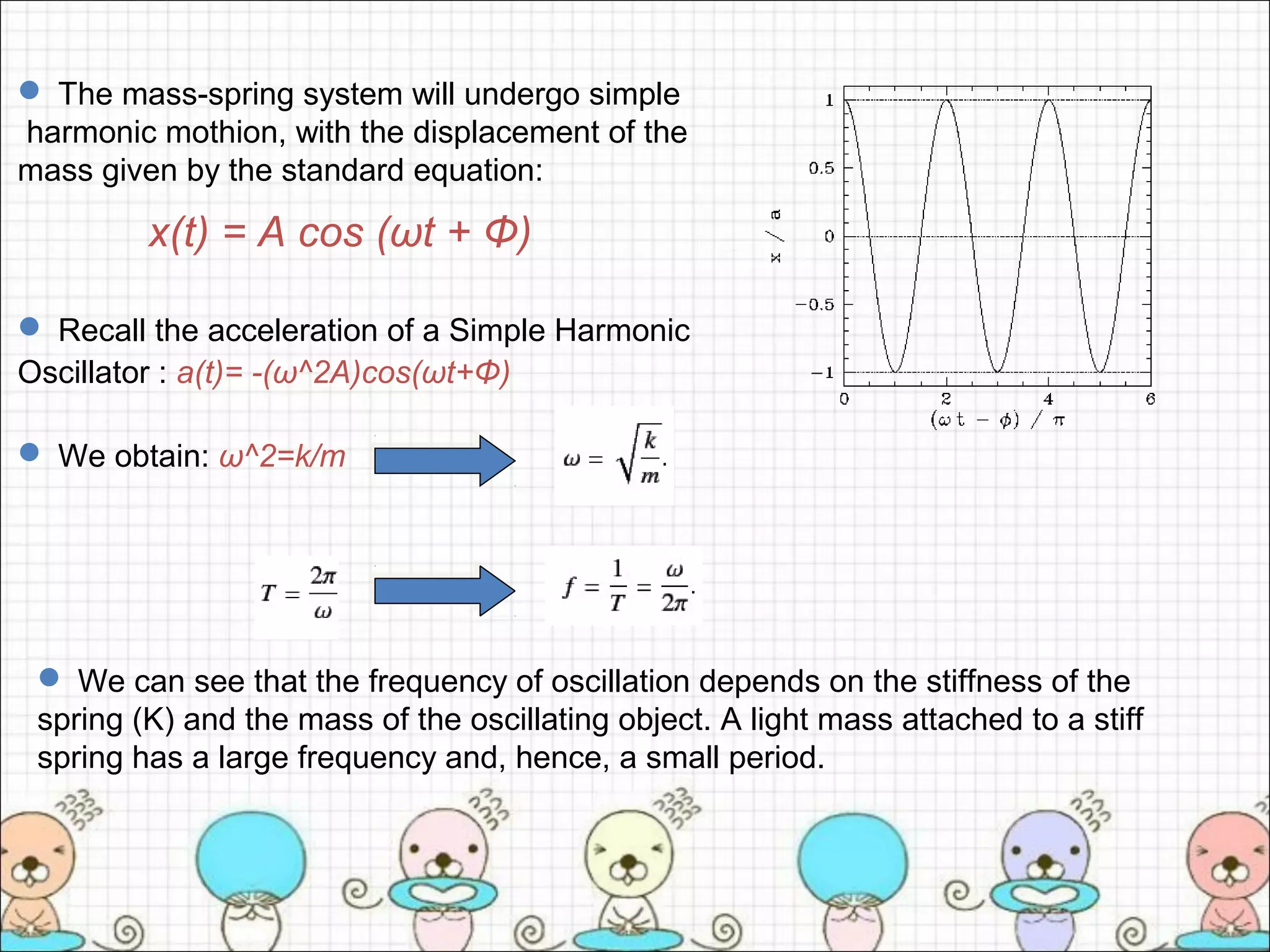
 The mass-spring system will undergo simple
harmonic mothion, with the displacement of the
mass given by the standard equation:
x(t) = A cos (ωt + Φ)
 Recall the acceleration of a Simple Harmonic
Oscillator : a(t)= -(ω^2A)cos(ωt+Φ)
 We obtain: ω^2=k/m
 We can see that the frequency of oscillation depends on the stiffness of the
spring (K) and the mass of the oscillating object. A light mass attached to a stiff
spring has a large frequency and, hence, a small period.
Thank you !
Thank you !

Learning object 1

  • 1.
    Horizontal Mass Spring System By:Yueyan Li section: LE2 Learning objective 1
  • 2.
     Consider acompact mass m that slides over a frictionless horizontal surface.  Suppose that the mass is attached to one end of a light horizontal spring whose other end is anchored in an immovable wall.  At time t , let x(t) be the extension of the spring. Note: the extension of the spring is the difference between the spring's actual length and its unstretched length. x(t) can also be used as a coordinate to determine the instantaneous horizontal displacement of the mass.
  • 3.
     The equilibriumstate of the system corresponds to the situation in which the mass is at rest, and the spring is unextended.  In this state, zero horizontal force acts on the mass, and so there is no reason for it to start to move.  However, if the system is perturbed from its equilibrium state (i.e., if the mass is displaced sideways, such that the spring becomes extended) then the mass experiences a horizontal force given by Hooke's law, f(x)= -kx
  • 4.
    • f(x)= -kx •Here, k>0 is the so-called force constant of the spring. • The negative sign in the preceding expression indicates that f(x) is a restoring force (i.e., if the displacement is positive then the force is negative, and vice versa). • The magnitude of this restoring force is directly proportional to the displacement of the mass from its equilibrium position. Hooke's law only holds for relatively small spring extensions. • Newton's second law of motion leads to the following time evolution equation for the system, F = ma = -kx a= -(k/m)x
  • 5.
     The mass-springsystem will undergo simple harmonic mothion, with the displacement of the mass given by the standard equation: x(t) = A cos (ωt + Φ)  Recall the acceleration of a Simple Harmonic Oscillator : a(t)= -(ω^2A)cos(ωt+Φ)  We obtain: ω^2=k/m  We can see that the frequency of oscillation depends on the stiffness of the spring (K) and the mass of the oscillating object. A light mass attached to a stiff spring has a large frequency and, hence, a small period.
  • 6.
  • 7.