BUDDHIST ARCHITECTURE

STUPA








BILAL KHAN
BHURA UMAIR
IQBAL ZAFAR
JYOTI YADAV
MOHD. RAGHIB
OMID PAKSIMA
TABISH IFTEKHAR
INTRODUCTION
•

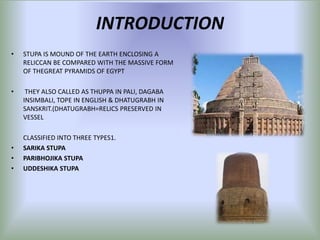
STUPA IS MOUND OF THE EARTH ENCLOSING A
RELICCAN BE COMPARED WITH THE MASSIVE FORM
OF THEGREAT PYRAMIDS OF EGYPT

•

THEY ALSO CALLED AS THUPPA IN PALI, DAGABA
INSIMBALI, TOPE IN ENGLISH & DHATUGRABH IN
SANSKRIT.(DHATUGRABH=RELICS PRESERVED IN
VESSEL

•
•
•

CLASSIFIED INTO THREE TYPES1.
SARIKA STUPA
PARIBHOJIKA STUPA
UDDESHIKA STUPA
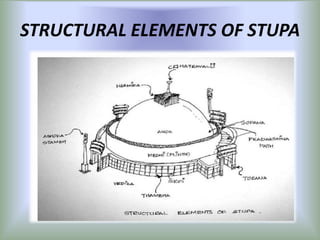
STRUCTURAL ELEMENTS OF STUPA
STUPA PLANNING
HARMIKA
ANDA
MEDHI
UPPER
PRADAKSHINA
PATH
LOWER
PRADAKSHINA
PATH
SANCHI STUPA


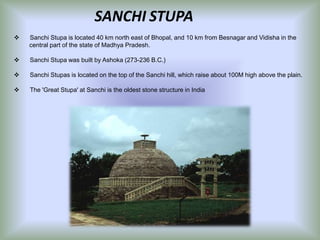
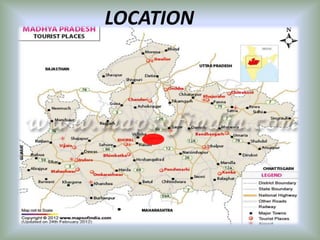
Sanchi Stupa is located 40 km north east of Bhopal, and 10 km from Besnagar and Vidisha in the
central part of the state of Madhya Pradesh.



Sanchi Stupa was built by Ashoka (273-236 B.C.)



Sanchi Stupas is located on the top of the Sanchi hill, which raise about 100M high above the plain.



The 'Great Stupa' at Sanchi is the oldest stone structure in India
LOCATION
SITE PLANNING


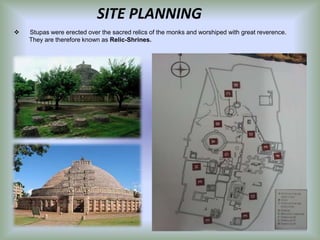
Stupas were erected over the sacred relics of the monks and worshiped with great reverence.
They are therefore known as Relic-Shrines.
SITE PLANNING


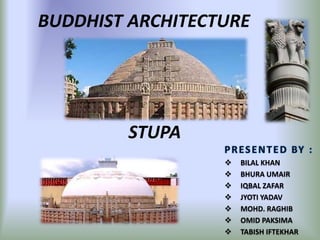
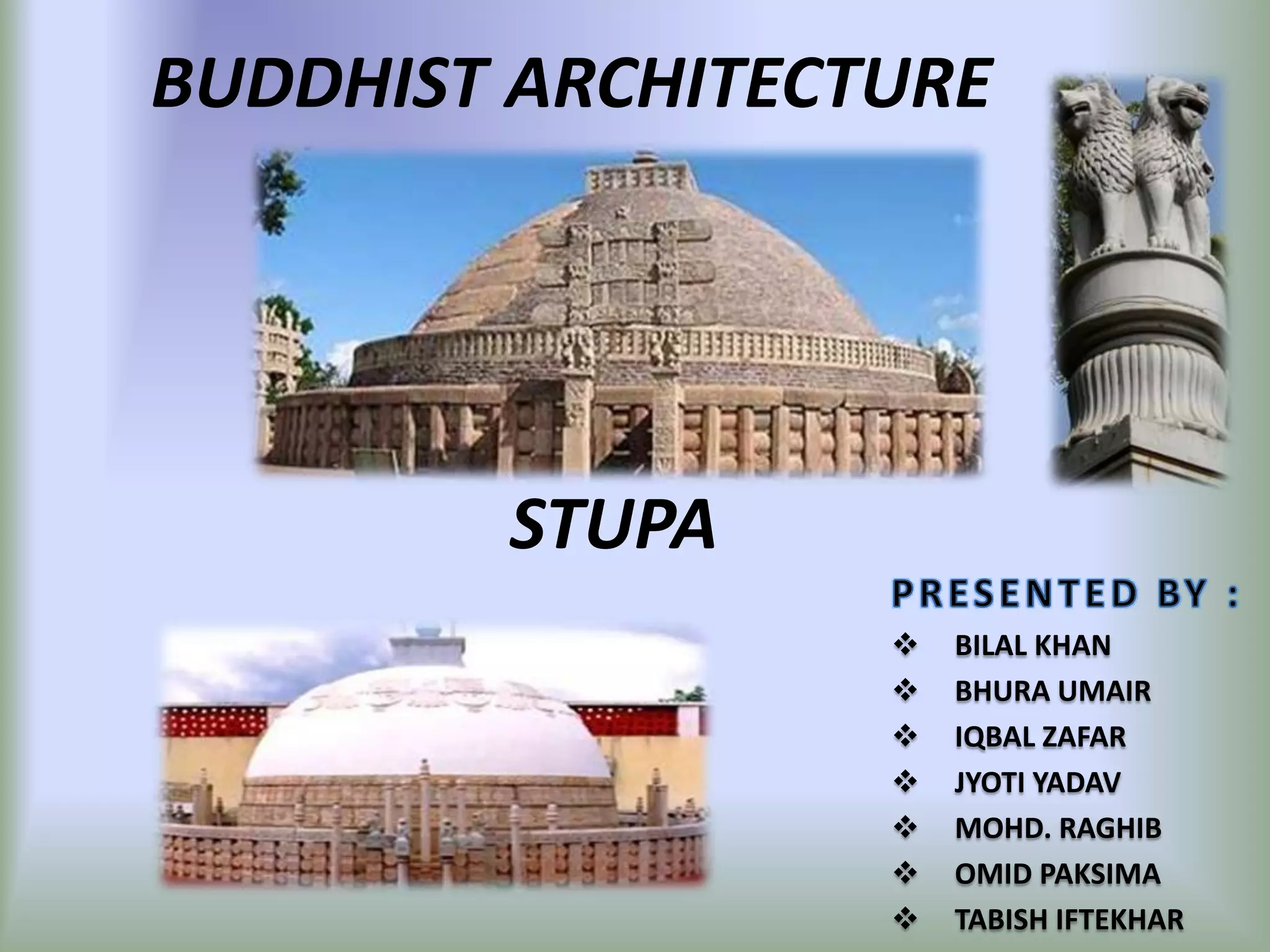
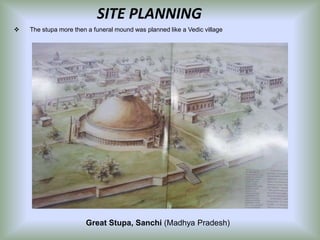
The stupa more then a funeral mound was planned like a Vedic village

Great Stupa, Sanchi (Madhya Pradesh)


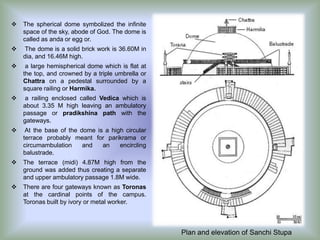
The spherical dome symbolized the infinite
space of the sky, abode of God. The dome is
called as anda or egg or.



The dome is a solid brick work is 36.60M in
dia, and 16.46M high.



a large hemispherical dome which is flat at
the top, and crowned by a triple umbrella or
Chattra on a pedestal surrounded by a
square railing or Harmika.



a railing enclosed called Vedica which is
about 3.35 M high leaving an ambulatory
passage or pradikshina path with the
gateways.



At the base of the dome is a high circular
terrace probably meant for parikrama or
circumambulation
and
an
encircling
balustrade.



The terrace (midi) 4.87M high from the
ground was added thus creating a separate
and upper ambulatory passage 1.8M wide.



There are four gateways known as Toronas
at the cardinal points of the campus.
Toronas built by ivory or metal worker.

Plan and elevation of Sanchi Stupa

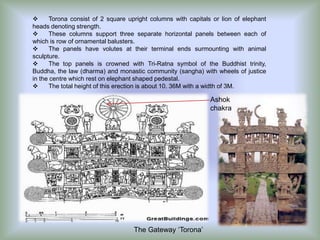
Torona consist of 2 square upright columns with capitals or lion of elephant
heads denoting strength.

These columns support three separate horizontal panels between each of
which is row of ornamental balusters.

The panels have volutes at their terminal ends surmounting with animal
sculpture.

The top panels is crowned with Tri-Ratna symbol of the Buddhist trinity,
Buddha, the law (dharma) and monastic community (sangha) with wheels of justice
in the centre which rest on elephant shaped pedestal.

The total height of this erection is about 10. 36M with a width of 3M.

Ashok
chakra

The Gateway ‘Torona’
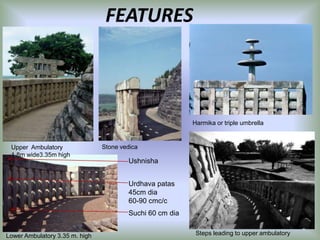
FEATURES

Harmika or triple umbrella

Upper Ambulatory
1.8m wide3.35m high

Stone vedica

Ushnisha
Urdhava patas
45cm dia
60-90 cmc/c
Suchi 60 cm dia
Lower Ambulatory 3.35 m. high

Steps leading to upper ambulatory
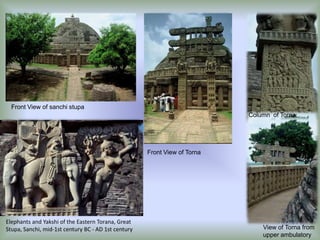
Front View of sanchi stupa
Column of Torna

Front View of Torna

Elephants and Yakshi of the Eastern Torana, Great
Stupa, Sanchi, mid-1st century BC - AD 1st century

View of Torna from
upper ambulatory
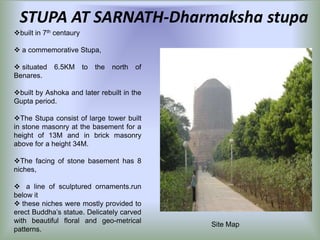
STUPA AT SARNATH-Dharmaksha stupa
built in 7th centaury
 a commemorative Stupa,
 situated
Benares.

6.5KM

to

the

north

of

built by Ashoka and later rebuilt in the
Gupta period.
The Stupa consist of large tower built
in stone masonry at the basement for a
height of 13M and in brick masonry
above for a height 34M.
The facing of stone basement has 8
niches,
 a line of sculptured ornaments.run
below it
 these niches were mostly provided to
erect Buddha’s statue. Delicately carved
with beautiful floral and geo-metrical
patterns.

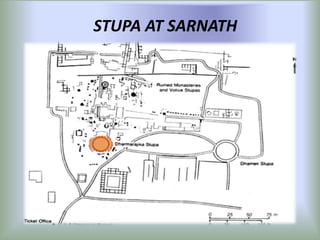
Site Map
STUPA AT SARNATH
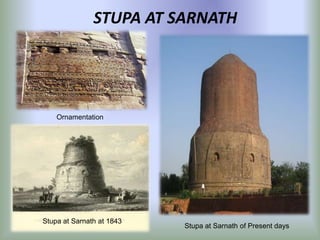
STUPA AT SARNATH

Ornamentation

Stupa at Sarnath at 1843

Stupa at Sarnath of Present days
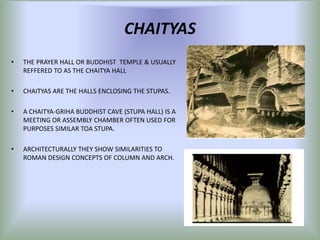
CHAITYAS
•

THE PRAYER HALL OR BUDDHIST TEMPLE & USUALLY
REFFERED TO AS THE CHAITYA HALL

•

CHAITYAS ARE THE HALLS ENCLOSING THE STUPAS.

•

A CHAITYA-GRIHA BUDDHIST CAVE (STUPA HALL) IS A
MEETING OR ASSEMBLY CHAMBER OFTEN USED FOR
PURPOSES SIMILAR TOA STUPA.

•

ARCHITECTURALLY THEY SHOW SIMILARITIES TO
ROMAN DESIGN CONCEPTS OF COLUMN AND ARCH.
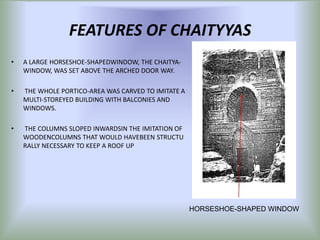
FEATURES OF CHAITYYAS
•

A LARGE HORSESHOE-SHAPEDWINDOW, THE CHAITYAWINDOW, WAS SET ABOVE THE ARCHED DOOR WAY.

•

THE WHOLE PORTICO-AREA WAS CARVED TO IMITATE A
MULTI-STOREYED BUILDING WITH BALCONIES AND
WINDOWS.

•

THE COLUMNS SLOPED INWARDSIN THE IMITATION OF
WOODENCOLUMNS THAT WOULD HAVEBEEN STRUCTU
RALLY NECESSARY TO KEEP A ROOF UP

HORSESHOE-SHAPED WINDOW

Buddhist architecture stupa

  • 1.
    BUDDHIST ARCHITECTURE STUPA        BILAL KHAN BHURAUMAIR IQBAL ZAFAR JYOTI YADAV MOHD. RAGHIB OMID PAKSIMA TABISH IFTEKHAR
  • 2.
    INTRODUCTION • STUPA IS MOUNDOF THE EARTH ENCLOSING A RELICCAN BE COMPARED WITH THE MASSIVE FORM OF THEGREAT PYRAMIDS OF EGYPT • THEY ALSO CALLED AS THUPPA IN PALI, DAGABA INSIMBALI, TOPE IN ENGLISH & DHATUGRABH IN SANSKRIT.(DHATUGRABH=RELICS PRESERVED IN VESSEL • • • CLASSIFIED INTO THREE TYPES1. SARIKA STUPA PARIBHOJIKA STUPA UDDESHIKA STUPA
  • 3.
  • 4.
  • 5.
    SANCHI STUPA  Sanchi Stupais located 40 km north east of Bhopal, and 10 km from Besnagar and Vidisha in the central part of the state of Madhya Pradesh.  Sanchi Stupa was built by Ashoka (273-236 B.C.)  Sanchi Stupas is located on the top of the Sanchi hill, which raise about 100M high above the plain.  The 'Great Stupa' at Sanchi is the oldest stone structure in India
  • 6.
  • 7.
    SITE PLANNING  Stupas wereerected over the sacred relics of the monks and worshiped with great reverence. They are therefore known as Relic-Shrines.
  • 8.
    SITE PLANNING  The stupamore then a funeral mound was planned like a Vedic village Great Stupa, Sanchi (Madhya Pradesh)
  • 9.
     The spherical domesymbolized the infinite space of the sky, abode of God. The dome is called as anda or egg or.  The dome is a solid brick work is 36.60M in dia, and 16.46M high.  a large hemispherical dome which is flat at the top, and crowned by a triple umbrella or Chattra on a pedestal surrounded by a square railing or Harmika.  a railing enclosed called Vedica which is about 3.35 M high leaving an ambulatory passage or pradikshina path with the gateways.  At the base of the dome is a high circular terrace probably meant for parikrama or circumambulation and an encircling balustrade.  The terrace (midi) 4.87M high from the ground was added thus creating a separate and upper ambulatory passage 1.8M wide.  There are four gateways known as Toronas at the cardinal points of the campus. Toronas built by ivory or metal worker. Plan and elevation of Sanchi Stupa
  • 10.
     Torona consist of2 square upright columns with capitals or lion of elephant heads denoting strength.  These columns support three separate horizontal panels between each of which is row of ornamental balusters.  The panels have volutes at their terminal ends surmounting with animal sculpture.  The top panels is crowned with Tri-Ratna symbol of the Buddhist trinity, Buddha, the law (dharma) and monastic community (sangha) with wheels of justice in the centre which rest on elephant shaped pedestal.  The total height of this erection is about 10. 36M with a width of 3M. Ashok chakra The Gateway ‘Torona’
  • 11.
    FEATURES Harmika or tripleumbrella Upper Ambulatory 1.8m wide3.35m high Stone vedica Ushnisha Urdhava patas 45cm dia 60-90 cmc/c Suchi 60 cm dia Lower Ambulatory 3.35 m. high Steps leading to upper ambulatory
  • 12.
    Front View ofsanchi stupa Column of Torna Front View of Torna Elephants and Yakshi of the Eastern Torana, Great Stupa, Sanchi, mid-1st century BC - AD 1st century View of Torna from upper ambulatory
  • 13.
    STUPA AT SARNATH-Dharmakshastupa built in 7th centaury  a commemorative Stupa,  situated Benares. 6.5KM to the north of built by Ashoka and later rebuilt in the Gupta period. The Stupa consist of large tower built in stone masonry at the basement for a height of 13M and in brick masonry above for a height 34M. The facing of stone basement has 8 niches,  a line of sculptured ornaments.run below it  these niches were mostly provided to erect Buddha’s statue. Delicately carved with beautiful floral and geo-metrical patterns. Site Map
  • 14.
  • 15.
    STUPA AT SARNATH Ornamentation Stupaat Sarnath at 1843 Stupa at Sarnath of Present days
  • 16.
    CHAITYAS • THE PRAYER HALLOR BUDDHIST TEMPLE & USUALLY REFFERED TO AS THE CHAITYA HALL • CHAITYAS ARE THE HALLS ENCLOSING THE STUPAS. • A CHAITYA-GRIHA BUDDHIST CAVE (STUPA HALL) IS A MEETING OR ASSEMBLY CHAMBER OFTEN USED FOR PURPOSES SIMILAR TOA STUPA. • ARCHITECTURALLY THEY SHOW SIMILARITIES TO ROMAN DESIGN CONCEPTS OF COLUMN AND ARCH.
  • 17.
    FEATURES OF CHAITYYAS • ALARGE HORSESHOE-SHAPEDWINDOW, THE CHAITYAWINDOW, WAS SET ABOVE THE ARCHED DOOR WAY. • THE WHOLE PORTICO-AREA WAS CARVED TO IMITATE A MULTI-STOREYED BUILDING WITH BALCONIES AND WINDOWS. • THE COLUMNS SLOPED INWARDSIN THE IMITATION OF WOODENCOLUMNS THAT WOULD HAVEBEEN STRUCTU RALLY NECESSARY TO KEEP A ROOF UP HORSESHOE-SHAPED WINDOW