Anti-lockBrakingSystem
Prepared
by:
Anti-lockBrakingSystem
 What is an Anti-Lock Braking System (ABS)?
 History of ABS
 Motivation for ABS Development
 Overview
 Principles for ABS Operation
 ABS Components Overview
 ABS Components
 Subaru Impreza ABS Application.
 How does ABS work?
 How ABS Work (Video)
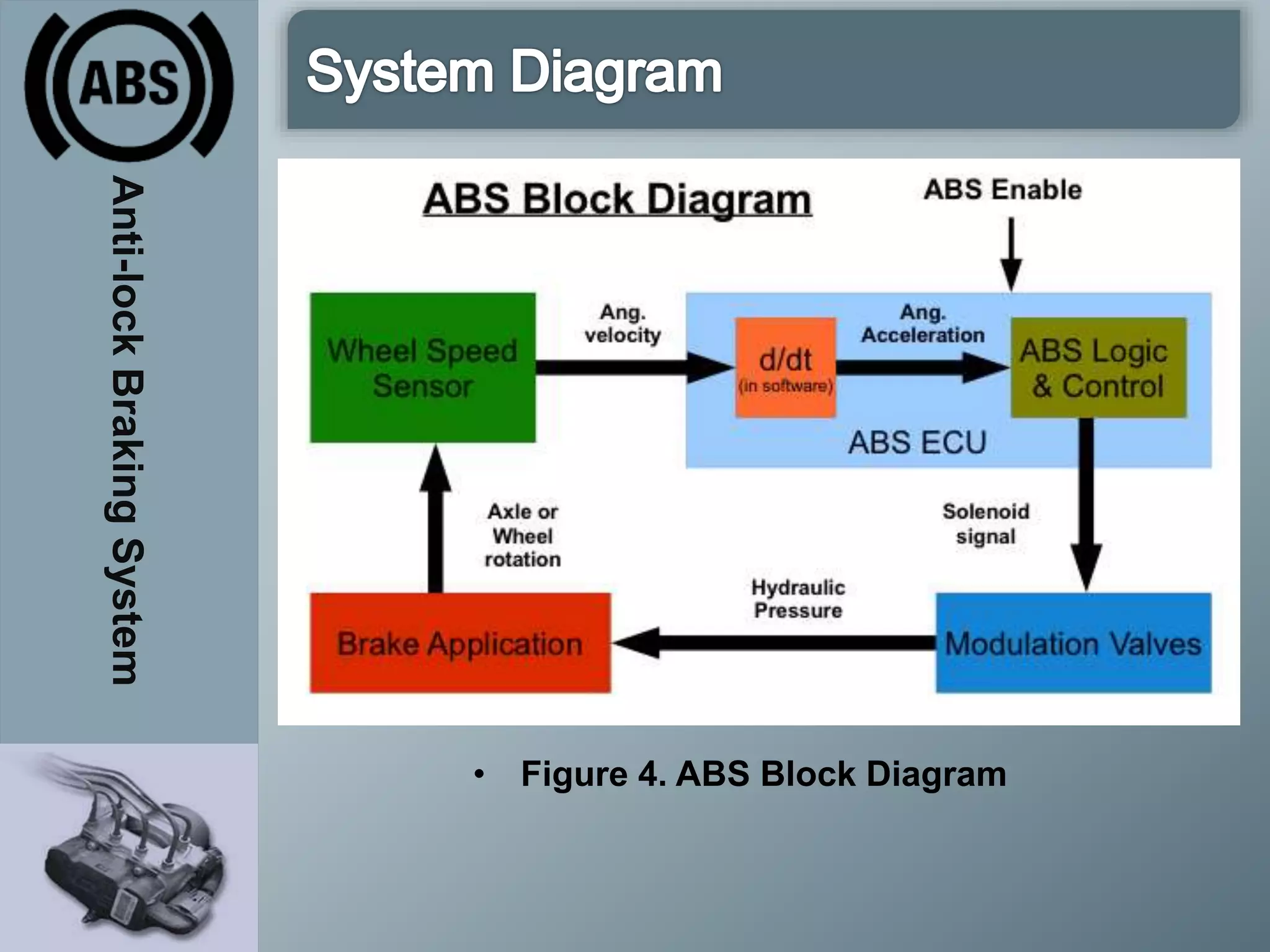
 System Diagram
 Anti-Lock Brake Types
 ABS Configurations
 Design Challenges
 Advantages & Disadvantages
 ABS Problems
 General information
 Summary
 Common questions
Anti-lockBrakingSystem
Anti-lock braking system (ABS) is
an automobile safety system
prevent the wheels of a vehicle
locking as brake pedal pressure is
applied - often suddenly in an
emergency or short stopping
distance. This enables the driver to
have steering control, preventing
skidding and loss of traction.
Anti-lockBrakingSystem
• 1929 :- ABS was first developed for aircraft by the
French automobile and aircraft pioneer Gabriel
Voisin, as threshold braking on airplanes is nearly
impossible.
• 1936: German company Bosch is awarded a patent
an “Apparatus for preventing lock-braking of
wheels in a motor vehicle”.
• 1936-: Bosch and Mercedes-Benz partner - R&D
into ABS.
• 1972: WABCO partners with Mercedes-Benz
developing first ABS for trucks.
• 1978: First production-line installation of ABS into
Mercedes and BMW vehicles.
• 1981: 100,000 Bosch ABS installed.
• 1985: First ABS installed on US vehicles.
Anti-lockBrakingSystem
• 1986: 1M Bosch ABS installed.
• 1987: Traction control - in conjunction with
ABS – used on passenger vehicles.
• 1989: ABS hydraulic unit combined with
standard hydraulic brake unit
• 1992: 10M Bosch ABS installed.
• 1995: Electronic Stability - in conjunction with
ABS and TCS - for passenger cars.
• 1999: 50M Bosch ABS installed.
• 2000: 6 of 10 new cars on the road are ABS
equipped.
• 2003: 100M Bosch ABS installed.
• Nowadays:- Almost all new cars have ABS.
Anti-lockBrakingSystem
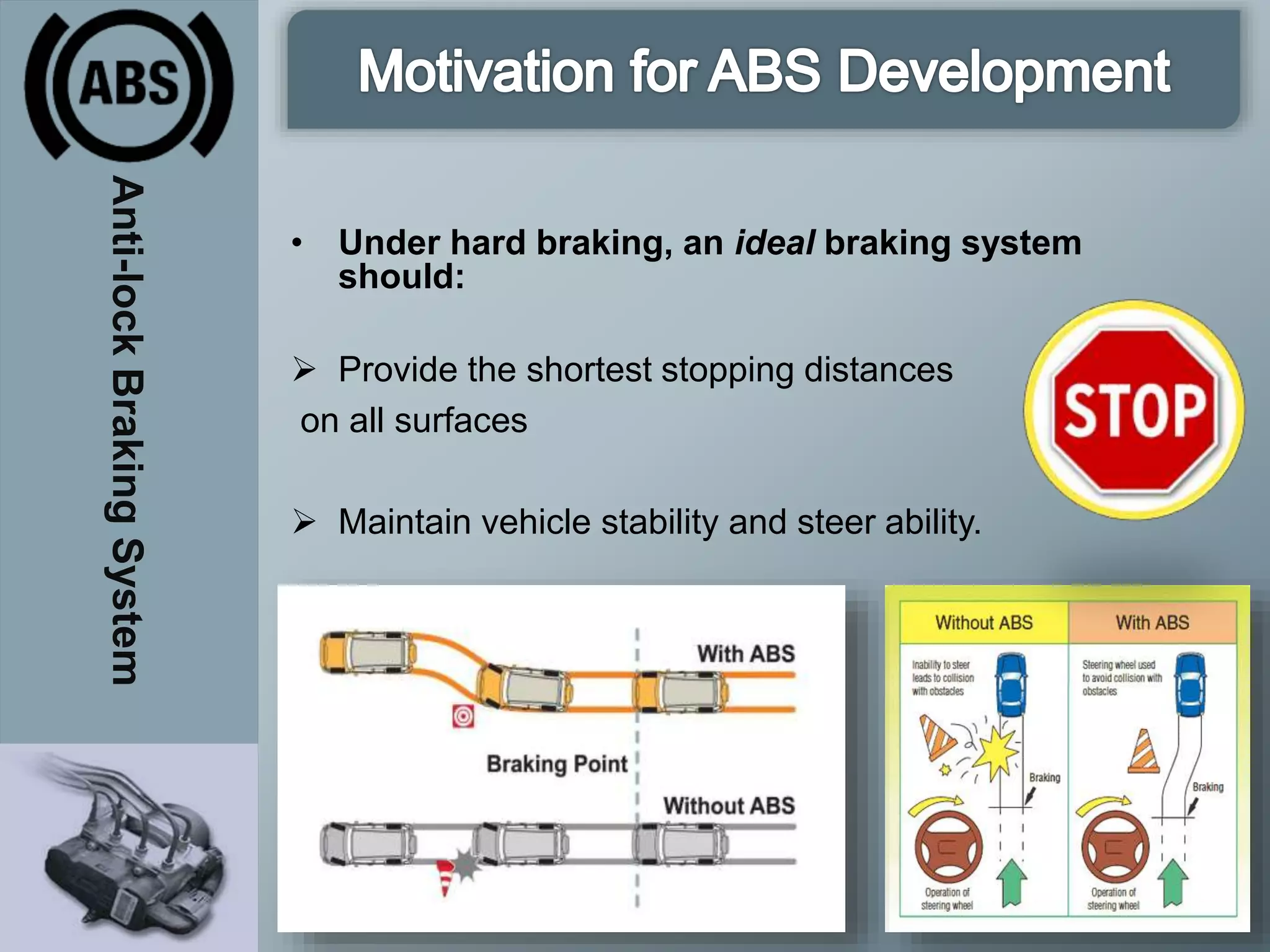
• Under hard braking, an ideal braking system
should:
 Provide the shortest stopping distances
on all surfaces
 Maintain vehicle stability and steer ability.
Anti-lockBrakingSystem
Many different control methods for ABS
systems have been developed. These
methods differ in their theoretical basis and
performance under the changes of road
conditions.
ABS
Research
Classical
Control
Optimal
Control
Nonlinear
Control
Robust
Control
Adaptive
Control
Intelligent
Control
Figure 1. Sampling of ABS control
Anti-lockBrakingSystem
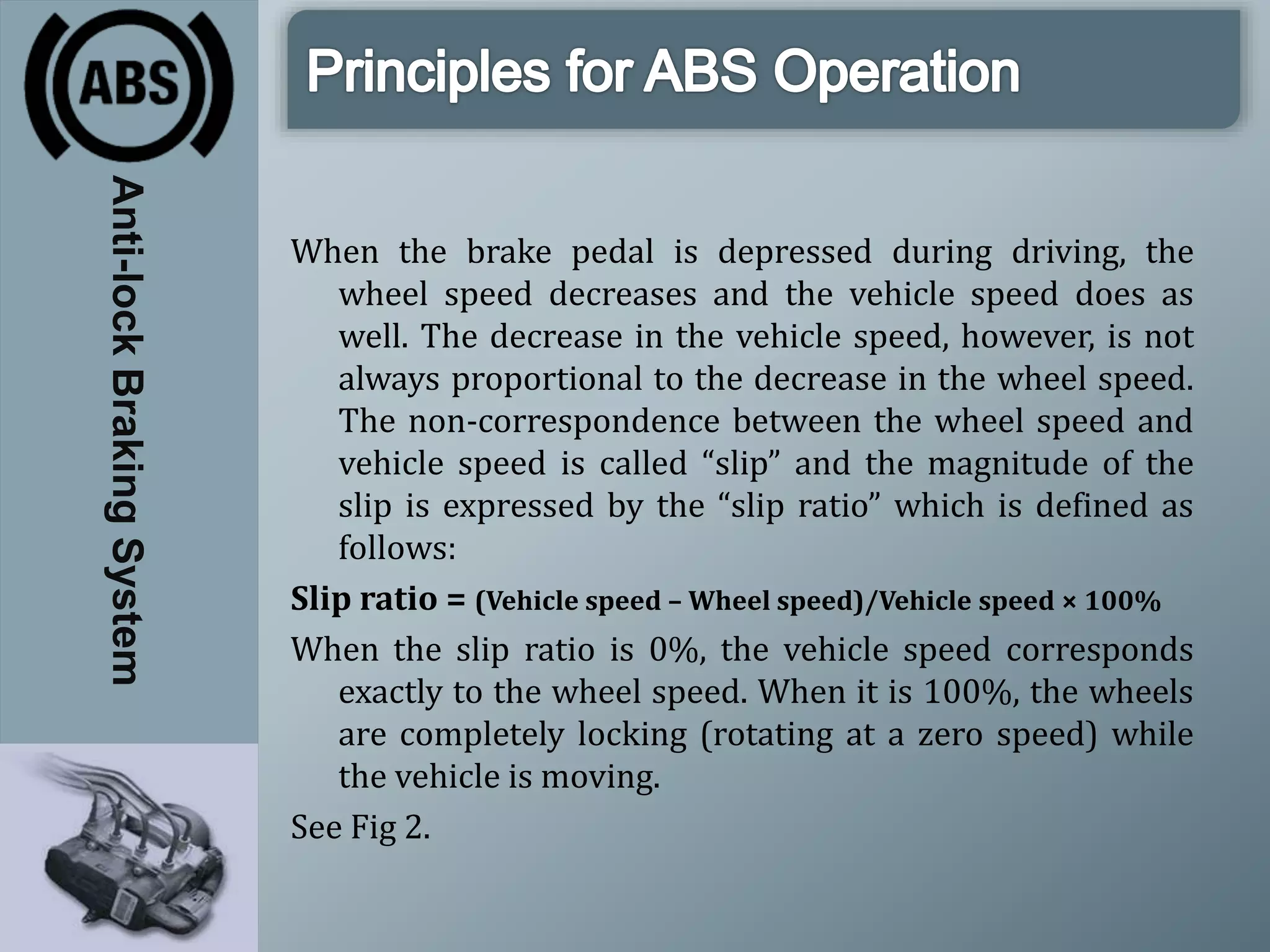
When the brake pedal is depressed during driving, the
wheel speed decreases and the vehicle speed does as
well. The decrease in the vehicle speed, however, is not
always proportional to the decrease in the wheel speed.
The non-correspondence between the wheel speed and
vehicle speed is called “slip” and the magnitude of the
slip is expressed by the “slip ratio” which is defined as
follows:
Slip ratio = (Vehicle speed – Wheel speed)/Vehicle speed × 100%
When the slip ratio is 0%, the vehicle speed corresponds
exactly to the wheel speed. When it is 100%, the wheels
are completely locking (rotating at a zero speed) while
the vehicle is moving.
See Fig 2.
Anti-lockBrakingSystem
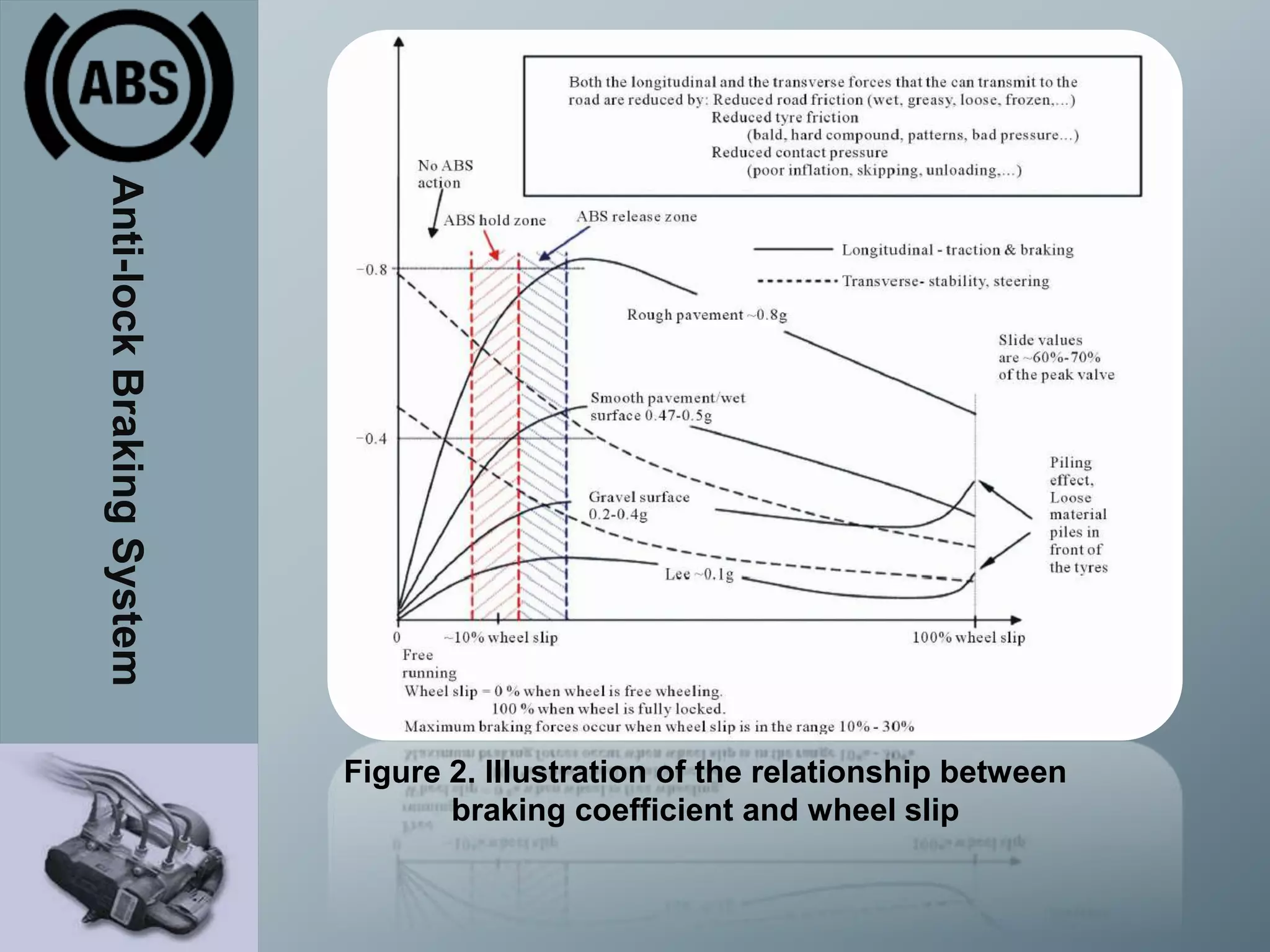
Figure 2. Illustration of the relationship between
braking coefficient and wheel slip
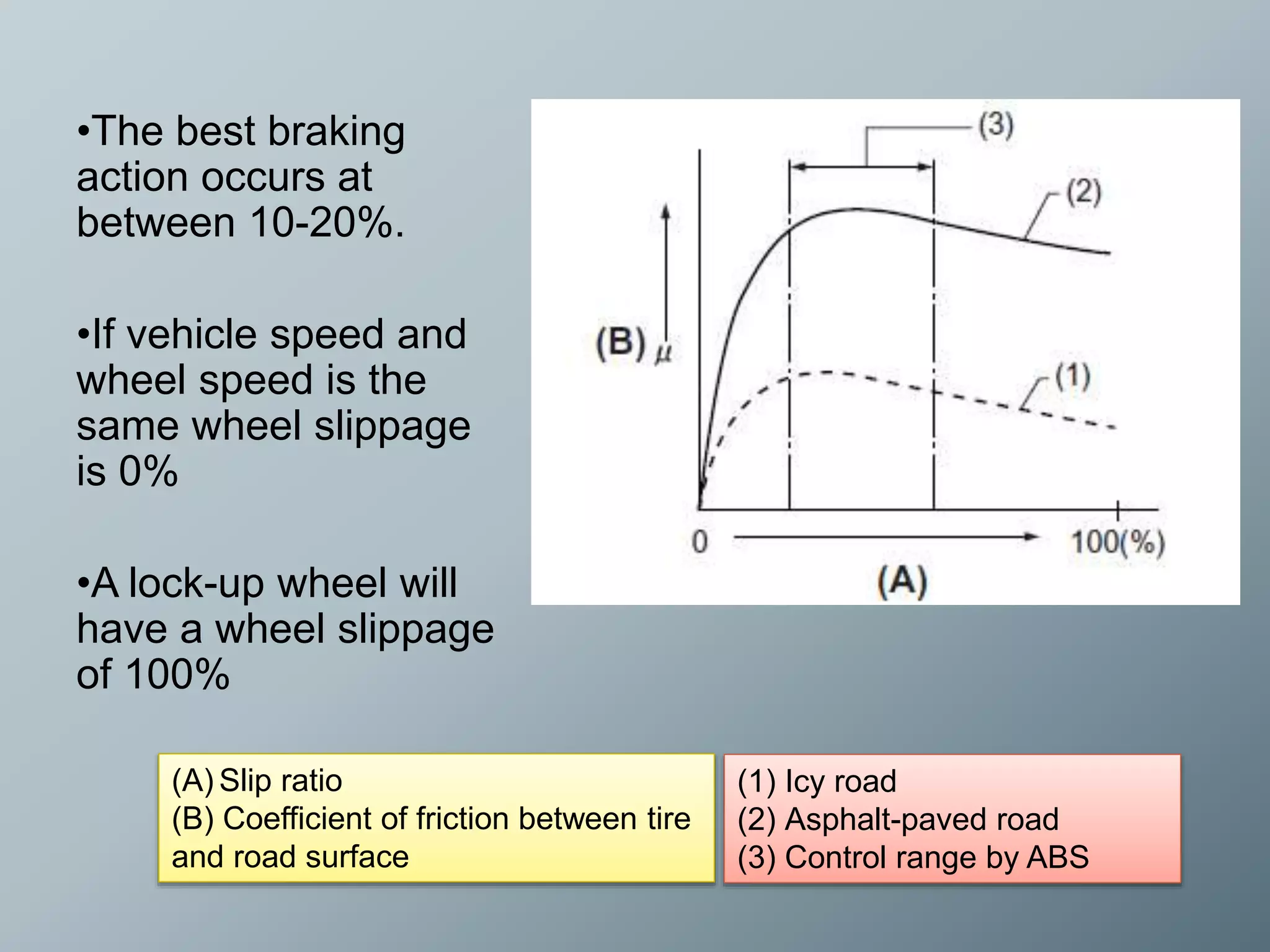
•The best braking
action occurs at
between 10-20%.
•If vehicle speed and
wheel speed is the
same wheel slippage
is 0%
•A lock-up wheel will
have a wheel slippage
of 100%
(A) Slip ratio
(B) Coefficient of friction between tire
and road surface
(1) Icy road
(2) Asphalt-paved road
(3) Control range by ABS
Anti-lockBrakingSystem
• Figure 2 shows the relationship between
braking co-efficient and wheel slip. It is
shown that the slide values for
stopping/traction force are proportionately
higher than the slide values for
cornering/steering force. A locked-up wheel
provides low road handling force and minimal
steering force.
Anti-lockBrakingSystem
The main benefit from ABS operation
is to maintain directional control of
the vehicle during heavy braking in
rare circumstances
Anti-lockBrakingSystem
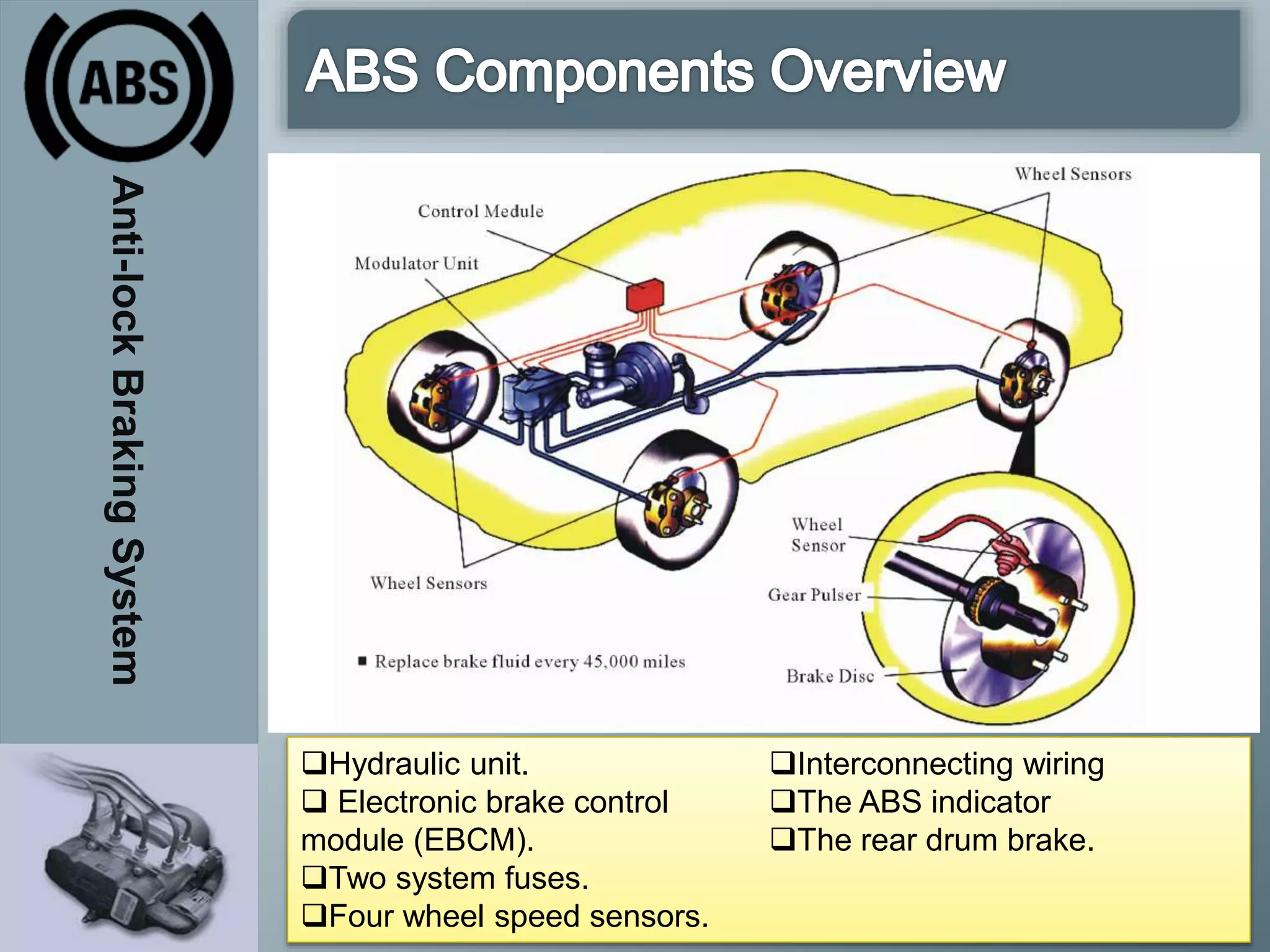
Hydraulic unit.
 Electronic brake control
module (EBCM).
Two system fuses.
Four wheel speed sensors.
Interconnecting wiring
The ABS indicator
The rear drum brake.
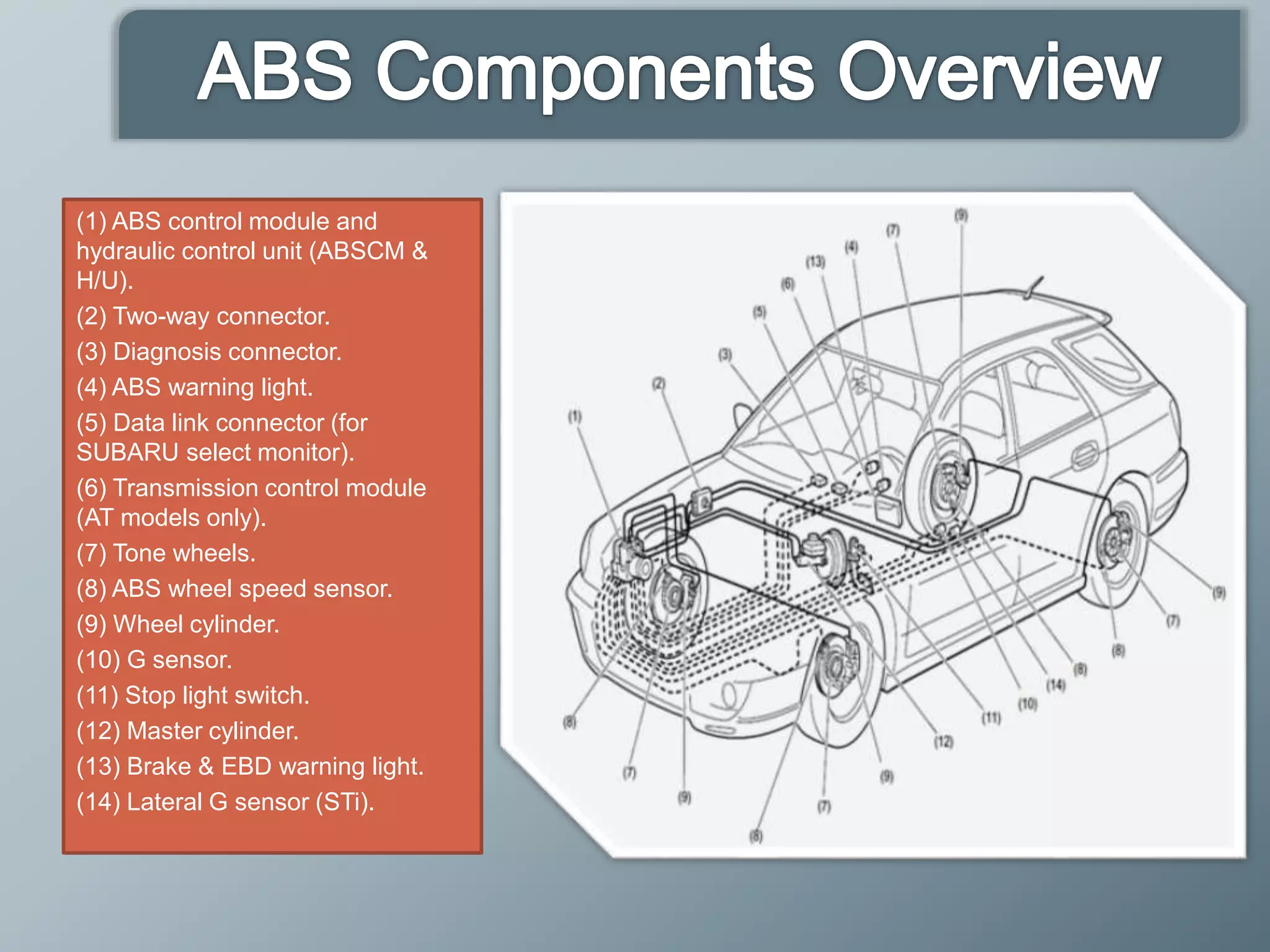
(1) ABS control module and
hydraulic control unit (ABSCM &
H/U).
(2) Two-way connector.
(3) Diagnosis connector.
(4) ABS warning light.
(5) Data link connector (for
SUBARU select monitor).
(6) Transmission control module
(AT models only).
(7) Tone wheels.
(8) ABS wheel speed sensor.
(9) Wheel cylinder.
(10) G sensor.
(11) Stop light switch.
(12) Master cylinder.
(13) Brake & EBD warning light.
(14) Lateral G sensor (STi).
Anti-lockBrakingSystem
• ABS brake system are
–Integrated
• An integrated system has the master
cylinder and control valve assembly
made together.
–Nonintegrated
• A nonintegrated has the master
cylinder and control valve assembly
made separate.
Anti-lockBrakingSystem
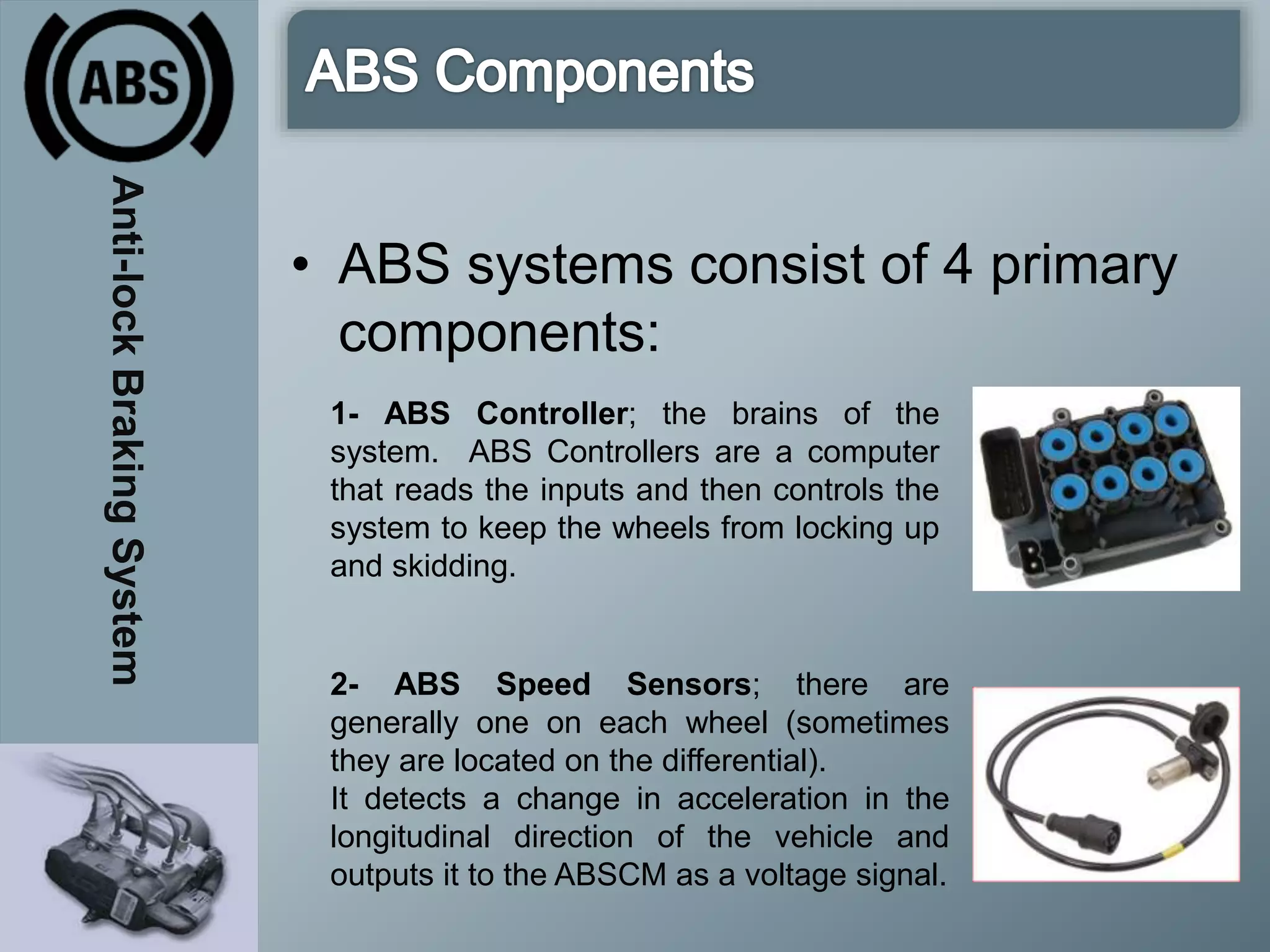
• ABS systems consist of 4 primary
components:
1- ABS Controller; the brains of the
system. ABS Controllers are a computer
that reads the inputs and then controls the
system to keep the wheels from locking up
and skidding.
2- ABS Speed Sensors; there are
generally one on each wheel (sometimes
they are located on the differential).
It detects a change in acceleration in the
longitudinal direction of the vehicle and
outputs it to the ABSCM as a voltage signal.
Anti-lockBrakingSystem
3- ABS Modulator/Valves; some system
have separate valves for each wheel with a
modulator to control them. Other systems
they are combined. In either case they
work with the controller and the pump to
add or release pressure from the individual
wheels brakes to control the braking.
4- ABS Pumps; since the ABS
modulator/valves can release pressure from
the individual wheels brakes there needs to
be a way to restore the pressure when
required. That is what the ABS pumps job
is. When the pump is cycling, the driver
may experience a slight pedal
vibration. This cycling is happening many
times per second and this slight vibration is
natural.
(1) ABS control module and
hydraulic control unit
(2) ABS control module section
(3) Valve relay
(4) Motor relay
(5) Motor
(6) Front left inlet solenoid valve
(7) Front left outlet solenoid valve
(8) Front right inlet solenoid valve
(9) Front right outlet solenoid valve
(10)Rear left inlet solenoid valve
(11)Rear left outlet solenoid valve
(12)Rear right inlet solenoid valve
(13)Rear right outlet solenoid valve
(14)Automatic transmission control
Module
(15) Diagnosis connector
(16) Data link connector
(17) ABS warning light
(18) Stop light switch
(19) Stop light
(20) G sensor
(21) Front left ABS wheel speed sensor
(22) Front right ABS wheel speed sensor
(23) Rear left ABS wheel speed sensor
(24) Rear right ABS wheel speed sensor
(25) IGN
(26) Battery
(27) Brake warning light
(28) Parking brake warning light
(29) Brake fluid level switch
(30) Lateral G sensor (STi)
(31) Driver-controllable center differential
control unit
Anti-lockBrakingSystem
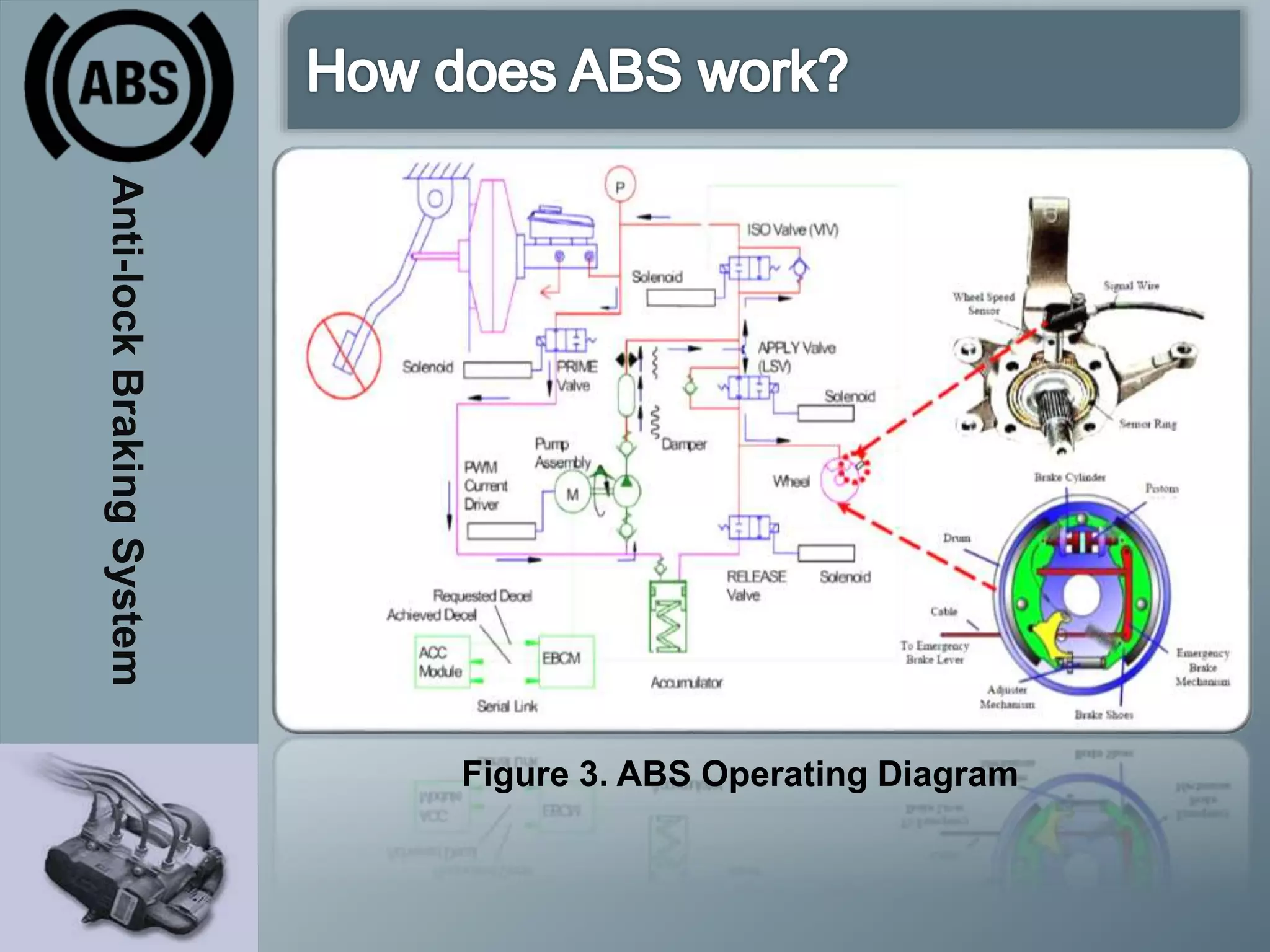
Figure 3. ABS Operating Diagram
We will discuss how one of the simpler system works.
 Sensors at each of the four wheels  sense the rotation of the wheel.
 Too much brake application  wheel stop rotating
 Sensors  ECU  releases brake line pressure  wheel turns
again.
 then ECU applies pressure again  stops the rotation of the wheel
releases it again and so on
NB:
 This releasing and re-application or pulsing of brake pressure
happens 20-30 times per second or more.
 This keeps the wheel just at the limit before locking up and
skidding no matter
 ABS system can maintain extremely high static pressure and must be
disabled before attempting repairs.
Anti-lockBrakingSystem
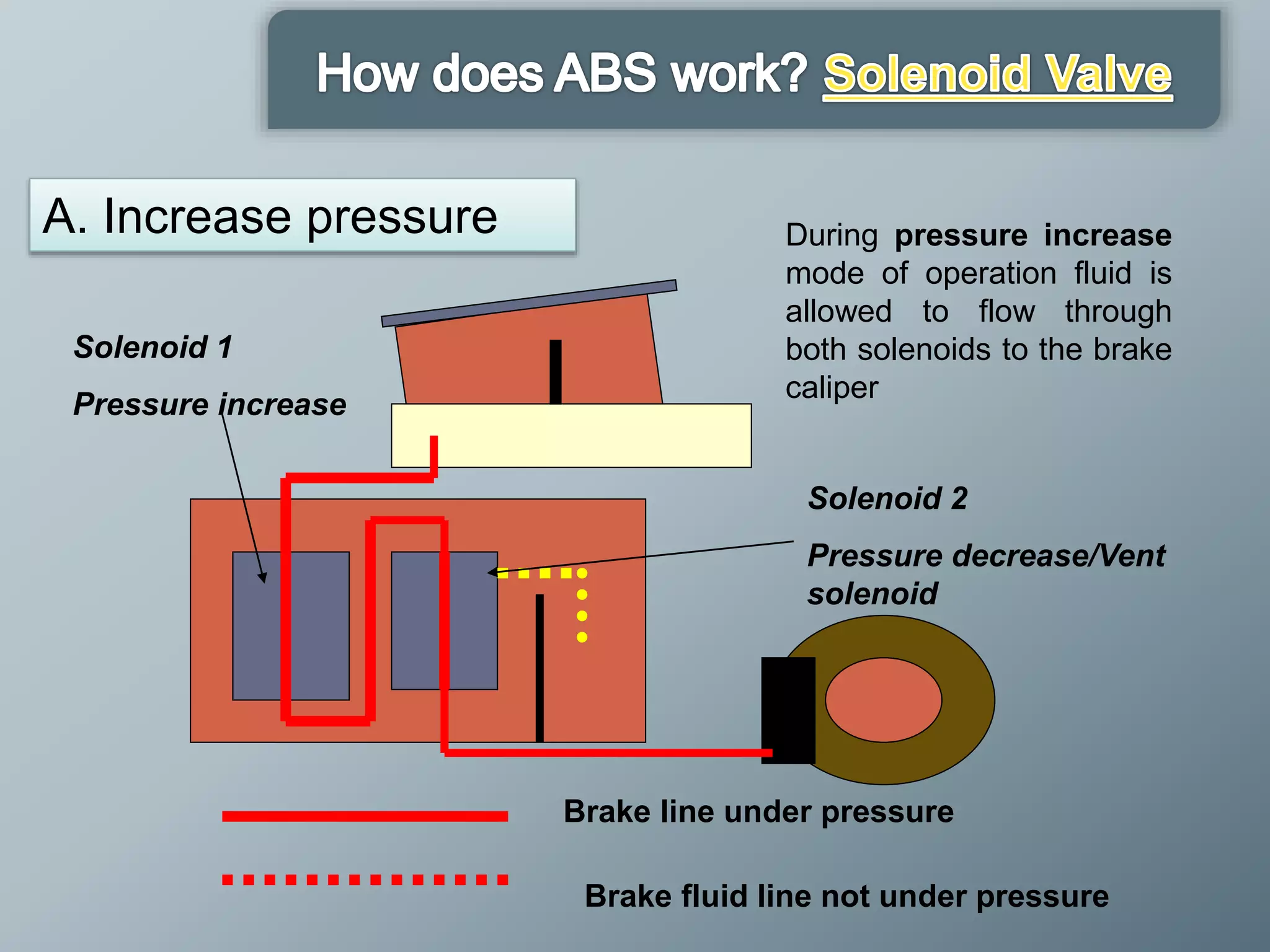
• Solenoid Valve Assembly:
Is a pair of valves that can:
A. Increase pressure
B. Hold pressure steady
C. Decrease pressure
During pressure increase
mode of operation fluid is
allowed to flow through
both solenoids to the brake
caliper
Solenoid 1
Pressure increase
Solenoid 2
Pressure decrease/Vent
solenoid
Brake line under pressure
Brake fluid line not under pressure
A. Increase pressure
During Pressure Hold
mode of operation both
solenoids are closed and
no additional fluid is
allowed to flow to brake
calipers.
Solenoid 1
Pressure increase
Solenoid 2
Pressure decrease/Vent
B. Hold pressure steady
During Pressure Vent mode
the pressure increase solenoid
is closed. The Vent solenoid
opens allowing fluid to vent
into an accumulator chamber
Solenoid 1
Pressure increase
Solenoid 2
Pressure decrease/Vent
C. Decrease pressure
Anti-lockBrakingSystem
• Figure 4. ABS Block Diagram
Anti-lockBrakingSystem
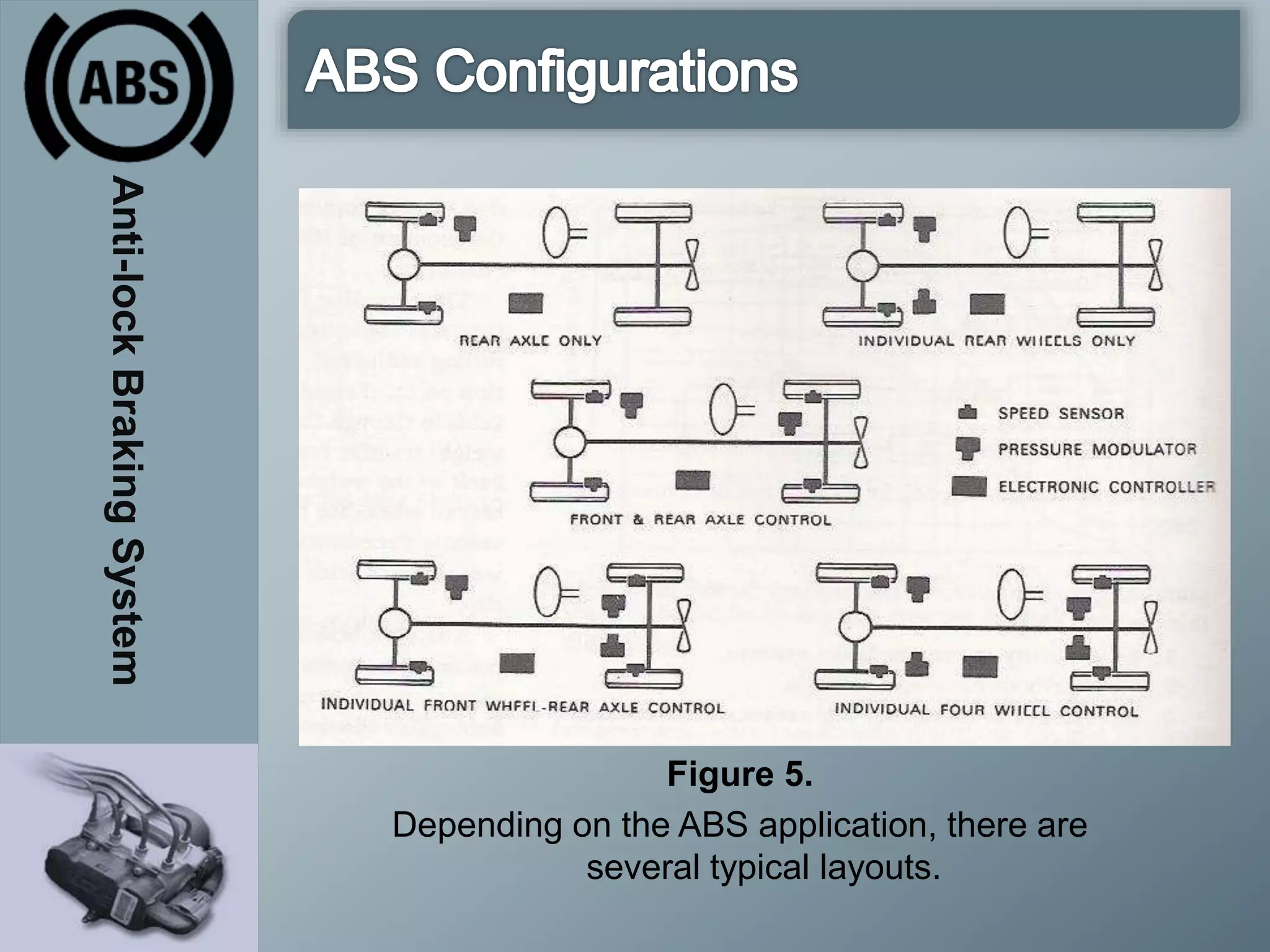
• ABS brakes are either
1 Channel
3 Channel
4 Channel
Anti-lockBrakingSystem
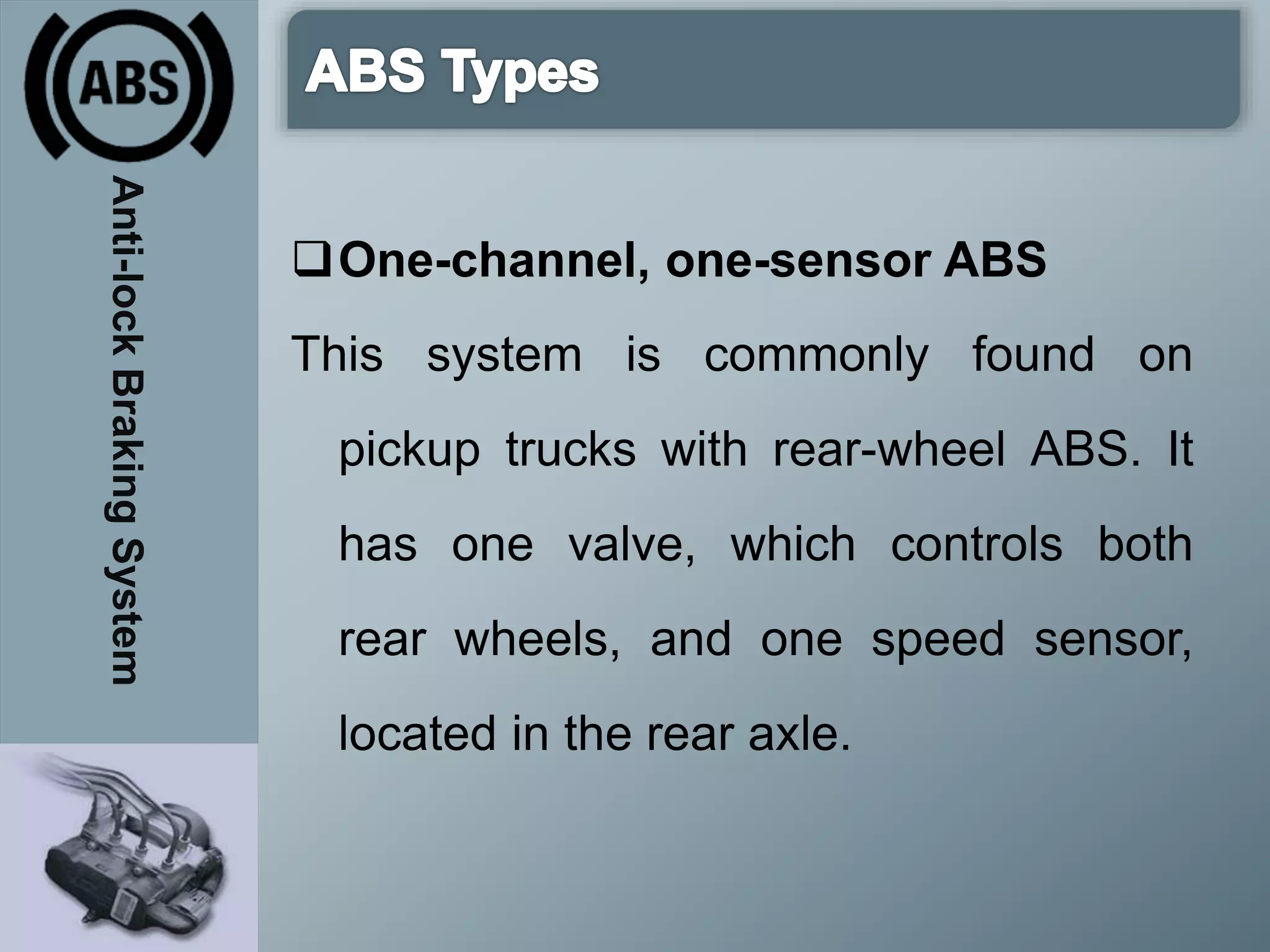
One-channel, one-sensor ABS
This system is commonly found on
pickup trucks with rear-wheel ABS. It
has one valve, which controls both
rear wheels, and one speed sensor,
located in the rear axle.
Anti-lockBrakingSystem
Three-channel, three-sensor ABS
This scheme, commonly found on pickup
trucks with four-wheel ABS, has a speed
sensor and a valve for each of the front
wheels, with one valve and one sensor for
both rear wheels. The speed sensor for
the rear wheels is located in the rear axle.
Anti-lockBrakingSystem
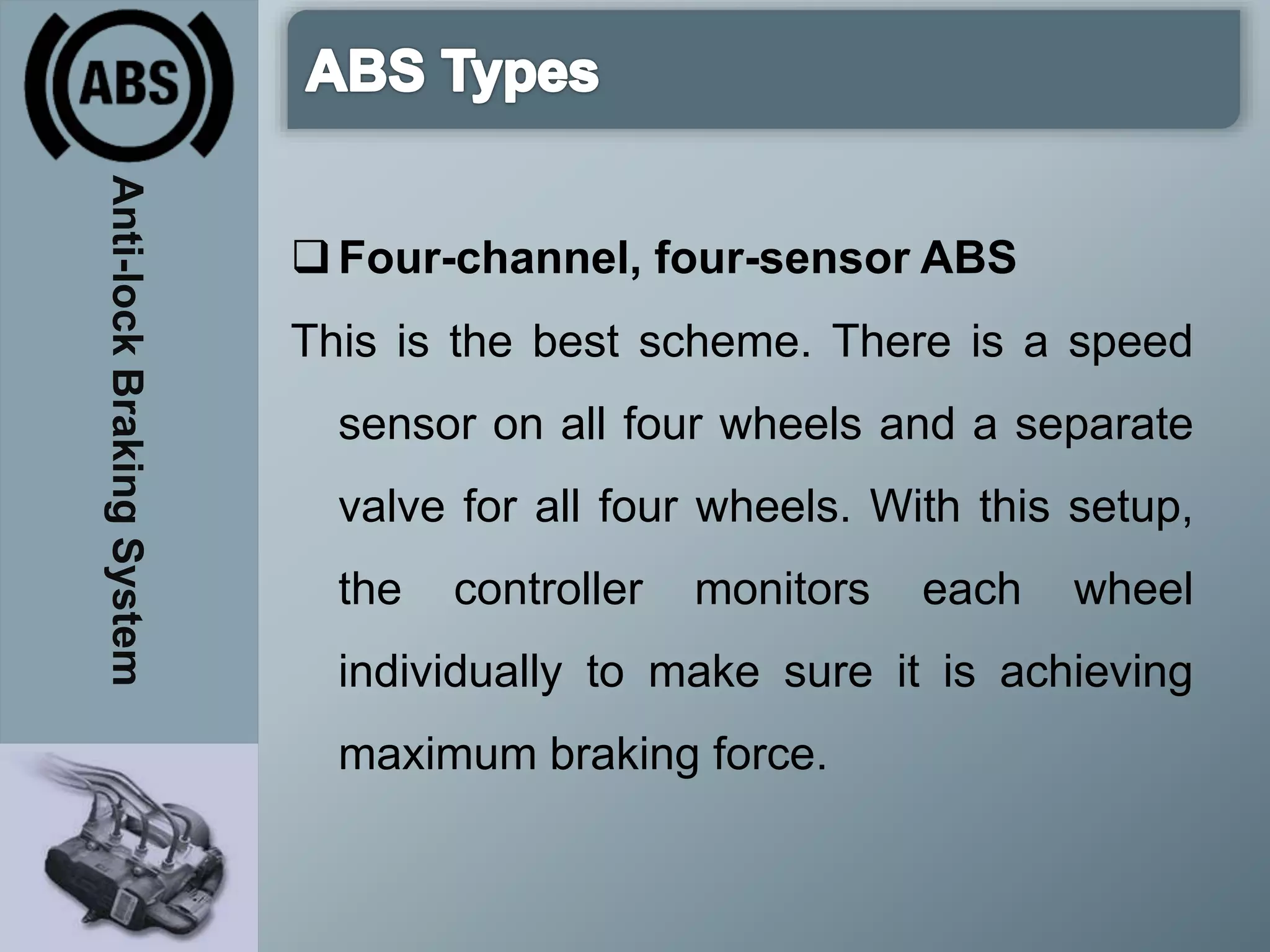
Four-channel, four-sensor ABS
This is the best scheme. There is a speed
sensor on all four wheels and a separate
valve for all four wheels. With this setup,
the controller monitors each wheel
individually to make sure it is achieving
maximum braking force.
Anti-lockBrakingSystem
Configurations of ABS Types
Anti-lockBrakingSystem
Figure 5.
Depending on the ABS application, there are
several typical layouts.
Anti-lockBrakingSystem
ABS control is highly nonlinear control problem due to the
complicated relationship between its components and
parameters. The research that has been carried out in
ABS control systems covers a broad range of issues
and challenges. Many different control methods for
ABS have been developed and research on improved
control methods is continuing. Most of these
approaches require system models, and some of them
cannot achieve satisfactory performance under the
changes of various road conditions. While soft
computing methods like Fuzzy control doesn’t need a
precise model. A brief idea of how soft computing is
employed in ABS control is given.
Anti-lockBrakingSystem
Fuzzy control :
Is Intelligent control systems can be
used in ABS control to emulate the
qualitative aspects of human
knowledge with several advantages
such as robustness, universal
approximation theorem and rule-based
algorithms.
Anti-lockBrakingSystem
• Advantages:
1. It allows the driver to maintain directional stability
and control over steering during braking
2. Safe and effective
3. Automatically changes the brake fluid pressure at
each wheel to maintain optimum brake performance.
4. ABS absorbs the unwanted turbulence shock waves
and modulates the pulses thus permitting the wheel
to continue turning under maximum braking pressure
Anti-lockBrakingSystem
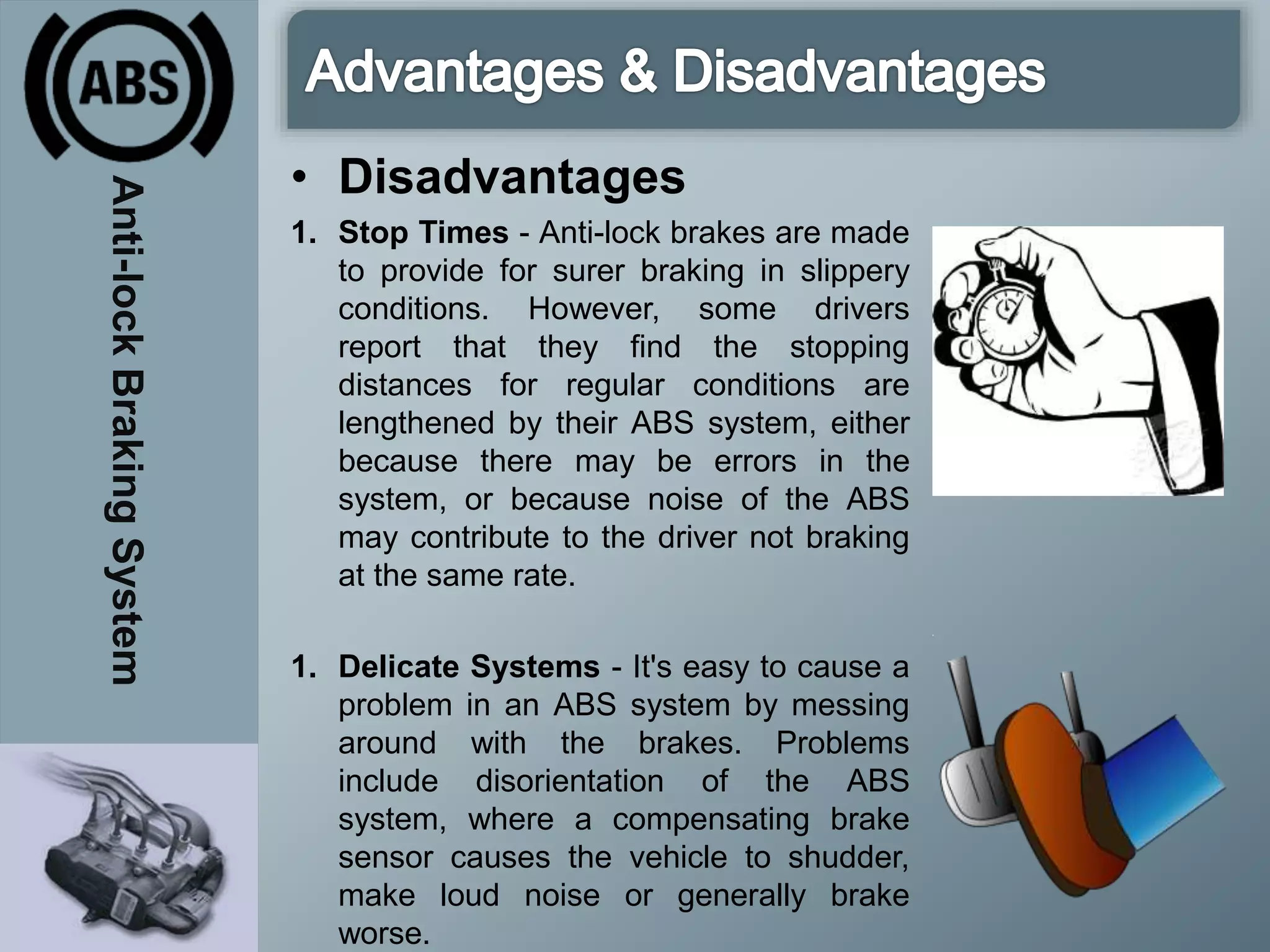
• Disadvantages
1. Stop Times - Anti-lock brakes are made
to provide for surer braking in slippery
conditions. However, some drivers
report that they find the stopping
distances for regular conditions are
lengthened by their ABS system, either
because there may be errors in the
system, or because noise of the ABS
may contribute to the driver not braking
at the same rate.
1. Delicate Systems - It's easy to cause a
problem in an ABS system by messing
around with the brakes. Problems
include disorientation of the ABS
system, where a compensating brake
sensor causes the vehicle to shudder,
make loud noise or generally brake
worse.
Anti-lockBrakingSystem
3. Cost - An ABS can be expensive
to maintain. Expensive sensors on
each wheel can cost hundreds of
dollars to fix if they get out of
calibration or develop other
problems. For some, this is a big
reason to decline an ABS in a
vehicle.
4. System damage - A variety of
factors can cause the system to
be less effective, and can present
with everything from shuddering of
the vehicle to loud noises while
trying to stop
Anti-lockBrakingSystem
Problems with ABS
The sensors on the wheels might get
contaminated by metallic dust. When this
condition occurs the sensors become less
efficient in picking up problems. In modern
ABS systems, two more sensors are added
to help:
 wheel angle sensor,
 gyroscopic sensor
Anti-lockBrakingSystem
The idea behind this is that when the
gyroscopic sensor detects that the car’s
direction is not the same as what the wheel
sensor reports, the ABS software will cut in to
brake the necessary wheel in order to help
the car go the direction the driver intends.
Anti-lockBrakingSystem
 Statistics show that approximately 40 % of automobile
accidents are due to skidding.
 Skidding , vehicle instability, steer inability and long
distance stopping, These problems commonly occur
on vehicle with conventional brake system which can
be avoided by adding devices called ABS.
 If there is an ABS failure, the system will revert to
normal brake operation. Normally the ABS warning
light will turn on and let the driver know there is a fault.
Anti-lockBrakingSystem
The antilock braking system controls
braking force by controlling the hydraulic
pressure of the braking system, so that the
wheels do not lock during braking.
The antilock braking system prevents
wheels locking or skidding, no matter how
hard brakes are applied, or how slippery the
road surface. Steering stays under control
and stopping distances are generally
reduced.
Anti-lockBrakingSystem
oWhat is ABS?
oWhy is that important?
oHow do I know whether my vehicle has ABS?
oWill I notice anything when the ABS is working or not?
oDoes ABS change the way I should use the brakes?
oHow does ABS work?
oDo cars with ABS stop more quickly than cars without?
oAre all antilock systems the same?
oHow can I familiarize myself with ABS?
Anti-lockBrakingSystem
Thanks for
your attention

Anti-lock Braking System (ABS)

  • 1.
  • 2.
    Anti-lockBrakingSystem  What isan Anti-Lock Braking System (ABS)?  History of ABS  Motivation for ABS Development  Overview  Principles for ABS Operation  ABS Components Overview  ABS Components  Subaru Impreza ABS Application.  How does ABS work?  How ABS Work (Video)  System Diagram  Anti-Lock Brake Types  ABS Configurations  Design Challenges  Advantages & Disadvantages  ABS Problems  General information  Summary  Common questions
  • 3.
    Anti-lockBrakingSystem Anti-lock braking system(ABS) is an automobile safety system prevent the wheels of a vehicle locking as brake pedal pressure is applied - often suddenly in an emergency or short stopping distance. This enables the driver to have steering control, preventing skidding and loss of traction.
  • 4.
    Anti-lockBrakingSystem • 1929 :-ABS was first developed for aircraft by the French automobile and aircraft pioneer Gabriel Voisin, as threshold braking on airplanes is nearly impossible. • 1936: German company Bosch is awarded a patent an “Apparatus for preventing lock-braking of wheels in a motor vehicle”. • 1936-: Bosch and Mercedes-Benz partner - R&D into ABS. • 1972: WABCO partners with Mercedes-Benz developing first ABS for trucks. • 1978: First production-line installation of ABS into Mercedes and BMW vehicles. • 1981: 100,000 Bosch ABS installed. • 1985: First ABS installed on US vehicles.
  • 5.
    Anti-lockBrakingSystem • 1986: 1MBosch ABS installed. • 1987: Traction control - in conjunction with ABS – used on passenger vehicles. • 1989: ABS hydraulic unit combined with standard hydraulic brake unit • 1992: 10M Bosch ABS installed. • 1995: Electronic Stability - in conjunction with ABS and TCS - for passenger cars. • 1999: 50M Bosch ABS installed. • 2000: 6 of 10 new cars on the road are ABS equipped. • 2003: 100M Bosch ABS installed. • Nowadays:- Almost all new cars have ABS.
  • 6.
    Anti-lockBrakingSystem • Under hardbraking, an ideal braking system should:  Provide the shortest stopping distances on all surfaces  Maintain vehicle stability and steer ability.
  • 7.
    Anti-lockBrakingSystem Many different controlmethods for ABS systems have been developed. These methods differ in their theoretical basis and performance under the changes of road conditions. ABS Research Classical Control Optimal Control Nonlinear Control Robust Control Adaptive Control Intelligent Control Figure 1. Sampling of ABS control
  • 8.
    Anti-lockBrakingSystem When the brakepedal is depressed during driving, the wheel speed decreases and the vehicle speed does as well. The decrease in the vehicle speed, however, is not always proportional to the decrease in the wheel speed. The non-correspondence between the wheel speed and vehicle speed is called “slip” and the magnitude of the slip is expressed by the “slip ratio” which is defined as follows: Slip ratio = (Vehicle speed – Wheel speed)/Vehicle speed × 100% When the slip ratio is 0%, the vehicle speed corresponds exactly to the wheel speed. When it is 100%, the wheels are completely locking (rotating at a zero speed) while the vehicle is moving. See Fig 2.
  • 9.
    Anti-lockBrakingSystem Figure 2. Illustrationof the relationship between braking coefficient and wheel slip
  • 10.
    •The best braking actionoccurs at between 10-20%. •If vehicle speed and wheel speed is the same wheel slippage is 0% •A lock-up wheel will have a wheel slippage of 100% (A) Slip ratio (B) Coefficient of friction between tire and road surface (1) Icy road (2) Asphalt-paved road (3) Control range by ABS
  • 11.
    Anti-lockBrakingSystem • Figure 2shows the relationship between braking co-efficient and wheel slip. It is shown that the slide values for stopping/traction force are proportionately higher than the slide values for cornering/steering force. A locked-up wheel provides low road handling force and minimal steering force.
  • 12.
    Anti-lockBrakingSystem The main benefitfrom ABS operation is to maintain directional control of the vehicle during heavy braking in rare circumstances
  • 13.
    Anti-lockBrakingSystem Hydraulic unit.  Electronicbrake control module (EBCM). Two system fuses. Four wheel speed sensors. Interconnecting wiring The ABS indicator The rear drum brake.
  • 14.
    (1) ABS controlmodule and hydraulic control unit (ABSCM & H/U). (2) Two-way connector. (3) Diagnosis connector. (4) ABS warning light. (5) Data link connector (for SUBARU select monitor). (6) Transmission control module (AT models only). (7) Tone wheels. (8) ABS wheel speed sensor. (9) Wheel cylinder. (10) G sensor. (11) Stop light switch. (12) Master cylinder. (13) Brake & EBD warning light. (14) Lateral G sensor (STi).
  • 15.
    Anti-lockBrakingSystem • ABS brakesystem are –Integrated • An integrated system has the master cylinder and control valve assembly made together. –Nonintegrated • A nonintegrated has the master cylinder and control valve assembly made separate.
  • 16.
    Anti-lockBrakingSystem • ABS systemsconsist of 4 primary components: 1- ABS Controller; the brains of the system. ABS Controllers are a computer that reads the inputs and then controls the system to keep the wheels from locking up and skidding. 2- ABS Speed Sensors; there are generally one on each wheel (sometimes they are located on the differential). It detects a change in acceleration in the longitudinal direction of the vehicle and outputs it to the ABSCM as a voltage signal.
  • 17.
    Anti-lockBrakingSystem 3- ABS Modulator/Valves;some system have separate valves for each wheel with a modulator to control them. Other systems they are combined. In either case they work with the controller and the pump to add or release pressure from the individual wheels brakes to control the braking. 4- ABS Pumps; since the ABS modulator/valves can release pressure from the individual wheels brakes there needs to be a way to restore the pressure when required. That is what the ABS pumps job is. When the pump is cycling, the driver may experience a slight pedal vibration. This cycling is happening many times per second and this slight vibration is natural.
  • 18.
    (1) ABS controlmodule and hydraulic control unit (2) ABS control module section (3) Valve relay (4) Motor relay (5) Motor (6) Front left inlet solenoid valve (7) Front left outlet solenoid valve (8) Front right inlet solenoid valve (9) Front right outlet solenoid valve (10)Rear left inlet solenoid valve (11)Rear left outlet solenoid valve (12)Rear right inlet solenoid valve (13)Rear right outlet solenoid valve (14)Automatic transmission control Module (15) Diagnosis connector
  • 19.
    (16) Data linkconnector (17) ABS warning light (18) Stop light switch (19) Stop light (20) G sensor (21) Front left ABS wheel speed sensor (22) Front right ABS wheel speed sensor (23) Rear left ABS wheel speed sensor (24) Rear right ABS wheel speed sensor (25) IGN (26) Battery (27) Brake warning light (28) Parking brake warning light (29) Brake fluid level switch (30) Lateral G sensor (STi) (31) Driver-controllable center differential control unit
  • 20.
  • 21.
    We will discusshow one of the simpler system works.  Sensors at each of the four wheels  sense the rotation of the wheel.  Too much brake application  wheel stop rotating  Sensors  ECU  releases brake line pressure  wheel turns again.  then ECU applies pressure again  stops the rotation of the wheel releases it again and so on NB:  This releasing and re-application or pulsing of brake pressure happens 20-30 times per second or more.  This keeps the wheel just at the limit before locking up and skidding no matter  ABS system can maintain extremely high static pressure and must be disabled before attempting repairs.
  • 22.
  • 23.
    Anti-lockBrakingSystem • Solenoid ValveAssembly: Is a pair of valves that can: A. Increase pressure B. Hold pressure steady C. Decrease pressure
  • 24.
    During pressure increase modeof operation fluid is allowed to flow through both solenoids to the brake caliper Solenoid 1 Pressure increase Solenoid 2 Pressure decrease/Vent solenoid Brake line under pressure Brake fluid line not under pressure A. Increase pressure
  • 25.
    During Pressure Hold modeof operation both solenoids are closed and no additional fluid is allowed to flow to brake calipers. Solenoid 1 Pressure increase Solenoid 2 Pressure decrease/Vent B. Hold pressure steady
  • 26.
    During Pressure Ventmode the pressure increase solenoid is closed. The Vent solenoid opens allowing fluid to vent into an accumulator chamber Solenoid 1 Pressure increase Solenoid 2 Pressure decrease/Vent C. Decrease pressure
  • 27.
  • 28.
    Anti-lockBrakingSystem • ABS brakesare either 1 Channel 3 Channel 4 Channel
  • 29.
    Anti-lockBrakingSystem One-channel, one-sensor ABS Thissystem is commonly found on pickup trucks with rear-wheel ABS. It has one valve, which controls both rear wheels, and one speed sensor, located in the rear axle.
  • 30.
    Anti-lockBrakingSystem Three-channel, three-sensor ABS Thisscheme, commonly found on pickup trucks with four-wheel ABS, has a speed sensor and a valve for each of the front wheels, with one valve and one sensor for both rear wheels. The speed sensor for the rear wheels is located in the rear axle.
  • 31.
    Anti-lockBrakingSystem Four-channel, four-sensor ABS Thisis the best scheme. There is a speed sensor on all four wheels and a separate valve for all four wheels. With this setup, the controller monitors each wheel individually to make sure it is achieving maximum braking force.
  • 32.
  • 33.
    Anti-lockBrakingSystem Figure 5. Depending onthe ABS application, there are several typical layouts.
  • 34.
    Anti-lockBrakingSystem ABS control ishighly nonlinear control problem due to the complicated relationship between its components and parameters. The research that has been carried out in ABS control systems covers a broad range of issues and challenges. Many different control methods for ABS have been developed and research on improved control methods is continuing. Most of these approaches require system models, and some of them cannot achieve satisfactory performance under the changes of various road conditions. While soft computing methods like Fuzzy control doesn’t need a precise model. A brief idea of how soft computing is employed in ABS control is given.
  • 35.
    Anti-lockBrakingSystem Fuzzy control : IsIntelligent control systems can be used in ABS control to emulate the qualitative aspects of human knowledge with several advantages such as robustness, universal approximation theorem and rule-based algorithms.
  • 36.
    Anti-lockBrakingSystem • Advantages: 1. Itallows the driver to maintain directional stability and control over steering during braking 2. Safe and effective 3. Automatically changes the brake fluid pressure at each wheel to maintain optimum brake performance. 4. ABS absorbs the unwanted turbulence shock waves and modulates the pulses thus permitting the wheel to continue turning under maximum braking pressure
  • 37.
    Anti-lockBrakingSystem • Disadvantages 1. StopTimes - Anti-lock brakes are made to provide for surer braking in slippery conditions. However, some drivers report that they find the stopping distances for regular conditions are lengthened by their ABS system, either because there may be errors in the system, or because noise of the ABS may contribute to the driver not braking at the same rate. 1. Delicate Systems - It's easy to cause a problem in an ABS system by messing around with the brakes. Problems include disorientation of the ABS system, where a compensating brake sensor causes the vehicle to shudder, make loud noise or generally brake worse.
  • 38.
    Anti-lockBrakingSystem 3. Cost -An ABS can be expensive to maintain. Expensive sensors on each wheel can cost hundreds of dollars to fix if they get out of calibration or develop other problems. For some, this is a big reason to decline an ABS in a vehicle. 4. System damage - A variety of factors can cause the system to be less effective, and can present with everything from shuddering of the vehicle to loud noises while trying to stop
  • 39.
    Anti-lockBrakingSystem Problems with ABS Thesensors on the wheels might get contaminated by metallic dust. When this condition occurs the sensors become less efficient in picking up problems. In modern ABS systems, two more sensors are added to help:  wheel angle sensor,  gyroscopic sensor
  • 40.
    Anti-lockBrakingSystem The idea behindthis is that when the gyroscopic sensor detects that the car’s direction is not the same as what the wheel sensor reports, the ABS software will cut in to brake the necessary wheel in order to help the car go the direction the driver intends.
  • 41.
    Anti-lockBrakingSystem  Statistics showthat approximately 40 % of automobile accidents are due to skidding.  Skidding , vehicle instability, steer inability and long distance stopping, These problems commonly occur on vehicle with conventional brake system which can be avoided by adding devices called ABS.  If there is an ABS failure, the system will revert to normal brake operation. Normally the ABS warning light will turn on and let the driver know there is a fault.
  • 42.
    Anti-lockBrakingSystem The antilock brakingsystem controls braking force by controlling the hydraulic pressure of the braking system, so that the wheels do not lock during braking. The antilock braking system prevents wheels locking or skidding, no matter how hard brakes are applied, or how slippery the road surface. Steering stays under control and stopping distances are generally reduced.
  • 43.
    Anti-lockBrakingSystem oWhat is ABS? oWhyis that important? oHow do I know whether my vehicle has ABS? oWill I notice anything when the ABS is working or not? oDoes ABS change the way I should use the brakes? oHow does ABS work? oDo cars with ABS stop more quickly than cars without? oAre all antilock systems the same? oHow can I familiarize myself with ABS?
  • 44.