Presented by: Myrna Macias and Amanda Aldrete
Identify the maternal, fetal and neonatal risk factors which predispose an infant to CDH.  Describe the clinical presentation of CDH. Identify radiologic changes in the course of CDH.  Identify complications associated with CDH.  Discuss the management of an infant with CDH.
Which means,  “present at birth ”. It simply means that a defect has been present since the time of birth.
A congenital diaphragmatic hernia is a birth defect where there is an abnormal hole in the diaphragm.
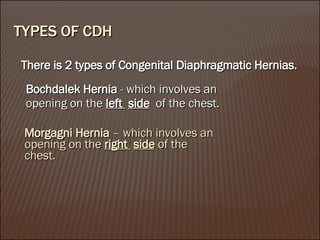
TYPES OF CDH Morgagni Hernia  – which involves an opening on the  right  side  of the chest. There is 2 types of Congenital Diaphragmatic Hernias. Bochdalek Hernia  - which involves an opening on the  left  side   of the chest.
BOCHDALEK HERNIA Most common type of hernia (left sided hernia) Makes up 90% of all cases Slightly more common in boys Shifting the of the heart and the mediastinal to the left, causing cardiac compression
Uncommon type of hernia (right) Makes up 2% of all cases More common in girls Signs and symptoms may or may not be present
Bochdalek hernia
Morgagni Hernia
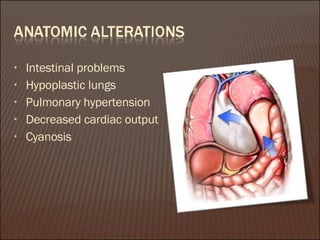
Intestinal problems Hypoplastic lungs  Pulmonary hypertension Decreased cardiac output Cyanosis
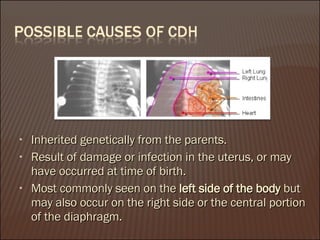
Inherited genetically from the parents. Result of damage or infection in the uterus, or may have occurred at time of birth.  Most commonly seen on the  left side of the body  but may also occur on the right side or the central portion of the diaphragm.
Present at birth: Rapid and shallow breathing  Tachycardia (>180 bpm) Cyanosis  Paradoxical breathing Breath sounds absent on the affected side.  Bowel sounds heard in the chest.  Concave abdomen that feels less full when touched.
12-15% of babies with CDH have other abnormalities such as hypoplastic heart or ventricular septal defect
Rate of about one in every 2,500 births. The left-sided Bochdalek hernia is seen in approximately 90% of cases.  The Morgagni hernia, a less-common, occurring in only 5-10% of cases of CDH.
Made before birth by ultrasound of the fetus Excess amounts of amniotic fluid Other tests such as fetal MRI, chromosome studies and fetal echocardiogram may also be done
Liver position Liver-to-head ratio (LHR)
Liver down = Larger lung LHR estimates size of lungs LHR  >  1.4  Good chance of survival LHR  <  1.0  Difficult time with survival
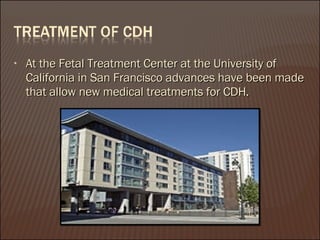
At the Fetal Treatment Center at the University of California in San Francisco advances have been made that allow new medical treatments for CDH.
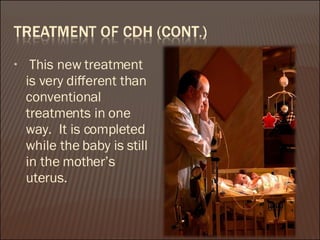
This new treatment is very different than conventional treatments in one way.  It is completed while the baby is still in the mother’s uterus.
FETENDO HFOV NO ECMO
 
Congenital Diaphragmatic Hernia . Retrieved May 20, 2008, from http://www.chw.org/display/PPF/DocID/34373/Nav/1/router.asp Congenital Diaphragmatic Hernia . (2008, May 2). Retrieved May 20, 2008, from http://fetus.ucsfmedicalcenter.org/cdh/ Congenital Diaphragmatic Hernia (CDH) . Retrieved May 14, 2008, from http://www.chop.edu/consumer/jsp/division/generic.jsp?id=86686 Congenital Diaphragmatic Hernia . Retrieved May 14, 2008, from http://www.eapsa.org/parents/resources/diaphjramaticHernia.cfm Diaphragmatic hernia . (2007, July 26). Retrieved May 14, 2008, from http:/www.nlm.nih.gov/medlineplus/ency/article/001135.html 20/20, ABC, News.  The Analisa Amen Story . (2008, April 1). Retrieved May 23, 2008, from http://fetus.ucsfmedicalcenter.org/cdh/analisa_amen.asp Hovsepian M.D., Michael , ., , Sheila, Berlin M.D.., Morrison M.D., Stuart, ., Meyers M.D., Melissa, ., Sivit M.D., Carlos, ., Weinert M.D., Dana, ., , Rainbow Babies, ., , Children's Hospital, .  Case Fourteen-Congenital Diaphragmatic Hernia . Retrieved May 20, 2008, from http://www.uhrad.com/pedsarc/peds014.html

cdh

  • 1.
    Presented by: MyrnaMacias and Amanda Aldrete
  • 2.
    Identify the maternal,fetal and neonatal risk factors which predispose an infant to CDH. Describe the clinical presentation of CDH. Identify radiologic changes in the course of CDH. Identify complications associated with CDH. Discuss the management of an infant with CDH.
  • 3.
    Which means, “present at birth ”. It simply means that a defect has been present since the time of birth.
  • 4.
    A congenital diaphragmatichernia is a birth defect where there is an abnormal hole in the diaphragm.
  • 5.
    TYPES OF CDHMorgagni Hernia – which involves an opening on the right side of the chest. There is 2 types of Congenital Diaphragmatic Hernias. Bochdalek Hernia - which involves an opening on the left side of the chest.
  • 6.
    BOCHDALEK HERNIA Mostcommon type of hernia (left sided hernia) Makes up 90% of all cases Slightly more common in boys Shifting the of the heart and the mediastinal to the left, causing cardiac compression
  • 7.
    Uncommon type ofhernia (right) Makes up 2% of all cases More common in girls Signs and symptoms may or may not be present
  • 8.
  • 9.
  • 10.
    Intestinal problems Hypoplasticlungs Pulmonary hypertension Decreased cardiac output Cyanosis
  • 11.
    Inherited genetically fromthe parents. Result of damage or infection in the uterus, or may have occurred at time of birth. Most commonly seen on the left side of the body but may also occur on the right side or the central portion of the diaphragm.
  • 12.
    Present at birth:Rapid and shallow breathing Tachycardia (>180 bpm) Cyanosis Paradoxical breathing Breath sounds absent on the affected side. Bowel sounds heard in the chest. Concave abdomen that feels less full when touched.
  • 13.
    12-15% of babieswith CDH have other abnormalities such as hypoplastic heart or ventricular septal defect
  • 14.
    Rate of aboutone in every 2,500 births. The left-sided Bochdalek hernia is seen in approximately 90% of cases. The Morgagni hernia, a less-common, occurring in only 5-10% of cases of CDH.
  • 15.
    Made before birthby ultrasound of the fetus Excess amounts of amniotic fluid Other tests such as fetal MRI, chromosome studies and fetal echocardiogram may also be done
  • 16.
  • 17.
    Liver down =Larger lung LHR estimates size of lungs LHR > 1.4 Good chance of survival LHR < 1.0 Difficult time with survival
  • 18.
    At the FetalTreatment Center at the University of California in San Francisco advances have been made that allow new medical treatments for CDH.
  • 19.
    This new treatmentis very different than conventional treatments in one way. It is completed while the baby is still in the mother’s uterus.
  • 20.
  • 21.
  • 22.
    Congenital Diaphragmatic Hernia. Retrieved May 20, 2008, from http://www.chw.org/display/PPF/DocID/34373/Nav/1/router.asp Congenital Diaphragmatic Hernia . (2008, May 2). Retrieved May 20, 2008, from http://fetus.ucsfmedicalcenter.org/cdh/ Congenital Diaphragmatic Hernia (CDH) . Retrieved May 14, 2008, from http://www.chop.edu/consumer/jsp/division/generic.jsp?id=86686 Congenital Diaphragmatic Hernia . Retrieved May 14, 2008, from http://www.eapsa.org/parents/resources/diaphjramaticHernia.cfm Diaphragmatic hernia . (2007, July 26). Retrieved May 14, 2008, from http:/www.nlm.nih.gov/medlineplus/ency/article/001135.html 20/20, ABC, News. The Analisa Amen Story . (2008, April 1). Retrieved May 23, 2008, from http://fetus.ucsfmedicalcenter.org/cdh/analisa_amen.asp Hovsepian M.D., Michael , ., , Sheila, Berlin M.D.., Morrison M.D., Stuart, ., Meyers M.D., Melissa, ., Sivit M.D., Carlos, ., Weinert M.D., Dana, ., , Rainbow Babies, ., , Children's Hospital, . Case Fourteen-Congenital Diaphragmatic Hernia . Retrieved May 20, 2008, from http://www.uhrad.com/pedsarc/peds014.html