Presented by
Gokul Lakshmanan
Introduction
• Space Shuttle was a partially reusable low Earth
orbital spacecraft
• Operated by NASA.
• The Space Shuttle was the most complex space
vehicle design of its time.
• Launched from the Kennedy Space Center
(KSC) in Florida.
• Its official program name was Space
Transportation System (STS).
History
• Total of 135 missions from 1981 to 2011.
• Launched numerous satellites, interplanetary
probes, and the Hubble Space Telescope, also
participated in construction and servicing of the
International Space Station.
• Total flight duration: 1322 days, 19 hours, 21 minutes
and 23 seconds.
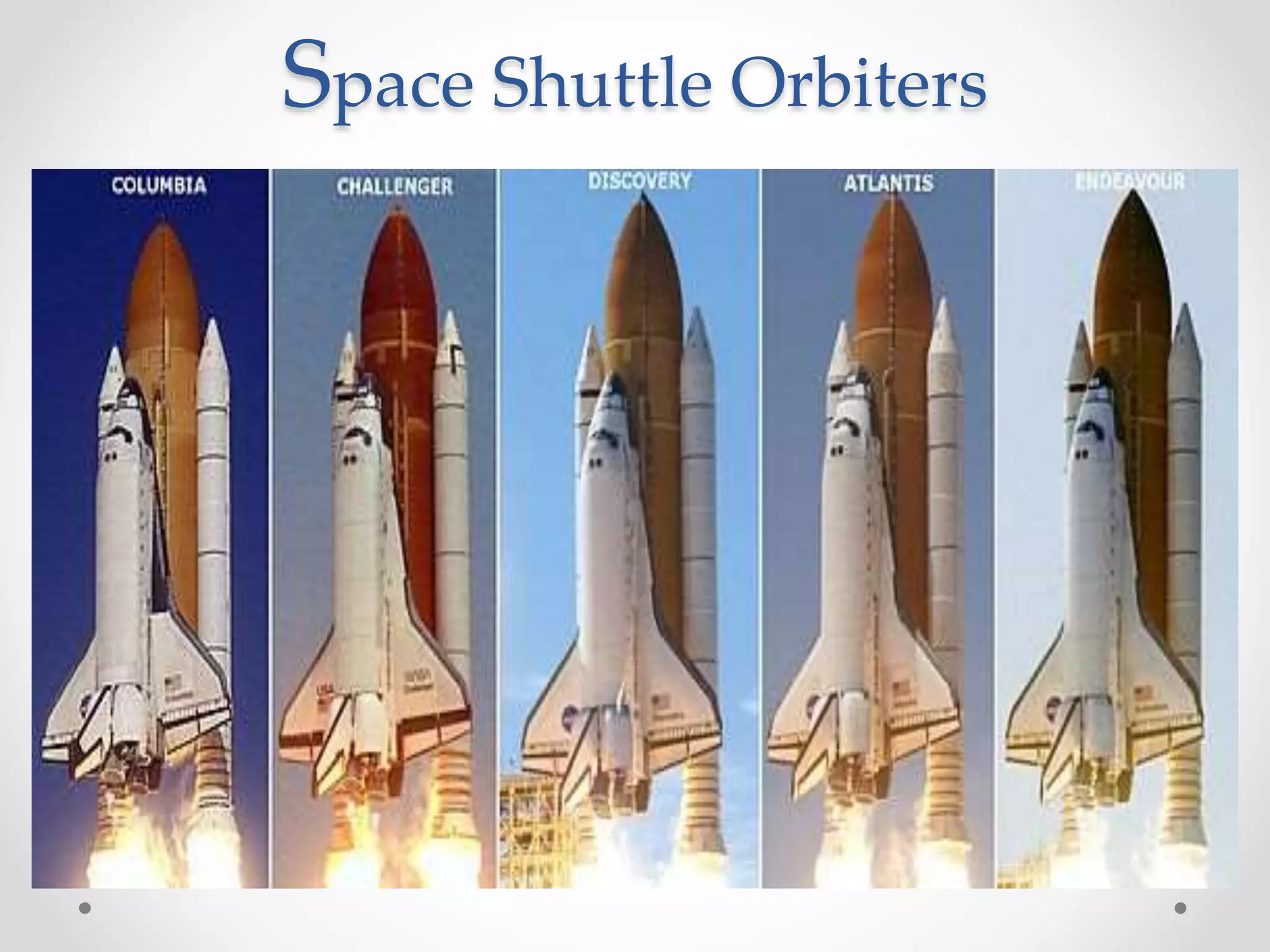
• Total 6 orbiters: Enterprise, Columbia, Challenger,
Discovery, Atlantis and Endeavour.
• Challenger and Columbia were destroyed in
mission accidents in 1986 and 2003.
Space Shuttle Orbiters
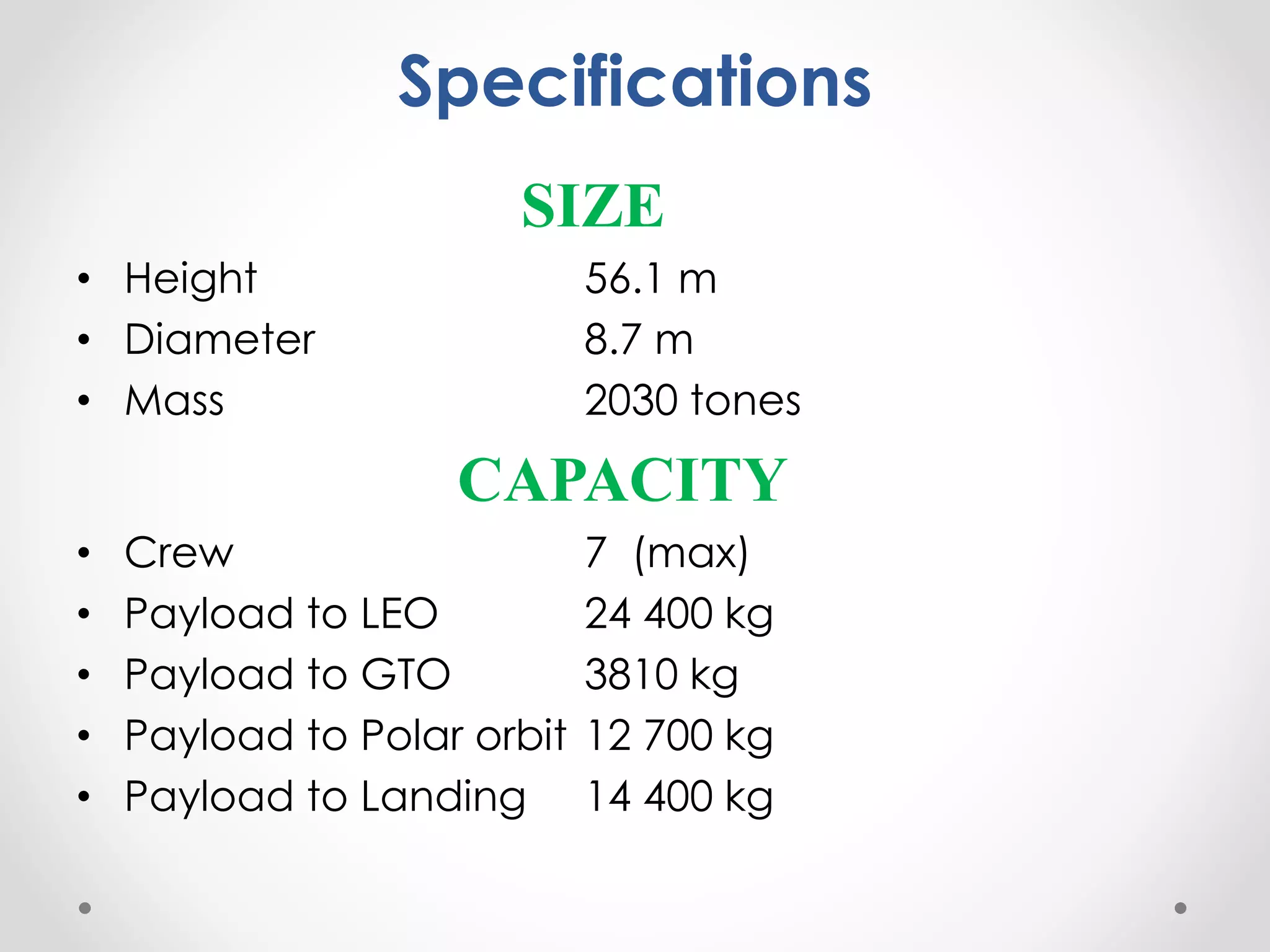
Specifications
SIZE
• Height 56.1 m
• Diameter 8.7 m
• Mass 2030 tones
CAPACITY
• Crew 7 (max)
• Payload to LEO 24 400 kg
• Payload to GTO 3810 kg
• Payload to Polar orbit 12 700 kg
• Payload to Landing 14 400 kg
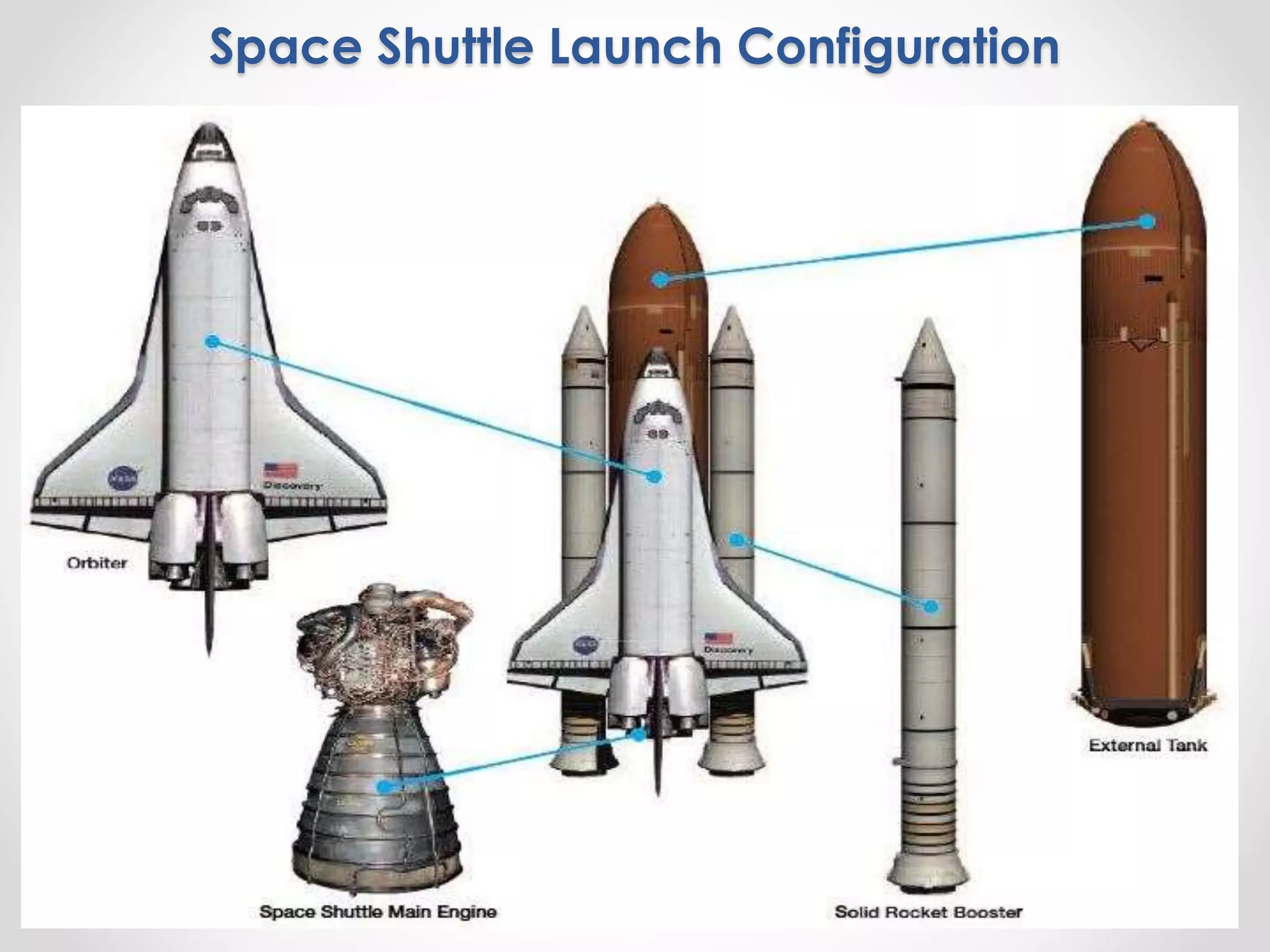
Space Shuttle Launch Configuration
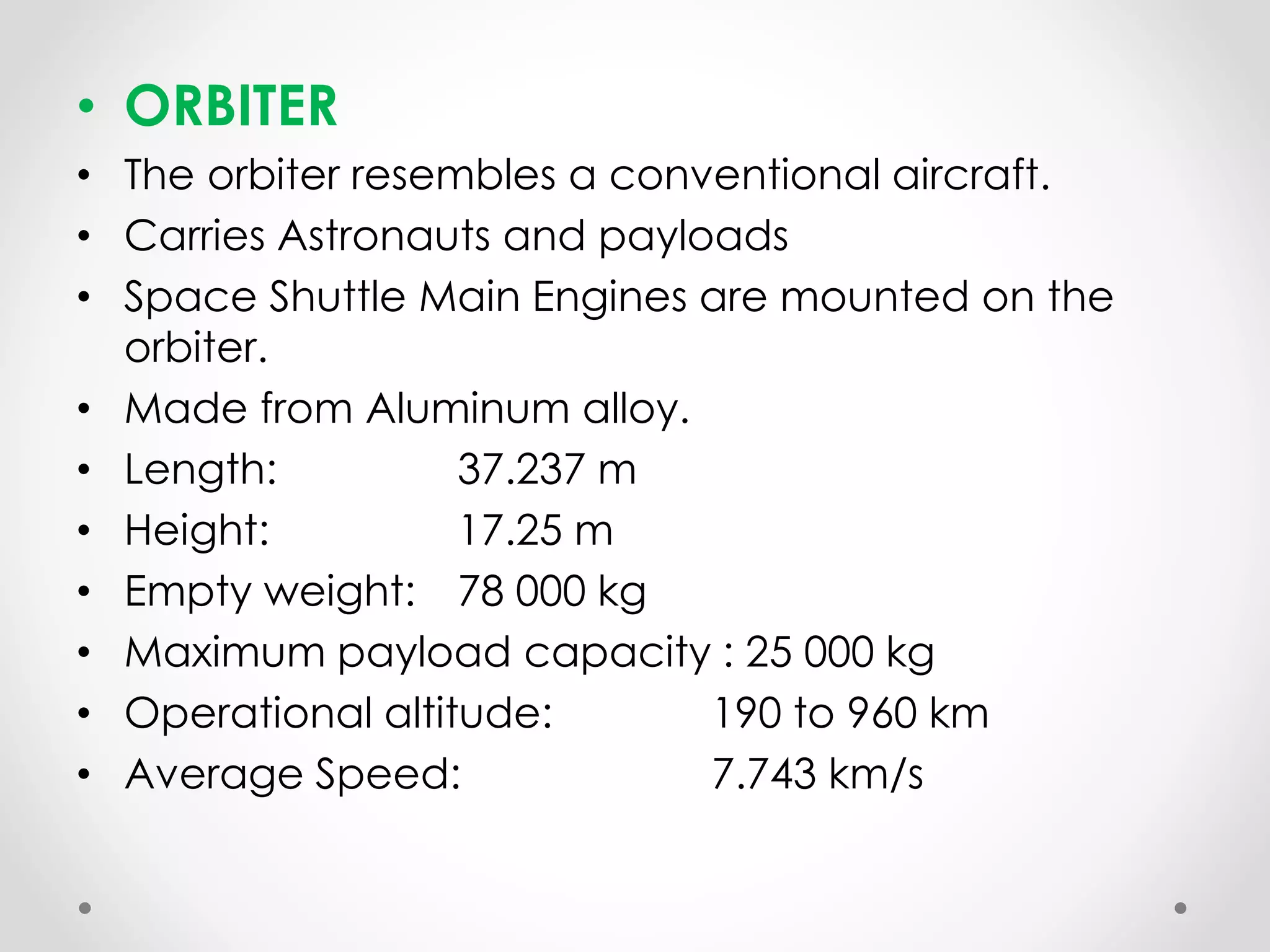
• ORBITER
• The orbiter resembles a conventional aircraft.
• Carries Astronauts and payloads
• Space Shuttle Main Engines are mounted on the
orbiter.
• Made from Aluminum alloy.
• Length: 37.237 m
• Height: 17.25 m
• Empty weight: 78 000 kg
• Maximum payload capacity : 25 000 kg
• Operational altitude: 190 to 960 km
• Average Speed: 7.743 km/s
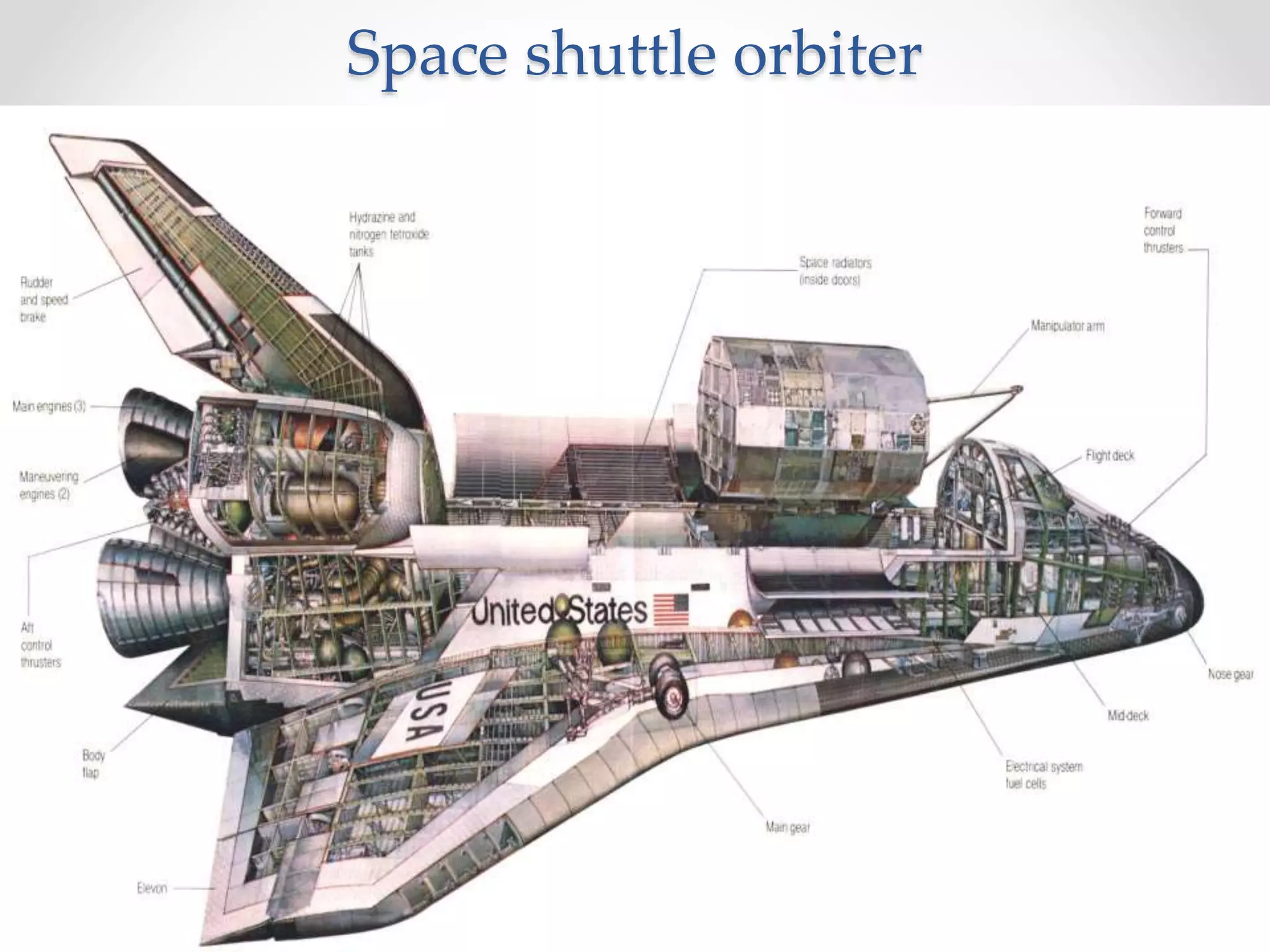
Space shuttle orbiter
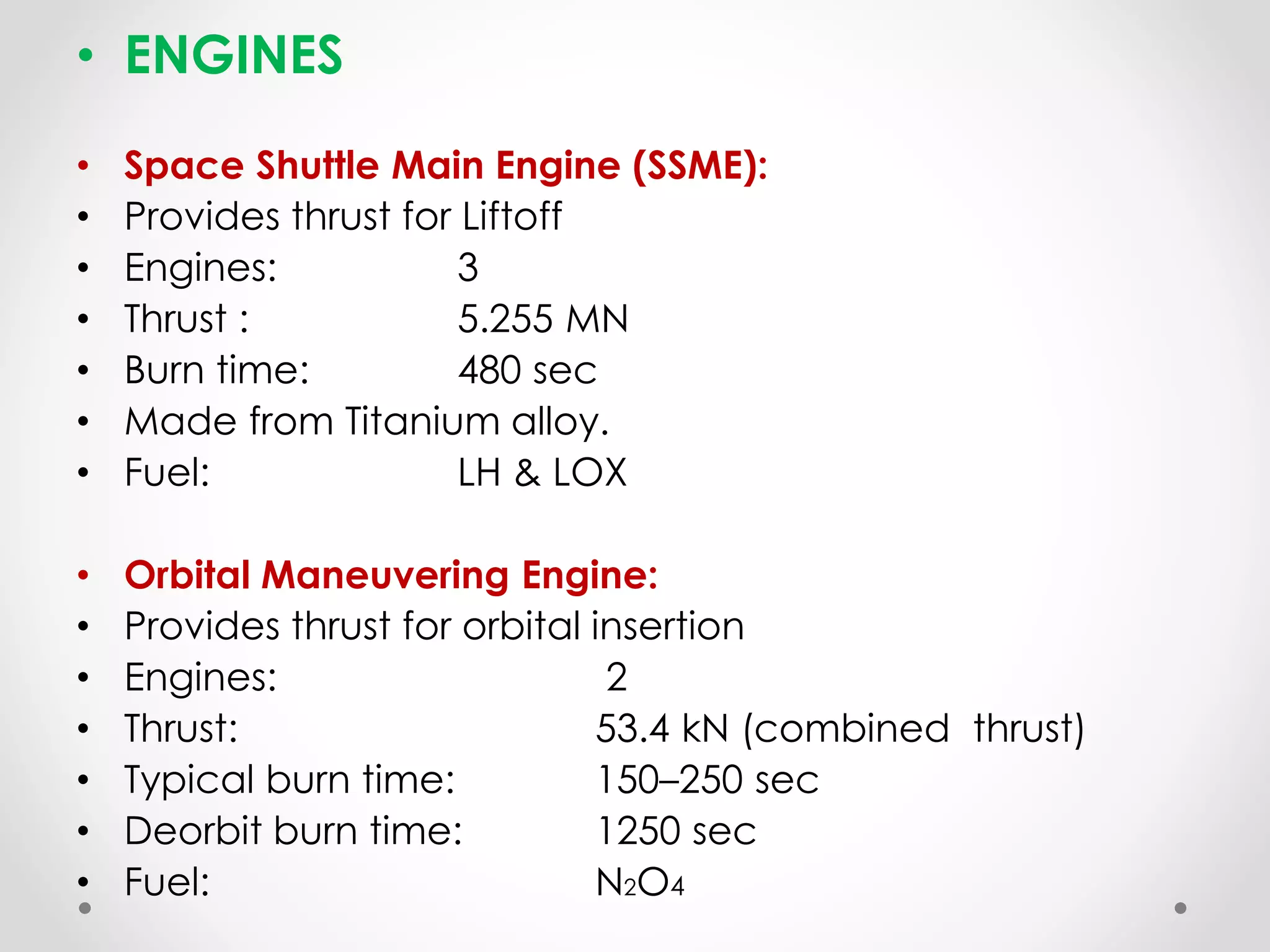
• ENGINES
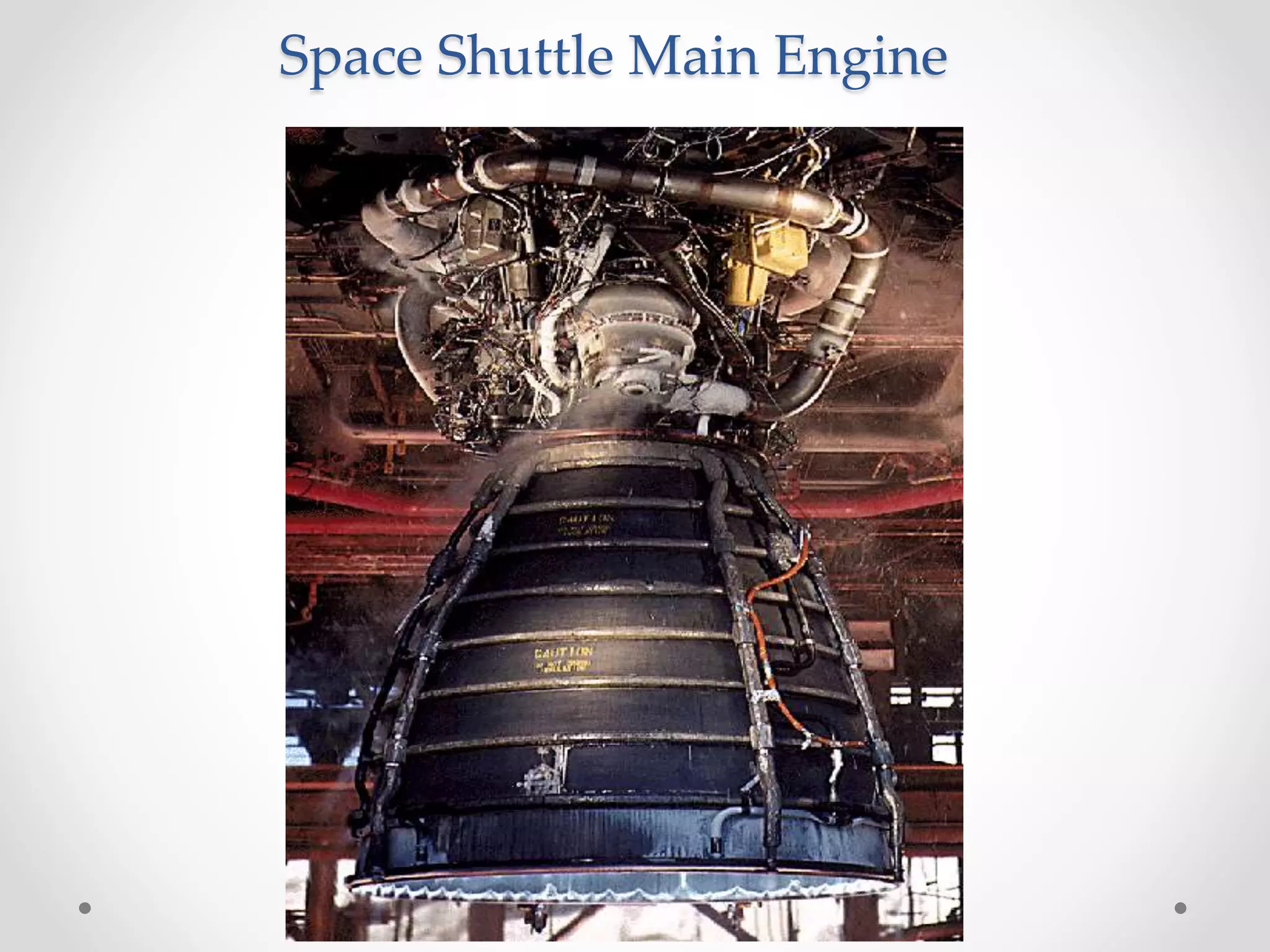
• Space Shuttle Main Engine (SSME):
• Provides thrust for Liftoff
• Engines: 3
• Thrust : 5.255 MN
• Burn time: 480 sec
• Made from Titanium alloy.
• Fuel: LH & LOX
• Orbital Maneuvering Engine:
• Provides thrust for orbital insertion
• Engines: 2
• Thrust: 53.4 kN (combined thrust)
• Typical burn time: 150–250 sec
• Deorbit burn time: 1250 sec
• Fuel: N2O4
Space Shuttle Main Engine
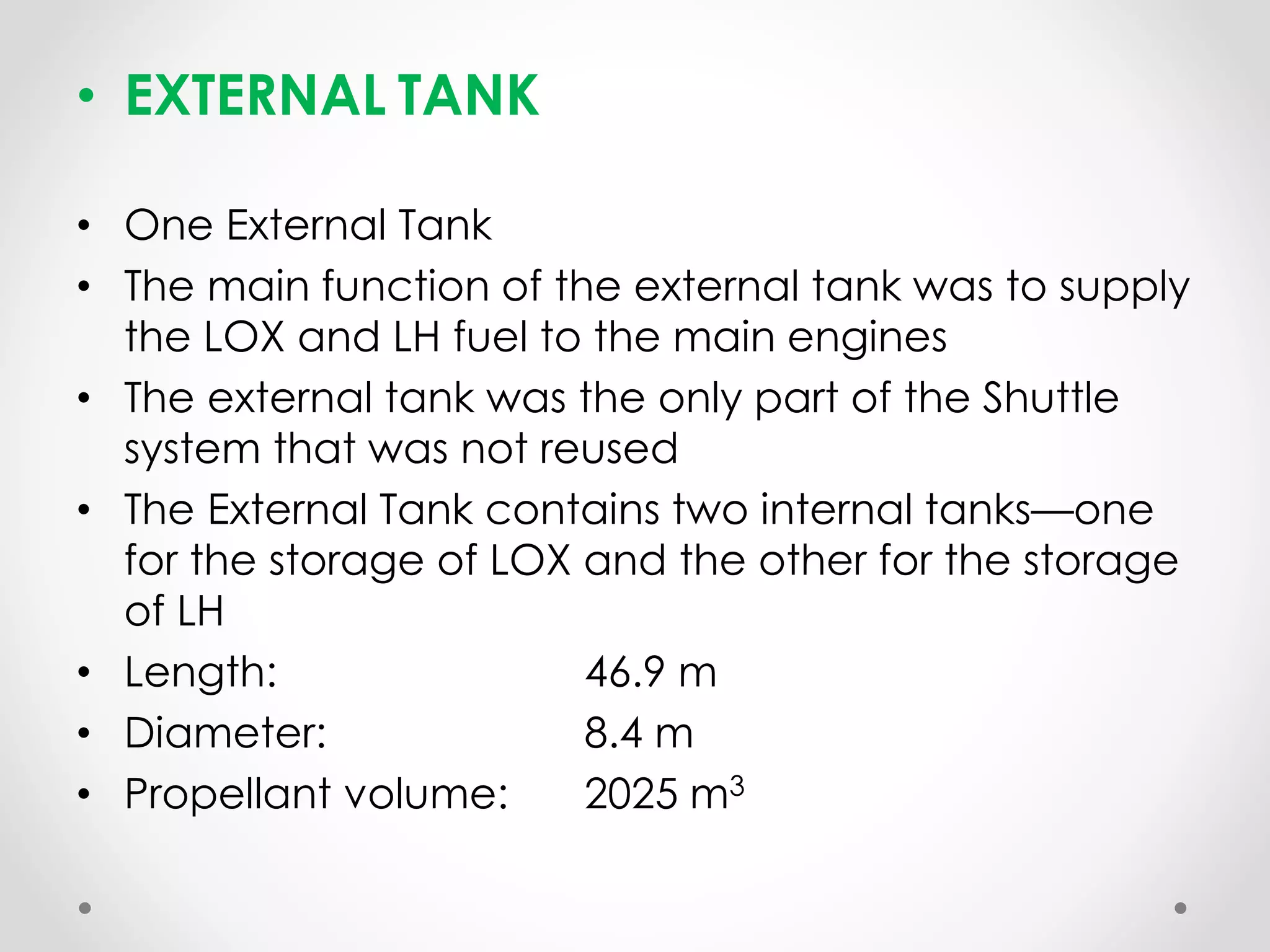
• EXTERNAL TANK
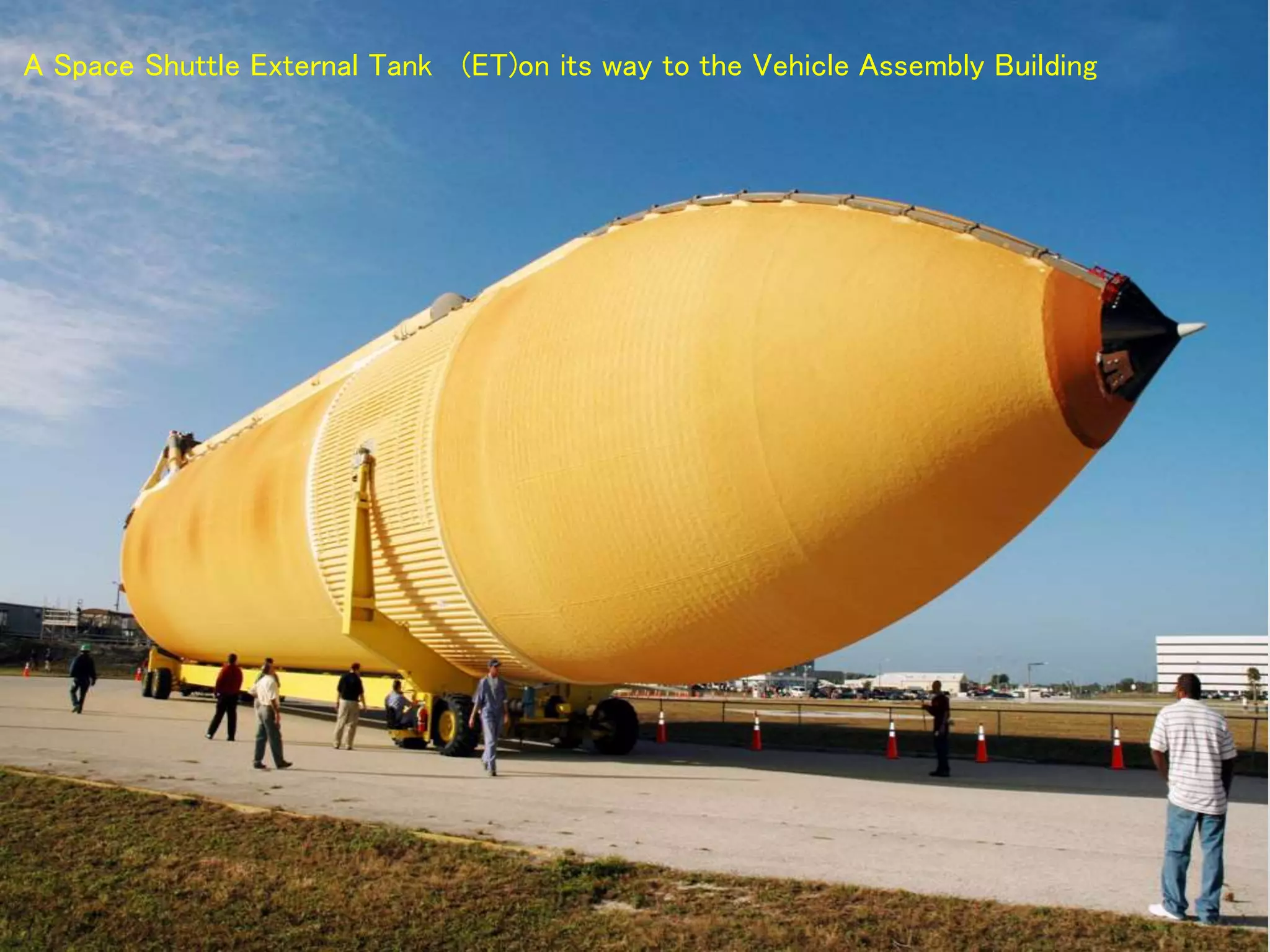
• One External Tank
• The main function of the external tank was to supply
the LOX and LH fuel to the main engines
• The external tank was the only part of the Shuttle
system that was not reused
• The External Tank contains two internal tanks—one
for the storage of LOX and the other for the storage
of LH
• Length: 46.9 m
• Diameter: 8.4 m
• Propellant volume: 2025 m3
.
A Space Shuttle External Tank (ET)on its way to the Vehicle Assembly Building
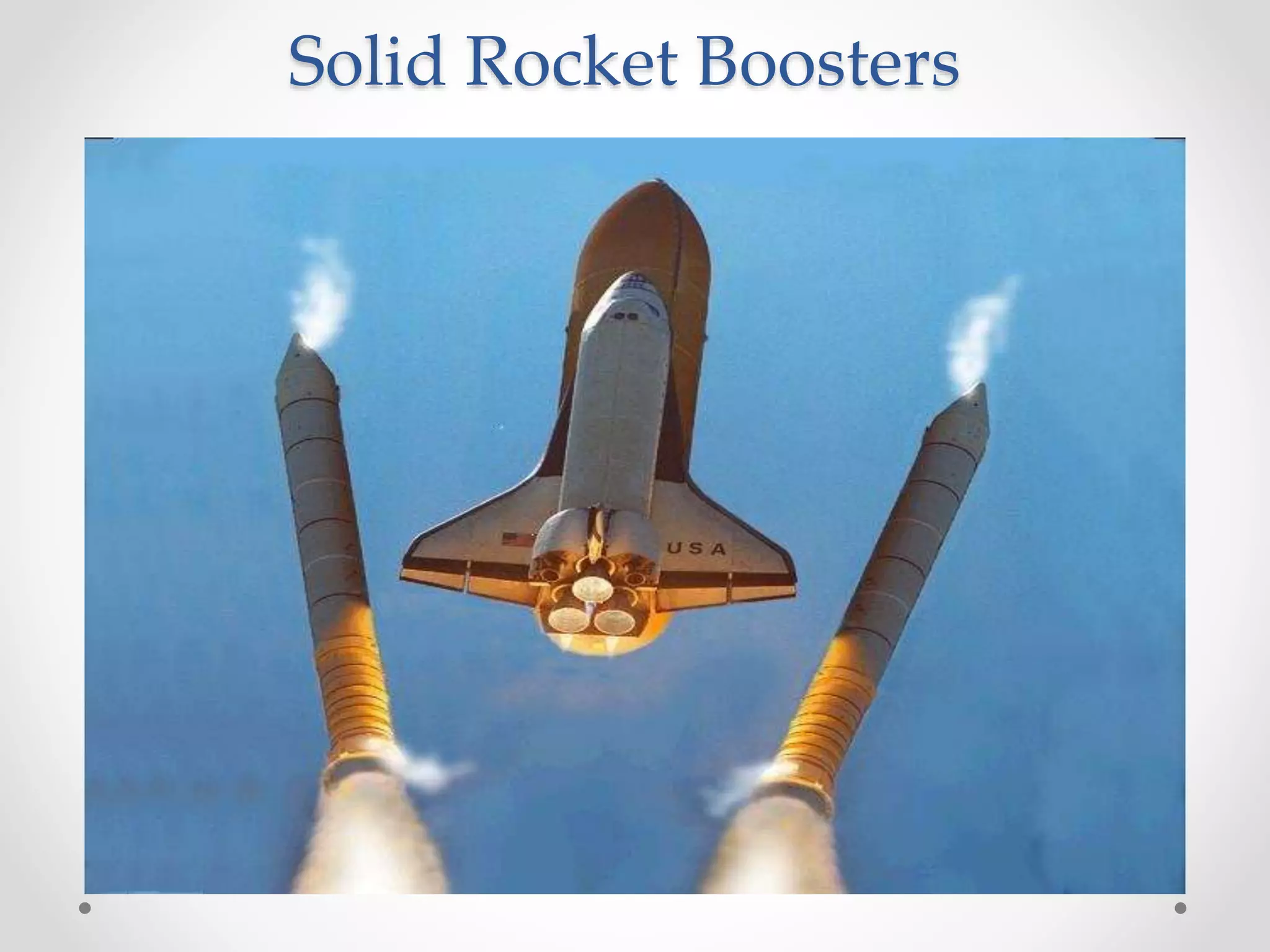
• SOLID ROCKET BOOSTERS (SRB)
• 2 Solid Rocket Boosters
• Length: 45.46 m
• Diameter: 3.71 m
• Empty weight (each): 68 000 kg
• Thrust (by each): 12.5 MN
• Burn time: 124 s
• Provide 83% of the total thrust at liftoff.
• Fuel: Solid Fuel(Ammonium perchlorate propellant)
Solid Rocket Boosters
Mission profile
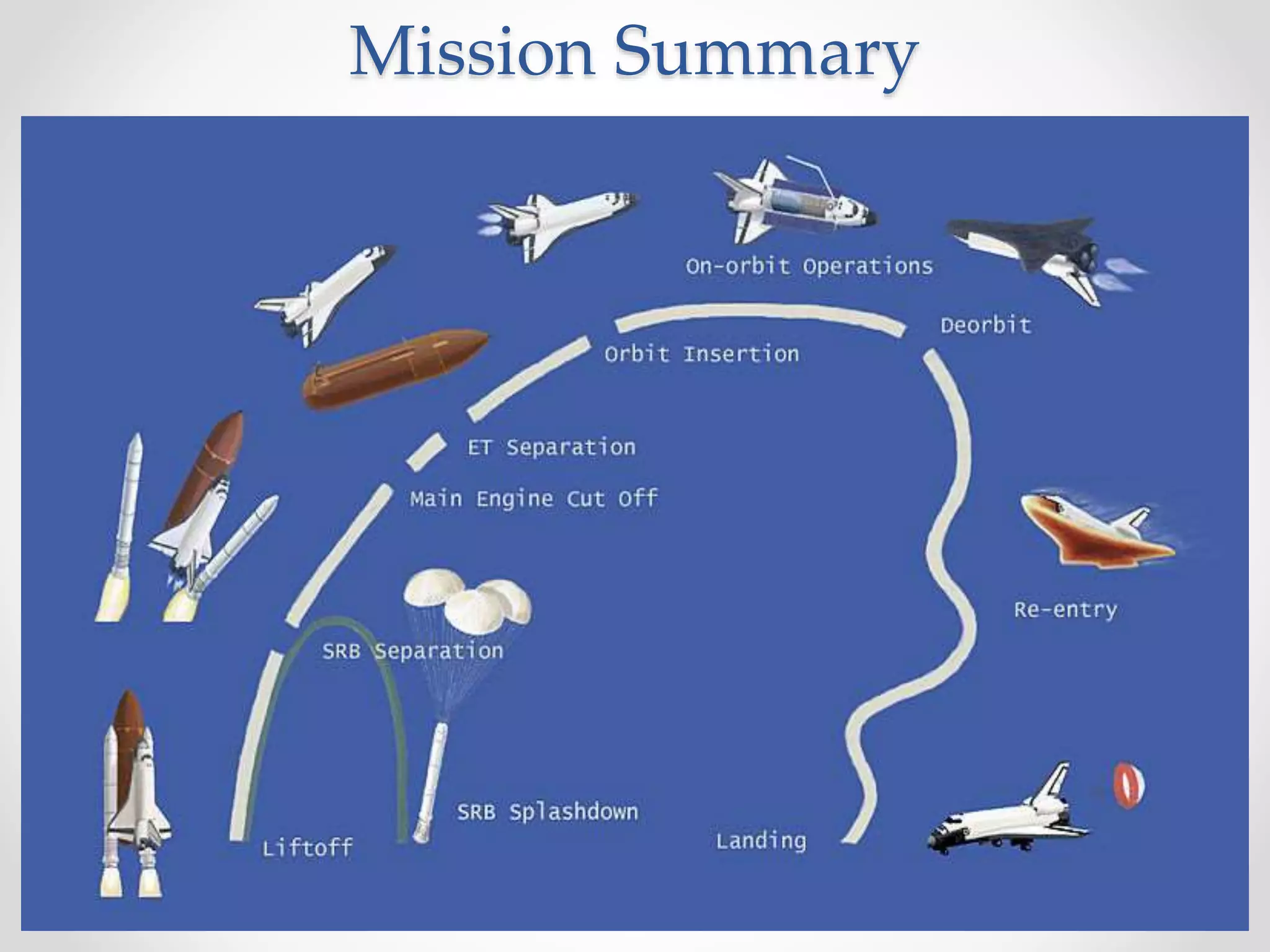
• A typical shuttle mission lasts seven to eight days,
but can extend to as much as 14 days depending
upon the objectives of the mission.
• A typical shuttle mission is as follows:
• 1. Getting into orbit
o 1.1 Launch
o 1.2 Ascent.
o 1.3 Orbital maneuvering burn.
• 2. Orbital life in space.
• 3. Re-entry.
• 4. Landing.
• GETTING INTO ORBIT (Launch Sequence)
• Launched from Kennedy Space Center
• T minus 31sec: Onboard computers take over the
launch sequence
• T minus16 sec: Sound suppression water system
activates
• T minus 6.6 sec: The shuttle's main engines ignites
• T minus 3 sec: Shuttle main engines are in liftoff
position.
• T minus 0 sec: SRBs are ignited and the shuttle lifts
offs.
• T plus 20 sec: The shuttle begin a combined roll,
pitch and yaw maneuver to oriented the vehicle
to correct orbit
• T plus 60 sec: Shuttle engines are at maximum
throttle.
• T plus 2 min: SRBs separate from the orbiter at an
altitude of 45 km. Parachutes deploy from the SRBs.
SRBs will land in the ocean
• T plus 8.5 min: Main engines shut down.
• T plus 9 min: ET separates from the orbiter. The ET
will burn up upon reentry.
• T plus 10.5 min: OMS engines fire to place orbiter in
orbit.
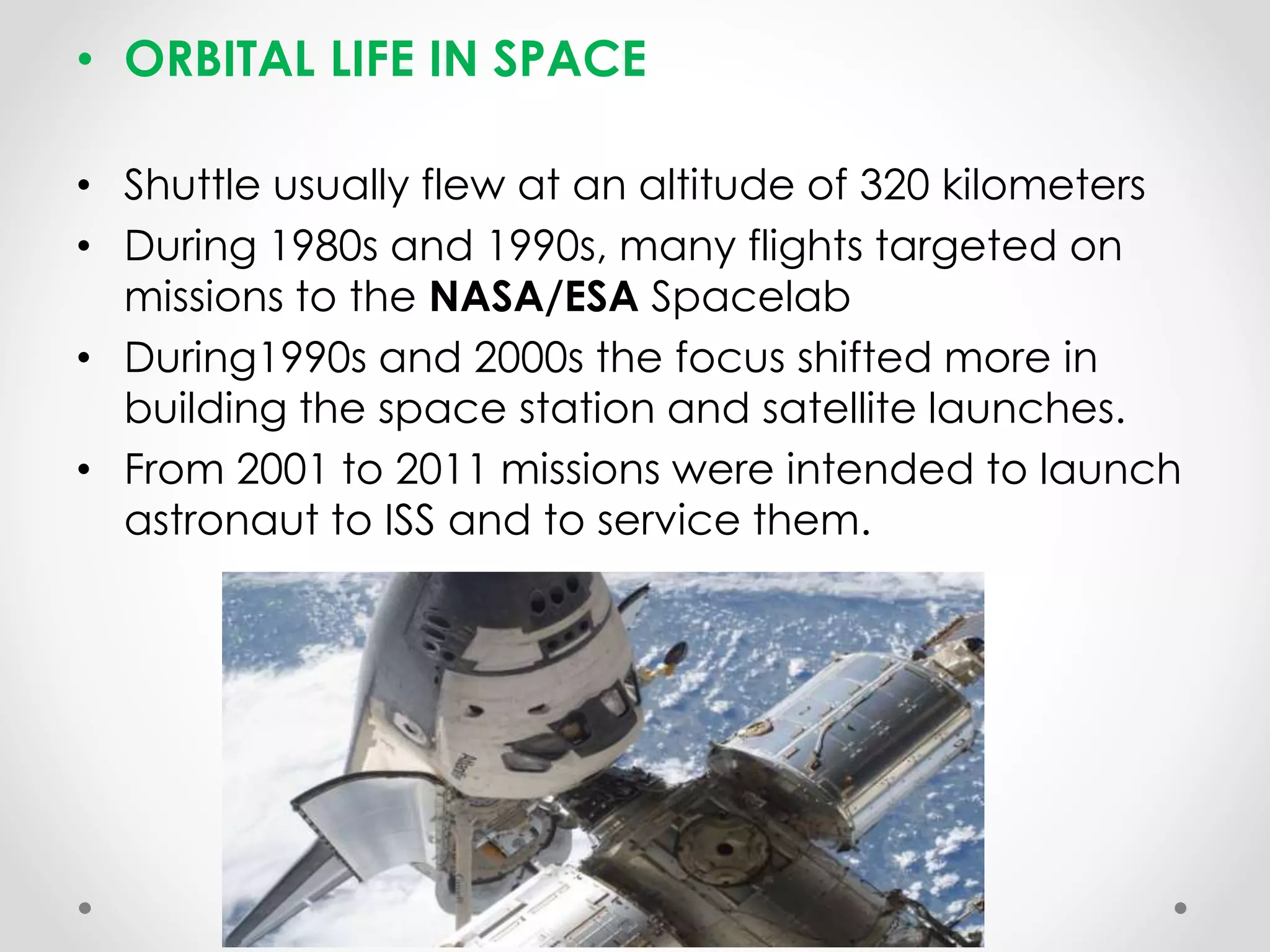
• ORBITAL LIFE IN SPACE
• Shuttle usually flew at an altitude of 320 kilometers
• During 1980s and 1990s, many flights targeted on
missions to the NASA/ESA Spacelab
• During1990s and 2000s the focus shifted more in
building the space station and satellite launches.
• From 2001 to 2011 missions were intended to launch
astronaut to ISS and to service them.
RE-ENTRY AND LANDING
• Usually Performed under computer control.
• However, the re-entry could be flown entirely
manually if an emergency arose.
• Begin re-entry by firing its OMS engines.
• Orbiter flies in the opposite direction to orbital
motion for approximately three minutes
• This will lower shuttles orbit down into the upper
atmosphere.
• Vehicle enters upper atmosphere at around Mach
25 at a 40-degree nose-up attitude, producing high
drag
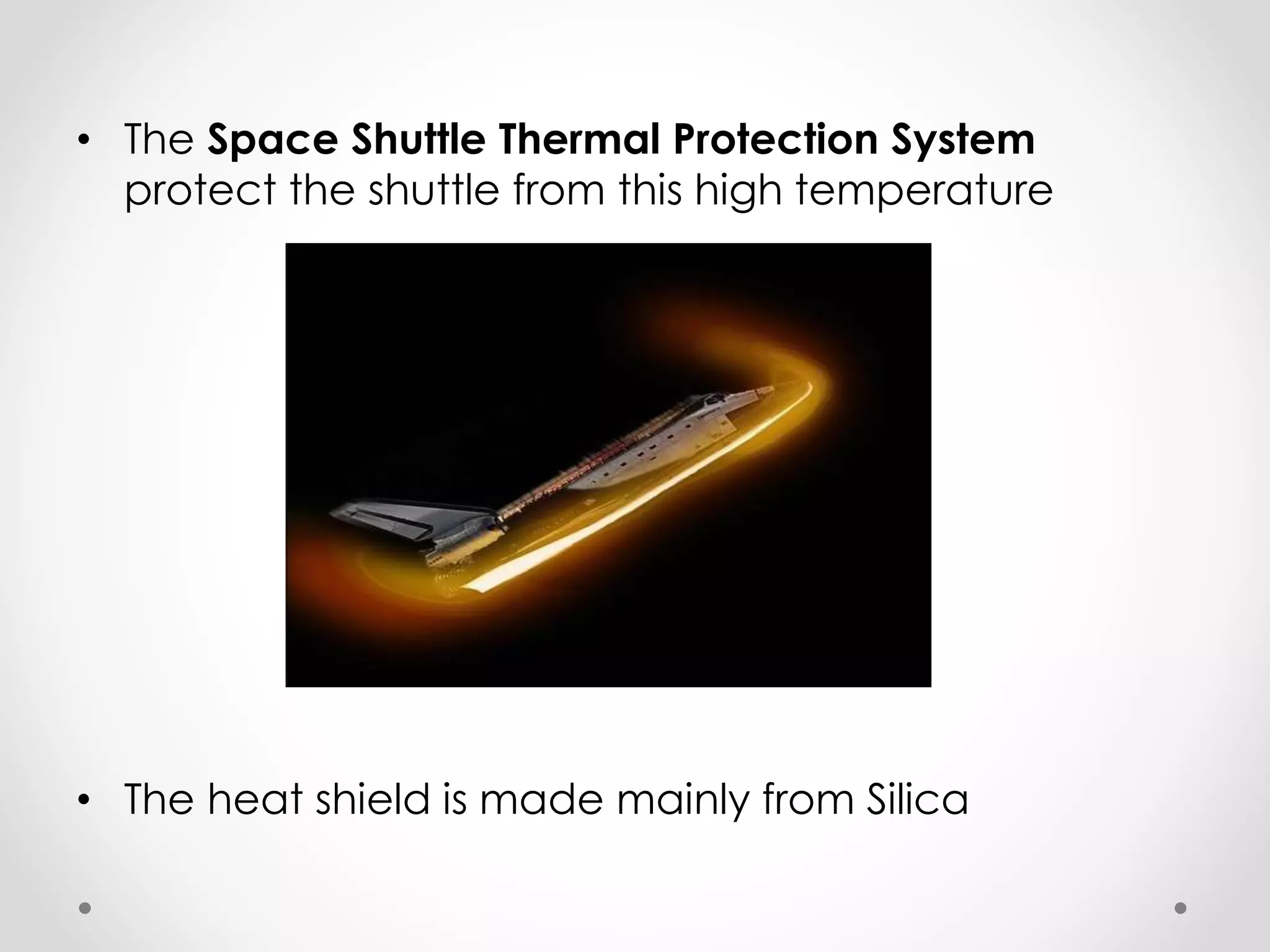
• Atmospheric friction produce a temperature of
about 1650 °C during re-entry
• This high temperature will heat up the orbiter
• The Space Shuttle Thermal Protection System
protect the shuttle from this high temperature
• The heat shield is made mainly from Silica
• By the end of the flight the orbiter reaches lower
atmosphere
• The shuttle now glide through the atmosphere like a
glider
• The vehicle level its wings, lower its nose and began
its approach to the landing site
• Approach and landing phase begin when the
orbiter was at about 3000 m altitude and 12 km
from the runway
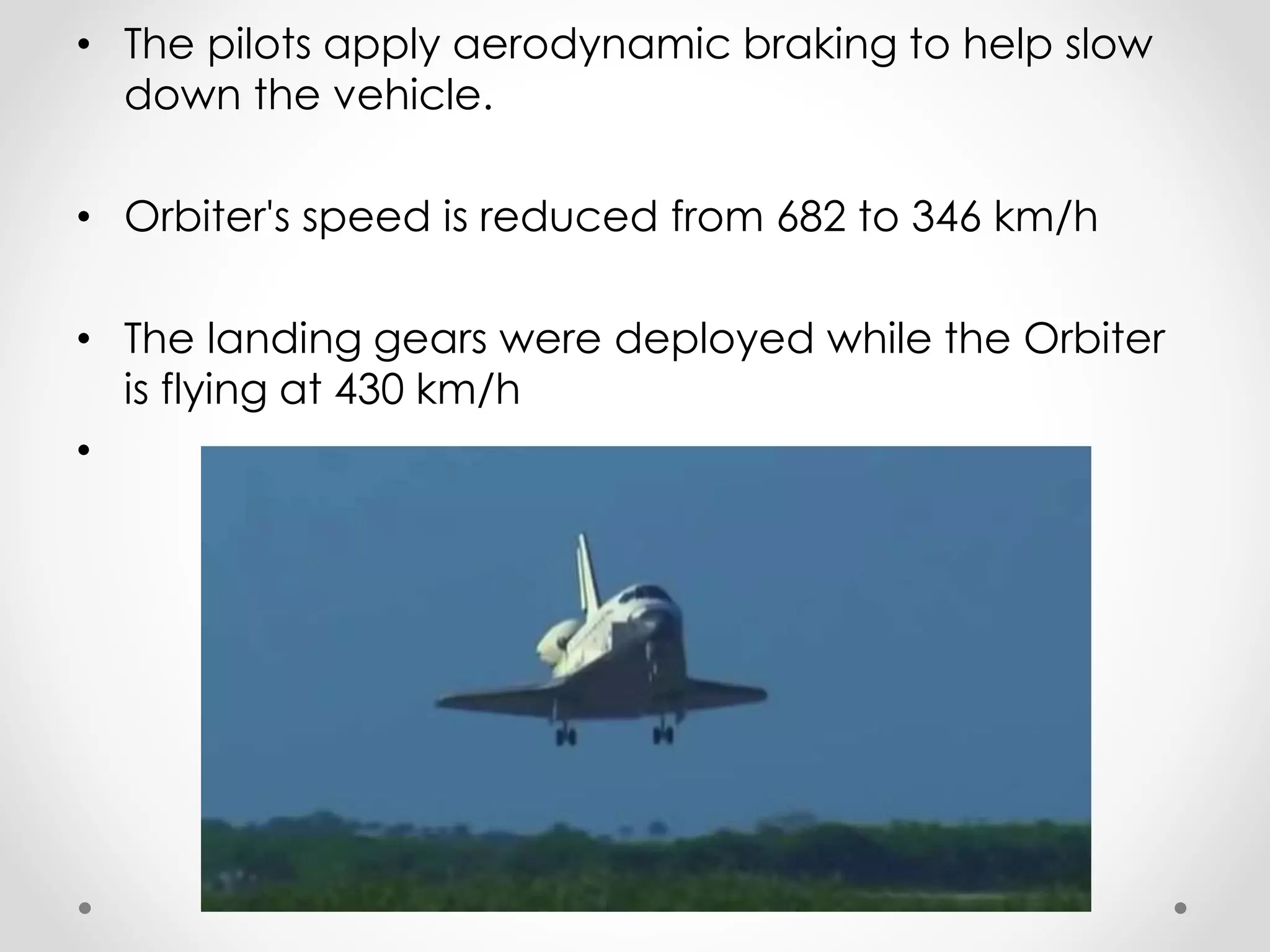
• The pilots apply aerodynamic braking to help slow
down the vehicle.
• Orbiter's speed is reduced from 682 to 346 km/h
• The landing gears were deployed while the Orbiter
is flying at 430 km/h
•
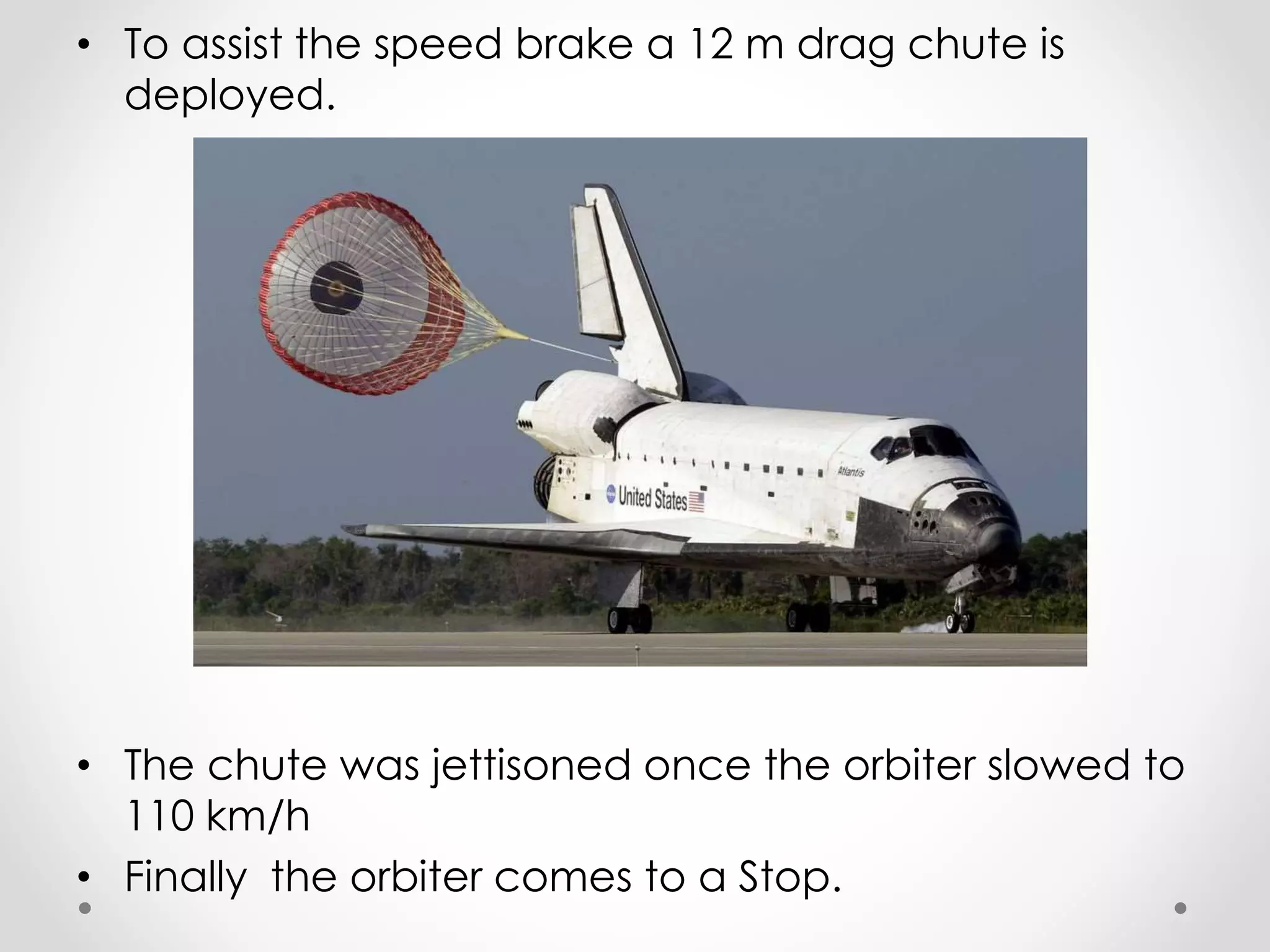
• To assist the speed brake a 12 m drag chute is
deployed.
• The chute was jettisoned once the orbiter slowed to
110 km/h
• Finally the orbiter comes to a Stop.
Mission Summary
Conclusion
• Space Shuttle was a partially reusable low Earth
orbital spacecraft
• Commissioned and operated by NASA from 1981 to
2011
• It was the most complex machine built at its time
• There were a total of 6 Orbital Vehicles build by
NASA
• A total of 14 astronauts were lost in space due to
space shuttle disaster including Indian astronaut
Kalpana Chawla
Reference
[1]Space Shuttle - A future Space Transportation System
Robert.F.Thompson
[2] Kyle, Ed. "STS Data Sheet". spacelaunchreport.com.
Retrieved July 2014.
[3] Space Shuttle Propulsion Systems, p. 153. NASA, June 26,
1990.
[4] Jenkins, Dennis R. (2006). Space Shuttle: The History of the
National Space Transportation System. Voyageur Press. ISBN 0-
9633974-5-1.
[5] "INTRODUCTION TO FUTURE LAUNCH VEHICLE
PLANS [1963–2001] Updated 6/15/2001, by Marcus Lindroos".
Pmview.com. June 15, 2001. Retrieved 2012-04-17.
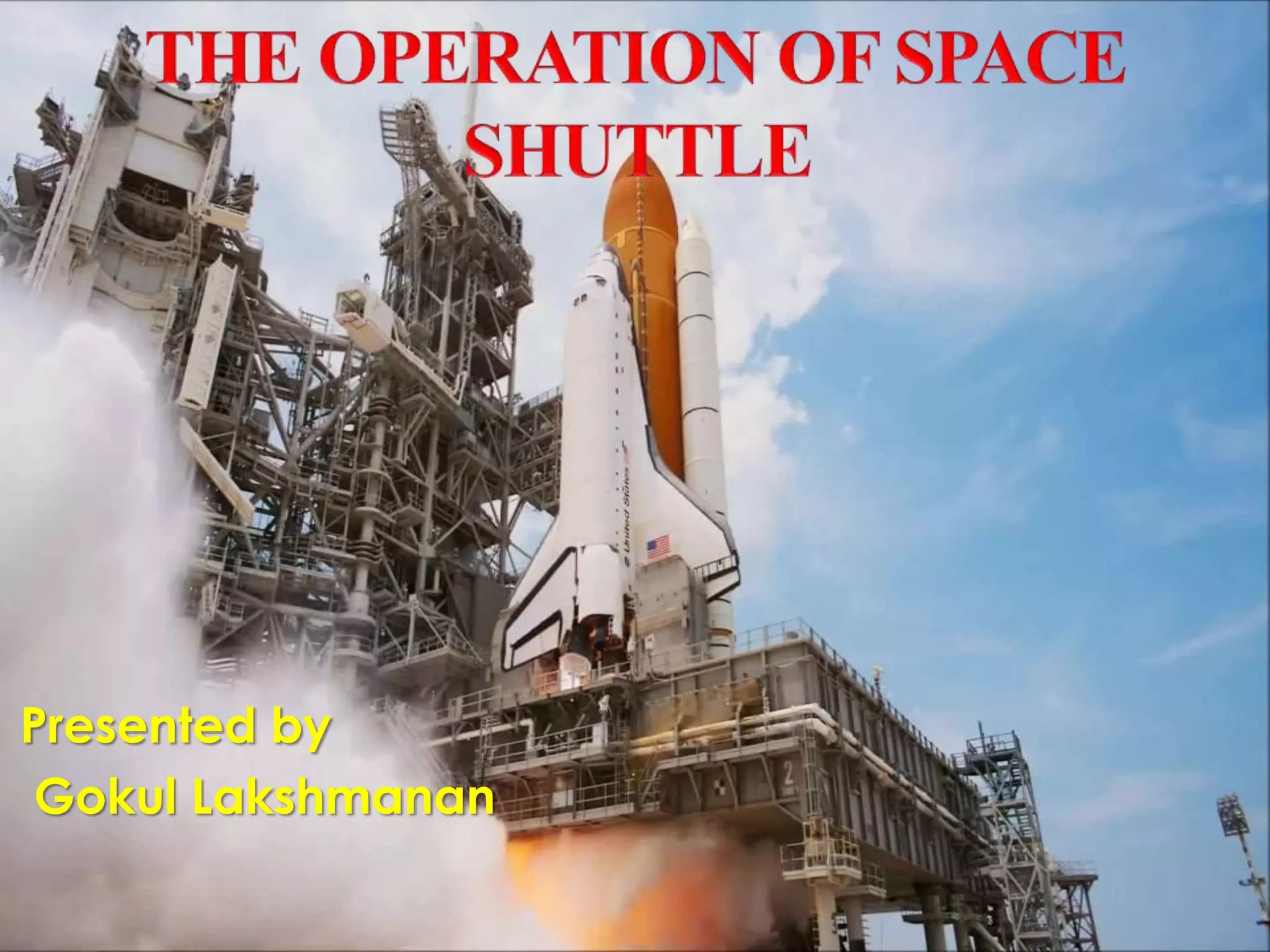
The Operation Of Space Shuttle

The Operation Of Space Shuttle

  • 1.
  • 2.
    Introduction • Space Shuttlewas a partially reusable low Earth orbital spacecraft • Operated by NASA. • The Space Shuttle was the most complex space vehicle design of its time. • Launched from the Kennedy Space Center (KSC) in Florida. • Its official program name was Space Transportation System (STS).
  • 3.
    History • Total of135 missions from 1981 to 2011. • Launched numerous satellites, interplanetary probes, and the Hubble Space Telescope, also participated in construction and servicing of the International Space Station. • Total flight duration: 1322 days, 19 hours, 21 minutes and 23 seconds. • Total 6 orbiters: Enterprise, Columbia, Challenger, Discovery, Atlantis and Endeavour. • Challenger and Columbia were destroyed in mission accidents in 1986 and 2003.
  • 4.
  • 5.
    Specifications SIZE • Height 56.1m • Diameter 8.7 m • Mass 2030 tones CAPACITY • Crew 7 (max) • Payload to LEO 24 400 kg • Payload to GTO 3810 kg • Payload to Polar orbit 12 700 kg • Payload to Landing 14 400 kg
  • 6.
    Space Shuttle LaunchConfiguration
  • 7.
    • ORBITER • Theorbiter resembles a conventional aircraft. • Carries Astronauts and payloads • Space Shuttle Main Engines are mounted on the orbiter. • Made from Aluminum alloy. • Length: 37.237 m • Height: 17.25 m • Empty weight: 78 000 kg • Maximum payload capacity : 25 000 kg • Operational altitude: 190 to 960 km • Average Speed: 7.743 km/s
  • 8.
  • 9.
    • ENGINES • SpaceShuttle Main Engine (SSME): • Provides thrust for Liftoff • Engines: 3 • Thrust : 5.255 MN • Burn time: 480 sec • Made from Titanium alloy. • Fuel: LH & LOX • Orbital Maneuvering Engine: • Provides thrust for orbital insertion • Engines: 2 • Thrust: 53.4 kN (combined thrust) • Typical burn time: 150–250 sec • Deorbit burn time: 1250 sec • Fuel: N2O4
  • 10.
  • 11.
    • EXTERNAL TANK •One External Tank • The main function of the external tank was to supply the LOX and LH fuel to the main engines • The external tank was the only part of the Shuttle system that was not reused • The External Tank contains two internal tanks—one for the storage of LOX and the other for the storage of LH • Length: 46.9 m • Diameter: 8.4 m • Propellant volume: 2025 m3
  • 12.
    . A Space ShuttleExternal Tank (ET)on its way to the Vehicle Assembly Building
  • 13.
    • SOLID ROCKETBOOSTERS (SRB) • 2 Solid Rocket Boosters • Length: 45.46 m • Diameter: 3.71 m • Empty weight (each): 68 000 kg • Thrust (by each): 12.5 MN • Burn time: 124 s • Provide 83% of the total thrust at liftoff. • Fuel: Solid Fuel(Ammonium perchlorate propellant)
  • 14.
  • 15.
    Mission profile • Atypical shuttle mission lasts seven to eight days, but can extend to as much as 14 days depending upon the objectives of the mission. • A typical shuttle mission is as follows: • 1. Getting into orbit o 1.1 Launch o 1.2 Ascent. o 1.3 Orbital maneuvering burn. • 2. Orbital life in space. • 3. Re-entry. • 4. Landing.
  • 16.
    • GETTING INTOORBIT (Launch Sequence) • Launched from Kennedy Space Center • T minus 31sec: Onboard computers take over the launch sequence • T minus16 sec: Sound suppression water system activates • T minus 6.6 sec: The shuttle's main engines ignites
  • 17.
    • T minus3 sec: Shuttle main engines are in liftoff position. • T minus 0 sec: SRBs are ignited and the shuttle lifts offs. • T plus 20 sec: The shuttle begin a combined roll, pitch and yaw maneuver to oriented the vehicle to correct orbit • T plus 60 sec: Shuttle engines are at maximum throttle.
  • 18.
    • T plus2 min: SRBs separate from the orbiter at an altitude of 45 km. Parachutes deploy from the SRBs. SRBs will land in the ocean • T plus 8.5 min: Main engines shut down. • T plus 9 min: ET separates from the orbiter. The ET will burn up upon reentry. • T plus 10.5 min: OMS engines fire to place orbiter in orbit.
  • 19.
    • ORBITAL LIFEIN SPACE • Shuttle usually flew at an altitude of 320 kilometers • During 1980s and 1990s, many flights targeted on missions to the NASA/ESA Spacelab • During1990s and 2000s the focus shifted more in building the space station and satellite launches. • From 2001 to 2011 missions were intended to launch astronaut to ISS and to service them.
  • 20.
    RE-ENTRY AND LANDING •Usually Performed under computer control. • However, the re-entry could be flown entirely manually if an emergency arose. • Begin re-entry by firing its OMS engines. • Orbiter flies in the opposite direction to orbital motion for approximately three minutes
  • 21.
    • This willlower shuttles orbit down into the upper atmosphere. • Vehicle enters upper atmosphere at around Mach 25 at a 40-degree nose-up attitude, producing high drag • Atmospheric friction produce a temperature of about 1650 °C during re-entry • This high temperature will heat up the orbiter
  • 22.
    • The SpaceShuttle Thermal Protection System protect the shuttle from this high temperature • The heat shield is made mainly from Silica
  • 23.
    • By theend of the flight the orbiter reaches lower atmosphere • The shuttle now glide through the atmosphere like a glider • The vehicle level its wings, lower its nose and began its approach to the landing site • Approach and landing phase begin when the orbiter was at about 3000 m altitude and 12 km from the runway
  • 24.
    • The pilotsapply aerodynamic braking to help slow down the vehicle. • Orbiter's speed is reduced from 682 to 346 km/h • The landing gears were deployed while the Orbiter is flying at 430 km/h •
  • 25.
    • To assistthe speed brake a 12 m drag chute is deployed. • The chute was jettisoned once the orbiter slowed to 110 km/h • Finally the orbiter comes to a Stop.
  • 26.
  • 27.
    Conclusion • Space Shuttlewas a partially reusable low Earth orbital spacecraft • Commissioned and operated by NASA from 1981 to 2011 • It was the most complex machine built at its time • There were a total of 6 Orbital Vehicles build by NASA • A total of 14 astronauts were lost in space due to space shuttle disaster including Indian astronaut Kalpana Chawla
  • 28.
    Reference [1]Space Shuttle -A future Space Transportation System Robert.F.Thompson [2] Kyle, Ed. "STS Data Sheet". spacelaunchreport.com. Retrieved July 2014. [3] Space Shuttle Propulsion Systems, p. 153. NASA, June 26, 1990. [4] Jenkins, Dennis R. (2006). Space Shuttle: The History of the National Space Transportation System. Voyageur Press. ISBN 0- 9633974-5-1. [5] "INTRODUCTION TO FUTURE LAUNCH VEHICLE PLANS [1963–2001] Updated 6/15/2001, by Marcus Lindroos". Pmview.com. June 15, 2001. Retrieved 2012-04-17.