
REUSABLE LAUNCH
VEHICLE TECHNOLOGY
By
Mr. NAGESH N
SAI VIDYA INSTITUTE OF TECHNOLOGY
Department of Mechanical Engineering
Technical Seminar on,
INTRODUCTION
 A Reusable Launch Vehicle (RLV) refers to a vehicle which can be used for
several missions.
 RLV is the space analogue of an Aircraft. Ideally it takes-off vertically and
can return with a steady decent.
 The main advantage of RLV is that it can be used multiple times, all the
parts of the launcher can be recovered and reused multiple times.
 A successful RLV will surely cut down mission cost and makes space travel
more accessible.
 To date, several fully reusable sub-orbital systems and partially reusable
orbital systems have been flown.
HISTORY
 Early ideas of a single-stage reusable spaceplane proved unrealistic and
although the first practical rocket vehicles such as the V-2 weapon of
WWII could reach the fringes of space, re-usable technology was too
heavy, and the rockets were expendable.
 The late 1960s saw the start of the Space Shuttle design process. From an
initial multitude of ideas, a two-stage reusable VTHL design was pushed
forward that eventually resulted in a reusable orbiter payload spacecraft
and reusable solid rocket boosters.
 Interest in developing new reusable vehicles occurred during the 1990s
the military Strategic Defense Initiative program "Brilliant Pebbles"
required low cost, rapid turnaround space launch. From this requirement
came the McDonnell Douglas Delta Clipper VTOL SSTO proposal. The DC-
X prototype for Delta Clipper demonstrated rapid turnaround time and
that automatic computer control of such a vehicle was possible.
PRESENT DAY
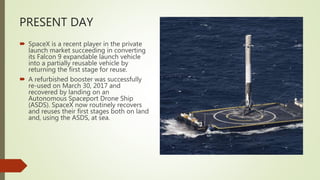
 SpaceX is a recent player in the private
launch market succeeding in converting
its Falcon 9 expandable launch vehicle
into a partially reusable vehicle by
returning the first stage for reuse.
 A refurbished booster was successfully
re-used on March 30, 2017 and
recovered by landing on an
Autonomous Spaceport Drone Ship
(ASDS). SpaceX now routinely recovers
and reuses their first stages both on land
and, using the ASDS, at sea.
WORKING OF RLV
METHOD 1 - Single Stage to Orbit (SSTO)
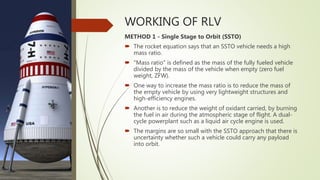
 The rocket equation says that an SSTO vehicle needs a high
mass ratio.
 "Mass ratio" is defined as the mass of the fully fueled vehicle
divided by the mass of the vehicle when empty (zero fuel
weight, ZFW).
 One way to increase the mass ratio is to reduce the mass of
the empty vehicle by using very lightweight structures and
high-efficiency engines.
 Another is to reduce the weight of oxidant carried, by burning
the fuel in air during the atmospheric stage of flight. A dual-
cycle powerplant such as a liquid air cycle engine is used.
 The margins are so small with the SSTO approach that there is
uncertainty whether such a vehicle could carry any payload
into orbit.
WORKING OF RLV
METHOD 2 – Two Stages to Orbit (TSTO)
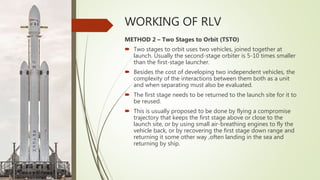
 Two stages to orbit uses two vehicles, joined together at
launch. Usually the second-stage orbiter is 5-10 times smaller
than the first-stage launcher.
 Besides the cost of developing two independent vehicles, the
complexity of the interactions between them both as a unit
and when separating must also be evaluated.
 The first stage needs to be returned to the launch site for it to
be reused.
 This is usually proposed to be done by flying a compromise
trajectory that keeps the first stage above or close to the
launch site, or by using small air-breathing engines to fly the
vehicle back, or by recovering the first stage down range and
returning it some other way ,often landing in the sea and
returning by ship.
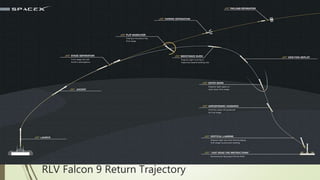
RLV Falcon 9 Return Trajectory
AIRBREATHING
ENGINE
APPROCH
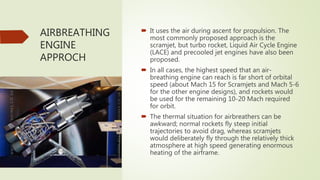
 It uses the air during ascent for propulsion. The
most commonly proposed approach is the
scramjet, but turbo rocket, Liquid Air Cycle Engine
(LACE) and precooled jet engines have also been
proposed.
 In all cases, the highest speed that an air-
breathing engine can reach is far short of orbital
speed (about Mach 15 for Scramjets and Mach 5-6
for the other engine designs), and rockets would
be used for the remaining 10-20 Mach required
for orbit.
 The thermal situation for airbreathers can be
awkward; normal rockets fly steep initial
trajectories to avoid drag, whereas scramjets
would deliberately fly through the relatively thick
atmosphere at high speed generating enormous
heating of the airframe.
TECHNOLOGIES DEVELOPED FOR REUSABLE LAUNCH
FEASIBILITY
 Restart able ignition system for the first-stage booster. Restarts are required at both
supersonic velocities in the upper atmosphere to decelerate the high velocity away from the
launch pad and put the booster on a descent trajectory back toward the launch pad.
 New attitude control technology for the booster stage and second stage to bring the
descending rocket body through the atmosphere in a manner conducive both to non-
destructive return and sufficient aerodynamic control such that the terminal phase of the
landing is possible.
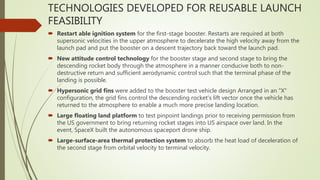
 Hypersonic grid fins were added to the booster test vehicle design Arranged in an "X"
configuration, the grid fins control the descending rocket's lift vector once the vehicle has
returned to the atmosphere to enable a much more precise landing location.
 Large floating land platform to test pinpoint landings prior to receiving permission from
the US government to bring returning rocket stages into US airspace over land. In the
event, SpaceX built the autonomous spaceport drone ship.
 Large-surface-area thermal protection system to absorb the heat load of deceleration of
the second stage from orbital velocity to terminal velocity.
DESIGN ISSUES
 Weight - Any RLV is degrading the launcher’s performance compared to ELV due
to additional stage inert mass. This additional mass is almost unavoidable due to
either supplementary mechanical or propulsion systems or surplus propellant
needed for the safe return of RLV stages.
 Reentry heat shields - These vehicles are often proposed to be some sort of
ceramic and/or carbon-carbon heat shields, or occasionally metallic heat shields
(possibly using water cooling or some sort of relatively exotic rare earth metal.)
Some shields would be single-use ablatives, discarded after reentry.
 R and D - The research & development costs of reusable vehicle are expected to
be higher, because making a vehicle reusable implies making it robust enough to
survive more than one use, which adds to the testing required.
 Maintenance - Reusable launch systems require maintenance, which is often
substantial. The Space Shuttle system required extensive refurbishing between
flights, primarily dealing with the silica tile TPS and the high performance LH2/LOX
burning main engines.
TEST FLIGHTS AND
OUTCOMES
 In 2013 SpaceX announced it had successfully tested
a large amount of new technology on the flight, and
that coupled with the technology advancements
made on the Grasshopper low-altitude landing
demonstrator, they were ready to test a full recovery
of the booster stage. The first flight test was
successful.
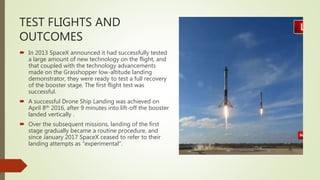
 A successful Drone Ship Landing was achieved on
April 8th 2016, after 9 minutes into lift-off the booster
landed vertically .
 Over the subsequent missions, landing of the first
stage gradually became a routine procedure, and
since January 2017 SpaceX ceased to refer to their
landing attempts as "experimental".
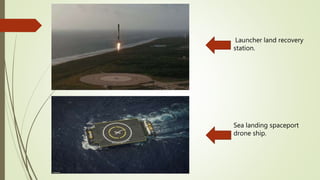
Launcher land recovery
station.
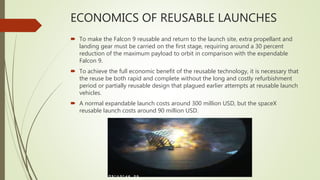
Sea landing spaceport
drone ship.
ECONOMICS OF REUSABLE LAUNCHES
 To make the Falcon 9 reusable and return to the launch site, extra propellant and
landing gear must be carried on the first stage, requiring around a 30 percent
reduction of the maximum payload to orbit in comparison with the expendable
Falcon 9.
 To achieve the full economic benefit of the reusable technology, it is necessary that
the reuse be both rapid and complete without the long and costly refurbishment
period or partially reusable design that plagued earlier attempts at reusable launch
vehicles.
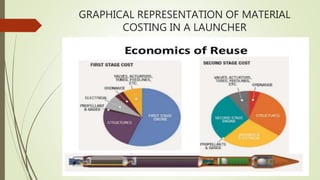
 A normal expandable launch costs around 300 million USD, but the spaceX
reusable launch costs around 90 million USD.
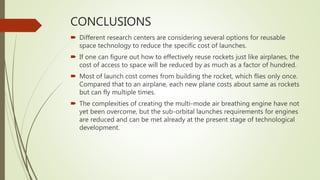
GRAPHICAL REPRESENTATION OF MATERIAL
COSTING IN A LAUNCHER
CONCLUSIONS
 Different research centers are considering several options for reusable
space technology to reduce the specific cost of launches.
 If one can figure out how to effectively reuse rockets just like airplanes, the
cost of access to space will be reduced by as much as a factor of hundred.
 Most of launch cost comes from building the rocket, which flies only once.
Compared that to an airplane, each new plane costs about same as rockets
but can fly multiple times.
 The complexities of creating the multi-mode air breathing engine have not
yet been overcome, but the sub-orbital launches requirements for engines
are reduced and can be met already at the present stage of technological
development.
REFERENCES
 “REUSABLE SPACE PLANES CHALLENGES AND CONTROL
PROBLEMS” by Alexander Nebylov, Vladimir Nebylov -
State University of Aerospace Instrumentation.
 “Technological Demonstration of reusable Launchers” by
P.Baiocco, Ch Bonnal – CNES, France.
 Performance Comparison of Reusable Launch Vehicles by
Mark Ayre, Tom Bowling, Cranfield University,
Bedfordshire, MK43 OAL.
 Reusable Launch Vehicles: Evolution Redefined by Bhavana
Y*, Mani Shankar N and Prarthana BK Department of
Mechanical Engineering, SNIST, India.
 Towards Reusable Launchers - A Widening Perspective by
H. Pfeffer Future Launchers Office, Directorate of
Launchers, ESA, Paris.
 www.spacex.com for Technical Specifications of launchers.
Thank You

Final Year Seminar Presentation.

  • 1.
    REUSABLE LAUNCH VEHICLE TECHNOLOGY By Mr.NAGESH N SAI VIDYA INSTITUTE OF TECHNOLOGY Department of Mechanical Engineering Technical Seminar on,
  • 2.
    INTRODUCTION  A ReusableLaunch Vehicle (RLV) refers to a vehicle which can be used for several missions.  RLV is the space analogue of an Aircraft. Ideally it takes-off vertically and can return with a steady decent.  The main advantage of RLV is that it can be used multiple times, all the parts of the launcher can be recovered and reused multiple times.  A successful RLV will surely cut down mission cost and makes space travel more accessible.  To date, several fully reusable sub-orbital systems and partially reusable orbital systems have been flown.
  • 3.
    HISTORY  Early ideasof a single-stage reusable spaceplane proved unrealistic and although the first practical rocket vehicles such as the V-2 weapon of WWII could reach the fringes of space, re-usable technology was too heavy, and the rockets were expendable.  The late 1960s saw the start of the Space Shuttle design process. From an initial multitude of ideas, a two-stage reusable VTHL design was pushed forward that eventually resulted in a reusable orbiter payload spacecraft and reusable solid rocket boosters.  Interest in developing new reusable vehicles occurred during the 1990s the military Strategic Defense Initiative program "Brilliant Pebbles" required low cost, rapid turnaround space launch. From this requirement came the McDonnell Douglas Delta Clipper VTOL SSTO proposal. The DC- X prototype for Delta Clipper demonstrated rapid turnaround time and that automatic computer control of such a vehicle was possible.
  • 4.
    PRESENT DAY  SpaceXis a recent player in the private launch market succeeding in converting its Falcon 9 expandable launch vehicle into a partially reusable vehicle by returning the first stage for reuse.  A refurbished booster was successfully re-used on March 30, 2017 and recovered by landing on an Autonomous Spaceport Drone Ship (ASDS). SpaceX now routinely recovers and reuses their first stages both on land and, using the ASDS, at sea.
  • 5.
    WORKING OF RLV METHOD1 - Single Stage to Orbit (SSTO)  The rocket equation says that an SSTO vehicle needs a high mass ratio.  "Mass ratio" is defined as the mass of the fully fueled vehicle divided by the mass of the vehicle when empty (zero fuel weight, ZFW).  One way to increase the mass ratio is to reduce the mass of the empty vehicle by using very lightweight structures and high-efficiency engines.  Another is to reduce the weight of oxidant carried, by burning the fuel in air during the atmospheric stage of flight. A dual- cycle powerplant such as a liquid air cycle engine is used.  The margins are so small with the SSTO approach that there is uncertainty whether such a vehicle could carry any payload into orbit.
  • 6.
    WORKING OF RLV METHOD2 – Two Stages to Orbit (TSTO)  Two stages to orbit uses two vehicles, joined together at launch. Usually the second-stage orbiter is 5-10 times smaller than the first-stage launcher.  Besides the cost of developing two independent vehicles, the complexity of the interactions between them both as a unit and when separating must also be evaluated.  The first stage needs to be returned to the launch site for it to be reused.  This is usually proposed to be done by flying a compromise trajectory that keeps the first stage above or close to the launch site, or by using small air-breathing engines to fly the vehicle back, or by recovering the first stage down range and returning it some other way ,often landing in the sea and returning by ship.
  • 7.
    RLV Falcon 9Return Trajectory
  • 8.
    AIRBREATHING ENGINE APPROCH  It usesthe air during ascent for propulsion. The most commonly proposed approach is the scramjet, but turbo rocket, Liquid Air Cycle Engine (LACE) and precooled jet engines have also been proposed.  In all cases, the highest speed that an air- breathing engine can reach is far short of orbital speed (about Mach 15 for Scramjets and Mach 5-6 for the other engine designs), and rockets would be used for the remaining 10-20 Mach required for orbit.  The thermal situation for airbreathers can be awkward; normal rockets fly steep initial trajectories to avoid drag, whereas scramjets would deliberately fly through the relatively thick atmosphere at high speed generating enormous heating of the airframe.
  • 9.
    TECHNOLOGIES DEVELOPED FORREUSABLE LAUNCH FEASIBILITY  Restart able ignition system for the first-stage booster. Restarts are required at both supersonic velocities in the upper atmosphere to decelerate the high velocity away from the launch pad and put the booster on a descent trajectory back toward the launch pad.  New attitude control technology for the booster stage and second stage to bring the descending rocket body through the atmosphere in a manner conducive both to non- destructive return and sufficient aerodynamic control such that the terminal phase of the landing is possible.  Hypersonic grid fins were added to the booster test vehicle design Arranged in an "X" configuration, the grid fins control the descending rocket's lift vector once the vehicle has returned to the atmosphere to enable a much more precise landing location.  Large floating land platform to test pinpoint landings prior to receiving permission from the US government to bring returning rocket stages into US airspace over land. In the event, SpaceX built the autonomous spaceport drone ship.  Large-surface-area thermal protection system to absorb the heat load of deceleration of the second stage from orbital velocity to terminal velocity.
  • 10.
    DESIGN ISSUES  Weight- Any RLV is degrading the launcher’s performance compared to ELV due to additional stage inert mass. This additional mass is almost unavoidable due to either supplementary mechanical or propulsion systems or surplus propellant needed for the safe return of RLV stages.  Reentry heat shields - These vehicles are often proposed to be some sort of ceramic and/or carbon-carbon heat shields, or occasionally metallic heat shields (possibly using water cooling or some sort of relatively exotic rare earth metal.) Some shields would be single-use ablatives, discarded after reentry.  R and D - The research & development costs of reusable vehicle are expected to be higher, because making a vehicle reusable implies making it robust enough to survive more than one use, which adds to the testing required.  Maintenance - Reusable launch systems require maintenance, which is often substantial. The Space Shuttle system required extensive refurbishing between flights, primarily dealing with the silica tile TPS and the high performance LH2/LOX burning main engines.
  • 11.
    TEST FLIGHTS AND OUTCOMES In 2013 SpaceX announced it had successfully tested a large amount of new technology on the flight, and that coupled with the technology advancements made on the Grasshopper low-altitude landing demonstrator, they were ready to test a full recovery of the booster stage. The first flight test was successful.  A successful Drone Ship Landing was achieved on April 8th 2016, after 9 minutes into lift-off the booster landed vertically .  Over the subsequent missions, landing of the first stage gradually became a routine procedure, and since January 2017 SpaceX ceased to refer to their landing attempts as "experimental".
  • 12.
    Launcher land recovery station. Sealanding spaceport drone ship.
  • 13.
    ECONOMICS OF REUSABLELAUNCHES  To make the Falcon 9 reusable and return to the launch site, extra propellant and landing gear must be carried on the first stage, requiring around a 30 percent reduction of the maximum payload to orbit in comparison with the expendable Falcon 9.  To achieve the full economic benefit of the reusable technology, it is necessary that the reuse be both rapid and complete without the long and costly refurbishment period or partially reusable design that plagued earlier attempts at reusable launch vehicles.  A normal expandable launch costs around 300 million USD, but the spaceX reusable launch costs around 90 million USD.
  • 14.
    GRAPHICAL REPRESENTATION OFMATERIAL COSTING IN A LAUNCHER
  • 15.
    CONCLUSIONS  Different researchcenters are considering several options for reusable space technology to reduce the specific cost of launches.  If one can figure out how to effectively reuse rockets just like airplanes, the cost of access to space will be reduced by as much as a factor of hundred.  Most of launch cost comes from building the rocket, which flies only once. Compared that to an airplane, each new plane costs about same as rockets but can fly multiple times.  The complexities of creating the multi-mode air breathing engine have not yet been overcome, but the sub-orbital launches requirements for engines are reduced and can be met already at the present stage of technological development.
  • 16.
    REFERENCES  “REUSABLE SPACEPLANES CHALLENGES AND CONTROL PROBLEMS” by Alexander Nebylov, Vladimir Nebylov - State University of Aerospace Instrumentation.  “Technological Demonstration of reusable Launchers” by P.Baiocco, Ch Bonnal – CNES, France.  Performance Comparison of Reusable Launch Vehicles by Mark Ayre, Tom Bowling, Cranfield University, Bedfordshire, MK43 OAL.  Reusable Launch Vehicles: Evolution Redefined by Bhavana Y*, Mani Shankar N and Prarthana BK Department of Mechanical Engineering, SNIST, India.  Towards Reusable Launchers - A Widening Perspective by H. Pfeffer Future Launchers Office, Directorate of Launchers, ESA, Paris.  www.spacex.com for Technical Specifications of launchers.
  • 17.