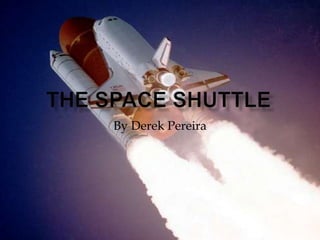
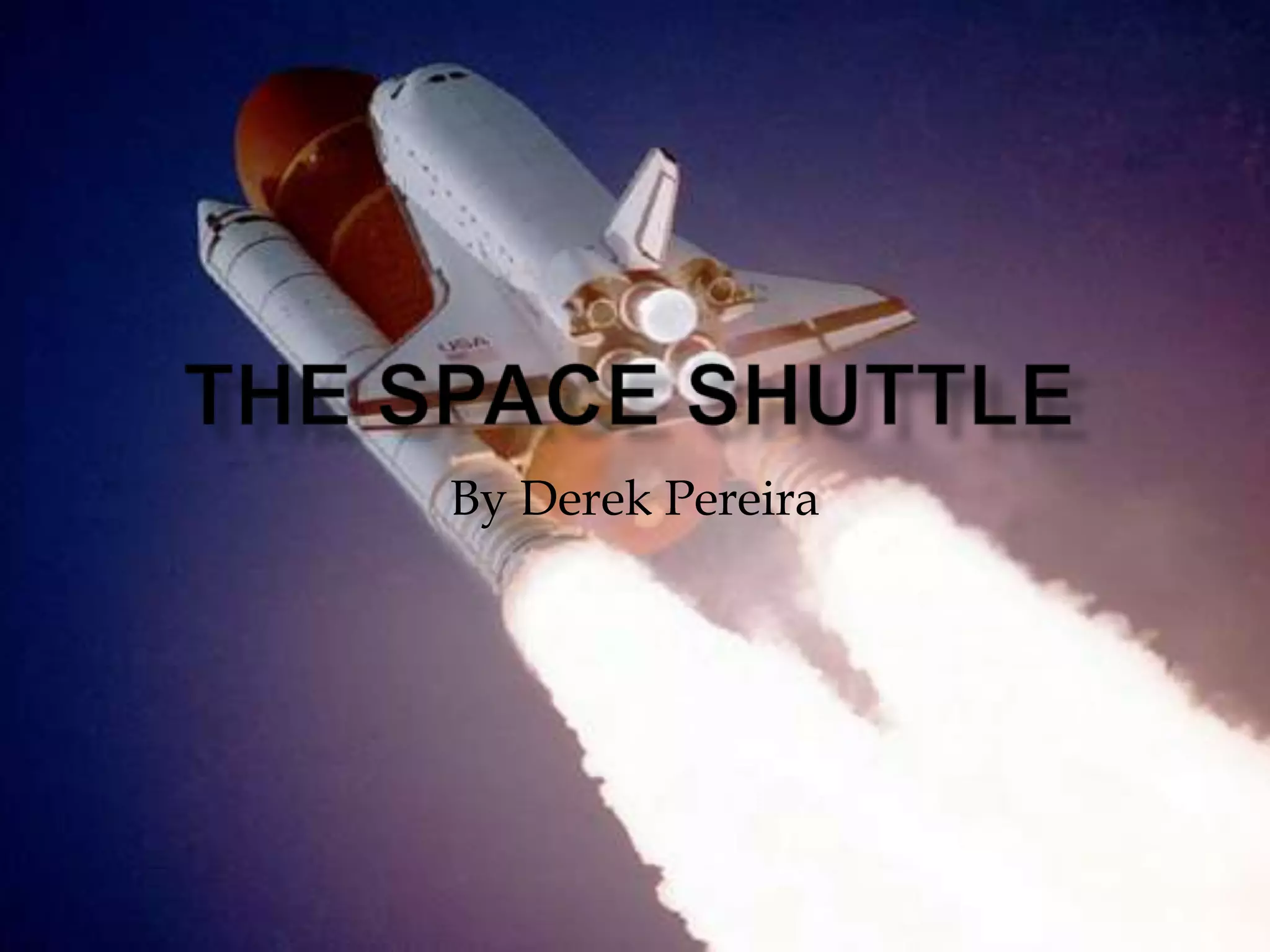
The Space ShuttleBy Derek Pereira
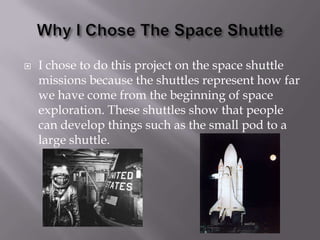
Why I Chose The Space ShuttleI chose to do this project on the space shuttle missions because the shuttles represent how far we have come from the beginning of space exploration. These shuttles show that people can develop things such as the small pod to a  large shuttle.
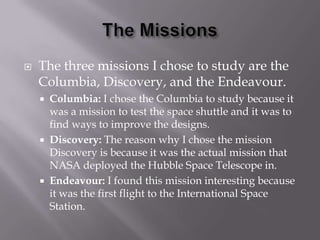
The MissionsThe three missions I chose to study are the Columbia, Discovery, and the Endeavour.  Columbia: I chose the Columbia to study because it was a mission to test the space shuttle and it was to find ways to improve the designs.Discovery: The reason why I chose the mission Discovery is because it was the actual mission that NASA deployed the Hubble Space Telescope in.Endeavour: I found this mission interesting because it was the first flight to the International Space Station.
The Columbia STS-1Date of launch: April 12th, 1981.Launch site: Kennedy Space Center in Florida.Trip lasted for two days six hours.Traveled a total of 1.074 million miles.Objective: To put a space shuttle into orbit successfully, and to test the performance of the shuttle during ascent, orbit, and reentry.Tested the orbiter, solid rocket boosters, and the external fuel tank.
The Columbia STS-1The launch was a complete success. However there were some issues. During reentry the shuttle appeared to be having problem. Once the shuttle landed NASA discovered that 16 heat shields were lost and 148 damaged due to an overpressure wave from the intense heat of the rocket boosters igniting.
Other Columbia MissionsThe Columbia actually had two other main missions. These included the STS-93 and the STS-107.STS-93: The first shuttle commanded by a woman, Eileen Collins. This mission had problems with the hydrogen tanks, but was still a success.STS-107: During the ascent a piece of foam appeared to hit the shuttle. NASA thought nothing of this until reentry when the shuttle exploded due to damaged heat tiles. The shuttle and crew were lost over Texas.
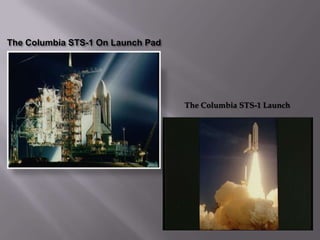
The Columbia STS-1 On Launch PadThe Columbia STS-1 Launch
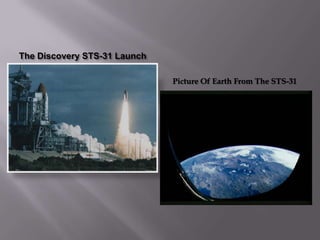
The Discovery STS-31Launch date:  April 24th, 1990.Launch Location: Edward’s Air Force Base, California.Distance Traveled: 2.1 million miles.Time In Space: Five days one hour.Mission Objective: The objective was to deploy the billion dollar Hubble Space Telescope to be able to see the universe more in depth.A problem happened with the telescope however. When NASA started receiving the pictures back they were blurry and unclear.
Other Discovery MissionsThere were four more main Discovery missions that NASA launched including the STS-41D, STS-60, STS-91, and finally the STS-95.STS-41D: Deployed three satellites; SBS-D, SYNCOM IV 2, and the TELSTAR.STS-60/STS-91: The STS-60 objective was to carry the first Russian cosmonaut (astronaut) into space on a US shuttle.STS-95: Carried out many tests including astronomical, human physiology, and physical sciences tests.
The Discovery STS-31 Launch Picture Of Earth From The STS-31
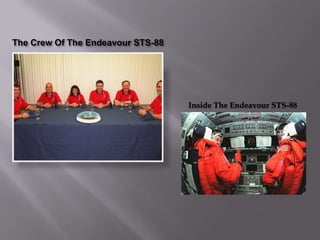
The Endeavour STS-88Launch Date: December 4th, 1998.Launch Location: Kennedy Space Center Pad A.Total Distance Traveled: 4.7 million miles.Time In Space: 11 days, 19 hoursObjective: To dock with the Zarya Control Module and attach the Unity Node which would later be the foundation for the Space Stations components.
The Endeavour STS-88Bob Cabana (The Endeavour Commander) flew to a rendezvous with Zarya, and Nancy Currie used the shuttle's robotic arm to grab the Russian-built spacecraft and attach it to the Unity Node in the shuttle’s payload bay. At the time, Zarya was the biggest object ever moved with the shuttle's robotic arm system. The Endeavour was the first human flight to help develop the ISS.
Other Endeavour MissionsThere are two other main Endeavour missions. These include the STS-61 and the STS-49.STS-61: The first Hubble Space Telescope servicing mission ever done. They replaced gyroscopes, solar panels, scientific instruments, and enhanced optics.STS-49: The first flight for the orbiter Endeavour. The main objective was to repair the INTELSAT VI to be usable.
The Crew Of The Endeavour STS-88Inside The Endeavour STS-88
SourcesSome information was gathered from Mrs. Billers note packet, but most information was  from the website:http://www.nasa.gov/mission_pages/shuttle/shuttlemissions/list_main.htmlPictures:http://images.jsc.nasa.gov/lores/S81-30458.jpghttp://images.ksc.nasa.gov/photos/1963/low/63-MA9-88.gifhttp://images.jsc.nasa.gov/lores/S81-29212.jpghttp://grcimagenet.grc.nasa.gov/GRCDigitalImages/1981/1981_02019L.jpghttp://images.ksc.nasa.gov/photos/1990/low/KSC-90PC-0610.gif
Sourceshttp://images.jsc.nasa.gov/lores/STS031-05-008.jpghttp://images.ksc.nasa.gov/photos/1998/low/KSC-98PC-1777.gifhttp://images.ksc.nasa.gov/photos/1998/low/KSC-98PC-1542.gif

Space shuttle presentation derek

  • 1.
    The Space ShuttleByDerek Pereira
  • 2.
    Why I ChoseThe Space ShuttleI chose to do this project on the space shuttle missions because the shuttles represent how far we have come from the beginning of space exploration. These shuttles show that people can develop things such as the small pod to a large shuttle.
  • 3.
    The MissionsThe threemissions I chose to study are the Columbia, Discovery, and the Endeavour. Columbia: I chose the Columbia to study because it was a mission to test the space shuttle and it was to find ways to improve the designs.Discovery: The reason why I chose the mission Discovery is because it was the actual mission that NASA deployed the Hubble Space Telescope in.Endeavour: I found this mission interesting because it was the first flight to the International Space Station.
  • 4.
    The Columbia STS-1Dateof launch: April 12th, 1981.Launch site: Kennedy Space Center in Florida.Trip lasted for two days six hours.Traveled a total of 1.074 million miles.Objective: To put a space shuttle into orbit successfully, and to test the performance of the shuttle during ascent, orbit, and reentry.Tested the orbiter, solid rocket boosters, and the external fuel tank.
  • 5.
    The Columbia STS-1Thelaunch was a complete success. However there were some issues. During reentry the shuttle appeared to be having problem. Once the shuttle landed NASA discovered that 16 heat shields were lost and 148 damaged due to an overpressure wave from the intense heat of the rocket boosters igniting.
  • 6.
    Other Columbia MissionsTheColumbia actually had two other main missions. These included the STS-93 and the STS-107.STS-93: The first shuttle commanded by a woman, Eileen Collins. This mission had problems with the hydrogen tanks, but was still a success.STS-107: During the ascent a piece of foam appeared to hit the shuttle. NASA thought nothing of this until reentry when the shuttle exploded due to damaged heat tiles. The shuttle and crew were lost over Texas.
  • 7.
    The Columbia STS-1On Launch PadThe Columbia STS-1 Launch
  • 8.
    The Discovery STS-31Launchdate: April 24th, 1990.Launch Location: Edward’s Air Force Base, California.Distance Traveled: 2.1 million miles.Time In Space: Five days one hour.Mission Objective: The objective was to deploy the billion dollar Hubble Space Telescope to be able to see the universe more in depth.A problem happened with the telescope however. When NASA started receiving the pictures back they were blurry and unclear.
  • 9.
    Other Discovery MissionsTherewere four more main Discovery missions that NASA launched including the STS-41D, STS-60, STS-91, and finally the STS-95.STS-41D: Deployed three satellites; SBS-D, SYNCOM IV 2, and the TELSTAR.STS-60/STS-91: The STS-60 objective was to carry the first Russian cosmonaut (astronaut) into space on a US shuttle.STS-95: Carried out many tests including astronomical, human physiology, and physical sciences tests.
  • 10.
    The Discovery STS-31Launch Picture Of Earth From The STS-31
  • 11.
    The Endeavour STS-88LaunchDate: December 4th, 1998.Launch Location: Kennedy Space Center Pad A.Total Distance Traveled: 4.7 million miles.Time In Space: 11 days, 19 hoursObjective: To dock with the Zarya Control Module and attach the Unity Node which would later be the foundation for the Space Stations components.
  • 12.
    The Endeavour STS-88BobCabana (The Endeavour Commander) flew to a rendezvous with Zarya, and Nancy Currie used the shuttle's robotic arm to grab the Russian-built spacecraft and attach it to the Unity Node in the shuttle’s payload bay. At the time, Zarya was the biggest object ever moved with the shuttle's robotic arm system. The Endeavour was the first human flight to help develop the ISS.
  • 13.
    Other Endeavour MissionsThereare two other main Endeavour missions. These include the STS-61 and the STS-49.STS-61: The first Hubble Space Telescope servicing mission ever done. They replaced gyroscopes, solar panels, scientific instruments, and enhanced optics.STS-49: The first flight for the orbiter Endeavour. The main objective was to repair the INTELSAT VI to be usable.
  • 14.
    The Crew OfThe Endeavour STS-88Inside The Endeavour STS-88
  • 15.
    SourcesSome information wasgathered from Mrs. Billers note packet, but most information was from the website:http://www.nasa.gov/mission_pages/shuttle/shuttlemissions/list_main.htmlPictures:http://images.jsc.nasa.gov/lores/S81-30458.jpghttp://images.ksc.nasa.gov/photos/1963/low/63-MA9-88.gifhttp://images.jsc.nasa.gov/lores/S81-29212.jpghttp://grcimagenet.grc.nasa.gov/GRCDigitalImages/1981/1981_02019L.jpghttp://images.ksc.nasa.gov/photos/1990/low/KSC-90PC-0610.gif
  • 16.