ELISA
By:
Girish Kumar K
IV MSc.
Biomedical Science
ELISA
• Enzyme-linked immunosorbent assay is
commonly known as ELISA where Ag-Ab
interaction is monitored by enzyme
measurement.
• It is similar in principle to Radio Immuno Assay
(RIA) but depends on an enzyme rather than a
radioactive label.
• An enzyme conjugated with an antibody reacts
with a colorless substrate to generate a colored
reaction product. Such a substrate is called a
chromogenic substrate.
PRINCIPLE
• ELISA use an enzyme to detect the binding of
antigen (Ag) antibody (Ab).
• The enzyme converts a colorless substrate
(chromogen) to a colored product, indicating the
presence of Ag:Ab binding.
• An ELISA can be used to detect either the
presence of antigens or antibodies in a sample
depending how the test is designed.
• A number of enzymes have been employed for
ELISA, including
1. Alkaline phosphatase
2. Horseradish peroxidase
3. Galactosidase
• These assays approach the sensitivity of RIAs
and have the advantage of being safer and less
costly.
Variants Of ELISA
• A number of variations of ELISA have been
developed, allowing qualitative detection or
quantitative measurement of either antigen or
antibody.
• Each type of ELISA can be used qualitatively
to detect the presence of antibody or antigen.
• Alternatively, a standard curve based on
known concentrations of antibody or antigen is
prepared, from which the unknown
concentration of a sample can be determined.
INDIRECT ELISA
• Antibody can be detected or quantitatively
determined with an indirect ELISA.
• Serum or some other sample containing primary
antibody (Ab1) is added to an antigen-coated
microtiter well and allowed to react with the
antigen attached to the well.
• After any free antibody (Ab1) is washed away, the
presence of antibody bound to the antigen is
detected by adding an enzyme-conjugated
secondary anti-isotype antibody (Ab2), which
binds to the primary antibody.
• Any free Ab₂ then is washed away and a
substrate for the enzyme is added.
• The amount of colored reaction product that
forms is measured by specialized
spectrophotometric plate readers, which can
measure the absorbance of all of the wells of a
96-well plate in seconds.
• Indirect ELISA detects the presence of serum
antibodies against human immunodeficiency
virus (HIV), the causative agent of AIDS.
• In this assay, recombinant envelope and core
proteins of HIV are adsorbed as solid-phase
antigens to microtiter wells.
• Individuals infected with HIV will produce
serum antibodies to epitopes on these viral
proteins.
• Generally, serum antibodies to HIV can be
detected by indirect ELISA within 6 weeks of
infection.
SANDWICH ELISA
• Antigen can be detected or measured by a
sandwich ELISA.
• In this technique, the antibody (rather than the
antigen) is immobilized on a microtiter well.
• A sample containing antigen is added and
allowed to react with the immobilized antibody.
• After the well is washed, a second enzyme-
linked antibody specific for a different epitope
on the antigen is added and allowed to react with
the bound antigen.
• After any free second antibody is removed by
washing, substrate is added, and the colored
reaction product is measured.
COMPETITIVE ELISA
• Another variation for measuring amounts of
antigen is competitive ELISA.
• In this technique, antibody is first incubated in
solution with a sample containing antigen.
• The antigen-antibody mixture is then added to
an antigen-coated microtiter well.
• The more antigen present in the sample, the less
free antibody will be available to bind to the
antigen-coated well.
• Addition of an enzyme-conjugated secondary
antibody (Ab₂) specific for the isotype of the
primary antibody can be used to determine the
amount of primary antibody bound to the well as
in an indirect ELISA.
• In the competitive assay however, higher the
concentration of antigen in the original sample,
the lower will be the absorbance.
CHEMILUMINESCENCE
• Measurement of light produced by
chemiluminescence during certain chemical
reactions provides a convenient and highly
sensitive alternative to absorbance
measurements in ELISA assays.
• In this versions of the ELISA using
chemiluminescence, a luxogenic (light-
generating) substrate takes the place of the
chromogenic substrate in conventional ELISA
reactions.
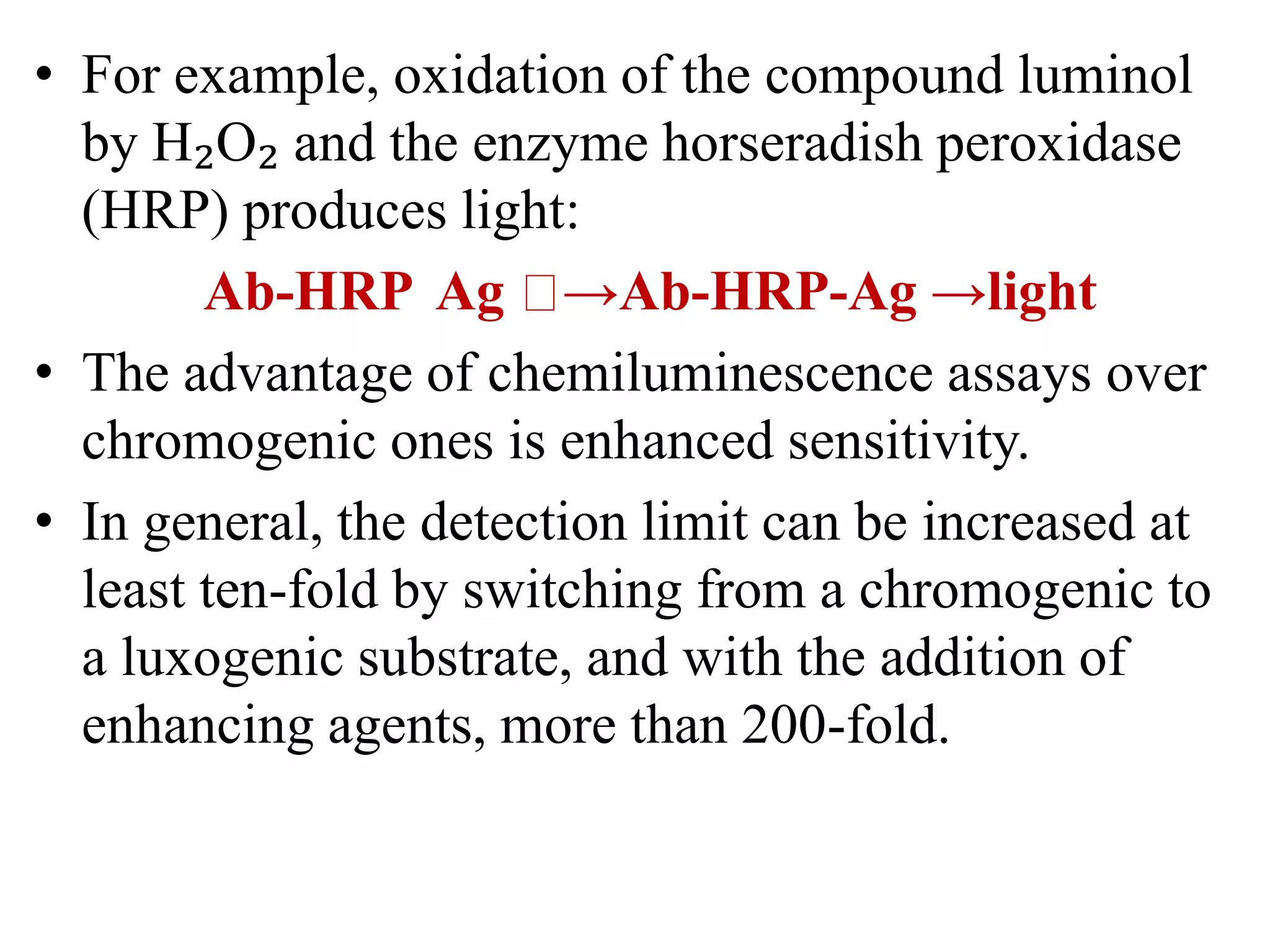
• For example, oxidation of the compound luminol
by H₂O₂ and the enzyme horseradish peroxidase
(HRP) produces light:
Ab-HRP Ag →Ab-HRP-Ag →light
• The advantage of chemiluminescence assays over
chromogenic ones is enhanced sensitivity.
• In general, the detection limit can be increased at
least ten-fold by switching from a chromogenic to
a luxogenic substrate, and with the addition of
enhancing agents, more than 200-fold.
ELISPOT ASSAY
• A modification of the ELISA called the
ELISPOT assay allows the quantitative
determination of the number of cells in a
population that are producing antibodies specific
for a given antigen or an antigen for specific
antibody.
• The plates are coated with the antigen (capture
antigen) recognized by the antibody of interest or
with the antibody (capture antibody) specific for
the antigen whose production is being assayed.
• A suspension of the cell population under
investigation is then added to the coated plates
and incubated.
• The cells settle onto the surface of the plate, and
secreted molecules bounds by the capture
molecules in the vicinity of the secreting cells,
producing a ring of antigen-antibody complexes
around each cell that is producing the molecule of
interest.
• The plate is then washed and an enzyme-linked
antibody specific for the secreted antigen or
specific for the species (e.g., goat anti-rabbit) of
the secreted antibody is added and allowed to
bind.
• Subsequent development of
the assay by addition of a
suitable chromogenic or
chemiluminescence-producing
substrate reveals the position
of each antibody- or antigen-
producing cell as a point of
color or light.
APPLICATION
• Serum antibody concentration.
• Detecting potential food allergens.
(milk, peanut, walnut, almonds and eggs)
• Tracking the spread of disease in disease
outbreaks. (e.g. HIV, bird flu, common COLD,
STDs.)
• Detection of antigen. (e.g. pregnancy hormones,
drug allergens, GMO, mad cow disease)
• Detection of antibodies to past exposure to
disease. (e.g. Lyme disease, trichinosis, HIV, bird
flu)
Elisa

Elisa

  • 1.
    ELISA By: Girish Kumar K IVMSc. Biomedical Science
  • 2.
    ELISA • Enzyme-linked immunosorbentassay is commonly known as ELISA where Ag-Ab interaction is monitored by enzyme measurement. • It is similar in principle to Radio Immuno Assay (RIA) but depends on an enzyme rather than a radioactive label. • An enzyme conjugated with an antibody reacts with a colorless substrate to generate a colored reaction product. Such a substrate is called a chromogenic substrate.
  • 3.
    PRINCIPLE • ELISA usean enzyme to detect the binding of antigen (Ag) antibody (Ab). • The enzyme converts a colorless substrate (chromogen) to a colored product, indicating the presence of Ag:Ab binding. • An ELISA can be used to detect either the presence of antigens or antibodies in a sample depending how the test is designed.
  • 4.
    • A numberof enzymes have been employed for ELISA, including 1. Alkaline phosphatase 2. Horseradish peroxidase 3. Galactosidase • These assays approach the sensitivity of RIAs and have the advantage of being safer and less costly.
  • 5.
    Variants Of ELISA •A number of variations of ELISA have been developed, allowing qualitative detection or quantitative measurement of either antigen or antibody. • Each type of ELISA can be used qualitatively to detect the presence of antibody or antigen. • Alternatively, a standard curve based on known concentrations of antibody or antigen is prepared, from which the unknown concentration of a sample can be determined.
  • 6.
    INDIRECT ELISA • Antibodycan be detected or quantitatively determined with an indirect ELISA. • Serum or some other sample containing primary antibody (Ab1) is added to an antigen-coated microtiter well and allowed to react with the antigen attached to the well. • After any free antibody (Ab1) is washed away, the presence of antibody bound to the antigen is detected by adding an enzyme-conjugated secondary anti-isotype antibody (Ab2), which binds to the primary antibody.
  • 7.
    • Any freeAb₂ then is washed away and a substrate for the enzyme is added. • The amount of colored reaction product that forms is measured by specialized spectrophotometric plate readers, which can measure the absorbance of all of the wells of a 96-well plate in seconds.
  • 8.
    • Indirect ELISAdetects the presence of serum antibodies against human immunodeficiency virus (HIV), the causative agent of AIDS. • In this assay, recombinant envelope and core proteins of HIV are adsorbed as solid-phase antigens to microtiter wells. • Individuals infected with HIV will produce serum antibodies to epitopes on these viral proteins. • Generally, serum antibodies to HIV can be detected by indirect ELISA within 6 weeks of infection.
  • 9.
    SANDWICH ELISA • Antigencan be detected or measured by a sandwich ELISA. • In this technique, the antibody (rather than the antigen) is immobilized on a microtiter well. • A sample containing antigen is added and allowed to react with the immobilized antibody. • After the well is washed, a second enzyme- linked antibody specific for a different epitope on the antigen is added and allowed to react with the bound antigen.
  • 10.
    • After anyfree second antibody is removed by washing, substrate is added, and the colored reaction product is measured.
  • 11.
    COMPETITIVE ELISA • Anothervariation for measuring amounts of antigen is competitive ELISA. • In this technique, antibody is first incubated in solution with a sample containing antigen. • The antigen-antibody mixture is then added to an antigen-coated microtiter well. • The more antigen present in the sample, the less free antibody will be available to bind to the antigen-coated well.
  • 12.
    • Addition ofan enzyme-conjugated secondary antibody (Ab₂) specific for the isotype of the primary antibody can be used to determine the amount of primary antibody bound to the well as in an indirect ELISA. • In the competitive assay however, higher the concentration of antigen in the original sample, the lower will be the absorbance.
  • 13.
    CHEMILUMINESCENCE • Measurement oflight produced by chemiluminescence during certain chemical reactions provides a convenient and highly sensitive alternative to absorbance measurements in ELISA assays. • In this versions of the ELISA using chemiluminescence, a luxogenic (light- generating) substrate takes the place of the chromogenic substrate in conventional ELISA reactions.
  • 14.
    • For example,oxidation of the compound luminol by H₂O₂ and the enzyme horseradish peroxidase (HRP) produces light: Ab-HRP Ag →Ab-HRP-Ag →light • The advantage of chemiluminescence assays over chromogenic ones is enhanced sensitivity. • In general, the detection limit can be increased at least ten-fold by switching from a chromogenic to a luxogenic substrate, and with the addition of enhancing agents, more than 200-fold.
  • 15.
    ELISPOT ASSAY • Amodification of the ELISA called the ELISPOT assay allows the quantitative determination of the number of cells in a population that are producing antibodies specific for a given antigen or an antigen for specific antibody. • The plates are coated with the antigen (capture antigen) recognized by the antibody of interest or with the antibody (capture antibody) specific for the antigen whose production is being assayed.
  • 16.
    • A suspensionof the cell population under investigation is then added to the coated plates and incubated. • The cells settle onto the surface of the plate, and secreted molecules bounds by the capture molecules in the vicinity of the secreting cells, producing a ring of antigen-antibody complexes around each cell that is producing the molecule of interest. • The plate is then washed and an enzyme-linked antibody specific for the secreted antigen or specific for the species (e.g., goat anti-rabbit) of the secreted antibody is added and allowed to bind.
  • 17.
    • Subsequent developmentof the assay by addition of a suitable chromogenic or chemiluminescence-producing substrate reveals the position of each antibody- or antigen- producing cell as a point of color or light.
  • 18.
    APPLICATION • Serum antibodyconcentration. • Detecting potential food allergens. (milk, peanut, walnut, almonds and eggs) • Tracking the spread of disease in disease outbreaks. (e.g. HIV, bird flu, common COLD, STDs.) • Detection of antigen. (e.g. pregnancy hormones, drug allergens, GMO, mad cow disease) • Detection of antibodies to past exposure to disease. (e.g. Lyme disease, trichinosis, HIV, bird flu)