
‫الرحيم‬ ‫الرحمن‬ ‫هللا‬ ‫بسم‬
Elmashreq University
Faculty of engineering
Electronics engineering dept
Prepared by: supervisor:
1.
Introduction:
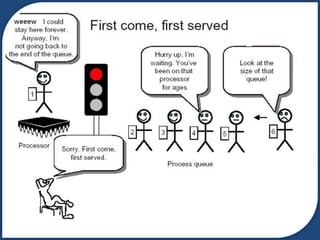
Process that requests the CPU FIRST is allocated the CPU FIRST.
It’s simplest to understand and the simplest to implement .
Other names of this algorithm are:
• First-In-First-Out (FIFO) .
• Run-to-Completion .
• Run-Until-Done .
 This is a non-preemptive algorithm.
 Example on real life such as: Buying tickets !
 Example on computer system likes: sharing printers.
 Implementation:
• FIFO queues.
• A new process enters the tail of the queue.
• The schedule selects from the head of the queue.
Scheduling Algorithms:
First-Come, First-Served (FCFS)
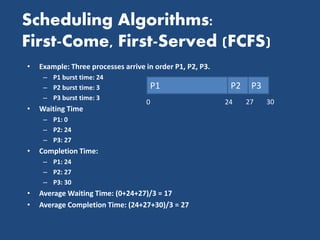
• Example: Three processes arrive in order P1, P2, P3.
– P1 burst time: 24
– P2 burst time: 3
– P3 burst time: 3
• Waiting Time
– P1: 0
– P2: 24
– P3: 27
• Completion Time:
– P1: 24
– P2: 27
– P3: 30
• Average Waiting Time: (0+24+27)/3 = 17
• Average Completion Time: (24+27+30)/3 = 27
P1 P2 P3
0 24 27 30
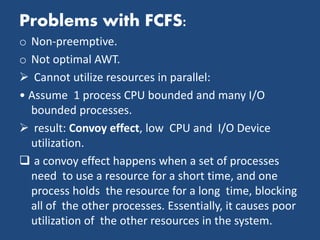
Problems with FCFS:
o Non-preemptive.
o Not optimal AWT.
 Cannot utilize resources in parallel:
• Assume 1 process CPU bounded and many I/O
bounded processes.
 result: Convoy effect, low CPU and I/O Device
utilization.
 a convoy effect happens when a set of processes
need to use a resource for a short time, and one
process holds the resource for a long time, blocking
all of the other processes. Essentially, it causes poor
utilization of the other resources in the system.
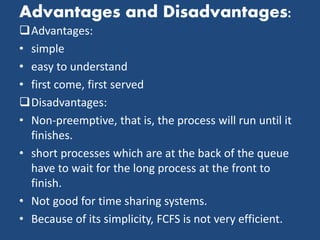
Advantages and Disadvantages:
Advantages:
• simple
• easy to understand
• first come, first served
Disadvantages:
• Non-preemptive, that is, the process will run until it
finishes.
• short processes which are at the back of the queue
have to wait for the long process at the front to
finish.
• Not good for time sharing systems.
• Because of its simplicity, FCFS is not very efficient.
Presentiaon  task sheduling first come first serve FCFS

Presentiaon task sheduling first come first serve FCFS

  • 1.
    ‫الرحيم‬ ‫الرحمن‬ ‫هللا‬‫بسم‬ Elmashreq University Faculty of engineering Electronics engineering dept Prepared by: supervisor: 1.
  • 2.
    Introduction: Process that requeststhe CPU FIRST is allocated the CPU FIRST. It’s simplest to understand and the simplest to implement . Other names of this algorithm are: • First-In-First-Out (FIFO) . • Run-to-Completion . • Run-Until-Done .  This is a non-preemptive algorithm.  Example on real life such as: Buying tickets !  Example on computer system likes: sharing printers.  Implementation: • FIFO queues. • A new process enters the tail of the queue. • The schedule selects from the head of the queue.
  • 4.
    Scheduling Algorithms: First-Come, First-Served(FCFS) • Example: Three processes arrive in order P1, P2, P3. – P1 burst time: 24 – P2 burst time: 3 – P3 burst time: 3 • Waiting Time – P1: 0 – P2: 24 – P3: 27 • Completion Time: – P1: 24 – P2: 27 – P3: 30 • Average Waiting Time: (0+24+27)/3 = 17 • Average Completion Time: (24+27+30)/3 = 27 P1 P2 P3 0 24 27 30
  • 5.
    Problems with FCFS: oNon-preemptive. o Not optimal AWT.  Cannot utilize resources in parallel: • Assume 1 process CPU bounded and many I/O bounded processes.  result: Convoy effect, low CPU and I/O Device utilization.  a convoy effect happens when a set of processes need to use a resource for a short time, and one process holds the resource for a long time, blocking all of the other processes. Essentially, it causes poor utilization of the other resources in the system.
  • 6.
    Advantages and Disadvantages: Advantages: •simple • easy to understand • first come, first served Disadvantages: • Non-preemptive, that is, the process will run until it finishes. • short processes which are at the back of the queue have to wait for the long process at the front to finish. • Not good for time sharing systems. • Because of its simplicity, FCFS is not very efficient.