FADEC
FADEC
• What is FADEC?
• Digital Electronic Controls
• Design Requirements : Modern
  Engine Control System
• Why is FADEC Preferred?
• A Backgrounder
• Location of FADEC
• Electronic Aspects of FADEC
• How does FADEC work?
• FADEC : Functions
• FADEC : Essential Features
• FADEC : Infrastructure (Simplified)
• Schematic Diagram
• Advantages & Limitations
WHAT IS FADEC?

FADEC:    (Full   Authority   Digital   Engine   Control
System)

-    a digital electronic control system
-    able to autonomously control the
engine
-     throughout        its    whole      operating
range
-    in both normal and fault conditions
WHAT IS FADEC?

FADEC:    (Full   Authority   Digital   Engine   Control
System)


- has a self-monitoring, self-operating,
redundant & fail-safe setup
-    comprises of a digital computer
and the other accessories (that control
all the aspects of aircraft engine
performance)
WHAT IS FADEC?

FADEC: (Full Authority Digital Engine Control System)

-     key system of gas turbine engines
-    provides optimum engine efficiency
for a given flight condition
-    also controls engine starting and
restarting.
WHAT IS FADEC?


FADEC: (Full Authority Digital Engine Control System)


-     lowers the work-load of pilots,

-   reduces the occurrence of pilot
errors,

-     provides         for    efficient      engine
operation.
WHAT IS FADEC?

FADEC: (Full Authority Digital Engine Control System)


allows the manufacturer to

      -program             engine      limitations
and

    -receive  engine               health        and
maintenance reports.
WHAT IS FADEC?

-    no   form   of   manual    override
available
-    places full authority to the control
of   operating parameters of the engine
in   the hands of the computer.
-    if a total FADEC failure occurs, the
     engine fails.
WHAT IS FADEC?

Note:      If the engine is controlled
digitally and   electronically but allows
for manual override, it is     considered
solely an Electronic Engine Control
(EEC) or Electronic Control Unit (ECU).
          An EEC, though a component
of a FADEC, is not by itself FADEC.
When standing alone, the       EEC makes
all of the decisions until the pilot
wishes to intervene.
DIGITAL ELECTRONIC CONTROL


The benefits of digital electronic
control of mechanical systems are
evident in greater precision and an
ability  to  measure    or    predict
performance degradation and incipient
failure.

Typical examples of this are digital
implementations of flight control or fly-
by-wire (FBW) and digital engine
control, or Full-Authority Digital Engine
Control (FADEC).
DIGITAL ELECTRONIC CONTROL


Integrated    Flight    and      Propulsion
Control (IFPC) allows closer     integration
of the aircraft flight control   and engine
control systems.

Flight control systems are virtually all
fly-by-wire (FBW) in the modern fighter
aircraft of today; the benefits being
weight reduction and improved handling
characteristics.
DESIGN REQUIREMENTS OF
MODERN ENGINE CONTROL
        SYSTEM
   • Speed / Accuracy / Ease of Control
     (Least Aircrew Workloads)

   • Wide Operational Range

   • Reliability & Operational Safety

   • Low Operating       &   Maintenance
     Costs

   • Should Not Add Weight

   • Fuel Efficiency

   • Dependable Starts
WHY IS FADEC PREFERRED?

New engines are adopting FADEC for

    -the   benefits   offered   by   digital
control,

    -improved         reliability      and
performance,

    -weight-reduction and

     -other improvements in system
integration and  data flow.
A BACKGROUNDER
 The FADEC systems were first used
in the automotive Industry where it is
well proven.

     Now-a-days airlines and the
militaries  all  over   the world
incorporate it on turbine powered
aircraft.

FADECs are made for piston engine
and jet engines both but they differ
in the way of controlling the engine .
A BACKGROUNDER

     Advanced, intelligent & robust
propulsion controls are critical for
improving      the     safety    and
maintainability of future propulsion
systems.

     Propulsion system reliability is
considered to be critical for aircraft
survival. Hence, FADEC systems came
into being.
A BACKGROUNDER

  FADEC is now common on many
engines.


  Semiconductor and equipment
cooling technology has advanced
so that control units can now be
mounted on the engine and still
provide highly reliable operation
for long periods.
A BACKGROUNDER

 Developing and implementing modern
intelligent engine systems requires the
introduction of numerous sensors,
actuators and processors to provide
the advanced functionality.
A BACKGROUNDER

  The application of artificial
intelligence and knowledge-
based     system    for     both
software      and     hardware
provides the foundation for
building     the     intelligent
control system of the future.
A BACKGROUNDER

 With time, control systems became
more     sophisticated    with    the
introduction of additional engine
condition   sensors    and   multiple
servo-loops.
A BACKGROUNDER

The task of handling engines was
eased     by   the  introduction    of
electronic control in the form of
magnetic amplifiers in early civil and
military aircraft.
A BACKGROUNDER
The    magnetic    amplifiers  allowed
engines to be stabilized at any speed
in the throttle range by introducing a
servo-loop with engine exhaust gas
temperature as a measure of engine
speed and an analogue fuel valve to
control fuel flow.
A BACKGROUNDER

Transistors, integrated circuits and
high    temperature    semi-conductors
have all played a part in the evolution
of   control   systems    from   range
temperature control through to full
digital engine control systems.
A BACKGROUNDER

This allowed the pilot to accelerate
and decelerate the engine while the
control system limited fuel flows to
prevent over- speeds or excessive
temperatures.
A BACKGROUNDER

With modern FADEC systems there are
no   mechanical   control     rods  or
mechanical reversions, and the pilot
can perform carefree handling of the
engine throughout the flight envelope.
A BACKGROUNDER


On modern aircraft the engine is
supervised by a computer to allow the
pilot   to   operate  at    maximum
performance in a combat aircraft or at
optimum fuel economy in a passenger
carrying aircraft.
A BACKGROUNDER

Today, each FADEC is unique and
therefore is expensive to develop,
produce, maintain, and upgrade for its
particular application.
A BACKGROUNDER

In the future, it is desired to establish
a universal or common standard for
engine controls and accessories. This
will significantly reduce the high
development       and    support    costs
across platforms.
LOCATION OF FADEC


FADEC is normally located on the
engine fan casing. Therefore, FADEC
cooling is difficult.
LOCATION OF FADEC

However, there are many features of
engine control which are distributed
around the engine – such as reverse
thrust,     presently     pneumatically
actuated – which would need to be
actuated by alternative means in a
more-electric engine. This leads to the
possibility of using distributed engine
control.
ELECTRONIC ASPECTS OF FADEC


Modern ECUs use a microprocessor
which can process the inputs from the
engine sensors in real time. An
electronic control unit contains the
hardware and software (firmware).
ELECTRONIC ASPECTS: FADEC


The hardware consists of electronic
components on a printed circuit board
(PCB), ceramic substrate or a thin
laminate   substrate.    The     main
component on this circuit board is a
microcontroller chip (CPU).
ELECTRONIC ASPECTS : FADEC


The    software  is   stored  in  the
microcontroller or other chips on the
PCB, typically in EPROMs or flash
memory so the CPU can be re-
programmed by uploading updated
code or replacing chips. This is also
referred to as an Electronic Engine
Management System (EMS).
HOW DOES FADEC WORK?

FADEC works by receiving multiple
input variables of the current flight
condition including air density, throttle
lever position, engine temperatures,
engine pressures, and many others.
HOW DOES FADEC WORK?


Each FADEC is essentially a centralized
system, with a redundant, central
computer and centrally located analog
signal    interfacing   circuitry    for
interfacing with sensors and actuators
located   throughout   the   propulsion
system.
HOW DOES FADEC WORK?


Engine operating parameters such as
fuel flow, stator vane position, bleed
valve    position  and   others    are
computed from this data and applied
as appropriate.
HOW DOES FADEC WORK?

For example, to avoid exceeding a
certain  engine   temperature,    the
FADEC    can  be    programmed      to
automatically take the necessary
measures without pilot intervention.

The inputs are received by the EEC
and analyzed up to 70 times per
second.
HOW DOES FADEC WORK?

FADEC computes the appropriate thrust
settings and applies them.

During   flight,   small  changes      in
operation are constantly being made    to
maintain efficiency.

Maximum      thrust     is   available for
emergency situations if the throttle is
advanced     to   full,    but   remember,
limitations can’t be exceeded.
HOW DOES FADEC WORK?


Another new feature of the FADEC
system is the ability to record the last
900 hours of flight.

With readings taken every second, this
stored information can be used to
diagnose problem areas as well as
review recent flight history.
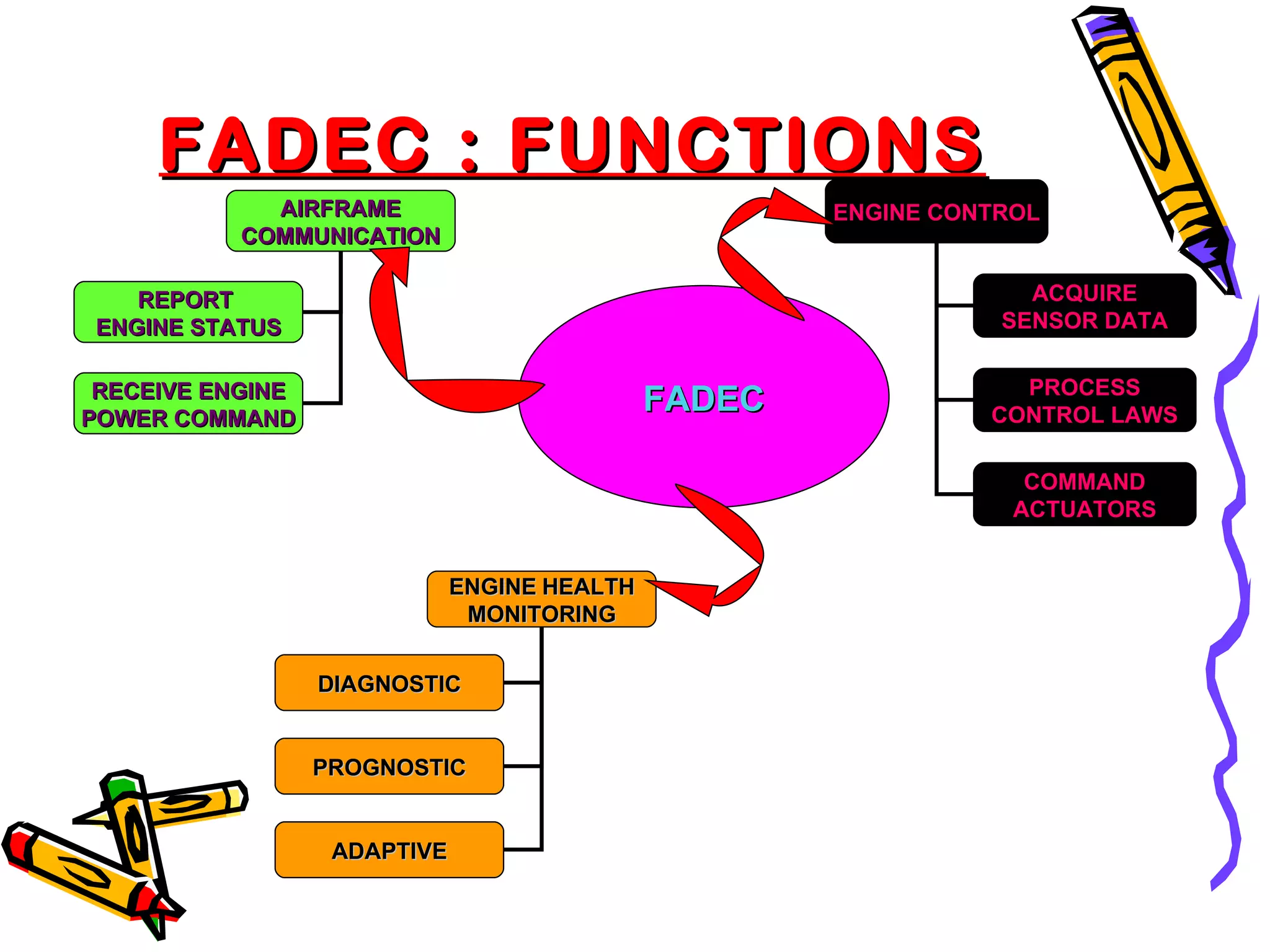
FADEC : FUNCTIONS
             AIRFRAME                                 ENGINE CONTROL
           COMMUNICATION

    REPORT                                                         ACQUIRE
 ENGINE STATUS                                                   SENSOR DATA


 RECEIVE ENGINE                                                   PROCESS
POWER COMMAND
                                              FADEC             CONTROL LAWS

                                                                   COMMAND
                                                                  ACTUATORS


                              ENGINE HEALTH
                               MONITORING


                  DIAGNOSTIC


                  PROGNOSTIC


                   ADAPTIVE
FADEC : ESSENTIAL
        FEATURES
-   Control & Monitoring of Engine Operations
-   Dual Channels & Redundancy
-   Engine Life Monitoring
-   Record of Engine Performance Parameters
-   Automated Troubleshooting
-   Memory Read or Recall of Engine Data
-   Control of Common Engine Problems
-   Display of Warnings
-   Adaptation
-   Isochronous Idle Speed
FADEC
      :INFRASTRUCTURE
CONTROL OPERATIONS IN GAS TURBINE
 ENGINES
FADEC:
      INFRASTRUCTURE
CONTROL OPERATIONS IN GAS TURBINE
 ENGINES
  - Air Control (Compressor Entry)

  - Fuel Control (Main / AB / Starting System)

  - Starting & Ignition Control

  - Lubrication Control

  - Surge Control (Through Bleed Valve)

  - Thrust Control (Through Exhaust Nozzle)

  - Vibration Control (Through Air / Fuel Control)
FADEC: INFRASTRUCTURE
SAMPLE CHAIN OF CONTROL (MECH.)
 OPERATION
     GEAR DRIVEN                    WORKING FLUID                ACTUATED
   MECHANICAL PUMP                      FROM                     ASSEMBLY
                                   ENGINE / AIRCRAFT


ELECTRO-HYDRO-MECHNICAL
                                                             MECHANICAL
      CONTROL UNIT
                                                             ACTUATORS
  SERVO                                                    POSITION POSITION
            POSITION    SOLENOID
ACTUATING
            SENSORS      VALVES                            SENSOR-1 SENSOR-2
 MOTORS


                                     FADEC COMPUTER


                       AIRCRAFT COMPUTER               COCKPIT
FADEC : INFRASTRUCTURE
SAMPLE CHAIN OF CONTROL (ELECT.)
 OPERATION
                                              MECHANICAL
                                              ACTUATORS
ELECTRO-HYDRO-MECHNICAL
      CONTROL UNIT                           POSITION POSITION
  SERVO                                      SENSOR-1 SENSOR-2
          POSITION SOLENOID
ACTUATING
          SENSORS   VALVES
 MOTORS

                                    FADEC
                                  COMPUTER


                                             PILOT’s THROTTLE
     VARIOUS INPUTS                             IN COCKPIT
     FROM AIRCRAFT
                                    POWER     DISPLAY PANEL
                                    SUPPLY      IN COCKPIT

                    VARIOUS INPUTS FROM /
                     COMMANDS TO ENGINE
FADEC: INFRASTRUCTURE
HARDWARE:

- Dual Power Supply
- FADEC Computer (With Logic Circuit PCBs &
  Programmed / Programmable Memory)
- A Set of Servo Actuating Motors / Solenoid Valves /
  Position Sensors (for every System Control Unit)
- Dual Position Sensors for Actuators (of every
  System)
- A Set of Electrical Harnesses (for every System)
- Display Panel with Indicators / Warning Lights (in
  Cockpit)
- Multiple Engine RPM, Pressure Sensors &
  Thermocouples
- Pilot’s Throttle
FADEC :
     INFRASTRUCTURE
SOFTWARE:
- EPR Schedules (For Thrust, over Entire
  Range of Engine Operation Without FADEC
  Computer Failure)

- N Schedules (For Thrust as per Pilot’s
  Throttle, Engine Operation in case of Limited
  FADEC Computer Functionality)
Note:      In case of certain degree of FADEC
 failure, there is an automatic mode switch-
 over from EPR to N rating. However, if the
 failure disappears, the pilot can reset the
 mode to switch-back to EPR mode.
FADEC: INFRASTRUCTURE
INPUTS:

    From Aircraft.

    -   Ambient Temperature
    -   Altitude
    -   Mach Number
    -   Angle of Attack
    -   Impact Pressure
    -   Landing Gear Position
    -   Missile / Rocket Firing Signals etc.
FADEC: INFRASTRUCTURE
 INPUTS:

     From Engine.

     - Throttle Lever Position
     - RPM
     - Turbine Outlet / Exhaust Gas
       Temperature
     - Exhaust Nozzle Area
     - Fan Duct Flaps Position
     - Bearing Temperatures
     - Engine Vibration
     - Engine Pressures
FADEC: INFRASTRUCTURE
SIMPLIFIED FADEC ARCHITECTURE

         FADEC LANE-A    FADEC
                         LANE-A
              FADEC     MONITOR
              LANE-A
             CONTROL
ENGINE                            ENGINE
THRUST   FADEC LANE-B    FADEC     FUEL
DEMAND                   LANE-B   DEMAND
              FADEC     MONITOR
              LANE-B
             CONTROL
FADEC: INFRASTRUCTURE
SIMPLIFIED FADEC ARCHITECHTURE

 This simplified architecture is typical
 of
 many dual-channel FADECs.

 There are two independent lanes: Lane
 A
 and Lane B.
FADEC: INFRASTRUCTURE
SIMPLIFIED FADEC ARCHITECHTURE


 Each lane comprises a Command
 and Monitor portion, which are
 interconnected for cross monitoring
 purposes, and undertakes the task
 of metering the fuel flow to the
 engine in accordance with the
 necessary control laws to satisfy the
 flight crew thrust command.
FADEC: INFRASTRUCTURE
SIMPLIFIED FADEC ARCHITECHTURE

 The analysis required to decide
 upon the impact of certain failures
 in conjunction with others, requires
 a Markov model in order to be able
 to understand the dependencies.
FADEC : INFRASTRUCTURE
MARKOV ANALYSIS MODEL


 •By using this model the effects of
 interrelated   failures  can     be
 examined.

 •The model has a total of 16 states as
 shown by the number in the bottom
 right-hand corner of the appropriate
 box.
FADEC : INFRASTRUCTURE
 MARKOV ANALYSIS MODEL


•Each box relates to the serviceability
state of the Lane A Command (Ca) and
Monitor     (Ma) channels and Lane B
Command (Cb) and         Monitor (Mb)
channels.
FADEC : INFRASTRUCTURE
 MARKOV ANALYSIS MODEL


•These range from the fully serviceable
state in box 1 through a series of failure
conditions to the totally failed state in box
16.

•Clearly most normal operating conditions
are going to be in the left-hand region of
the model.
FADEC :
        INFRASTRUCTURE
 MARKOV MODEL ANALYSIS

                               CaMa .CbMb 6


              Ca Ma.CbMb 2     Ca Ma. Cb Mb 7      CaMa . Cb Mb 12


               Ca Ma .CbMb 3   Ca Ma.Cb Mb 8       CaMa .Cb Mb 13
CaMa.CbMb 1                                                          CaMa . CbMb 16

              CaMa. Cb Mb 4    Ca Ma . Cb Mb 9     Ca Ma. CbMb 14


               CaMa.Cb Mb 5    Ca Ma .Cb Mb 10     Ca Ma . CbMb 15


                               CaMa. CbMb 11


   NO FAILURE             1 FAILURE              2 FAILURES            3
   FAILURES              4 FAILURES


              DISPACHABLE             CONTROLLABLE               ENGINE
                 ENGINE                  ENGINE                SHUT-DOWN
FADEC:
INFRASTRUCTURE
 Concentrating on the left-hand side of the
 model it can be seen that the fully
 serviceable state in box 1 can migrate to any
 one of six states:

 – Failure of Command channel A results in
   state 2 being reached.
 – Failure of Monitor channel A results in
   state 3 being reached.
 – Failure of Command channel B results in
   state 4 being reached.
 – Failure of Monitor channel B results in
   state 5 being reached.
 – Failure of the cross-monitor between
   Command A and Monitor A results in both
   being lost simultaneously and reaching
   state 6.
 – Failure of the cross-monitor between
   Command B and Monitor B results in both
   being lost simultaneously and reaching
   state 11.
FADEC:
INFRASTRUCTURE


All of these failure states result in an
engine which may still be controlled by
the FADEC. However, further failures
beyond this point may result in an
engine which may not be controllable
either because both control channels
are inoperative or because the ‘good’
control and monitor lanes are in
opposing channels or worse.
FADEC:
INFRASTRUCTURE

The model shown above is constructed
according to the following rules: an
engine may be dispatched as a ‘get-
you-home’ measure provided that only
one monitor channel has failed.

This means that states 3 and 5 are
dispatchable: but not states 2, 4, 6, or
11 as subsequent failures could result
in engine shut-down.
FADEC: ESSENTIAL
   FEATURES


 MILITARY / TRANSPORT AIRCRAFT
 - Compressor Entry Guide Vanes
   Control (For LP Compressor & HP
   Compressor)
 - Main Fuel Control
 - AB Fuel Control (For Core & Fan AB)
 - Starting Fuel Control & Ignition
   Control
 - Bleed Valve Control & Fan Duct
   Flaps Control
 - Exhaust Nozzle Control
FADEC : SCHEMATIC DIAGRAM
                              LP COMPRESSOR
            STARTING          AIR EGV CONTROL
               &
            IGNITION          HP COMPRESSOR
            CONTROL           AIR EGV CONTROL
 POWER                           MAIN FUEL
 SUPPLY                          CONTROL
                               CORE AB FUEL
                                 CONTROL
                       EECU
            FADEC               FAN AB FUEL
 AIRCRAFT                        CONTROL
 COMPUTER
                              EXHAUST NOZZLE
                                 CONTROL

                              FAN DUCT FLAPS
                                 CONTROL

   PILOT                       BLEED VALVE
     IN                          CONTROL
  COCKPIT
CENTRALIZED CONTROL ARCHITECTURE
Each function resides within the FADECControl unique point-to-
                  Centralized Engine and uses
point analog connections to system effectors.
                                  Sensor
                                electronics         Sensor_1
                                  Sensor
                                electronics
                                                    Sensor_2
          Communication

                                  Sensor
          Communication         electronics
                                                    Sensor_ j


            CPU /
                          BUS


           Memory
                                 Actuation         Actuator_n
                                electronics


           Power                 Actuation         Actuator_2
                                electronics
                                 Actuation
                                electronics        Actuator_1
            FADEC
DISTRIBUTED CONTROL ARCHITECTURE
Functions are distributed outside of the Control
                  Centralized Engine FADEC and communicate
via a common interface standard.

                                    Sensor
                                  electronics    Sensor_1

                                    Sensor
                                  electronics    Sensor_2
          Communication


          Communication             Sensor
                                  electronics    Sensor_ j


            CPU /
           Memory
                          BUS


                                   Actuation
                                  electronics    Actuator_n


                                   Actuation
           Power                  electronics    Actuator_2

                                   Actuation
                                  electronics    Actuator_1

            FADEC
FADEC : ADVANTAGES
  - Reduced Aircrew Workload.
  - Improved Fuel Efficiency up to
    15% (Due to faster, Accurate
    Engine Control no trimming is
    required).
  - Reduced Aircraft Weight and
    Engine Size (Due to Absence of
    Heavy Mechanical Assemblies,
    No Scattering of Pipelines &
    Electrical Wirings).
  - Enhanced Engine Life (Due to
    Engine Operation in Safer /
    Mean Range).
  - Improved Reliability (Due to
FADEC : ADVANTAGES
 - Minimum Maintenance due to On
   Board      Computer    Guided
   Troubleshooting       (Aircraft
   can return to Flying at the
   Earliest).

 - Isochronous Idle speed leads to
   Smoother Engine Starts.
FADEC : ADVANTAGES

  - Maximum    Performance    in   a
    combat aircraft or at Optimum
    Fuel Economy in a Transport
    Aircraft  are   possible   after
    necessary      Adaptation       /
    Programming        of    FADEC
    Computer.

  - Auto-testing removes the need
    for test-running the engine after
    minor      maintenance      work
    ( Resulting in annual savings of
FADEC : LIMITATIONS
   - Pilot can not      override   the
     FADEC Control.


   - In the event of complete FADEC
     Failure, pilot left with no other
     option than having to fly with
     least      performance,       just
     sufficient to land safely. (This
     limitation has been removed in
     modern transport aircraft by
     having two FADEC Computers.)
FADEC: ANY QUESTION


        ?

Fadec full authority digital engine control-final

  • 1.
  • 2.
    FADEC • What isFADEC? • Digital Electronic Controls • Design Requirements : Modern Engine Control System • Why is FADEC Preferred? • A Backgrounder • Location of FADEC • Electronic Aspects of FADEC • How does FADEC work? • FADEC : Functions • FADEC : Essential Features • FADEC : Infrastructure (Simplified) • Schematic Diagram • Advantages & Limitations
  • 3.
    WHAT IS FADEC? FADEC: (Full Authority Digital Engine Control System) - a digital electronic control system - able to autonomously control the engine - throughout its whole operating range - in both normal and fault conditions
  • 4.
    WHAT IS FADEC? FADEC: (Full Authority Digital Engine Control System) - has a self-monitoring, self-operating, redundant & fail-safe setup - comprises of a digital computer and the other accessories (that control all the aspects of aircraft engine performance)
  • 5.
    WHAT IS FADEC? FADEC:(Full Authority Digital Engine Control System) - key system of gas turbine engines - provides optimum engine efficiency for a given flight condition - also controls engine starting and restarting.
  • 6.
    WHAT IS FADEC? FADEC:(Full Authority Digital Engine Control System) - lowers the work-load of pilots, - reduces the occurrence of pilot errors, - provides for efficient engine operation.
  • 7.
    WHAT IS FADEC? FADEC:(Full Authority Digital Engine Control System) allows the manufacturer to -program engine limitations and -receive engine health and maintenance reports.
  • 8.
    WHAT IS FADEC? - no form of manual override available - places full authority to the control of operating parameters of the engine in the hands of the computer. - if a total FADEC failure occurs, the engine fails.
  • 9.
    WHAT IS FADEC? Note: If the engine is controlled digitally and electronically but allows for manual override, it is considered solely an Electronic Engine Control (EEC) or Electronic Control Unit (ECU). An EEC, though a component of a FADEC, is not by itself FADEC. When standing alone, the EEC makes all of the decisions until the pilot wishes to intervene.
  • 10.
    DIGITAL ELECTRONIC CONTROL Thebenefits of digital electronic control of mechanical systems are evident in greater precision and an ability to measure or predict performance degradation and incipient failure. Typical examples of this are digital implementations of flight control or fly- by-wire (FBW) and digital engine control, or Full-Authority Digital Engine Control (FADEC).
  • 11.
    DIGITAL ELECTRONIC CONTROL Integrated Flight and Propulsion Control (IFPC) allows closer integration of the aircraft flight control and engine control systems. Flight control systems are virtually all fly-by-wire (FBW) in the modern fighter aircraft of today; the benefits being weight reduction and improved handling characteristics.
  • 12.
    DESIGN REQUIREMENTS OF MODERNENGINE CONTROL SYSTEM • Speed / Accuracy / Ease of Control (Least Aircrew Workloads) • Wide Operational Range • Reliability & Operational Safety • Low Operating & Maintenance Costs • Should Not Add Weight • Fuel Efficiency • Dependable Starts
  • 13.
    WHY IS FADECPREFERRED? New engines are adopting FADEC for -the benefits offered by digital control, -improved reliability and performance, -weight-reduction and -other improvements in system integration and data flow.
  • 14.
    A BACKGROUNDER TheFADEC systems were first used in the automotive Industry where it is well proven. Now-a-days airlines and the militaries all over the world incorporate it on turbine powered aircraft. FADECs are made for piston engine and jet engines both but they differ in the way of controlling the engine .
  • 15.
    A BACKGROUNDER Advanced, intelligent & robust propulsion controls are critical for improving the safety and maintainability of future propulsion systems. Propulsion system reliability is considered to be critical for aircraft survival. Hence, FADEC systems came into being.
  • 16.
    A BACKGROUNDER FADEC is now common on many engines. Semiconductor and equipment cooling technology has advanced so that control units can now be mounted on the engine and still provide highly reliable operation for long periods.
  • 17.
    A BACKGROUNDER Developingand implementing modern intelligent engine systems requires the introduction of numerous sensors, actuators and processors to provide the advanced functionality.
  • 18.
    A BACKGROUNDER The application of artificial intelligence and knowledge- based system for both software and hardware provides the foundation for building the intelligent control system of the future.
  • 19.
    A BACKGROUNDER Withtime, control systems became more sophisticated with the introduction of additional engine condition sensors and multiple servo-loops.
  • 20.
    A BACKGROUNDER The taskof handling engines was eased by the introduction of electronic control in the form of magnetic amplifiers in early civil and military aircraft.
  • 21.
    A BACKGROUNDER The magnetic amplifiers allowed engines to be stabilized at any speed in the throttle range by introducing a servo-loop with engine exhaust gas temperature as a measure of engine speed and an analogue fuel valve to control fuel flow.
  • 22.
    A BACKGROUNDER Transistors, integratedcircuits and high temperature semi-conductors have all played a part in the evolution of control systems from range temperature control through to full digital engine control systems.
  • 23.
    A BACKGROUNDER This allowedthe pilot to accelerate and decelerate the engine while the control system limited fuel flows to prevent over- speeds or excessive temperatures.
  • 24.
    A BACKGROUNDER With modernFADEC systems there are no mechanical control rods or mechanical reversions, and the pilot can perform carefree handling of the engine throughout the flight envelope.
  • 25.
    A BACKGROUNDER On modernaircraft the engine is supervised by a computer to allow the pilot to operate at maximum performance in a combat aircraft or at optimum fuel economy in a passenger carrying aircraft.
  • 26.
    A BACKGROUNDER Today, eachFADEC is unique and therefore is expensive to develop, produce, maintain, and upgrade for its particular application.
  • 27.
    A BACKGROUNDER In thefuture, it is desired to establish a universal or common standard for engine controls and accessories. This will significantly reduce the high development and support costs across platforms.
  • 28.
    LOCATION OF FADEC FADECis normally located on the engine fan casing. Therefore, FADEC cooling is difficult.
  • 29.
    LOCATION OF FADEC However,there are many features of engine control which are distributed around the engine – such as reverse thrust, presently pneumatically actuated – which would need to be actuated by alternative means in a more-electric engine. This leads to the possibility of using distributed engine control.
  • 30.
    ELECTRONIC ASPECTS OFFADEC Modern ECUs use a microprocessor which can process the inputs from the engine sensors in real time. An electronic control unit contains the hardware and software (firmware).
  • 31.
    ELECTRONIC ASPECTS: FADEC Thehardware consists of electronic components on a printed circuit board (PCB), ceramic substrate or a thin laminate substrate. The main component on this circuit board is a microcontroller chip (CPU).
  • 32.
    ELECTRONIC ASPECTS :FADEC The software is stored in the microcontroller or other chips on the PCB, typically in EPROMs or flash memory so the CPU can be re- programmed by uploading updated code or replacing chips. This is also referred to as an Electronic Engine Management System (EMS).
  • 33.
    HOW DOES FADECWORK? FADEC works by receiving multiple input variables of the current flight condition including air density, throttle lever position, engine temperatures, engine pressures, and many others.
  • 34.
    HOW DOES FADECWORK? Each FADEC is essentially a centralized system, with a redundant, central computer and centrally located analog signal interfacing circuitry for interfacing with sensors and actuators located throughout the propulsion system.
  • 35.
    HOW DOES FADECWORK? Engine operating parameters such as fuel flow, stator vane position, bleed valve position and others are computed from this data and applied as appropriate.
  • 36.
    HOW DOES FADECWORK? For example, to avoid exceeding a certain engine temperature, the FADEC can be programmed to automatically take the necessary measures without pilot intervention. The inputs are received by the EEC and analyzed up to 70 times per second.
  • 37.
    HOW DOES FADECWORK? FADEC computes the appropriate thrust settings and applies them. During flight, small changes in operation are constantly being made to maintain efficiency. Maximum thrust is available for emergency situations if the throttle is advanced to full, but remember, limitations can’t be exceeded.
  • 38.
    HOW DOES FADECWORK? Another new feature of the FADEC system is the ability to record the last 900 hours of flight. With readings taken every second, this stored information can be used to diagnose problem areas as well as review recent flight history.
  • 39.
    FADEC : FUNCTIONS AIRFRAME ENGINE CONTROL COMMUNICATION REPORT ACQUIRE ENGINE STATUS SENSOR DATA RECEIVE ENGINE PROCESS POWER COMMAND FADEC CONTROL LAWS COMMAND ACTUATORS ENGINE HEALTH MONITORING DIAGNOSTIC PROGNOSTIC ADAPTIVE
  • 40.
    FADEC : ESSENTIAL FEATURES - Control & Monitoring of Engine Operations - Dual Channels & Redundancy - Engine Life Monitoring - Record of Engine Performance Parameters - Automated Troubleshooting - Memory Read or Recall of Engine Data - Control of Common Engine Problems - Display of Warnings - Adaptation - Isochronous Idle Speed
  • 41.
    FADEC :INFRASTRUCTURE CONTROL OPERATIONS IN GAS TURBINE ENGINES
  • 42.
    FADEC: INFRASTRUCTURE CONTROL OPERATIONS IN GAS TURBINE ENGINES - Air Control (Compressor Entry) - Fuel Control (Main / AB / Starting System) - Starting & Ignition Control - Lubrication Control - Surge Control (Through Bleed Valve) - Thrust Control (Through Exhaust Nozzle) - Vibration Control (Through Air / Fuel Control)
  • 43.
    FADEC: INFRASTRUCTURE SAMPLE CHAINOF CONTROL (MECH.) OPERATION GEAR DRIVEN WORKING FLUID ACTUATED MECHANICAL PUMP FROM ASSEMBLY ENGINE / AIRCRAFT ELECTRO-HYDRO-MECHNICAL MECHANICAL CONTROL UNIT ACTUATORS SERVO POSITION POSITION POSITION SOLENOID ACTUATING SENSORS VALVES SENSOR-1 SENSOR-2 MOTORS FADEC COMPUTER AIRCRAFT COMPUTER COCKPIT
  • 44.
    FADEC : INFRASTRUCTURE SAMPLECHAIN OF CONTROL (ELECT.) OPERATION MECHANICAL ACTUATORS ELECTRO-HYDRO-MECHNICAL CONTROL UNIT POSITION POSITION SERVO SENSOR-1 SENSOR-2 POSITION SOLENOID ACTUATING SENSORS VALVES MOTORS FADEC COMPUTER PILOT’s THROTTLE VARIOUS INPUTS IN COCKPIT FROM AIRCRAFT POWER DISPLAY PANEL SUPPLY IN COCKPIT VARIOUS INPUTS FROM / COMMANDS TO ENGINE
  • 45.
    FADEC: INFRASTRUCTURE HARDWARE: - DualPower Supply - FADEC Computer (With Logic Circuit PCBs & Programmed / Programmable Memory) - A Set of Servo Actuating Motors / Solenoid Valves / Position Sensors (for every System Control Unit) - Dual Position Sensors for Actuators (of every System) - A Set of Electrical Harnesses (for every System) - Display Panel with Indicators / Warning Lights (in Cockpit) - Multiple Engine RPM, Pressure Sensors & Thermocouples - Pilot’s Throttle
  • 46.
    FADEC : INFRASTRUCTURE SOFTWARE: - EPR Schedules (For Thrust, over Entire Range of Engine Operation Without FADEC Computer Failure) - N Schedules (For Thrust as per Pilot’s Throttle, Engine Operation in case of Limited FADEC Computer Functionality) Note: In case of certain degree of FADEC failure, there is an automatic mode switch- over from EPR to N rating. However, if the failure disappears, the pilot can reset the mode to switch-back to EPR mode.
  • 47.
    FADEC: INFRASTRUCTURE INPUTS: From Aircraft. - Ambient Temperature - Altitude - Mach Number - Angle of Attack - Impact Pressure - Landing Gear Position - Missile / Rocket Firing Signals etc.
  • 48.
    FADEC: INFRASTRUCTURE INPUTS: From Engine. - Throttle Lever Position - RPM - Turbine Outlet / Exhaust Gas Temperature - Exhaust Nozzle Area - Fan Duct Flaps Position - Bearing Temperatures - Engine Vibration - Engine Pressures
  • 49.
    FADEC: INFRASTRUCTURE SIMPLIFIED FADECARCHITECTURE FADEC LANE-A FADEC LANE-A FADEC MONITOR LANE-A CONTROL ENGINE ENGINE THRUST FADEC LANE-B FADEC FUEL DEMAND LANE-B DEMAND FADEC MONITOR LANE-B CONTROL
  • 50.
    FADEC: INFRASTRUCTURE SIMPLIFIED FADECARCHITECHTURE This simplified architecture is typical of many dual-channel FADECs. There are two independent lanes: Lane A and Lane B.
  • 51.
    FADEC: INFRASTRUCTURE SIMPLIFIED FADECARCHITECHTURE Each lane comprises a Command and Monitor portion, which are interconnected for cross monitoring purposes, and undertakes the task of metering the fuel flow to the engine in accordance with the necessary control laws to satisfy the flight crew thrust command.
  • 52.
    FADEC: INFRASTRUCTURE SIMPLIFIED FADECARCHITECHTURE The analysis required to decide upon the impact of certain failures in conjunction with others, requires a Markov model in order to be able to understand the dependencies.
  • 53.
    FADEC : INFRASTRUCTURE MARKOVANALYSIS MODEL •By using this model the effects of interrelated failures can be examined. •The model has a total of 16 states as shown by the number in the bottom right-hand corner of the appropriate box.
  • 54.
    FADEC : INFRASTRUCTURE MARKOV ANALYSIS MODEL •Each box relates to the serviceability state of the Lane A Command (Ca) and Monitor (Ma) channels and Lane B Command (Cb) and Monitor (Mb) channels.
  • 55.
    FADEC : INFRASTRUCTURE MARKOV ANALYSIS MODEL •These range from the fully serviceable state in box 1 through a series of failure conditions to the totally failed state in box 16. •Clearly most normal operating conditions are going to be in the left-hand region of the model.
  • 56.
    FADEC : INFRASTRUCTURE MARKOV MODEL ANALYSIS CaMa .CbMb 6 Ca Ma.CbMb 2 Ca Ma. Cb Mb 7 CaMa . Cb Mb 12 Ca Ma .CbMb 3 Ca Ma.Cb Mb 8 CaMa .Cb Mb 13 CaMa.CbMb 1 CaMa . CbMb 16 CaMa. Cb Mb 4 Ca Ma . Cb Mb 9 Ca Ma. CbMb 14 CaMa.Cb Mb 5 Ca Ma .Cb Mb 10 Ca Ma . CbMb 15 CaMa. CbMb 11 NO FAILURE 1 FAILURE 2 FAILURES 3 FAILURES 4 FAILURES DISPACHABLE CONTROLLABLE ENGINE ENGINE ENGINE SHUT-DOWN
  • 57.
    FADEC: INFRASTRUCTURE Concentrating onthe left-hand side of the model it can be seen that the fully serviceable state in box 1 can migrate to any one of six states: – Failure of Command channel A results in state 2 being reached. – Failure of Monitor channel A results in state 3 being reached. – Failure of Command channel B results in state 4 being reached. – Failure of Monitor channel B results in state 5 being reached. – Failure of the cross-monitor between Command A and Monitor A results in both being lost simultaneously and reaching state 6. – Failure of the cross-monitor between Command B and Monitor B results in both being lost simultaneously and reaching state 11.
  • 58.
    FADEC: INFRASTRUCTURE All of thesefailure states result in an engine which may still be controlled by the FADEC. However, further failures beyond this point may result in an engine which may not be controllable either because both control channels are inoperative or because the ‘good’ control and monitor lanes are in opposing channels or worse.
  • 59.
    FADEC: INFRASTRUCTURE The model shownabove is constructed according to the following rules: an engine may be dispatched as a ‘get- you-home’ measure provided that only one monitor channel has failed. This means that states 3 and 5 are dispatchable: but not states 2, 4, 6, or 11 as subsequent failures could result in engine shut-down.
  • 60.
    FADEC: ESSENTIAL FEATURES MILITARY / TRANSPORT AIRCRAFT - Compressor Entry Guide Vanes Control (For LP Compressor & HP Compressor) - Main Fuel Control - AB Fuel Control (For Core & Fan AB) - Starting Fuel Control & Ignition Control - Bleed Valve Control & Fan Duct Flaps Control - Exhaust Nozzle Control
  • 61.
    FADEC : SCHEMATICDIAGRAM LP COMPRESSOR STARTING AIR EGV CONTROL & IGNITION HP COMPRESSOR CONTROL AIR EGV CONTROL POWER MAIN FUEL SUPPLY CONTROL CORE AB FUEL CONTROL EECU FADEC FAN AB FUEL AIRCRAFT CONTROL COMPUTER EXHAUST NOZZLE CONTROL FAN DUCT FLAPS CONTROL PILOT BLEED VALVE IN CONTROL COCKPIT
  • 62.
    CENTRALIZED CONTROL ARCHITECTURE Eachfunction resides within the FADECControl unique point-to- Centralized Engine and uses point analog connections to system effectors. Sensor electronics Sensor_1 Sensor electronics Sensor_2 Communication Sensor Communication electronics Sensor_ j CPU / BUS Memory Actuation Actuator_n electronics Power Actuation Actuator_2 electronics Actuation electronics Actuator_1 FADEC
  • 63.
    DISTRIBUTED CONTROL ARCHITECTURE Functionsare distributed outside of the Control Centralized Engine FADEC and communicate via a common interface standard. Sensor electronics Sensor_1 Sensor electronics Sensor_2 Communication Communication Sensor electronics Sensor_ j CPU / Memory BUS Actuation electronics Actuator_n Actuation Power electronics Actuator_2 Actuation electronics Actuator_1 FADEC
  • 64.
    FADEC : ADVANTAGES - Reduced Aircrew Workload. - Improved Fuel Efficiency up to 15% (Due to faster, Accurate Engine Control no trimming is required). - Reduced Aircraft Weight and Engine Size (Due to Absence of Heavy Mechanical Assemblies, No Scattering of Pipelines & Electrical Wirings). - Enhanced Engine Life (Due to Engine Operation in Safer / Mean Range). - Improved Reliability (Due to
  • 65.
    FADEC : ADVANTAGES - Minimum Maintenance due to On Board Computer Guided Troubleshooting (Aircraft can return to Flying at the Earliest). - Isochronous Idle speed leads to Smoother Engine Starts.
  • 66.
    FADEC : ADVANTAGES - Maximum Performance in a combat aircraft or at Optimum Fuel Economy in a Transport Aircraft are possible after necessary Adaptation / Programming of FADEC Computer. - Auto-testing removes the need for test-running the engine after minor maintenance work ( Resulting in annual savings of
  • 67.
    FADEC : LIMITATIONS - Pilot can not override the FADEC Control. - In the event of complete FADEC Failure, pilot left with no other option than having to fly with least performance, just sufficient to land safely. (This limitation has been removed in modern transport aircraft by having two FADEC Computers.)
  • 69.