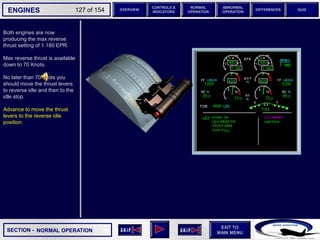
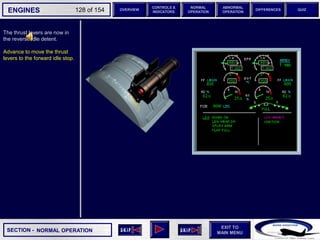
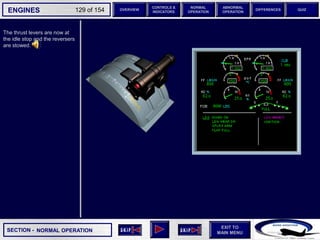
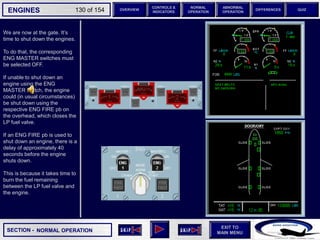
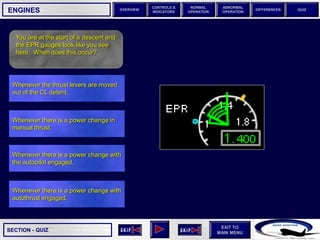
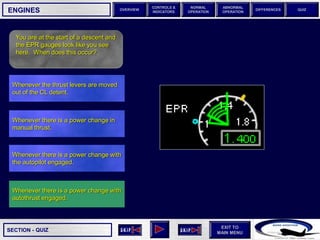
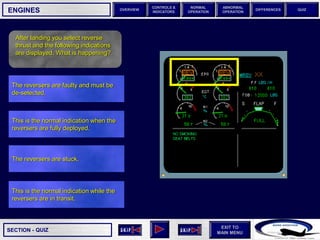
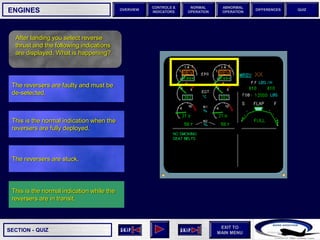
SECTION -
EXIT TO
MAIN MENU
ENGINES OVERVIEW
NORMAL
OPERATION
ABNORMAL
OPERATION
CONTROLS &
INDICATORS
DIFFERENCES QUIZ
1 of 154
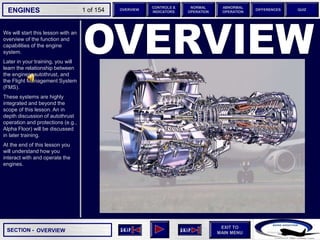
We will start this lesson with an
overview of the function and
capabilities of the engine
system.
Later in your training, you will
learn the relationship between
the engines, autothrust, and
the Flight Management System
(FMS).
These systems are highly
integrated and beyond the
scope of this lesson. An in
depth discussion of autothrust
operation and protections (e.g.,
Alpha Floor) will be discussed
in later training.
At the end of this lesson you
will understand how you
interact with and operate the
engines.
OVERVIEW
SECTION -
EXIT TO
MAIN MENU
ENGINES OVERVIEW
NORMAL
OPERATION
ABNORMAL
OPERATION
CONTROLS &
INDICATORS
DIFFERENCES QUIZ
2 of 154
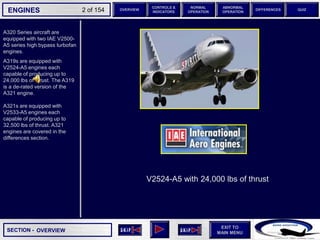
A320 Series aircraft are
equipped with two IAE V2500-
A5 series high bypass turbofan
engines.
A319s are equipped with
V2524-A5 engines each
capable of producing up to
24,000 lbs of thrust. The A319
is a de-rated version of the
A321 engine.
A321s are equipped with
V2533-A5 engines each
capable of producing up to
32,500 lbs of thrust. A321
engines are covered in the
differences section.
V2524-A5 with 24,000 lbs of thrust
OVERVIEW
SECTION -
EXIT TO
MAIN MENU
ENGINES OVERVIEW
NORMAL
OPERATION
ABNORMAL
OPERATION
CONTROLS &
INDICATORS
DIFFERENCES QUIZ
3 of 154
Like most modern high bypass
turbofan engines, these
engines incorporate a:
ď‚§ Fan
ď‚§ Low Pressure Compressor
ď‚§ High Pressure Compressor
ď‚§ Combustion chamber with
two igniters.
ď‚§ High Pressure Turbine
ď‚§ Low Pressure Turbine
OVERVIEW
High Pressure Compressor
Combustion Chamber
High Pressure Turbine
FAN
Low Pressure Compressor
Low pressure Turbine
SECTION -
EXIT TO
MAIN MENU
ENGINES OVERVIEW
NORMAL
OPERATION
ABNORMAL
OPERATION
CONTROLS &
INDICATORS
DIFFERENCES QUIZ
4 of 154
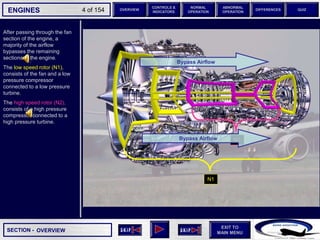
After passing through the fan
section of the engine, a
majority of the airflow
bypasses the remaining
sections of the engine.
The low speed rotor (N1),
consists of the fan and a low
pressure compressor
connected to a low pressure
turbine.
The high speed rotor (N2),
consists of a high pressure
compressor connected to a
high pressure turbine.
N1
N2
OVERVIEW
Bypass Airflow
Bypass Airflow
SECTION -
EXIT TO
MAIN MENU
ENGINES OVERVIEW
NORMAL
OPERATION
ABNORMAL
OPERATION
CONTROLS &
INDICATORS
DIFFERENCES QUIZ
5 of 154
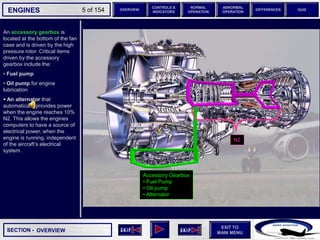
An accessory gearbox is
located at the bottom of the fan
case and is driven by the high
pressure rotor. Critical items
driven by the accessory
gearbox include the:
• Fuel pump
• Oil pump for engine
lubrication
ď‚§ An alternator that
automatically provides power
when the engine reaches 10%
N2. This allows the engines
computers to have a source of
electrical power, when the
engine is running, independent
of the aircraft’s electrical
system.
Accessory Gearbox
• Fuel Pump
• Oil pump
• Alternator
OVERVIEW
N2
SECTION -
EXIT TO
MAIN MENU
ENGINES OVERVIEW
NORMAL
OPERATION
ABNORMAL
OPERATION
CONTROLS &
INDICATORS
DIFFERENCES QUIZ
6 of 154
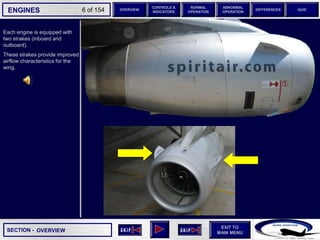
Each engine is equipped with
two strakes (inboard and
outboard).
These strakes provide improved
airflow characteristics for the
wing.
OVERVIEW
SECTION -
EXIT TO
MAIN MENU
ENGINES OVERVIEW
NORMAL
OPERATION
ABNORMAL
OPERATION
CONTROLS &
INDICATORS
DIFFERENCES QUIZ
7 of 154
Full Authority Digital Engine Control
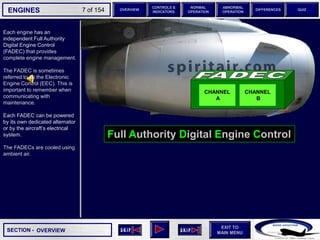
Each engine has an
independent Full Authority
Digital Engine Control
(FADEC) that provides
complete engine management.
The FADEC is sometimes
referred to as the Electronic
Engine Control (EEC). This is
important to remember when
communicating with
maintenance.
Each FADEC can be powered
by its own dedicated alternator
or by the aircraft’s electrical
system.
The FADECs are cooled using
ambient air.
OVERVIEW
CHANNEL
A
CHANNEL
B
SECTION -
EXIT TO
MAIN MENU
ENGINES OVERVIEW
NORMAL
OPERATION
ABNORMAL
OPERATION
CONTROLS &
INDICATORS
DIFFERENCES QUIZ
8 of 154
Full Authority Digital Engine Control
OVERVIEW
CHANNEL
A
CHANNEL
B
Each FADEC controls its
respective engine for maximum
fuel efficiency and surge free
operation.
Major functions that the
FADECs perform include:
ď‚§ Fuel flow, thrust reverser, and
ignition control
ď‚§ Protection from exceeding N1,
N2, and EPR limits at all times
ď‚§ Protection from exceeding
EGT limits (during automatic
starts on the ground only)
ď‚§ Protection for starter
engagement time and
re-engagement speed
ď‚§ Computation of fuel used and
thrust limits
ď‚§ Computation of thrust
penalties for the use of air
conditioning and ice protection
ď‚§ Acceleration and deceleration
schedules
ď‚§ Idle settings
ď‚§ Providing engine information
for cockpit display and to other
aircraft systems.
SECTION -
EXIT TO
MAIN MENU
ENGINES OVERVIEW
NORMAL
OPERATION
ABNORMAL
OPERATION
CONTROLS &
INDICATORS
DIFFERENCES QUIZ
9 of 154
Full Authority Digital Engine Control
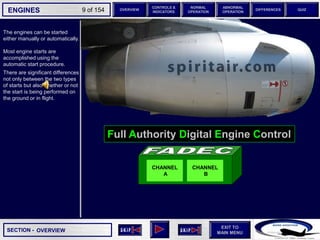
The engines can be started
either manually or automatically.
Most engine starts are
accomplished using the
automatic start procedure.
There are significant differences
not only between the two types
of starts but also whether or not
the start is being performed on
the ground or in flight.
OVERVIEW
CHANNEL
A
CHANNEL
B
SECTION -
EXIT TO
MAIN MENU
ENGINES OVERVIEW
NORMAL
OPERATION
ABNORMAL
OPERATION
CONTROLS &
INDICATORS
DIFFERENCES QUIZ
10 of 154
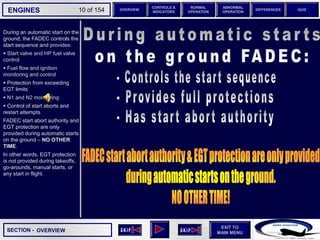
During an automatic start on the
ground, the FADEC controls the
start sequence and provides:
ď‚§ Start valve and HP fuel valve
control
ď‚§ Fuel flow and ignition
monitoring and control
ď‚§ Protection from exceeding
EGT limits
ď‚§ N1 and N2 monitoring
ď‚§ Control of start aborts and
restart attempts
FADEC start abort authority and
EGT protection are only
provided during automatic starts
on the ground – NO OTHER
TIME.
In other words, EGT protection
is not provided during takeoffs,
go-arounds, manual starts, or
any start in flight.
OVERVIEW
SECTION -
EXIT TO
MAIN MENU
ENGINES OVERVIEW
NORMAL
OPERATION
ABNORMAL
OPERATION
CONTROLS &
INDICATORS
DIFFERENCES QUIZ
11 of 154
The crew controls the start
sequence during manual
engine starts.
The FADEC monitors manual
starts and provides warnings
and cautions if necessary, but
does not provide protections.
FADEC start abort authority is
never provided during a
manual engine start.
Manual engine starts are
discussed in detail in the
NORMAL OPERATION
section.
OVERVIEW
SECTION -
EXIT TO
MAIN MENU
ENGINES OVERVIEW
NORMAL
OPERATION
ABNORMAL
OPERATION
CONTROLS &
INDICATORS
DIFFERENCES QUIZ
12 of 154
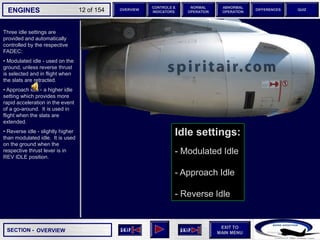
Idle settings:
- Modulated Idle
- Approach Idle
- Reverse Idle
Three idle settings are
provided and automatically
controlled by the respective
FADEC:
• Modulated idle - used on the
ground, unless reverse thrust
is selected and in flight when
the slats are retracted.
• Approach idle - a higher idle
setting which provides more
rapid acceleration in the event
of a go-around. It is used in
flight when the slats are
extended.
• Reverse idle - slightly higher
than modulated idle. It is used
on the ground when the
respective thrust lever is in
REV IDLE position.
OVERVIEW
SECTION -
EXIT TO
MAIN MENU
ENGINES OVERVIEW
NORMAL
OPERATION
ABNORMAL
OPERATION
CONTROLS &
INDICATORS
DIFFERENCES QUIZ
13 of 154
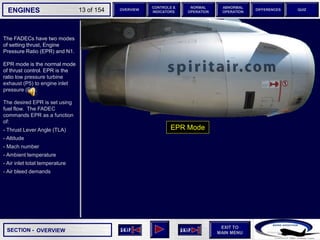
The FADECs have two modes
of setting thrust, Engine
Pressure Ratio (EPR) and N1.
EPR mode is the normal mode
of thrust control. EPR is the
ratio low pressure turbine
exhaust (P5) to engine inlet
pressure (P2).
OVERVIEW
The desired EPR is set using
fuel flow. The FADEC
commands EPR as a function
of:
- Thrust Lever Angle (TLA)
- Altitude
- Mach number
- Ambient temperature
- Air inlet total temperature
- Air bleed demands
EPR Mode
SECTION -
EXIT TO
MAIN MENU
ENGINES OVERVIEW
NORMAL
OPERATION
ABNORMAL
OPERATION
CONTROLS &
INDICATORS
DIFFERENCES QUIZ
14 of 154
N1 Modes
If the EPR mode of a FADEC
is not available, the effected
FADEC automatically reverts to
N1 mode.
If this occurs, an equivalent
thrust to that achieved in EPR
mode is provided until thrust
lever position is changed.
Autothrust and Alpha Floor are
both lost. These functions are
discussed in later training.
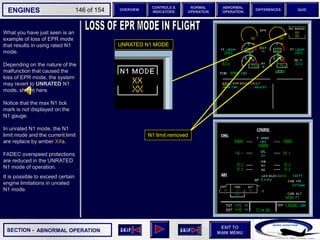
Depending on the nature of the
failure that caused the loss of
EPR mode, the FADEC will
revert to either:
- Rated N1 mode or
- Unrated N1 mode.
OVERVIEW
Rated N1 Mode
Unrated N1 Mode
EPR Mode
SECTION -
EXIT TO
MAIN MENU
ENGINES OVERVIEW
NORMAL
OPERATION
ABNORMAL
OPERATION
CONTROLS &
INDICATORS
DIFFERENCES QUIZ
15 of 154
RATED N1 MODE
In rated mode, N1limits are
displayed on the E/WD and the
FADEC protections remain
unchanged.
The rated N1 mode can be
selected manually using an
ENG N1 MODE pb on the
overhead panel.
UNRATED N1 MODE
An automatic reversion to
unrated N1 mode occurs if
both EPR and rated N1 modes
are not available.
In unrated mode, N1 limits are
not displayed on the E/WD and
the FADEC overspeed
protections are reduced.
It is possible to exceed certain
engine limitations in unrated
N1 mode.
The N1 modes are discussed
in detail in the ABNORMAL
OPERATION section.
OVERVIEW
Rated N1 Mode
Unrated N1 Mode
EPR Mode
SECTION -
EXIT TO
MAIN MENU
ENGINES OVERVIEW
NORMAL
OPERATION
ABNORMAL
OPERATION
CONTROLS &
INDICATORS
DIFFERENCES QUIZ
16 of 154
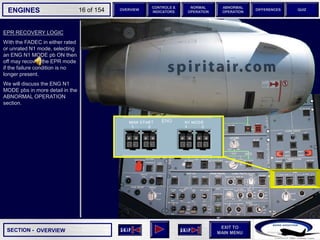
EPR RECOVERY LOGIC
With the FADEC in either rated
or unrated N1 mode, selecting
an ENG N1 MODE pb ON then
off may recover the EPR mode
if the failure condition is no
longer present.
We will discuss the ENG N1
MODE pbs in more detail in the
ABNORMAL OPERATION
section.
OVERVIEW
SECTION -
EXIT TO
MAIN MENU
ENGINES OVERVIEW
NORMAL
OPERATION
ABNORMAL
OPERATION
CONTROLS &
INDICATORS
DIFFERENCES QUIZ
17 of 154
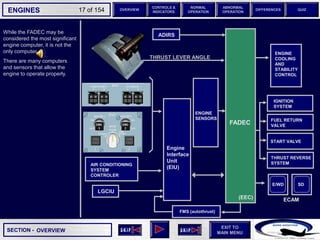
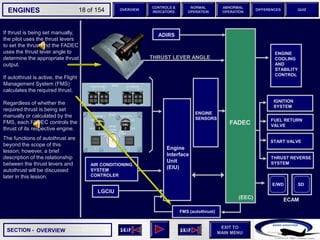
While the FADEC may be
considered the most significant
engine computer, it is not the
only computer.
There are many computers
and sensors that allow the
engine to operate properly.
OVERVIEW
FADEC
Engine
Interface
Unit
(EIU)
FMS (autothrust)
LGCIU
AIR CONDITIONING
SYSTEM
CONTROLER
ENGINE
SENSORS
ENGINE
COOLING
AND
STABILITY
CONTROL
IGNITION
SYSTEM
FUEL RETURN
VALVE
START VALVE
THRUST REVERSE
SYSTEM
THRUST LEVER ANGLE
(EEC) ECAM
E/WD SD
ADIRS
SECTION -
EXIT TO
MAIN MENU
ENGINES OVERVIEW
NORMAL
OPERATION
ABNORMAL
OPERATION
CONTROLS &
INDICATORS
DIFFERENCES QUIZ
18 of 154
If thrust is being set manually,
the pilot uses the thrust levers
to set the thrust and the FADEC
uses the thrust lever angle to
determine the appropriate thrust
output.
If autothrust is active, the Flight
Management System (FMS)
calculates the required thrust.
Regardless of whether the
required thrust is being set
manually or calculated by the
FMS, each FADEC controls the
thrust of its respective engine.
The functions of autothrust are
beyond the scope of this
lesson; however, a brief
description of the relationship
between the thrust levers and
autothrust will be discussed
later in this lesson.
OVERVIEW
FADEC
Engine
Interface
Unit
(EIU)
LGCIU
AIR CONDITIONING
SYSTEM
CONTROLER
ENGINE
SENSORS
ENGINE
COOLING
AND
STABILITY
CONTROL
IGNITION
SYSTEM
FUEL RETURN
VALVE
START VALVE
THRUST REVERSE
SYSTEM
THRUST LEVER ANGLE
(EEC) ECAM
E/WD SD
ADIRS
FMS (autothrust)
SECTION -
EXIT TO
MAIN MENU
ENGINES OVERVIEW
NORMAL
OPERATION
ABNORMAL
OPERATION
CONTROLS &
INDICATORS
DIFFERENCES QUIZ
19 of 154
CHANNEL
A
CHANNEL
B
Each FADEC has two identical
and independent channels
(A and B).
Either channel is capable of
operating the engine. One
channel is active and the other
is in standby.
If the active channel fails, the
other becomes active
automatically.
ACTIVE ACTIVE
OVERVIEW
STANDBY
SECTION -
EXIT TO
MAIN MENU
ENGINES OVERVIEW
NORMAL
OPERATION
ABNORMAL
OPERATION
CONTROLS &
INDICATORS
DIFFERENCES QUIZ
20 of 154
When N2 is greater than 10%,
its FADEC is powered by an
alternator driven by the
accessory gearbox.
When an engine is not running,
or should the alternator fail,
each FADEC can be supplied
by the aircraft’s electrical
system.
OVERVIEW
Alternator
Aircraft’s
Electrical
System
CHANNEL
A
CHANNEL
B
ACTIVE STANDBY
SECTION -
EXIT TO
MAIN MENU
ENGINES OVERVIEW
NORMAL
OPERATION
ABNORMAL
OPERATION
CONTROLS &
INDICATORS
DIFFERENCES QUIZ
21 of 154
FROM FUEL TANKS
IDG and Engine
Oil Coolers
Fuel
Metering Unit
HP Fuel
Shut Off
LP Fuel Valve
The fuel system supplies fuel
to the combustion chambers at
the required rate and pressure
calculated by the FADEC.
The FADEC computes the fuel
flow necessary to maintain the
target thrust level.
Fuel pressure is supplied by
the accessory gear box driven
low pressure (LP) and high
pressure (HP) fuel pumps.
LP Pump
HP Pump
OVERVIEW
SECTION -
EXIT TO
MAIN MENU
ENGINES OVERVIEW
NORMAL
OPERATION
ABNORMAL
OPERATION
CONTROLS &
INDICATORS
DIFFERENCES QUIZ
22 of 154
FROM FUEL TANKS
IDG and Engine
Oil Coolers
Fuel
Metering Unit
HP Fuel
Shut Off
LP Fuel Valve
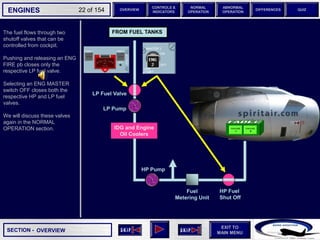
The fuel flows through two
shutoff valves that can be
controlled from cockpit.
Pushing and releasing an ENG
FIRE pb closes only the
respective LP fuel valve.
Selecting an ENG MASTER
switch OFF closes both the
respective HP and LP fuel
valves.
We will discuss these valves
again in the NORMAL
OPERATION section.
LP Pump
HP Pump
OVERVIEW
SECTION -
EXIT TO
MAIN MENU
ENGINES OVERVIEW
NORMAL
OPERATION
ABNORMAL
OPERATION
CONTROLS &
INDICATORS
DIFFERENCES QUIZ
23 of 154
FROM FUEL TANKS
IDG and Engine
Oil Coolers
TO
Actuators
LP Fuel Valve
Fuel is used to cool engine and
IDG oil.
Fuel pressure is also used to
open and close various valves
in the engine.
These functions are carried out
automatically and require no
pilot intervention.
LP Pump
HP Pump
OVERVIEW
Fuel
Metering Unit
HP Fuel
Shut Off
SECTION -
EXIT TO
MAIN MENU
ENGINES OVERVIEW
NORMAL
OPERATION
ABNORMAL
OPERATION
CONTROLS &
INDICATORS
DIFFERENCES QUIZ
24 of 154
CHANNEL
A
CHANNEL
B
Igniter Circuit B
Igniter Circuit A
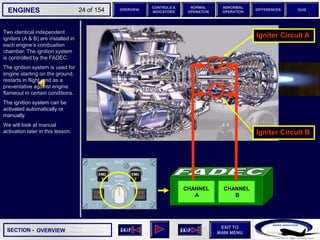
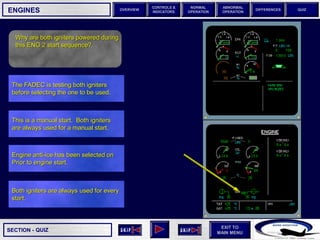
Two identical independent
igniters (A & B) are installed in
each engine’s combustion
chamber. The ignition system
is controlled by the FADEC.
The ignition system is used for
engine starting on the ground,
restarts in flight, and as a
preventative against engine
flameout in certain conditions.
The ignition system can be
activated automatically or
manually.
We will look at manual
activation later in this lesson.
OVERVIEW
SECTION -
EXIT TO
MAIN MENU
ENGINES OVERVIEW
NORMAL
OPERATION
ABNORMAL
OPERATION
CONTROLS &
INDICATORS
DIFFERENCES QUIZ
25 of 154
The FADEC automatically
activates continuous ignition
(igniters A & B) on the
respective engine when the
engine is running and any of
the following occur:
• An ENG ANTI ICE pb is
selected ON
• Takeoff thrust selected
• The Engine Interface Unit
(EIU) fails
• Approach idle is active (i.e.,
slats extended in flight)
• A engine flameout or surge is
detected in flight.
• The ENG MASTER is cycled
from ON to OFF then back to
the ON position.
OVERVIEW
SECTION -
EXIT TO
MAIN MENU
ENGINES OVERVIEW
NORMAL
OPERATION
ABNORMAL
OPERATION
CONTROLS &
INDICATORS
DIFFERENCES QUIZ
26 of 154
Each engine is equipped with
hydraulically actuated thrust
reversers that are controlled
independently by the
respective FADEC.
Reverse thrust is achieved by
directing the flow of fan
(bypass) air forward.
Aft moving translating sleeves
are installed on each engine.
Pivoting blocker doors are
installed inside the cowl on
each engine.
When reverse thrust is
selected, the translating sleeve
moves aft and the blocker
doors pivot to deflect fan air
forward through a now
exposed cascade.
Only fan air is used for reverse
thrust, no core air is used.
OVERVIEW
Translating Sleeve
Blocker Doors
Translating Sleeve
Cascade
SECTION -
EXIT TO
MAIN MENU
ENGINES OVERVIEW
NORMAL
OPERATION
ABNORMAL
OPERATION
CONTROLS &
INDICATORS
DIFFERENCES QUIZ
27 of 154
SEC 1
SEC 2
SEC 3
CHANNEL
A
CHANNEL
B
The FADEC is programmed
with multiple safety features to
ensure the reversers only
deploy on the ground and only
when requested by the pilot.
Reverser deployment requires:
• At least one FADEC channel
is functioning normally and has
received a reverser signal from
that engine’s thrust lever.
• The aircraft is sensed on the
ground by at least one Landing
Gear Control and Interface Unit
(LGCIU).
• The thrust lever reverser
signal is further confirmed by at
least one Spoiler Elevator
Computer (SEC).
FADEC limits thrust to idle
reverse until the respective
engine’s reversers are fully
deployed.
If an uncommanded reverser
deployment occurs, the
FADEC automatically
commands idle thrust on the
respective engine.
OVERVIEW
LGCIU 1
LGCIU 2
On
ground
SECTION -
EXIT TO
MAIN MENU
ENGINES OVERVIEW
NORMAL
OPERATION
ABNORMAL
OPERATION
CONTROLS &
INDICATORS
DIFFERENCES QUIZ
28 of 154
In this section we will first
discuss the engine controls
available in the cockpit
followed by how the engine
information is presented on the
ECAM.
We will start with the controls
for engine start and shutdown
which are located on the center
pedestal, just behind the thrust
levers.
CONTROLS & INDICATORS
SECTION -
EXIT TO
MAIN MENU
ENGINES OVERVIEW
NORMAL
OPERATION
ABNORMAL
OPERATION
CONTROLS &
INDICATORS
DIFFERENCES QUIZ
29 of 154
FUEL
TANKS
HP Valve
LP Valve
Actuators
When the ENG 1 and ENG 2
MASTER switches are
selected OFF, both the LP and
HP fuel valves close, causing
both engines to shut down.
Moving these switches from
ON to OFF also resets both
channels of the respective
FADEC.
Advance to select both ENG
MASTER switches OFF.
CONTROLS & INDICATORS
SECTION -
EXIT TO
MAIN MENU
ENGINES OVERVIEW
NORMAL
OPERATION
ABNORMAL
OPERATION
CONTROLS &
INDICATORS
DIFFERENCES QUIZ
30 of 154
FUEL
TANKS
The FIRE lights, just aft of the
MASTER switches, are
warning lights not pushbuttons.
The FIRE light illuminates if a
fire is detected in the
respective engine.
It is a repeater of the light in
the ENG FIRE pb on the
overhead panel.
Engine fire detection is
covered in the Fire Protection
lesson.
CONTROLS & INDICATORS
HP Valve
LP Valve
Actuators
SECTION -
EXIT TO
MAIN MENU
ENGINES OVERVIEW
NORMAL
OPERATION
ABNORMAL
OPERATION
CONTROLS &
INDICATORS
DIFFERENCES QUIZ
31 of 154
The FAULT light illuminates
and an ECAM message is
displayed if any of the following
occur:
- An automatic start abort.
- A start valve fault.
- A disagreement between the
HP fuel valve position and its
commanded position.
In this example, there has
been an automatic start abort.
CONTROLS & INDICATORS
FUEL
TANKS
HP Valve
LP Valve
Actuators
SECTION -
EXIT TO
MAIN MENU
ENGINES OVERVIEW
NORMAL
OPERATION
ABNORMAL
OPERATION
CONTROLS &
INDICATORS
DIFFERENCES QUIZ
32 of 154
CONTROLS & INDICATORS
FUEL
TANKS
HP Valve
LP Valve
Actuators
In this example, the HP fuel
valve is in disagreement with
its commanded position.
SECTION -
EXIT TO
MAIN MENU
ENGINES OVERVIEW
NORMAL
OPERATION
ABNORMAL
OPERATION
CONTROLS &
INDICATORS
DIFFERENCES QUIZ
33 of 154
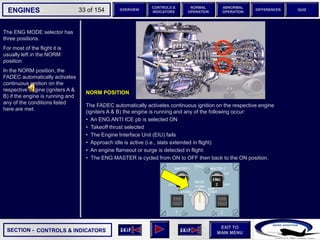
The ENG MODE selector has
three positions.
For most of the flight it is
usually left in the NORM
position.
In the NORM position, the
FADEC automatically activates
continuous ignition on the
respective engine (igniters A &
B) if the engine is running and
any of the conditions listed
here are met.
CONTROLS & INDICATORS
NORM POSITION
The FADEC automatically activates continuous ignition on the respective engine
(igniters A & B) the engine is running and any of the following occur:
• An ENG ANTI ICE pb is selected ON
• Takeoff thrust selected
• The Engine Interface Unit (EIU) fails
• Approach idle is active (i.e., slats extended in flight)
• An engine flameout or surge is detected in flight.
• The ENG MASTER is cycled from ON to OFF then back to the ON position.
SECTION -
EXIT TO
MAIN MENU
ENGINES OVERVIEW
NORMAL
OPERATION
ABNORMAL
OPERATION
CONTROLS &
INDICATORS
DIFFERENCES QUIZ
34 of 154
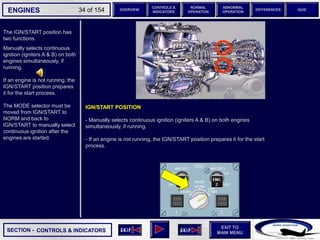
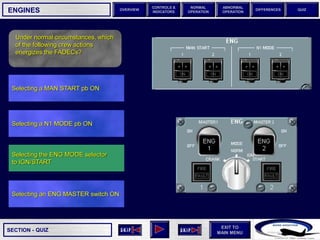
The IGN/START position has
two functions.
Manually selects continuous
ignition (igniters A & B) on both
engines simultaneously, if
running.
If an engine is not running, the
IGN/START position prepares
it for the start process.
The MODE selector must be
moved from IGN/START to
NORM and back to
IGN/START to manually select
continuous ignition after the
engines are started.
CONTROLS & INDICATORS
IGN/START POSITION
- Manually selects continuous ignition (igniters A & B) on both engines
simultaneously, if running.
- If an engine is not running, the IGN/START position prepares it for the start
process.
SECTION -
EXIT TO
MAIN MENU
ENGINES OVERVIEW
NORMAL
OPERATION
ABNORMAL
OPERATION
CONTROLS &
INDICATORS
DIFFERENCES QUIZ
35 of 154
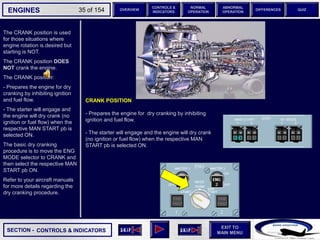
The CRANK position is used
for those situations where
engine rotation is desired but
starting is NOT.
The CRANK position DOES
NOT crank the engine.
The CRANK position:
- Prepares the engine for dry
cranking by inhibiting ignition
and fuel flow.
- The starter will engage and
the engine will dry crank (no
ignition or fuel flow) when the
respective MAN START pb is
selected ON.
The basic dry cranking
procedure is to move the ENG
MODE selector to CRANK and
then select the respective MAN
START pb ON.
Refer to your aircraft manuals
for more details regarding the
dry cranking procedure.
CONTROLS & INDICATORS
CRANK POSITION
- Prepares the engine for dry cranking by inhibiting
ignition and fuel flow.
- The starter will engage and the engine will dry crank
(no ignition or fuel flow) when the respective MAN
START pb is selected ON.
SECTION -
EXIT TO
MAIN MENU
ENGINES OVERVIEW
NORMAL
OPERATION
ABNORMAL
OPERATION
CONTROLS &
INDICATORS
DIFFERENCES QUIZ
36 of 154
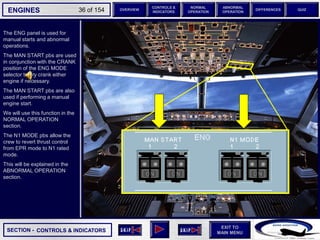
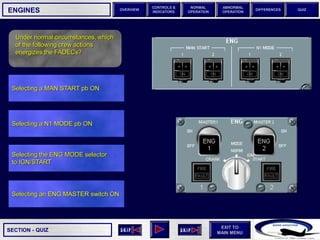
The ENG panel is used for
manual starts and abnormal
operations.
The MAN START pbs are used
in conjunction with the CRANK
position of the ENG MODE
selector to dry crank either
engine if necessary.
The MAN START pbs are also
used if performing a manual
engine start.
We will use this function in the
NORMAL OPERATION
section.
The N1 MODE pbs allow the
crew to revert thrust control
from EPR mode to N1 rated
mode.
This will be explained in the
ABNORMAL OPERATION
section.
CONTROLS & INDICATORS
SECTION -
EXIT TO
MAIN MENU
ENGINES OVERVIEW
NORMAL
OPERATION
ABNORMAL
OPERATION
CONTROLS &
INDICATORS
DIFFERENCES QUIZ
37 of 154
FADEC FADEC
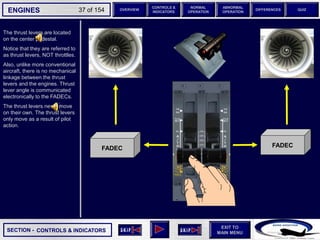
The thrust levers are located
on the center pedestal.
Notice that they are referred to
as thrust levers, NOT throttles.
Also, unlike more conventional
aircraft, there is no mechanical
linkage between the thrust
levers and the engines. Thrust
lever angle is communicated
electronically to the FADECs.
The thrust levers never move
on their own. The thrust levers
only move as a result of pilot
action.
CONTROLS & INDICATORS
SECTION -
EXIT TO
MAIN MENU
ENGINES OVERVIEW
NORMAL
OPERATION
ABNORMAL
OPERATION
CONTROLS &
INDICATORS
DIFFERENCES QUIZ
38 of 154
When thrust is being operated
manually (autothrust off), thrust
corresponds to the position of
the thrust levers.
Pull them aft to decrease thrust
or push them forward to
increase thrust.
FADEC FADEC
CONTROLS & INDICATORS
SECTION -
EXIT TO
MAIN MENU
ENGINES OVERVIEW
NORMAL
OPERATION
ABNORMAL
OPERATION
CONTROLS &
INDICATORS
DIFFERENCES QUIZ
39 of 154
CONTROLS & INDICATORS
During forward thrust, the
thrust levers are moved
through an arc that is defined
by two stops:
ď‚§ 0 which signifies idle thrust
And…
IDLE stop
SECTION -
EXIT TO
MAIN MENU
ENGINES OVERVIEW
NORMAL
OPERATION
ABNORMAL
OPERATION
CONTROLS &
INDICATORS
DIFFERENCES QUIZ
40 of 154
During forward thrust, the
thrust levers are moved
through an arc that is defined
by two stops:
ď‚§ 0 which signifies idle thrust
And…
ď‚§ TOGA (Take Off Go Around)
which provides maximum
available thrust and is limited
to 5 minutes.
CONTROLS & INDICATORS
TOGA stop
IDLE stop
SECTION -
EXIT TO
MAIN MENU
ENGINES OVERVIEW
NORMAL
OPERATION
ABNORMAL
OPERATION
CONTROLS &
INDICATORS
DIFFERENCES QUIZ
41 of 154
In between these two stops are
two detents.
The detent marked CL is the
climb detent.
- Selecting this detent requests
climb thrust is being controlled
manually.
-This detent is also the normal
position of the thrust levers
when autothrust is active.
More on this in a just a little bit.
CLIMB detent
CONTROLS & INDICATORS
TOGA stop
IDLE stop
SECTION -
EXIT TO
MAIN MENU
ENGINES OVERVIEW
NORMAL
OPERATION
ABNORMAL
OPERATION
CONTROLS &
INDICATORS
DIFFERENCES QUIZ
42 of 154
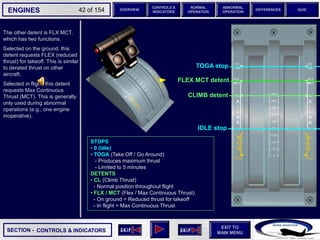
The other detent is FLX MCT,
which has two functions.
Selected on the ground, this
detent requests FLEX (reduced
thrust) for takeoff. This is similar
to derated thrust on other
aircraft.
Selected in flight, this detent
requests Max Continuous
Thrust (MCT). This is generally
only used during abnormal
operations (e.g., one engine
inoperative).
FLEX MCT detent
CLIMB detent
STOPS
• 0 (Idle)
• TOGA (Take Off / Go Around)
- Produces maximum thrust
- Limited to 5 minutes
DETENTS
• CL (Climb Thrust)
- Normal position throughout flight
• FLX / MCT (Flex / Max Continuous Thrust)
- On ground = Reduced thrust for takeoff
- In flight = Max Continuous Thrust
CONTROLS & INDICATORS
TOGA stop
IDLE stop
SECTION -
EXIT TO
MAIN MENU
ENGINES OVERVIEW
NORMAL
OPERATION
ABNORMAL
OPERATION
CONTROLS &
INDICATORS
DIFFERENCES QUIZ
43 of 154
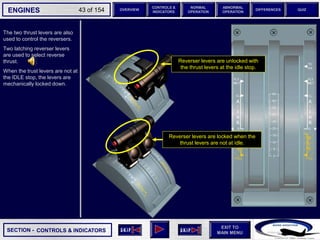
The two thrust levers are also
used to control the reversers.
Two latching reverser levers
are used to select reverse
thrust.
When the trust levers are not at
the IDLE stop, the levers are
mechanically locked down.
CONTROLS & INDICATORS
Reverser levers are locked when the
thrust levers are not at idle.
Reverser levers are unlocked with
the thrust levers at the idle stop.
SECTION -
EXIT TO
MAIN MENU
ENGINES OVERVIEW
NORMAL
OPERATION
ABNORMAL
OPERATION
CONTROLS &
INDICATORS
DIFFERENCES QUIZ
44 of 154
CONTROLS & INDICATORS
IDLE stop
When the thrust levers are at
the IDLE stop, reverse can be
selected by lifting the reverser
levers.
This allows the thrust levers to
be pulled back beyond the
forward IDLE stop and into the
reverse idle detent.
Advance to lift the reverser
levers and move the thrust
levers to the reverse idle
detent.
SECTION -
EXIT TO
MAIN MENU
ENGINES OVERVIEW
NORMAL
OPERATION
ABNORMAL
OPERATION
CONTROLS &
INDICATORS
DIFFERENCES QUIZ
45 of 154
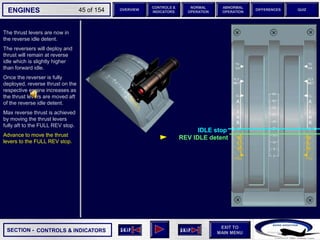
The thrust levers are now in
the reverse idle detent.
The reversers will deploy and
thrust will remain at reverse
idle which is slightly higher
than forward idle.
Once the reverser is fully
deployed, reverse thrust on the
respective engine increases as
the thrust levers are moved aft
of the reverse idle detent.
Max reverse thrust is achieved
by moving the thrust levers
fully aft to the FULL REV stop.
Advance to move the thrust
levers to the FULL REV stop.
CONTROLS & INDICATORS
REV IDLE detent
IDLE stop
SECTION -
EXIT TO
MAIN MENU
ENGINES OVERVIEW
NORMAL
OPERATION
ABNORMAL
OPERATION
CONTROLS &
INDICATORS
DIFFERENCES QUIZ
46 of 154
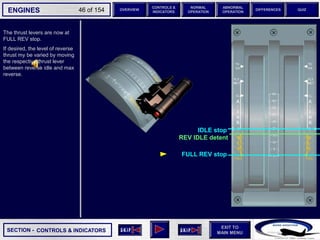
The thrust levers are now at
FULL REV stop.
If desired, the level of reverse
thrust my be varied by moving
the respective thrust lever
between reverse idle and max
reverse.
CONTROLS & INDICATORS
FULL REV stop
REV IDLE detent
IDLE stop
SECTION -
EXIT TO
MAIN MENU
ENGINES OVERVIEW
NORMAL
OPERATION
ABNORMAL
OPERATION
CONTROLS &
INDICATORS
DIFFERENCES QUIZ
47 of 154
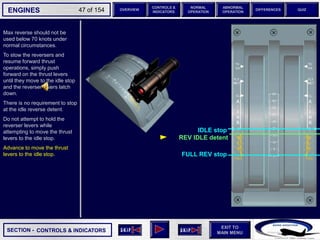
Max reverse should not be
used below 70 knots under
normal circumstances.
To stow the reversers and
resume forward thrust
operations, simply push
forward on the thrust levers
until they move to the idle stop
and the reverser levers latch
down.
There is no requirement to stop
at the idle reverse detent.
Do not attempt to hold the
reverser levers while
attempting to move the thrust
levers to the idle stop.
Advance to move the thrust
levers to the idle stop.
CONTROLS & INDICATORS
REV IDLE detent
IDLE stop
FULL REV stop
SECTION -
EXIT TO
MAIN MENU
ENGINES OVERVIEW
NORMAL
OPERATION
ABNORMAL
OPERATION
CONTROLS &
INDICATORS
DIFFERENCES QUIZ
48 of 154
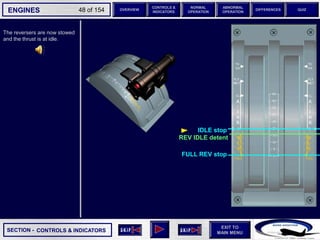
IDLE stop
The reversers are now stowed
and the thrust is at idle.
CONTROLS & INDICATORS
REV IDLE detent
FULL REV stop
SECTION -
EXIT TO
MAIN MENU
ENGINES OVERVIEW
NORMAL
OPERATION
ABNORMAL
OPERATION
CONTROLS &
INDICATORS
DIFFERENCES QUIZ
49 of 154
FLEX MCT detent
CLIMB detent
TOGA stop
The alternative to manual
thrust control is the aircraft’s
autothrust system.
The relationship between
autothrust, the thrust levers,
and the rest of the autoflight
system is quite complex.
For this reason, we will discuss
only the basic relationship
between autothrust, the thrust
levers, and the engines.
You will learn more about
autothrust during later training.
Autothrust can be either off or
engaged. When engaged,
autothrust has two modes:
armed or active.
Autothrust is automatically
armed during takeoff when the
thrust levers are moved to
TOGA or FLX.
Autothrust may also be
engaged by pushing the FCU
A/THR pb.
Advance to apply takeoff
power.
CONTROLS & INDICATORS
A/THR Off
IDLE stop
SECTION -
EXIT TO
MAIN MENU
ENGINES OVERVIEW
NORMAL
OPERATION
ABNORMAL
OPERATION
CONTROLS &
INDICATORS
DIFFERENCES QUIZ
50 of 154
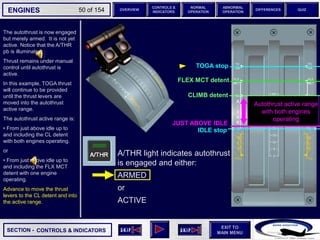
The autothrust is now engaged
but merely armed. It is not yet
active. Notice that the A/THR
pb is illuminated.
Thrust remains under manual
control until autothrust is
active.
In this example, TOGA thrust
will continue to be provided
until the thrust levers are
moved into the autothrust
active range.
The autothrust active range is:
• From just above idle up to
and including the CL detent
with both engines operating.
or
• From just above idle up to
and including the FLX MCT
detent with one engine
operating.
Advance to move the thrust
levers to the CL detent and into
the active range.
CONTROLS & INDICATORS
FLEX MCT detent
TOGA stop
IDLE stop
CLIMB detent
Autothrust active range
with both engines
operating
JUST ABOVE IDLE
CLIMB detent
A/THR light indicates autothrust
is engaged and either:
ARMED
or
ACTIVE
SECTION -
EXIT TO
MAIN MENU
ENGINES OVERVIEW
NORMAL
OPERATION
ABNORMAL
OPERATION
CONTROLS &
INDICATORS
DIFFERENCES QUIZ
51 of 154
FLEX/MCT detent
TOGA stop
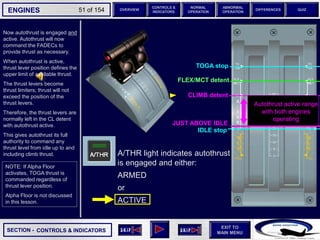
Now autothrust is engaged and
active. Autothrust will now
command the FADECs to
provide thrust as necessary.
When autothrust is active,
thrust lever position defines the
upper limit of available thrust.
The thrust levers become
thrust limiters; thrust will not
exceed the position of the
thrust levers.
Therefore, the thrust levers are
normally left in the CL detent
with autothrust active.
This gives autothrust its full
authority to command any
thrust level from idle up to and
including climb thrust.
CONTROLS & INDICATORS
FLEX MCT detent
IDLE stop
CLIMB detent
Autothrust active range
with both engines
operating
JUST ABOVE IDLE
NOTE: If Alpha Floor
activates, TOGA thrust is
commanded regardless of
thrust lever position.
Alpha Floor is not discussed
in this lesson.
A/THR light indicates autothrust
is engaged and either:
ARMED
or
ACTIVE
SECTION -
EXIT TO
MAIN MENU
ENGINES OVERVIEW
NORMAL
OPERATION
ABNORMAL
OPERATION
CONTROLS &
INDICATORS
DIFFERENCES QUIZ
52 of 154
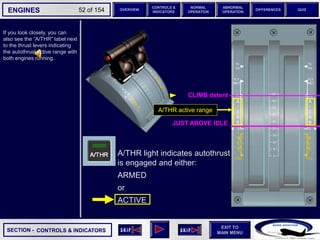
If you look closely, you can
also see the “A/THR” label next
to the thrust levers indicating
the autothrust active range with
both engines running.
CONTROLS & INDICATORS
CLIMB detent
JUST ABOVE IDLE
A/THR active range
A/THR light indicates autothrust
is engaged and either:
ARMED
or
ACTIVE
SECTION -
EXIT TO
MAIN MENU
ENGINES OVERVIEW
NORMAL
OPERATION
ABNORMAL
OPERATION
CONTROLS &
INDICATORS
DIFFERENCES QUIZ
53 of 154
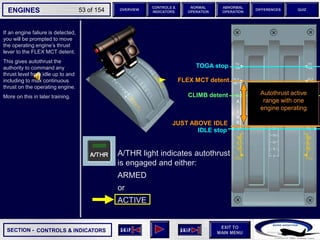
If an engine faliure is detected,
you will be prompted to move
the operating engine’s thrust
lever to the FLEX MCT detent.
This gives autothrust the
authority to command any
thrust level from idle up to and
including to max continuous
thrust on the operating engine.
More on this in later training.
CONTROLS & INDICATORS
IDLE stop
JUST ABOVE IDLE
TOGA stop
FLEX MCT detent
CLIMB detent Autothrust active
range with one
engine operating
A/THR light indicates autothrust
is engaged and either:
ARMED
or
ACTIVE
SECTION -
EXIT TO
MAIN MENU
ENGINES OVERVIEW
NORMAL
OPERATION
ABNORMAL
OPERATION
CONTROLS &
INDICATORS
DIFFERENCES QUIZ
54 of 154
Autothrust can be disengaged
using either of two red
instinctive disconnect pbs
located on the side of the
thrust levers.
These pbs allow you to quickly
revert to manual thrust control
if necessary.
If either of the instinctive
disconnect pbs are pushed,
thrust immediately changes to
match thrust lever position.
Normally, thrust lever position
is matched to the current thrust
output (displayed on the E/WD)
prior to disconnecting
autothrust to prevent an
unwanted thrust change.
Once again, keep in mind that
autothrust will be discussed in
detail during later training.
Advance to push either
instinctive disconnect pb.
CONTROLS & INDICATORS
Instinctive
disconnect pb
A/THR light indicates autothrust
is engaged and either:
ARMED
or
ACTIVE
SECTION -
EXIT TO
MAIN MENU
ENGINES OVERVIEW
NORMAL
OPERATION
ABNORMAL
OPERATION
CONTROLS &
INDICATORS
DIFFERENCES QUIZ
55 of 154
Autothrust is now disengaged
(off).
Thrust output now directly
corresponds to thrust lever
position.
Autothrust could be
re-engaged by ensuring the
thrust levers are in the active
range (normally the CL detent)
and pushing the FCU A/THR
pb.
CONTROLS & INDICATORS
A/THR disengaged (off)
SECTION -
EXIT TO
MAIN MENU
ENGINES OVERVIEW
NORMAL
OPERATION
ABNORMAL
OPERATION
CONTROLS &
INDICATORS
DIFFERENCES QUIZ
56 of 154
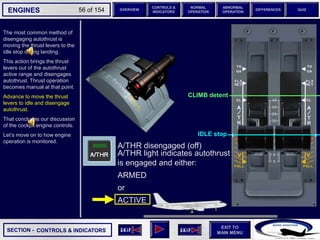
The most common method of
disengaging autothrust is
moving the thrust levers to the
idle stop during landing.
This action brings the thrust
levers out of the autothrust
active range and disengages
autothrust. Thrust operation
becomes manual at that point.
Advance to move the thrust
levers to idle and disengage
autothrust.
That concludes our discussion
of the cockpit engine controls.
Let’s move on to how engine
operation is monitored.
CONTROLS & INDICATORS
IDLE stop
CLIMB detent
A/THR light indicates autothrust
is engaged and either:
ARMED
or
ACTIVE
A/THR disengaged (off)
SECTION -
EXIT TO
MAIN MENU
ENGINES OVERVIEW
NORMAL
OPERATION
ABNORMAL
OPERATION
CONTROLS &
INDICATORS
DIFFERENCES QUIZ
57 of 154
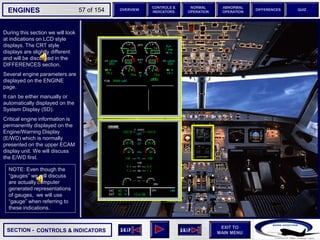
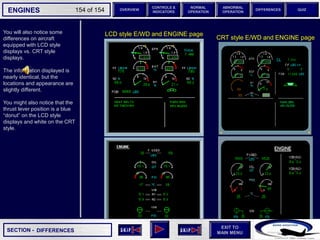
During this section we will look
at indications on LCD style
displays. The CRT style
displays are slightly different
and will be discussed in the
DIFFERENCES section.
Several engine parameters are
displayed on the ENGINE
page.
It can be either manually or
automatically displayed on the
System Display (SD).
Critical engine information is
permanently displayed on the
Engine/Warning Display
(E/WD) which is normally
presented on the upper ECAM
display unit. We will discuss
the E/WD first.
CONTROLS & INDICATORS
NOTE: Even though the
“gauges” we will discuss
are actually computer
generated representations
of gauges, we will use
“gauge” when referring to
these indications.
SECTION -
EXIT TO
MAIN MENU
ENGINES OVERVIEW
NORMAL
OPERATION
ABNORMAL
OPERATION
CONTROLS &
INDICATORS
DIFFERENCES QUIZ
58 of 154
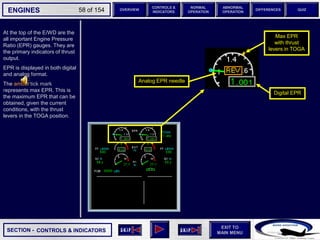
At the top of the E/WD are the
all important Engine Pressure
Ratio (EPR) gauges. They are
the primary indicators of thrust
output.
EPR is displayed in both digital
and analog format.
The amber tick mark
represents max EPR. This is
the maximum EPR that can be
obtained, given the current
conditions, with the thrust
levers in the TOGA position.
6 6
6
Max EPR
with thrust
levers in TOGA
CONTROLS & INDICATORS
Analog EPR needle
Digital EPR
SECTION -
EXIT TO
MAIN MENU
ENGINES OVERVIEW
NORMAL
OPERATION
ABNORMAL
OPERATION
CONTROLS &
INDICATORS
DIFFERENCES QUIZ
59 of 154
6 6
6
Max EPR
with thrust
levers in TOGA
CONTROLS & INDICATORS
Analog EPR needle
Digital EPR
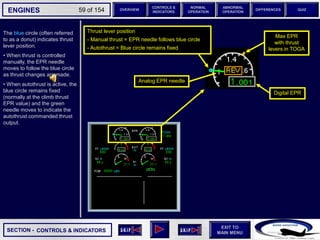
The blue circle (often referred
to as a donut) indicates thrust
lever position.
• When thrust is controlled
manually, the EPR needle
moves to follow the blue circle
as thrust changes are made.
• When autothrust is active, the
blue circle remains fixed
(normally at the climb thrust
EPR value) and the green
needle moves to indicate the
autothrust commanded thrust
output.
Thrust lever position
- Manual thrust = EPR needle follows blue circle
- Autothrust = Blue circle remains fixed
SECTION -
EXIT TO
MAIN MENU
ENGINES OVERVIEW
NORMAL
OPERATION
ABNORMAL
OPERATION
CONTROLS &
INDICATORS
DIFFERENCES QUIZ
60 of 154
6 6
6
Max EPR
with thrust
levers in TOGA
CONTROLS & INDICATORS
Analog EPR needle
Digital EPR
Thrust lever position
- Manual thrust = EPR needle follows blue circle
- Autothrust = Blue circle remains fixed
- When at least one reverser is
unstowed
- When the reverser is fully deployed
- (flashing then steady) if reverser is
unstowed in flight
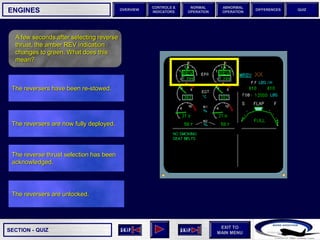
REV Indication
The REV indications are
displayed in amber when the
respective engine’s reverser is
unstowed or unlocked.
It changes to green when the
reverser is fully deployed,
assuming reverse thrust was
requested.
If a reverser is unstowed in
flight, the REV indication
flashes amber for a few
seconds and then remains
steady.
We will look at some additional
EPR gauge indications in the
NORMAL OPERATION
section.
SECTION -
EXIT TO
MAIN MENU
ENGINES OVERVIEW
NORMAL
OPERATION
ABNORMAL
OPERATION
CONTROLS &
INDICATORS
DIFFERENCES QUIZ
61 of 154
The thrust limit mode and EPR
limit are displayed to the right
of the EPR gauges.
The EPR limit reflects the
FADEC calculation of the max
EPR for various modes based
on current conditions.
The mode and EPR limit
displayed are based on thrust
lever position and whether the
aircraft is on the ground or in
flight.
When on the ground with at
least one engine running, the
TOGA EPR limit is shown,
regardless of thrust lever
position, with one major
exception, described next.
6 6
TO/GA
FLEX/MCT
CLIMB
IDLE
CONTROLS & INDICATORS
SECTION -
EXIT TO
MAIN MENU
ENGINES OVERVIEW
NORMAL
OPERATION
ABNORMAL
OPERATION
CONTROLS &
INDICATORS
DIFFERENCES QUIZ
62 of 154
If a FLEX temperature is
entered in the MCDU TAKE
OFF page prior to takeoff, the
FLX EPR limit and temperature
replace the TOGA limit.
This will be the achieved EPR
during takeoff when the thrust
levers are moved to the FLX
detent.
If the thrust levers are
advanced to TOGA, the FLX
limit will be ignored and thrust
will go to the TOGA limit and
the EPR limit will reflect the
new takeoff thrust setting.
You will learn more about
FLEX during later training.
TO/GA
FLEX/MCT
CLIMB
IDLE
- On the ground with engines running
or
- During takeoff
TOGA
FLEX
CONTROLS & INDICATORS
OR
SECTION -
EXIT TO
MAIN MENU
ENGINES OVERVIEW
NORMAL
OPERATION
ABNORMAL
OPERATION
CONTROLS &
INDICATORS
DIFFERENCES QUIZ
63 of 154
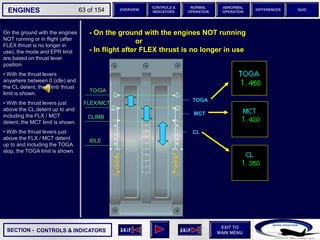
On the ground with the engines
NOT running or in flight (after
FLEX thrust is no longer in
use), the mode and EPR limit
are based on thrust lever
position.
• With the thrust levers
anywhere between 0 (idle) and
the CL detent, the climb thrust
limit is shown.
• With the thrust levers just
above the CL detent up to and
including the FLX / MCT
detent, the MCT limit is shown.
• With the thrust levers just
above the FLX / MCT detent
up to and including the TOGA
stop, the TOGA limit is shown.
TO/GA
CLIMB
IDLE
TOGA
MCT
CL
CONTROLS & INDICATORS
- On the ground with the engines NOT running
or
- In flight after FLEX thrust is no longer in use
FLEX/MCT
SECTION -
EXIT TO
MAIN MENU
ENGINES OVERVIEW
NORMAL
OPERATION
ABNORMAL
OPERATION
CONTROLS &
INDICATORS
DIFFERENCES QUIZ
64 of 154
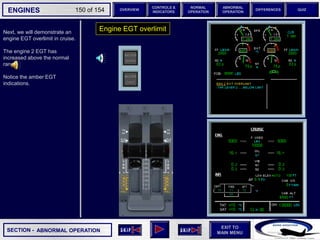
6 6
The next set of gauges display
the Exhaust Gas Temperature
(EGT) for each engine.
The current EGT is displayed
in digital and analog formats.
The amber tick mark indicates
the current EGT limit. During
engine starts on the ground,
the tick mark represents the
start limit.
When the engine is running, it
indicates the continuous
operation limit.
The amber tick mark is NOT
displayed when any of the
following occur:
• Takeoff thrust is applied.
• Reverse thrust is selected.
• Alpha floor is active.
If the actual EGT reaches or
exceeds the current EGT limit,
the digital and analog
indications change to amber
and pulse.
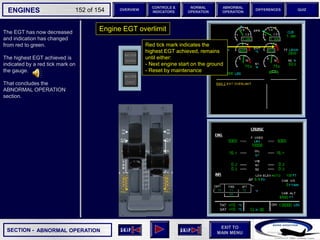
Pulsing Amber – EGT exceeded MAX EGT
CONTROLS & INDICATORS
Analog EGT
Digital EGT
Current EGT limit, NOT displayed:
- When takeoff thrust is selected
- When reverse thrust is selected
- If Alpha Floor is active
SECTION -
EXIT TO
MAIN MENU
ENGINES OVERVIEW
NORMAL
OPERATION
ABNORMAL
OPERATION
CONTROLS &
INDICATORS
DIFFERENCES QUIZ
65 of 154
6 6
Pulsing Amber – EGT exceeded MAX EGT
Pulsing Red – EGT exceeded MAX permissible EGT
CONTROLS & INDICATORS
Analog EGT
Digital EGT
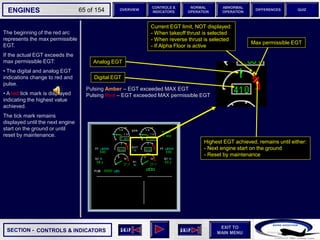
The beginning of the red arc
represents the max permissible
EGT.
If the actual EGT exceeds the
max permissible EGT:
• The digital and analog EGT
indications change to red and
pulse.
• A red tick mark is displayed
indicating the highest value
achieved.
The tick mark remains
displayed until the next engine
start on the ground or until
reset by maintenance.
Max permissible EGT
Highest EGT achieved, remains until either:
- Next engine start on the ground
- Reset by maintenance
Current EGT limit, NOT displayed:
- When takeoff thrust is selected
- When reverse thrust is selected
- If Alpha Floor is active
SECTION -
EXIT TO
MAIN MENU
ENGINES OVERVIEW
NORMAL
OPERATION
ABNORMAL
OPERATION
CONTROLS &
INDICATORS
DIFFERENCES QUIZ
66 of 154
6 6
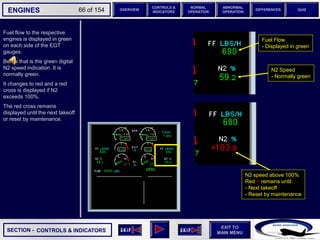
Fuel flow to the respective
engines is displayed in green
on each side of the EGT
gauges.
Below that is the green digital
N2 speed indication. It is
normally green.
It changes to red and a red
cross is displayed if N2
exceeds 100%.
The red cross remains
displayed until the next takeoff
or reset by maintenance.
CONTROLS & INDICATORS
Fuel Flow
- Displayed in green
N2 Speed
- Normally green
N2 speed above 100%
Red + remains until:
- Next takeoff
- Reset by maintenance
SECTION -
EXIT TO
MAIN MENU
ENGINES OVERVIEW
NORMAL
OPERATION
ABNORMAL
OPERATION
CONTROLS &
INDICATORS
DIFFERENCES QUIZ
67 of 154
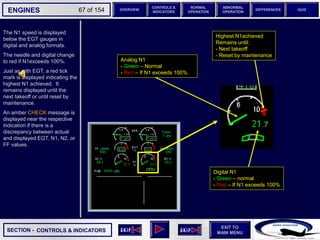
The N1 speed is displayed
below the EGT gauges in
digital and analog formats.
The needle and digital change
to red if N1exceeds 100%.
Just as with EGT, a red tick
mark is displayed indicating the
highest N1 achieved. It
remains displayed until the
next takeoff or until reset by
maintenance.
An amber CHECK message is
displayed near the respective
indication if there is a
discrepancy between actual
and displayed EGT, N1, N2, or
FF values.
6 6
CONTROLS & INDICATORS
Analog N1
- Green – Normal
- Red – If N1 exceeds 100%.
Highest N1achieved
Remains until:
- Next takeoff
- Reset by maintenance
Digital N1
- Green – normal
- Red – If N1 exceeds 100%
SECTION -
EXIT TO
MAIN MENU
ENGINES OVERVIEW
NORMAL
OPERATION
ABNORMAL
OPERATION
CONTROLS &
INDICATORS
DIFFERENCES QUIZ
68 of 154
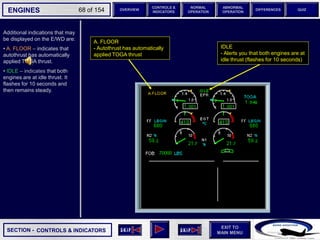
Additional indications that may
be displayed on the E/WD are:
• A. FLOOR – indicates that
autothrust has automatically
applied TOGA thrust.
• IDLE – indicates that both
engines are at idle thrust. It
flashes for 10 seconds and
then remains steady.
CONTROLS & INDICATORS
A. FLOOR
- Autothrust has automatically
applied TOGA thrust
IDLE
- Alerts you that both engines are at
idle thrust (flashes for 10 seconds)
SECTION -
EXIT TO
MAIN MENU
ENGINES OVERVIEW
NORMAL
OPERATION
ABNORMAL
OPERATION
CONTROLS &
INDICATORS
DIFFERENCES QUIZ
69 of 154
We will now look at the
indications displayed on the
ENGINE page.
The fuel used for each engine
is displayed digitally in green.
The F. USED value is reset to
0 during engine start and is
repeated on the CRUISE and
FUEL pages.
Since this value is provided by
the FADEC independent of the
fuel system, it can be useful in
determining your fuel state if a
fuel quantity discrepancy
occurs.
F. USED
- Reset to 0 during engine start
- Repeated on the CRUISE & FUEL pages
- Provided by the FADEC
CONTROLS & INDICATORS
SECTION -
EXIT TO
MAIN MENU
ENGINES OVERVIEW
NORMAL
OPERATION
ABNORMAL
OPERATION
CONTROLS &
INDICATORS
DIFFERENCES QUIZ
70 of 154
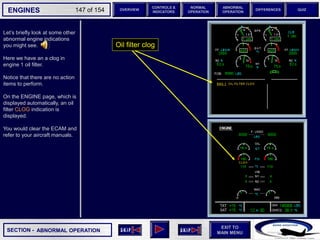
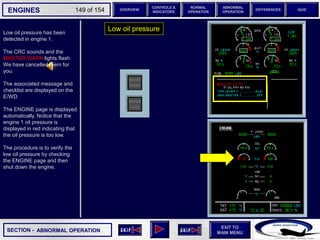
Next are the engine oil system
indications.
A digital and analog display of
oil quantity is provided. Both
are normally green. They pulse
green (advisory) if the oil
quantity drops below
approximately 5 quarts.
A digital and analog readout of
oil pressure is provided. Again,
they are both normally green.
The digital indication pulses
(advisory) if the high pressure
limit is exceeded.
The analog and digital
indications change to amber if
the oil pressure drops below 80
psi and red below 60 psi.
CONTROLS & INDICATORS
Analog Oil Quantity
Digital Oil Quantity
Green – normal
Pulsing green – quantity below 5 quarts
Analog Oil Pressure
Digital Oil Pressure
Green – normal
Pulsing green – high pressure limit
exceeded
Amber – pressure below 80 psi
Red – pressure below 60 psi
SECTION -
EXIT TO
MAIN MENU
ENGINES OVERVIEW
NORMAL
OPERATION
ABNORMAL
OPERATION
CONTROLS &
INDICATORS
DIFFERENCES QUIZ
71 of 154
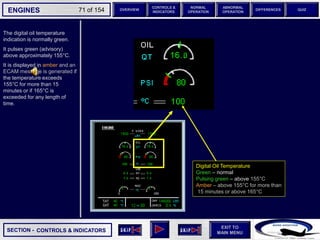
The digital oil temperature
indication is normally green.
It pulses green (advisory)
above approximately 155°C.
It is displayed in amber and an
ECAM message is generated if
the temperature exceeds
155°C for more than 15
minutes or if 165°C is
exceeded for any length of
time.
CONTROLS & INDICATORS
Digital Oil Temperature
Green – normal
Pulsing green – above 155°C
Amber – above 155°C for more than
15 minutes or above 165°C
SECTION -
EXIT TO
MAIN MENU
ENGINES OVERVIEW
NORMAL
OPERATION
ABNORMAL
OPERATION
CONTROLS &
INDICATORS
DIFFERENCES QUIZ
72 of 154
Digital vibration indications are
provided for both N1 and N2.
The respective indication
pulses green if it exceeds 5
units.
CONTROLS & INDICATORS
N1 & N2 Digital Vibration Indications
Green - normal
Pulsing green - above 5 units
SECTION -
EXIT TO
MAIN MENU
ENGINES OVERVIEW
NORMAL
OPERATION
ABNORMAL
OPERATION
CONTROLS &
INDICATORS
DIFFERENCES QUIZ
73 of 154
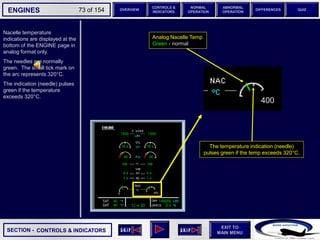
Nacelle temperature
indications are displayed at the
bottom of the ENGINE page in
analog format only.
The needles are normally
green. The small tick mark on
the arc represents 320°C.
The indication (needle) pulses
green if the temperature
exceeds 320°C.
400
400
CONTROLS & INDICATORS
Analog Nacelle Temp
Green - normal
The temperature indication (needle)
pulses green if the temp exceeds 320°C.
SECTION -
EXIT TO
MAIN MENU
ENGINES OVERVIEW
NORMAL
OPERATION
ABNORMAL
OPERATION
CONTROLS &
INDICATORS
DIFFERENCES QUIZ
74 of 154
Start Valve
During engine start, the nacelle
temperature indications are
replaced by information
relating to ignition and start
valve operation.
The FADEC selected igniters
(A, B, or both [A &B] ) are
displayed when selected for
use.
The letter indicates that the
specific igniter, or igniters,
have been activated. It DOES
NOT indicate if they are
actually firing.
Start valve indications are
displayed below the igniters.
The start valves are displayed
either open or closed.
Below each start valve is a
digital indication of the bleed
pressure available to that start
valve.
The bleed pressure indication
is displayed in amber if the
minimum or maximum limits
are exceeded.
Valve Open
Valve Closed
CONTROLS & INDICATORS
FADEC selected igniter - indicates igniter is activated, NOT that the igniter is firing
Bleed Pressure
Green – normal
Amber – min or max pressure is exceeded
SECTION -
EXIT TO
MAIN MENU
ENGINES OVERVIEW
NORMAL
OPERATION
ABNORMAL
OPERATION
CONTROLS &
INDICATORS
DIFFERENCES QUIZ
75 of 154
Certain engines parameters
are repeated on the CRUISE
page using the same display
logic as the ENGINE page.
Total fuel used , which is
displayed on the CRUISE
page, is not provided on the
ENGINE page.
CONTROLS & INDICATORS
Total Fuel Used
SECTION -
EXIT TO
MAIN MENU
ENGINES OVERVIEW
NORMAL
OPERATION
ABNORMAL
OPERATION
CONTROLS &
INDICATORS
DIFFERENCES QUIZ
76 of 154
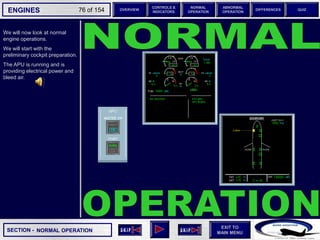
We will now look at normal
engine operations.
We will start with the
preliminary cockpit preparation.
The APU is running and is
providing electrical power and
bleed air.
NORMAL OPERATION
SECTION -
EXIT TO
MAIN MENU
ENGINES OVERVIEW
NORMAL
OPERATION
ABNORMAL
OPERATION
CONTROLS &
INDICATORS
DIFFERENCES QUIZ
77 of 154
FADEC
FADEC
AIRCRAFT
ELECTRICAL
SYSTEM
After 5 MINUTES - FADECs are unpowered
After AC power is established,
the FADECs are powered
automatically by the aircraft’s
electrical system and provide
engine indications on the
E/WD.
If engine start is not initiated
within 5 minutes of AC power
application, the FADECs shut
down automatically and all the
engine indications change to
amber XXs.
NORMAL OPERATION
SECTION -
EXIT TO
MAIN MENU
ENGINES OVERVIEW
NORMAL
OPERATION
ABNORMAL
OPERATION
CONTROLS &
INDICATORS
DIFFERENCES QUIZ
78 of 154
During the preflight, the
overhead ENG panel is
checked to ensure all four pbs
are off (lights out).
Later in the preflight, the
engine oil quantity is checked
on the ENGINE page.
Refer to your aircraft manuals
for specific oil requirements
NORMAL OPERATION
SECTION -
EXIT TO
MAIN MENU
ENGINES OVERVIEW
NORMAL
OPERATION
ABNORMAL
OPERATION
CONTROLS &
INDICATORS
DIFFERENCES QUIZ
79 of 154
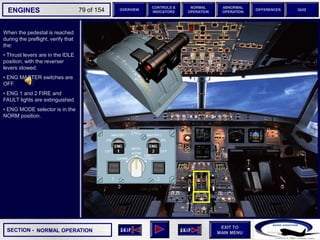
When the pedestal is reached
during the preflight, verify that
the:
• Thrust levers are in the IDLE
position, with the reverser
levers stowed.
• ENG MASTER switches are
OFF.
• ENG 1 and 2 FIRE and
FAULT lights are extinguished.
• ENG MODE selector is in the
NORM position.
NORMAL OPERATION
SECTION -
EXIT TO
MAIN MENU
ENGINES OVERVIEW
NORMAL
OPERATION
ABNORMAL
OPERATION
CONTROLS &
INDICATORS
DIFFERENCES QUIZ
80 of 154
It is now time to start engines.
We will start the engines using
the automatic engine start
procedure.
One of three sources of air
could be used to start the
engines.
1. APU bleed air
2. Opposite engine bleed air
3. External high pressure air
NORMAL OPERATION
SECTION -
EXIT TO
MAIN MENU
ENGINES OVERVIEW
NORMAL
OPERATION
ABNORMAL
OPERATION
CONTROLS &
INDICATORS
DIFFERENCES QUIZ
81 of 154
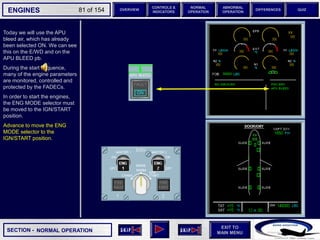
Today we will use the APU
bleed air, which has already
been selected ON. We can see
this on the E/WD and on the
APU BLEED pb.
During the start sequence,
many of the engine parameters
are monitored, controlled and
protected by the FADECs.
In order to start the engines,
the ENG MODE selector must
be moved to the IGN/START
position.
Advance to move the ENG
MODE selector to the
IGN/START position.
NORMAL OPERATION
SECTION -
EXIT TO
MAIN MENU
ENGINES OVERVIEW
NORMAL
OPERATION
ABNORMAL
OPERATION
CONTROLS &
INDICATORS
DIFFERENCES QUIZ
82 of 154
When IGN/START is selected,
the FADECs are powered
again.
This is shown on the E/WD by
the indications changing from
amber to green (except N1 and
N2).
N1 and N2 will be displayed
after they reach a
predetermined rotation speed.
The ENGINE page replaces
the DOOR/OXY page and
displays all engine indications.
After 30 seconds, without any
movement of the ENG
MASTER switches, the
DOOR/OXY page would
replace the ENGINE page
automatically (until an ENG
MASTER switch is selected
ON).
NORMAL OPERATION
SECTION -
EXIT TO
MAIN MENU
ENGINES OVERVIEW
NORMAL
OPERATION
ABNORMAL
OPERATION
CONTROLS &
INDICATORS
DIFFERENCES QUIZ
83 of 154
We will start the engines using
the available APU bleed air to
operate the pneumatic starters.
We can see that the APU is
providing 32 psi of bleed
pressure at the engine start
valves.
NORMAL OPERATION
32 psi of bleed pressure is available
at the engine start valves.
SECTION -
EXIT TO
MAIN MENU
ENGINES OVERVIEW
NORMAL
OPERATION
ABNORMAL
OPERATION
CONTROLS &
INDICATORS
DIFFERENCES QUIZ
84 of 154
The normal procedure is to
start engine 2 first because the
yellow hydraulic system engine
driven pump is on engine 2
and the yellow system supplies
parking brake pressure.
Advance to move the ENG 2
MASTER switch to the ON
position.
NORMAL OPERATION
SECTION -
EXIT TO
MAIN MENU
ENGINES OVERVIEW
NORMAL
OPERATION
ABNORMAL
OPERATION
CONTROLS &
INDICATORS
DIFFERENCES QUIZ
85 of 154
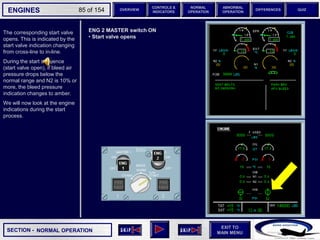
The corresponding start valve
opens. This is indicated by the
start valve indication changing
from cross-line to in-line.
During the start sequence
(start valve open), if bleed air
pressure drops below the
normal range and N2 is 10% or
more, the bleed pressure
indication changes to amber.
We will now look at the engine
indications during the start
process.
NORMAL OPERATION
ENG 2 MASTER switch ON
• Start valve opens
SECTION -
EXIT TO
MAIN MENU
ENGINES OVERVIEW
NORMAL
OPERATION
ABNORMAL
OPERATION
CONTROLS &
INDICATORS
DIFFERENCES QUIZ
86 of 154
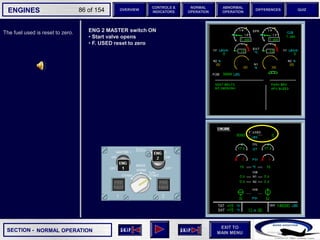
The fuel used is reset to zero.
NORMAL OPERATION
ENG 2 MASTER switch ON
• Start valve opens
• F. USED reset to zero
SECTION -
EXIT TO
MAIN MENU
ENGINES OVERVIEW
NORMAL
OPERATION
ABNORMAL
OPERATION
CONTROLS &
INDICATORS
DIFFERENCES QUIZ
87 of 154
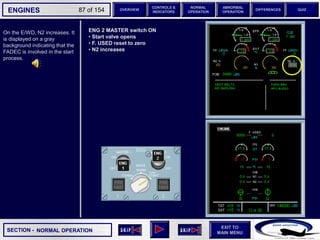
On the E/WD, N2 increases. It
is displayed on a gray
background indicating that the
FADEC is involved in the start
process.
NORMAL OPERATION
ENG 2 MASTER switch ON
• Start valve opens
• F. USED reset to zero
• N2 increases
SECTION -
EXIT TO
MAIN MENU
ENGINES OVERVIEW
NORMAL
OPERATION
ABNORMAL
OPERATION
CONTROLS &
INDICATORS
DIFFERENCES QUIZ
88 of 154
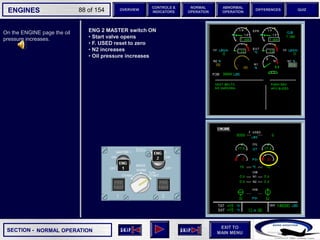
On the ENGINE page the oil
pressure increases.
NORMAL OPERATION
ENG 2 MASTER switch ON
• Start valve opens
• F. USED reset to zero
• N2 increases
• Oil pressure increases
SECTION -
EXIT TO
MAIN MENU
ENGINES OVERVIEW
NORMAL
OPERATION
ABNORMAL
OPERATION
CONTROLS &
INDICATORS
DIFFERENCES QUIZ
89 of 154
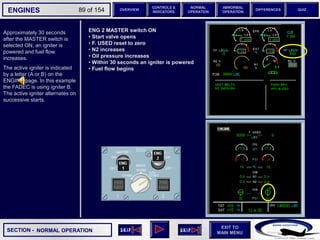
Approximately 30 seconds
after the MASTER switch is
selected ON, an igniter is
powered and fuel flow
increases.
The active igniter is indicated
by a letter (A or B) on the
ENGINE page. In this example
the FADEC is using igniter B.
The active igniter alternates on
successive starts.
NORMAL OPERATION
ENG 2 MASTER switch ON
• Start valve opens
• F. USED reset to zero
• N2 increases
• Oil pressure increases
• Within 30 seconds an igniter is powered
• Fuel flow begins
SECTION -
EXIT TO
MAIN MENU
ENGINES OVERVIEW
NORMAL
OPERATION
ABNORMAL
OPERATION
CONTROLS &
INDICATORS
DIFFERENCES QUIZ
90 of 154
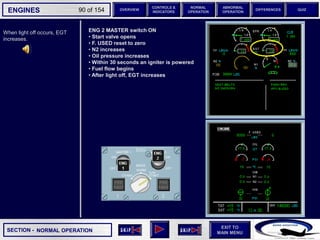
When light off occurs, EGT
increases.
NORMAL OPERATION
ENG 2 MASTER switch ON
• Start valve opens
• F. USED reset to zero
• N2 increases
• Oil pressure increases
• Within 30 seconds an igniter is powered
• Fuel flow begins
• After light off, EGT increases
SECTION -
EXIT TO
MAIN MENU
ENGINES OVERVIEW
NORMAL
OPERATION
ABNORMAL
OPERATION
CONTROLS &
INDICATORS
DIFFERENCES QUIZ
91 of 154
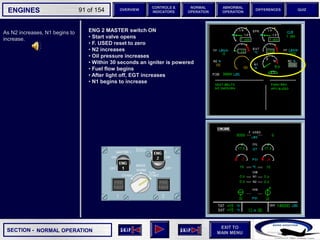
As N2 increases, N1 begins to
increase.
NORMAL OPERATION
ENG 2 MASTER switch ON
• Start valve opens
• F. USED reset to zero
• N2 increases
• Oil pressure increases
• Within 30 seconds an igniter is powered
• Fuel flow begins
• After light off, EGT increases
• N1 begins to increase
SECTION -
EXIT TO
MAIN MENU
ENGINES OVERVIEW
NORMAL
OPERATION
ABNORMAL
OPERATION
CONTROLS &
INDICATORS
DIFFERENCES QUIZ
92 of 154
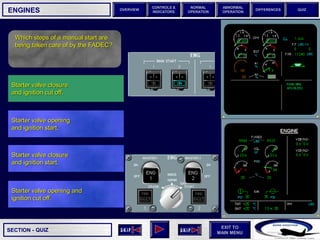
When N2 is between 43 and
48%, the FADEC closes the
start valve and deactivates the
igniter.
Notice on the ENGINE page
the start valve is closed and
the igniter indication is
removed.
NORMAL OPERATION
ENG 2 MASTER switch ON
• Start valve opens
• F. USED reset to zero
• N2 increases
• Oil pressure increases
• Within 30 seconds an igniter is powered
• Fuel flow begins
• After light off, EGT increases
• N1 begins to increase
• N2 43-48%, start valve closes & ignition off
SECTION -
EXIT TO
MAIN MENU
ENGINES OVERVIEW
NORMAL
OPERATION
ABNORMAL
OPERATION
CONTROLS &
INDICATORS
DIFFERENCES QUIZ
93 of 154
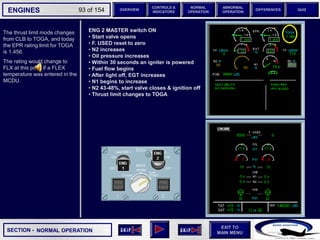
The thrust limit mode changes
from CLB to TOGA, and today
the EPR rating limit for TOGA
is 1.456.
The rating would change to
FLX at this point if a FLEX
temperature was entered in the
MCDU.
NORMAL OPERATION
ENG 2 MASTER switch ON
• Start valve opens
• F. USED reset to zero
• N2 increases
• Oil pressure increases
• Within 30 seconds an igniter is powered
• Fuel flow begins
• After light off, EGT increases
• N1 begins to increase
• N2 43-48%, start valve closes & ignition off
• Thrust limit changes to TOGA
SECTION -
EXIT TO
MAIN MENU
ENGINES OVERVIEW
NORMAL
OPERATION
ABNORMAL
OPERATION
CONTROLS &
INDICATORS
DIFFERENCES QUIZ
94 of 154
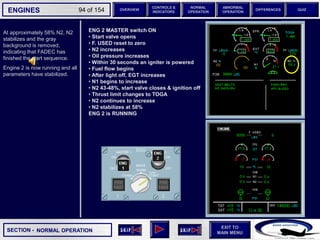
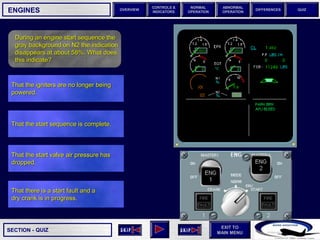
At approximately 58% N2, N2
stabilizes and the gray
background is removed,
indicating that FADEC has
finished the start sequence.
Engine 2 is now running and all
parameters have stabilized.
ENG 2 MASTER switch ON
• Start valve opens
• F. USED reset to zero
• N2 increases
• Oil pressure increases
• Within 30 seconds an igniter is powered
• Fuel flow begins
• After light off, EGT increases
• N1 begins to increase
• N2 43-48%, start valve closes & ignition off
• Thrust limit changes to TOGA
• N2 continues to increase
• N2 stabilizes at 58%
ENG 2 is RUNNING
NORMAL OPERATION
SECTION -
EXIT TO
MAIN MENU
ENGINES OVERVIEW
NORMAL
OPERATION
ABNORMAL
OPERATION
CONTROLS &
INDICATORS
DIFFERENCES QUIZ
95 of 154
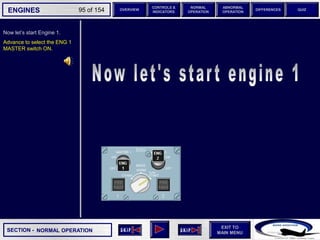
Now let’s start Engine 1.
Advance to select the ENG 1
MASTER switch ON.
NORMAL OPERATION
SECTION -
EXIT TO
MAIN MENU
ENGINES OVERVIEW
NORMAL
OPERATION
ABNORMAL
OPERATION
CONTROLS &
INDICATORS
DIFFERENCES QUIZ
96 of 154
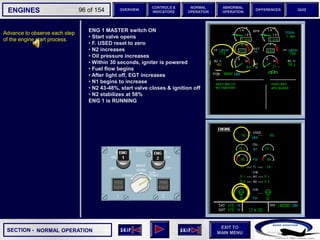
ENG 1 MASTER switch ON
• Start valve opens
• F. USED reset to zero
• N2 increases
• Oil pressure increases
• Within 30 seconds, igniter is powered
• Fuel flow begins
• After light off, EGT increases
• N1 begins to increase
• N2 43-48%, start valve closes & ignition off
• N2 stabilizes at 58%
ENG 1 is RUNNING
Advance to observe each step
of the engine start process.
NORMAL OPERATION
SECTION -
EXIT TO
MAIN MENU
ENGINES OVERVIEW
NORMAL
OPERATION
ABNORMAL
OPERATION
CONTROLS &
INDICATORS
DIFFERENCES QUIZ
97 of 154
NORMAL OPERATION
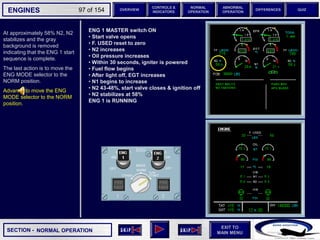
At approximately 58% N2, N2
stabilizes and the gray
background is removed
indicating that the ENG 1 start
sequence is complete.
The last action is to move the
ENG MODE selector to the
NORM position.
Advance to move the ENG
MODE selector to the NORM
position.
ENG 1 MASTER switch ON
• Start valve opens
• F. USED reset to zero
• N2 increases
• Oil pressure increases
• Within 30 seconds, igniter is powered
• Fuel flow begins
• After light off, EGT increases
• N1 begins to increase
• N2 43-48%, start valve closes & ignition off
• N2 stabilizes at 58%
ENG 1 is RUNNING
SECTION -
EXIT TO
MAIN MENU
ENGINES OVERVIEW
NORMAL
OPERATION
ABNORMAL
OPERATION
CONTROLS &
INDICATORS
DIFFERENCES QUIZ
98 of 154
When the ENG MODE selector
is moved back to the NORM
position, the WHEEL page will
eventually replace the ENGINE
page (this can take up to 10
seconds).
If the ENG MODE selector is
not moved to the NORM
position, the ENGINE page will
remain displayed and override
the automatic ECAM page
display logic.
That concludes the automatic
engine start sequence.
REL REL
NORMAL OPERATION
SECTION -
EXIT TO
MAIN MENU
ENGINES OVERVIEW
NORMAL
OPERATION
ABNORMAL
OPERATION
CONTROLS &
INDICATORS
DIFFERENCES QUIZ
99 of 154
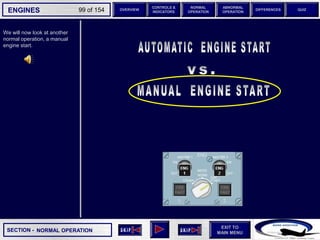
We will now look at another
normal operation, a manual
engine start.
NORMAL OPERATION
SECTION -
EXIT TO
MAIN MENU
ENGINES OVERVIEW
NORMAL
OPERATION
ABNORMAL
OPERATION
CONTROLS &
INDICATORS
DIFFERENCES QUIZ
100 of 154
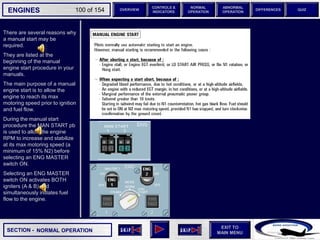
There are several reasons why
a manual start may be
required.
They are listed at the
beginning of the manual
engine start procedure in your
manuals.
The main purpose of a manual
engine start is to allow the
engine to reach its max
motoring speed prior to ignition
and fuel flow.
During the manual start
procedure the MAN START pb
is used to allow the engine
RPM to increase and stabilize
at its max motoring speed (a
minimum of 15% N2) before
selecting an ENG MASTER
switch ON.
Selecting an ENG MASTER
switch ON activates BOTH
igniters (A & B) and
simultaneously initiates fuel
flow to the engine.
NORMAL OPERATION
SECTION -
EXIT TO
MAIN MENU
ENGINES OVERVIEW
NORMAL
OPERATION
ABNORMAL
OPERATION
CONTROLS &
INDICATORS
DIFFERENCES QUIZ
101 of 154
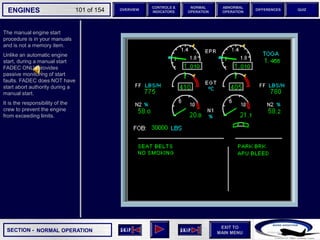
The manual engine start
procedure is in your manuals
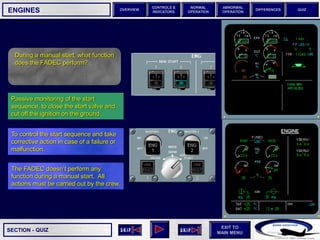
and is not a memory item.
Unlike an automatic engine
start, during a manual start
FADEC ONLY provides
passive monitoring of start
faults. FADEC does NOT have
start abort authority during a
manual start.
It is the responsibility of the
crew to prevent the engine
from exceeding limits.
NORMAL OPERATION
SECTION -
EXIT TO
MAIN MENU
ENGINES OVERVIEW
NORMAL
OPERATION
ABNORMAL
OPERATION
CONTROLS &
INDICATORS
DIFFERENCES QUIZ
102 of 154
We will assume a normal
automatic start has already
been attempted but failed due
to low bleed pressure.
The decision has been made
to attempt a manual start.
Before attempting a second
start of the same engine, the
ENG MODE selector should be
recycled to the NORM position
then back to IGN/START. This
resets FADEC and prepares it
for another start attempt.
Advance to move the ENG
MODE selector back to the
NORM position.
NORMAL OPERATION
SECTION -
EXIT TO
MAIN MENU
ENGINES OVERVIEW
NORMAL
OPERATION
ABNORMAL
OPERATION
CONTROLS &
INDICATORS
DIFFERENCES QUIZ
103 of 154
Now that the FADEC has been
reset, let’s move it back to
IGN/START.
NORMAL OPERATION
SECTION -
EXIT TO
MAIN MENU
ENGINES OVERVIEW
NORMAL
OPERATION
ABNORMAL
OPERATION
CONTROLS &
INDICATORS
DIFFERENCES QUIZ
104 of 154
The ENG MODE selector is
now in the IGN/START
position.
The FADECs are energized
and the engine parameters are
displayed on the E/WD.
The ENGINE page is displayed
automatically.
NORMAL OPERATION
SECTION -
EXIT TO
MAIN MENU
ENGINES OVERVIEW
NORMAL
OPERATION
ABNORMAL
OPERATION
CONTROLS &
INDICATORS
DIFFERENCES QUIZ
105 of 154
We will start engine 2 using
APU bleed. Other bleed
sources could be used as the
situation requires.
The ENG MAN START pbs are
used to open the respective
start valve.
Advance to lift the guard and
push the ENG 2 MAN START
pb.
NORMAL OPERATION
SECTION -
EXIT TO
MAIN MENU
ENGINES OVERVIEW
NORMAL
OPERATION
ABNORMAL
OPERATION
CONTROLS &
INDICATORS
DIFFERENCES QUIZ
106 of 154
The engine 2 start valve
opened, the engine has
reached its maximum motoring
speed, and FADEC is
monitoring the start process.
Now that the engine has
reached its maximum motoring
speed (15% minimum), you
can select the ENG 2
MASTER switch ON.
Advance to select the ENG 2
MASTER switch ON.
NORMAL OPERATION
SECTION -
EXIT TO
MAIN MENU
ENGINES OVERVIEW
NORMAL
OPERATION
ABNORMAL
OPERATION
CONTROLS &
INDICATORS
DIFFERENCES QUIZ
107 of 154
Selecting the MASTER switch
ON:
• Resets fuel used to zero
• Activates both igniters (A & B)
• Initiates fuel flow
Notice also that N1 has started
to increase.
The FADEC automatically uses
both igniters (A & B) for a
manual start.
Observe these indications, then
advance to continue with the
manual start process.
NORMAL OPERATION
SECTION -
EXIT TO
MAIN MENU
ENGINES OVERVIEW
NORMAL
OPERATION
ABNORMAL
OPERATION
CONTROLS &
INDICATORS
DIFFERENCES QUIZ
108 of 154
When N2 is between 43 and
48%, FADEC automatically
closes the start valve and
deactivates both igniters.
Advance to select the ENG 2
MAN START pb off.
NORMAL OPERATION
SECTION -
EXIT TO
MAIN MENU
ENGINES OVERVIEW
NORMAL
OPERATION
ABNORMAL
OPERATION
CONTROLS &
INDICATORS
DIFFERENCES QUIZ
109 of 154
Selecting the MAN START pb
off simply makes the pb agree
with the automatic closure of
the start valve by the FADEC.
N2 continues to increase. At
about 58%, N2 stabilizes and
the gray background is
removed.
Engine 2 is now running and all
its parameters are stabilized.
You would then proceed to
start engine 1 but we will move
on taxiing the aircraft.
NORMAL OPERATION
SECTION -
EXIT TO
MAIN MENU
ENGINES OVERVIEW
NORMAL
OPERATION
ABNORMAL
OPERATION
CONTROLS &
INDICATORS
DIFFERENCES QUIZ
110 of 154
Only a small increase in thrust
is typically needed to get the
aircraft moving on the ground.
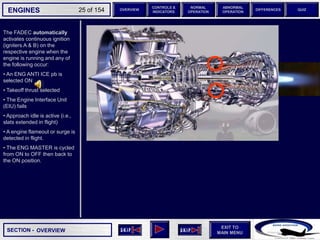
Once it’s moving, idle thrust is
usually sufficient to maintain
taxi speed.
On the ground, thrust control is
entirely conventional. Thrust
output corresponds directly to
thrust lever position.
NORMAL OPERATION
SECTION -
EXIT TO
MAIN MENU
ENGINES OVERVIEW
NORMAL
OPERATION
ABNORMAL
OPERATION
CONTROLS &
INDICATORS
DIFFERENCES QUIZ
111 of 154
During taxi out, the E/WD
should be checked to ensure
the correct thrust mode is
displayed (TOGA or FLX).
Today, we will be making a
FLX takeoff with a pilot entered
flex temperature of 35°C.
This means that with the thrust
levers in the FLX detent the
engines will provide the thrust
equivalent to that produced
using TOGA with a 35°C
ambient air temperature.
FLX takeoffs significantly
extend engine life, use less
fuel, and should be considered
the normal takeoff power
setting.
Flex takeoffs will be discussed
in more detail during later
training.
NORMAL OPERATION
SECTION -
EXIT TO
MAIN MENU
ENGINES OVERVIEW
NORMAL
OPERATION
ABNORMAL
OPERATION
CONTROLS &
INDICATORS
DIFFERENCES QUIZ
112 of 154
When on the ground at low
speed, the FADEC protects
against fan flutter by
preventing the engine from
being stabilized in a range of
60 - 74% N1.
Therefore, during engine
acceleration on the ground you
may notice a non-linear thrust
response to thrust lever
movement.
REL REL
NORMAL OPERATION
SECTION -
EXIT TO
MAIN MENU
ENGINES OVERVIEW
NORMAL
OPERATION
ABNORMAL
OPERATION
CONTROLS &
INDICATORS
DIFFERENCES QUIZ
113 of 154
Today we will make a FLX
takeoff since this is what you
will do on the majority of your
takeoffs.
The first step is to move the
thrust levers from idle to
approximately 1.1 EPR.
Keep in mind that thrust lever
position is indicated by the blue
circles on the outside of the
EPR gauges.
Advance to move the thrust
levers to 1.1 EPR.
NORMAL OPERATION
6 6
SECTION -
EXIT TO
MAIN MENU
ENGINES OVERVIEW
NORMAL
OPERATION
ABNORMAL
OPERATION
CONTROLS &
INDICATORS
DIFFERENCES QUIZ
114 of 154
Pausing the thrust levers at 1.1
EPR during the takeoff
provides you with an
opportunity to ensure that the
engines are producing thrust
symmetrically and that
everything is normal.
As both EPR needles
approach 1.1 EPR, the thrust
levers may be moved to the
desired takeoff thrust setting, in
this case FLX.
It is not necessary to hold the
brakes while the engines
accelerate to 1.1 EPR or to
wait until the thrust actually
achieves 1.1 EPR before
moving the thrust levers to a
takeoff position.
Advance to move the thrust
levers to the FLX detent.
NORMAL OPERATION
6 6
SECTION -
EXIT TO
MAIN MENU
ENGINES OVERVIEW
NORMAL
OPERATION
ABNORMAL
OPERATION
CONTROLS &
INDICATORS
DIFFERENCES QUIZ
115 of 154
When takeoff thrust is applied,
the ENGINE page replaces the
WHEEL page on the SD.
Moving the thrust levers to a
takeoff position (FLX or TOGA)
on the ground automatically
arms the autothrust.
During takeoff roll, the EPR
gauges should be checked to
ensure both engines have
achieved the EPR displayed in
the upper right corner of the
E/WD.
TOGA thrust is always
available by moving the thrust
levers to the TOGA position.
NORMAL OPERATION
6 6
SECTION -
EXIT TO
MAIN MENU
ENGINES OVERVIEW
NORMAL
OPERATION
ABNORMAL
OPERATION
CONTROLS &
INDICATORS
DIFFERENCES QUIZ
116 of 154
At thrust reduction altitude
(normally 1500’ AGL), we will
move the thrust levers aft to the
CL detent.
Advance to move the thrust
levers to the CL detent.
NORMAL OPERATION
6 6
SECTION -
EXIT TO
MAIN MENU
ENGINES OVERVIEW
NORMAL
OPERATION
ABNORMAL
OPERATION
CONTROLS &
INDICATORS
DIFFERENCES QUIZ
117 of 154
When the levers are in the CL
detent:
• Autothrust automatically
changes from armed to active.
• The thrust limit mode
changes to CLB with the
corresponding change in EPR
rating limit.
• After a short delay, the
CRUISE page replaces the
ENGINE page on the SD.
P
TAT
SAT
0
-7
°C
°C H
10
F. USED
LBS
QT
7200 7200
OIL
16.5 16.5
ENG
AIR
2.9
AFT
70
FWD
71 72
63
CAB V/S
CAB ALT
FT
/ MIN
FT
PS
I
LDG ELEV AUT
O F
T
100
2000
-100
°F
ISA -16 °C
GW 111400 LBS
CRUISE
1 + 2
14400
VIB N1
N2
0.2 0.1
0.4
CKPT
NORMAL OPERATION
6 6
SECTION -
EXIT TO
MAIN MENU
ENGINES OVERVIEW
NORMAL
OPERATION
ABNORMAL
OPERATION
CONTROLS &
INDICATORS
DIFFERENCES QUIZ
118 of 154
We are now in cruise flight, the
thrust levers are in the CL
detent, and autothrust is active.
To maintain the desired speed
in level flight the autothrust
system is commanding an EPR
of 1.210.
NORMAL OPERATION
P
TAT
SAT
0
-7
°C
°C H
10
F. USED
LBS
QT
7200 7200
OIL
16.5 16.5
ENG
AIR
2.9
AFT
70
FWD
71 72
63
CAB V/S
CAB ALT
FT
/ MIN
FT
PS
I
LDG ELEV AUT
O F
T
100
2000
-100
°F
ISA -16 °C
GW 111400 LBS
CRUISE
1 + 2
14400
VIB N1
N2
0.2 0.1
0.4
CKPT
SECTION -
EXIT TO
MAIN MENU
ENGINES OVERVIEW
NORMAL
OPERATION
ABNORMAL
OPERATION
CONTROLS &
INDICATORS
DIFFERENCES QUIZ
119 of 154
Assume you have just begun a
long descent to a lower
altitude. With inputs from the
FMS, the autothrust has
determined that idle thrust is
required for the descent.
Advance now to see EPR
move to idle.
Let’s look at this in more detail.
NORMAL OPERATION
P
TAT
SAT
0
-7
°C
°C H
10
F. USED
LBS
QT
7200 7200
OIL
16.5 16.5
ENG
AIR
2.9
AFT
70
FWD
71 72
63
CAB V/S
CAB ALT
FT
/ MIN
FT
PS
I
LDG ELEV AUT
O F
T
100
2000
-100
°F
ISA -16 °C
GW 111400 LBS
CRUISE
1 + 2
14400
VIB N1
N2
0.2 0.1
0.4
CKPT
6 6
SECTION -
EXIT TO
MAIN MENU
ENGINES OVERVIEW
NORMAL
OPERATION
ABNORMAL
OPERATION
CONTROLS &
INDICATORS
DIFFERENCES QUIZ
120 of 154
P
TAT
SAT
0
-7
°C
°C H
10
F. USED
LBS
QT
7200 7200
OIL
16.5 16.5
ENG
AIR
2.9
AFT
70
FWD
71 72
63
CAB V/S
CAB ALT
FT
/ MIN
FT
PS
I
LDG ELEV AUT
O F
T
100
2000
-100
°F
ISA -16 °C
GW 111400 LBS
CRUISE
1 + 2
14400
VIB N1
N2
0.2 0.1
0.4
CKPT
When autothrust is active,
green arcs are displayed
between the actual EPR and
the autothrust commanded
EPR value.
The green triangle indicates
the direction of EPR tendency.
When the new EPR value is
reached, all these indications,
except for the actual EPR,
disappear.
These indications are only
displayed when autothrust is
active.
Autothrust and the associated
indications are covered in more
detail in later training.
NORMAL OPERATION
6 6
EPR Actual
EPR Commanded
EPR Trend
SECTION -
EXIT TO
MAIN MENU
ENGINES OVERVIEW
NORMAL
OPERATION
ABNORMAL
OPERATION
CONTROLS &
INDICATORS
DIFFERENCES QUIZ
121 of 154
P
TAT
SAT
0
-7
°C
°C H
10
F. USED
LBS
QT
7200 7200
OIL
16.5 16.5
ENG
AIR
2.9
AFT
70
FWD
71 72
63
CAB V/S
CAB ALT
FT
/ MIN
FT
PS
I
LDG ELEV AUT
O F
T
100
2000
-100
°F
ISA -16 °C
GW 111400 LBS
CRUISE
1 + 2
14400
VIB N1
N2
0.2 0.1
0.4
CKPT
During cruise, descent and
approach phases, autothrust is
normally active and the thrust
levers remain in the CL detent. CRUISE
DESCENT
APPROACH
NORMAL OPERATION
CLIMB
SECTION -
EXIT TO
MAIN MENU
ENGINES OVERVIEW
NORMAL
OPERATION
ABNORMAL
OPERATION
CONTROLS &
INDICATORS
DIFFERENCES QUIZ
122 of 154
P
TAT
SAT
0
-7
°C
°C H
10
F. USED
LBS
QT
7200 7200
OIL
16.5 16.5
ENG
AIR
2.9
AFT
70
FWD
71 72
63
CAB V/S
CAB ALT
FT
/ MIN
FT
PS
I
LDG ELEV AUT
O F
T
100
2000
-100
°F
ISA -16 °C
GW 111400 LBS
CRUISE
1 + 2
14400
VIB N1
N2
0.2 0.1
0.4
CKPT
In heavy rain, turbulence, or in
other situations it may be
advisable to manually activate
continuous ignition.
Refer to your aircraft manuals
for more details.
Moving the ENG MODE
selector to the IGN/START
position when the engines are
running activates both igniters
in each engine.
Advance to move the ENG
MODE selector to the
IGN/START position.
NORMAL OPERATION
SECTION -
EXIT TO
MAIN MENU
ENGINES OVERVIEW
NORMAL
OPERATION
ABNORMAL
OPERATION
CONTROLS &
INDICATORS
DIFFERENCES QUIZ
123 of 154
P
TAT
SAT
0
-7
°C
°C H
10
F. USED
LBS
QT
7200 7200
OIL
16.5 16.5
ENG
AIR
2.9
AFT
70
FWD
71 72
63
CAB V/S
CAB ALT
FT
/ MIN
FT
PS
I
LDG ELEV AUT
O F
T
100
2000
-100
°F
ISA -16 °C
GW 111400 LBS
CRUISE
1 + 2
14400
VIB N1
N2
0.2 0.1
0.4
CKPT
The IGNITION memo is
displayed on the E/WD when
continuous ignition is activated.
NORMAL OPERATION
SECTION -
EXIT TO
MAIN MENU
ENGINES OVERVIEW
NORMAL
OPERATION
ABNORMAL
OPERATION
CONTROLS &
INDICATORS
DIFFERENCES QUIZ
124 of 154
We are now ready to land.
During landing the pilot will
move the thrust levers to IDLE.
There is a RETARD auto
callout to remind the crew if
this has not been done.
Advance to move the thrust
levers to idle.
NORMAL OPERATION
SECTION -
EXIT TO
MAIN MENU
ENGINES OVERVIEW
NORMAL
OPERATION
ABNORMAL
OPERATION
CONTROLS &
INDICATORS
DIFFERENCES QUIZ
125 of 154
Moving the thrust levers to idle
disengages the autothrust and
returns the thrust to manual
operation.
Select reverse thrust after main
gear touchdown.
Advance to select reverse
thrust.
NORMAL OPERATION
SECTION -
EXIT TO
MAIN MENU
ENGINES OVERVIEW
NORMAL
OPERATION
ABNORMAL
OPERATION
CONTROLS &
INDICATORS
DIFFERENCES QUIZ
126 of 154
REV is displayed in amber
when the reversers are
unstowed.
REV is displayed in green
when the reversers are fully
deployed.
Notice that the thrust limit
mode on the E/WD now
displays MREV.
Except on slippery runways, if
one reverser fails to deploy
properly the good reverser can
still be used.
Advance to select FULL
reverse thrust.
NORMAL OPERATION
SECTION -
EXIT TO
MAIN MENU
ENGINES OVERVIEW
NORMAL
OPERATION
ABNORMAL
OPERATION
CONTROLS &
INDICATORS
DIFFERENCES QUIZ
127 of 154
Both engines are now
producing the max reverse
thrust setting of 1.180 EPR.
Max reverse thrust is available
down to 70 Knots.
No later than 70 knots you
should move the thrust levers
to reverse idle and then to the
idle stop.
Advance to move the thrust
levers to the reverse idle
position.
NORMAL OPERATION
SECTION -
EXIT TO
MAIN MENU
ENGINES OVERVIEW
NORMAL
OPERATION
ABNORMAL
OPERATION
CONTROLS &
INDICATORS
DIFFERENCES QUIZ
128 of 154
The thrust levers are now in
the reverse idle detent.
Advance to move the thrust
levers to the forward idle stop.
NORMAL OPERATION
SECTION -
EXIT TO
MAIN MENU
ENGINES OVERVIEW
NORMAL
OPERATION
ABNORMAL
OPERATION
CONTROLS &
INDICATORS
DIFFERENCES QUIZ
129 of 154
The thrust levers are now at
the idle stop and the reversers
are stowed.
NORMAL OPERATION
SECTION -
EXIT TO
MAIN MENU
ENGINES OVERVIEW
NORMAL
OPERATION
ABNORMAL
OPERATION
CONTROLS &
INDICATORS
DIFFERENCES QUIZ
130 of 154
We are now at the gate. It’s
time to shut down the engines.
To do that, the corresponding
ENG MASTER switches must
be selected OFF.
If unable to shut down an
engine using the ENG
MASTER switch, the engine
could (in usual circumstances)
be shut down using the
respective ENG FIRE pb on
the overhead, which closes the
LP fuel valve.
If an ENG FIRE pb is used to
shut down an engine, there is a
delay of approximately 40
seconds before the engine
shuts down.
This is because it takes time to
burn the fuel remaining
between the LP fuel valve and
the engine.
NORMAL OPERATION
SECTION -
EXIT TO
MAIN MENU
ENGINES OVERVIEW
NORMAL
OPERATION
ABNORMAL
OPERATION
CONTROLS &
INDICATORS
DIFFERENCES QUIZ
131 of 154
Let’s take a look at some
abnormal operations.
In this section we will cover the
indications of specific failures
and detail their consequences.
As you perform the steps
required to deal with these
selected failures you will gain a
better understanding of the
system.
ABNORMAL OPERATION
SECTION -
EXIT TO
MAIN MENU
ENGINES OVERVIEW
NORMAL
OPERATION
ABNORMAL
OPERATION
CONTROLS &
INDICATORS
DIFFERENCES QUIZ
132 of 154
We will begin with a
demonstration of an abnormal
engine start.
We are at the gate with all the
flows and checklists complete
up to engine start.
Advance to rotate the ENG
MODE selector to IGN/START.
ABNORMAL OPERATION
SECTION -
EXIT TO
MAIN MENU
ENGINES OVERVIEW
NORMAL
OPERATION
ABNORMAL
OPERATION
CONTROLS &
INDICATORS
DIFFERENCES QUIZ
133 of 154
Continue the procedure by
selecting ENG 2 MASTER
switch ON.
ABNORMAL OPERATION
SECTION -
EXIT TO
MAIN MENU
ENGINES OVERVIEW
NORMAL
OPERATION
ABNORMAL
OPERATION
CONTROLS &
INDICATORS
DIFFERENCES QUIZ
134 of 154
Initially you see all the
indications you have observed
before, including:
• Fuel used reset to zero
• The start valve opens
• N2 increases
• Oil pressure increases
• Within 30 seconds, an igniter
is displayed, in this case igniter
B, and fuel flow begins.
ABNORMAL OPERATION
SECTION -
EXIT TO
MAIN MENU
ENGINES OVERVIEW
NORMAL
OPERATION
ABNORMAL
OPERATION
CONTROLS &
INDICATORS
DIFFERENCES QUIZ
135 of 154
You hear a single chime and
the MASTER CAUT light
illuminates.
We have extinguished the
MASTER CAUT for you.
On the ENG panel, the ENG 2
FAULT light illuminates
indicating that the automatic
start has been aborted.
The ECAM message confirms
this. The NEW START IN
PROGRESS message is NOT
an action step.
It indicates that the FADEC
has detected a problem during
an automatic start and is taking
steps to attempt to correct the
problem and accomplish a
successful start.
ABNORMAL OPERATION
SECTION -
EXIT TO
MAIN MENU
ENGINES OVERVIEW
NORMAL
OPERATION
ABNORMAL
OPERATION
CONTROLS &
INDICATORS
DIFFERENCES QUIZ
136 of 154
The FADEC will abort an
automatic start on the ground
for many reasons.
It is not necessary for you to
memorize them, but it is
important that you understand
that the FADEC is watching for
numerous abnormalities during
start, including:
• Starter time exceeded
• Impending EGT overtemp
• No light off
• Lower than normal N1
• Starter failure
• Hung start
The ECAM will display the
same START FAULT message
if any these start problems
occur.
The FADEC can abort an automatic start on
the ground if any of the following occur:
• Starter time exceeded
• Impending EGT overtemp
• No light off
• Lower than normal N1
• Starter failure
• Hung start
ABNORMAL OPERATION
SECTION -
EXIT TO
MAIN MENU
ENGINES OVERVIEW
NORMAL
OPERATION
ABNORMAL
OPERATION
CONTROLS &
INDICATORS
DIFFERENCES QUIZ
137 of 154
Watch what FADEC does to
attempt to get the engine
started.
Automatically the FADEC shuts
off the fuel and turns off the
ignition.
After 30 seconds of dry crank,
a new start is launched.
Advance to observe the next
start attempt.
30 SECONDS
ABNORMAL OPERATION
SECTION -
EXIT TO
MAIN MENU
ENGINES OVERVIEW
NORMAL
OPERATION
ABNORMAL
OPERATION
CONTROLS &
INDICATORS
DIFFERENCES QUIZ
138 of 154
Both igniters A and B are now
activated and the fuel flow
begins.
If the FADEC is successful in
getting the engine started, the
ECAM message will be
removed and the FAULT light
will extinguish.
ABNORMAL OPERATION
SECTION -
EXIT TO
MAIN MENU
ENGINES OVERVIEW
NORMAL
OPERATION
ABNORMAL
OPERATION
CONTROLS &
INDICATORS
DIFFERENCES QUIZ
139 of 154
If the second start attempt is
unsuccessful, or if FADEC
makes no further attempts to
start the engine, the ECAM will
reflect that the start was
aborted.
Notice that the igniters have
been deactivated and the start
valve has closed.
On the ECAM a secondary
message is displayed
indicating that the start fault is
due to NO LIGHT UP.
An action step is now
displayed directing you to
select the ENG MASTER OFF.
The display of this action step
confirms that FADEC has given
up trying to start the engine.
Advance to select the ENG 2
MASTER switch OFF.
ABNORMAL OPERATION
SECTION -
EXIT TO
MAIN MENU
ENGINES OVERVIEW
NORMAL
OPERATION
ABNORMAL
OPERATION
CONTROLS &
INDICATORS
DIFFERENCES QUIZ
140 of 154
At this point you would seek
assistance from maintenance.
Now let’s look at another
abnormal.
ABNORMAL OPERATION
SECTION -
EXIT TO
MAIN MENU
ENGINES OVERVIEW
NORMAL
OPERATION
ABNORMAL
OPERATION
CONTROLS &
INDICATORS
DIFFERENCES QUIZ
141 of 154
Here we have a loss of EPR
mode in flight.
If EPR mode is lost, the
effected FADEC automatically
reverts to N1 mode.
During cruise you hear a single
chime and the MASTER CAUT
lights illuminate.
We have extinguished the
MASTER CAUT light for you.
P
TAT
SAT
0
-7
°C
°C H
10
F. USED
LBS
QT
7200 7200
OIL
16.5 16.5
ENG
AIR
2.9
AFT
70
FWD
71 72
63
CAB V/S
CAB ALT
FT
/ MIN
FT
PS
I
LDG ELEV AUT
O F
T
100
2000
-100
°F
ISA -16 °C
GW 111400 LBS
CRUISE
1 + 2
14400
VIB N1
N2
0.2 0.1
0.4
CKPT
ABNORMAL OPERATION
SECTION -
EXIT TO
MAIN MENU
ENGINES OVERVIEW
NORMAL
OPERATION
ABNORMAL
OPERATION
CONTROLS &
INDICATORS
DIFFERENCES QUIZ
142 of 154
The first message relates to
the loss of autothrust.
Autothrust is lost if EPR mode
is lost on either engine.
If autothrust fails for any
reason, thrust is locked at the
current setting. The thrust will
remain locked at the current
setting until a thrust lever is
moved or autothrust is
restored.
When you accomplish the
action step and move the
thrust levers out of the CL
detent you transition to manual
thrust operation.
Before we take that step, let’s
look at how the other
indications on the E/WD have
changed.
P
TAT
SAT
0
-7
°C
°C H
10
F. USED
LBS
QT
7200 7200
OIL
16.5 16.5
ENG
AIR
2.9
AFT
70
FWD
71 72
63
CAB V/S
CAB ALT
FT
/ MIN
FT
PS
I
LDG ELEV AUT
O F
T
100
2000
-100
°F
ISA -16 °C
GW 111400 LBS
CRUISE
1 + 2
14400
VIB N1
N2
0.2 0.1
0.4
CKPT
A/THR
THRUST LOCK
MODE
ABNORMAL OPERATION
SECTION -
EXIT TO
MAIN MENU
ENGINES OVERVIEW
NORMAL
OPERATION
ABNORMAL
OPERATION
CONTROLS &
INDICATORS
DIFFERENCES QUIZ
143 of 154
NOTE: The REV indications, both green and
amber, remain available when needed.
The engine 1 EPR gauge is
amber. The EPR needle is
removed and the digital
readout is replaced by amber
XXs. All these indications show
that engine 1 EPR mode is
lost.
Changes have also occurred
on the engine 1 N1 gauge.
The blue circle representing
thrust lever position is now
displayed on the N1 gauge. A
gray box now surrounds the
digital N1 indication.
An amber tick mark now
appears on the N1 gauge
indicating the N1 TOGA limit.
The amber tick mark will move
to indicate the max reverse N1
limit when reverse thrust is
used.
Reverser status is still
indicated on the EPR gauges.
ABNORMAL OPERATION
EPR FAILURE
GRAY BOX (added)
THRUST LEVER POSITION (added)
N1 TOGA LIMIT (added)
SECTION -
EXIT TO
MAIN MENU
ENGINES OVERVIEW
NORMAL
OPERATION
ABNORMAL
OPERATION
CONTROLS &
INDICATORS
DIFFERENCES QUIZ
144 of 154
P
TAT
SAT
0
-7
°C
°C H
10
F. USED
LBS
QT
7200 7200
OIL
16.5 16.5
ENG
AIR
2.9
AFT
70
FWD
71 72
63
CAB V/S
CAB ALT
FT
/ MIN
FT
PS
I
LDG ELEV AUT
O F
T
100
2000
-100
°F
ISA -16 °C
GW 111400 LBS
CRUISE
1 + 2
14400
VIB N1
N2
0.2 0.1
0.4
CKPT
We have now moved the thrust
levers and are controlling
thrust manually.
We are now ready to perform
the next ECAM actions items.
Advance to push the ENG 1
N1 MODE pb.
The ON light in the N1 MODE
pb is now illuminated.
Advance to push the ENG 2
N1 MODE pb.
ABNORMAL OPERATION
SECTION -
EXIT TO
MAIN MENU
ENGINES OVERVIEW
NORMAL
OPERATION
ABNORMAL
OPERATION
CONTROLS &
INDICATORS
DIFFERENCES QUIZ
145 of 154
P
TAT
SAT
0
-7
°C
°C H
10
F. USED
LBS
QT
7200 7200
OIL
16.5 16.5
ENG
AIR
2.9
AFT
70
FWD
71 72
63
CAB V/S
CAB ALT
FT
/ MIN
FT
PS
I
LDG ELEV AUT
O F
T
100
2000
-100
°F
ISA -16 °C
GW 111400 LBS
CRUISE
1 + 2
14400
VIB N1
N2
0.2 0.1
0.4
CKPT
The engine 2 EPR gauge turns
amber indicating that the EPR
MODE is lost. The N1
indications are now the same
for both engines.
Once both engines are
operating in N1 mode, the EPR
limit mode is replaced by the
N1 limit mode and the current
N1 limit.
It indicates that both engines
are now controlled using N1.
Display of the N1limit mode
and the current limit indicates
that the engines are operating
in RATED N1 mode.
As the remaining blue action
step indicates, it is now
necessary to control thrust
manually for the rest of the
flight.
ABNORMAL OPERATION
The amber EPR gauges indicates that
EPR mode is now lost for both
engines.
The N1 indications are now the same
for both engines.
Display of the N1 limit mode and
current limit indicates that both engines
are operating in rated N1 mode.
SECTION -
EXIT TO
MAIN MENU
ENGINES OVERVIEW
NORMAL
OPERATION
ABNORMAL
OPERATION
CONTROLS &
INDICATORS
DIFFERENCES QUIZ
146 of 154
P
TAT
SAT
0
-7
°C
°C H
10
F. USED
LBS
QT
7200 7200
OIL
16.5 16.5
ENG
AIR
2.9
AFT
70
FWD
71 72
63
CAB V/S
CAB ALT
FT
/ MIN
FT
PS
I
LDG ELEV AUT
O F
T
100
2000
-100
°F
ISA -16 °C
GW 111400 LBS
CRUISE
1 + 2
14400
VIB N1
N2
0.2 0.1
0.4
CKPT
What you have just seen is an
example of loss of EPR mode
that results in using rated N1
mode.
Depending on the nature of the
malfunction that caused the
loss of EPR mode, the system
may revert to UNRATED N1
mode, shown here.
Notice that the max N1 tick
mark is not displayed on the
N1 gauge.
In unrated N1 mode, the N1
limit mode and the current limit
are replace by amber XXs.
FADEC overspeed protections
are reduced in the UNRATED
N1 mode of operation.
It is possible to exceed certain
engine limitations in unrated
N1 mode.
UNRATED N1 MODE
ABNORMAL OPERATION
N1 limit removed
SECTION -
EXIT TO
MAIN MENU
ENGINES OVERVIEW
NORMAL
OPERATION
ABNORMAL
OPERATION
CONTROLS &
INDICATORS
DIFFERENCES QUIZ
147 of 154
Let’s briefly look at some other
abnormal engine indications
you might see.
Here we have an a clog in
engine 1 oil filter.
Notice that there are no action
items to perform.
On the ENGINE page, which is
displayed automatically, an oil
filter CLOG indication is
displayed.
You would clear the ECAM and
refer to your aircraft manuals.
P
TAT
SAT
0
-7
°C
°C H
10
F. USED
LBS
QT
7200 7200
OIL
16.5 16.5
ENG
AIR
2.9
AFT
70
FWD
71 72
63
CAB V/S
CAB ALT
FT
/ MIN
FT
PS
I
LDG ELEV AUT
O F
T
100
2000
-100
°F
ISA -16 °C
GW 111400 LBS
CRUISE
1 + 2
14400
VIB N1
N2
0.2 0.1
0.4
CKPT
ABNORMAL OPERATION
Oil filter clog
SECTION -
EXIT TO
MAIN MENU
ENGINES OVERVIEW
NORMAL
OPERATION
ABNORMAL
OPERATION
CONTROLS &
INDICATORS
DIFFERENCES QUIZ
148 of 154
The same type of problem can
occur with the engine fuel
system.
Here we have an engine 2 fuel
filter clog.
Again, you would clear the
ECAM and refer to your aircraft
manuals.
ABNORMAL OPERATION
Fuel filter clog
SECTION -
EXIT TO
MAIN MENU
ENGINES OVERVIEW
NORMAL
OPERATION
ABNORMAL
OPERATION
CONTROLS &
INDICATORS
DIFFERENCES QUIZ
149 of 154
Low oil pressure has been
detected in engine 1.
The CRC sounds and the
MASTER WARN lights flash.
We have cancelled them for
you.
The associated message and
checklist are displayed on the
E/WD.
The ENGINE page is displayed
automatically. Notice that the
engine 1 oil pressure is
displayed in red indicating that
the oil pressure is too low.
The procedure is to verify the
low oil pressure by checking
the ENGINE page and then
shut down the engine.
Low oil pressure
ABNORMAL OPERATION
SECTION -
EXIT TO
MAIN MENU
ENGINES OVERVIEW
NORMAL
OPERATION
ABNORMAL
OPERATION
CONTROLS &
INDICATORS
DIFFERENCES QUIZ
150 of 154
P
TAT
SAT
0
-7
°C
°C H
10
F. USED
LBS
QT
7200 7200
OIL
16.5 16.5
ENG
AIR
2.9
AFT
70
FWD
71 72
63
CAB V/S
CAB ALT
FT
/ MIN
FT
PS
I
LDG ELEV AUT
O F
T
100
2000
-100
°F
ISA -16 °C
GW 111400 LBS
CRUISE
1 + 2
14400
VIB N1
N2
0.2 0.1
0.4
CKPT
Next, we will demonstrate an
engine EGT overlimit in cruise.
The engine 2 EGT has
increased above the normal
range.
Notice the amber EGT
indications.
Engine EGT overlimit
ABNORMAL OPERATION
SECTION -
EXIT TO
MAIN MENU
ENGINES OVERVIEW
NORMAL
OPERATION
ABNORMAL
OPERATION
CONTROLS &
INDICATORS
DIFFERENCES QUIZ
151 of 154
P
TAT
SAT
0
-7
°C
°C H
10
F. USED
LBS
QT
7200 7200
OIL
16.5 16.5
ENG
AIR
2.9
AFT
70
FWD
71 72
63
CAB V/S
CAB ALT
FT
/ MIN
FT
PS
I
LDG ELEV AUT
O F
T
100
2000
-100
°F
ISA -16 °C
GW 111400 LBS
CRUISE
1 + 2
14400
VIB N1
N2
0.2 0.1
0.4
CKPT
The EGT has continued to
increase and the EGT
indication is now red.
The only ECAM action is to
move the thrust lever until the
EGT is within limits.
Advance to reduce the engine
2 thrust lever.
ABNORMAL OPERATION
Engine EGT overlimit
SECTION -
EXIT TO
MAIN MENU
ENGINES OVERVIEW
NORMAL
OPERATION
ABNORMAL
OPERATION
CONTROLS &
INDICATORS
DIFFERENCES QUIZ
152 of 154
P
TAT
SAT
0
-7
°C
°C H
10
F. USED
LBS
QT
7200 7200
OIL
16.5 16.5
ENG
AIR
2.9
AFT
70
FWD
71 72
63
CAB V/S
CAB ALT
FT
/ MIN
FT
PS
I
LDG ELEV AUT
O F
T
100
2000
-100
°F
ISA -16 °C
GW 111400 LBS
CRUISE
1 + 2
14400
VIB N1
N2
0.2 0.1
0.4
CKPT
The EGT has now decreased
and indication has changed
from red to green.
The highest EGT achieved is
indicated by a red tick mark on
the gauge.
That concludes the
ABNORMAL OPERATION
section.
ABNORMAL OPERATION
Engine EGT overlimit
Red tick mark indicates the
highest EGT achieved, remains
until either:
- Next engine start on the ground
- Reset by maintenance
SECTION -
EXIT TO
MAIN MENU
ENGINES OVERVIEW
NORMAL
OPERATION
ABNORMAL
OPERATION
CONTROLS &
INDICATORS
DIFFERENCES QUIZ
153 of 154
Let’s take a look at some of the
A321 engine differences.
Remember that both the A319
and A321 are equipped with
IAE V2500-A5 series engines.
The A319 engine is simply a
de-rated version.
A319s are equipped with
V2524-A5 engines capable of
producing up to 24,000 lbs of
thrust.
A321s are equipped with
V2533-A5 engines capable of
producing up to 32,500 lbs of
thrust.
You will also notice differences
in EGT limits on an A319 vs.
an A321. Refer to your aircraft
manuals for this information.
DIFFERENCES
SECTION -
EXIT TO
MAIN MENU
ENGINES OVERVIEW
NORMAL
OPERATION
ABNORMAL
OPERATION
CONTROLS &
INDICATORS
DIFFERENCES QUIZ
154 of 154
You will also notice some
differences on aircraft
equipped with LCD style
displays vs. CRT style
displays.
The information displayed is
nearly identical, but the
locations and appearance are
slightly different.
You might also notice that the
thrust lever position is a blue
“donut” on the LCD style
displays and white on the CRT
style.
DIFFERENCES
LCD style E/WD and ENGINE page
CRT style E/WD and ENGINE page
SECTION -
EXIT TO
MAIN MENU
OVERVIEW
NORMAL
OPERATION
ABNORMAL
OPERATION
CONTROLS &
INDICATORS
DIFFERENCES QUIZ
QUIZ
ENGINES
SECTION -
EXIT TO
MAIN MENU
OVERVIEW
NORMAL
OPERATION
ABNORMAL
OPERATION
CONTROLS &
INDICATORS
DIFFERENCES QUIZ
QUIZ
ENGINES
Any manual setting.
Takeoffs can be performed using
which power settings?
FLEX or TOGA.
CLIMB and TOGA.
Only MCT.
SECTION -
EXIT TO
MAIN MENU
OVERVIEW
NORMAL
OPERATION
ABNORMAL
OPERATION
CONTROLS &
INDICATORS
DIFFERENCES QUIZ
QUIZ
ENGINES
Any manual setting.
Takeoffs can be performed using
which power settings?
FLEX or TOGA.
CLIMB and TOGA.
Only MCT.
SECTION -
EXIT TO
MAIN MENU
OVERVIEW
NORMAL
OPERATION
ABNORMAL
OPERATION
CONTROLS &
INDICATORS
DIFFERENCES QUIZ
QUIZ
ENGINES
You are about to perform a takeoff.
You have not inserted a FLEX
temperature.
Can you still take-off?
Yes, but only using the TOGA detent.
Yes, by setting the thrust levers to the
FLEX/MCT detent.
Yes, by setting the thrust levers to the
CLIMB detent.
Not until a FLEX temperature
is inserted.
SECTION -
EXIT TO
MAIN MENU
OVERVIEW
NORMAL
OPERATION
ABNORMAL
OPERATION
CONTROLS &
INDICATORS
DIFFERENCES QUIZ
QUIZ
ENGINES
You are about to perform a takeoff.
You have not inserted a FLEX
temperature.
Can you still take-off?
Yes, but only using the TOGA detent.
Yes, by setting the thrust levers to the
FLEX/MCT detent.
Yes, by setting the thrust levers to the
CLIMB detent.
Not until a FLEX temperature
is inserted.
SECTION -
EXIT TO
MAIN MENU
OVERVIEW
NORMAL
OPERATION
ABNORMAL
OPERATION
CONTROLS &
INDICATORS
DIFFERENCES QUIZ
QUIZ
ENGINES
Yes, igniters are used alternatively for
engine start, in this case B.
Yes, igniter B is always used for ENG 2
start.
No, normally both igniters are used for
all engine starts.
Yes, igniter A is only used for engine
anti ice.
During the automatic start sequence
of ENG 2, you notice that only igniter
B is powered. Is this normal?
SECTION -
EXIT TO
MAIN MENU
OVERVIEW
NORMAL
OPERATION
ABNORMAL
OPERATION
CONTROLS &
INDICATORS
DIFFERENCES QUIZ
QUIZ
ENGINES
Yes, igniters are used alternatively for
engine start, in this case B.
Yes, igniter B is always used for ENG 2
start.
No, normally both igniters are used for
all engine starts.
Yes, igniter A is only used for engine
anti ice.
During the automatic start sequence
of ENG 2, you notice that only igniter
B is powered. Is this normal?
SECTION -
EXIT TO
MAIN MENU
OVERVIEW
NORMAL
OPERATION
ABNORMAL
OPERATION
CONTROLS &
INDICATORS
DIFFERENCES QUIZ
QUIZ
ENGINES
You are performing a takeoff with the
thrust levers in the FLEX detent.
Is autothrust now active?
Yes
No
SECTION -
EXIT TO
MAIN MENU
OVERVIEW
NORMAL
OPERATION
ABNORMAL
OPERATION
CONTROLS &
INDICATORS
DIFFERENCES QUIZ
QUIZ
ENGINES
In the FLEX detent autothrust is armed
but not active.
You are performing a takeoff with the
thrust levers in the FLEX detent.
Is autothrust now active?
Yes
No
SECTION -
EXIT TO
MAIN MENU
OVERVIEW
NORMAL
OPERATION
ABNORMAL
OPERATION
CONTROLS &
INDICATORS
DIFFERENCES QUIZ
QUIZ
ENGINES
After takeoff the autothrust will not
become active until…
The A/THR pb is manually selected on.
An autopilot is engaged.
The thrust levers are moved out of the
TO/GA or FLEX/MCT detents.
The thrust levers are placed in the
active range (e.g., CL detent).
SECTION -
EXIT TO
MAIN MENU
OVERVIEW
NORMAL
OPERATION
ABNORMAL
OPERATION
CONTROLS &
INDICATORS
DIFFERENCES QUIZ
QUIZ
ENGINES
After takeoff the autothrust will not
become active until…
The A/THR pb is manually selected on.
An autopilot is engaged.
The thrust levers are moved out of the
TO/GA or FLEX/MCT detents.
The thrust levers are placed in the
active range (e.g., CL detent).
SECTION -
EXIT TO
MAIN MENU
OVERVIEW
NORMAL
OPERATION
ABNORMAL
OPERATION
CONTROLS &
INDICATORS
DIFFERENCES QUIZ
QUIZ
ENGINES
You are at the start of a descent and
the EPR gauges look like you see
here. When does this occur?
Whenever there is a power change with
autothrust engaged.
Whenever there is a power change with
the autopilot engaged.
Whenever there is a power change in
manual thrust.
Whenever the thrust levers are moved
out of the CL detent.
SECTION -
EXIT TO
MAIN MENU
OVERVIEW
NORMAL
OPERATION
ABNORMAL
OPERATION
CONTROLS &
INDICATORS
DIFFERENCES QUIZ
QUIZ
ENGINES
You are at the start of a descent and
the EPR gauges look like you see
here. When does this occur?
Whenever there is a power change with
autothrust engaged.
Whenever there is a power change with
the autopilot engaged.
Whenever there is a power change in
manual thrust.
Whenever the thrust levers are moved
out of the CL detent.
SECTION -
EXIT TO
MAIN MENU
OVERVIEW
NORMAL
OPERATION
ABNORMAL
OPERATION
CONTROLS &
INDICATORS
DIFFERENCES QUIZ
QUIZ
ENGINES
After landing you select reverse
thrust and the following indications
are displayed. What is happening?
This is the normal indication while the
reversers are in transit.
The reversers are stuck.
This is the normal indication when the
reversers are fully deployed.
The reversers are faulty and must be
de-selected.
SECTION -
EXIT TO
MAIN MENU
OVERVIEW
NORMAL
OPERATION
ABNORMAL
OPERATION
CONTROLS &
INDICATORS
DIFFERENCES QUIZ
QUIZ
ENGINES
After landing you select reverse
thrust and the following indications
are displayed. What is happening?
This is the normal indication while the
reversers are in transit.
The reversers are stuck.
This is the normal indication when the
reversers are fully deployed.
The reversers are faulty and must be
de-selected.
SECTION -
EXIT TO
MAIN MENU
OVERVIEW
NORMAL
OPERATION
ABNORMAL
OPERATION
CONTROLS &
INDICATORS
DIFFERENCES QUIZ
QUIZ
ENGINES
A few seconds after selecting reverse
thrust, the amber REV indication
changes to green. What does this
mean?
The reversers are unlocked.
The reverse thrust selection has been
acknowledged.
The reversers are now fully deployed.
The reversers have been re-stowed.
SECTION -
EXIT TO
MAIN MENU
OVERVIEW
NORMAL
OPERATION
ABNORMAL
OPERATION
CONTROLS &
INDICATORS
DIFFERENCES QUIZ
QUIZ
ENGINES
A few seconds after selecting reverse
thrust, the amber REV indication
changes to green. What does this
mean?
The reversers are unlocked.
The reverse thrust selection has been
acknowledged.
The reversers are now fully deployed.
The reversers have been re-stowed.
SECTION -
EXIT TO
MAIN MENU
OVERVIEW
NORMAL
OPERATION
ABNORMAL
OPERATION
CONTROLS &
INDICATORS
DIFFERENCES QUIZ
QUIZ
ENGINES
Under normal circumstances, which
of the following crew actions
energizes the FADECs?
Selecting an ENG MASTER switch ON
Selecting the ENG MODE selector
to IGN/START
Selecting a N1 MODE pb ON
Selecting a MAN START pb ON
SECTION -
EXIT TO
MAIN MENU
OVERVIEW
NORMAL
OPERATION
ABNORMAL
OPERATION
CONTROLS &
INDICATORS
DIFFERENCES QUIZ
QUIZ
ENGINES
Under normal circumstances, which
of the following crew actions
energizes the FADECs?
Selecting an ENG MASTER switch ON
Selecting the ENG MODE selector
to IGN/START
Selecting a N1 MODE pb ON
Selecting a MAN START pb ON
SECTION -
EXIT TO
MAIN MENU
OVERVIEW
NORMAL
OPERATION
ABNORMAL
OPERATION
CONTROLS &
INDICATORS
DIFFERENCES QUIZ
QUIZ
ENGINES
Both igniters are always used for every
start.
Engine anti-ice has been selected on
Prior to engine start.
This is a manual start. Both igniters
are always used for a manual start.
The FADEC is testing both igniters
before selecting the one to be used.
Why are both igniters powered during
this ENG 2 start sequence?
SECTION -
EXIT TO
MAIN MENU
OVERVIEW
NORMAL
OPERATION
ABNORMAL
OPERATION
CONTROLS &
INDICATORS
DIFFERENCES QUIZ
QUIZ
ENGINES
Both igniters are always used for every
start.
Engine anti-ice has been selected on
Prior to engine start.
This is a manual start. Both igniters
are always used for a manual start.
The FADEC is testing both igniters
before selecting the one to be used.
Why are both igniters powered during
this ENG 2 start sequence?
SECTION -
EXIT TO
MAIN MENU
OVERVIEW
NORMAL
OPERATION
ABNORMAL
OPERATION
CONTROLS &
INDICATORS
DIFFERENCES QUIZ
QUIZ
ENGINES
That there is a failure in the engine fire
extinguishing system.
That there is a failure of
the ENG MODE selector.
That there is a failure in the automatic
start sequence.
During engine start the amber FAULT
light on the ENG panel illuminates.
This indicates...
SECTION -
EXIT TO
MAIN MENU
OVERVIEW
NORMAL
OPERATION
ABNORMAL
OPERATION
CONTROLS &
INDICATORS
DIFFERENCES QUIZ
QUIZ
ENGINES
That there is a failure in the engine fire
extinguishing system.
That there is a failure of
the ENG MODE selector.
That there is a failure in the automatic
start sequence.
During engine start the amber FAULT
light on the ENG panel illuminates.
This indicates...
SECTION -
EXIT TO
MAIN MENU
OVERVIEW
NORMAL
OPERATION
ABNORMAL
OPERATION
CONTROLS &
INDICATORS
DIFFERENCES QUIZ
QUIZ
ENGINES
You are in the middle of a manual
engine start. Which of the following
will occur when you select ENG
MASTER 2 ON?
The fuel used is reset, one igniter
is powered and fuel flow is indicated.
The fuel used is reset, both igniters are
powered and fuel flow is indicated.
The fuel used is reset, fuel flow is
indicated, and the IGNITION message
is displayed on the E/WD.
The fuel used is reset, both igniters are
powered and EPR increases.
SECTION -
EXIT TO
MAIN MENU
OVERVIEW
NORMAL
OPERATION
ABNORMAL
OPERATION
CONTROLS &
INDICATORS
DIFFERENCES QUIZ
QUIZ
ENGINES
You are in the middle of a manual
engine start. Which of the following
will occur when you select ENG
MASTER 2 ON?
The fuel used is reset, one igniter
is powered and fuel flow is indicated.
The fuel flow is reset, both igniters are
powered and fuel used is indicated.
The fuel used is reset, fuel flow is
indicated, and the IGNITION message
is displayed on the E/WD.
The fuel used is reset, both igniters are
powered and EPR increases.
SECTION -
EXIT TO
MAIN MENU
OVERVIEW
NORMAL
OPERATION
ABNORMAL
OPERATION
CONTROLS &
INDICATORS
DIFFERENCES QUIZ
QUIZ
ENGINES
During a manual start, what function
does the FADEC perform?
The FADEC doesn’t perform any
function during a manual start. All
actions must be carried out by the crew.
To control the start sequence and take
corrective action in case of a failure or
malfunction.
Passive monitoring of the start
sequence, to close the start valve and
cut off the ignition on the ground.
SECTION -
EXIT TO
MAIN MENU
OVERVIEW
NORMAL
OPERATION
ABNORMAL
OPERATION
CONTROLS &
INDICATORS
DIFFERENCES QUIZ
QUIZ
ENGINES
During a manual start, what function
does the FADEC perform?
The FADEC doesn’t perform any
function during a manual start. All
actions must be carried out by the crew.
To control the start sequence and take
corrective action in case of a failure or
malfunction.
Passive monitoring of the start
sequence, to close the start valve and
cut off the ignition on the ground.
SECTION -
EXIT TO
MAIN MENU
OVERVIEW
NORMAL
OPERATION
ABNORMAL
OPERATION
CONTROLS &
INDICATORS
DIFFERENCES QUIZ
QUIZ
ENGINES
During an engine start sequence the
gray background on N2 the indication
disappears at about 58%. What does
this indicate?
That the start valve air pressure has
dropped.
That the start sequence is complete.
That the igniters are no longer being
powered.
That there is a start fault and a
dry crank is in progress.
SECTION -
EXIT TO
MAIN MENU
OVERVIEW
NORMAL
OPERATION
ABNORMAL
OPERATION
CONTROLS &
INDICATORS
DIFFERENCES QUIZ
QUIZ
ENGINES
During an engine start sequence the
gray background on N2 the indication
disappears at about 58%. What does
this indicate?
That the start valve air pressure has
dropped.
That the start sequence is complete.
That the igniters are no longer being
powered.
That there is a start fault and a
dry crank is in progress.
SECTION -
EXIT TO
MAIN MENU
OVERVIEW
NORMAL
OPERATION
ABNORMAL
OPERATION
CONTROLS &
INDICATORS
DIFFERENCES QUIZ
QUIZ
ENGINES
Which steps of a manual start are
being taken care of by the FADEC?
Starter valve closure
and ignition start.
Starter valve opening
and ignition start.
Starter valve closure
and ignition cut off.
Starter valve opening and
ignition cut off.
SECTION -
EXIT TO
MAIN MENU
OVERVIEW
NORMAL
OPERATION
ABNORMAL
OPERATION
CONTROLS &
INDICATORS
DIFFERENCES QUIZ
QUIZ
ENGINES
Which steps of a manual start are
being taken care of by the FADEC?
Starter valve closure
and ignition start.
Starter valve opening
and ignition start.
Starter valve closure
and ignition cut off.
Starter valve opening and
ignition cut off.
SECTION -
EXIT TO
MAIN MENU
OVERVIEW
NORMAL
OPERATION
ABNORMAL
OPERATION
CONTROLS &
INDICATORS
DIFFERENCES QUIZ
QUIZ
ENGINES
You have completed the
Engines lesson.
QUIZ
Click here to
exit to the main menu.

Engines.ppt

  • 1.
    SECTION - EXIT TO MAINMENU ENGINES OVERVIEW NORMAL OPERATION ABNORMAL OPERATION CONTROLS & INDICATORS DIFFERENCES QUIZ 1 of 154 We will start this lesson with an overview of the function and capabilities of the engine system. Later in your training, you will learn the relationship between the engines, autothrust, and the Flight Management System (FMS). These systems are highly integrated and beyond the scope of this lesson. An in depth discussion of autothrust operation and protections (e.g., Alpha Floor) will be discussed in later training. At the end of this lesson you will understand how you interact with and operate the engines. OVERVIEW
  • 2.
    SECTION - EXIT TO MAINMENU ENGINES OVERVIEW NORMAL OPERATION ABNORMAL OPERATION CONTROLS & INDICATORS DIFFERENCES QUIZ 2 of 154 A320 Series aircraft are equipped with two IAE V2500- A5 series high bypass turbofan engines. A319s are equipped with V2524-A5 engines each capable of producing up to 24,000 lbs of thrust. The A319 is a de-rated version of the A321 engine. A321s are equipped with V2533-A5 engines each capable of producing up to 32,500 lbs of thrust. A321 engines are covered in the differences section. V2524-A5 with 24,000 lbs of thrust OVERVIEW
  • 3.
    SECTION - EXIT TO MAINMENU ENGINES OVERVIEW NORMAL OPERATION ABNORMAL OPERATION CONTROLS & INDICATORS DIFFERENCES QUIZ 3 of 154 Like most modern high bypass turbofan engines, these engines incorporate a: ď‚§ Fan ď‚§ Low Pressure Compressor ď‚§ High Pressure Compressor ď‚§ Combustion chamber with two igniters. ď‚§ High Pressure Turbine ď‚§ Low Pressure Turbine OVERVIEW High Pressure Compressor Combustion Chamber High Pressure Turbine FAN Low Pressure Compressor Low pressure Turbine
  • 4.
    SECTION - EXIT TO MAINMENU ENGINES OVERVIEW NORMAL OPERATION ABNORMAL OPERATION CONTROLS & INDICATORS DIFFERENCES QUIZ 4 of 154 After passing through the fan section of the engine, a majority of the airflow bypasses the remaining sections of the engine. The low speed rotor (N1), consists of the fan and a low pressure compressor connected to a low pressure turbine. The high speed rotor (N2), consists of a high pressure compressor connected to a high pressure turbine. N1 N2 OVERVIEW Bypass Airflow Bypass Airflow
  • 5.
    SECTION - EXIT TO MAINMENU ENGINES OVERVIEW NORMAL OPERATION ABNORMAL OPERATION CONTROLS & INDICATORS DIFFERENCES QUIZ 5 of 154 An accessory gearbox is located at the bottom of the fan case and is driven by the high pressure rotor. Critical items driven by the accessory gearbox include the: • Fuel pump • Oil pump for engine lubrication  An alternator that automatically provides power when the engine reaches 10% N2. This allows the engines computers to have a source of electrical power, when the engine is running, independent of the aircraft’s electrical system. Accessory Gearbox • Fuel Pump • Oil pump • Alternator OVERVIEW N2
  • 6.
    SECTION - EXIT TO MAINMENU ENGINES OVERVIEW NORMAL OPERATION ABNORMAL OPERATION CONTROLS & INDICATORS DIFFERENCES QUIZ 6 of 154 Each engine is equipped with two strakes (inboard and outboard). These strakes provide improved airflow characteristics for the wing. OVERVIEW
  • 7.
    SECTION - EXIT TO MAINMENU ENGINES OVERVIEW NORMAL OPERATION ABNORMAL OPERATION CONTROLS & INDICATORS DIFFERENCES QUIZ 7 of 154 Full Authority Digital Engine Control Each engine has an independent Full Authority Digital Engine Control (FADEC) that provides complete engine management. The FADEC is sometimes referred to as the Electronic Engine Control (EEC). This is important to remember when communicating with maintenance. Each FADEC can be powered by its own dedicated alternator or by the aircraft’s electrical system. The FADECs are cooled using ambient air. OVERVIEW CHANNEL A CHANNEL B
  • 8.
    SECTION - EXIT TO MAINMENU ENGINES OVERVIEW NORMAL OPERATION ABNORMAL OPERATION CONTROLS & INDICATORS DIFFERENCES QUIZ 8 of 154 Full Authority Digital Engine Control OVERVIEW CHANNEL A CHANNEL B Each FADEC controls its respective engine for maximum fuel efficiency and surge free operation. Major functions that the FADECs perform include: ď‚§ Fuel flow, thrust reverser, and ignition control ď‚§ Protection from exceeding N1, N2, and EPR limits at all times ď‚§ Protection from exceeding EGT limits (during automatic starts on the ground only) ď‚§ Protection for starter engagement time and re-engagement speed ď‚§ Computation of fuel used and thrust limits ď‚§ Computation of thrust penalties for the use of air conditioning and ice protection ď‚§ Acceleration and deceleration schedules ď‚§ Idle settings ď‚§ Providing engine information for cockpit display and to other aircraft systems.
  • 9.
    SECTION - EXIT TO MAINMENU ENGINES OVERVIEW NORMAL OPERATION ABNORMAL OPERATION CONTROLS & INDICATORS DIFFERENCES QUIZ 9 of 154 Full Authority Digital Engine Control The engines can be started either manually or automatically. Most engine starts are accomplished using the automatic start procedure. There are significant differences not only between the two types of starts but also whether or not the start is being performed on the ground or in flight. OVERVIEW CHANNEL A CHANNEL B
  • 10.
    SECTION - EXIT TO MAINMENU ENGINES OVERVIEW NORMAL OPERATION ABNORMAL OPERATION CONTROLS & INDICATORS DIFFERENCES QUIZ 10 of 154 During an automatic start on the ground, the FADEC controls the start sequence and provides:  Start valve and HP fuel valve control  Fuel flow and ignition monitoring and control  Protection from exceeding EGT limits  N1 and N2 monitoring  Control of start aborts and restart attempts FADEC start abort authority and EGT protection are only provided during automatic starts on the ground – NO OTHER TIME. In other words, EGT protection is not provided during takeoffs, go-arounds, manual starts, or any start in flight. OVERVIEW
  • 11.
    SECTION - EXIT TO MAINMENU ENGINES OVERVIEW NORMAL OPERATION ABNORMAL OPERATION CONTROLS & INDICATORS DIFFERENCES QUIZ 11 of 154 The crew controls the start sequence during manual engine starts. The FADEC monitors manual starts and provides warnings and cautions if necessary, but does not provide protections. FADEC start abort authority is never provided during a manual engine start. Manual engine starts are discussed in detail in the NORMAL OPERATION section. OVERVIEW
  • 12.
    SECTION - EXIT TO MAINMENU ENGINES OVERVIEW NORMAL OPERATION ABNORMAL OPERATION CONTROLS & INDICATORS DIFFERENCES QUIZ 12 of 154 Idle settings: - Modulated Idle - Approach Idle - Reverse Idle Three idle settings are provided and automatically controlled by the respective FADEC: • Modulated idle - used on the ground, unless reverse thrust is selected and in flight when the slats are retracted. • Approach idle - a higher idle setting which provides more rapid acceleration in the event of a go-around. It is used in flight when the slats are extended. • Reverse idle - slightly higher than modulated idle. It is used on the ground when the respective thrust lever is in REV IDLE position. OVERVIEW
  • 13.
    SECTION - EXIT TO MAINMENU ENGINES OVERVIEW NORMAL OPERATION ABNORMAL OPERATION CONTROLS & INDICATORS DIFFERENCES QUIZ 13 of 154 The FADECs have two modes of setting thrust, Engine Pressure Ratio (EPR) and N1. EPR mode is the normal mode of thrust control. EPR is the ratio low pressure turbine exhaust (P5) to engine inlet pressure (P2). OVERVIEW The desired EPR is set using fuel flow. The FADEC commands EPR as a function of: - Thrust Lever Angle (TLA) - Altitude - Mach number - Ambient temperature - Air inlet total temperature - Air bleed demands EPR Mode
  • 14.
    SECTION - EXIT TO MAINMENU ENGINES OVERVIEW NORMAL OPERATION ABNORMAL OPERATION CONTROLS & INDICATORS DIFFERENCES QUIZ 14 of 154 N1 Modes If the EPR mode of a FADEC is not available, the effected FADEC automatically reverts to N1 mode. If this occurs, an equivalent thrust to that achieved in EPR mode is provided until thrust lever position is changed. Autothrust and Alpha Floor are both lost. These functions are discussed in later training. Depending on the nature of the failure that caused the loss of EPR mode, the FADEC will revert to either: - Rated N1 mode or - Unrated N1 mode. OVERVIEW Rated N1 Mode Unrated N1 Mode EPR Mode
  • 15.
    SECTION - EXIT TO MAINMENU ENGINES OVERVIEW NORMAL OPERATION ABNORMAL OPERATION CONTROLS & INDICATORS DIFFERENCES QUIZ 15 of 154 RATED N1 MODE In rated mode, N1limits are displayed on the E/WD and the FADEC protections remain unchanged. The rated N1 mode can be selected manually using an ENG N1 MODE pb on the overhead panel. UNRATED N1 MODE An automatic reversion to unrated N1 mode occurs if both EPR and rated N1 modes are not available. In unrated mode, N1 limits are not displayed on the E/WD and the FADEC overspeed protections are reduced. It is possible to exceed certain engine limitations in unrated N1 mode. The N1 modes are discussed in detail in the ABNORMAL OPERATION section. OVERVIEW Rated N1 Mode Unrated N1 Mode EPR Mode
  • 16.
    SECTION - EXIT TO MAINMENU ENGINES OVERVIEW NORMAL OPERATION ABNORMAL OPERATION CONTROLS & INDICATORS DIFFERENCES QUIZ 16 of 154 EPR RECOVERY LOGIC With the FADEC in either rated or unrated N1 mode, selecting an ENG N1 MODE pb ON then off may recover the EPR mode if the failure condition is no longer present. We will discuss the ENG N1 MODE pbs in more detail in the ABNORMAL OPERATION section. OVERVIEW
  • 17.
    SECTION - EXIT TO MAINMENU ENGINES OVERVIEW NORMAL OPERATION ABNORMAL OPERATION CONTROLS & INDICATORS DIFFERENCES QUIZ 17 of 154 While the FADEC may be considered the most significant engine computer, it is not the only computer. There are many computers and sensors that allow the engine to operate properly. OVERVIEW FADEC Engine Interface Unit (EIU) FMS (autothrust) LGCIU AIR CONDITIONING SYSTEM CONTROLER ENGINE SENSORS ENGINE COOLING AND STABILITY CONTROL IGNITION SYSTEM FUEL RETURN VALVE START VALVE THRUST REVERSE SYSTEM THRUST LEVER ANGLE (EEC) ECAM E/WD SD ADIRS
  • 18.
    SECTION - EXIT TO MAINMENU ENGINES OVERVIEW NORMAL OPERATION ABNORMAL OPERATION CONTROLS & INDICATORS DIFFERENCES QUIZ 18 of 154 If thrust is being set manually, the pilot uses the thrust levers to set the thrust and the FADEC uses the thrust lever angle to determine the appropriate thrust output. If autothrust is active, the Flight Management System (FMS) calculates the required thrust. Regardless of whether the required thrust is being set manually or calculated by the FMS, each FADEC controls the thrust of its respective engine. The functions of autothrust are beyond the scope of this lesson; however, a brief description of the relationship between the thrust levers and autothrust will be discussed later in this lesson. OVERVIEW FADEC Engine Interface Unit (EIU) LGCIU AIR CONDITIONING SYSTEM CONTROLER ENGINE SENSORS ENGINE COOLING AND STABILITY CONTROL IGNITION SYSTEM FUEL RETURN VALVE START VALVE THRUST REVERSE SYSTEM THRUST LEVER ANGLE (EEC) ECAM E/WD SD ADIRS FMS (autothrust)
  • 19.
    SECTION - EXIT TO MAINMENU ENGINES OVERVIEW NORMAL OPERATION ABNORMAL OPERATION CONTROLS & INDICATORS DIFFERENCES QUIZ 19 of 154 CHANNEL A CHANNEL B Each FADEC has two identical and independent channels (A and B). Either channel is capable of operating the engine. One channel is active and the other is in standby. If the active channel fails, the other becomes active automatically. ACTIVE ACTIVE OVERVIEW STANDBY
  • 20.
    SECTION - EXIT TO MAINMENU ENGINES OVERVIEW NORMAL OPERATION ABNORMAL OPERATION CONTROLS & INDICATORS DIFFERENCES QUIZ 20 of 154 When N2 is greater than 10%, its FADEC is powered by an alternator driven by the accessory gearbox. When an engine is not running, or should the alternator fail, each FADEC can be supplied by the aircraft’s electrical system. OVERVIEW Alternator Aircraft’s Electrical System CHANNEL A CHANNEL B ACTIVE STANDBY
  • 21.
    SECTION - EXIT TO MAINMENU ENGINES OVERVIEW NORMAL OPERATION ABNORMAL OPERATION CONTROLS & INDICATORS DIFFERENCES QUIZ 21 of 154 FROM FUEL TANKS IDG and Engine Oil Coolers Fuel Metering Unit HP Fuel Shut Off LP Fuel Valve The fuel system supplies fuel to the combustion chambers at the required rate and pressure calculated by the FADEC. The FADEC computes the fuel flow necessary to maintain the target thrust level. Fuel pressure is supplied by the accessory gear box driven low pressure (LP) and high pressure (HP) fuel pumps. LP Pump HP Pump OVERVIEW
  • 22.
    SECTION - EXIT TO MAINMENU ENGINES OVERVIEW NORMAL OPERATION ABNORMAL OPERATION CONTROLS & INDICATORS DIFFERENCES QUIZ 22 of 154 FROM FUEL TANKS IDG and Engine Oil Coolers Fuel Metering Unit HP Fuel Shut Off LP Fuel Valve The fuel flows through two shutoff valves that can be controlled from cockpit. Pushing and releasing an ENG FIRE pb closes only the respective LP fuel valve. Selecting an ENG MASTER switch OFF closes both the respective HP and LP fuel valves. We will discuss these valves again in the NORMAL OPERATION section. LP Pump HP Pump OVERVIEW
  • 23.
    SECTION - EXIT TO MAINMENU ENGINES OVERVIEW NORMAL OPERATION ABNORMAL OPERATION CONTROLS & INDICATORS DIFFERENCES QUIZ 23 of 154 FROM FUEL TANKS IDG and Engine Oil Coolers TO Actuators LP Fuel Valve Fuel is used to cool engine and IDG oil. Fuel pressure is also used to open and close various valves in the engine. These functions are carried out automatically and require no pilot intervention. LP Pump HP Pump OVERVIEW Fuel Metering Unit HP Fuel Shut Off
  • 24.
    SECTION - EXIT TO MAINMENU ENGINES OVERVIEW NORMAL OPERATION ABNORMAL OPERATION CONTROLS & INDICATORS DIFFERENCES QUIZ 24 of 154 CHANNEL A CHANNEL B Igniter Circuit B Igniter Circuit A Two identical independent igniters (A & B) are installed in each engine’s combustion chamber. The ignition system is controlled by the FADEC. The ignition system is used for engine starting on the ground, restarts in flight, and as a preventative against engine flameout in certain conditions. The ignition system can be activated automatically or manually. We will look at manual activation later in this lesson. OVERVIEW
  • 25.
    SECTION - EXIT TO MAINMENU ENGINES OVERVIEW NORMAL OPERATION ABNORMAL OPERATION CONTROLS & INDICATORS DIFFERENCES QUIZ 25 of 154 The FADEC automatically activates continuous ignition (igniters A & B) on the respective engine when the engine is running and any of the following occur: • An ENG ANTI ICE pb is selected ON • Takeoff thrust selected • The Engine Interface Unit (EIU) fails • Approach idle is active (i.e., slats extended in flight) • A engine flameout or surge is detected in flight. • The ENG MASTER is cycled from ON to OFF then back to the ON position. OVERVIEW
  • 26.
    SECTION - EXIT TO MAINMENU ENGINES OVERVIEW NORMAL OPERATION ABNORMAL OPERATION CONTROLS & INDICATORS DIFFERENCES QUIZ 26 of 154 Each engine is equipped with hydraulically actuated thrust reversers that are controlled independently by the respective FADEC. Reverse thrust is achieved by directing the flow of fan (bypass) air forward. Aft moving translating sleeves are installed on each engine. Pivoting blocker doors are installed inside the cowl on each engine. When reverse thrust is selected, the translating sleeve moves aft and the blocker doors pivot to deflect fan air forward through a now exposed cascade. Only fan air is used for reverse thrust, no core air is used. OVERVIEW Translating Sleeve Blocker Doors Translating Sleeve Cascade
  • 27.
    SECTION - EXIT TO MAINMENU ENGINES OVERVIEW NORMAL OPERATION ABNORMAL OPERATION CONTROLS & INDICATORS DIFFERENCES QUIZ 27 of 154 SEC 1 SEC 2 SEC 3 CHANNEL A CHANNEL B The FADEC is programmed with multiple safety features to ensure the reversers only deploy on the ground and only when requested by the pilot. Reverser deployment requires: • At least one FADEC channel is functioning normally and has received a reverser signal from that engine’s thrust lever. • The aircraft is sensed on the ground by at least one Landing Gear Control and Interface Unit (LGCIU). • The thrust lever reverser signal is further confirmed by at least one Spoiler Elevator Computer (SEC). FADEC limits thrust to idle reverse until the respective engine’s reversers are fully deployed. If an uncommanded reverser deployment occurs, the FADEC automatically commands idle thrust on the respective engine. OVERVIEW LGCIU 1 LGCIU 2 On ground
  • 28.
    SECTION - EXIT TO MAINMENU ENGINES OVERVIEW NORMAL OPERATION ABNORMAL OPERATION CONTROLS & INDICATORS DIFFERENCES QUIZ 28 of 154 In this section we will first discuss the engine controls available in the cockpit followed by how the engine information is presented on the ECAM. We will start with the controls for engine start and shutdown which are located on the center pedestal, just behind the thrust levers. CONTROLS & INDICATORS
  • 29.
    SECTION - EXIT TO MAINMENU ENGINES OVERVIEW NORMAL OPERATION ABNORMAL OPERATION CONTROLS & INDICATORS DIFFERENCES QUIZ 29 of 154 FUEL TANKS HP Valve LP Valve Actuators When the ENG 1 and ENG 2 MASTER switches are selected OFF, both the LP and HP fuel valves close, causing both engines to shut down. Moving these switches from ON to OFF also resets both channels of the respective FADEC. Advance to select both ENG MASTER switches OFF. CONTROLS & INDICATORS
  • 30.
    SECTION - EXIT TO MAINMENU ENGINES OVERVIEW NORMAL OPERATION ABNORMAL OPERATION CONTROLS & INDICATORS DIFFERENCES QUIZ 30 of 154 FUEL TANKS The FIRE lights, just aft of the MASTER switches, are warning lights not pushbuttons. The FIRE light illuminates if a fire is detected in the respective engine. It is a repeater of the light in the ENG FIRE pb on the overhead panel. Engine fire detection is covered in the Fire Protection lesson. CONTROLS & INDICATORS HP Valve LP Valve Actuators
  • 31.
    SECTION - EXIT TO MAINMENU ENGINES OVERVIEW NORMAL OPERATION ABNORMAL OPERATION CONTROLS & INDICATORS DIFFERENCES QUIZ 31 of 154 The FAULT light illuminates and an ECAM message is displayed if any of the following occur: - An automatic start abort. - A start valve fault. - A disagreement between the HP fuel valve position and its commanded position. In this example, there has been an automatic start abort. CONTROLS & INDICATORS FUEL TANKS HP Valve LP Valve Actuators
  • 32.
    SECTION - EXIT TO MAINMENU ENGINES OVERVIEW NORMAL OPERATION ABNORMAL OPERATION CONTROLS & INDICATORS DIFFERENCES QUIZ 32 of 154 CONTROLS & INDICATORS FUEL TANKS HP Valve LP Valve Actuators In this example, the HP fuel valve is in disagreement with its commanded position.
  • 33.
    SECTION - EXIT TO MAINMENU ENGINES OVERVIEW NORMAL OPERATION ABNORMAL OPERATION CONTROLS & INDICATORS DIFFERENCES QUIZ 33 of 154 The ENG MODE selector has three positions. For most of the flight it is usually left in the NORM position. In the NORM position, the FADEC automatically activates continuous ignition on the respective engine (igniters A & B) if the engine is running and any of the conditions listed here are met. CONTROLS & INDICATORS NORM POSITION The FADEC automatically activates continuous ignition on the respective engine (igniters A & B) the engine is running and any of the following occur: • An ENG ANTI ICE pb is selected ON • Takeoff thrust selected • The Engine Interface Unit (EIU) fails • Approach idle is active (i.e., slats extended in flight) • An engine flameout or surge is detected in flight. • The ENG MASTER is cycled from ON to OFF then back to the ON position.
  • 34.
    SECTION - EXIT TO MAINMENU ENGINES OVERVIEW NORMAL OPERATION ABNORMAL OPERATION CONTROLS & INDICATORS DIFFERENCES QUIZ 34 of 154 The IGN/START position has two functions. Manually selects continuous ignition (igniters A & B) on both engines simultaneously, if running. If an engine is not running, the IGN/START position prepares it for the start process. The MODE selector must be moved from IGN/START to NORM and back to IGN/START to manually select continuous ignition after the engines are started. CONTROLS & INDICATORS IGN/START POSITION - Manually selects continuous ignition (igniters A & B) on both engines simultaneously, if running. - If an engine is not running, the IGN/START position prepares it for the start process.
  • 35.
    SECTION - EXIT TO MAINMENU ENGINES OVERVIEW NORMAL OPERATION ABNORMAL OPERATION CONTROLS & INDICATORS DIFFERENCES QUIZ 35 of 154 The CRANK position is used for those situations where engine rotation is desired but starting is NOT. The CRANK position DOES NOT crank the engine. The CRANK position: - Prepares the engine for dry cranking by inhibiting ignition and fuel flow. - The starter will engage and the engine will dry crank (no ignition or fuel flow) when the respective MAN START pb is selected ON. The basic dry cranking procedure is to move the ENG MODE selector to CRANK and then select the respective MAN START pb ON. Refer to your aircraft manuals for more details regarding the dry cranking procedure. CONTROLS & INDICATORS CRANK POSITION - Prepares the engine for dry cranking by inhibiting ignition and fuel flow. - The starter will engage and the engine will dry crank (no ignition or fuel flow) when the respective MAN START pb is selected ON.
  • 36.
    SECTION - EXIT TO MAINMENU ENGINES OVERVIEW NORMAL OPERATION ABNORMAL OPERATION CONTROLS & INDICATORS DIFFERENCES QUIZ 36 of 154 The ENG panel is used for manual starts and abnormal operations. The MAN START pbs are used in conjunction with the CRANK position of the ENG MODE selector to dry crank either engine if necessary. The MAN START pbs are also used if performing a manual engine start. We will use this function in the NORMAL OPERATION section. The N1 MODE pbs allow the crew to revert thrust control from EPR mode to N1 rated mode. This will be explained in the ABNORMAL OPERATION section. CONTROLS & INDICATORS
  • 37.
    SECTION - EXIT TO MAINMENU ENGINES OVERVIEW NORMAL OPERATION ABNORMAL OPERATION CONTROLS & INDICATORS DIFFERENCES QUIZ 37 of 154 FADEC FADEC The thrust levers are located on the center pedestal. Notice that they are referred to as thrust levers, NOT throttles. Also, unlike more conventional aircraft, there is no mechanical linkage between the thrust levers and the engines. Thrust lever angle is communicated electronically to the FADECs. The thrust levers never move on their own. The thrust levers only move as a result of pilot action. CONTROLS & INDICATORS
  • 38.
    SECTION - EXIT TO MAINMENU ENGINES OVERVIEW NORMAL OPERATION ABNORMAL OPERATION CONTROLS & INDICATORS DIFFERENCES QUIZ 38 of 154 When thrust is being operated manually (autothrust off), thrust corresponds to the position of the thrust levers. Pull them aft to decrease thrust or push them forward to increase thrust. FADEC FADEC CONTROLS & INDICATORS
  • 39.
    SECTION - EXIT TO MAINMENU ENGINES OVERVIEW NORMAL OPERATION ABNORMAL OPERATION CONTROLS & INDICATORS DIFFERENCES QUIZ 39 of 154 CONTROLS & INDICATORS During forward thrust, the thrust levers are moved through an arc that is defined by two stops:  0 which signifies idle thrust And… IDLE stop
  • 40.
    SECTION - EXIT TO MAINMENU ENGINES OVERVIEW NORMAL OPERATION ABNORMAL OPERATION CONTROLS & INDICATORS DIFFERENCES QUIZ 40 of 154 During forward thrust, the thrust levers are moved through an arc that is defined by two stops:  0 which signifies idle thrust And…  TOGA (Take Off Go Around) which provides maximum available thrust and is limited to 5 minutes. CONTROLS & INDICATORS TOGA stop IDLE stop
  • 41.
    SECTION - EXIT TO MAINMENU ENGINES OVERVIEW NORMAL OPERATION ABNORMAL OPERATION CONTROLS & INDICATORS DIFFERENCES QUIZ 41 of 154 In between these two stops are two detents. The detent marked CL is the climb detent. - Selecting this detent requests climb thrust is being controlled manually. -This detent is also the normal position of the thrust levers when autothrust is active. More on this in a just a little bit. CLIMB detent CONTROLS & INDICATORS TOGA stop IDLE stop
  • 42.
    SECTION - EXIT TO MAINMENU ENGINES OVERVIEW NORMAL OPERATION ABNORMAL OPERATION CONTROLS & INDICATORS DIFFERENCES QUIZ 42 of 154 The other detent is FLX MCT, which has two functions. Selected on the ground, this detent requests FLEX (reduced thrust) for takeoff. This is similar to derated thrust on other aircraft. Selected in flight, this detent requests Max Continuous Thrust (MCT). This is generally only used during abnormal operations (e.g., one engine inoperative). FLEX MCT detent CLIMB detent STOPS • 0 (Idle) • TOGA (Take Off / Go Around) - Produces maximum thrust - Limited to 5 minutes DETENTS • CL (Climb Thrust) - Normal position throughout flight • FLX / MCT (Flex / Max Continuous Thrust) - On ground = Reduced thrust for takeoff - In flight = Max Continuous Thrust CONTROLS & INDICATORS TOGA stop IDLE stop
  • 43.
    SECTION - EXIT TO MAINMENU ENGINES OVERVIEW NORMAL OPERATION ABNORMAL OPERATION CONTROLS & INDICATORS DIFFERENCES QUIZ 43 of 154 The two thrust levers are also used to control the reversers. Two latching reverser levers are used to select reverse thrust. When the trust levers are not at the IDLE stop, the levers are mechanically locked down. CONTROLS & INDICATORS Reverser levers are locked when the thrust levers are not at idle. Reverser levers are unlocked with the thrust levers at the idle stop.
  • 44.
    SECTION - EXIT TO MAINMENU ENGINES OVERVIEW NORMAL OPERATION ABNORMAL OPERATION CONTROLS & INDICATORS DIFFERENCES QUIZ 44 of 154 CONTROLS & INDICATORS IDLE stop When the thrust levers are at the IDLE stop, reverse can be selected by lifting the reverser levers. This allows the thrust levers to be pulled back beyond the forward IDLE stop and into the reverse idle detent. Advance to lift the reverser levers and move the thrust levers to the reverse idle detent.
  • 45.
    SECTION - EXIT TO MAINMENU ENGINES OVERVIEW NORMAL OPERATION ABNORMAL OPERATION CONTROLS & INDICATORS DIFFERENCES QUIZ 45 of 154 The thrust levers are now in the reverse idle detent. The reversers will deploy and thrust will remain at reverse idle which is slightly higher than forward idle. Once the reverser is fully deployed, reverse thrust on the respective engine increases as the thrust levers are moved aft of the reverse idle detent. Max reverse thrust is achieved by moving the thrust levers fully aft to the FULL REV stop. Advance to move the thrust levers to the FULL REV stop. CONTROLS & INDICATORS REV IDLE detent IDLE stop
  • 46.
    SECTION - EXIT TO MAINMENU ENGINES OVERVIEW NORMAL OPERATION ABNORMAL OPERATION CONTROLS & INDICATORS DIFFERENCES QUIZ 46 of 154 The thrust levers are now at FULL REV stop. If desired, the level of reverse thrust my be varied by moving the respective thrust lever between reverse idle and max reverse. CONTROLS & INDICATORS FULL REV stop REV IDLE detent IDLE stop
  • 47.
    SECTION - EXIT TO MAINMENU ENGINES OVERVIEW NORMAL OPERATION ABNORMAL OPERATION CONTROLS & INDICATORS DIFFERENCES QUIZ 47 of 154 Max reverse should not be used below 70 knots under normal circumstances. To stow the reversers and resume forward thrust operations, simply push forward on the thrust levers until they move to the idle stop and the reverser levers latch down. There is no requirement to stop at the idle reverse detent. Do not attempt to hold the reverser levers while attempting to move the thrust levers to the idle stop. Advance to move the thrust levers to the idle stop. CONTROLS & INDICATORS REV IDLE detent IDLE stop FULL REV stop
  • 48.
    SECTION - EXIT TO MAINMENU ENGINES OVERVIEW NORMAL OPERATION ABNORMAL OPERATION CONTROLS & INDICATORS DIFFERENCES QUIZ 48 of 154 IDLE stop The reversers are now stowed and the thrust is at idle. CONTROLS & INDICATORS REV IDLE detent FULL REV stop
  • 49.
    SECTION - EXIT TO MAINMENU ENGINES OVERVIEW NORMAL OPERATION ABNORMAL OPERATION CONTROLS & INDICATORS DIFFERENCES QUIZ 49 of 154 FLEX MCT detent CLIMB detent TOGA stop The alternative to manual thrust control is the aircraft’s autothrust system. The relationship between autothrust, the thrust levers, and the rest of the autoflight system is quite complex. For this reason, we will discuss only the basic relationship between autothrust, the thrust levers, and the engines. You will learn more about autothrust during later training. Autothrust can be either off or engaged. When engaged, autothrust has two modes: armed or active. Autothrust is automatically armed during takeoff when the thrust levers are moved to TOGA or FLX. Autothrust may also be engaged by pushing the FCU A/THR pb. Advance to apply takeoff power. CONTROLS & INDICATORS A/THR Off IDLE stop
  • 50.
    SECTION - EXIT TO MAINMENU ENGINES OVERVIEW NORMAL OPERATION ABNORMAL OPERATION CONTROLS & INDICATORS DIFFERENCES QUIZ 50 of 154 The autothrust is now engaged but merely armed. It is not yet active. Notice that the A/THR pb is illuminated. Thrust remains under manual control until autothrust is active. In this example, TOGA thrust will continue to be provided until the thrust levers are moved into the autothrust active range. The autothrust active range is: • From just above idle up to and including the CL detent with both engines operating. or • From just above idle up to and including the FLX MCT detent with one engine operating. Advance to move the thrust levers to the CL detent and into the active range. CONTROLS & INDICATORS FLEX MCT detent TOGA stop IDLE stop CLIMB detent Autothrust active range with both engines operating JUST ABOVE IDLE CLIMB detent A/THR light indicates autothrust is engaged and either: ARMED or ACTIVE
  • 51.
    SECTION - EXIT TO MAINMENU ENGINES OVERVIEW NORMAL OPERATION ABNORMAL OPERATION CONTROLS & INDICATORS DIFFERENCES QUIZ 51 of 154 FLEX/MCT detent TOGA stop Now autothrust is engaged and active. Autothrust will now command the FADECs to provide thrust as necessary. When autothrust is active, thrust lever position defines the upper limit of available thrust. The thrust levers become thrust limiters; thrust will not exceed the position of the thrust levers. Therefore, the thrust levers are normally left in the CL detent with autothrust active. This gives autothrust its full authority to command any thrust level from idle up to and including climb thrust. CONTROLS & INDICATORS FLEX MCT detent IDLE stop CLIMB detent Autothrust active range with both engines operating JUST ABOVE IDLE NOTE: If Alpha Floor activates, TOGA thrust is commanded regardless of thrust lever position. Alpha Floor is not discussed in this lesson. A/THR light indicates autothrust is engaged and either: ARMED or ACTIVE
  • 52.
    SECTION - EXIT TO MAINMENU ENGINES OVERVIEW NORMAL OPERATION ABNORMAL OPERATION CONTROLS & INDICATORS DIFFERENCES QUIZ 52 of 154 If you look closely, you can also see the “A/THR” label next to the thrust levers indicating the autothrust active range with both engines running. CONTROLS & INDICATORS CLIMB detent JUST ABOVE IDLE A/THR active range A/THR light indicates autothrust is engaged and either: ARMED or ACTIVE
  • 53.
    SECTION - EXIT TO MAINMENU ENGINES OVERVIEW NORMAL OPERATION ABNORMAL OPERATION CONTROLS & INDICATORS DIFFERENCES QUIZ 53 of 154 If an engine faliure is detected, you will be prompted to move the operating engine’s thrust lever to the FLEX MCT detent. This gives autothrust the authority to command any thrust level from idle up to and including to max continuous thrust on the operating engine. More on this in later training. CONTROLS & INDICATORS IDLE stop JUST ABOVE IDLE TOGA stop FLEX MCT detent CLIMB detent Autothrust active range with one engine operating A/THR light indicates autothrust is engaged and either: ARMED or ACTIVE
  • 54.
    SECTION - EXIT TO MAINMENU ENGINES OVERVIEW NORMAL OPERATION ABNORMAL OPERATION CONTROLS & INDICATORS DIFFERENCES QUIZ 54 of 154 Autothrust can be disengaged using either of two red instinctive disconnect pbs located on the side of the thrust levers. These pbs allow you to quickly revert to manual thrust control if necessary. If either of the instinctive disconnect pbs are pushed, thrust immediately changes to match thrust lever position. Normally, thrust lever position is matched to the current thrust output (displayed on the E/WD) prior to disconnecting autothrust to prevent an unwanted thrust change. Once again, keep in mind that autothrust will be discussed in detail during later training. Advance to push either instinctive disconnect pb. CONTROLS & INDICATORS Instinctive disconnect pb A/THR light indicates autothrust is engaged and either: ARMED or ACTIVE
  • 55.
    SECTION - EXIT TO MAINMENU ENGINES OVERVIEW NORMAL OPERATION ABNORMAL OPERATION CONTROLS & INDICATORS DIFFERENCES QUIZ 55 of 154 Autothrust is now disengaged (off). Thrust output now directly corresponds to thrust lever position. Autothrust could be re-engaged by ensuring the thrust levers are in the active range (normally the CL detent) and pushing the FCU A/THR pb. CONTROLS & INDICATORS A/THR disengaged (off)
  • 56.
    SECTION - EXIT TO MAINMENU ENGINES OVERVIEW NORMAL OPERATION ABNORMAL OPERATION CONTROLS & INDICATORS DIFFERENCES QUIZ 56 of 154 The most common method of disengaging autothrust is moving the thrust levers to the idle stop during landing. This action brings the thrust levers out of the autothrust active range and disengages autothrust. Thrust operation becomes manual at that point. Advance to move the thrust levers to idle and disengage autothrust. That concludes our discussion of the cockpit engine controls. Let’s move on to how engine operation is monitored. CONTROLS & INDICATORS IDLE stop CLIMB detent A/THR light indicates autothrust is engaged and either: ARMED or ACTIVE A/THR disengaged (off)
  • 57.
    SECTION - EXIT TO MAINMENU ENGINES OVERVIEW NORMAL OPERATION ABNORMAL OPERATION CONTROLS & INDICATORS DIFFERENCES QUIZ 57 of 154 During this section we will look at indications on LCD style displays. The CRT style displays are slightly different and will be discussed in the DIFFERENCES section. Several engine parameters are displayed on the ENGINE page. It can be either manually or automatically displayed on the System Display (SD). Critical engine information is permanently displayed on the Engine/Warning Display (E/WD) which is normally presented on the upper ECAM display unit. We will discuss the E/WD first. CONTROLS & INDICATORS NOTE: Even though the “gauges” we will discuss are actually computer generated representations of gauges, we will use “gauge” when referring to these indications.
  • 58.
    SECTION - EXIT TO MAINMENU ENGINES OVERVIEW NORMAL OPERATION ABNORMAL OPERATION CONTROLS & INDICATORS DIFFERENCES QUIZ 58 of 154 At the top of the E/WD are the all important Engine Pressure Ratio (EPR) gauges. They are the primary indicators of thrust output. EPR is displayed in both digital and analog format. The amber tick mark represents max EPR. This is the maximum EPR that can be obtained, given the current conditions, with the thrust levers in the TOGA position. 6 6 6 Max EPR with thrust levers in TOGA CONTROLS & INDICATORS Analog EPR needle Digital EPR
  • 59.
    SECTION - EXIT TO MAINMENU ENGINES OVERVIEW NORMAL OPERATION ABNORMAL OPERATION CONTROLS & INDICATORS DIFFERENCES QUIZ 59 of 154 6 6 6 Max EPR with thrust levers in TOGA CONTROLS & INDICATORS Analog EPR needle Digital EPR The blue circle (often referred to as a donut) indicates thrust lever position. • When thrust is controlled manually, the EPR needle moves to follow the blue circle as thrust changes are made. • When autothrust is active, the blue circle remains fixed (normally at the climb thrust EPR value) and the green needle moves to indicate the autothrust commanded thrust output. Thrust lever position - Manual thrust = EPR needle follows blue circle - Autothrust = Blue circle remains fixed
  • 60.
    SECTION - EXIT TO MAINMENU ENGINES OVERVIEW NORMAL OPERATION ABNORMAL OPERATION CONTROLS & INDICATORS DIFFERENCES QUIZ 60 of 154 6 6 6 Max EPR with thrust levers in TOGA CONTROLS & INDICATORS Analog EPR needle Digital EPR Thrust lever position - Manual thrust = EPR needle follows blue circle - Autothrust = Blue circle remains fixed - When at least one reverser is unstowed - When the reverser is fully deployed - (flashing then steady) if reverser is unstowed in flight REV Indication The REV indications are displayed in amber when the respective engine’s reverser is unstowed or unlocked. It changes to green when the reverser is fully deployed, assuming reverse thrust was requested. If a reverser is unstowed in flight, the REV indication flashes amber for a few seconds and then remains steady. We will look at some additional EPR gauge indications in the NORMAL OPERATION section.
  • 61.
    SECTION - EXIT TO MAINMENU ENGINES OVERVIEW NORMAL OPERATION ABNORMAL OPERATION CONTROLS & INDICATORS DIFFERENCES QUIZ 61 of 154 The thrust limit mode and EPR limit are displayed to the right of the EPR gauges. The EPR limit reflects the FADEC calculation of the max EPR for various modes based on current conditions. The mode and EPR limit displayed are based on thrust lever position and whether the aircraft is on the ground or in flight. When on the ground with at least one engine running, the TOGA EPR limit is shown, regardless of thrust lever position, with one major exception, described next. 6 6 TO/GA FLEX/MCT CLIMB IDLE CONTROLS & INDICATORS
  • 62.
    SECTION - EXIT TO MAINMENU ENGINES OVERVIEW NORMAL OPERATION ABNORMAL OPERATION CONTROLS & INDICATORS DIFFERENCES QUIZ 62 of 154 If a FLEX temperature is entered in the MCDU TAKE OFF page prior to takeoff, the FLX EPR limit and temperature replace the TOGA limit. This will be the achieved EPR during takeoff when the thrust levers are moved to the FLX detent. If the thrust levers are advanced to TOGA, the FLX limit will be ignored and thrust will go to the TOGA limit and the EPR limit will reflect the new takeoff thrust setting. You will learn more about FLEX during later training. TO/GA FLEX/MCT CLIMB IDLE - On the ground with engines running or - During takeoff TOGA FLEX CONTROLS & INDICATORS OR
  • 63.
    SECTION - EXIT TO MAINMENU ENGINES OVERVIEW NORMAL OPERATION ABNORMAL OPERATION CONTROLS & INDICATORS DIFFERENCES QUIZ 63 of 154 On the ground with the engines NOT running or in flight (after FLEX thrust is no longer in use), the mode and EPR limit are based on thrust lever position. • With the thrust levers anywhere between 0 (idle) and the CL detent, the climb thrust limit is shown. • With the thrust levers just above the CL detent up to and including the FLX / MCT detent, the MCT limit is shown. • With the thrust levers just above the FLX / MCT detent up to and including the TOGA stop, the TOGA limit is shown. TO/GA CLIMB IDLE TOGA MCT CL CONTROLS & INDICATORS - On the ground with the engines NOT running or - In flight after FLEX thrust is no longer in use FLEX/MCT
  • 64.
    SECTION - EXIT TO MAINMENU ENGINES OVERVIEW NORMAL OPERATION ABNORMAL OPERATION CONTROLS & INDICATORS DIFFERENCES QUIZ 64 of 154 6 6 The next set of gauges display the Exhaust Gas Temperature (EGT) for each engine. The current EGT is displayed in digital and analog formats. The amber tick mark indicates the current EGT limit. During engine starts on the ground, the tick mark represents the start limit. When the engine is running, it indicates the continuous operation limit. The amber tick mark is NOT displayed when any of the following occur: • Takeoff thrust is applied. • Reverse thrust is selected. • Alpha floor is active. If the actual EGT reaches or exceeds the current EGT limit, the digital and analog indications change to amber and pulse. Pulsing Amber – EGT exceeded MAX EGT CONTROLS & INDICATORS Analog EGT Digital EGT Current EGT limit, NOT displayed: - When takeoff thrust is selected - When reverse thrust is selected - If Alpha Floor is active
  • 65.
    SECTION - EXIT TO MAINMENU ENGINES OVERVIEW NORMAL OPERATION ABNORMAL OPERATION CONTROLS & INDICATORS DIFFERENCES QUIZ 65 of 154 6 6 Pulsing Amber – EGT exceeded MAX EGT Pulsing Red – EGT exceeded MAX permissible EGT CONTROLS & INDICATORS Analog EGT Digital EGT The beginning of the red arc represents the max permissible EGT. If the actual EGT exceeds the max permissible EGT: • The digital and analog EGT indications change to red and pulse. • A red tick mark is displayed indicating the highest value achieved. The tick mark remains displayed until the next engine start on the ground or until reset by maintenance. Max permissible EGT Highest EGT achieved, remains until either: - Next engine start on the ground - Reset by maintenance Current EGT limit, NOT displayed: - When takeoff thrust is selected - When reverse thrust is selected - If Alpha Floor is active
  • 66.
    SECTION - EXIT TO MAINMENU ENGINES OVERVIEW NORMAL OPERATION ABNORMAL OPERATION CONTROLS & INDICATORS DIFFERENCES QUIZ 66 of 154 6 6 Fuel flow to the respective engines is displayed in green on each side of the EGT gauges. Below that is the green digital N2 speed indication. It is normally green. It changes to red and a red cross is displayed if N2 exceeds 100%. The red cross remains displayed until the next takeoff or reset by maintenance. CONTROLS & INDICATORS Fuel Flow - Displayed in green N2 Speed - Normally green N2 speed above 100% Red + remains until: - Next takeoff - Reset by maintenance
  • 67.
    SECTION - EXIT TO MAINMENU ENGINES OVERVIEW NORMAL OPERATION ABNORMAL OPERATION CONTROLS & INDICATORS DIFFERENCES QUIZ 67 of 154 The N1 speed is displayed below the EGT gauges in digital and analog formats. The needle and digital change to red if N1exceeds 100%. Just as with EGT, a red tick mark is displayed indicating the highest N1 achieved. It remains displayed until the next takeoff or until reset by maintenance. An amber CHECK message is displayed near the respective indication if there is a discrepancy between actual and displayed EGT, N1, N2, or FF values. 6 6 CONTROLS & INDICATORS Analog N1 - Green – Normal - Red – If N1 exceeds 100%. Highest N1achieved Remains until: - Next takeoff - Reset by maintenance Digital N1 - Green – normal - Red – If N1 exceeds 100%
  • 68.
    SECTION - EXIT TO MAINMENU ENGINES OVERVIEW NORMAL OPERATION ABNORMAL OPERATION CONTROLS & INDICATORS DIFFERENCES QUIZ 68 of 154 Additional indications that may be displayed on the E/WD are: • A. FLOOR – indicates that autothrust has automatically applied TOGA thrust. • IDLE – indicates that both engines are at idle thrust. It flashes for 10 seconds and then remains steady. CONTROLS & INDICATORS A. FLOOR - Autothrust has automatically applied TOGA thrust IDLE - Alerts you that both engines are at idle thrust (flashes for 10 seconds)
  • 69.
    SECTION - EXIT TO MAINMENU ENGINES OVERVIEW NORMAL OPERATION ABNORMAL OPERATION CONTROLS & INDICATORS DIFFERENCES QUIZ 69 of 154 We will now look at the indications displayed on the ENGINE page. The fuel used for each engine is displayed digitally in green. The F. USED value is reset to 0 during engine start and is repeated on the CRUISE and FUEL pages. Since this value is provided by the FADEC independent of the fuel system, it can be useful in determining your fuel state if a fuel quantity discrepancy occurs. F. USED - Reset to 0 during engine start - Repeated on the CRUISE & FUEL pages - Provided by the FADEC CONTROLS & INDICATORS
  • 70.
    SECTION - EXIT TO MAINMENU ENGINES OVERVIEW NORMAL OPERATION ABNORMAL OPERATION CONTROLS & INDICATORS DIFFERENCES QUIZ 70 of 154 Next are the engine oil system indications. A digital and analog display of oil quantity is provided. Both are normally green. They pulse green (advisory) if the oil quantity drops below approximately 5 quarts. A digital and analog readout of oil pressure is provided. Again, they are both normally green. The digital indication pulses (advisory) if the high pressure limit is exceeded. The analog and digital indications change to amber if the oil pressure drops below 80 psi and red below 60 psi. CONTROLS & INDICATORS Analog Oil Quantity Digital Oil Quantity Green – normal Pulsing green – quantity below 5 quarts Analog Oil Pressure Digital Oil Pressure Green – normal Pulsing green – high pressure limit exceeded Amber – pressure below 80 psi Red – pressure below 60 psi
  • 71.
    SECTION - EXIT TO MAINMENU ENGINES OVERVIEW NORMAL OPERATION ABNORMAL OPERATION CONTROLS & INDICATORS DIFFERENCES QUIZ 71 of 154 The digital oil temperature indication is normally green. It pulses green (advisory) above approximately 155°C. It is displayed in amber and an ECAM message is generated if the temperature exceeds 155°C for more than 15 minutes or if 165°C is exceeded for any length of time. CONTROLS & INDICATORS Digital Oil Temperature Green – normal Pulsing green – above 155°C Amber – above 155°C for more than 15 minutes or above 165°C
  • 72.
    SECTION - EXIT TO MAINMENU ENGINES OVERVIEW NORMAL OPERATION ABNORMAL OPERATION CONTROLS & INDICATORS DIFFERENCES QUIZ 72 of 154 Digital vibration indications are provided for both N1 and N2. The respective indication pulses green if it exceeds 5 units. CONTROLS & INDICATORS N1 & N2 Digital Vibration Indications Green - normal Pulsing green - above 5 units
  • 73.
    SECTION - EXIT TO MAINMENU ENGINES OVERVIEW NORMAL OPERATION ABNORMAL OPERATION CONTROLS & INDICATORS DIFFERENCES QUIZ 73 of 154 Nacelle temperature indications are displayed at the bottom of the ENGINE page in analog format only. The needles are normally green. The small tick mark on the arc represents 320°C. The indication (needle) pulses green if the temperature exceeds 320°C. 400 400 CONTROLS & INDICATORS Analog Nacelle Temp Green - normal The temperature indication (needle) pulses green if the temp exceeds 320°C.
  • 74.
    SECTION - EXIT TO MAINMENU ENGINES OVERVIEW NORMAL OPERATION ABNORMAL OPERATION CONTROLS & INDICATORS DIFFERENCES QUIZ 74 of 154 Start Valve During engine start, the nacelle temperature indications are replaced by information relating to ignition and start valve operation. The FADEC selected igniters (A, B, or both [A &B] ) are displayed when selected for use. The letter indicates that the specific igniter, or igniters, have been activated. It DOES NOT indicate if they are actually firing. Start valve indications are displayed below the igniters. The start valves are displayed either open or closed. Below each start valve is a digital indication of the bleed pressure available to that start valve. The bleed pressure indication is displayed in amber if the minimum or maximum limits are exceeded. Valve Open Valve Closed CONTROLS & INDICATORS FADEC selected igniter - indicates igniter is activated, NOT that the igniter is firing Bleed Pressure Green – normal Amber – min or max pressure is exceeded
  • 75.
    SECTION - EXIT TO MAINMENU ENGINES OVERVIEW NORMAL OPERATION ABNORMAL OPERATION CONTROLS & INDICATORS DIFFERENCES QUIZ 75 of 154 Certain engines parameters are repeated on the CRUISE page using the same display logic as the ENGINE page. Total fuel used , which is displayed on the CRUISE page, is not provided on the ENGINE page. CONTROLS & INDICATORS Total Fuel Used
  • 76.
    SECTION - EXIT TO MAINMENU ENGINES OVERVIEW NORMAL OPERATION ABNORMAL OPERATION CONTROLS & INDICATORS DIFFERENCES QUIZ 76 of 154 We will now look at normal engine operations. We will start with the preliminary cockpit preparation. The APU is running and is providing electrical power and bleed air. NORMAL OPERATION
  • 77.
    SECTION - EXIT TO MAINMENU ENGINES OVERVIEW NORMAL OPERATION ABNORMAL OPERATION CONTROLS & INDICATORS DIFFERENCES QUIZ 77 of 154 FADEC FADEC AIRCRAFT ELECTRICAL SYSTEM After 5 MINUTES - FADECs are unpowered After AC power is established, the FADECs are powered automatically by the aircraft’s electrical system and provide engine indications on the E/WD. If engine start is not initiated within 5 minutes of AC power application, the FADECs shut down automatically and all the engine indications change to amber XXs. NORMAL OPERATION
  • 78.
    SECTION - EXIT TO MAINMENU ENGINES OVERVIEW NORMAL OPERATION ABNORMAL OPERATION CONTROLS & INDICATORS DIFFERENCES QUIZ 78 of 154 During the preflight, the overhead ENG panel is checked to ensure all four pbs are off (lights out). Later in the preflight, the engine oil quantity is checked on the ENGINE page. Refer to your aircraft manuals for specific oil requirements NORMAL OPERATION
  • 79.
    SECTION - EXIT TO MAINMENU ENGINES OVERVIEW NORMAL OPERATION ABNORMAL OPERATION CONTROLS & INDICATORS DIFFERENCES QUIZ 79 of 154 When the pedestal is reached during the preflight, verify that the: • Thrust levers are in the IDLE position, with the reverser levers stowed. • ENG MASTER switches are OFF. • ENG 1 and 2 FIRE and FAULT lights are extinguished. • ENG MODE selector is in the NORM position. NORMAL OPERATION
  • 80.
    SECTION - EXIT TO MAINMENU ENGINES OVERVIEW NORMAL OPERATION ABNORMAL OPERATION CONTROLS & INDICATORS DIFFERENCES QUIZ 80 of 154 It is now time to start engines. We will start the engines using the automatic engine start procedure. One of three sources of air could be used to start the engines. 1. APU bleed air 2. Opposite engine bleed air 3. External high pressure air NORMAL OPERATION
  • 81.
    SECTION - EXIT TO MAINMENU ENGINES OVERVIEW NORMAL OPERATION ABNORMAL OPERATION CONTROLS & INDICATORS DIFFERENCES QUIZ 81 of 154 Today we will use the APU bleed air, which has already been selected ON. We can see this on the E/WD and on the APU BLEED pb. During the start sequence, many of the engine parameters are monitored, controlled and protected by the FADECs. In order to start the engines, the ENG MODE selector must be moved to the IGN/START position. Advance to move the ENG MODE selector to the IGN/START position. NORMAL OPERATION
  • 82.
    SECTION - EXIT TO MAINMENU ENGINES OVERVIEW NORMAL OPERATION ABNORMAL OPERATION CONTROLS & INDICATORS DIFFERENCES QUIZ 82 of 154 When IGN/START is selected, the FADECs are powered again. This is shown on the E/WD by the indications changing from amber to green (except N1 and N2). N1 and N2 will be displayed after they reach a predetermined rotation speed. The ENGINE page replaces the DOOR/OXY page and displays all engine indications. After 30 seconds, without any movement of the ENG MASTER switches, the DOOR/OXY page would replace the ENGINE page automatically (until an ENG MASTER switch is selected ON). NORMAL OPERATION
  • 83.
    SECTION - EXIT TO MAINMENU ENGINES OVERVIEW NORMAL OPERATION ABNORMAL OPERATION CONTROLS & INDICATORS DIFFERENCES QUIZ 83 of 154 We will start the engines using the available APU bleed air to operate the pneumatic starters. We can see that the APU is providing 32 psi of bleed pressure at the engine start valves. NORMAL OPERATION 32 psi of bleed pressure is available at the engine start valves.
  • 84.
    SECTION - EXIT TO MAINMENU ENGINES OVERVIEW NORMAL OPERATION ABNORMAL OPERATION CONTROLS & INDICATORS DIFFERENCES QUIZ 84 of 154 The normal procedure is to start engine 2 first because the yellow hydraulic system engine driven pump is on engine 2 and the yellow system supplies parking brake pressure. Advance to move the ENG 2 MASTER switch to the ON position. NORMAL OPERATION
  • 85.
    SECTION - EXIT TO MAINMENU ENGINES OVERVIEW NORMAL OPERATION ABNORMAL OPERATION CONTROLS & INDICATORS DIFFERENCES QUIZ 85 of 154 The corresponding start valve opens. This is indicated by the start valve indication changing from cross-line to in-line. During the start sequence (start valve open), if bleed air pressure drops below the normal range and N2 is 10% or more, the bleed pressure indication changes to amber. We will now look at the engine indications during the start process. NORMAL OPERATION ENG 2 MASTER switch ON • Start valve opens
  • 86.
    SECTION - EXIT TO MAINMENU ENGINES OVERVIEW NORMAL OPERATION ABNORMAL OPERATION CONTROLS & INDICATORS DIFFERENCES QUIZ 86 of 154 The fuel used is reset to zero. NORMAL OPERATION ENG 2 MASTER switch ON • Start valve opens • F. USED reset to zero
  • 87.
    SECTION - EXIT TO MAINMENU ENGINES OVERVIEW NORMAL OPERATION ABNORMAL OPERATION CONTROLS & INDICATORS DIFFERENCES QUIZ 87 of 154 On the E/WD, N2 increases. It is displayed on a gray background indicating that the FADEC is involved in the start process. NORMAL OPERATION ENG 2 MASTER switch ON • Start valve opens • F. USED reset to zero • N2 increases
  • 88.
    SECTION - EXIT TO MAINMENU ENGINES OVERVIEW NORMAL OPERATION ABNORMAL OPERATION CONTROLS & INDICATORS DIFFERENCES QUIZ 88 of 154 On the ENGINE page the oil pressure increases. NORMAL OPERATION ENG 2 MASTER switch ON • Start valve opens • F. USED reset to zero • N2 increases • Oil pressure increases
  • 89.
    SECTION - EXIT TO MAINMENU ENGINES OVERVIEW NORMAL OPERATION ABNORMAL OPERATION CONTROLS & INDICATORS DIFFERENCES QUIZ 89 of 154 Approximately 30 seconds after the MASTER switch is selected ON, an igniter is powered and fuel flow increases. The active igniter is indicated by a letter (A or B) on the ENGINE page. In this example the FADEC is using igniter B. The active igniter alternates on successive starts. NORMAL OPERATION ENG 2 MASTER switch ON • Start valve opens • F. USED reset to zero • N2 increases • Oil pressure increases • Within 30 seconds an igniter is powered • Fuel flow begins
  • 90.
    SECTION - EXIT TO MAINMENU ENGINES OVERVIEW NORMAL OPERATION ABNORMAL OPERATION CONTROLS & INDICATORS DIFFERENCES QUIZ 90 of 154 When light off occurs, EGT increases. NORMAL OPERATION ENG 2 MASTER switch ON • Start valve opens • F. USED reset to zero • N2 increases • Oil pressure increases • Within 30 seconds an igniter is powered • Fuel flow begins • After light off, EGT increases
  • 91.
    SECTION - EXIT TO MAINMENU ENGINES OVERVIEW NORMAL OPERATION ABNORMAL OPERATION CONTROLS & INDICATORS DIFFERENCES QUIZ 91 of 154 As N2 increases, N1 begins to increase. NORMAL OPERATION ENG 2 MASTER switch ON • Start valve opens • F. USED reset to zero • N2 increases • Oil pressure increases • Within 30 seconds an igniter is powered • Fuel flow begins • After light off, EGT increases • N1 begins to increase
  • 92.
    SECTION - EXIT TO MAINMENU ENGINES OVERVIEW NORMAL OPERATION ABNORMAL OPERATION CONTROLS & INDICATORS DIFFERENCES QUIZ 92 of 154 When N2 is between 43 and 48%, the FADEC closes the start valve and deactivates the igniter. Notice on the ENGINE page the start valve is closed and the igniter indication is removed. NORMAL OPERATION ENG 2 MASTER switch ON • Start valve opens • F. USED reset to zero • N2 increases • Oil pressure increases • Within 30 seconds an igniter is powered • Fuel flow begins • After light off, EGT increases • N1 begins to increase • N2 43-48%, start valve closes & ignition off
  • 93.
    SECTION - EXIT TO MAINMENU ENGINES OVERVIEW NORMAL OPERATION ABNORMAL OPERATION CONTROLS & INDICATORS DIFFERENCES QUIZ 93 of 154 The thrust limit mode changes from CLB to TOGA, and today the EPR rating limit for TOGA is 1.456. The rating would change to FLX at this point if a FLEX temperature was entered in the MCDU. NORMAL OPERATION ENG 2 MASTER switch ON • Start valve opens • F. USED reset to zero • N2 increases • Oil pressure increases • Within 30 seconds an igniter is powered • Fuel flow begins • After light off, EGT increases • N1 begins to increase • N2 43-48%, start valve closes & ignition off • Thrust limit changes to TOGA
  • 94.
    SECTION - EXIT TO MAINMENU ENGINES OVERVIEW NORMAL OPERATION ABNORMAL OPERATION CONTROLS & INDICATORS DIFFERENCES QUIZ 94 of 154 At approximately 58% N2, N2 stabilizes and the gray background is removed, indicating that FADEC has finished the start sequence. Engine 2 is now running and all parameters have stabilized. ENG 2 MASTER switch ON • Start valve opens • F. USED reset to zero • N2 increases • Oil pressure increases • Within 30 seconds an igniter is powered • Fuel flow begins • After light off, EGT increases • N1 begins to increase • N2 43-48%, start valve closes & ignition off • Thrust limit changes to TOGA • N2 continues to increase • N2 stabilizes at 58% ENG 2 is RUNNING NORMAL OPERATION
  • 95.
    SECTION - EXIT TO MAINMENU ENGINES OVERVIEW NORMAL OPERATION ABNORMAL OPERATION CONTROLS & INDICATORS DIFFERENCES QUIZ 95 of 154 Now let’s start Engine 1. Advance to select the ENG 1 MASTER switch ON. NORMAL OPERATION
  • 96.
    SECTION - EXIT TO MAINMENU ENGINES OVERVIEW NORMAL OPERATION ABNORMAL OPERATION CONTROLS & INDICATORS DIFFERENCES QUIZ 96 of 154 ENG 1 MASTER switch ON • Start valve opens • F. USED reset to zero • N2 increases • Oil pressure increases • Within 30 seconds, igniter is powered • Fuel flow begins • After light off, EGT increases • N1 begins to increase • N2 43-48%, start valve closes & ignition off • N2 stabilizes at 58% ENG 1 is RUNNING Advance to observe each step of the engine start process. NORMAL OPERATION
  • 97.
    SECTION - EXIT TO MAINMENU ENGINES OVERVIEW NORMAL OPERATION ABNORMAL OPERATION CONTROLS & INDICATORS DIFFERENCES QUIZ 97 of 154 NORMAL OPERATION At approximately 58% N2, N2 stabilizes and the gray background is removed indicating that the ENG 1 start sequence is complete. The last action is to move the ENG MODE selector to the NORM position. Advance to move the ENG MODE selector to the NORM position. ENG 1 MASTER switch ON • Start valve opens • F. USED reset to zero • N2 increases • Oil pressure increases • Within 30 seconds, igniter is powered • Fuel flow begins • After light off, EGT increases • N1 begins to increase • N2 43-48%, start valve closes & ignition off • N2 stabilizes at 58% ENG 1 is RUNNING
  • 98.
    SECTION - EXIT TO MAINMENU ENGINES OVERVIEW NORMAL OPERATION ABNORMAL OPERATION CONTROLS & INDICATORS DIFFERENCES QUIZ 98 of 154 When the ENG MODE selector is moved back to the NORM position, the WHEEL page will eventually replace the ENGINE page (this can take up to 10 seconds). If the ENG MODE selector is not moved to the NORM position, the ENGINE page will remain displayed and override the automatic ECAM page display logic. That concludes the automatic engine start sequence. REL REL NORMAL OPERATION
  • 99.
    SECTION - EXIT TO MAINMENU ENGINES OVERVIEW NORMAL OPERATION ABNORMAL OPERATION CONTROLS & INDICATORS DIFFERENCES QUIZ 99 of 154 We will now look at another normal operation, a manual engine start. NORMAL OPERATION
  • 100.
    SECTION - EXIT TO MAINMENU ENGINES OVERVIEW NORMAL OPERATION ABNORMAL OPERATION CONTROLS & INDICATORS DIFFERENCES QUIZ 100 of 154 There are several reasons why a manual start may be required. They are listed at the beginning of the manual engine start procedure in your manuals. The main purpose of a manual engine start is to allow the engine to reach its max motoring speed prior to ignition and fuel flow. During the manual start procedure the MAN START pb is used to allow the engine RPM to increase and stabilize at its max motoring speed (a minimum of 15% N2) before selecting an ENG MASTER switch ON. Selecting an ENG MASTER switch ON activates BOTH igniters (A & B) and simultaneously initiates fuel flow to the engine. NORMAL OPERATION
  • 101.
    SECTION - EXIT TO MAINMENU ENGINES OVERVIEW NORMAL OPERATION ABNORMAL OPERATION CONTROLS & INDICATORS DIFFERENCES QUIZ 101 of 154 The manual engine start procedure is in your manuals and is not a memory item. Unlike an automatic engine start, during a manual start FADEC ONLY provides passive monitoring of start faults. FADEC does NOT have start abort authority during a manual start. It is the responsibility of the crew to prevent the engine from exceeding limits. NORMAL OPERATION
  • 102.
    SECTION - EXIT TO MAINMENU ENGINES OVERVIEW NORMAL OPERATION ABNORMAL OPERATION CONTROLS & INDICATORS DIFFERENCES QUIZ 102 of 154 We will assume a normal automatic start has already been attempted but failed due to low bleed pressure. The decision has been made to attempt a manual start. Before attempting a second start of the same engine, the ENG MODE selector should be recycled to the NORM position then back to IGN/START. This resets FADEC and prepares it for another start attempt. Advance to move the ENG MODE selector back to the NORM position. NORMAL OPERATION
  • 103.
    SECTION - EXIT TO MAINMENU ENGINES OVERVIEW NORMAL OPERATION ABNORMAL OPERATION CONTROLS & INDICATORS DIFFERENCES QUIZ 103 of 154 Now that the FADEC has been reset, let’s move it back to IGN/START. NORMAL OPERATION
  • 104.
    SECTION - EXIT TO MAINMENU ENGINES OVERVIEW NORMAL OPERATION ABNORMAL OPERATION CONTROLS & INDICATORS DIFFERENCES QUIZ 104 of 154 The ENG MODE selector is now in the IGN/START position. The FADECs are energized and the engine parameters are displayed on the E/WD. The ENGINE page is displayed automatically. NORMAL OPERATION
  • 105.
    SECTION - EXIT TO MAINMENU ENGINES OVERVIEW NORMAL OPERATION ABNORMAL OPERATION CONTROLS & INDICATORS DIFFERENCES QUIZ 105 of 154 We will start engine 2 using APU bleed. Other bleed sources could be used as the situation requires. The ENG MAN START pbs are used to open the respective start valve. Advance to lift the guard and push the ENG 2 MAN START pb. NORMAL OPERATION
  • 106.
    SECTION - EXIT TO MAINMENU ENGINES OVERVIEW NORMAL OPERATION ABNORMAL OPERATION CONTROLS & INDICATORS DIFFERENCES QUIZ 106 of 154 The engine 2 start valve opened, the engine has reached its maximum motoring speed, and FADEC is monitoring the start process. Now that the engine has reached its maximum motoring speed (15% minimum), you can select the ENG 2 MASTER switch ON. Advance to select the ENG 2 MASTER switch ON. NORMAL OPERATION
  • 107.
    SECTION - EXIT TO MAINMENU ENGINES OVERVIEW NORMAL OPERATION ABNORMAL OPERATION CONTROLS & INDICATORS DIFFERENCES QUIZ 107 of 154 Selecting the MASTER switch ON: • Resets fuel used to zero • Activates both igniters (A & B) • Initiates fuel flow Notice also that N1 has started to increase. The FADEC automatically uses both igniters (A & B) for a manual start. Observe these indications, then advance to continue with the manual start process. NORMAL OPERATION
  • 108.
    SECTION - EXIT TO MAINMENU ENGINES OVERVIEW NORMAL OPERATION ABNORMAL OPERATION CONTROLS & INDICATORS DIFFERENCES QUIZ 108 of 154 When N2 is between 43 and 48%, FADEC automatically closes the start valve and deactivates both igniters. Advance to select the ENG 2 MAN START pb off. NORMAL OPERATION
  • 109.
    SECTION - EXIT TO MAINMENU ENGINES OVERVIEW NORMAL OPERATION ABNORMAL OPERATION CONTROLS & INDICATORS DIFFERENCES QUIZ 109 of 154 Selecting the MAN START pb off simply makes the pb agree with the automatic closure of the start valve by the FADEC. N2 continues to increase. At about 58%, N2 stabilizes and the gray background is removed. Engine 2 is now running and all its parameters are stabilized. You would then proceed to start engine 1 but we will move on taxiing the aircraft. NORMAL OPERATION
  • 110.
    SECTION - EXIT TO MAINMENU ENGINES OVERVIEW NORMAL OPERATION ABNORMAL OPERATION CONTROLS & INDICATORS DIFFERENCES QUIZ 110 of 154 Only a small increase in thrust is typically needed to get the aircraft moving on the ground. Once it’s moving, idle thrust is usually sufficient to maintain taxi speed. On the ground, thrust control is entirely conventional. Thrust output corresponds directly to thrust lever position. NORMAL OPERATION
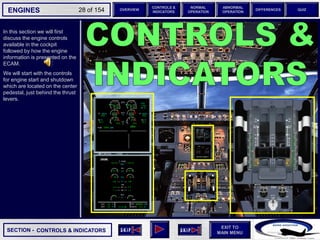
  • 111.
    SECTION - EXIT TO MAINMENU ENGINES OVERVIEW NORMAL OPERATION ABNORMAL OPERATION CONTROLS & INDICATORS DIFFERENCES QUIZ 111 of 154 During taxi out, the E/WD should be checked to ensure the correct thrust mode is displayed (TOGA or FLX). Today, we will be making a FLX takeoff with a pilot entered flex temperature of 35°C. This means that with the thrust levers in the FLX detent the engines will provide the thrust equivalent to that produced using TOGA with a 35°C ambient air temperature. FLX takeoffs significantly extend engine life, use less fuel, and should be considered the normal takeoff power setting. Flex takeoffs will be discussed in more detail during later training. NORMAL OPERATION
  • 112.
    SECTION - EXIT TO MAINMENU ENGINES OVERVIEW NORMAL OPERATION ABNORMAL OPERATION CONTROLS & INDICATORS DIFFERENCES QUIZ 112 of 154 When on the ground at low speed, the FADEC protects against fan flutter by preventing the engine from being stabilized in a range of 60 - 74% N1. Therefore, during engine acceleration on the ground you may notice a non-linear thrust response to thrust lever movement. REL REL NORMAL OPERATION
  • 113.
    SECTION - EXIT TO MAINMENU ENGINES OVERVIEW NORMAL OPERATION ABNORMAL OPERATION CONTROLS & INDICATORS DIFFERENCES QUIZ 113 of 154 Today we will make a FLX takeoff since this is what you will do on the majority of your takeoffs. The first step is to move the thrust levers from idle to approximately 1.1 EPR. Keep in mind that thrust lever position is indicated by the blue circles on the outside of the EPR gauges. Advance to move the thrust levers to 1.1 EPR. NORMAL OPERATION 6 6
  • 114.
    SECTION - EXIT TO MAINMENU ENGINES OVERVIEW NORMAL OPERATION ABNORMAL OPERATION CONTROLS & INDICATORS DIFFERENCES QUIZ 114 of 154 Pausing the thrust levers at 1.1 EPR during the takeoff provides you with an opportunity to ensure that the engines are producing thrust symmetrically and that everything is normal. As both EPR needles approach 1.1 EPR, the thrust levers may be moved to the desired takeoff thrust setting, in this case FLX. It is not necessary to hold the brakes while the engines accelerate to 1.1 EPR or to wait until the thrust actually achieves 1.1 EPR before moving the thrust levers to a takeoff position. Advance to move the thrust levers to the FLX detent. NORMAL OPERATION 6 6
  • 115.
    SECTION - EXIT TO MAINMENU ENGINES OVERVIEW NORMAL OPERATION ABNORMAL OPERATION CONTROLS & INDICATORS DIFFERENCES QUIZ 115 of 154 When takeoff thrust is applied, the ENGINE page replaces the WHEEL page on the SD. Moving the thrust levers to a takeoff position (FLX or TOGA) on the ground automatically arms the autothrust. During takeoff roll, the EPR gauges should be checked to ensure both engines have achieved the EPR displayed in the upper right corner of the E/WD. TOGA thrust is always available by moving the thrust levers to the TOGA position. NORMAL OPERATION 6 6
  • 116.
    SECTION - EXIT TO MAINMENU ENGINES OVERVIEW NORMAL OPERATION ABNORMAL OPERATION CONTROLS & INDICATORS DIFFERENCES QUIZ 116 of 154 At thrust reduction altitude (normally 1500’ AGL), we will move the thrust levers aft to the CL detent. Advance to move the thrust levers to the CL detent. NORMAL OPERATION 6 6
  • 117.
    SECTION - EXIT TO MAINMENU ENGINES OVERVIEW NORMAL OPERATION ABNORMAL OPERATION CONTROLS & INDICATORS DIFFERENCES QUIZ 117 of 154 When the levers are in the CL detent: • Autothrust automatically changes from armed to active. • The thrust limit mode changes to CLB with the corresponding change in EPR rating limit. • After a short delay, the CRUISE page replaces the ENGINE page on the SD. P TAT SAT 0 -7 °C °C H 10 F. USED LBS QT 7200 7200 OIL 16.5 16.5 ENG AIR 2.9 AFT 70 FWD 71 72 63 CAB V/S CAB ALT FT / MIN FT PS I LDG ELEV AUT O F T 100 2000 -100 °F ISA -16 °C GW 111400 LBS CRUISE 1 + 2 14400 VIB N1 N2 0.2 0.1 0.4 CKPT NORMAL OPERATION 6 6
  • 118.
    SECTION - EXIT TO MAINMENU ENGINES OVERVIEW NORMAL OPERATION ABNORMAL OPERATION CONTROLS & INDICATORS DIFFERENCES QUIZ 118 of 154 We are now in cruise flight, the thrust levers are in the CL detent, and autothrust is active. To maintain the desired speed in level flight the autothrust system is commanding an EPR of 1.210. NORMAL OPERATION P TAT SAT 0 -7 °C °C H 10 F. USED LBS QT 7200 7200 OIL 16.5 16.5 ENG AIR 2.9 AFT 70 FWD 71 72 63 CAB V/S CAB ALT FT / MIN FT PS I LDG ELEV AUT O F T 100 2000 -100 °F ISA -16 °C GW 111400 LBS CRUISE 1 + 2 14400 VIB N1 N2 0.2 0.1 0.4 CKPT
  • 119.
    SECTION - EXIT TO MAINMENU ENGINES OVERVIEW NORMAL OPERATION ABNORMAL OPERATION CONTROLS & INDICATORS DIFFERENCES QUIZ 119 of 154 Assume you have just begun a long descent to a lower altitude. With inputs from the FMS, the autothrust has determined that idle thrust is required for the descent. Advance now to see EPR move to idle. Let’s look at this in more detail. NORMAL OPERATION P TAT SAT 0 -7 °C °C H 10 F. USED LBS QT 7200 7200 OIL 16.5 16.5 ENG AIR 2.9 AFT 70 FWD 71 72 63 CAB V/S CAB ALT FT / MIN FT PS I LDG ELEV AUT O F T 100 2000 -100 °F ISA -16 °C GW 111400 LBS CRUISE 1 + 2 14400 VIB N1 N2 0.2 0.1 0.4 CKPT 6 6
  • 120.
    SECTION - EXIT TO MAINMENU ENGINES OVERVIEW NORMAL OPERATION ABNORMAL OPERATION CONTROLS & INDICATORS DIFFERENCES QUIZ 120 of 154 P TAT SAT 0 -7 °C °C H 10 F. USED LBS QT 7200 7200 OIL 16.5 16.5 ENG AIR 2.9 AFT 70 FWD 71 72 63 CAB V/S CAB ALT FT / MIN FT PS I LDG ELEV AUT O F T 100 2000 -100 °F ISA -16 °C GW 111400 LBS CRUISE 1 + 2 14400 VIB N1 N2 0.2 0.1 0.4 CKPT When autothrust is active, green arcs are displayed between the actual EPR and the autothrust commanded EPR value. The green triangle indicates the direction of EPR tendency. When the new EPR value is reached, all these indications, except for the actual EPR, disappear. These indications are only displayed when autothrust is active. Autothrust and the associated indications are covered in more detail in later training. NORMAL OPERATION 6 6 EPR Actual EPR Commanded EPR Trend
  • 121.
    SECTION - EXIT TO MAINMENU ENGINES OVERVIEW NORMAL OPERATION ABNORMAL OPERATION CONTROLS & INDICATORS DIFFERENCES QUIZ 121 of 154 P TAT SAT 0 -7 °C °C H 10 F. USED LBS QT 7200 7200 OIL 16.5 16.5 ENG AIR 2.9 AFT 70 FWD 71 72 63 CAB V/S CAB ALT FT / MIN FT PS I LDG ELEV AUT O F T 100 2000 -100 °F ISA -16 °C GW 111400 LBS CRUISE 1 + 2 14400 VIB N1 N2 0.2 0.1 0.4 CKPT During cruise, descent and approach phases, autothrust is normally active and the thrust levers remain in the CL detent. CRUISE DESCENT APPROACH NORMAL OPERATION CLIMB
  • 122.
    SECTION - EXIT TO MAINMENU ENGINES OVERVIEW NORMAL OPERATION ABNORMAL OPERATION CONTROLS & INDICATORS DIFFERENCES QUIZ 122 of 154 P TAT SAT 0 -7 °C °C H 10 F. USED LBS QT 7200 7200 OIL 16.5 16.5 ENG AIR 2.9 AFT 70 FWD 71 72 63 CAB V/S CAB ALT FT / MIN FT PS I LDG ELEV AUT O F T 100 2000 -100 °F ISA -16 °C GW 111400 LBS CRUISE 1 + 2 14400 VIB N1 N2 0.2 0.1 0.4 CKPT In heavy rain, turbulence, or in other situations it may be advisable to manually activate continuous ignition. Refer to your aircraft manuals for more details. Moving the ENG MODE selector to the IGN/START position when the engines are running activates both igniters in each engine. Advance to move the ENG MODE selector to the IGN/START position. NORMAL OPERATION
  • 123.
    SECTION - EXIT TO MAINMENU ENGINES OVERVIEW NORMAL OPERATION ABNORMAL OPERATION CONTROLS & INDICATORS DIFFERENCES QUIZ 123 of 154 P TAT SAT 0 -7 °C °C H 10 F. USED LBS QT 7200 7200 OIL 16.5 16.5 ENG AIR 2.9 AFT 70 FWD 71 72 63 CAB V/S CAB ALT FT / MIN FT PS I LDG ELEV AUT O F T 100 2000 -100 °F ISA -16 °C GW 111400 LBS CRUISE 1 + 2 14400 VIB N1 N2 0.2 0.1 0.4 CKPT The IGNITION memo is displayed on the E/WD when continuous ignition is activated. NORMAL OPERATION
  • 124.
    SECTION - EXIT TO MAINMENU ENGINES OVERVIEW NORMAL OPERATION ABNORMAL OPERATION CONTROLS & INDICATORS DIFFERENCES QUIZ 124 of 154 We are now ready to land. During landing the pilot will move the thrust levers to IDLE. There is a RETARD auto callout to remind the crew if this has not been done. Advance to move the thrust levers to idle. NORMAL OPERATION
  • 125.
    SECTION - EXIT TO MAINMENU ENGINES OVERVIEW NORMAL OPERATION ABNORMAL OPERATION CONTROLS & INDICATORS DIFFERENCES QUIZ 125 of 154 Moving the thrust levers to idle disengages the autothrust and returns the thrust to manual operation. Select reverse thrust after main gear touchdown. Advance to select reverse thrust. NORMAL OPERATION
  • 126.
    SECTION - EXIT TO MAINMENU ENGINES OVERVIEW NORMAL OPERATION ABNORMAL OPERATION CONTROLS & INDICATORS DIFFERENCES QUIZ 126 of 154 REV is displayed in amber when the reversers are unstowed. REV is displayed in green when the reversers are fully deployed. Notice that the thrust limit mode on the E/WD now displays MREV. Except on slippery runways, if one reverser fails to deploy properly the good reverser can still be used. Advance to select FULL reverse thrust. NORMAL OPERATION
  • 127.
    SECTION - EXIT TO MAINMENU ENGINES OVERVIEW NORMAL OPERATION ABNORMAL OPERATION CONTROLS & INDICATORS DIFFERENCES QUIZ 127 of 154 Both engines are now producing the max reverse thrust setting of 1.180 EPR. Max reverse thrust is available down to 70 Knots. No later than 70 knots you should move the thrust levers to reverse idle and then to the idle stop. Advance to move the thrust levers to the reverse idle position. NORMAL OPERATION
  • 128.
    SECTION - EXIT TO MAINMENU ENGINES OVERVIEW NORMAL OPERATION ABNORMAL OPERATION CONTROLS & INDICATORS DIFFERENCES QUIZ 128 of 154 The thrust levers are now in the reverse idle detent. Advance to move the thrust levers to the forward idle stop. NORMAL OPERATION
  • 129.
    SECTION - EXIT TO MAINMENU ENGINES OVERVIEW NORMAL OPERATION ABNORMAL OPERATION CONTROLS & INDICATORS DIFFERENCES QUIZ 129 of 154 The thrust levers are now at the idle stop and the reversers are stowed. NORMAL OPERATION
  • 130.
    SECTION - EXIT TO MAINMENU ENGINES OVERVIEW NORMAL OPERATION ABNORMAL OPERATION CONTROLS & INDICATORS DIFFERENCES QUIZ 130 of 154 We are now at the gate. It’s time to shut down the engines. To do that, the corresponding ENG MASTER switches must be selected OFF. If unable to shut down an engine using the ENG MASTER switch, the engine could (in usual circumstances) be shut down using the respective ENG FIRE pb on the overhead, which closes the LP fuel valve. If an ENG FIRE pb is used to shut down an engine, there is a delay of approximately 40 seconds before the engine shuts down. This is because it takes time to burn the fuel remaining between the LP fuel valve and the engine. NORMAL OPERATION
  • 131.
    SECTION - EXIT TO MAINMENU ENGINES OVERVIEW NORMAL OPERATION ABNORMAL OPERATION CONTROLS & INDICATORS DIFFERENCES QUIZ 131 of 154 Let’s take a look at some abnormal operations. In this section we will cover the indications of specific failures and detail their consequences. As you perform the steps required to deal with these selected failures you will gain a better understanding of the system. ABNORMAL OPERATION
  • 132.
    SECTION - EXIT TO MAINMENU ENGINES OVERVIEW NORMAL OPERATION ABNORMAL OPERATION CONTROLS & INDICATORS DIFFERENCES QUIZ 132 of 154 We will begin with a demonstration of an abnormal engine start. We are at the gate with all the flows and checklists complete up to engine start. Advance to rotate the ENG MODE selector to IGN/START. ABNORMAL OPERATION
  • 133.
    SECTION - EXIT TO MAINMENU ENGINES OVERVIEW NORMAL OPERATION ABNORMAL OPERATION CONTROLS & INDICATORS DIFFERENCES QUIZ 133 of 154 Continue the procedure by selecting ENG 2 MASTER switch ON. ABNORMAL OPERATION
  • 134.
    SECTION - EXIT TO MAINMENU ENGINES OVERVIEW NORMAL OPERATION ABNORMAL OPERATION CONTROLS & INDICATORS DIFFERENCES QUIZ 134 of 154 Initially you see all the indications you have observed before, including: • Fuel used reset to zero • The start valve opens • N2 increases • Oil pressure increases • Within 30 seconds, an igniter is displayed, in this case igniter B, and fuel flow begins. ABNORMAL OPERATION
  • 135.
    SECTION - EXIT TO MAINMENU ENGINES OVERVIEW NORMAL OPERATION ABNORMAL OPERATION CONTROLS & INDICATORS DIFFERENCES QUIZ 135 of 154 You hear a single chime and the MASTER CAUT light illuminates. We have extinguished the MASTER CAUT for you. On the ENG panel, the ENG 2 FAULT light illuminates indicating that the automatic start has been aborted. The ECAM message confirms this. The NEW START IN PROGRESS message is NOT an action step. It indicates that the FADEC has detected a problem during an automatic start and is taking steps to attempt to correct the problem and accomplish a successful start. ABNORMAL OPERATION
  • 136.
    SECTION - EXIT TO MAINMENU ENGINES OVERVIEW NORMAL OPERATION ABNORMAL OPERATION CONTROLS & INDICATORS DIFFERENCES QUIZ 136 of 154 The FADEC will abort an automatic start on the ground for many reasons. It is not necessary for you to memorize them, but it is important that you understand that the FADEC is watching for numerous abnormalities during start, including: • Starter time exceeded • Impending EGT overtemp • No light off • Lower than normal N1 • Starter failure • Hung start The ECAM will display the same START FAULT message if any these start problems occur. The FADEC can abort an automatic start on the ground if any of the following occur: • Starter time exceeded • Impending EGT overtemp • No light off • Lower than normal N1 • Starter failure • Hung start ABNORMAL OPERATION
  • 137.
    SECTION - EXIT TO MAINMENU ENGINES OVERVIEW NORMAL OPERATION ABNORMAL OPERATION CONTROLS & INDICATORS DIFFERENCES QUIZ 137 of 154 Watch what FADEC does to attempt to get the engine started. Automatically the FADEC shuts off the fuel and turns off the ignition. After 30 seconds of dry crank, a new start is launched. Advance to observe the next start attempt. 30 SECONDS ABNORMAL OPERATION
  • 138.
    SECTION - EXIT TO MAINMENU ENGINES OVERVIEW NORMAL OPERATION ABNORMAL OPERATION CONTROLS & INDICATORS DIFFERENCES QUIZ 138 of 154 Both igniters A and B are now activated and the fuel flow begins. If the FADEC is successful in getting the engine started, the ECAM message will be removed and the FAULT light will extinguish. ABNORMAL OPERATION
  • 139.
    SECTION - EXIT TO MAINMENU ENGINES OVERVIEW NORMAL OPERATION ABNORMAL OPERATION CONTROLS & INDICATORS DIFFERENCES QUIZ 139 of 154 If the second start attempt is unsuccessful, or if FADEC makes no further attempts to start the engine, the ECAM will reflect that the start was aborted. Notice that the igniters have been deactivated and the start valve has closed. On the ECAM a secondary message is displayed indicating that the start fault is due to NO LIGHT UP. An action step is now displayed directing you to select the ENG MASTER OFF. The display of this action step confirms that FADEC has given up trying to start the engine. Advance to select the ENG 2 MASTER switch OFF. ABNORMAL OPERATION
  • 140.
    SECTION - EXIT TO MAINMENU ENGINES OVERVIEW NORMAL OPERATION ABNORMAL OPERATION CONTROLS & INDICATORS DIFFERENCES QUIZ 140 of 154 At this point you would seek assistance from maintenance. Now let’s look at another abnormal. ABNORMAL OPERATION
  • 141.
    SECTION - EXIT TO MAINMENU ENGINES OVERVIEW NORMAL OPERATION ABNORMAL OPERATION CONTROLS & INDICATORS DIFFERENCES QUIZ 141 of 154 Here we have a loss of EPR mode in flight. If EPR mode is lost, the effected FADEC automatically reverts to N1 mode. During cruise you hear a single chime and the MASTER CAUT lights illuminate. We have extinguished the MASTER CAUT light for you. P TAT SAT 0 -7 °C °C H 10 F. USED LBS QT 7200 7200 OIL 16.5 16.5 ENG AIR 2.9 AFT 70 FWD 71 72 63 CAB V/S CAB ALT FT / MIN FT PS I LDG ELEV AUT O F T 100 2000 -100 °F ISA -16 °C GW 111400 LBS CRUISE 1 + 2 14400 VIB N1 N2 0.2 0.1 0.4 CKPT ABNORMAL OPERATION
  • 142.
    SECTION - EXIT TO MAINMENU ENGINES OVERVIEW NORMAL OPERATION ABNORMAL OPERATION CONTROLS & INDICATORS DIFFERENCES QUIZ 142 of 154 The first message relates to the loss of autothrust. Autothrust is lost if EPR mode is lost on either engine. If autothrust fails for any reason, thrust is locked at the current setting. The thrust will remain locked at the current setting until a thrust lever is moved or autothrust is restored. When you accomplish the action step and move the thrust levers out of the CL detent you transition to manual thrust operation. Before we take that step, let’s look at how the other indications on the E/WD have changed. P TAT SAT 0 -7 °C °C H 10 F. USED LBS QT 7200 7200 OIL 16.5 16.5 ENG AIR 2.9 AFT 70 FWD 71 72 63 CAB V/S CAB ALT FT / MIN FT PS I LDG ELEV AUT O F T 100 2000 -100 °F ISA -16 °C GW 111400 LBS CRUISE 1 + 2 14400 VIB N1 N2 0.2 0.1 0.4 CKPT A/THR THRUST LOCK MODE ABNORMAL OPERATION
  • 143.
    SECTION - EXIT TO MAINMENU ENGINES OVERVIEW NORMAL OPERATION ABNORMAL OPERATION CONTROLS & INDICATORS DIFFERENCES QUIZ 143 of 154 NOTE: The REV indications, both green and amber, remain available when needed. The engine 1 EPR gauge is amber. The EPR needle is removed and the digital readout is replaced by amber XXs. All these indications show that engine 1 EPR mode is lost. Changes have also occurred on the engine 1 N1 gauge. The blue circle representing thrust lever position is now displayed on the N1 gauge. A gray box now surrounds the digital N1 indication. An amber tick mark now appears on the N1 gauge indicating the N1 TOGA limit. The amber tick mark will move to indicate the max reverse N1 limit when reverse thrust is used. Reverser status is still indicated on the EPR gauges. ABNORMAL OPERATION EPR FAILURE GRAY BOX (added) THRUST LEVER POSITION (added) N1 TOGA LIMIT (added)
  • 144.
    SECTION - EXIT TO MAINMENU ENGINES OVERVIEW NORMAL OPERATION ABNORMAL OPERATION CONTROLS & INDICATORS DIFFERENCES QUIZ 144 of 154 P TAT SAT 0 -7 °C °C H 10 F. USED LBS QT 7200 7200 OIL 16.5 16.5 ENG AIR 2.9 AFT 70 FWD 71 72 63 CAB V/S CAB ALT FT / MIN FT PS I LDG ELEV AUT O F T 100 2000 -100 °F ISA -16 °C GW 111400 LBS CRUISE 1 + 2 14400 VIB N1 N2 0.2 0.1 0.4 CKPT We have now moved the thrust levers and are controlling thrust manually. We are now ready to perform the next ECAM actions items. Advance to push the ENG 1 N1 MODE pb. The ON light in the N1 MODE pb is now illuminated. Advance to push the ENG 2 N1 MODE pb. ABNORMAL OPERATION
  • 145.
    SECTION - EXIT TO MAINMENU ENGINES OVERVIEW NORMAL OPERATION ABNORMAL OPERATION CONTROLS & INDICATORS DIFFERENCES QUIZ 145 of 154 P TAT SAT 0 -7 °C °C H 10 F. USED LBS QT 7200 7200 OIL 16.5 16.5 ENG AIR 2.9 AFT 70 FWD 71 72 63 CAB V/S CAB ALT FT / MIN FT PS I LDG ELEV AUT O F T 100 2000 -100 °F ISA -16 °C GW 111400 LBS CRUISE 1 + 2 14400 VIB N1 N2 0.2 0.1 0.4 CKPT The engine 2 EPR gauge turns amber indicating that the EPR MODE is lost. The N1 indications are now the same for both engines. Once both engines are operating in N1 mode, the EPR limit mode is replaced by the N1 limit mode and the current N1 limit. It indicates that both engines are now controlled using N1. Display of the N1limit mode and the current limit indicates that the engines are operating in RATED N1 mode. As the remaining blue action step indicates, it is now necessary to control thrust manually for the rest of the flight. ABNORMAL OPERATION The amber EPR gauges indicates that EPR mode is now lost for both engines. The N1 indications are now the same for both engines. Display of the N1 limit mode and current limit indicates that both engines are operating in rated N1 mode.
  • 146.
    SECTION - EXIT TO MAINMENU ENGINES OVERVIEW NORMAL OPERATION ABNORMAL OPERATION CONTROLS & INDICATORS DIFFERENCES QUIZ 146 of 154 P TAT SAT 0 -7 °C °C H 10 F. USED LBS QT 7200 7200 OIL 16.5 16.5 ENG AIR 2.9 AFT 70 FWD 71 72 63 CAB V/S CAB ALT FT / MIN FT PS I LDG ELEV AUT O F T 100 2000 -100 °F ISA -16 °C GW 111400 LBS CRUISE 1 + 2 14400 VIB N1 N2 0.2 0.1 0.4 CKPT What you have just seen is an example of loss of EPR mode that results in using rated N1 mode. Depending on the nature of the malfunction that caused the loss of EPR mode, the system may revert to UNRATED N1 mode, shown here. Notice that the max N1 tick mark is not displayed on the N1 gauge. In unrated N1 mode, the N1 limit mode and the current limit are replace by amber XXs. FADEC overspeed protections are reduced in the UNRATED N1 mode of operation. It is possible to exceed certain engine limitations in unrated N1 mode. UNRATED N1 MODE ABNORMAL OPERATION N1 limit removed
  • 147.
    SECTION - EXIT TO MAINMENU ENGINES OVERVIEW NORMAL OPERATION ABNORMAL OPERATION CONTROLS & INDICATORS DIFFERENCES QUIZ 147 of 154 Let’s briefly look at some other abnormal engine indications you might see. Here we have an a clog in engine 1 oil filter. Notice that there are no action items to perform. On the ENGINE page, which is displayed automatically, an oil filter CLOG indication is displayed. You would clear the ECAM and refer to your aircraft manuals. P TAT SAT 0 -7 °C °C H 10 F. USED LBS QT 7200 7200 OIL 16.5 16.5 ENG AIR 2.9 AFT 70 FWD 71 72 63 CAB V/S CAB ALT FT / MIN FT PS I LDG ELEV AUT O F T 100 2000 -100 °F ISA -16 °C GW 111400 LBS CRUISE 1 + 2 14400 VIB N1 N2 0.2 0.1 0.4 CKPT ABNORMAL OPERATION Oil filter clog
  • 148.
    SECTION - EXIT TO MAINMENU ENGINES OVERVIEW NORMAL OPERATION ABNORMAL OPERATION CONTROLS & INDICATORS DIFFERENCES QUIZ 148 of 154 The same type of problem can occur with the engine fuel system. Here we have an engine 2 fuel filter clog. Again, you would clear the ECAM and refer to your aircraft manuals. ABNORMAL OPERATION Fuel filter clog
  • 149.
    SECTION - EXIT TO MAINMENU ENGINES OVERVIEW NORMAL OPERATION ABNORMAL OPERATION CONTROLS & INDICATORS DIFFERENCES QUIZ 149 of 154 Low oil pressure has been detected in engine 1. The CRC sounds and the MASTER WARN lights flash. We have cancelled them for you. The associated message and checklist are displayed on the E/WD. The ENGINE page is displayed automatically. Notice that the engine 1 oil pressure is displayed in red indicating that the oil pressure is too low. The procedure is to verify the low oil pressure by checking the ENGINE page and then shut down the engine. Low oil pressure ABNORMAL OPERATION
  • 150.
    SECTION - EXIT TO MAINMENU ENGINES OVERVIEW NORMAL OPERATION ABNORMAL OPERATION CONTROLS & INDICATORS DIFFERENCES QUIZ 150 of 154 P TAT SAT 0 -7 °C °C H 10 F. USED LBS QT 7200 7200 OIL 16.5 16.5 ENG AIR 2.9 AFT 70 FWD 71 72 63 CAB V/S CAB ALT FT / MIN FT PS I LDG ELEV AUT O F T 100 2000 -100 °F ISA -16 °C GW 111400 LBS CRUISE 1 + 2 14400 VIB N1 N2 0.2 0.1 0.4 CKPT Next, we will demonstrate an engine EGT overlimit in cruise. The engine 2 EGT has increased above the normal range. Notice the amber EGT indications. Engine EGT overlimit ABNORMAL OPERATION
  • 151.
    SECTION - EXIT TO MAINMENU ENGINES OVERVIEW NORMAL OPERATION ABNORMAL OPERATION CONTROLS & INDICATORS DIFFERENCES QUIZ 151 of 154 P TAT SAT 0 -7 °C °C H 10 F. USED LBS QT 7200 7200 OIL 16.5 16.5 ENG AIR 2.9 AFT 70 FWD 71 72 63 CAB V/S CAB ALT FT / MIN FT PS I LDG ELEV AUT O F T 100 2000 -100 °F ISA -16 °C GW 111400 LBS CRUISE 1 + 2 14400 VIB N1 N2 0.2 0.1 0.4 CKPT The EGT has continued to increase and the EGT indication is now red. The only ECAM action is to move the thrust lever until the EGT is within limits. Advance to reduce the engine 2 thrust lever. ABNORMAL OPERATION Engine EGT overlimit
  • 152.
    SECTION - EXIT TO MAINMENU ENGINES OVERVIEW NORMAL OPERATION ABNORMAL OPERATION CONTROLS & INDICATORS DIFFERENCES QUIZ 152 of 154 P TAT SAT 0 -7 °C °C H 10 F. USED LBS QT 7200 7200 OIL 16.5 16.5 ENG AIR 2.9 AFT 70 FWD 71 72 63 CAB V/S CAB ALT FT / MIN FT PS I LDG ELEV AUT O F T 100 2000 -100 °F ISA -16 °C GW 111400 LBS CRUISE 1 + 2 14400 VIB N1 N2 0.2 0.1 0.4 CKPT The EGT has now decreased and indication has changed from red to green. The highest EGT achieved is indicated by a red tick mark on the gauge. That concludes the ABNORMAL OPERATION section. ABNORMAL OPERATION Engine EGT overlimit Red tick mark indicates the highest EGT achieved, remains until either: - Next engine start on the ground - Reset by maintenance
  • 153.
    SECTION - EXIT TO MAINMENU ENGINES OVERVIEW NORMAL OPERATION ABNORMAL OPERATION CONTROLS & INDICATORS DIFFERENCES QUIZ 153 of 154 Let’s take a look at some of the A321 engine differences. Remember that both the A319 and A321 are equipped with IAE V2500-A5 series engines. The A319 engine is simply a de-rated version. A319s are equipped with V2524-A5 engines capable of producing up to 24,000 lbs of thrust. A321s are equipped with V2533-A5 engines capable of producing up to 32,500 lbs of thrust. You will also notice differences in EGT limits on an A319 vs. an A321. Refer to your aircraft manuals for this information. DIFFERENCES
  • 154.
    SECTION - EXIT TO MAINMENU ENGINES OVERVIEW NORMAL OPERATION ABNORMAL OPERATION CONTROLS & INDICATORS DIFFERENCES QUIZ 154 of 154 You will also notice some differences on aircraft equipped with LCD style displays vs. CRT style displays. The information displayed is nearly identical, but the locations and appearance are slightly different. You might also notice that the thrust lever position is a blue “donut” on the LCD style displays and white on the CRT style. DIFFERENCES LCD style E/WD and ENGINE page CRT style E/WD and ENGINE page
  • 155.
    SECTION - EXIT TO MAINMENU OVERVIEW NORMAL OPERATION ABNORMAL OPERATION CONTROLS & INDICATORS DIFFERENCES QUIZ QUIZ ENGINES
  • 156.
    SECTION - EXIT TO MAINMENU OVERVIEW NORMAL OPERATION ABNORMAL OPERATION CONTROLS & INDICATORS DIFFERENCES QUIZ QUIZ ENGINES Any manual setting. Takeoffs can be performed using which power settings? FLEX or TOGA. CLIMB and TOGA. Only MCT.
  • 157.
    SECTION - EXIT TO MAINMENU OVERVIEW NORMAL OPERATION ABNORMAL OPERATION CONTROLS & INDICATORS DIFFERENCES QUIZ QUIZ ENGINES Any manual setting. Takeoffs can be performed using which power settings? FLEX or TOGA. CLIMB and TOGA. Only MCT.
  • 158.
    SECTION - EXIT TO MAINMENU OVERVIEW NORMAL OPERATION ABNORMAL OPERATION CONTROLS & INDICATORS DIFFERENCES QUIZ QUIZ ENGINES You are about to perform a takeoff. You have not inserted a FLEX temperature. Can you still take-off? Yes, but only using the TOGA detent. Yes, by setting the thrust levers to the FLEX/MCT detent. Yes, by setting the thrust levers to the CLIMB detent. Not until a FLEX temperature is inserted.
  • 159.
    SECTION - EXIT TO MAINMENU OVERVIEW NORMAL OPERATION ABNORMAL OPERATION CONTROLS & INDICATORS DIFFERENCES QUIZ QUIZ ENGINES You are about to perform a takeoff. You have not inserted a FLEX temperature. Can you still take-off? Yes, but only using the TOGA detent. Yes, by setting the thrust levers to the FLEX/MCT detent. Yes, by setting the thrust levers to the CLIMB detent. Not until a FLEX temperature is inserted.
  • 160.
    SECTION - EXIT TO MAINMENU OVERVIEW NORMAL OPERATION ABNORMAL OPERATION CONTROLS & INDICATORS DIFFERENCES QUIZ QUIZ ENGINES Yes, igniters are used alternatively for engine start, in this case B. Yes, igniter B is always used for ENG 2 start. No, normally both igniters are used for all engine starts. Yes, igniter A is only used for engine anti ice. During the automatic start sequence of ENG 2, you notice that only igniter B is powered. Is this normal?
  • 161.
    SECTION - EXIT TO MAINMENU OVERVIEW NORMAL OPERATION ABNORMAL OPERATION CONTROLS & INDICATORS DIFFERENCES QUIZ QUIZ ENGINES Yes, igniters are used alternatively for engine start, in this case B. Yes, igniter B is always used for ENG 2 start. No, normally both igniters are used for all engine starts. Yes, igniter A is only used for engine anti ice. During the automatic start sequence of ENG 2, you notice that only igniter B is powered. Is this normal?
  • 162.
    SECTION - EXIT TO MAINMENU OVERVIEW NORMAL OPERATION ABNORMAL OPERATION CONTROLS & INDICATORS DIFFERENCES QUIZ QUIZ ENGINES You are performing a takeoff with the thrust levers in the FLEX detent. Is autothrust now active? Yes No
  • 163.
    SECTION - EXIT TO MAINMENU OVERVIEW NORMAL OPERATION ABNORMAL OPERATION CONTROLS & INDICATORS DIFFERENCES QUIZ QUIZ ENGINES In the FLEX detent autothrust is armed but not active. You are performing a takeoff with the thrust levers in the FLEX detent. Is autothrust now active? Yes No
  • 164.
    SECTION - EXIT TO MAINMENU OVERVIEW NORMAL OPERATION ABNORMAL OPERATION CONTROLS & INDICATORS DIFFERENCES QUIZ QUIZ ENGINES After takeoff the autothrust will not become active until… The A/THR pb is manually selected on. An autopilot is engaged. The thrust levers are moved out of the TO/GA or FLEX/MCT detents. The thrust levers are placed in the active range (e.g., CL detent).
  • 165.
    SECTION - EXIT TO MAINMENU OVERVIEW NORMAL OPERATION ABNORMAL OPERATION CONTROLS & INDICATORS DIFFERENCES QUIZ QUIZ ENGINES After takeoff the autothrust will not become active until… The A/THR pb is manually selected on. An autopilot is engaged. The thrust levers are moved out of the TO/GA or FLEX/MCT detents. The thrust levers are placed in the active range (e.g., CL detent).
  • 166.
    SECTION - EXIT TO MAINMENU OVERVIEW NORMAL OPERATION ABNORMAL OPERATION CONTROLS & INDICATORS DIFFERENCES QUIZ QUIZ ENGINES You are at the start of a descent and the EPR gauges look like you see here. When does this occur? Whenever there is a power change with autothrust engaged. Whenever there is a power change with the autopilot engaged. Whenever there is a power change in manual thrust. Whenever the thrust levers are moved out of the CL detent.
  • 167.
    SECTION - EXIT TO MAINMENU OVERVIEW NORMAL OPERATION ABNORMAL OPERATION CONTROLS & INDICATORS DIFFERENCES QUIZ QUIZ ENGINES You are at the start of a descent and the EPR gauges look like you see here. When does this occur? Whenever there is a power change with autothrust engaged. Whenever there is a power change with the autopilot engaged. Whenever there is a power change in manual thrust. Whenever the thrust levers are moved out of the CL detent.
  • 168.
    SECTION - EXIT TO MAINMENU OVERVIEW NORMAL OPERATION ABNORMAL OPERATION CONTROLS & INDICATORS DIFFERENCES QUIZ QUIZ ENGINES After landing you select reverse thrust and the following indications are displayed. What is happening? This is the normal indication while the reversers are in transit. The reversers are stuck. This is the normal indication when the reversers are fully deployed. The reversers are faulty and must be de-selected.
  • 169.
    SECTION - EXIT TO MAINMENU OVERVIEW NORMAL OPERATION ABNORMAL OPERATION CONTROLS & INDICATORS DIFFERENCES QUIZ QUIZ ENGINES After landing you select reverse thrust and the following indications are displayed. What is happening? This is the normal indication while the reversers are in transit. The reversers are stuck. This is the normal indication when the reversers are fully deployed. The reversers are faulty and must be de-selected.
  • 170.
    SECTION - EXIT TO MAINMENU OVERVIEW NORMAL OPERATION ABNORMAL OPERATION CONTROLS & INDICATORS DIFFERENCES QUIZ QUIZ ENGINES A few seconds after selecting reverse thrust, the amber REV indication changes to green. What does this mean? The reversers are unlocked. The reverse thrust selection has been acknowledged. The reversers are now fully deployed. The reversers have been re-stowed.
  • 171.
    SECTION - EXIT TO MAINMENU OVERVIEW NORMAL OPERATION ABNORMAL OPERATION CONTROLS & INDICATORS DIFFERENCES QUIZ QUIZ ENGINES A few seconds after selecting reverse thrust, the amber REV indication changes to green. What does this mean? The reversers are unlocked. The reverse thrust selection has been acknowledged. The reversers are now fully deployed. The reversers have been re-stowed.
  • 172.
    SECTION - EXIT TO MAINMENU OVERVIEW NORMAL OPERATION ABNORMAL OPERATION CONTROLS & INDICATORS DIFFERENCES QUIZ QUIZ ENGINES Under normal circumstances, which of the following crew actions energizes the FADECs? Selecting an ENG MASTER switch ON Selecting the ENG MODE selector to IGN/START Selecting a N1 MODE pb ON Selecting a MAN START pb ON
  • 173.
    SECTION - EXIT TO MAINMENU OVERVIEW NORMAL OPERATION ABNORMAL OPERATION CONTROLS & INDICATORS DIFFERENCES QUIZ QUIZ ENGINES Under normal circumstances, which of the following crew actions energizes the FADECs? Selecting an ENG MASTER switch ON Selecting the ENG MODE selector to IGN/START Selecting a N1 MODE pb ON Selecting a MAN START pb ON
  • 174.
    SECTION - EXIT TO MAINMENU OVERVIEW NORMAL OPERATION ABNORMAL OPERATION CONTROLS & INDICATORS DIFFERENCES QUIZ QUIZ ENGINES Both igniters are always used for every start. Engine anti-ice has been selected on Prior to engine start. This is a manual start. Both igniters are always used for a manual start. The FADEC is testing both igniters before selecting the one to be used. Why are both igniters powered during this ENG 2 start sequence?
  • 175.
    SECTION - EXIT TO MAINMENU OVERVIEW NORMAL OPERATION ABNORMAL OPERATION CONTROLS & INDICATORS DIFFERENCES QUIZ QUIZ ENGINES Both igniters are always used for every start. Engine anti-ice has been selected on Prior to engine start. This is a manual start. Both igniters are always used for a manual start. The FADEC is testing both igniters before selecting the one to be used. Why are both igniters powered during this ENG 2 start sequence?
  • 176.
    SECTION - EXIT TO MAINMENU OVERVIEW NORMAL OPERATION ABNORMAL OPERATION CONTROLS & INDICATORS DIFFERENCES QUIZ QUIZ ENGINES That there is a failure in the engine fire extinguishing system. That there is a failure of the ENG MODE selector. That there is a failure in the automatic start sequence. During engine start the amber FAULT light on the ENG panel illuminates. This indicates...
  • 177.
    SECTION - EXIT TO MAINMENU OVERVIEW NORMAL OPERATION ABNORMAL OPERATION CONTROLS & INDICATORS DIFFERENCES QUIZ QUIZ ENGINES That there is a failure in the engine fire extinguishing system. That there is a failure of the ENG MODE selector. That there is a failure in the automatic start sequence. During engine start the amber FAULT light on the ENG panel illuminates. This indicates...
  • 178.
    SECTION - EXIT TO MAINMENU OVERVIEW NORMAL OPERATION ABNORMAL OPERATION CONTROLS & INDICATORS DIFFERENCES QUIZ QUIZ ENGINES You are in the middle of a manual engine start. Which of the following will occur when you select ENG MASTER 2 ON? The fuel used is reset, one igniter is powered and fuel flow is indicated. The fuel used is reset, both igniters are powered and fuel flow is indicated. The fuel used is reset, fuel flow is indicated, and the IGNITION message is displayed on the E/WD. The fuel used is reset, both igniters are powered and EPR increases.
  • 179.
    SECTION - EXIT TO MAINMENU OVERVIEW NORMAL OPERATION ABNORMAL OPERATION CONTROLS & INDICATORS DIFFERENCES QUIZ QUIZ ENGINES You are in the middle of a manual engine start. Which of the following will occur when you select ENG MASTER 2 ON? The fuel used is reset, one igniter is powered and fuel flow is indicated. The fuel flow is reset, both igniters are powered and fuel used is indicated. The fuel used is reset, fuel flow is indicated, and the IGNITION message is displayed on the E/WD. The fuel used is reset, both igniters are powered and EPR increases.
  • 180.
    SECTION - EXIT TO MAINMENU OVERVIEW NORMAL OPERATION ABNORMAL OPERATION CONTROLS & INDICATORS DIFFERENCES QUIZ QUIZ ENGINES During a manual start, what function does the FADEC perform? The FADEC doesn’t perform any function during a manual start. All actions must be carried out by the crew. To control the start sequence and take corrective action in case of a failure or malfunction. Passive monitoring of the start sequence, to close the start valve and cut off the ignition on the ground.
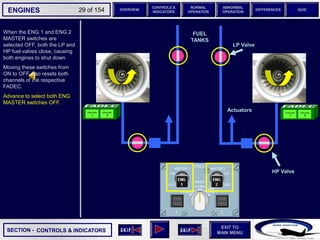
  • 181.
    SECTION - EXIT TO MAINMENU OVERVIEW NORMAL OPERATION ABNORMAL OPERATION CONTROLS & INDICATORS DIFFERENCES QUIZ QUIZ ENGINES During a manual start, what function does the FADEC perform? The FADEC doesn’t perform any function during a manual start. All actions must be carried out by the crew. To control the start sequence and take corrective action in case of a failure or malfunction. Passive monitoring of the start sequence, to close the start valve and cut off the ignition on the ground.
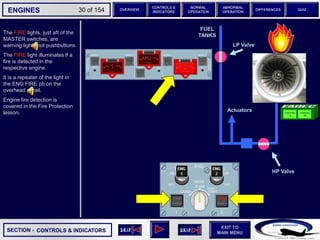
  • 182.
    SECTION - EXIT TO MAINMENU OVERVIEW NORMAL OPERATION ABNORMAL OPERATION CONTROLS & INDICATORS DIFFERENCES QUIZ QUIZ ENGINES During an engine start sequence the gray background on N2 the indication disappears at about 58%. What does this indicate? That the start valve air pressure has dropped. That the start sequence is complete. That the igniters are no longer being powered. That there is a start fault and a dry crank is in progress.
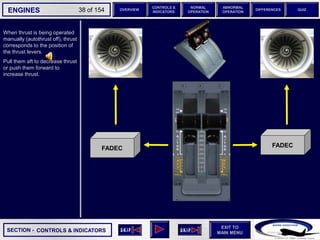
  • 183.
    SECTION - EXIT TO MAINMENU OVERVIEW NORMAL OPERATION ABNORMAL OPERATION CONTROLS & INDICATORS DIFFERENCES QUIZ QUIZ ENGINES During an engine start sequence the gray background on N2 the indication disappears at about 58%. What does this indicate? That the start valve air pressure has dropped. That the start sequence is complete. That the igniters are no longer being powered. That there is a start fault and a dry crank is in progress.
  • 184.
    SECTION - EXIT TO MAINMENU OVERVIEW NORMAL OPERATION ABNORMAL OPERATION CONTROLS & INDICATORS DIFFERENCES QUIZ QUIZ ENGINES Which steps of a manual start are being taken care of by the FADEC? Starter valve closure and ignition start. Starter valve opening and ignition start. Starter valve closure and ignition cut off. Starter valve opening and ignition cut off.
  • 185.
    SECTION - EXIT TO MAINMENU OVERVIEW NORMAL OPERATION ABNORMAL OPERATION CONTROLS & INDICATORS DIFFERENCES QUIZ QUIZ ENGINES Which steps of a manual start are being taken care of by the FADEC? Starter valve closure and ignition start. Starter valve opening and ignition start. Starter valve closure and ignition cut off. Starter valve opening and ignition cut off.
  • 186.
    SECTION - EXIT TO MAINMENU OVERVIEW NORMAL OPERATION ABNORMAL OPERATION CONTROLS & INDICATORS DIFFERENCES QUIZ QUIZ ENGINES You have completed the Engines lesson. QUIZ Click here to exit to the main menu.