DIGITAL IMAGE
PROCESSING
Presented by
Gayathry Satheesan
1DIGITAL IMAGE PROCESSING
Digital image processing
• In computer science, digital image processing is the use of
computer algorithms to perform image processing on digital images.
• As a subcategory or field of digital signal processing, digital image
processing has many advantages over analog image processing.
• It allows a much wider range of algorithms to be applied to the input
data and can avoid problems such as the build-up of noise and signal
distortion during processing.
• Since images are defined over two dimensions (perhaps more) digital
image processing may be modeled in the form of multidimensional
systems.
2DIGITAL IMAGE PROCESSING
History
• Many of the techniques of digital image processing, or digital picture
processing as it often was called, were developed in the 1960s at the Jet
Propulsion Laboratory, with application to satellite imagery, wire-photo
standards conversion, medical imaging. videophone, character recognition
,and photograph enhancement.
• The purpose of early image processing was to improve the quality of the
image.
• It was aimed at human beings to improve the visual effect of people.
• In image processing, the input is a low-quality image, and the out put is an
image with improved quality.
• Common image processing include image enhancement, restoration,
encoding, and compression.
3DIGITAL IMAGE PROCESSING
• The first successful application was the American Jet Propulsion
Laboratory (JPL).
• They used image processing techniques such as geometric
correction, gradation transformation, noise removal, etc. on the
thousands of lunar photos sent back by the Space Detector Ranger
7 in 1964, taking into account the position of the sun and the
environment of the moon.
• The impact of the successful mapping of the moon's surface map
by the computer has been a huge success.
•
4DIGITAL IMAGE PROCESSING
• Later, more complex image processing was performed on the
nearly 100,000 photos sent back by the spacecraft, so that the
topographic map, color map and panoramic mosaic of the moon
were obtained, which achieved extraordinary results and laid a
solid foundation for human landing on the moon.
• Roliferate as affordable computers and dedicated hardware were
becoming available.
• This led to images being processed in real-time, for some
dedicated problems such as television standards conversion.
5DIGITAL IMAGE PROCESSING
• As general-purpose computers became faster, they started to take
over the role of dedicated hardware for all but the most
specialized and computer-intensive operations.
• With the fast computers and signal processors available in the
2000s, digital image processing has become the most common
form of image processing, and is generally used because it is not
only the most versatile method, but also the cheapest.
• Digital image processing technology for medical applications was
inducted into the Space Foundation Space Technology Hall of
Fame in 1994.[4]
6DIGITAL IMAGE PROCESSING
• Image sensors
• The basis for modern image sensors is metal-oxide-
semiconductor (MOS) technology, which originates from the invention
of the MOSFET (MOS field-effect transistor) by Mohamed
M,Atalla and Dawon Kahng at Bell Labs in 1959.
• This led to the development of digital semiconductor image sensors,
including the charge-coupled device (CCD) and later the CMOS sensor.
• The charge-coupled device was invented by Willard S.
Boyle and George E. Smith at Bell Labs in 1969.
7DIGITAL IMAGE PROCESSING
• While researching MOS technology, they realized that an electric
charge was the analogy of the magnetic bubble and that it could be
stored on a tiny MOS capacitor.
• As it was fairly straight forward to fabricate a series of MOS
capacitors in a row, they connected a suitable voltage to them so that
the charge could be stepped along from one to the next.
• The CCD is a semiconductor circuit that was later used in the
first digital video cameras for television broadcasting.
• The NMOS active-pixel sensor (APS) was invented by Olympus in
Japan during the mid-1980s.
8DIGITAL IMAGE PROCESSING
• This was enabled by advances in MOS semiconductor device
fabrication, with MOSFET scaling reaching smaller micron and then
sub-micron levels.
• The NMOS APS was fabricated by Tsutomu Nakamura's team at
Olympus in 1985.
• The CMOS active-pixel sensor (CMOS sensor) was later developed
by Eric Fossum's team at the NASA Jet Propulsion Laboratory in
1993.By 2007, sales of CMOS sensors had surpassed CCD sensors.
9DIGITAL IMAGE PROCESSING
• Image compression
• An important development in digital image compression technology was
the discrete cosine transform (DCT), a lossy compression technique first
proposed by Nasir Ahmed in 1972.
• DCT compression became the basis for JPEG, which was introduced by
the Joint Photographic Experts Group in 1992.
• JPEG compresses images down to much smaller file sizes, and has
become the most widely used image file format on the Internet.
• Its highly efficient DCT compression algorithm was largely responsible
for the wide proliferation of digital images and digital photos,with
several billion JPEG images produced every day as of 2015.
10DIGITAL IMAGE PROCESSING
• Digital signal processor (DSP)
• Electronic signal processing was revolutionized by the wide adoption
of MOS technology in the 1970s.
• MOS integrated circuit technology was the basis for the first single-
chip microprocessors and microcontrollers in the early 1970s, and then
the first single-chip digital signal processor (DSP) chips in the late 1970s.
• DSP chips have since been widely used in digital image processing.
• The discrete cosine transform (DCT) image compression algorithm has
been widely implemented in DSP chips, with many companies
developing DSP chips based on DCT technology.
11DIGITAL IMAGE PROCESSING
• DCTs are widely used for encoding, decoding, video coding, audio
coding, multiplexing, control signals, signaling, analog-to-digital
conversion, formatting luminance and color differences, and color
formats such as YUV444 and YUV411.
• DCTs are also used for encoding operations such as motion
estimation, motion compensation, inter-frame prediction, quantization,
perceptual weighting, entropy encoding, variable encoding, and motion
vectors, and decoding operations such as the inverse operation between
different color formats (YIQ, YUV and RGB) for display purposes.
• DCTs are also commonly used for high-definition television (HDTV)
encoder/decoder chips
12DIGITAL IMAGE PROCESSING
Digital image transformations
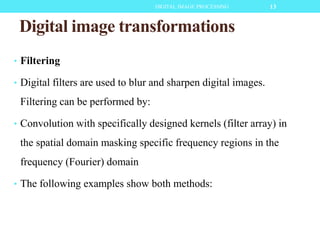
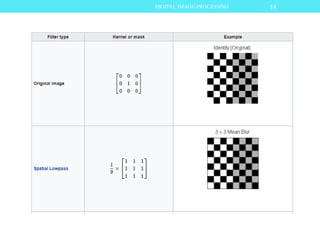
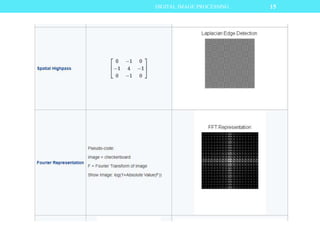
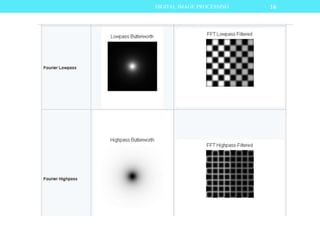
• Filtering
• Digital filters are used to blur and sharpen digital images.
Filtering can be performed by:
• Convolution with specifically designed kernels (filter array) in
the spatial domain masking specific frequency regions in the
frequency (Fourier) domain
• The following examples show both methods:
13DIGITAL IMAGE PROCESSING
14DIGITAL IMAGE PROCESSING
15DIGITAL IMAGE PROCESSING
16DIGITAL IMAGE PROCESSING
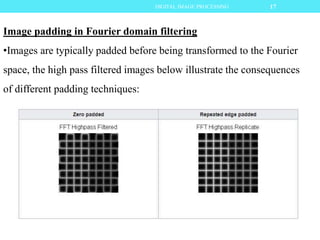
Image padding in Fourier domain filtering
•Images are typically padded before being transformed to the Fourier
space, the high pass filtered images below illustrate the consequences
of different padding techniques:
17DIGITAL IMAGE PROCESSING
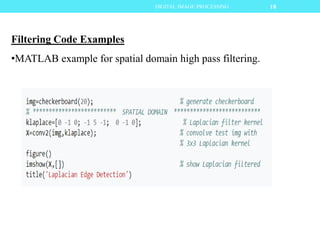
Filtering Code Examples
•MATLAB example for spatial domain high pass filtering.
18DIGITAL IMAGE PROCESSING
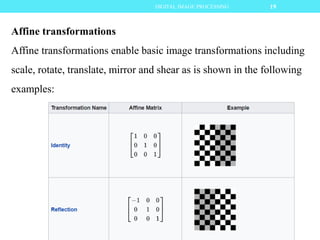
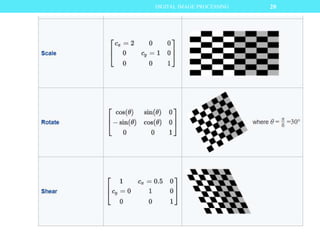
Affine transformations
Affine transformations enable basic image transformations including
scale, rotate, translate, mirror and shear as is shown in the following
examples:
19DIGITAL IMAGE PROCESSING
20DIGITAL IMAGE PROCESSING
• To apply the affine matrix to an image, the image is converted to
matrix in which each entry corresponds to the pixel intensity at
that location.
• Then each pixel's location can be represented as a vector
indicating the coordinates of that pixel in the image, [x, y], where
x and y are the row and column of a pixel in the image matrix.
• This allows the coordinate to be multiplied by an affine-
transformation matrix, which gives the position that the pixel
value will be copied to in the output image.
• However, to allow transformations that require translation
transformations, 3 dimensional homogeneous coordinates are
21DIGITAL IMAGE PROCESSING
• However, to allow transformations that require translation
transformations, 3 dimensional homogeneous coordinates are needed.
• The third dimension is usually set to a non-zero constant, usually 1, so
that the new coordinate is [x, y, 1].
• This allows the coordinate vector to be multiplied by a 3 by 3 matrix,
enabling translation shifts.
• So the third dimension, which is the constant 1, allows translation.
• Because matrix multiplication is associative, multiple affine
transformations can be combined into a single affine transformation by
multiplying the matrix of each individual transformation in the order
that the transformations are done.
22DIGITAL IMAGE PROCESSING
• This results in a single matrix that, when applied to a point vector, gives
the same result as all the individual transformations performed on the
vector [x, y, 1] in sequence.
• Thus a sequence of affine transformation matrices can be reduced to a
single affine transformation matrix.
• For example, 2 dimensional coordinates only allow rotation about the
origin (0, 0). But 3 dimensional homogeneous coordinates can be used to
first translate any point to (0, 0), then perform the rotation, and lastly
translate the origin (0, 0) back to the original point (the opposite of the
first translation).
• These 3 affine transformations can be combined into a single matrix, thus
allowing rotation around any point in the image
23DIGITAL IMAGE PROCESSING
Applications
• Digital camera images
• Digital cameras generally include specialized digital image processing
hardware – either dedicated chips or added circuitry on other chips – to
convert the raw data from their image sensor into a color-
corrected image in a standard image file format.
• Film
• Westworld (1973) was the first feature film to use the digital image
processing to pixellate photography to simulate an android's point of
view.
24DIGITAL IMAGE PROCESSING
The End!!
25DIGITAL IMAGE PROCESSING

Digital image processing

  • 1.
    DIGITAL IMAGE PROCESSING Presented by GayathrySatheesan 1DIGITAL IMAGE PROCESSING
  • 2.
    Digital image processing •In computer science, digital image processing is the use of computer algorithms to perform image processing on digital images. • As a subcategory or field of digital signal processing, digital image processing has many advantages over analog image processing. • It allows a much wider range of algorithms to be applied to the input data and can avoid problems such as the build-up of noise and signal distortion during processing. • Since images are defined over two dimensions (perhaps more) digital image processing may be modeled in the form of multidimensional systems. 2DIGITAL IMAGE PROCESSING
  • 3.
    History • Many ofthe techniques of digital image processing, or digital picture processing as it often was called, were developed in the 1960s at the Jet Propulsion Laboratory, with application to satellite imagery, wire-photo standards conversion, medical imaging. videophone, character recognition ,and photograph enhancement. • The purpose of early image processing was to improve the quality of the image. • It was aimed at human beings to improve the visual effect of people. • In image processing, the input is a low-quality image, and the out put is an image with improved quality. • Common image processing include image enhancement, restoration, encoding, and compression. 3DIGITAL IMAGE PROCESSING
  • 4.
    • The firstsuccessful application was the American Jet Propulsion Laboratory (JPL). • They used image processing techniques such as geometric correction, gradation transformation, noise removal, etc. on the thousands of lunar photos sent back by the Space Detector Ranger 7 in 1964, taking into account the position of the sun and the environment of the moon. • The impact of the successful mapping of the moon's surface map by the computer has been a huge success. • 4DIGITAL IMAGE PROCESSING
  • 5.
    • Later, morecomplex image processing was performed on the nearly 100,000 photos sent back by the spacecraft, so that the topographic map, color map and panoramic mosaic of the moon were obtained, which achieved extraordinary results and laid a solid foundation for human landing on the moon. • Roliferate as affordable computers and dedicated hardware were becoming available. • This led to images being processed in real-time, for some dedicated problems such as television standards conversion. 5DIGITAL IMAGE PROCESSING
  • 6.
    • As general-purposecomputers became faster, they started to take over the role of dedicated hardware for all but the most specialized and computer-intensive operations. • With the fast computers and signal processors available in the 2000s, digital image processing has become the most common form of image processing, and is generally used because it is not only the most versatile method, but also the cheapest. • Digital image processing technology for medical applications was inducted into the Space Foundation Space Technology Hall of Fame in 1994.[4] 6DIGITAL IMAGE PROCESSING
  • 7.
    • Image sensors •The basis for modern image sensors is metal-oxide- semiconductor (MOS) technology, which originates from the invention of the MOSFET (MOS field-effect transistor) by Mohamed M,Atalla and Dawon Kahng at Bell Labs in 1959. • This led to the development of digital semiconductor image sensors, including the charge-coupled device (CCD) and later the CMOS sensor. • The charge-coupled device was invented by Willard S. Boyle and George E. Smith at Bell Labs in 1969. 7DIGITAL IMAGE PROCESSING
  • 8.
    • While researchingMOS technology, they realized that an electric charge was the analogy of the magnetic bubble and that it could be stored on a tiny MOS capacitor. • As it was fairly straight forward to fabricate a series of MOS capacitors in a row, they connected a suitable voltage to them so that the charge could be stepped along from one to the next. • The CCD is a semiconductor circuit that was later used in the first digital video cameras for television broadcasting. • The NMOS active-pixel sensor (APS) was invented by Olympus in Japan during the mid-1980s. 8DIGITAL IMAGE PROCESSING
  • 9.
    • This wasenabled by advances in MOS semiconductor device fabrication, with MOSFET scaling reaching smaller micron and then sub-micron levels. • The NMOS APS was fabricated by Tsutomu Nakamura's team at Olympus in 1985. • The CMOS active-pixel sensor (CMOS sensor) was later developed by Eric Fossum's team at the NASA Jet Propulsion Laboratory in 1993.By 2007, sales of CMOS sensors had surpassed CCD sensors. 9DIGITAL IMAGE PROCESSING
  • 10.
    • Image compression •An important development in digital image compression technology was the discrete cosine transform (DCT), a lossy compression technique first proposed by Nasir Ahmed in 1972. • DCT compression became the basis for JPEG, which was introduced by the Joint Photographic Experts Group in 1992. • JPEG compresses images down to much smaller file sizes, and has become the most widely used image file format on the Internet. • Its highly efficient DCT compression algorithm was largely responsible for the wide proliferation of digital images and digital photos,with several billion JPEG images produced every day as of 2015. 10DIGITAL IMAGE PROCESSING
  • 11.
    • Digital signalprocessor (DSP) • Electronic signal processing was revolutionized by the wide adoption of MOS technology in the 1970s. • MOS integrated circuit technology was the basis for the first single- chip microprocessors and microcontrollers in the early 1970s, and then the first single-chip digital signal processor (DSP) chips in the late 1970s. • DSP chips have since been widely used in digital image processing. • The discrete cosine transform (DCT) image compression algorithm has been widely implemented in DSP chips, with many companies developing DSP chips based on DCT technology. 11DIGITAL IMAGE PROCESSING
  • 12.
    • DCTs arewidely used for encoding, decoding, video coding, audio coding, multiplexing, control signals, signaling, analog-to-digital conversion, formatting luminance and color differences, and color formats such as YUV444 and YUV411. • DCTs are also used for encoding operations such as motion estimation, motion compensation, inter-frame prediction, quantization, perceptual weighting, entropy encoding, variable encoding, and motion vectors, and decoding operations such as the inverse operation between different color formats (YIQ, YUV and RGB) for display purposes. • DCTs are also commonly used for high-definition television (HDTV) encoder/decoder chips 12DIGITAL IMAGE PROCESSING
  • 13.
    Digital image transformations •Filtering • Digital filters are used to blur and sharpen digital images. Filtering can be performed by: • Convolution with specifically designed kernels (filter array) in the spatial domain masking specific frequency regions in the frequency (Fourier) domain • The following examples show both methods: 13DIGITAL IMAGE PROCESSING
  • 14.
  • 15.
  • 16.
  • 17.
    Image padding inFourier domain filtering •Images are typically padded before being transformed to the Fourier space, the high pass filtered images below illustrate the consequences of different padding techniques: 17DIGITAL IMAGE PROCESSING
  • 18.
    Filtering Code Examples •MATLABexample for spatial domain high pass filtering. 18DIGITAL IMAGE PROCESSING
  • 19.
    Affine transformations Affine transformationsenable basic image transformations including scale, rotate, translate, mirror and shear as is shown in the following examples: 19DIGITAL IMAGE PROCESSING
  • 20.
  • 21.
    • To applythe affine matrix to an image, the image is converted to matrix in which each entry corresponds to the pixel intensity at that location. • Then each pixel's location can be represented as a vector indicating the coordinates of that pixel in the image, [x, y], where x and y are the row and column of a pixel in the image matrix. • This allows the coordinate to be multiplied by an affine- transformation matrix, which gives the position that the pixel value will be copied to in the output image. • However, to allow transformations that require translation transformations, 3 dimensional homogeneous coordinates are 21DIGITAL IMAGE PROCESSING
  • 22.
    • However, toallow transformations that require translation transformations, 3 dimensional homogeneous coordinates are needed. • The third dimension is usually set to a non-zero constant, usually 1, so that the new coordinate is [x, y, 1]. • This allows the coordinate vector to be multiplied by a 3 by 3 matrix, enabling translation shifts. • So the third dimension, which is the constant 1, allows translation. • Because matrix multiplication is associative, multiple affine transformations can be combined into a single affine transformation by multiplying the matrix of each individual transformation in the order that the transformations are done. 22DIGITAL IMAGE PROCESSING
  • 23.
    • This resultsin a single matrix that, when applied to a point vector, gives the same result as all the individual transformations performed on the vector [x, y, 1] in sequence. • Thus a sequence of affine transformation matrices can be reduced to a single affine transformation matrix. • For example, 2 dimensional coordinates only allow rotation about the origin (0, 0). But 3 dimensional homogeneous coordinates can be used to first translate any point to (0, 0), then perform the rotation, and lastly translate the origin (0, 0) back to the original point (the opposite of the first translation). • These 3 affine transformations can be combined into a single matrix, thus allowing rotation around any point in the image 23DIGITAL IMAGE PROCESSING
  • 24.
    Applications • Digital cameraimages • Digital cameras generally include specialized digital image processing hardware – either dedicated chips or added circuitry on other chips – to convert the raw data from their image sensor into a color- corrected image in a standard image file format. • Film • Westworld (1973) was the first feature film to use the digital image processing to pixellate photography to simulate an android's point of view. 24DIGITAL IMAGE PROCESSING
  • 25.