Modal AuxiliariesEnglish IIIPrepared by: Gerardo Molina
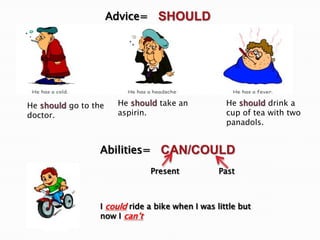
SHOULDAdvice=He should take an aspirin.He should drink a cup of tea with two panadols.He should go to the doctor.CAN/COULDAbilities=PresentPastI could ride a bike when I was little but now I can’t
Can isused.- Toexpress ability:He can speak Spanish but he can't write it very well. Toexpress permission:Can I talk to my friends in the library waiting room?To express theoretical possibility:American automobile makers can make better cars if they think there's a profit in it.could is used.- To express an ability in the past:I could always beat you at tennis when we were kids. To express past or future permission:Could I bury my cat in your back yard? To express present possibility:We could always spend the afternoon just sitting around talking. To express possibility or ability in contingent circumstances:If he studied harder, he could pass this course.
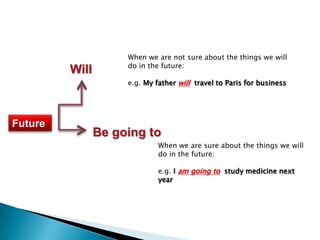
When we are not sure about the things we will do in the future:e.g. My father will  travel to Paris for businessWillFutureBe going toWhen we are sure about the things we will do in the future:e.g. Iamgoing to  study medicine next year
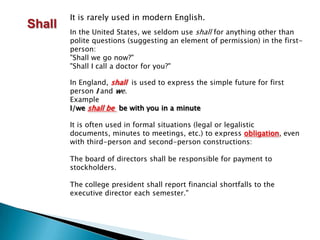
It is rarely used in modern English.ShallIn the United States, we seldom use shall for anything other than polite questions (suggesting an element of permission) in the first-person: "Shall we go now?" "Shall I call a doctor for you?" In England, shall  is used to express the simple future for first person I and we.ExampleI/weshall be be with you in a minuteIt is often used in formal situations (legal or legalistic documents, minutes to meetings, etc.) to express obligation, even with third-person and second-person constructions:The board of directors shall be responsible for payment to stockholders. The college president shall report financial shortfalls to the executive director each semester."
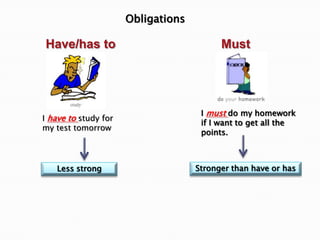
ObligationsHave/has toMustI must do my homework if I want to get all the points.I have to study for my test tomorrowStronger than have or hasLess strong
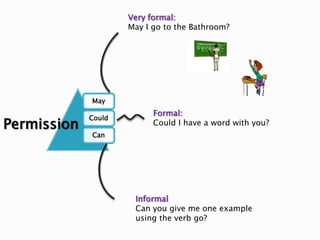
Very formal: May I go to the Bathroom?Formal: Could I have a word with you?PermissionInformalCan you give me one example using the verb go?
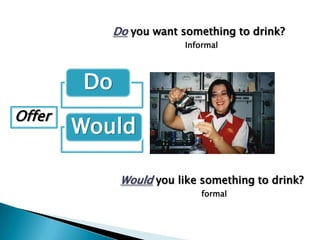
Do you want something to drink?InformalOfferWould you like something to drink?formal
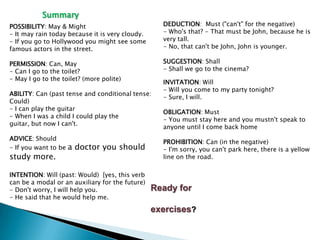
SummaryDEDUCTION:  Must ("can't" for the negative)- Who's that? - That must be John, because he is very tall.- No, that can't be John, John is younger.SUGGESTION: Shall- Shall we go to the cinema?INVITATION: Will- Will you come to my party tonight?- Sure, I will.OBLIGATION: Must- You must stay here and you mustn't speak to anyone until I come back homePROHIBITION: Can (in the negative)- I'm sorry, you can't park here, there is a yellow line on the road.POSSIBILITY: May & Might- It may rain today because it is very cloudy.- If you go to Hollywood you might see some famous actors in the street.PERMISSION: Can, May- Can I go to the toilet?- May I go to the toilet? (more polite)ABILITY: Can (past tense and conditional tense: Could)- I can play the guitar- When I was a child I could play the guitar, but now I can't.ADVICE: Should- If you want to be a doctor you should study more.INTENTION: Will (past: Would)  [yes, this verb can be a modal or an auxiliary for the future)- Don't worry, I will help you.- He said that he would help me.Ready forexercises?
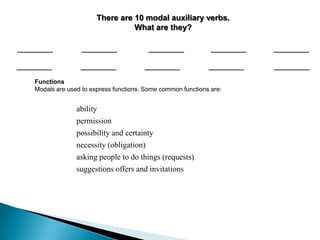
There are 10 modal auxiliary verbs.What are they?____________   	____________ 	  ____________  	 ____________   	____________   ____________   	____________   	____________   	____________  	 ____________   FunctionsModals are used to express functions. Some common functions are:
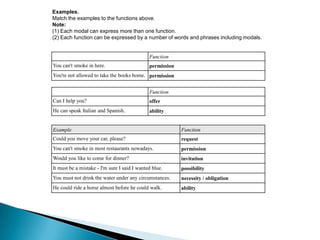
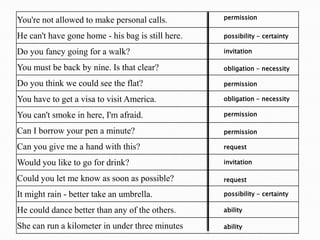
Examples.Match the examples to the functions above.Note:(1) Each modal can express more than one function.(2) Each function can be expressed by a number of words and phrases including modals.
permissionpossibility - certaintyinvitationobligation - necessitypermissionobligation - necessitypermissionpermissionrequestinvitationrequestpossibility - certaintyabilityability
http://web2.uvcs.uvic.ca/courses/elc/studyzone/330/grammar/Visit this link….for more about modals.

Modal auxiliaries

  • 1.
  • 2.
    SHOULDAdvice=He should takean aspirin.He should drink a cup of tea with two panadols.He should go to the doctor.CAN/COULDAbilities=PresentPastI could ride a bike when I was little but now I can’t
  • 3.
    Can isused.- Toexpressability:He can speak Spanish but he can't write it very well. Toexpress permission:Can I talk to my friends in the library waiting room?To express theoretical possibility:American automobile makers can make better cars if they think there's a profit in it.could is used.- To express an ability in the past:I could always beat you at tennis when we were kids. To express past or future permission:Could I bury my cat in your back yard? To express present possibility:We could always spend the afternoon just sitting around talking. To express possibility or ability in contingent circumstances:If he studied harder, he could pass this course.
  • 4.
    When we arenot sure about the things we will do in the future:e.g. My father will travel to Paris for businessWillFutureBe going toWhen we are sure about the things we will do in the future:e.g. Iamgoing to study medicine next year
  • 5.
    It is rarelyused in modern English.ShallIn the United States, we seldom use shall for anything other than polite questions (suggesting an element of permission) in the first-person: "Shall we go now?" "Shall I call a doctor for you?" In England, shall is used to express the simple future for first person I and we.ExampleI/weshall be be with you in a minuteIt is often used in formal situations (legal or legalistic documents, minutes to meetings, etc.) to express obligation, even with third-person and second-person constructions:The board of directors shall be responsible for payment to stockholders. The college president shall report financial shortfalls to the executive director each semester."
  • 6.
    ObligationsHave/has toMustI mustdo my homework if I want to get all the points.I have to study for my test tomorrowStronger than have or hasLess strong
  • 7.
    Very formal: MayI go to the Bathroom?Formal: Could I have a word with you?PermissionInformalCan you give me one example using the verb go?
  • 8.
    Do you wantsomething to drink?InformalOfferWould you like something to drink?formal
  • 9.
    SummaryDEDUCTION:  Must ("can't"for the negative)- Who's that? - That must be John, because he is very tall.- No, that can't be John, John is younger.SUGGESTION: Shall- Shall we go to the cinema?INVITATION: Will- Will you come to my party tonight?- Sure, I will.OBLIGATION: Must- You must stay here and you mustn't speak to anyone until I come back homePROHIBITION: Can (in the negative)- I'm sorry, you can't park here, there is a yellow line on the road.POSSIBILITY: May & Might- It may rain today because it is very cloudy.- If you go to Hollywood you might see some famous actors in the street.PERMISSION: Can, May- Can I go to the toilet?- May I go to the toilet? (more polite)ABILITY: Can (past tense and conditional tense: Could)- I can play the guitar- When I was a child I could play the guitar, but now I can't.ADVICE: Should- If you want to be a doctor you should study more.INTENTION: Will (past: Would)  [yes, this verb can be a modal or an auxiliary for the future)- Don't worry, I will help you.- He said that he would help me.Ready forexercises?
  • 10.
    There are 10modal auxiliary verbs.What are they?____________ ____________ ____________ ____________ ____________ ____________ ____________ ____________ ____________ ____________ FunctionsModals are used to express functions. Some common functions are:
  • 11.
    Examples.Match the examplesto the functions above.Note:(1) Each modal can express more than one function.(2) Each function can be expressed by a number of words and phrases including modals.
  • 12.
    permissionpossibility - certaintyinvitationobligation- necessitypermissionobligation - necessitypermissionpermissionrequestinvitationrequestpossibility - certaintyabilityability
  • 13.