1-1 REAL NUMBERS
      & NUMBER
    OPERATIONS
Today’s Objectives:
I will use a number line to graph and

order real numbers.
I will identify properties of and use

operations with real numbers.
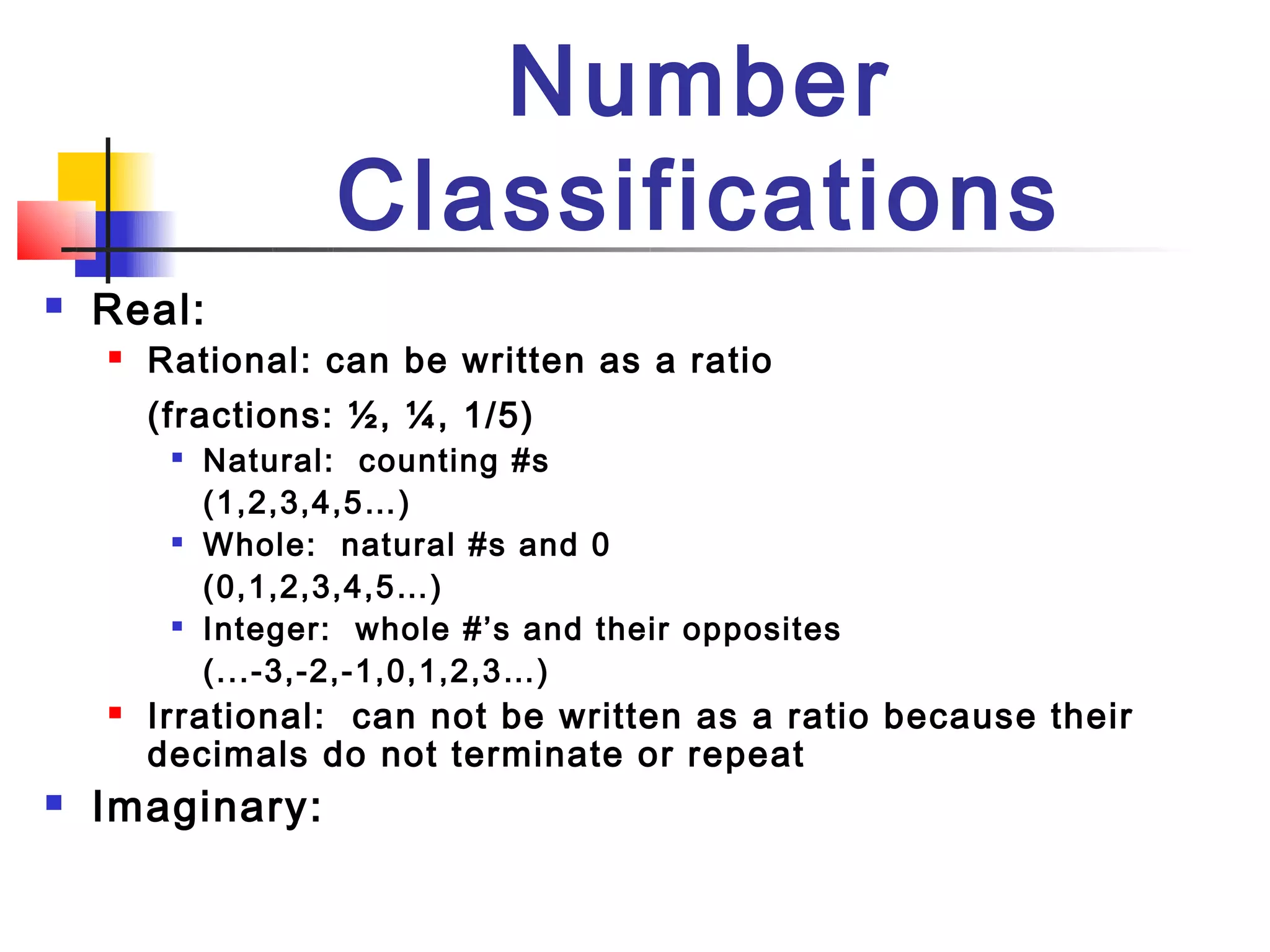
Number
                    Classifications
   Real:
       Rational: can be written as a ratio
        (fractions: ½, ¼, 1/5)
         
             Natural: counting #s
             (1,2,3,4,5…)
            Whole: natural #s and 0
             (0,1,2,3,4,5…)
            Integer: whole #’s and their opposites
             (...-3,-2,-1,0,1,2,3…)
       Irrational: can not be written as a ratio because their
        decimals do not terminate or repeat
   Imaginary:
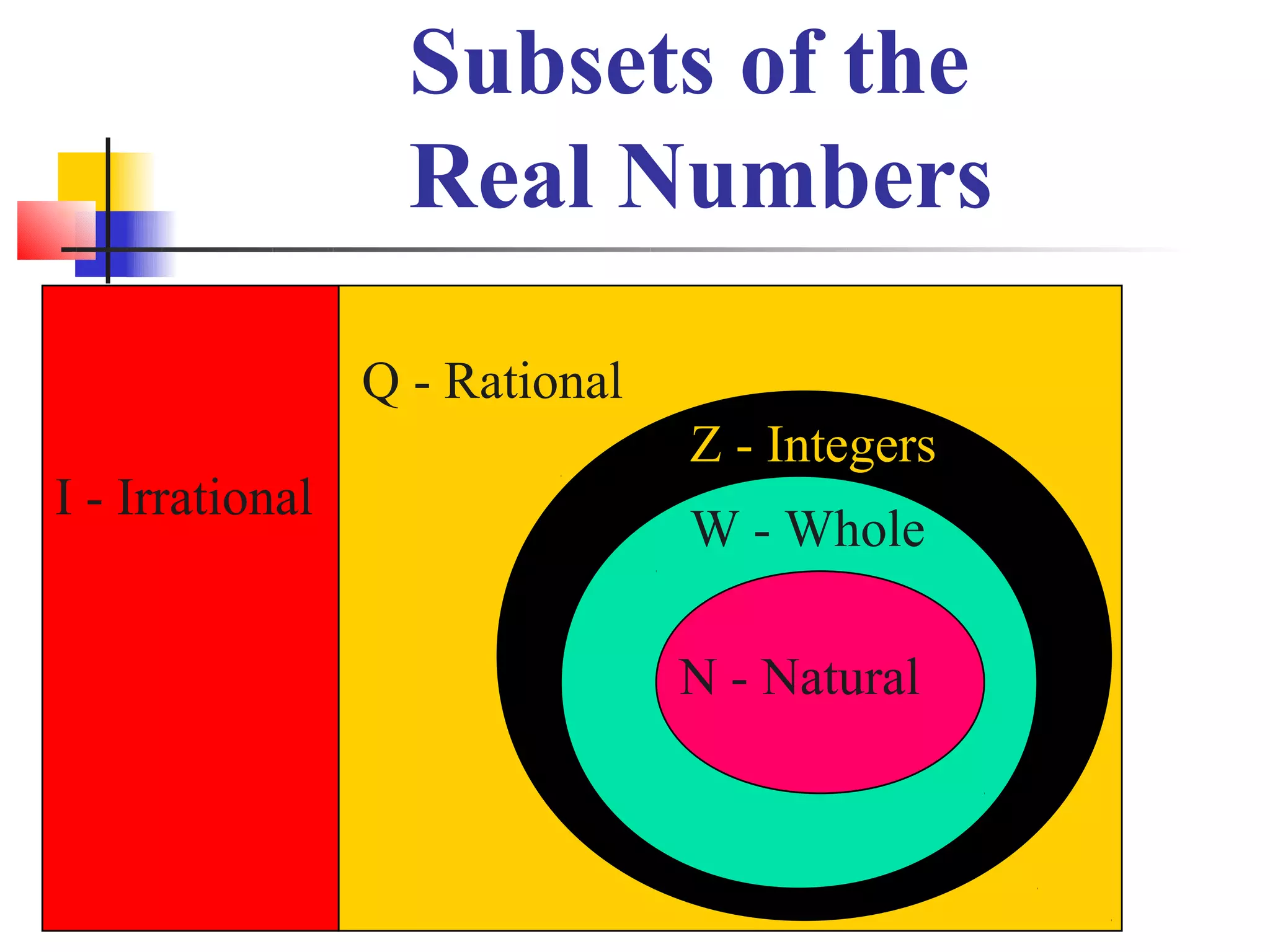
Subsets of the
                   Real Numbers

                 Q - Rational
                                Z - Integers
I - Irrational
                                W - Whole

                                N - Natural
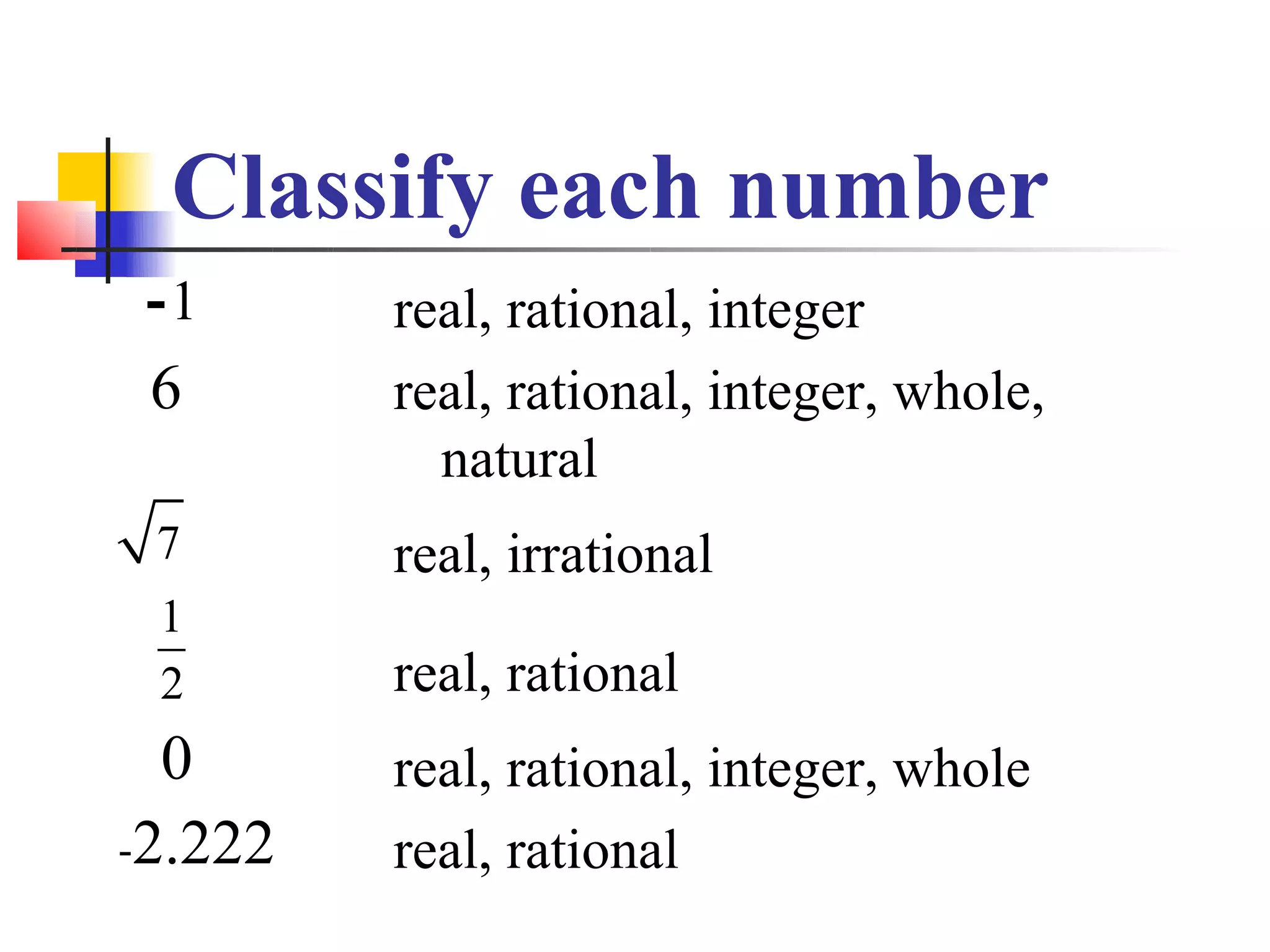
Classify each number
 -1      real, rational, integer
 6       real, rational, integer, whole,
           natural
 7       real, irrational
 1
 2       real, rational
  0      real, rational, integer, whole
-2.222   real, rational
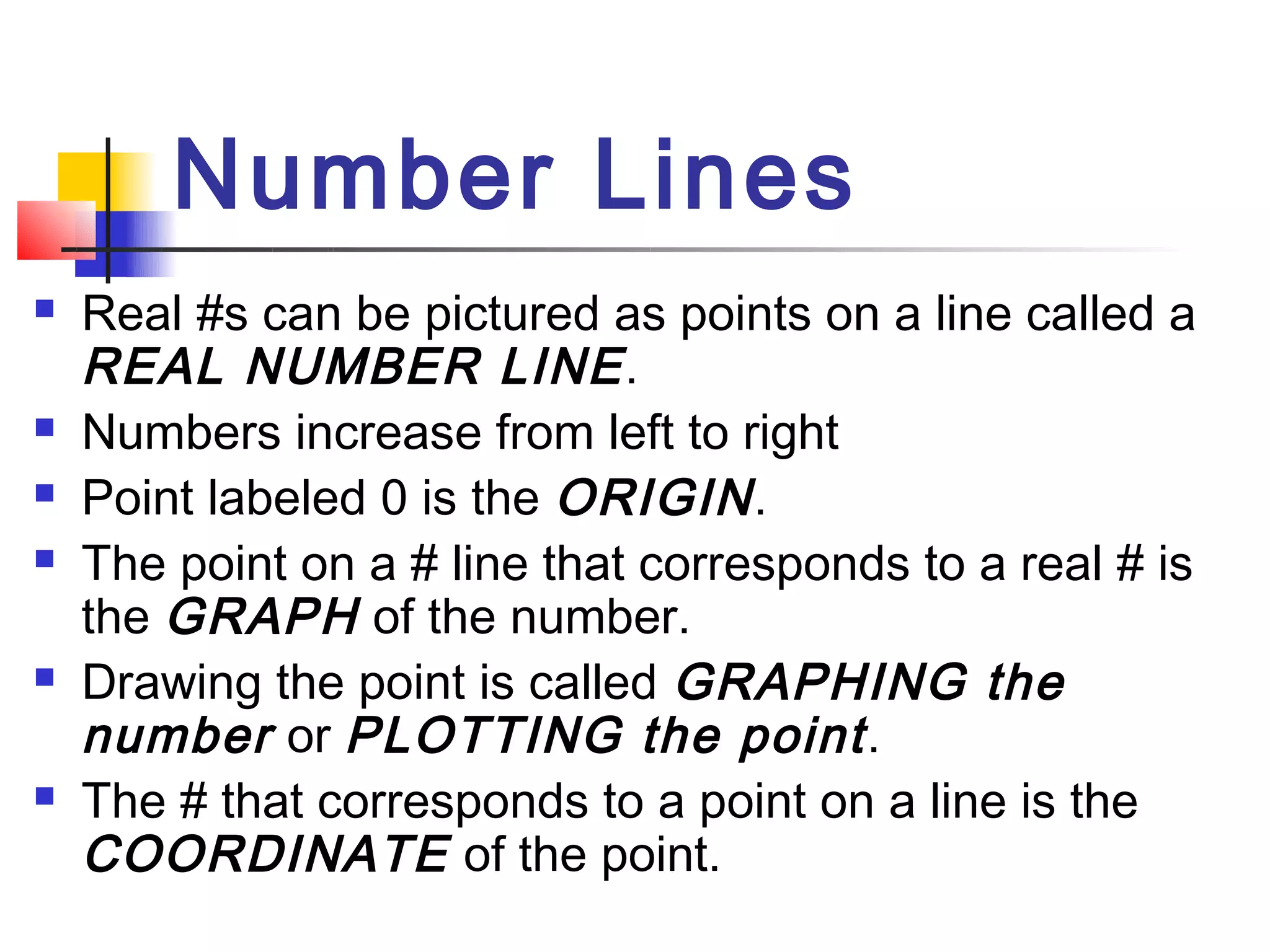
Number Lines
   Real #s can be pictured as points on a line called a
    REAL NUMBER LINE .
   Numbers increase from left to right
   Point labeled 0 is the ORIGIN .
   The point on a # line that corresponds to a real # is
    the GRAPH of the number.
   Drawing the point is called GRAPHING the
    number or PLOTTING the point .
   The # that corresponds to a point on a line is the
    COORDINATE of the point.
Ordering Real
           Numbers
   A number line can be used to order real
    numbers.
   The inequality symbols <, >, ≤, and ≥
    can be used to show the order of two
    numbers.
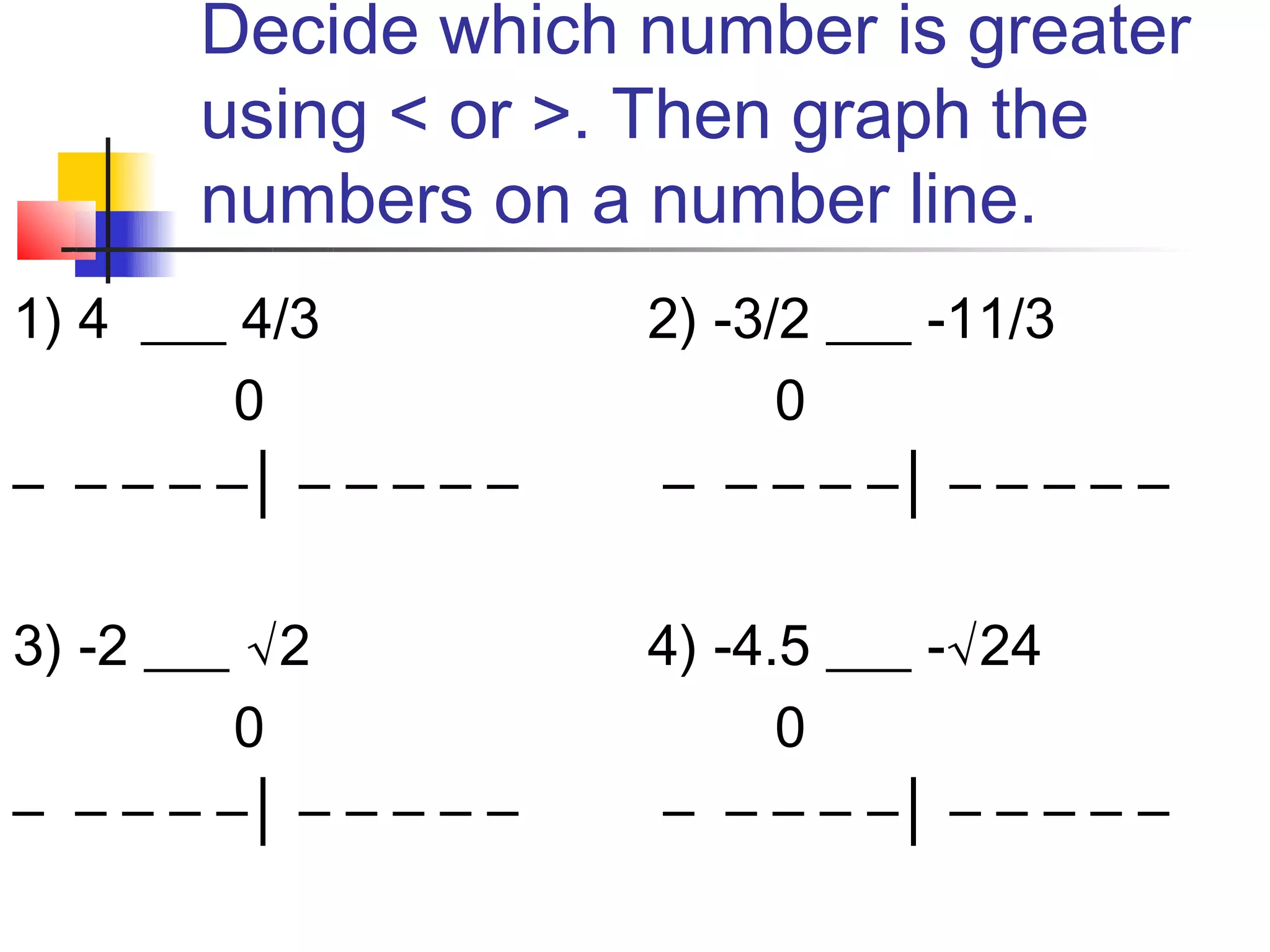
Decide which number is greater
       using < or >. Then graph the
       numbers on a number line.
1) 4 ___ 4/3           2) -3/2 ___ -11/3
         0                   0
– – – – –│ – – – – –   – – – – –│ – – – – –

3) -2 ___ √2           4) -4.5 ___ -√24
         0                   0
– – – – –│ – – – – –   – – – – –│ – – – – –
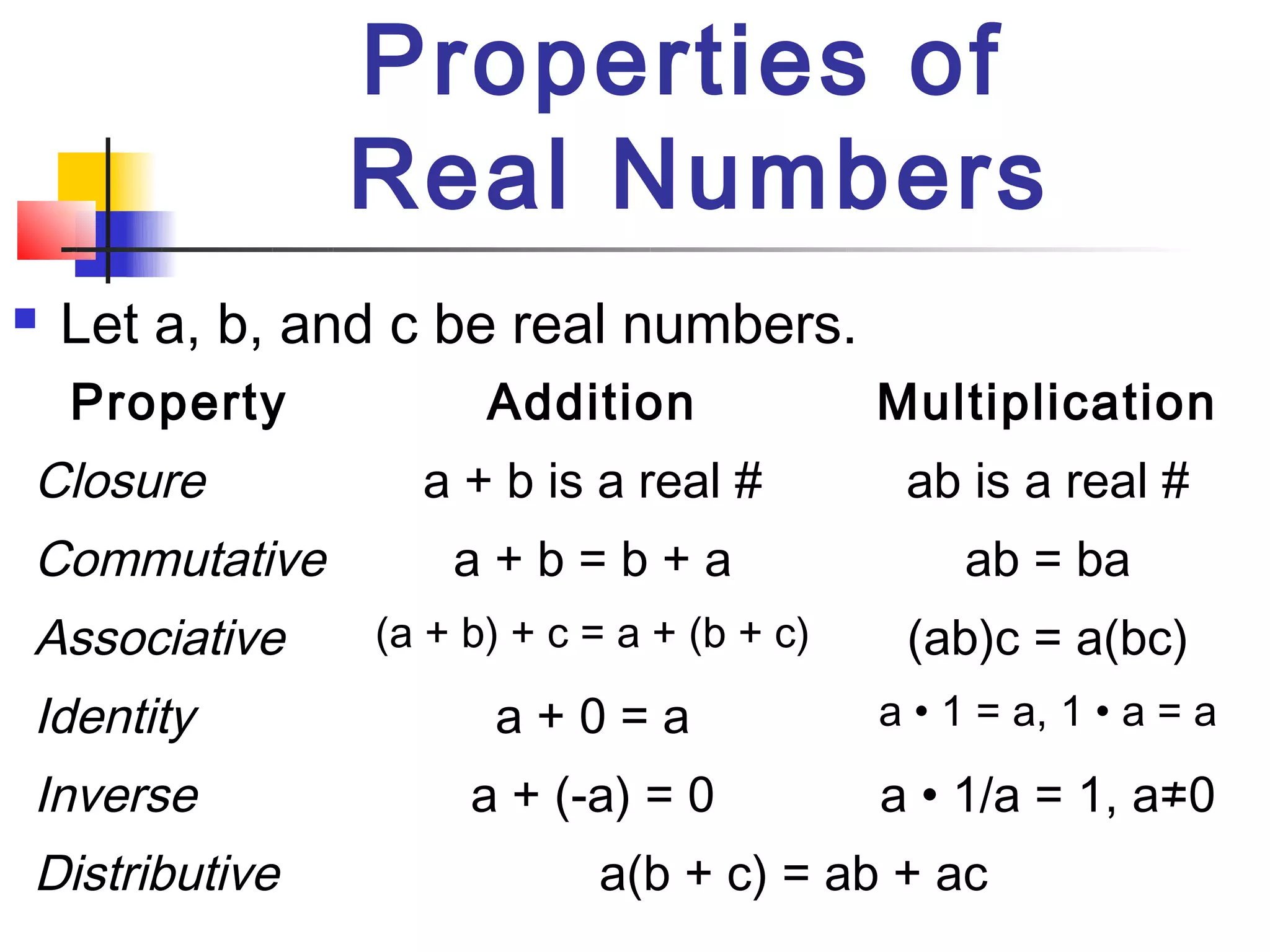
Properties of
               Real Numbers
   Let a, b, and c be real numbers.
    Property          Addition              Multiplication
Closure           a + b is a real #          ab is a real #
Commutative         a+b=b+a                      ab = ba
Associative     (a + b) + c = a + (b + c)    (ab)c = a(bc)
Identity              a+0=a                 a • 1 = a, 1 • a = a

Inverse              a + (-a) = 0           a • 1/a = 1, a≠0
Distributive                a(b + c) = ab + ac
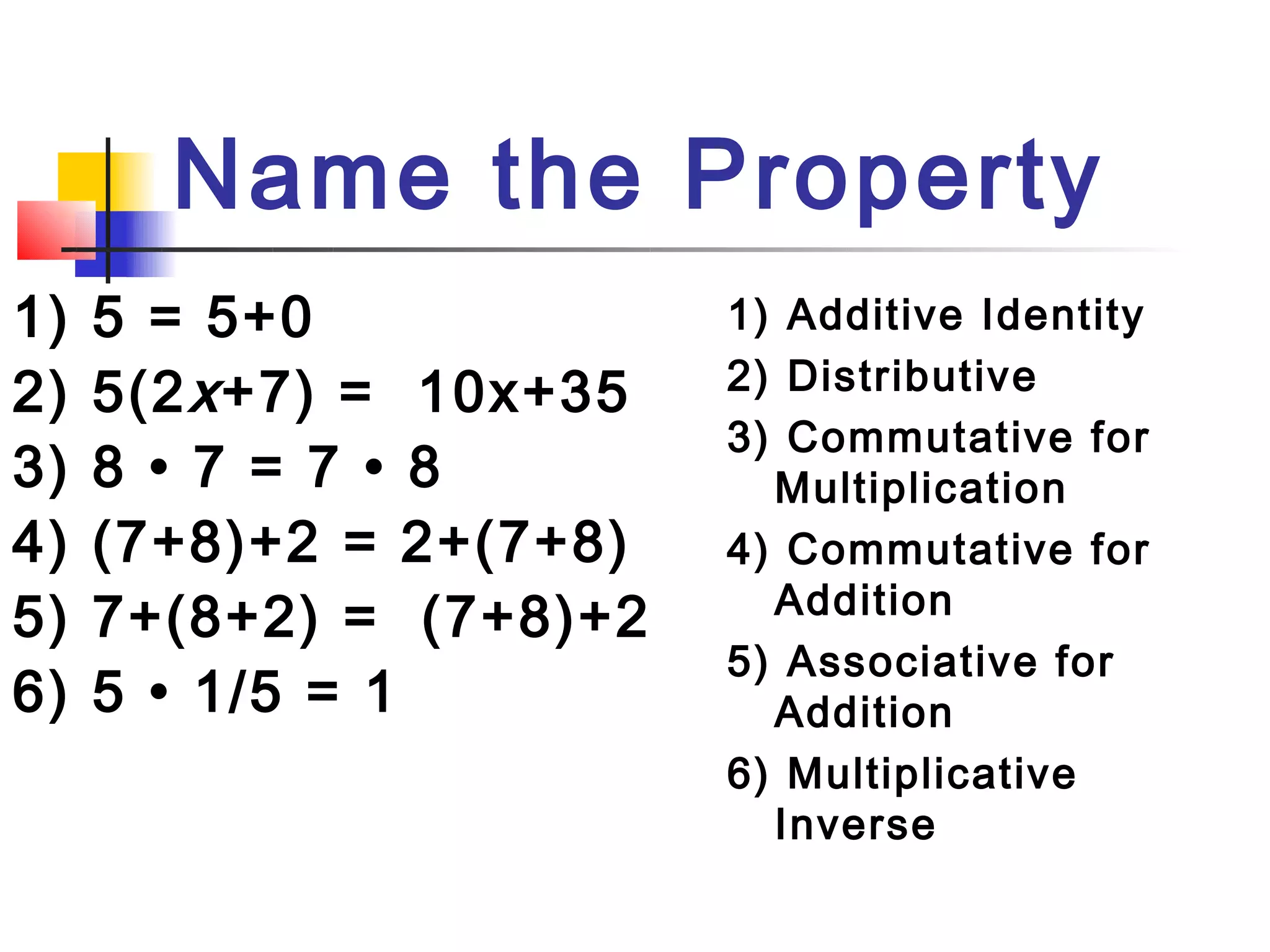
Name the Property
1)   5 = 5+0              1) Additive Identity
2)   5(2 x +7) = 10x+35   2) Distributive
                          3) Commutative for
3)   8 • 7 = 7 • 8          Multiplication
4)   (7+8)+2 = 2+(7+8)    4) Commutative for
                            Addition
5)   7+(8+2) = (7+8)+2
                          5) Associative for
6)   5 • 1/5 = 1            Addition
                          6) Multiplicative
                            Inverse
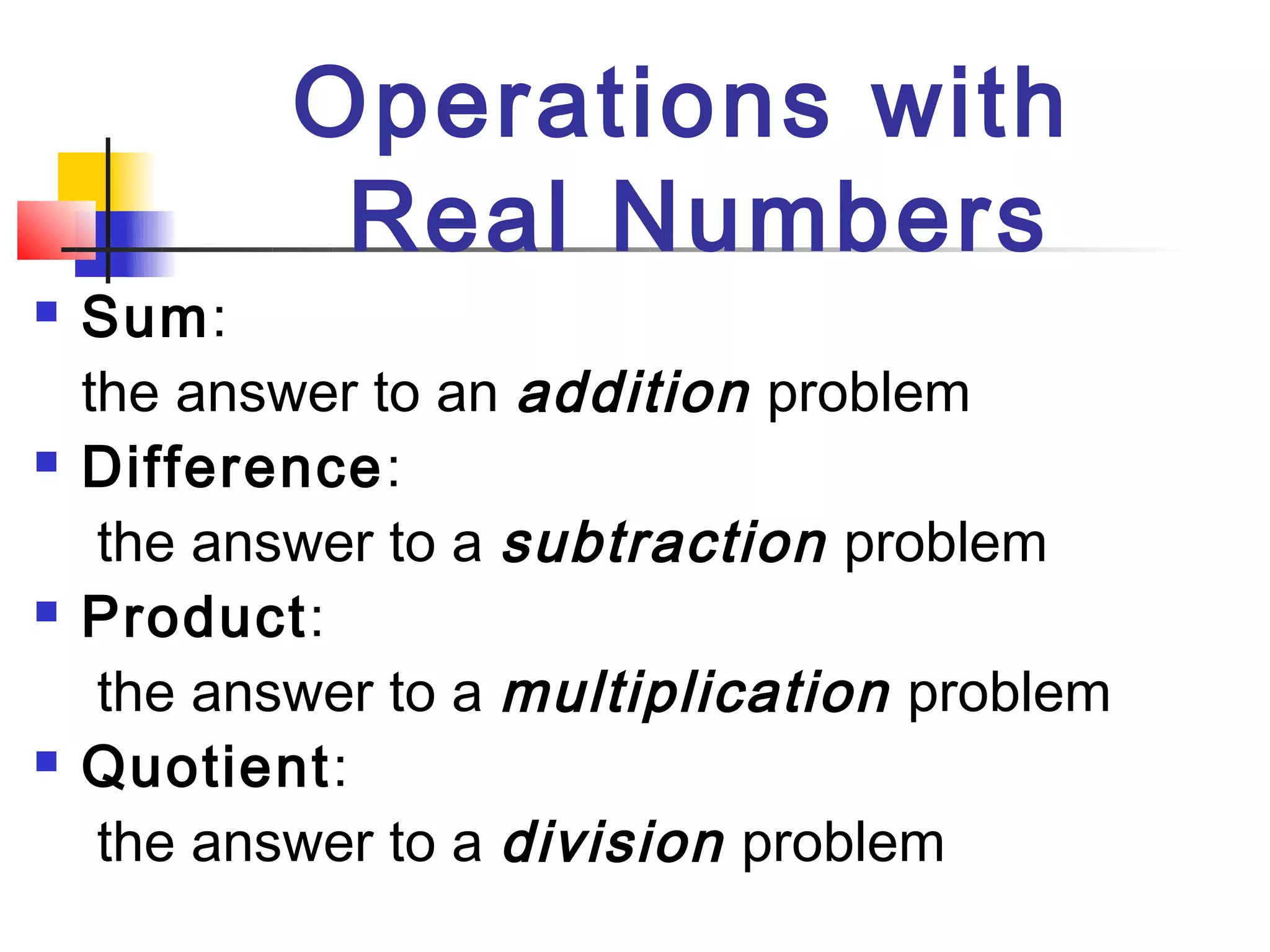
Operations with
            Real Numbers
   Sum:
    the answer to an addition problem
   Difference:
     the answer to a subtraction problem
   Product:
     the answer to a multiplication problem
   Quotient:
     the answer to a division problem
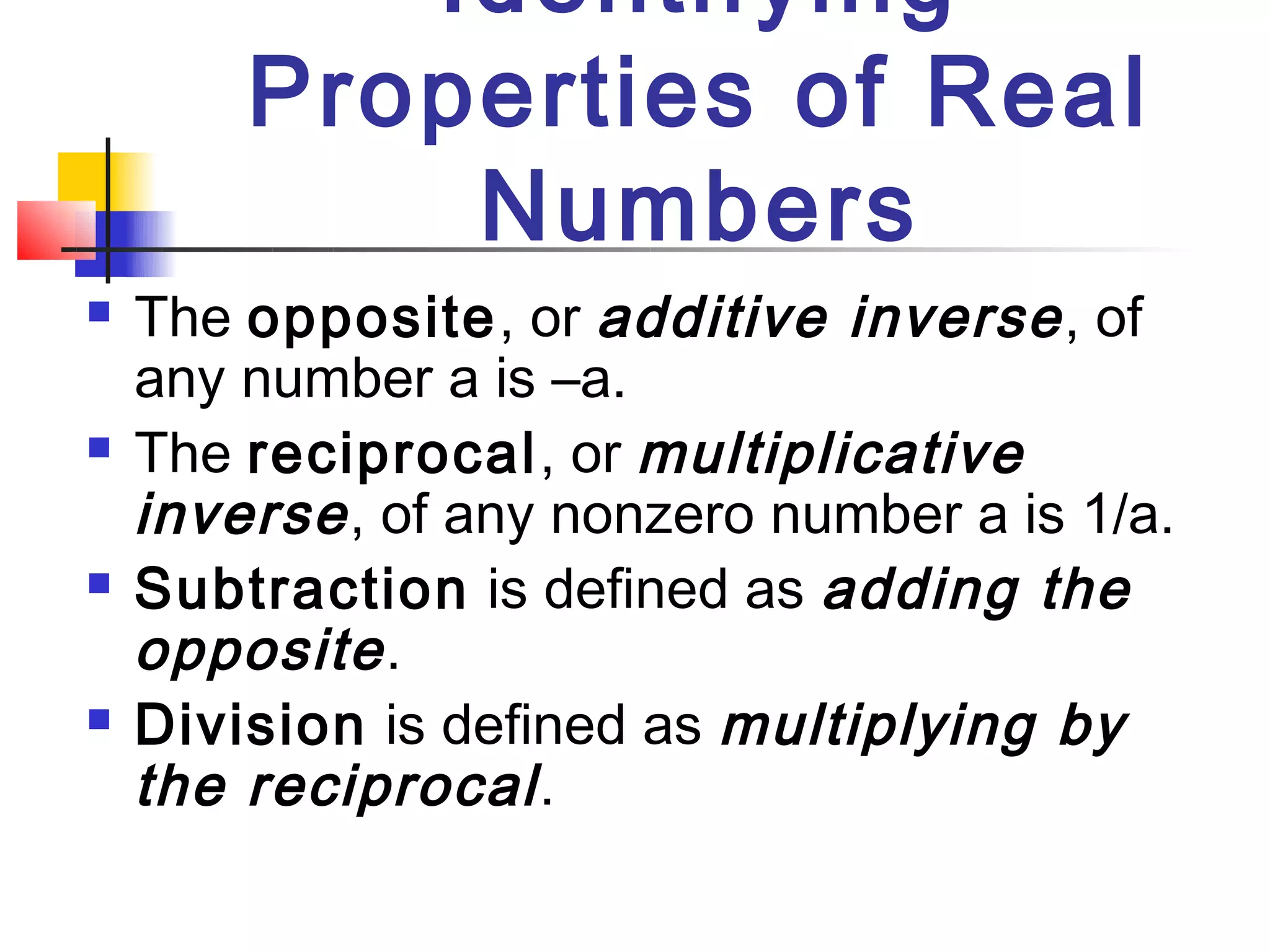
Identifying
        Properties of Real
            Numbers
   The opposite, or additive inverse , of
    any number a is –a.
   The reciprocal, or multiplicative
    inverse , of any nonzero number a is 1/a.
   Subtraction is defined as adding the
    opposite .
   Division is defined as multiplying by
    the reciprocal .
Unit Analysis
   When you use the operations of addition,
    subtraction, multiplication, and division in real
    life, you should use unit analysis to check
    that your units make sense.

1.1 real numbers & operations

  • 1.
    1-1 REAL NUMBERS & NUMBER OPERATIONS Today’s Objectives: I will use a number line to graph and order real numbers. I will identify properties of and use operations with real numbers.
  • 2.
    Number Classifications  Real:  Rational: can be written as a ratio (fractions: ½, ¼, 1/5)  Natural: counting #s (1,2,3,4,5…)  Whole: natural #s and 0 (0,1,2,3,4,5…)  Integer: whole #’s and their opposites (...-3,-2,-1,0,1,2,3…)  Irrational: can not be written as a ratio because their decimals do not terminate or repeat  Imaginary:
  • 3.
    Subsets of the Real Numbers Q - Rational Z - Integers I - Irrational W - Whole N - Natural
  • 4.
    Classify each number -1 real, rational, integer 6 real, rational, integer, whole, natural 7 real, irrational 1 2 real, rational 0 real, rational, integer, whole -2.222 real, rational
  • 5.
    Number Lines  Real #s can be pictured as points on a line called a REAL NUMBER LINE .  Numbers increase from left to right  Point labeled 0 is the ORIGIN .  The point on a # line that corresponds to a real # is the GRAPH of the number.  Drawing the point is called GRAPHING the number or PLOTTING the point .  The # that corresponds to a point on a line is the COORDINATE of the point.
  • 6.
    Ordering Real Numbers  A number line can be used to order real numbers.  The inequality symbols <, >, ≤, and ≥ can be used to show the order of two numbers.
  • 7.
    Decide which numberis greater using < or >. Then graph the numbers on a number line. 1) 4 ___ 4/3 2) -3/2 ___ -11/3 0 0 – – – – –│ – – – – – – – – – –│ – – – – – 3) -2 ___ √2 4) -4.5 ___ -√24 0 0 – – – – –│ – – – – – – – – – –│ – – – – –
  • 8.
    Properties of Real Numbers  Let a, b, and c be real numbers. Property Addition Multiplication Closure a + b is a real # ab is a real # Commutative a+b=b+a ab = ba Associative (a + b) + c = a + (b + c) (ab)c = a(bc) Identity a+0=a a • 1 = a, 1 • a = a Inverse a + (-a) = 0 a • 1/a = 1, a≠0 Distributive a(b + c) = ab + ac
  • 9.
    Name the Property 1) 5 = 5+0 1) Additive Identity 2) 5(2 x +7) = 10x+35 2) Distributive 3) Commutative for 3) 8 • 7 = 7 • 8 Multiplication 4) (7+8)+2 = 2+(7+8) 4) Commutative for Addition 5) 7+(8+2) = (7+8)+2 5) Associative for 6) 5 • 1/5 = 1 Addition 6) Multiplicative Inverse
  • 10.
    Operations with Real Numbers  Sum: the answer to an addition problem  Difference: the answer to a subtraction problem  Product: the answer to a multiplication problem  Quotient: the answer to a division problem
  • 11.
    Identifying Properties of Real Numbers  The opposite, or additive inverse , of any number a is –a.  The reciprocal, or multiplicative inverse , of any nonzero number a is 1/a.  Subtraction is defined as adding the opposite .  Division is defined as multiplying by the reciprocal .
  • 12.
    Unit Analysis  When you use the operations of addition, subtraction, multiplication, and division in real life, you should use unit analysis to check that your units make sense.